A Soul Lost From WWII Comes Home – Part 4


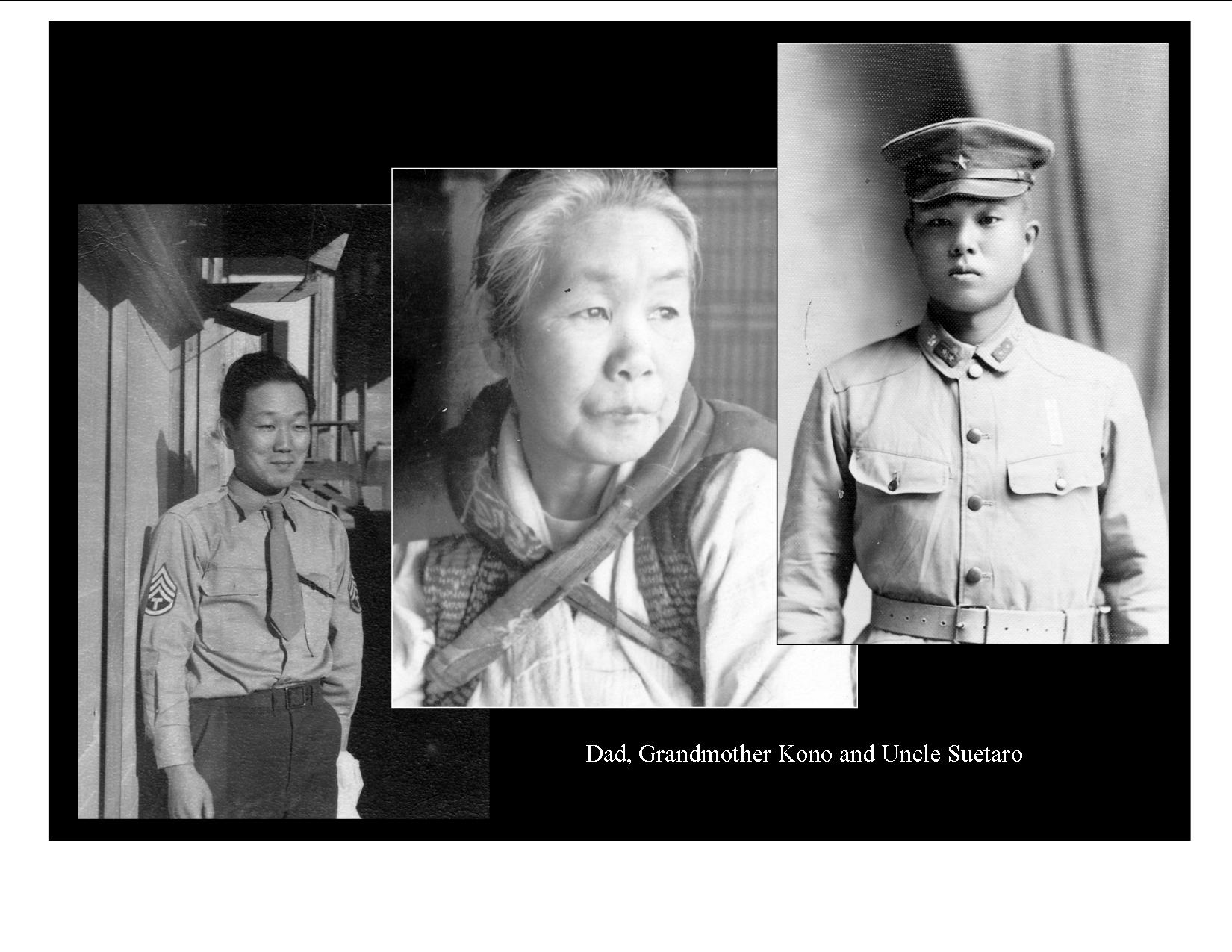
kono collage
Grandmother Kono, flanked by my dad on the left and his younger brother Suetaro on the right.

As we readied for Day 3 of our pilgrimage, the fate of my Seattle-born Uncle Suetaro became even more haunting.  From my study of the Battle of Leyte and from now standing on its very soil, the enormity of doom that hovered unbeknownst over Uncle Suetaro became very clear.

Vastly outnumbered by the Allied invasion forces and out-supplied, only 20 young men out of the 2,550 in his Hiroshima-based 41st Infantry Regiment would ever leave Leyte.  The remains of the 2,530 soldiers are still there.

c-10-465
After the first memorial service and just north of Jaro, off to the west of the road that runs up to Carigara Bay. The low lying hills behind us is from where Col. Newman’s column came under fire from my uncle’s IJA’s 41st Regiment on November 1, 1944.

Day 3 – The Morning

The same torch-like sun greeted us once again in the morning as we gathered for Day 3 of our pilgrimage.  Today promised to hold the biggest emotional impact of our journey: we will be actually tracing the footsteps of our Uncle Suetaro.

While our young drivers expertly dodged two-cycle motorcycles, pedicabs and colorful small buses with passengers holding on to dear life on the back bumpers, we headed up to the once standing and vital steel bridge at Cavite… and my Uncle’s destiny.¹

c-10-466 Due to high costs, I was unable to use my smartphone’s GPS nor Google maps to track our movements nor mark our coordinates; as such, we came upon the bridge without notice…but we had indeed arrived.

c-10-360
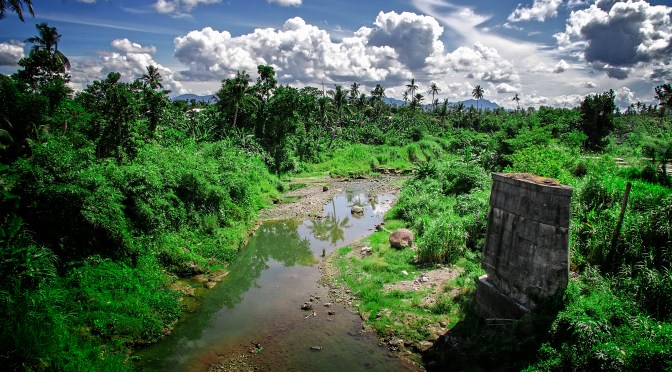
The remnants of the Mainit River Bridge of 1944.

As we got out of the vans, it firmly struck me that we were in audience of my uncle’s past footsteps… The footsteps of the uncle I never had the chance to meet because of war.  Our paths had finally crossed.

In 1944, it was referred to as the Mainit River Bridge; its remnant was right in front of us.  We stood on its replacement bridge about 50 yards away, with heavy traffic rushing by, barely passing us on the narrow walkway.  The original steel bridge spanned from right to left in the above picture.

A dark weight bore down on me as I stared at the single concrete column.  Like on some of the walls and fences at Normandy, it was pot-marked with bullet holes and artillery damage from that day.  I could hear the gunfire, the artillery, the whump of mortar rounds hitting their targets and the desperate screams of young men dying.  My skin – even in 90F weather and covered with sweat – got goosebumps and my eyes teared up. This is where I believe my uncle met his likely death… on the left side of the river and above centerline in the picture.  According to Mr. Ota’s book, my uncle’s lieutenant in charge of the 37mm anti-tank guns, Lt. Shiduoka, was killed; in addition, over 1,000 Japanese soldiers died between October 30th and November 1st.

Although the bridge was rigged with explosive charges but sadly for the Japanese Army, the combat engineer was killed before he could set off them off.  The bridge was left intact.  On the other hand, it was good for our US Army as essential Sherman tanks and self-propelled howitzers could now traverse the muddy river to engage the enemy.  I can “feel” both sides of the battle.  Victory and defeat.  Perhaps that is a curse.

I offered gassho, the Buddhist way of prayer, to all those young men – especially to Uncle Suetaro – while on that bridge, quivering with the weight of the traffic lumbering over it.  Anguish filled my chest as tears filled my eyes.

I wonder how my dad or grandmother would have reacted if they had seen it.

The First Memorial Service

c-10-362
Entering Jaro, Leyte.

If Uncle Suetaro had survived the combat, we followed the road towards the west (see map above); it was the same road they would have retreated on – albeit dirt or mud the evening of October 30, 1944.  We then entered the town of Jaro.

We then turned north towards Carigara Bay but stopped after about a kilometer.  (See red arrow in battle map above.)  I didn’t know why until we started to get out.  We were to conduct our first official memorial service of this pilgrimage at this spot.  Believe me that the memorial service in and of itself worried me as I am not Japanese.  I am American.  Japanese pay attention to minute actions; acting in one way may be harmonious, another way very rude and unacceptable.

And it is true: a Japanese man can come to America and become American… but an American can go and live out the rest of his life in Japan and never become Japanese.  Although I was born in Japan, the latter is me.

_____________________________________________

jaro us soldier
This US Army photo was indicated as taken at Jaro, Leyte. This could very well be close to where we stopped but regardless, it should give you an idea of what our US soldiers saw – very heavy forestation in stifling humidity.

We had stopped on a narrow two lane street, across from a small dwelling filled with a number of children.  As we left the coolness of the van, the sweltering heat greeted us once again.  Mr. Ota explained that just beyond our view from the road was the low-lying hills on which the 41st Regiment had hidden themselves and fired upon the tanks and Col. Newman on November 1.¹  And he was right: Col. Newman would not have been able to see the low-lying hills, especially since the vegetation would have been much thicker on November 1, 1944 (see photo above).  The Japanese Army selected their defensive position well.

Our party assembled their articles to be carried to the memorial service location: photographs, food, cigarette packs, water, incense and osake.  Things that a young Japanese soldier longed for out on the battlefield.  Mr. Ota’s young, tall son Daichi lugged along a small side table for us in this heat.

My guess is we walked inland about a quarter of a mile from the dwelling.  We stopped at the base of the low-lying hill, now clearly visible in front of us.

c-10-467
Mr. Ota explaining to us about the low hills not visible from the road and from which a Japanese 37mm anti-tank round entered through the barrel of an American Sherman M4 tank. Uncle Suetaro was a sergeant in command of a 37mm anti-tank gun crew.

Palm fronds were swaying in a consistent but warm breeze and ground cover would crackle as we stepped upon them.  But in drastic contrast to explosions caused by US 105mm howitzer shells exploding or the sound of Japanese Nambu machine guns blasting away 71 years ago, some birds were joyously singing about us.  Perhaps they knew why we were there – for peace and remembrance.
c-10-388
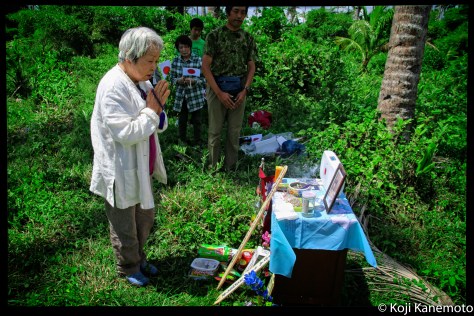
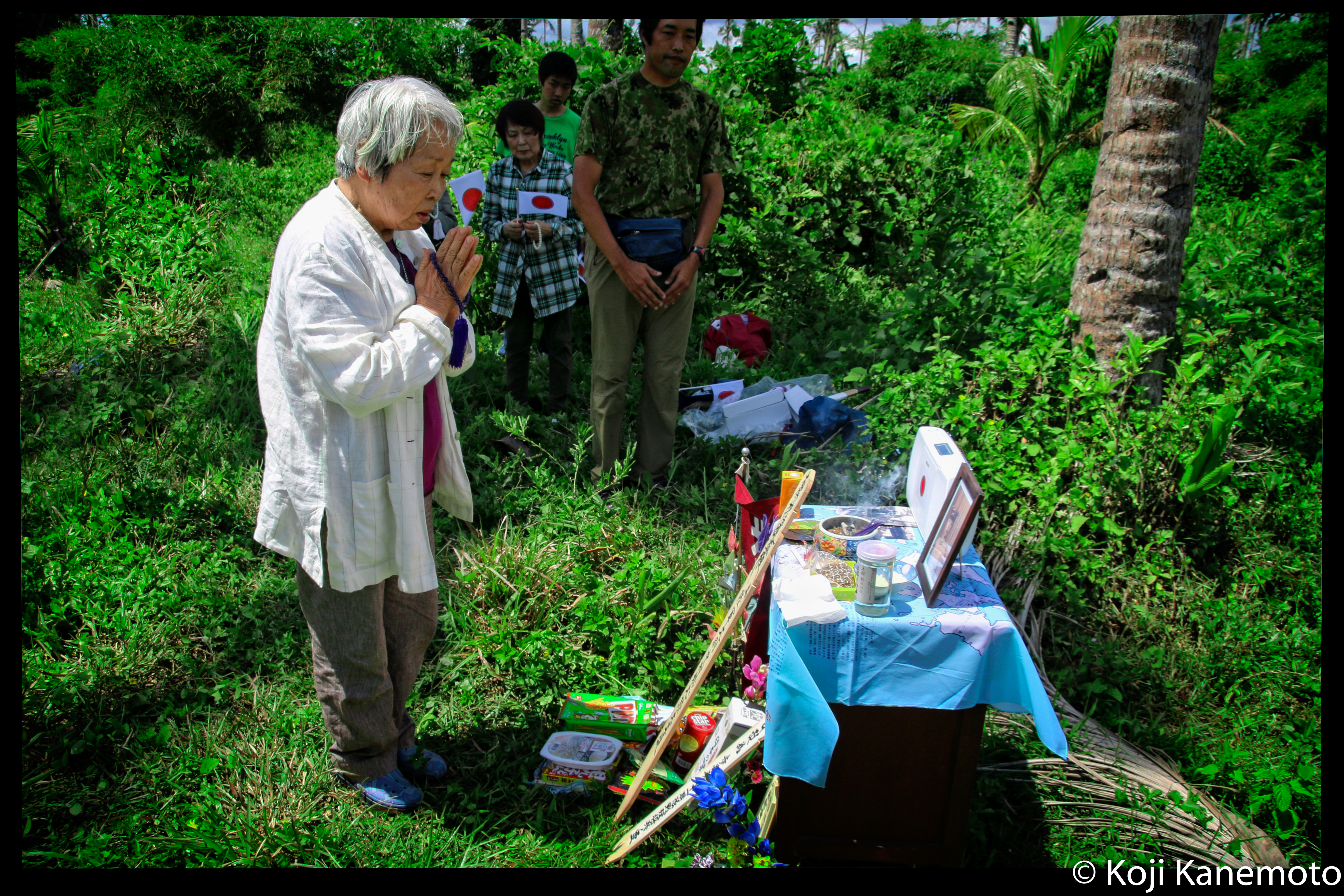
Masako offering her gassho and incense.

While many tried to shield themselves from the searing sun by standing in the little shade that was available, the folks meticulously placed their offerings and remembrances of family.

c-10-468
The memorial table still in the midst of preparation. Mr. Ota had the blue cloth designed for the memorial; there is a map of Leyte along with main battle sites. The wooden boards are called TOHBA (塔婆) I believe; some will have five notches designating five-tiered pagodas. Some believe them to function as antennae, a way of calling the souls back.

There was a first time for everything.  This service was going to be definitely mystifying for me.  And I could see Mr. Ota went though a lot of trouble so that we would have a memorable service filled with honor, release of grief and closure.  He did the planning and preparation on his own; we didn’t have to ask him.

The service would last about 20 minutes.  The program entailed:

  1. Singing of the Japan’s hymm
  2. A minute of silence
  3. Sutra chanting by Mr. Kagimoto
  4. Incense offering and gassho
  5. Reading of letters
  6. Singing of the 41st Infantry Regiment regimental song

My very amateurishly shortened and edited video is below, including a portion of Masako reading her poignant yet touching letter to her Uncle Suetaro who, for us, was still somewhere in the low lying hills in front of us.

_______________________________________________

As Masako stared at the framed photo of Uncle Suetaro in his Imperial Japanese Army uniform, taken before he left Japan, she began to  tenderly read her letter to him.  Masako said in essence:

“Dear Uncle Suetaro, we finally get to meet again.  After you were drafted, I remember being taken twice to see you at your army base in Fukuyama.  My mother took me the first time; we took you some makizushi which you very discreetly kept out of sight and ate very quickly.  Then my father took me to see you the second time.  You said to him many times, “Please look after my mother…

You had sent me postcards from your station in the Far East, showing pictures of the local children.  They are still forever etched in my heart.

On this land upon which I stand now, Uncle, you fought courageously though you were so very hungry and exhausted.

After the war ended, your oldest brother Yutaka² came back from America and officially adopted me into the Kanemoto family.  On February 8, 1954, your mother Kono took her last breath while her head was resting in my arms.

I have raised two children and as if destiny, I have resolutely carried on the family name on your behalf.

Uncle Suetaro, please sleep in peace.”

There wasn’t a dry eye.  I think even the birds were crying.

_________________________________________

The second service in Part 5

NOTES:

  1. On October 30, 1944, both Japanese and American battle records show my uncle’s 41st Infantry Regiment of the Imperial Japanese Army and the US Army’s 34th Infantry met in fierce violence at the bridge, ending in indescribably horrific hand-to-hand fighting to the death.  For my story combining both American and Japanese records on this battle, please click here.  (Ms. Teraoka’s uncle, Lt. Nakamura, was also engaged in this combat as Communications Officer but survived the battle.)
  2. Uncle Yutaka became the head of the family after the war.  He, like my dad Koso and Suetaro’s older sister Shizue, were imprisoned in Tule Lake, CA with their families after the outbreak of war although all were American citizens.  For clarification purposes only:
FAMILY ORG CHART WORDPRESS
Family chart

Another Kind of Hero


A wonderful story of lifelong bonding.

A Soul Lost From WWII Comes Home – Part 3


c-10-437
The “pilgrims”. Clockwise from left: Mr. Yusuke Ota, Ms. Setsu Teraoka, Tomiko, Mr. Bungo Kagimoto, Izumi, Kiyoshi, Masako and Namie.

Experiencing this heat and humidity was one of my personal goals for this pilgrimage.  No history book on the Battle for Leyte could ever truly convey the endurance each soldier – American or Japanese – put up in order to stay alive given the climate, kill the enemy and go back home.

It was all out war… A war that fumbling politicians caused or created with their own personal agendas .  Even though failing, Roosevelt, Tojo, Hitler and Churchill didn’t have to go to Leyte to potentially lose their own lives.  They sent young, vibrant boys and men in their stead to fight and die in this climate unsuited for violent life and death struggles.

Millions of other people died, too.

_____________________________________________

Day 2

(Note: by clicking on most of the images, you can see the location on a map.)

Although early in the morning, the sun was already unforgiving.  In reacting to the humidity, your body begins to perspire just standing there in the open-air lobby.  Once you step out of the shade, rays come down on you so searingly that you wouldn’t need a microwave to zap popcorn.  Just leave the Orville Redenbacher bag out on the sidewalk for a few minutes.  I’m not kidding – and I live in LA.

I thought I was a whiz kid by bringing along one of those microfiber drying cloths you use when wiping off your car after washing it.  You know it can soak up Lake Michigan and not drip one drop.  Well, it was useless in this heat.  It also wasn’t anti-odor. 🙂

As we awaited our vans, I also noticed the ladies were all wearing long sleeve over-shirts.  In this heat?  Odd.  So I asked my cousin Masako why she put on additional shirts given it was so hot.

She said that it was because they didn’t want to get dark.

Oh well.

(They put on gloves, too.)

_____________________________________________

MacArthur Landing Memorial Park

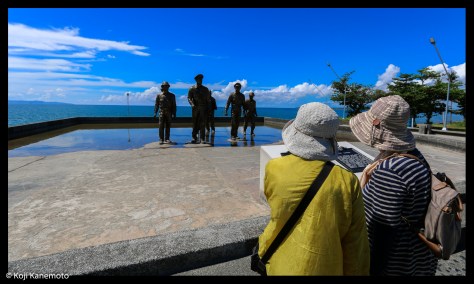
c-10-440Our first official stop was MacArthur Landing Memorial Park; it is in Palo and was codenamed “Red Beach” for the invasion of Leyte on October 20, 1944.  This is where MacArthur waded ashore then broadcast his speech to the Filipinos of, “I have returned.”

c-10-439
My cousins are in the background viewing the memorial.
c-10-438
Cousins Tomiko and Masako taking in the sight.

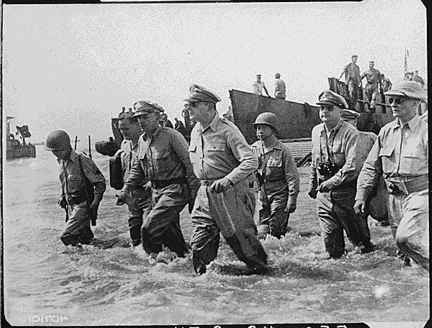
Well, actually, he had returned at least three times by the time he made his broadcast.  You see, he waded ashore at least three times (not sure of actual count but at least three) to ensure he got the best possible photo and news coverage.

To his credit, though, there still was small arms fire around the area.

Proof of at least one other wading attempt by MacArthur:

MacArthurLanding
National Archives.

Notice Philippines President Osmena (in the jungle hat) is to the left of MacArthur in the above image; yet, in the memorial, he is on MacArthur’s right.

_______________________________________________

Hill 522

Our next stop was “Hill 522 (see notes)”.¹  Essentially, this high ground was critical to saving US lives as it commanded a sweeping view of the landing beaches and ground inland.  It was called Hill 522 as it was 522′ high.

Leyte’s temperatures do not vary extensively during the year; on this day, my cell phone said it was 89F.   If it were this hot on October 20, 1944, the US soldiers and Filipino guerrillas faced a daunting task slogging up that hill with full packs, weapons and ammunition…  Never mind they were being shot at.  The same for the Japanese soldiers scrambling up to reinforce their positions.

c-10-442
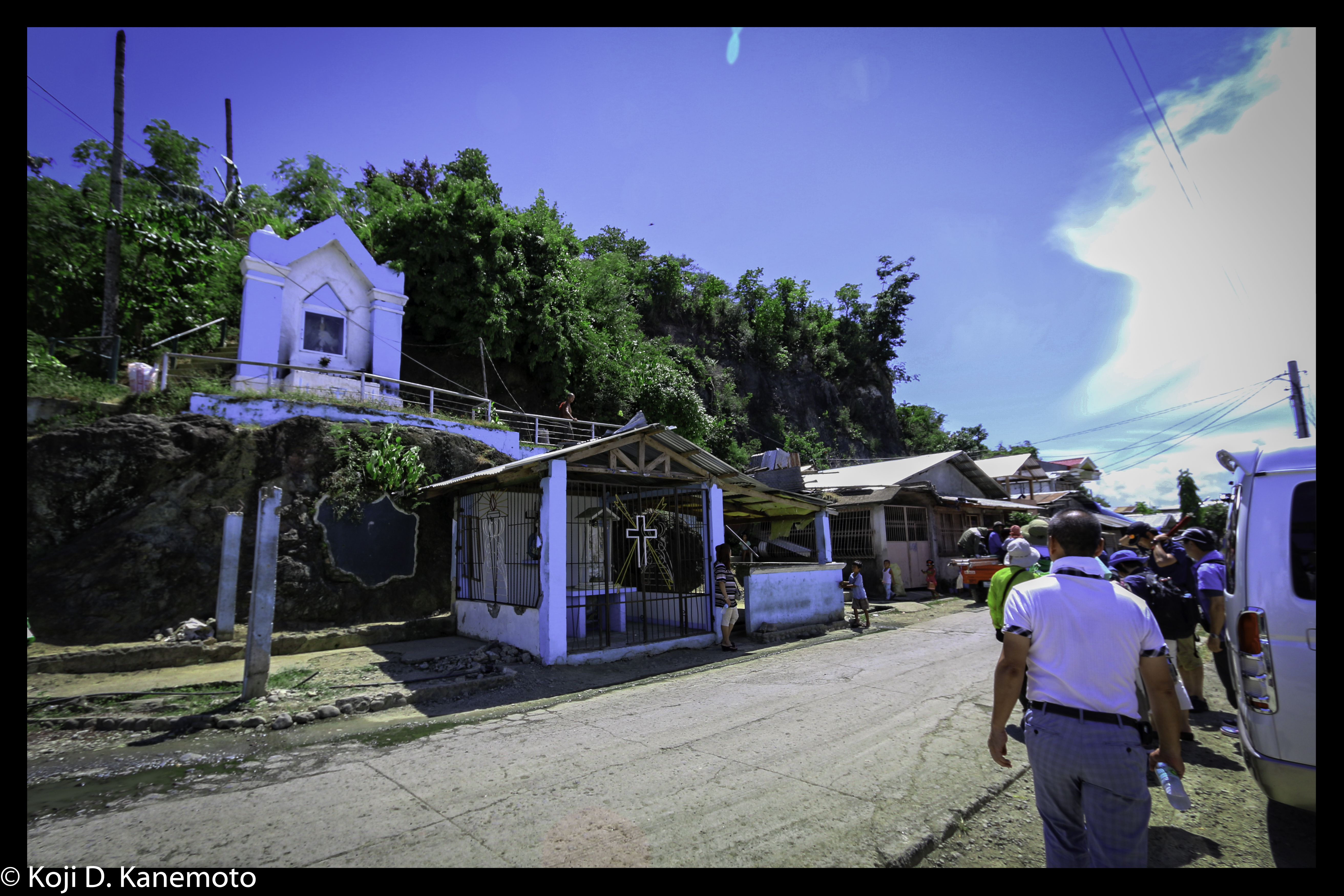
This is how Hill 522 looks like today from street level; you cannot see the peak from here. The stairs up to the top begin between the blue and beige structures. Akehira is to the right with his back to us and a towel wrapped around his neck. One of the vans we rode in is on his right.

c-10-446We walked past a little village girl; the journey up the hill begins:

c-10-443

c-10-444
Gotta hand it to my cousin Masako; she’s in the striped shirt with a backpack.

Just half a year earlier, Masako had tremendous difficulty just walking… but after visiting the shrine, she felt that Uncle Suetaro was calling her to visit him on Leyte and began to strengthen her legs with exercise.  This would be her first true test.

It leveled off for about 30 yards before climbing once again.  We passed some homes:

Distinctive odors signaled the absence of an established sewage system.  I now had a first hand idea of what Old Man Jack always said about the islands he fought on during WWII.

After some more climbing, we came to a clearing.  With my t-shirt soaking up the world’s supply of Sparkletts water, I thought, “Dang, that wasn’t a tough climb at all!”  Wrong.

c-10-447It was a rest stop.  Duh.  My guess is that it was about 200′ up the hill.  The crest of Hill 522 was straight ahead in the picture above but you still can’t see it.  And Masako was still hanging in there.  What a driven lady she was.

Well, she and her sister Tomiko made it to about the 300′ mark before they had to retire.  What an effort, especially with her bad legs, the heat and humidity.

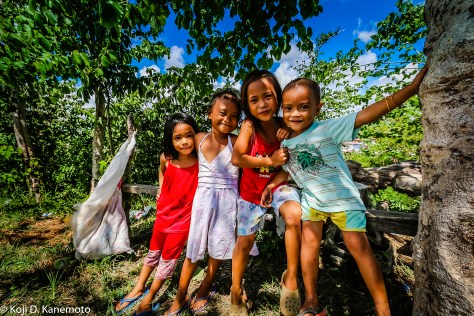
This is where I ran into four village children who were trailing us part of the way up the hill:

c-10-463As for me and the hop, skip and a jump to the top?  Well, this southern Californian began to fall behind, slowly but surely.  I blame it on the 100 pounds of camera equipment and the eight gallons of water I was lugging in my backpack…not.

c-10-448
Where I petered out… You cans see my cousins are still climbing.

I petered out at around the 400′ mark (Just trying to make me look good.) as the heat and humidity got to me.  So I’m a wuss.  To tell you the truth, I got a bit dizzy.  In that heat, I did think of the soldiers fighting for their lives on his hill 71 years ago.  Do we even know their names?

c-10-445
The view from where I petered out, looking generally south. I left the telephone line in for reference. The hill which intersects it is Catmon Hill, another vital piece of high ground that needed capture as quickly as possible. It would not be under control for several days.

Well, my older cousins Namie and Kiyoshi – along with the rest of the group – made it to the top where a large cross has been erected.  Incredible, yes?  And Namie survived the atomic bombing.  They said it afforded a commanding view of the surroundings, a testament to the combat need to take this hill.

________________________________________________

Hill 120

c-10-449
A recreation of Lt. Mills hoisting the first flag is visible. Although hidden by the vegetation, there is also a radioman at the base of the palm tree.

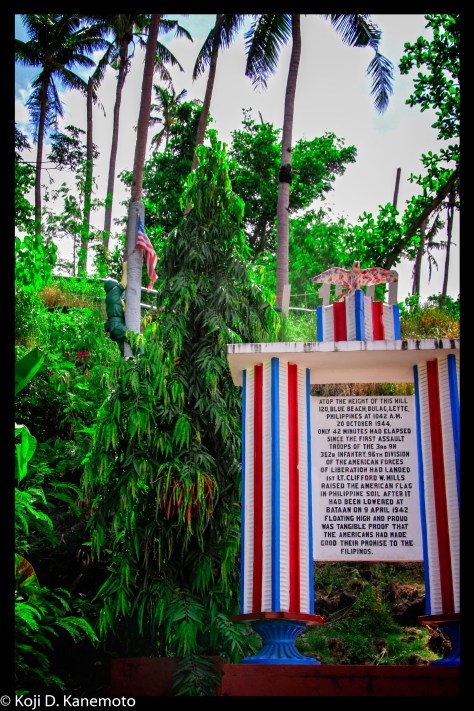
After a much needed lunch and rest stop, our next destination was Hill 120². Hill 120 is still a sacred place to the Filipinos; it was here that the US flag was first hoisted above Leyte by US Army Lt. Clifford Mills.

As with many other places on Leyte, this hill was severely pummeled by the 200 mph+ winds of Typhoon Yolanda, felling several trees and ripped apart the memorial.  Given that, I was amazed at the growth that had sprung up since then.  (I also understand that before the typhoon, this memorial was in excellent shape with the landscape being pruned and structures maintained.  Leyte is still in process of bringing this site to its previous state.)

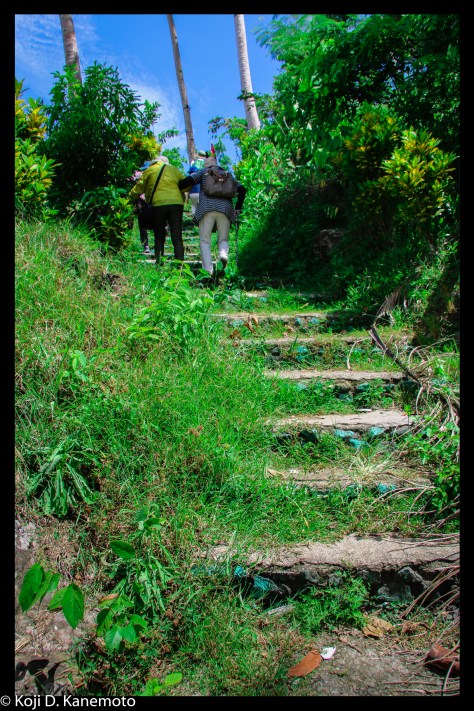
While “only” 120′ high, Masako again took on the challenge.  Because of the damage from the typhoon, some of the footing was precarious but she ambled up.  A lot of the footing was not clearly visible due to the growth.  It swallowed up your feet and legs.

c-10-450c-10-451c-10-452

Given this vegetation is what has grown back since the typhoon, it still amazed me with its height and thickness. Grasses were chest high in some spots; walking through the vegetation left tiny thistle-like things stuck in your shoes and socks. You definitely felt the coarseness rub on your legs as you made your way through.  It was impossible to walk through it silently.  If you were a soldier, the rustling must have sounded like a fog horn.

USA-P-Return-p75
Hill 120 during battle. I believe we parked on the same road running diagonally through this photo.  Signal Corps photo.
c-10-453
This memorial sign was recently rebuilt and put up by the Filipinos; its predecessor had been blown away and down the backside of the hill by Typhoon Yolanda.

There is one stump (below) that I could see remaining from the actual battle on October 20, 1944, pot-marked with bullet holes; my cousin Kiyoshi is walking past it:

c-10-454
When compared to the previous B&W photo taken on A-Day, 1944, the ocean is somewhat in the same direction. The road we traveled is the same as in the B&W photo.

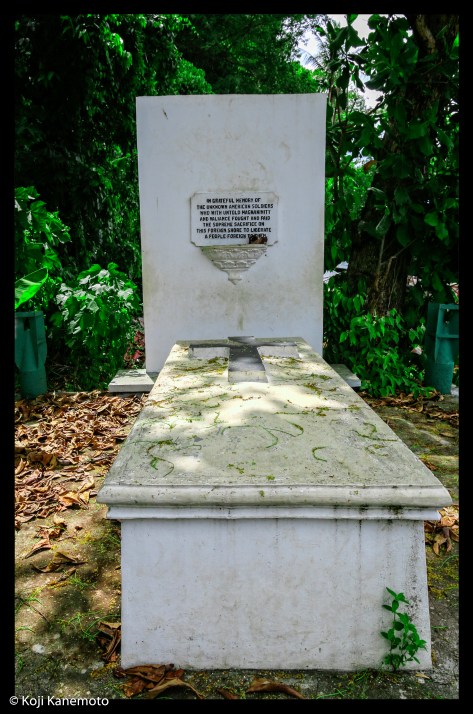
After descending back down, we walked around to the side of the hill; it was dotted with a number of privately erected memorials.  One was for the US soldiers; it was flanked by unexploded bomb casings.

c-10-455
It reads, “In grateful memory of the unknown American soldiers who with untold magnanimity and valiance fought and paid the the supreme sacrifice on this foreign shore to liberate a people foreign to them.”

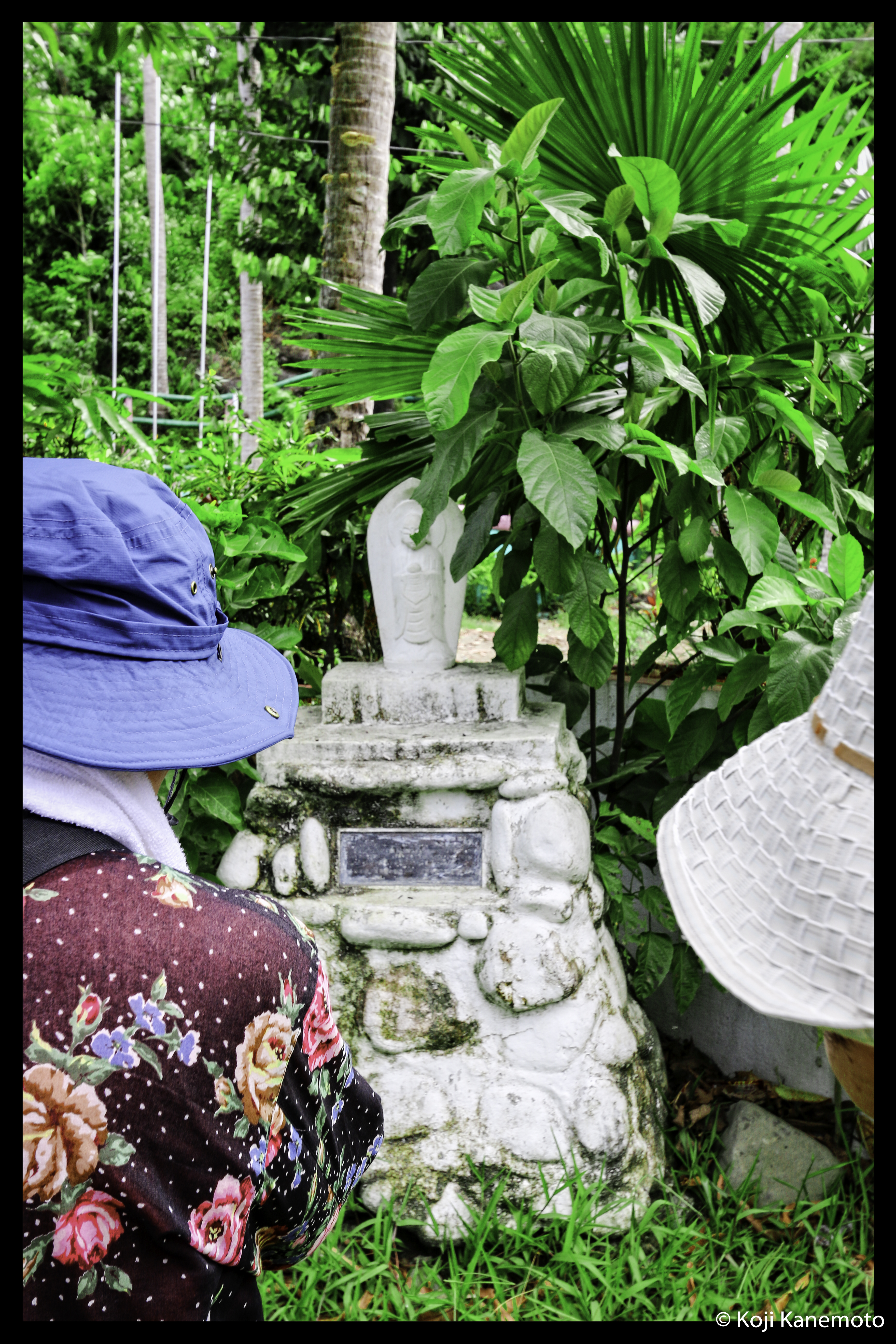
Several others were for Japanese soldiers, all privately erected.  This is when Masako truly began to feel the relevance of why she just had to come.

c-10-462
Namie and Tomiko offer “gassho”, or prayer, in reflection of those who perished and long since forgotten.

c-10-457

c-10-459
Namie and Tomiko offer their gassho at yet another memorial.
c-10-461
Mr. Ota photographs another memorial, erected in 1977.

c-10-460

My five cousins. Masako, Tomiko and Namie on the left survived the atomic bombing. Izumi is Masako’s filial daughter with Kiyoshi next to her. Kiyoshi was born immediately after war’s end; the moment came in the Kanemoto home quite suddenly.

___________________________________________

At Hill 120 and while looking at the number of memorials, Masako said to me, “All these memorials…  It is terrible knowing they lost their lives and have since been forgotten.”

We all felt the same, I’m sure.  I did.

…and this is a feeling you will never find in a textbook.

You had to be there.

__________________________________________

Day 3 to follow…  Masako and I read our letters to Uncle Suetaro and pacificparatrooper’s father Smitty at the actual battle sites on Leyte.  Short videos will be included for those interested.

Part 4 is here.

BATTLE NOTES:

  1.  Per Cannon’s book: While the 2d Battalion, 19th Infantry, was proceeding cautiously forward the 1st Battalion was working toward Hill 522. This hill, which rose directly from the river’s edge north of Palo, overlooked the landing beaches and its upward trails were steep and winding. Hill 522 presented the most significant terrain feature which would have to be overcome before the American forces could push into the interior from Palo and it constituted one of the chief objectives for A Day. Three months earlier General Makino had started to fortify it, impressing nearly all of the male population of Palo for the work. By A Day they had constructed five well-camouflaged pillboxes of rocks, planking, and logs, covered with earth. Numerous tunnels honeycombed the hill; the communications trenches were seven feet deep.During the preliminary bombardments the Navy had delivered some of its heaviest blows on the hill, and the bombardment was continued by Battery B of the 13th Field Artillery Battalion and Battery A of the 63d Field Artillery Battalion. The 1st Battalion of the 19th Infantry sent reconnaissance parties to locate a northern route to the hill. The plan had been to move inland from the extreme south of the beachhead, but that area was still in Japanese hands. At 1430, when scouts reported finding a covered route on the northern side of the hill, the 1st Battalion immediately moved out in a column of companies. The column had barely started when Company A, in the lead, was held up by enemy fire from the five pillboxes. The remainder of the battalion moved north around Company A, and, skirting the woods, attacked Hill 522 from the northeast, with Company C on the right and Company B on the left.The men, although tired from the day’s activity and strain, made steady progress up the slope. As the troops moved upward, American mortars started to shell the crest of the hill. It was thought that this was artillery fire and a request was made that it be lifted. It came, however, from the chemical mortars. After a short delay the firing ceased. At dusk Company B reached the first crest of the hill and was halted by fire from two enemy bunkers. The company thereupon dug in.At the same time scouts from Company C reached the central and highest crest of the hill and espied about two platoons of Japanese coming up the other side. They shouted for the remainder of the company to hurry. Company C got to the top of the hill barely ahead of the Japanese, and a sharp engagement took place in which about fifty Japanese were killed. Company C held the highest crest of the hill. During this attack, 1st Lt. Dallas Dick was struck in the leg and his carbine was shot from his hands, but he continued to command his unit until his evacuation forty-eight hours later.During the night the Japanese made frequent but unsuccessful attempts to infiltrate the company area and in the darkness they carried away their dead and wounded. During the action to secure Hill 522, fourteen men of the 1st Battalion were killed and ninety-five wounded; thirty of the latter eventually rejoined their units. General Irving, who had assumed command of the 24th Division ashore at 1420, later said that if Hill 522 had not been secured when it was, the Americans might have suffered a thousand casualties in the assault.By the end of A Day, the division had crossed Highway 1 and established physical contact with the 1st Cavalry Division on its right flank. In spite of strong opposition on its left flank, the 24th Division had secured Hill 522, which dominated the route into the interior and overlooked the town of Palo, the entrance point into Leyte Valley. Furthermore, the X Corps had now secured a firm beachhead area averaging a mile in depth and extending over five miles from the tip of the Cataisan Peninsula to the vicinity of Palo, and had captured the important Tacloban airstrip on the Cataisan Peninsula.
  2. Per Cannon’s book, the amphibian tractors carrying the 3d Battalion, 382d Infantry, were held up by the tank barriers of coconut logs and debris on the beach, and the troops were forced to debark at the water’s edge. Several hundred yards off the beach this battalion began to receive heavy fire from Hill 120, which was about 600 yards from the beach. The hill dominated the regimental beach area and was the A Day objective for the battalion. The fire pinned down the battalion, which thereupon called for mortar support and naval gunfire. The resulting barrage forced the Japanese out of their positions, and at 1040 the battalion advanced and captured Hill 120.

A 1937 Yearbook, the Atomic Bomb and Hiroshima


While it is August 6th here in the States, it it the 7th already in Hiroshima. I offer this story in hopes of peace.

Mustang.Koji's avatarMasako and Spam Musubi

(Please see An Atomic Spark and a 1937 Yearbook and Dad Was in the Newspaper for background information.)

There is living proof of forgiveness from a few – and they let out a resounding message of world peace for us.

My son Takeshi, second cousin Izumi and my cousin Masako at the Hiroshima Peace Memorial Museum.

_______________________

It was an extreme emotional experience – not just for my oldest son Takeshi and I but for the kind souls who joyfully spent their afternoons with us on a hot September day in Hiroshima.  I was able to finally meet – and thank – the people who were kind enough to seek out my father’s 1937 high school yearbook and thereby give my father a joyous remembrance of his most happiest days of youth in the sunset of his long life.

_______________________

Not being a writer, putting this experience into words is…

View original post 1,275 more words

A Soul Lost from WWII Comes Home – Part 2


c-10-388
My 81 year old cousin Masako is the first to offer “gassho” to our fallen Uncle Suetaro. She is the last one alive to truly remember him aside from my father (96).

Leyte Pilgrimage – Day One

As we made our descent into Leyte’s Tacloban Airport, I vacated my port-side preferred aisle seat and moved towards the window then buckled in.  Visibly condensed, chilled and misted air flowed out of the specialized air conditioning system above us, very necessary in the Southwest Pacific.  Our final approach was north to south.

The tarmac filled my window and thought to myself, My god.  We are actually going to land on the island where my uncle was killed.  It is finally happening.  Our plane touched down at 4:40 pm.

c-10-422
Touchdown. Tacloban, Leyte.

I wonder what my cousin Masako felt at that very same instant.  Besides my 96 year old father, she is the last person on this earth that truly remembers Uncle Suetaro.¹  I had been imagining many things of my uncle’s resting place.  I solemnly realized that I had been grieving over what we know happened to him as well as how my father silently grieved for decades… but now, I feared about what we may discover about what truly happened to Uncle Suetaro.  His suffering.  His death.

I slung my orange backpack weighed down with my cameras and lenses over my shoulder then exited from the rear of the air conditioned jet.  It would be six days before I would once again sit in such air conditioned luxury.  The impact of the tropical heat and humidity was immediate on this southern California body.  I began to perspire faster than Hillary could tell a lie.  It reminded me of the climate inside the house when I lived with my last ex – ugly.

c-10-421
A smiling Masako after retrieving her luggage at the uncultivated Tacloban Airport. I wonder what she felt deep inside at that moment.
c-10-403
Also accompanying us was Ms. S. Teraoka; she is carrying wooden boards on which is charcoal ink calligraphy written by her temple’s reverend. Her uncle was a lieutenant who also killed on Leyte.
c-10-424
Mr. B. Kagimoto, a news reporter from RCC Broadcasting Co. in Hiroshima, was also part of our little pilgrimage.

_____________________________________________

After being greeted by Akehira and Calimera, husband and wife owners of the limo service, we quickly exited the heat and humidity into two cooled vans.

c-10-385
Calimera and Akehira, Leyte residents. Their home was also significantly damaged by Typhoon Yolanda. No one was exempt.

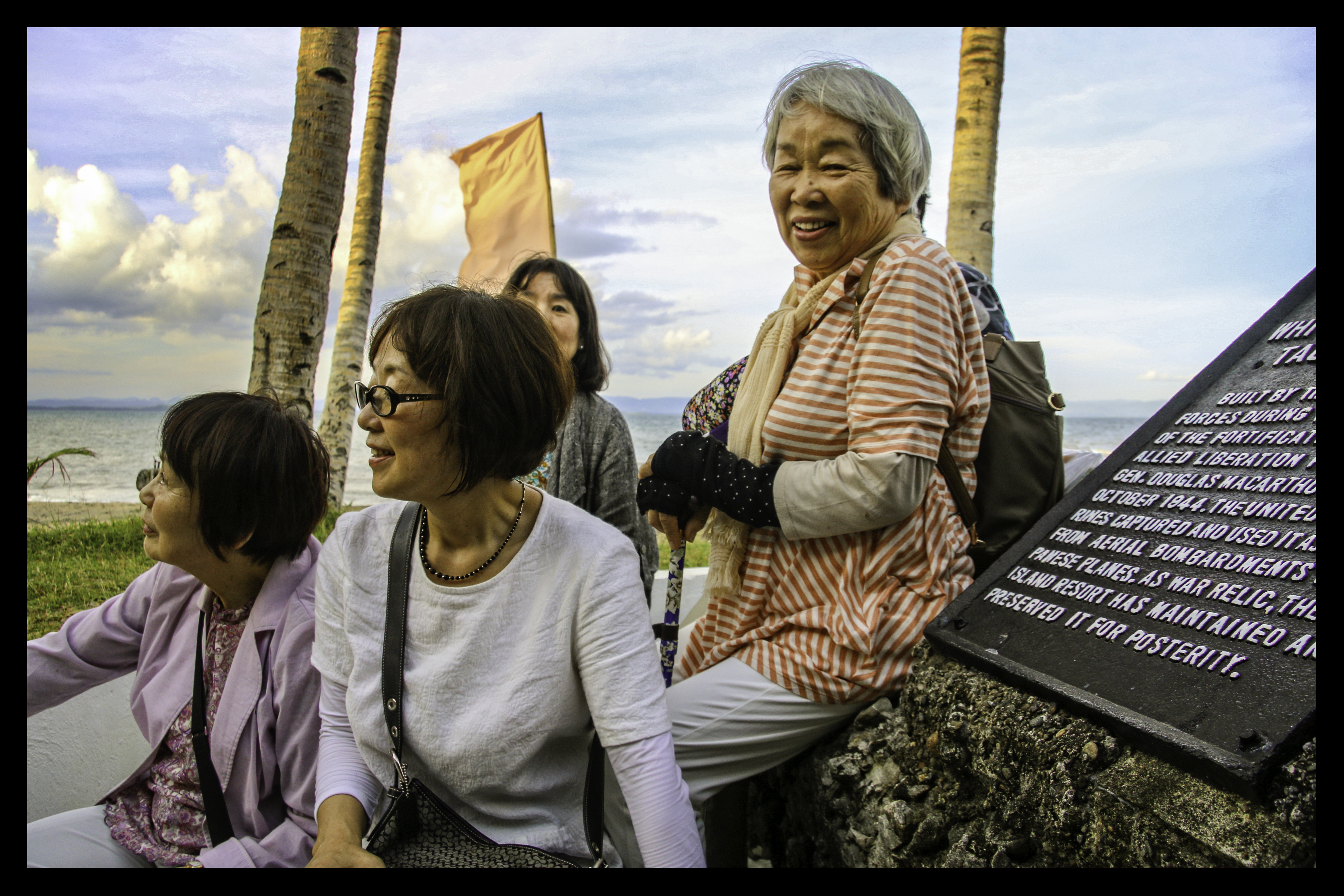
Along the way to our hotel, we made our first stop: White Beach.  Code named White Beach (see below) by the American invasion forces, it lays just south of the airport.  There were two Imperial Japanese Army pillboxes left pretty intact for historical purposes.

20048503510_de2739e726_o
White Beach on October 20, 1944. Source: Leyte, Return to the Philippines by M. Hamlin Cannon.

On A-Day, the US Army’s 7th Cavalry Regiment assaulted White Beach.

Per Cannon’s book, “…Both squadrons landed on schedule, with only slight opposition, and immediately began to execute their assignments. The 2d Squadron, within fifteen minutes after landing, knocked out two pillboxes on the beach, killing eight Japanese in one and five in the other.”

These are those two pillboxes.

c-10-405
One of the two Japanese pillboxes taken out by the US Army’s  7th Cavalry on October 20, 1944.
c-10-406
(R to L) Mr. Ota, Tomiko, Masako, Namie and Akehira gaze upon a pillbox at White Beach.
c-10-407
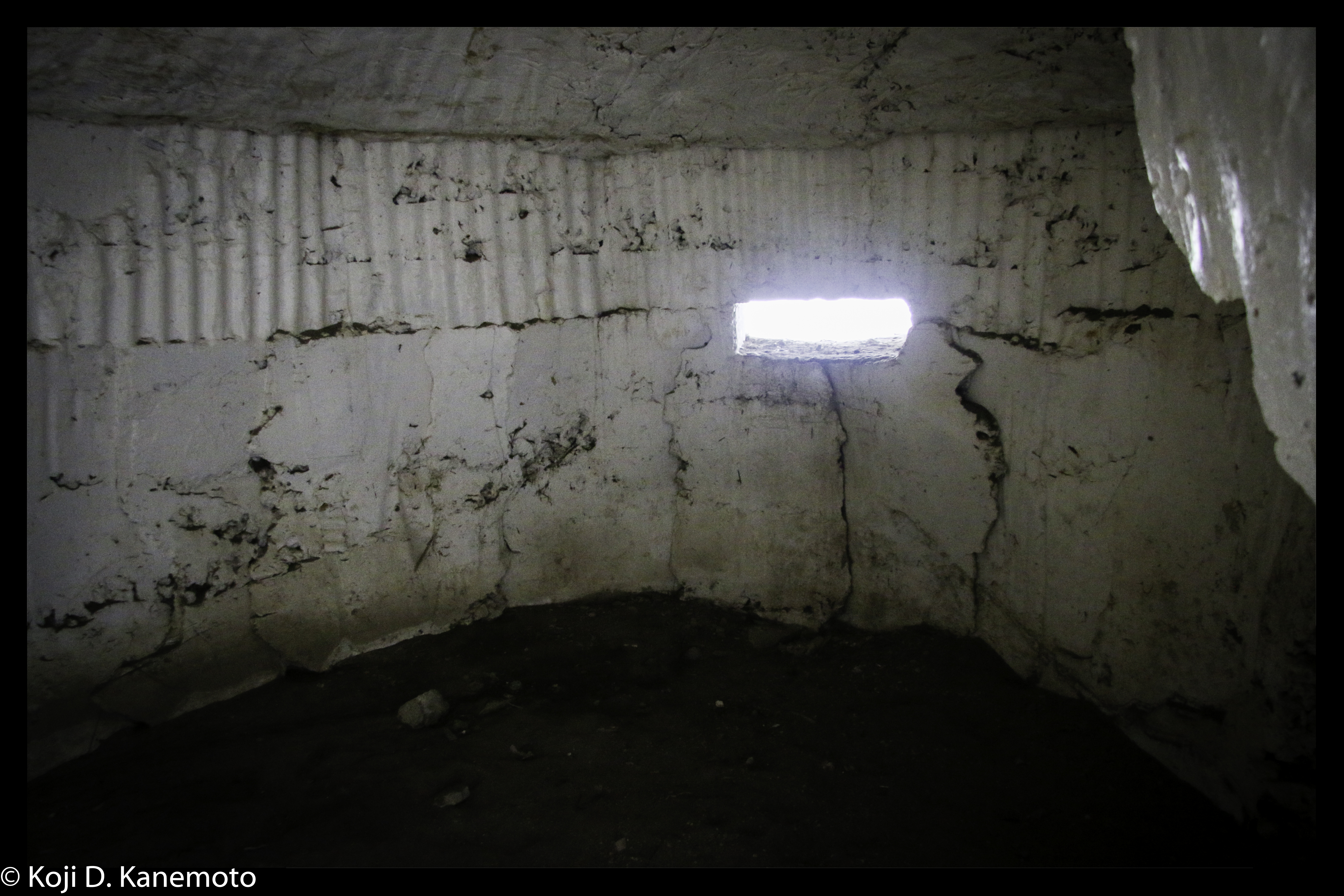
I took Masako down to see the interior. The mosquitoes were very happy in there, awaiting tasty humans like me.
c-10-408
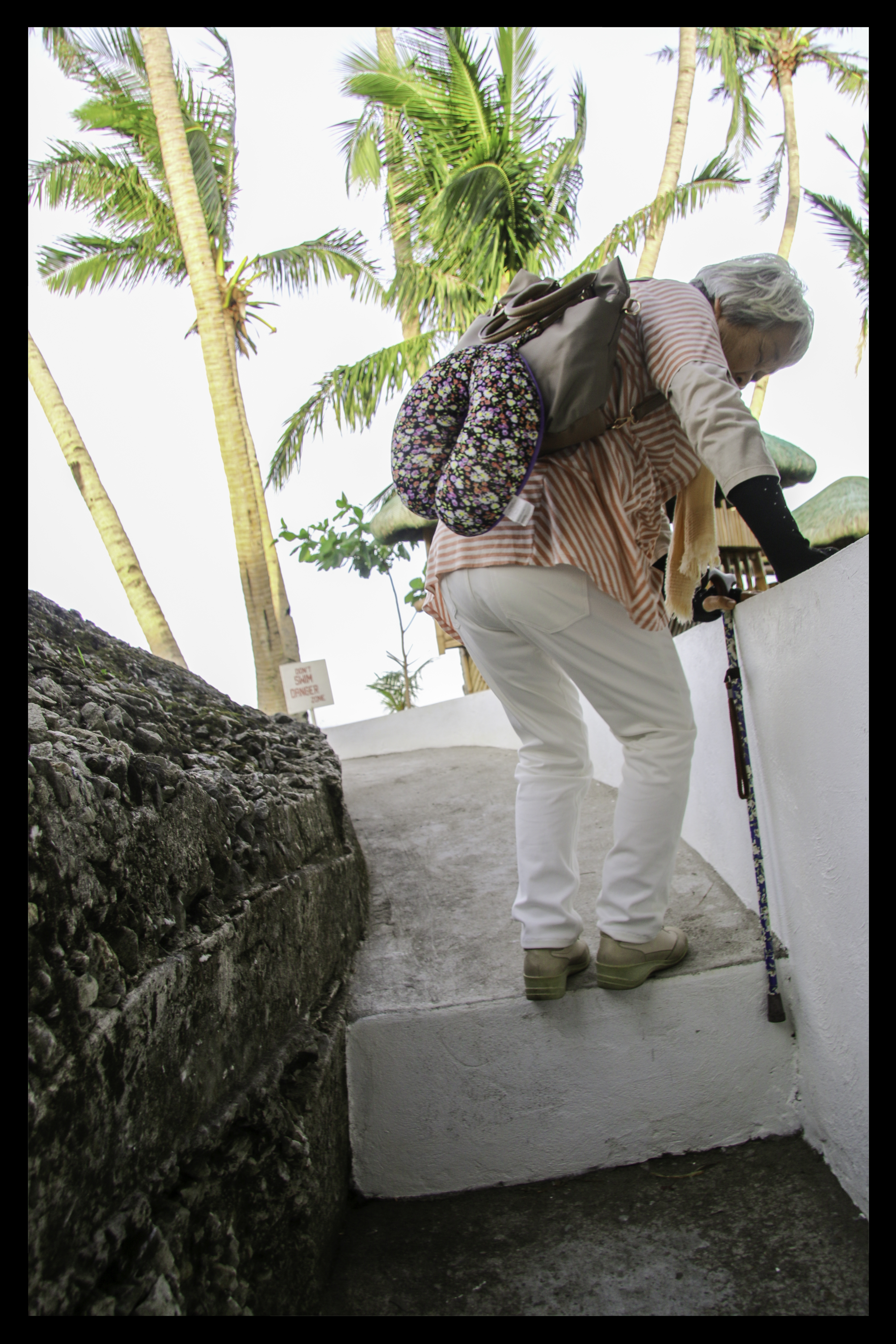
Masako determinedly climbing back up the stairs after looking inside the pillbox.
c-10-409
A gleeful Masako, Izumi and Tomiko resting upon the remnants of the second pillbox. I didn’t have the heart to inform Masako either five or eight Japanese soldiers died inside that pillbox via rifle fire, hand grenade or flame thrower as the exterior was intact.

Day Two to follow.

That’s when the crying really begins.

Part 3 is here.

______________________________________________

NOTES

  1.  The only other person with active memories of Uncle Suetaro was the reverend of the Buddhist temple adjacent to our Hiroshima home.  I talked with him three years ago when he was about 90 years old but with a sharp as a tack memory.  He passed away last year per Masako.