I have found that "family" around you is a product of twists of fate, world events and personal decisions made long ago. Anguish, happiness, despair and harmony. The effect of war on families and the resulting peace from the untold sacrifices made by the Greatest Generation.
While I am not a writer, I hope to be able to bring to light the spontaneity of life. As I wish to be historically accurate, some quotes will be as I heard them...but there was no malice coming from those that spoke those words. They were reliving the past horrors of war - a war that you nor I fought in. They did.
“Such short little lives our pets have to spend with us, and they spend most of it waiting for us to come home each day.”
– John Grogan, Marley and Me: Life and Love With the World’s Worst Dog
May he rest in peace.
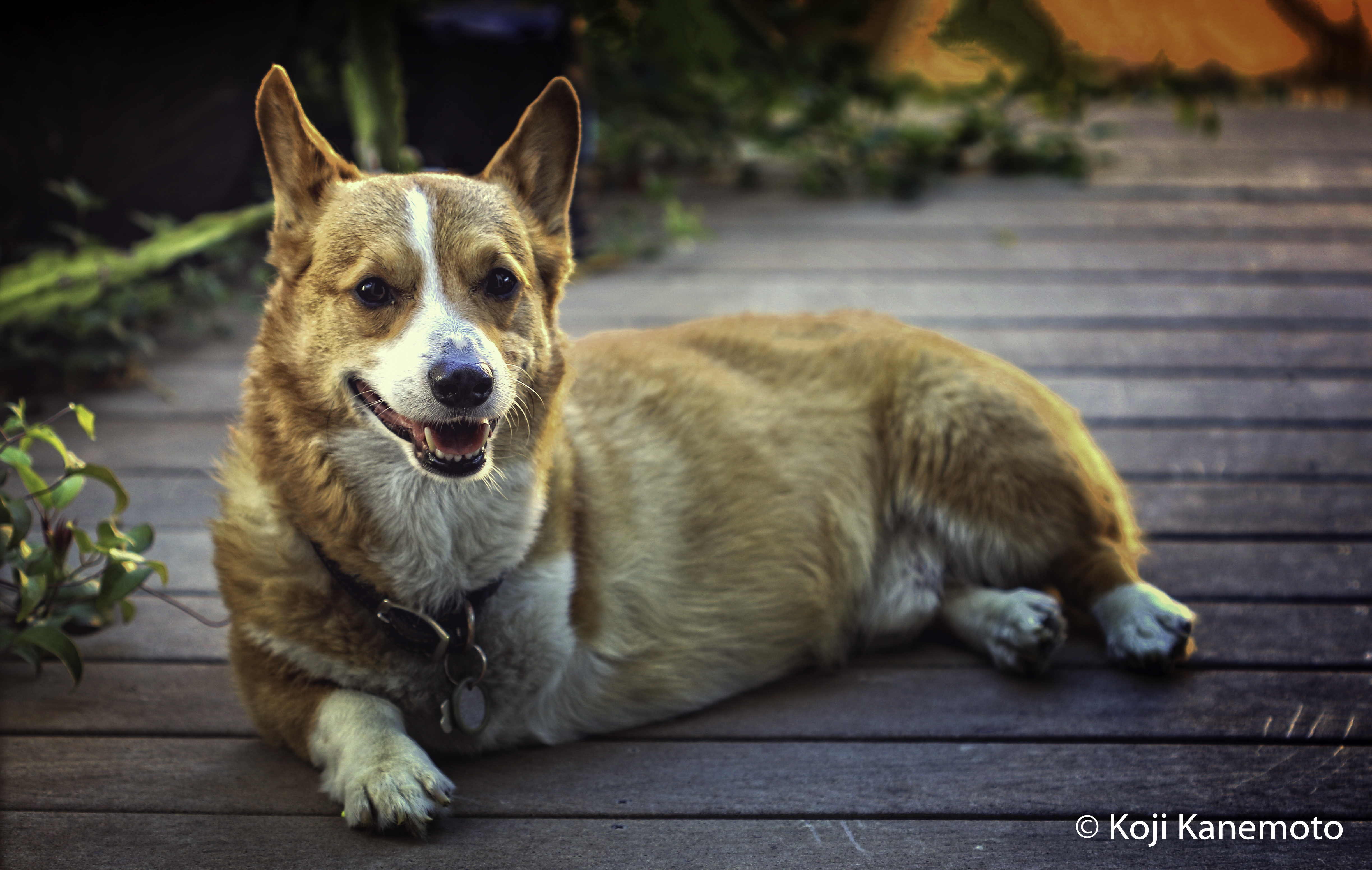
Yogi, my oldest daughter Robyn’s lovable three-legged corgi, left us last week.
______________________________________
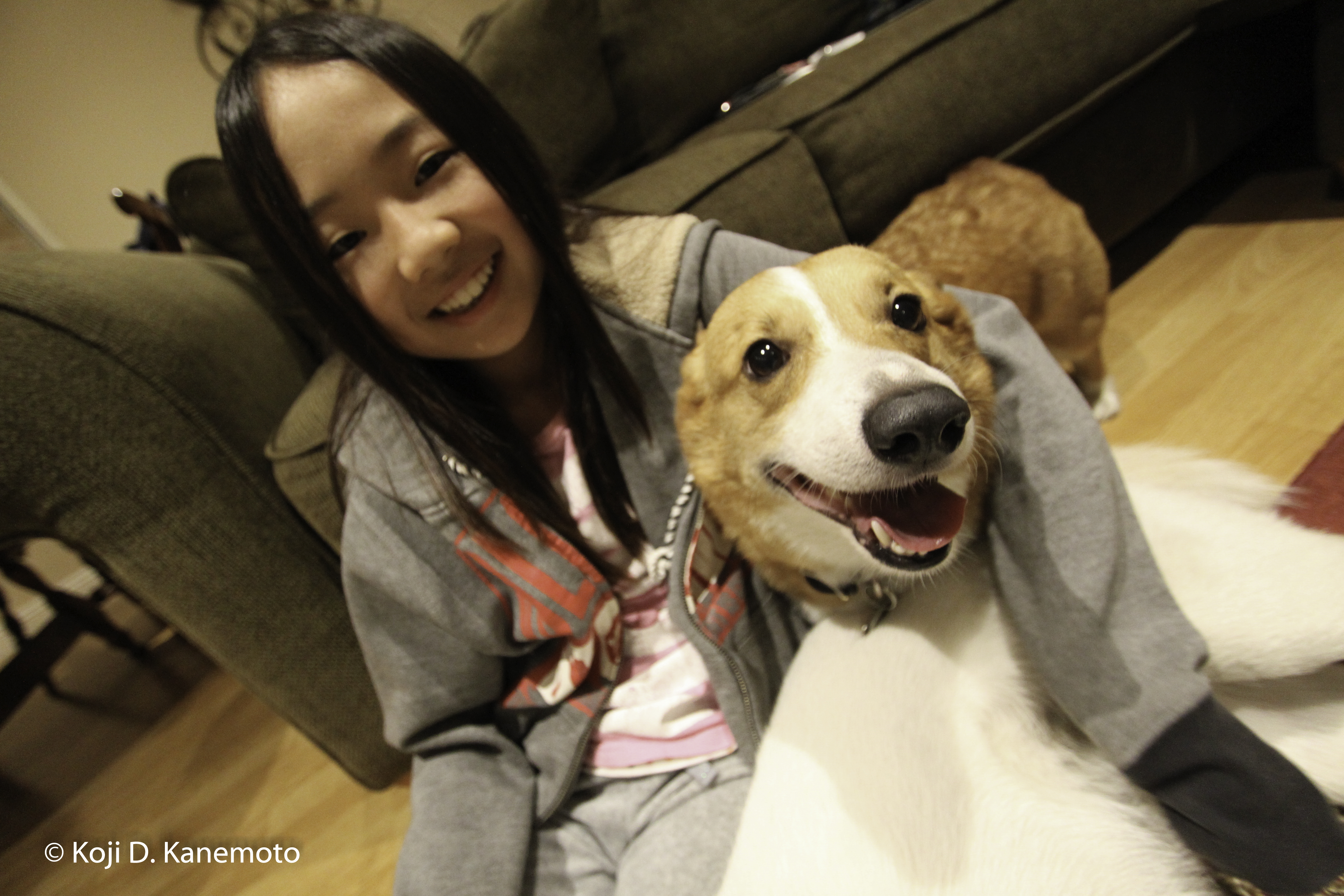
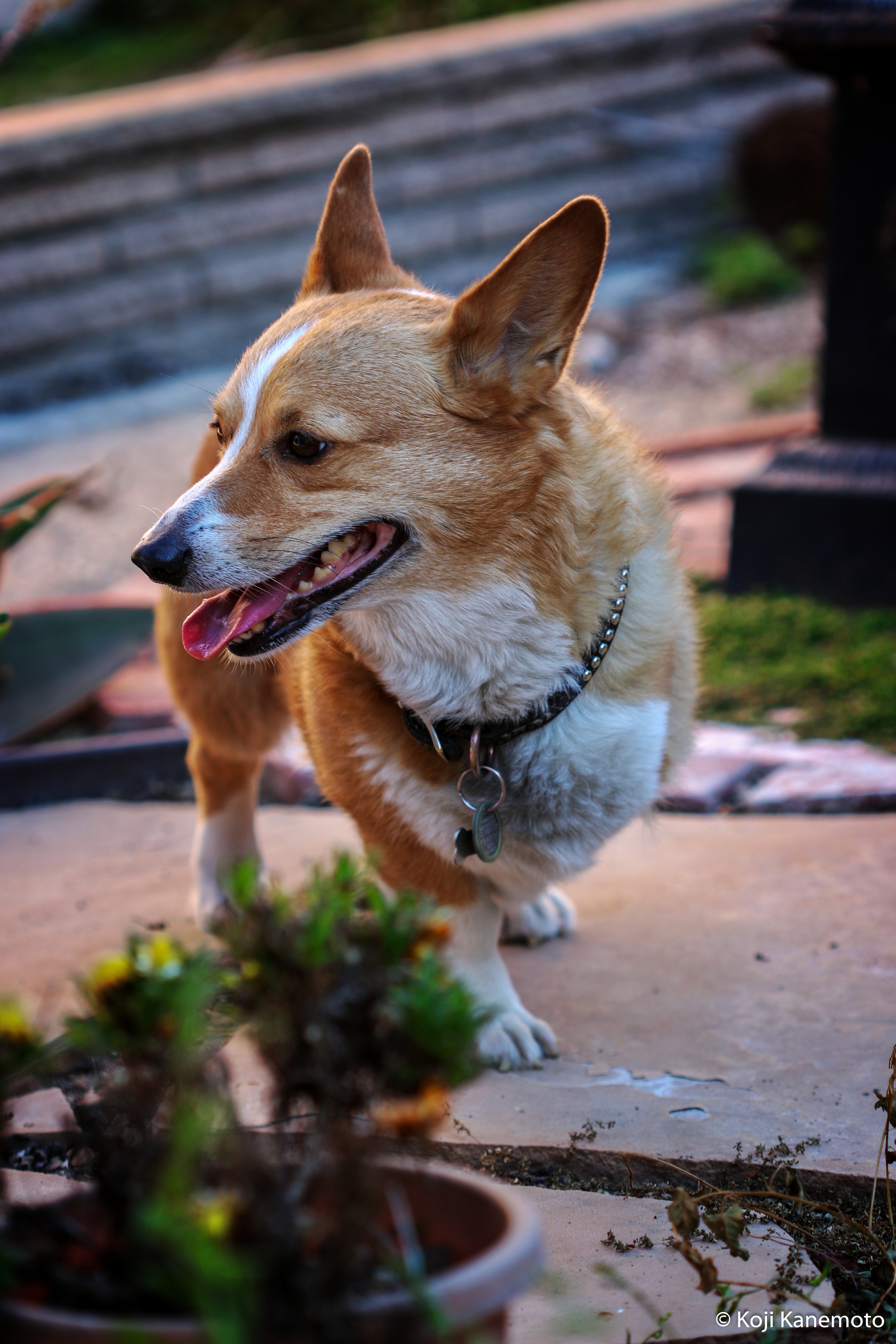
Yogi was such a happy dog. Her loving nicknames for Yogi included “Yogs” or “Yo-Yo”.
The day Yogi became part of the family… Who could resist him?
Yogs made me grin when he would run…if you can call it running. Indeed, it was like watching a huge log of Jimmy Dean sausage on steroids with four Vienna sausages¹ as legs, chugging through the grass.
Man, he loved to play with a ball. You’d toss a tennis ball or a toy and he would just instantly turn his back on you and bound away with his tailless butt the only thing you could see… just like how the famous Willie Mays did after hearing the the crack of the bat. After he chased it down, he’d bring it back near your feet. He’d then stare at the now motionless ball… And if Yogi thought you were ignoring him, he’d use his long, skinny nose to nudge it closer to you if you didn’t pick it up. “Again! Again!” he was saying. The simple joy he must have had.
The only time he wasn’t happy was when fireworks went off. He would cower behind Robyn’s toilet, shaking in fear, with his two shivering rear legs protruding out from behind the toilet. He was such a lovable wuse.
And he always wanted to be alongside somebody. “Hey! Me! Me! Look at me!” he was saying in dog-speak.
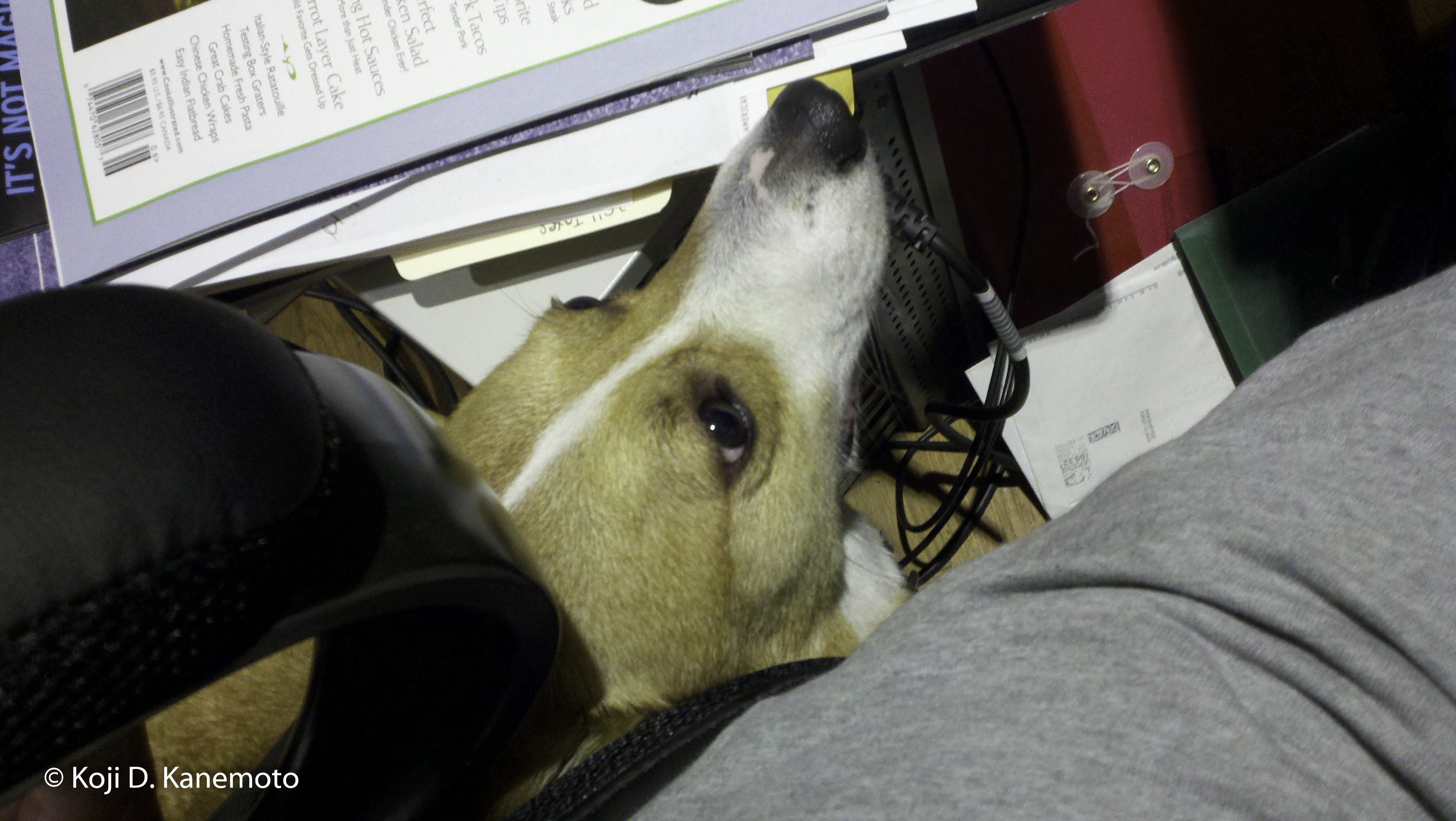
Yogi did not like it when I would try to sneak off to work on my computer. He made sure you knew he was there.
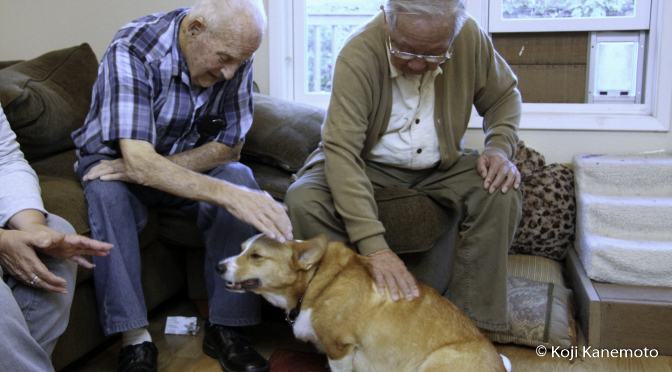
Yogs loved everyone – at least everyone who loved dogs. He was always so happy to see you. And he also knew who loved him. He took in my dad and Old Man Jack very quickly on Father’s day in 2011.
Old Man Jack, my dad and Yogi on Thanksgiving 2010.
When Robyn would bring Yogi to my house, I’m sure he sensed in her car with his doggy nose, “Ooo! Ooo! We’re near grandpa’s house… The house that I can jump onto comfy sofas all I want and leave my hair all over them…and mama can’t say no! Woof!”
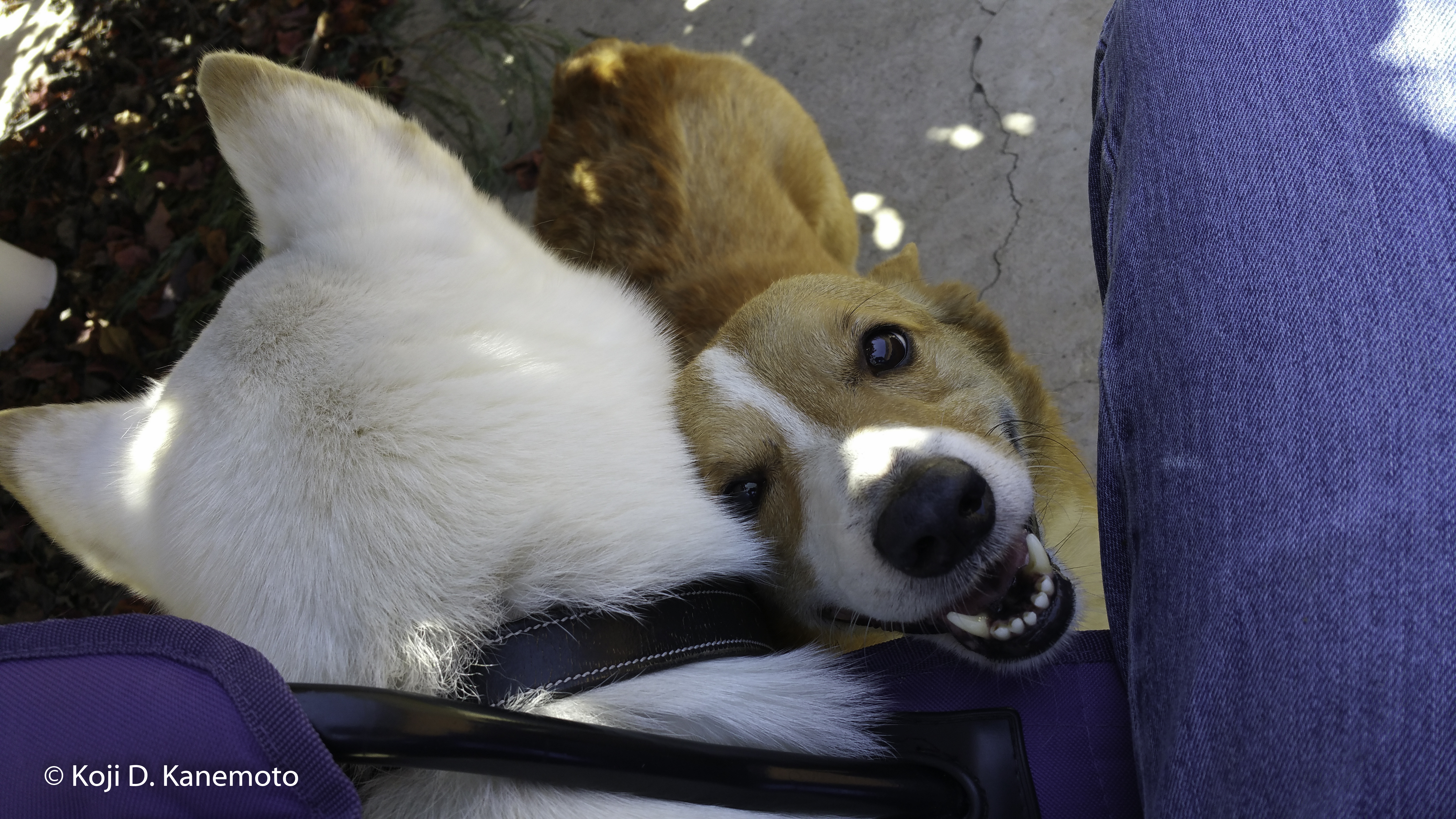
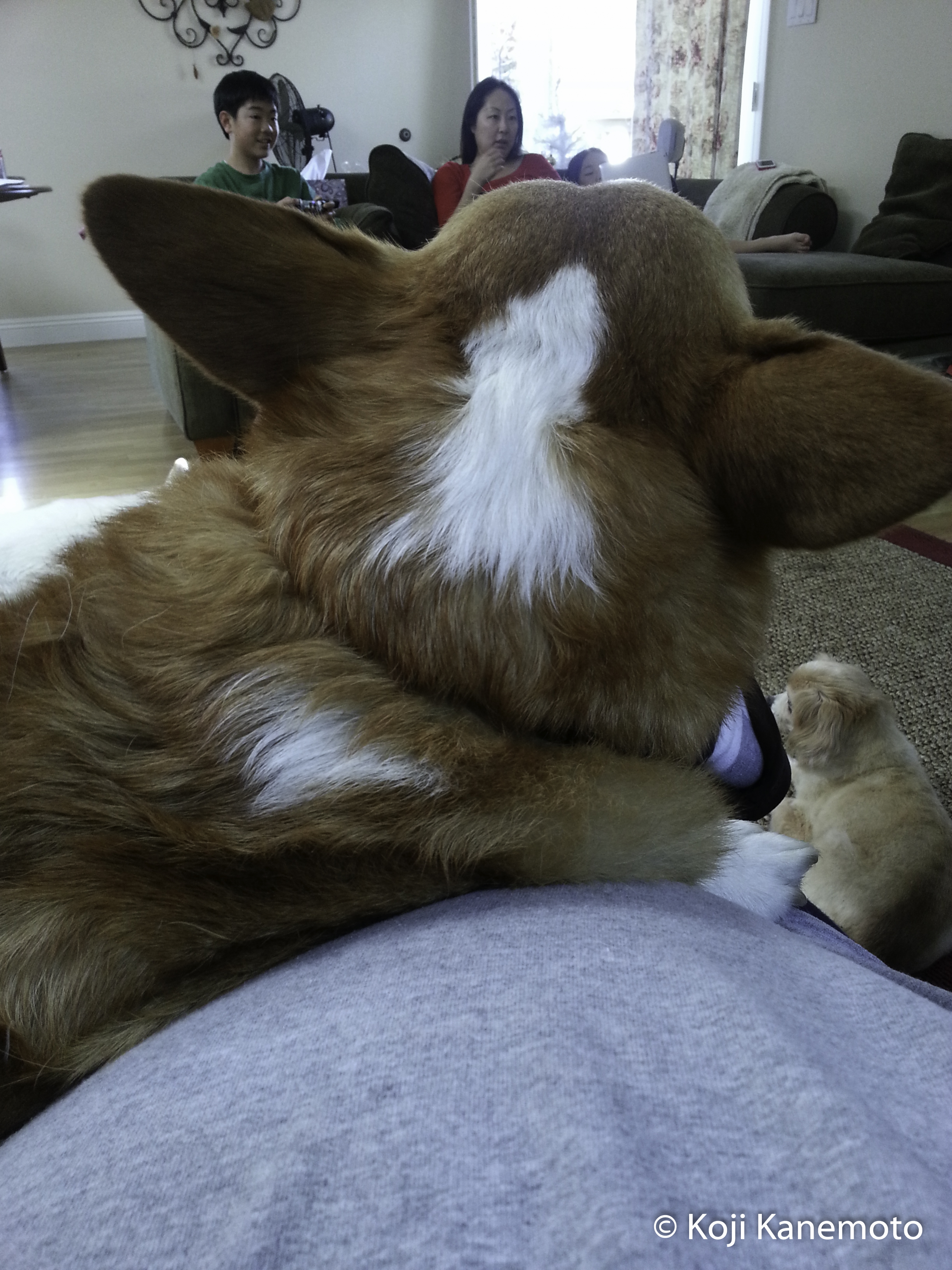
And one of Yogi’s most favorite spots to sit was on my lap as I sat on my sofa; it was a silent doggy signal… His stubby little Vienna Sausage legs would propel him right onto my lap as soon as I sat down. No invite was necessary. Then, he would would lovingly lay his head on my nice round belly.
Once he made it to my lap, he didn’t have to say one bark; his face said, “Pet me, you dumb human, while I leave tons of my hair as souvenirs!”
Yogi’s “pet me immediately” look… right on my belly.
Well, perhaps I was stretching it a bit. Yogs didn’t really care whose lap it was… It would become HIS spot. No matter what you were sitting on. No matter how little space there was… It was all his space.
Yogs just HAD to jump on my littlest daughter’s lap. It didn’t bother him one bit the chair was narrower than a plane seat in Economy Class.
But make no mistake about it. He knew who his mama was. When Robyn would bring him over to my home to look after him for part of the day and then grew tired of all the attention I was giving him (How rude!), he would patiently wait at the door for his mama to come home.
Can his nose get any closer to the door?
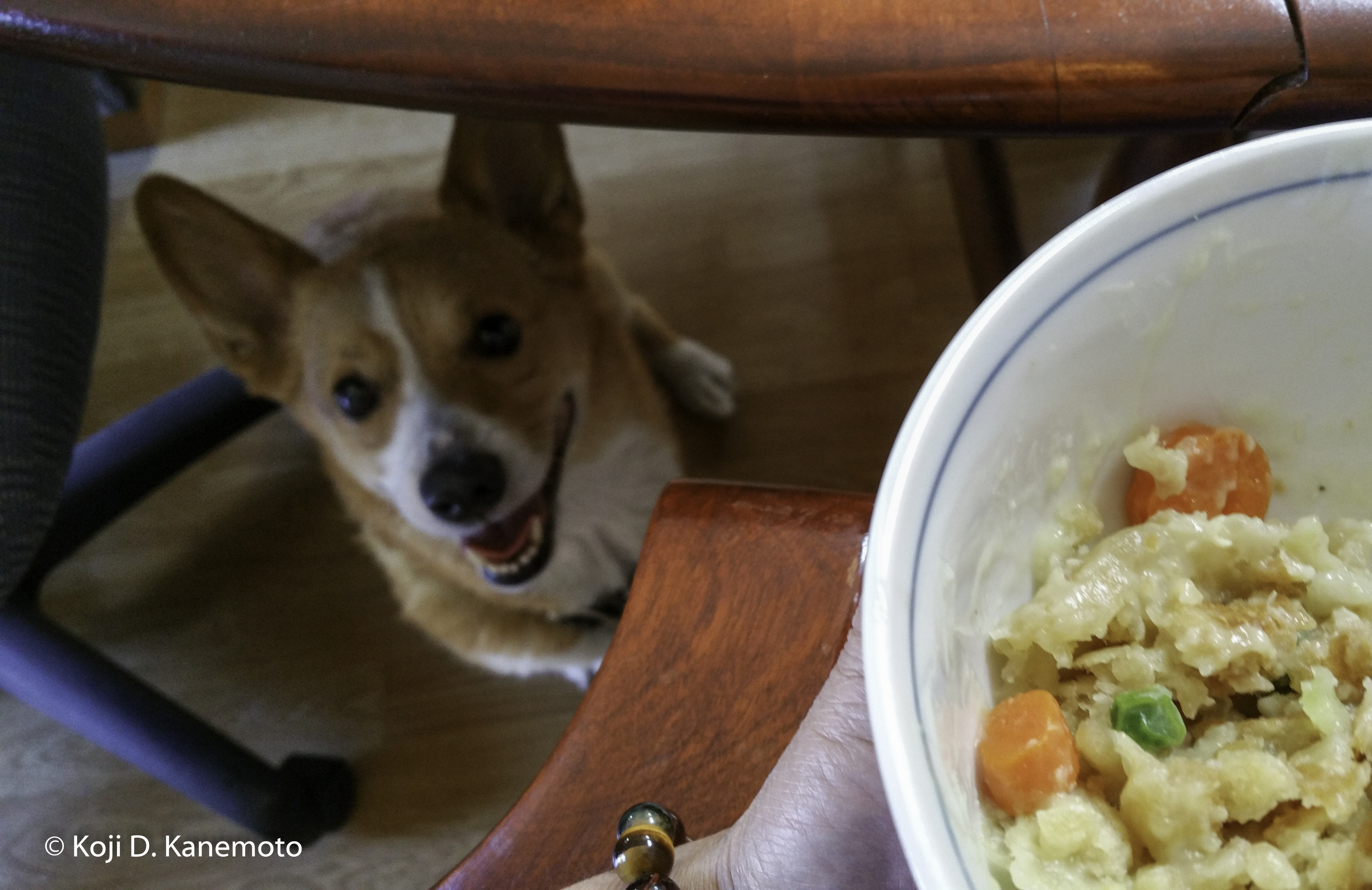
And of course, his “Feed me some of that human food!” face.
“Huh? I don’t care if it has preservatives! …What??? Mama said no??? Well, if you don’t tell her, I won’t!”²
_________________________________________
It was right before Christmas last year; her usual happy boy Yogi was then not only limping, he would yelp after I patted him on the usual spot: his side near his shoulder. After a few persistent visits with different vets, Robyn tragically found out why her beloved son was limping.
Yogi had cancer. He was only eight.
She was devastated. We all were but I felt most badly for Robyn and I knew exactly how she felt. Yogi was a big part of her life and he provided much happiness. But just as if Yogs was her boy, she opted for surgery… but in order to remove the tumor, her beloved Corgi had to lose his leg.
Yogs sans a leg during his final visit to my home where he had unfettered access to sofas…
He returned home the day after Christmas last year. Robyn was so happy Yo-Yo was back home.
We went to visit Robyn on August 23rd. Even with all my failings, Yogs would always greet me with great happiness at the door with his stocky Jimmy Dean Sausage body nearly bowling me over. But this time, he barely made it over to me as we walked in. I said, “Yogiiii… What’s wrong?” I secretly feared for the worst. I knew in my heart something was very wrong with Yogi.
She took Yogi to the vet on August 30th. Inoperable cancer had now spread to his spine; he was in great pain. She called me over that night to say goodbye as did many other family and friends. There was great sadness. But there was a happy moment. She said I could give Yogi some of my human food deli sandwich. I think we all gave Yogi some. He must’ve been so happy.
Yogi left us the next day, August 31st, while being lovingly held by my daughter and son-in-law, just like Masako held my grandma in her arms as she passed away, Yogi was blessed with having such an adoring mom and dad.
I know he is in doggy heaven. More precisely, the “Dogs That Brought the Most Happiness to Mom and Dad” wing of doggy heaven. While very, very sad, I know Robyn’s heart is at peace knowing her beloved Yogi is now free of pain.
I will dearly miss you, Yogs.
________________________________________
Notes:
For those who don’t know what a Vienna Sausage is:
Imagine being a Marine. You’re in Afghanistan. You see your buddies getting blown up by the cowardly enemy’s IED or killed after an ambush. Then, after a bitter, maniacal all-out war, their religious leader capitulates.
Now, suddenly, you are standing out in the desert, outside of Fallujah, waiting to go in as part of the “occupying force”. Your feelings and emotions are going amok – anger coupled with fear of the unknown… You will be surrounded by the enemy who also fought the exact same bitter war against you.
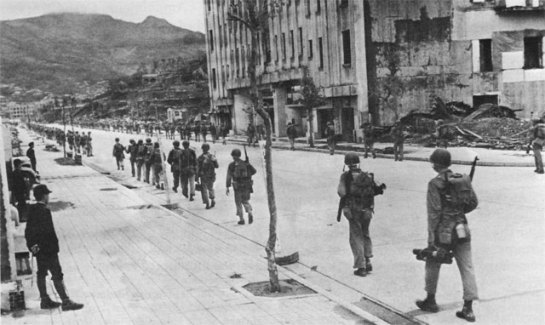
US 26th Marines marching into Sasebo, Japan – August 1945. Notice the Japanese standing to the left and the general absence of civilians.
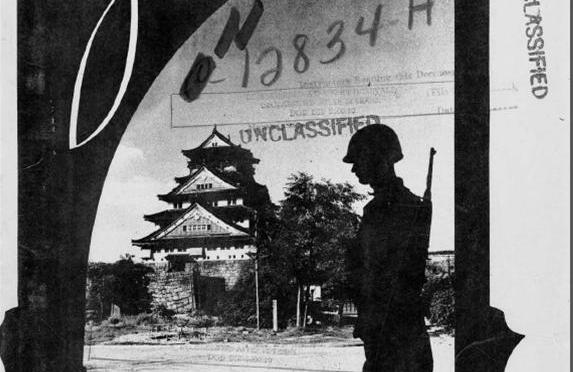
Now… imagine you are a young Marine on a troop ship off the Japanese coast. It is August 30, 1945. A few weeks earlier, you became acquainted with the term atomic bomb. The Emperor of Japan just capitulated.
some of the destruction caused when the high-jacked American Airlines flight slammed into the Pentagon on Sept. 11. The terrorist attack caused extensive damage to the west face of the Pentagon
AFTER FLIGHT 77 hit the Pentagon on 9/11, the following incident occurred:
A chaplain, who happened to be assigned to the Pentagon, told of an incident that never made the news:
“A daycare facility inside the Pentagon had many children, including infants who were in heavy cribs. The daycare supervisor, looking at all the children they needed to evacuate, was in a panic over what they could do. There were many children, mostly toddlers, as well as the infants that would need to be taken out with the cribs.
Pentagon Memorial
“There was no time to try to bundle them into carriers and strollers. Just then a young Marine came running into the center and asked what they needed…
This is an off topic post so if you’re here for the gym stuff, come on back and see me tomorrow!
For the Black Lives Matter Protesters and Supporters
Useful Idiot is a term that you may or may not be familiar with. It’s use is often attributed to Vladimir Lenin. Regardless of it’s actual point of origin, it’s used to describe people who function as tools in a cause whose ultimate goals they are blind to and whose leaders hold them in contempt while simultaneously using them for their own ends. In the case of Black Lives Matter, it describes a purposeful manipulation of emotion and a spoonfeeding of propaganda on the part of the more powerful leaders that is taken up by the street level protestors or “marks” as truth.
You see, they are using you, my friends. They’re using you as attack dogs to help in…
Before Pearl Harbor, the US was still not recovered from the Great Depression. With the money printed in great quantity – as a necessity – by the US government, the US war machine rolled into action. Many executives and businessmen taking part in this frantic and mass expenditure of government money with their companies gained their financial fortunes from this great war as did a large number of Congressmen.
The boots on the ground also had fortune – but it was MISfortune. Misfortune fell upon the millions of brave young men who were sent to war because world leaders had their own agendas. Millions were killed like my dad’s favorite brother, my Uncle Suetaro.
Misfortune, unfortunately, also followed home for the rest of their lives those young men who survived combat. Men like Smitty, Old Man Jack and Mr. Johnson. Horrible nightmares each and every night. Some succumbed to the immense weight this horrible misfortune had on their minds and ended their own lives after making it home. Sadly, they are all being forgotten in our children’s history books.
______________________________________
Our little group was afforded a day of sightseeing before leaving for Osaka/Kansai Airport in Japan, once again led by Mr. Yusuke Ota. Here’s a small collection of sights taken in, some during the week (Clicking on an image will show you its location.):
Mr. Kagimoto hunts for dragonflies at the golf course we had lunch at. The facility was once for US Army officers.Shoeless children help their elder sell pineapples at bayside in Tacloban City.Meeting with beautiful wife of Tacloban City’s Mayor, Christina Gonzales, a former actress. Thank goodness for our Carmela in the center: she speaks four languages fluently including Tagalog, English and Japanese.Villaba’s town center; the beach is off immediately to the left. Our two vans are at the right.(From left) Masako, Christina Gonzales and Carmela. The other young lady in red in the background is another Filipina actress.
Mr. Ota inspects a clock tower he donated to Tacloban City; he serves as a councilman in Fukuyama City where my uncle’s regimental army base was located during the war.
School boys at Old Kawayan City, Leyte.At Albuera, Leyte. One of two self-destroyed Japanese howitzers can be seen behind Izumi.Hard life of a Filipino fisherman.At the San Juanico Bridge, the longest bridge in the Philippines. Engineering was provided by the Japanese.
While waiting at the Manila Airport for our connecting flight to Osaka, Mr. Ota took us to the Philippine Air Force Museum where among other items was the Type 99 Arisaka rifle Lt. Onoda kept with him for over 29 years in the Philippine jungle. He was the last holdout from WWII:
____________________________________
Epilogue
A Victory Nonetheless
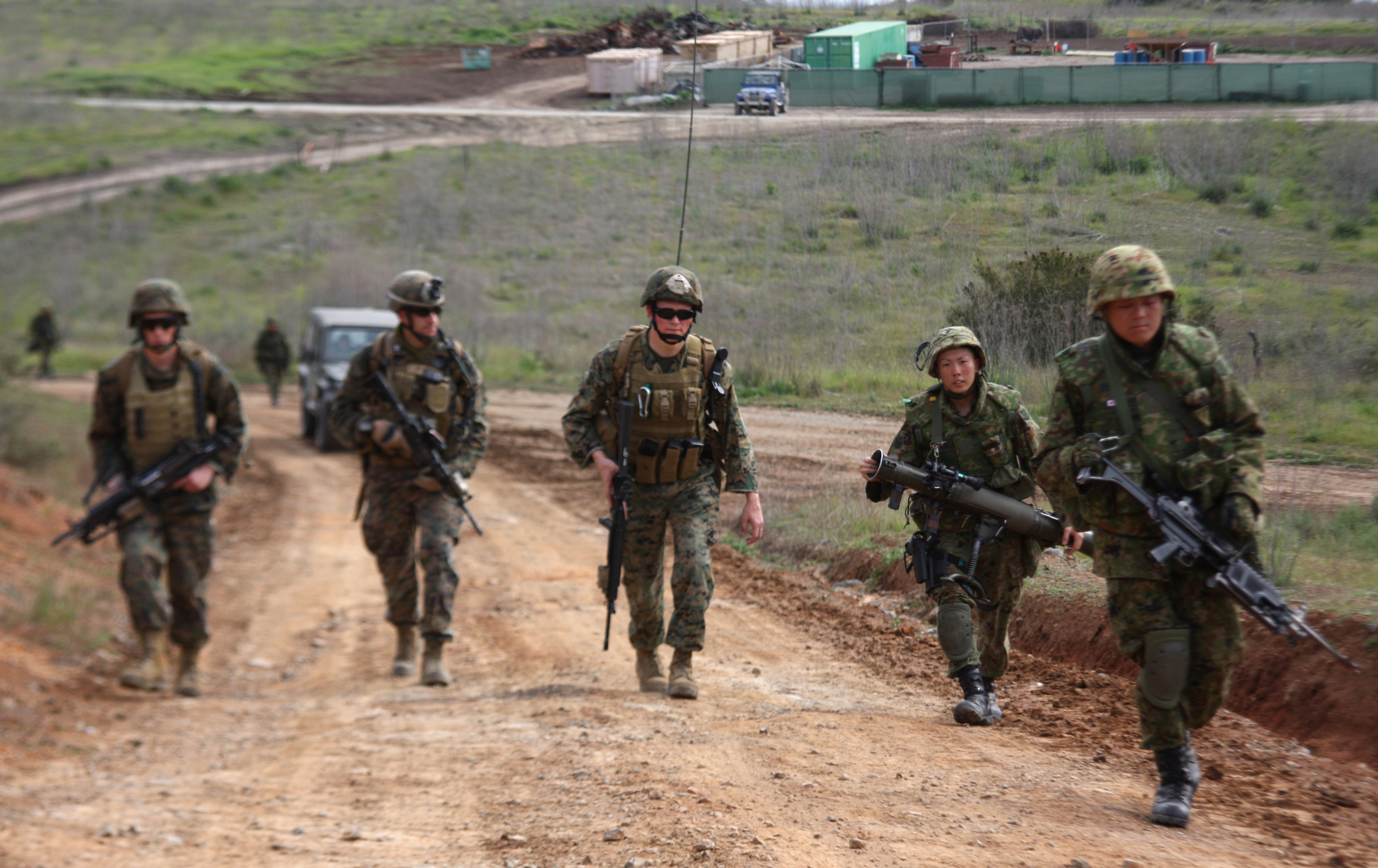
Seventy years after this most brutal war in the Pacific, the same US Marines and the same Japanese military that sought to kill each other with extreme bitterness are now the closest of allies as shown in the USMC photos below. Now, they sail together on the same US Navy ships, eat together, train together and assault the beaches here at Camp Pendleton, CA together in joint training exercises. The same with the US Army. My gut feeling is one of these gallant young men would die to protect the other if the unfortunate circumstances arose.
Then:
Bitter enemies then, U.S. Marines inspect the bodies of three Japanese soldiers killed in the invasion at Peleliu island at the Palau group, September 16, 1944. (AP Photo/Joe Rosenthal)
Today:
U.S. Marines and Japanese soldiers carry gear during a hike at Camp Pendleton, Calif., on Feb. 15, 2011. (Three US Marines on the left, two Japanese Self-Defense Forces soldiers on the right.) DoD photo by Lance Cpl. Gene Allen Ainsworth III, U.S. Marine Corps. (Released)
Uncle Suetaro lost his life and while Smitty carried the war silently for the rest of his life, they were both victorious because of the above.
It was not in vain.
________________________________
One War. Two Countries. One Family.
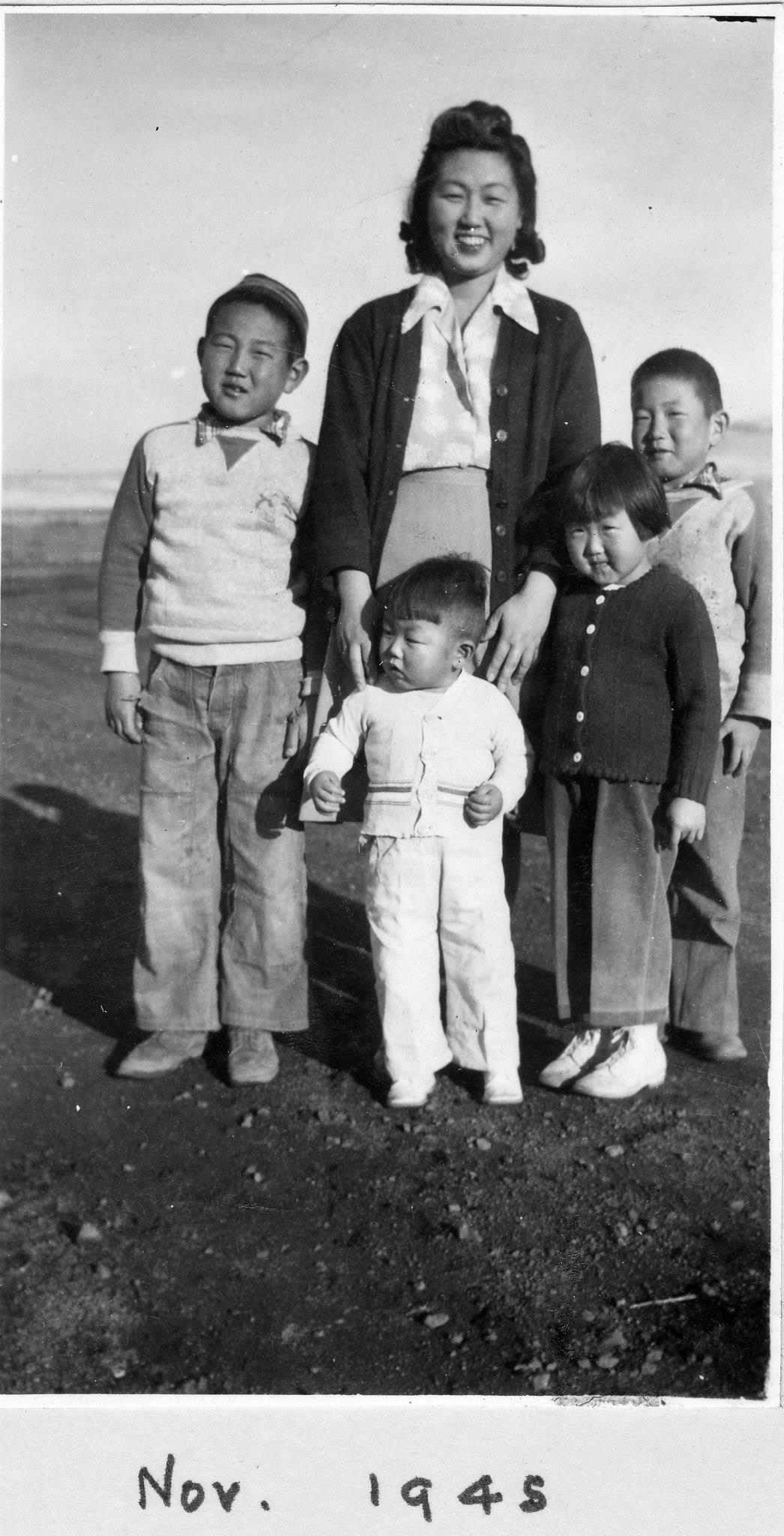
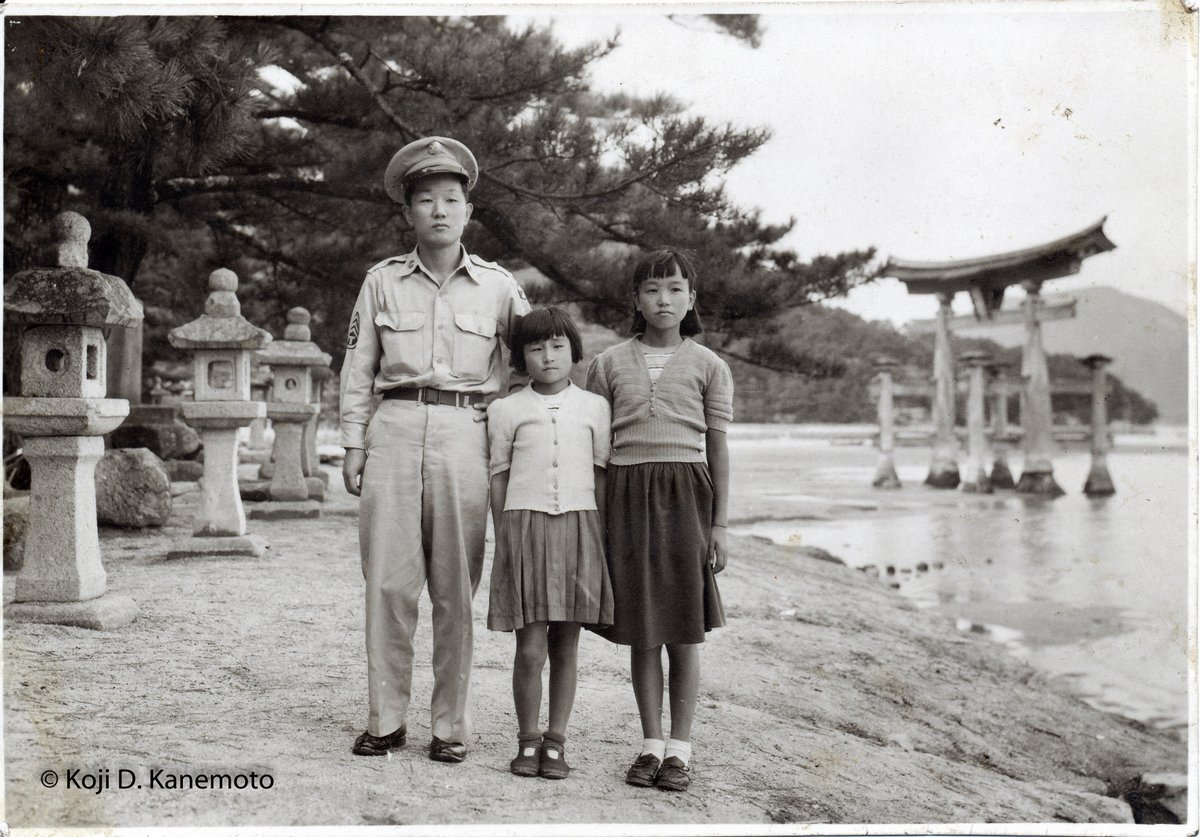
Uncle Yutaka, taken at the Minidoka, ID “War Relocation Center”, circa 1944. You can see the sub-standard wooden barracks they lived in; they only had tar paper covering the wood slat walls. Yutaka was the oldest surviving sibling but was imprisoned here during the war. My dad and cousins were also here but no picture of them is available.Aunt Shiz and my cousins as they leave the Tule Lake, CA “War Relocation Center”, November 1945. My best guess is she still doesn’t know for certain that her younger brother Suetaro had been taken by the Japanese Imperial Army and killed. The atomic bomb was dropped on Hiroshima where her mother Kono and older sister Michie (and her children that went on the pilgrimage) lived just three months earlier.Dad in his US 8th Army uniform along with Namie (center) who went on the pilgrimage and Sadako, her older sister. Dad had taken them Spam and C-rations plus clothing he bought at the PX in Tokyo. April 1948, Miyajima, Japan.Uncle Suetaro’s official death certificate from the remnants of the Japanese military. It was dated October 15, 1947, less than two months before my dad arrived as a US Army sergeant for the Occupation of Japan.
My Thoughts of the Experience
I cannot speak for Masako or my other cousins but what you believe in is almighty. Hope. Fear. Happiness. Sadness. I experienced all those during the pilgrimage to Leyte.
While listening to Masako’s tender letter to Uncle Suetaro, a feeling of deep regrets and the dashing of hope experienced by Grandmother Kono buried me. My heart could see Grandmother’s face in silent torment, resting in Masako’s arms in 1954 as she drew her last breath in the Kanemoto family home.
Grandma Kono at her Seattle barbershop, circa 1917. A forlorn Grandma and Masako, sometime after learning of Suetaro’s death, circa 1948. Grandma would pass away in this very home six years later.
Just like most American mothers, Grandmother must have clung on to a hope – however dim – that her youngest son Suetaro would come home… the one she decided to keep from returning to Seattle in 1940 so that he could carry on the Kanemoto name and inherit the home and land. That was not to be now. It would have been better to have let him go home. Her son would be alive.
But perhaps Uncle Suetaro would have ended up in the same prison camps that my dad, aunts and uncles were in but would still be alive. Or, he would have answered the call out of camp and volunteered for the US Army as thousands of other Nisei’s did to prove their loyalty, only to die in Italy or France as part of the 442nd Regimental Combat Team during WWII.¹
Uncle Suetaro and my dad.
I also thought about my dad often during the trek. At 96 years of age, this journey would have been physically impossible for him. More so, I wondered if the stirring up of fond memories of his youngest brother would do more harm than good at this stage in his life.
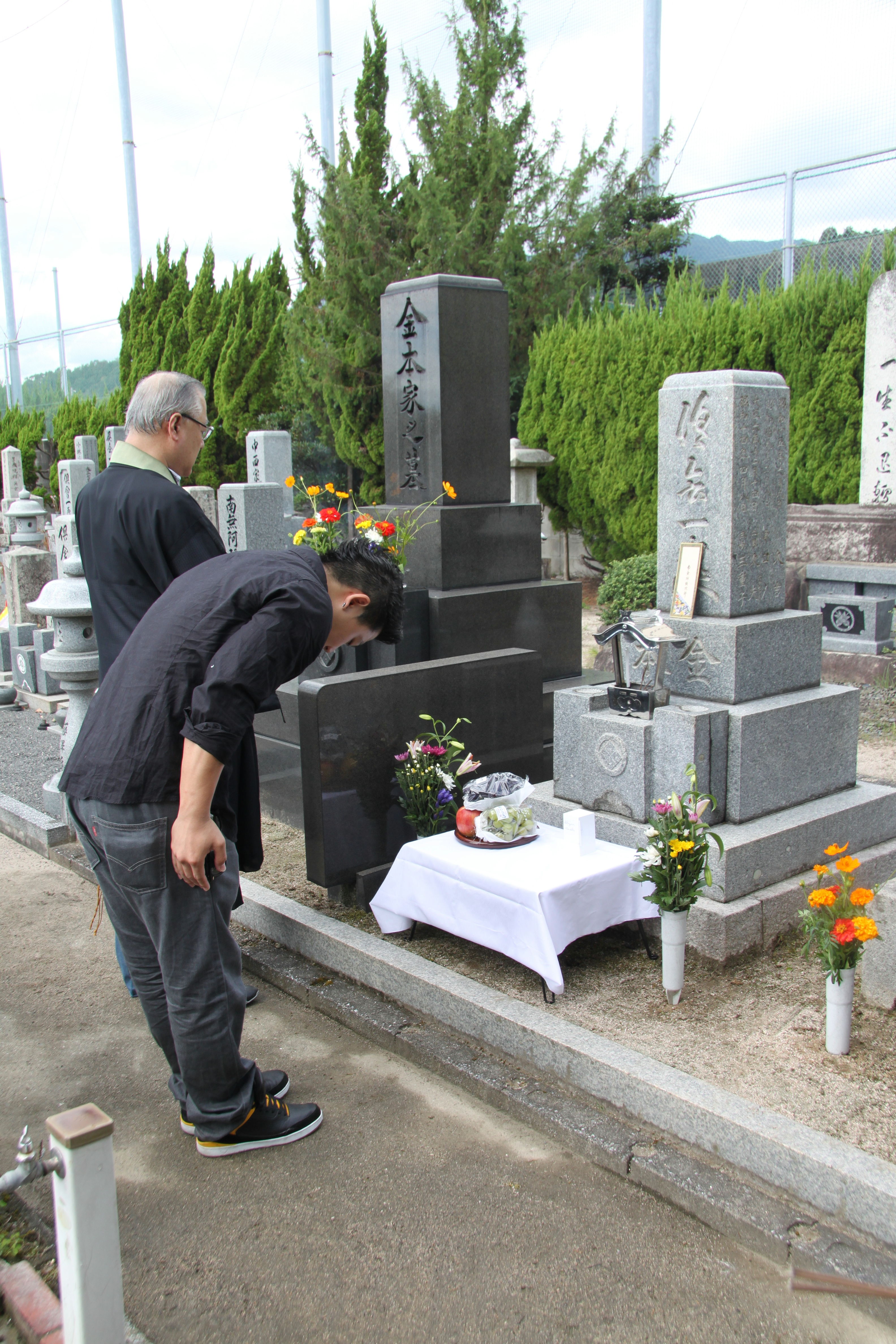
In 2012, my then 24 year old son bows deeply in front of the family crypt holding Uncle Suetaro’s fingernail clippings and a lock of hair. Uncle Suetaro was killed also at 24 years of age.
I also felt more deeply the quandary confronting Uncle Suetaro when he was drafted into the Japanese Imperial Army. The decision he had to make to knowingly fight the country your siblings were living in as Americans… and the country he most dearly wanted to return to. However, he wrote in his farewell letter that he will fight to free his older siblings from the prisons FDR sent them to.
Also in his heart and in that of his mother, both knew this was a one-way trip. A death sentence. Japanese soldiers rarely returned from war. In the case of his IJA’s 41st Regiment, only 20 young men returned home out of 2,550.
I’m sure just like any other American boy, he wanted a life that was worth living, a life filled with feelings, emotions, love and dreams. That would never happen and it pains me without end.
Before he met his death, was he drowned in futility or solace? Did he see death up close and come to the stark realization that would be his future perhaps tomorrow? What did he dream about as he took his last breaths or was he blindly looking up at the stars hoping? Was he dreaming about his childhood, playing on the corner of King and Maynard in Seattle with my dad? Was he in great pain or was his death swift and without warning? Did he see the eyes of the American soldier inches from his own eyes in a hand-to-hand combat to the death? Was he hungry? How terrified was he?
A tiny photo of the two brothers, dad and Suetaro, in Hiroshima, perhaps 1928. It fell out from behind one of the pictures in Uncle Suetaro’s photo album, filled with pictures Uncle Yutaka likely mailed to him from Seattle. Although tiny, it must have been precious to Uncle Suetaro for him to have kept it. I wish I knew why.
The painful mystery of what Uncle Suetaro did, felt or saw in his last days will remain forever so… That is one agony that will be with me until my own time comes. Happily, we at least visited him in his unmarked graveyard among the now lusciously green vegetation with the birds endlessly singing Taps for him.
As Izumi passionately said to Uncle Suetaro’s spirit, “Come home with us.”
Indeed, he did.
He is no longer a soul lost in a faraway jungle.
_________________________________
I wish to thank my Hiroshima cousins for making this unforgettable pilgrimage possible and a special thank you to Izumi whose untiring efforts to follow up on Japan-based leads brought comfort to our family. I also wish to express my sincere gratitude to Akehira and Carmela who made dear Masako’s journey so comfortable and worry-free. And a heartfelt thank you to Mr. Yusuke Ota whose in-depth knowledge allowed us to see our Uncle Suetaro’s last footsteps on this earth and gave Masako peace in her soul.
Most of all, Uncle, thank you for your sacrifice. Indeed, you set your older brothers and sister free.
Rest in peace.
南無阿弥陀仏
____________________________
Other chapters are here for ease of locating earlier posts in this series:
My foolproof creamy Spaghetti Carbonara from scratch.
I had started out thinking this would be another “She’s Killing Me” story; it certainly qualified but this pasta dish turned out so well that it’ll just be another cooking story. Well, not completely.
But it’s my creamy Spaghetti Carbonara.
__________________________________________
The kids were in Japan for over three weeks and landed at LAX at night on August 17th. In short, the ex insisted on picking them up and keeping them for a few days. But she decided it would behoove her to bring them to my house so she changed the schedule at 3 pm the next day. They were dropped off at my house at 5:30 pm. Of course, she had selfish reasons and yes, they were in la-la land from jet lag. They slept for the most part for the first couple of days.
Seriously, I had mentioned to the kids they should have some kids over since school begins August 31st. Jack just wanted to stay home but my Little Cake Boss Brooke… That’s a whole ‘nuther story.
All week, between snoozes, she was asking if I would take her and her friends shopping.
“Sure but DON’T make it last minute, OK?” said I.
Just like the previous two times… Wednesday, no plans. Thursday, no plans. Friday, no plans… Then Saturday, at 3:30 pm, she says, “Can ‘J’ come over?”
I never learn. “Sure,” I hesitatingly replied.
“…Can sheeee… eat with us,” she cunningly asked. Never mind I had gone to the supermarket already for just the three of us.
“Oookay” I replied even more hesitatingly.
Then the whammy: “…Can sheeeeeeeee… sleepover?”
Arrrgghhh.
_________________________________
So I decided to make Spaghetti Carbonara – for the first time. I thought her friend J would give some feedback if I asked her. So I went to Cook’s Illustrated… and the pasta dish turned out excellent if I say so myself.
The ingredients are simple and I had them in the fridge already – except for the Pecorino. Yes, because of my Little Cake Boss, I had to make another run to the supermarket just for the cheese. Well, actually two since the first place didn’t carry it:
8 slices bacon, cut into 1/2-inch pieces (They’re easier to slice up if you freeze them for a bit.)
1/2 cup water
3 garlic cloves, minced
2 1/2 ounces Pecorino Romano, grated (1 1/4 cups)
3 large eggs plus 1 large yolk
1 teaspoon pepper
1 pound spaghetti
1 teaspoon salt
Putting it all together was a snap; their instructions are:
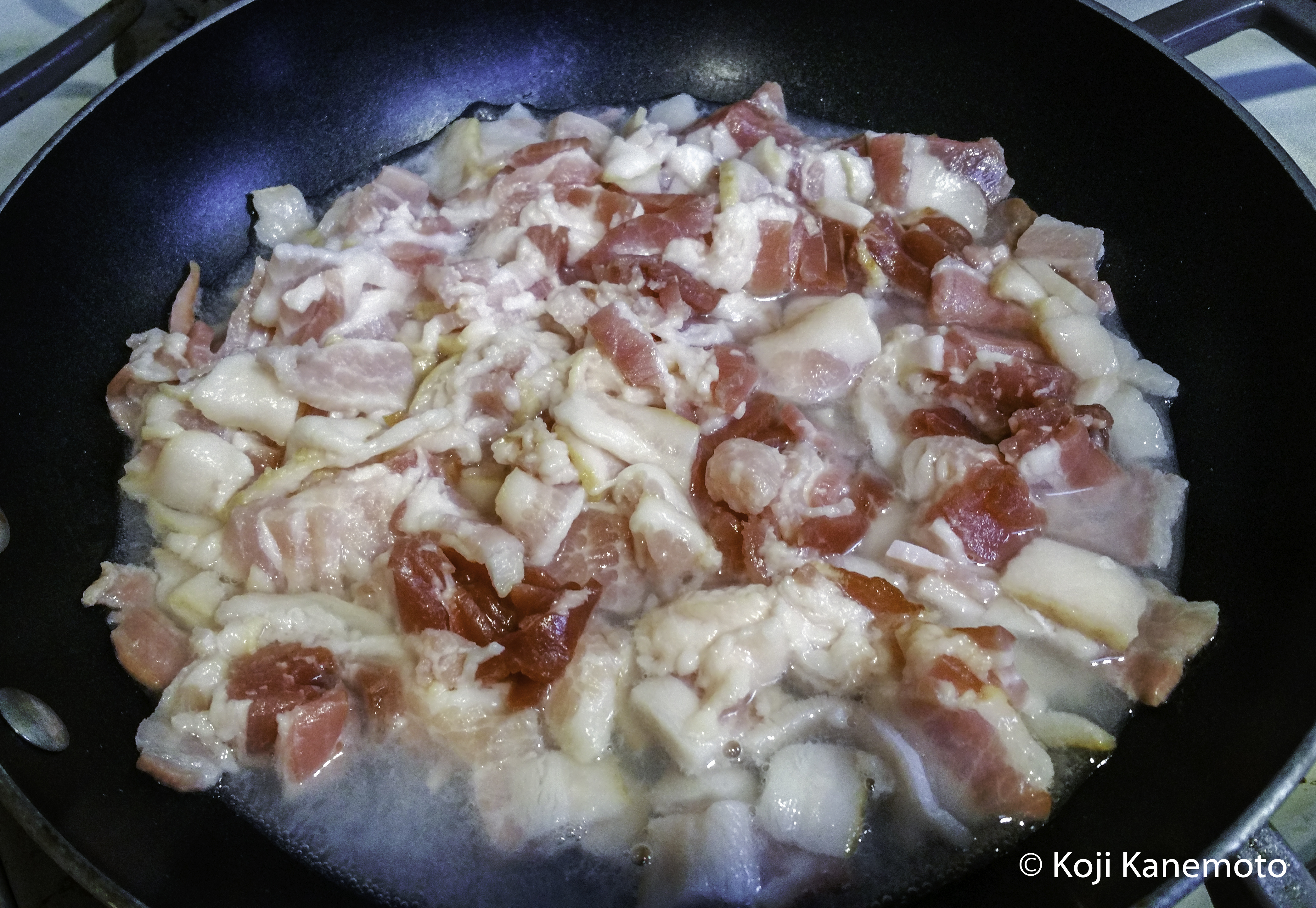
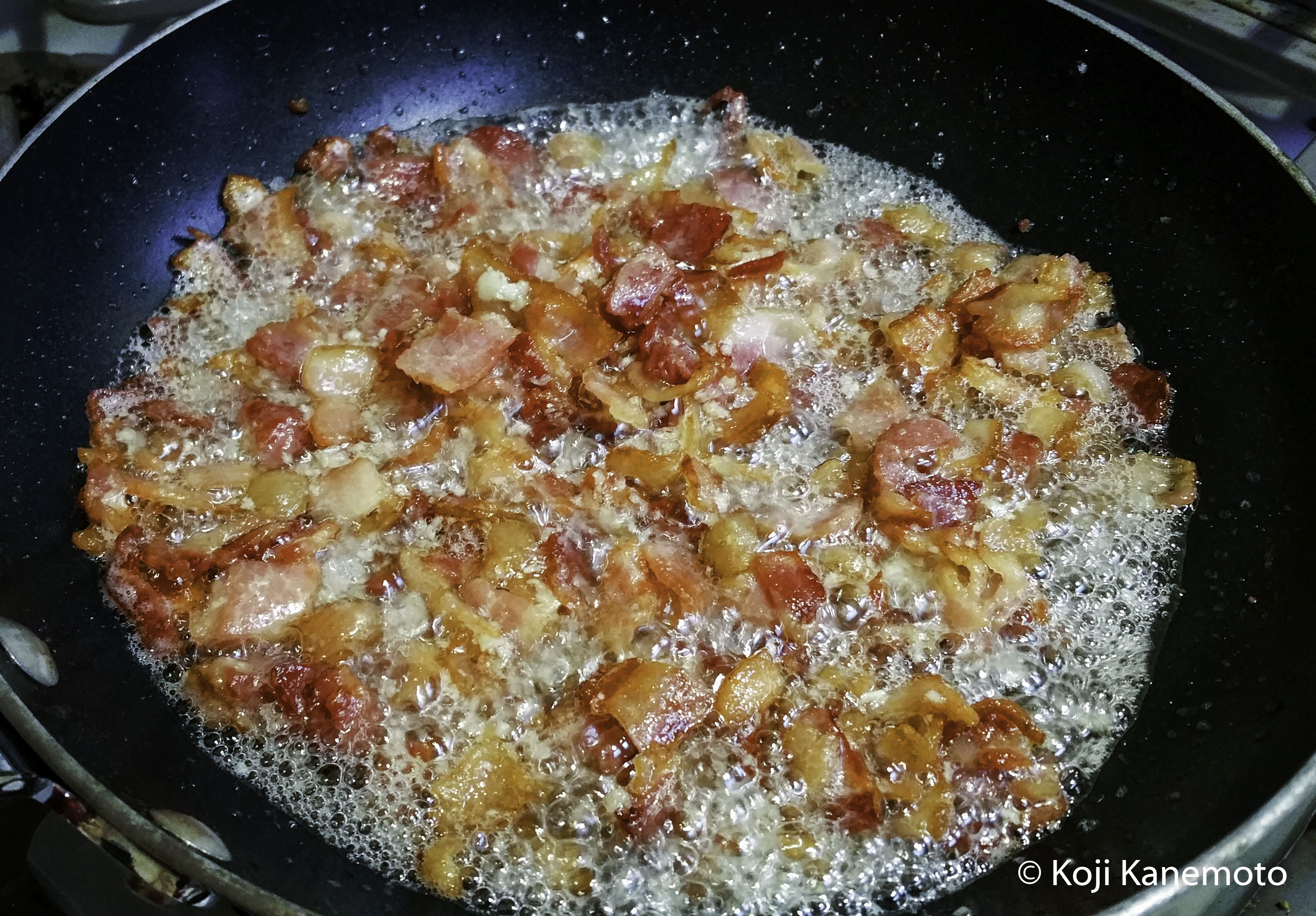
1. Bring bacon and water to simmer in 10-inch nonstick skillet over medium heat; cook until water evaporates and bacon begins to sizzle, about 8 minutes. Reduce heat to medium-low and continue to cook until fat renders and bacon browns, 5 to 8 minutes longer.
Doing it in the above manner allows the bacon to remain chewy for the carbonara and not crisp up:
With the water added to the bacon.Water’s nearly evaporated, right around eight minutes. A snap!Near the end of the cooking cycle. The bacon turned out as advertised! Chewy yet done and substantial.
2. Add garlic and cook, stirring constantly, until fragrant, about 30 seconds. Strain bacon mixture through fine-mesh strainer set in bowl. Set aside bacon mixture. Measure out 1 tablespoon fat and place in medium bowl. Whisk Pecorino, eggs and yolk, and pepper into fat until combined.
3. Meanwhile, bring 2 quarts water to boil in Dutch oven. (You use less water than normal for this dish to insure the water you will add to the sauce is real starchy.) Set colander in large bowl. Add spaghetti and salt to pot; cook, stirring frequently, until al dente. Drain spaghetti in colander set in bowl, reserving cooking water. Pour 1 cup cooking water into liquid measuring cup and discard remainder. Return spaghetti to now-empty bowl.
4. Slowly whisk ½ cup reserved cooking water into Pecorino mixture. Gradually pour Pecorino mixture over spaghetti, tossing to coat. Add bacon mixture and toss to combine. Let spaghetti rest, tossing frequently, until sauce has thickened slightly and coats spaghetti, 2 to 4 minutes, adjusting consistency with remaining reserved cooking water if needed. Serve immediately.
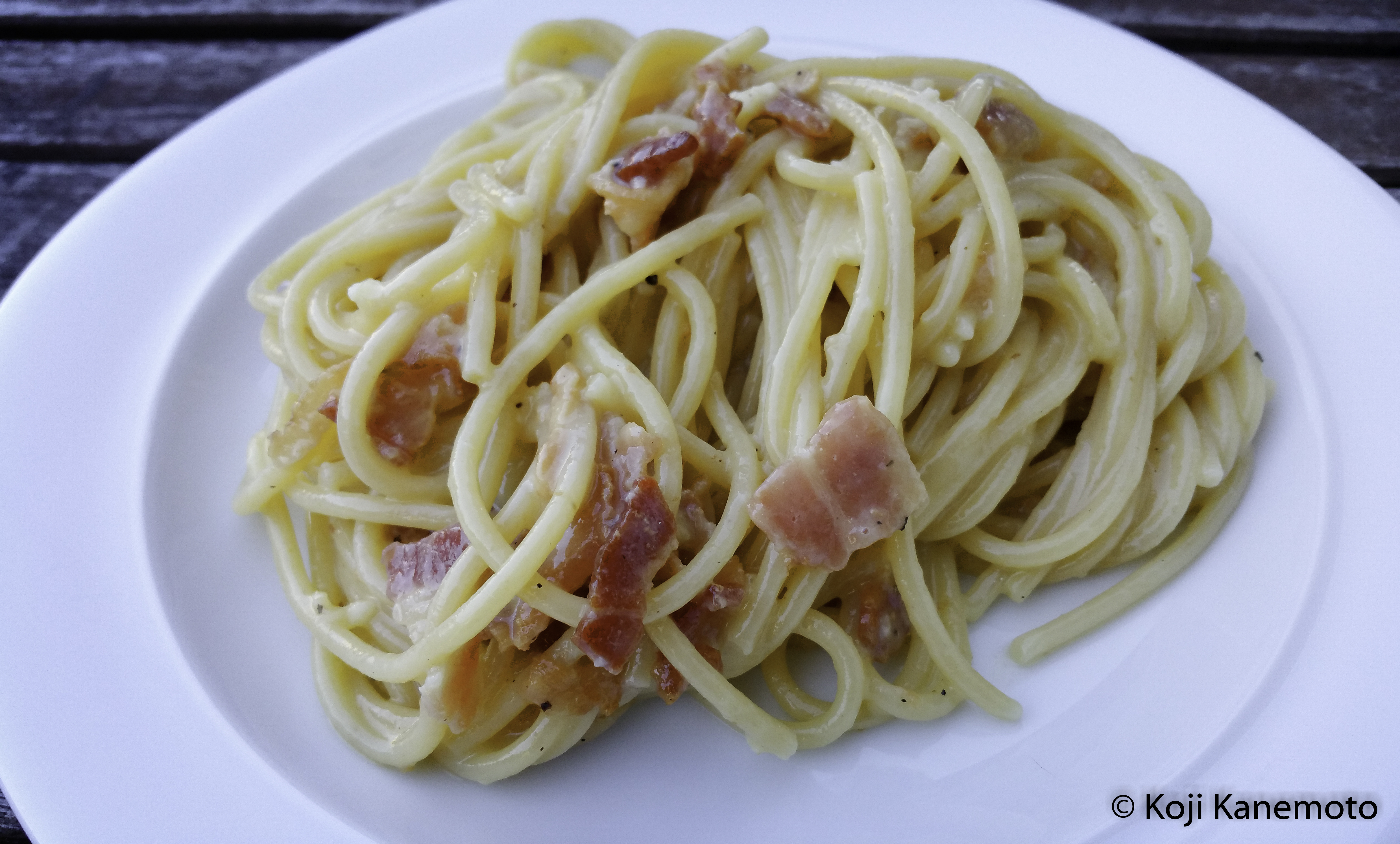
Voila!
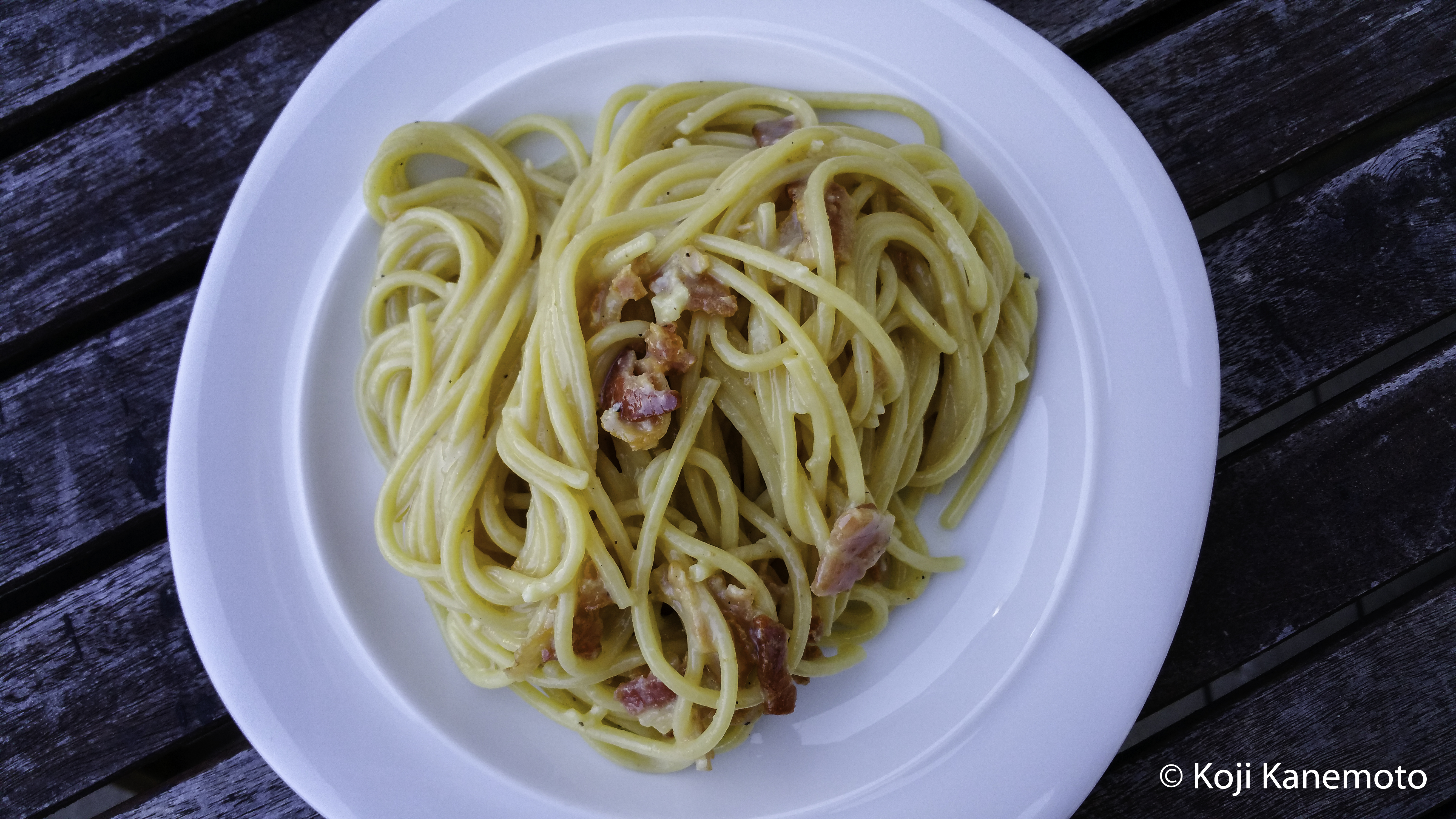
Spaghetti Carbonara, creamy and full of flavor – and not heavy!
Most of all, happy faces!
The Little (and cunning) Little Cake Boss and her classmate friend “J”.
So give this easy and delicious dish a shot.
Someone will love it!
And by the way, they were up until 4 am. Let me ask you moms: Why do you even call it a sleepover??!
My shepherd’s pie. The kids love it. They even eat the peas!
Well, my kids finally returned from Japan this past Monday; they had been gone for over three weeks. Believe me, I didn’t like it ONE bit. Worst part of it was my ex prevented me from emailing with them for longer than the last two weeks of their stay. What kind of parent would do that, I ask? There are some other irritating things about this trip – like her postponing applying for the Little Cake Boss’ passport until the last minute. They finally picked it up from the Federal Building in Westwood two working days before their departure in late July. No kidding.
But they are back albeit badly jet lagged; they went back to their mom’s today after a groggy week with me. I had asked them what they would like to eat their second night back now that they are home and Jack immediately, said, “Shepherd’s Pie!” So Shepherd’s Pie it was.
As a couple of my friends have asked me to provide them with the recipe, I thought I’d take a break from writing about my Leyte pilgrimage. The pilgrimage was emotionally draining; it still is weighing on my heart, especially when I write about it for my family’s sake.
On Leyte, July 2015.
________________________________________
The recipe is quite easy. I use Rachael Ray’s recipe for this one instead of my standby cooking bible, Cook’s Illustrated. Besides, she’s as cute as a button. (Did you know some “pro” chefs on TV don’t think she should be showing people how to cook?)
The ingredients are:
2 pounds potatoes, such as russet, peeled and cubed
2 tablespoons sour cream
1 large egg yolk
1/2 cup cream
Salt and freshly ground black pepper
1 tablespoon extra-virgin olive oil, 1 turn of the pan
1 3/4 pounds ground beef (lean preferred for me)
1 carrot, peeled and chopped
1 onion, chopped
2 tablespoons butter
2 tablespoons all-purpose flour
1 cup beef stock or broth
2 teaspoons Worcestershire, eyeball it
1/2 cup frozen peas, a couple of handfuls
1 teaspoon sweet paprika
2 tablespoons chopped fresh parsley
For the potatoes, I use russets, about four of the potatoes found in your typical supermarket’s bulk bag. While I wash the skin, I leave the skin on and drop them into cold water with about an inch to cover. The reason I start with cold water is that I believe (ha) that the potatoes will cook more uniformly. I feel that dropping them into boiling water will cook them unevenly, from the outside-in.
Combine sour cream, egg yolk and cream. Add the cream mixture into slightly mashed potatoes then mash until potatoes are almost smooth.
While potatoes boil, preheat a large skillet over medium high heat. Add oil to hot pan with beef or lamb. Season meat with salt and pepper. Brown and crumble meat for 3 or 4 minutes. Add chopped carrot and onion to the meat. Cook veggies with meat 5 minutes, stirring frequently.
In a second small skillet over medium heat cook butter and flour together two minutes. Whisk in broth and Worcestershire sauce. Thicken gravy one minute. Add gravy to meat and vegetables. Stir in peas.
Preheat broiler to high. Fill a small rectangular casserole with meat and vegetable mixture. Spoon potatoes over meat evenly. Top potatoes with paprika and broil 6 to 8 inches from the heat until potatoes are evenly browned. Top casserole dish with chopped parsley and serve.
_________________________________________
As a side note, I do cook the carrots a bit first, then add the ground beef and onions to brown. If still frozen, I throw the peas in for a minute before I add the gravy mixture.
Lastly, you’re not going to see the paprika and chopped parsley leaves in the picture above because… I forgot. Old age sucks.
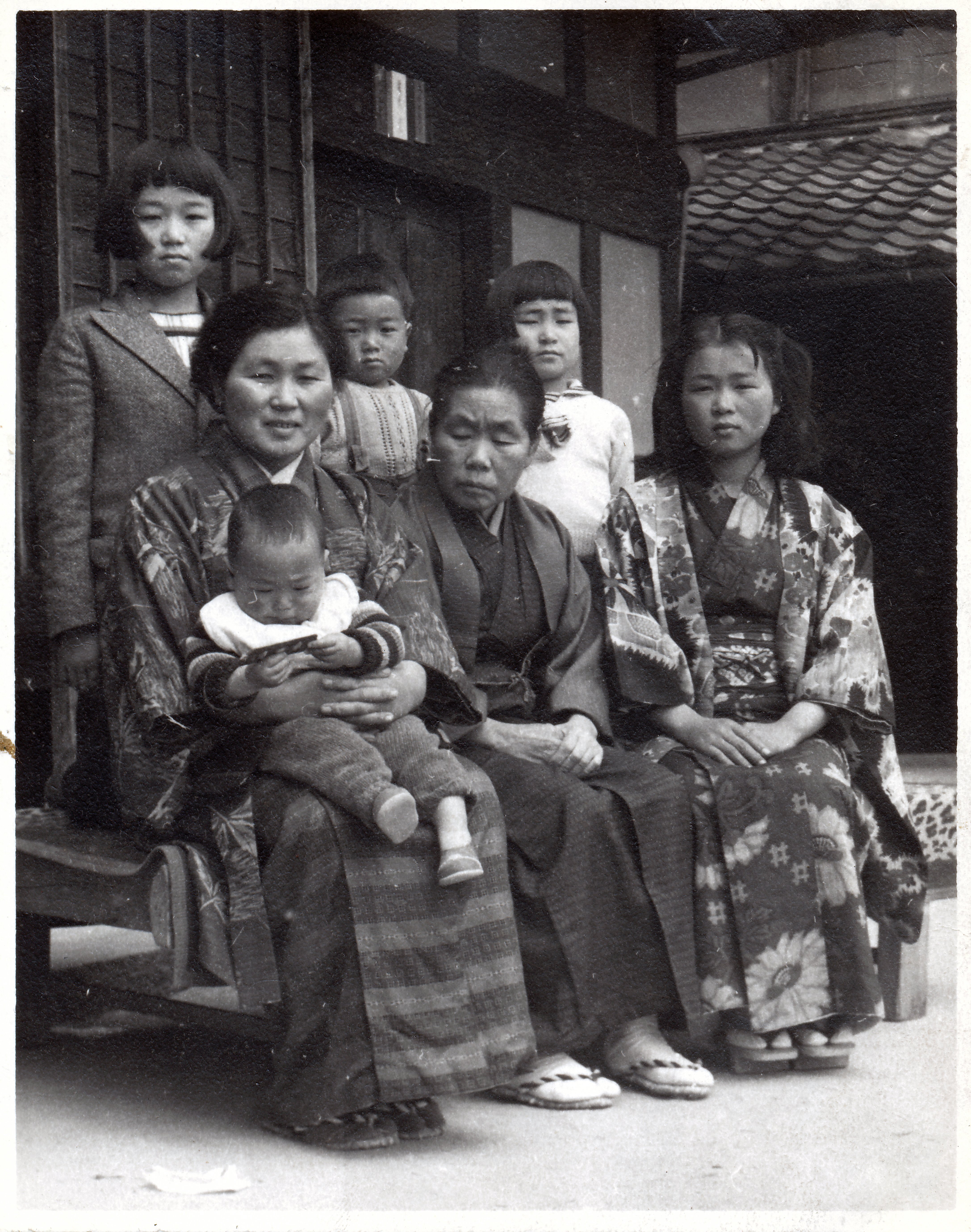
In our pilgrimage from the photo above was then baby Kiyoshi (held by their mother Michie), Masako on the far right in a kimono and Namie standing next to her. Taken by my father in 1948 in front of the Kanemoto home in Hiroshima. The house was still not repaired from the damage caused by the atomic bomb.
“Uncle, Let’s Go Home…”
Uncle, let’s go home… Those were the words that devotedly flowed with compassion from Masako’s daughter, Izumi, during our fourth and last memorial service on Leyte. “Leyte Fuji” stood before her, covered in greenery that had likely been destroyed 70 years earlier. Her voice was draped in unchained anguish and power. Her unbridled emotions from her 心 – her heart – were felt by everyone; tears and restrained sobs were in abundance.
Me included.
___________________________________________
There are readers who had their fathers or other loved ones killed or imprisoned by the Japanese. There are readers whose loved ones learned to forgive after fighting a bitter war. There are readers who will forever despise what the Japanese did. I certainly accept that.
While these services may be foreign in appearance, they are to honor those killed in a field of combat. If you live in America, place yourself on the sacred grounds of Arlington… Then you glimpse a caisson pulled past the crosses with the flag draped over a casket or taps being played with the folded flag presented to the deceased loved one with thanks given by a comrade on bended knee.
That is what these services are in substance, at least in my opinion.
Just no cemetery.
The difference is my uncle is not in any cemetery. (US Army cemetery under construction, Leyte. US Army photo.)
Day 4 – Last Service
After the long climb down the path Japanese soldiers took in December 1944 from the town of Catagbacan, we briefly rested in a small, humble cluster of family dwellings.
A dwelling at the foot of the path down from the mountain. A couple of villagers climbed palm trees like the one in the center to cut down coconuts.
In an effort to help in their sustenance, Mr. Ota paid the village folks to climb up palm trees to cut down what appeared to be coconuts. They chopped open the narrow end at an angle with a machete and we sampled it.
Soon, we retreated to the air conditioned vans, taking two villagers (including the guide with the machete) to where a motorcycle would take them back up the long, winding dirt road and home (Catagbacan). While I was near death, these two young men weren’t winded at all. My older cousins had also recovered nicely. Hmm…. Am I old?
We headed to a quick outdoor lunch before continuing on to our last memorial stop: “Leyte Fuji”.
_________________________________________________
Last Memorial Service – and the Most Emotional
As we neared the end of our journey, I had come to realize we have been reading our kind thoughts to our family members, both Uncle Suetaro and Lt. Nakamura, both of whom were killed in war and left on this island. What made it doleful is that it would have been much, much better to say these kind words to them while they were living.
But there was one anguished tone among all the letters, excepting Masako’s: we all apologized in one way, shape or form to our departed uncles for not knowing of them or even they had died in war… That we were enjoying life. And we all shared remorse for all the young men who died here under these gruesome conditions – Japanese or American. They took their last breaths fighting for what they believed in, smothered by depression and futility, death, disease, in unwashed and bloodied uniforms.
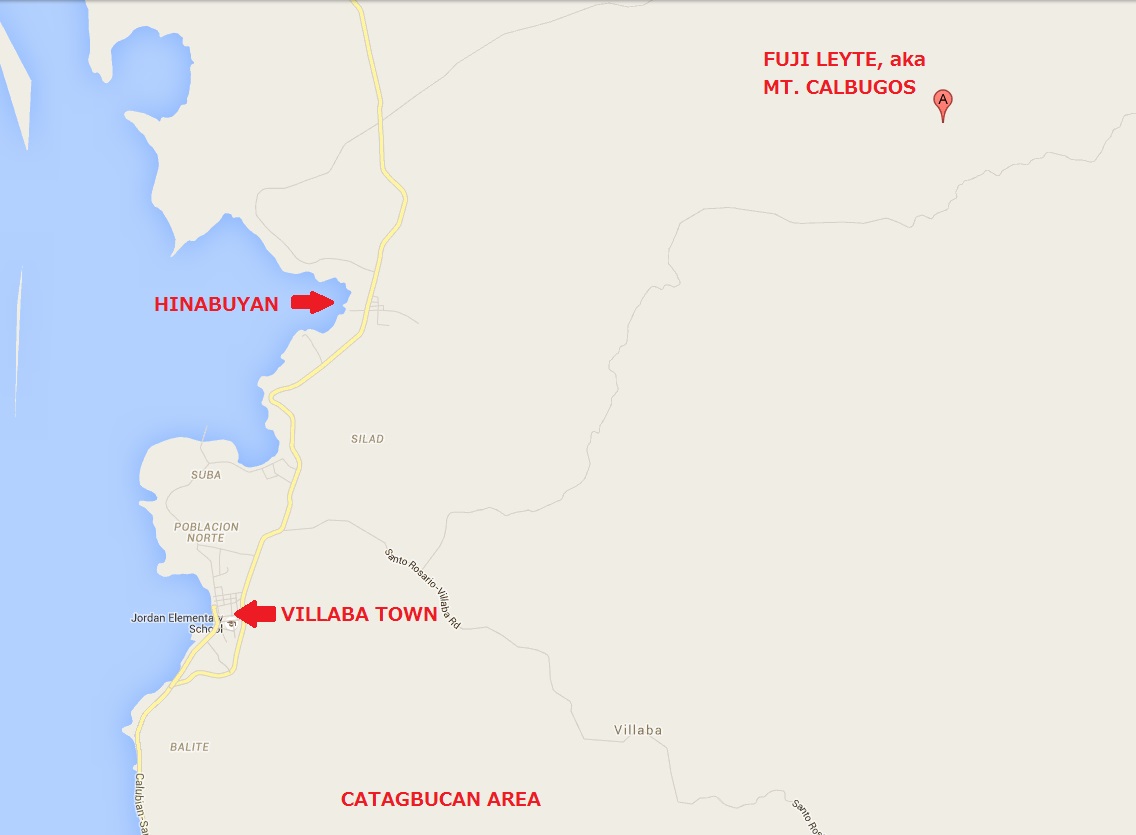
Approximate location of “Leyte Fuji”, or Mt. Calbugos.
“Leyte Fuji” is the nickname given to Mt. Calbugos (aka Calbukos, 11.2541,124.4539) by the Japanese over the decades. Many deaths occurred around this hilly range with the one prominent peak; while large numbers were of Japanese, American soldiers also perished as did many Filipinos.
Leyte Fuji was in clear view from the spot picked by Mr. Ota; it was at the end of a short road, in from a narrow highway. There were some very basic dwellings and a small village store. There were children about as there was an open air schoolroom adjacent to where we parked; it was an unpaved and decaying homemade basketball court. Palm tree stumps were used to hold the rickety backboards made out of scrap pieces of wood.
The outdoor classroom filled with children can be seen.
An occasional two-cycle engine’d motorcycle would putt by and the loud voices of young school children at play showed their interest was understandably elsewhere.
The sun was not bashful; the sunshine was blazing and the air sweltering. The group did their best to setup the memorial table for the last time but a constant and mischievous hot breeze kept the photos fluttering and softly toppled the other items.
The two best “readings” were from these two fantastic ladies. The best for last, as they say. Every heartbreak, every torment, every regret, every loss and the feeling of shame flowed forcefully – shame that we all knew very little of these men who died. Some did not know them at all until recently – like me and Setsu.
Setsu wrote her letter with traditional brush and charcoal ink. Such writing can show the emotions of those writing them. Think of them as art.
While Izumi read her letter first, I choose to describe now Setsu’s passionate reading to her uncle, Lt. Nakamura. She had chosen to write her letter on a traditional Japanese notebook with brush and charcoal ink, writing daily and filling it with her deep and unrestrained feelings.
She bowed at her uncle’s picture on the memorial table. Leyte Fuji was dominant before her. She began by introducing herself as his niece. She understandably broke down a number of times. There is no shame in that.
In one passage, she said a nurse had stopped by her grandmother’s house after war’s end. The nurse said she had went with Lt. Nakamura to dockside to send him off… and that he told this nurse he should be on the next ship and coming home soon. Even after she received official notification after war’s end that he was declared dead on July 15, 1945, she probably continued to believe he would still come home… just like my Grandmother Kono.
The peak of Leyte Fuji. Many people died on this now green land. Just realizing there are unburied bones humbled me incredibly.
In another passage, she talked about her father (Nakamura’s brother) that when he went off to war, he knew in his heart Lt. Nakamura would never be coming home. She felt tremendous anguish knowing her father suffered such a burden for so many years.
A much shortened video of Setsu’s letter:
Setsu’s letter was very eloquently read in spite of overflowing emotions. It simply brought many to tears; Masako had to sit down, apparently overcome with the sadness and heat.
_________________________________________
Of my Hiroshima cousins, I have communicated with Izumi the most. The only daughter of Masako, she looks after Masako in spite of working six days a week as a pre-school teacher and raising her beautiful daughter, Yuu-chan. She is a most caring person and feels for others.
It is with Izumi this trek for Uncle Suetaro’s hidden life and death began in 2010. My then seven year old daughter Brooke was snooping in my dad’s closet at his assisted living apartment when she stumbled across my dad’s small box. She had opened it up and brought out a photo of a Japanese soldier. I thought, “Gee, that’s odd,” as I knew my dad was US Army. So I showed my then 91 year old dad the picture of the Japanese soldier and asked him, “Who’s this?”
He quickly replied, “Sue-boh (pronounced SUE – e – boh).”
“Sue-boh? Who’s that?” I asked.
“My brother. He was killed.”
And so the journey began, culminating in Izumi’s passionate reading of her letter to Uncle Suetaro below.
__________________________________________
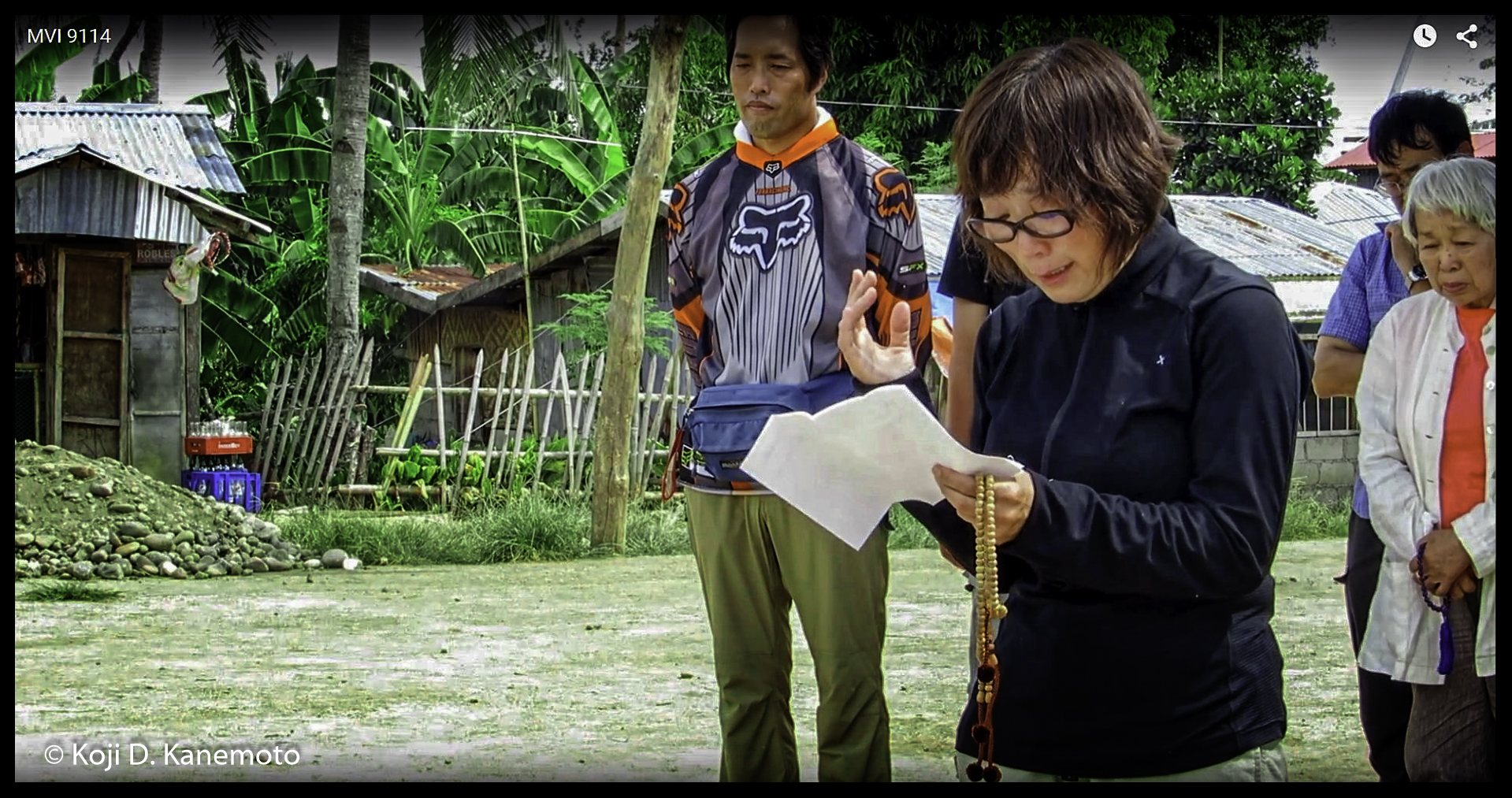
Screenshots of video I took of Izumi emotionally reading her letter to Uncle Suetaro. Her video will be kept private.How the scene appeared on July 22, 2015. You can see the makeshift basketball hoop in the background. We all freely broke down.
Preceded by a short, softly spoken message from Namie, trying to summarize Izumi’s well-written letter afire with emotions by using words is not possible; yet, I will try to summarize her words here and how it was delivered:
“Dear Uncle Suetaro,
We have come together at last… I have come to take you home…”
Five years of pent up emotions burst forth. Her emotions overcame her and sadness showed itself through her broken voice and tears. Indeed, after we all heard her say “take you home” to our forgotten uncle, the flood gates opened for everyone.
“You still have family in America… When Koji asked me about you, I was so ashamed as I knew nothing… Since then, you have become deeply entrenched in my heart and soul, day in and day out… You are forever in my mind…”
She paused to try and collect herself. She was only partially successful; it was clear that for her, this was a cleansing, a purging of sorrow, regret and happiness that had amassed over the last five years.
“With the unending patience from Mr. Ota, I learned of your hardships… Of how you arrived here for war… Your battles and final days.
After learning of your sacrifice for your (American) family as well as Japan, I said to Koji, Masako and my aunts, ‘We must go to Leyte’… and now, we are finally here with you… I have now heard your voice, was touched by your heavenly soul and heard of how kind and gentle of a young man you were…”
She paused again to collect herself and continued with her magnificent reading.
“Last year, my mother was hardly able to walk. After memories of you from 70 years ago were stirred up, my mother said you beckoned her here… and she is now here, dismissing her bad legs and all from her mind, to be with you here and to honor you on this land…
And to all of your fellow 41st Regiment soldiers who died, you had to do your duty seven decades ago and you did that with tremendous fortitude and courage… Your bravery has seeped into me…
To the souls of the 41st Regiment and Uncle Suetaro, let’s go home together…
Love, Izumi”
Nobody had Puffs… Even then, several boxes would have been required.
Our group with the memorial table before us and Fuji Leyte behind. Yes, brave and young men were killed on this very ground.Masako and Izumi, their pilgrimage to seek out Uncle Suetaro ending in front of Leyte Fuji.
A Marine protecting Vietnamese children. This may be an AP photo.
I have a number of good friends who went to Viet Nam, another ugly war. Without going into politics, my thoughts while on Leyte also went to these friends who fought on or were stationed in Viet Nam.
Unlike a certain former president, my buds did not evade the draft… or avoid, whichever term you prefer. My friends did their duty. When they got drafted, they reported for duty as any American man should have.
But while I certainly appreciate their sacrifices, nothing in what I’ve read gave a hint about the climate THEY in Viet Nam had to fight and survive in. Having been on Leyte, I can now more fully sense it was indescribably WORSE than what was written, if any.
Just like for Uncle Suetaro and Smitty, their days were grueling and a throwback to the times of cavemen. Nightfall brought very little relief in temperature or humidity. If my friends were at a fire base in the Vietnamese jungles, they went on for days without showers or even toilets. New, laundered dungarees? Dry feet during the monsoons? No.
When I got back to LA and got over my jet lag, I called several of them to thank them even more and explained I more fully appreciate their sacrifices of their youth for the rotten conditions under which they faithfully fulfilled their duties. One also had a father who was gunner on a Liberator in the sweltering SWP as well. (There are a number of bloggers I know that I did not call but you know who you are. Thank you.)
_________________________________________________
Masako and Namie during a lighter moment. Clouds gave us a brief relief from the oppressive heat – but not the humidity.
Day 4 – Villaba
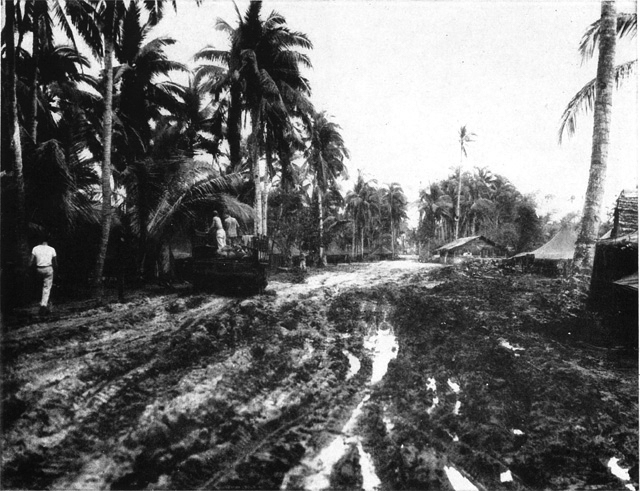
After chowing down in the morning, we piled into our well-driven vans once again. We headed north towards Villaba on the same road that Uncle Suetaro marched up in October 1944 to Carigara but back then, it was mostly dirt – or mud. They also had use of undetermined vehicles but the road offered no protection from US airpower from which rained bombs and strafing runs. US planes dominated the skies.
A muddy road on Leyte; the mud would become much worse. USMC photo.
In addition, their march north was hampered by attacks from US-supplied Filipino guerrillas. They would blow up parts of the road that were at most merely passable. In addition to slippery, oozing mud (see above), the Japanese were forced to go off the main road to bypass the destroyed sections. This implies, for example, that since Uncle Suetaro’s platoon was hauling their 37mm cannons, they would be forced to break down the artillery pieces into the two wheels and cannon barrel sections to carry it over blown up section of road… in addition to lugging their shells and ammunition.
________________________________________________
On our way north towards Cananga, Mr. Ota spotted a “Jack Fruit” at roadside; we had never seen a fruit this big before. Have you? It must be the Fat Albert of the fruit world.
The enormity of the Jack Fruit is apparent with Setsu standing next to it.
Passerbys were equally bewildered by our “touristy-ness”, it seems. We definitely caught their attention.
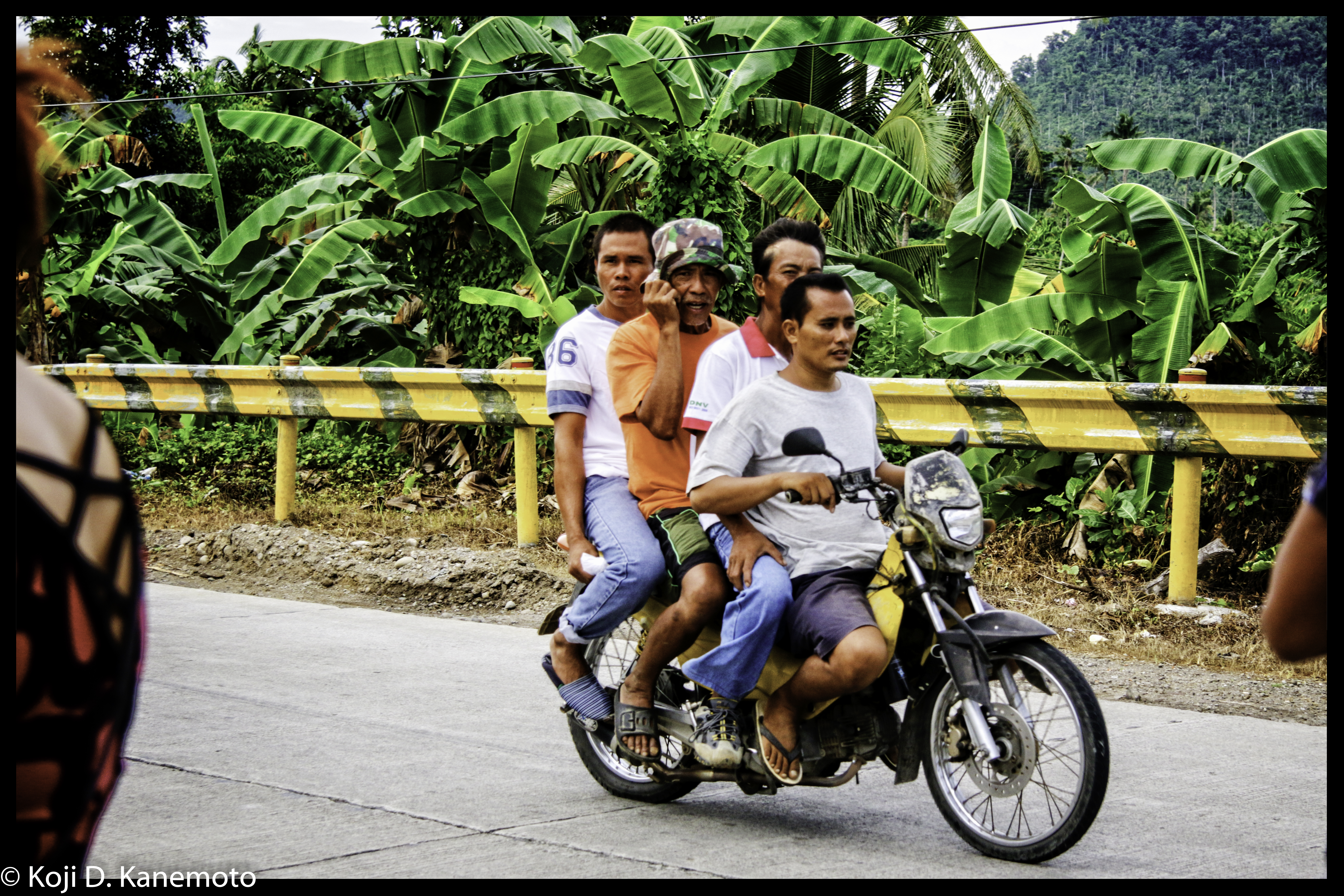
I believe this little motorcycle is powered by a 125cc two-cycle engine. Scenes like this were commonplace on Leyte.
Third Memorial Service
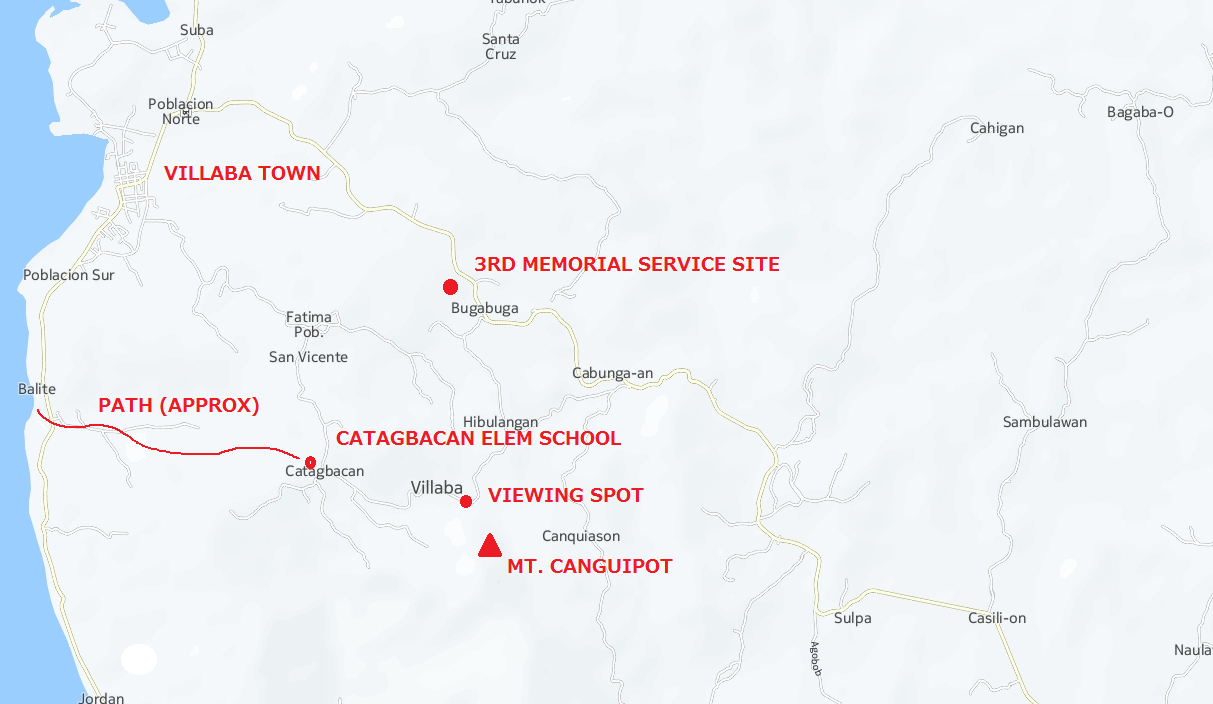
Detailed road maps of this area of Leyte are hard to find nor would my GPS work; as such, all locations indicated are approximate.
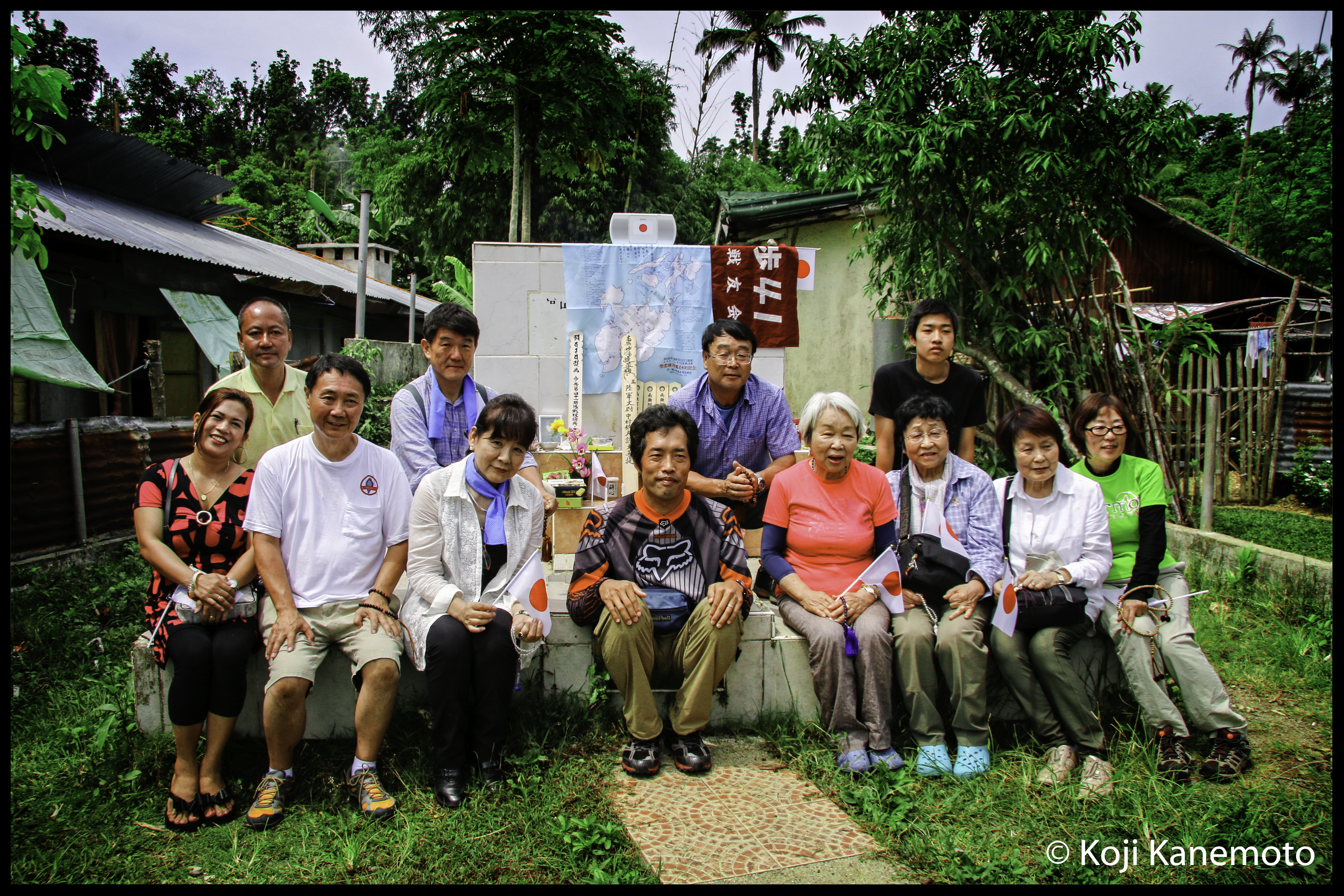
After veering off from a town called Cananga, we headed northwest. We stopped at an older memorial (indicated by #3 above) erected by a Japanese citizen many years ago. It had not been maintained but amazingly rested in between two dwellings. Unfortunately, it was erected just yards away from the street.
Busy preparing for the service. The incense is already going.Tribute to Uncle Suetaro along with food offerings. The origami cranes (folded paper art) are from the Hiroshima Peace Park.Tribute to Setsu’s uncle, Lt. Nakamura. He was one of the last 268 survivors before they met their deaths near here.
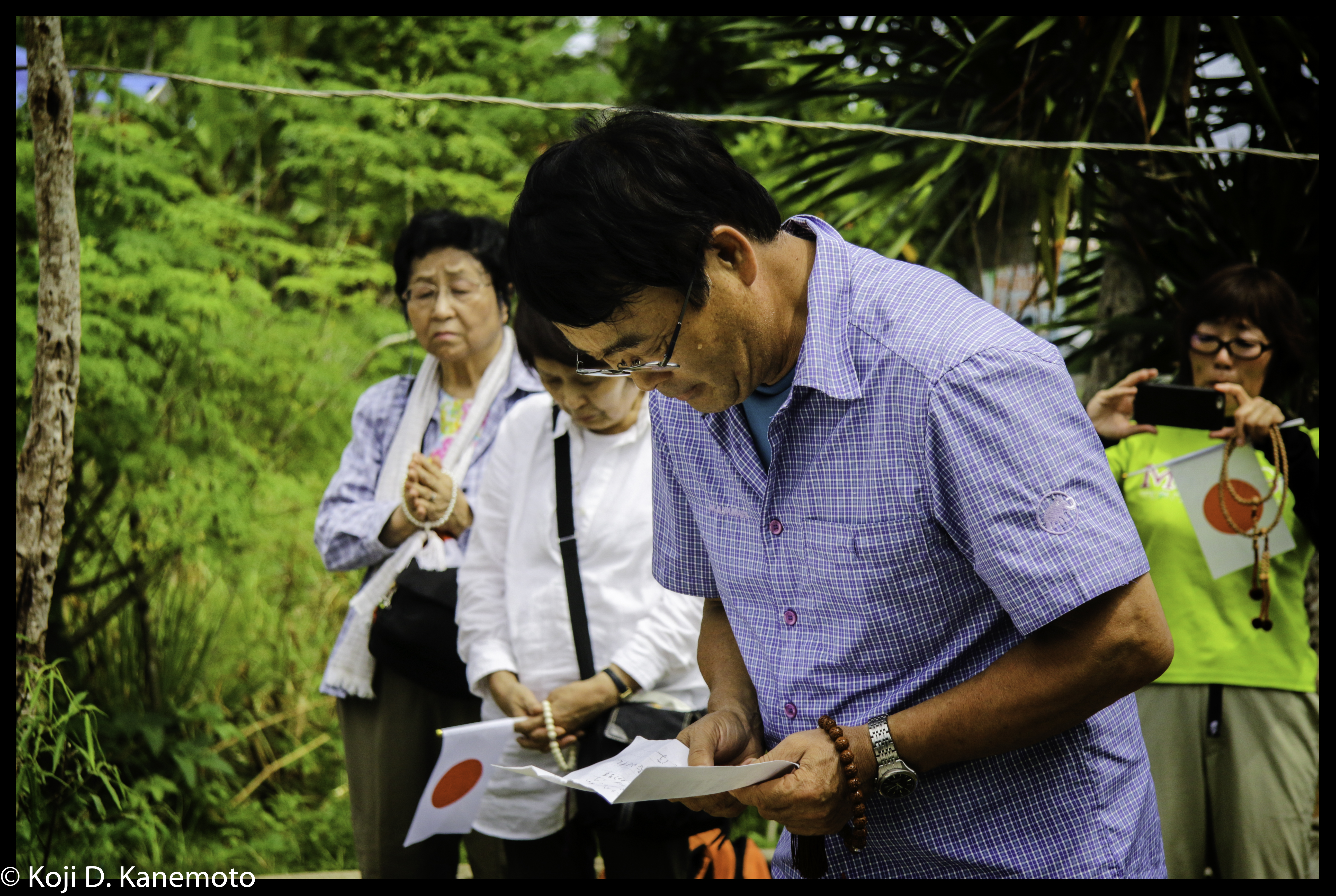
At this service, my cousin Kiyoshi read his letter to Uncle Suetaro.
Dripping in perspiration, Kiyoshi was incredibly strong emotionally reading his letter to his uncle that he was never able to meet. In his letter, Kiyoshi introduced himself to his Uncle Suetaro and that they were finally able to meet here. Kiyoshi hoped that Uncle Suetaro was not lonely as no one had come to see him in these past 70 years and to please forgive us. He explained he was the last child of Suetaro’s older sister Michie and that it is said he was born in Suetaro’s place after his death. Because of Michie’s strength and devotion, all of her children are living long lives. He closed by saying we will always remember his life and sacrifices then bowed reverently.
Kiyoshi bows reverently while perspiration runs down his face.
After closing the ceremony, we once again handed out the food to the local children and families who were very grateful and friendly.
This is where the young mother and daughter were photographed and shown in Part 1.
Again, like the low decibel thunder we heard after I read my letters, we soon saw a sign that Uncle Suetaro heard Kiyoshi and Namie: a rainbow appeared overhead, spotted by Izumi. It was very fulfilling for us to see.
It’s a badly exposed cell phone pic; sorry.The young man at the upper right is Mr. Ota’s teen-aged son, Daichi.
_________________________________________
We then headed towards the Mt. Canguipot area, a smaller hill just east of the town of Villaba (see map above). It is said many Japanese soldiers closed their eyes for the last time while looking at Mt. Canguipot. I understand Ms. Setsu Teraoka’s uncle, Lt. Nakamura, died here in its shadow, possibly during the last “banzai” charges against the US 1st Cavalry on December 31, 1944.
Our drivers, under Mr. Ota’s accurate GPS-assisted directions, wormed their way up a hidden dirt road – a very uneven and narrow hidden dirt road. My belly was wider than the road. Frankly, I don’t know how Mr. Ota even remembered where this road was except it was slightly south of the actual seaside town of Villaba. This is where we saw the adorable little village girl running alongside us.
After bumping and thumping up the road in the vans engineered for city driving, we ended up at a very small clearing found at the crest in a small town called Catagbacan (marked by “school” in the map above). We disembarked with all the village folk staring at us; there were a number of poor, scraggly dogs roaming about, their skin badly infected from incessant scratching of their numerous mosquito bites. My two daughters would have been devastated if they had seen them.
Mr. Ota leads us down the dirt and stone path towards the dark clouds which signify the gods overlooking Mt. Canguipot.
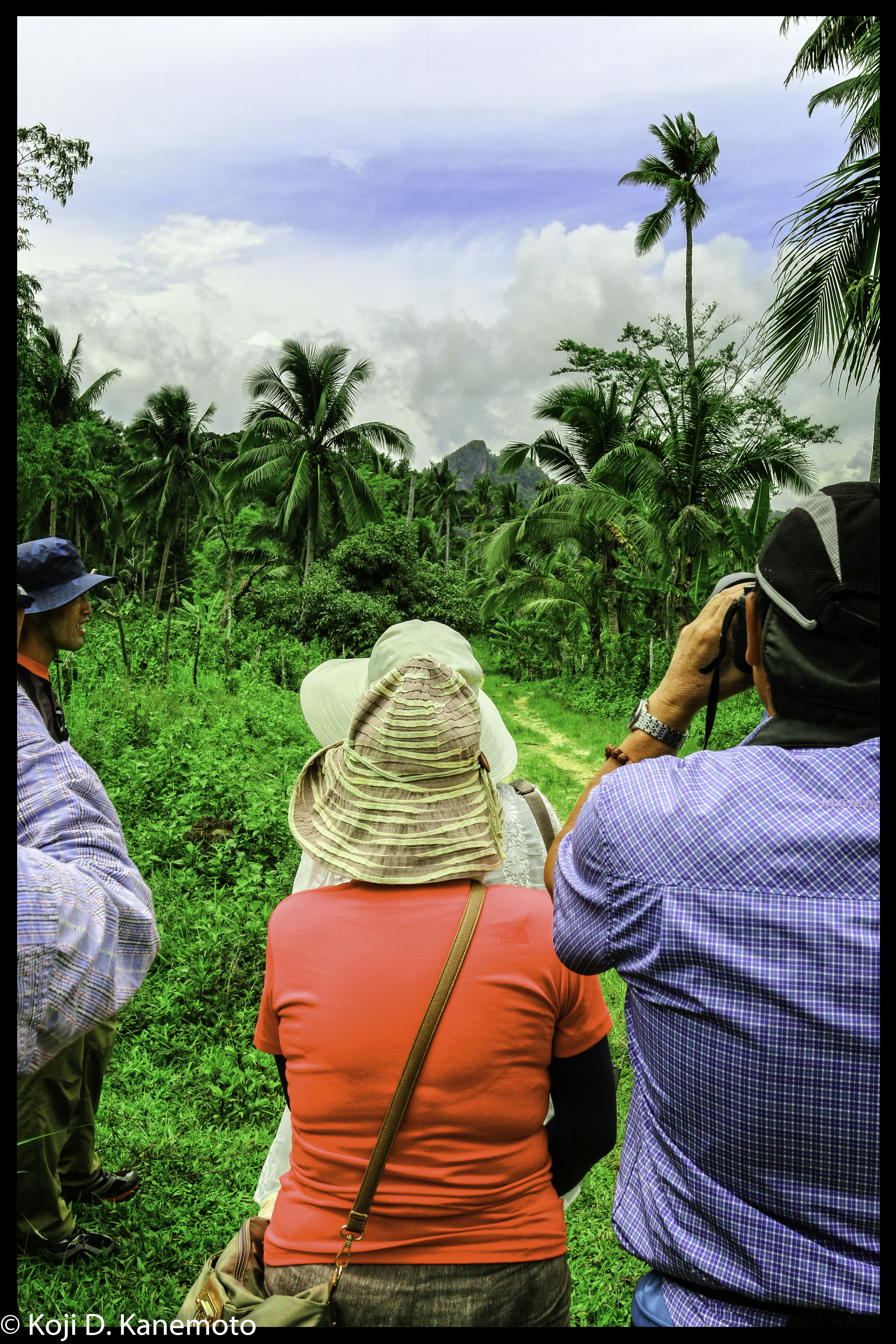
Mr. Ota led our party down a dirt path; after a distance, the peak of Mt. Canguipot veiled in dark clouds assembled by the Japanese gods began to peer down on our little pilgrimage. Perhaps they were beckoning us.
The peak of Mt. Canguipot. Mr. Ota is at left, explaining to our group the last days of the 41st Regiment.
Nearing the end of the trail, Mr. Ota explained to us what happened around Mt. Canguipot, which included Lt. Nakamura. He had collected this detailed information through many years of dedicated research including interviews of a couple of survivors. Their last coordinated attacks were recorded to be on December 31, 1944. (See US battle notes below.)
After offering our Buddhist prayers to the souls, we headed back up the incline. Masako doggedly kept up with us.
We crossed through Catagbacan’s center and into their small elementary school, partially rebuilt after Typhoon Yolanda. It was a large spread, with its natural sprawling beauty. Mr. Ota explained that the last remaining rag tag survivors of the 41st Regiment had assembled in this spot along with others. (One report said there were 268 in total.)
Masako and I catch up to our party awaiting us at the Catagbacan Elementary School.
The Path
Mr. Ota had explained that every single night, a couple of the most capable men would walk down the hill under the cover of darkness to the shoreline in Balite. They had heard rumors that the Japanese Navy was arranging for their evacuation. The boats never came and therefore, they were never rescued. (For details of their hopes on being evacuated yet tragic and ultimate futility, please see my A Soul Lost in a Faraway Jungle.)
I was then duped into taking a “short” trek down to the shore area from this peak by Masako’s daughter, Izumi. (She and my son did the same thing to me in Japan, tricking me into climbing Mt. Misen in Hiroshima. I will get even!) She said, “Koji-san, let’s go (to your death is what I thought)!”
While Masako, escorted by Carmela, wisely made the decision to return to the nice air conditioned van, Mr. Ota had hired a young man to lead us down the path taken by the Japanese soldiers in December, 1944. Hint of the things to come: he had a machete to cut through the growth, not a Black & Decker portable trimmer with rechargeable lithium batteries. We exited through the backside of the school, never to be seen by humanity again. Just kidding.
The trek down the path was through abundant natural growth and sweltering humidity. Passing through shaded areas provided no relief; in fact, in some spots, the humidity had become entrapped by the vegetation. Nothing better than natural saunas.
Yes, I was the straggler but my excuse was I was lugging my back pack laden with 100 pounds of camera equipment. Just kidding; I’m just a SoCal wuse. Even Namie and Tomiko were ahead of me as we neared the shoreline. Notice the guide had made them walking sticks out of branches he cut down along the way.
Namie in front negotiating the incline aided by the walking stick cut by the guide with his machete.
I had wilted once again on this trek; Mr. Ota said it was about 2-3 kilometers. (I shall get even, Izumi-san!) But seriously, what I thought about was how emaciated and very thirsty soldiers – without medical provisions either – did this night after night for a couple of weeks in hopes of spotting Japanese Navy rescue boats. I understand a vast number of these “boats” were actually commandeered Filipino hollowed-out canoes with pontoons.
“Jungle rot”
For those soldiers in December of 1944, it was desperation to survive and return home; I have never experienced this. In fact, after being abandoned on this island by their own military, it would have been easy to be overcome by hopelessness and depression. However, in a testament to their fortitude and determination, I was (plenty) fed, had bottled mineral water and dry shoes, socks and feet; yet, I was still pretty beat up. They likely were infected with jungle rot, dysentery, malaria, infected wounds… This went for all military on that island, Japanese or US (who likely had access to medical care however basic).
Remember: not only did they climb down, they had to climb back up before dawn in their emaciated condition. Still, the thick growth effectively covered their movements during the day offering some protection against US airpower. They could also easily duck into the bush if need be to avoid being detected.
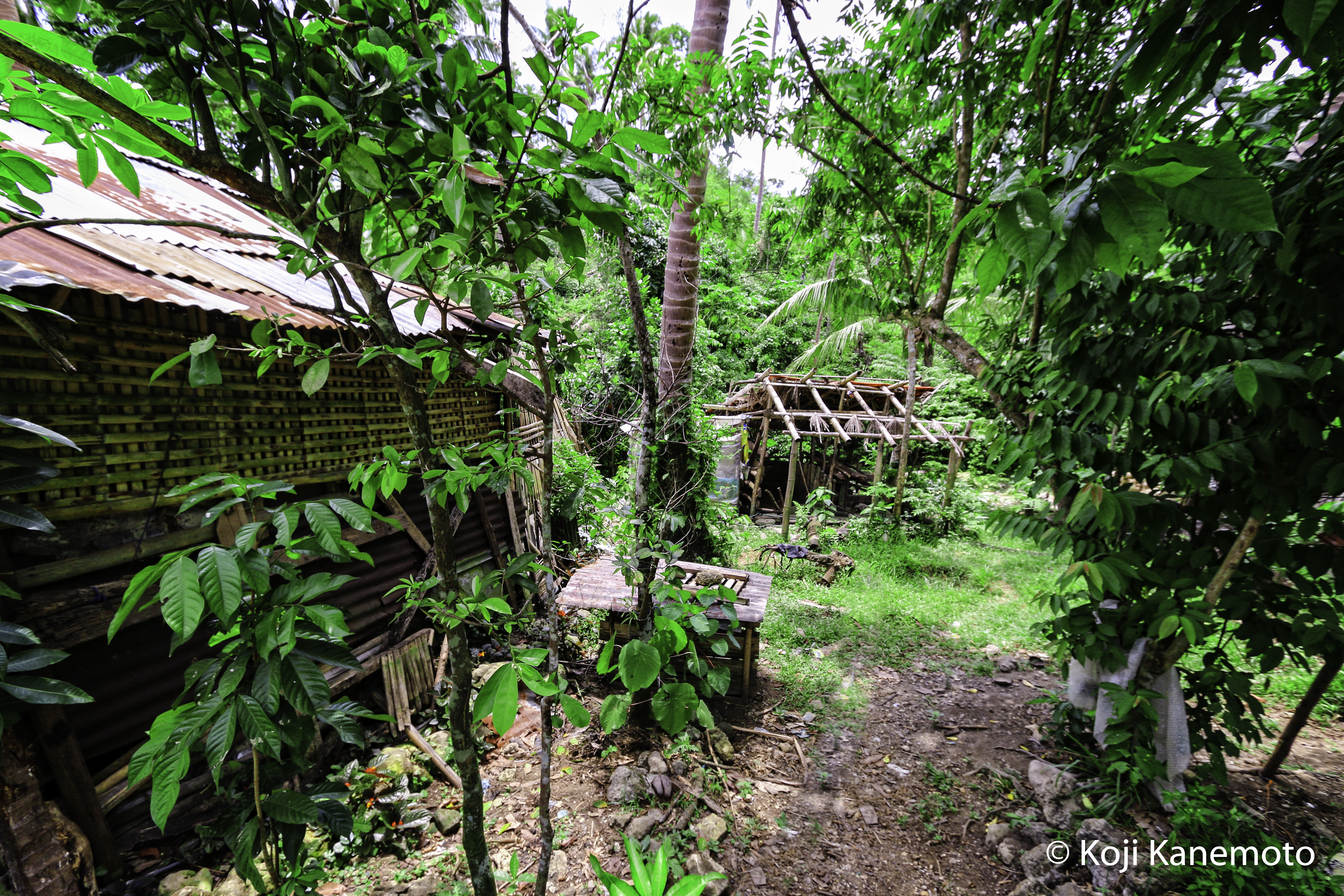
A dwelling near the shoreline.
________________________________________________
By this time in December 1944, death was the rule which governed their existence; surviving until this time was the exception. Yet, in spite of starvation, thirst, illness and depression, these last few soldiers survived, only to perish here due to their inability to surrender.
Two powerful letters and emotion-laden deliveries by Izumi and Setsu will mark the last service.
You will definitely shed a tear or two.
To be continued in Part 8.
_______________________________________
Other chapters are here for ease of locating earlier posts in this series:
US BATTLE NOTES (from Leyte: The Return to the Philippines by M. Hamlin Cannon):
The US 1st Cavalry Division
With the clearing of Highway 2 and the junction of the X and XXIV Corps at a point just south of Kananga, the 1st Cavalry Division was in readiness to push toward the west coast in conjunction with assaults by the 77th Division on its left and the 32d Division on its right. The troops were on a 2,500-yard front along Highway 2 between Kananga and Lonoy.
On the morning of 23 December the assault units of the 1st Cavalry Division moved out from the highway and started west. None encountered any resistance. The 1st Squadron, 12th Cavalry, established a night perimeter on a ridge about 1,400 yards slightly northwest of Kananga. The 1st Squadron, 5th Cavalry, set up a night perimeter 1,000 yards north of that of the 1st Squadron, 12th Cavalry, while the 1st Squadron, 7th Cavalry, dug in for the night on a line with the other two squadrons.
This first day’s march set the pattern for the next several days. The regiments pushed steadily forward, meeting only scattered resistance. The chief obstacles were waist-deep swamps in the zone of the 12th Cavalry. These were waded on 24 December. The tangled vegetation and sharp, precipitous ridges that were henceforward encountered also made the passage slow and difficult.
On 28 December, the foremost elements of the 5th and 12th Cavalry Regiments broke out of the mountains and reached the barrio of Tibur on the west coast, about 2,800 yards north of Abijao. By nightfall on the following day, the 7th Cavalry was also on the west coast but farther north. In its advance it had encountered and destroyed many small, scattered groups of the enemy, most of whom showed little desire to fight. The regiment arrived at Villaba, two and one-half miles north of Tibur, at dusk, and in securing the town killed thirty-five Japanese.
During the early morning hours of 31 December, the Japanese launched four counterattacks against the forces at Villaba. Each started with a bugle call, the first attack beginning at 0230 and the final one at dawn. An estimated 500 of the enemy, armed with mortars, machine guns, and rifles, participated in the assaults, but the American artillery stopped the Japanese and their forces scattered. On 31 December, the 77th Division began to relieve the elements of the 1st Cavalry Division, which moved back to Kananga.
On the morning of the 30th of December, the 7th Cavalry had made physical contact northeast of Villaba with the 127th Infantry, 32d Division, which had been driving to the west coast north of the 1st Cavalry Division.


 Man, he loved to play with a ball. You’d toss a tennis ball or a toy and he would just instantly turn his back on you and bound away with his tailless butt the only thing you could see… just like how the famous Willie Mays did after hearing the the crack of the bat. After he chased it down, he’d bring it back near your feet. He’d then stare at the now motionless ball… And if Yogi thought you were ignoring him, he’d use his long, skinny nose to nudge it closer to you if you didn’t pick it up. “Again! Again!” he was saying. The simple joy he must have had.
 The only time he wasn’t happy was when fireworks went off. He would cower behind Robyn’s toilet, shaking in fear, with his two shivering rear legs protruding out from behind the toilet. He was such a lovable wuse.
 Once he made it to my lap, he didn’t have to say one bark; his face said, “Pet me, you dumb human, while I leave tons of my hair as souvenirs!”


 And of course, his “Feed me some of that human food!” face.
 _________________________________________





























 Masako and Spam Musubi