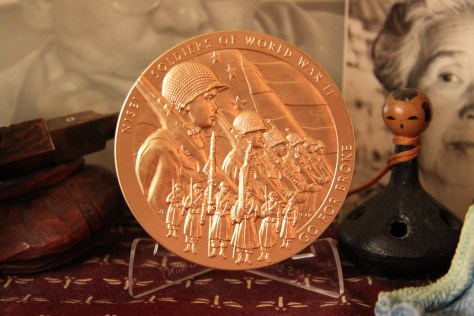
There be gold in my family. Really. Well, the Congressional Gold Medal, that is. And it is made out of gold and honors the “Nisei Soldiers of World War II”. Its on display at the Smithsonian.
In fact, my family was awarded two of them. Two Congressional Gold Medals. Pretty neat, don’t you think? Three if you include a distant relative. Four if Dad had enlisted in the Army five weeks earlier. OK. Enough of that.
Face of “Nisei Soldiers of World War II” Congressional Gold MedalBackside of “Nisei Soldiers of World War II” Congressional Gold Medal
________________________
It was just a miracle mom and her younger sister Eiko survived the war having lived in the heart of Tokyo where very little was left standing. My grandmother was required to train with a sharpened bamboo spear to repel the invaders that were expected to come. It’s true.
But when war ended in 1945, neither my mother nor my Aunt Eiko could have possibly thought that they – through no grand scheme – would each end up marrying an “invader” and that they would end up living in America. The country that bombed their home into ashes. But it was a brutal war. Just fact.
Even more stunning is that they would be unknowingly dovetailed with the famed US 8th Army’s Military Intelligence Service (MIS) for the rest of their lives. (I had briefly reported on the top secret MIS in an earlier short story.)
________________________
Taken on December 8, 1946 in Tokyo. (L to R) Mom, Taro, Aunt Eiko. Standing are my grandparents. Notice the US 8th Army shoulder patch on Taro. Isn’t he handsome? He was 21 years old.
The first family member bestowed the Congressional Gold Medal is my mother and Aunt Eiko’s cousin, Taro Tanji; he is pictured above in a family portrait taken in Tokyo. He was born in Merced County, CA. Taro, like my father, was imprisoned in the camp called Granada in Colorado for being of Japanese heritage although he didn’t speak one word of Japanese.
In 1944, along with thousands of other young American boys of Japanese heritage, he was drafted out of the camp into the US Army. He was a “Nisei”. He then was assigned to the top secret US Army Military Intelligence Service Language School (MISLS) in Fort Snelling, Minnesota to learn the Japanese language.
After graduating, he was assigned to Tokyo as part of US 8th Army and became part of the Allied Occupation. Once there, he immediately sought the fate of my mother’s family.
Through the resources of the MIS, he miraculously located my grandmother – the same one who was forced to train with a bamboo spear. They had survived but were in dire straits like millions of other survivors.
Exactly as my father did for my cousin Masako in Hiroshima, Taro used whatever pay he had to buy them clothing and essentials from the PX, took them C-rations and of course, American cigarettes for my grandfather. There are many stories of other things Taro did (he was a STRONG man) which I will save for later.
Aunt Eiko and Taro, taken in the late 1960’s at his home in Gardena, CA.
A kind man, Taro became a much loved teacher in the Gardena school system. He recently passed away in Gardena, CA in 2009.
His CGM was posthumously awarded to his wife, Aunt Martha. Amazingly, neither mom nor Aunt Eiko realized Taro was part of the MIS until I told them. I determined that through research of US Army records.
______________________
My Aunt Eiko was sickly as a young girl. Indeed, it was a miracle especially for her to have survived. She hates medicine, even to this day. As a funny story, when the US Army began de-licing the surviving Japanese citizens, she ran away as she was terrified she would get sick from the powder. Well, it was DDT so she wasn’t that far off.
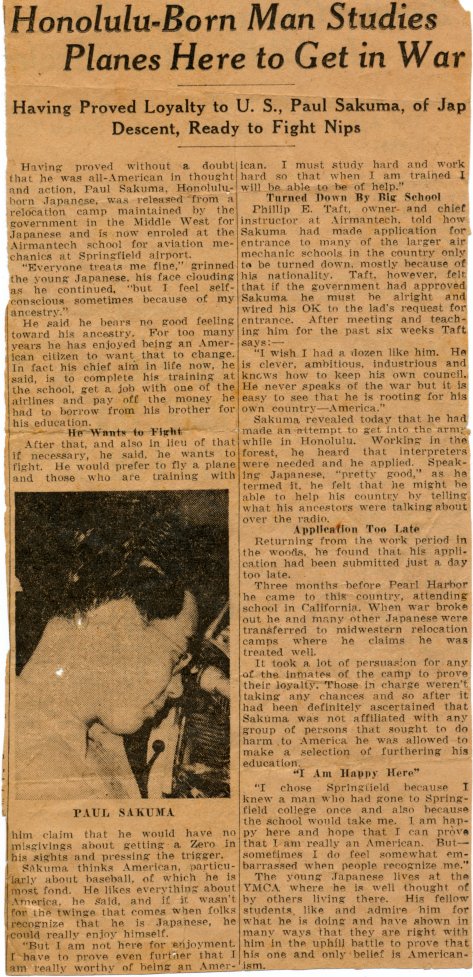
In 1966, she met Paul Sakuma, a Hawaiian born Nisei. While Uncle Paul told Aunt Eiko he was also put into camp on the Mainland (the article says that, too), I can find no record of his internment. However, Uncle Paul was at some time in Springfield, Massachusetts after the war started. He was “featured” in this newspaper article. Surely, the title of the article was a sign of the times.
Newspaper article on Uncle Paul during war time, Springfield, MA.
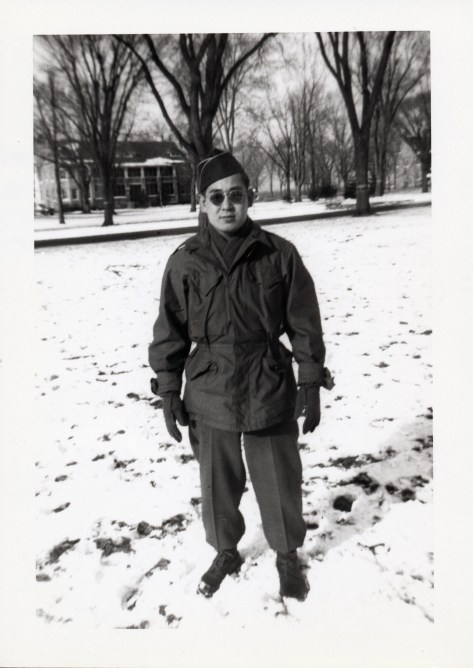
Uncle Paul was also drafted in 1944 and was also sent to the MISLS at Fort Snelling, Minnesota. This is the only photo Aunt Eiko has of Uncle Paul in uniform. I stumbled across it last year. Frankly, Aunt Eiko also knew very little of his Army days but I noticed the building in the background (below) as being the old cavalry barracks at Fort Snelling which sparked my researching again. He was also indeed a member of the famed MIS unbeknownst to Aunt Eiko.
Uncle Paul at Ft. Snelling’s top secret Military Intelligence Service Language School, circa Winter 1945. The old barracks is seen in the background.
Uncle Paul was also immediately dispatched to Tokyo as part of the Occupation Force. He was assigned to the 720th Military Police Battalion and accompanied patrols where his translation abilities were needed. A couple of good patrol stories – ones that men would likely appreciate. Perhaps some ladies, too. No harm, no foul, as the great Chick Hearn said.
Days before my first marriage, I got a call from Aunt Eiko late at night. She was hysterical. Uncle Paul had died of a massive heart attack in 1980 in Tokyo in the new home he had just finished building for them. He had continued living in Tokyo as a civilian employee of the USAF.
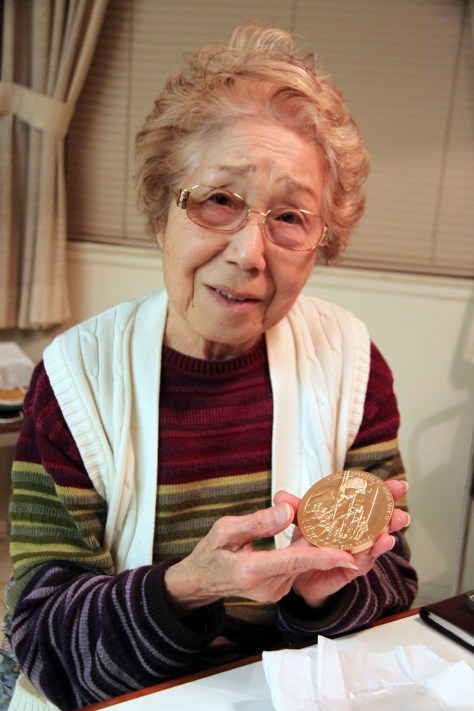
Like Taro, Uncle Paul was posthumously awarded the CGM. I secured the CGM and surprised her with it. Aunt Eiko “cried for happy” as he held the medal for the first time early this year (below). She loves him greatly to this day. She said, “Even today, Paul brings me great happiness.” If that doesn’t bring a tear to your eyes, well, you’re pretty tough.
Holding Uncle Paul’s Congressional Gold Medal for the first time, Aunt Eiko cried for happy. Incidentally, she became an American citizen about ten years ago.
_______________________
As dad volunteered in February 1947, he did not qualify for the CGM. But unbelievably, mom, too, did not know much of what dad did in the Army let alone him being a member of the MIS. Mom said dad never talked much about it except to say he did not enjoy interrogating Japanese soldiers being returned from Russia and Manchuria.
Nevertheless, mom and Aunt Eiko WERE enmeshed with the famed Military Intelligence Service although they didn’t realize it. Fate. They were surrounded by the invaders – secretly. Famous ones at that. A prejudiced opinion, of course.
_______________________
I am very proud of these Americans. The Congressional Gold Medal is a tremendous honor and finally brings to public light the importance of the intelligence they secretly obtained for our United States of America amidst prejudice and discrimination.
I like to think that these Americans of Japanese heritage weathered the clouds of that time so we could have glorious sunshine today.
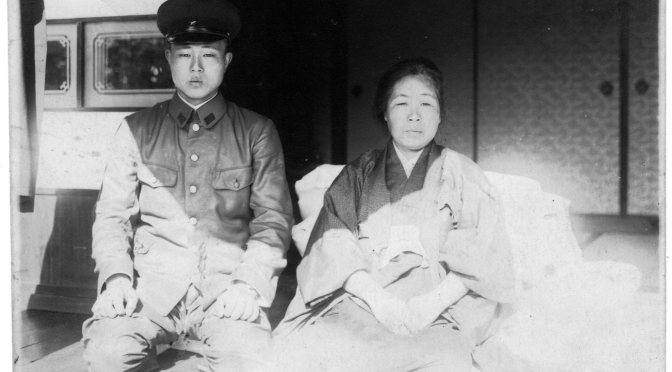
The last known photo of my Uncle Suetaro. He did not return from Leyte during the final stages of World War II. My Grandmother Kono – having suffered a stroke – is propped up by Japanese “shiki-futon” for the picture. Taken in Hiroshima, 1944.
Yes, a small percentage of Japanese soldiers were anxious to die for their emperor.
But a vast majority was frightened of having to go to war. My opinion, of course.
Young Japanese boys were drafted from farms and fishing villages – just like we did here in the US of A during that time. Boys from Parsons, Kansas or from a sea coast shrimping town in Louisiana.
And they all had moms.
__________________________
Like all Americans of my age, we were taught that the Japanese soldiers of WWII were fanatics. That they all were hell-bent to charge into a hail of Allied machine gun fire. To willingly die.
We were also taught that when a US Marine charged well entrenched Japanese soldiers with a satchel charge, he was a hero. Not a fanatic. He was John Wayne or Kirk Douglas. Was Esprit de Corps driving the young Marine to offer his life to save his buddies?
There is no intent to question our American values of valor or honor. Just a quandary.
_________________________
My Hiroshima cousin Masako mentioned in Hawai’i having seen a photo of Uncle Suetaro and Grandmother. It was taken the day before Uncle shipped out for war (1944). Masako said Grandmother – having suffered a stroke the day before – was propped up by “shiki-futon”, or Japanese bedding for the picture. She felt strongly it was the last picture taken of Uncle Suetaro but doesn’t know what happened to it.
_________________________
A few weeks ago, my California cousin Janice came across a number of old photos; she had forgotten about them. She said there were some family photos from Hiroshima. Her father – Uncle Suetaro’s and my Dad’s oldest brother – had apparently been able to hold on to them through the decades.
I asked Janice if there were any photos of my Dad’s two youngest siblings, Suetaro and Mieko, or of Michie (Masako’s mother). Janice then described a picture of Uncle Suetaro in a uniform and Grandmother (seen at the beginning of this story).
I was stunned. Topo Giggio meets Godzilla. It was the photo Masako vividly recalled seeing decades ago.
Is there an air of fearfulness…of fright? You can decide. But as we were led to believe, all Japanese soldiers were fanatics…yes?
In an earlier blog, I praised Old Man Jack for his forgiveness. It is not possible to write about what he did or saw out on the god-forsaken islands in the Pacific during World War II. Only he truly knew what was in his soul.
But in spite of his exposure to combat in that very personal and bitter war, Jack’s practice of forgiveness was his most important contribution to the healing of this world. The world we enjoy today. I truly believe that.
Old man Jack loved my kids – perhaps his warmth and the forgiveness in his heart will shine through.
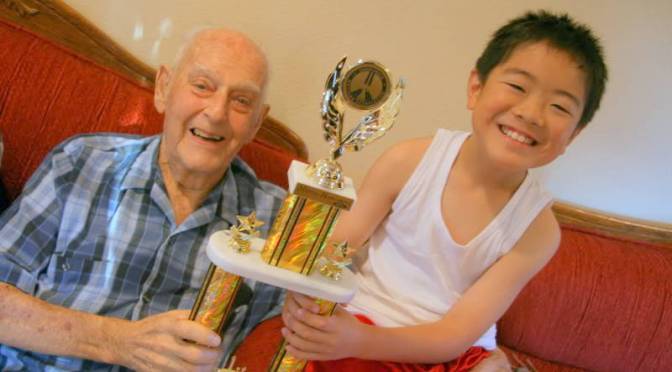
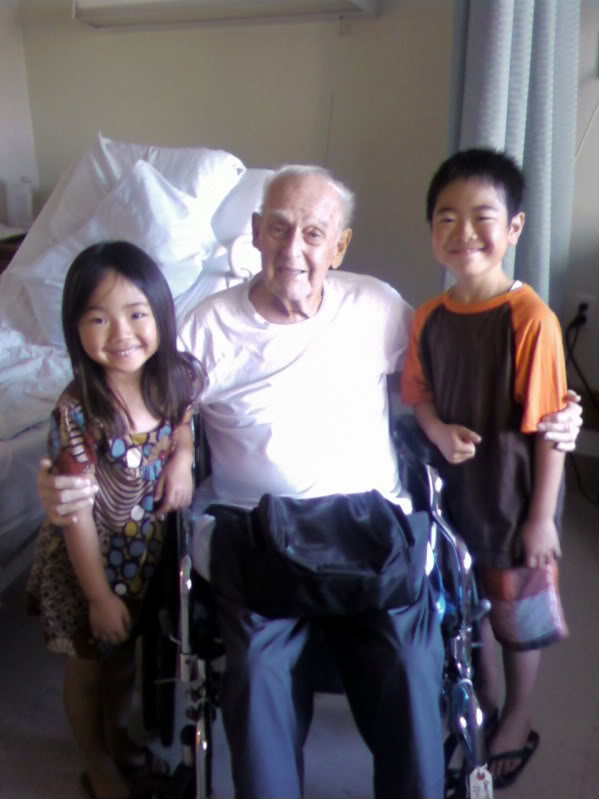
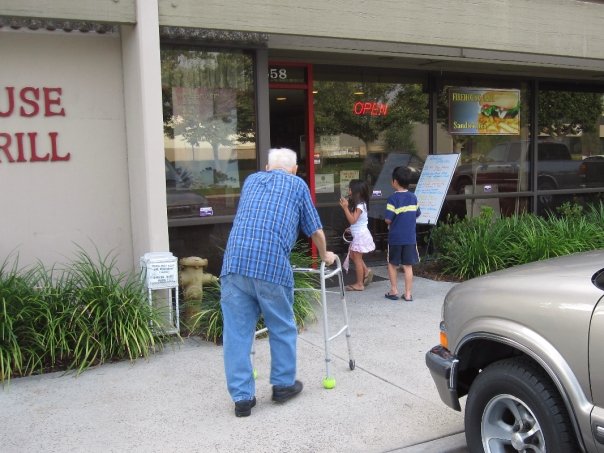
Jack was in the hospital often in the last five years of his life. We went as often as we could to say hi.When Jack was laid up in the hospital and couldn’t make the block party, my kids wrote him a special 4th of July greeting. They wrote “Big Jack” as my son was known as “Little Jack”. Yes, I named my son after old man Jack.Old man Jack loved it when my Mustang won at car shows. Here are the “two Jacks” in my life. You can see old man Jack’s trademark grin.We’d sit outside on our front lawn whenever we could… He’d share his sailor’s wisdom (with appropriate restraint) and my kids would smile.My kids lead the way to one of our breakfasts. Against my wishes, he’d insist on paying for the kids’ chow as well. I could never win.He loved it when we’d all visit with him in his home. He loved my kids. Imagine that…My oldest son loves to work on his muscles – as did old man Jack in his youth.
It was Monday, Valentines’ Day 2001. My wife was five months pregnant at the time we moved into this wonderful neighborhood smothered in US Naval glory. After I came back from work the next day, she told me a kind old man stopped her as she was wheeling out the trash bin. She said he hobbled from across our quiet street lined with peppercorn trees then kindly wheeled them out for her.
I found out the “old man” was a World War II combat vet. Worse yet, he was a sailor in the Pacific – he fought the Japanese in World War II.
“Holy crap,” flashed through my mind, “What if he finds out we’re Japanese?”
Twelve years later, I was honored to have been a pallbearer at his funeral.
I was so far off base about my first thoughts on Old Man Jack that even George Burns could have picked me off without being called for a balk…and this while he was in his grave.
I felt so ashamed.
_____________________________
I snapped this picture of a happy Jack Garrett when we went to the Chino Planes of Fame in 2003.
“Young man, get over here and plant your butt in that chair,” barked old man Jack from his cluttered garage across the street. Having lived in that house since 1953, it was filled with his life history.
“But I have my stogie going, Jack,” said I.
“Well, I can see it and I sure as hell can smell it. Now shut up and sit down. I want to tell you something.”
That was Old Man Jack, my dear neighbor who lived across the street. I like to think we were close.
He was 87 years old by that summer’s day in 2010 when he called me over. While he had become feeble, his barrel chest was still prominent. He was a rabble-rouser in his youth. He was always “mixing it up” throughout his young years… Well, he was mixing it up even while working at Northrup in the 50’s. That makes me grin.
His handshake was always firm and warm; you didn’t need to be psychic to sense his insight and outlook on life. He always spoke his mind. He earned that right having been shot at, strafed, and bombed on “those stinkin’ islands” in the Southwest Pacific as he so often said during a most bitter war.
___________________________
Taken on Father’s Day 2010
I had invited Jack to Father’s Day dinner that summer just two years ago; my Dad who was 91 was coming as well.
Jack knew my dad was US Army but I fretted over what they would say to each other when they first met. Or how they would react to one another. It was more than just a concern over the centuries old rivalry between Army and Navy. It was the bitter war.
Dad was in the front room when Jack rang the bell – right on time as always. Jack had on his favorite blue plaid shirt; he wore it often as it had a pocket for his glasses. I often wondered how often he washed it, though. Jack and Dad are shown here on Father’s Day 2010.
“Dad,” I said, “This is Jack, US Navy, Aviation Machinist’s Mate, First Class, the Pacific.”
“Jack, this is my Dad. US 8th Army, sergeant, Military Intelligence Service.”
Although not as agile as they once were, they immediately saluted each other.
_______________________
You didn’t need a sound system to hear them. Dad and Jack are both hard of hearing.
It was easy to hear Jack ask Dad what he did in the Army. During the Occupation of Japan, Dad said he went into a room once a week that reeked of dry cleaning to retrieve a crate. (The crates contained documents, photos and other personal items such as war diaries written by Japanese soldiers. They were removed from a WWII battlefield – read on.) He would then translate the contents for military intelligence (below).
Dad translating captured war documents in the U.S. 8th Army HQ’s, Yokohama, Japan. 1947.
I had to tend to cooking so I lost track of the conversation. It was regretful I didn’t keep tuned in.
_______________________
So back to being called over by Jack on that summer’s day.
He was sitting in his favorite blue wheelchair. He didn’t need it but it belonged to his beloved wife Carol who passed away ten years before. They married during the waning days of the war. They had been married for 55 strong years.
“So what did you want to tell me, Jack?” I asked.
He then went into his trance – one signaling evident anguish and wretched remembrances. When he went into these trances, he always started by staring at his hands while picking at his right thumbnail with his left ring finger. He would lift his once thick eyebrows now turned snow white with age, then begin talking in a slow, deliberate pace, never taking his eyes off his hands.
“I went on ID patrol…” Jack rasply whispered while ever so slightly drawing out his words.
“ID patrol? What is that?” I asked.
He ignored me. It was as if I wasn’t sitting next to him… He had already left the present. He had stepped foot onto that violent SW Pacific jungle of 70 years ago. I’m sure its smell was as vivid to him in his tormented subconscious as it was seven decades ago.
“They would issue six of us white caps M1’s with bayonets… Then we’d follow two Marines on a patrol into the jungle.”
“Patrol? You? You were ground crew, Jack,” I remarked.
“Ain’t enough of them (Marines) to go around on those stinkin’ islands so we got picked,” he said, still speaking in a lifeless yet pained monotone. He added, “If you got killed, you rotted real quick in that jungle heat. And if you got killed with shit in your pants, you got buried with shit in your pants.”
His stare doesn’t change. His eyes have glassed over. He is in a different world now – one of 70 years ago in a stifling jungle, his youthful, sweaty hands trying to grip onto his Garand rifle while wearing a smelly steel helmet… Listening in terror for any sound that may signal a Japanese soldier concealed in ambush knowing that the enemy was just there shortly before. A world that only combat veterans understand. Thankfully, you and I never will. Never.
“The Marines had two bags – one small one and a big one. When we found one, the two Marines would stand guard. We’d hold the rifle by the butt end and use the fixed bayonet to fish out the tags.”
It was then when I realized what he was painfully regurgitating.
This is what he meant by “I.D. patrol”. They were going back into the jungle to locate the dead Marines they had to leave behind after a “tussle” with the enemy as Jack liked to say – a life or death firefight. Old Man Jack was only 20 years old. The Marines were likely younger. Ponder that thought.
“We weren’t allowed to touch the dead (Marine) as the Japs would booby-trap ‘em. We’d hand over the tags hanging on the the end of the bayonet to one of the Marines who would put a tag in the small bag. They marked a map for the graves registration guys to come back later.”
Jack’s anguished delivery dimmed even further. “But we’d come across a dead Jap. Nobody cared about them so they rotted where they were. But we’d have to stick the bayonet into the rotting goo and try to fish stuff out. The prize was a pouch or a satchel. Those would go into the big duffel bag just as they were, covered with rot and maggots. We headed back to CP and that’s the last I saw of those bags,” he said.
He abruptly ended but his unconscious stare didn’t change. He was still in the jungle, scared out of his wits. He was still picking at his thumbnail all this time. His head hardly moved while he sat in the blue wheelchair that belonged to his beloved wife.
I thought to myself, “Is that the end, Jack? That’s it? Why did you tell me this?” I knew not to pry any more so I kept the thoughts to myself. He was in torment already. Seventy years had passed but he was reliving the awfulness of a brutal war. Nevertheless, I wondered why he chose that time to tell me about this horrific recall of something he experienced so very young.
It bugged me for several weeks.
____________________
About a month later, I understood why Jack told me the story after I communicated with Mr. Grant Ichikawa, a more well known veteran of the famed US Army’s Military Intelligence Service and combat veteran himself. Apparently, the items they recovered from Japanese corpses were dry cleaned to remove the rotting body fluids. After getting dry cleaned, they ended up in the crates that were in the room my Dad went into once a week when he was in the Military Intelligence Service…and why the room reeked of dry cleaning.
The brief chat with my dad on Father’s Day sparked that vile memory back to life. It had been eating at Old Man Jack since that day. He wanted to get it off his once mightily barreled chest.
I lament to this day that an invitation to a Father’s Day dinner had resulted in an unwanted recall of horror Jack was very much trying to forget. More so, I lament he relived such horrors each night for the last 70 years of his life. Seventy years.
Jack was a great man to have endured combat in the Pacific during World War II. He was an immeasurable giant in learning to forgive – although he was never able to forget.
I miss him greatly. I thanked him for all we have when I visited him today at his grave on this glorious Memorial Day.
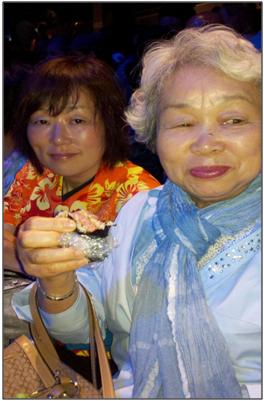
Masako savoring her Spam Musubi Kailua. Her daughter Izumi looks on.
It was a small yet precious family reunion. My 78 year old cousin Masako Kanemoto, who flew in from Hiroshima, took a bite out of a “Spam™ musubi” while we were taking a snack break in Kailua, Hawai’i. It’s a slice of Spam sandwiched in between some rice and wrapped in seaweed. “How mundane,” I thought.
Masako then beamed. “We had very little food for so many years. After the war, your father brought us food and clothing when he was in the US Army…” My dad was part of the US 8th Army’s Military Intelligence Service.
She continued, “He brought us much as he could carry. I was so hungry and I will always remember that first bite. I couldn’t believe how something could be so delicious.” She was referring to something my father had brought along with him 65 years ago – Spam.
Emotions tore through me and my eyes welled rapidly. I felt so selfish and ignorant for taking the Spam for granted. I fumbled but snapped the photo of Masako enjoying the Spam musubi.
__________________________
My grandfather Hisakichi Kanemoto immigrated from Hiroshima to Seattle in the late 1890’s. My grandmother Kono Kanemoto was a true picture bride for my grandfather. Grandmother gave birth to a total of seven children of which my father was the fifth; all but one was born in Seattle – they were US citizens.
My grandparents struggled to survive; the family lived in the Fujii Hotel in downtown Seattle. They worked a basement barber shop in the hotel with Grandfather cutting the hair and Grandmother expertly working the straight razor. A cousin said Grandmother made the customers feel appreciated and made them feel at ease with her people skills. It certainly wasn’t Grandfather – if there were a Japanese Marine, he could have been their poster boy. “By the book”, as they say.
As was customary during that time, many Japanese-American children (“Nisei”) were rotated back to Hiroshima by ship to learn the Japanese language and customs when they were about eight years old. It was no easy cruise has they were crammed into the cargo hold for the lowest fares. They spent about ten years in Hiroshima then returned by themselves when they turned 18. Dad was no exception.
By around 1930, the grandparents and five of the siblings were in Hiroshima; the oldest (Uncle Yutaka) was forced to live in America alone at a young age. I understand he was sad and frightened about that. Their second son, Hisao, passed away in Seattle from encephalitis when he was only about two.
Now fluent in Japanese, dad returned to Seattle on his own in 1937 at 18 years of age, preceded by an older sister Shizue in 1934. Dad was apparently very bright as he graduated from Hiroshima’s Nichuu High School – it was for the higher achievers. He excelled in mathematics as well as in track and swimming. He helped dig the school’s pool. No union labor back then.
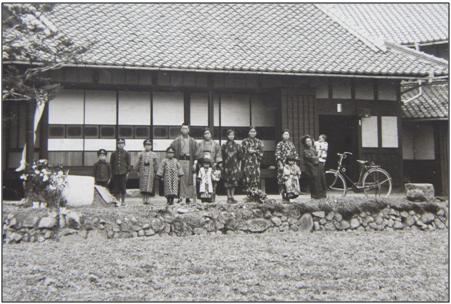
Dad is standing, third from left in this rare family portrait taken in front of his family’s new Hiroshima home, circa 1929.
_______________________
After dad returned to Seattle, Grandmother made the decision to remain in Hiroshima. It was a fateful decision.
In the 1930’s, Japan had already began their invasions of China, Manchuria and Burma; they were on their quest to secure raw materials for their industries and ultimately for their military. National pride was at its peak; military conquests filled the news and the world was taking notice with great consternation. When Japan was condemned for their aggressions by the League of Nations, she withdrew and shocked the world.
The threat of war with America loomed. Anti-Japanese sentiment grew – Americans in Seattle routinely harassed or even attacked Japanese in public. Unfortunately, many of the “Japanese” they harassed were American citizens like my dad, uncles and aunts. Some young Nisei girls were also groped, molested or raped. Folks knew where Hawai’i was at this time but Pearl Harbor was Timbuktu.
They all had the misfortune of looking Japanese, similar to how some Americans look upon Muslims today.
My Grandmother was not exempt from the harassment. She was called “Jap” many times. She was even egged. While she was a fighter, she decided the threats and discrimination were too much.
______________________________
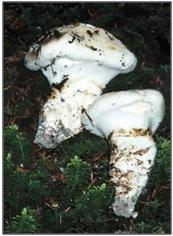
Matsutake
My dad was close to his youngest brother, Suetaro. They farmed the mushroom property Grandfather owned in Hiroshima; the special mushroom delicacy called “matsutake” grew only during a brief season. Dad, Uncle Suetaro and perhaps three other boys strapped on woven baskets onto their backs and filled them with the precious matsutake. Grandmother would sell them as quickly and as best she could – they had no refrigeration. The earnings would make up the bulk of their income for the year.
While dad had returned to Seattle in 1937, Uncle Suetaro was anxiously awaiting his turn to go back to Seattle. He was to turn 18 in 1939. However, Dad’s youngest sister Mieko died earlier in 1939 of a kidney infection; she was about 15 years old. By that time, Grandmother knew Grandfather was suffering from stomach cancer. His older sister (and the only one not born in the United States) Michie had married and had given birth to a daughter – Masako, my cousin. They lived in another village called “Tomo” some distance away.
Having decided to remain in Japan due to the harassment and threats she experienced, Grandmother then made the fateful decision to not allow Uncle Suetaro to return to Seattle. After all, there was no other Kanemoto left to inherit the house and land. Uncle Suetaro was dejected and very upset but obeyed Grandmother. He was a loyal son.
Grandfather died the next year. With Mieko also gone, only Grandmother and Uncle Suetaro remained in the house.
______________________________
Uncle Suetaro was drafted into the Japanese Imperial Army. His regiment was training in Fukuyama, Hiroshima. Aunt Michie with her nine year old daughter (and my cousin) Masako in tow went to visit Uncle Suetaro when they could. She remembers a couple of trips. It was not easy travel in war-torn Japan. For one trip, Aunt Michie managed to take sashimi – in this time of little food, it was a tremendous treat and gift.
On that trip, Masako remembers her mother stealthily sliding over to Uncle Suetaro the wrapped sashimi. He was being stared at by many of his fellow soldiers – they were not well fed either. She remembers Uncle slowly turning so that the others could not see and quickly devoured the treat.
Masako also knows Uncle was well respected by his fellow soldiers due to his knowledge of English in a wicked twist of fate as my father’s top secret US Army unit used their knowledge of Japanese to kill as many of the enemy and to save American lives.
_______________________________
Uncle Suetaro (sitting on the sofa arm) received his orders to ship out to Leyte Gulf in the Philippines; the family recalls it to be 1944. As tradition called, they had a farewell celebration. In such celebrations, the soldier who was facing certain death received a Japanese flag signed by relatives and friends to carry into battle.
Uncle Suetaro was to ship out the next day. Grandmother was like any other mother – she was anguished. More so, she knew that soldiers sent off to war rarely returned unless maimed. Her decision to not allow her youngest son to return to Seattle in 1939 now deeply stabbed at her heart…so much so that she suffered her first stroke the next day.
______________________________
Grandmother only had use of her right arm; Masako said she would pull herself around the now empty house with that one good arm. Aunt Michie – after working a grueling day at her husband’s farm – would likely have walked several miles to Grandmother’s house to tend to her needs which included feeding her as well as changing and washing her diapers.
This was war time; they used old clothing for diapers. Tide laundry soap? They didn’t have any soap to speak off. A washing machine? They didn’t have one let alone electricity. Aunt Michie washed them by hand with well water on a washboard. She then walked miles back to her farm only to get up a few hours later before dawn to work the farm.
______________________________
Transport Kashii Maru under attack at Ormoc Bay 1944
No one truly knows how Uncle Suetaro died.
Perhaps he was killed during one of the numerous Allied artillery barrages or bombings, or was cut down in a futile banzai charge. Perhaps he died in a cave from starvation or illness – or from committing suicide.
Perhaps he never made it ashore and met his death when he was on a troopship being strafed or sunk by airplanes from land-based US Marine Corsairs or carrier-launched US Navy F6F Hellcats or a US Army Air Force P-38 Lightning. The Allies ruled the skies and wrecked havoc on Japanese ships.
Tragically, he was American. While his oldest siblings were imprisoned in US concentration camps for “looking Japanese”, Uncle was thrust into desperate circumstances and was clothed in the uniform of the 14th Japanese Imperial Army, 41st Infantry Regiment… Eerily similar to his mother who was egged and called a Jap while in Seattle, his own countrymen were now trying to kill him with 75mm shells launched from miles away or .50 caliber machine gun rounds in a closer encounter. Not eggs this time.
It is more troubling knowing Ike was of German ancestry and MacArthur’s right hand man General Willoughby was of ROYAL German lineage and spoke fluent German but English with a pronounced accent. His birth name was Weidenbach; imagine if they were imprisoned in Tule Lake with my Dad for “looking German”. No political comment being made; its just historical fact.
Uncle Suetaro’s 41st Infantry Regiment – likely including the other young men who watched him stealthily eat sashimi – was annihilated by the US Army on Leyte. His body was never recovered. Ironically, when I used to watch the B&W news reels of the war on TV or see combat photos of dead Japanese soldiers, I would see them with purely American eyes. Now, I earnestly review them in hopes of seeing a glimpse of Uncle Suetaro…as my Aunt Shizue did for many, many years. She still does at 95 years of age near Downtown, LA.
__________________________
Eleven year old Masako was sitting in her classroom on August 6, 1945; her school was partially behind Mt. Suzugamine just west of Hiroshima’s center. Some windows were opened as it was in the middle of summer.
There was an indescribable, blinding white flash. There was no noise except for some of the girls screaming, Masako recalls. They all left their seats and ran towards the windows to see what had happened. Masako ended up standing behind a couple of girls at an open window.
It was like an invisible wrecking ball slammed into their school. All of her classmates that ran to a closed window to look were pierced by shards of shattered window glass as the shock wave hit, she said. All were hurled backwards by the force. Even the girls in front of Masako were pierced by debris being hurled at supersonic speeds…
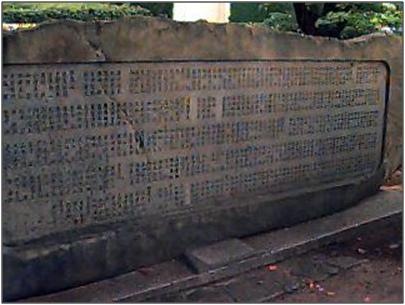
This wall is what remains of Dad’s high school in Hiroshima. It is inscribed with the names of the students who ceased to exist on Aug. 6, 1945.
As she looked through openings that were once windows to her classroom, they were now windows to a demonic swirling dark mass of blackness. Ironically, she described it as a “matsutake no kumo”, or “matsutake cloud”… The same mushroom my father and uncle had picked as children.
Now, the same hill they picked matsutake from saved Masako’s life. It provided the school partial shielding from the atomic blast. There was nothing left of Hiroshima just around the bend. All that was left of my father’s beloved “Nichuu High School” was a short span of a wall. It was about 1,500 meters from the hypocenter (left).
Masako saw horribly disfigured bodies over the next few days. They had aimlessly wandered from around the bend after the blast. They perished where their bodies laid. Masako was also covered in a thin oily, sticky substance called black rain.
______________________________
From before the blast, ten year old Masako was tending to the care of Grandmother; by war’s end, there were only shreds of material left that could be used for diapers. It was brown under her fingernails from having to wash her soiled diapers by hand.
While Grandmother had made a partial recovery, she still only had use of her right arm. Then sometime after war’s end, a representative of the Japanese military came to visit Grandmother. Uncle Suetaro would not be returning home. Masako says her anguished scream was one only a mother can own, made horribly worse knowing she forbid Uncle Suetaro returning to Seattle. She suffered her second stroke.
_______________________________
Dad and the rest of the imprisoned siblings and the grandchildren of Grandmother and Grandfather were released from camp in September 1945. A year after, Dad found out he was going to be drafted by the same government that took his passport, fingerprinted him, put him and his family behind barbed wire and made him keep on his person all the time a draft card (on the left) that classified him as an Enemy Alien (4C). There were also guard towers manned by soldiers with Browning machine guns.
According to Masako and other family members, his oldest brother Yutaka (and now heading up the remaining family) then nearly begged him to volunteer for the Military Intelligence Service so he could check up on Grandmother. Dad tells me, “Well, if I get drafted, I’ll be a buck private. If I volunteer, I can be a sergeant – more pay.”
I tend to believe my other family members.
______________________________
Dad arrived in Yokohama on December 7, 1947 and was assigned to the 8th US Army’s G-2, 166th Language Detachment; this was the Military Intelligence Service. It was kept top secret during the war; nearly all of them were Japanese-Americans. The accomplishments and heroics of his predecessors were not declassified until the 1970’s. Dad was one of the early graduates of the Army’s language school (“DLI”) in the Presidio. He was a Technical Sergeant, 3rd Grade – I’m sure the young Japanese ladies thought his chevrons were captain’s bars.
Dad and Masako in 1948. Itsukushima Shrine, Hiroshima. Dad remembers this was taken by a photography vendor.
At his first opportunity, he took a train down to Hiroshima then somehow made it to Grandmother’s home. Masako was a young girl 14 years of age by then. He carried two large Army duffle bags full of food and clothing – including the Spam. They are in the photo on the left.
None of the surviving Kanemoto family members from that time period know how Dad learned of the news of Uncle Suetaro’s death. Regardless, the death of his favorite brother scarred his mind and heart for eternity. Even today, when I see him, he asks, “How is Suetaro?” He never asks of his other siblings.
______________________________
Masako and I finish our Spam musubi. She tells me of how kind my father was to her, Grandmother and Aunt Michie. My dad does remember how indebted they all were to Masako for giving up a lot of her youth to care for Grandmother.
Masako enjoys Spam even to this day.
On a side street in Kailua, Oahu, Spam had also become a cherished delicacy for me.












 Masako and Spam Musubi