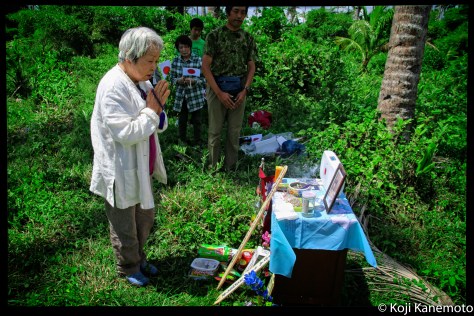
My 81 year old cousin Masako is the first to offer “gassho” to our fallen Uncle Suetaro. She is the last one alive to truly remember him aside from my father (96).
Leyte Pilgrimage – Day One
As we made our descent into Leyte’s Tacloban Airport, I vacated my port-side preferred aisle seat and moved towards the window then buckled in. Visibly condensed, chilled and misted air flowed out of the specialized air conditioning system above us, very necessary in the Southwest Pacific. Our final approach was north to south.
The tarmac filled my window and thought to myself, My god. We are actually going to land on the island where my uncle was killed. It is finally happening. Our plane touched down at 4:40 pm.
Touchdown. Tacloban, Leyte.
I wonder what my cousin Masako felt at that very same instant. Besides my 96 year old father, she is the last person on this earth that truly remembers Uncle Suetaro.¹ I had been imagining many things of my uncle’s resting place. I solemnly realized that I had been grieving over what we know happened to him as well as how my father silently grieved for decades… but now, I feared about what we may discover about what truly happened to Uncle Suetaro. His suffering. His death.
I slung my orange backpack weighed down with my cameras and lenses over my shoulder then exited from the rear of the air conditioned jet. It would be six days before I would once again sit in such air conditioned luxury. The impact of the tropical heat and humidity was immediate on this southern California body. I began to perspire faster than Hillary could tell a lie. It reminded me of the climate inside the house when I lived with my last ex – ugly.
A smiling Masako after retrieving her luggage at the uncultivated Tacloban Airport. I wonder what she felt deep inside at that moment.Also accompanying us was Ms. S. Teraoka; she is carrying wooden boards on which is charcoal ink calligraphy written by her temple’s reverend. Her uncle was a lieutenant who also killed on Leyte.Mr. B. Kagimoto, a news reporter from RCC Broadcasting Co. in Hiroshima, was also part of our little pilgrimage.
_____________________________________________
After being greeted by Akehira and Calimera, husband and wife owners of the limo service, we quickly exited the heat and humidity into two cooled vans.
Calimera and Akehira, Leyte residents. Their home was also significantly damaged by Typhoon Yolanda. No one was exempt.
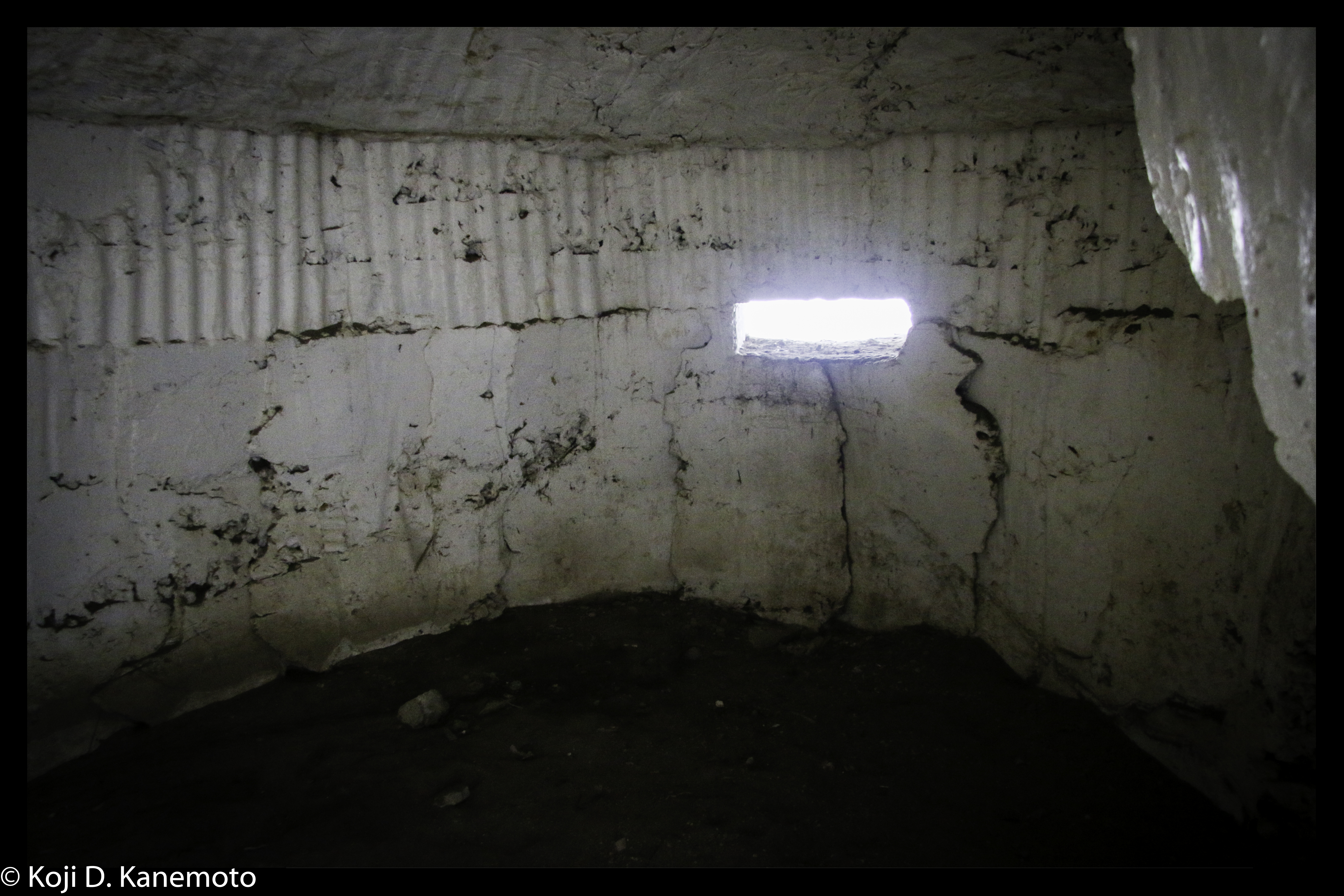
Along the way to our hotel, we made our first stop: White Beach. Code named White Beach (see below) by the American invasion forces, it lays just south of the airport. There were two Imperial Japanese Army pillboxes left pretty intact for historical purposes.
White Beach on October 20, 1944. Source: Leyte, Return to the Philippines by M. Hamlin Cannon.
On A-Day, the US Army’s 7th Cavalry Regiment assaulted White Beach.
Per Cannon’s book, “…Both squadrons landed on schedule, with only slight opposition, and immediately began to execute their assignments. The 2d Squadron, within fifteen minutes after landing, knocked out two pillboxes on the beach, killing eight Japanese in one and five in the other.”
These are those two pillboxes.
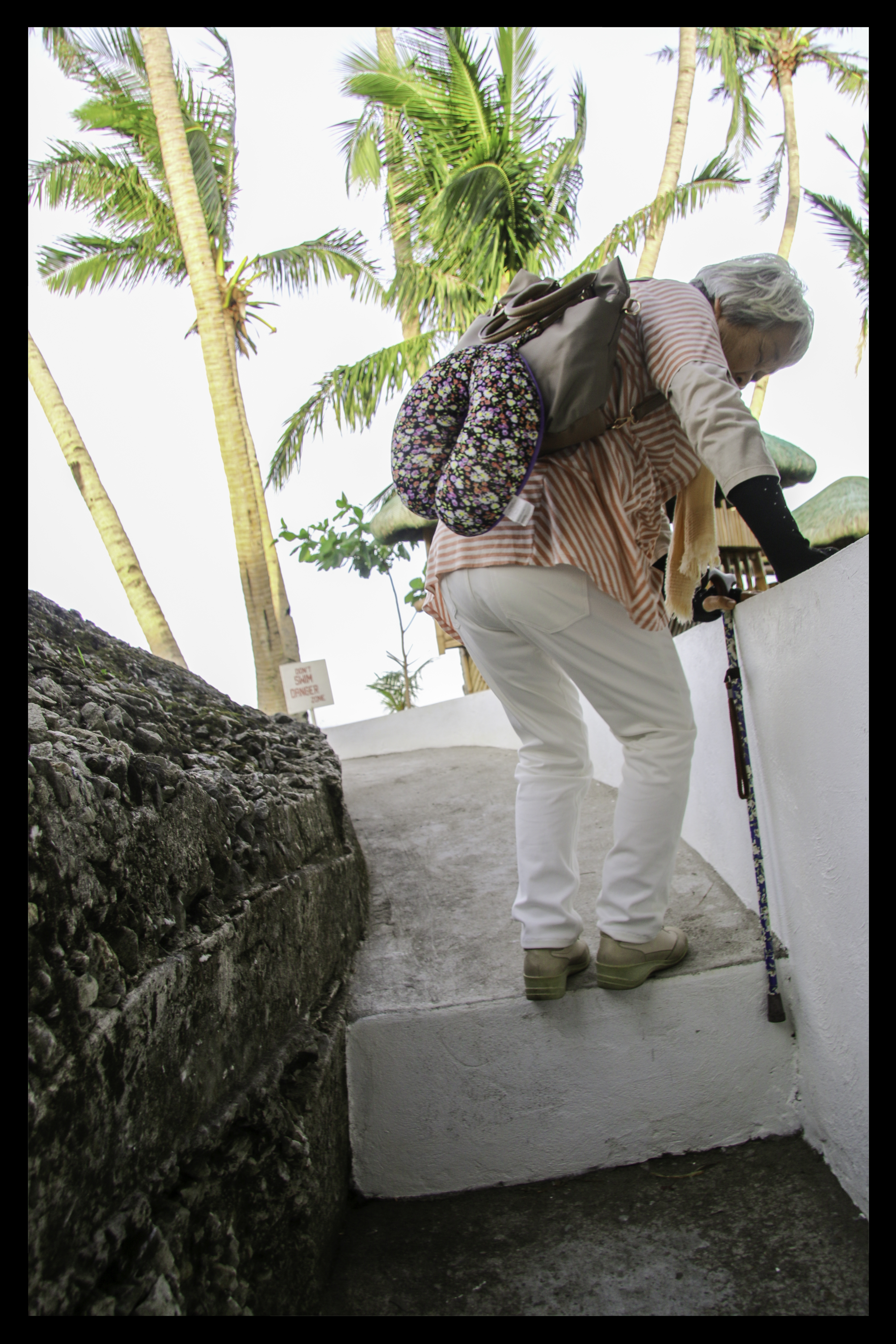
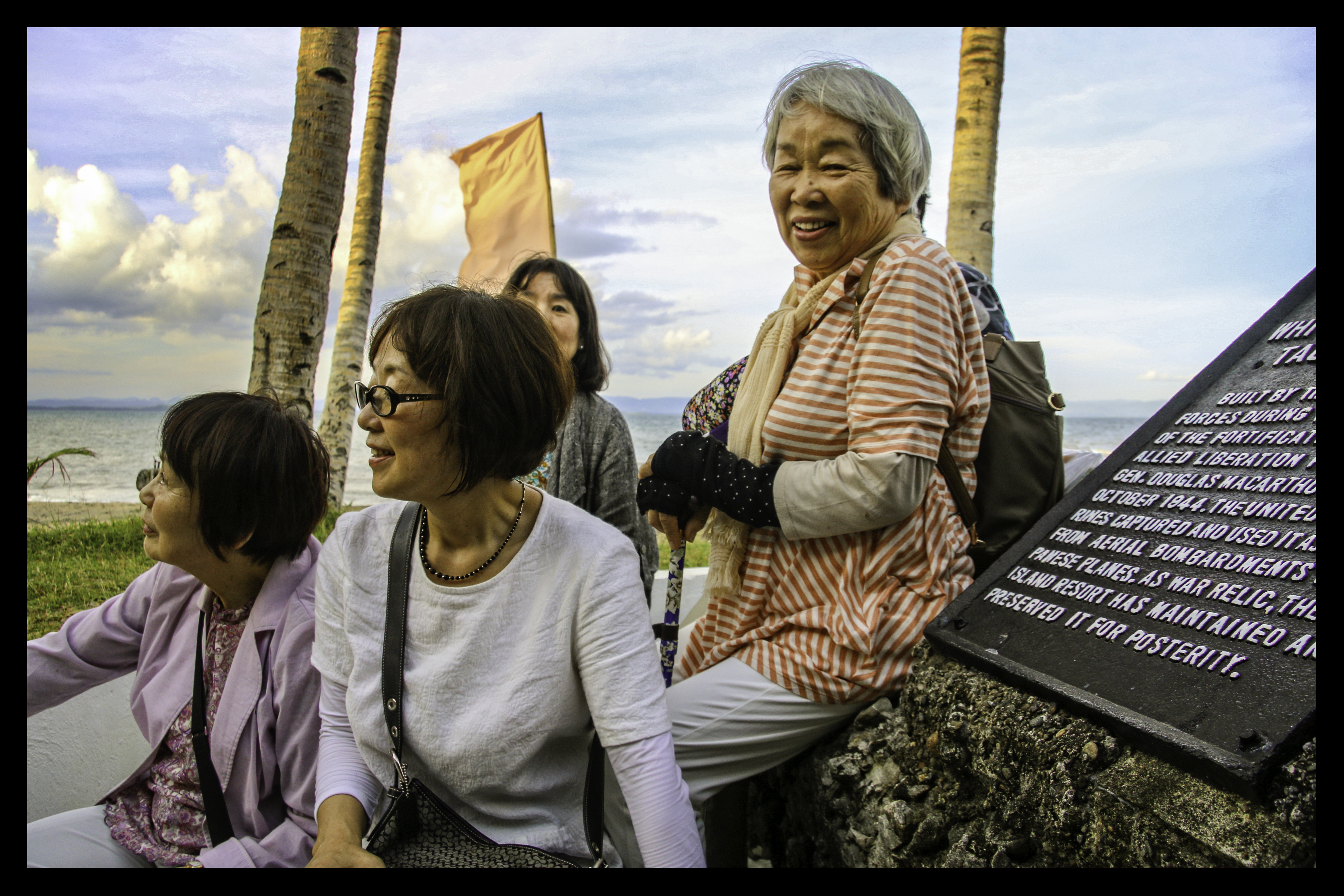
One of the two Japanese pillboxes taken out by the US Army’s 7th Cavalry on October 20, 1944.(R to L) Mr. Ota, Tomiko, Masako, Namie and Akehira gaze upon a pillbox at White Beach.I took Masako down to see the interior. The mosquitoes were very happy in there, awaiting tasty humans like me.Masako determinedly climbing back up the stairs after looking inside the pillbox.A gleeful Masako, Izumi and Tomiko resting upon the remnants of the second pillbox. I didn’t have the heart to inform Masako either five or eight Japanese soldiers died inside that pillbox via rifle fire, hand grenade or flame thrower as the exterior was intact.
The only other person with active memories of Uncle Suetaro was the reverend of the Buddhist temple adjacent to our Hiroshima home. I talked with him three years ago when he was about 90 years old but with a sharp as a tack memory. He passed away last year per Masako.
On a sweltering, humid day, the family poses in front of Breakneck Ridge after the second of four memorial services. The one with the belly is me. Leyte, Philippines. July 22, 2015.
“Perhaps somewhere on Leyte, while surrounded by the US Army, Uncle Suetaro glimpsed up at the night sky through the dense palm fronds. Rain fell upon his unwashed face. Perhaps he was wounded and if so, perhaps shivering from a raging infection. If he lived until morning, he found each dawn worse than the dawn before. He was starving.
He knew inside his heart he was not evil… But if I am not evil, why am I here dying?“
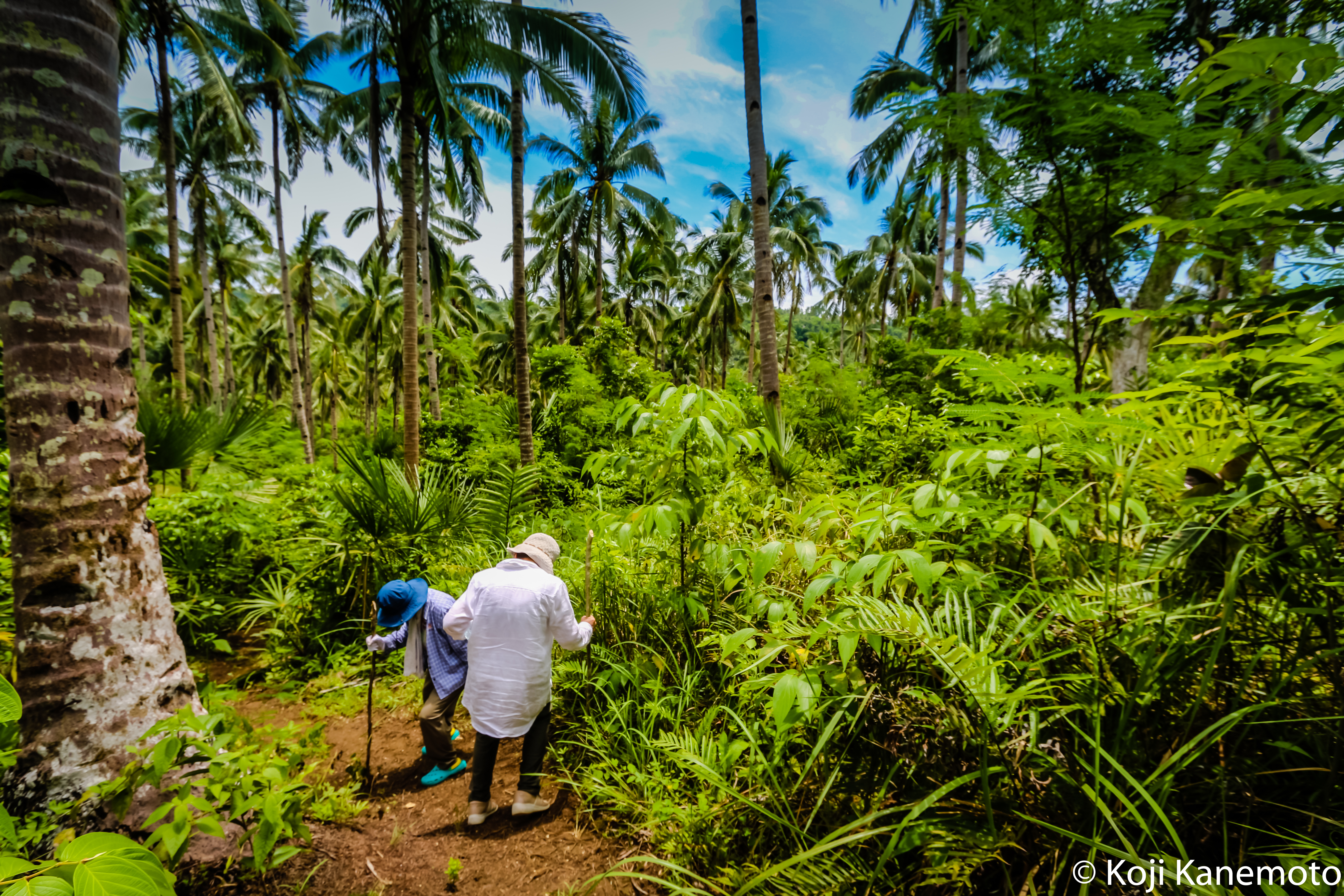
Cousins Namie and Tomiko negotiate an incline on Leyte. They are all in their late 70’s.
A Pilgrimage to Leyte Begins
At 33,000 feet, the Philippine Airline’s pressurized cabin was cool and comfortable. An hour into our three and a half hour flight to Tacloban, Leyte, it began to fill with the wonderful, pleasant scent of lunch.
The attractive Filipina flight attendant handed us our meals. As I took the gold foil cover off the chicken lunch, I turned to my cousin Kiyoshi seated next to me in 46H on my left and said, “末太郎さん、腹へっていたでしょう、” or “Uncle Suetaro must have been so hungry.”
My eyes began to tear up once again. It would happen many times during our Hiroshima family’s pilgrimage to Leyte…
______________________________________
The wife of Tacloban City’s Mayor, the former actress Cristina Gonzales, was kind enough to greet our group.
In the epilogue of my story, “A Soul Lost in a Faraway Jungle”, my 81 year old cousin Masako climbed a long flight of stone stairs to the top of a military shrine in Hiroshima. She said our deceased Uncle Suetaro called out to her. With that, we knew we would be headed to Leyte. It was just a question of when.
“When” was last week. July 19, 2015.
My four Hiroshima cousins and Masako’s daughter went on a six-day/five-night pilgrimage to Leyte, spearheaded by the author of the book “Eternal 41st”, Mr. Yusuke Ota. With us was another lady whose uncle was verified as being killed on Leyte near the end. Also with us was a news reporter from a Hiroshima newspaper.
We went to honor not just our uncle who was killed as a Japanese soldier but for all souls who never returned from that island during WWII.
I also took with me a letter as well as photographs from blogger gpcox of PacificParatrooperto be read to her father “Smitty”. Smitty was a paratrooper with the US 11th Airborne and fought for his own life on Leyte against the Imperial Japanese Army – of which my uncle was one. My uncle arrived on Leyte October 26, 1945; Smitty on November 18, 1945. Smitty returned home; my Uncle Suetaro did not.
The memorial tabletop, Japanese-style. You can see Smitty’s photos on the right alongside the photos of my Uncle Suetaro. Perhaps their paths crossed but ultimately, their sacrifices 70 years ago led to the US/Japan harmony we have today. Indeed, I like to think they were both victorious.
__________________________________________
Leyte
But first, a quick look at Leyte and its people:
A little Filipina girl runs alongside us as we pass through her small village:
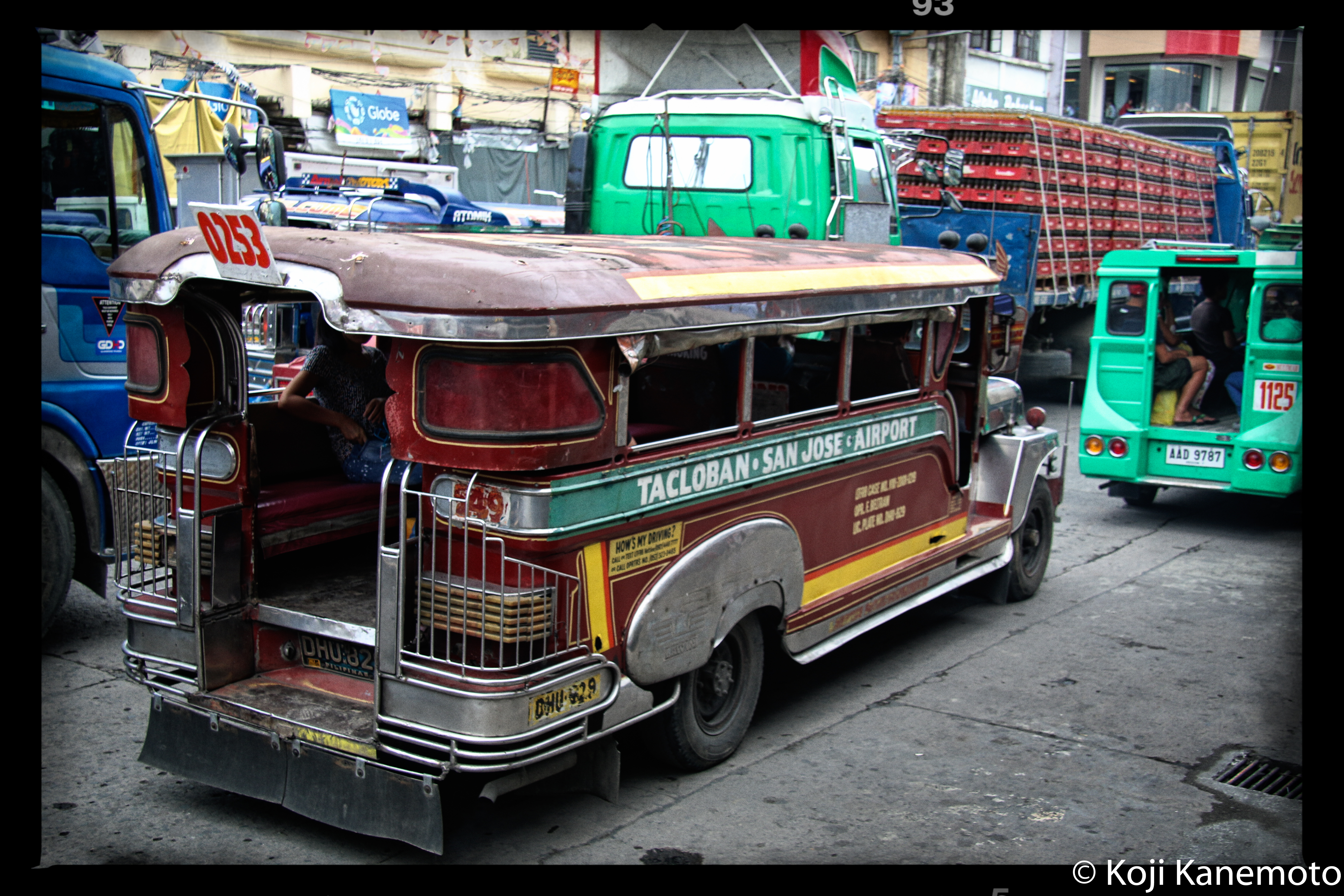
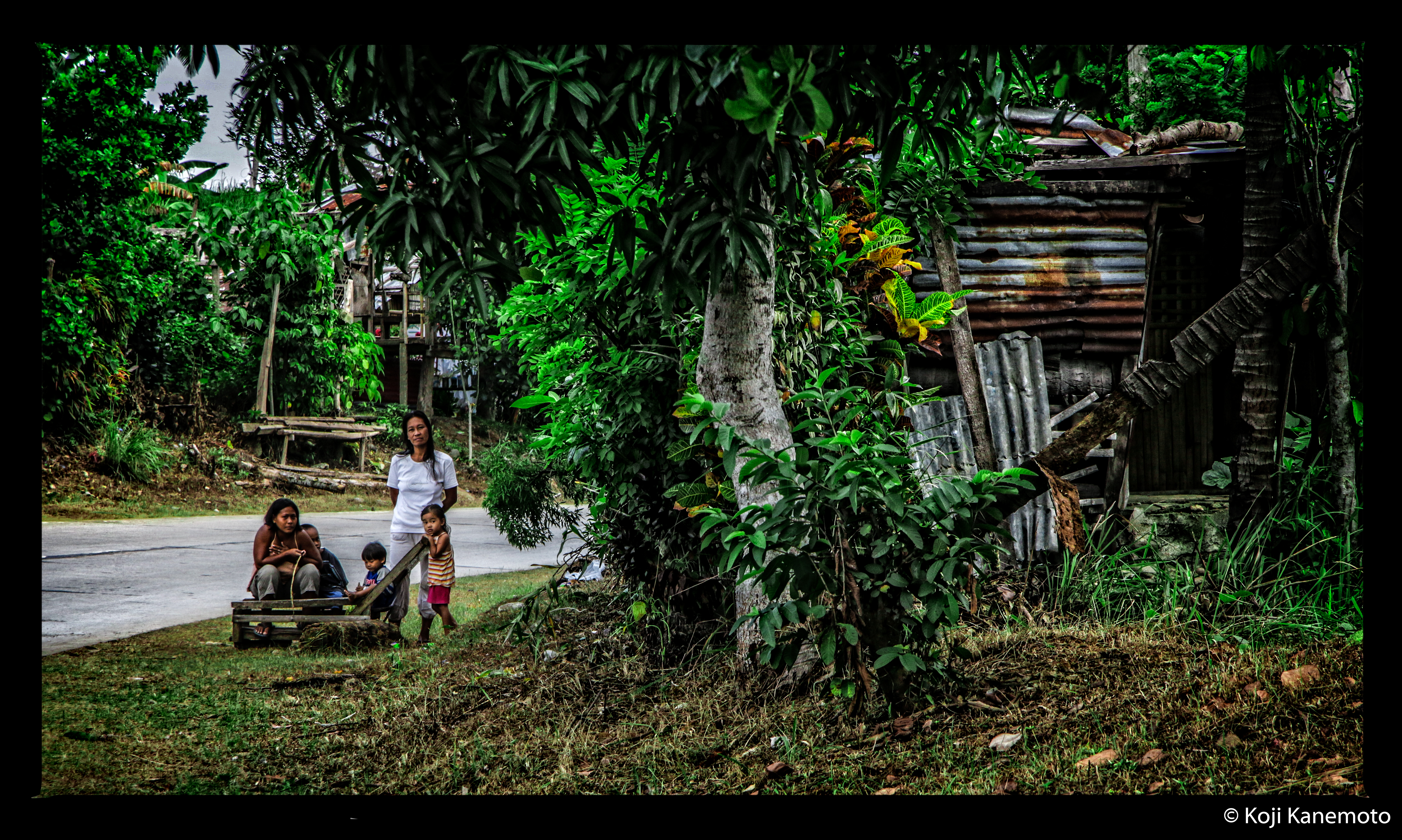
Filipina children we encountered climbing Hill 522 near the invasion beaches of 1944.A typical transit bus, taken through our van’s window.Local people almost always watched our memorial services including this young mother and daughter. She is clutching some of the food we distributed after the services.Vegetable peddler, Tacloban City.Curious locals watching us near Limon River which turned blood red during the battle in 1944 per interviews.Family selling bananas at street side. Bananas grow everywhere on Leyte.
The entire island is in various stages of reconstruction after it was devastated by Typhoon Yolanda less than two years ago. Death toll estimates range from 6,000 to 10,000 people.
Tacloban City and the aftermath of Typhoon Yolanda.
Mr. Ota is very active in the noble Tacloban City/Fukuyama Sister City relations. If you would like to contribute to their recovery efforts, please contact Mr. Ota directly through his blog:
Grandfather Hisakichi and Grandmother Kono posing in Seattle with their first child, my Uncle Yutaka, in 1910.
My grandfather, Hisakichi Kanemoto, immigrated from Hiroshima in 1898 with my grandmother Kono coming in 1908 to become his picture bride. They had seven children of which my dad is the last surviving sibling at 96 years of age. Five of those children called “Hotel Fujii” their home at King and Maynard in Seattle, WA. Sadly, Hotel Fujii is no longer standing.
_________________________________
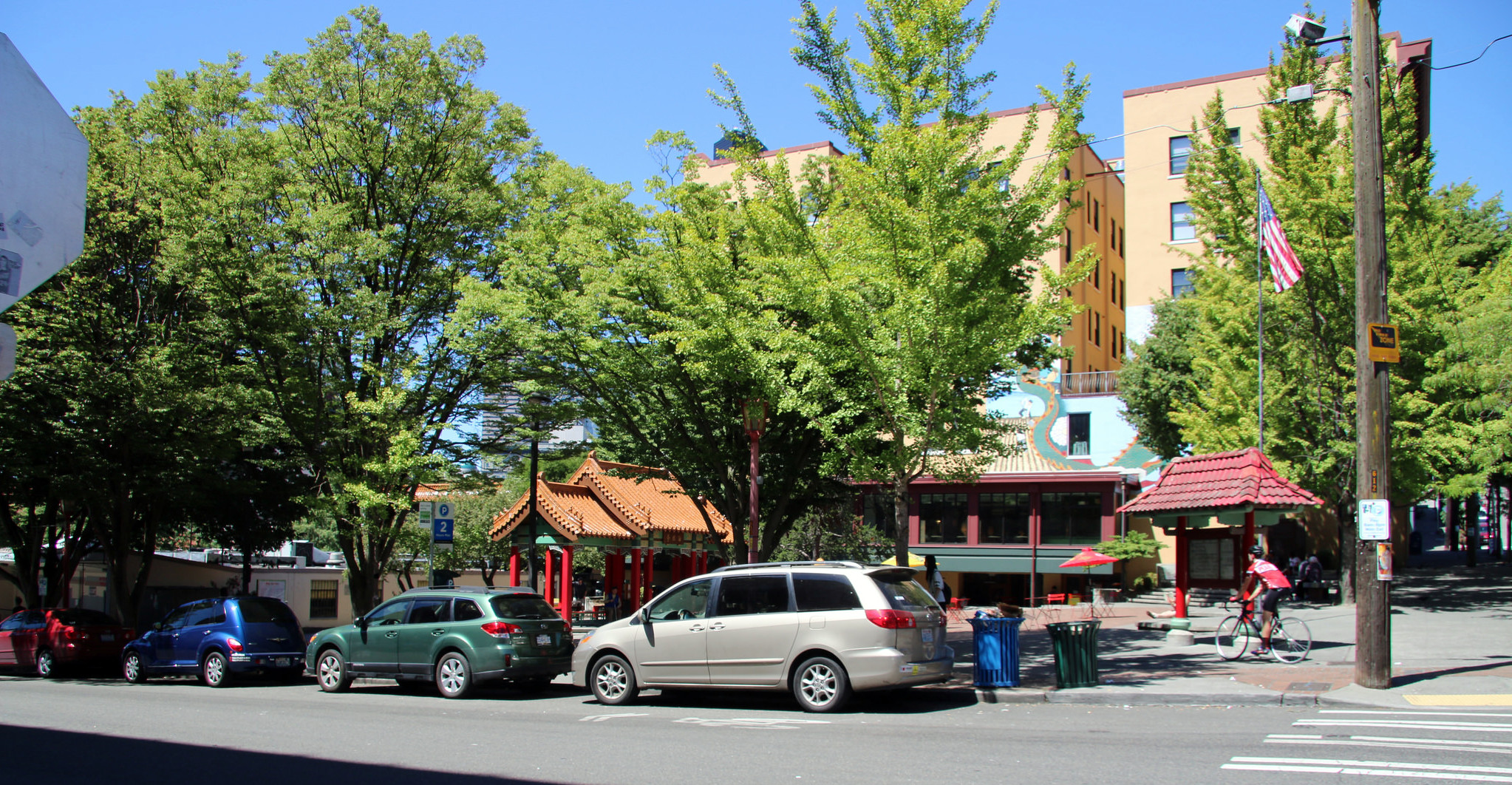
My two littlest kids and I took a short vacation trip to Seattle the week of June 22, 2015. One project I tasked myself was to attempt putting together “then and now” recreations of family photos taken about 100 years ago. Well, mostly 90 years ago but 100 sounded better. Yet, I was only partially successful; it was luck for the most part:
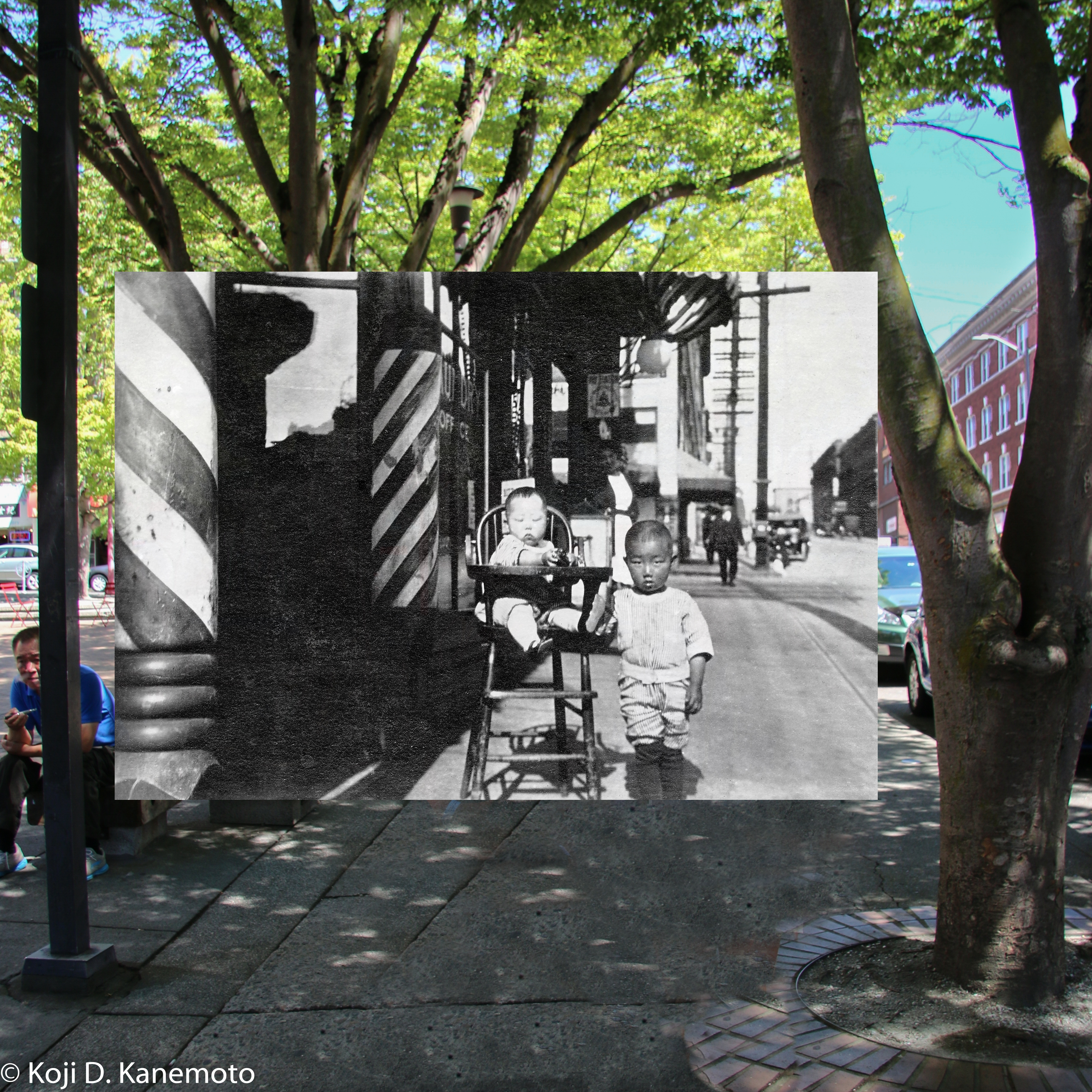
(Clockwise) Grandmother Kono, Uncle Suetaro, an unknown girl and dad on tricycle. Dad says the corner brick building had a butcher shop at street level. Circa 1925. Color image taken at King and Maynard, June 25, 2015.Looking east up King Street. You can see the “Hotel Fujii” signage extending out from the hotel above my Grandmother. Year unknown but post 1917.At King and Maynard. Clockwise from Grandmother: Aunt Shiz, Uncle Suetaro, Dad and baby Mieko. Based on baby Mieko, likely 1925.Grandfather Hisakichi at far right, taken at Mt. Rainier August 1919. Finding a similar location on Mt. Rainier was a long shot but I had hoped this location in 1919 would not be far from current road stops as they were traveling in a 1913 Chevrolet Classic Six (Note 1). The 2015 color shot was a few hundred yards from the Rainier Inn.Aunt Shiz dancing on left, looking east up King Street. The bottom of the Hotel Fujii signage is above the girls. My guess is circa 1923.Grandmother Kono holding baby Mieko. Uncle Suetaro is peeking over the chair looking at his sister. Dad is standing in the middle with Aunt Shiz to his right. The lady is unknown as is the child but we suspect it is Mrs. Fujii. King and Maynard, circa 1923.Dad and Uncle Suetaro in front of Grandfather’s barbershop. Circa 1922, King and Maynard.Although a poor recreation, Grandfather is standing at right with his hand on an unnamed male buddy. He is in other photos. Taken at the entrance to Grandfather’s barbershop (best guess as to location). Circa 1917.
This “then and now” project was only partially successful as I did not consider many things:
Other very successful “then and now” recreations by professionals primarily had one thing in their backgrounds that I did not: a building. I overlooked that fact. The Fujii Hotel was torn down with only a park left in its place, e.g., there were no windows or doors to line up the old photos with. For the most part, that made for difficulty in guessing/placing from where the photos from the mid-1910s to the 1920s were taken.
I did not consider the fact that the buildings on this street 100 years ago were built on a hill, i.e., all were built upon a concrete base that was taller at the west end compared to the east end.
Because of the number of cars parked curbside, I had to resort to wide angle shots. By doing so, perspective in comparison to the original would not be correct.
There were a few homeless at the park who clearly did not want their picture taken. As my two kids were with me, that became a hurdle.
I did not take into account the time of day (shade).
I did not anticipate the construction nor the large trucks, garbage cans and trees blocking the view.
I misjudged the position from where I took the photographs, affecting perspective and angle. I should have been ten more yards east for a few of the images. Too late now.
I also realized that there were no pictures of Uncle Yutaka nor Aunt Michie at the Hotel Fujii. Uncle Yutaka had likely already been in Japan (1913) by the time these old family photos were taken. Aunt Michie, of course, was the only sibling not born in Seattle but rather in Hiroshima.
Uncle Yutaka and Aunt Michie, taken circa 1918 in Hiroshima.
A lot was learned.
I only wish I had gained the experience before undertaking this family project. I do hope my cousins and children will still find these images interesting if not to merely appreciate our family photos from “100 years ago”.
_____________________________
NOTES:
1. Grandfather (back to camera in center) camping on Mt. Rainier and Mr. Fujii’s 1913 Chevrolet Six:
2. King and Maynard today:
The current store “Gossip” behind my kids was a butcher shop in the 1910s/1920s per my father.
3. The northeast corner of King and Maynard, taken June 25, 2015. The building still stands as it was 100 years ago.
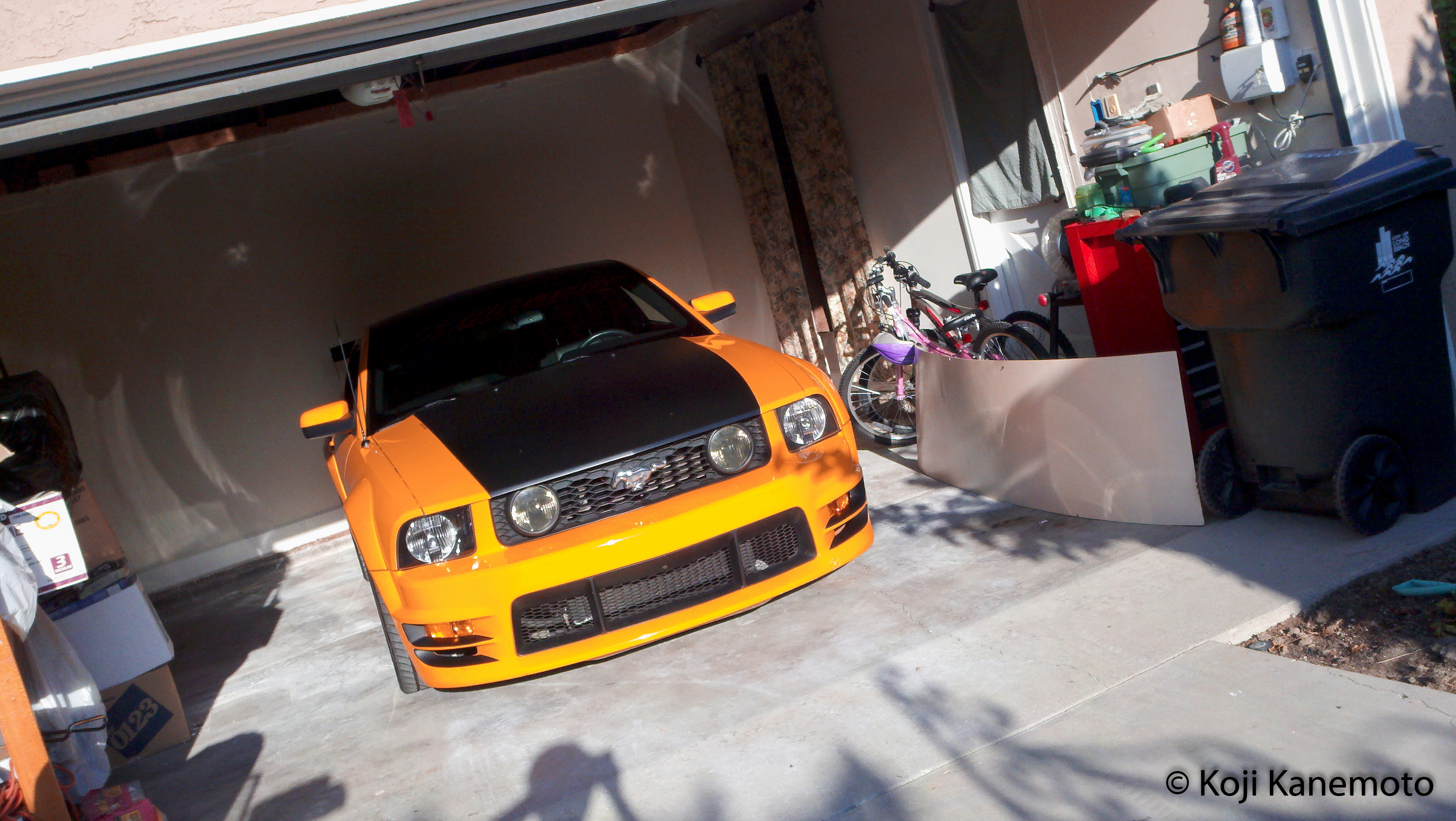
My supercharged Grabber Orange Mustang lived outside 24/7 for her first five years. Old Man Jack’s driveway is to the very left; he would on occasion call me over to his garage to chat.
I was out front one morning, enjoying a gorgeous holiday weekend. While pointing in my general direction, Old Man Jack said to me from across the street, “Koji, she needs to come in at night.” My car was in between Jack and me. He loved my car…almost as much as his F4U Corsair.
Why would he tell me to put my Grabber Orange Mustang into the garage? He knows it’s parked outside 24/7 because the aggravating ex took away my garage space without saying a word.
“Say what, Jack?” asked I…
I was humbled shortly thereafter by this exceptional and aging WWII combat vet who went to war as a young boy.
______________________________________
Indeed, I had to park my supercharged, car show winning Grabber Orange Mustang at curbside 24/7. Blistering sun, rain, ashes from wildfires, toxic sea gull poop and dog pee on my chrome wheels, I tell ya. The sea gull poop was the worst: unless you got if off before the desert-like sun microwaved it, it would leave the vinyl graphics underneath stained. Crap.
Sea gull bomb.Aftermath of sea gull bomb – the stain.
But I had to park it outside on the street, as I mentioned, as my darned ex decided to secretly take over my man-cave just months before I got the Mustang GT.
After the divorce and after throwing a lot of the stuff she didn’t take, this is what the garage looked like. The illegally built room took up about 75% of the space. She even had a door, lights and curtains installed. Definitely no room for a car… Well, maybe a Smart car…but that isn’t a car. 🙂
If you thought Pearl Harbor was a sneak attack, the ex’s takeover of my man-cave was a blitzkrieg. Let’s just say it was a helluva shock to come home from work one day to find an illegal alien well on his way into putting up walls in the garage. She was building a “massage room”. Well, in the end, it was used for much more, unfortunately.
The cleared out space after I paid my AMERICAN citizen buddy to tear it down and haul it away. My car now has a home. Notice the door and the window with curtains she had installed. It’s going to cost a pretty penny to have them torn out and filled in. Oh… Look at the bottom right corner… Six feet of my driveway is missing. That is another ex story.
________________________________________
But back to Old Man Jack telling me that “she needs to come in at night”…
“Jack, I can’t put the car in the garage. You know that,” I said.
“No, not the car, you dumb shit. The flag!” he said with his boyish trademark grin and with great fondness.
“Huh? The flag?” I asked.
“Shit, didn’t they teach you anything in school? You gotta put a light on her if she’s staying out at night,” he said.
Old Man Jack with his happy face on and me. He would pass away about a year later.
I then realized he had pointed to the flag behind me and not my car. Duh. I had put the red, white and blue out for the holidays as always and had simply left it out – and yes, for convenience. He must have seen it left out the night before. But then again, he must have been biting his tongue for years as I had left it out before.
As Popeye, the Sailor Man would say, “How embarrassinks.”
______________________________________
Well, Old Man Jack was right; there has to be a light shining on the flag at night. And yes, I had learned that exact flag etiquette as a youngster in school but just plain forgot with time. Heck, me and this other kid had the honor to take down the school’s flag at the end of the day on a regular basis then properly fold her up while in the 6th grade. I can still hear the clamps clanking on the metal flag pole as we lowered her.
Anyways, I had remembered that story with today being Memorial Day. I had the flag out in reverence to our fallen. I even caught the tail end of a flight of four WWII T-6 Texans just north of us in a missing man formation.
________________________________________
It is now dark outside and yes, I brought her in. Can’t upset Old Man Jack, you know.
But it ate my heart out to see it draped over his casket just about three years later.
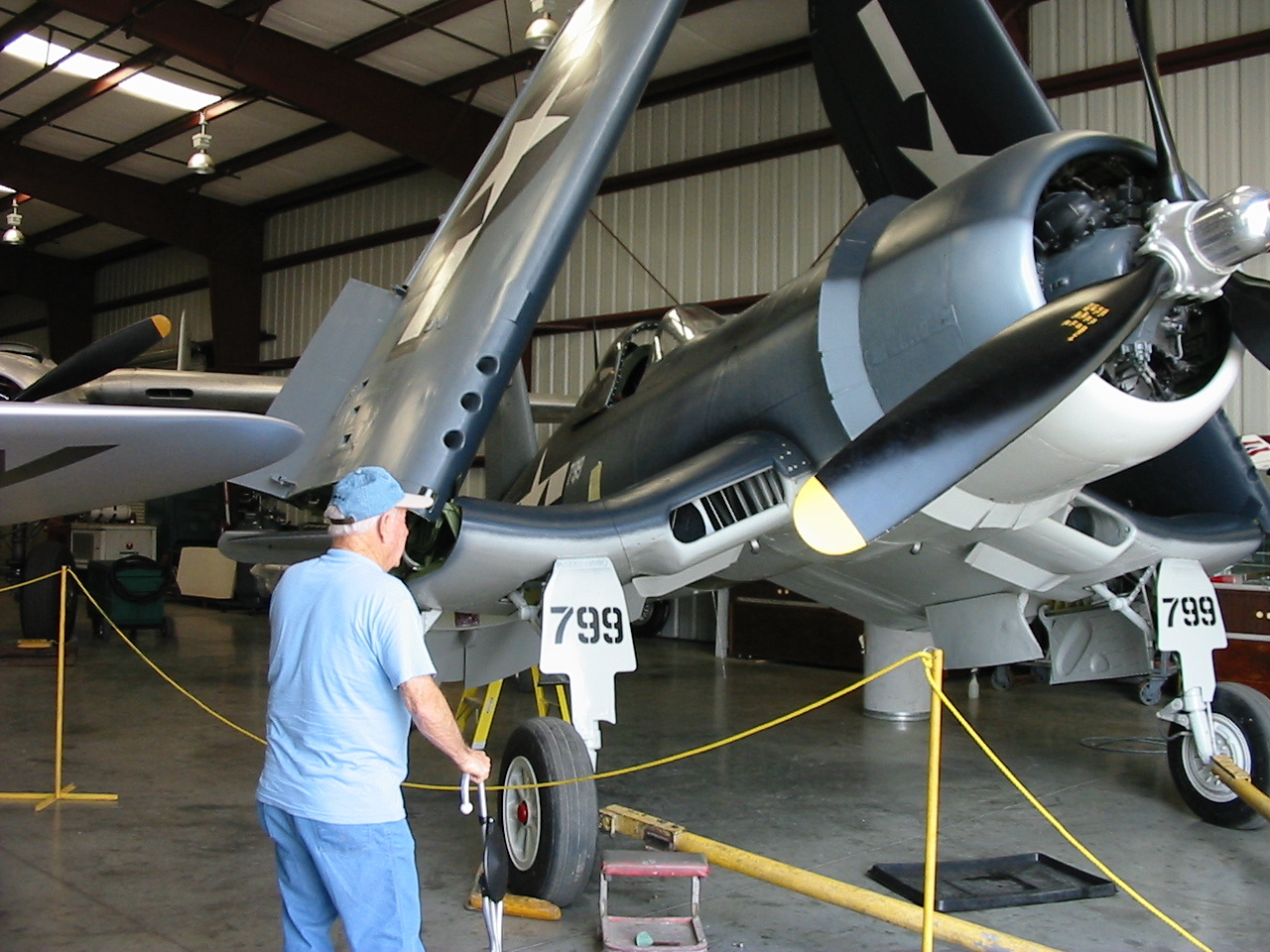
After recovering from a flood of memories, Old Man Jack stares at the other girl in his life: the F4U Corsair. Planes of Fame, March 3, 2003. Copyright Koji D. Kanemoto.
“….The son-of-a-bitch had no legs…” said Old Man Jack from his wife’s blue wheelchair. His arms were making like windmills. Well, windmills as fast as his 88 year old arms could go. He had a comical yet strained look on his face, his bushy white eyebrows still prominent.
But you could see the pain behind those eyes…and in his deadened voice.
___________________________________
Several months have passed since I visited with Old Man Jack at his grave. With Memorial Day around the corner, May 17th was a beautiful day to visit him. A recent rainstorm had just passed and the blue skies were painted with thin, wispy clouds.
I could see no one had stopped by since my last visit; at least no one that left flowers for his wife Carol and him. The hole for flowers was covered up and grass had crept up onto his gravestone.
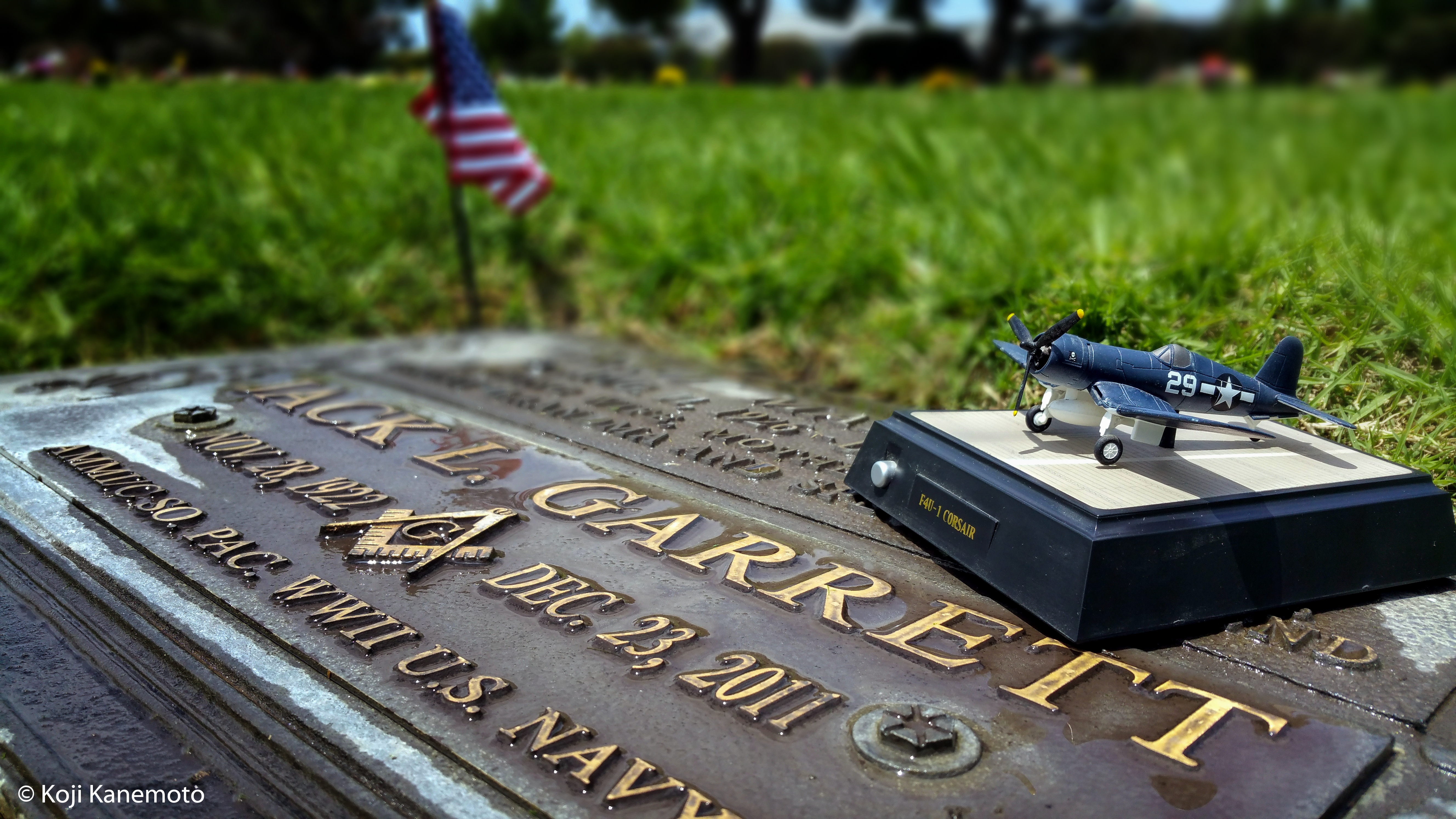
I had brought along something for Jack this time; something I thought he would enjoy. So after cleaning up his resting place, it was placed atop his gravestone – his beloved F4U Corsair:
He loved the F4U Corsair. He reflected on seeing the entire patrol return to base at wave top, do a victory roll then peel off with a tear in his eyes.
I’m hoping he was beaming. He couldn’t possibly be happier, being with the two most beautiful ladies in his life.
____________________________________
But back to his story.
A few months before he was taken away from his home, we had been sitting in his cluttered garage, talking about this and that; I just can’t recall what. But something in our talk triggered an ugly war flashback from his tormented and mightily buried subconscious. By that day in 2011, I could tell when he was enduring one, having sat in his garage with him for ten years.
He began as he did before. He would suddenly stop then gaze down at his hands for a couple of seconds. His left ring finger would begin to rhythmically pick under his right thumbnail. His white, bushy eyebrows now made thin with time would partly obscure his eyes from me when he lowered his head.
While I am unable to recall his exact words, he slowly allowed an ugly event to surface:
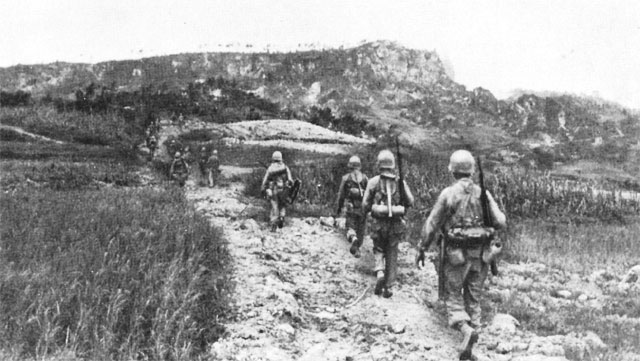
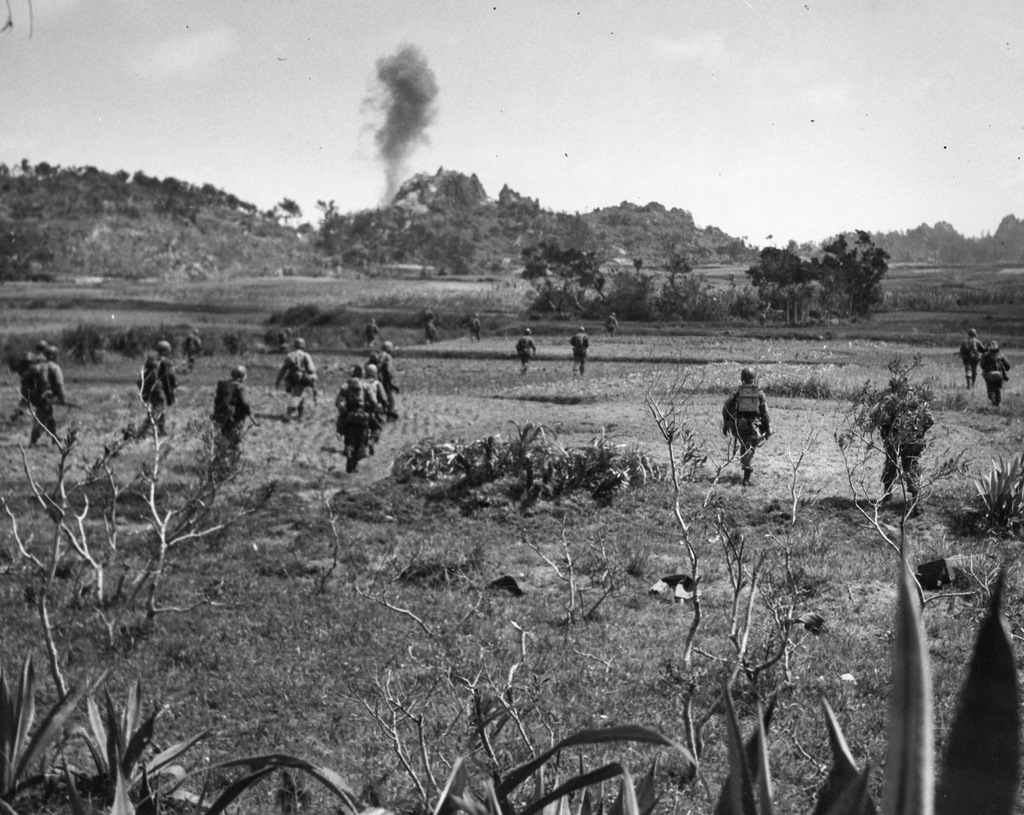
Old Man Jack began, “We were ordered to go on a patrol. We were issued rifles and hoped to God we wouldn’t come across any Japs,” he said in a remorseful way.¹ “Then, we came to these rice paddies… We could see hills around us… but that also meant the Japs could see us.”²
Perhaps it was this rice paddy in Okinawa. Archival image.…Or this rice paddy. US Army photo.
“We just followed the guy in front of us like cattle,” he said. “We were making it through the rice paddies when a couple of shells came in. Man, I hit the ground real quick.
Then all of a sudden, all hell broke loose. Rounds were coming in like crazy all around me. They had this area zeroed in real good.”
He continued. “I ain’t ashamed to say it. I was scared real bad. Then we all started to scram. I got up and started to run. I dumped my rifle and ran like crazy.” While in that blue wheelchair that belonged to his beloved wife Carol, Old Man Jack made like he was running, much like Popeye in this clip:
He then took his gaze away from his hands. “Then I saw this guy flying through the air with his arms making like he was still running… but the son-of-a-bitch had no legs!” He pointed his finger and made an arc like a rainbow, then swung his arms like a windmill. Apparently, an enemy round had hit his comrade, severing his upper torso from his legs then throwing him into the air. Although the comrade met a violent end, Old Man Jack was describing how he saw his arms flailing.
He stopped. His eyes returned to his hands. I still cannot imagine the torment he was enduring, even after 70 years.
I never will. I just hope he didn’t take it to his grave with him.
_____________________________________
While Old Man Jack was fortunate to have survived combat unlike my Uncle Suetaro or Sgt. Bill Genaust, it was but a physical survival.
Combat tormented him forever.
Let us remember this Memorial Day our fellow Americans who perished so young for the sake of their families and friends, no matter which conflict… and also firmly support those in uniform as I write. They, too, are being forgotten by many, even as they fight – and die – for us in godforsaken faraway places.
My friend’s first husband, Sgt. Robert W. Harsock, US Army, Viet Nam, posthumously bestowed the Medal of Honor. National Medal of Honor Memorial, Riverside National Cemetery. Copyright Koji D. Kanemoto
____________________________________
NOTES:
1. I would like to remind my readers that Old Man Jack had no hatred to me or my family when he uttered the word “Jap”. He is digressing to a most vile period in his life in which he could be killed the very next moment. If you are offended, it is suggested you participate in an all-out war; perhaps you will understand why.
2. At his funeral, the minister read off the islands he fought on. Based solely on his description of the large rice paddy and hills combined with what the minister said, I firmly believe this was Okinawa 1945. Oddly, while Old Man Jack mentioned Guadalcanal, Rabaul, Bougainville and Green Island, he never mentioned Okinawa.
While avoiding any political endorsement of Prime Minister Winston Churchill, he did lead England to victory over Hitler’s Germany during World War II.
It was a grave time for England¹. While I am certainly not a military historian, his famous speeches – with his distinctive speech and delivery which helped keep the British morale bolstered – always intrigued me. They were always stirring. Why is that, I thought.
As an example, an excerpt of one of his more famous WWII speeches follows, broadcast to the free world at the end of the Battle of Britain¹. He pays homage to the brave, young RAF pilots who flew countless of sorties in defense of their homeland against numerically superior Nazi warplanes. The radio broadcast recording is set to start moments before his famous words of “Never in the field of human conflict was so much owed by so many to so few“:
But there IS something in his speeches that captivated the common English layman of war-ravaged England…and me. He captured the populace with his radio broadcasts, from chimney sweeps to the most learned elite. This in a time when Nazi Germany laid siege to the island nation, eventually bombing London itself (which was part of a key tactical blunder²).
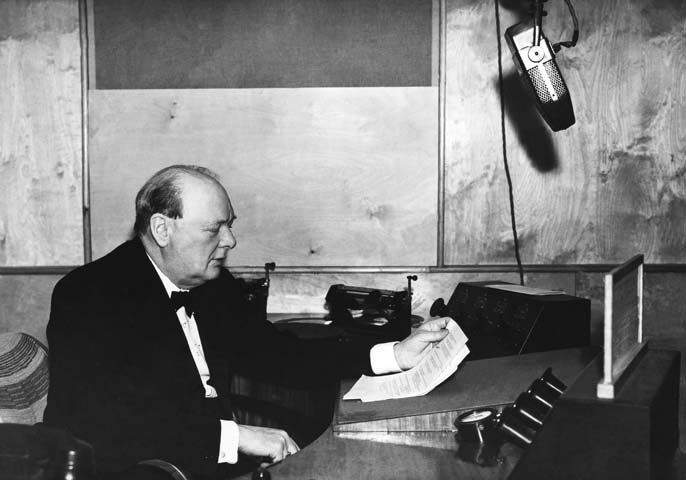
Nevertheless, his tone is generally reserved during his speeches; yet, it is stirring. It certainly is not animated as that of his psychotic foe, Hitler; it is said Churchill would merely sit behind the microphone on a desk while his faithful cigar burned at his side while broadcasting his speech. (Hitler is one of the most animated, dynamic speakers I have watched even though he was inhuman.)
An archival image of Sir Winston Churchill broadcasting to the English population, 1942.
Then, a couple of years ago, I had stumbled across an article about his speeches. I think I was researching in support of one of my son’s school projects when I came across it. But it finally laid bare his secret to me for his successful speeches: it was the simplicity of his words.
His speeches not only excluded complex words, like perpendicularity or discombobulation for the most part, his ultimate secret was the number of syllables in a word.
It was rare he used any word with more than three syllables. Yes, three syllables. Amazing, isn’t it?
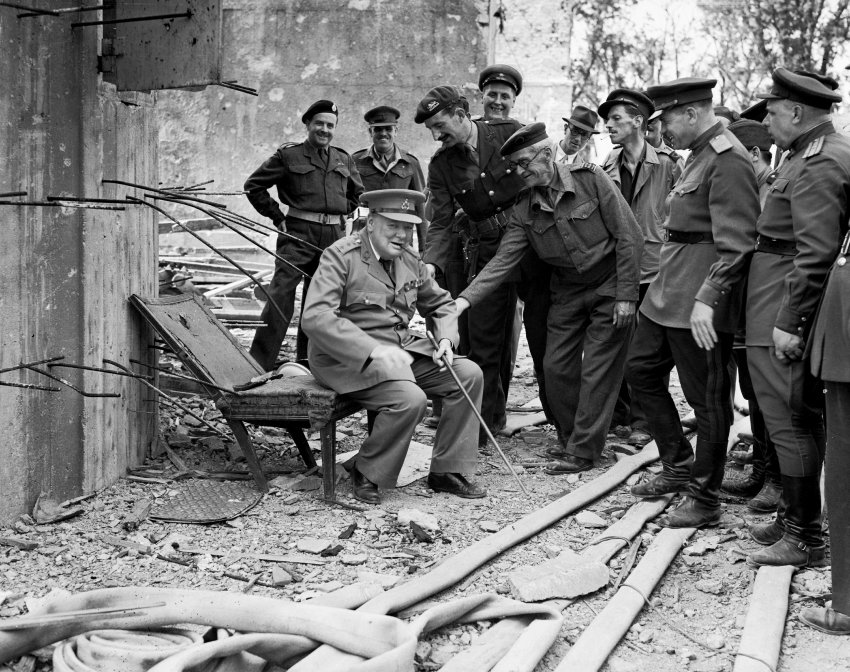
With his cigar going, Sir Winston Churchill visits Hitler’s destroyed Chancellery in July 1945. Archival photograph.
In an excerpt from his speech on June 4, 1940 below, you can see his perfect choice of words. There are only three words with more than three syllables (bold italics). Simplicity was his preference and key to his success:
“I have, myself, full confidence that if all do their duty, if nothing is neglected, and if the best arrangements are made, as they are being made, we shall prove ourselves once again able to defend our Island home, to ride out the storm of war, and to outlive the menace of tyranny, if necessary for years, if necessary alone. At any rate, that is what we are going to try to do. That is the resolve of His Majesty’s Government-every man of them. That is the will of Parliament and the nation. The British Empire and the French Republic, linked together in their cause and in their need, will defend to the death their native soil, aiding each other like good comrades to the utmost of their strength. Even though large tracts of Europe and many old and famous States have fallen or may fall into the grip of the Gestapo and all the odious apparatus of Nazi rule, we shall not flag or fail. We shall go on to the end, we shall fight in France, we shall fight on the seas and oceans, we shall fight with growing confidence and growing strength in the air, we shall defend our Island, whatever the cost may be, we shall fight on the beaches, we shall fight on the landing grounds, we shall fight in the fields and in the streets, we shall fight in the hills; we shall never surrender, and even if, which I do not for a moment believe, this Island or a large part of it were subjugated and starving, then our Empire beyond the seas, armed and guarded by the British Fleet, would carry on the struggle, until, in God’s good time, the New World, with all its power and might, steps forth to the rescue and the liberation of the old.”
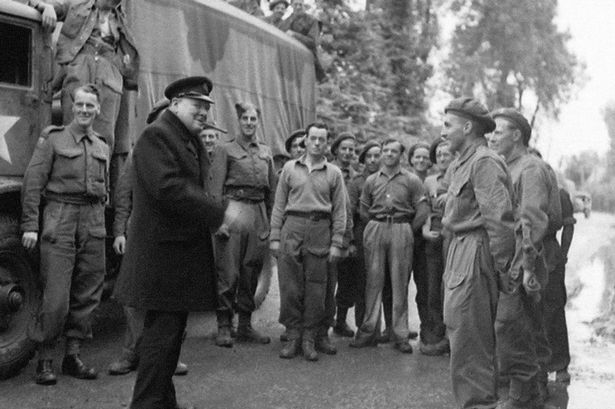
Sir Winston Churchill, with cigar going, visits British troops in France six days after D-Day. Archival photo.
________________________________________
Anyways, I just thought it was fascinating to finally learn one key to Sir Winston Churchill’s successful and historic speeches. After he carried England through the war, I am sad he was voted out as Prime Minister in Britain’s first elections after Germany’s surrender. He passed away in 1965 at the age of 90.
But one thing is for certain. My Little Cake Boss Diva has instinctively mastered Churchill’s speech skills.
“Papa… Why do you do it that way? Do it this way!”
See? All three syllables or less… She must be captivating although she is a bit more animated than Churchill was.
Someone help me.
By the way, my text above has twelve words that have more than three syllables. 🙂
____________________________________________
For a collection of Sir Winston Churchill’s speeches, please click here.
NOTES:
1. It is but my belief that England’s situation in 1939 while dire was not as gloomy as history presents it to be. Nevertheless, it was a most dangerous time to be a Londoner.
2. Perhaps in the future, I will write about this “blunder” by Hitler and most of all, Goering. One unbelievable tactical error was ordering his Me-109’s – arguably a better fighter plane than the British Spitfire – to fly alongside his bombers in a defensive move.
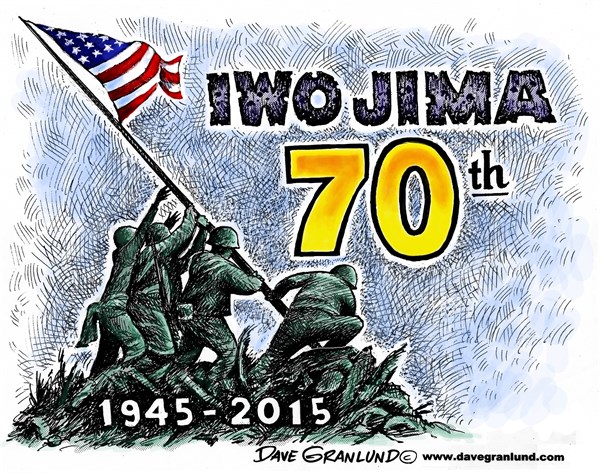
While on the sands of Iwo Jima last month for the 70th Anniversary, this former P-51 fighter pilot (Jerry Yellin) spoke so eloquently and humbly about WWII that it brought tears to my eyes.
Now 91 years old, he flew off Iwo Jima in the very last mission of WWII, escorting B-29s on their bombing mission. During this very last mission, his wingman was killed.
Yet, he talks nobly about the nightmares of war and about his own family which now includes a Japanese daughter-in-law and grandchildren.
I hope you will watch and listen to this gentleman.
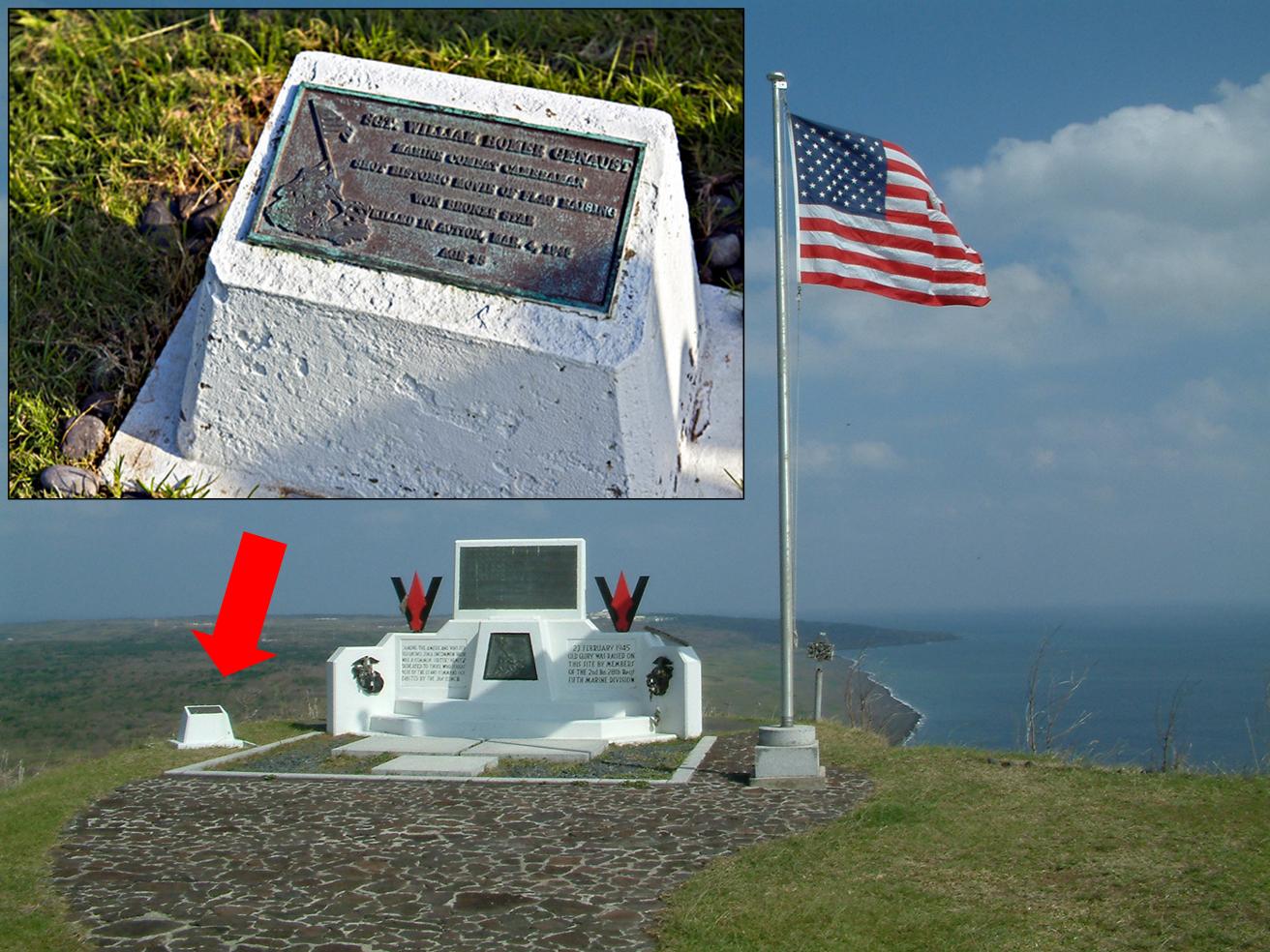
The Marine Memorial atop Mt. Suribachi (date unknown). The inset is a close up of a plaque honoring Sgt. Genaust. It says, “Sgt. William Homer Genaust, Marine Combat Cameraman, Shot Historic Movie of Flag Raising, Won Bronze Star, Killed in Action, Mar. 4, 1945. Age 38”. His body lays hidden at the northern tip of the island, seen beyond the Memorial. I am unaware of the current status of this memorial. The Japanese military has closed its base on Iwo Jima; it is now largely uninhabited except for those lost souls.
After filming the second flag raising, Sgt. Genaust did some more filming of the battle. A few reels focused on litter bearers carrying young deceased Marines. Some footage was shot of a Navy Corpsman rendering aid to wounded Marines. But the most foreboding footage depicted the cave-by-cave elimination of Japanese soldiers. All in all, he shot 23 Kodachrome rolls, each about four minutes in length.
Roll 23 was shot on March 2, 1945. In a documentary, the roll begins with Genaust holding the paper identifying it as #23. But amongst all the fear, violence and carnage, he is still wearing his wedding band.
In this roll, there was some brief footage taken of a Corpsman rendering aid to a wounded Japanese soldier. It would be his last roll. He would not be picking up a camera again.
____________________________________
It apparently rained for a couple of days after shooting roll #23. On March 4, 1945 and according to various interviews, it appears that Sgt. Genaust, as a rifleman, accompanied a patrol with the 28th Marines. Their objective was Hill 362.¹
A portion of Hill 362A. USMC photo
They came upon a cave opening. They had to clear it then seal it. Grenades were thrown in. With the confusion of battle, casualties and time, specifics are varied but it is clear Sgt. Genaust entered the cave with flashlight at hand. After a brief period, Japanese machine gun fire erupted from within the cave. As in many other instances, Sgt. William Homer Genaust, USMC, was gunned down; he became one of the 5,931 Marine deaths on that godforsaken eight square mile sulfuric island.²
The Marines decided it would be too dangerous to enter the cave, not only to kill the enemy but to retrieve the body of Sgt. Genaust. According to USMC procedure at that time, grenades were hurled into the cave opening and it was seared with flame throwers. TNT was then used to seal the opening. Sgt. Genaust would not be recovered.
He was killed in action nine days after filming atop Mt. Suribachi. He never lived to see his historic footage nor of its impact on patriotism… but Adelaide, his wife, would.
But she would be viewing it in a way you may not expect.
_________________________________________
The processed USMC color motion pictures were apparently divided into two batches: D-Day to D+8 (containing Genaust’s flag footage) and D+8 to D+18. The first batch went to the Joint Staff in DC; the second batch was brought in by Norm Hatch.
After review by the Joint Staff, the footage was sent to… Hollywood. They would use such footage for newsreels or documentaries. The Kodachrome 16mm footage would be blown up to B&W 35mm movie footage for use in theaters and the like.
The first time Genaust’s footage (uncredited) was made public was in the Universal Newsreel of March 19, 1945 with a caption of “Old Glory Flies Over Iwo Jima”. It was a seven second clip.
The next time the footage was shown was in To the Shores of Iwo Jima, with the production supervised by Norm Hatch . The flag footage, in the middle of the documentary, aired on June 7, 1945. Incredibly, the fighting on Iwo Jima was still going on. (YouTube link below is set to begin at some of Genaust’s footage of flame throwers on D-Day; his flag footage is at around the 10 minute mark.)
The footage became one of the inspirations for Sands of Iwo Jima. It was also used in the TV series, Victory at Sea, which I watched as a youth over and over.
________________________________________
On April 25, 1945, Adelaide received the dreaded telegram… just like hundreds of thousands of American mothers and wives of that time. That is how she learned of his death.
USMC archives.
According to an interview of Sgt. Genaust’s nephew in a recent documentary, he said Adelaide did not realize nor was told the famous footage was taken by her husband. Upon learning her late husband was the cinematographer, however, whenever Adelaide would go to a movie theater, she would constantly see the footage. I can imagine in her heart, the hurt would be renewed and badly. She soon stopped going. Later, the footage would be also shown when TV stations used to sign off for the night.
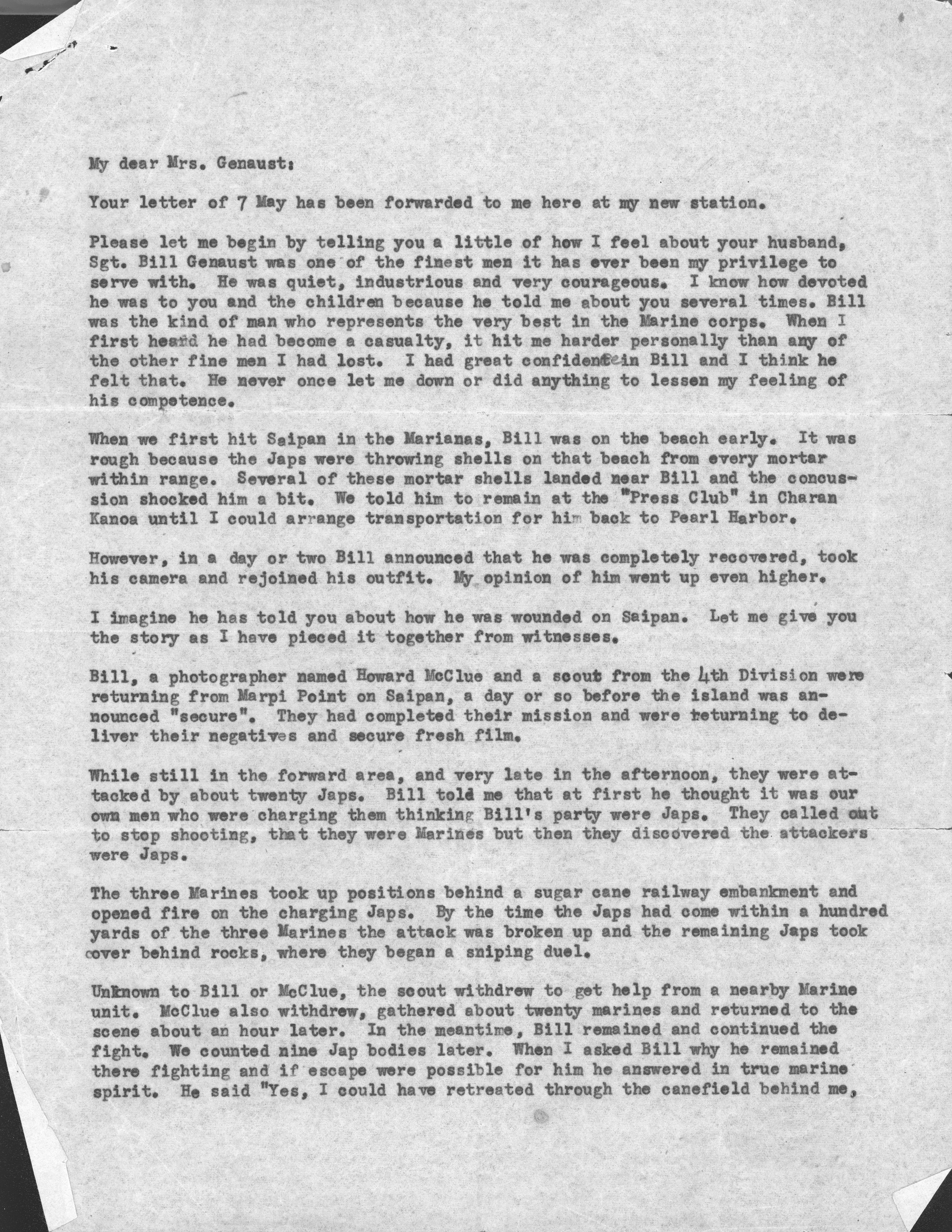
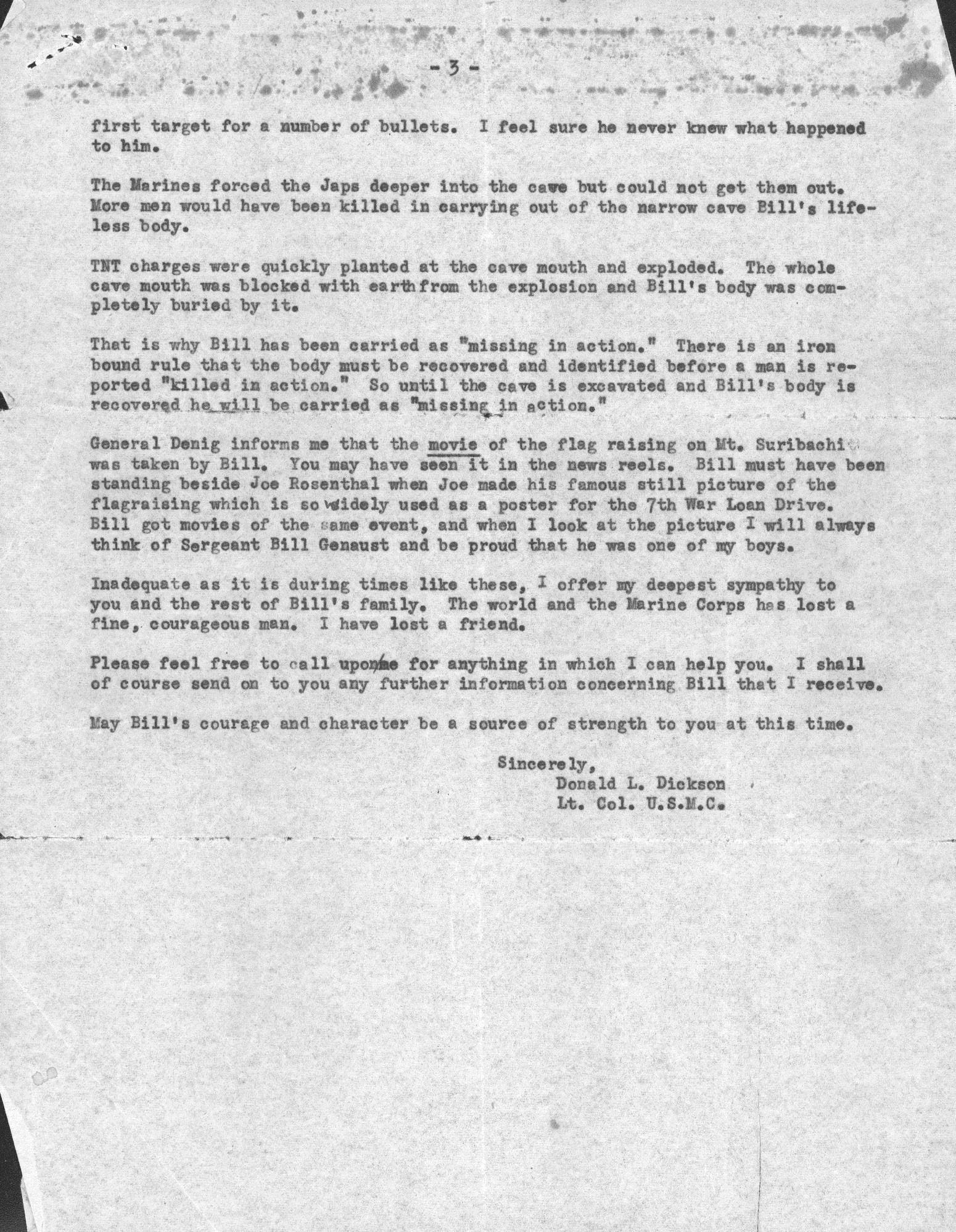
It also appears that Adelaide wrote a letter on May 7 to Lt. Colonel Donald Dickson, her late husband’s commander. It is but my guess but since Sgt. Genaust was declared missing in action (as per procedure), Adelaide may have written Dickson and asked of the possibility he may have been captured.
Dickson replied with a courteous and respectful three page letter (Undated, letter in its entirety. National Museum of the Marine Corps):
And in a wretched twist, the US Post Office delivered to Adelaide a letter months later. The letter had been written by her husband a couple of months before his death. Upon reading the letter and in anguish, she threw it away.
You see… it was Adelaide who convinced her husband, William Homer Genaust, to become a combat cameraman for the United States Marine Corps.
Both flags are in the possession of the National Museum of the Marine Corps, located just outside the sacred grounds of Marine Corps Base Quantico in Virginia.
The first flag raised on Iwo Jima. Both flags are at the National Museum of the Marine Corps, just outside the Marine Corps Base Quantico. The second flag is kept in a crate to protect it from further decay and is not shown anymore on a regular basis. I hope to visit the museum one day. USMC photo.
In spite of attempts in 2007 and 2008, JPAC has been unable to locate the remains of Sgt. Genaust. However, another viable lead has reportedly surfaced. An Army veteran who was stationed on Iwo Jima from 1946 – 1947 clearly recalled seeing a wooden sign which read “Bill Genaust died here”. However, it was reportedly on the north side of Hill 362A, not the SW side where JPAC was targeting.³ This has been rejected by the US military.
Sgt. Bill Genaust is still on Iwo Jima.
May his soul be at peace… as well as Adelaide’s.
As the Marines say, “Once a Marine, always a Marine.”
1. According to such sources, there was an US Army Nisei linguist on Genaust’s final patrol whose job was to talk the Japanese out of such caves. All in all, there were over 50 Japanese-American Nisei’s on Iwo Jima. One (Sgt. Mike Masato Deguchi) stepped on a land mine and died from his wounds after war’s end.
US Army Nisei Tom Miyagi (on the far right in USMC helmet) on Iwo Jima holds a wounded Japanese soldier while he receives medical attention.A rare photo of some of the US Army Nisei’s sent to the battle for Iwo Jima. The Caucasian lieutenant in the center is unidentified.
AP press photographer Joe Rosenthal spoke highly of the Nisei he observed on Iwo Jima, saying they were there to prove they were Americans (per Nisei Linguists, Dr. James McNaughton, US Army Historian).
2. One of the greatest Marines in history, Gunnery Sergeant John Basilone, MOH and Navy Cross, was also killed on Iwo Jima on the first day of the invasion.
3. Japan still makes recovery visits to Iwo Jima. They are still uncovering Japanese remains, some of which have become mummified.





























 Masako and Spam Musubi