Tag Archives: Marines

The Pain of Survival and Aunt Michie – Part 6


Ebisu-woman
A mother holding her child in Ebisu, a part of Tokyo, and in front of her corrugated tin hut. 1946. National Archives.

Indeed, the difficult struggle for food in enough quantities and quality continued.  Black markets for food flourished, particularly in larger cities.

Housing in the cities, however, was extremely tough.  As an example, after many cities were bombed out, millions flocked to Kyoto.  MacArthur and other Allied military leaders omitted Kyoto as a target for its ancient cultural richness.  Many Japanese had heard of that by war’s end and trekked to Kyoto in hopes of finding a roof over their heads.  Unfortunately, all living spaces were occupied.  No rooms were available, even at a huge premium.

Even in 1948 – three years after war’s end – Tokyo still had tremendous scars as can be seen in one of my father’s photographs below:
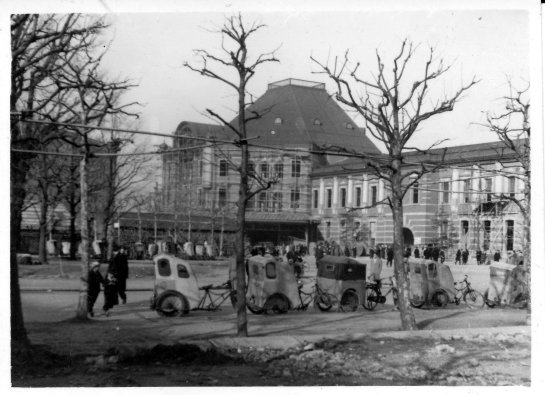
image0-11
The trees bear the scars of the firebombing. Tokyo Station is in the background being rebuilt with the aid of the US military. Notice the “jinrikisha” lined up in front; they were the equivalent of taxis today and were pulled or pedaled by Japanese men to make a living. Cars will not be available for about ten more years.  Taken by my father in March 1948 while serving in the US 8th Army under General Eichelberger.

______________________________

Soon after the bomb was dropped, the hostilities finally ended.  However, food and essential goods continued to be largely absent.  Amazingly, my cousins who went through that hell choose to reflect on these post-war years positively.  That is, reflecting on it as a miserable time will but cause a wound to fester.  They had seen enough of festering wounds.

But let us step back a year in Aunt Michie’s life.
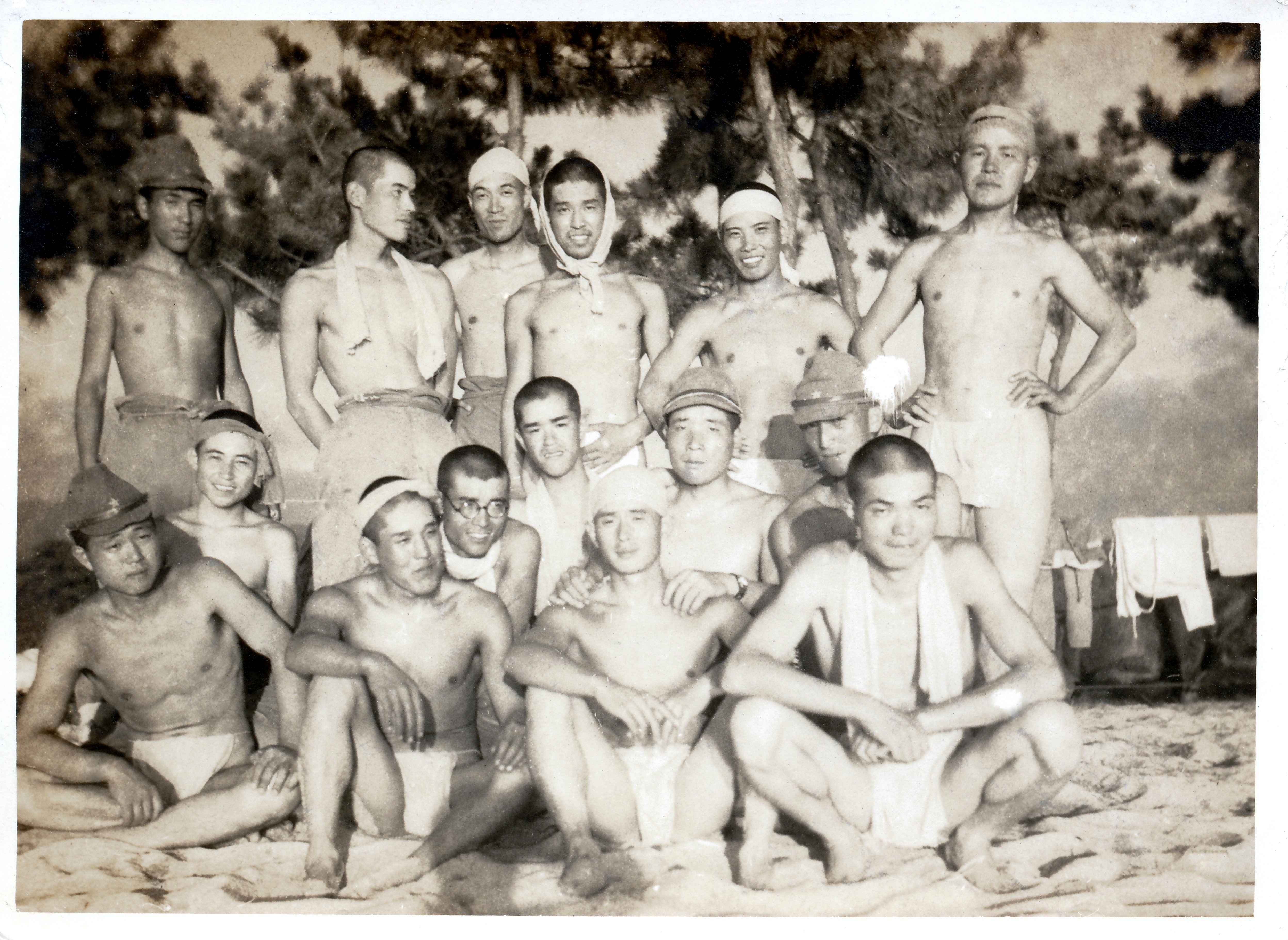
image0-059
Uncle Suetaro is pictured at the bottom left with his Army buddies. You can see how lean they are due to insufficient nutrition.  August 11. 1943.

One month before the surrender, Grandmother Kono was informed by the remnants of the Japanese military that her son Suetaro was killed on Leyte fighting as an Imperial Japanese soldier.  The date of death was recorded as July 15, 1945.  The Emperor capitulated just one month later.  Of course, we have no record of that communication nor when Grandmother Kono was actually told, but the bomb was dropped just around this time, we believe.

A little more than a year earlier, around March 3, 1944, Suetaro walked to Tomo and Masako’s school.  He wrote a farewell note on a chalkboard at Masako’s elementary school to say good bye as he was off to war.  Masako remembers he had written to be a good girl and that he was sorry he couldn’t say good bye in person.  The family took their last family picture with Suetaro (Part 2); he was flanked by his older sister Michie and Mikizo.

We believe the next day, Aunt Michie went to the train depot to say good bye to Suetaro.  She was very fond of him and “his American citizenship”.  Everyone loved the fun Suetaro and she apparently talked of him often after his death.  But at that farewell, deep down, she knew it would be the last time she would see him.  I wonder how she felt watching the train disappear.

image0-073 retouched
This photo was in Grandmother Kono’s photo album. Flag waving school girls stand on the right.  After talking about it with Kiyoshi, we believe this was the send-off Aunt Michie went to – to see her brother Suetaro go off to war and certain death. Kiyoshi indicates that a professional photographer took these types of photos at the train station and that the pictures would be offered for sale.  1943.

Soldiers rarely came back.  Per tradition, he had left Grandma Kono some of his nail clippings and some of his hair.  That is what is in the family crypt.

For hundreds of thousands, entire bodies would never be found.  This was true for America, England, Australia, Russia or Germany.

But at least part of him remains there in Hiroshima.

The cousins tell me Aunt Michie grieved for days after his departure… and that she was torn apart when she learned of his death.

The bomb would fall just days later.

______________________________

According to the family, even shortly after the bedlam caused by the bomb, Aunt Michie continued to care for her stricken mother by walking to her house five miles away when she could.  My dad said the road was “pretty” level but that since it is Japan, there were hills along the way, especially near Ishiuchi, a small village.
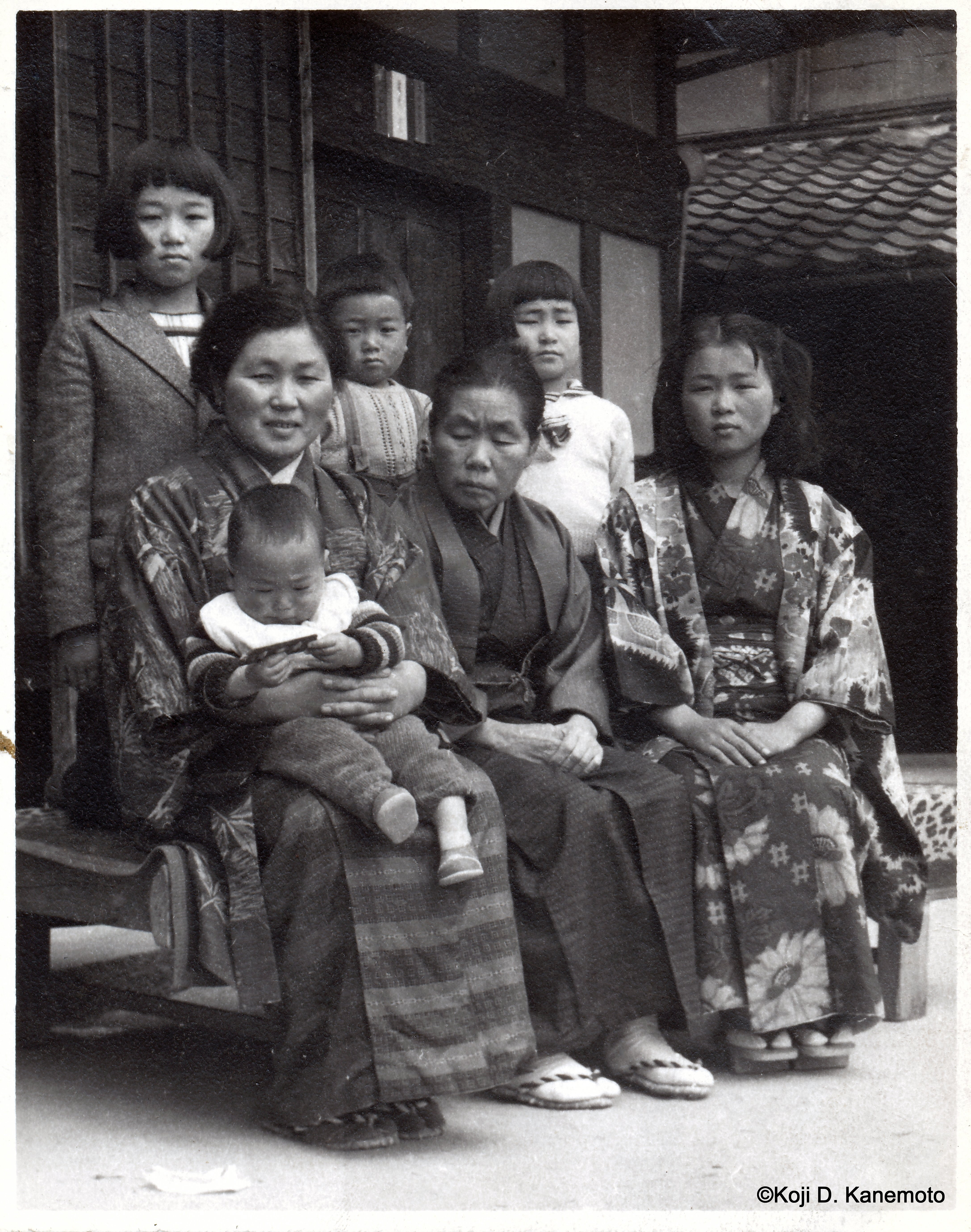
Taken by my father in April 1948 in front of the Hiroshima family home. Holding the baby Kiyoshi, who was born in the home, is Aunt Michie then clockwise – Sadako (who savored the white rice), Masataka, Namie (who pulled maggots out with chopsticks), Masako (who was thrown across her classroom by the shockwave, and Grandmother Kono (who did shaves at her Seattle barbershop).

In December 1947, Aunt Michie started to have contractions while walking over such a hill.  She was able to make it to Grandmother Kono’s house where she gave birth to Kiyoshi, right then and there.  No, no doctor…no nurse… and Grandmother Kono could not help due to her stroke.  It is said she was very happy that the birth took place at her childhood home.  She grew up there along with her American siblings.  She had felt safe.

___________________________

My cousins believe their mother, Aunt Michie, gave all of herself for her children and her family.  In spite of malnourishment, she toiled in her farm’s fields, cared for Grandmother Kono, gave her all in the bomb’s aftermath, set the example for her children.  She put everyone before her.

But soon after giving birth to Kiyoshi, she developed kidney problems.

They tell me that medical care then was still pretty non-existent so she had no choice but to ride it out.  However, she pushed herself back into working the farm too soon to care for her children, her own stricken mother and other household duties.  That was Aunt Michie.

IMG_6220
An “石じぞう”, or a stone buddha, along a pathway in Hiroshima. ©Koji Kanemoto 2013

Cousin Kiyoshi remembers massaging his mother’s swollen legs after a day’s work.  He also fondly remembers perspiring trying to keep up with Aunt Michie on a hot, humid summer day as they walked up a hill overgrown with thick, green wild grass.  There was a “石じぞう”, or a stone figure representing Buddha, alongside a ridge overlooking a blue Hiroshima Bay.  Kiyoshi will always remember that moment, looking at his mother with perspiration running down her face and the blueness of the bay.

In retrospect, they feel that if Michie had taken some time to rest and more often that she may have regained her health.

On May 29, 1963, she was laying in the same farmhouse in which she nursed the 23 injured people that fateful day.  Her kidneys were giving out.  She opened her eyes one last time and looked lovingly at each of her children who were gathered about her then closed them.  Thirty years after her father gave away her hand in marriage at 19, after 30 years of a life heaped with physical and emotional demands one after another, world changing events and family tragedies…  After enduring the pain of survival, Aunt Michie left this world.  She was but 48.

IMG_3387
In September 2012, I visited Aunt Michie for the first time. Masako is flanked by her daughter Izumi and my son Takeshi. Similar to the hot summer morning when she was knocked down by the shockwave, it was hot and humid that day. Now, I feel it was appropriate.

IMG_3378

Aunt Michie conquered all and gave her life to others so they could get to tomorrow… and she did that with dignity and unconditional love for her children.

____________________________

An epilogue will follow for Part 7….
The Pain of Survival and Aunt Michie – Part 5


japansurrender88
A rare photograph taken after listening to the Emperor’s surrender speech, August 15, 1945. There was a coup attempt the night before the speech was broadcast.

Although the violence of World War II was nearing an end, other aspects of the war could continue against Japanese civilians for years to come.

Their infrastructure was gone.  Essential assets such as manufacturing plants, machinery, trains, roads, housing, utilities, even fishing boats had been destroyed.

And most of all, food.

And Aunt Michie’s dignity – the entire family’s dignity – will continue to be tested until the late 1940’s.

____________________________

boy genmai mainichi
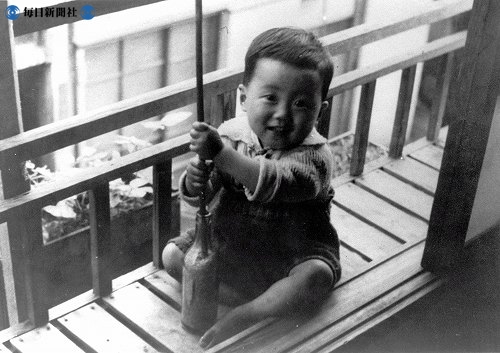
Dated April 1943. A boy poses holding a stick in a bottle filled with unpolished brown rice. This is not the polished brown rice you eat today at Panda Express. It was more wild. Japanese would insert a stick into a bottle partially filled with brown rice then repeatedly jab at the rice until the husk came off. It was low grade rice with the germ still on. (From the Mainichi Shimbun archives.)

For eons, Japan has been unable to produce enough rice for their people let alone food.  In fact, it was not until about the time Japan hosted the 1964 Olympics that Japan could produce enough rice for themselves.

The war took a terrible toll on regular folks from getting their “rice fix” – they were just not able to eat it.  This deprived them savoring it, the mental and biological satisfaction of just eating it.  Think of it this way – what if not just bread itself was kept from you but also the sweet smell of the freshly baked bread with the perfect crust..with melting butter?  Talk about attacks on your psyche: deprivation.  Deprivation for years.  Prolonged sensual deprivation makes for huge changes in one’s outlook on life.

Like the photo of the little boy, millions of civilians would acquire a wild form of brown rice (玄米 genmai) and de-husk them as shown.  Along with barley, it served as a substitute for the flavorful white rice with the higher calories.

_____________________________

Confronted by not only the absence of medical supplies, Aunt Michie’s house was now filled with 23 men, women and children with varying degrees of burns.  I doubt emergency rooms could handle such a sudden load of burn victims… but Michie’s family did.  On top of that, her house was damaged by the atomic bomb’s shockwave.  It pains me to even see in my mind what they had to do to make the house habitable enough so quickly to nurse the injured.

It was mayhem and Michie personally did not ask for this horrific situation… but now, on top of trying to provide medical care for 23 people, she was confronted with one ominous problem: how to feed them all.  There was no food left in the city of Hiroshima and it was just over the hill.  And any food left in the village of Tomo was fresh.  It would spoil quickly anyways in the heat as there was no refrigeration.  No supermarket.  No canned goods either.

She did as Aunt Michie only could.  She used her precious reserve of rice and only served it to the ailing victims.  I am sure she believed that would be the only way to truly help them survive as all of them were malnourished.  As a result of rationing the remaining rice to the victims, her own children who weren’t physically injured were delegated to survive on cooked pumpkins, stems, stalks or taro roots for the duration.

A huge, gut wrenching decision for Aunt Michie, I’m sure.

image0-012
Some of the wild grass or other vegetation boiled for emergency eating can be seen behind my father and Uncle Suetaro. Hiroshima, circa 1929. Copyright Koji Kanemoto

To help this dire situation, the Hiroshima aunt who was not badly injured went about the area with Mikizo’s parents scavenging for wild grass and other vegetation to boil.  That, too, became part of their food.  Although likely not very nutritious to say the least, there was no other alternative.  And it is important to note such wild vegetation they boiled or ate had been subjected to the black rain…

What do you have in your yard?

Perhaps you can somewhat understand why my cousin Masako thought Spam was the most delicious thing she ever ate.

____________________________

In spite of all Aunt Michie could do, my cousins tell me some of the burn victims’ injuries wouldn’t heal.  They had worsened.  Their wounds began to fester or decay for lack of a better description.  Pus formed.  There was nothing they could do.

The odor of the decaying flesh permeated out of the house.  They say you could smell it from the dirt road immediately outside.

It became so intense that people would hold their noses to scurry past the house.

None of my cousins who were there tell me they will ever forget that vulgar smell of rotting flesh… or death.  Never.

Just like Old Man Jack.

___________________________

IMG_5861
From Aunt Michie clockwise: Aunt Michie (holding Kiyoshi), Namie, Mikizo’s father, Masataka, Sadako, Masako, Mikizo and Mikizo’s mother. Taken in 1948 at their farmhouse where they cared for 23 victims. Courtesy of Kiyoshi Aramaki.

My cousins tell me some didn’t make it.

Others would pass away in the next couple of years from the effects of their injuries or radiation.

Nevertheless, the struggle for food and other essentials would continue…but my Aunt Michie’s immediate family survived.  Even Tomiko who was in Hiroshima proper.

And Aunt Michie’s dignity and strength reigned supreme.

They all made it to tomorrow.

__________________________

The surrender documents were signed by Emperor Hirohito’s representatives aboard the USS Missouri on September 2, 1945.

Unbelievably, Mikizo also survived the war.  Although taken prisoner upon Japan’s surrender as a soldier in the Imperial Japanese Army, he was released from Manchuria and allowed to return to his Hiroshima farm in late 1946.

To be continued in Part 6….
The Pain of Survival and Aunt Michie – Part 4


You can hardly tell this is a young girl anymore. As Masako and Mr. Tsukamoto told me, they were walking dead. Flesh literally melted off their bodies and dangled. Grotesque forms which were once human beings.

The aftermath of the bombing was no different from hell.  Not that I’ve seen hell nor that I would want to…

But Aunt Michie and my very young cousins saw it.

They visited hell.

_____________________________

a-bomb1
Atomic bomb survivors. Perhaps this is what Aunt Michie and her cousins saw in their search for relatives on the other side of the hill. If you notice the flask the young girl is holding to her lips.  It was likely filled with radioactive water.

Nearly all doctors and nurses within the city had been killed or seriously wounded on August 6, 1945.  If they survived the blast, they were likely to fall ill from radiation poisoning and they themselves would die within days.  All remaining medical supplies – which had been nearly non-existent due to the war – had been destroyed as well.  Most food – even unpicked fruits or vegetables – were contaminated with radiation as was water(¹).  Thousands of corpses plugged the rivers as they would go in to soothe their burns but would soon perish.

It is important to note that food rationing in Japan was much more extreme than what was imposed on the American public.  While the rationing in America began in May 1942, it started with just coffee and sugar.  In Japan, rationing of a far more extensive reach began in 1939 if not earlier.  It extended to nearly all first quality food stuffs.  Rice, barley, seafood, meat, soy bean paste and soy sauce, vegetables, fruit, seafood, etc.  Groups called “tonari-gumi” were established in villages and the like; they monitored and rationed food to the Japanese families based on what work they were doing, e.g., war production, number of family members along with their age and sex.  The rationing was so severe that when one family member died, the family did not report it.  The average caloric daily intake was cut down to less than 2,000 a day by 1945.

homeless_orphan_in_postwar_tokyo
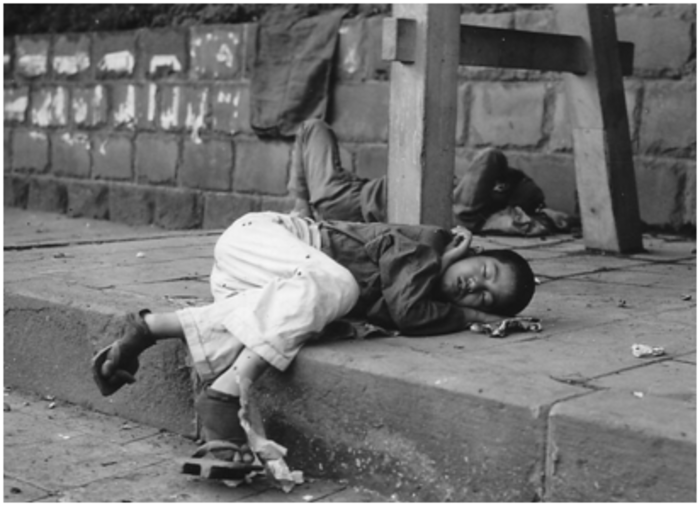
Homeless orphan in Tokyo. He would have to be determined if he was to survive.

The Japanese civilians were starving, so to speak, and were without question malnourished.

Aunt Michie was no different.  She was hungry like everyone else and likely tired easily due to low nutritional intake and daily physical and emotional demands upon her.  It is important to have an understanding of her condition at this crucial moment in history.

________________________________

2-sadako1
Sadako – taken in early 1948 by my father while on furlough. She would marry a distant cousin (common cultural practice at that time) who was also badly burned in the atomic explosion.  She is wearing clothing my father bought for her at the Tokyo PX.

After the shock and black rain subsided, Aunt Michie’s thoughts immediately went to her treasured family.  According to my cousins, she went into her priceless family rice reserves and cooked real rice for the children.  Sadako, the second oldest, remembers to this day how she savored that bowl of rice, a definite luxury at that time.  While but a child of ten years and filled with anxiety about eating such a fine meal, she saw at that moment her mother’s love and affection for them was unconditional.

Aunt Michie’s thoughts went to the Aramaki family (aunt and uncle’s family) who lived in Hiroshima.  She had no way of knowing that day but they had become direct victims of the atomic bombing.  They had been burned over most of their bodies and had even been trapped under their destroyed house.  They managed to struggle with their searing injuries to Aunt Michie’s house to seek refuge and care.  They had realized that only strong family support would allow them to live.

Grotesquely, the path going over the 300 meter high hill which the relatives traveled became littered with scores of dead people.  Masako said they were unrecognizable lumps of flesh and died where they crumpled.  Many had their clothes burned away.  While thousands were killed instantly, other thousands suffered for days before dying from intense burns, radioactive poisoning and other injuries.  As radiation poisoning was unheard of amongst them, some were told they had dysentery and the like.  Many before dying oozed pus from their ears and blood ran from their noses.  You will not read this in any Western textbook.  In fact, the gruesome information about the days, months and years after August 6th was suppressed for a couple of decades by both governments.

While the dazed and immensely pained adults struggled to Michie’s farm, there were young children of the family unaccounted for(²).  Without hesitation and unbelievably, Aunt Michie – in her weakened state – pulled a two wheel cart over the hill to Hiroshima to look for them.

Over a hill.

大八車
I believe this to be the type of cart Aunt Michie pulled to Hiroshima to look for the unaccounted for children of the family. Kiyoshi called it a 大八車, or large two wheeled wooden cart.

Miraculously and while the details are lost, she found some of them and hauled them back to the farm on the cart, now laden with the additional weight of the children…  on the same road that was further littered with dead and dying people.  Think of the mental anguish Michie had to endure when dying people came up to her and asked for her help…  It would be difficult to not look at them.  It was more difficult to ignore them, I’m sure.

According to my cousins, a total of 23 people got refuge and care at Aunt Michie’s farm.  I understand many were relatives from the Aramaki side of the family.

There were more hurdles for Michie and her children immediately ahead – caring for the injured and dying.

_____________________________

526
You can tell which way this woman was facing when the bomb went off. Her left side is burned. Photo was likely taken after August 6, 1945.
Caring for Victim of Hiroshima Bombing
A mother looks after her child. This photo was also likely taken after August 6, 1945.
Victim of Hiroshima Bombing
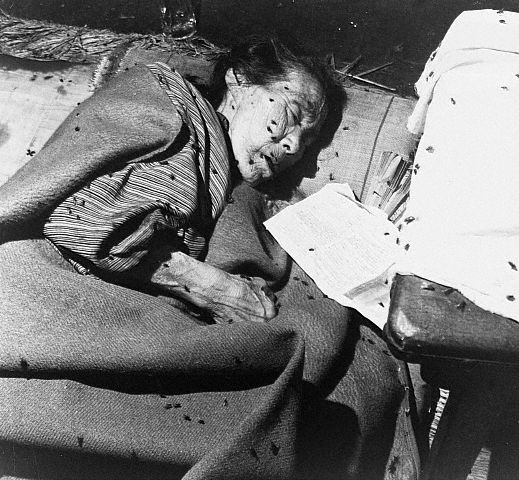
An elderly woman lies dying on the floor covered with flies. Perhaps this is just one of the sickening sights Michie and her children have buried in their conscious.

The preceding photographs may show what Michie and the children were faced with.  And the children were just that – children.

How old are your children, by the way?

The older cousins recall that they, Michie, Mikizo’s parents and the less injured relatives took on a 24 hour a day field hospital of sorts to treat the injured.  It was stifling hot and humid; yet, they had to be given constant attention and there were so many of them.  I cannot imagine how exhausting this task could have been, especially when you are hungry and malnourished yourself.

pattern
Taken sometime after August 6, 1945. The side of her you see is what had faced the atomic explosion. The patterns are from her clothing she wore that day. It was where the dark patterns of her clothing had been in contact with her skin. Masako recalls vividly this type of pattern among the burn victims and that the maggots followed that pattern.

The common injury were burns.  Severe burns…and they had no medicine whatsoever.(³)  No Bactine.  No Motrin.  No aloe.  All Michie could do was to coat the burns with a type of cooking oil and bandage them with pieces of cloth.  She must have endured unlimited anguish in knowing she could not measurably lessen their pain and suffering.  There must have been constant crying and unbearable moans of pain.

And on their hands, blood from human beings.

3-namie1
Namie – taken in early 1948 by my father while on furlough.

Six year old Namie could never forget what she had to do.  Flies were swarming having sensed dying flesh.  Namie was tasked with shooing them away with a fan but they wouldn’t stay away.  And worse yet – time and time again, she had to remove the maggots that were feeding on dead flesh…with chopsticks.  I do not know if I could have done that…but Namie did.

The turmoil that must have stormed inside Aunt Michie to tell her daughters to do what they had to do for the sake of survival…and then to be stern with them and tell them to continue when they wavered or cried…  must have been punishing to her as a loving mother.  She must have wanted to cry.

Aunt Michie was the point woman.

And she fulfilled that role.

Her goal was to get everyone to tomorrow.

_____________________________

To be continued in Part 5….

Notes:

(1) Per my 2012 meeting with Mr. Tsukamoto in Hiroshima, water is the main theme of the Cenotaph at the Peace Park.  Survivors clamored for water.  Where there was well water, many survivors were suffocated as dozens more pressed against them for the precious liquid.  Please see “A 1937 Yearbook, the Atomic Bomb and Hiroshima” for further information and links to their personal story.

(2) The number of unaccounted for children is unclear.

(3) Mr. Tsukamoto recounted how they had to constantly mash yams and place them over their burns to temporarily lessen the pain.  They did that for over a month, he says.

The Pain of Survival and Aunt Michie – Part 3


Japanese-home-defense-training_1945
Japanese women being given “home defense training”. My grandmother on my mother’s side underwent such training on a Tokyo schoolground. 1945.

The Japanese home front had essentially collapsed by 1945.  Instead of focusing on food, supplies, building air raid shelters and organizing orderly evacuations of civilians, Japanese military leadership focused on misleading news reports and propaganda.  Millions fled the cities into safer rural areas(¹) on their own initiative but once there, supplies of daily sustenance was meager.

_______________________

In one’s own life, you are tested.  A good human being will at times prove oneself to be a good brother or sister, son or daughter, friend or life partner.  Some fail.  Some pass.

Aunt Michie was one who passed; her heart led her to care for others before herself.  It is as if she knew being good to others was the way to have a good life.

As an example, US air and naval forces ruled the skies and the seas.  A key staple of the Japanese diet – fish – had been nearly cut off  as fishing boats were attacked once out to sea.  Yet, when Aunt Michie came across sashimi, she traveled hours with Masako in tow to take a precious portion to her brother Suetaro at his army base in Fukuoka:

“…(Masako) remembers a couple of trips (to see Suetaro). It was not easy travel in war-torn Japan.  For one trip, Aunt Michie managed to take sashimi – in this time of little food, it was a tremendous treat and gift. On that trip, Masako remembers her mother stealthily sliding over to Uncle Suetaro the wrapped sashimi. He was being stared at by many of his fellow soldiers – they were not well fed either.  She remembers Uncle slowly turning so that the others could not see and quickly devoured the treat.”

(From Masako and Spam Musubi)

Aunt Michie could have eaten the precious sashimi herself…but didn’t.

___________________________

With her husband taken by the Imperial Japanese Army then dispatched to war in Manchuria, she was burdened with running the farm… still laboring to produce crops only to be taken by the military.  She would get up before sunrise, help prepare meals, tend to the family then toil in the fields.  And when her mother became partially paralyzed and alone in her own home five miles away, Aunt Michie knew she had to take care of her, too.  Michie was the last of her children left in Japan.

My Grandmother Kono – having suffered a stroke – is propped up from behind by Japanese “shiki-futon” for the picture. She would not see her son alive again. Taken in Hiroshima, May 3,1944.

While Michie and Grandmother Kono managed to get part-time care, Aunt Michie still took it upon herself to check in on her stricken mother.  My cousins tell me their mother Aunt Michie would take them along for the ten mile round trip to her Kanemoto family home.

No car.  No bus.  No taxi.  No trains or bicycles.  They had to walk.  After all, it was 1944 and fuel was a huge luxury.  One memory the youngest happily recollect is that they would take turns riding in some kind of baby stroller that Michie would push to Grandmother Kono’s.  Neverthless, it was still a great deal of effort and sacrifice on Michie’s part in any case… and she did this after working in the fields, too.

Masako will eventually end up caring for Grandmother Kono.

___________________________

IMG_5869
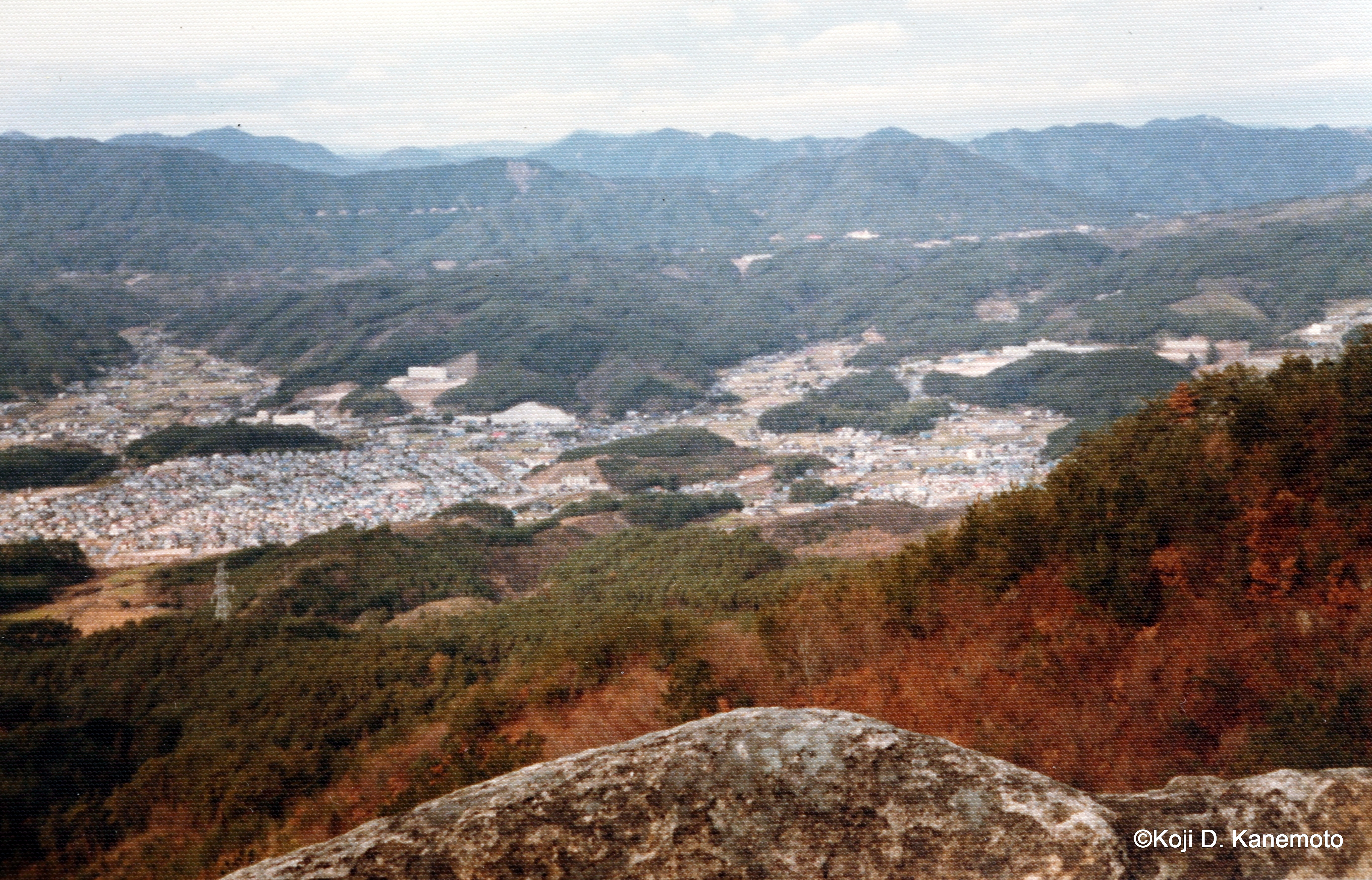
Family photo taken of the town of Tomo about 35 years ago atop the 300 meter tall hill separating it from Hiroshima. Hiroshima is directly behind. This short hill served to partially deflect the atomic bomb’s shockwave. Courtesy of Kiyoshi Aramaki.
IMG_5870
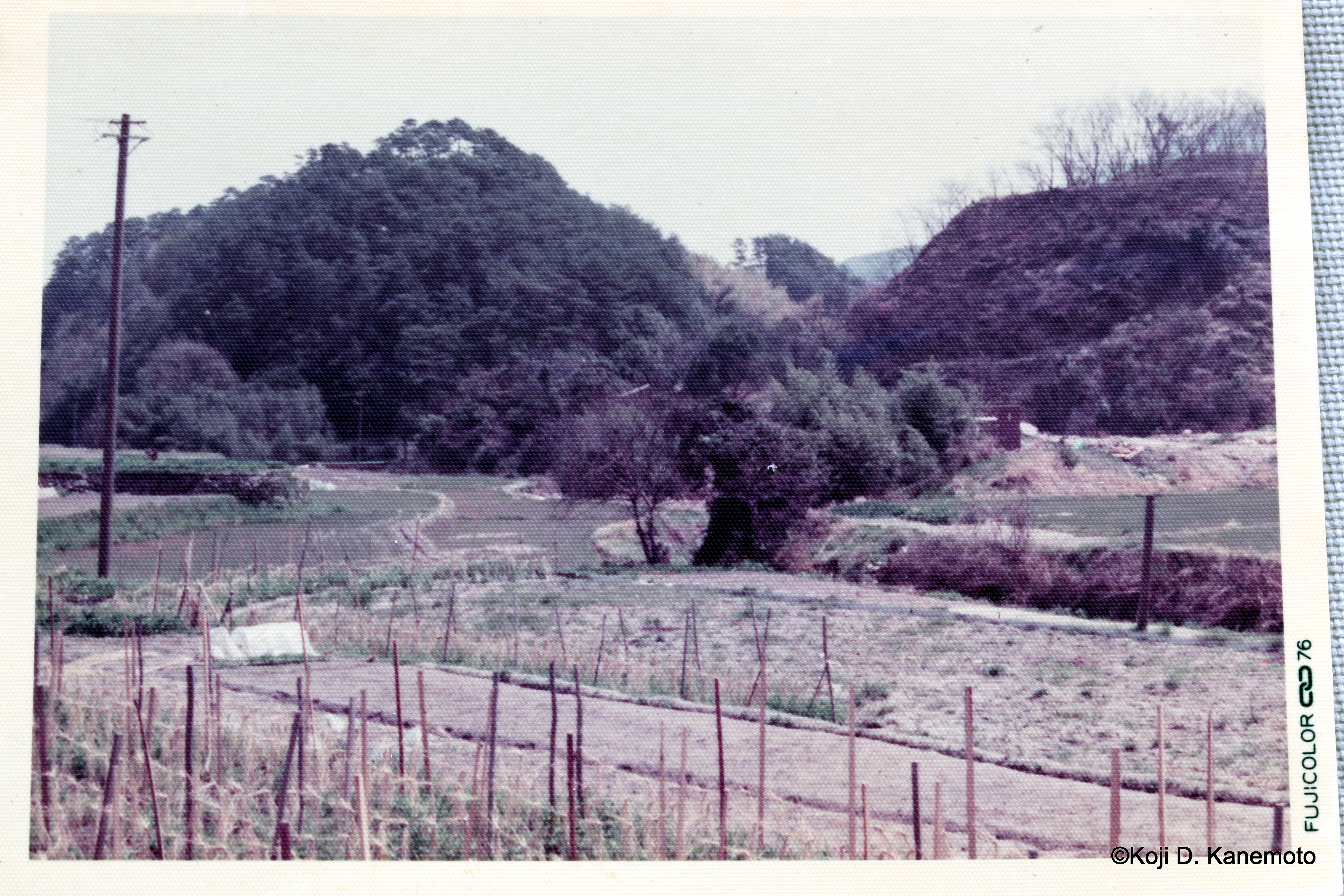
Per Kiyoshi, this was taken from the house and shows some of the field Michie had to cultivate. She was here when the shockwave hit. While the one on the right is no longer there, the family burial plot was between the two small mounds you see here. Courtesy of Kiyoshi Aramaki and dated 1976.

After picking herself off the ground, Aunt Michie saw an evil yet mystifying mushroom cloud slowly rising up beyond the 300 meter tall hill separating her village from Hiroshima proper.  At that instant, she knew her life had taken a wrenching turn for the worse… as if it could get any worse.

I cannot imagine what was going through her mind and heart watching that mushroom cloud rising.  She could not have even dreamed that it was one massive bomb, a couple of kilometers away, that could cause this sort of force and devastation.  It must have defied belief.

Hiroshima_10
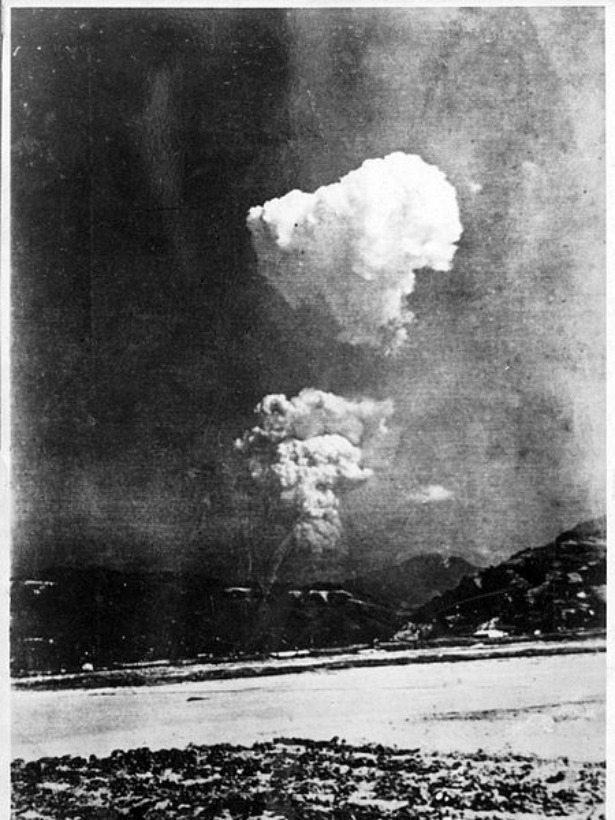
A relatively unseen image of the explosion, taken from a Kataitaichi, six miles east of Hiroshima. Michie was nearly due west and on the other side of the cloud. The cloud would reach 40,000 feet in just four minutes. It would ultimately rise to 60,000 feet. (Horikawa Elementary School)

According to Michie and my cousins, the shockwave blew out all the sliding doors, all the tatami mats were flung and the ceiling was shoved up in the house.  Try to imagine yourself being inside the house.  The same thing happened to Grandmother Kono’s house five miles south (See map in Part 1).

As per their daily air raid drill, they apparently all ran to the air raid shelter in the small hill behind their house.  After about half an hour and with the mushroom cloud still rising, a black, syrupy rain began to fall on them.  According to the cousins, Michie believed that the Americans were dropping oil from space.

She could not have fathomed it was contaminated with over 200 kinds of radioactive isotopes.  We now call it black rain.

IMG_6116
I took this photo of a preserved wall section stained with actual black rain from that fateful day. Hiroshima Peace Museum, November 2013.

Sadako, who was ten years old, clearly remembers their white blouses had turned black from the rain.  No one – absolutely no one – knew that other than staining skin, clothing, and buildings, but that ingesting black rain by breathing and by consumption of contaminated food or water, would lead to radiation poisoning.  Even flowers would bloom in distorted shapes and forms from the radiation.

_______________________________

With the enormity and the suddenness of the brilliant flash of light followed by a shockwave and the swirling mushroom cloud, Michie deep inside knew her world had forever changed.

Horror was to literally come into hand shortly to enforce that foreboding thought.

_______________________________

To be continued in Part 4….

(1) Albeit late, my mother’s family fled to the Fukui Prefecture in early July 1945 to escape the bombing of Tokyo.

A Father-ly Invasion


Imagine being a Marine. You’re in Afghanistan.  You see your buddies getting blown up by the cowardly enemy’s IED or killed after an ambush. Then, after a bitter, maniacal all-out war, their religious leader capitulates.

Now, suddenly, you are standing out in the desert, outside of Fallujah, waiting to go in as part of the “occupying force”. Your feelings and emotions are going amok – anger coupled with fear of the unknown… You will be surrounded by the enemy who also fought the exact same bitter war against you.

USMC
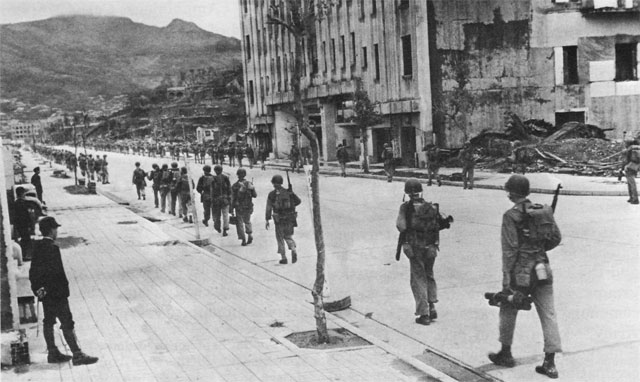
US 26th Marines marching into Sasebo, Japan – August 1945. Notice the Japanese standing to the left and the general absence of civilians.

Now… imagine you are a young Marine on a troop ship off the Japanese coast. It is August 30, 1945. A few weeks earlier, you became acquainted with the term atomic bomb. The Emperor of Japan just capitulated.

You are to go ashore onto the Japanese homeland.  But in this case, you are not wading ashore to occupy a city. You are wading ashore to occupy an entire country.

_______________________

As we now know, the initial “invasion” of Japan by Allied forces ended up being entirely peaceful; no one was killed. Perhaps there was a small incident or two, but I have not read anything to indicate a single shot was fired. How could that be? How could hundreds of thousands of Marines, soldiers and sailors have stormed ashore – under an assault mindset – onto a homeland populated with maniacal military and millions of civilians – and not erupt in combat?

army report 98th

Per a report of the US Army’s 98th Infantry Division dated December 20, 1945:

“The mission assigned the Division was participation in the occupation of Japan; however, due to uncertainty as to the attitude of the people, the real intentions of the Japanese army, and the possibility of treachery or sabotage, the Division was directed to be combat loaded and prepared for any eventuality. Thus planning for the occupation of Japan was based upon an assault landing rather than an administrative movement…”

(Click here to see actual report.)

______________________

There is no single answer. The peaceful invasion was the result of hundreds of contributing influences.

One came from Father Patrick Byrne, a Catholic priest in a country dominated by Buddhism.

patrick byrne
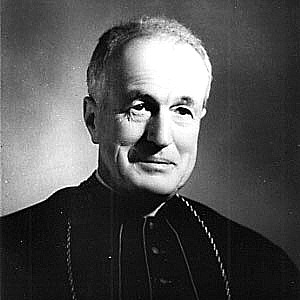
Father Patrick Byrne. He was elevated to Bishop prior to his death.

Father Byrne had been sent to Kyoto in 1935 to set up a mission. As he was respectful of the peoples, he was put under house arrest (confinement) when war broke out. Of course, it was very harsh. His only companions were a cat and a parrot. Food was poor and scarce, just like it was for the unfortunate civilians.

Per “Escape from Manchuria” by Paul K. Maruyama (USAF, Ret.), he emphasizes the importance of the role fulfilled by Father Byrne immediately after the Emperor broadcast his surrender. Although in very poor health, Father Byrne with the aid of a newspaper reporter and a Father Furuya, hurriedly put together a radio broadcast intended for TWO audiences: (1) one for the Japanese homeland and (2) one for the “invading” Allied forces.

As hordes of civilians were escaping to the countryside, getting from Kyoto to Tokyo in the few available trains was hard but after 15 hours, he made it being escorted by police. He then recorded his speech on or about August 20, 1945, which was re-broadcast many times via radio and shortwave…to the Japanese people and to the countless number of Allied occupying forces staging off-shore.

His radio broadcast:

“The war is over. What can I say first of all to the Japanese people whom I have loved and who love me as a brother for more than 10 years? I share their grief when the Emperor spoke to them and told them that they had fought a good fight but now he wanted them to give up the war and turn to peace. I, an American, speak to you Japanese in the name of those soldiers about to enter your land to assure you that you need to have no fear. They are not coming to the shores as invaders, with tanks, bayonets and bullets, but merely as representatives of their country, taking occupation of Japan to help you once more to reconstruct and build on the new foundation of democracy. The eyes of the world are on this occupying army. You may rest assured they come peaceably.

What can I say to you, the soldiers of my native land, regarding these people? Their feelings will naturally be mixed with emotions as you look up on the victors entering their land, where the homes have been destroyed or burned, their sons and fathers of families killed or maimed and wounded. It is only natural that you look with anger, fear, mistrust, and frustration at your arrival. Should you add to their present feelings by any any ruthless attacks upon the women and young people in this land, I am afraid of what the consequences might be. So I urge you to cooperate with me as I assure the Japanese people that you will commit no degradations, that you would have goodwill and charity in trying to realize what these people, the real victims of the war, have suffered and will not do anything to add to the pain they endure.

You are on trial before the eyes of the world. Any violence or immorality, any unjust or criminal act on your part will not only be a stain on your character but on that the nation you represent.

I believe I may assure you people of Japan that the army chaplains would do everything they can to remind our soldiers of their moral responsibility. The Military Police, too, will carefully protect your interests and will arrest anyone found violating the law. If there seems to be any violation of this protection which is your due, I have been assured by the Archbishop of Tokyo that he will appeal to the Holy Father in Rome who in turn will make known to the whole world by radio and the press any form of injustice. Freedom of the press in the United States will cooperate so that such news will not be suppressed.

I am not afraid because I know these Americans and trust them, but I can understand the fears of the Japanese people. Soldiers coming into Japan, I strongly urge you to come with kind hearts and be good friends of these people. You have fought hard and want a victory. I know you want to enjoy it and want to be proud of it, but please try to understand the distress of the Japanese and make your behavior calm and warm as representatives of a great nation. Perhaps after two or three months, they will begin to understand you better, and then I think there will come an intimate friendship between you and them.”

________________________

The Allied Forces – with the words of Father Bryne questioned in many soldiers’ minds as to intent – stormed ashore on August 30, 1945 on many beaches all around Japan. Once ashore, they were largely astonished to learn over the next few hours the truth in Father Byrne’s words.

fig16
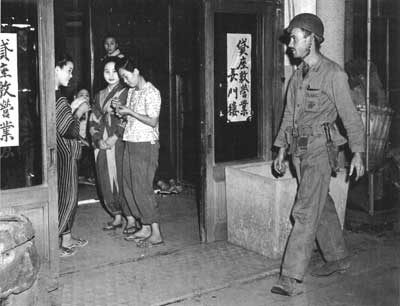
A Marine walks past young Japanese women on a routine patrol.  Thousands of vials of poison were distributed to thousands of young girls in preparation for the “invasion”. (USMC Photo)

________________________

According to “Escape from Manchuria”, Father Byrne made a recovery back in the United States after the war and was elevated to Bishop when he was sent to Korea in 1947. In 1950, he was captured by the North Koreans and once again was subjected to horrifying treatment and captivity before being put on the Korean War equivalent of the Bataan Death March.

He fell ill during the march in freezing conditions and when he could not continue, he was taken to a shack. There, on a frozen floor and without any warmth, he passed away on November 20, 1950 at a place called Ha Chang Ri, North Korea.

(Note: Edited Feb. 2, 2014.  For some reason, the photo of Father Patrick Bryne had been removed.)

Big Time Sucky


I’m sorry, nice-minded bloggers…

But this REALLY a prime-time sucky.

Worse than a twerky even.

___________________________

It’s not just Obama approving a paltry 1% pay increase for our military… It’s that a military man or woman can’t support his or her family.  Paltry pay.  And it keeps getting worse.

Please view the related short news broadcast and news print by clicking on the image below…  Hear the extent of the horrendous impact on our military and veterans – AND THEIR FAMILIES.

vet pay cut

And remember, they got SEQUESTERED earlier this year.  More cuts in household income.

Alternate direct link: http://video.foxnews.com/v/2966371566001/growing-need-for-govt-assistance-among-military-men-women/#

_______________________________

You don’t need to be accurate to get your point across.

Congress people pay themselves somewheres over $150,000 a year – certainly no ILLICIT income, of course – and don’t get shot at or maimed.  They take LONG recesses (i.e., vacations), too.

And Obama sends these poor guys and gals to get shot at?  At less than a $20,000 salary?  (And he takes vacations to Hawai’i costing us MILLIONS each time.)

But wounded or disabled vets?  THEY should get lifetime pay.

Period.

Not the self-centered bozos in Washington, DC.

Period.

Rant over.

Sorry.

Old Man Jack-ism #6 – The Zero


Image
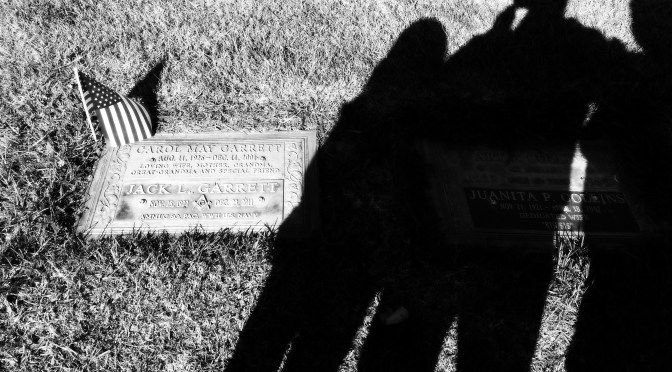
I stopped by with a cigar to visit with Jack today.  I hoped there will be others visiting given the date and holiday season…

Today, I thought I’d visit with Old Man Jack for a while.  I didn’t drive my supercharged and unmufflered Grabber Orange Mustang to visit him although he loved it so much.  It looked like rain.  But I did take a cigar with me.

I know he didn’t mind the cigar.

He said it “doesn’t smell much better than the stinkin’ islands…but anything smelled better than those stinkin’ islands”.

____________________________

He would reminisce much more frequently about the war on those islands when it involved “fun memories” and I recalled one while chatting with him today at his grave. Believe me, whether it be a “fun” memory or not, a tear or two always tags along.

Old Man Jack always described the islands in the Southwest Pacific to be “those stinkin’ islands”.  He had said that while things always stunk, “everything smelled like shit”.  Pardon the French but those are the words expressed by the now old man who was back then a young boy of nineteen.  Hell, put it into perspective.  That spoiled young singer Justin Bieber is nineteen.  I’ll leave it at that.

“When I got there, I wondered why things smelled like shit,” he said with his trademark grin.  The one where the left corner of his mouth rises.  “Well, I was a dumb shit punk myself back then.”

_______________________________

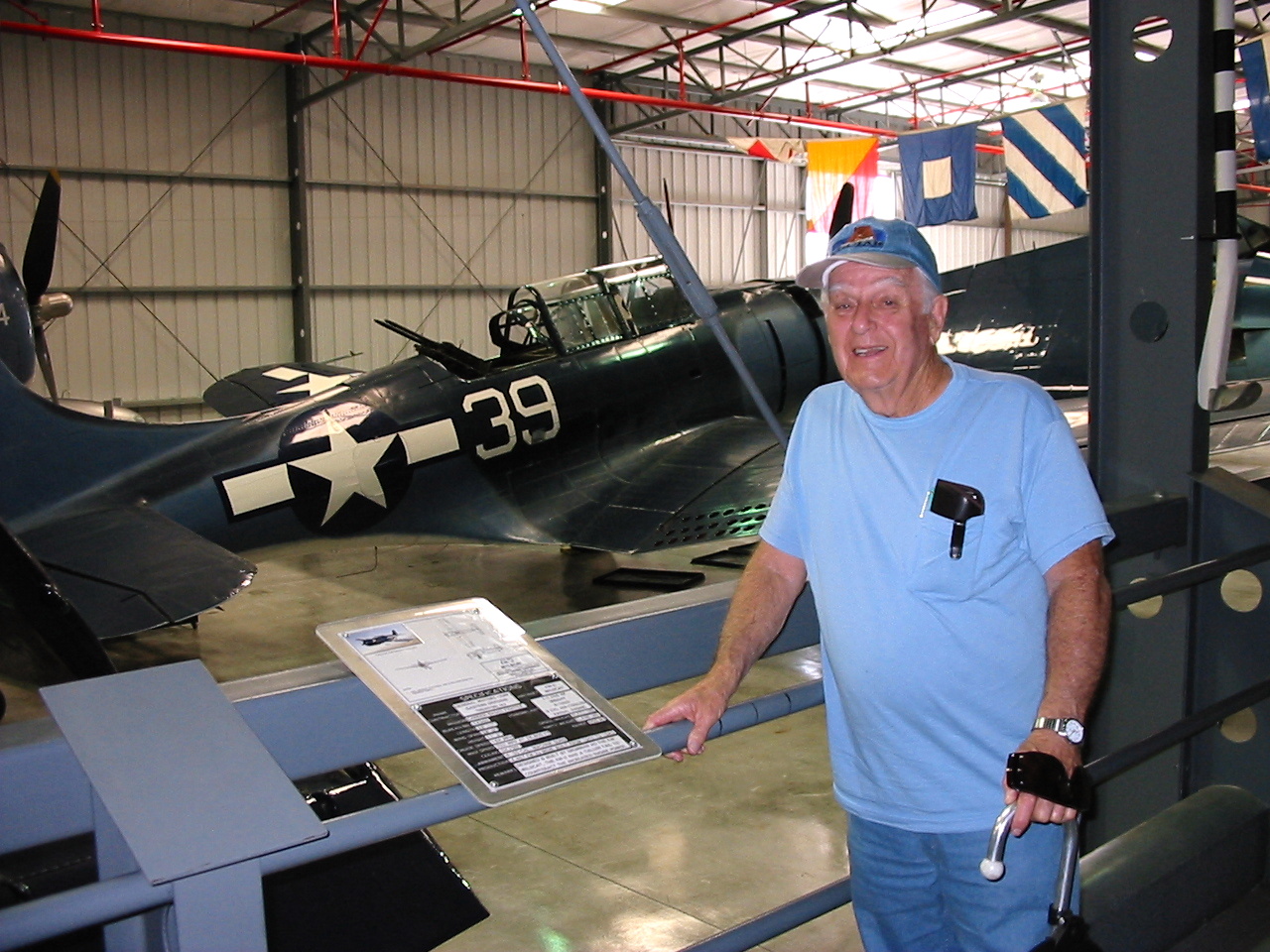
We had been touring the mock up of the CV-6 carrier deck (USS Enterprise) at the Chino Planes of Fame Museum back in 2003.  Our friendship had begun solidifying by then.  I had taken him there primarily to see his beloved F4U Corsair so this was a side trip at the museum.

On the “flight deck” was a Douglass SBD-5 Dauntless dive bomber.

Image
Jack in 2003 with the Douglas SBD-5 Dauntless behind him.  You can make out his boyish grin.

One thing he immediately spit out was after seeing the plane was, “That rear seat is just a metal plate.  You sat on your parachute for a cushion…”  He then continued, “…and those were twin .30’s back there.”

He told me once a Navy dive bomber pilot “grabbed him by the collar” early on and told him to get into the rear seat “quick-like”.  I remember asking him why because at that time, I didn’t know he was certified to fly.  In typical Old Man Jack fashion, he quipped, “‘Cuz I was the only one there.”  Accent on the “there”, please.

“Well, we were flying up there.  Man, that parachute made for a lousy cushion,” he said.  “Then a Zero got on our six…and then I saw these little flashes.  I figured out real quick he was shooting at us.”  Jack’s still got that grin on his face.

“The pilot yelled, Shoot, you son of a bitch!  Shoot!  Shoot!  So I did.”

“The pilot kept yelling, Shoot!  Shoot!“.  Then I yelled, “I did! I did!”

He wasn’t afraid to say it.  Jack said he got so scared he just laid on the triggers and didn’t let go.  There was only about 15 seconds worth of rounds.  He had fired off all his ammo.

“Man, I heard every god damn cuss word from that pilot,” he chuckled, still with that trademark grin.

But then he ended it by saying, “…And whoo-ee, I crapped in my pants…  And that’s how I figured out why everything smelled like shit.”

rear gunner
A WWII period photo of rear gunner and the twin .30 caliber machine guns.

____________________________

I never asked him what happened to that Zero…or if they successfully dropped their bomb…or what happened to that Navy pilot.

But one thing is for sure.  I would have liked to have seen Justin Bieber in that back seat behind those twin .30s.

I’m sure his voice would get even higher…permanently…and would have needed a diaper change.

Real men don’t wear diapers.  Jack sure as hell didn’t.  He just shit in his pants and wasn’t ashamed to admit it.

____________________________

I enjoyed our chat today, Jack.

And I’ll be sure to drive the Mustang next time so you can hear it.

Miss you.

“Old Man Jack-ism” #4


Day after tomorrow – two years ago – Old Man Jack left us. He would be free of his nightmares of war which plagued him nightly for seventy years. While it is self-serving to reblog your own story, I am reblogging this for the sake of men like him who gave away their youth to serve in hell. People today need to KNOW and REMEMBER.  I regret the huge majority of Americans today are ignorant of what people had to do so that we can enjoy – and complain – of what we have today.
Rest in peace, Jack. I will try to visit you today to say hi.

Mustang.Koji's avatarMasako and Spam Musubi

“Koji, don’t let anyone tell you different.  War makes good boys do crazy things.”

That was the first time Old Man Jack shared something with me about the war in a voice of unfeigned remorse.  In turn, it was one of my first journeys in his time machine in which he allowed me to ride along.

Front row seats.  Free of charge.

It was in 2002 to the best of my recollection.  It was just before my littlest firecracker was born.

__________________________

KA-BAR.  If you are a World War II US Marine who served on “those stinkin’ islands”, there is no explanation necessary.

A KA-BAR was a Marine’s most prized personal possession.  It was always at their side.

They opened their C-rations with it.  Dug foxholes with it.  Chopped coconut logs with it.  Hammered nails with it.  Indestructible.

Most importantly, for killing.  Designed for slashing and stabbing.  Desperate hand-to-hand combat.  To the death.

The KA-BAR…

View original post 472 more words

The Way It Should Be


bw us marine

After a sergeant in the Marine Corps reached mandatory age and got mustered out, he entered civilian life and became a high school teacher.   Just before the school year started, the former enlisted Marine injured his back.   He was required to wear a plaster cast around the upper part of his body.  Fortunately, the cast fit under his shirt and wasn’t noticeable.

On the first day of class, he found himself assigned to the toughest students in the school.  The smart-aleck punks, having already heard the new teacher was a Marine, were leery of him and he knew they would be testing his discipline in the classroom.

Walking confidently into the rowdy classroom, the new teacher opened the window wide and sat down at his desk. When a strong breeze made his tie flap, he picked up a stapler and stapled the tie to his chest.

Dead silence…

The rest of the year went very smoothly.

Oo-rah.

…and that’s the way it should be.

CNN’s Cleaver


I received this light-hearted story with a brilliant sally in an email today…and thought it was apropos as we have a tremendous racial divide threatening to cleave a deeper valley into our US of A.  And as I’ve posted earlier, I feel CNN is behind some – if not a lot – of this cleaving.

So here it is.

_______________________________

Image
A biker… Once a Marine, always a Marine.

A Harley  Biker is riding by the zoo in Washington, DC when he sees a little girl leaning  into the lion’s cage. Suddenly, the lion grabs her by the collar of her jacket and tries to pull her inside to slaughter her, under the eyes of her screaming parents.

The biker jumps off his  Harley, runs to the cage and hits the lion square on the nose with a powerful  punch.

Reeling from the pain, the lion jumps back, letting go of the girl, and the biker brings her to her  terrified parents, who thank him endlessly. A reporter has watched the whole  event.

The reporter addressing the Harley rider says, “Sir, this was the most gallant and brave thing I’ve seen a  man do in my whole life.”

The Harley rider replies, “Why, it was nothing, really.  The lion was behind bars. I just saw this little kid in danger and acted as I felt right.”

The reporter says, “Well, I’ll make sure this won’t go unnoticed.  I’m a reporter for CNN, and tomorrow’s headlines will have this story… So, what do you do for a living and what political  affiliation do you have?’

The biker  replies, “I’m a U.S. Marine and a Republican.”

The journalist leaves.

The  following morning, the biker checks CNN to see if it indeed brings news of his actions and sees:

U.S. MARINE ASSAULTS AFRICAN IMMIGRANT AND STEALS HIS  LUNCH

…and THAT pretty much sums up the media’s approach to the news these days…

Image

ImageImage