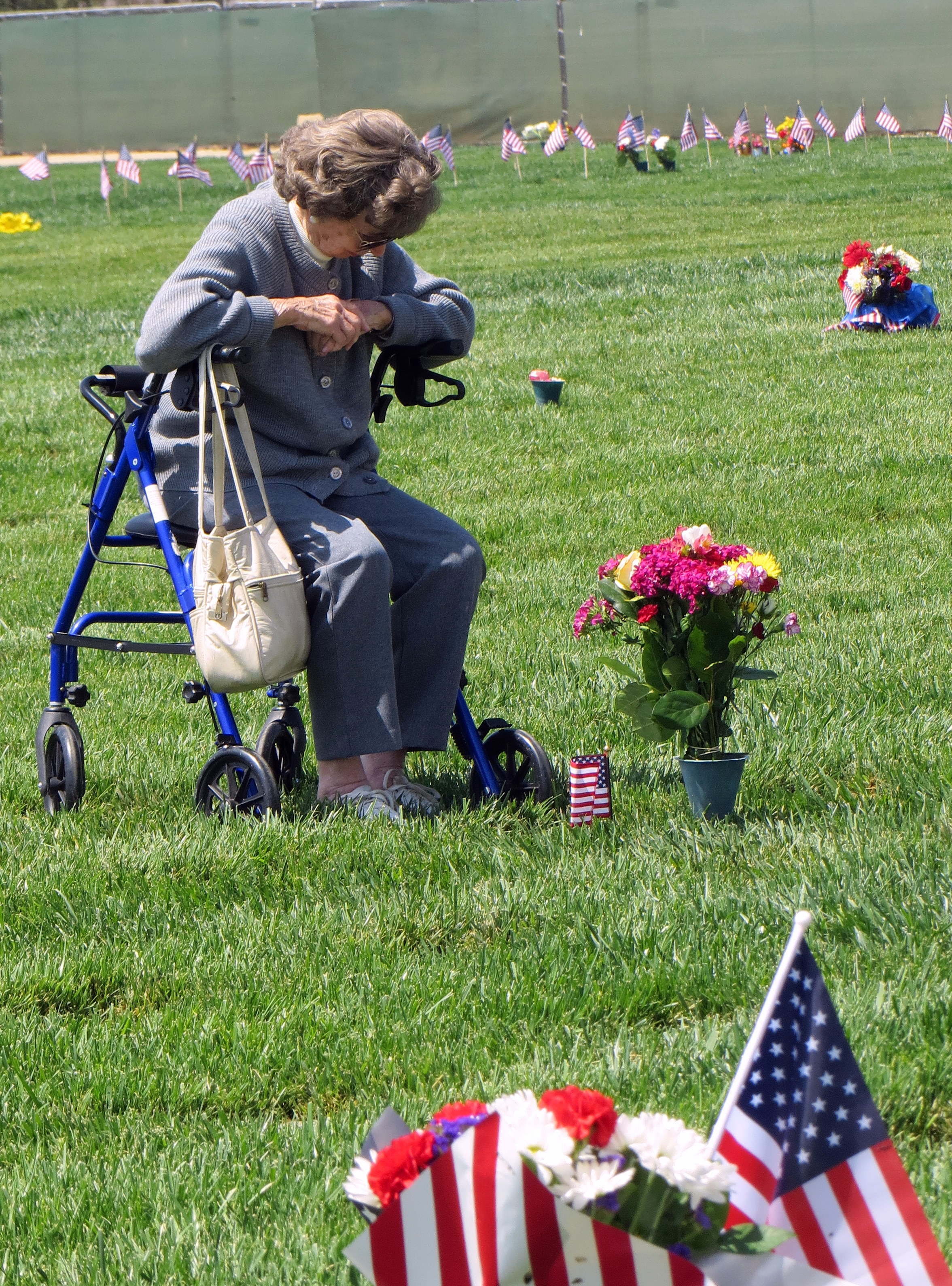
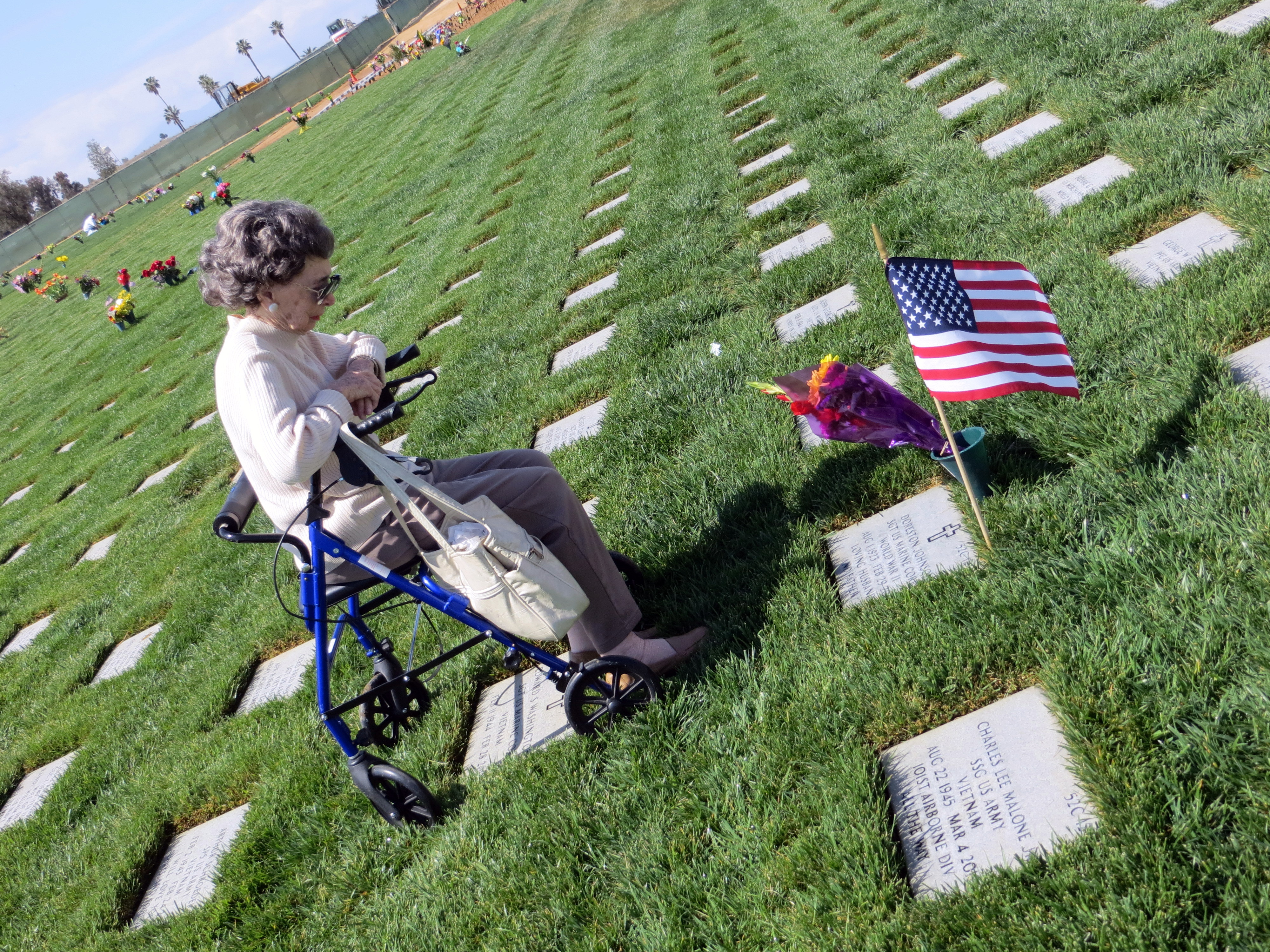
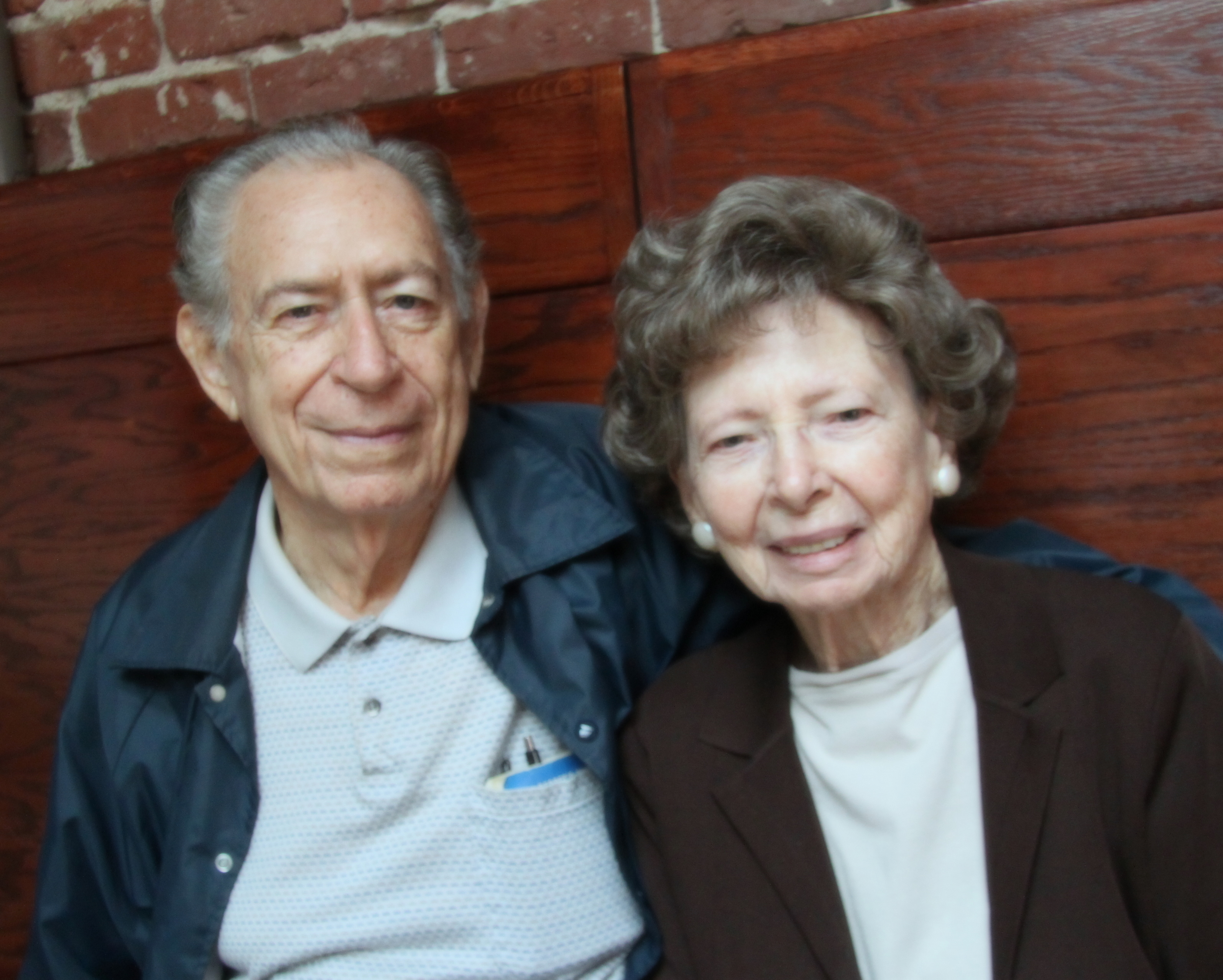
Marge and I at Riverside National Cemetery, Memorial Day Weekend 2013
A LETTER…
[Please also see “Mr. Johnson, USMC” if you wish to learn the background of this couple from the Greatest Generation by clicking on the link.]
Dear Marge,
Well, Marge, you made it indeed… To see your beloved husband Johnnie for Memorial Day.
A heroic US Marine who fought on-board the USS Enterprise in World War II.
Decorated.
And he was but 17 years old when he set sail for the Battle of Midway.
Seventeen. You said he was still in high school when he signed up for the Marines. Unbelievable.
We were met by thousands of American flags being planted by hundreds of Boy Scouts and volunteers. You were so happy to see the red, white and blue saturating the cemetery, bit by bit.
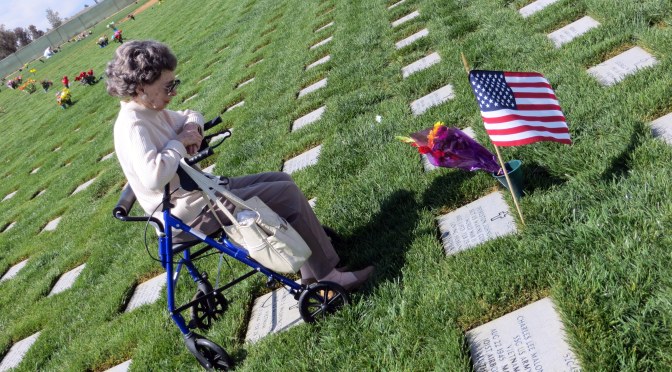
While the Boy Scouts hadn’t made it to your husband’s resting place yet, we had our own little flag… and your beautiful bouquet we were able to pick up along the way. You were so pleased with them but we made it a promise the next bouquet will be the colors of the USMC – scarlett and gold. You knew he would like that. Yes you did.
It was only the Saturday before Memorial Day but you were so elated to see how many people were there already…and we arrived at 10:00 AM! You were worried we wouldn’t be able to find a place to park when someone upstairs opened one up for us.
You were so anxious to visit him that you made it out of my car in record time and walked as quickly as you could!
While you used your stroller to get to the general area of his grave site, we had to leave the stroller and walk the last twenty yards on very saturated ground. You were holding onto my arm so tightly as the muddy earth gave way as we walked. Remember? My shoe sunk into the soil and inch or more.
And when we got there, we couldn’t find any water decanters… They were all being used by the hundreds of other mourners…but by some lucky grace, we ran into Vicky… She had bought 1,000 beautiful flags on her own and her niece was placing them neatly all along the columbine. She went out of her way to find one for you!
Vicki and her niece holding another bunch of the 1,000 flags she had bought to place along the columbine.Some of the 1,000 flags purchased by Vicki and placed by her niece for our fallen.
Your bouquet was so beautiful, Marge. You said quietly Johnnie – your husband of 66-1/2 years – would like them so much. You miss him dearly, don’t you Marge? I miss him…
And like the last time, on Easter Sunday, you talked with him…
She is talking to Johnnie… True love and devotion…
You shared with me again of how he left your life…and you were there for him til the very end… and how alone you felt because you are the last one alive from amongst your friends. There is no one else. You said you still look for Johnnie at your assisted senior care center to ask him a question but he doesn’t answer…
Thriving love…
____________________________
We promised to go back in two months, yes?
I will be calling you because he means so much to you… and it means so much to me.
I wish people would understand your love and devotion.
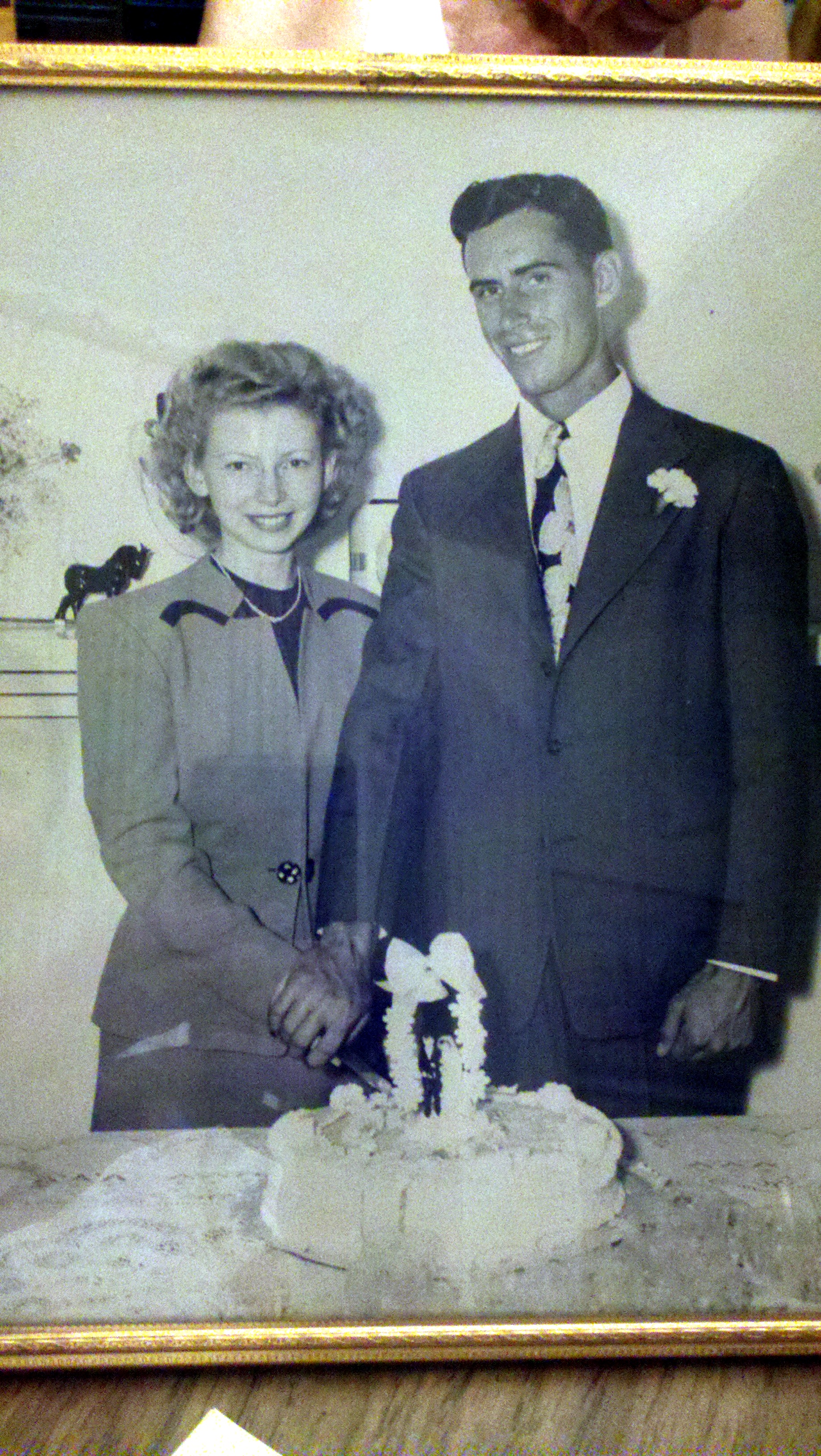
Marge and Mr. Johnson on their wedding day in June 1945.
In the 2012 limited release movie, “Memorial Day”, children are playing at their grandparent’s home in a rural setting. It is Memorial Day weekend. A 13 year old boy stumbles across a dusty box in a barn.
The box is his grandfather’s WWII Army footlocker, emblazoned with the unit insignia of his famed unit, the 82nd Airborne. It is filled with “souvenirs” he had brought home from war.
The young grandson probingly asks the grandfather for the stories behind the souvenirs to which he curtly answers no – and bitterly orders the boy to take the footlocker back to where he found it.
“It’s Memorial Day…” says the grandson.
“Damn straight it is,” barks back the grandfather.
The young lad digs in, not wanting to fall short in his quest for answers, and pushes the footlocker even closer to his grandfather.
The grandson then doggedly asks, “What is it I’m supposed to remember?”
Checkmate.
___________________________
Memorial Day.
In essence, a day to remember, honor and pray for those nameless souls who were KIA (Killed in Action).
To remember those that didn’t return from war. Young boys. Young men.
But as the young boy in the movie asked, “What is it I’m supposed to remember?”
Do YOU have an answer to that boy’s question?
I didn’t…and perhaps still don’t as I was not shot at, bombed or strafed…nor killed.
__________________________
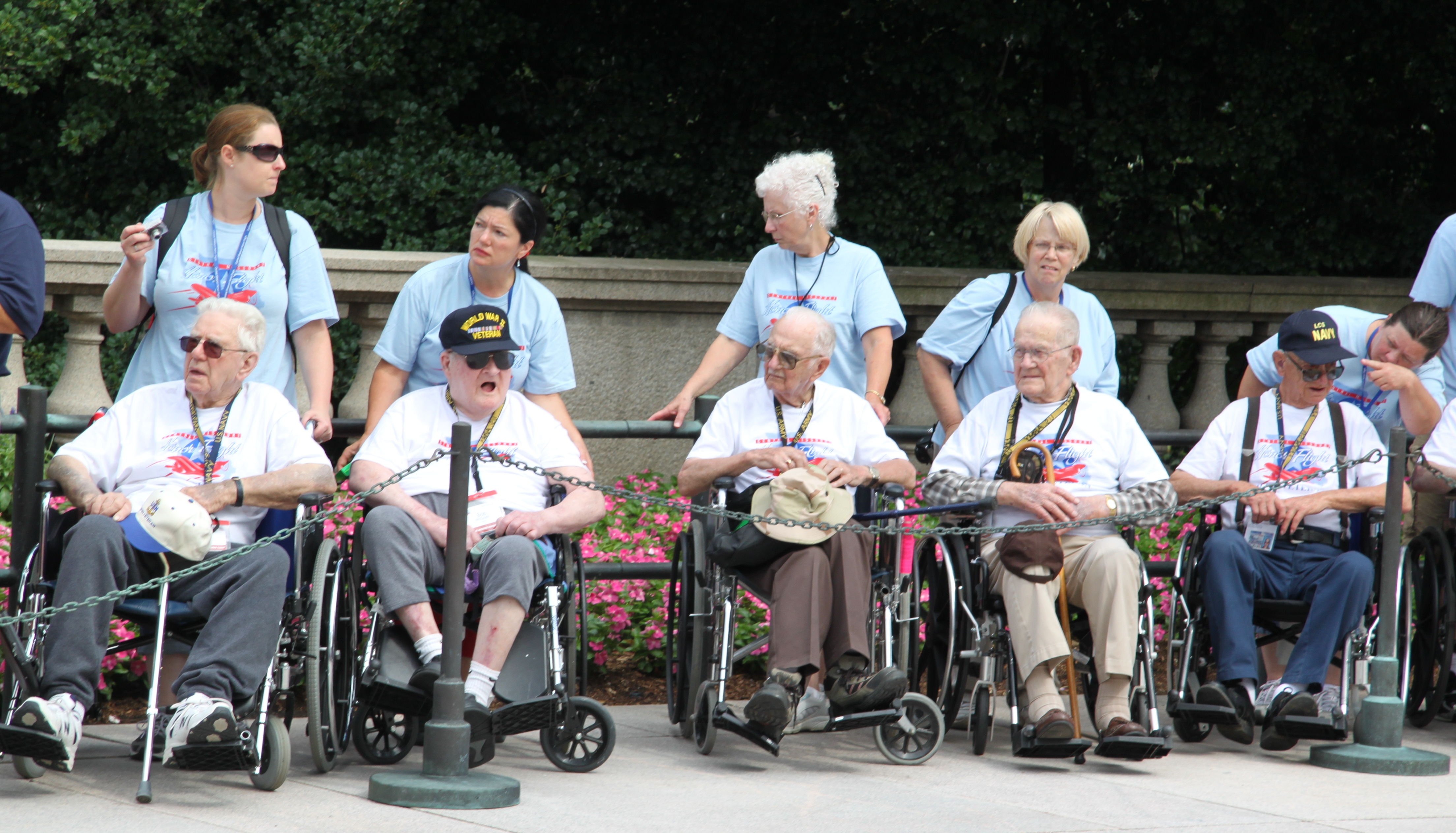
My photo of WWII vets at the Tomb of the Unknown Soldier. July 2010
The only thing I do know is that WWII combat veterans do NOT want to talk about “it”.
And that’s our problem, I feel. Because these combat vets are unable to share with us the horror they lived through 70 years ago, it helps diffuse the essence of Memorial Day.
They are unable to share for their own sanity’s sake.
As WWII combat survivors (a.k.a., now collectively known as “vets”) would bravely crack open their bottled abominations to talk about “it” with me, I will venture to blurt that possibly – just possibly – they feel unbearable guilt and shame for what they saw…or did…or did NOT do… but that they survived to talk about “it”.
But their buddies didn’t.
___________________________
(Note: World War II is the focus of this story. WWII was a cataclysm of never to be matched magnitude again. There was wanton destruction of entire cities and civilians. Inflicting casualties on the enemy was expected and accepted by the majority. This is not to downplay Korea, Viet Nam or our current war on terrorism. There are different rules of engagement now with much different social expectations by the “good guys”.)
Perhaps you will let me take a chance with trying to bring to light some of the “it” things you may or may not know… If you can at least read about the combat experience, perhaps it will help YOU appreciate Memorial Day even more… and of those that are not with us today.
I’ve collected these personal observations, comments and facts from talking with several bona fide WWII combat vets and just plain reading. Nothing scientific, of course.
So here goes:
Nearing death, as grievously wounded young men take their last gasps, the most often said word was, “Mama”.
Under fire, many would curl up into a fetal position shaking uncontrollably while their buddies would somehow raise their weapons to shoot back… only to get showered with their blood and brains as a enemy round obliterated his buddy’s head. It is not about cowardice. It is FEAR.
About 25% of them peed in their pants. About 10% shit in their pants. (Old Man Jack did both…and he was not ashamed to say so. Ergo, his quote from Two Old Men and a Father’s Day Anguish: “If you got killed with shit in your pants, you got buried with shit in your pants.”)
Another 25% of these brave young boys and men were so scared or were so repulsed at the gore, e.g., at seeing liquified brains spewing from a shattered skull, they vomited.
One Marine told me he was to silently kill a Japanese sentry using a makeshift garotte only to find the sentry had fallen asleep face up. He couldn’t use the garotte as the enemy’s helmet was in the sand and the enemy could let out a scream if he used his Kabar. At the appointed minute, my friend had no choice but to jump on the sleeping soldier and grip his Adam’s apple with all his might… to keep him from yelling, too. He knew the enemy died when his body went limp and urinated. My friend did, too. He said he thinks he gripped the enemy’s throat for over two minutes. His hands couldn’t stop shaking. It was his first hand-to-hand kill.
After hearing sounds at night, frightened soldiers or Marines would unleash a violent and impenetrable barrage of carbine and machine gun fire. When they reconnoitered at day break, they discovered they had mistakenly slaughtered unarmed men, women and children. They would vomit then, too. (I can’t imagine what went on in their souls for the rest of their lives.)
Sometime in 1943, Army psychiatrists took a survey of “frontline” troops. Less than 1% said they wanted to go back into battle (I understand this was exclusive of the more higher trained units like the Rangers or Airborne). Almost NONE of the Silver Star recipients wanted to go back. But they did.
Army psychiatrists found that 60 days was the limit for being on the front lines…before a soldier would crack. Old Man Jack was out on the front for just about a year for his first deployment on “those stinkin’ islands”.
A Nisei 442nd vet told me just the sound of the Nazi MG42 machine gun would make them shit in their pants. It could fire up to 1,500 rounds a minute and chew through tree trunks behind which they were seeking cover. Sometimes, a buddy’s top half would be separated from the bottom half by the MG42…and they saw it happen.
Another Nisei vet told me they were on patrol when they came under a barrage. As he and a buddy dove into a shell hole for cover, his buddy’s arm went into a rotting, foul mass of a decomposing German’s remains.
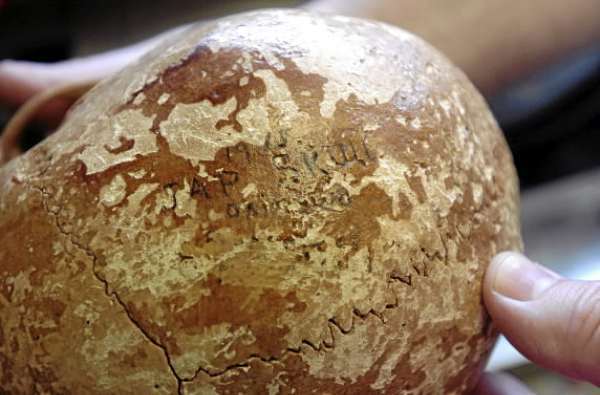
Human souvenir hunting was rampant – and most extreme in the Pacific Theater. Correspondents documented in their reports that a number of Allied military “boiled” Japanese skulls or left them out for the ants to eat away most of the flesh, then kept them. Sailors would leave a skull in a net trawling behind their ship to cleanse them of flesh. For some, the skulls were too large or awkward so they would keep ears or noses. (In fact, Customs had issues with these skulls when a military man would bring them back to the US after discharge.) And as Old Man Jack witnessed in “Old Man Jack-isms #4“, some would collect gold teeth.
A souvenir skull. Someone had etched “1945 Jap skull Okinawa” onto it.
In a battle report, several very young Marines cut off the heads from Japanese corpses, impaled them onto stakes and pointed the faces at the enemy across the way to taunt them. When their commanding officer ordered them to take the severed heads down, they replied something to the effect of if we eat like animals, fight like animals and look like animals, we are going to act like animals.
Old Man Jack mentioned something he called “squeakers”. He didn’t elaborate on it too much but it’s when fear becomes so overpowering, men would get dry mouth or start gagging… a problem if you were an officer trying to give orders under fire to keep men alive. They would “squeak”.
“Take a very, very ripe tomato. Throw it with all your might against a weathered cedar plank fence. Listen to the sound of the impact. That’s what it sounds like when a bullet hits your buddy.” A Nisei vet told me that.
___________________________
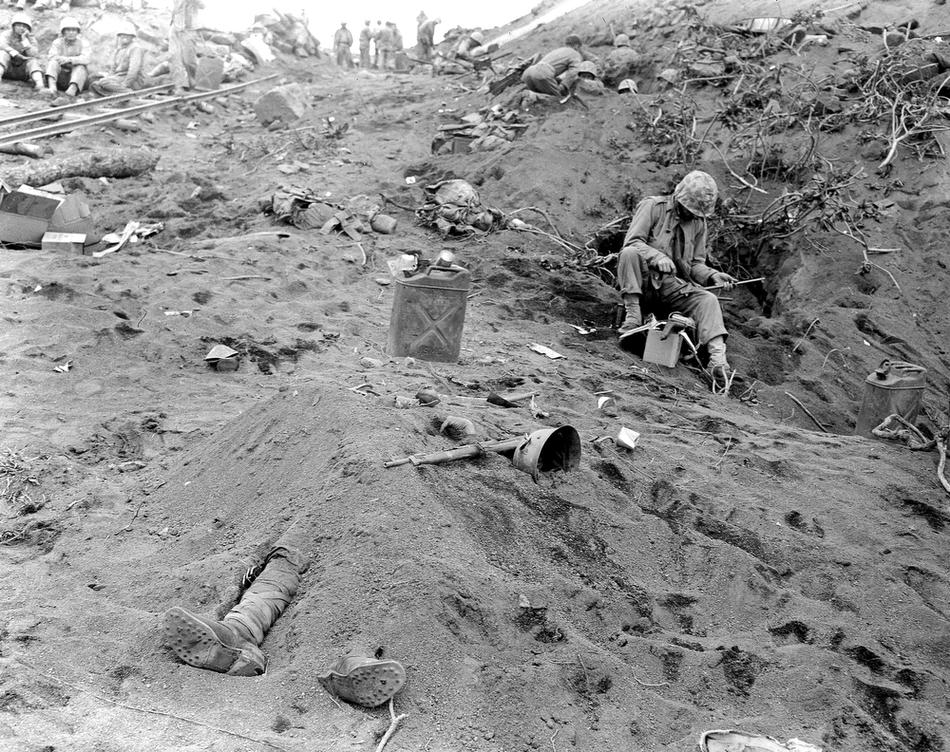
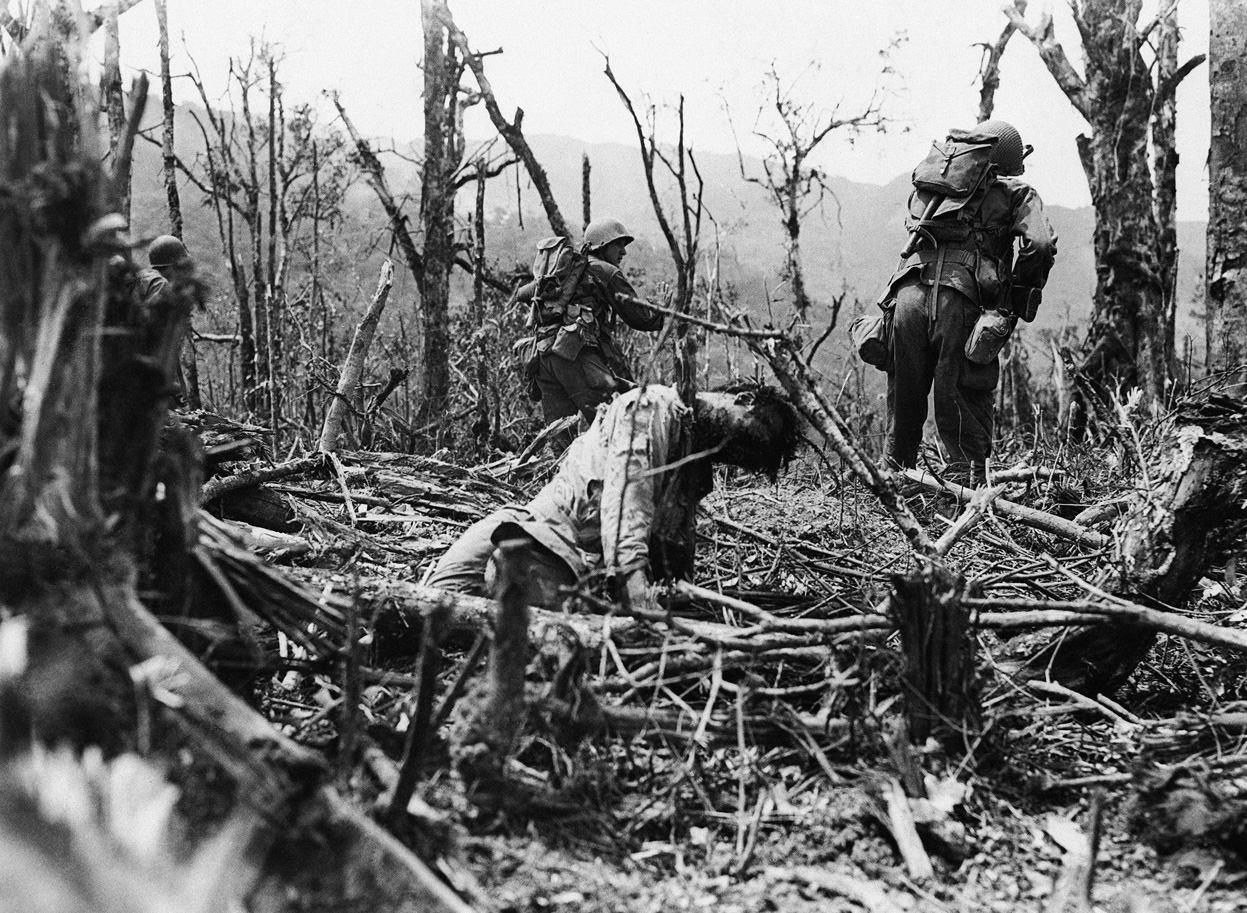
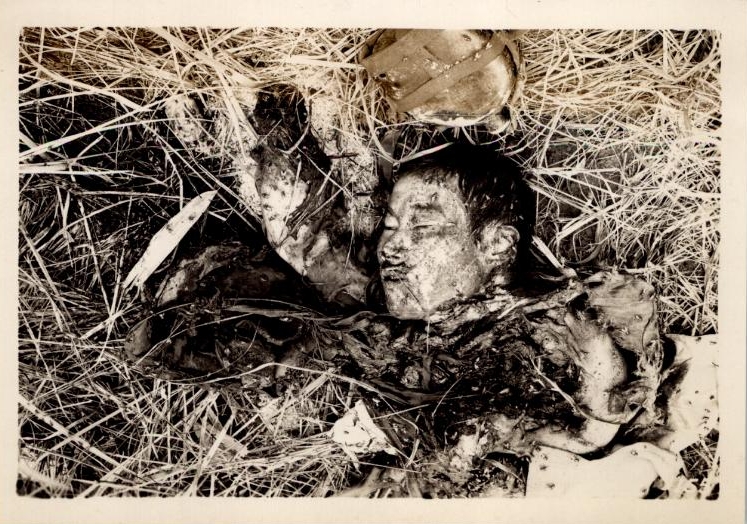
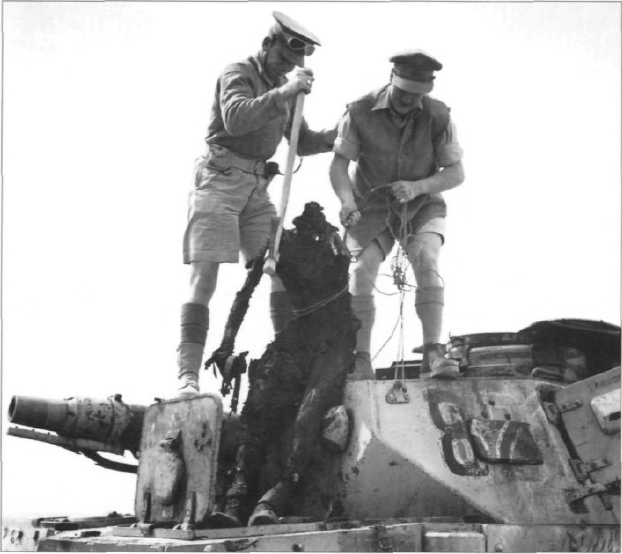
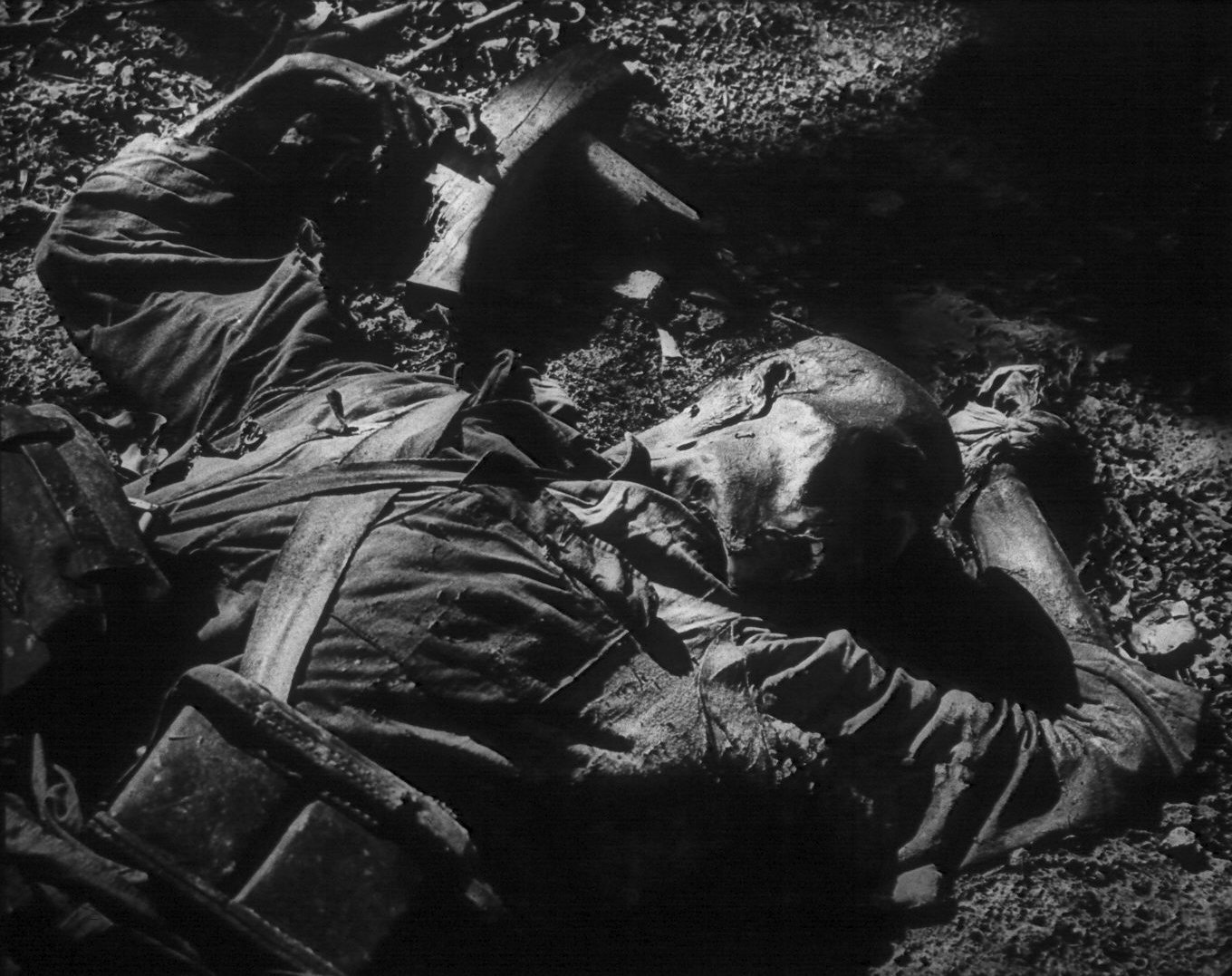
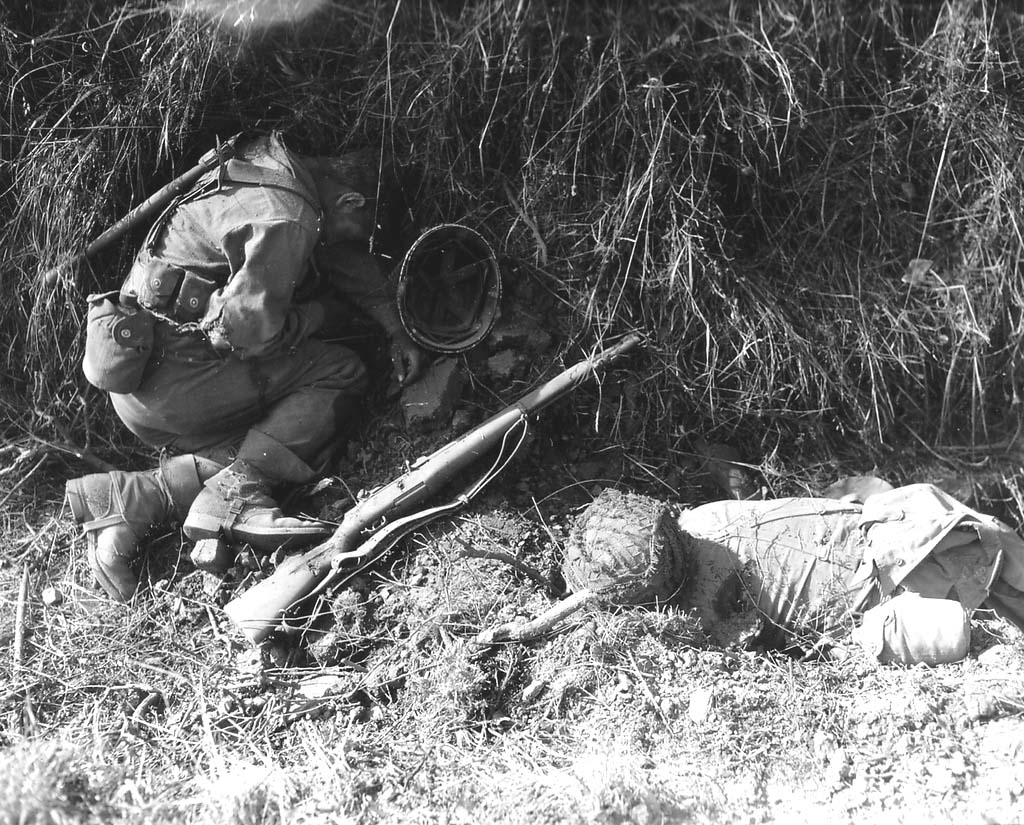
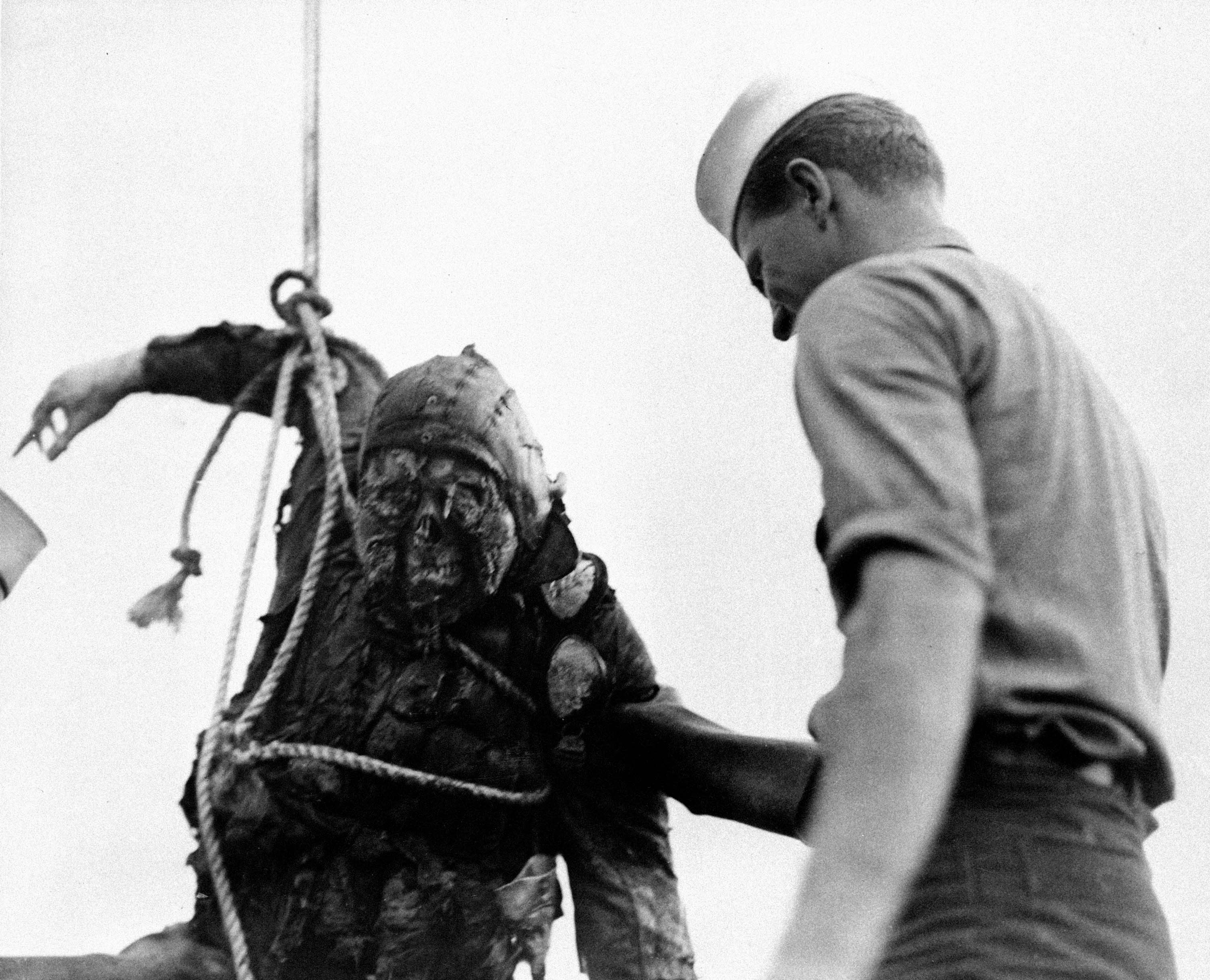
These next images, to be politically correct in today’s world, will be very upsetting to some so a warning to you… But these must be seen to help comprehend why many combat veterans don’t want to talk about “it” and therefore, the difficulty in helping us answer, “What am I supposed to remember?”:
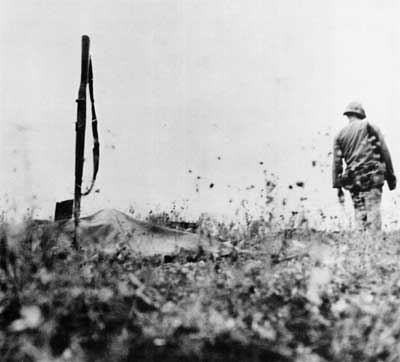
A dead and frozen Nazi is propped up like a road sign.The booted feet of a dead Japanese soldier, foreground, and his hand protrude from beneath a mound of earth on Iwo Jima during the American invasion of the Japanese Volcano Island stronghold in 1945 in World War II. U.S. Marines can be seen nearby in foxholes. (AP Photo/Joe Rosenthal)Perhaps this is similar to what Mr. Johnson saw during the Battle of Santa Cruz Islands and Guadalcanal where he was gravely wounded. Note the position of this dead sailor’s feet relative to his upper body. National Archives.A US Army soldier lays as he died on Okinawa while the fighting continues around him. National Archives.Dismembered Japanese soldier on Luzon, 1945. US Army photo archives.British military removing burned German corpse from knocked out Panzer IV tank. National Archives.Dead Japanese soldier in decomposition. Perhaps this is an example of what Old Man Jack tried to suppress in his recollection of his morbid experience in “ID patrol“. US Marine Corps archives.Two from the US Army 3rd Armored killed in action in France. National Archives.Dead Kamikaze pilot. Notice the rubber glove on the US sailor’s right hand. US Navy.Dated March 3, 1944
Perhaps some of the other “it” they saw involved civilians.
Records related to this photograph of a slain young Russian female indicate the photo was taken from a dead German’s wallet.A description that was attached to this photo state a young girl is led away from her sister who was just killed. Notice the camera in the old man’s hand. He also sports some kind of arm band.
_____________________________
So why these gruesome photos of carnage and violent death?
Are they REALLY necessary for you to see?
I believe so… and the preceding photos were relatively tame to be quite honest. There are much more gruesome ones in private collections. Old Man Jack had a collection but I only got a glimpse of ONE picture early in our relationship and it was of a severed Japanese head. He never brought the photos out again.
But it’s important that Americans today understand “it” went to the hundreds of thousands of now silent US military graves… and “it” also remains tightly bottled up in the few surviving combat vets from WWII.
They have a right to keep “it” bottled up. Vacuum sealed. To keep their sanity although they relive and suffer horribly through “it” each night.
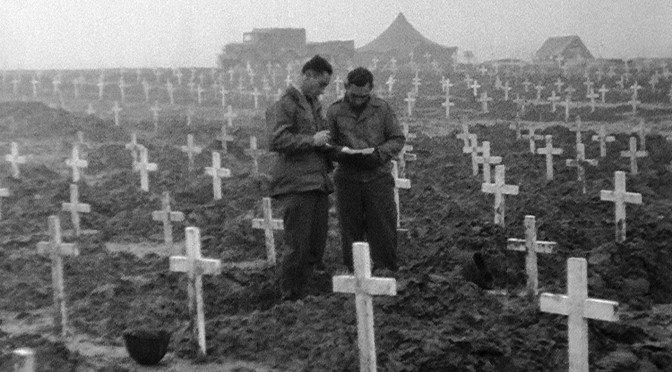
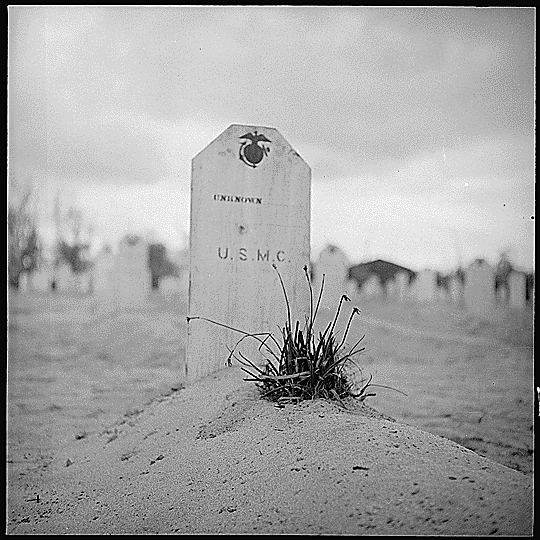
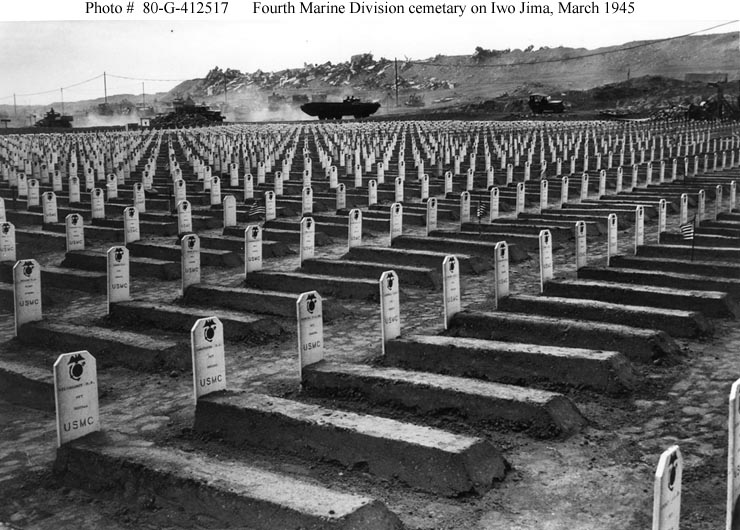
Field grave for an unknown US Marine. Some souls will never be identified.
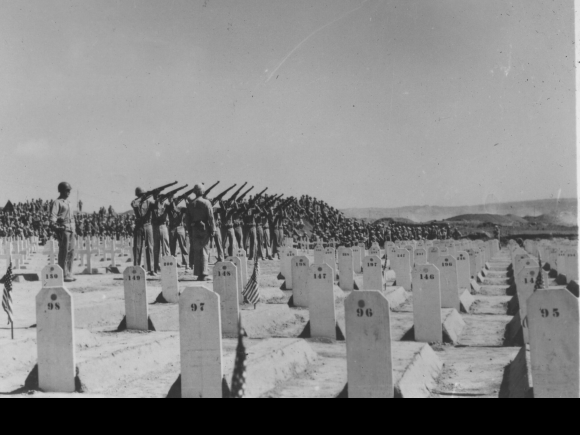
Thousands of graves on a “stinkin’ island”… all killed in action.
Iwo Jima. US Marine Corps.Saipan burial of a Marine killed in action.French civilians erected this silent tribute to an unknown American solider who has fallen in the crusade to liberate France. Carentan, France., 06/17/1944Some souls will never be found.Somewhere in northern Europe.Like this torn photograph of an Iwo Jima battlefield cemetery, memories of young boys who lost their lives so violently are fading away.
___________________________
Memorial Day.
To remember those killed.
But without seeing, understanding or accepting the horrible demise these young fighting men encountered ending their short lives, the true meaning of Memorial Day is lost.
It is not truly about the combat vets alive today or who passed away since war’s end… but they sure the hell are part of it. Those alive mightily grip a key to their secrets – preventing your entry into their private internal hell.
__________________________
I will remember this when I visit the graves of Old Man Jack and Mr. Johnson this Memorial Day and will think of their fallen comrades.
And I will thank them and their unnamed buddies when I enjoy my barbequed hamburger this Memorial Day weekend and a cigar.
They died for me.
So I could enjoy my hamburger and cigar.
And I shall
A final, short tribute to those resting in graves today:
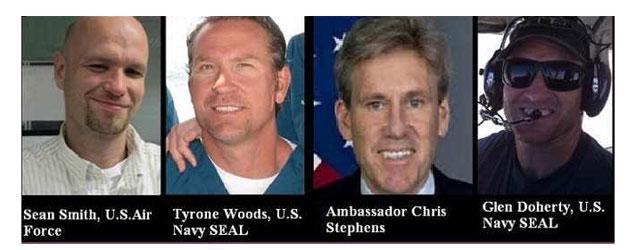
But there are four Americans whom I believe – BELIEVE – needlessly died at the hands of terrorists on 9/11 last year.
The four who died are pictured above…along with their names.
____________________________
The attackers actually had enough time to snap pictures of themselves.
For argument’s sake, let’s say the firefight DID last about eight hours…that it wasn’t over in a flash.
For argument’s sake, let’s say there were drones videoing the attacks.
For argument’s sake, let’s say there was a gunship up in the air with her dedicated crew’s fingers on the triggers of very accurate weapons. Well, their fingers were on very accurate targeting systems, not triggers.
For argument’s sake, let’s say the attack took place on any OTHER day instead of 9/11.
For argument’s sake, let’s say that the two former SEALs – our BEST – were killed SEVEN hours after pleas for help went out.
SEVEN HOURS?
____________________________
The deceased souls parents want to know. Here is just one letter from one mother to Congress. It’s a link so please feel free to click on it:
The mother was there when her son’s body – in a flag-draped casket – was off-loaded in Washington, DC.
(Yes. President Obama and Hillary were there.)
____________________________
Our country needs to heal.
Not just about Benghazi…but about nearly everything.
We are divided – right down the middle, it seems.
But what happened to CHARACTER?
A person I like to follow is Michael Josephson. He “teaches” folks about ethics and character. I would like to close this blog with this excerpt from one of his commentaries:
“The way we treat people we think can’t help or hurt us — like housekeepers, waiters, and secretaries — tells more about our character than how we treat people we think are important. How we behave when we think no one is looking or when we don’t think we will get caught more accurately portrays our character than what we say or do in service of our reputations.
Of course, our assessment of a person’s character is an opinion and it isn’t always right. Abraham Lincoln recognized an important difference between character and reputation. “Character,” he said “is like a tree and reputation like its shadow. The shadow is what we think of it; the tree is the real thing.”
Because the shape of a shadow is determined by the angle of light and the perspective of the observer, it’s not a perfect image of the tree. In the same way, reputation is not always an accurate reflection of character. Some people derive more benefit from their reputation than they deserve; others are better than their reputations.
Still, reputation matters. It determines how others think of us and treat us and whether we are held in high or low esteem. That’s why many people and organizations are so preoccupied with their image that they actually undermine their character by concealing or creating facts to make them look better. It’s ironic that reputations are often the result of dishonesty or the lack of accountability.”
____________________________
Hillary… No more conveniently-timed strokes or falls or other ills.
Parents want to know what happened and why their sons are no longer with them.
We want to know why NOTHING has been done to go after these terrorists, some of whom were in PICTURES…on the INTERNET. It’s been eight months, for heaven’s sake.
I’ll give him that but that’s maybe why we were close.
He didn’t care who was there when he spoke. His thinking was it was their fault for listening in to something they had no business in. Lot of truth in that, I guess.
But it was if his departed wife came down from above and washed his mouth out with soap when my kids were in earshot. He spoke like an angel.
Well, not quite…but almost.
Some of his more oft-used phrases (light-heartedly said) were:
“You dumb shit. Shut up and listen,” or,
“They thought they knew everything but found out the hard way,” or,
“Them Marines thought they owned the beach but they forget who brought them there.”
When he would say these phrases, it would likely be when he was story-telling on some of the more memorable moments on those “stinkin’ islands”.
But one of Old Man Jack’s phrases keeps popping back into my head with fondness:
“They didn’t know shit from Shinola.”
___________________________
For some of you, no explanation is necessary.
But for you younger folks, Shinola was known for shoe and boot polish.
And for Old Man Jack’s phrase, the dark brown Shinola boot polish would be implied…which has a strikingly similar coloration to cow poop.
Hence, “…doesn’t know shit from Shinola”.
Pardon the French.
And yes, the phrase arose from the ranks of World War II military personnel.
___________________________
And while Old Man Jack DID get the local newspaper delivered to him, he never really read them.
He’d look through them for some restaurant coupons. That was about it. I asked him why and he said he doesn’t believe half the s*it in it.
(Odd why there’s an asterik there when I quoted him earlier.)
__________________________
Which brings me to one thing that depresses me immensely: the lack of legitimate oversight on our media.
They use their own medium without restraint. To suit their pocketbooks.
How they deem fit…and pay no mind to us.
Doctors get controlled.
CPA’s get controlled by the government now.
Everyone else does… Oops. Not the lawyers. They’re as bad as the media. Did I say that before?
But certain media “stations” or “newspapers” love to castrate law enforcement personnel…or shame soldiers or Marines doing their best to protect us after one incident.
It is like they were the judge and jury before the case could come to court…or actual facts disclosed…or the brutal environment in which our young men and women trying to protect us is truly displayed.
THEY deem it wrong. That’s similar to discrimination.
__________________________
But to close this story – and as I blogged once before – please compare these two webpage screen prints taken within minutes of each other.
First CNN. Notice nothing is highlighted about gun control (when that was all they could write about at that time) or the murder of four Americans in Benghazi…but they deem news of a woman who shows up after 11 years to be crucial to Americans. Certainly nothing embarrassing to President Obama.
And here’s the webpage from Fox News. It does highlight the murder of four Americans and brings up guns…and makes only small mention of the mysterious woman that CNN deemed important. But certainly, the first two items could embarrass President Obama.
_____________________________
“If you don’t read the newspaper, you’re uninformed. If you read the newspaper, you’re mis-informed.”
― Mark Twain
Old Man Jack was right…again.
So what are we to read?
After all, we need facts and truth so that we’d be able to tell the difference between shit and Shinola.
As I was cutting down trees and chipping the cuttings in the backyard this past Good Friday, Marge’s caretaker drove Marge up to see me. What a pleasant surprise – besides, it gave me a great excuse to stop working. I hate yard work.
After chatting, she brought up her husband. It had been a year since his funeral with full military honors and that she hadn’t been back to see him.
She didn’t need to say anything more.
We agreed I would take her to see him two days later – Easter Sunday.
________________________________
Mostly, I will let the few pictures and short videos speak for themselves.
Her first words as she saw his gravestone: “Oh, my darling…” in a quivering voice.
They loved each other greatly.She sat there, talking to him, for about 45 minutes. I left her alone for most of the time.
She loved and missed him so much, she struggled out of her walker to kneel down and kiss his gravestone. I offered to help and she said, “This is something I have to do on my own…” Such fortitude.
After I DID help her back up (she said I could help her now), she reminisced with me at graveside before we departed:
On the way back to the car, we took a break (in the hot sun) as her legs are weak now. As any great lady from that great generation does, she thanked me over and over for taking her to see her husband, especially on Easter Sunday, while crying. I said to her that Mr. Johnson and Old Man Jack could never forget the horrors from combat but they were the greatest human beings – because they learned to forgive – and that it was an honor she asked ME… an American of Japanese descent, to escort her to visit with her husband.
These Americans from back then gave their all for our country… and nearly all of them have outlived their friends. They are now alone – after all that sacrifice that you nor I will EVER weather.
I think they deserve better.
We should all try to return the favor, no matter how small the gesture, when the opportunity presents itself.
“She’s the most beautiful thing I had ever seen,” said Old Man Jack in a trembling voice and with very wet eyes.
On March 3, 2003. Truly.
______________________
He was referring to the F4U Corsair. I had taken him to the Chino Planes of Fame Museum in Chino, CA. The WWII aircraft there – all of them – fly.
That’s right. They get up in the air.
Planes that were engineered with a minimal lifespan as they were meant for combat were still spinning their props for the men who flew them – or worked on them.
Old Man Jack was one of them.
Do you know what these beautiful planes look like? What they may have sounded like to Old Man Jack 70 years ago? Ever see one fly? A vid I took at the Planes of Fame Airshow:
In case you haven’t figured it out, his Corsair is “on the tail” of a famed Zero of the Imperial Japanese Navy in this mock dogfight. I filmed it almost ten years ago at an air show there at Chino Planes of Fame.
______________________
Old Man Jack was an “AMM 1/C” during WWII, or “Aviation Machinist Mate First Class”. He could have re-upped after the war and been promoted to Chief Petty Officer but like Mrs. Johnson, Carol would have none of that.
I am not positively sure as Old Man Jack would only give tidbits here and there but he was responsible for the aircraft. Before flight – and while remembering this was at the front lines on “those stinkin’ islands” – he would get into the cockpit and make sure all essential bells and whistles worked after his crew worked on it all night. I also believe he was to pilot one on occasion to maintain his certs. Very simplistically said on my part.
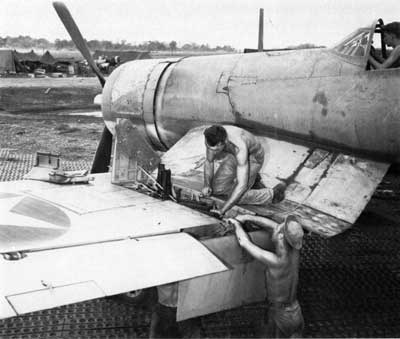
US Navy ground crew servicing a Corsair on what appears to be Guadalcanal – where Old Man Jack was. National Archives 127-N-55431
The pilot was headed off into harm’s way. The pilot’s life depended on Jack and his crew. It’s airworthiness.
But one thing is for certain – Old Man Jack said many times “there just weren’t enough spare parts so we had to make do.”
______________________
But back to the story…
Our friendship had begun to solidify by then… I had mentioned to him that I was a member of the museum and that he wouldn’t have to worry about me paying for his entry. But that wasn’t why he hesitated. You will see why. And I found out later myself why he was so hesitant.
Back then, the museum’s WWII hangars were divided into the two main theaters of operation: the European and the Pacific – where Old Man Jack was stationed during the thick of things.
We meandered through the European Theater hangar. He recognized them right away. The P-51. The P-47. Others.
He had brought along his “walking chair”; it was light and when folded up, it was a walking aid. If you press down on it a certain way, it would spread out into a little chair. Well, he was doing good…and I was happy.
______________________
To get to the Pacific Theater hangar, you would leave the European Theater hangar and mosey across a tarmac.
Chino Planes of Fame and “X” marks the spot.
It was a hot day. Old Man Jack was in a t-shirt. Blue, of course.
We were slowly making it across the tarmac. I knew a Corsair was in there – pretty as the day she rolled off the assembly line. As the hangar door was cracked open, you could see the wing spar.
Then Old Man Jack stopped. At the white “X” marked in the map above. Dead in his tracks.
He propped open his chair.
He sat down.
I was wondering if he was tired. We were out in the sun. Why’d he stop there?
I walked back to him. His hands that still firmly shook your hands were on his knees. His head was bowed down.
Then I saw it.
His shoulders were shuddering a bit at first, then began to bob up and down.
The man who had a barrel chest…the man who worked on these planes as a young man whose bushy eyebrows had turned white with age …was crying.
Deeply. No sounds. He was holding it in…
_________________________
I walked away.
The plumbing in my eyes broke too.
I think he cried quietly for about a couple of minutes. Out there on the tarmac. In the sun.
Old Man Jack then straightened up. He wiped his eyes.
“Young man, earn your pay. Give me your hand and help me up.”
Old Man Jack was back.
_________________________
We walked over to her – Jack’s beloved Corsair. His eyes were still wet.
I remember him saying very quietly while trying very hard to hold back his now visible anguish, “I knew a lot of young boys who flew them,” his voice cracking with 70 years of nightmares tormenting him. “Some of them just didn’t come back. I could never stop thinking, ‘Did a Jap get him… or was it me?'”
Nothing more need be said.
A very, VERY proud Jack Garrett, AMM 1/C showing off his barrel chest as best he could.
_________________________
That’s when he told me she was the most beautiful girl in the sky. But like any woman, she was a pain to keep happy.
“We didn’t wear shirts because it was so _ucking hot; I’d burn my stomach and chest on that hot metal.” He pointed at the wing spar (the bottom of the “gull wing”) and said, “We would always slip on those damn spars. You never had good footing.”
He then recollected other things. He told me “We’d stick a shotgun shell into a breech under the cowling and fire it off to turn over the engine.” As I surely didn’t know much better back then, I asked why. “Because the dumb son-of-a-bitch who designed the plane didn’t put in a starter. That’s why.” Oh, boy (with a smile). “And if she didn’t turn over, you only had a couple more tries at it before you had to let it cool off.”
Old Man Jack then smiled a bit when he admitted he fell off the wing while taxiing once. “Like a dumb smart ass kid, I stood up on the wing when the pilot was taxiing. You were taught to lay on the wing to point which way to go but (the wing’s surface) was too damn hot so I stood up. We hit a bump and off I came.” (Note: the Corsair’s nose was long to accommodate the powerful engine. It was so long that it obscured the pilot’s forward view during taxi and landing.)
One more thing he said. “There was nothing better than seeing the flight come back after a patrol at wave top, do victory rolls then peel off.” He was a bit choked up.
_________________________
When we got home, he said to me, “I didn’t know how I would react if I saw something and that’s why I put you off in going. But I feel good about it now. Thank you, young man.”
He gave me that solid Jack Garrett handshake…and a hug.
I think he enjoyed the visit…and no better way to end my first six months of blogging.
But we’ve been “at war” against terrorism – both foreign and now domestic – since 2001. More than 11 years.
But the war against Japan started officially for us on December 7, 1941. We were caught flat-footed.
Yet it was over by August 15, 1945.
Incredible. In 3 years, 8 months, 8 days. How could that have happened so quickly (relatively speaking)? Have you ever thought of this timeline?
________________________
Well, I have removed my Kevlar flak vest for all you bloggers who love history – and who are immensely more versed and intelligent than I…or is it me?
Below herein is my “Top Ten” list of the reasons why Japan lost the Pacific War…so quickly.
I’d like to hear your opinions, corrections, or teachings.
Hunting season is open. Rubber bullets are most suitable.
_______________________________
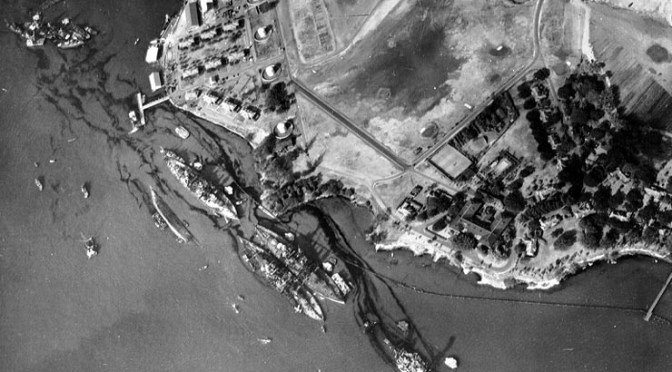
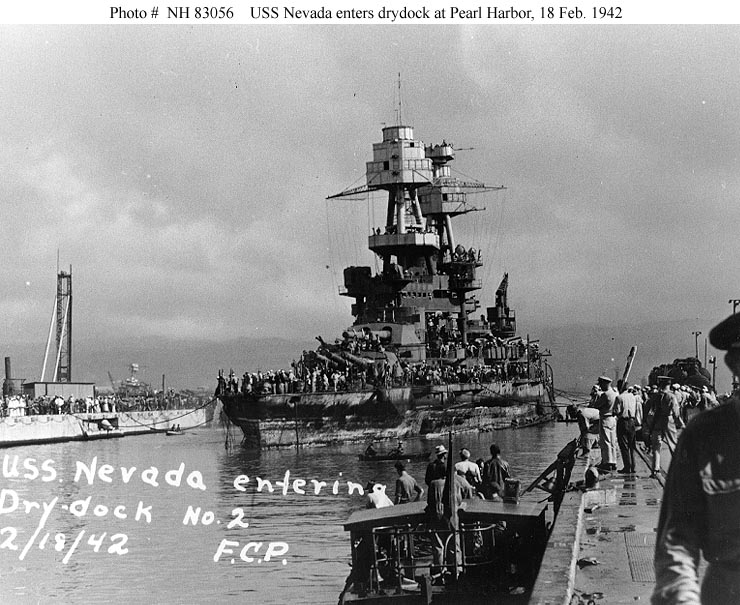
Damage from overhead – Pearl Harbor aftermath
1. Long Range Failure of Pearl Harbor Attack
a. Admiral Nagumo – placed in charge of the attack force by the Japanese Imperial Navy and NOT by Admiral Yamamoto – failed to fully execute the direct orders issued to him by Yamamoto.
b. Attack plans skewed towards sinking of carriers (which were not there). Genda wanted to insure carriers were sent to bottom and therefore be unsalvageable. Because our carriers were not there, pilots overly concentrated on battleships or other less tactically important ships.
c. The ordnance used by the attacking Japanese was inappropriate for sinking battleships. Besides, Pearl Harbor is way to shallow to allow for “sinking to the bottom of the ocean,” so to speak.
d. The first wave of Japanese torpedo bombers – although a complete tactical surprise – was a dismal failure with very few hits.
e. Failed to destroy dry docks and fuel dumps (Hawaii is an island country and had to import all fuel…like Japan). Although there is the fog of battle, Nagumo (overly cautious) did not heed the strong advice from Fuchida who urged a third wave just for such purpose.
f. In light of “e” above, Yamamoto himself had one weakness: he did not see his submarine force has an OFFENSIVE weapon. He failed to deploy them between Pearl Harbor and the West Coast of the US to target supply ships – which would have been carrying fuel, materiel and supplies to rebuild Pearl Harbor.
g. Nearly all ships damaged by the attack were refloated.
h. Insufficient training by Japanese Navy in preparation for attack.
i. Lastly – and for some foolish reason – they attacked on a Sunday morning.
2. Breaking of the Japanese Naval Code and the failure of the Japanese to accept it was broken.
3. 24-hour Repair of USS Yorktown after Coral Sea in Preparation for Battle of Midway.
USS Yorktown afire
4. Innovation of US Navy to Use CO2 for Fire Suppression.
a. US Navy would flood fuel tanks on ships with carbon dioxide thereby displacing oxygen before battle.
b. Japanese ships had useless fire suppression systems with fuel right alongside ordnance.
5. Innovation of Rubber-lined Fuel Tanks and Armor Protection for Pilots on US Aircraft
An example of survivability with self-sealing fuel tanks and armoring. F6F Hellcat.
a. “Self-sealing tanks” in wings.
b. Impressive armor shielding for the pilot (especially in the Grumman F6F Hellcat).
c. Japanese planes had neither, leading to insurmountable casualties and easy shoot-downs, i.e., Japanese aircraft would “flame” or disintegrate under withering fire from .50 caliber guns.
Japanese planes did not have self-sealing fuel tanks
6. Battle of Midway
a. Huge tactical gamble by Nimitz in usage of Spruance as task force commander.
b. Tactical decision to launch torpedo planes early on by Spruance. While all but one pilot perished and no torpedoes hit, Mitsubishi Zeroes assigned to combat air patrol were at low altitudes since they shot down the torpedo planes.
c. Dauntless dive bombers (with US fighter cover) were able to dive relatively uncontested and caught Nagumo between launchings with ordnance scattered about.
d. Confusion by Japanese pilots that two US carriers were sunk. In actuality and while eventually sunk, the USS Yorktown had been hit in the first wave but the fires had been put out before the second wave attacked.
e. With the sinking of four Japanese carriers (see Fire Suppression above) and loss of valuable pilots, the Japanese Navy ceased to be an offensive force.
7. Production Might of the US
a. We had eight carriers at time of Pearl Harbor (in the Pacific and the Atlantic) but were down to two after the Battle of Midway.
b. We lost the Wasp, Hornet, Lexington and Yorktown by then.
c. The USS Enterprise was the last operational carrier. The “other” carrier, the USS Langley, was used only for training purposes and was out in the Atlantic.
d. By the time of the invasion of Okinawa in 1945, however, we had over 40 carriers as part of the assault fleet alone.
8. Semi-automatic M1 Garand rifle and the M-2 Flamethrower
a. Japanese military were burdened with reliable but bolt action Arisaka or failure-prone Nambu armaments. (Bolt-action implies the shooter must lower his rifle to load the next round and then re-sight.)
b. The M-1 Garand took an eight-round clip. The round had tremendous stopping power, was rugged and a rifle squad could lay down withering fire with the semi-automatic. The shooter did not have to lower his rifle to load the next round and re-sight.
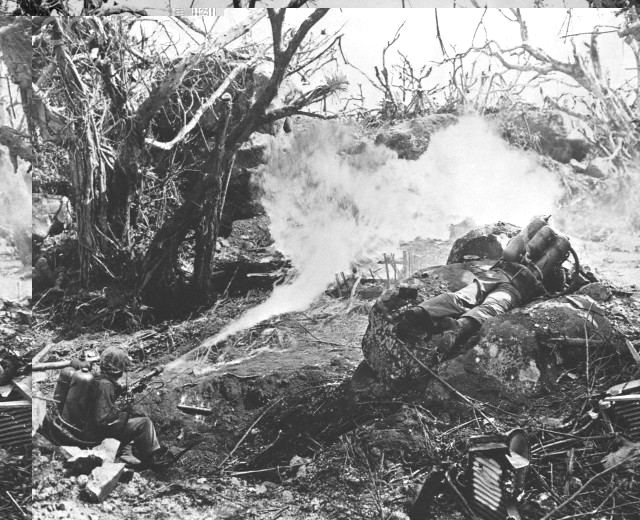
c. On Iwo Jima and other island battles, the Japanese were rarely seen. As such, the flamethrower was critical for success although accompanied by high mortality rates.
Marines carry the M1 Garand into battle at Tarawa Nov 1943US Marines using M-2 flamethrower against entrenched enemy on Iwo Jima
9. The Japanese-American (or “Nisei”) Soldiers in the Top Secret Military Intelligence Service (MIS)
Two of the Nisei secretly attached to Merrill’s Marauders plan with General Stillwell.
a. MIS secretly accompanied Marines and soldiers for every Pacific Theater amphibious assault or parachuted in with Airborne troops.
b. Nisei’s were the actual soldiers that listened in on Japanese Navy radio transmissions and NOT US Navy personnel. One transmission disclosed details on Admiral Yamamoto’s flight schedule which led to his shootdown.
c. Quickly translated captured major Japanese battle plans for Leyte Gulf (Z-Plan) and allowed for the lop-sided victory at the “Great Marianas Turkey Shoot”.
d. The invaluable intel provided by the MIS proved to the (generally unsupportive) top echelon that the Japanese military was near operational collapse in many combat areas.
10. The US Marine Corps
Marine catches up to comrades after covering fallen buddy with tarp and marking it with his M-1
____________________________
OK. So what about the B-29’s or the atomic bombs/fire bombings? Aren’t they some of the reasons Japan lost the Pacific War?
No. Not in my humble opinion.
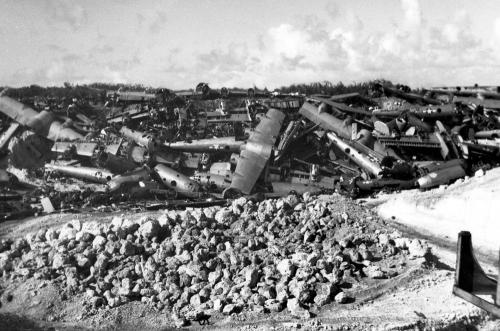
B-29 boneyard, Tinian
Historical facts will show that the B-29s were largely ineffective until the time LeMay unleashed the firebombing campaign on March 9, 1945. The first B-29s were deployed out of India and China in the summer of 1944. For the first missions, about 20% failed to reach their target due largely to mechanical trouble. Of the approximately 80% that made it to target, only a couple of bombs actually hit target. Therefore, ineffective results.
Their engines were also prone to overheating in flight. Criminy.
As for the firebombings/atomic bombings, it is my opinion Japan had already lost the Pacific War due to the ten summarized reasons above. Intelligence obtained by the US Army MIS Nisei’s like my dad’s predecessors support that conclusion. When the Nisei interrogated Japanese prisoners at the front lines, it was clear they were nearly without food, water, medical supplies or ammunition. Their morale was also devastated. For instance, Japanese soldiers that surrendered would say, “We were terrified. For every mortar round we would fire at the Marines, ten rounds would come back.” The Japanese needed to make every round count; the Americans didn’t.
Japanese soldiers – dead, wounded or captured – would have uncensored letters from home on their person. After the Nisei translated those letters on the battlefront, they disclosed that their families, too, were without much food or water…and that morale was extremely low.
____________________________
So some Greek dude said centuries ago that, “In war, truth is the first casualty.”
Pretty smart. But that applies even today – and certainly during World War II.
We were raised with certain textbooks for our history classes. We believed in them. We had no reason not to.
But the truth is, there are many versions of history. Factual versions. Incorrect versions. Factual versions “edited” by the victors. Factual versions written by the losers. And new versions. And versions to further patriotism.
But there is one thing for sure… Said by one of the most brilliant minds this world has known:
“I do not know with what weapons World War III will be fought, but World War IV will be fought with sticks and stones.”
Just two months after Old Man Jack passed away, so did the young boy who stood in the US Marine Corps Recruiting Station in Louisiana in 1942.
The man who told me funerals don’t do a damn for him anymore.
Mr. Johnson was gone.
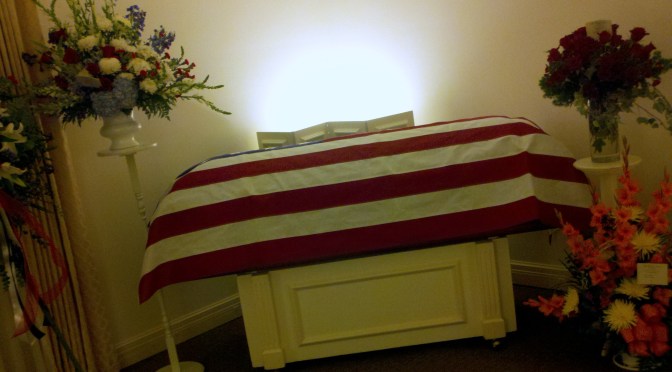
The cremated remains of Mr. Johnson
___________________________
The neighborhood was in shock. I had waved to Mr. Johnson just three days earlier while he and Marge gingerly got out of their car. I said in a louder than normal voice from across the street: “We’re still on for breakfast on Saturday, right Mr. Johnson?” We were to go have breakfast and chat about Old Man Jack – and perhaps learn more of Mr. Johnson. Instead, he died suddenly just three days later. Three days.
After 66-1/2 years of marriage, Marge was now a widow. A sudden illness took his last breath away when bombs could not 70 years earlier. He was 89 years old.
Marge surprised me when she asked if I would video Mr. Johnson’s funeral. I told her it would be my privilege. I was elated to be of some service to her.
___________________________
After Old Man Jack’s funeral, Mr. Johnson invited me over after I got home from work that night. That was when he volunteered that story about how “he got suckered into becoming a Marine”. Lovingly, of course. You could tell he had esprit de corps in his blood to that day. He was proud of not having BEEN a Marine, but of BEING a Marine. He had all the right to be.
He also talked about how he met Marge. What a wonderful story it was. I will try to capture the essence of what he told me.
_____________________________
By early 1944, Mr. Johnson (now a sergeant) had been taken off the front lines to recover from his grave wounds. He was “pretty messed up,” as he put it. Didn’t say much more. He was put in charge of the motor pool at Camp Pendleton during convalescence.
The base commander’s wife, a proper lady, he said, had come to the motor pool to get her car fixed up. Mr. Johnson said it was a beat up Chevy especially on the inside but it was better than most for those times.
After she commented on the car’s condition, Mr. Johnson said he’ll do his best to make it more presentable.
He had come to know an upholsterer in Oceanside so Mr. Johnson arranged for the interior to get tidied up some. He also had it painted. She was elated.
I wish I had jotted down the commander’s name. Darn.
_____________________________
Sometime towards the latter part of ’44, he said, there was some scuttlebutt about a big operation that was brewing.
But then, the base commander called Mr. Johnson into his office.
“Johnnie,” he said, looking through his file, “you’re pretty used up. I’m sending you to rehabilitation.”
So off he went. While Mr. Johnson used “a hospital out in San Bernardino” as a description, the hospital was likely somewhere near the mountains because he mentioned Lake Arrowhead.
As I write this, there is a good probability it was Naval Hospital, Norco, as it was officially called back then.
Naval Hospital, Corona
_____________________________
During rehabilitation, he ventured to a USO dance being held at the hospital. The USO was such a morale booster for these young men. Mr. Johnson was no exception.
There, against the wall, he said, was this pretty young thing. It was Marge. She was studying to become a nurse…which she did.
…and if I understood him correctly, they got married the day after he got discharged from the Corps in 1945. It sounded like if Marge just didn’t want a husband that would go off to war, let alone as a Marine. She got her way, of course:
Marge and Mr. Johnson on their wedding day in 1945.
Don’t you think they are a gorgeous couple? A gift of chance… and war.
(As a historical note, the “scuttlebutt” ended up to be… Iwo Jima. Part of the 3rd Marine Division, Mr. Johnson said that in a way, he was glad he didn’t go… Not that he DIDN’T want to go but because of what the Marines horribly found out after the first waves landed ashore. He learned from the Marines that made it back that all vehicles that went ashore in the first couple of days were sitting ducks for enemy artillery. This was made worse by all the volcanic ash being spewed up by the artillery rounds, just choking off the engines just minutes later because it would clog up the air filters. Some of boys were burned alive, he was told, after their vehicles got hit…in the same vehicles he was in charge of at Camp Pendleton.)
_____________________________
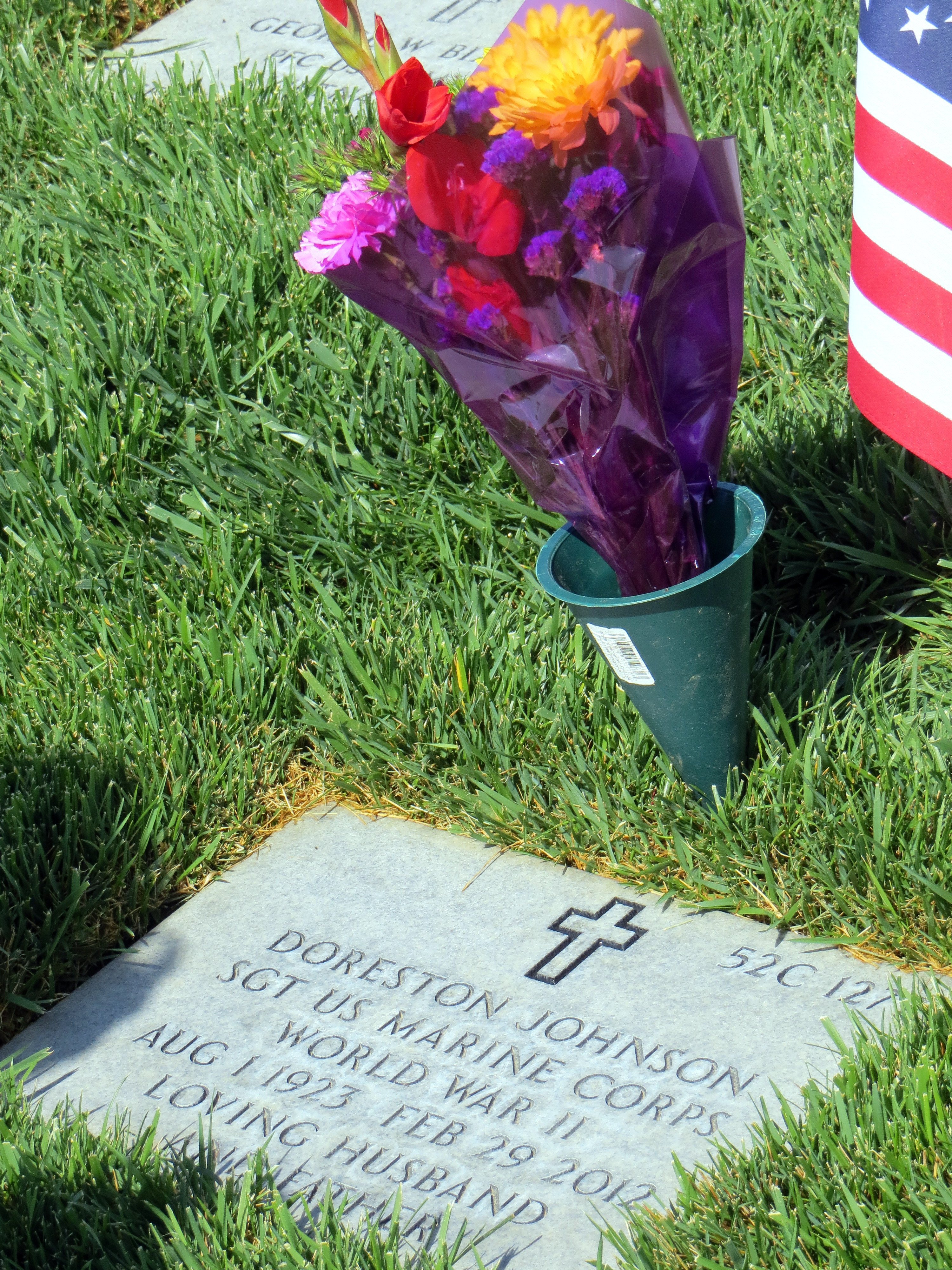
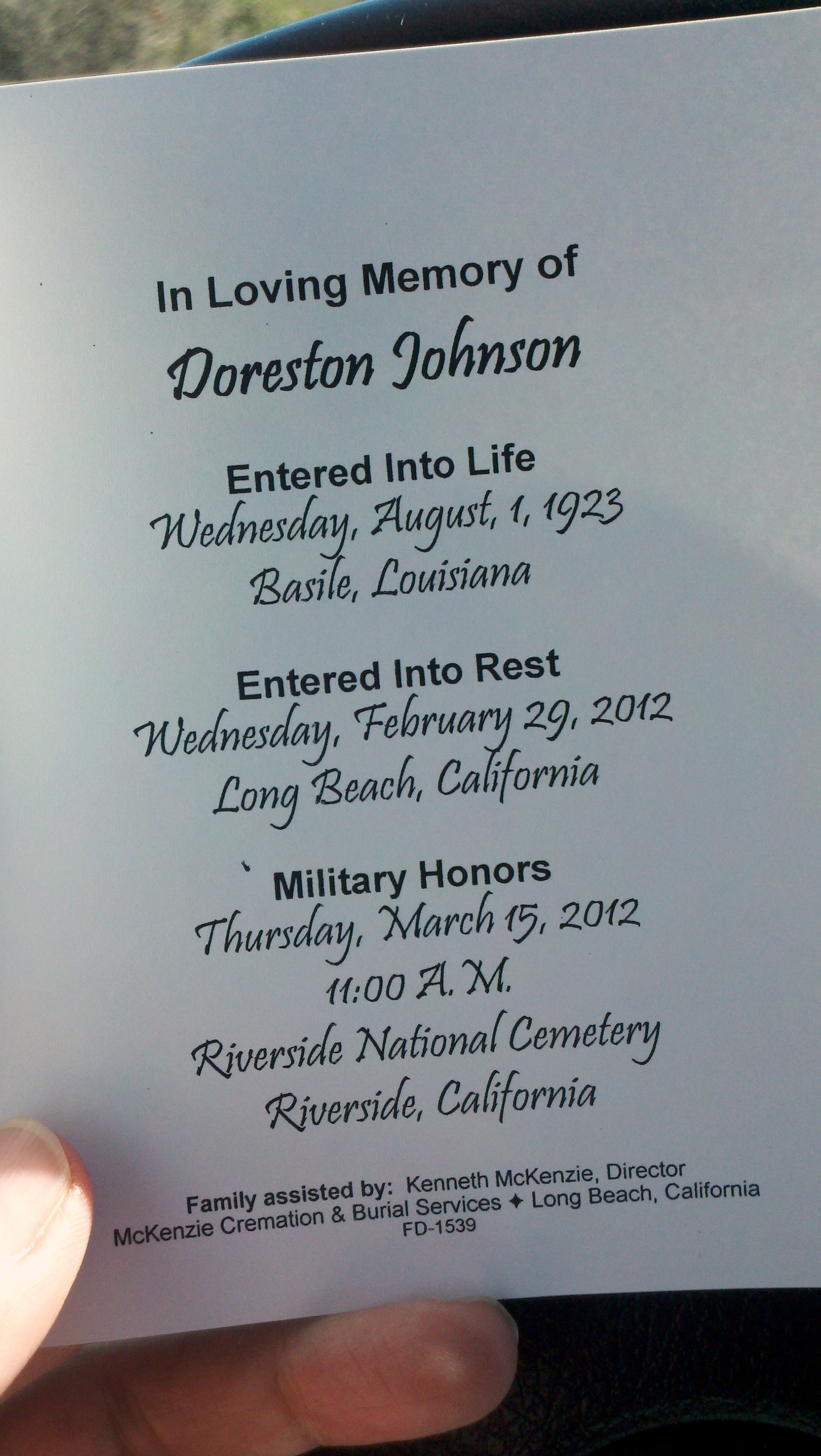
One reason why I was never able to find any military record on Mr. Johnson became obvious on his funeral day; that’s when I – and the other neighbors – found out his name wasn’t Johnnie, but Doreston.
“Doreston”
I was partially successful in videotaping Mr. Johnson’s funeral. It wasn’t as smooth as I wanted it to be for Marge’s sake. There was a bit of disorganization and miscommunication, too. Many of us following the hearse were just waiting in our cars wondering what to do next…when I saw the Marine burial detail getting ready to escort Mr. Johnson’s urn to a covered area. Time for a mad dash.
A couple of notes about the video below if you wish to watch…
I’m not much an editor but I managed to insert the “Marine’s Hymm” from my all-time Marine Corps classic, “Sands of Iwo Jima”. Gives me goose bumps every time. It starts a bit after the 1:00 mark.
There is some footage at the National Medal of Honor Memorial; Mr. Johnson would be interred just yards away. Sgt. Hartsock is my friend’s first husband who was posthumously bestowed the Medal of Honor. You will also see the names of some of the 22 Nisei’s who were also bestowed the Medal of Honor during WWII.
The bugler you see is a long-time friend of Mr. Johnson. I understand he is also in his 80’s and volunteers his services everyday. A very fitting and personal tribute.
This was also the first 21-gun salute I was ever able to have the honor to witness in person. I am glad it was for Mr. Johnson:
_______________________________
During this time, and now armed with his true first name, I was pretty determined to uncover some of his unspoken valor during the Solomon Islands Campaign and the Battle of Santa Cruz Islands…and I was partially successful.
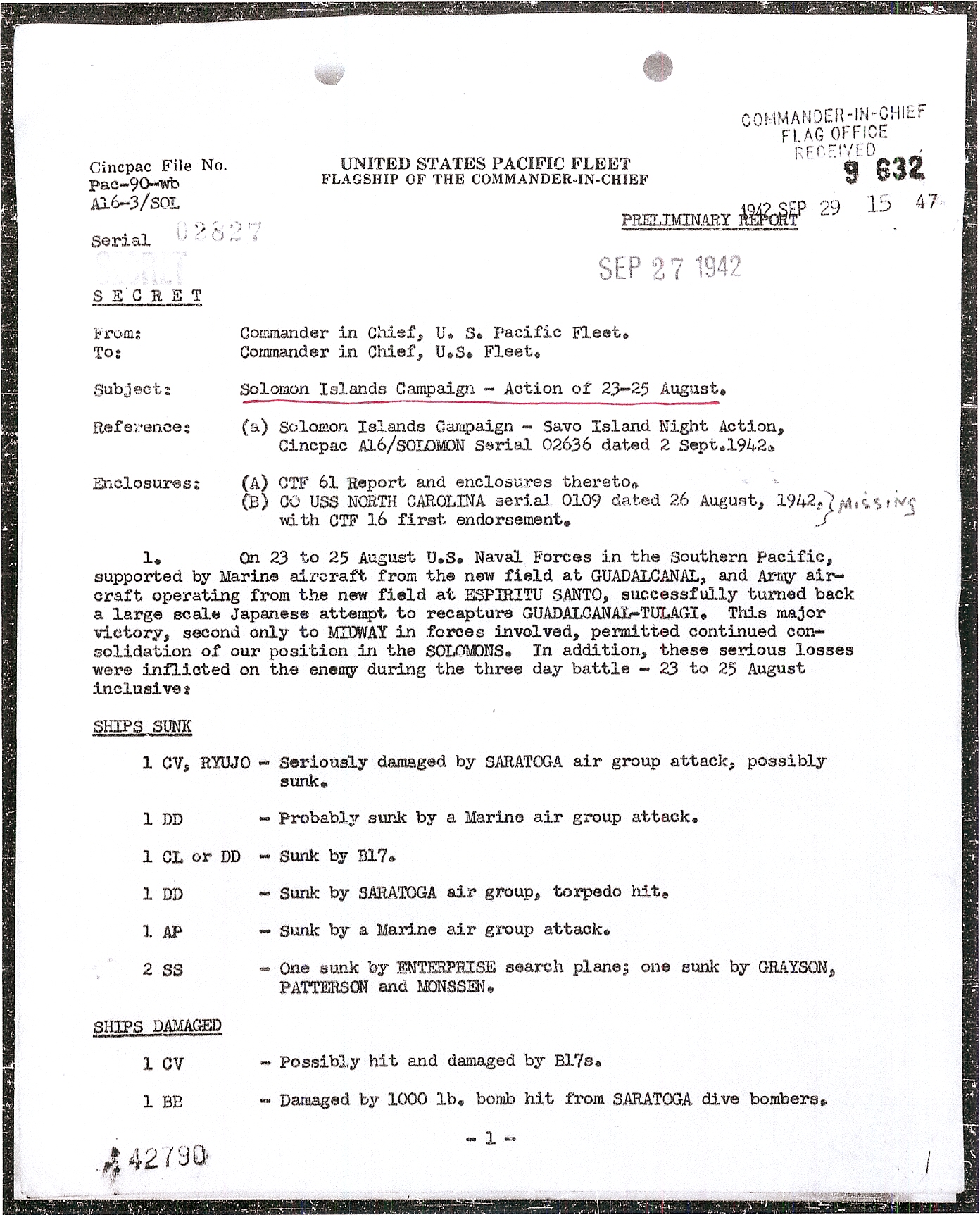
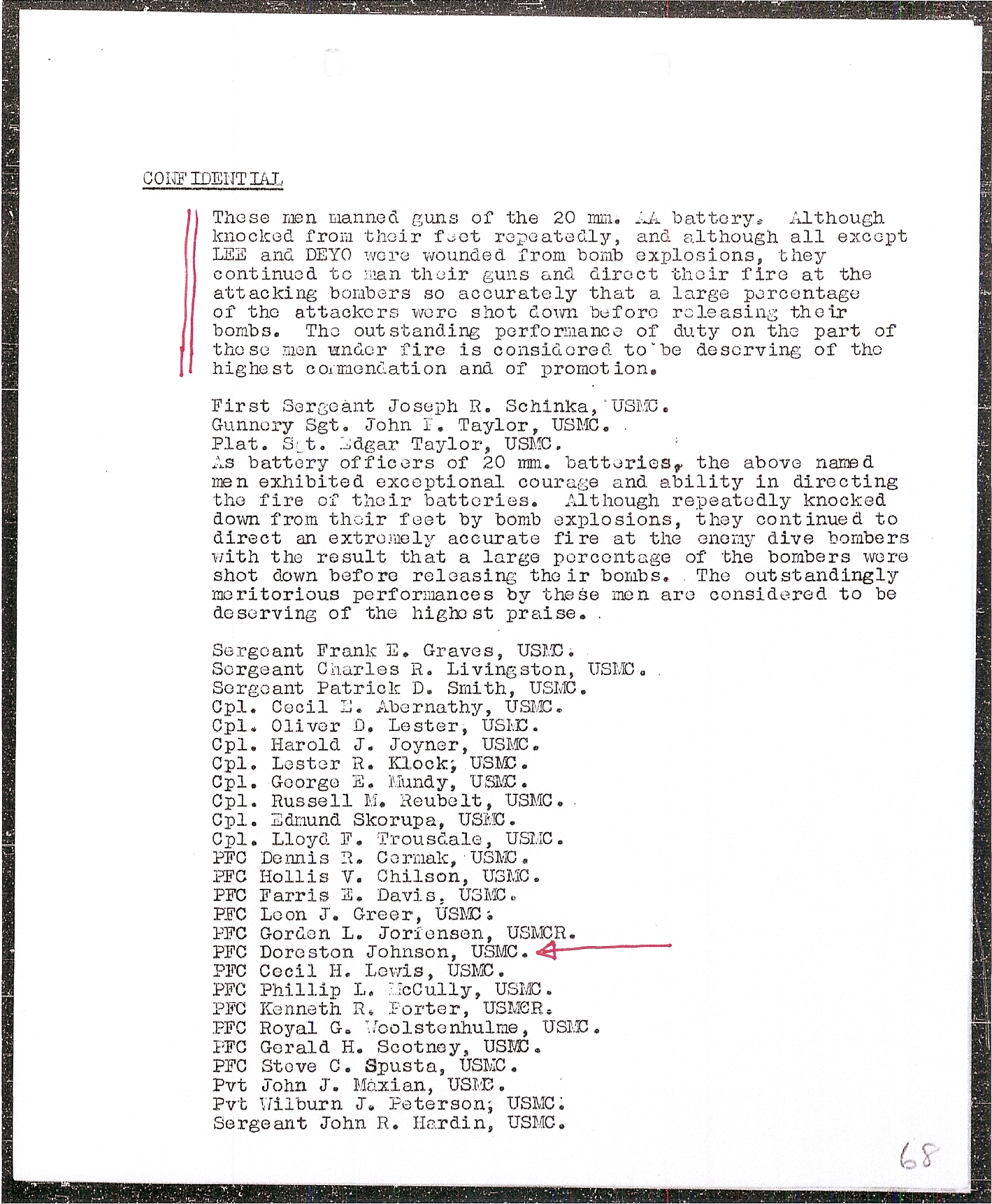
These are two pages from CINCPAC’s official, confidential after battle report. They were called “War Diaries” and are daily operational journals created by various naval commands throughout the Navy during WWII (The Marine Corps is an arm of the US Navy). I was only able to find this single battle report for the Solomon Islands Campaign:
War Diary, Cover PageSpecific page recognizing Mr. Johnson’s valor under fire.
I do NOT know for sure if Mr. Johnson fought on the islands but Old Man Jack never mentioned anything except him serving on the Big E…
_________________________________
As for Mr. Johnson’s wounds, Old Man Jack muttered once “Johnnie was hit twice. The last time was pretty bad.” He didn’t say more.
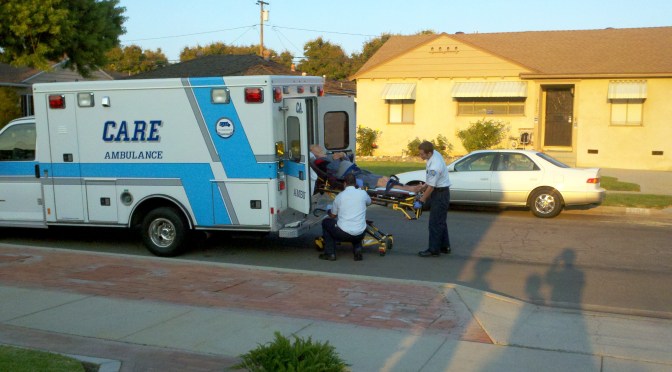
But Mr. Johnson collapsed at his house in 2011. Marge called me over to help while waiting for the ambulance. Mr. Johnson was on his side, left hand gripping the bed sheets and right arm pinned in under his body. He was too big for me to lift him off the floor by myself. So I yelled, “C’mon, Marine! Get your sorry ass off this floor!” Seriously. With that, he grunted, grabbed the bed sheets one more time, and together, we got his upper body onto his bed…
But in the process, I saw his chest.
His first fall in the house. Marge’s shadow is the one on the left. My little house can be seen beyond the ambulance’s cab. (Edit)
My god.
The scars.
______________________________
Tears of Remembrance and Closing
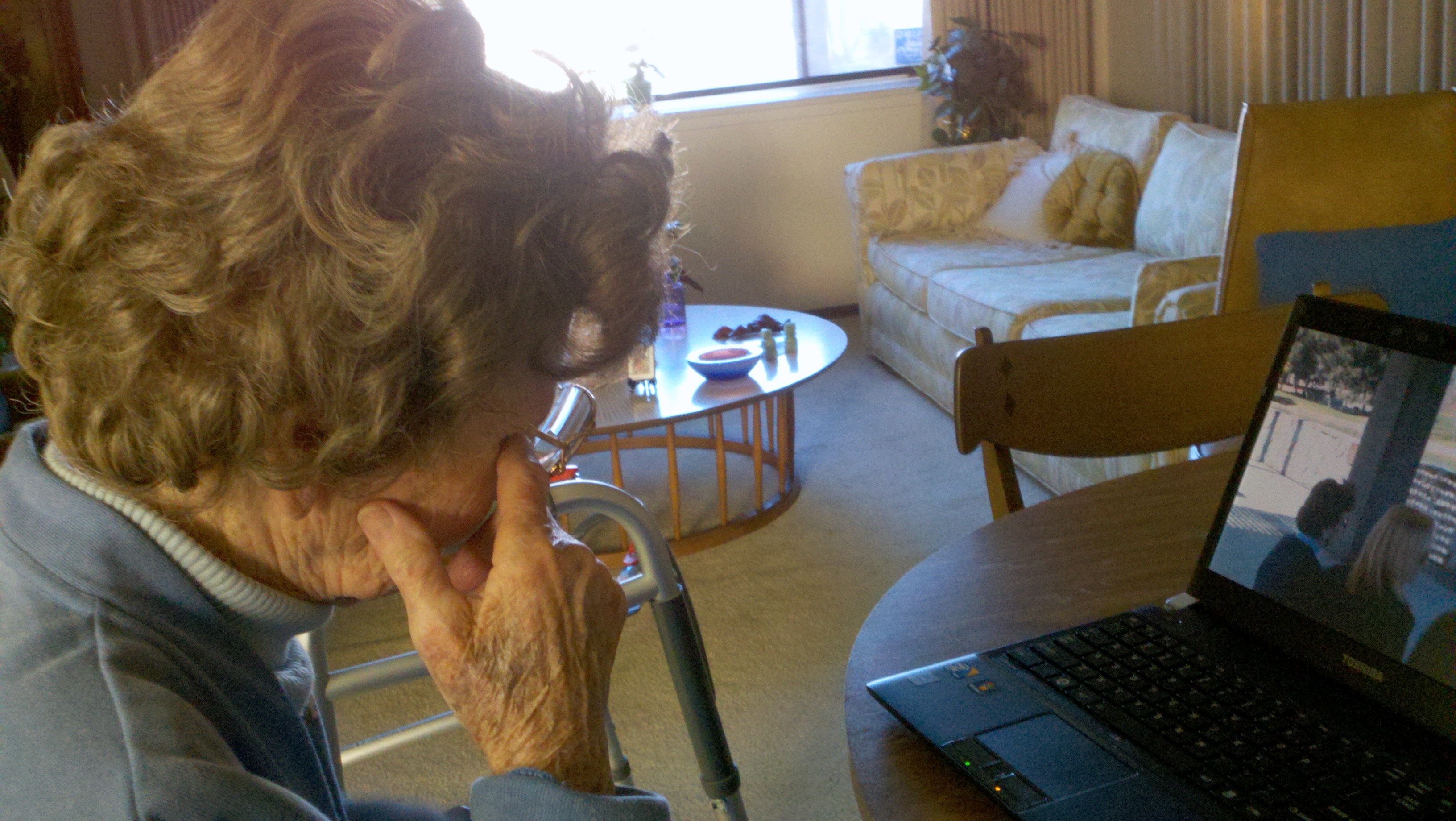
Two days after the funeral, I had finished putting the video together for Marge. We watched it together on my laptop as she didn’t have a DVD player that worked. Dry eyes had to take a back seat. She was so grateful.
But she called me at work a couple of days later. She asked if I could stop by after work again…and show her the video one more time. I was so surprised by her request…but so happy. She must have liked it.
When I played it for her – and when the “Marine’s Hymm” from the John Wayne iconic classic “Sands of Iwo Jima” began playing, her left hand began to rhythmically and softly beat to the theme song… ever so softly. Then her head bobbed along with the beat. That broke me.
Tears of Remembrance – Marge, now a widow after 66-1/2 years of marriage
She asked me again to explain the page from the Solomon Islands Battle Report which clearly states how he valiantly fought and incurred his wounds… Then when the 21-gun salute played on the screen, that was it… She broke down. I cannot imagine how large those floodgates may have been for her emotionally.
She thanked me immensely…
But it was so humbling as it was me who wanted to thank her and her husband… the same young boy in that Louisiana recruiting station who did what he had to do… and had enough humanity left in him to forgive.
I figured if Mr. Johnson wanted to tell me more, he would have.
But as with Old Man Jack, I never asked for more.
I believe that’s how these combat vets want it.
They don’t want to be quizzed about what they said or asked to describe more.
They will tell you some things of what they experienced. Probably to let the devils out that have been eating away at them for 70 years.
They have a built in limiter to keep more memories from popping back up…the things they saw or did that they try so hard to suppress to stay sane. Every minute for the rest of their lives.
They deserve that respect. Always. And you feel honored they felt enough confidence in your character that you would accept what they were telling you as is.
I feel they appreciated that.
___________________________
I was alone with Old Man Jack during visitation. It was good as I was able to say good-bye in private… The mortuary didn’t invest in good quality Kleenex, though.
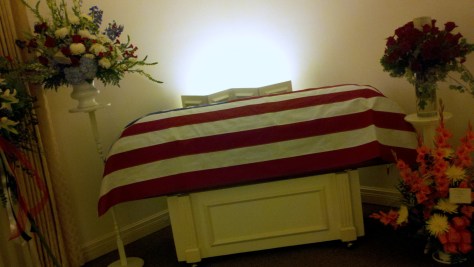
Mr. Johnson and I walked together into the little chapel where Old Man Jack’s funeral service was being held. His flag-draped coffin was proudly presented up front.
It was mostly relatives as all his friends had passed away before him. I felt distant as I don’t recall ever seeing them visiting with Old Man Jack. But they were relatives.
Mr. Johnson and I were likely the only ones there outside of family besides a daughter of one of his fellow employees from the old Northrop plant. We had met once when Old Man Jack was in ICU from a tremendously bad intestinal infection.
His only daughter Karen was busy going over things with the reverend. You will have to excuse me if I used the wrong term for him; it was a Christian service and I am not.
Mr. Johnson and I sat next to each other in the back row.
__________________________
Here is Old Man Jack on our tiny patio deck, in his trademark blue plaid shirt losing another “chat” with his only child, Karen. I’m sure – in spite of his boasts – he lost to his lovely wife in a similar fashion through the years… Hence, “A man ain’t got a chance.“
Karen finally approached us. It was good to see her again. I hadn’t seen her since she moved Old Man Jack up to their mountain home just five months earlier.
We greeted and it was already tough not to shed a tear. She then said, “Koji, we have enough young relatives here to be pallbearers but I know you and dad were close. I think he would like it very much if you would be one of his pallbearers.”
I looked at Mr. Johnson. I guess I was unknowingly seeking his acceptance knowing they both fought a bitter war together.
Mr. Johnson smiled and nodded his head as if he knew I was asking him if it would be OK.
It was emotional. My eye plumbing was already leaking a bit before but it broke loose.
After Old Man Jack fought on “those stinkin’ islands” and had nightmares for the remainder of his life, I was now going to help carry this great American on his last journey.
I kept the gloves in memory of Old Man Jack and the honor he allowed me.
It is a mark of the Greatest Generation. Forgiveness. Honor to the end.
_________________________
Just a short vid of the flag presentation to Jack’s daughter. (I apologize for the video quality but they only sell the video cameras with the little swing out screen now. It’s hard to get used to and hard to see the image in bright sun…and impossible to hold still…but towards the end, you can see Mr. Johnson sitting right behind her.)
I wondered what was going through Mr. Johnson’s mind after saying to me earlier “…funerals don’t do a damn thing for me anymore”.
He didn’t get teary-eyed once. A true Marine, I thought. I also briefly felt he had his mind on other pressing matters.
I was about to find out.
__________________________
After the ceremony, I helped Mr. Johnson back to my car. He hadn’t said much at all nor showed ANY emotion.
I opened the car door for him; it would be a struggle for him to get back into my low-slung machine with his bad back and unsteady legs.
But he stopped short of getting in. He towered over the roof of the car as he was standing on the curb next to other graves. I remember clearly his right arm was on the roof of the car and his left was seeking support from the top of the passenger door glass.
Then he spoke.
“Koji, I’m sorry I was so curt with you in the car…when I said funerals don’t do a damn for me anymore. I hope you’ll let me explain why.”
I didn’t know what was coming. He continued but he had that look on his face. The same glassed-over gaze Old Man Jack had when he was going to talk about something he was trying to forget.
“Koji, the Japs jumped us and they jumped us good. Real good. We were caught out in the open. We had fighter cover but there was just a shit load of them. Just too many. They were coming down at us from every which way.”
He mimicked with his right hand that he had elevated towards the sky toy planes – just like we did when we were kids. But these weren’t toys that day. He was reliving a battle…but he didn’t say where or when. Just like Old Man Jack.
“They just kept coming and coming. We took a bad licking. A real bad one. We just kept reloading and firing at them.
We lost a lot of good men.”
He stopped for a moment. He never once said he was on the Big E.
“I got put in charge of the Burial Detail. There weren’t too many of us left that could get around.” He was, I assume, talking about his fellow Marines. He was a Private at that time and at the Battle of Santa Cruz; you will find out later how I discovered that. But it’s not good when a young Marine private who was in boot camp just months earlier gets put in charge of a burial detail on board the greatest lady of the sea.
“I don’t know who the son-of-a-bitches were. They were wrapped up in canvas and a shell would be put inside at their feet to weight them down. Then we’d dump them over the side. We’d salute. Then we’d do it again…and again…and again. I don’t remember how many times I saluted. I didn’t keep count. But that’s why funerals don’t do much for me anymore. I had been in enough of them.”
__________________________
I was left humbled and voiceless. Too late I realized Mr. Johnson WAS having sickening thoughts running through his mind – from the time when I asked him to help hold ME together.
And I was ignorant to even think he had his mind on other pressing matters during the funeral.
With that selfish request, I instead helped unleash some vile memories within him.
__________________________
Mr. Johnson himself would pass away shortly thereafter.
More to come in Part IV. I hope you’ll stay tuned.
The carnage he was to experience would be absent even from the worst possible nightmare a nineteen year old boy can possibly have dreamed.
Violence no young boy of 19 should have to endure.
He would have two lives after he stepped into that Marine Corps recruiting station: one of reality during the day and of a nightmare he would never awaken from at night.
____________________________
I took them to breakfast for a belated 66th wedding anniversary and 88th birthdays. It’s softened as that’s how Marge wanted it. Seal Beach, CA. August 14, 2011.
I was not close to Mr. Johnson as I was to Old Man Jack; perhaps it was because for the first five years after I moved into this patriotic Naval neighborhood, he and his good wife Marge traveled about the US in their motorhome. They were gone for perhaps six to eight months out of the year. Man, did they enjoy seeing the US of A. After all, he fought for her.
He stayed indoors most of the time when at home while Marge would walkabout during the warm summer nights with her wine and chat with neighbors and me. She enjoyed her Chablis very much. Slowly, her legs would give way to age. Mr. Johnson’s, too.
____________________________
In the early part of 1942, Mr. Johnson found himself on a little boat out in the middle of the Pacific – the Big E.
The USS Enterprise.
CV-6.
She was one of only three operational carriers in the Pacific. The Enterprise, Hornet and Yorktown.
The Battle for Midway
He was on his way to the Battle of Midway (Mr. Johnson did not tell me that. Old Man Jack did.). June of 1942.
A tremendous gamble of scarce naval assets and young men by Admiral Nimitz.
PFC Doreston “Johnnie” Johnson manned her anti-aircraft batteries as a US Marine.
Thousands of young lives were lost during the most critical sea battle – on both sides. But the critical gamble paid off for the US. The Japanese Imperial Navy lost four carriers. They would never recover.
But we lost the Yorktown. A tremendous loss for the United States…but the tide of war changed.
The USS Yorktown on fire at the crucial Battle of Midway. She would later be sunk.
Miraculously, the Enterprise escaped damage.
And as far as I understand, so did the young boy from Basile, Louisiana, Mr. Johnson.
At least physically.
_________________________
Guadalcanal and the Solomon Islands Campaign
His next trial would be Guadalcanal and the Solomon Islands campaign.
It would be an insult to to all the brave men that were there if I were to even try and express in writing what brutal sea combat was like.
I was not there. But every young man there thought – every second – that there was a bomb coming at him. Constantly.
Like hearing shrapnel from near bomb misses ricocheting off the batteries – or striking flesh. The deafening, unending thundering of “whump-whump-whump” from AA batteries. The yelling. The sound of a mortally wounded enemy plane crashing into the water nearby with a likewise young pilot. The screams of wounded or dying boys.
This is taken from a naval summary: “After a month of rest and overhaul, Enterprise sailed on 15 July for the South Pacific where she joined TF 61 to support the amphibious landings in the Solomon Islands on 8 August. For the next 2 weeks, the carrier and her planes guarded seaborne communication lines southwest of the Solomons. On 24 August a strong Japanese force was sighted some 200 miles north of Guadalcanal and TF 61 sent planes to the attack. An enemy light carrier was sent to the bottom and the Japanese troops intended for Guadalcanal were forced back. Enterprise suffered most heavily of the United States ships, 3 direct hits and 4 near misses killed 74, wounded 95, and inflicted serious damage on the carrier. But well-trained damage control parties, and quick, hard work patched her up so that she was able to return to Hawaii under her own power.”
“Repaired at Pearl Harbor from 10 September to 16 October, Enterprise departed once more for the South Pacific where with Hornet, she formed TF 61. On 26 October, Enterprise scout planes located a Japanese carrier force and the Battle of the Santa Cruz Island was underway. Enterprise aircraft struck carriers, battleships, and cruisers during the struggle, while the “Big E” herself underwent intensive attack. Hit twice by bombs, Enterprise lost 44 killed and had 75 wounded. Despite serious damage, she continued in action and took on board a large number of planes from Hornet when that carrier had to be abandoned. Though the American losses of a carrier and a destroyer were more severe than the Japanese loss of one light cruiser, the battle gained priceless time to reinforce Guadalcanal against the next enemy onslaught.
Regardless of who is correct – and we’ll never know for obvious reasons – Enterprise gunners shot down more planes at Eastern Solomons in 15 minutes and at Santa Cruz in 25 minutes than did the vast majority of all battleships, carriers, cruisers and destroyers throughout the entire war.
She was the last operating carrier in the Pacific.”
For those of you who are unfamiliar with the violence of World War II, perhaps these photos will give you an idea.
Try – just try – to imagine you are on that ship… Nineteen years old. The Japanese planes are shooting at you and dropping bombs on you. Dead and wounded boys are everywhere. Fires are raging… The ship is listing…and through all this, you must continue to man your anti-aircraft guns… Protecting the ship and the lives of your fellow Americans.
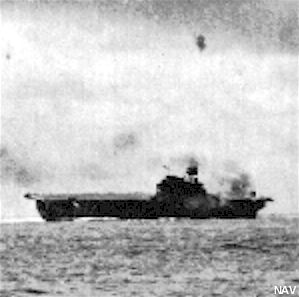
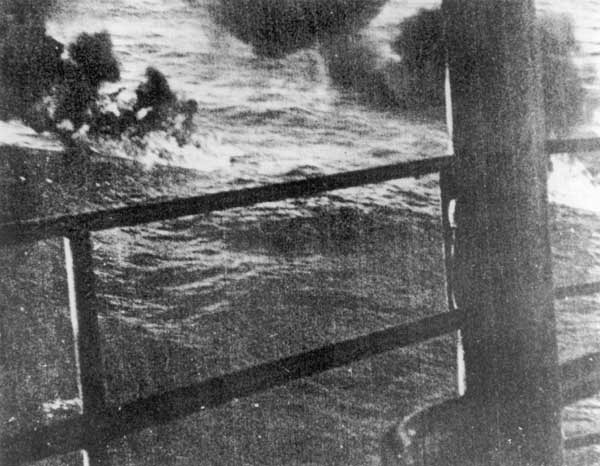
A Japanese bomb explodes on the USS EnterpriseOne of the direct bomb hits. All the young men in this area (Gun Group 3) were killed. Many could not be found.The USS Enterprise under attack. A near miss but men were killed or wounded by the shrapnel.The USS Enterprise on fire. August 24, 1942. Mr. Johnson was on her.A Val bomber on fire goes past the radar mast on the USS Enterprise. Perhaps one of Mr. Johnson’s rounds hit it.Damaged hull from one of the near misses.More hull damage from bomb shrapnel.The USS Enterprise listing from battle damage.Burning Japanese planes seen from the deck of the Enterprise. That’s how close they were. Up close and very personal. Aug. 24, 1942.Burial service at sea for 44 of the men after the battle at Santa Cruz. Oct 27 1942
Remember these young boys. I always will.
Mr. Johnson was one of them.
Mr. Johnson was one of those wounded.
Twice.
And I have proof of his valor and guts on board as a US Marine.





























 Masako and Spam Musubi