Tag Archives: Military Intelligence Service

A Mother’s Anguished Solitude – Part II


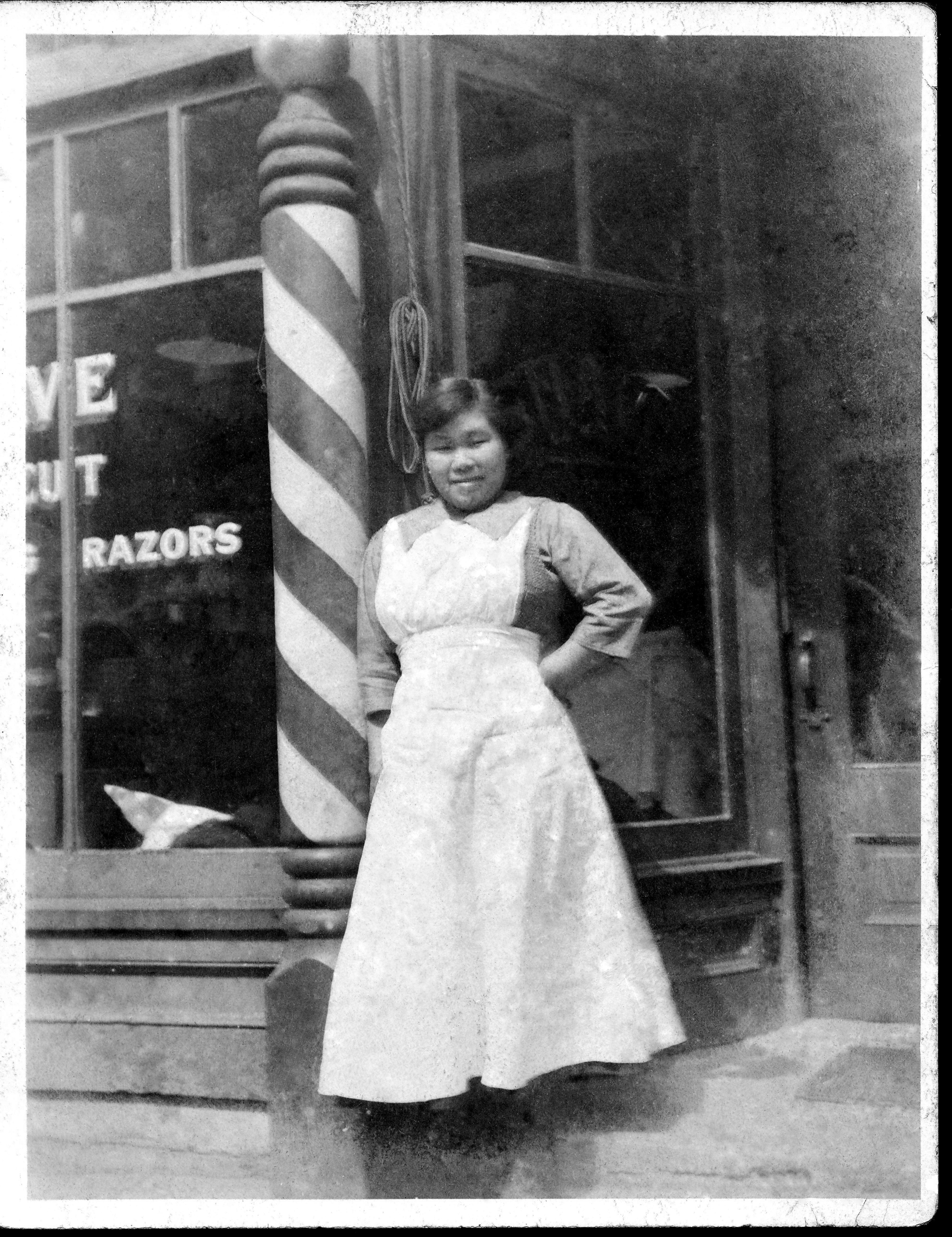
A young Grandmother Kono takes a modeling pose in front of her Seattle barbershop. She cannot possibly have foreseen what the future holds in store for her.

The most wicked risk of a mother’s love for a child is loss, and the price of loss is grief…  But the sheer passion of grief can become indescribable if a mother ponders on her decisions.

_________________________________

In Part I, we left when my father returned to Seattle to stay while leaving behind in Hiroshima his two youngest siblings and his parents.  This was 1937.  Before leaving, the family took this portrait with Grandmother Kono sitting on the sakura wood at the house.  Suetaro is standing next to her:
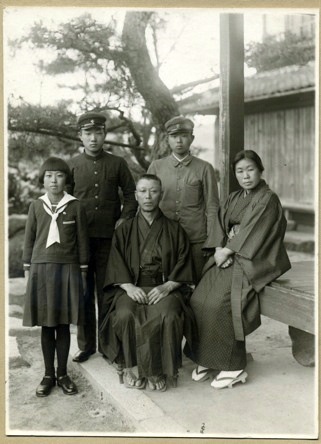
One of the last portraits of the three siblings and my grandparents. Grandmother Kono is sitting on the sakura wood written about in “Souls of Wood“. Circa 1937

My father says that their younger sister Mieko was ill often.  Indeed, she passed away in 1939 at just 15 years of age from an apparent kidney infection.  Since my father was already in Seattle by that time, only his youngest brother Suetaro was left along with my grandparents.  Most decisively, Grandmother decided Suetaro was not to return to Seattle when he turned 18.  In “Masako and Spam Musubi,” she was very concerned over the harassment and intimidation she had received due to the threat of war against Japan.  I also “feel” that Grandmother knew Grandfather was ill by the time she made the decision.

Sure enough, the very next year (1940), Grandfather Hisakichi passed away from stomach cancer.  He was 59 years old.  After raising Mieko for 15 years and marrying Hisakichi 31 years earlier in Seattle as a picture bride, only she and Suetaro were left in their home.  War with America would start the following year.  A war in which her three oldest surviving children called America home.
One family.  One war.  Two countries…  One mother.
_________________________________
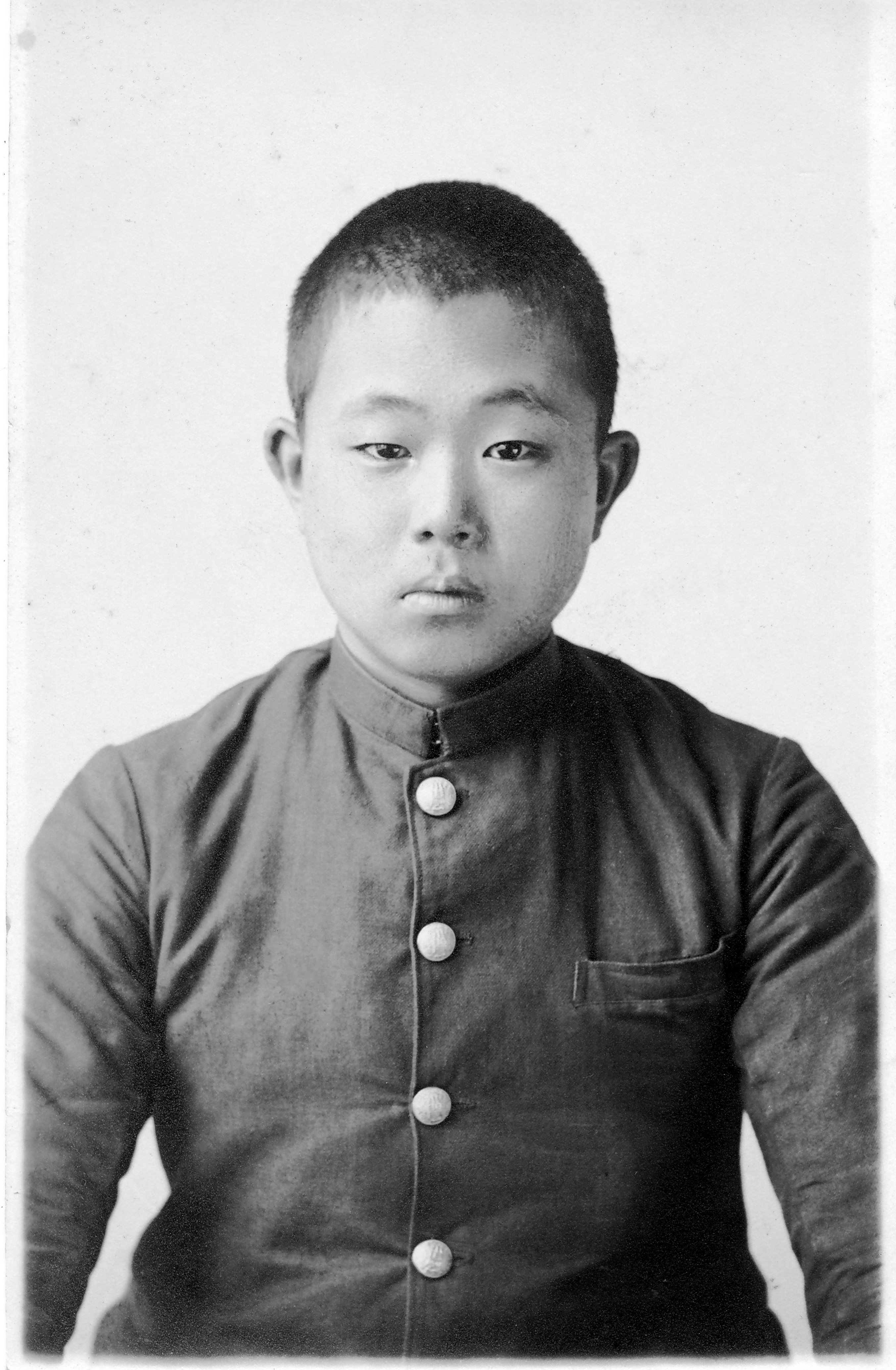
An undated school portrait of Suetaro. He looks to be about 14 years old.
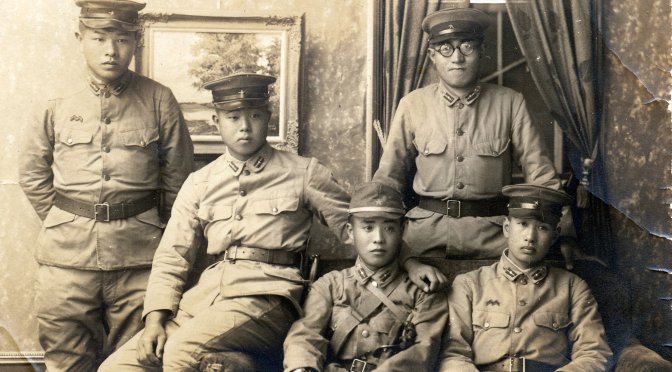
For reasons I have been unable to document, Suetaro became part of the Imperial Japanese Army.  All Dad will say now is being taken by the Imperial Army was “part of life” back then.  Below, he is sitting on the sofa’s arm to celebrate the young man in the center being sent to China’s Army HQs.
According to the handwritten date on the back, this photo of Suetaro below (on right manning a non-combat grade light machine gun made for training) was taken on May 10, 1939 at the “Hara Mura Training Grounds”:
Suetaro on the right. Dated May 10, 1939. I wonder what Grandmother Kono was feeling.
Here is Suetaro, perhaps in a posed photograph for PR purposes.  It is of professional quality and taken on the same day as above:
Likely a professionally taken photograph of Suetaro.  It was also taken on May 10, 1939 in Hara Mura.

I have a strong belief this was taken at the Fukuyama training grounds for his regiment, the 41st Infantry Regiment (unverified):

A proud looking Suetaro in his full Army uniform. I cannot tell if the handle on his katana, or “samurai sword”, is wrapped in silk or machine stamped. All military issued swords were numbered, by the way.

Another piece of his elusive history then emerged – but it was not from the 100 year old woodshed.

____________________________
Readers know that my Uncle Suetaro was killed in action as a Japanese soldier on Leyte.  His regiment – the 41st Infantry Regiment – was annihilated by the US Army on Leyte.  My Grandmother Kono was told he perished on July 15, 1945 – just a month before Japan surrendered.  My father’s secret US Army unit, the Military Intelligence Service (MIS), had a direct hand in the high number of Japanese casualties – and the low number of American casualties.  In other words, the MIS likely had a direct hand in the annihilation of Suetaro’s regiment.  The MIS was comprised of Americans…of Japanese descent.
Dad as part of the MIS in post-war Japan.
It is not known if Grandmother knew of this fact.  It would have been an overwhelming of her heart.
____________________________________

However, this is not a story on Suetaro’s life but about his life with his mother.  In “Masako and Spam Musubi”, we know she had her second stroke after being informed by the remnants of the Japanese military of her beloved Suetaro’s death.  The last Kanemoto in the family home was now… herself.

During my trip to the family home in September, my cousin Masako, her younger brother Kiyoshi, her son Toshiro along with my son were looking at vintage photos Toshiro uncovered just a couple weeks prior in the shed.  A number were of Suetaro with my father and Grandmother.  We were all quite emotional by then.  Masako removed herself from the table; I assumed she was overcome.  I didn’t stop her from quietly leaving thinking that.

Instead, she came back a few minutes later with something in her hand.  It was a small notebook.  Aged and frayed at the bindings.  Her eyes were red.

It was Suetaro’s war diary.  We were simply stunned.  Masako had it secreted away.  For decades.  She chose to bring it out now.  For closure.  It was the right time.
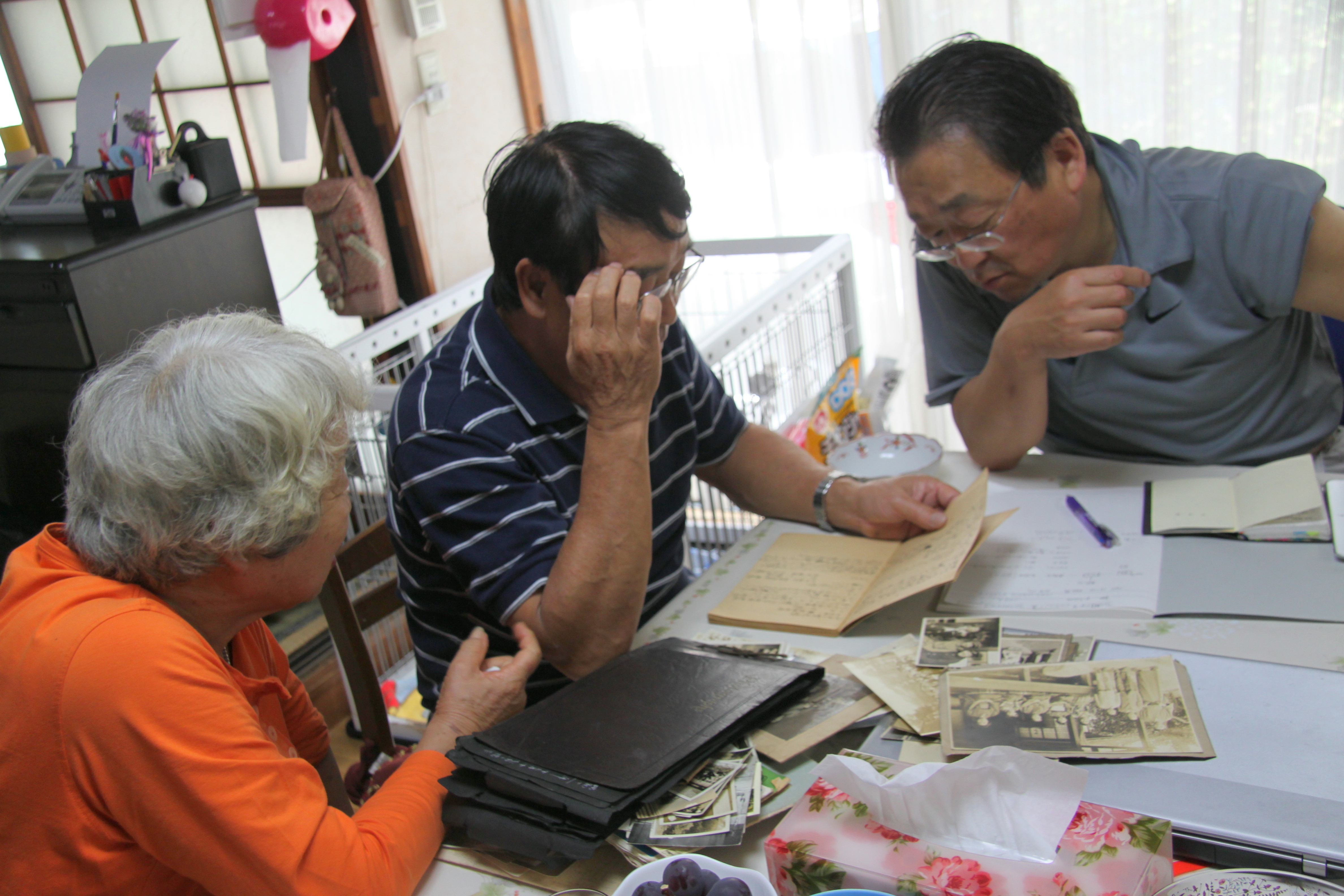
Masako shocked all of us when she brought out Suetaro’s Army diary.  (L to R) Masako, Kiyoshi and Toshiro, her son.  The Kleenex box is there for my use.

It took us a few moments to realize what she had brought.  It was brittle and smelled of old books.  The paperstock was of low quality – more like newspaper stock – as paper was in very limited supply during the war years.  We handled it as gently as possible.

The first few pages were of what he did during a short period of time; Suetaro’s writing was neat and in black ink.

Then the handwriting changed.  Suddenly.  It was hurried.  Rushed.  And in pencil.

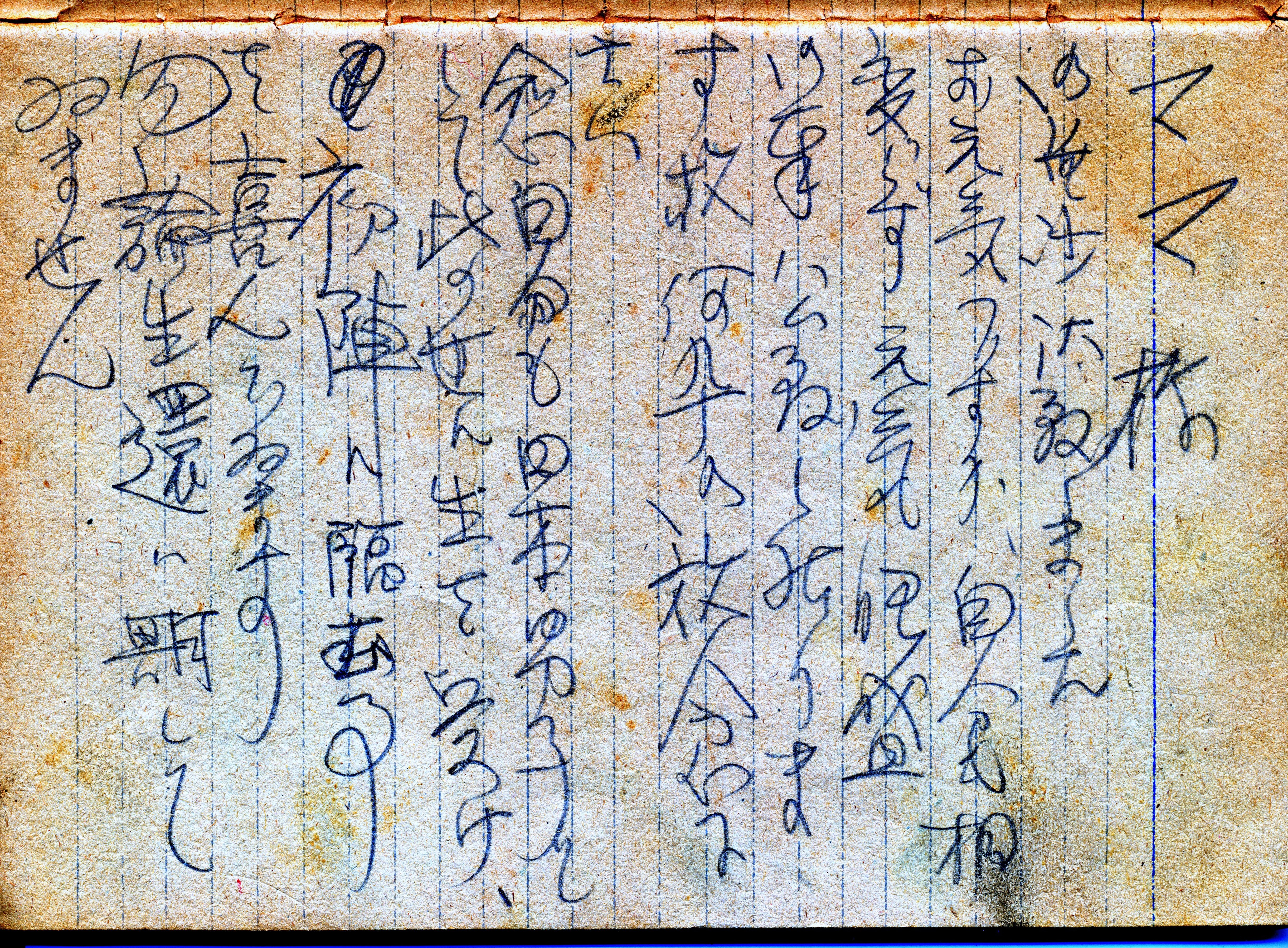
It was his farewell letter to his mother.  My dad’s mother.  My grandmother.  It was dated March 3, 1944.
Kiyoshi is holding Suetaro’s farewell letter. It starts with “Dearest Mama” on the right.
Kiyoshi tried to read it; it was difficult as it not only was in his hurried cursive but in pre-MacArthur Japanese.  Many characters are simply not used any more.  Unused since 1945.  Only a few people can read it – like my father.  Suetaro’s brother.  But we managed to read critical passages.  I will include two pages as reference.  However, these are very literal translations of a few sentences but needs be read in its entire context considering the environment was when he wrote this.  It is easy to misunderstand or misconstrue his heart and soul at that moment.
Towards the left, it states, “初陣に臨むことを喜んでいます. 勿論, 生還を期してはいません”, or literally, “I am glad to be going to war and facing my first combat. Of course, I do not expect to be coming back.”
He writes, “今の時局は日本が起つか亡びるかの境です。どうしてもやり抜かねばいけないのです。兄さん達を救い出すことも夢見てます,” or “At this time, Japan is at the point of either winning or perishing. We must persevere as I still dream that we will free our older brothers.”

I stress this abbreviated presentation can be misunderstood.  My interpretation is, “I willingly go to war for Japan as we are on the brink of winning or losing.  By winning, Japan will free my older brothers from the concentration camps in the US.”

He will fight – and die – so that Japan will win.  If Japan wins, they would take over the United States and by doing so, free my Dad and his older brother Yutaka from the concentration camp.  At the time of his writing, both were imprisoned at the camp in Minidoka, Idaho after being relocated from Tule Lake, CA.  (His nephew, Bobby, had already perished in Minidoka at the young age of six.)  His older sister, my Aunt Shiz who passed away last month, was imprisoned at Manzanar.

Man, my eyes welled up.  Everybody was in shock…even Masako once again.

_______________________________

I am unable to comprehend how my Grandmother must have felt reading that letter in 1944.  Suetaro had secreted it away in the “butsudan”, or family altar.  She had decided Suetaro was not to return to Seattle to join his elder siblings.  Now, having read this letter, her regret must have been immense.  Grief.  She lost a piece of herself.  A beloved piece.

Mieko had passed away.  So did her husband in 1940.  Now her youngest son writes he does not expect to return.

Could she have foreseen this fate while she happily stood in front of her Seattle barbershop near King St. and Maynard in Seattle in the 1910’s?  I doubt it.

She would be alone.  To ponder.  To possibly regret to her last day.

A mother’s anguished solitude.

It is dated April 9th on the back with no year indicated. However, as my father took it when he was in the MIS, I will assume it is around 1948. Her face is worn.

Souls of Wood


They walked on it.  They posed for family portraits on it.  They passed away on it.  It felt as if their souls were infused in it.

Although my ancestors have come and gone through that house for about a hundred years, the old sakura wood shared their souls with me.

______________________________________

Then:

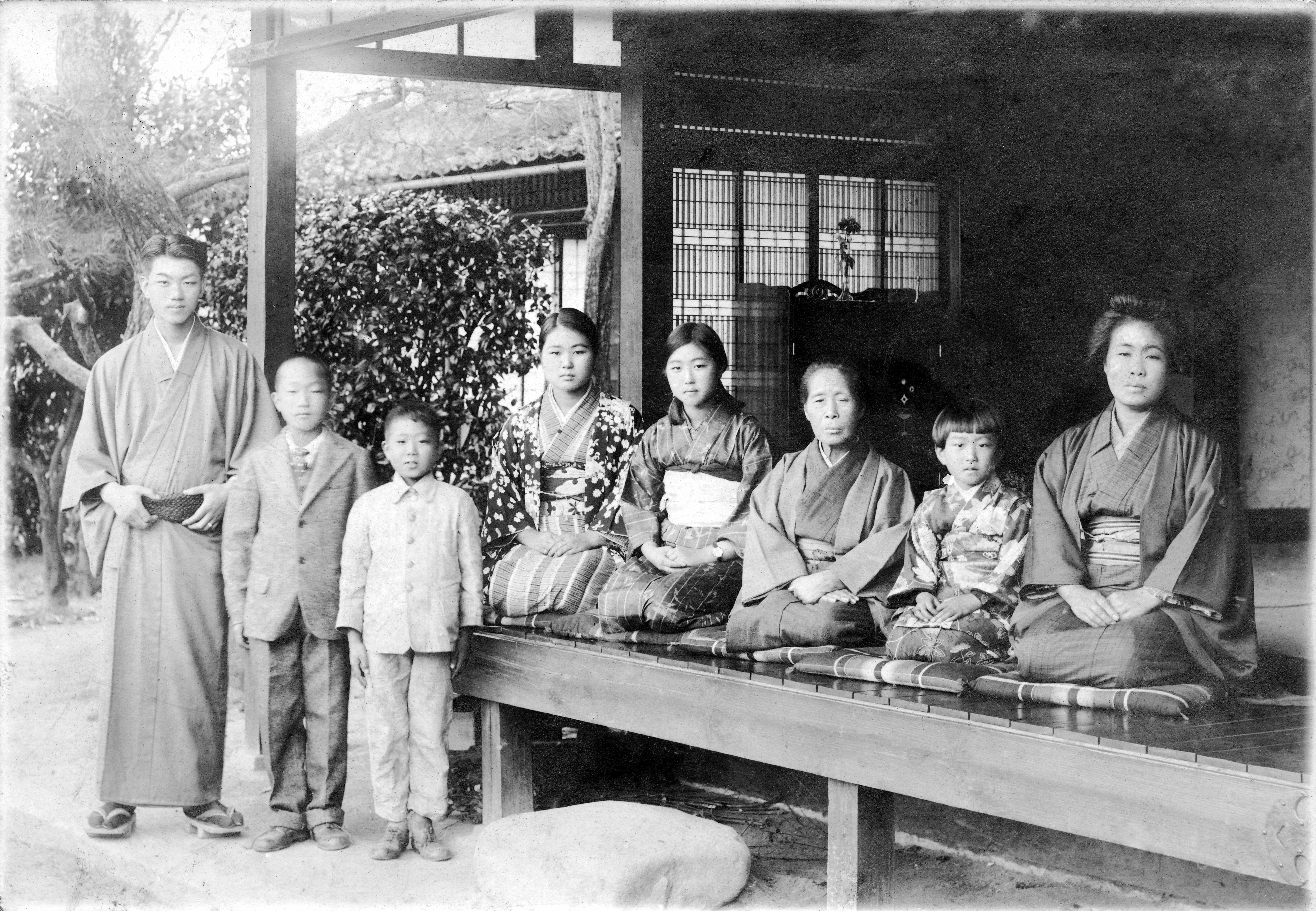
The Kanemoto’s sat on the cherry wood walkway for a portrait. Notice the glass paneling at the center-rear.  My father (second from left) is sadly all who remains from that generation. Circa 1928, Hiroshima, Japan.

Now:

Although aged and weathered, the sakura (Japanese cherry) wood upon which my ancestors sat upon for family portraits is unchanged. Even the glass paneling in the background is the same.

____________________________

While I am certainly not in the construction industry, my father’s family home is based on the Edo design era.  Generally speaking, they are built on stone foundations, with supporting square timbers and a raised floor.  “Tatami” mats were used for flooring.

My father, while now 93 and suffering from dementia, fondly recalled the floor plan of the Kanemoto house…especially of the main room seen the family portrait.  He said it had a “tokonoma”, or a small alcove alongside the altar, or “butsudan”.  He also clearly recalled the floor space measured by the number of tatami mats used; in this case, “hachijyou” or eight mats.

This is the room in which my cousin Masako “saw” Aunt Shiz a few days before she passed away.

____________________________

The house was indeed damaged from the atomic bomb’s shock wave.  This same shock wave shook the Enola Gay violently even while trying to escape the blast at about 30,000 feet altitude.  She was 11-1/2 miles away.

The house is about 4-1/2 miles away by way the crow flies.  Almost due west of the hypocenter.  Masako was knocked down by the hard-hitting shock wave while in her classroom.

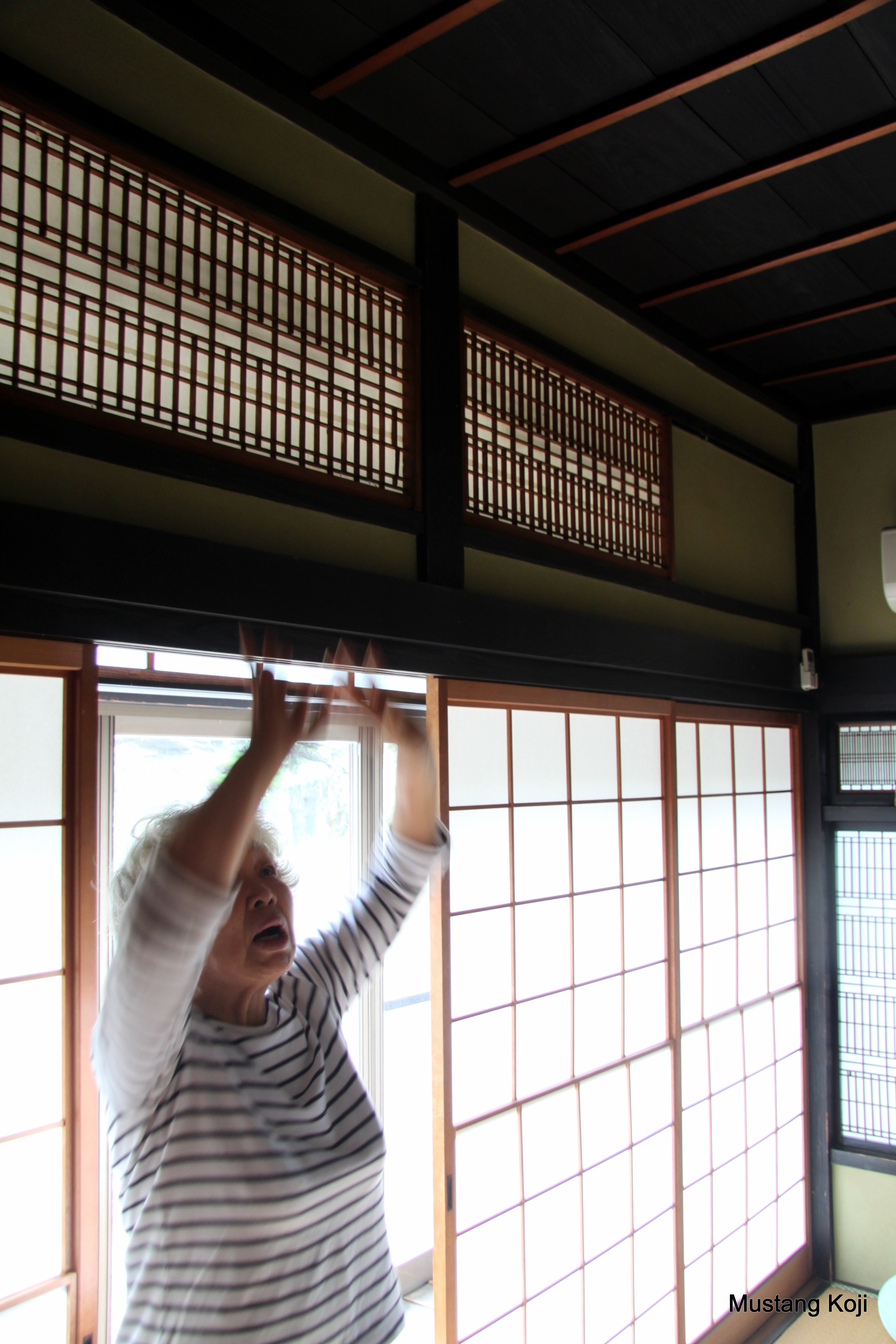
A low lying hill called Mt. Suzugamine served somewhat as a barrier, deflecting the shock wave.  Still, nearly all of the sliding door panels were knocked down and the ceiling was sucked up more than a foot per Masako.  Roof tiling was also blown away from the force.

Masako is trying to show how the atomic bomb’s shock wave lifted the ceiling up over a foot. It is repaired now but was left as-is for decades.
Masako in the process of trying to show how far the ceiling was lifted by the blast on August 6, 1945.

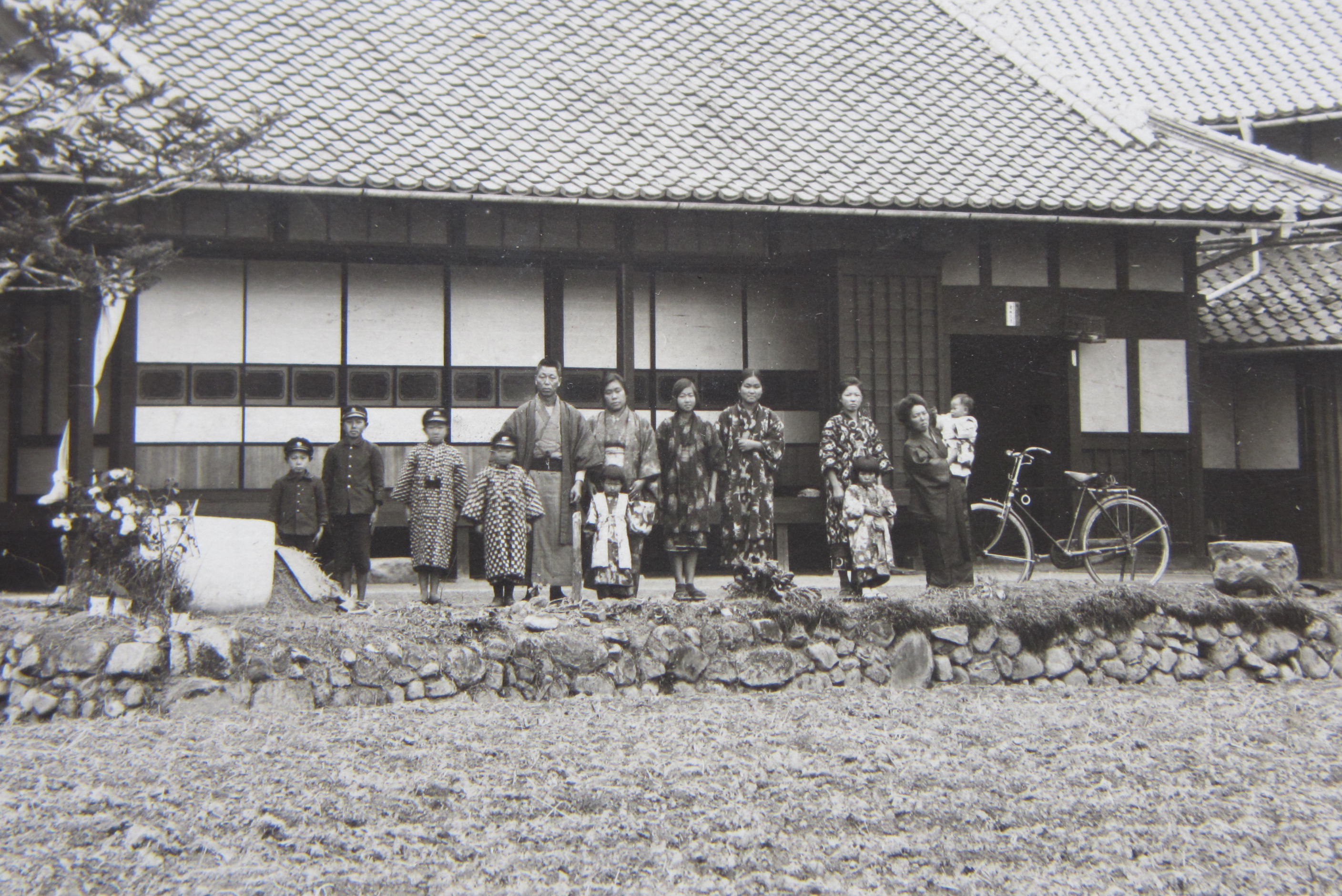
My Uncle Suetaro took one of his last photos in front of this house in May 1944.  My grandmother already had her stroke and is not in this photo but his sister, Michie, is standing to his right.

One of the family treasures found during our journey to the family home in Hiroshima this month. Uncle Suetaro is going to war and his death.

Grandmother Kono’s funeral in 1954; my father can be seen in the lighter suit to the left standing next to Michie and Masako (hidden by the flowers):

Grandmother Kono’s funeral at the house.  1954

The home does have spirits within.  It’s not cornball.  It is an incredible sensation.  We were called to those souls in the wood this month.  Seriously.

________________________________________

When I saw my son in front of the home, I saw that I’m in the last half of my journey in life… but I came back to myself on that old sakura wood.

Early family picture in front of the house.  The entry is on the right.
My son Takeshi standing next to the Kanemoto name in front of the house just this month.  The entry can be seen behind him.

A 1937 Yearbook, the Atomic Bomb and Hiroshima


(Please see An Atomic Spark and a 1937 Yearbook and Dad Was in the Newspaper for background information.)

There is living proof of forgiveness from a few – and they let out a resounding message of world peace for us.

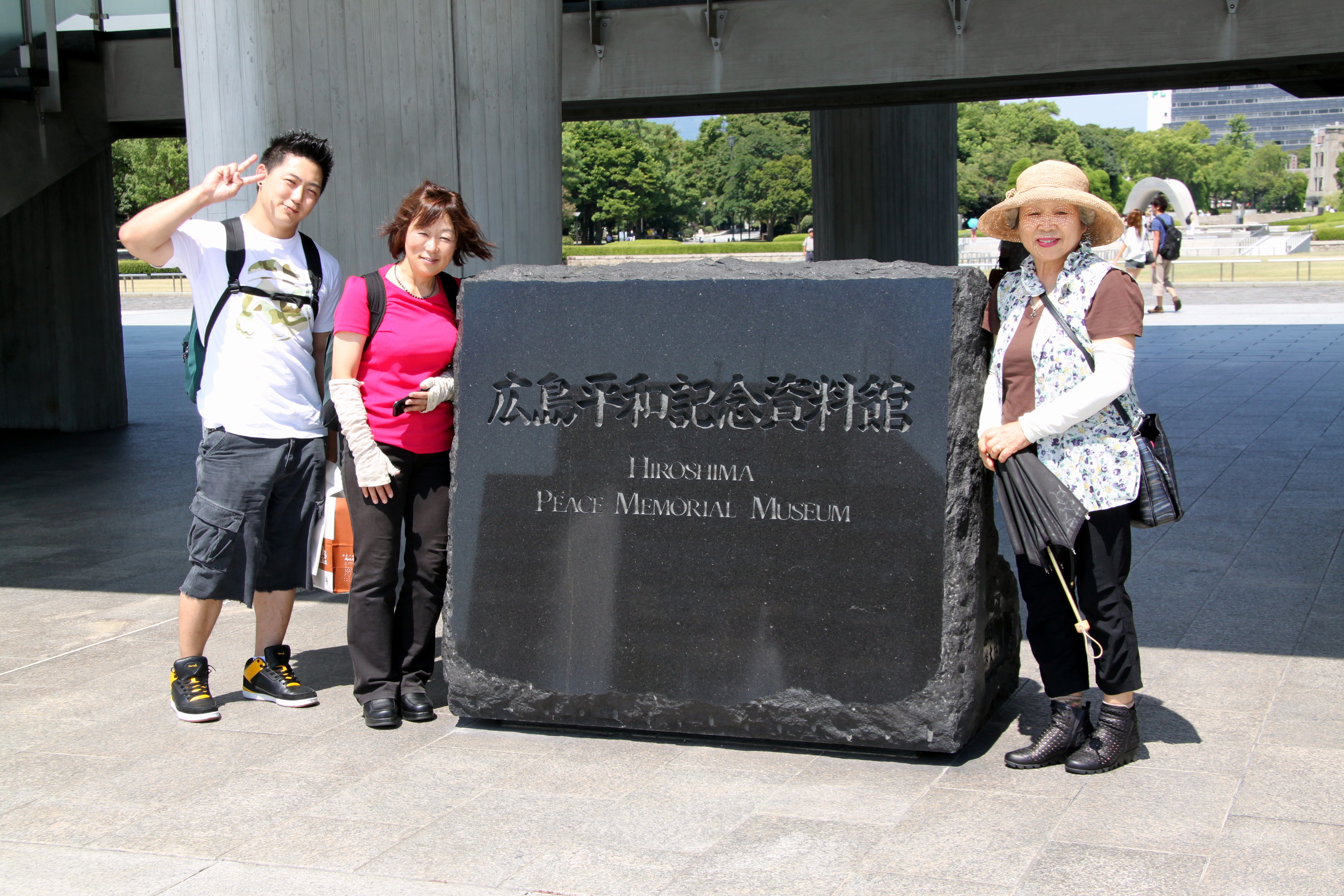
My son Takeshi, second cousin Izumi and my cousin Masako at the Hiroshima Peace Memorial Museum.

_______________________

It was an extreme emotional experience – not just for my oldest son Takeshi and I but for the kind souls who joyfully spent their afternoons with us on a hot September day in Hiroshima.  I was able to finally meet – and thank – the people who were kind enough to seek out my father’s 1937 high school yearbook and thereby give my father a joyous remembrance of his most happiest days of youth in the sunset of his long life.

_______________________

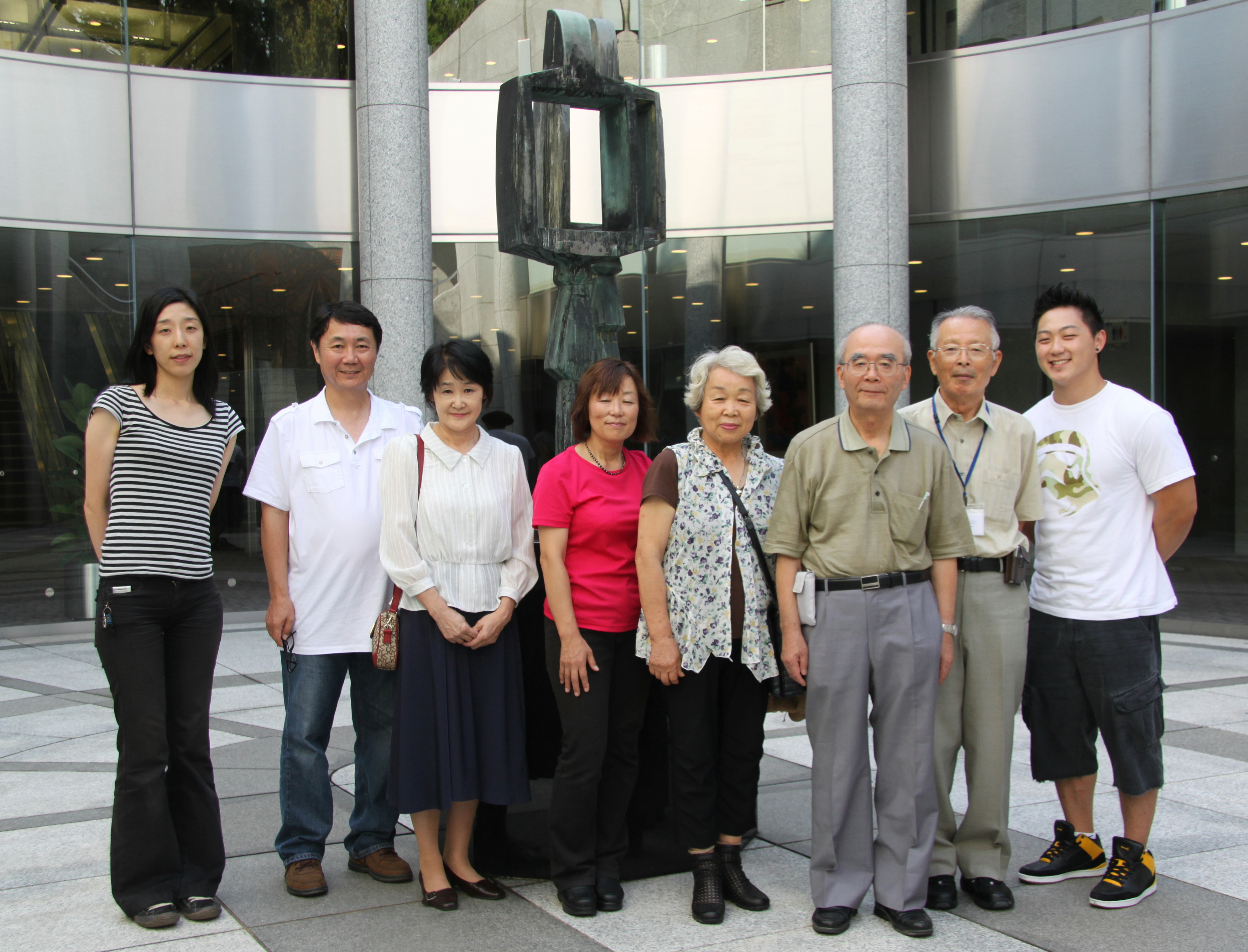
Not being a writer, putting this experience into words is an endeavor.  But on September 6, 2012, we were able to meet in person Mr. Tsukamoto, Ms. Kanetou, Ms. Tanaka and Mr. Aramaki.

From left: Ms. Tanaka of the Hiroshima Chugoku Shimbun newspaper, myself, Ms. Kanetou who tracked down my dad’s 1937 yearbook, my cousins Izumi and Masako, Mr. Tsukamoto who first answered my blind email and set things into motion, Mr. Aramaki our guide and my son Takeshi. Messrs. Tsukamoto and Aramaki are survivors of the atomic bombing.

__________________________

Any guided tour is exceptional.  A personally guided tour of a peace memorial and museum of a man-made event of unparalleled violence cannot be surpassed. Both gentlemen were severely burned as young children.  With all doctors killed in the city, they had to resort to mashed yam salve to soothe their wounds. (To see a VERY well written piece on their atomic experiences translated into English, please feel free to read it here.)  Imagine doing that yourself as a youngster.

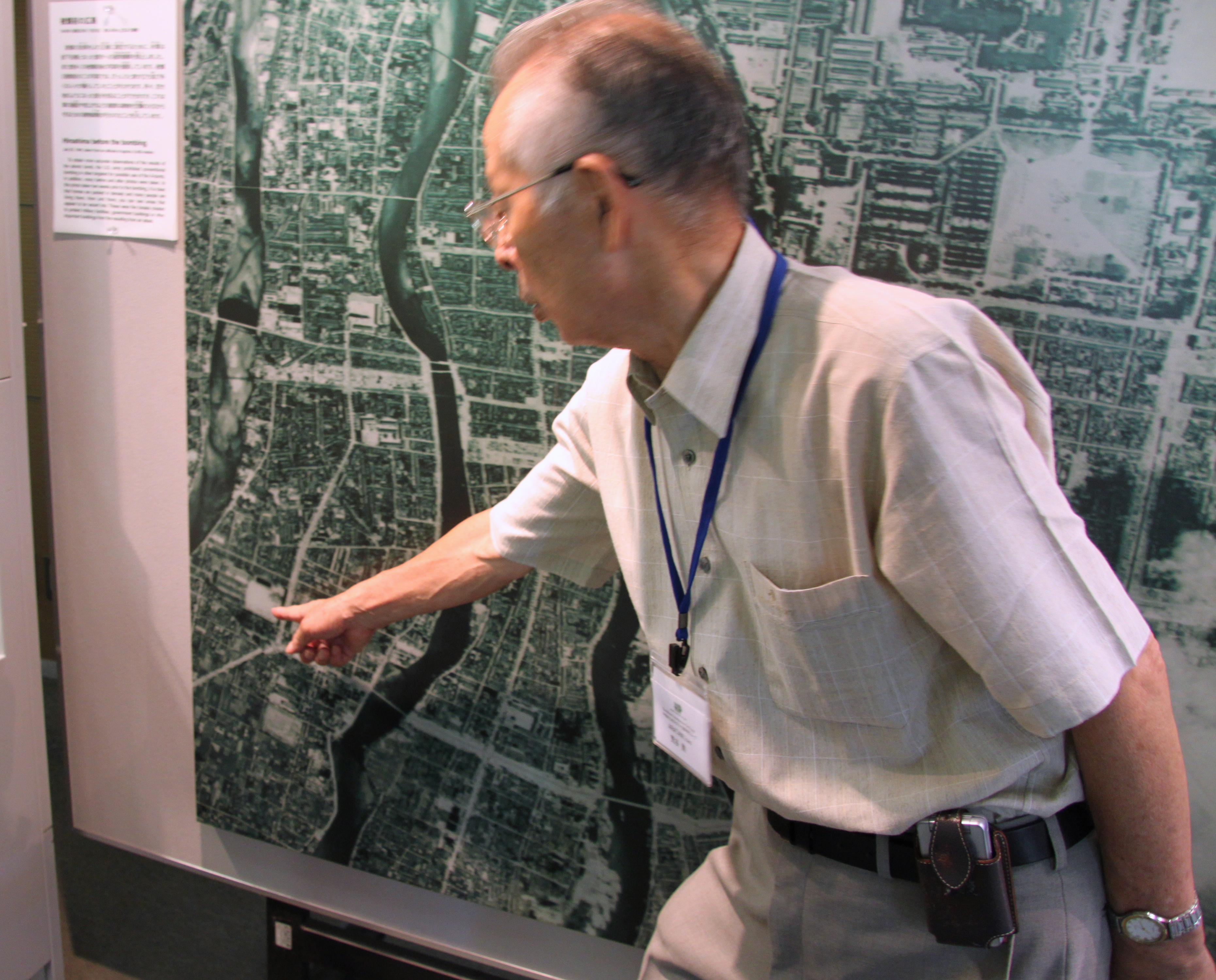
They first pointed out where my father’s beloved high school, Nichuu, was situated in relation to the hypocenter.  It is one thing to see it on your monitor.  It is another thing to see it on a large wall map.  Overwhelming.  I knew it was close but it was not much further than one of my father’s triple jumps in Track and Field.  It ceased to exist – as did over 320 of their young classmates.

Mr. Aratani points to the now vacant square lot that was once his school – and my father’s.

By destiny, both men – young children at that time being forced into laboring for Japan’s war effort – were saved by the decision of their instructor, Mr. Sekimoto.  Mr. Sekimoto decided it would be best for small group of them (which included another one of my relatives) to clear a large parade ground to the southeast (東練兵場) for the next crop of sweet potatoes.  The other classmates were sent to work on building a firebreak near Nichu – which sealed their fate.  They were erased from the face of this earth in a second.

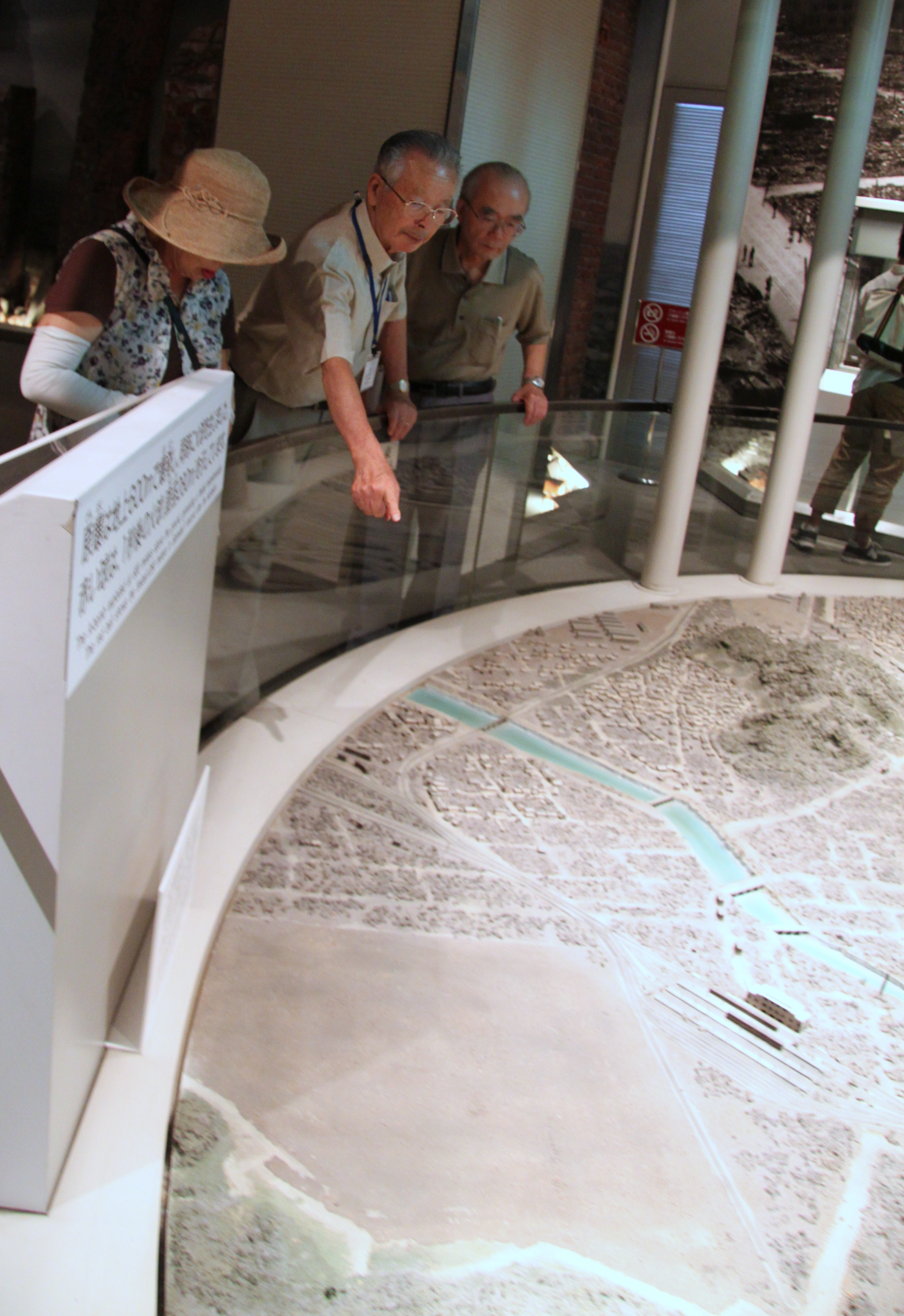
Mr. Aratani and Mr. Tsukamoto point out the Eastern Parade Ground to my cousin Masako where they were to pull weeds that fateful morning. I subsequently learned another relative of mine, Hitoshi Kubo, was also with them. His burns were more severe.

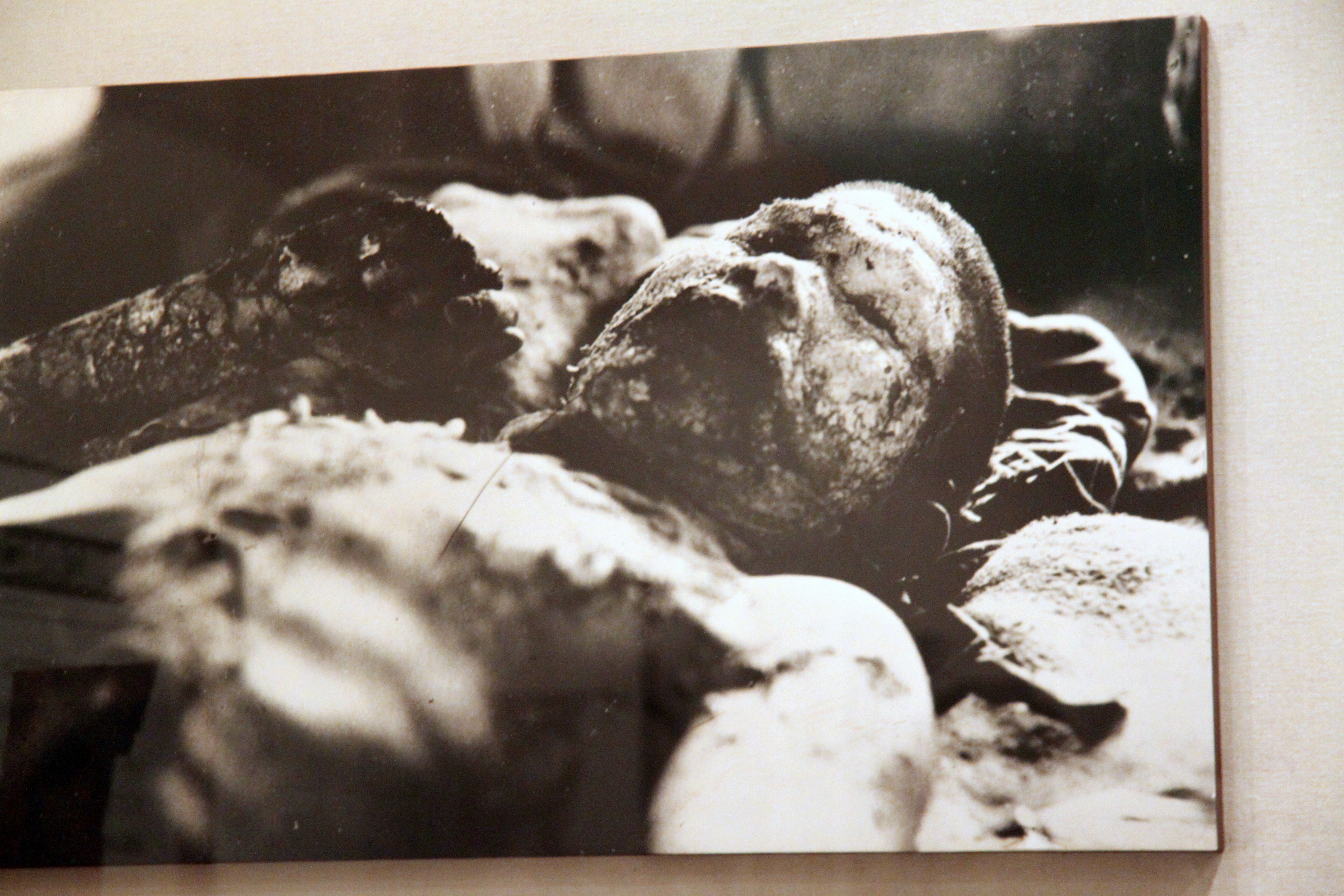
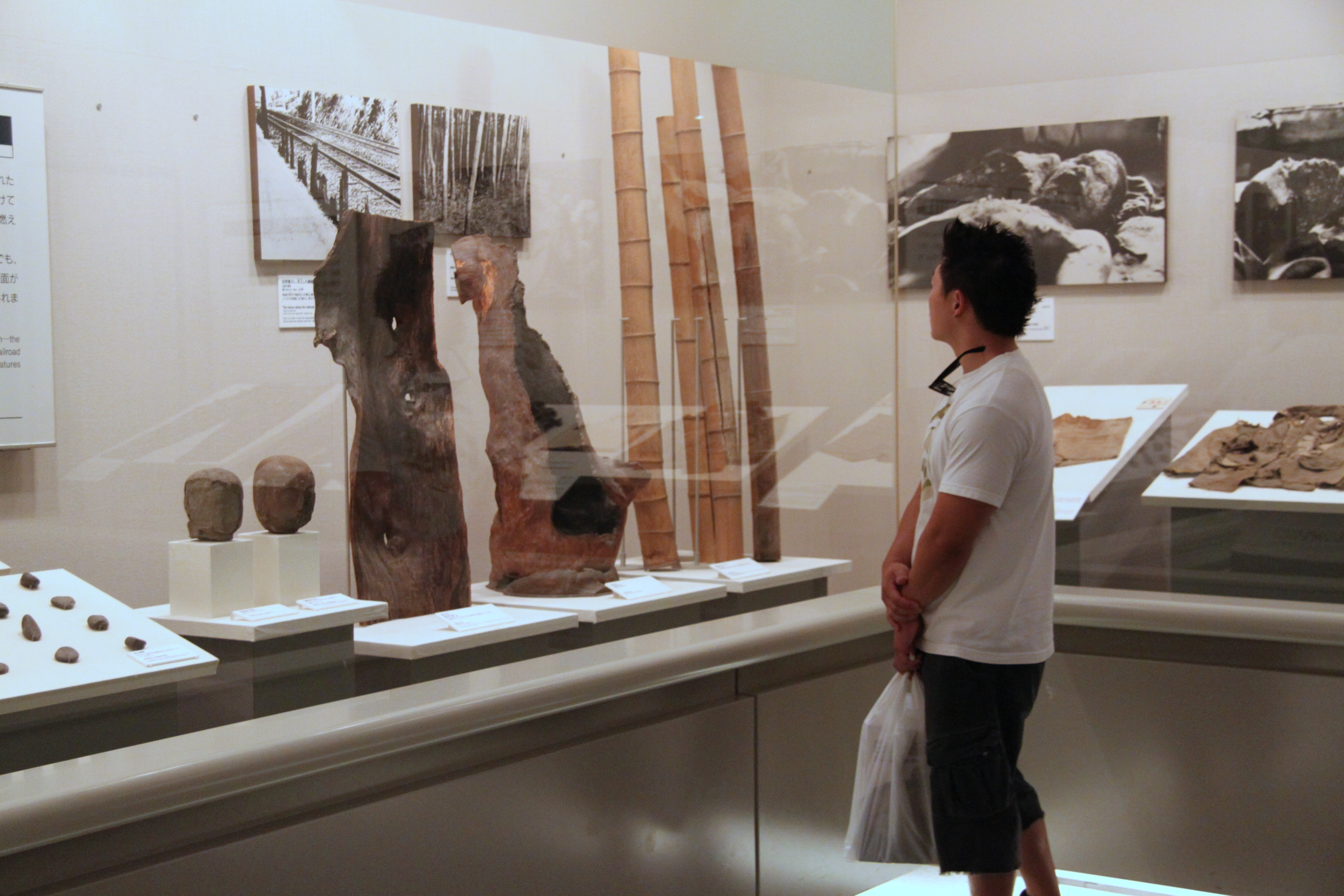
Due to time, we journeyed outside with these two 81 year old gentlemen for further education.  However, without any inference of what was right or what was wrong 70 years ago, just a couple of images from within the Memorial Museum:

My son Takeshi, I believe, was very focused on the many displays. I believe the message of the Peace Museum was completely absorbed into his psyche.

Messrs. Tsukamoto and Aratani guided us to the Nichuu High School Memorial, emblazoned with the 321 fellow students who perished.  As did Mr. Tsukamoto on August 6th, 2012, I offered water; my son Takeshi also without any urging whatsoever left his precious water bottle on that hot and humid day which is a glorious gesture.  There is a reason for the water as will be explained shortly.

Mr. Aratani, Mr. Tsukamoto and myself offer water to the Memorial and a prayer for their young Nichuu classmates and souls.  321 of them.
My son leaves his water bottle for the young souls.

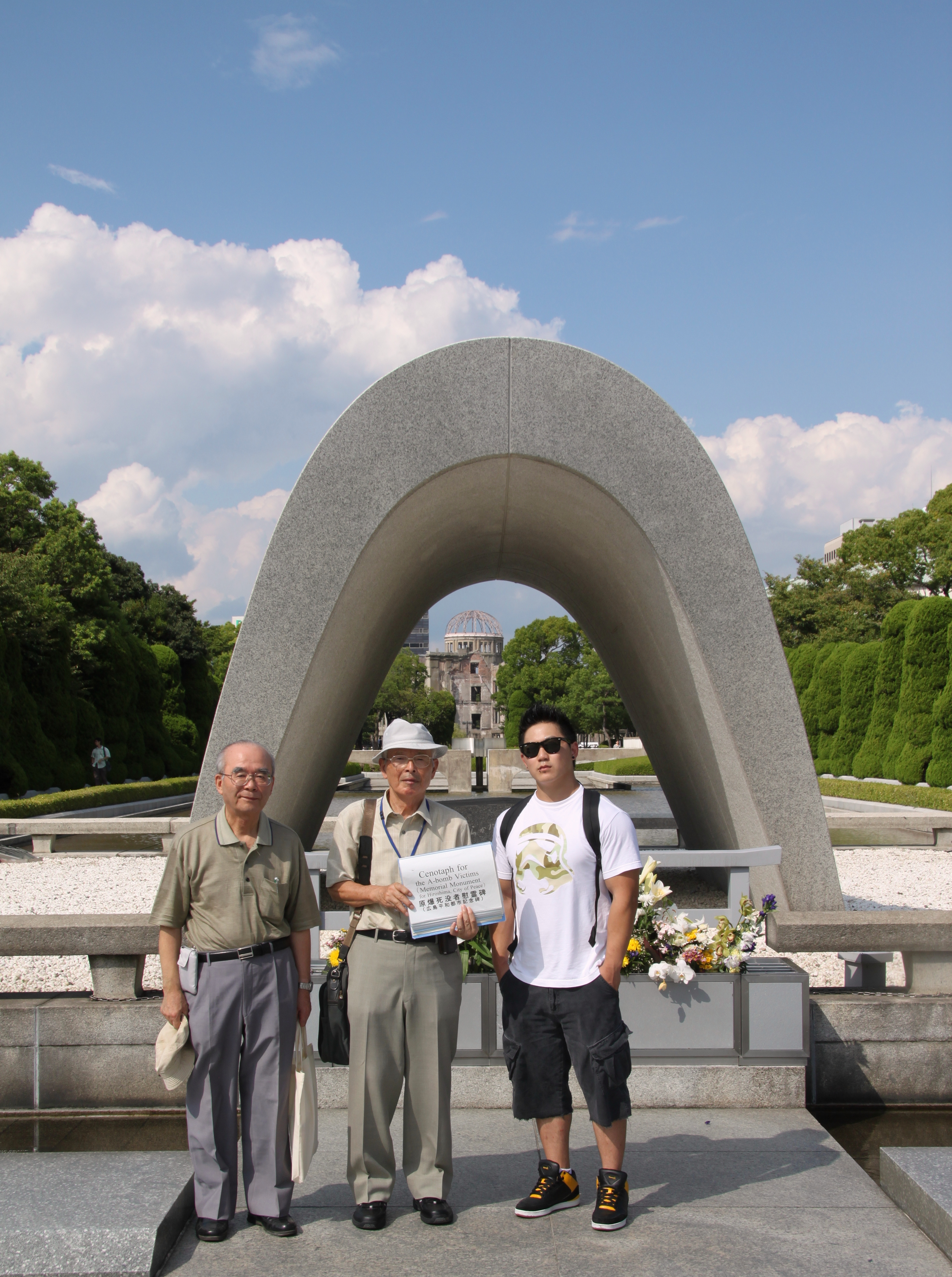
We journeyed towards the cenotaph.  On the way through a park, Mr. Tsukamoto began to cry.  I asked him what was wrong.  He replied, “Your father is very fortunate to have family that think of his well-being.  My soul is now filled with joy.”  We hugged each other under the shade of a tree and cried together.  As it turns out, his father died at a young age; he was never able to thank his father for raising him through a most horrible period.

We arrived at the cenotaph; the inscription was designed and written by Mr. Tsubokawa’s and Aratani’s good friend, Prof. Saika Tadayoshi.  In English, it says, “For to repeat the fault we shall cease for we shall not repeat the evil.”  It was purposely written with no subject.  It is for the reader to decide.  Mr. Tsukamoto subsequently sent this image of the actual manuscript of Prof. Tadayoshi written in calligraphy (brush and carbon ink).

From Mr. Tsukamoto.

The Atomic Dome can be seen perfectly centered through the arch.  He explained the “eternal flame” is not truly meant to be eternal.  It is to be extinguished when all nuclear weapons are abolished.

Cenotaph

Just beyond the cenotaph can be seen a pool of refreshing water.  The water symbolizes all the cries for water from the victims who survived the atomic blast.  Nearly all would perish.  Remember the water we poured on Nichu’s Memorial Stone?

We then walked to the actual hypocenter.  The atomic bomb exploded about 1,900 feet directly above.

The atomic bomb exploded directly above this spot.
There are several rivers flowing through Hiroshima.  We all know through books that the rivers were engorged with corpses and debris.  However, there are no photos in existence as it was when the city was destroyed.  There was no film let alone medical care.  However, before the US scientists came to measure radiation levels about two months later, a huge typhoon hit the devastated city.  While the rain tore through the rivers carrying the corpses out to sea, the rain also largely washed away radiation levels.  Therefore, when the US scientists did measure the radiation levels, it was tremendously lower than what it truly was.  You won’t find that written in any of our school history books.

This river was engorged with victims and were washed out to sea by a huge typhoon. There are no photos of this horrible scene as witnessed by our two survivors.

We returned from the very enlightening tour to join Masako, Izumi, Ms. Kanetou and Ms. Tanaka.  My father was bestowed with many kind gifts one of which was a compilation of years past of Nichu – including images of when dad’s class was digging the pool at the school in the early 30’s.  But lastly, as a small token of peace, fellow blogger Seapunk2 sent me some artistic pieces representing peace and serenity.  One was presented Ms. Kanetou.  I explained it to her that the artist said a sense of peace may be coming “…directly from her actions. You may feel the spirit contained within them.  (I) sat so long and quietly, collecting those tiny pieces, sometimes with tweezers. It’s a beautiful experience, to listen to the shore birds, seals, waves and take in the Pacific while I gather the otherwise unnoticed gifts from the earth and sea. Then, once I got the idea for containing them, that, too, was peaceful and gave me a lovely sense of satisfaction…”

Peace token from seapunk2!

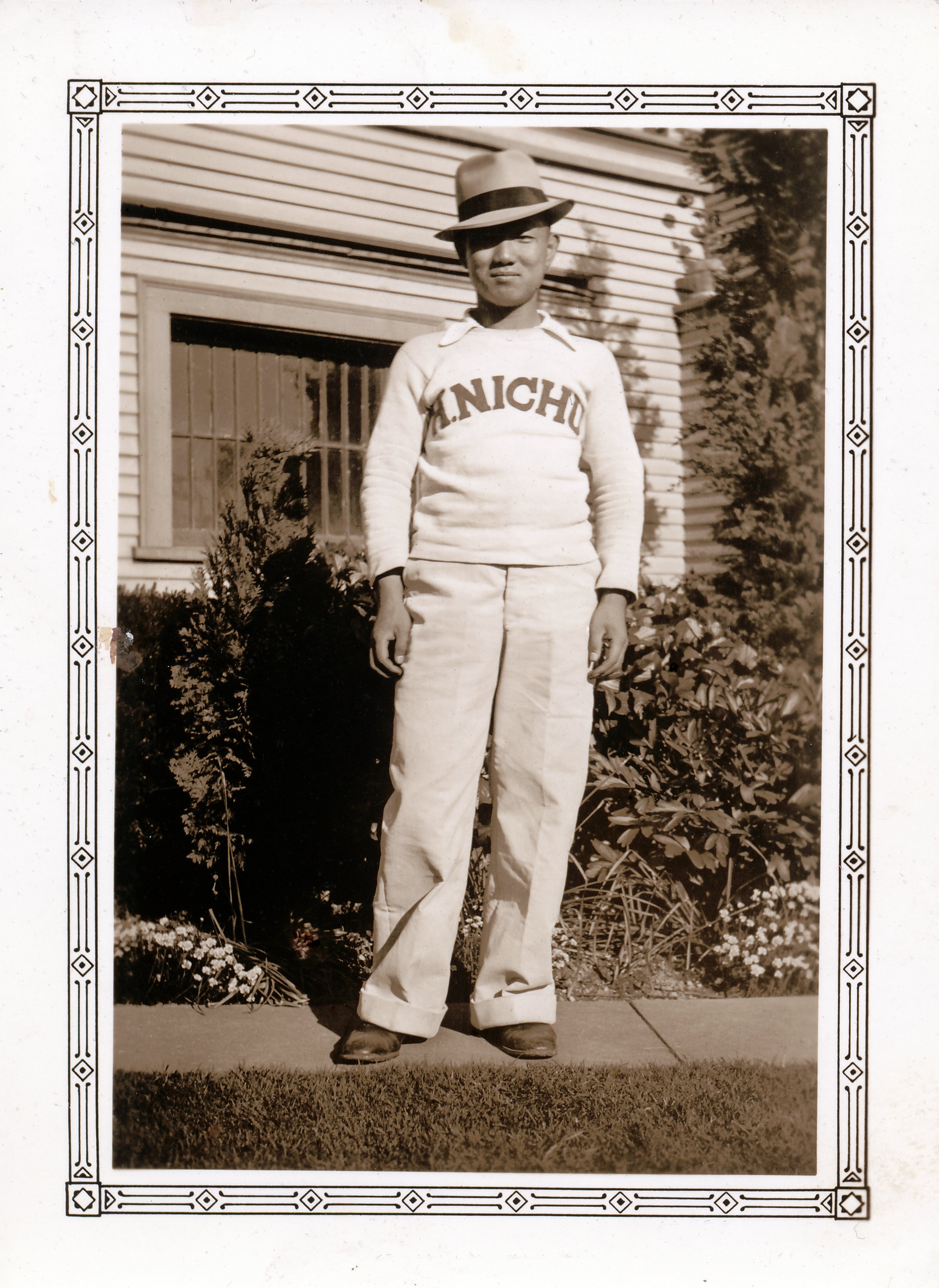
Lastly, in a photo discovery made just a few hours before meeting them, I came across a photo of dad taken in 1937 soon after he arrived back in Seattle after spending ten years in Hiroshima and graduating from Nichu.  He’s sporting his Nichu varsity sweater.  The attendees were overjoyed to see Dad’s pride in Nichu – even across the ocean.

Dad in his pride and joy Nichu varsity sweater taken in Seattle, 1937. You can also see his bent right elbow. That is another discovery story.

__________________________________

The men were burned severely as children working in a field for their country’s victory.  While their country lost, it was but a moment in their lifetime.  They still attained victory for the world.

More to come on one family, two countries and World War II.

LIFE and GENERATIONS – Backwards and Forward


Life can be fulfilling, emotional, filled with awe…and eerie.  All at once.  In ten short days.  In a country far away.

But life and its generations help you live it backwards and forward.

__________________________

Ten great days were spent in Tokyo and Hiroshima with my oldest son, Takeshi.  He is 24 years old.  We had never been on vacation together.  My loss.  I admit to being worried he was not going to enjoy himself.

There is so much to write about for family and friends but jet lag affects more than sleep.  There is a cavernous disconnect between my (normally minimally functioning) brain and my fingers.

__________________________

But during this trip…

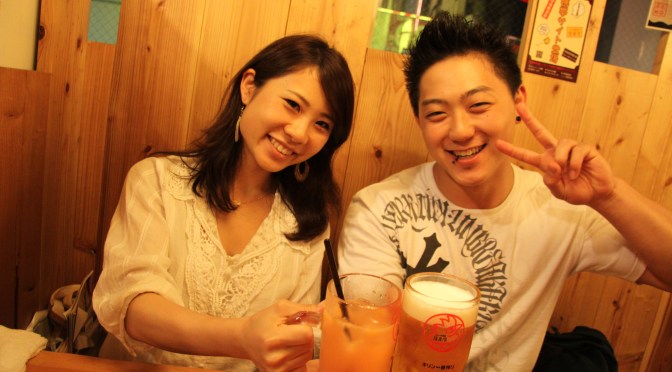
My son enjoyed his time with my dad’s side of the family immensely – so much so he shed a few tears at a farewell dinner they threw for us.  He even found a new drinking buddy – my cousin’s intelligent and beautiful granddaughter, Yuu-chan:

My son Takeshi and Yuu-chan in Tokyo

With my cousin Toshio Nakano, we saw my father’s station he served in as part of the 8th US Army’s G-2, Military Intelligence Service in Yokohama; because I carried some photos of him in uniform inside, the Public Relations Officer escorted us to a view from the (unrestricted) roof:

Dad’s Army station while in the US 8th Army in Yokohama

Was able to meet my cousin Masako (78) once again and the family – and we were royally treated:

Great fun with family in Hiroshima

Took the cremated remains of my Aunt Shiz (95) for internment; she was my dad’s last living sibling.  He is now the last one:

Ceremony for Aunt Shiz

Saw the most beautiful parts of Japan:

Miyajima’s grand Tori’i

A most EMOTIONAL meeting with those responsible for finding my dad’s 1937 high school yearbook:

A most wonderful meeting of peace-loving people

And the most STARTLING and tear-jerking finds of generations past – including those of my father’s younger brother who was KIA as part of the Japanese Imperial Army:

Unbelievable family discoveries

I hope you’ll stay tuned until this old mind functions again.  Not that it ever did.  Thought it best to say that before someone did.

“Old Man Jack-ism” #4


“Koji, don’t let anyone tell you different.  War makes good boys do crazy things.”

That was the first time Old Man Jack shared something with me about the war in a voice of unfeigned remorse.  In turn, it was one of my first journeys in his time machine in which he allowed me to ride along.

Front row seats.  Free of charge.

It was in 2002 to the best of my recollection.  It was just before my littlest firecracker was born.

__________________________

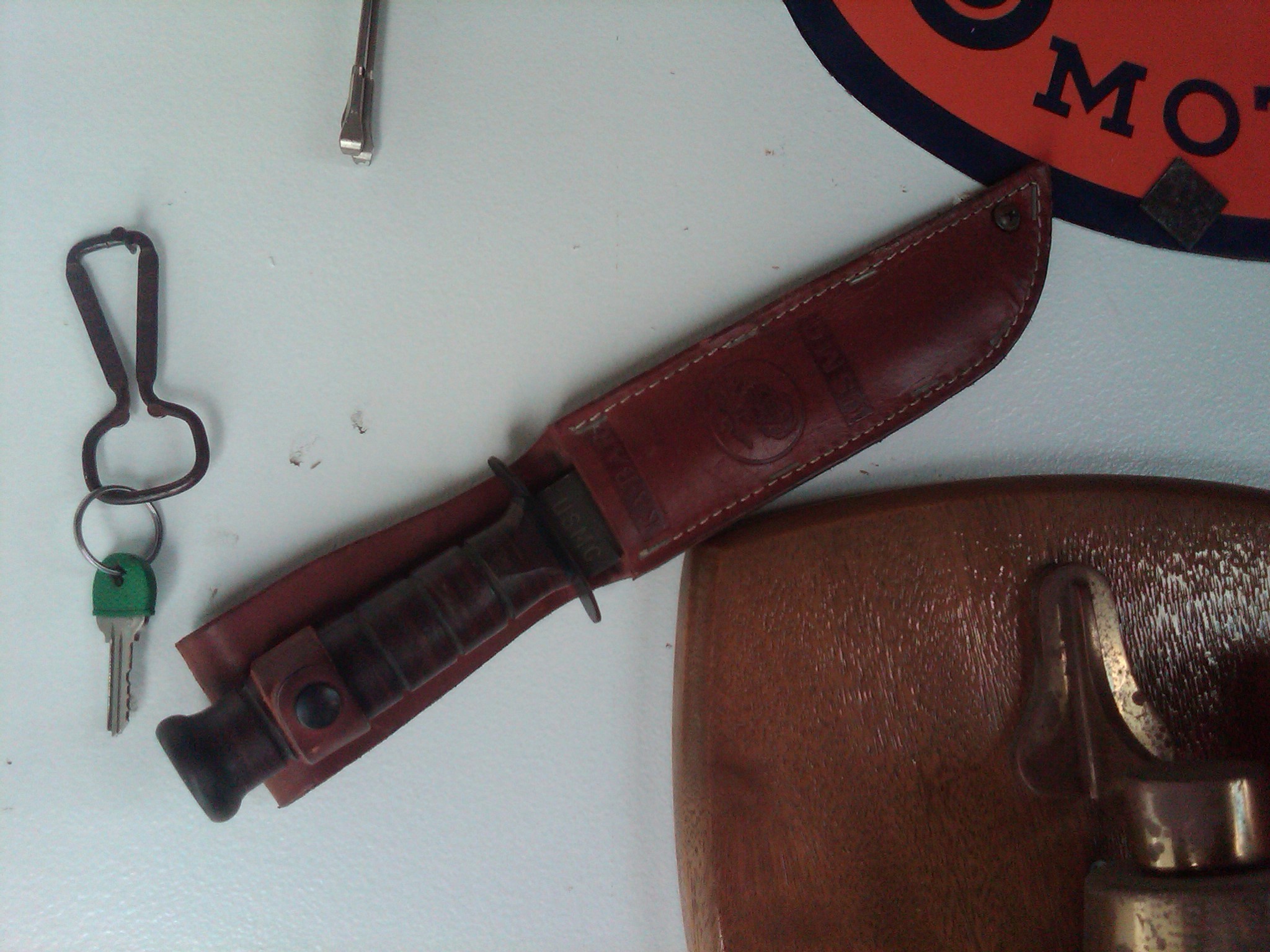
KA-BAR.  If you are a World War II US Marine who served on “those stinkin’ islands”, there is no explanation necessary.

My friend’s KA-BAR. He stated it was his grandfather’s who had served in the Pacific Theater. He allowed me to hold it. Its mass will stun you.

A KA-BAR was a Marine’s most prized personal possession.  It was always at their side.

They opened their C-rations with it.  Dug foxholes with it.  Chopped coconut logs with it.  Hammered nails with it.  Indestructible.

Most importantly, for killing.  Designed for slashing and stabbing.  Desperate hand-to-hand combat.  To the death.

The KA-BAR served them so well that many Marines who survived passed it down to their children.

Old Man Jack said several times, “I’ll tell ya – us white caps always tussled with the Marines ‘cuz they thought they were better than us…but there wasn’t anyone better at protecting your sorry asses with theirs when it came time.”

_________________________

(If you are prone to nausea, you should not continue to read this Old Man Jack story.)

I did not know this free ride was coming.  It was unexpected and spontaneous.  I recall that clearly.

That afternoon, he began describing something vile he witnessed during the war.  Today, I fully realize he was trying to vomit demons out from his soul.

He needed to.

Jack visiting at my house on Sept. 23, 2006. He would fall gravely ill about a year later.

________________________

He didn’t tell me what island; that would be his pattern up until his death.  If he was talking about something a young man should never have witnessed, he would never say what island he was on.  However, my educated guess as to the year would be late 1943 or early 1944.

Old Man Jack said to the best of my recollection that “…the Japs broke through our perimeter”.

“When the fighting broke out, most of us (the ground crew servicing Marine Corsairs) dove straight into the nearest foxholes.  I only had a .45 and I kept my head down except for a dumb ass split second or two…”  He tried to mimic what he did by extending his neck a bit and flicking his head left and right.

“All hell was breaking loose.  Men were screaming all over the place.  You could tell which rounds were from us and which ones were theirs.”

It was all over in a couple of minutes, Jack said.  “I did hear moaning then a CRACK from a .45 or a M1…”  A Marine apparently dispensed a wounded enemy soldier.

“I got up.  There was still a little yelling going on.  And I ain’t ashamed to say I started shaking real bad.  Then I see this kid (i.e., a Marine) dragging this wounded Jap; he was hit pretty bad but I could tell he was still alive.  The Marine grabbed his KA-BAR and sliced open that son-of-a-bitch’s mouth.  I could see the Jap was flinching.  The kid was trying to gouge out gold (from his teeth).”

Another Marine came over and shot the Jap dead with his .45.  The kid yelled, ‘Hey!  Why’d you have to go do that for?!’

The other Marine just looked at him for a split second and walked away.  I stopped looking.”

Jack then just slowly shook his head.

________________________

I remember Old Man Jack was looking down when he finished.  He had on a grey sweatshirt as winter was coming on.

Front row seats in his time machine of nightmares.  He just forgot to mention it was on his roller coaster he kept hidden inside.

He had other free tickets for me in the years that followed.

There Be Gold in My Family


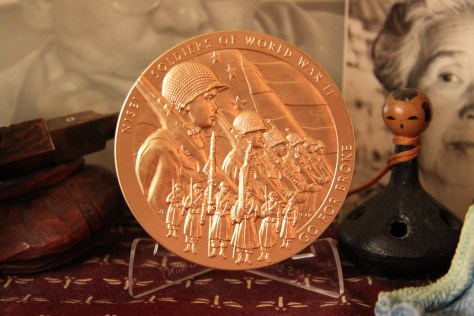
There be gold in my family.  Really.  Well, the Congressional Gold Medal, that is.  And it is made out of gold and honors the “Nisei Soldiers of World War II”.  Its on display at the Smithsonian.

In fact, my family was awarded two of them.  Two Congressional Gold Medals.  Pretty neat, don’t you think?  Three if you include a distant relative.  Four if Dad had enlisted in the Army five weeks earlier.  OK.  Enough of that.

Face of “Nisei Soldiers of World War II” Congressional Gold Medal
Backside of “Nisei Soldiers of World War II” Congressional Gold Medal

________________________

It was just a miracle mom and her younger sister Eiko survived the war having lived in the heart of Tokyo where very little was left standing.  My grandmother was required to train with a sharpened bamboo spear to repel the invaders that were expected to come.  It’s true.

But when war ended in 1945, neither my mother nor my Aunt Eiko could have possibly thought that they – through no grand scheme – would each end up marrying an “invader” and that they would end up living in America.  The country that bombed their home into ashes.  But it was a brutal war.  Just fact.

Even more stunning is that they would be unknowingly dovetailed with the famed US 8th Army’s Military Intelligence Service (MIS) for the rest of their lives.  (I had briefly reported on the top secret MIS in an earlier short story.)
________________________

Taken on December 8, 1946 in Tokyo. (L to R) Mom, Taro, Aunt Eiko. Standing are my grandparents.  Notice the US 8th Army shoulder patch on Taro.  Isn’t he handsome?  He was 21 years old.

The first family member bestowed the Congressional Gold Medal is my mother and Aunt Eiko’s cousin, Taro Tanji; he is pictured above in a family portrait taken in Tokyo.  He was born in Merced County, CA.  Taro, like my father, was imprisoned in the camp called Granada in Colorado for being of Japanese heritage although he didn’t speak one word of Japanese.

In 1944, along with thousands of other young American boys of Japanese heritage, he was drafted out of the camp into the US Army.  He was a “Nisei”.  He then was assigned to the top secret US Army Military Intelligence Service Language School (MISLS) in Fort Snelling, Minnesota to learn the Japanese language.

After graduating, he was assigned to Tokyo as part of US 8th Army and became part of the Allied Occupation.  Once there, he immediately sought the fate of my mother’s family.

Through the resources of the MIS, he miraculously located my grandmother – the same one who was forced to train with a bamboo spear.  They had survived but were in dire straits like millions of other survivors.

Exactly as my father did for my cousin Masako in Hiroshima, Taro used whatever pay he had to buy them clothing and essentials from the PX, took them C-rations and of course, American cigarettes for my grandfather.  There are many stories of other things Taro did (he was a STRONG man) which I will save for later.

Aunt Eiko and Taro, taken in the late 1960’s at his home in Gardena, CA.

A kind man, Taro became a much loved teacher in the Gardena school system.  He recently passed away in Gardena, CA in 2009.

His CGM was posthumously awarded to his wife, Aunt Martha.  Amazingly, neither mom nor Aunt Eiko realized Taro was part of the MIS until I told them.  I determined that through research of US Army records.
______________________

My Aunt Eiko was sickly as a young girl.  Indeed, it was a miracle especially for her to have survived.  She hates medicine, even to this day.  As a funny story, when the US Army began de-licing the surviving Japanese citizens, she ran away as she was terrified she would get sick from the powder.  Well, it was DDT so she wasn’t that far off.

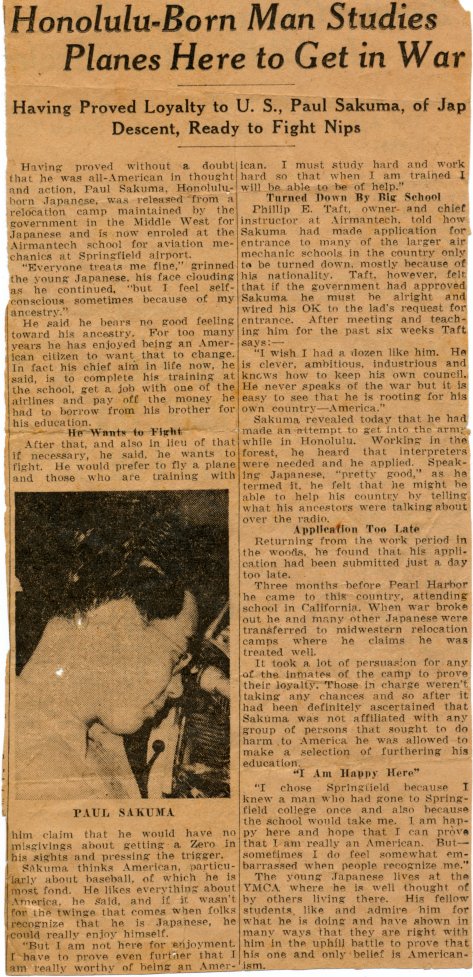
In 1966, she met Paul Sakuma, a Hawaiian born Nisei.  While Uncle Paul told Aunt Eiko he was also put into camp on the Mainland (the article says that, too), I can find no record of his internment.  However, Uncle Paul was at some time in Springfield, Massachusetts after the war started.  He was “featured” in this newspaper article.  Surely, the title of the article was a sign of the times.

Newspaper article on Uncle Paul during war time, Springfield, MA.

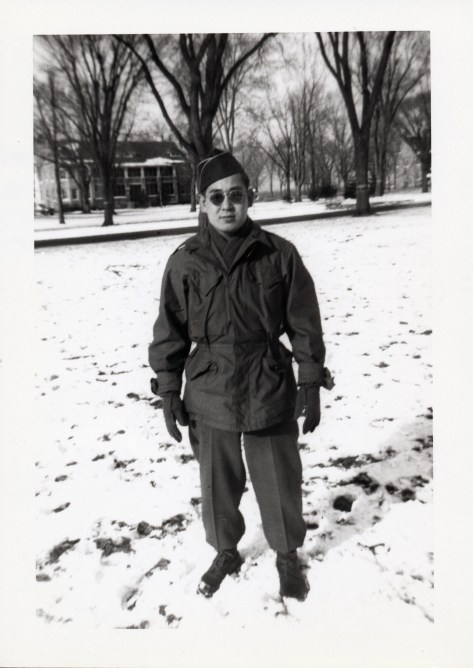
Uncle Paul was also drafted in 1944 and was also sent to the MISLS at Fort Snelling, Minnesota.  This is the only photo Aunt Eiko has of Uncle Paul in uniform.  I stumbled across it last year.  Frankly, Aunt Eiko also knew very little of his Army days but I noticed the building in the background (below) as being the old cavalry barracks at Fort Snelling which sparked my researching again.  He was also indeed a member of the famed MIS unbeknownst to Aunt Eiko.

Uncle Paul at Ft. Snelling’s top secret Military Intelligence Service Language School, circa Winter 1945. The old barracks is seen in the background.

Uncle Paul was also immediately dispatched to Tokyo as part of the Occupation Force.  He was assigned to the 720th Military Police Battalion and accompanied patrols where his translation abilities were needed.  A couple of good patrol stories – ones that men would likely appreciate.  Perhaps some ladies, too.  No harm, no foul, as the great Chick Hearn said.

Days before my first marriage, I got a call from Aunt Eiko late at night.  She was hysterical.  Uncle Paul had died of a massive heart attack in 1980 in Tokyo in the new home he had just finished building for them.  He had continued living in Tokyo as a civilian employee of the USAF.

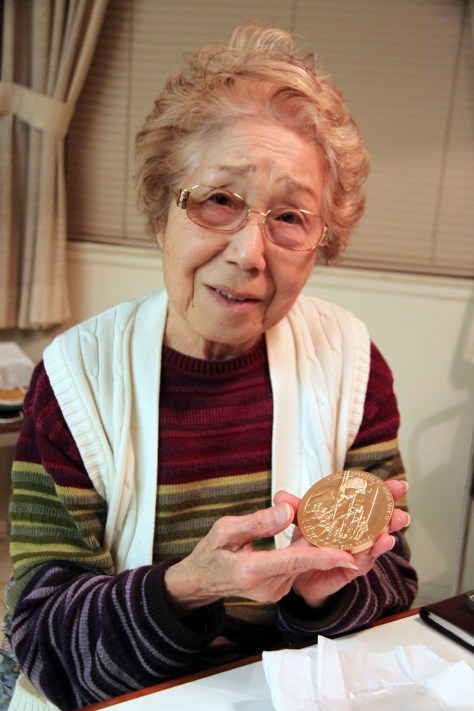
Like Taro, Uncle Paul was posthumously awarded the CGM.  I secured the CGM and surprised her with it.  Aunt Eiko “cried for happy” as he held the medal for the first time early this year (below).  She loves him greatly to this day.  She said, “Even today, Paul brings me great happiness.”  If that doesn’t bring a tear to your eyes, well, you’re pretty tough.

Holding Uncle Paul’s Congressional Gold Medal for the first time, Aunt Eiko cried for happy. Incidentally, she became an American citizen about ten years ago.

_______________________

As dad volunteered in February 1947, he did not qualify for the CGM.  But unbelievably, mom, too, did not know much of what dad did in the Army let alone him being a member of the MIS.  Mom said dad never talked much about it except to say he did not enjoy interrogating Japanese soldiers being returned from Russia and Manchuria.

Nevertheless, mom and Aunt Eiko WERE enmeshed with the famed Military Intelligence Service although they didn’t realize it.  Fate.  They were surrounded by the invaders – secretly.  Famous ones at that.  A prejudiced opinion, of course.
_______________________

I am very proud of these Americans.  The Congressional Gold Medal is a tremendous honor and finally brings to public light the importance of the intelligence they secretly obtained for our United States of America amidst prejudice and discrimination.

I like to think that these Americans of Japanese heritage weathered the clouds of that time so we could have glorious sunshine today.

An Atomic Spark from a 1937 Yearbook


The Atomic Peace Dome, 1,500 yards from Dad’s high school.

The atomic bombing of Hiroshima left a spark – a spark which grew into universal forgiveness and kindness.  From that unbounded forgiveness and kindness came a 1937 high school yearbook from a school that no longer existed – but its soul survived intact and gloriously
_________________

Dad is simply a very quiet man.  For every word he spoke, mom must have said a bazillion words.  No wonder he was quiet.  (You know, it may have been better to write “every word he tried to speak”.)

But this past Sunday, June 10, dad was a songbird in Spring…even though mom was there.

Dad was eighteen again and back in Hiroshima, riding the train to school with his friend Aoki.  Carefree.  Young.  After 75 years, Dad was looking through his high school yearbook he probably never saw.

How I got that yearbook from 1937 for Dad is a story of unbounded kindness and a love for peace – and driven by a unwavering desire to honor those that perished in Hiroshima.

_________________

All Dad had said in the past was that he ran track in his high school days and that the school was called “Nichu”.  I thought it was a nickname.  He wasn’t enthusiastic to share much more.

I was determined to find out more of my Dad’s past he was keeping hidden.

In Dad’s shoebox: a Nichu High School Pennant flying for an athletic meet in 1937.

All I had to start with had been a 1930’s photo (above) of a pennant Dad had stashed away in a shoebox and a couple of class photos.  After some exploring, I figured out the Japanese symbol on the flag was a melding of “二” and “中”, or “Nichu”, the name Dad mentioned.

Researching in the Japanese language was an endeavor.   I finally came across a possible lead and sent a blind e-mail…  In spite of considerable odds, I received a reply from a man in Hiroshima.

_________________

Mr. Akira Tsukamoto is a survivor.

In the waning days of the war, school children were put to work for their nation’s war effort in factories and fields.  That was their destiny.  Mr. Tsukamoto was one of those children.

Their teacher was Mr. Sekimoto; they had a nickname for him, “Mr. Pale”, because of his pale complexion.   The night before that fateful morning, Mr. Sekimoto had decided that it would be better for the class to tend a field and clear it of weeds.  Preparing the field for crops was more important than having class, he determined.  They would be in the northwest area of Hiroshima.

My two littlest kids standing in front of the Enola Gay in 2010.  I always viewed her as part of history.  Now I see a personal link.

Then came the morning and they were in the field while the other classes fatefully went to school.  Then they heard the familiar drone of B-29 engines.  They all saw what appeared to be three parachutes and a B-29 flying away.  One student recalls seeing something black in shape tumbling towards the earth.

There was a terrible blue and yellow flash.  A shock wave blew them down.  They covered their eyes and mouths as they had been trained.  But the heat from the blast was so searing, they could hear their skin and hair burning.

Their faces and bodies were burned on the left sides; in addition to searing pain, their skin slipped off.  All they could use was mashed raw potatoes as a salve.  It would take two months for their wounds to heal.  They say they were spared for a greater cause.

Mr. Tsukamoto’s story – translated into English – can be read here.  It is gripping and without malice.  Just kindness.

___________________

Fast forward 67 years.  Mr. Tsukamoto – the child who was pulling weeds in a field – was the one who kindly responded to my blind e-mail.  It turns out he graduated after the war from the school that rose out of the ashes of Nichu.

He did not know me but his survivor’s heart – driven now for world peace and in honor of 300+ young classmates that perished – propelled him to our communicating.

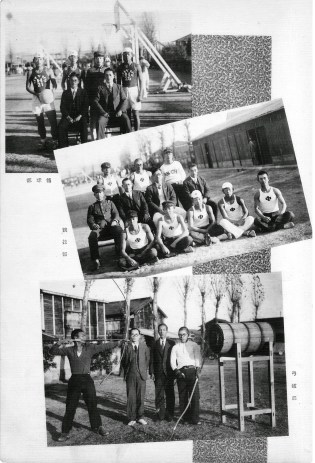
After learning of my search for information on my father’s high school years, he found Ms. Tomoko Kanetou.  Ms. Kanetou is an administrative manager at Dad’s successor school.  Together, they tracked down an actual copy of dad’s yearbook from 1937.  It is the last copy in existence.  She conscientiously made high resolution scans of the 48 page yearbook and sent a CD to me here in the United States through my cousin Masako.

They did all this without pause.  For a complete stranger across the Pacific.  An American.  Just incredible.

In the middle picture is Dad’s track team with him at front row, center. Mr. Sekimoto, the one whose decision saved Mr. Tsukamoto, is in the bottom photo, standing next to the archer on the left.

___________________

This past weekend, my oldest daughter hosted an early Father’s Day breakfast at her first home.  My father went through the yearbook I assembled page by page.  Not once.  Not twice…but for almost three hours during last Sunday morning.

He remembered the school song.  He said he was on their track team and won 1st or 2nd places in the 100m, 200m, broad jump and triple-jump.  He was even pictured, front and center, in Nichu’s track team yearbook photo (right).

Other pages struck me with disbelief and astonishment.  They gave a glimpse into life during the “pre-war” days in Hiroshima.  He talked about the influence of war on schooling.  That will be saved for a later story but further explains why his love and remembrances of his youngest brother are buried so deep in his hidden memories.

My ever-quiet father was not quiet that morning.  I have never heard him talk so much and for so long…  Truly an atomic spark from a 1937 yearbook.  All arising from a peace-fueled and unsolicited joint effort by complete strangers, Mr. Tsukamoto and Ms. Kanetou.  Perhaps they weren’t complete strangers after all.

_______________________

At day’s end with the yearbook… A smile the world’s supply of pistachios couldn’t buy.

In an earlier story, I praised old man Jack for being a giant in forgiving.

There are other giants in this world.

Mr. Tsukamoto, a survivor and Ms. Kanetou.

On behalf of my father, I thank you.

“There’s No Toilet Paper in the Jungle of Burma”


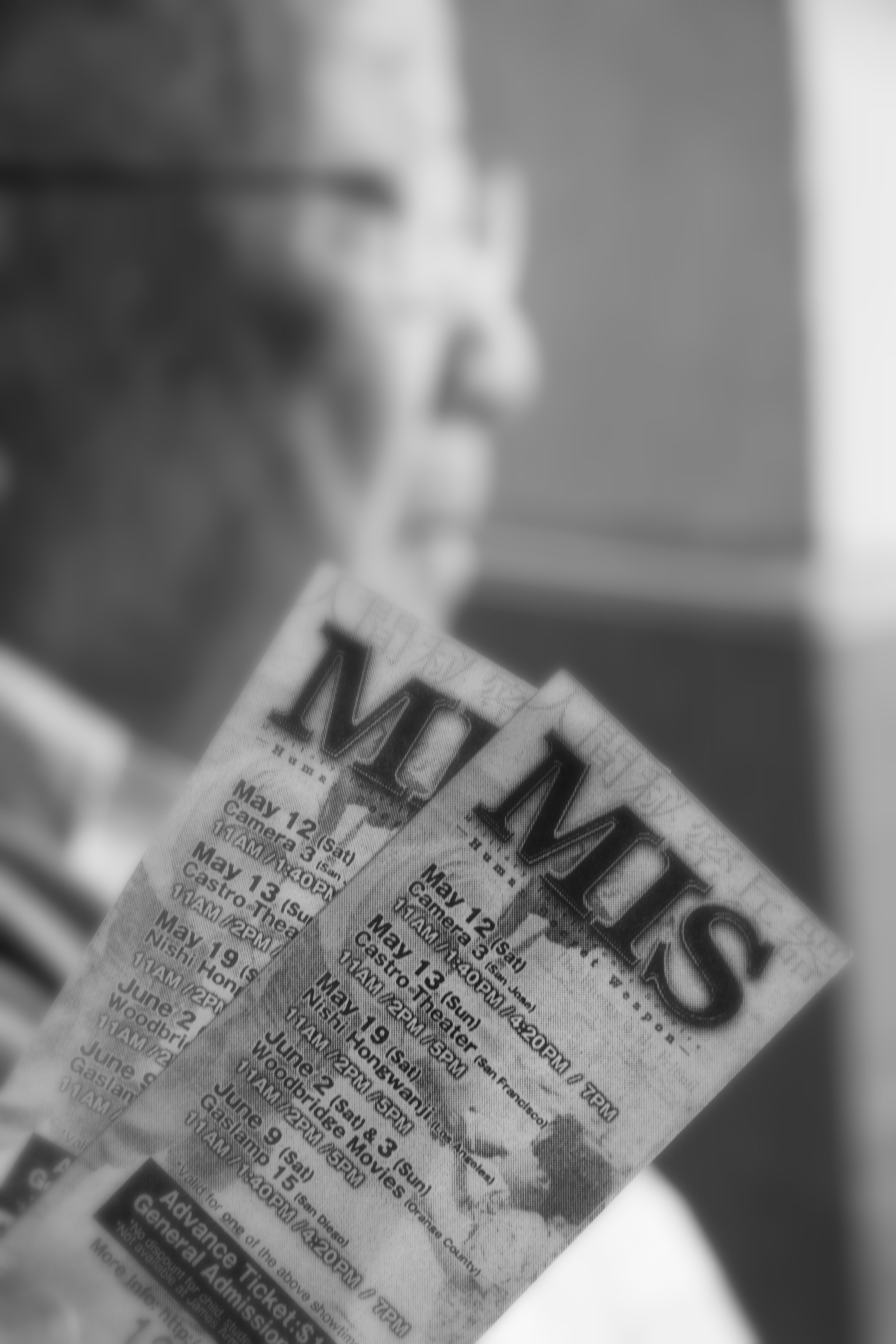
Dad and I waiting to go in to watch MIS

Dad broke his silence.

“War is no good,” he said as we left the small community movie theater near his assisted living home today; we had just watched the limited release documentary “MIS: Human Secret Weapon”.  It was about his highly classified World War II US Army unit.  He had silently watched and with a ghostly stillness.  But I saw him wipe his eyes twice after gently lifting his glasses.  Others openly wept…but I had never, ever seen him shed a tear before today.

I was ignorant.  Combat isn’t necessary for the ugliness of war to be buried in a person’s mind.  The documentary made it clear that it is also easily dug out.  All one needs to do is scratch.

Official US Army document certifying his Military Intelligence Service days.

___________________

The documentary reveals the conflicted state of mind of the then young Japanese-Americans who made up the US Army’s Military Intelligence Service (MIS).  About 3,000 of them – including two of my uncles – secretly and faithfully served the red, white and blue, hastening the Japanese surrender on board the USS Missouri.

Another 3,000 served during the Occupation of Japan.  My dad was one and worked out of General Eichelberger’s US 8th Army’s GHQ in Yokohama.  That’s when he was able to journey to Hiroshima and see his mother for the first time in ten years…and when a hungry Masako first relished the flavor of Spam.

__________________

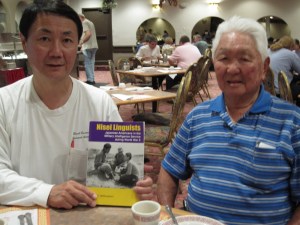
Grant Ichikawa, MIS, CGM and me. 2010

One Nisei veteran interviewed was Grant Ichikawa.  He was gracious enough to not only greet me and my family in 2010 near his home in Rosslyn, VA, he also secretly treated us to lunch.  Pun intended.  He had lost his wife Millie just months before.  She was an even rarer female member of the MIS as well.

He and Terry Shima (also interviewed in the documentary) gave me the jump start in finding out about Dad’s involvement in the MIS.  During that all too brief get together, Grant did touch on what he did on the battlefront in a GI uniform.  He also said it “got dicey”.

In this documentary, you learn of one such experience.  He was told there were Japanese soldiers who had agreed to surrender.  Grant said he was the point man.  They proceeded to the rendezvous point where he met the Japanese commander; they were in the middle of an open field.

It turns out there were 200 to 250 of them; all their weapons were in good working order he says in the documentary.  Grant suddenly realized – out in the middle of this field – that these Japanese soldiers were “toukoutai”, or “suicide corps”.  Grant just as quickly and with great consternation realized there were only ten of them… GI’s, that is, armed only with rifles.  I’m sure Grant picked his words wisely.  He is still alive.

“Dicey” was a definite understatement.

_______________________

In a lighter moment, Ken Akune described how they were searching a Japanese soldier that had surrendered in the jungle of Burma.  They came across one of the American propaganda leaflets promising safe passage for those Japanese soldiers that surrendered.  It was neatly folded in a pocket.

Surrender Propaganda Written by MIS Nisei.

Akune asked the Japanese soldier if he believed what the leaflet promised since the MIS Nisei wrote it.  The Japanese soldier said no but that it made for good toilet paper.  “There was no toilet paper in the jungle of Burma,” said the prisoner.

_______________________

Thomas Tsubota broke down at the end of his interview.  Many did.

Tsubota was one of the top secret MIS members of Merrill’s Marauders.

They had just stumbled across ten Japanese soldiers in a small jungle clearing, he says.  “Boom,” he said, in a split second they killed them all.  He described how his commander, Colonel Beach, called him over to inspect a photo album taken off one of the now dead Japanese soldiers

They looked through the album.  Tsubota told Col. Beach there was nothing of military importance in it but as they came upon the last page of the album, there was a picture of a mother and a daughter.

Tsubota said Colonel Beach’s eyes got red, filled with tears and he said, “Thank you, Tom.”

While crying, Tsubota ended the interview by saying this is why he isn’t enthusiastic about talking about the war.  Too painful.  He doesn’t want to think about that sad moment.  Tsubota is 96 years old.  I thought Dad was old.

______________________

The documentary intensely yet humanely describes the internal turmoil within these young American GIs of Japanese descent.  Quite a few had brothers who were left in Japan when war broke out and were killed as Japanese soldiers.  Deep down, many carried guilt that their own secret actions led to the deaths of their own brothers.  My Dad’s youngest brother – my Uncle Suetaro – was one of those casualties.

But these 3,000 young American boys of Japanese heritage did their job as did millions of other young American boys…but in secret.  They translated diaries covered with blood or offered cigarettes to Japanese prisoners to extract military intelligence while battles were raging.

They endured years of discrimination and intimidation to boot – both from GI’s fighting alongside them as well as back home.  A barber in Chicago wouldn’t cut Dad’s hair because of his race – and he was wearing his perfectly creased US Army uniform with sergeant’s stripes, sleeve highlighted by the proud shoulder patch of the US 8th Army.

The secrecy was officially lifted in 1972 by Executive Order 11652.
______________________

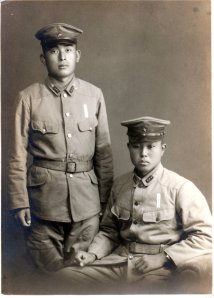
Uncle Suetaro on right.

Just the two of us, I thought, were going to see this movie and that this may help Dad slow down his growing dementia.

I was wrong.

His quiet tears and with his exiting comment, I am sure Uncle Suetaro was there, too, in Dad’s heart – as if it was 1937 in Hiroshima when he last saw his brother alive.

Over the past two years, I’ve asked, “Dad, tell me about what you worked on in the MIS.  What was the one thing you remember the most?  A picture?  A diary?”  Each time, the answer was vague or “I don’t know.”  I chalked it up to senility.

He doesn’t want to talk about it…just like Tsubota painfully recalling Col. Beach and the photo of a mother and a daughter taken from a Japanese soldier they had just killed.

Ugly recollections from war wanting to be masked need not come from battlefields, bullets or bombs.

Two Old Men and a Father’s Day Anguish


It was Monday, Valentines’ Day 2001.  My wife was five months pregnant at the time we moved into this wonderful neighborhood smothered in US Naval glory.  After I came back from work the next day, she told me a kind old man stopped her as she was wheeling out the trash bin.  She said he hobbled from across our quiet street lined with peppercorn trees then kindly wheeled them out for her.

I found out the “old man” was a World War II combat vet.  Worse yet, he was a sailor in the Pacific – he fought the Japanese in World War II.

“Holy crap,” flashed through my mind, “What if he finds out we’re Japanese?”

Twelve years later, I was honored to have been a pallbearer at his funeral.

I was so far off base about my first thoughts on Old Man Jack that even George Burns could have picked me off without being called for a balk…and this while he was in his grave.

I felt so ashamed.

_____________________________

I snapped this picture of a happy Jack Garrett when we went to the Chino Planes of Fame in 2003.

“Young man, get over here and plant your butt in that chair,” barked old man Jack from his cluttered garage across the street.  Having lived in that house since 1953, it was filled with his life history.

“But I have my stogie going, Jack,” said I.

“Well, I can see it and I sure as hell can smell it.  Now shut up and sit down.  I want to tell you something.”

That was Old Man Jack, my dear neighbor who lived across the street.  I like to think we were close.

He was 87 years old by that summer’s day in 2010 when he called me over.  While he had become feeble, his barrel chest was still prominent.  He was a rabble-rouser in his youth.  He was always “mixing it up” throughout his young years…  Well, he was mixing it up even while working at Northrup in the 50’s.  That makes me grin.

His handshake was always firm and warm; you didn’t need to be psychic to sense his insight and outlook on life.  He always spoke his mind.  He earned that right having been shot at, strafed, and bombed on “those stinkin’ islands” in the Southwest Pacific as he so often said during a most bitter war.

___________________________

Taken on Father’s Day 2010

I had invited Jack to Father’s Day dinner that summer just two years ago; my Dad who was 91 was coming as well.

Jack knew my dad was US Army but I fretted over what they would say to each other when they first met.  Or how they would react to one another.  It was more than just a concern over the centuries old rivalry between Army and Navy.  It was the bitter war.

Dad was in the front room when Jack rang the bell – right on time as always.  Jack had on his favorite blue plaid shirt; he wore it often as it had a pocket for his glasses.  I often wondered how often he washed it, though.  Jack and Dad are shown here on Father’s Day 2010.

“Dad,” I said, “This is Jack, US Navy, Aviation Machinist’s Mate, First Class, the Pacific.”

“Jack, this is my Dad.  US 8th Army, sergeant, Military Intelligence Service.”

Although not as agile as they once were, they immediately saluted each other.

_______________________

You didn’t need a sound system to hear them.  Dad and Jack are both hard of hearing.

It was easy to hear Jack ask Dad what he did in the Army.  During the Occupation of Japan, Dad said he went into a room once a week that reeked of dry cleaning to retrieve a crate.  (The crates contained documents, photos and other personal items such as war diaries written by Japanese soldiers.  They were removed from a WWII battlefield – read on.)  He would then translate the contents for military intelligence (below).

2016-11-12_04-06-14
Dad translating captured war documents in the U.S. 8th Army HQ’s, Yokohama, Japan. 1947.

I had to tend to cooking so I lost track of the conversation.  It was regretful I didn’t keep tuned in.

_______________________

So back to being called over by Jack on that summer’s day.

He was sitting in his favorite blue wheelchair.  He didn’t need it but it belonged to his beloved wife Carol who passed away ten years before.  They married during the waning days of the war.  They had been married for 55 strong years.

“So what did you want to tell me, Jack?” I asked.

He then went into his trance – one signaling evident anguish and wretched remembrances.  When he went into these trances, he always started by staring at his hands while picking at his right thumbnail with his left ring finger.  He would lift his once thick eyebrows now turned snow white with age, then begin talking in a slow, deliberate pace, never taking his eyes off his hands.

“I went on ID patrol…” Jack rasply whispered while ever so slightly drawing out his words.

“ID patrol?  What is that?” I asked.

He ignored me.  It was as if I wasn’t sitting next to him… He had already left the present. He had stepped foot onto that violent SW Pacific jungle of 70 years ago.  I’m sure its smell was as vivid to him in his tormented subconscious as it was seven decades ago.

“They would issue six of us white caps M1’s with bayonets…  Then we’d follow two Marines on a patrol into the jungle.”

“Patrol?  You?  You were ground crew, Jack,” I remarked.

“Ain’t enough of them (Marines) to go around on those stinkin’ islands so we got picked,” he said, still speaking in a lifeless yet pained monotone.  He added, “If you got killed, you rotted real quick in that jungle heat.  And if you got killed with shit in your pants, you got buried with shit in your pants.”

His stare doesn’t change.  His eyes have glassed over.  He is in a different world now – one of 70 years ago in a stifling jungle, his youthful, sweaty hands trying to grip onto his Garand rifle while wearing a smelly steel helmet… Listening in terror for any sound that may signal a Japanese soldier concealed in ambush knowing that the enemy was just there shortly before. A world that only combat veterans understand.  Thankfully, you and I never will.  Never.

“The Marines had two bags – one small one and a big one.  When we found one, the two Marines would stand guard.  We’d hold the rifle by the butt end and use the fixed bayonet to fish out the tags.”

It was then when I realized what he was painfully regurgitating.

This is what he meant by “I.D. patrol”. They were going back into the jungle to locate the dead Marines they had to leave behind after a “tussle” with the enemy as Jack liked to say – a life or death firefight.  Old Man Jack was only 20 years old.  The Marines were likely younger.  Ponder that thought.

“We weren’t allowed to touch the dead (Marine) as the Japs would booby-trap ‘em.  We’d hand over the tags hanging on the the end of the bayonet to one of the Marines who would put a tag in the small bag.  They marked a map for the graves registration guys to come back later.”

Jack’s anguished delivery dimmed even further.  “But we’d come across a dead Jap.  Nobody cared about them so they rotted where they were.  But we’d have to stick the bayonet into the rotting goo and try to fish stuff out.  The prize was a pouch or a satchel.  Those would go into the big duffel bag just as they were, covered with rot and maggots. We headed back to CP and that’s the last I saw of those bags,” he said.

He abruptly ended but his unconscious stare didn’t change.  He was still in the jungle, scared out of his wits. He was still picking at his thumbnail all this time.  His head hardly moved while he sat in the blue wheelchair that belonged to his beloved wife.

I thought to myself, “Is that the end, Jack?  That’s it?  Why did you tell me this?”  I knew not to pry any more so I kept the thoughts to myself.  He was in torment already.  Seventy years had passed but he was reliving the awfulness of a brutal war.  Nevertheless, I wondered why he chose that time to tell me about this horrific recall of something he experienced so very young.

It bugged me for several weeks.

____________________

About a month later, I understood why Jack told me the story after I communicated with Mr. Grant Ichikawa, a more well known veteran of the famed US Army’s Military Intelligence Service and combat veteran himself.  Apparently, the items they recovered from Japanese corpses were dry cleaned to remove the rotting body fluids.  After getting dry cleaned, they ended up in the crates that were in the room my Dad went into once a week when he was in the Military Intelligence Service…and why the room reeked of dry cleaning.

The brief chat with my dad on Father’s Day sparked that vile memory back to life.  It had been eating at Old Man Jack since that day.  He wanted to get it off his once mightily barreled chest.

I lament to this day that an invitation to a Father’s Day dinner had resulted in an unwanted recall of horror Jack was very much trying to forget.  More so, I lament he relived such horrors each night for the last 70 years of his life.  Seventy years.

Jack was a great man to have endured combat in the Pacific during World War II.  He was an immeasurable giant in learning to forgive – although he was never able to forget.

I miss him greatly.  I thanked him for all we have when I visited him today at his grave on this glorious Memorial Day.

The Letter from 1945


The Letter from 1945

February 19, 1945 – Men with names like Kuwahara and Koyanagi were with the US Marines on the sands of Iwo Jima.

No, not the Japanese soldiers within the concrete fortifications led by General Tadamichi Kuribayashi of the Japanese Imperial Army. These were Americans of Japanese descent, or Japanese-Americans. Nisei. And to make matters worse, they were in the uniforms of the US Army. GI Joes. The Japanese were trying to kill them, too.

Sorry, Marines. It wasn’t all your show – lightheatedly, of course.  (One of the greatest US Marines, John Basilone, CMH, Navy Cross gave his life on those black talcum powder-like sands.)

Having said that, ever watch the iconic B&W World War II classic, “The Sands of Iwo Jima”? John Wayne might just be turning over in his grave.  But to his credit, the movie is one of my faves.  It’s theme song, “The Marine’s Hymm”, gives me goosebumps even to this day.

________________________

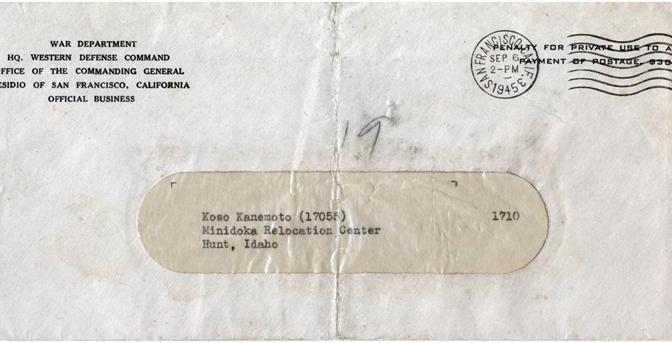
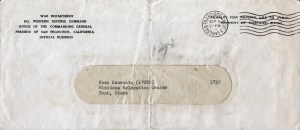
The envelope immediately caught my attention. Aside from a crease, the envelope looked pristine. It was addressed to my Dad while he was in Minidoka, an Idaho prison camp where he and over 10,000 Japanese-Americans were imprisoned by FDR. It was postmarked September 6, 1945 – just about seven months after the bloody fight for Iwo Jima. The return address was the “War Department”.

If you’ll get past the lawyer speak, the letter says Dad is now free to go about America as he chooses.

___________________________

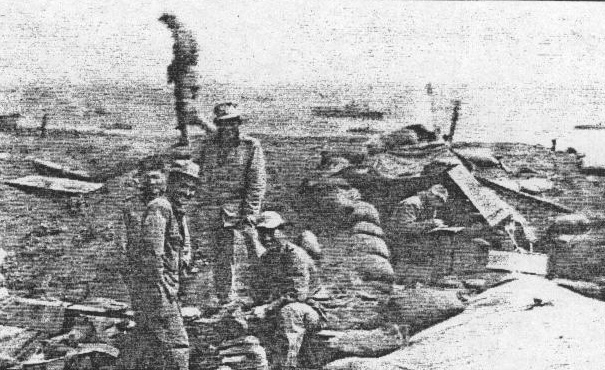
Because of secrecy, photos of Japanese-Americans in the US Army’s MIS are rare. This one shows Nisei on the sands of Iwo Jima.

About one thousand young Nisei men volunteered for the US Army while their families remained imprisoned in Minidoka. That’s about ten percent of the total camp’s population. Most who volunteered were from my Dad’s home state, Washington. While Dad was not one of those volunteers, 71 of these young men from Minidoka were killed fighting for the red, white and blue. Two were bestowed the Medal of Honor – posthumously. Silent patriots to this day.

“Kibei” were amongst those 1,000 men. Kibei’s were a sub-set of Nisei’s as a whole. A Kibei is a Japanese-American who actually spent time being raised in Japan. One result was they were absolutely fluent in Japanese – read, write, speak. Even slang and dirty words. No land-locked Nisei could come close. Dad was a Kibei.

___________________________

During the war, over 6,000 Nisei became part of the Military Intelligence Service (MIS). The MIS were top secret. They were largely all volunteers.

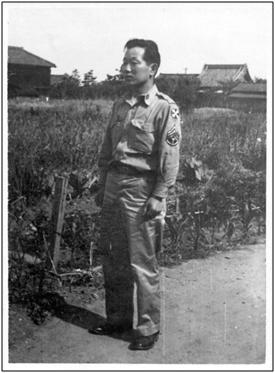
But the Kibei – they formed the crucial core of the group. The most fluent. The decisive secret weapon. As luck would have it, many of these Kibei were from Hiroshima. Their fathers came to Hawaii or Washington in droves from Hiroshima for a better life – just like my Grandfather Hisakichi. (Dad is pictured here standing next to his Hiroshima home in 1947.)

MIS Kibei were the ones who intercepted and swiftly translated the Japanese Imperial Navy radio transmissions that led to the shoot down of Admiral Yamamoto’s transport. Kibei also swiftly and accurately translated captured critical secret military plans written in Japanese (“Z-Plan“) for the defense of the Marianas Islands and the Philippines; this led to the lopsided American naval victory called the “Marianas Turkey Shoot” in 1944 – as well as to the death of my Seattle-born Uncle Suetaro. My dad’s youngest brother.

Interestingly, due to continuing suspicions, the US Navy and the Marine Corps refused to enlist the Nisei. Their loss.

___________________________

Actual “Z-Plan” report translated by Nisei of the top secret MIS.

The cloak and dagger actions of the MIS were only declassified in the 1972 by Executive Order 11652. That’s a long time. And true to their oaths, these Nisei kept their heroics to themselves for all those decades. They sought no honor or recognition.

____________________________

But back to the letter of 1945 – mailed to my Dad just seven months after the vicious fight for Iwo Jima. While my father finally volunteered for duty in February 1947 and became part of the famed MIS, his silent and patriotic Nisei brothers that preceded him hastened the end of war and saved millions of casualties – for both sides.

In recognition for their patriotism, sacrifices and loyalty, Congress bestowed upon the MIS and other Nisei who fought for the US in 2010 the Congressional Gold Medal. Two of my uncles were recipients although they had passed away.

By the way, the first recipient of the Congressional Gold Medal was George Washington. I believe the Nisei are in pretty good company.

__________________________

No credit is being taken from the young Marines who fought and died for Iwo Jima. The Marines did take Iwo Jima with their blood…but they were not alone. About 50 Nisei MIS’ers landed in the first assault waves alongside the Marines.

Just ask Mineo Yamagata, a MIS veteran of Saipan and Tinian. He accompanied the 28th Marines to the summit of Mt. Suribachi and witnessed the flag raising.

Oh… He was from Hawaii.