Category Archives: Army

A Soul Lost in a Faraway Jungle – Part 6/Epilogue


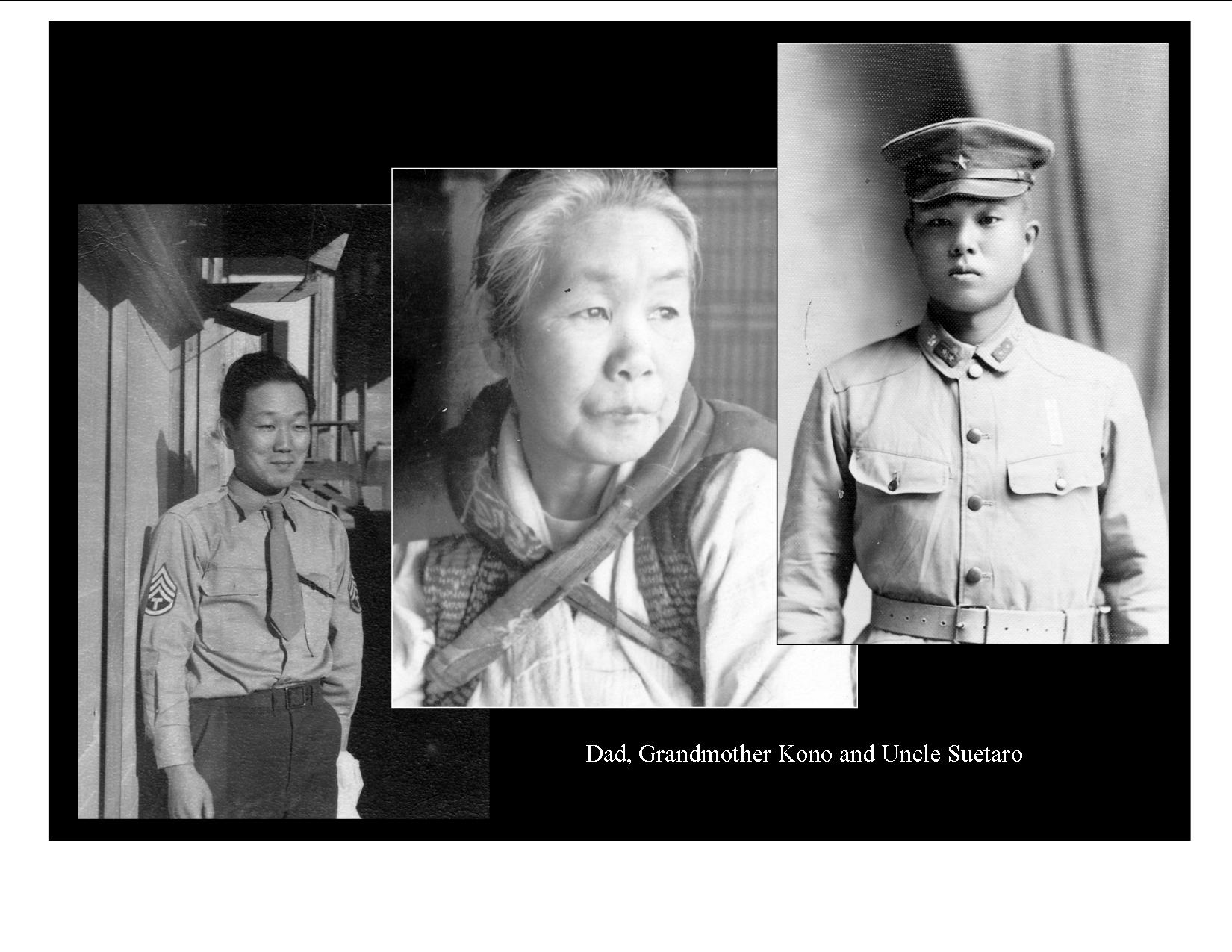
kono collage
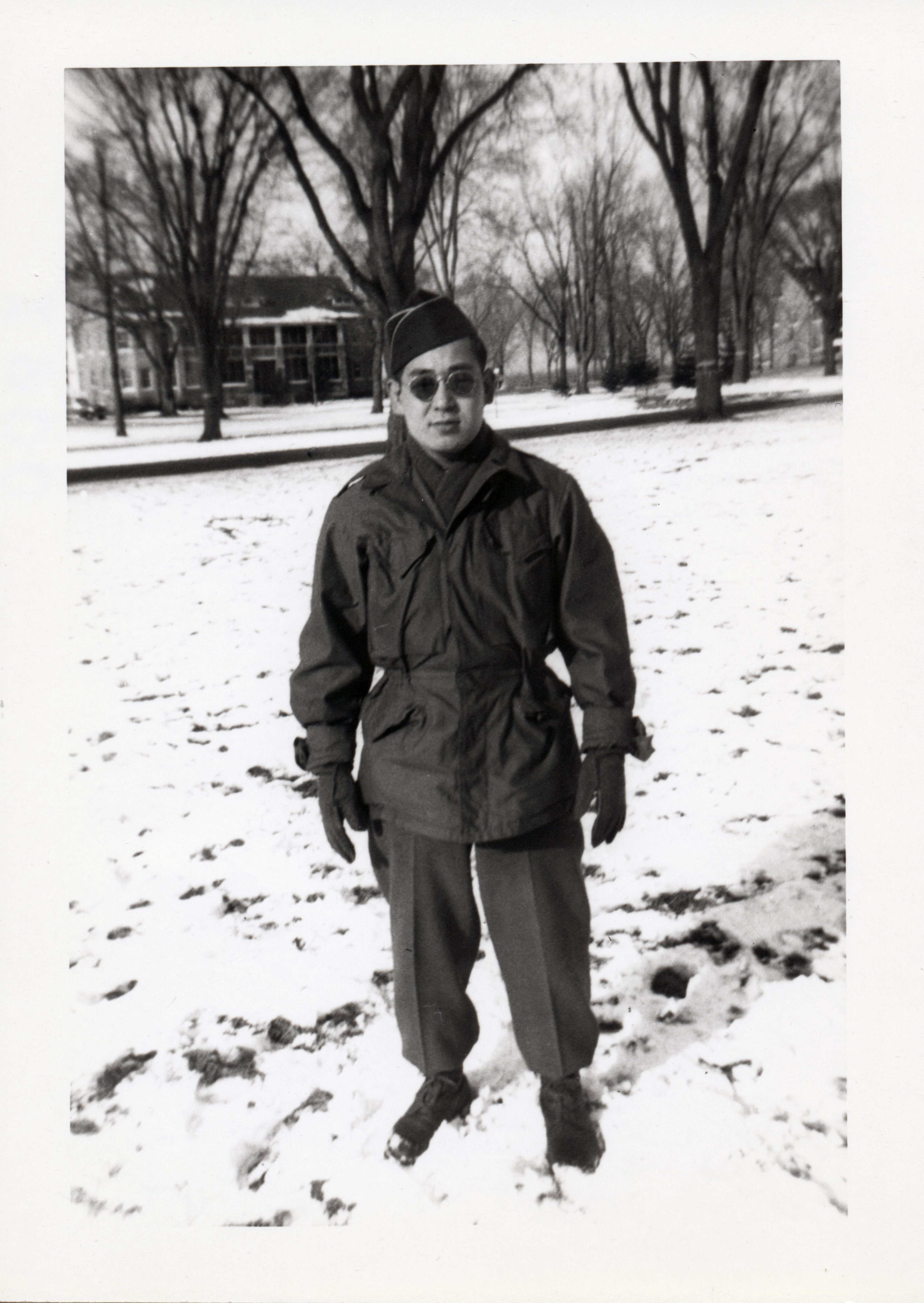
A portrait of my grandmother taken by my father in their Hiroshima home. She is flanked by my father (left) and Uncle Suetaro (right), both in their respective country’s uniforms. April 1948.

“Tell me the truth about death. I don’t know what it is. We have them, then they are gone but they stay in our minds. Their stories are part of us as long as we live and as long as we tell them or write them down.”

ELLEN GILCHRIST

________________

The Pain of Hope

I opened this series trying to describe the anguish a mother must have suffered – no matter what her country – knowing her son was missing in action in a battlefront so far away…

When we closed Part 5 of this series, no Imperial Japanese soldier came down off Mt. Canguipot on August 15, 1945, the day Japan officially surrendered to the Allies.¹ The US Navy and Army had also effectively sealed off any chance of retreating to other islands.

Uncle Suetaro was still on Leyte.

______________________________

The date when Grandmother Kono and Aunt Michie learned of Japan’s surrender is unknown. After all, Japan and especially Hiroshima was in shambles from the fire and atomic bombings but I’m sure they learned fast enough.

But with war over and just like ANY stateside mother, Grandmother Kono waited for her son to come home… her precious son born in Seattle who was to carry on the family name in Japan.

As days passed then months, deep in her heart, she must have come to the realization Uncle Suetaro may not be coming home…but the hope was still burning inside, I’m sure.

Hope is powerful. Hoping, you believe, will change destiny. But on or about October 15, 1947, Grandmother Kono will learn that such hope can magnify anguish.

She learned her son was declared dead.

_______________________________________

Japanese War Records

In January of this year and through the urging of Mr. Ota, my cousin Masako and her daughter Izumi journeyed to the Hiroshima Prefectural Office in hopes of retrieving some official military record or declaration of his death. Not knowing was eating them, too.

Because of the strictness of Japanese society, they were unsure the government would release Uncle Suetaro’s military record (if any) to his niece, Masako. I understand in anticipation of this, Masako had a “song and dance” prepared. She wanted to know that badly as to what happened to him.

Suetaro's farewell letter. It starts with
Suetaro’s farewell letter. It starts with “Dearest Mama”.

She took along the precious, brittle 72 year old notebook with her… the notebook in which Uncle Suetaro hurriedly wrote his good bye letter to Grandmother Kono in May 1944. She told the government worker stories of her Uncle Suetaro from 75 years ago – that he was always happy-go-lucky and was the peacekeeper with his kind heart.

Perhaps the song and dance was unnecessary but she was successful. As sad as it was, she was given Uncle Suetaro’s certified death notification. She was also given a copy of a handwritten IJA service record that abruptly ended in 1943 – when the tide of war turned against Japan.

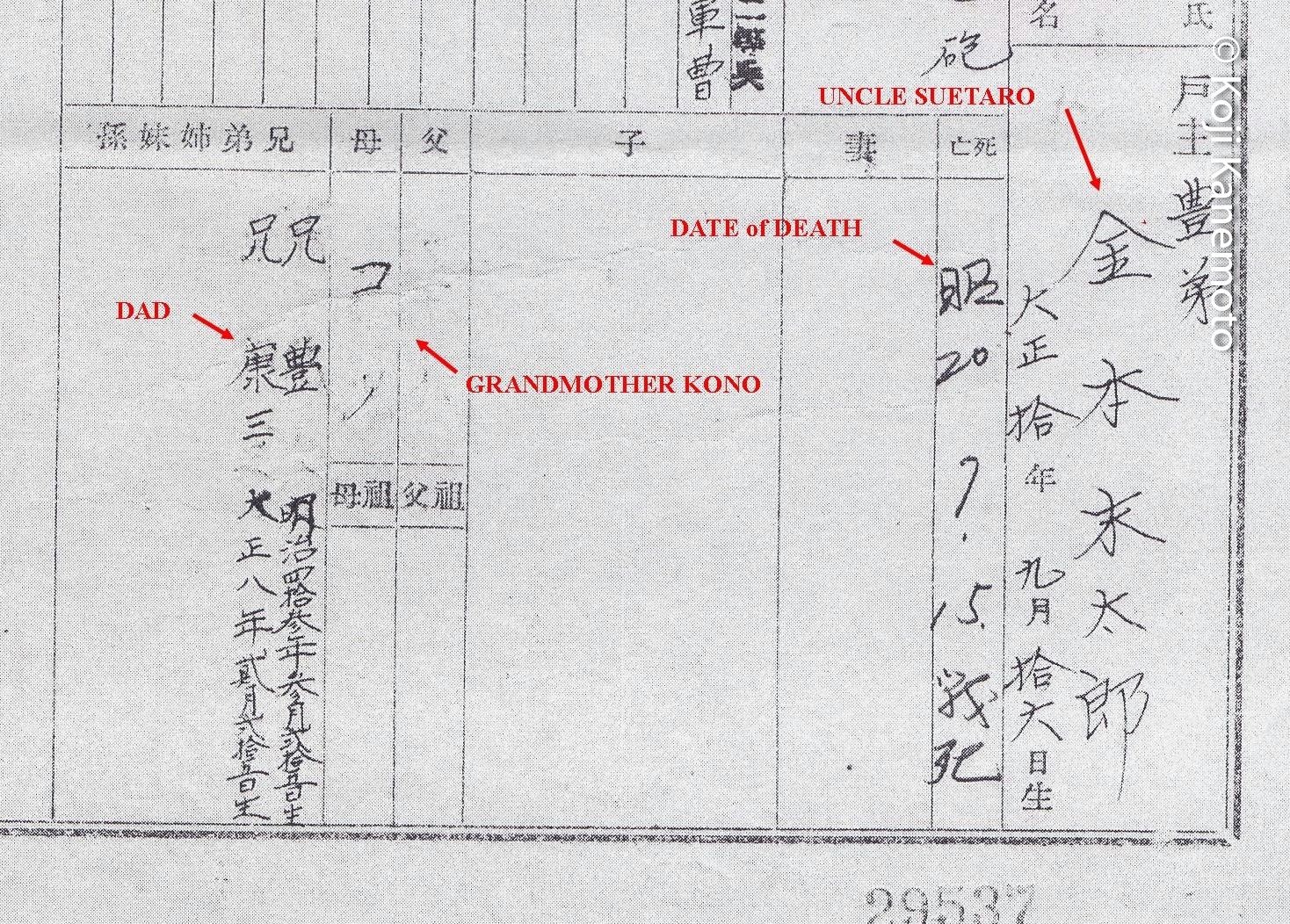
c-10-109
Excerpt from the certified military death certificate obtained by Masako. It states his place of death was 20 km north of Villaba, Leyte.
c-10-111
Copy of Uncle Suetaro’s handwritten military record. Sadly, my father and Uncle Yutaka are listed as next of kin. All three were American citizens.

In Masako’s heart and mind, she then accepted Uncle Suetaro’s fate and resting place.

__________________________________

Uncle Suetaro’s Spirit Calls Out

But with the recent discoveries and stirring of beautiful memories, the spirit of Uncle Suetaro dominated her thoughts my cousin Masako said. His spirit beckoned her mightily…so much so that even with her failing legs, she determined to go “visit him”.

At eighty years of age and with ailing legs, Masako and her filial daughter Izumi journeyed to 備後護国神社, or “Bingo Gokoku Jinjya” on February 2, 2015. It is a military shrine in which resides the god-like spirits of those men who gave their young lives in defense of Japan.

Izumi wrote that she escorted Masako to offer her prayers to Uncle Suetaro at the first altar (below), believing that was a far as she could go.

c-10-112
Main entrance to Bingo Shrine and first altar. Photo by Izumi K.

Then Masako, in a stunning revelation, said, “I am going to climb to the top… Suetaro is calling for me.”

No joke.
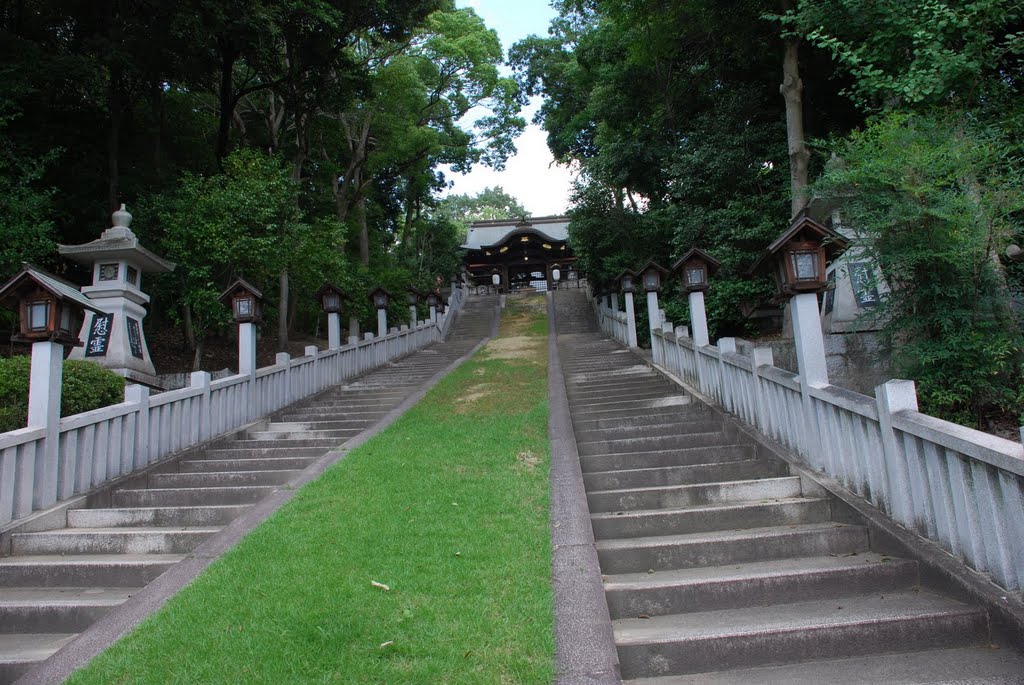
bingo steps
The steps Masako climbed – with her bad legs and knees – to get to the main shrine at the top…on her own… Without help from her filial daughter, Izumi. She said Uncle Suetaro was watching over her. (Photo source unknown.)

Izumi was beyond belief. Stunned.

Her mother was going to walk up the numerous steps that reached upwards towards the brave spirits. No cane. No assistance. By herself.

Masako climbed the steps, one by one. Determinedly.

Izumi wrote to me that upon reaching the top, Masako said in her Hiroshima dialect (translated by me), “Whew..! I made it! I climbed the stairs! You know, I feel Suetaro was nudging me from behind, all the time.” (「まあ~ あがれたわ~ 末太郎さんが後ろからおしてくれたんじゃろ~か???」)

Here is a link to a video from youtube of the shrine and stairs. It is so peaceful, you can hear Uncle Suetaro whispering. No wonder Masako had to climb those stairs:

From that day, Izumi says, Masako had renewed her life energy, all due to the call from Uncle Suetaro’s spirit.

But she did voice in reflection, “Suetaro was starving… When I think about that, dieting is nothing (meaning she can do it).”

Or, “Suetaro must be so lonely… When I think of that, I feel that we must go to Leyte to visit him and offer our prayers so he won’t be lonely anymore.”

…then, “Now I’ve got to go to the pool to strengthen my legs… so that I can walk on Leyte.”

And she means that.

She is likely going to Leyte this year.

And it looks as if Izumi and I will be going, too.

________________________________________

Epilogue
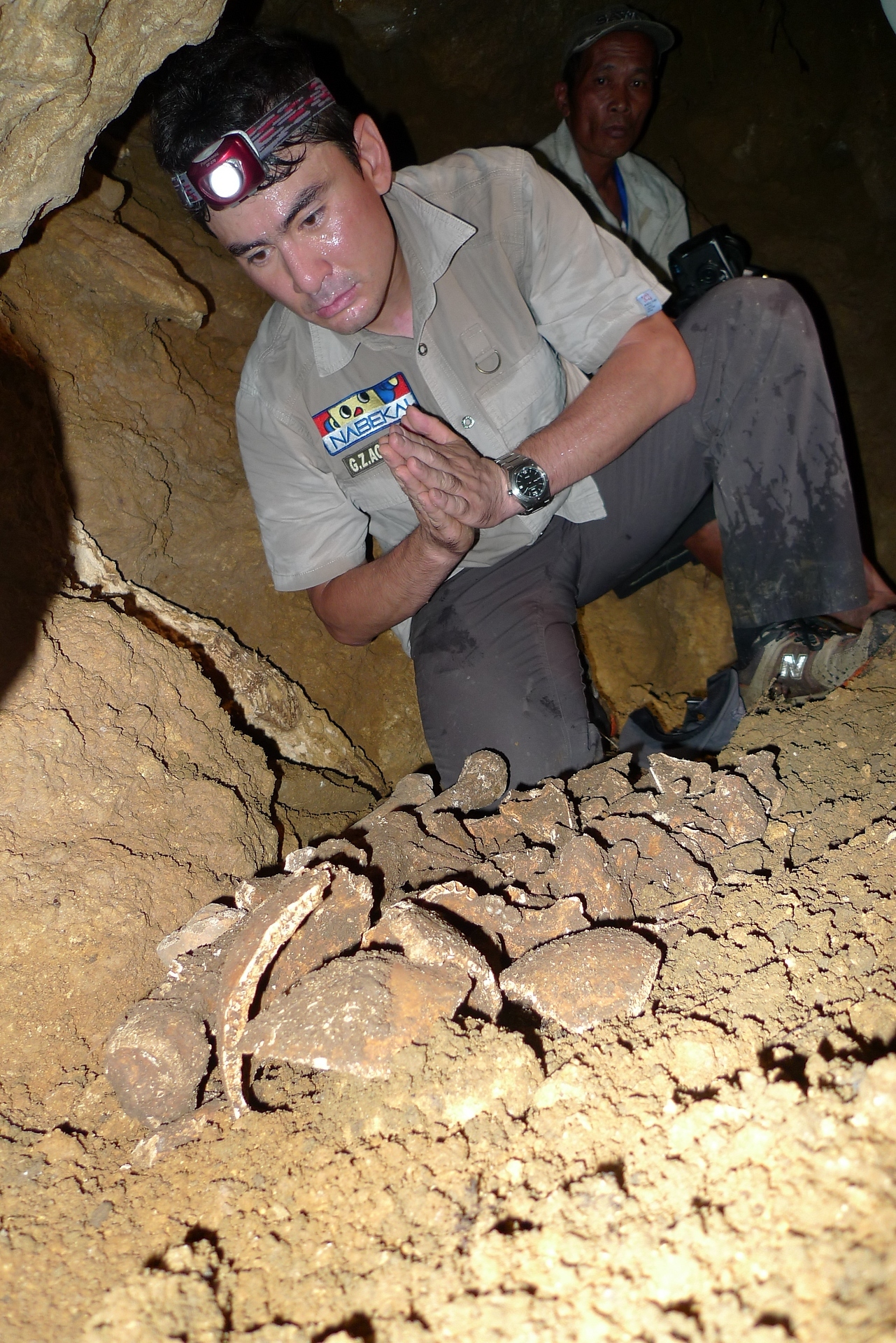
hone2
I believe this young man is called Noguchi but am not positive. He journeyed to Leyte to cremate any Japanese soldier’s remains he finds as in the above. He is in one of the hundreds of caves on Leyte. His Japanese website is here: http://www.noguchi-ken.com/M/2008/10/51133019.html

Uncle Suetaro’s Soul and Resting Place

Uncle Suetaro’s dreams of life in America died with him…shared only by him. But his spirit lives on.

Perhaps somewhere on Leyte, while surrounded by the US Army, he glimpsed up at the night sky through the dense palm fronds. Rain fell upon his unwashed face. Perhaps he was wounded and if so, perhaps shivering from a raging infection. If he lived until morning, he found each dawn worse than the dawn before. He was starving.

He knew inside his heart he was not evil… But if I am not evil, why am I here dying?

While I cannot speak to how my Hiroshima cousins feel, to me, the hard evidence tells me Uncle Suetaro did make it to Leyte as a soldier in the IJA’s 41st Regiment. With the good help from Mr. Ota, his official military records document that.

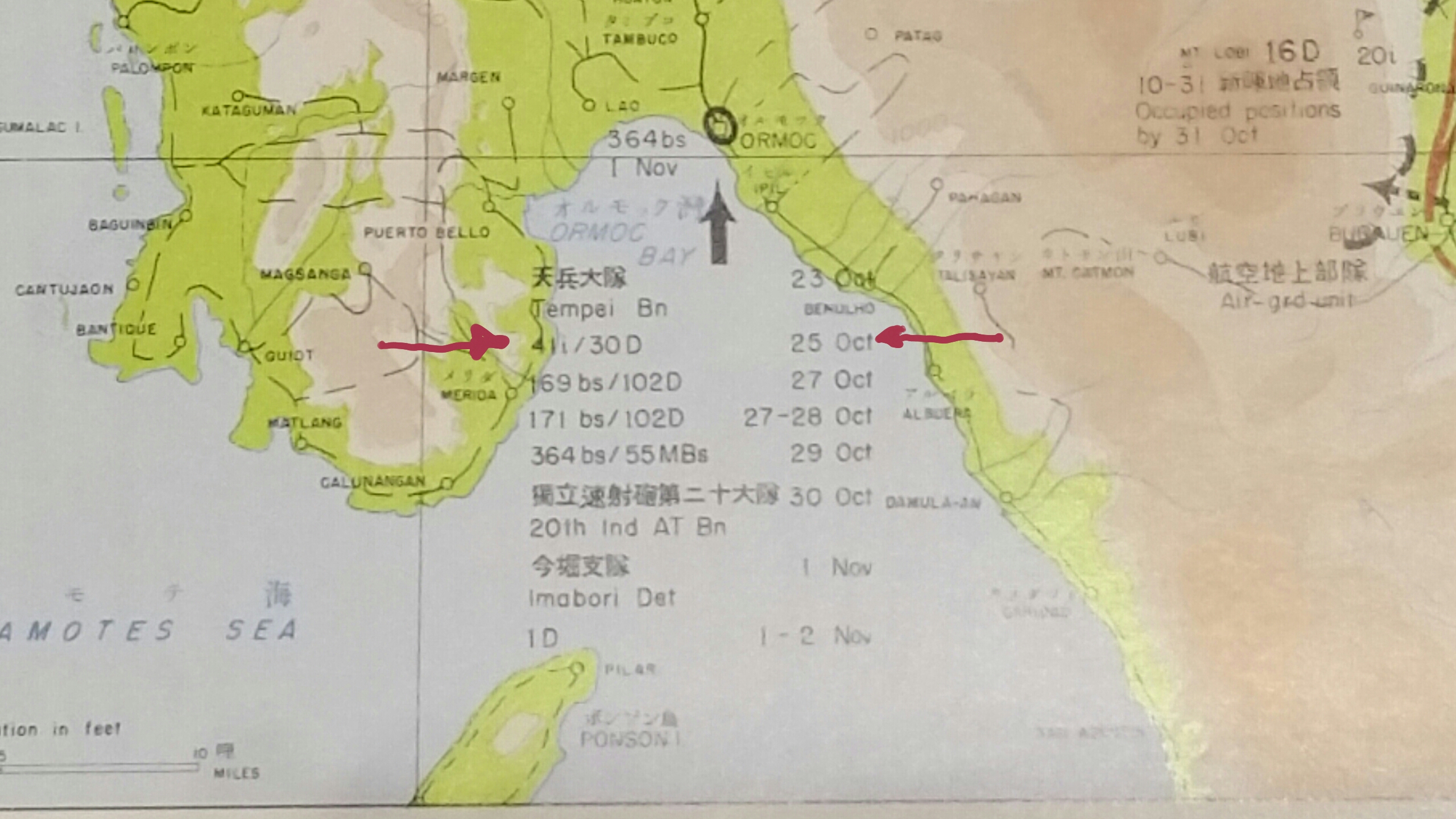
But truthfully, I don’t know if he was in the troop convoy that disembarked on October 26th in Ormoc. Records indicate that only two of three battalions of the 41st Regiment landed there; the third battalion remained on Mindanao for a short period. Yet, it appears that even that last battalion headed to Leyte in short order.

Due to Mr. Ota’s notes and as corroborated by official US Army combat records, Uncle’s 41st Regiment did fiercely engage Colonel Newman’s 34th Infantry at the end of October and that one of Suetaro’s lieutenants was killed during that violent combat.

Combat records of the US 12th Cavalry Regiment document that once again Uncle Suetaro’s unit was engaged in combat. The presence of the 41st Regiment was confirmed by dog tags, having been removed from Japanese bodies then translated by Nisei’s in the US 8th Army’s 166th Language Detachment – the same unit my dad was assigned to in 1947.

There is second hand testimony that a few survivors had assembled on Mt. Canguipot from January 1945… and “mopping up” actions by the US Army units continued. Indeed, it was far from a “mopping up” situation.

Those of you versed in WWII will know of how enemy corpses were handled – down to the use of lye – so there is no need for elaboration. If you are not familiar with how death is handled in a WWII battlefield, the only thing you need to know is it is odious.

Therefore, how he met his death will never be known…nor his place of rest uncovered with his identification intact. Perhaps there was a picture of him and his siblings in his pocket that has long since dissolved away. But dedicated Japanese citizens visit these battlegrounds in search of Japanese remains to cremate them. Maybe Uncle Suetaro has been given such an honor.

I can only hope death had a heart…that he did not suffer for so long only to endure an agonizing death in a lonely confine… but statistically, over 60% of the 2,875,000 Japanese war deaths was attributed to starvation or illness (including those arising from wounds and lack of medical care).

Indeed, Uncle Suetaro is a soul lost in a faraway jungle.

yasukuni collage
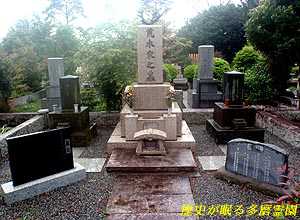
My oldest son and I visited Tokyo in August, 2012. One stop was at the Yasukuni Shrine, Japan’s equivalent of our Arlington National Cemetery in a way. We left a prayer for Uncle Suetaro. May your soul be at peace, Uncle.

___________________

Mr. Ota, on behalf of my family here in the US, I thank you for your help in our search for Uncle Suetaro.

大田様、大変お世話様でした。米国におる金本ファミリーは感謝しております。お礼を申し上げます。

正子さん、いずみさん、淳さん, 俊郎さん、有難う御座いました。末太郎さんは大喜びでしょう。。。

__________________________________________

Part 1 is here.

Part 2 is here.

Part 3 is here.

Part 4 is here.

Part 5 is here.

NOTES:

  1. Yes, some holdouts continued to fight the Allies after war’s official end and more lives were lost on both sides. And indeed, there were two notable soldiers who held out for many, many years. Sgt. Onoda was the longest holdout, living for 29 years in a Philippine jungle until his former commanding officer flew to the Philippines then personally rescinded his order to stay and fight but this is atypical.

A Soul Lost in a Faraway Jungle – Part 5


hwy 2 carigara
Road conditions between Jaro and Carigara at time of battle. Conditions get much worse. American battle reports state the rain would be so intense that you could not see past several yards. Traversing hilly, slick and muddy jungle terrain was beyond description. US Army photo.

Leyte – November 1, 1944

US version of battle, October 30 – November 1, 1944. Return to Leyte.

When we left Part 4, at least one of Uncle Suetaro’s officers – 1st Lt. Shioduka –  was killed during this battle per Mr. Ota’s book.  If so – and if Uncle Suetaro himself survived – he would possibly left in charge of his 37mm anti-tank gun platoon being a Master Sergeant.

After retreating, Mr. Ota understands that around 2:20 pm, the surviving troops of the 41st Regiment tried to dig in along the banks of the Ginagon River and wait for the US troops to advance into their sights.  However, after doing so, a deluge flooded the river and they were forced to move.  Nevertheless, defensive positions were established just north of Jaro.

Per Cannon’s Leyte: Return to the Philippines:

At 8 am on 30 October, Colonel Newman ordered the 3d Battalion of the 34th Infantry to start for Carigara down the highway. As the battalion left the outskirts of Jaro, with Company L in the lead, it came under fire from Japanese who were dug in under shacks along the road. Upon a call from the commanding officer of Company L, the tanks came up in a column, fired under the shacks, and then retired. The leading platoon was drawn back so that artillery fire might be placed on the Japanese, but the enemy could not be located precisely enough to use the artillery. Colonel Newman then ordered a cautious movement forward without artillery support, a squad placed on each side of the road and two tanks in the center. The squads had advanced only fifty yards when Japanese fire again pinned them down.

When Colonel Newman came forward and discovered why the advance was held up he declared, “I’ll get the men going okay.” Upon hearing that the regimental commander was to lead them, the men started to move forward. The Japanese at once opened fire with artillery and mortars, and Colonel Newman was hit in the stomach. Although badly wounded he tried to devise some means of clearing the situation. After sending a runner back with orders to have Colonel Postlethwait fire on the Japanese position, he said, “Leave me here and get mortar fire on that enemy position.” As soon as possible Colonel Newman was put on a poncho and dragged back to safety.¹

At this point in battle, Mr. Ota reports, a M4 Sherman was proceeding up the left side of the highway when it came under fire.  As the gunner was in the process of reloading (i.e., the breech was open), a 37mm anti-tank round directly entered the M4 Sherman’s 75mm barrel, passed through and carried through the radio before detonating.  While all three tank crew members were wounded, the results would have been more disastrous if a round was chambered.  Uncle Suetaro manned 37mm anti-tank guns.

Around Jaro and Tunga, fierce and intense see-saw battles took place.  Continuing on with Leyte: Return to the Philippines, it reports:

Company E pushed down the left side of the road but was halted by fire from an enemy pillbox on a knoll. A self-propelled 105-mm. howitzer was brought up, and fire from this weapon completely disorganized the Japanese and forced them to desert their position. When the howitzer had exhausted its ammunition, another was brought up to replace it. By this time, however, the enemy’s artillery was registering on the spot and the second was disabled before it could fire a shot.

Elements of the 41st Infantry Regiment, protected by artillery, gathered in front of Company E and emplaced machine guns in a position from which they could enfilade the company. Thereupon Company E committed its reserve platoon to its left flank but shortly afterward received orders to protect the disabled howitzer and dig in for the night. A tank was sent up to cover the establishment of the night perimeter. Company G received orders to fall back and dig in for the night, and upon its withdrawal the Japanese concentrated their fire on Company E.  Although badly shaken, Company E held on and protected (a damaged) howitzer…. Company E then disengaged and fell back through Company F, as Company G had done.

Under the protective cover of night, the 41st Infantry Regiment retreated.

Uncle Suetaro’s 41st Regiment, along with troops that had landed at Ormoc during the naval Battle of Leyte Gulf, had succeeded for the moment to stall the advance of the US 34th Infantry.  But fighting would continue.

2015-02-22 10.48.21
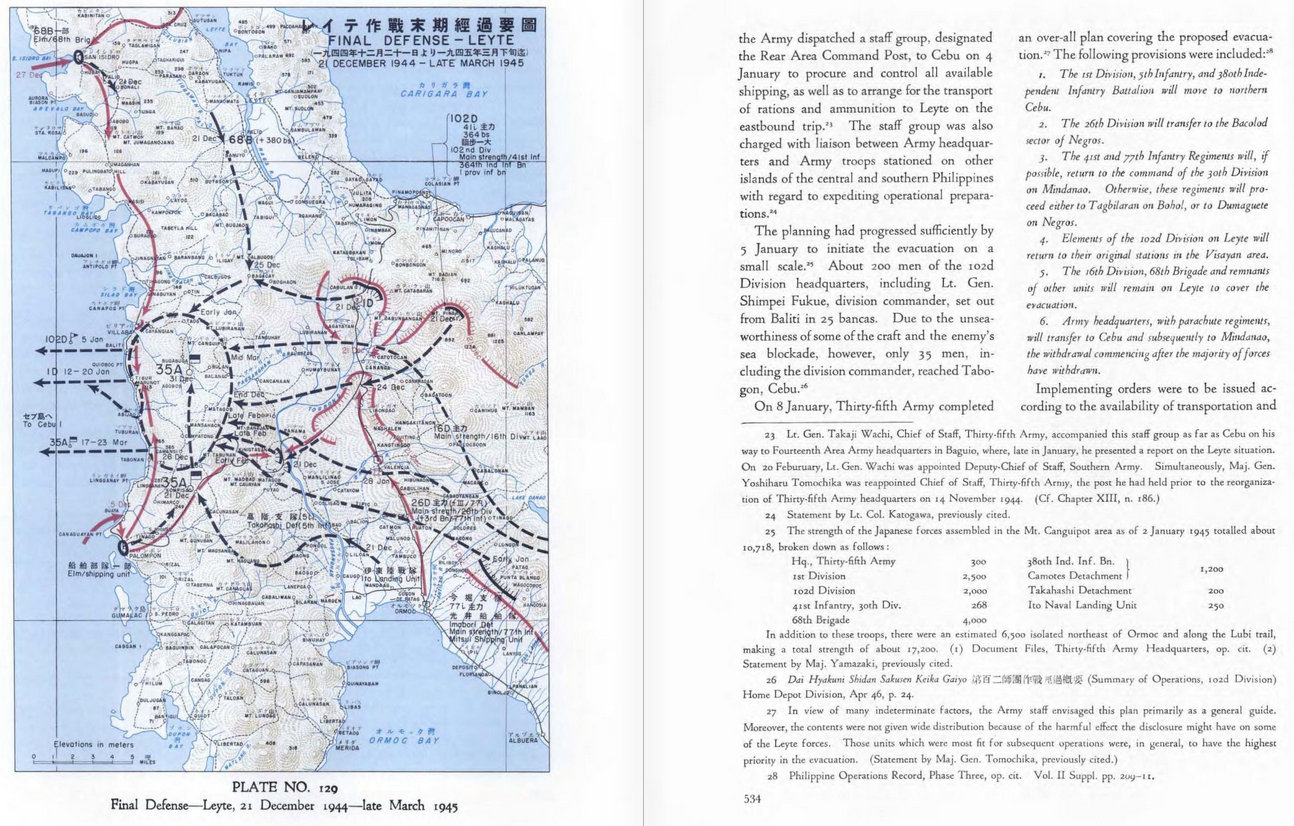
Situational summary of what happened after the fight for Mainit Bridge. You can enlarge the view by clicking on the image. From Reports of General MacArthur.

On November 1, General Suzuki determined defending Carigara was untenable.  As such, and during the night following, General Suzuki withdrew his troops from Carigara.  He ordered his remaining troops – now low on food, ammunition, overwhelmed with dying wounded and no hope for adequate re-supply – to establish strong defensive positions in the mountains southwest of the town in the vicinity of Limon.  By “clever deception as to his strength and intentions,” the enemy completely deluded the Americans into believing that his major force was still in Carigara per the Sixth Army’s Operations Report, Leyte.

Of significant note, a massive typhoon hit the Philippines on November 8, 1944.  Trees were felled and the slow pace of resupply nearly ceased.  Trails were washed away with flooding at the lower elevations.  This affected both the IJA and US forces, likely the Japanese the hardest.

I wonder what Uncle Suetaro was feeling as the intense rain from the typhoon pummeled him in the jungle while being surrounded by the US Army.  He could not light a fire even if it were safe to do so.  I wonder how cold he was or if he was shivering while laying in the thick mud.  I wonder what he was eating just to stay alive let alone fight for his life.

Breakneck Ridge: Second Phase

Per Leyte: Return to the Philippines, the 41st Regiment is documented again:

On 9 November the Japanese 26th Division arrived at Ormoc in three large transports with a destroyer escort. The troops landed without their equipment and ammunition, since aircraft from the Fifth Air Force bombed the convoy and forced it to depart before the unloading was completed. During the convoy’s return, some of the Japanese vessels were destroyed by the American aircraft.

The arrival of these (Japanese) troops was in accord with a plan embodied in the order which had been taken from the dead Japanese officer on the previous day.² This plan envisaged a grand offensive which was to start in the middle of November. The 41st Infantry Regiment of the 30th Division and the 169th and 171st Independent Infantry Battalions of the 102d Division were to secure a line that ran from a hill 3,500 yards northwest of Jaro to a point just south of Pinamopoan and protect the movement of the 1st Division to this line. With the arrival of the 1st Division on this defensive line, a coordinated attack was to be launched–the 1st Division seizing the Carigara area and the 41st Infantry Regiment and the 26th Division attacking the Mt. Mamban area about ten miles southeast of Limon. The way would then be open for a drive into Leyte Valley.

Battle Against the US 12th Cavalry Regiment

16625205006_276938a5a8_o
Situational overview. Blue is US; red is IJA. Villaba and 1st Div are highlighted in green.

Per a US 1st Cavalry Division website (http://www.first-team.us/tableaux/chapt_02/) and with the research performed by Mr. Ota, the 41st Regiment was positively identified as being present on “Hill 2348” and fighting against the US 12th Cavalry Regiment (a subset of the 1st Cavalry Division) :

On 20 November, the rest of the 12th Cavalry became heavily engaged around Mt. Cabungaan, about three miles south of Hill 2348. The enemy had dug in on the reverse side of sharp slopes. Individual troopers were again faced with the task of searching out and destroying positions in the fog. Throughout the night of 21 – 22 November the 271st Field Artillery kept the Japanese on the northwest side of Mt. Catabaran awake by heavy concentrations of fire. Before the day was over, patrols from the 12th Cavalry had established observation posts within 150 yards of Cananga on Highway 2 in the Ormoc Valley.

Mr. Ota uncovered a 12th Cavalry report on microfiche in a Japanese governmental archive, dated November 26, 1944.  It states in part, “Dog tags from Hill 2348 confirmed elements of the 41st Regiment there.”²  In it, it states fog and the muddy terrain made for extreme conditions but they used 81mm mortars to eliminate Japanese positions.

The website continues:

On 26 November, both the 12th and 112th Cavalry Regiments launched attacks against their immediate opposition. The enemy positions that had given heavy resistance to the 112th Cavalry on the two previous days were seized in the afternoon after a pulverizing barrage from the 82nd and 99th Field Artillery Battalions. On 28 November the 2nd Squadron, 12th Cavalry launched another successful attack on Hill 2348 which took the form of a double envelopment. The 1st Squadron renewed their attack on positions on Mt. Cabungaan but sharp ridges held up their advance, The 112th Cavalry continued to move toward its objective…

On 01 December the 112th Cavalry engaged the enemy at the ridge south of Limon. On the night of 02 December, the battle for Hill 2348 reached its climax. The 2nd Squadron, 12th Cavalry suffered heavy casualties from the heavy machine gun fire, mortars, and waves of Japanese troops in suicidal attacks. On 04 December, the 2nd Squadron, 12th Cavalry attacked and overcame a position to its front with the enemy fleeing in the confusion. “A” Troop, of the 112th, in a drive to the northwest, made contact with the left flank elements of the 32nd Division. Thus the drive became an unremitting continuous line against the Japanese and enemy elements that were caught behind the line were trapped.

Throughout 07 and 08 December, patrols of the 5th and 12 Cavalry continued mop up operations. The 1st Squadron, 112th Cavalry moved out to locate and cut supply lines of the enemy who were still holding up the advance of the 2nd Squadron. On 09 December, heavy rains brought tactical operations to a near standstill and limited activity to patrol missions…

…The Division continued the attack west toward the coast over swamps against scattered resistance. By 29 December the 7th Cavalry had reached the Visayan Sea and initiated action to take the coastal barrio of Villaba. On 31 December after four “Banzai” attacks, each preceded by bugle calls, the small barrio fell.

can
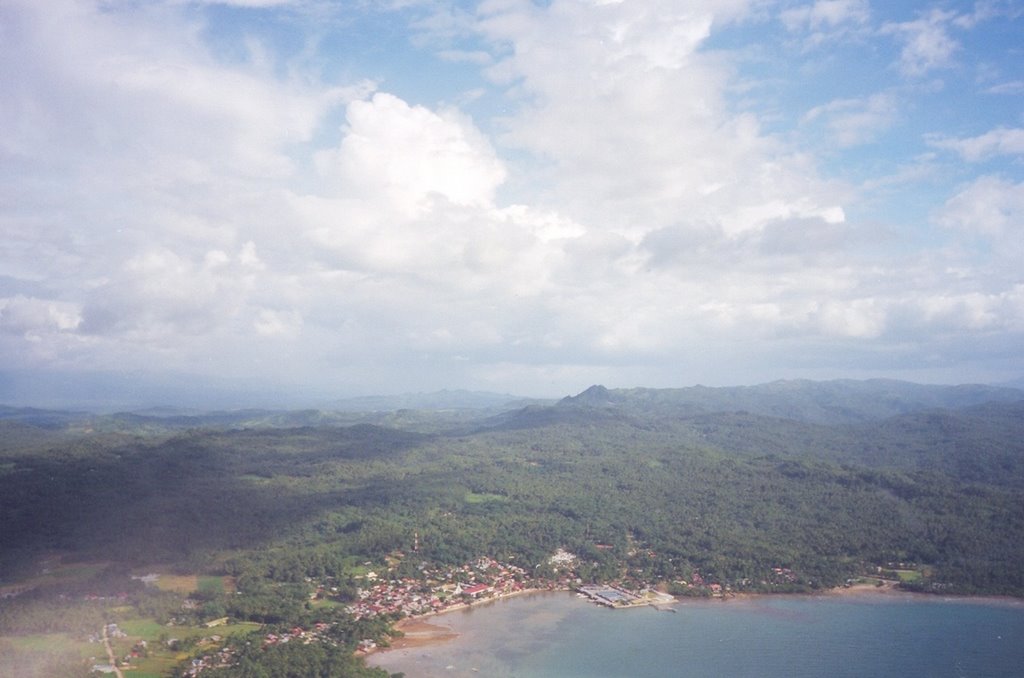
A view from offshore looking east towards the town of Villaba. Mt. Canguipot – where the survivors of my Uncle’s IJA regiment reportedly retreated – is at center.

Attempts to Leave Leyte

By January 1945, Japanese command was in shambles.  However, some planned effort was made by the IJA to retreat (evacuate) to other islands.  Certain departure points were selected south of Villaba, east of the island of Cebu.

The Japanese only had 40 seaworthy landing craft available to evacuate survivors.  (A record exists which estimated 268 soldiers of the 41st Regiment were left out of the 2,550 that landed at Ormoc on October 26, 1944.)  The US ruled the seas and the skies making any large scale evacuation impossible.

The Reports of General MacArthur states only about 200 soldiers were able to board the landing crafts; however, only 35 made it to Cebu.  Once MacArthur figured out this was an evacuation attempt, the Villaba coastline came under intense attack.  Evacuation hopes ended for Uncle Suetaro.

Lt. General Makino attempted as best possible to assemble any IJA survivors in the Mt. Canguipot area, just a couple of miles east of Villaba.

By April, 1945, only a small number of tattered, hungry and ill soldiers were believed to still be alive.  In a Japanese book called Rising Sun, it was reported up to 100 Japanese soldiers were dying each day during this time from starvation and/or illness.³

If Uncle Suetaro was still alive, I passionately wonder what intense emotions were raging through him.  Perhaps he thought of his mother or of his remaining siblings in America.  I am here fighting to free my brothers and sister from the American concentration camps.

He must have known his young life would be ending on that island – on that hill to become another soul lost in a faraway jungle.

I can but hope his fear was overcome by tranquility.

______________________________________

The war ended four months later, on August 15, 1945.

No one walked down off Mt. Canguipot that day… in particular, my Uncle Suetaro.

An epilogue will follow and will close this series.

Part 1 is here.

Part 2 is here.

Part 3 is here.

Part 4 is here.

Part 6/Epilogue is here.

NOTES:

1. Although Aubrey “Red” Newman would survive his grievous stomach wound, he would not return to battle before war’s end.  However, he was awarded the Distinguished Service Cross for his command actions and retired a Major General.  He passed away in 1994 at 90 years of age.

2. It is just my opinion but only one of the 120 US 8th Army Nisei’s in the Military Intelligence Service on Leyte could have translated this key document in less than a day.
3. I am not convinced of this information’s authenticity.

A Soul Lost in a Faraway Jungle – Part 4


15846903294_50f8d8c3f9_o
From left: Dad, Uncle Yutaka, Uncle Suetaro, Grandmother Kono, Aunt Mieko, Grandfather Hisakichi and Aunt Shiz.  Circa 1925 in Seattle, WA.

My father will be 96 years old later this month in February.  He is the only one left out of the above family picture taken in Seattle.

Yet, even last year, he fondly recalls his younger brother Suetaro (standing in front of my Grandmother above) while growing up in Hiroshima before the war.  That’s all he remembers now – his fun childhood years in Hiroshima.  He has memory issues.  Quite a bit now.  He calls me Suetaro or asks me how he is doing.

One story he told me was they would walk to the train station together in the morning to get to school; they would take turns slowly pedaling the only bike they had, riding alongside the other brother who was walking.  They would simply leave it by a merchant next to the train station and hop on the train.  However, when school got out, whoever got to the bicycle first would get to ride it home, leaving the other brother in the dust – or rain.

_____________________________________

Dulag, where Lt. Gen. Makino's HQs were moved from.  Oct. 29, 1944.Used with permission from my flickr friend, John T.  By clicking on the image, you can see other archival photographs in his collection.
Dulag village, where Lt. Gen. Makino’s HQs was moved from. Taken Oct. 29, 1944.  Utter destruction.  Used with permission from my flickr friend, John T. By clicking on the image, you can see other archival photographs in his collection.

Combat – Mainit River

When we left Part 3, Uncle Suetaro – now a Sergeant (軍曹) in the Imperial Japanese Army (IJA) – was to be headed towards Jaro and the Mainit River bridge at dawn.  The orders for his 41st Regiment was to defend it against the fast-advancing US Army, specifically the 34th Infantry.

According to Mr. Ota and if my translating is correct, the town of Jaro is situated by a river which runs along the base of a mountain.  At that time, elements of the IJA 33rd Regiment had set up some defensive positions around the bridge.  Per Leyte 1944: the Soldiers’ Battle, these defensive positions included earthen pillboxes covered with grass and spider holes; they also had an ammo dump.

c-10-98
Uncle Suetaro during mandatory high school military training, May 10, 1939 at the “Hara Mura Training Grounds” in the Hiroshima Prefecture. My father had returned to Seattle two years earlier. Suetaro, too, was due to return to Seattle soon hereafter…but did not.

Regimental commander Iwatani intended on ambushing the US Army soldiers and prepared as best possible on the road approaching the bridge (Highway 2).  During the night, he decided the 2nd Echelon (5th Company plus Communications Officer Nakamura) to move from Carigara to the defensive position to bolster its strength.  The remnants of the 33rd Regiment from the 16th were also assigned (they took heavy losses fighting the US Army at Palo and had retreated to this area).

Ordered to leave their knapsacks behind to lighten their load (perhaps the commander knew it would be a one way trip), the group left early on the 28th for the six kilometer march to Jaro.  They double-timed from about the half-way point on the relatively level road to Jaro.   They reached the outskirts of Jaro and began to deploy as ordered.

15971775964_6af3065bf6_o
Mainit Bridge is at the 4 o’clock position, just outside the circle formed by the broken lines. From the Reports of General MacArthur. (Note: If you are accustomed to viewing US battle maps, the colors are switched since this is based on post-war Japanese sources. Black is the Imperial Japanese Army, red the US Army.)

In his book, he reports that the 41st Regiment was dispersed; one company and one platoon consisting of two machine gun crews were deployed on the east in addition to one platoon manning two 37mm anti-tank guns.  The tattered battalion of riflemen from the 16th Division, 33rd Regiment were deployed to the west.  They were ready to ambush the approaching Americans in Iwatani’s mind but their intelligence was very flawed.  Most of all, these troops did not know the Imperial Japanese Navy had lost the major sea battles surrounding Leyte.

On October 30th, Lt. Col. Thomas E. Clifford, Jr., the commanding officer of the 1st Battalion, advanced through the town of Alangalang a mile and a half south of the Mainit River bridge.

Per Leyte: Return to the Philippines:

“As Company C reached the Mainit River, it made contact with the (Japanese), who had dug in on both steeply sloping banks of the river at the steel bridge crossing. The company suffered five casualties. It was opposed by the remaining elements of the 33d Infantry, which had been considerably mauled by the Americans. Company C withdrew 300 yards as Companies B and A pressed forward on the left side of the road under continuous rifle fire.  Colonel Pearsall’s 2nd Battalion had followed the 1st Battalion, and both units were to make an assault against the 41st Infantry Regiment, which had arrived in the area. Three batteries of the 63d Field Artillery Battalion shelled the enemy positions for a depth of 300 yards on the eastern side of the river and 100 yards on the western side.”

At this time, per Mr. Ota’s book, it is believed the 41st Regiment was stretched out and pretty much decentralized with respect to command.  As such and to their benefit, it is reported that the effect of the artillery barrage was minimized.  This is not directly mentioned in the US battle reports.

jaro us soldier
A US soldier seeks cover behind a US 37mm anti-tank gun near Jaro. National Archives.

Leyte: Return to the Philippines continues:

“After the artillery concentration was over, the two battalions were to move out to the attack – the 1st on the left and the 2nd on the right. The regimental commander ordered the 1st Battalion to attack, destroy the enemy resistance, and secure the eastern bank of the river. Five tanks were to follow in the rear of the assault companies and fire at targets of opportunity. Five hundred yards away, to the right of the 1st Battalion, Companies E and F of Pearsall’s battalion were to cross the river, destroy enemy resistance on the western side, and then go south on Highway 2 to contact the enemy at the bridge.”

The Japanese defenses were well thought out; the Japanese excelled at defense.  However, the grasses in front of the earthen pillboxes used as camouflage began to smolder as the Japanese fired their weapons, becoming a smoke signal for American artillery fire.  They were quickly eliminated and most violently.

The 1st Battalion moved to the water’s edge, where it was pinned down by enemy fire. Companies E and F of the 2nd Battalion, however, were able to push north 500 yards through the heavy brush, and amid a driving rain they managed to ford the river unobserved. Once on the other side they charged the entrenchments of the 41st Infantry Regiment on the river, with Company F in the lead. As Company F neared the bridge it overran three mortar positions without stopping but was finally halted by heavy machine gun fire. After the company’s 60-mm. mortar had knocked out the machine gun, the unit continued to advance and passed the bridgehead before it ran out of ammunition. Company E then relieved Company F, while the latter set up heavy machine guns to silence enemy machine guns in the woods to the west. By 1500 the bridge was in American hands. The Japanese had placed a demolition charge on the bridge, but the American advance had been so swift that the enemy never had an opportunity to set off the charge.”

There was gruesome close quarters combat.  In reference to Company F above, led by Captain Austin, the 2nd Battalion, 34th Infantry charged the Japanese defenders with bayonets and eliminated them.

れいて
Found this image through using Japanese search terms. No source was indicated but it said Japanese troops were not prepared for the Leyte jungle ecosystem.

During this battle, 1st Lt. Shioduka, in command of the 37mm anti-tank guns my Uncle Suetaro was apparently manning, was killed in action per Mr. Ota.

The surviving remnants of this Japanese defensive force retreated through Jaro.  By 5 pm, the 34th Infantry successfully occupied Jaro.

Per Mr. Ota’s research, it appears that although the demolition charges had been set, the combat engineer who was in charge of the detail was killed.  As such, no order to blow the bridge was issued and because of this strategic failure, Sherman M4 tanks and heavy artillery pieces were able to continue on to Carigara.

While I do not believe this film compilation to be an official US Army release, it may provide you with a possible glimpse into that war.  However, no movie can ever transmit to you, the reader, the immensity of the fear that was being experienced by both the American and Japanese soldiers.

Both sides.

Every minute.

Every hour.

Every Day.

Also note combat film from that period had no sound; all sound you hear has been edited in.  It is set to start at the 2:15 mark:

To be continued in Part 5.

________________________

Part 1 is here.

Part 2 is here.

Part 3 is here.

Part 5 is HERE.

Epilogue is HERE.

A Soul Lost in a Faraway Jungle – Part 3


Jaro
Current Google map of Leyte battle area, inserted for ease of viewing and geographical orientation.

Battle Situation Overview

Even before my Uncle Suetaro and his 41st Regiment of the Imperial Japanese Army landed in Ormoc at dawn on October 26, 1944, the US Sixth Army’s X Corps fought through four miles of beach between the Palo River and the Tacloban airstrip.  XXIV Corps further south also made significant progress, overcoming the Japanese resistance.  However, incredibly swampy terrain was more their enemy than the Japanese at times.

By the end of A-Day, the 1st Cavalry Division had secured the Tacloban airstrip.  Most critically, Lt. General Makino, commanding Uncle Suetaro’s 41st Regiment and the 16th Division, was forced to evacuate his Command Headquarters in Dulag (below) to a village called Dagami.

dulag airfield leyte
The inevitable violence of war.  Dead Japanese soldiers lay next to a knocked out Type 95 Japanese tank at Dulag Airfield. Dulag was the location of Lt. General Makino’s headquarters. October 20, 1944. National Archives.

First: Irony

In closing Part 2 of this series, the US 8th Army’s Military Intelligence Service (MIS) was mentioned.  During the war in the Pacific, nearly all MIS soldiers were Japanese-Americans.  Caucasians were primarily officers although a few NCOs were assigned.

Although Uncle Suetaro’s older siblings (my dad, Uncle Yutaka, Aunt Shiz and their families) remained imprisoned in the US concentration camps for people of Japanese blood until war’s end, my dad did volunteer for service in the US Army in February 1947.

After prodding, my dad told me and my cousin Neil (Yutaka’s son) he volunteered because by doing so, he’d get three chevrons on his sleeve; but, if they drafted him, he’d be a lowly buck private.  “More pay,” he told us.

The story I choose to believe, however, is that Uncle Yutaka –  then living in Chicago and now the leader of the entire family – implored or directed my dad to join up solely to check up on their mother and remaining sister, Michie, in Hiroshima.  Of course, the anguish of not knowing what happened to their youngest brother – my Uncle Suetaro – played a deep, silent role.  This is a belief that I have not shared with others.

Well, Dad got his chevrons and sergeant’s pay.  He became part of the famed MIS, post-hostilities.

c-10-94
Photo of Dad translating a document. Taken at US 8th Army HQs in Yokohama, Japan. April 1948.

________________________________________

11th ab
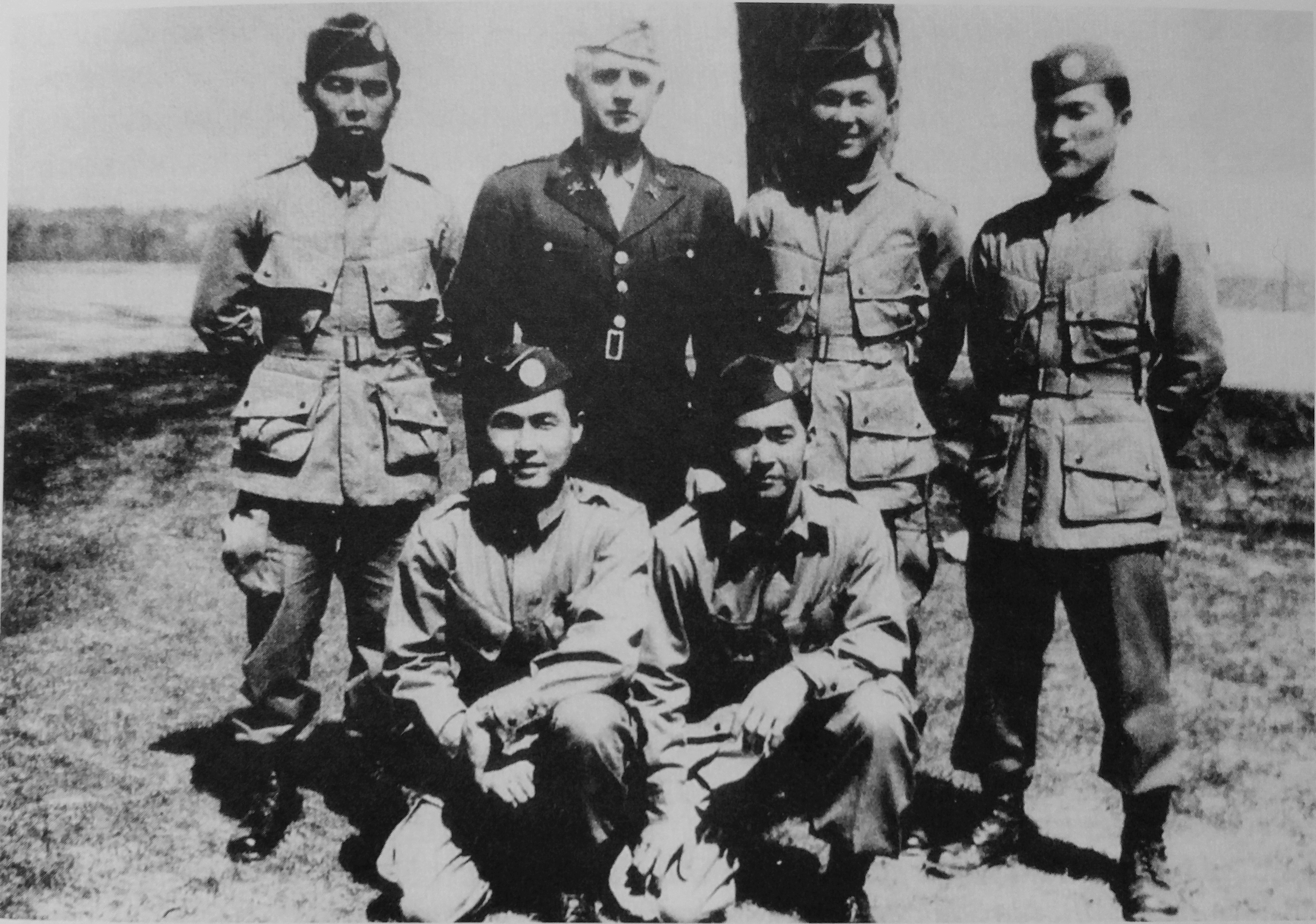
Five MIS Nisei pose with Colonel Rasmussen after receiving their jump wings. Do you think it odd to see Japanese-Americans in US Army paratrooper uniforms?  They were assigned to the famed 11th Airborne Division which eventually fought on Leyte and Luzon.  From Pg. 127 of Nisei Linguists.

As my Uncle Suetaro fought for Japan and his life on Leyte, the MIS was diligently doing their patriotic duty as US Army soldiers to end his life.  Dr. James C. McNaughton writes in his authoritative book, Nisei Linguists:

On 20 October the Nisei language teams went ashore with the assault elements of four divisions and two corps. Maj. George Aurell led the Sixth Army team.  His team sergeant, S.Sgt. Kazuo Kozaki, recalled: “We were kept busy all day and immediately. There were loads and loads of captured documents, although no prisoners were taken yet. I had to virtually wade through a pile of papers—operation orders, operation maps, manuals, magazines, books, paybooks, saving books, notebooks and diaries, handwritten or printed, official or private — to find out if there was any valuable information for our immediate use.”

Some Nisei saw direct combat. When the Japanese counterattacked the 7th Infantry Division, the Nisei “were a little bit heroic,” a Caucasian sergeant recalled. “They would climb on board a Japanese tank going by, knock on the
things, converse in Japanese, and as soon as the door popped open, they’d drop a hand grenade — boom!”

On 25 October two more Sixth Army language detachments arrived on board a landing ship, tank…”

One hundred and twenty Nisei’s and Kibei’s served on Leyte.¹

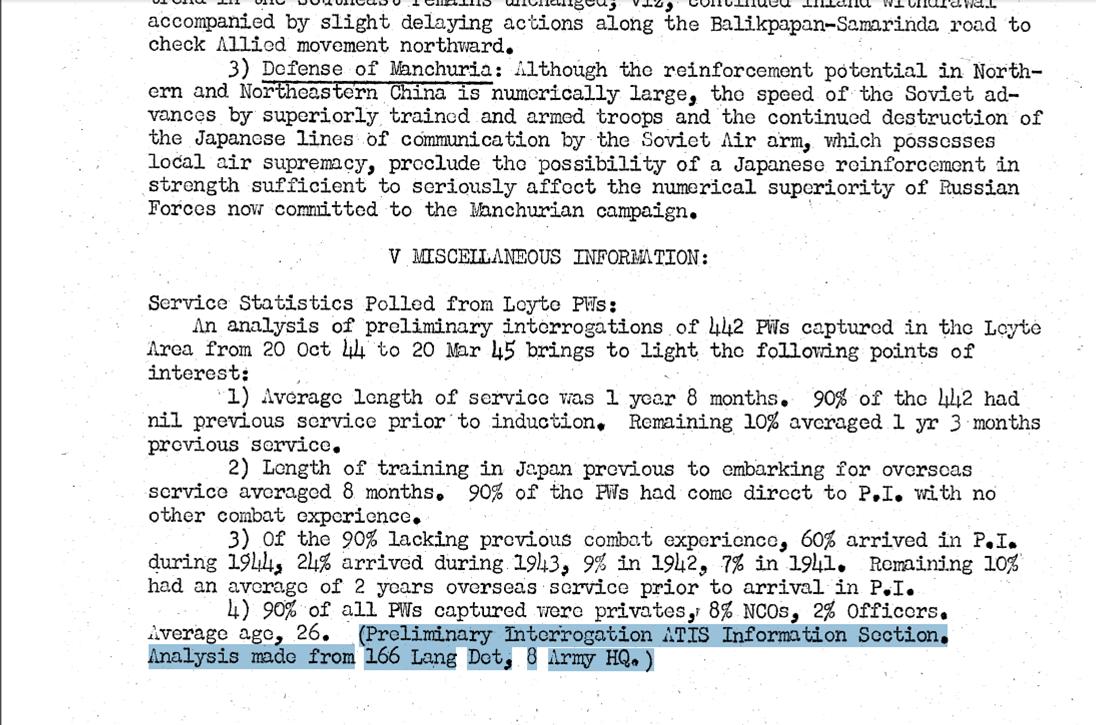
The unspoken irony for my father is here, hidden in this secret behind-the-scenes world.  If you note the highlighted print in this once top-secret US 8th Army report, it states, “Preliminary Interrogation ATIS Information Section.  Analysis made from 166 Det, 8 Army HQ”.

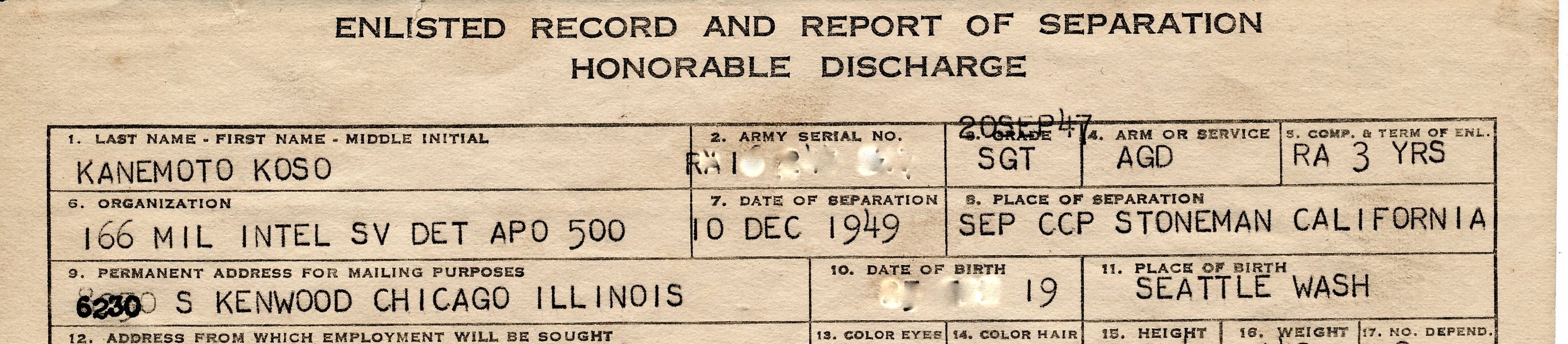
166thHere is the pertinent section of my dad’s discharge papers:

166th detHe served with the same G-2 166th Language Detachment that did their best to kill Japanese soldiers on Leyte – including Uncle Suetaro.  While the Nisei’s were on Leyte since the invasion began Oct. 20, 1944, they were reorganized into the 166th Language Detachment on 20 June 1945 per US Army records.

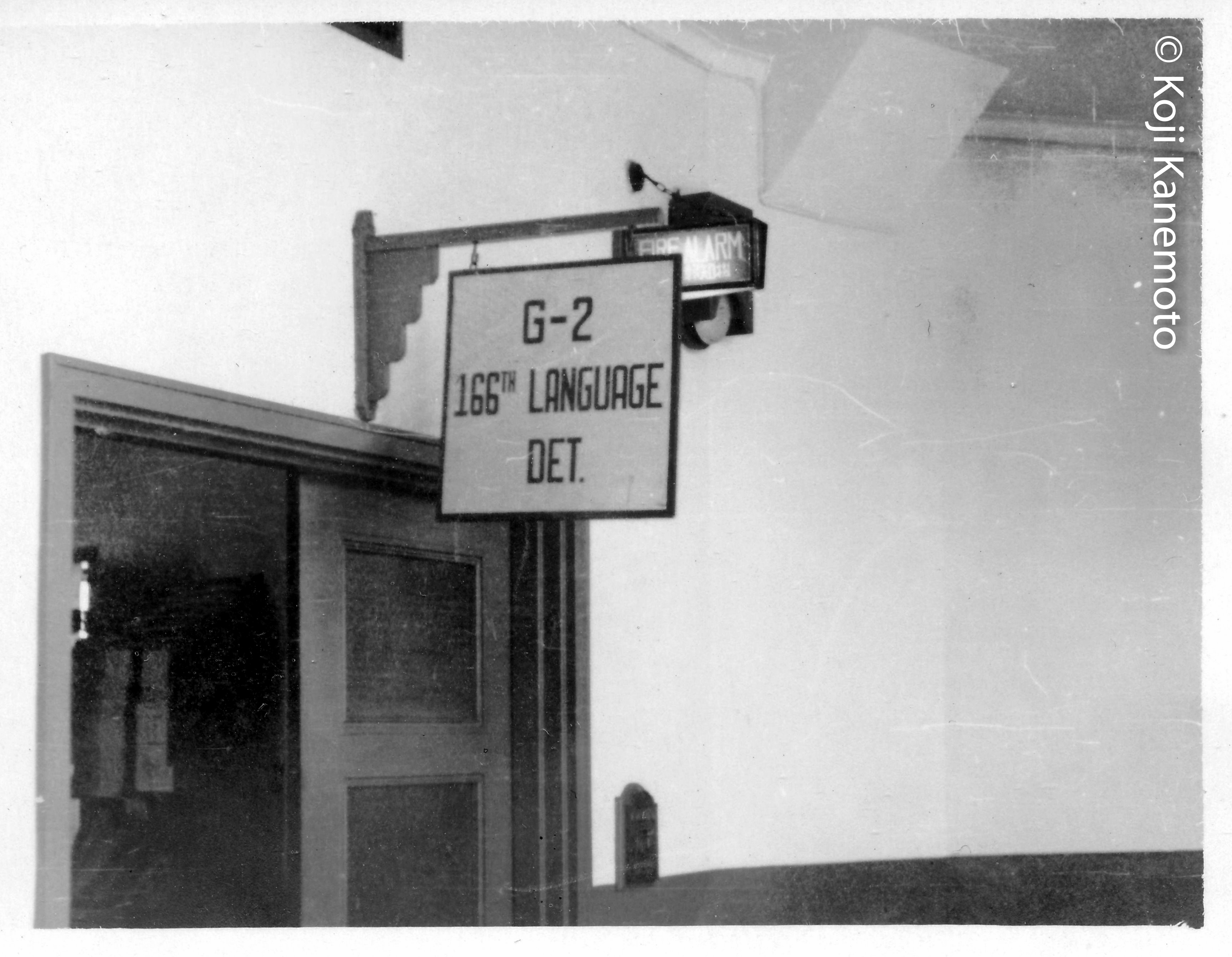
c-10-92
Picture of sign taken by my dad outside his office door in the US 8th Army HQ Building in Yokohama, Japan. Circa 1947.

I am darned sure he translated some documents captured on Leyte… where his favorite brother died.  How this must have plagued him for the rest of his life – to this very day.

____________________________________

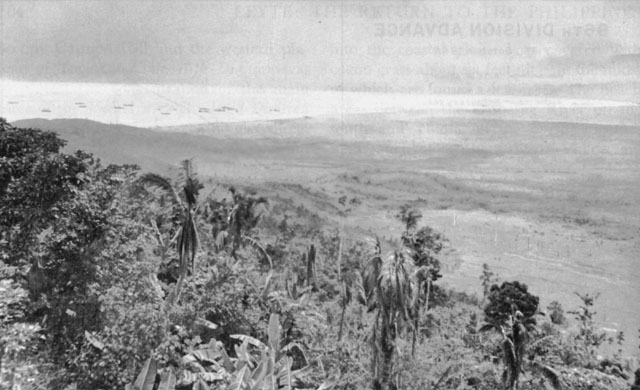
catmon hill archives
The view from atop Catmon Hill after being taken by the US Army, October 1944. The Japanese observed the US invasion forces from this hilltop position as they landed and directed artillery fire. National Archives.

Back to the War on Leyte and Uncle Suetaro…

Per Mr. Ota’s book, The Eternal 41st, the composition of the 2,550 troops that disembarked at Ormoc was:

  • Regimental HQ staff
  • A rifle company (under Sasaki)
  • An artillery squadron (under Fukunishi)
  • A signals squadron (under Nakamura)
  • 1st Battalion (under Nishida)
  • 2nd Battalion (under Masaoka)
  • An attachment of combat engineers
  • A platoon of litter bearers from a medical regiment

However, their potential effectiveness had already been negated.  It was their fate.  Per his book, it appears the troops – including Uncle Suetaro – were forced to quickly ship out of Cagayan with but a day’s notice and with only what they could essentially carry on their backs or reasonably transport: ammunition, food, lighter artillery pieces like the 37mm anti-tank gun, etc.¹  This would be the proverbial nail in their coffin as the USN and USAAF would in short order obliterate their supply chain.

{His information above is corroborated by the information in the Reports of General MacArthur as follows:

Thirty-fifth Army took immediate action to move reinforcements to Leyte in accordance with the Suzu No. 2 Operation plan, which had already been activated on 19 October. Orders were issued during the 20th directing the following units to advance immediately to Leyte, where they were to come under 16th Division command:

1. 41st Infantry Regiment (less one battalion) of the 30th Division (Army reserve from Mindanao)

2. 169th Infantry Battalion of the I02d Division from the Visayas sector.

3. One infantry battalion of the 57th Independent Mixed Brigade, from Cebu.)}

USS Portland (CA-33)
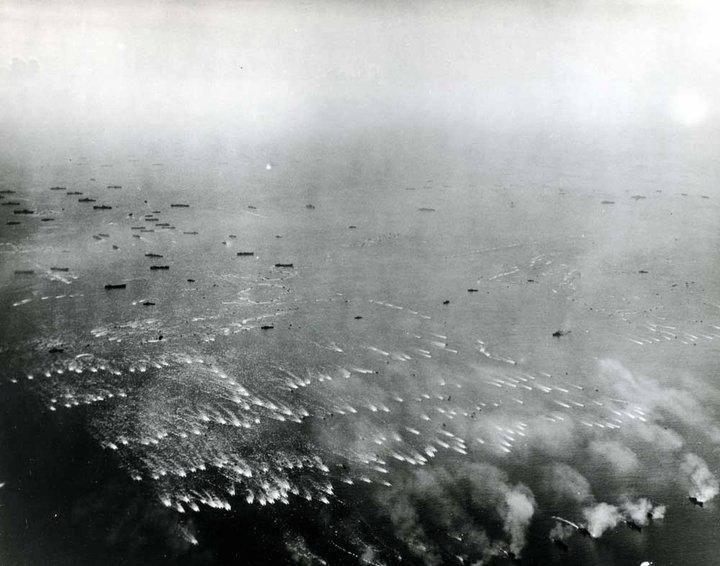
Part of Leyte invasion fleet with US Army troops assaulting Leyte beach. You can see Uncle Suetaro never had a chance.  Taken from a USN reconnaissance plane from the USS Portland. National Archives.
battle_philippines archives
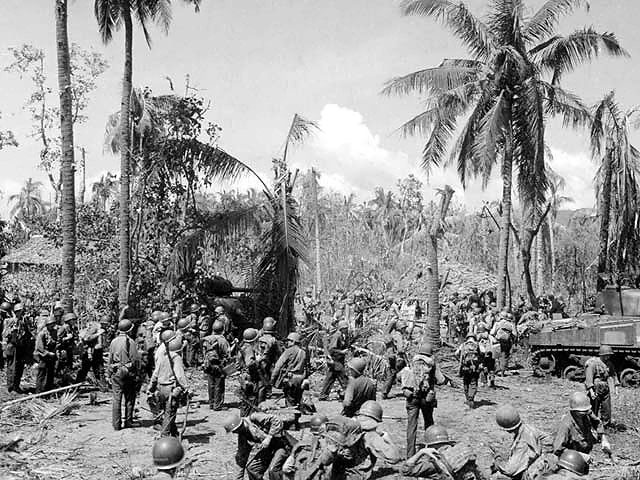
US soldiers on Leyte, October 20, 1944. National Archives

After landing in Ormoc at dawn, they became attached to the 16th Division under Lt. General Makino…but communication had been completely disrupted.  Makino’s HQ had been located in the coastal town of Dulag but it had been taken by the US 7th Infantry Division on the first day of the invasion.  Makino was in the process of moving his HQ ten miles inland to a town called Dagami five days before Uncle Suetaro landed.  Sadly, per the Reports of General MacArthur, orders had been issued by Japanese General Suzuki prior to their landing and were based on faulty intelligence:

Upon receipt of this dispatch, Lt. Gen. Suzuki and his staff began formulating a new operational plan covering the deployment of forces on Leyte. This plan, completed within the next few days, was essentially as follows ²:

1. Operational policy:

a. The Army will act immediately in cooperation with the decisive operations of the naval and air forces.

b. Reinforcements will be concentrated on the plain near Carigara.

c. Enemy troops which have landed near Tacloban and in the Dulag area will be destroyed.

d. The direction of the initial main effort will be against the enemy in the Dulag area.

e. The general attack will begin on or about 10 November.

2. Allocation of missions:

a. The 16th Div. will hold the Dulag area, Catmon Hill, and the heights west of Tacloban in order to cover the concentration of the main forces of the Thirty-fifth Army.

b. The following units, after landing at the ports indicated, will concentrate on the Carigara plain:

1st Div.-Carigara (Uncle Suetaro)

26th Div.-Carigara

102d Div. (Hq. and three battalions)-Ormoc

c. After the concentration of the Army’s main forces on the Carigara plain and adjacent areas to the southeast, operations will begin with the objective of destroying the enemy in the Dulag and then the Tacloban area.

Per Mr. Ota’s book, they slogged north to Carigara; they did make camp to rest one night in Kananga, a half-way point.  However, the US-supported guerrillas were constantly pestering the advancing Japanese force by destroying bridges and roads.  This wrecked havoc with vehicles and heavy rolling stock.  This obviously wore down artillery crews exacerbated by the rain, humidity, and limited food and medical supplies.  They still were unable to establish communication with Lt. General Makino; they were essentially going into combat pretty blind.

On or about October 28, 1944, the 41st Infantry Regiment moved from Carigara to the southeast section of Jaro.  They were to secure a bridge at a three fork highway junction.  {In corroboration, a US report states General Suzuki planned to have these troops move north along the Ormoc-Limon road (Highway 2) through Ormoc Valley, from which they were to diverge in three columns and capture the Carigara-Jaro road.³}  I believe this was the Mainit River bridge.

Unfortunately, they would soon clash violently with the US Army’s 34th Infantry, with dwindling provisions and weather combining into an insurmountable force against their staying alive.

To be continued in Part 4.

1. “Nisei” were the children of the first generation Japanese to immigrate legally to the US.  Being born here, they were American citizens.  A “Kibei” is a subset of Nisei; these Nisei children were rotated back to Japan for a period of time to learn the Japanese language with the understanding they would return to the US.  My dad is a Kibei.  KIbei’s were absolutely fluent in Japanese and formed the heart of the MIS.  In fact, some Kibei’s used to rib the Nisei “translators” because many spoke in a feminine way having learned it from their first generation mothers.
2. ULTRA intercepts reported the approach of this shipping, but MacArthur’s staff at first thought they indicated the beginning of an enemy evacuation. The necessary diversion of Third Fleet and Seventh Fleet aircraft for operations against surviving Japanese fleet units and the incomplete buildup of the U.S. Fifth Air Force on Leyte itself also weakened Allied reconnaissance and offensive capabilities in the immediate vicinity of the battle. Not until the first week in November did MacArthur’s staff realize that an enemy reinforcement was under way. Thereafter, American forces inflicted severe damage on local Japanese merchant shipping, sinking twenty-four transports bound for Leyte and another twenty-two elsewhere in the Philippines, as well as several warships and smaller vessels. By 11 December, however, the Japanese had succeeded in moving to Leyte more than 34,000 troops and over 10,000 tons of materiel, most of it through the port of Ormoc on the west coast. – Per Dai Sanjugo Gun Hatsuchaku Bunsho Utsushi (Document Files, Thirty-fifth Army headquarters) Oct-Dec 44, pp. 21-2, 25, cited in Reports of General MacArthur.
3. Leyte: Return to the Philippines, M. Hamlin Cannon. 1953

A Soul Lost in a Faraway Jungle – Part 2


It is believed I occupy a potentially unique position when it comes to looking at history as it pertains to the Pacific Theater in World War II.  I am American first and foremost and have studied WWII history out of curiosity.  As expressed in the description of my blog, my viewpoint is from “one war, two countries, one family”.  However, one potential uniqueness is that I am able to read a bit of Japanese; you may be amazed to read what is written about WWII from the Japanese viewpoint of history. As such, I believe each battle will have in the background two broad, driving and dissimilar viewpoints: one from America and one from Japan.  The attack on Pearl Harbor is one example. But that is but the surface on war’s history – a high altitude view.  One that can be easily manipulated politically. But being on the ground dealing in face to face combat – or interrogation – leaves little to interpretation.  However, the fog of time challenges what is seen in a veteran’s mind.

Many of us here in the US interested in this world-wide cataclysm believe the Japanese soldier was a fanatic… freely willing to give his life for the Emperor.  The banzai charges.  The kamikaze attacks.  Individual soldiers throwing themselves under tanks with an explosive charge strapped onto their backs in a suicide attack. The truth of the matter is… they were farm boys.  City boys.  Just like our boys, they were drafted.  Instead of dying in “banzai attacks”, these “fanatical” Japanese soldiers wanted to go home just like our boys…but they couldn’t for fear of reprisal against their families.  Being a buck private in the Japanese army was brutal.  Perhaps not as brutal as the treatment they gave POWs but brutal nonetheless.  My Uncle warned his brother-in-law of that brutality in his farewell letter written on May 3, 1944.

A Look Into Imperial Japanese Army Morale

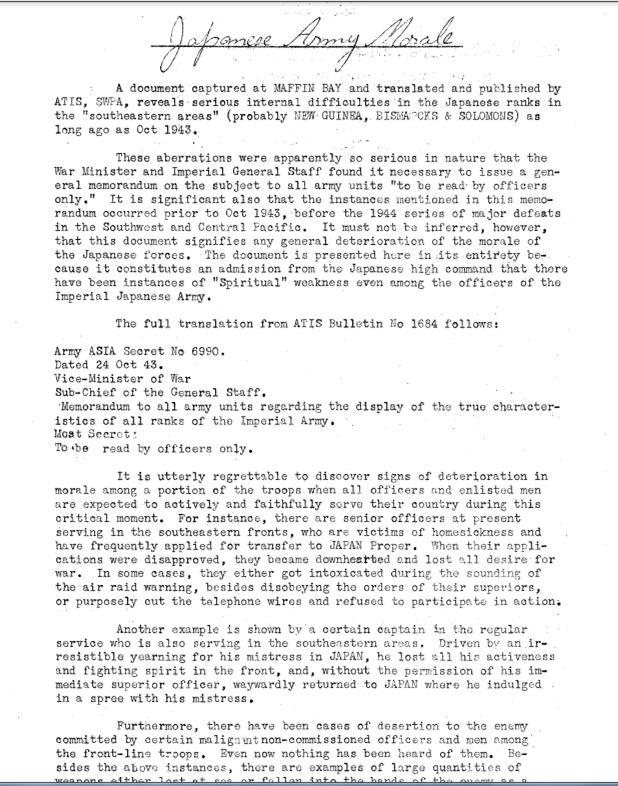
Indeed, as early as 1943, morale amongst the Japanese soldiers was very poor per this US Army G-2 intelligence report:

Morale
Excerpt from “Intelligence Bulletin, G-2 USAFPOA, Feb 1945”. The translation was performed by a Nisei in the Military Intelligence Service.  The captured Japanese document was dated October 24, 1943.

So perhaps things are not what they seem? I wonder how my Uncle Suetaro felt.

_________________________________

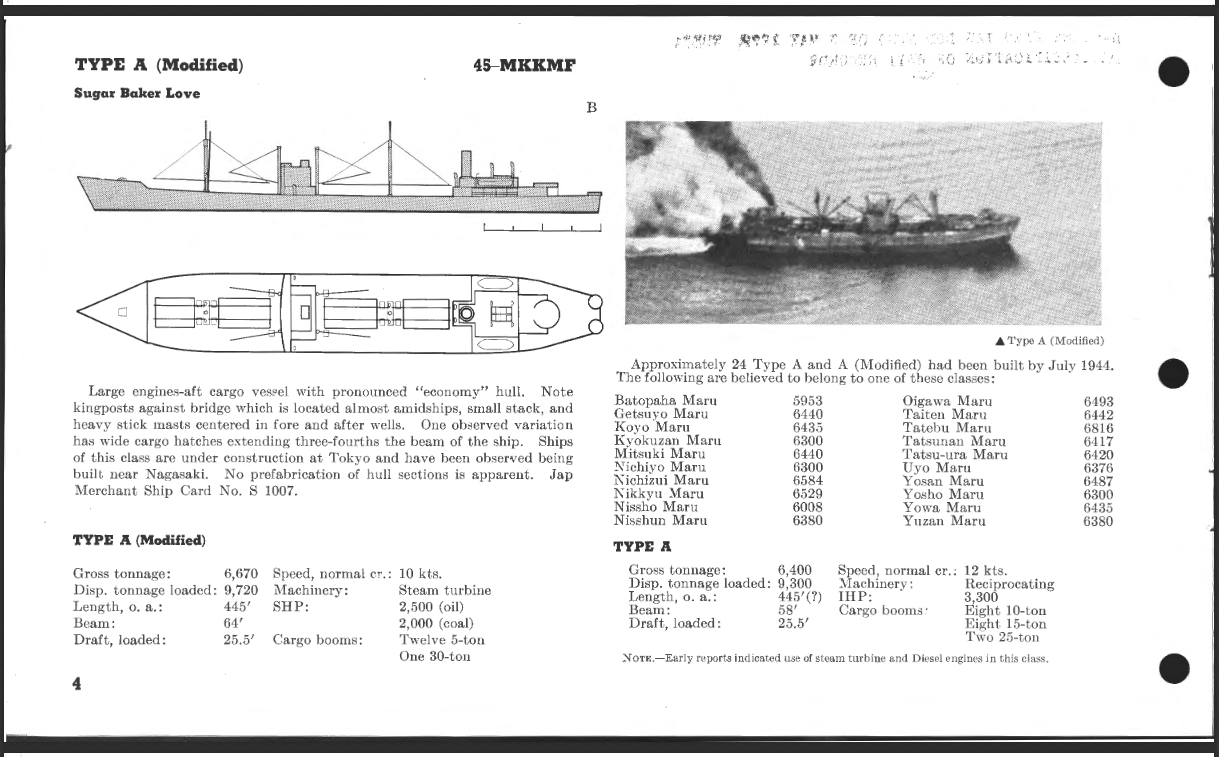
The 41st Regiment, and therefore Uncle Suetaro, was stationed in Pyongyang, Korea in May, 1944 per Mr. Ota’s book.  It had become absorbed by the Imperial Japanese Army’s 30th Division. After sunset on May 8, 1944, the 41st Regiment boarded a steam locomotive bound for Pusan.  After one day’s ride, they arrived in Pusan on May 9 at 4:00 PM. All 5,000 troops soon began to cram onto a ship called the 日昌丸 (Nissho Maru) with a capacity of 3,000 troops…  in addition to supplies and their backpacks.  American intelligence reports indicate temperatures could rise to 120F within the holds.

oni ships1
oni ships2 The Nissho Maru is listed in this WWII era Division of Naval Intelligence report.
Per Mr. Ota’s reconstruction, the Nissho Maru departed Pusan on May 10 as part of a Imperial Japanese Navy fleet convoy. At about 3 PM the next day, the convoy docked in Moji Port in Kyushu, Japan to take on more supplies and hook up with other transports.  During this time, their destination was disclosed: Mindanao.  I am sure thoughts of seeing his mother was enveloping his mind…and heart.

Hiroshima was not far away. In the early dawn hours of May 13, the convoy – now consisting of eleven transports and four destroyer escorts, departed Moji Port.  They were vigilant against US submarines and proceeded at best possible speed.  They docked at Manila during the evening of the 18th.  The troops were already plagued with severe cases of sweat rash.
Soon, the 1st and 2nd Battalions on board the Nissho Maru headed to Cagayan with the 3rd Battalion and headquarters staff headed to Surigao on board the Tamatsu Maru.  Because they were splitting up and therefore would be separated from their regimental colors, the commanding officers boarded the Nissho Maru on the 19th as a send off.  They reached their destinations on the 23rd.  Soon, they were engaging Filipino guerrillas and they were extracting their toll on Uncle Suetaro’s regiment.  Per Mr. Ota, Captain Okamoto, a combat veteran from New Guinea was killed.  On July 10, Captain Ozaki, commanding officer of the 2nd Batallion, was also killed.  Short on officers, Captain Masaoka was appointed commanding officer of the remaining troops, numbering about 1,000.
October 20, 1944 – Invasion of Leyte

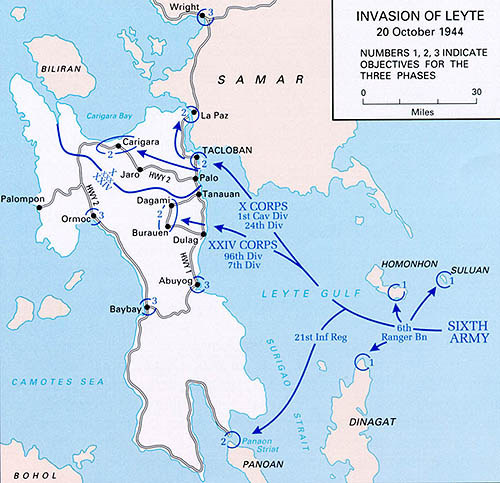
By the time of the invasion, General Yamashita had more than 400,000 soldiers stationed about the Philippines.  My Uncle Suetaro’s division, the 30th Division, was stationed on Mindanao to the south.  Yamashita had access to close to 900 planes, about 100 airfields (the largest of which was Tacloban on Leyte), and a naval fleet spearheaded by four carriers and seven battleships.  (However, this paled in comparison to the naval and air forces of the US. For instance, by the time of the Battle of Leyte Gulf, the US had 34 carriers at their disposal.) The invasion of Leyte was preceded by the US 6th Ranger Battalion taking three smaller islands to the east of Leyte Gulf on October 17, 1944. The weather was perfect and all hell broke lose on October 20, 1944 (A-Day) when MacArthur unleashed the Sixth Army’s X Corps, XXIV Corps and the 21st Infantry Regiment in three different assaults on three eastward facing beaches (see below):

invasion file
From “Leyte”, US Army publication.

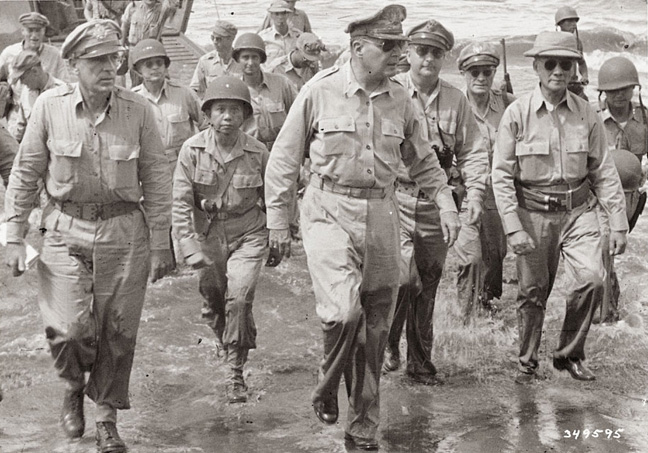
General Yamashita was caught flat-footed.  He had anticipated MacArthur would invade Luzon first.  He had to scramble.  In fact, the invasion’s advance was so rapid that MacArthur made his walk onto the Leyte beach a “Hollywood-esque” event on the first day.  Yes, he actually had several takes done of wading ashore being the media seeker he was but it is true there was gunfire off in the distance. Fortunately for our troops, the Japanese had withdrawn her troops from shoreline defensive posts.  Even though there had been up to four hours of bombardment by the USN of the shore defenses, many fortifications – including pillboxes – were untouched per an A-Day communication to General Hap Arnold of the USAAF from General Kenney.  He concluded there would have been a blood bath similar to Tarawa if the Japanese hadn’t withdrawn.

wading
MacArthur pompously wading ashore on Leyte on October 20, 1944. He would shortly broadcast that speech where he says, “I have returned.” National Archive photo.

The first major coordinated Japanese Army troop movements (i.e., reinforcements) to Leyte involved troop transports, joined by units of Cruiser Division 16 out of Manila.  The objective was to transport about 2,550 soldiers (count per Mr. Ota) of the 41st Regiment from Cagayan, on Mindanao, to Ormoc.  Named Convoy TA 1 by the USN, it included heavy cruiser Aoba, light cruiser Kinu, Uranami, three new T.1-class transports (T.6, T.9, and T.10), and two new T.101-class transports, (T.101 and T.102). They were to be led by Rear Admiral Sakonju Naomasa in the Aoba but she had been torpedoed two days earlier by the USS Bream.  The flag had been transferred to Kinu. This convoy picked up the surviving 1st and 2nd Battalion members of the 30th Division at Cagayan, Mindanao on October 25th and arrived at Ormoc.  Fortunately, the Division had been alerted the day before so they were ready.  Uncle Suetaro had apparently been in the the 3rd Echelon, 1st wave of five transports that disembarked on the 26th in Ormoc.

16291457788_4267db9b81_o
Source: Reports of General MacArthur.

Per Mr. Ota and under the command of Lt. General Shiro Makino, Uncle Suetaro’s 41st Regiment headed towards Tacloban.  He could not have foreseen what was ahead of him: swamps, jungle, mud, illness, starvation…and the US Sixth Army. …and most poignantly, up against my dad’s US 8th Army’s Nisei’s in the Military Intelligence Service. To be continued in Part 3. (Note: The Battle of Leyte Gulf took place from October 23 to 26, 1944.  The immense Japanese battleship Yamato was reportedly only a few hours from Ormoc Bay when she inexplicably turned back during this epic sea battle.)

Part 1 is HERE.

Part 3 is HERE.

Part 4 is HERE.

Part 5 is HERE.

Epilogue is HERE.

The Firebombing of Tokyo – Epilogue


YOKOTA AIR BASE, Japan — Lt. Gen. Burton Field, United States Forces Japan commander and 5th Air Force commander, gives Tomo Ishikawa, Gakushuin Women’s College student, a hug after she presented him 1,000 origami cranes March 16, 2012. The students made a total of 4,000 origami cranes and gave 1,000 to a member of each service. This was in appreciation for all the help given by the 5th Air Force to the Japanese citizens stranded by the tsunami.  (U.S. Air Force photo/Staff Sgt. Chad C. Strohmeyer)

The Firebombing of Tokyo – Epilogue

War is hell.

Vile.

Scars are left on those who had to endure the horror…

Those who witnessed it…

Those who fought in it…

But then hopefully there is a healing.

Perhaps it will take a generation or two.

But it will happen.

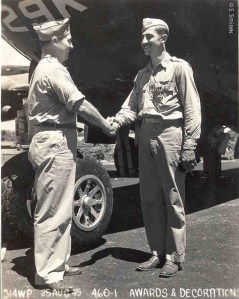
Capt. Ray Smisek receiving his second Distinguished Flying Cross on Guam, August 25, 1945. Incredible bravery indeed. Courtesy S. Smisek.

Perhaps one will never forget… but one can forgive.

Perhaps is it wrong of me – a person who never endured war – to say it so simply.  Forgive.

But I have witnessed forgiving with Old Man Jack… Mr. Johnson…

Warriors have forgiven and tried to move on with their life in spite of nightmares for the rest of their lives.

Civilians, too.

The result is endearing friendship.  The same USAF that bombed Japan assisted thousands of stranded Japanese civilians after the tsunami.  The world has benefited but at the cost of the sanity of single souls so many decades ago.

Captain Ray B. Smisek

On Sept. 2, 1945, Captain Ray Smisek once again made a round trip flight to Tokyo.

air_superfortress17
A glimpse at a formation of B-29s flying over the USS Missouri on Sept. 2, 1945. Perhaps Capt. Smisek’s B-29 is pictured. National Archives.

This time, it was as a member of one of the great air armadas ever assembled in history.  Over 300 carrier based Navy planes and hundreds of B-29s.  MacArthur rightfully wanted to make an impression upon the Japanese people by ordering a huge flyover Tokyo Bay and the USS Missouri, where the formal surrender documents were signed.  (They were to fly over at the moment of the signing but were late, upwards of ten minutes.  MacArthur apparently whispered to General Hap Arnold of the USAAF something to the effect of, “Now would be a good time, Hap,” with respect to his missing armada.)

It was the crew’s 21st mission.  They were going home.

smisek-1-4
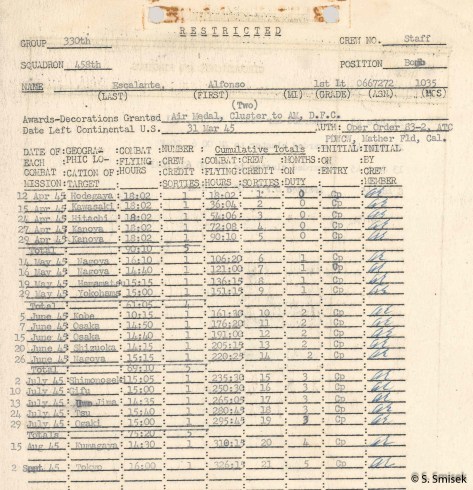
Official Mission List, retained by Capt. Smisek’s bombadier, Capt. Alfonso Escalante. Courtesy of S. Smisek.

______________________________

In Part 1, son S. Smisek said of his father that he hated to kill anything – even bugs.  That was his character.

Capt. Ray Smisek returned home to his parents after the war and tried his hand in the Los Angeles real estate market; he also worked as a cook in a restaurant.  He must have made one heckuva Sauerkraut, one of his favorites.

smisek-10-11
Capt. Ray Smisek with his parents after returning home. They must have been proud. Photo courtesy of S. Smisek (Copyright).

But…  Ray Smisek had met a young woman while he and a back-seater were on a cross-country training flight in 1942.  They were flying from Greenville, Mississippi when the BT-13 trainer developed engine trouble.  To make matters worse, there was a bad storm.  Not swell conditions when you’re training to be a pilot.  Fortunately, the clouds miraculously parted and a small town below was bathed in forgiving sunlight.  He said he did a barrel roll and dove through the break in the clouds.  It turned out to be a rural airport in Springfield, MO (now known at the Springfield-Branson National Airport).

On the USAAF’s dime, he was put up in a posh hotel.  After noticing “this sweet thing walk by” per his son, Ray Smisek asked a desk clerk if he knew who she was.  Seeing the twinkle in his eye, the clerk contacted the gal’s father who agreed to let him meet his daughter…but under the father’s mindful eye.  She apparently “had a guy”, so to speak, but they still ended up becoming pen pals.  Those letters must have been so important to a young man off in a faraway place facing death at any time.  It may have been fate but her beau tragically perished in a B-24 Liberator accident in England.
She was a singer in the “big bands” era of the 40’s and traveled extensively.  Remembering there was no internet, Ray finally tracked her down in 1947.  She was in Houston for a gig.  His son tells me he drove for two days straight to get to where she was performing.  Ray had a note he had written and asked a waiter to hand it to her.  It said, “Let me take you home and love you forever.  Ray!”  The note is a precious heirloom; the family still has it.
After getting married, Ray re-enlisted in the newly organized USAF (It was separated from the US Army.).  He flew for 16 more years in service of our country and retired from the USAF as a Colonel in 1963.  Along the way, they had five children; one was born at each station at which he was assigned.  Talk about the hardships of a military family.
smisek-10-10
Family picture taken in the 1980’s, with Ray (plaid shirt) and his wife (red blouse), five children and the grandparents to the right of center. Courtesy of S. Smisek.

S. Smisek explained to me that his father rarely, if ever, talked about his time at war while he was growing up.  That was very typical, you see.  His son wrote very eloquently:

When I was growing up, he never spoke much of his time during the war. When asked about those times, I could see a sullenness come over his face, then he would most often ask me another question just to change the subject. In those rare exchanges when he would answer, he made it very clear that he desired no recognition for what he had done. He desired no contact with his fellow comrades, felt no honor for the devastation he had helped cause, and amazingly to me, felt no affection whatsoever for the incredible aircraft which had brought he and his crew back safely from so many missions over so many horrible places.

He, along with the rest of these brave young men, was an ordinary and yet an extraordinary human being – a person who offered some of his life’s most vital years in the service of his country, and who sacrificed his ambitions so that countless others would have the freedom to accomplish theirs.

Raymond B. Smisek was diagnosed with a very aggressive cancer in 1989 and passed away at home, surrounded by his family, in August 1990.  He was just 70 years old.  His son believes his father also suffered from another cancer – one related to unhealed scars from war.  His son said they were cancers of the soul and spirit, much more damaging than those of the body.  His wife – the singer in the big bands of the ’40s – passed away in 2001.

____________________________________

Please visit his son’s tribute to the men of the 330th Bombardment Group at www.330th.org.  For the sake of the families of the WWII airmen, S. Smisek has researched and brought many of the pieces together of what it was like for their fathers at war.  Through his website and in a sterling triumph several years ago, S. Smisek played a key role in coordinating the meeting of a Japanese gentleman living in Canada with a B-29 pilot from his father’s squadron. Seventy years earlier, the Japanese gentleman was in Kumagaya Japan as an eight year old, running from the bombs being dropped from the pilot’s aircraft.  The two finally met and it was moving and emotional moment per S. Smisek.  For an article of the meeting, please click here.

____________________________________

Aunt Eiko

tokyo station-1
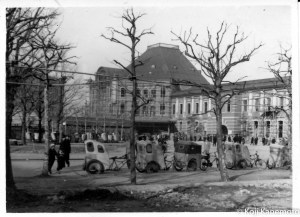
Dad took this picture of the Tokyo Station in 1947. His G-2 HQ was to his left in front of the Palace. The station was being rebuilt, courtesy of the US. Notice the rickshaws lined up in front; the Japanese had no cars until the late 50’s. Also note the trees; they are burned.

There was no escaping bombardment for Aunt Eiko, even after moving to Fukui slightly inland from the Japan Sea; the US Navy shelled their farming neighborhood heavily.  She also vividly remembers a small group of high school aged Japanese soldiers relaxing at the nearby beach and still cries inside knowing their fate.

Preceded by my mother, Aunt Eiko and grandma returned to Tokyo sometime in mid-September to find it in shambles.  People were living in lean-to’s, she said, and running water still had not yet been re-established in devastated areas.  Food was a tremendous daily hurdle.  She cannot recall when but she remembers it was such a relief when MacArthur began rationing out beans and drinkable water…but it was American beans.  Still, the beans were appreciated.

image0-108
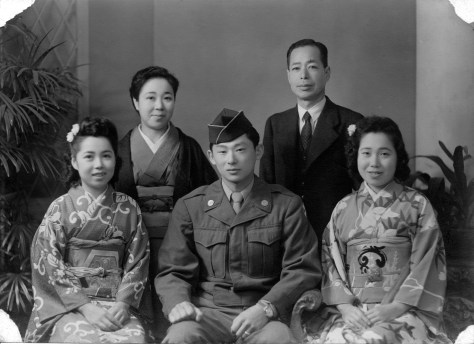
PFC Taro Tanji seated in center flanked by (from left) mom, grandparents and Aunt Eiko. You can make out Taro’s US 8th Army emblem. Taken in Tokyo, December 8, 1946.
image0-38
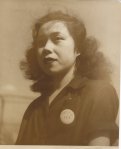
Aunt Eiko got a job at the Tokyo PX, working out of the Matsuzakaya Department Store in the Ginza. You can see “Tokyo PX” on her badge. 1947, Tokyo. Copyright Koji D. Kanemoto.

But their greatest savior surviving the first few months after war’s end was another relative – an American.  An American of Japanese descent that is.  Taro Tanji was born in Livingston, CA but was drafted out of the Amache War Relocation Center in Colorado by the US Army.  He became a member of the famed Military Intelligence Service.

He arrived in Tokyo at war’s end as part of the US 8th Army’s Occupation Force.  Through his intelligence connections, he was able to track down Aunt Eiko and family in a suburb called “Toritsu Daigaku”.  Some of it had miraculously escaped burning.

Driving up in his US Army jeep, he stayed at their house every weekend.  Each time, he would bring a duffle bag filled with C-rations, instant coffee and American cigarettes for my Grandfather (which he reluctantly accepted – funny story).  Yes, Aunt Eiko ate the Spam and deviled ham.  Taro managed to get in a good word and found both Aunt Eiko and my mother jobs at the PX.

TouritsuDaigaku - Summer 1952
Aunt Eiko and her love in her life, Puri. Circa 1952, Toritsu Gakuen, Tokyo. Copyright Koji D. Kanemoto

Things were tough until the early 50’s.  Dogs as pets were still rare as they also needed to be fed…but Aunt Eiko wanted dearly to achieve one of her dreams – to have a dog.

And so she did… She named him “Prince”, or “Puri” when you shorten “Pu-ri-un-su” pronounced in Japanese.  She loved him until he passed away in 1968.  She was devastated, of course.  I think Puri was an escape from the war’s ugliness for her.

She met Paul Sakuma sometime in the late 60’s; he was a Hawaiian born Sansei who was also drafted by the US Army into the Military Intelligence Service by the US Army.  He was attached to the 720th MP Battalion to serve as a translator.  He told a funny story to Aunt Eiko where the MPs frequently raided certain types of “houses”…  You know…  GI’s were prohibited from “fraternizing with the enemy” so they would raid them.  One time, there was a fellow MIS Nisei caught inside.  He made sure the “howlies” couldn’t escape…but held the door open for the Nisei.  After being discharged, he decided to stay in Tokyo to live and worked for the USAF as a civilian employee, using his knowledge of Japanese as a go-between.

Uncle Paul at Ft. Snelling's top secret Military Intelligence Service Language School, circa Winter 1945.  The old barracks is seen in the background.
Uncle Paul at Ft. Snelling’s top secret Military Intelligence Service Language School, circa Winter 1945. The old barracks is seen in the background.

They married but had no children – but a week before my first marriage in 1980, I got a phone call from Aunt Eiko in Tokyo.  She was sobbing uncontrollably.

Uncle Paul had gone upstairs in their beautiful home he just had built for them after washing her car.  He screamed, “Eiko!”  It would be his last word; he suffered a massive heart attack and died, right there at the top of the stairs in his brand new home.

Soon after his death, Aunt Eiko immigrated to the US along with my grandmother.  She became an US citizen about a dozen years ago.

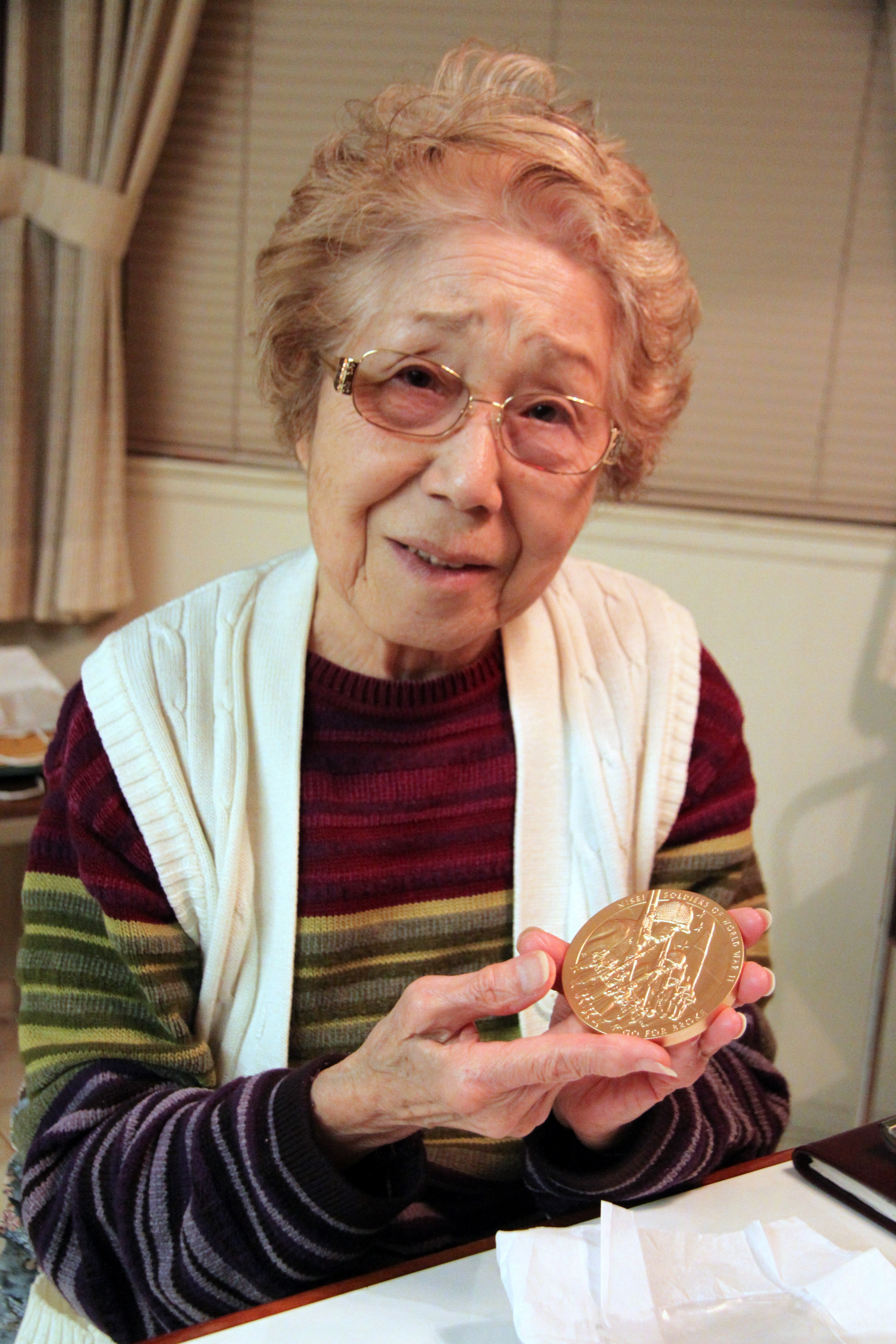
In an irony, the country that bombed her city to ashes in 1945 bestowed upon her beloved husband Uncle Paul (as well as to Uncle Taro) the Congressional Gold Medal in 2010 for their service to the country.  While both had passed away before the award, Aunt Eiko cried for happy when I surprised her with the medal.  She said, “Even after all these years, Paul still brings me happiness.”

Holding Uncle Paul's Congressional Gold Medal for the first time, Aunt Eiko cried for happy.  Incidentally, she became an American citizen about ten years ago.
Holding Uncle Paul’s Congressional Gold Medal for the first time, Aunt Eiko cried for happy. Incidentally, she became an American citizen about a dozen years ago. Copyright Koji D. Kanemoto.
With her best friend - August 1963
Aunt Eiko with her childhood friend – the one who was burned during a firebombing. August 1963, Tokyo. Copyright Koji D. Kanemoto

As for her childhood friends, she is all who remains now at 88 years of age, just like Old Man Jack.  Her friend who was burned during the firebombings was one of the last to pass away.  She was the tall girl standing behind Aunt Eiko atop the Asahi Newspaper Building on October 30, 1937 and shown here in 1963.

__________________________

A most sincere thank you to S. Smisek without whom this series would not have been possible.  I wish him continued fortune with his 330th Bomb Group’s website, helping those descendants piece together their father’s contribution in World War II.

IMG_3413
My two youngest kids standing beneath the Enola Gay in 2010, the most famous B-29. Her single bomb destroyed my father’s Hiroshima high school and damaged my grandmother’s home as well. Read the story by clicking on the photo.  Copyright Koji D. Kanemoto.

Previous parts can be found by clicking on the links below:

The Firebombing of Tokyo – Part 1

The Firebombing of Tokyo – Part 2

The Firebombing of Tokyo – Part 3

The Firebombing of Tokyo – Part 4

The Firebombing of Tokyo – Part 1


A View From Both Sides

IMG_5039-1
From left: Grandmother, Dad in US Army uniform 1947 and his youngest brother (seated), circa 1943. The writing is my aunt’s; you can see “B-29”.  Copyright Koji D. Kanemoto

My Aunt Eiko called me in April of 2011; you can tell she was crying.

“I’ve seen this before,” she said in Japanese.  She was watching the TV footage of the disaster caused by the 9.0 earthquake and tsunami in Japan.

Dumbfounded, I asked, “How could you have seen this before?  The earthquake just happened.”

“完全な破壊。。。戦争思い出したわぁ。。。” or loosely translated, “From the war…  I remember seeing this (complete destruction) from the war…”

Ironically, she was recalling what she saw exactly 66 years earlier – April 1945 – when Tokyo and many other cities were firebombed in an all out world war.

She was there.

And so was someone else from the other side of the Pacific.

________________________________

Through the miracle of WordPress, many of us here have met in the most peculiar of ways –  the hub being World War II…  Perhaps ironic but nevertheless destiny.

For instance, pacificparatrooper‘s father was in the US Army’s 11th Airborne and parachuted into combat over the Philippines with my Dad’s youngest brother killed later on Leyte as a Japanese soldier.  JeanneRene‘s father fought on the wretched islands as a critical Seabee.  Of course, my neighbor Old Man Jack was a sailor fighting to survive in the thick of things on those “stinkin’ islands” – Guadalcanal, Rabaul, Okinawa and Green Island.  Mr. Johnson fought and was wounded on-board CV-6, the USS Enterprise, manning the 20mm AA guns as a US Marine.  Although they returned, they did not return home unscathed.

None of them did.

The Main “Human Beings” of this Story

This series hopes to present the ugliness of war as personally experienced by two human beings – one who was on the ground and one who was in the air.

…The scarring of a Tokyo teen-aged girl on the ground: my Aunt Eiko.

Circa 1932
(L to R) Aunt Eiko, Mom, Grandpa and Grandma. Circa 1938, Tokyo. Copyright Koji D. Kanemoto

…AND the scarring of a young B-29 Superfortress pilot in the US Army Air Force’s 330th Bomber Wing: Capt. Ray B. Smisek who flew bombing missions over Japan.

Capt Smisek 2
Ray B. Smisek (to right of nose gear) after a safe return from a bombing mission to Gifu. Behind him is the B-29 he captained with a crew of ten young men, the “City of San Francisco”. 1945. Courtesy of son S. Smisek (copyright).

There is one sad, dreadful thing about their fateful relationship: neither had asked for it.

Neither had asked for war.

A very bitter war.

________________________________

Ray B. Smisek, the Gent

Capt Smisek Catalina island
A “life is good” portrait of Ray Smisek on Catalina Island. Copyrighted photo courtesy of S. Smisek.

One person I met online was S. Smisek.  He has an extensive photo collection on flickr of his father’s service during World War II; that is where our paths crossed (his photo link is here).  His father was Capt. Smisek, the captain of “City of San Francisco”, a B-29 bomber flying out of Guam as part of the 330th Bombardment Group, 458th Squadron.  Born in Minnesota in 1920, he was also a lead pilot – a very heavy responsibility let alone if under attack.

His son shared with me his remembrances of his father.  He shared that Capt. Smisek liked flying above all else – especially open cockpit.

“(His dad) liked Czech and German food, like Sauerkraut, sausage and beer. Polka music. Baseball and football.  He loved baking bread and pastry.  Made amazing sourdough pancakes and Christmas bread. He loved gardening.  He could grow ANYTHING and liked to tinker on anything and everything around the house.  Fix it… or break it if it already was fixed.

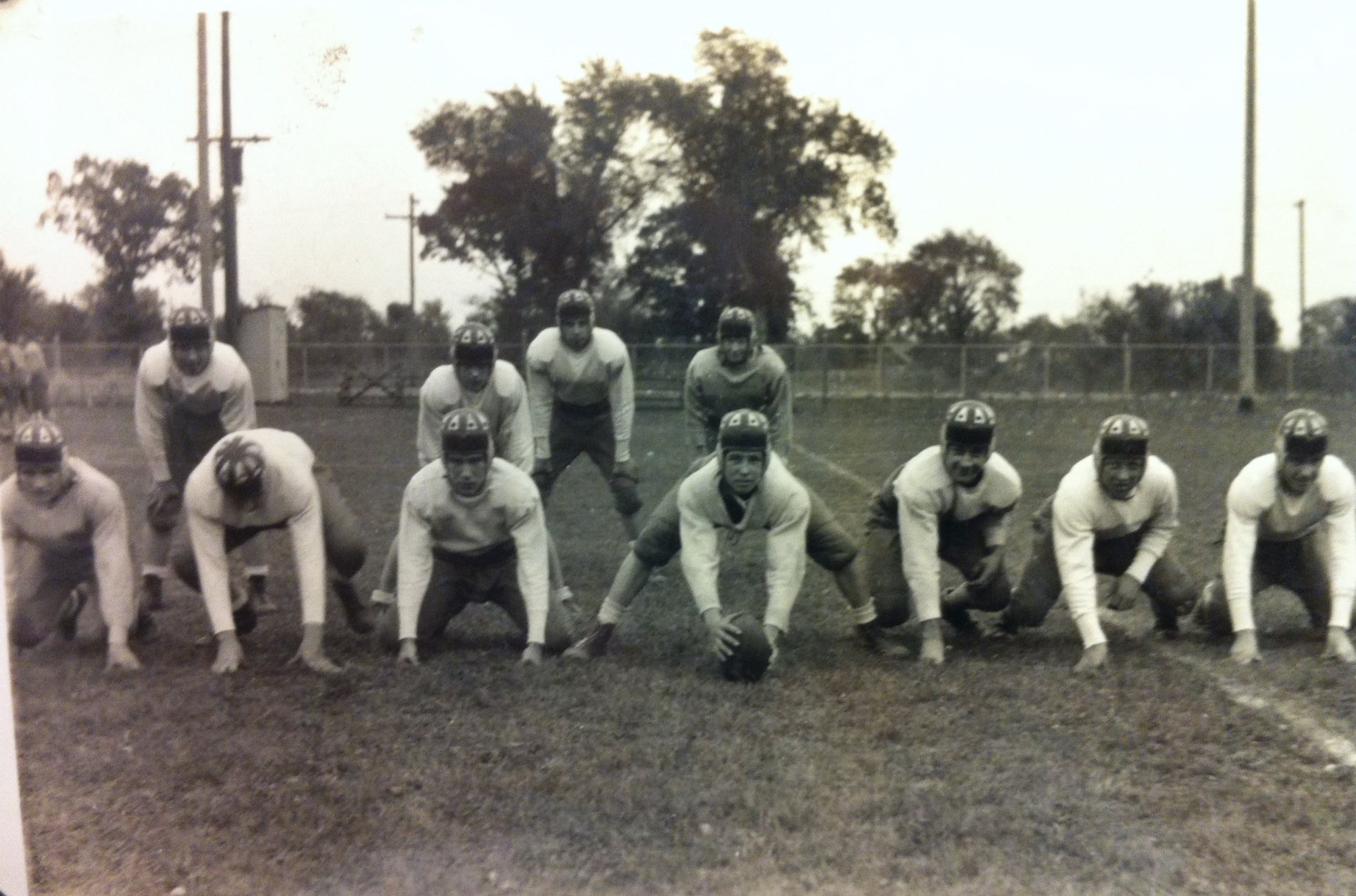
Capt Smisek Football at 18 yo Thrid from front right
A young Ray Smisek, third from right. Copyrighted photo courtesy of S. Smisek.

He hated hunting. Did not like to kill anything.  He would pick up bugs and release them outside.  Used to freak us kids out!

He liked his newspaper and watching the news.  He occasionally smoked a pipe.  Wore Old Spice aftershave all the time I knew him (I keep some around to this day.).  He loved licorice. 

He was honest as the day is long.  A man of his word.  A handshake was an agreement.  A promise.  A very strong Republican who loved Richard Nixon and John Wayne.  He liked Louis L’Amour books.  I think he dreamed of being a cowboy.

(Dad) hated racists.  Always gave everyone a chance. Maybe two and that’s it.”

Aunt Eiko, the Teenager

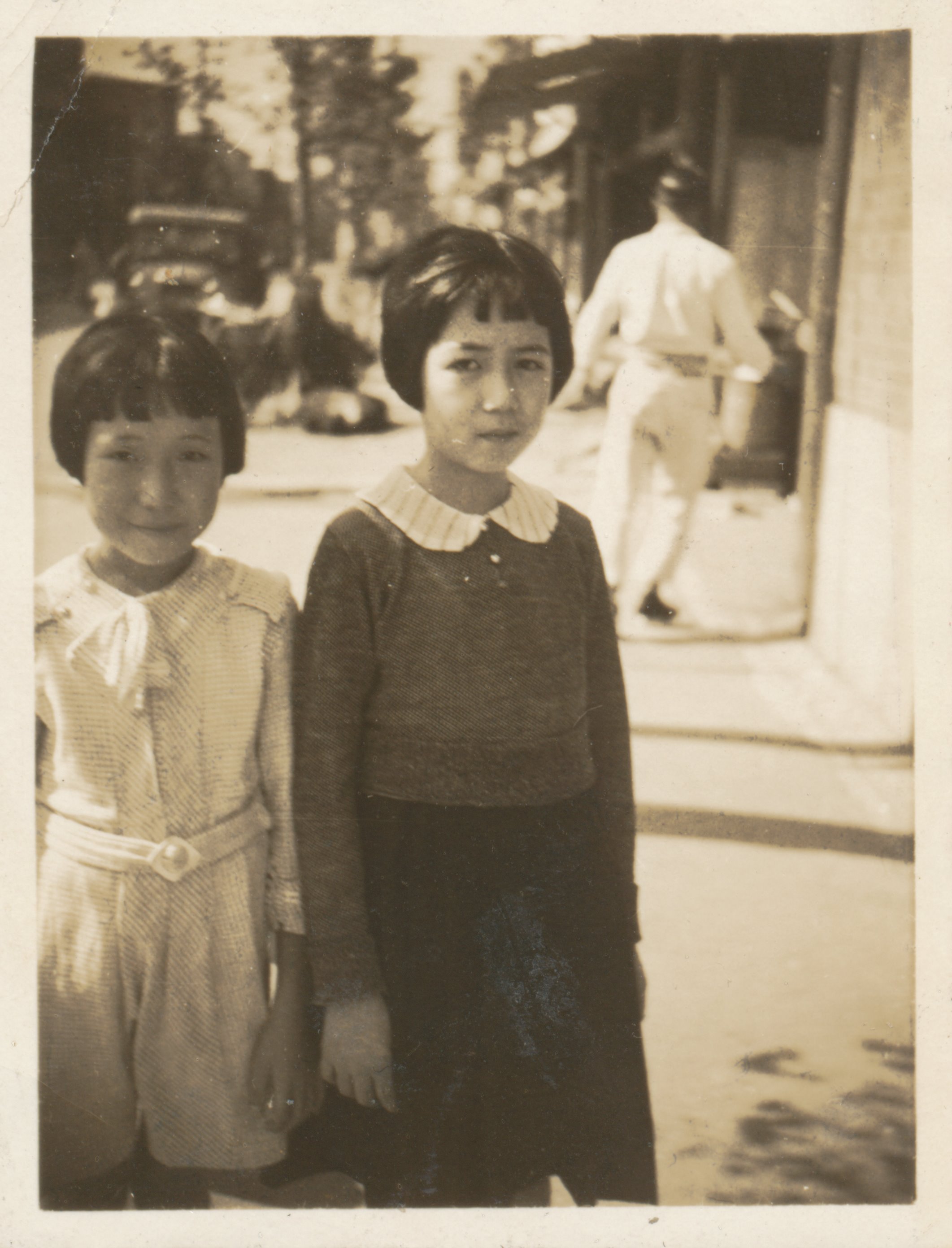
(L to R) Aunt Eiko and mom. Circa 1932, Shimbashi, Tokyo.

My Aunt Eiko and my mother had lived with my grandparents in Tokyo since their births in the mid-1920’s. Their childhood home was next to the Ginza at Shimbashi 5 Chome; think of it as Japan’s Beverly Hills.  It is within walking distance from the Imperial Palace.  My aunt says the picture to the left was taken near their Shimbashi home and next to a relative’s kimono shop in the Ginza.

As a child, she was apparently sickly.  They say she was quite skinny from this ailment and that ailment; the food shortage didn’t help much although my grandfather reportedly had black market connections to obtain food once in a while.  Nevertheless, she had a weak digestive system.  She has it to this day.

Like most Japanese “upper society” girls of that time, she was required to know how to play the shamisen, or a Japanese stringed instrument.  She was also trained on the silk kimono – it was an elaborate dress that took a couple of hours to put on properly.

Showa 14 Aki - Fall 1939 / Grandma in center, Aunt Eiko on right
Aunt Eiko on right playing the “shamisen”. Tokyo, Autumn 1939.

Aunt Eiko didn’t disappoint anyone’s ear drums when she saw a bug.  She screamed really loud when a bug got near her.  It was easy to see them since they get as big as footballs there in Japan.  Ok, I’m exaggerating – a little.

She had an artistic flair, with her grandfather being a noted painter and art professor.  She loved “ikebana”, or flower arranging.  In fact, she made it her career after war’s end, becoming one of the top ranked ikebana instructors in Tokyo.

Amazingly, in spite of her stomach ailments, she liked cooking; unfortunately, she had a knack for burning things.  I know.

Most of all, she loved dogs.  After feeding one with her chopsticks, she’d just go right back to using them to feed herself… but with food a scarcity, her love for dogs would have to wait until quite a while after war’s end.

________________________________

In Part 2, we will visit the B-29 Superfortress, her crews and the ordnance she would typically carry into battle above Japan.

Hope you’ll stay tuned.

Edit: You can find the other chapters in the links below:

The Firebombing of Tokyo – Part 2

The Firebombing of Tokyo – Part 3

The Firebombing of Tokyo – Part 4

The Firebombing of Tokyo – Epilogue

Fairy Tales, Dragons and MacArthur – Part 2


Screen
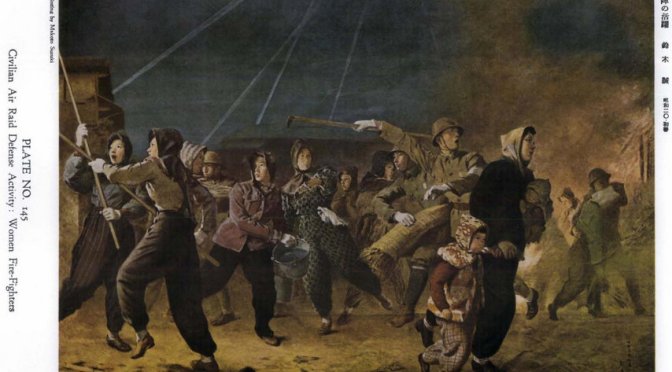
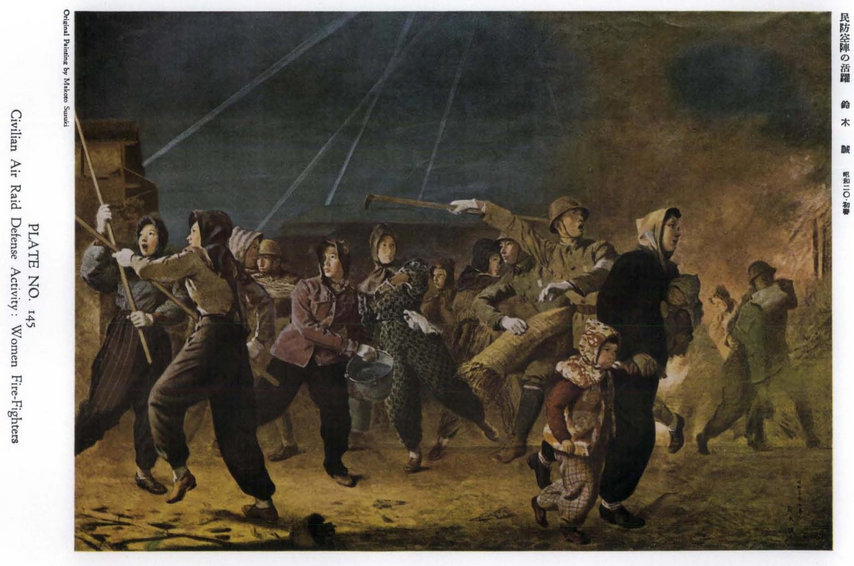
Japanese artwork from “Reports of General MacArthur – Japanese Operations in the Southwest Pacific Area Volume II Part II”, Page 595. US Army

(Continuation from Part 1)

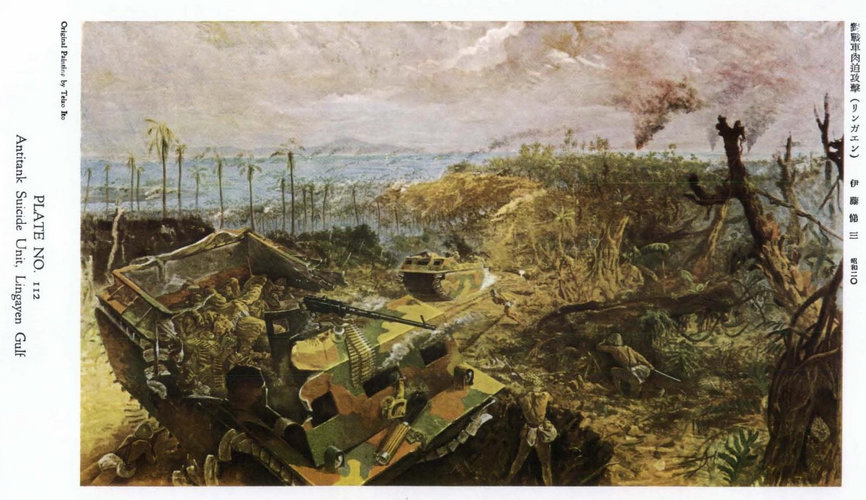
Mitsuko went about Tokyo seeking artists to paint war scenes from the Japanese point of view.  This task was made much easier as Willoughby gave her permission to ride about in her own private jeep.  This was a definite indicator of his affection for Mitsuko as all Japanese women were prohibited from even riding in any Allied military vehicle, let alone have one assigned to her.¹  With her purse flush with cash from Willoughby, Mitsuko paid starving artists large sums of money for art pieces depicting the war from the Japanese point of view.  It was reported that she paid these artists up to several hundred dollars for one piece; this caused great dissension amongst the Japanese men who were assigned to compile the history.  At that time, a year’s average salary rarely exceeded $150.  Many of these men were also former Japanese military and were required to address their superiors as if they were still in the military.  Kawabe ran the group as if it were still his army.  Some of them found it dishonorable to be even working “for the invaders”, as my Tokyo grandmother liked to say.

Screen Pg 533
Japanese artwork from “Reports of General MacArthur Japanese Operations in the Southwest Pacific Area Volume II Part II”, Page 472. US Army

Fraud was suspected with respect to Kawabe and Arisue.  To further their spying, they asked for and received a tidy sum of money from Willoughby to supposedly increase spying activities on the Communists in the surrounding Asiatic regions.  Similar to what is happening today but on a grander scale, some of these supposed spies just “disappeared” after receiving a supposed cash payment.  While the CIA apparently came to the conclusion there was a scam going on, they failed to take remedial action.

In a further documented twist, the subservient Hattori was himself pursuing his own agenda in secret.  Actually, he had two secret and separate agendas.

taihei
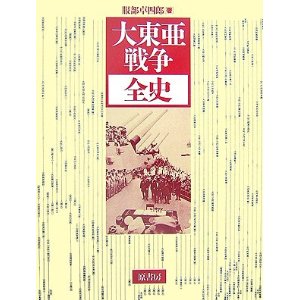
Hattori’s condensed 大東亜戦争前史 , or “The Complete History of the Great East Asia War”. It is also in DVD.

First, as he solely determined what would go into the Japanese-version of the history, Hattori was absconding with selected crucial documents that came across his desk.  He had schemed that once “the invaders” left, he would write his way into history by publishing his own “true” version of the war against the Allies. By 1953, he was partly successful in that he did put together an eight volume history entitled “大東亜戦争全史”, or “The Complete History of the Great East Asia War”.

Second, he was gung-ho to re-arm the new Japan.  It is reported that by 1949, the brilliant planner Hattori had drawn up a four division army with key officer positions already determined, complete with detailed arms and logistics laid out.

He passed away in 1960.  In another twist of fate, his original publication was condensed into a thousand page book and published five years later under the same title.²

________________________________

As for Willoughby, he also pursued his own agenda.  Yes, he was motivated to glorify his commanding officer, General MacArthur, in the history books.  Using the funding from G-2, the project moved along out in the open.  Most anyone knew about it although it was done under a military intelligence umbrella.

However, in late 1947, G-2’s history department requested copies of the documented history.  In a bewildering response, Willoughby replied by saying it was not ready; he also replied in like for the Japanese volumes.  But what made it bizarre was that he stated it was but MacArthur’s personal record – a report, if you will – of what happened during the war…  Essentially, that it was not an official US Army publication.  As such, it would not be subject to review and approval by the US Army prior to publication.  However, in a kind gesture, Willoughby indicated they would receive copies once it was published.

Willoughby went to a former Army officer, General Stackpole, in 1948; he owned a publishing company specializing in military history.  Due to the immenseness of the volumes, Stackpole declined participation on the grounds it was too large a printing effort for his company.  Willoughby then sought out Japanese printing companies but they were still in shambles from the war.  He was unsuccessful.  It was reported unofficially that MacArthur had known, at least, of the attempt.

Eventually, five samples of the “report” were published in 1950 by a Japanese printing company with the assistance of Washington.  However, during this time, Willoughby – for (their) mutual protection – ordered all extraneous documentation collected during this five-year project that may jeopardize MacArthur’s hero status destroyed… and they were.  Even notes and drafts were burned.  The burning was supervised on March 2, 1951 by two US Army officers assigned to Willoughby’s history detachment.

The reasoning and significance behind this burning at that time is now clear.  On April 11, 1951, President Truman relieved General MacArthur of his duties for his handling of the Korean War.  To give you an idea of the volumes of documentation collected yet remaining after the burning, MacArthur brought back 32 footlockers full of documentation.  Willoughby himself brought three more which apparently contained the galley proofs.  He claimed these were MacArthur’s personal property… a diary of sorts.  Willoughby managed to convince the government to finally print the “report” in 1953; however, MacArthur intervened and squashed the agreement citing the documentation was full of errors and was just a draft.  It was not printed.

book cover macMacArthur did sell his memoirs for nearly $1 million in 1963 but like Hattori, MacArthur passed away soon thereafter in April 1964 and ironically never saw his memoirs published.

Nevertheless, the US Army finally did publish the two-sided “history” of WWII in 1967 after MacArthur’s death.  The publication is entitled “Reports of General MacArthur” and can be read online at several websites.  Previously owned hard copies are also available online.  It is immense.  From what I understand, the Army disclaimed any responsibility over its accuracy throughout its four volumes.  It does contain the original Japanese artwork sought out by Mitsuko.³

Willoughby passed away in October 1972 in Naples, Florida.  He is buried in Arlington.

_________________________________

Villaba1
“Reports of General MacArthur”. Page 533. While the Imperial Japanese Army informed my grandmother Uncle Suetaro was killed on July 15, 1945 at Villaba, this battle report is unfortunately dated for March 1945.

In closing, I came across some information in the “Reports of General MacArthur” as to the action that potentially led to the combat death of my own Uncle Suetaro on Leyte near a village called Villaba…on Page 533 of Volume 2, Part 2.  My Hiroshima cousins believe he was assigned to the Imperial Japanese Army’s 41st Mixed Regiment; it had been annihilated on Leyte.  He was reportedly killed on July 15, 1945 but it is clear per MacArthur’s “report” that centralized Japanese army command on Leyte had ceased in March 1945 per this Japanese record.

Perhaps finding out exactly what happened to my Uncle Suetaro will only occur in a fairy tale.  To realize I will never find out is my dragon to slay.

____________________________

Footnote:

1  Though I have yet to see one photo, my mother and aunt claim our Uncle Taro took them around what was left of Tokyo in his US Army jeep.  Uncle Taro was a Private in the US 8th Army’s Military Intelligence Service.

2  Unbelievably, it is available on Amazon Japan.

3  Although I have scoured Japanese websites, only scant sentences can be found about Mitsuko.  Her fate is unknown to me except for her grave marker.

Fairy Tales, Dragons and MacArthur – Part 1


http://www.wall321.com

As I watched “How to Train Your Dragon” on Blu-Ray for the third time with my kids, it became clear that knights in shining armor kill dragons…and only in fairy tales.

A tremendous Einstein moment for this old geezer.

But then I realized that sometimes, what we read about WWII history can be sort of a fairy tale, complete with a knight in shining armor trying to slay a dragon… the dragon being what truly happened in war.

History becomes what the writer – or a leader – wants it to be in the public domain.

_____________________________

Unknown to many is that another battle raged after the surrender of Japan.  It was about what was to be recorded as an official history of WWII.  It was a battle involving glorification, greed and politics of both the victors and the defeated.

And of course, it involved General of the Army Douglas MacArthur.

General of the Army Douglas MacArthur www.historychannel.com
General of the Army Douglas MacArthur
http://www.historychannel.com

First, a quick opinion and summary of MacArthur from this arm-chair (amateur) historian’s viewpoint.

MacArthur had a helluva an ego as did George Patton and Bernard Montgomery.  He was suspicious, short tempered, short on patience and embittered.  MacArthur – as did Patton – studied military history extensively; he loved Napoleon.  As commander, he failed to appropriately alert the troops under his command in the Philippines immediately prior to Pearl and worse yet, in the hours after.  He had to flee the Philippines on a PT boat along with his family to avoid capture leaving behind his troops.  However, supported by a brilliant, top notch staff and highly critical intel derived from intercepted then deciphered Japanese transmissions, he was highly successful in winning the war in the Pacific.  He was a hero at war’s end to his great gratification.  He was so loved by the American public that quite a few babies were named Douglas.

____________________________

Primarily due to a ridiculously small and inexperienced staff, only a relatively short written history of WWII in the Pacific emerged in late 1946 to the chagrin of MacArthur.  He immediately then placed Major General Charles Willoughby in charge of generating an “official” history.

willoughby kawabe
Willoughby (left) then Kawabe. http://www.trumanlibrary.org

Willoughby was in charge of the US Army’s G-2 (i.e., military intelligence) in the Southwest Pacific theater of war and was trusted by MacArthur.  (I briefly reported on Willougby in “Ike, a German-American Soldier”.)  Having a heavy German accent, Willoughby was very loyal to MacArthur, pompous and stoutly anti-Communist.  He seized the opportunity to “write the history” on victory in the Pacific under MacArthur’s leadership.

The tiny staff then blossomed under Willoughby to over 100 and was headquartered on the 3rd floor of the “NYK Building (Nippon Yusen Kaisha)” just a block from MacArthur’s GHQ in the Dai-Ichi Seimei Building; both are situated directly across the Imperial Palace.  (Coincidentally, my dad was stationed in the NYK Building on the 4th Floor as a US 8th Army Technical Sergeant, 3rd Grade in Willoughby’s G-2. He is pictured below with the edge of MacArthur’s GHQ seen on the extreme right. The NYK Building is off the picture to his left.  Behind him is the moat of the Imperial Palace.)

By the Emperor's Palace 1947

Aviary Photo_130579620590287532
You can clearly see the devastation caused by firebombing. http://www.geocities.jp/torikai016/map/P0229tokyo-tokyo1947.jpg

Seeking glory in this mission, Willoughby recruited by the end of 1946 top Japanese military officers, spies and even war criminals.  Each had their own personal goals and copious amounts of US money flowed into these Japanese hands.  One Japanese officer who Willoughby met in Manila was the Imperial Japanese Army’s Lt. General Torashiro Kawabe (photo above).  Amazingly, because Kawabe also spoke German very well and was anti-Communist, he and Willoughby struck it off well.

A short time later, still in 1946, Willoughby met Lt. General Seizo Arisue who was the intelligence chief for the Imperial Japanese Army.  By sheer luck, Arisue was also fluent in German and a staunch anti-Communist and reported he had the extensive spy network in place mentioned above.  A triad had thus formed and the project to document history took off but with a twist: to Willoughby’s credit, he foresaw a “dual” history.  As history always gets written by the victor, Willoughby wanted two volumes.   One would be the US side of the story, the second volume to be Japan’s.

In early 1947, Willoughby was introduced to a former colonel who served at the Imperial General Headquarters in Tokyo during the war.  His name was Col. Takuhiro Hattori.  Hattori was known to both Kawabe and Arisue as a genius in planning and organizing.  Hattori eventually became the person from Japan’s side to determine what went into the war history.

araki_mi2
Crypt, or ohaka, of the Araki’s in Japan. Click on link to a Japanese website, “History Sleeps in This Cemetery”. http://www6.plala.or.jp/guti/cemetery/PERSON/A/araki_mi.html

Generous money flowed through Willoughby to Kawabe and Arisue, reportedly to help fund the spy network.  Along the way, they brought in an “Issei” (a Japan-born first generation immigrant to the US like my grandfather) plus a university professor named Mitsutaro Araki.  He also received education in Germany but no history would be complete without sexual escapades.  Professor Araki’s wife was a socialite who used her beauty to charm others, primarily men.  Her name was Mitsuko Araki. As a bit of trivia, Mitsuko was the only Japanese who was allowed free, unhindered entry/exit to GHQ.  It was believed the CIA concluded she and Willoughby were having an affair.

In his efforts to make his recorded history unique, Willoughby paid Mitsuko to find and compensate artists who could paint battle scenes from Japanese eyes.  He felt photos were too ordinary plus many were from US sources.

To be continued in Part 2.

Fresh Tuna and Pyrex Pie Plates


A good number of pies have come out of my oven during the past six months to be taken to parties and such.  Even to a cigar lounge.  Fortunately, there have been no claims of food poisoning – so far.

But I ended up buying a few more Pyrex pie plates (They work great provided you place them on a preheated cookie sheet – helps brown the bottom.).  But what to do with them when pies are on hold?  They just lay in my pots and pan drawers.

Well, my vetunary good friend from the 1980’s, Tom G., had a “fishy” time last weekend.  Tom is an avid fisherman and got shot at in Viet Nam.  He was drafted and did his duty as an American (unlike Clinton).  His dad saw combat as a gunner in a B-24 Liberator during WWII.  His family has indeed served the US of A.

Anyway, Tom went out on a fishing boat and everyone on board hooked tuna like crazy… except for Tom.  Just kidding!  He snagged his limit of five so we were recipients of fresh tuna!

What does fresh tuna have to do with pie plates?

Lots.

As my kids “whine” about eating, i.e., “Pasta again, Papa?”, I decided to try something different – and easy… and hopefully, the kids would eat it.  That’s where the pie plates come in.

I decided to try the “Garlic and Ginger BBQ Tuna”.  Couldn’t go wrong, I thought, as I know the kids’ll eat (almost) anything if it has soy sauce and garlic in it.

The marinade was simple:

  1. 2 tbsp soy sauce (I have a ton of that)
  2. 2 tbsp Japanese rice vinegar (I have a ton of that, too)
  3. 1 tbsp sesame seed oil
  4. Freshly rated ginger (Use the side of a spoon to scrape off the outside.)
  5. Minced garlic
  6. Chopped green onion
  7. Pepper (I used the Japanese kind)
IMG_3943-002
Ready to get grilled!

All went into a Pyrex pie plate (which I have a ton of) and the tuna was marinated for about 30 minutes in the fridge (turned after 15 minutes).  Onto a dilapidated Weber BBQ grill over medium heat they went, four minutes each side (I had to slightly over-grill them as my son Jack wouldn’t eat it if he saw just a touch of red). Three minutes may be sufficient, too.

They turned out good!

IMG_3949-001-1So if you have an unused Pyrex pie plate and a great friend like Tom, try it!

buru tunaThanks, Tom!