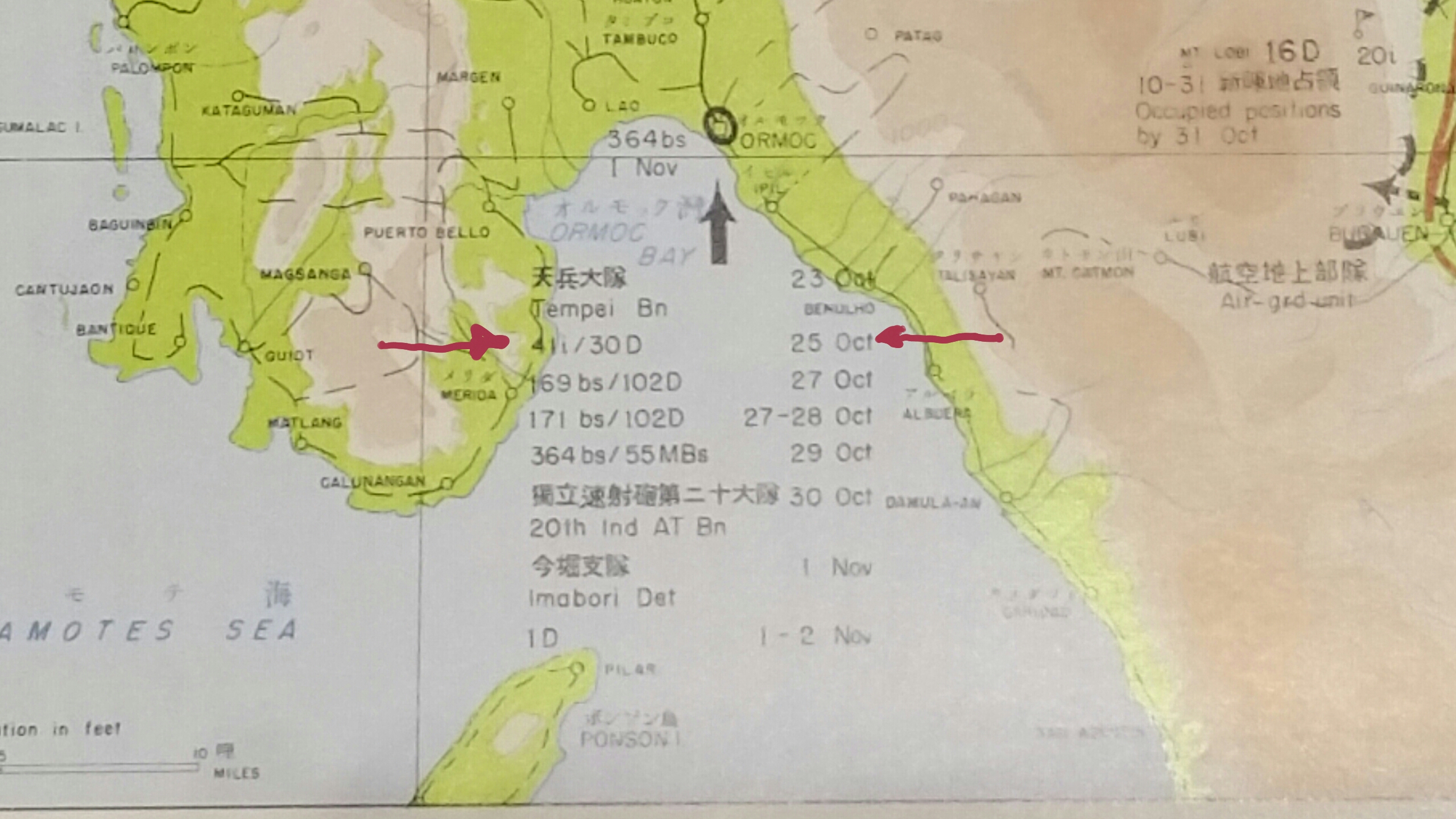
Current Google map of Leyte battle area, inserted for ease of viewing and geographical orientation.
Battle Situation Overview
Even before my Uncle Suetaro and his 41st Regiment of the Imperial Japanese Army landed in Ormoc at dawn on October 26, 1944, the US Sixth Army’s X Corps fought through four miles of beach between the Palo River and the Tacloban airstrip. XXIV Corps further south also made significant progress, overcoming the Japanese resistance. However, incredibly swampy terrain was more their enemy than the Japanese at times.
By the end of A-Day, the 1st Cavalry Division had secured the Tacloban airstrip. Most critically, Lt. General Makino, commanding Uncle Suetaro’s 41st Regiment and the 16th Division, was forced to evacuate his Command Headquarters in Dulag (below) to a village called Dagami.
The inevitable violence of war. Dead Japanese soldiers lay next to a knocked out Type 95 Japanese tank at Dulag Airfield. Dulag was the location of Lt. General Makino’s headquarters. October 20, 1944. National Archives.
First: Irony
In closing Part 2 of this series, the US 8th Army’s Military Intelligence Service (MIS) was mentioned. During the war in the Pacific, nearly all MIS soldiers were Japanese-Americans. Caucasians were primarily officers although a few NCOs were assigned.
Although Uncle Suetaro’s older siblings (my dad, Uncle Yutaka, Aunt Shiz and their families) remained imprisoned in the US concentration camps for people of Japanese blood until war’s end, my dad did volunteer for service in the US Army in February 1947.
After prodding, my dad told me and my cousin Neil (Yutaka’s son) he volunteered because by doing so, he’d get three chevrons on his sleeve; but, if they drafted him, he’d be a lowly buck private. “More pay,” he told us.
The story I choose to believe, however, is that Uncle Yutaka – then living in Chicago and now the leader of the entire family – implored or directed my dad to join up solely to check up on their mother and remaining sister, Michie, in Hiroshima. Of course, the anguish of not knowing what happened to their youngest brother – my Uncle Suetaro – played a deep, silent role. This is a belief that I have not shared with others.
Well, Dad got his chevrons and sergeant’s pay. He became part of the famed MIS, post-hostilities.
Photo of Dad translating a document. Taken at US 8th Army HQs in Yokohama, Japan. April 1948.
________________________________________
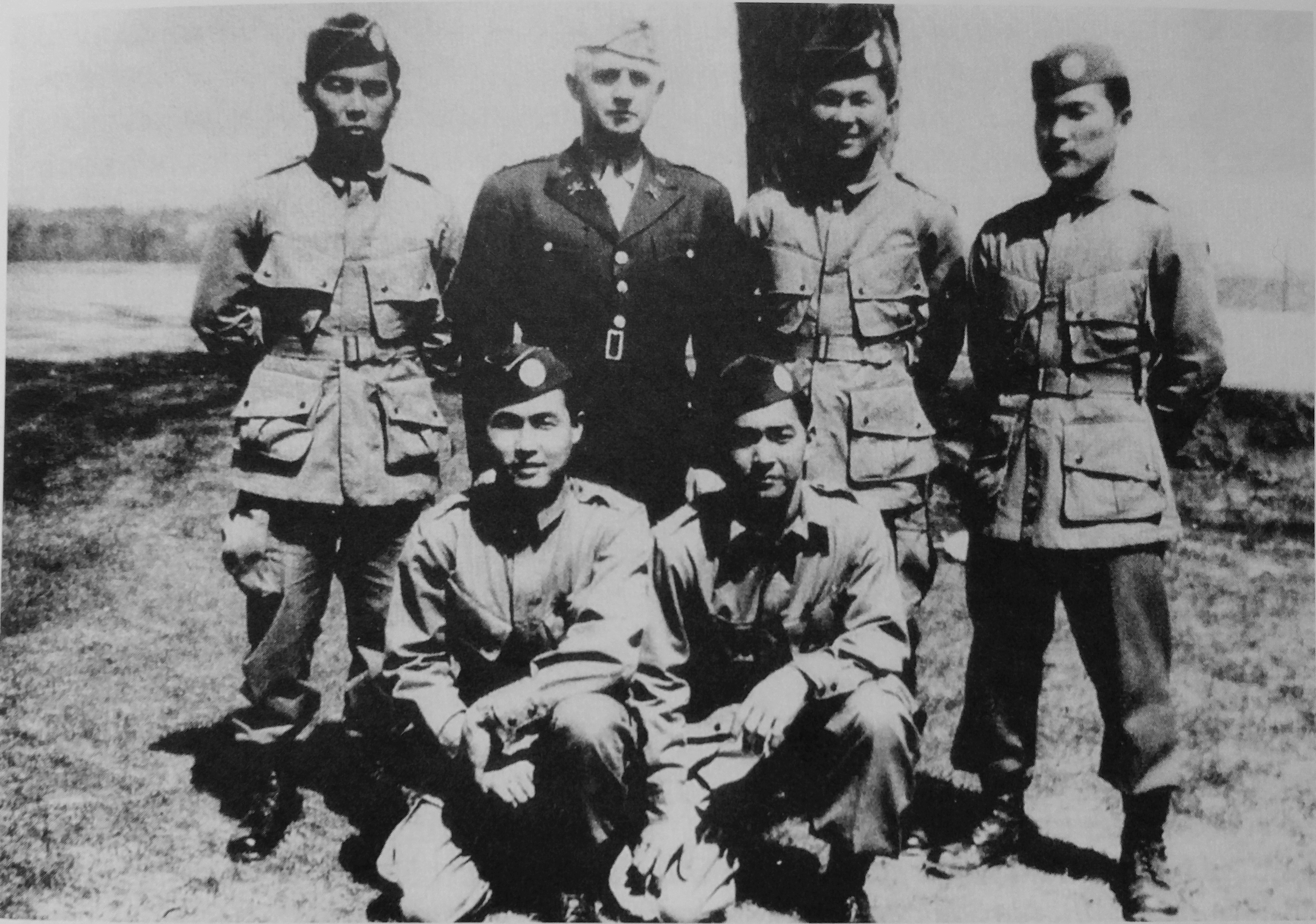
Five MIS Nisei pose with Colonel Rasmussen after receiving their jump wings. Do you think it odd to see Japanese-Americans in US Army paratrooper uniforms? They were assigned to the famed 11th Airborne Division which eventually fought on Leyte and Luzon. From Pg. 127 of Nisei Linguists.
As my Uncle Suetaro fought for Japan and his life on Leyte, the MIS was diligently doing their patriotic duty as US Army soldiers to end his life. Dr. James C. McNaughton writes in his authoritative book, Nisei Linguists:
On 20 October the Nisei language teams went ashore with the assault elements of four divisions and two corps. Maj. George Aurell led the Sixth Army team. His team sergeant, S.Sgt. Kazuo Kozaki, recalled: “We were kept busy all day and immediately. There were loads and loads of captured documents, although no prisoners were taken yet. I had to virtually wade through a pile of papers—operation orders, operation maps, manuals, magazines, books, paybooks, saving books, notebooks and diaries, handwritten or printed, official or private — to find out if there was any valuable information for our immediate use.”
Some Nisei saw direct combat. When the Japanese counterattacked the 7th Infantry Division, the Nisei “were a little bit heroic,” a Caucasian sergeant recalled. “They would climb on board a Japanese tank going by, knock on the things, converse in Japanese, and as soon as the door popped open, they’d drop a hand grenade — boom!”
On 25 October two more Sixth Army language detachments arrived on board a landing ship, tank…”
One hundred and twenty Nisei’s and Kibei’s served on Leyte.¹
The unspoken irony for my father is here, hidden in this secret behind-the-scenes world. If you note the highlighted print in this once top-secret US 8th Army report, it states, “Preliminary Interrogation ATIS Information Section. Analysis made from 166 Det, 8 Army HQ”.
Here is the pertinent section of my dad’s discharge papers:
He served with the same G-2 166th Language Detachment that did their best to kill Japanese soldiers on Leyte – including Uncle Suetaro. While the Nisei’s were on Leyte since the invasion began Oct. 20, 1944, they were reorganized into the 166th Language Detachment on 20 June 1945 per US Army records.
Picture of sign taken by my dad outside his office door in the US 8th Army HQ Building in Yokohama, Japan. Circa 1947.
I am darned sure he translated some documents captured on Leyte… where his favorite brother died. How this must have plagued him for the rest of his life – to this very day.
____________________________________
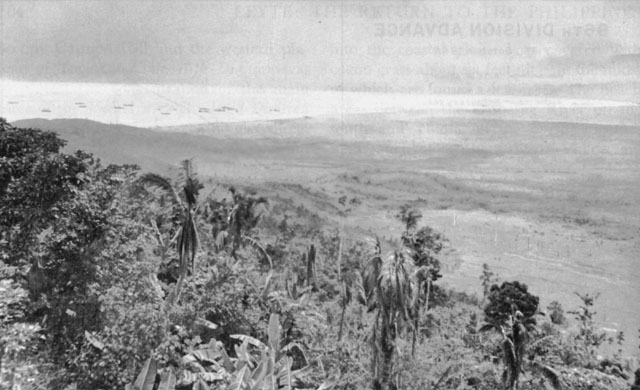
The view from atop Catmon Hill after being taken by the US Army, October 1944. The Japanese observed the US invasion forces from this hilltop position as they landed and directed artillery fire. National Archives.
Back to the War on Leyte and Uncle Suetaro…
Per Mr. Ota’s book, The Eternal 41st, the composition of the 2,550 troops that disembarked at Ormoc was:
Regimental HQ staff
A rifle company (under Sasaki)
An artillery squadron (under Fukunishi)
A signals squadron (under Nakamura)
1st Battalion (under Nishida)
2nd Battalion (under Masaoka)
An attachment of combat engineers
A platoon of litter bearers from a medical regiment
However, their potential effectiveness had already been negated. It was their fate. Per his book, it appears the troops – including Uncle Suetaro – were forced to quickly ship out of Cagayan with but a day’s notice and with only what they could essentially carry on their backs or reasonably transport: ammunition, food, lighter artillery pieces like the 37mm anti-tank gun, etc.¹ This would be the proverbial nail in their coffin as the USN and USAAF would in short order obliterate their supply chain.
Thirty-fifth Army took immediate action to move reinforcements to Leyte in accordance with the Suzu No. 2 Operation plan, which had already been activated on 19 October. Orders were issued during the 20th directing the following units to advance immediately to Leyte, where they were to come under 16th Division command:
1. 41st Infantry Regiment (less one battalion) of the 30th Division (Army reserve from Mindanao)
2. 169th Infantry Battalion of the I02d Division from the Visayas sector.
3. One infantry battalion of the 57th Independent Mixed Brigade, from Cebu.)}
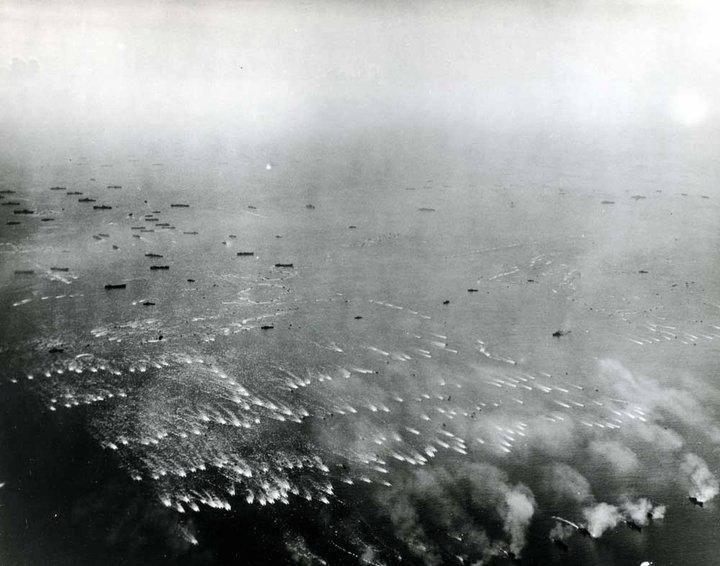
Part of Leyte invasion fleet with US Army troops assaulting Leyte beach. You can see Uncle Suetaro never had a chance. Taken from a USN reconnaissance plane from the USS Portland. National Archives.
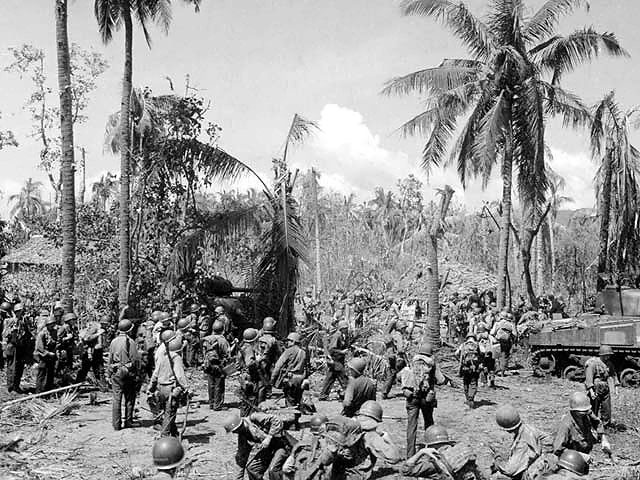
US soldiers on Leyte, October 20, 1944. National Archives
After landing in Ormoc at dawn, they became attached to the 16th Division under Lt. General Makino…but communication had been completely disrupted. Makino’s HQ had been located in the coastal town of Dulag but it had been taken by the US 7th Infantry Division on the first day of the invasion. Makino was in the process of moving his HQ ten miles inland to a town called Dagami five days before Uncle Suetaro landed. Sadly, per the Reports of General MacArthur, orders had been issued by Japanese General Suzuki prior to their landing and were based on faulty intelligence:
Upon receipt of this dispatch, Lt. Gen. Suzuki and his staff began formulating a new operational plan covering the deployment of forces on Leyte. This plan, completed within the next few days, was essentially as follows ²:
1. Operational policy:
a. The Army will act immediately in cooperation with the decisive operations of the naval and air forces.
b. Reinforcements will be concentrated on the plain near Carigara.
c. Enemy troops which have landed near Tacloban and in the Dulag area will be destroyed.
d. The direction of the initial main effort will be against the enemy in the Dulag area.
e. The general attack will begin on or about 10 November.
2. Allocation of missions:
a. The 16th Div. will hold the Dulag area, Catmon Hill, and the heights west of Tacloban in order to cover the concentration of the main forces of the Thirty-fifth Army.
b. The following units, after landing at the ports indicated, will concentrate on the Carigara plain:
1st Div.-Carigara (Uncle Suetaro)
26th Div.-Carigara
102d Div. (Hq. and three battalions)-Ormoc
c. After the concentration of the Army’s main forces on the Carigara plain and adjacent areas to the southeast, operations will begin with the objective of destroying the enemy in the Dulag and then the Tacloban area.
Per Mr. Ota’s book, they slogged north to Carigara; they did make camp to rest one night in Kananga, a half-way point. However, the US-supported guerrillas were constantly pestering the advancing Japanese force by destroying bridges and roads. This wrecked havoc with vehicles and heavy rolling stock. This obviously wore down artillery crews exacerbated by the rain, humidity, and limited food and medical supplies. They still were unable to establish communication with Lt. General Makino; they were essentially going into combat pretty blind.
On or about October 28, 1944, the 41st Infantry Regiment moved from Carigara to the southeast section of Jaro. They were to secure a bridge at a three fork highway junction. {In corroboration, a US report states General Suzuki planned to have these troops move north along the Ormoc-Limon road (Highway 2) through Ormoc Valley, from which they were to diverge in three columns and capture the Carigara-Jaro road.³} I believe this was the Mainit River bridge.
Unfortunately, they would soon clash violently with the US Army’s 34th Infantry, with dwindling provisions and weather combining into an insurmountable force against their staying alive.
To be continued in Part 4.
1. “Nisei” were the children of the first generation Japanese to immigrate legally to the US. Being born here, they were American citizens. A “Kibei” is a subset of Nisei; these Nisei children were rotated back to Japan for a period of time to learn the Japanese language with the understanding they would return to the US. My dad is a Kibei. KIbei’s were absolutely fluent in Japanese and formed the heart of the MIS. In fact, some Kibei’s used to rib the Nisei “translators” because many spoke in a feminine way having learned it from their first generation mothers.
2. ULTRA intercepts reported the approach of this shipping, but MacArthur’s staff at first thought they indicated the beginning of an enemy evacuation. The necessary diversion of Third Fleet and Seventh Fleet aircraft for operations against surviving Japanese fleet units and the incomplete buildup of the U.S. Fifth Air Force on Leyte itself also weakened Allied reconnaissance and offensive capabilities in the immediate vicinity of the battle. Not until the first week in November did MacArthur’s staff realize that an enemy reinforcement was under way. Thereafter, American forces inflicted severe damage on local Japanese merchant shipping, sinking twenty-four transports bound for Leyte and another twenty-two elsewhere in the Philippines, as well as several warships and smaller vessels. By 11 December, however, the Japanese had succeeded in moving to Leyte more than 34,000 troops and over 10,000 tons of materiel, most of it through the port of Ormoc on the west coast. – Per Dai Sanjugo Gun Hatsuchaku Bunsho Utsushi (Document Files, Thirty-fifth Army headquarters) Oct-Dec 44, pp. 21-2, 25, cited in Reports of General MacArthur.
3. Leyte: Return to the Philippines, M. Hamlin Cannon. 1953
It is believed I occupy a potentially unique position when it comes to looking at history as it pertains to the Pacific Theater in World War II. I am American first and foremost and have studied WWII history out of curiosity. As expressed in the description of my blog, my viewpoint is from “one war, two countries, one family”. However, one potential uniqueness is that I am able to read a bit of Japanese; you may be amazed to read what is written about WWII from the Japanese viewpoint of history. As such, I believe each battle will have in the background two broad, driving and dissimilar viewpoints: one from America and one from Japan. The attack on Pearl Harbor is one example. But that is but the surface on war’s history – a high altitude view. One that can be easily manipulated politically. But being on the ground dealing in face to face combat – or interrogation – leaves little to interpretation. However, the fog of time challenges what is seen in a veteran’s mind.
Many of us here in the US interested in this world-wide cataclysm believe the Japanese soldier was a fanatic… freely willing to give his life for the Emperor. The banzai charges. The kamikaze attacks. Individual soldiers throwing themselves under tanks with an explosive charge strapped onto their backs in a suicide attack. The truth of the matter is… they were farm boys. City boys. Just like our boys, they were drafted. Instead of dying in “banzai attacks”, these “fanatical” Japanese soldiers wanted to go home just like our boys…but they couldn’t for fear of reprisal against their families. Being a buck private in the Japanese army was brutal. Perhaps not as brutal as the treatment they gave POWs but brutal nonetheless. My Uncle warned his brother-in-law of that brutality in his farewell letter written on May 3, 1944.
A Look Into Imperial Japanese Army Morale
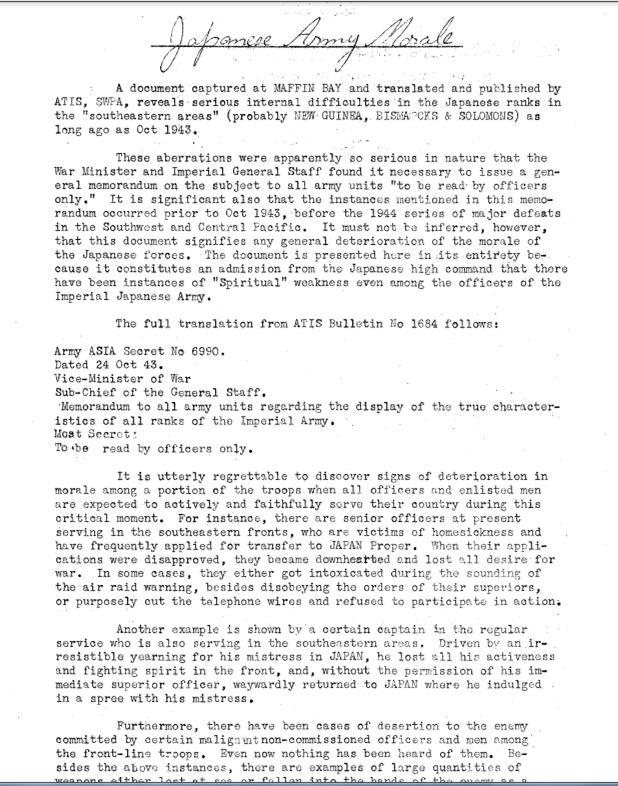
Indeed, as early as 1943, morale amongst the Japanese soldiers was very poor per this US Army G-2 intelligence report:
Excerpt from “Intelligence Bulletin, G-2 USAFPOA, Feb 1945”. The translation was performed by a Nisei in the Military Intelligence Service. The captured Japanese document was dated October 24, 1943.
So perhaps things are not what they seem? I wonder how my Uncle Suetaro felt.
_________________________________
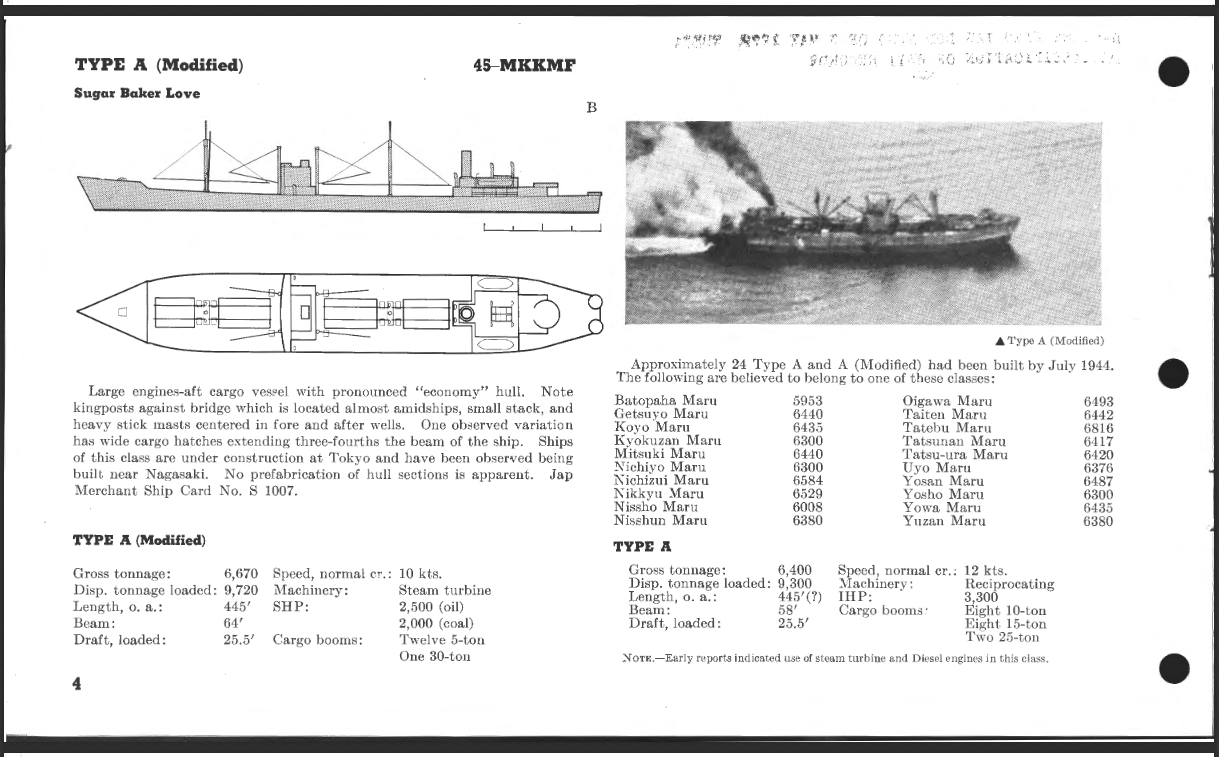
The 41st Regiment, and therefore Uncle Suetaro, was stationed in Pyongyang, Korea in May, 1944 per Mr. Ota’s book. It had become absorbed by the Imperial Japanese Army’s 30th Division. After sunset on May 8, 1944, the 41st Regiment boarded a steam locomotive bound for Pusan. After one day’s ride, they arrived in Pusan on May 9 at 4:00 PM. All 5,000 troops soon began to cram onto a ship called the 日昌丸 (Nissho Maru) with a capacity of 3,000 troops… in addition to supplies and their backpacks. American intelligence reports indicate temperatures could rise to 120F within the holds.
The Nissho Maru is listed in this WWII era Division of Naval Intelligence report.
Per Mr. Ota’s reconstruction, the Nissho Maru departed Pusan on May 10 as part of a Imperial Japanese Navy fleet convoy. At about 3 PM the next day, the convoy docked in Moji Port in Kyushu, Japan to take on more supplies and hook up with other transports. During this time, their destination was disclosed: Mindanao. I am sure thoughts of seeing his mother was enveloping his mind…and heart.
Hiroshima was not far away. In the early dawn hours of May 13, the convoy – now consisting of eleven transports and four destroyer escorts, departed Moji Port. They were vigilant against US submarines and proceeded at best possible speed. They docked at Manila during the evening of the 18th. The troops were already plagued with severe cases of sweat rash.
Soon, the 1st and 2nd Battalions on board the Nissho Maru headed to Cagayan with the 3rd Battalion and headquarters staff headed to Surigao on board the Tamatsu Maru. Because they were splitting up and therefore would be separated from their regimental colors, the commanding officers boarded the Nissho Maru on the 19th as a send off. They reached their destinations on the 23rd. Soon, they were engaging Filipino guerrillas and they were extracting their toll on Uncle Suetaro’s regiment. Per Mr. Ota, Captain Okamoto, a combat veteran from New Guinea was killed. On July 10, Captain Ozaki, commanding officer of the 2nd Batallion, was also killed. Short on officers, Captain Masaoka was appointed commanding officer of the remaining troops, numbering about 1,000.
October 20, 1944 – Invasion of Leyte
By the time of the invasion, General Yamashita had more than 400,000 soldiers stationed about the Philippines. My Uncle Suetaro’s division, the 30th Division, was stationed on Mindanao to the south. Yamashita had access to close to 900 planes, about 100 airfields (the largest of which was Tacloban on Leyte), and a naval fleet spearheaded by four carriers and seven battleships. (However, this paled in comparison to the naval and air forces of the US. For instance, by the time of the Battle of Leyte Gulf, the US had 34 carriers at their disposal.) The invasion of Leyte was preceded by the US 6th Ranger Battalion taking three smaller islands to the east of Leyte Gulf on October 17, 1944. The weather was perfect and all hell broke lose on October 20, 1944 (A-Day) when MacArthur unleashed the Sixth Army’s X Corps, XXIV Corps and the 21st Infantry Regiment in three different assaults on three eastward facing beaches (see below):
From “Leyte”, US Army publication.
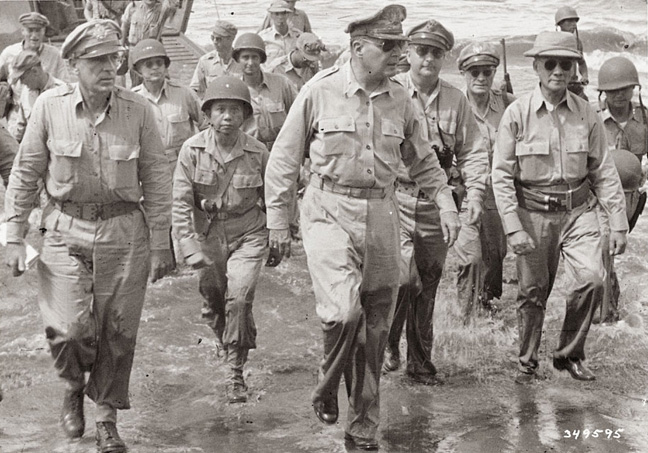
General Yamashita was caught flat-footed. He had anticipated MacArthur would invade Luzon first. He had to scramble. In fact, the invasion’s advance was so rapid that MacArthur made his walk onto the Leyte beach a “Hollywood-esque” event on the first day. Yes, he actually had several takes done of wading ashore being the media seeker he was but it is true there was gunfire off in the distance. Fortunately for our troops, the Japanese had withdrawn her troops from shoreline defensive posts. Even though there had been up to four hours of bombardment by the USN of the shore defenses, many fortifications – including pillboxes – were untouched per an A-Day communication to General Hap Arnold of the USAAF from General Kenney. He concluded there would have been a blood bath similar to Tarawa if the Japanese hadn’t withdrawn.
MacArthur pompously wading ashore on Leyte on October 20, 1944. He would shortly broadcast that speech where he says, “I have returned.” National Archive photo.
The first major coordinated Japanese Army troop movements (i.e., reinforcements) to Leyte involved troop transports, joined by units of Cruiser Division 16 out of Manila. The objective was to transport about 2,550 soldiers (count per Mr. Ota) of the 41st Regiment from Cagayan, on Mindanao, to Ormoc. Named Convoy TA 1 by the USN, it included heavy cruiser Aoba, light cruiser Kinu, Uranami, three new T.1-class transports (T.6, T.9, and T.10), and two new T.101-class transports, (T.101 and T.102). They were to be led by Rear Admiral Sakonju Naomasa in the Aoba but she had been torpedoed two days earlier by the USS Bream. The flag had been transferred to Kinu. This convoy picked up the surviving 1st and 2nd Battalion members of the 30th Division at Cagayan, Mindanao on October 25th and arrived at Ormoc. Fortunately, the Division had been alerted the day before so they were ready. Uncle Suetaro had apparently been in the the 3rd Echelon, 1st wave of five transports that disembarked on the 26th in Ormoc.
Source: Reports of General MacArthur.
Per Mr. Ota and under the command of Lt. General Shiro Makino, Uncle Suetaro’s 41st Regiment headed towards Tacloban. He could not have foreseen what was ahead of him: swamps, jungle, mud, illness, starvation…and the US Sixth Army. …and most poignantly, up against my dad’s US 8th Army’s Nisei’s in the Military Intelligence Service. To be continued in Part 3. (Note: The Battle of Leyte Gulf took place from October 23 to 26, 1944. The immense Japanese battleship Yamato was reportedly only a few hours from Ormoc Bay when she inexplicably turned back during this epic sea battle.)
A mother during World War II could suffer no greater anguish than receiving a telegram that her son was not killed but rather, deemed missing in action.
One irony rests with the fact we were the victors in World War II. While certainly not in all instances, we have a large percentage of intact battle records – and survivors – to help identify (or locate) remains largely because we were victors.
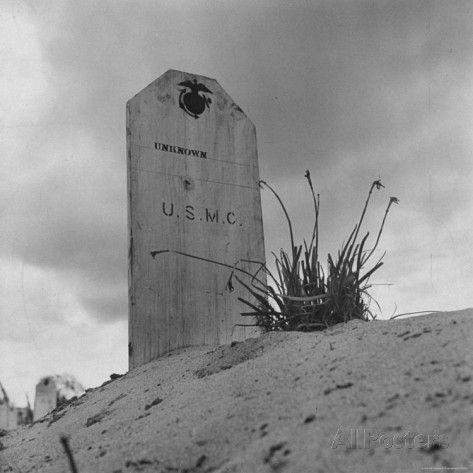
For us here in the US, roughly 420,000 are deemed as killed in action during World War II. However, at one time, there were roughly 80,000 classified as missing in action. There is a second irony here. As seen in the solemn photograph above, parts of a vibrant yet unidentifiable son were brought to this battlefield cemetery for burial. In other words, we have his remains; his name, however, is not on the grave marker. His name is on the list of those missing in action.
The most horrible anguish for a mother, in my opinion, is knowing he could not be found or not knowing where or how he met his end. Her son physically will be forever alone where he perished, never to be seen again… to be taken back over time into the earth from whence he came.
__________________________________
Absence of Records
Japan was at the losing end of the war (as was Nazi Germany). Japan’s major cities were obliterated as were her paper records unless underground or well protected against fire. To further exacerbate the bleakness of this situation, most combat notes or reports written by Japanese officers at a front never made it back to Japan for the most part, especially if the unit was disseminated. Further, as a unit became closer to annihilation, Japanese army headquarters would lose all contact.
On the other hand, many of these written reports made it into US hands and used as intelligence against the Japanese themselves; US Army soldiers were under orders to retrieve all such material. Such documents were taken from those who surrendered or from overrun positions. The most gruesome was having to remove it from a dead soldier – or what was left of him.
The end result was Japanese headquarters more often than not knew little or nothing of what happened to individual soldiers or sailors – especially when it came to NCOs, or Non-Commissioned Officers.
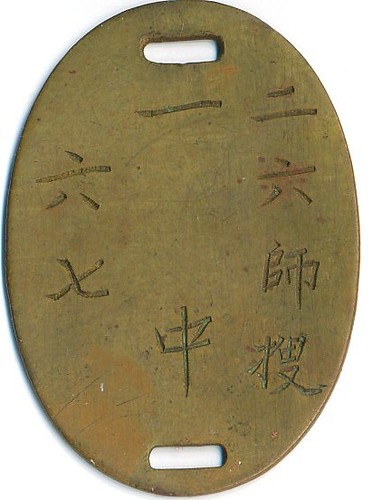
American military wore dog tags (a set of two) towards war’s end, complete with name, home town and serial number to help with identification. Japanese NCOs – like my Uncle Suetaro – also wore “ID tags”, called 認識票 (Ninshikihyo).
Unlike the machine stamped American tags, all of the Japanese tags were stamped by hand with a small chisel and hammer. Most of all, these NCO tags generally only had their assigned regiment number, possibly a unit number and a serial number. No name.
Their fates disappeared with the deaths of their units.
_____________________________________
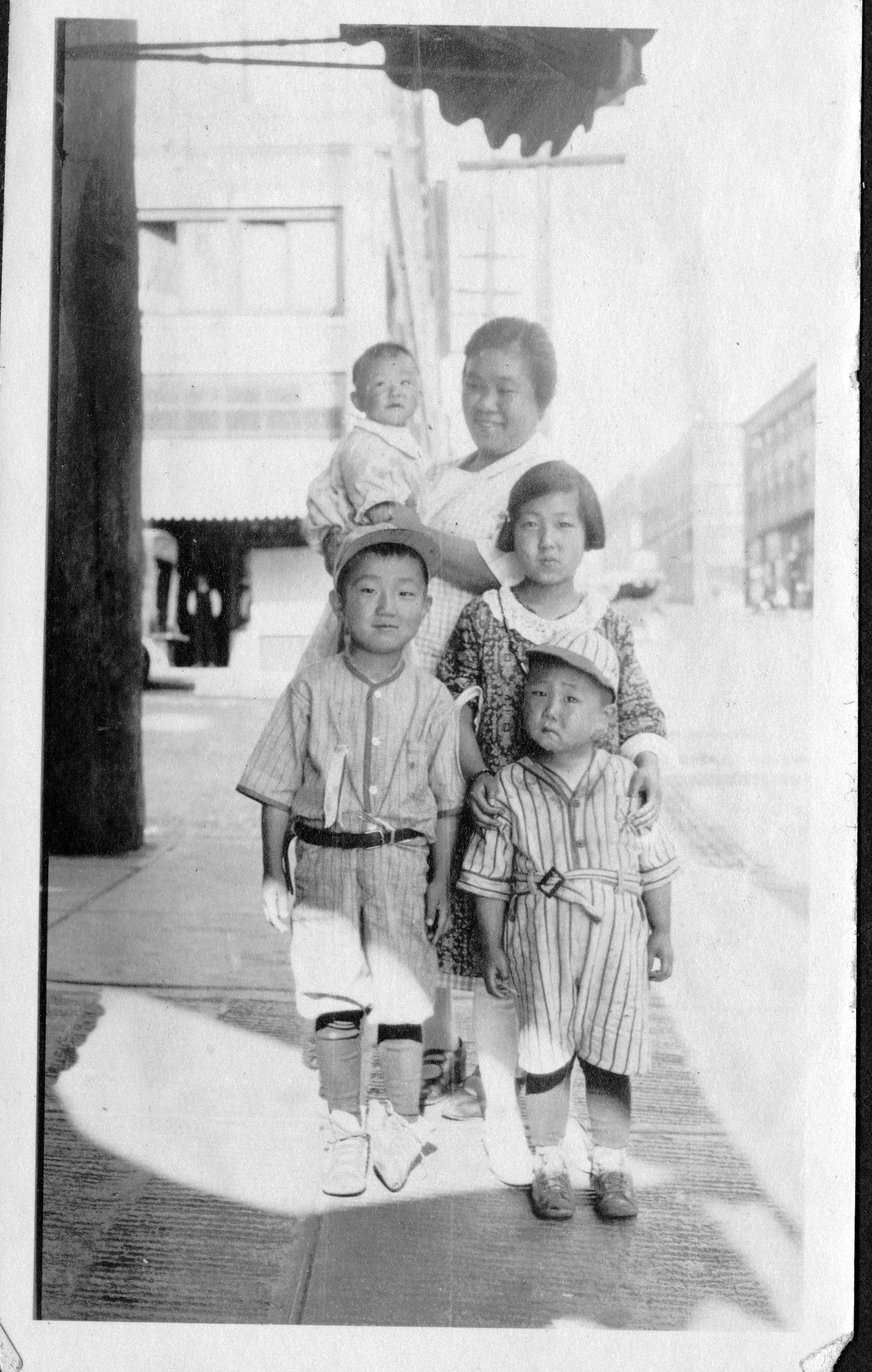
Uncle Suetaro is on the high chair with Dad standing next to him. They are in front of my grandparent’s barbershop on King St and Maynard in Seattle. Circa 1923. The shop was inside Hotel Fujii (no longer standing).
The Discoveries
The void of not knowing how or exactly where my Uncle Suetaro was killed has plagued me for five years now. Yes, I was unaware that dad had a younger brother let alone killed as a Japanese soldier until then.
My Hiroshima cousins, Masako, Kiyoshi, Toshiro and Masako’s daughter Izumi, believed Uncle Suetaro met his end near a village called Villaba on Leyte, thirty days before war’s end on July 15, 1945. This was essentially based on word of mouth. Any other information had been lost in the seven decades since his tragic death. (I believe my father knew more specifics about his death having heard it directly from my grandmother and his older sister, Michie, in 1947. He refuses to talk about it.)
However, in November last year, we renewed interest in a link we found on a Japanese website. Izumi took the initiative and pursued it. It led to an actual memorial association started by the approximately 20 survivors of my Uncle’s unit, the 41st Regiment.
Long story short, it turns out there is one man, Mr. Yusuke Ota, who had also taken a huge interest in the Hiroshima-based 41st Regiment. He was just about to publish a book on the regiment when Izumi made contact with him, with well over 500 pages of data and history he’s uncovered .
Mr. Ota’s book, “The Eternal 41st”.
In addition to buying our family ten copies of his book (in vertically written Japanese, unfortunately), Izumi began a dialogue with the author, Mr. Ota. Mr. Ota was gracious enough to share his thoughts on our Uncle Suetaro based upon our vintage photos.
The Weapon
After viewing the photos and in his opinion, Uncle Suetaro was part of an anti-tank gun squad manning a Type 94 37mm anti-tank gun based on a German design. In the early part of our war with Japan, the 37mm was deadly against our antiquated Stuart and early Sherman tank models.
A partially restored Type 94 37mm anti-tank gun. It was already obsolete by the time the US entered the war. From http://www.tomboy205.cocolog-nifty.com
The photos below were taken in Japan and were scanned from my Hiroshima Grandmother Kono’s photo album. I believe Uncle Suetaro gave them to her:
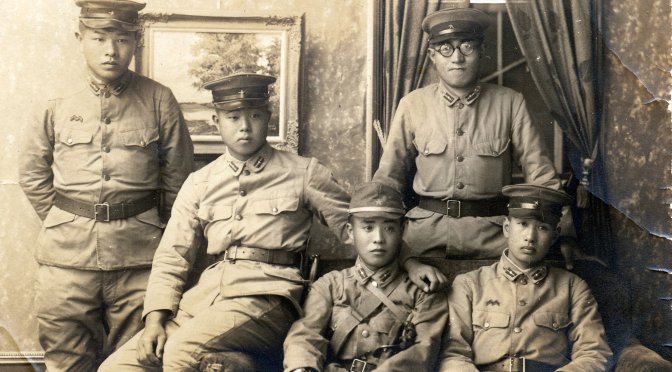
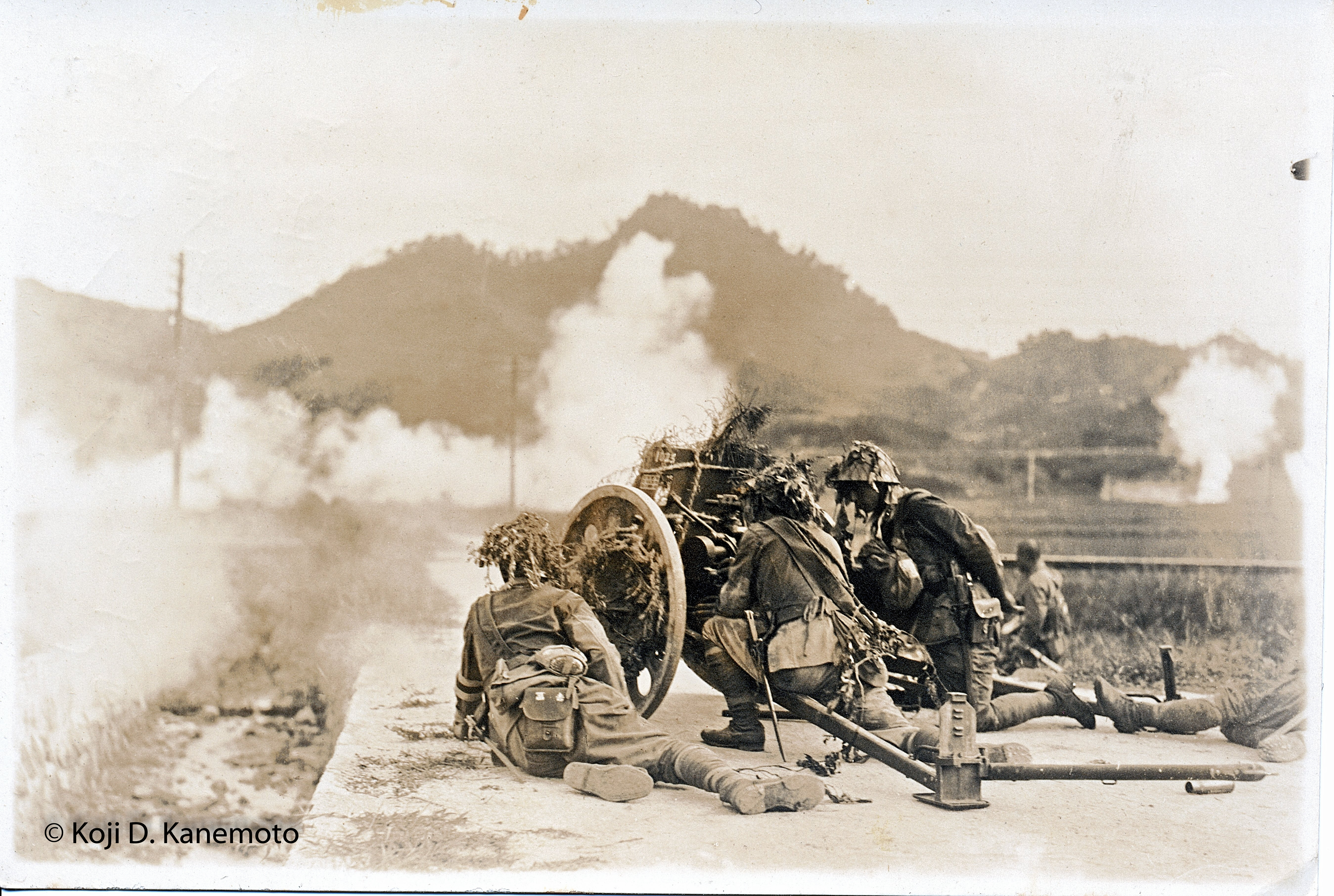
Our family assumes the soldiers pictured were from Uncle Suetaro’s 41st Regiment. A 37mm anti-tank gun is behind them. On the backside, Uncle wrote “石手川ニテ、昭和18六月二十三日”, or “taken at Ishite River, June 23, 1943”. Ishite River is in the current Ehime Prefecture of Japan.On the back side, Uncle Suetaro wrote, “温泉郡浅海村” or “Onsengun Asanamimura” as the location for this training exercise in Japan. We cannot tell if he is pictured. It is now part of the Ehime Prefecture. Dated August 19, 1943.
The 37mm anti-tank gun was manned by eleven men and was equipped with either wooden or steel wheels. It could be broken down into four main parts so that it could be hauled by four mules or carried if need be. It weighed about 220 pounds. But it is easier said than done – imagine you are in a hilly jungle during the monsoons or in a swamp… and you’re hungry, thirsty or even wounded.
It was low profile, a typical Japanese design, meant to be fired in combat while prone or squatting. It had a straight sight and a well supplied and trained team could fire a round every two seconds. They were deployed, if possible, in groups of four guns.
________________________________
Combat
We believe, through Mr. Ota’s book, that Uncle Suetaro’s 41st Regiment was stationed in Pyongyang, Korea in early May, 1944. (Edit: 2/7/2015)
By this time, Japan’s control over the Philippines had begun to deteriorate. The Allies were knocking on their doorstep. The Imperial Japanese Navy was to lose tremendous naval assets in the Battle of the Philippine Sea in just a few weeks. Filipino guerrillas were also attacking Japanese infrastructure from within. The Japanese military believed that General MacArthur would begin his attacks and assault Mindanao in short order.
In response to that conclusion, The Japanese army reorganized and placed the infamous General Tomoyuki Yamashita in charge of the newly restructured 14th Area Army. My uncle’s unit, the 41st Regiment, was then attached to the 14th Area Army.
By the end of May, Uncle Suetaro and his 41st Regiment were on Leyte.
My aunt’s second cousins are on the left, Mr. and Mrs. Nakano. I took this while were were on the way to their field to harvest yams. They harvested yams from the same field during the waning days of the war. August 1974, Fukui, Japan.
We must realize that those who endured World War II – as combatants or as civilians – are leaving this world daily.
Of those who survived and remain with us today, it is not enough to have seen it as a small child. Of course, I am not implying there was no damaging effect on their souls. If you were such a child and witnessed a bomb blast, that will be in your mind forevermore.
But those who were young adults back then have the most intimate, most detailed recollections. Unfortunately, they would by now at the least be in their late 80s or early 90s – like my parents and Aunt Eiko.
Even so, the mental faculties of these aging survivors have diminished with age. For some, dementia has taken over or of course, many just do not wish to recall it. My dad is that way on both counts even though he did not endure combat. For instance, he still refuses to recall what he first felt getting off that train at the obliterated remains of the Hiroshima train station in 1947 as a US Army sergeant. I’m positive he also went to see the ruins of his beloved high school where he ran track.
——————————————–
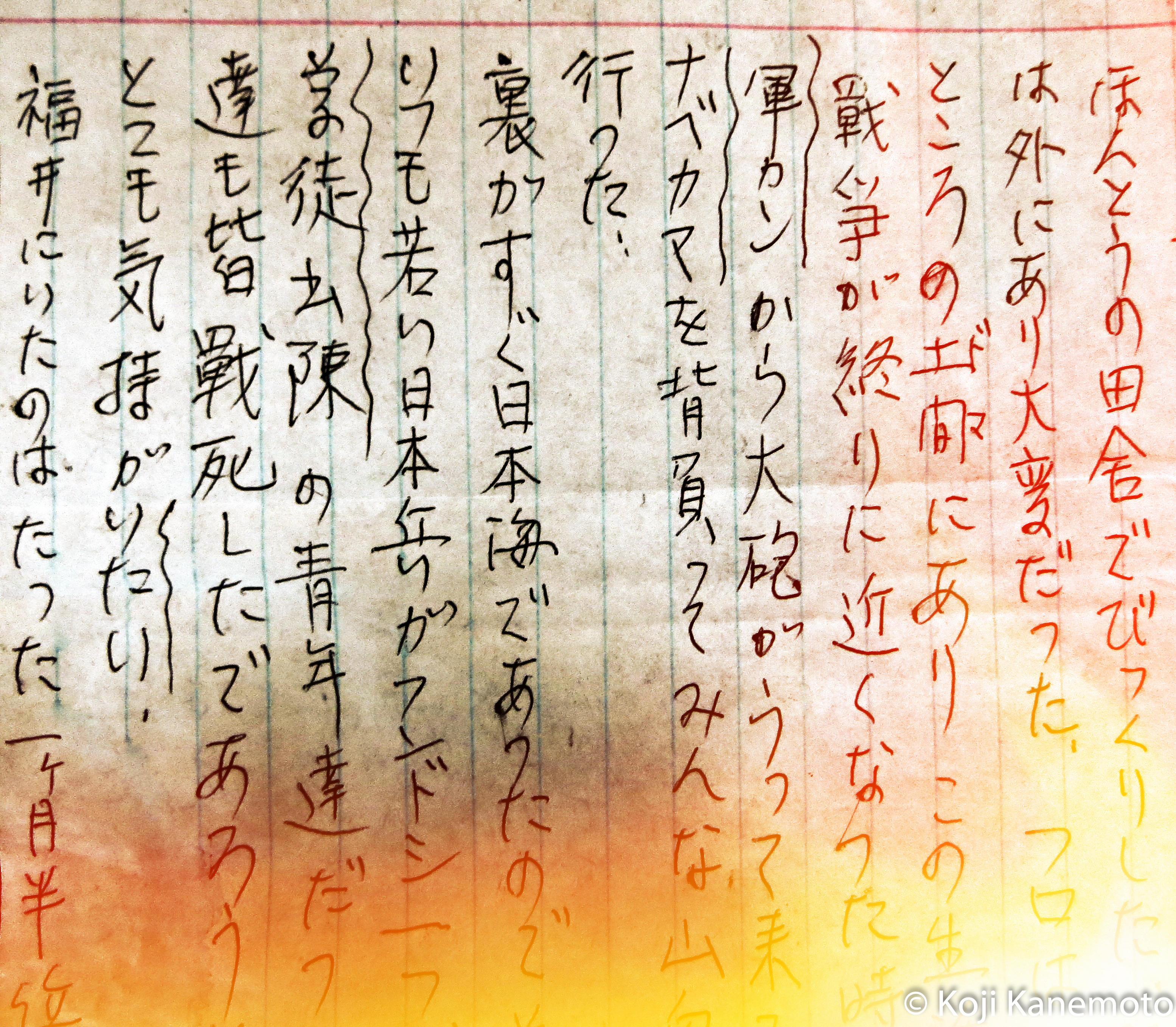
Some of my Aunt Eiko’s poignant notes about the last weeks of war.
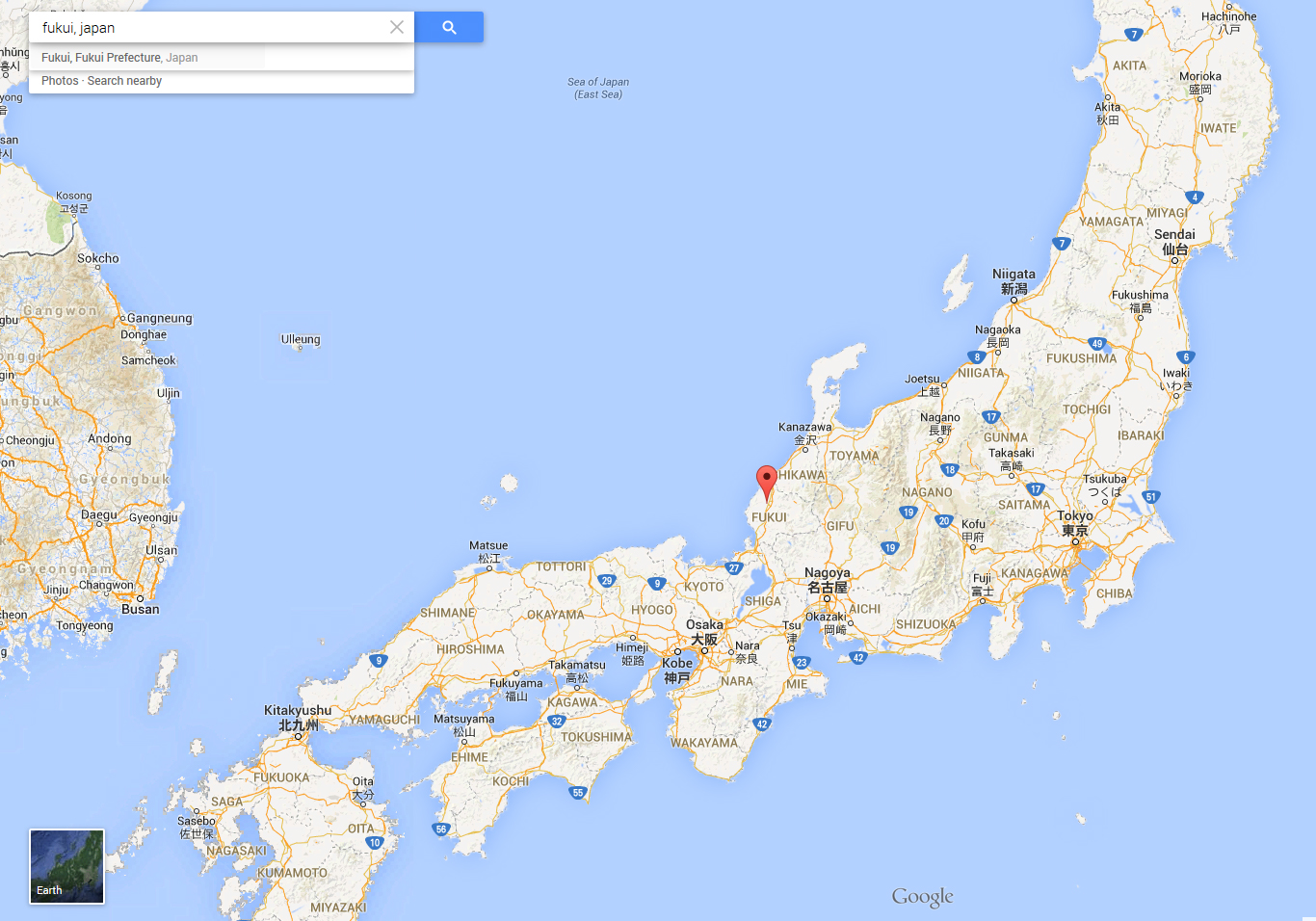
As described in my series on the firebombing of Tokyo (link is here), my aunt, mother and grandmother fled Tokyo around July 1, 1945 via train. They were headed for Fukui, a town alongside the Japan Sea, and the farm of Mr. Shinkichi Mitani (He is my second great uncle so you can figure that one out.) My guess is grandfather believed the farmlands to be a very safe refuge. My grandfather accompanied them on their journey to safety but he would be returning to Tokyo after they reached their destination. To this day, my aunt does not know why he went back to Tokyo, a most dangerous and desperate city to live in.
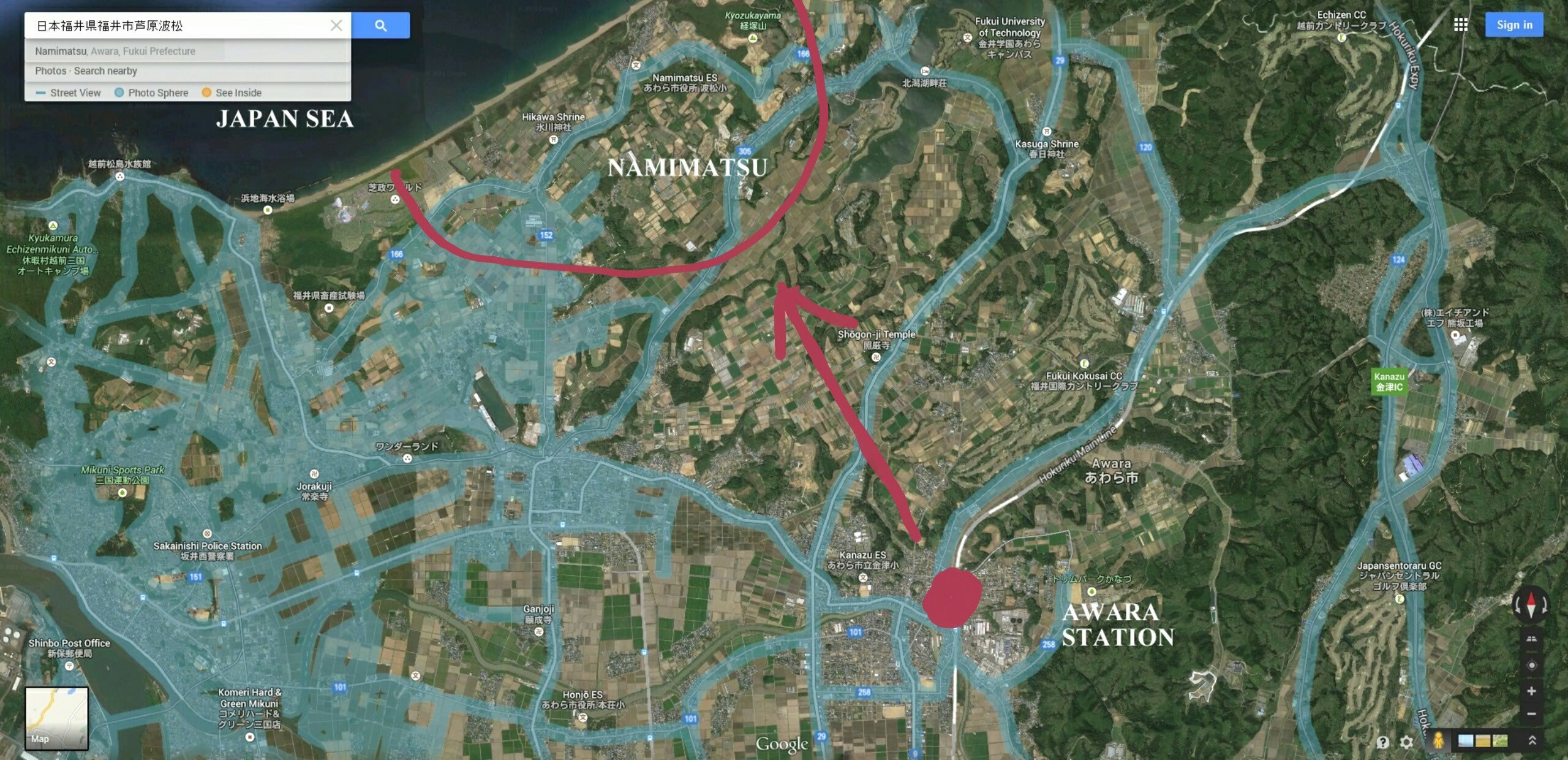
Fukui is marked by the red marker. Tokyo is directly east along the bay.
As the railroad system in Japan was devastated, it always perplexes me as to how my grandfather managed to get tickets on a rare operating train let alone get seats…but he did. The train ride is even more incredible given the Allies ruled the skies by then; during daylight, American P-51 Mustangs strafed targets of opportunity at will: trains, boats and factories. It appears they traveled at night.
My aunt firmly recalls the train being overfilled with civilians trying to escape extermination in Tokyo. But with my grandfather’s connections (and likely a bribe or two while spouting he was of samurai heritage), they were fortunate to get seats in an uncrowded private rail car. You see, the car was only for Japanese military officers; the military still ruled Japan. She remembers many of them were in white uniforms¹, all with “katana”, or their ceremonial “samurai swords” as the Allied military forces called them. She said she didn’t say a word. She felt the solemnness heavily amongst them in the stuffy humidity.
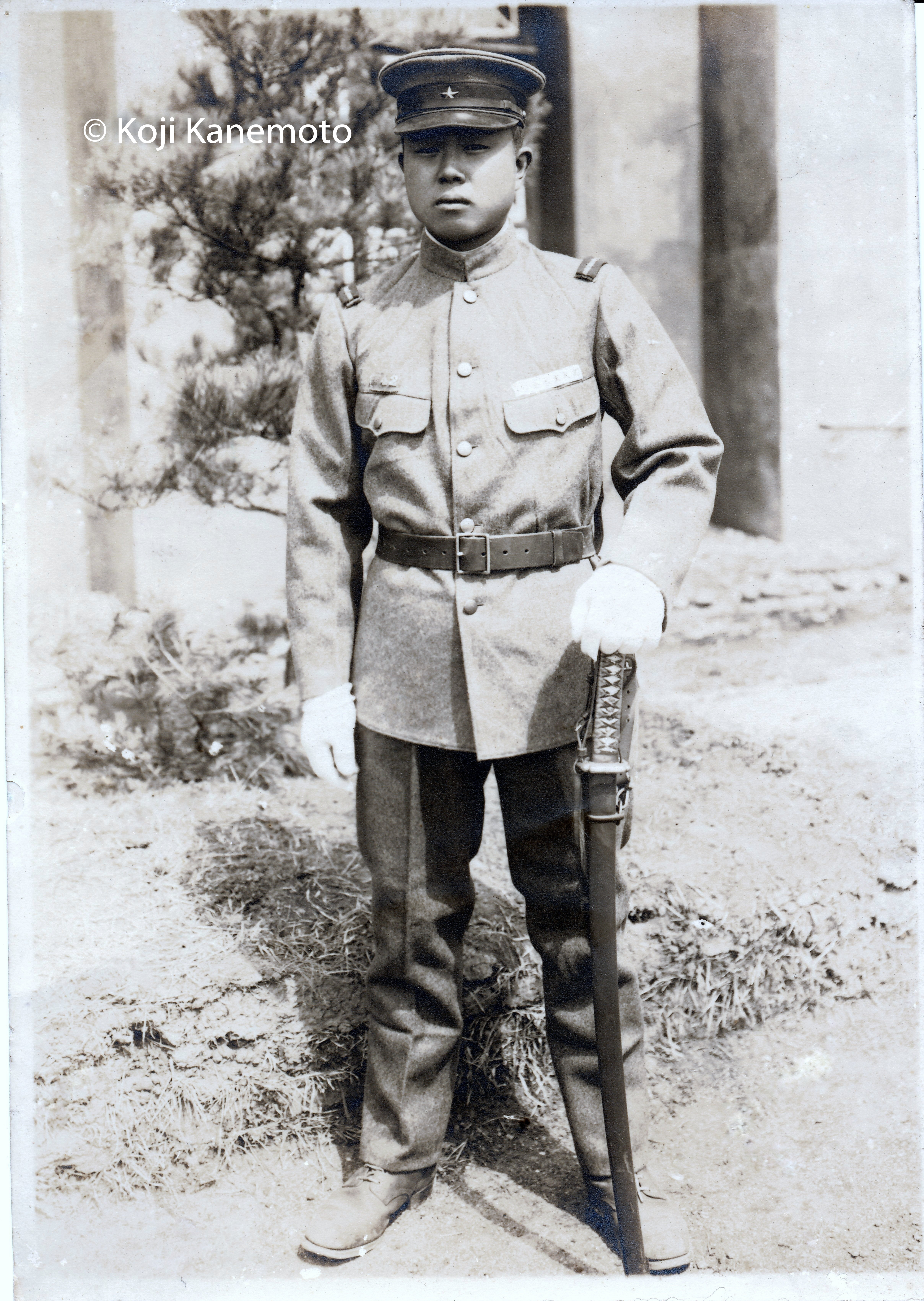
My dad’s youngest brother, Uncle Suetaro, is sporting a “katana”, or samurai sword for a ceremony of some kind. Although born in Seattle, he was unable to leave Hiroshima and became drafted into the Japanese Imperial Army. He was KIA on Leyte by US forces. Circa 1944.
_________________________________
The Mitani farm was about 2-1/2 miles NW of Awara Station in a village called Namimatsu; the beach was about a ten minute walk away.
She said they arrived at the Awara Station (芦原) at night. Humidity was a constant during that time as it was the rainy season (梅雨, or “Tsuyu”); nothing could dry out and mildew would proliferate. They walked roughly 2-1/2 miles (一里) in total darkness on a hilly dirt trail looking for the farm of Mr. Mitani. Being of an aristocratic family, I’m sure their trek was quite the challenge emotionally and physically. No, they did not have a Craftsman flashlight. No street lights either. The only thing that possibly glowed was my grandfather’s cigarette.
The challenge would escalate. While living conditions in Tokyo were wretched, they had been aristocrats. She was unprepared for farm life. Indeed, she had become a Japanese Zsa Zsa Gabor in a real life “Green Acres”.
When I visited the Mitani farm in 1974. Although the Mitanis had passed away, Mitani’s daughter is at the center with the blue headband. Her husband is at the far right with my mom standing next to him in “American” clothing. I am at the far left, toting my Canon F-1 camera of back then.
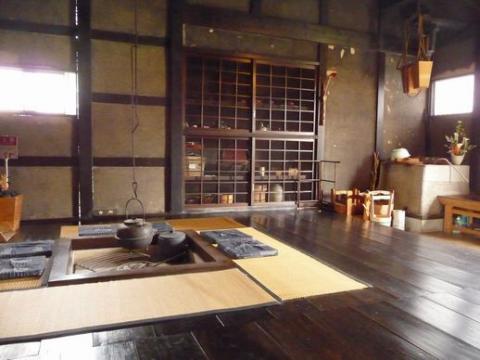
Aunt Eiko described the farmhouse and its associated living conditions as essential beyond belief. She was greeted by a 土間 (doma), or a living area with a dirt floor², as she entered. Immediately inside the doorway was a relatively exposed お風呂, or traditional Japanese bath tub. Her biggest surprise was the toilet – or rather, the absence of one. It was indeed a hole in the ground outside. (I know. I used it when I visited in 1974…but it had toilet paper when I went.)
__________________________________
During the day, they helped farm the yams Mr. Mitani was growing. They also ate a lot of those yams because it was available. There wasn’t much else.
My second cousin Toshio on the left, mom pulling some yams, Mr. Nakano at right when we were visiting Fukui in 1974. It was the first time back for mom and Aunt Eiko since the war.
Although my grandfather moved them to Fukui as a safe refuge, he was mistaken.
Shortly after arrival, Aunt Eiko said the terror of being on the losing end of war struck again. US warships began to shell the farming areas in the Namimatsu village.³ Mrs. Mitani immediately screamed, “Run for the hills! Run for the hills!” She vividly remembers Mrs. Mitani and all the other villagers strap their “nabekama” (鍋釜), or cast iron cooking cauldrons, onto their backs and whatever foodstuff they could grab and carry. You see, life had become primal for the farmers and villagers. Food and water was their wealth. Everything else had become expendable by then.
A traditional cooking cauldron, or “鍋釜 (nabekama)” hangs above a firepit towards the bottom left in the picture above.
They all did run to the hills as the shelling continued, she said. I do not know how long the barrage lasted nor how far away those hills were or if anyone she had met there was injured or killed. Surely, the damage must have been quite measurable on the essential crops or already dilapidated farmhouses if they were hit. For some, it may have become the straw that broke the camel’s back. The years of war would have taken its toll.
_________________________________
The Japan Sea was on the “backside” of the farm, she said (see map above); it was close by. One poignant memory she has is one of watching young Japanese soldiers by the coastal sea cliffs several times.
My Uncle Suetaro is at the bottom left at a beach; he and many of his fellow soldiers are in their typical loincloths. I am confident my Aunt Eiko saw very similarly dressed young soldiers like these by the sea cliffs at Fukui.
She says that as the Japan Sea was on the other side of the farm, she watched young Japanese soldiers joyously swimming by the sea cliffs in their loincloths (フンドシ or fundoshi). They were Army recruits and so very young. Aunt Eiko says her heart is pained to this day knowing that all those young boys she saw swimming in the Japan Sea certainly perished.
____________________________________
Preceded by my mom, Aunt Eiko and grandmother returned to Tokyo about a month after war’s end. The Mitani’s had taken them into their already burdened life, provided shelter and shared whatever meager provisions they had. While they have all passed on, she is grateful to them to this day.
As she wrote, the sight of Mrs. Mitani strapping on their cauldron remains etched in her mind to this day.
To Aunt Eiko, the simple cast iron cauldron had helped stew the essence of survival.
Notes:
1. Being the summer months, the white uniforms were likely worn by Imperial Japanese Navy officers.
2. For a visual on what a dirt floor house may have looked like, please click on this link.
3. While TF 37 and 38 were operating around Japan attacking targets, I was successful in only locating one battle record of Fukui being attacked when Aunt Eiko was there. It belongs to the US 20th Air Force; in Mission 277 flown on July 19th, 1945, 127 B-29s carpet bombed Fukui’s urban area. Military records state that Fukui was deemed an important military target, producing aircraft parts, electrical equipment, machine motors, various metal products and textiles. It was also reportedly an important railroad center. Per Wikipedia, the attack was meant to destroy industries, disrupt rail communications, and decrease Japan’s recuperative potential. Of the city’s 1.9 sq. miles at the time, 84.8% of Fukui was destroyed that day. I am under the assumption that having witnessed B-29 attacks in Tokyo that she definitely would have heard the ominous drone of the B-29s. As such, she maintains it was a naval barrage.
Uncle Suetaro (L) and my dad (R). Taken from the Hiroshima house with Mt. Suzugamine in background. Circa 1929
During my visit to my father’s childhood home in Hiroshima last summer, I was entrusted with hundreds of vintage family photos and mementos. I brought them back here stateside, promising my Hiroshima family I would “restore” them.
Well, after a good start, I developed a painful case “tennis elbow” from using the mouse so much during the retouching process. Sadly, it came to a screeching halt sometime in November last year.
But one very, very special item was entrusted with me – my Uncle Suetaro’s war diary.
Although born an American citizen in Seattle with the rest of his siblings, he was writing this war diary as a sergeant in the Japanese Imperial Army.
The last entry was a farewell letter to his Mother.
______________________________
The photo above had been secreted away behind another photo that was in Uncle Suetaro’s album. He meticulously kept the album up to the time of war. His oldest brother, my Uncle Yutaka, had conscientiously sent him family photos they had taken in Chicago and Los Angeles before imprisonment. Suetaro complimented the photos with his beautiful Japanese calligraphy, written in a silver, whitish ink.
The photo of Uncle Suetaro and my dad shown at the beginning was so very tiny – but there was something Uncle Suetaro loved about it to keep it. I wish I knew what it was.
Actual size
__________________________________
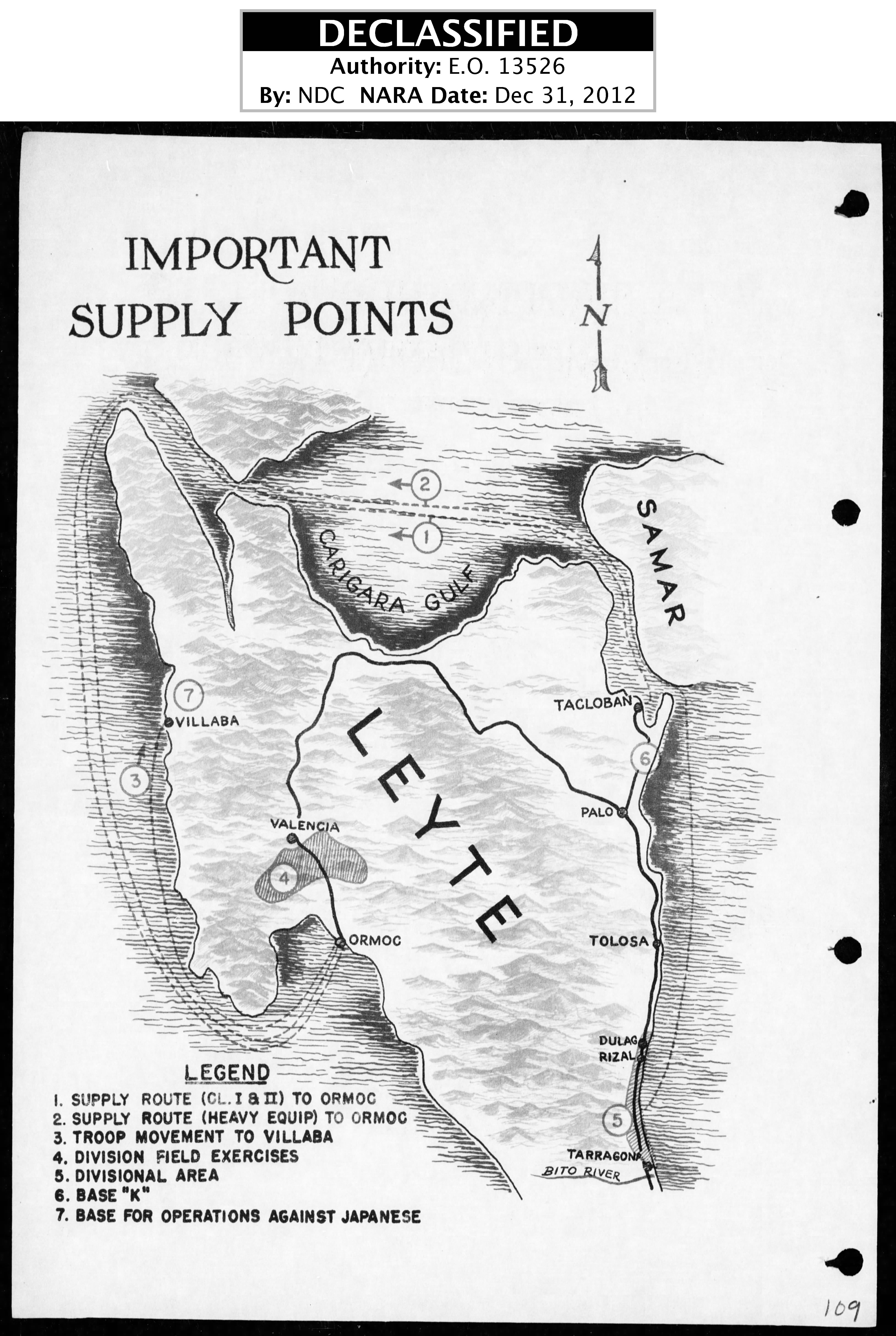
Uncle Suetaro was killed as a sergeant major of the Japanese Imperial Army on Leyte apparently near a town called “Villaba”. Below is an actual page from a “war diary”, an official report written and published by the US Army. Villaba is located on the western shore of Leyte but not far from Ormoc Bay, which was a killing field for Japanese ships by US aircraft.
Source: US Army 81st Infantry Division Headquarters / Report of Operations
His remains were never recovered. In the family grave are his tiny pieces of his fingernails and a lock of hair. It was custom at that time to leave parts of your earthly body with your family as returning was unlikely.
Not much to bury… but it was better than not returning at all.
In a spiritualistic way, he had never left.
____________________________________
This is his farewell letter to his Mother (my Grandmother).
It is clear it was very hurriedly written.
With the help of my cousin Kiyoshi in Hiroshima and my dad, we’ve typed up Uncle Suetaro’s farewell letter – complete with old Japanese characters and translated as best possible into English. When reading this, please remember these are the words as written as a soldier going off to fight the Americans – but he was once a young American boy born in Seattle, WA.
Cover. His name is at the bottom. 金本 末太郎ママ様 Dear Mama, 御無沙汰致しました。 I am sorry for not writing for a while. お元気ですか。 自分も相変わらず元気旺盛御奉公致しております故、何卒ご放念く ださい。 How are you? As usual, I am full of life fulfilling my duty to my country so please feel at ease. (元気で国のために力を尽くしてるので心配しないでください) 愈(いよいよ)自分も日本男子としてこの世に生を受け、初陣に臨むことを喜んでいます. More and more, as I realize I was born into this world as a Japanese male, I am overjoyed to be going into my first combat. 勿論(もちろん)生還を期してはいません(生きて帰ることは思ってはいません)。 Of course, I do not expect to come back alive.併せ(しかしながら)自分に何事があっても決して驚かないように、また決して力を 落とさないよう平素より力強く暮らしてください。 And for you, Mother, whatever happens, do not be taken by surprise and please fight back with even more energy than you normally would. 24年の長いあいだスネかじりにて非常にご心配をかけ誠にすいませんでした。 I deeply apologize for these 24 years of worry and concern I have caused you. お赦し下さい(おゆるし下さい)。 Please forgive me. 今の時局は日本が起つか亡びるかの境です。 At this time, Japan is at the boundary of either winning or perishing. どうしてもやり抜かねばいけないのです。 We must persevere. 兄さん達を救い出すことも夢見てます。 I still dream that we can free our older brothers (from forced imprisonment in America by FDR – Ed.). 自分のことは決して心配せずお体をくれぐれも気をつけて無理をしないよう長生きを してください。 Please do not worry about me but instead, please take it easy on yourself and live a long life.
(Note: Green indicates an edit inserted for clarification purposes.)
何事あっても荒槇、小林の方に相談して下さい。 If something comes up, please discuss it with the Kobayashis or Aramakis. 金本家は絶対に倒してはいけないのです。 No matter what, do not allow the Kanemoto name be extinguished. 伴の兄さんもお召の日が必ずあることと思います。 Mikizou-san will also be drafted. (荒槇幹造さんも必ず徴兵されることと思う) 歳はとっていても軍隊に入れば初年兵です。一年生です。 Although he is much older in age, he will be treated like any other draftee. As a young recruit. 絶対服従を旨とするようよく言って下さい。 Implore upon him to obey every command without question. 近所の皆さん、河野,倉本、白井、武田、永井、正覚寺、梶田、山城、山根、杉本、 辻、河野…、橋本,西本、松本繁人、小林、中本、新宅、武蔵、水入、土井、堀田、住岡、見崎、長尾、加藤、三好、内藤、島本、(Writing continues next page from here) 宮本先生、谷口先生、慶雲寺などの人によろしくよろしくお伝えください。ではこれにて失礼します。 With that, I will say farewell. 何時までも何時までもお達者のほどお祈り致しております。 I pray for all eternity for your good health and prosperity. 南無阿弥陀仏の御6文字と共に行きます。 I go blessed with the six realms of Namu Amida Butsu. サヨウナラ Sayonara 昭和19年5月3日 May 3, 1944 末太郎より ママ様へ From Suetaro To Mama-san
His farewell send-off is pictured below. Masako-san believes Suetaro wrote the letter around this time. It was at gatherings such as this when a Japanese soldier was given a “good luck” battle flag – the ones that many WWII combat veterans “removed from the battlefield” as souvenirs. There are many cases now where their sons and daughters – or grandchildren – are making efforts to return such flags to the Japanese families.
Uncle Suetaro (center) is pictured just before going off to war and his death. You will notice my grandmother is missing from the photo; that is because she suffered her first stroke knowing her last son was going to his death.
_______________________________________
Bertrand Russell wrote, “War does not determine who is right – only who is left.”
He is correct.
On a much smaller scale, though, Grandmother Kono was all who was left in that house when war’s end came. Her precious son Suetaro – who she kept from returning to America for the purpose of keeping the Kanemoto name going – was dead. She was now alone. I wonder how she felt.
A mother’s anguished solitude.
Grandma and four youngest children at the corner of King and Maynard in Seattle, circa 1926. From clockwise right-front: Suetaro, dad, Mieko, Grandmother Kono and Shizue.
Grandmother standing near King and Maynard in Seattle with (L to R) unknown girl, Dad and her loving hand on Suetaro. Circa 1925
My Grandmother Kono could not have possibly foreseen her future pain in solitude… But the anguish she endured seven decades ago brings our family together today along with a message to the world.
________________________________
Born on October 6, 1888 in a Hiroshima village called Furue, Grandmother Kono came into Seattle on February 4, 1909 via the Shinano Maru. She was a picture bride for my Grandfather Hisakichi.
She gave birth to seven children; all but one was born in Seattle. They were American citizens.
Uncle Suetaro (Soo-e-ta-rou) was #6 and born in Seattle sometime late in 1920 although I have been unable to locate his birth records on-line. His name (末太郎) implies “last boy (or child)” but as you can see in the damaged photo above, Grandmother and Grandfather appear to have had an “oops” moment. That’s Mieko, their youngest sister; she became truly the last child.
Uncle Suetaro is on the high chair with Dad standing next to him. They are in front of my grandparent’s barbershop on King St and Maynard in Seattle. The shop was inside Hotel Fujii (no longer standing). Circa 1921.
________________________________
While growing up, Uncle Suetaro was my father’s favorite sibling. Suetaro and dad were inseparable from what I am told. Dad’s nickname for him was (and still is) “Sue-boh”.
Suetaro was a happy child and always made people laugh and feel good – like Grandmother Kono. Suetaro and Dad played “oninga”, or tag, together frequently; there was no Nintendo or footballs to throw around in the 20’s. When Suetaro got old enough, they picked “matsutake” mushrooms together on Grandfather’s mountain property as told in “Masako and Spam Musubi“. When Grandmother made fish for dinner, Dad wouldn’t eat it – but Suetaro did. Suetaro ate everything.
This is my favorite photo of three of the youngest siblings; we uncovered it just this month in Hiroshima thanks to my cousin Toshiro:
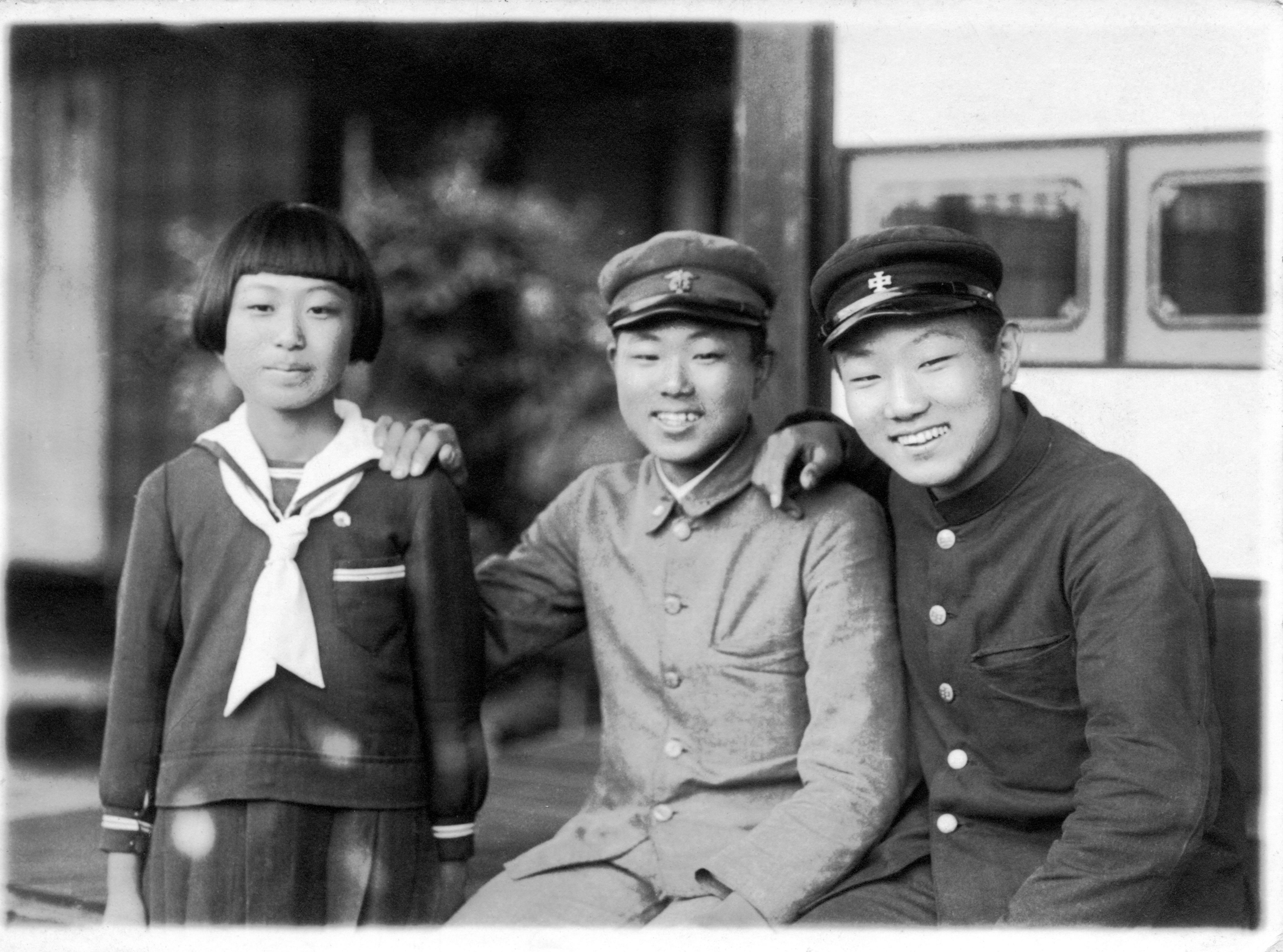
The three youngest siblings: Mieko, Suetaro and Dad. A rare photo as all three are smiling – especially Dad. This portrait was also taken while they sat on the Hiroshima home’s sakura wood. My assumption is it was taken immediately before Dad left to return to Seattle.
Dad says they had one bicycle to share between them. On school days, they would walk to the train station together in the morning while one slowly rode the bike. They would leave it at a little shop which was still quite a ways away. However, whoever got to the bicycle first AFTER school got to ride it home – quickly. Leaving the other brother in the dust. And it was a long walk – especially in the summer heat and humidity. Perhaps it was the bicycle in the early portrait shown in “Souls of Wood“?
________________________________
Dad left Hiroshima soon after graduating from Nichuu High School at 18 years of age; he arrived back in Seattle on May 18, 1937.
Grandmother, Suetaro and Mieko were left behind in Hiroshima.
He would never see his favorite brother Suetaro or Mieko alive again… and Grandmother Kono will soon experience a demonic dread that will stay with her for the rest of her life.
________________________________
To Be Continued… A direct link to Part II is HERE.
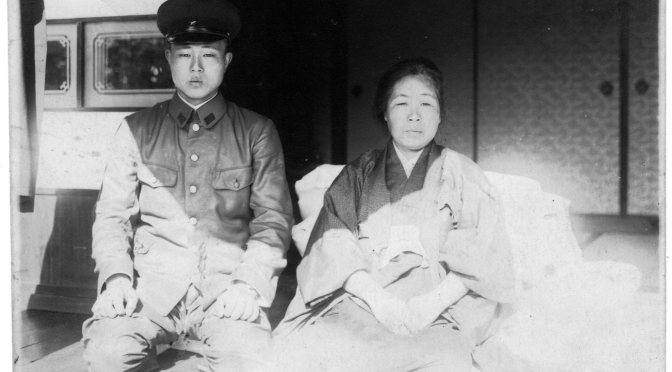
The last known photo of my Uncle Suetaro. He did not return from Leyte during the final stages of World War II. My Grandmother Kono – having suffered a stroke – is propped up by Japanese “shiki-futon” for the picture. Taken in Hiroshima, 1944.
Yes, a small percentage of Japanese soldiers were anxious to die for their emperor.
But a vast majority was frightened of having to go to war. My opinion, of course.
Young Japanese boys were drafted from farms and fishing villages – just like we did here in the US of A during that time. Boys from Parsons, Kansas or from a sea coast shrimping town in Louisiana.
And they all had moms.
__________________________
Like all Americans of my age, we were taught that the Japanese soldiers of WWII were fanatics. That they all were hell-bent to charge into a hail of Allied machine gun fire. To willingly die.
We were also taught that when a US Marine charged well entrenched Japanese soldiers with a satchel charge, he was a hero. Not a fanatic. He was John Wayne or Kirk Douglas. Was Esprit de Corps driving the young Marine to offer his life to save his buddies?
There is no intent to question our American values of valor or honor. Just a quandary.
_________________________
My Hiroshima cousin Masako mentioned in Hawai’i having seen a photo of Uncle Suetaro and Grandmother. It was taken the day before Uncle shipped out for war (1944). Masako said Grandmother – having suffered a stroke the day before – was propped up by “shiki-futon”, or Japanese bedding for the picture. She felt strongly it was the last picture taken of Uncle Suetaro but doesn’t know what happened to it.
_________________________
A few weeks ago, my California cousin Janice came across a number of old photos; she had forgotten about them. She said there were some family photos from Hiroshima. Her father – Uncle Suetaro’s and my Dad’s oldest brother – had apparently been able to hold on to them through the decades.
I asked Janice if there were any photos of my Dad’s two youngest siblings, Suetaro and Mieko, or of Michie (Masako’s mother). Janice then described a picture of Uncle Suetaro in a uniform and Grandmother (seen at the beginning of this story).
I was stunned. Topo Giggio meets Godzilla. It was the photo Masako vividly recalled seeing decades ago.
Is there an air of fearfulness…of fright? You can decide. But as we were led to believe, all Japanese soldiers were fanatics…yes?
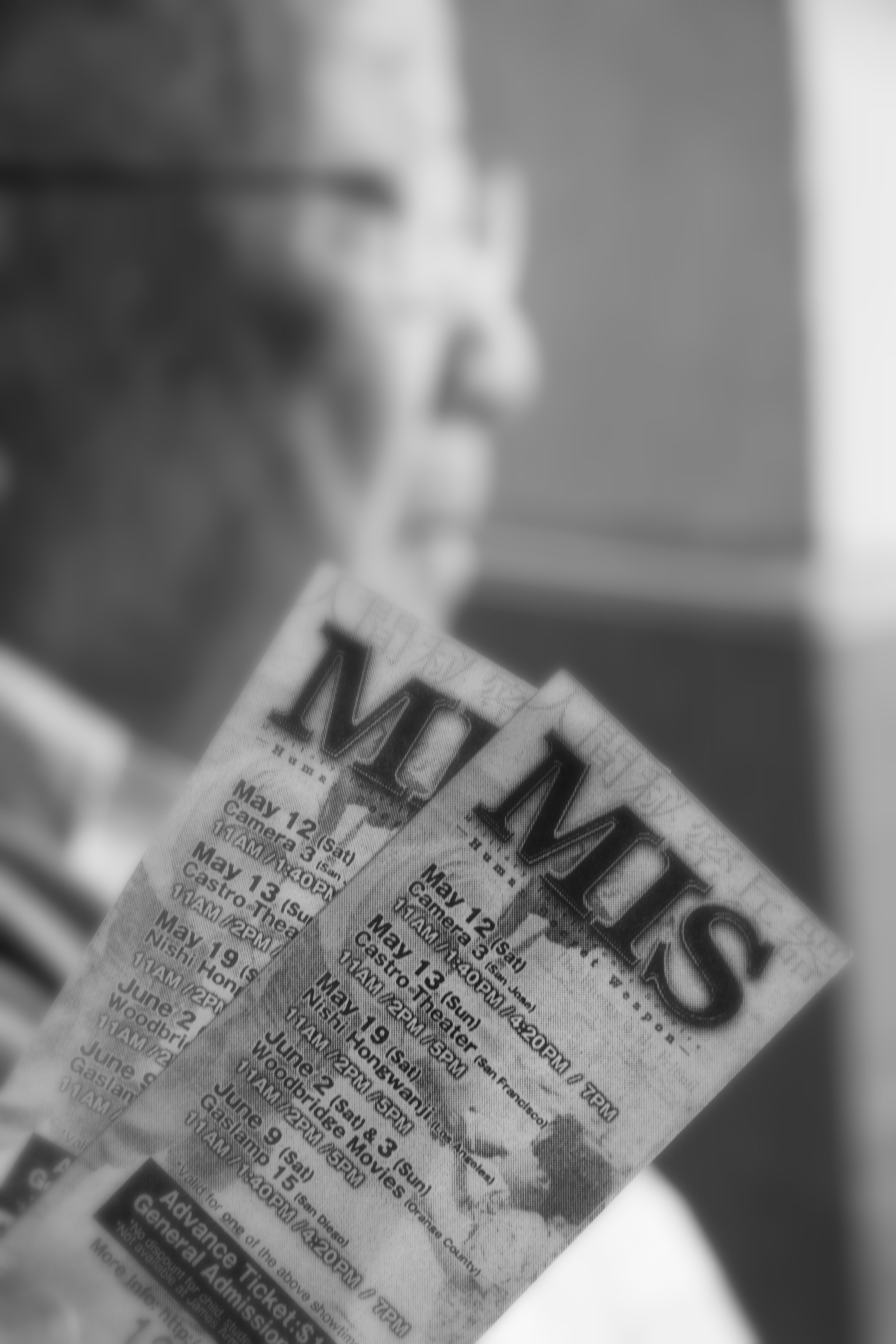
“War is no good,” he said as we left the small community movie theater near his assisted living home today; we had just watched the limited release documentary “MIS: Human Secret Weapon”. It was about his highly classified World War II US Army unit. He had silently watched and with a ghostly stillness. But I saw him wipe his eyes twice after gently lifting his glasses. Others openly wept…but I had never, ever seen him shed a tear before today.
I was ignorant. Combat isn’t necessary for the ugliness of war to be buried in a person’s mind. The documentary made it clear that it is also easily dug out. All one needs to do is scratch.
Official US Army document certifying his Military Intelligence Service days.
___________________
The documentary reveals the conflicted state of mind of the then young Japanese-Americans who made up the US Army’s Military Intelligence Service (MIS). About 3,000 of them – including two of my uncles – secretly and faithfully served the red, white and blue, hastening the Japanese surrender on board the USS Missouri.
Another 3,000 served during the Occupation of Japan. My dad was one and worked out of General Eichelberger’s US 8th Army’s GHQ in Yokohama. That’s when he was able to journey to Hiroshima and see his mother for the first time in ten years…and when a hungry Masako first relished the flavor of Spam.
__________________
Grant Ichikawa, MIS, CGM and me. 2010
One Nisei veteran interviewed was Grant Ichikawa. He was gracious enough to not only greet me and my family in 2010 near his home in Rosslyn, VA, he also secretly treated us to lunch. Pun intended. He had lost his wife Millie just months before. She was an even rarer female member of the MIS as well.
He and Terry Shima (also interviewed in the documentary) gave me the jump start in finding out about Dad’s involvement in the MIS. During that all too brief get together, Grant did touch on what he did on the battlefront in a GI uniform. He also said it “got dicey”.
In this documentary, you learn of one such experience. He was told there were Japanese soldiers who had agreed to surrender. Grant said he was the point man. They proceeded to the rendezvous point where he met the Japanese commander; they were in the middle of an open field.
It turns out there were 200 to 250 of them; all their weapons were in good working order he says in the documentary. Grant suddenly realized – out in the middle of this field – that these Japanese soldiers were “toukoutai”, or “suicide corps”. Grant just as quickly and with great consternation realized there were only ten of them… GI’s, that is, armed only with rifles. I’m sure Grant picked his words wisely. He is still alive.
“Dicey” was a definite understatement.
_______________________
In a lighter moment, Ken Akune described how they were searching a Japanese soldier that had surrendered in the jungle of Burma. They came across one of the American propaganda leaflets promising safe passage for those Japanese soldiers that surrendered. It was neatly folded in a pocket.
Surrender Propaganda Written by MIS Nisei.
Akune asked the Japanese soldier if he believed what the leaflet promised since the MIS Nisei wrote it. The Japanese soldier said no but that it made for good toilet paper. “There was no toilet paper in the jungle of Burma,” said the prisoner.
_______________________
Thomas Tsubota broke down at the end of his interview. Many did.
Tsubota was one of the top secret MIS members of Merrill’s Marauders.
They had just stumbled across ten Japanese soldiers in a small jungle clearing, he says. “Boom,” he said, in a split second they killed them all. He described how his commander, Colonel Beach, called him over to inspect a photo album taken off one of the now dead Japanese soldiers
They looked through the album. Tsubota told Col. Beach there was nothing of military importance in it but as they came upon the last page of the album, there was a picture of a mother and a daughter.
Tsubota said Colonel Beach’s eyes got red, filled with tears and he said, “Thank you, Tom.”
While crying, Tsubota ended the interview by saying this is why he isn’t enthusiastic about talking about the war. Too painful. He doesn’t want to think about that sad moment. Tsubota is 96 years old. I thought Dad was old.
______________________
The documentary intensely yet humanely describes the internal turmoil within these young American GIs of Japanese descent. Quite a few had brothers who were left in Japan when war broke out and were killed as Japanese soldiers. Deep down, many carried guilt that their own secret actions led to the deaths of their own brothers. My Dad’s youngest brother – my Uncle Suetaro – was one of those casualties.
But these 3,000 young American boys of Japanese heritage did their job as did millions of other young American boys…but in secret. They translated diaries covered with blood or offered cigarettes to Japanese prisoners to extract military intelligence while battles were raging.
They endured years of discrimination and intimidation to boot – both from GI’s fighting alongside them as well as back home. A barber in Chicago wouldn’t cut Dad’s hair because of his race – and he was wearing his perfectly creased US Army uniform with sergeant’s stripes, sleeve highlighted by the proud shoulder patch of the US 8th Army.
The secrecy was officially lifted in 1972 by Executive Order 11652.
______________________
Uncle Suetaro on right.
Just the two of us, I thought, were going to see this movie and that this may help Dad slow down his growing dementia.
I was wrong.
His quiet tears and with his exiting comment, I am sure Uncle Suetaro was there, too, in Dad’s heart – as if it was 1937 in Hiroshima when he last saw his brother alive.
Over the past two years, I’ve asked, “Dad, tell me about what you worked on in the MIS. What was the one thing you remember the most? A picture? A diary?” Each time, the answer was vague or “I don’t know.” I chalked it up to senility.
He doesn’t want to talk about it…just like Tsubota painfully recalling Col. Beach and the photo of a mother and a daughter taken from a Japanese soldier they had just killed.
Ugly recollections from war wanting to be masked need not come from battlefields, bullets or bombs.


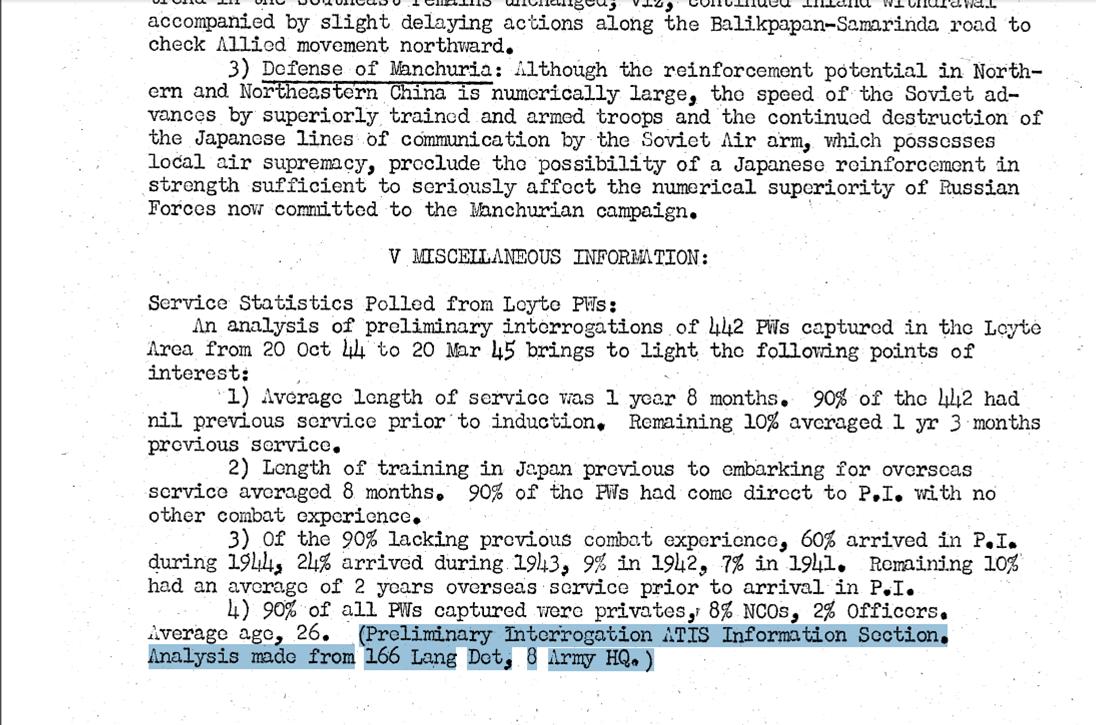 Here is the pertinent section of my dad’s discharge papers:
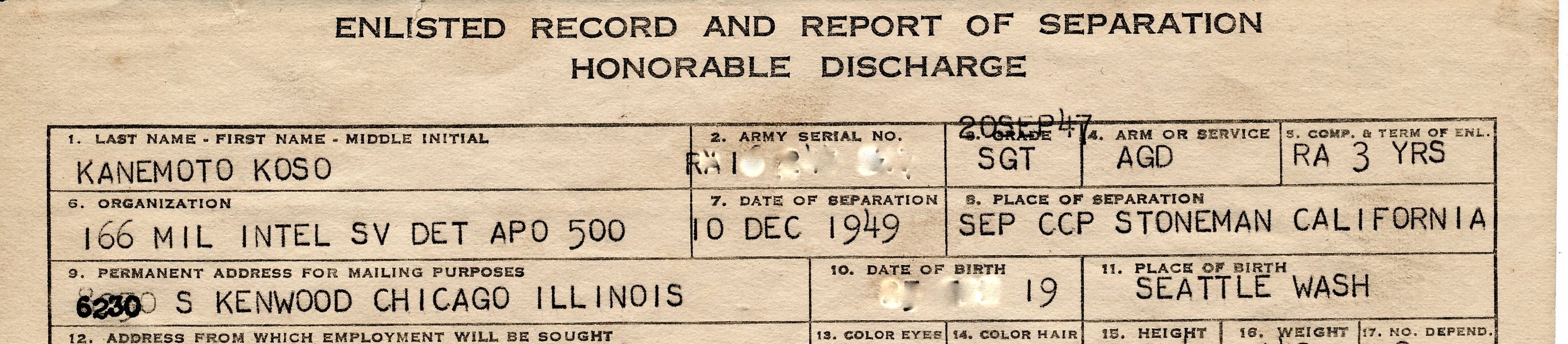 He served with the same G-2 166th Language Detachment that did their best to kill Japanese soldiers on Leyte – including Uncle Suetaro. While the Nisei’s were on Leyte since the invasion began Oct. 20, 1944, they were reorganized into the 166th Language Detachment on 20 June 1945 per US Army records.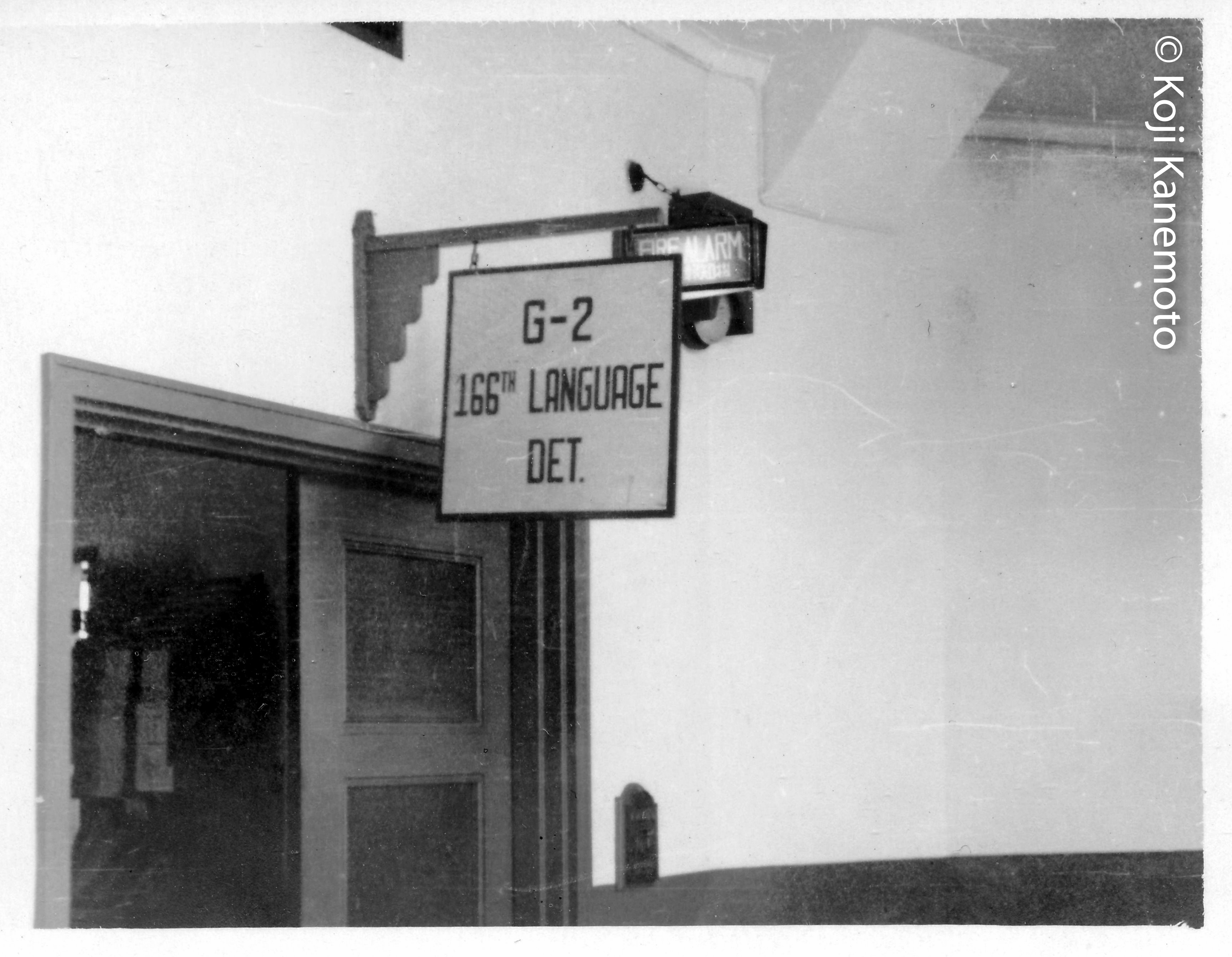
 The Nissho Maru is listed in this WWII era Division of Naval Intelligence report.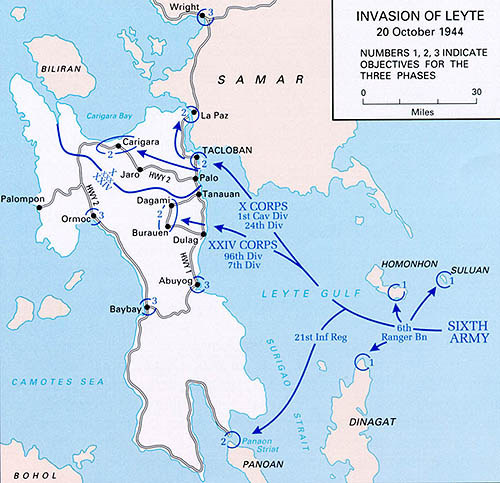



















 Masako and Spam Musubi