Loyal readers know of my love for WWII combat veteran “Old Man Jack”.
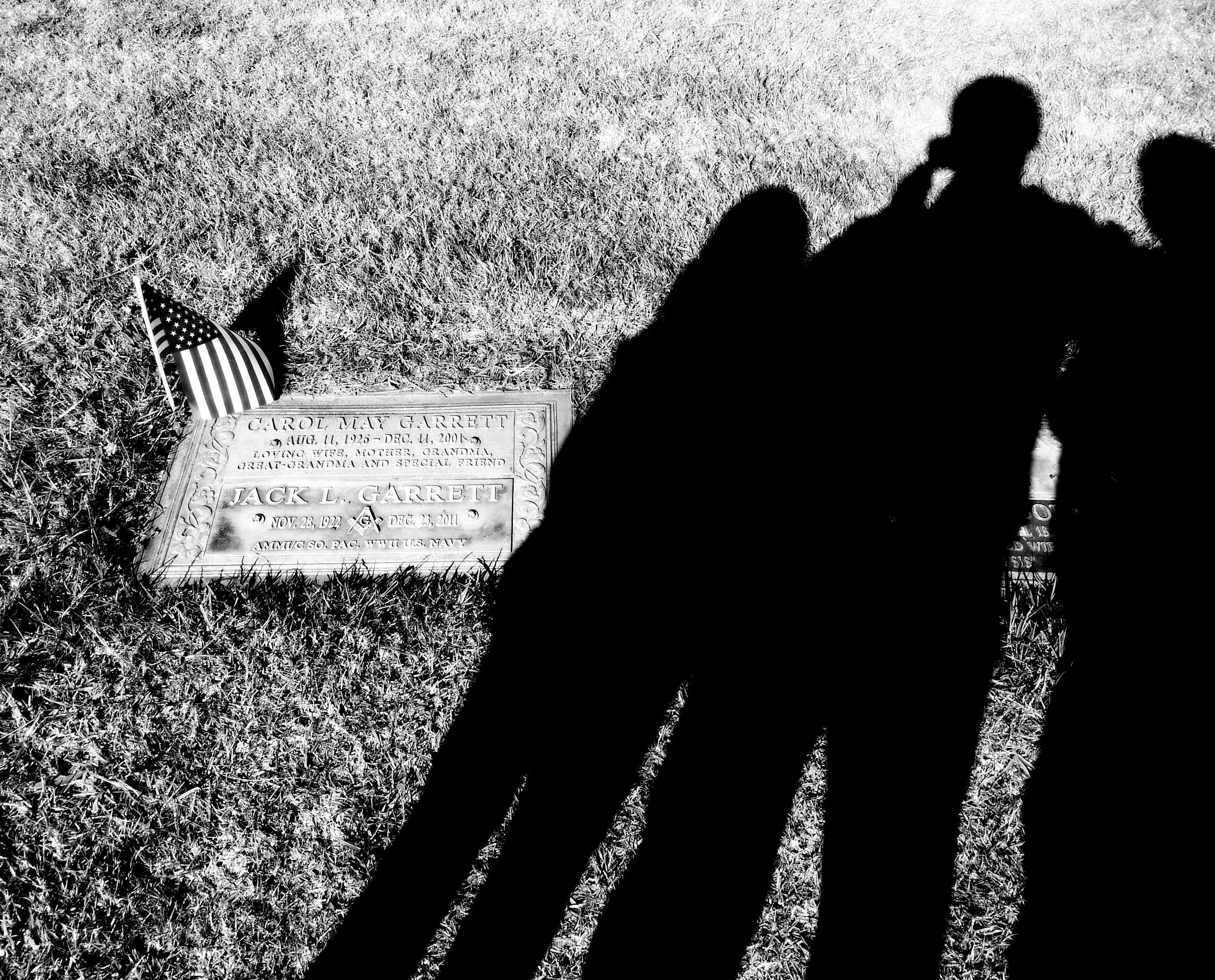
After suffering through seven decades of nightmares of war, he is now finally at peace. Hopefully, he is resting comfortably beneath these shadows cast by my two youngest kids and I:
And a shadow cast by Old Glory:
For new visitors, please feel free to click and read one story of this great American who is now all but being forgotten in our new “Common Core” history textbooks. He earned the honor to be remembered:
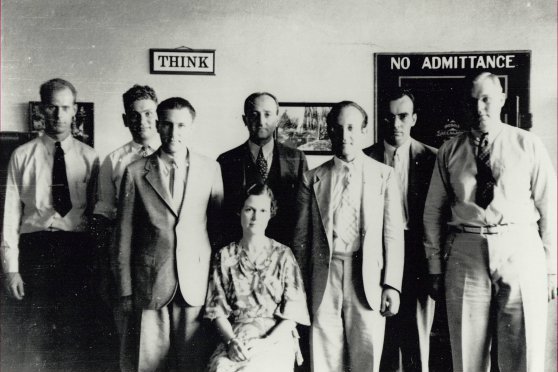
William F. Friedman, standing in center. Friedman was charged with the responsibility of cracking the highly complex “Purple” diplomatic code. This SIS team did so in eighteen months. Friedman was hospitalized for four months from the strain. (US Army)
In Part 1 of “What Did FDR Know?”, I submitted tidbits that FDR – in spite of his campaign promises of not sending American boys to war – DID secretly plan with Churchill on how to get America into war without damaging their political images. Their secret discussions were nearly made public by Tyler Kent but he was tried secretly in a British court and admonished to prison until war’s end. Secretary of State Cordell Hull, on November 29, 1941, tried to leak to a major newspaper man intelligence gathered about the Imperial Japanese Navy heading towards Pearl Harbor.
In Part 2 of “What Did FDR Know?”, some history at Pearl Harbor before December 7, 1941 was provided as well as a brief history into cryptanalysis, the Japanese JN-25 and Purple codes and how the US Army and Navy broke them before and after Pearl Harbor.
In this Part 3, I will attempt to present evidence on intelligence gathered BEFORE the surprise attack on Pearl Harbor.
Part 4 will attempt to present evidence on the extent of our “listening in” on Imperial Japanese Navy battle plans post Pearl Harbor.
Part 5 will attempt to present evidence on the imprisonment of Japanese and Japanese-Americans in the “war relocation centers”, as FDR called them.
The goal is to allow you to come to your own conclusion as to “What Did FDR Know?”
___________________________
We learned that the US Navy struggled to break the JN-25 code that was changed immediately before the attack. However, OP-20-G was able to decipher coded messages immediately prior to a reasonable extent. The number of JN-25 messages intercepted between just September 1 and December 4, 1941 numbered 26,581. Of these, 2,413 were released by the (now famous) NSA in 1979. Although there were more than 1,000 just between Tokyo and the attack fleet, only 20 are reportedly in the National Archives. (So much for the IJN operating under “strict radio silence” during the voyage to Pearl Harbor.)
The Purple code also became another critical source of intelligence, especially the week before Pearl Harbor. Luckily, we had been intercepting and deciphering them since September 1939… more than two years before Pearl Harbor.
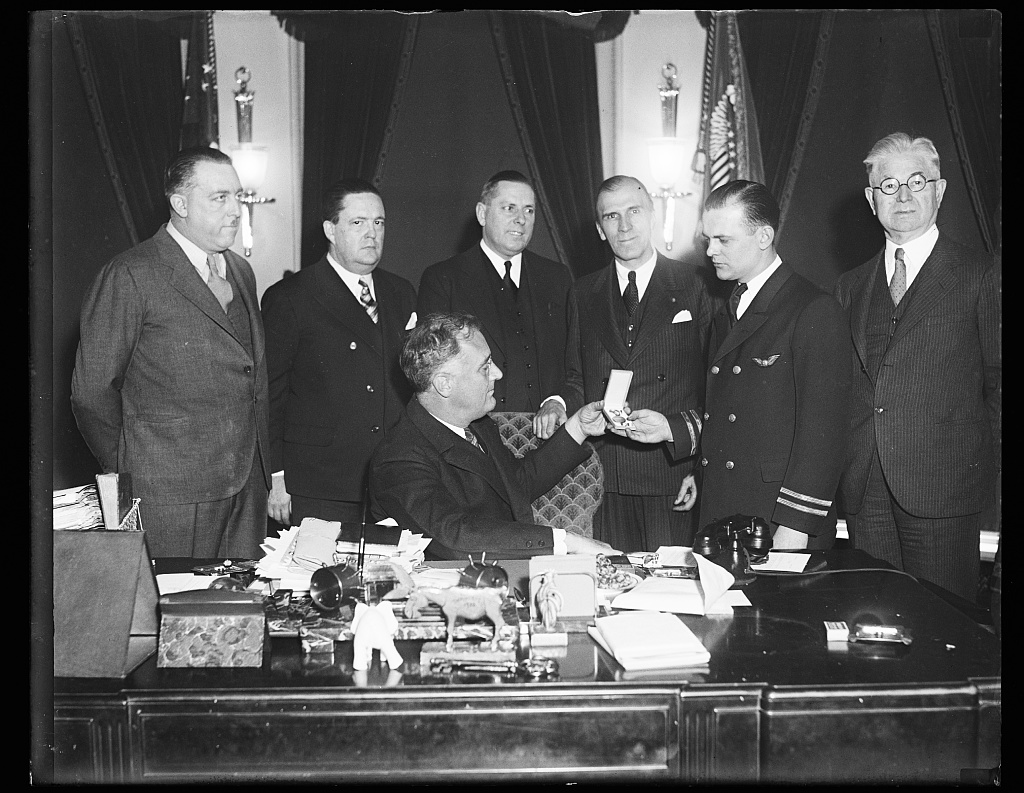
The Oval Office, 1933. Criminy, isn’t that a telephone on FDR’s desk?
Just what was transmitted by the Japanese diplomats about Pearl Harbor and intercepted through MAGIC? What other events occurred either in relation to the intercepts or the looming signs of the attack on Pearl Harbor? Please note that in 1941, they did not have emails, fax machines, TV, FedEx or SMARTphones. However, they did have TELEphones. Remember those things?
As shown above, there were more than 26,000 in JN-25 messages alone so going into detail about what was known in total would not be appropriate for this blog. However, if I were to summarize:
With respect to the Purple analog machines built from scratch, eight were made by the Naval Gun Factory in DC. Two each were used by OP-20-G and SIS; two were sent to the British. One was sent to Cavite in the Philippines. The last one was intended for Pearl Harbor – it was instead given to the British. It is likely true that even if Pearl had a Purple machine, it may not have been of too much value as it is reported the Japanese Consulate there did not have a deciphering machine.
Selected MAGIC ciphers were indeed placed into locked briefcases then shown to the top ten men in power over war – including FDR, just like in the movies.
Lt. Com. Arthur H. McCollum of Office of Naval Intelligence signed an eight point memo for FDR on how to coerce Japan into war with the US (aka “McCollum Memo”, the first page of which is shown at right). It was presented to FDR on October 7, 1940; FDR began implementing them the next day; all eight were eventually put into place.
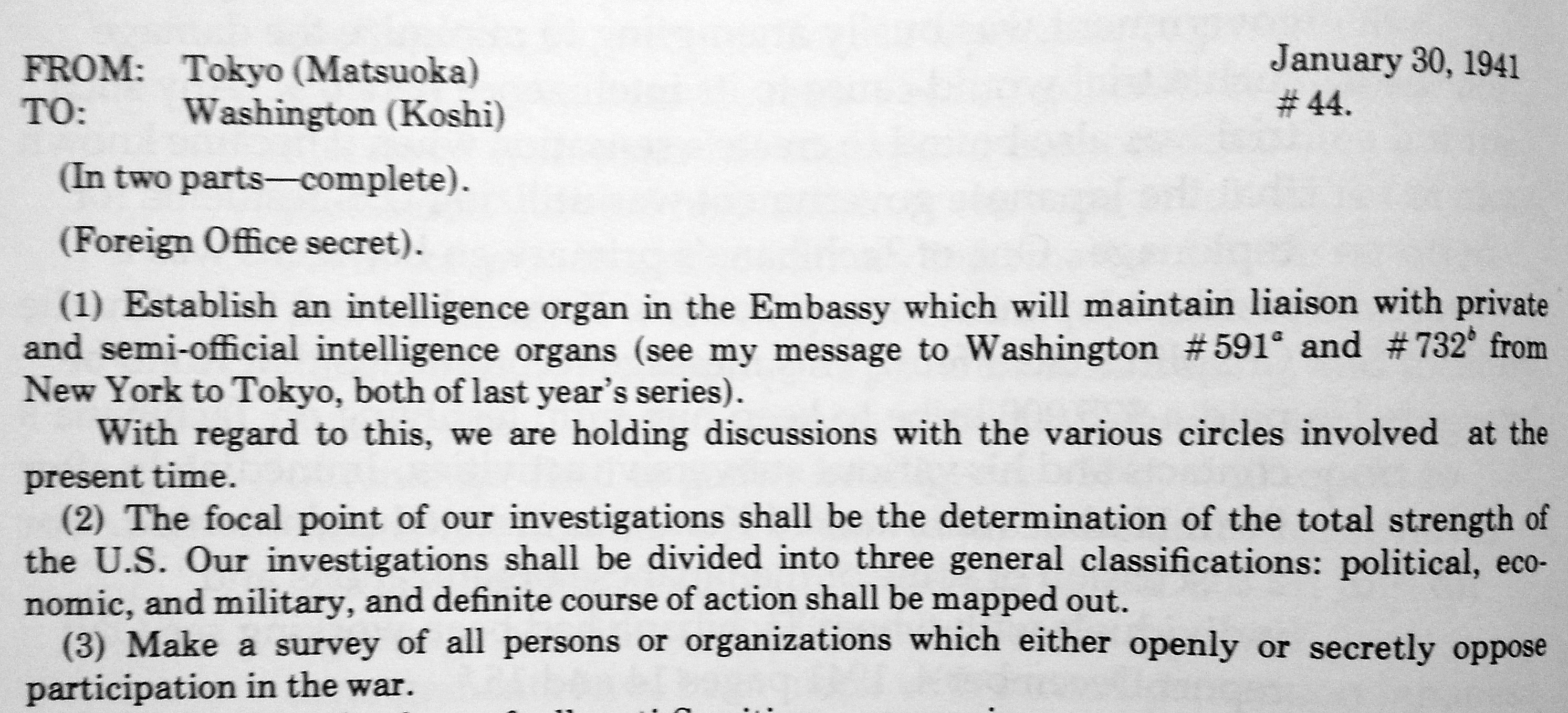
A Purple message was intercepted on January 30, 1941. Tokyo instructed its diplomats to recruit agents covertly to spy on Allied movements and production. Issei and Nisei were mentioned for recruiting in the message. This espionage net could be for no other reason than to supply military information to Tokyo.
Typed copy of the Purple transmission of January 30, 1941.
Per “President Roosevelt and the Coming of War 1941”, FDR actually proposed losing six cruisers and two carriers at Manila in order to get into war but was stopped by Navy Chief Stark.
On July 10, 1941, the US Military Attache in Japan reported the Imperial Japanese Navy was conducting secret training missions at Ariake Bay involving torpedo runs at moored ships.
After the Atlantic Conference and meeting with FDR, Prime Minister Churchill cabled his Cabinet on August 14, 1941 that FDR was intent on getting into the war.
A high level US Navy report was submitted on March 31, 1941 clearly stating that Pearl Harbor would be targeted, even so far as stating the Japanese Navy would utilize six carriers and surprise attack at dawn. That was because Japan strategically had few options and definitely could not have the Pacific Fleet to contend with.
A Korean agent by the name of Kilsoo Haan met with Eric Severeid of CBS that there was solid evidence that Japan would attack before Christmas. In October, Haan was able to convince US Senator Guy Gillette of these plans. Gillette alerted the State Department, Army and Navy Intelligence and FDR personally.
A coded message of September 24, 1941, from Japanese Naval Intelligence headquarters in Tokyo to the Japanese consul general in Honolulu, was intercepted and deciphered.(1) It requested the exact locations of all US Navy ships in Pearl Harbor; it even specifically asked to know if two ships were moored alongside each other. It was a map. Such detailed information would only be required if the Japanese were planning an attack on the ships at their moorings. The Japanese had not asked for such detailed information before. However, two top US officers, Stark and Turner, prohibited informing Pearl Harbor and Kimmel of this critical intelligence.
A JN-25 message was deciphered on November 1, 1941. It ordered the Japanese fleet practicing the attack to continue drills against anchored warships at at Ariake Bay. Words included “to ambush and completely destroy the US enemy.” References to using armor-piercing bombs and “near surface torpedoes” was also mentioned.
A Purple message of November 5th: Tokyo notified its Washington ambassadors that November 25th was the deadline for an agreement with the U.S. (to avoid war).
A Purple message of November 11th from Tokyo to its diplomats warned, “The situation is nearing a climax, and the time is getting short.”
Admiral Kimmel, following established Naval doctrines concerning unstable international conditions, ordered 46 (roughly one-half) of the Pacific Fleet out to sea in late November – specifically into the North Pacific. He did not inform Washington and when FDR found out, he ordered the fleet back to port under the guise such an exercise would provoke the Japanese. Undaunted, Kimmel had Admiral “Bull” Halsey put together a carrier-focused plan to protect Pearl Harbor which was never carried out. Instead, on November 26, 1941, Admiral Stark in Washington ordered Halsey to take to sea with his carriers; their mission was to ferry fighter planes to Midway and Wake Islands. Now you know why the carriers – the main target of the Imperial Japanese Navy – were “by luck” not at Pearl on December 7th.
A JN25 order of November 23 – “The first air attack has been set for 0330 hours on X-day.” (Tokyo time)
Another Purple message November 16th changed the deadline to November 29th. However, it stated, “The deadline absolutely cannot be changed. After that, things are automatically going to happen.”
The Japanese fleet left Japan (Hitokappu Bay) on November 25th. Remembering we were intercepting all Japanese Naval transmissions, about one hour after the Japanese attack force left port for Hawaii, the U.S. Navy issued an order forbidding U.S. and Allied shipping to travel via the north-west Pacific. All transpacific shipping was rerouted through the South Pacific. It should be easy to figure out why. If any commercial ship accidentally stumbled on the Japanese task force, it might alert Pearl Harbor. As Rear Admiral Richmond K. Turner, the Navy’s War Plans officer in 1941, stated: “We were prepared to divert traffic when we believed war was imminent. We sent the traffic down via the Torres Strait, so that the track of the Japanese task force would be clear of any traffic.”
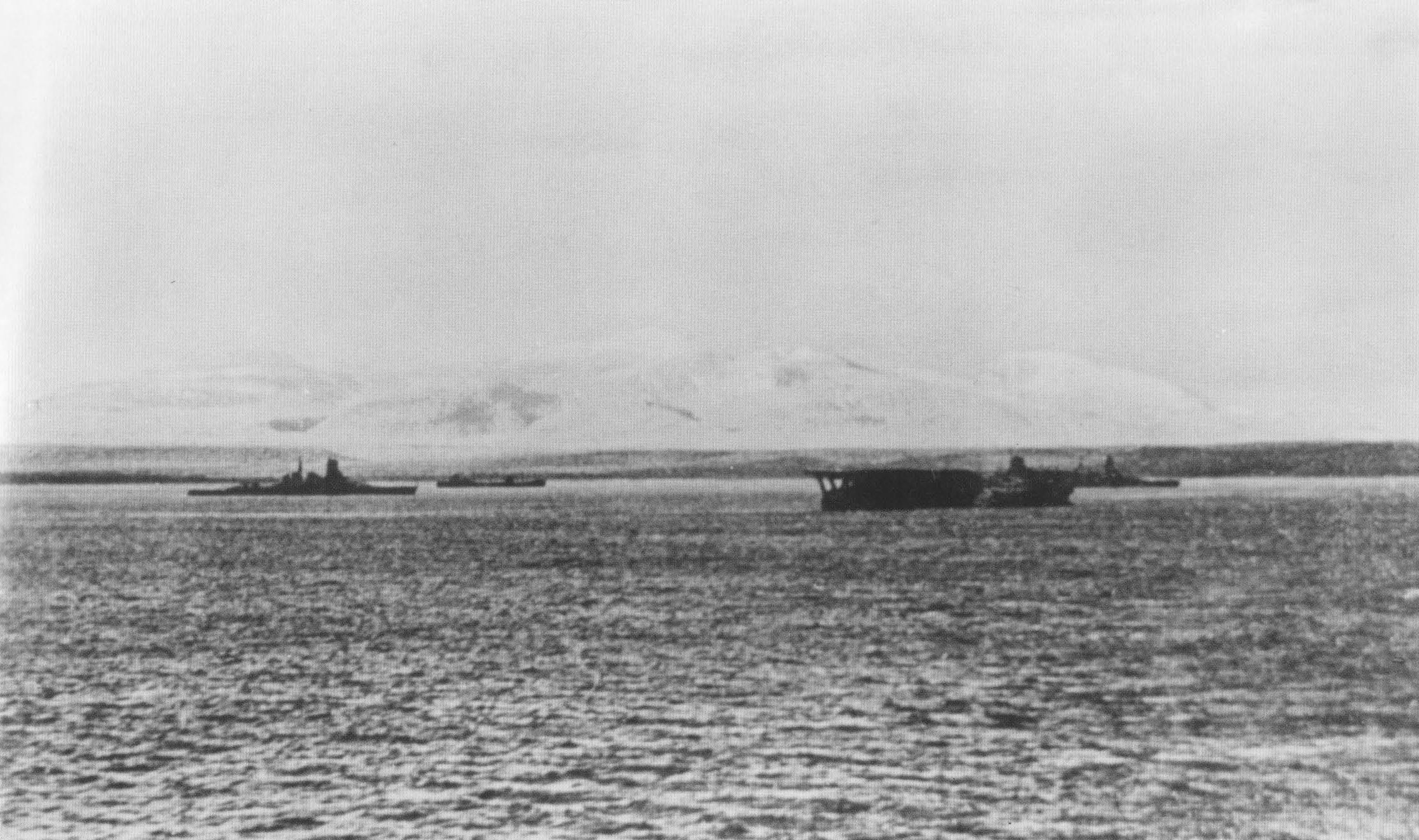
Imperial Japanese Navy’s carrier Kaga and battleship Kirishima at Hitokappa Bay, November 23, 1941. They would set sail in a couple of days for Pearl Harbor. Kaga would be sunk at the Battle of Midway. Kirishima would be attacked and would capsize on November 15, 1942 in Ironbottom Sound.
British initially decrypted a message sent Nov. 19 setting up the “Winds” alert. The US decoded it Nov. 28. The message stated there would be an attack and that the signal would come over Radio Tokyo as a weather report – rain meaning war, east (Higashi no kaze ame) meaning the US.
On November 25, 1941, the great Admiral Isoroku Yamamoto himself, using the cracked JN-25 code, sent this message to his fleet: “(a) The task force, keeping its movements strictly secret and maintaining close guard against submarines and aircraft, shall advance into Hawaiian waters and upon the very opening of hostilities, shall attack the main force of the United States Fleet in Hawaii and deal it a mortal blow. The raid is planned for dawn on X-day — exact date to be given by later order. (b) Should the negotiations with the US prove successful, the task force shall hold itself in readiness forthwith to return and reassemble. (c) The task force will move out of Hitokappu Wan on the morning of 26 November and advance to the standing-by position on the afternoon of 4 December and speedily complete refueling.” This was decoded by the British on November 25 and the Dutch on November 27. WHEN it was decoded by the US is still a national secret; however, on November 26, ONI reported the concentration of units of the Japanese fleet at an “unknown port” ready for offensive action. ONI knew the fleet had been assembled at Hittokappu Bay since November 22, 1941.
Actual message sent to the Pacific on November 27, 1941 by Admiral Stark, Chief of Naval Operations. Please read the alert carefully and see if Pearl Harbor is mentioned. Kimmel and Short received this alert.
In reaction to #17 above, Churchill himself sent FDR a secret message likely warning him about war erupting; this was presumably in response to British intelligence decoding Yamamoto’s message. (Note: Likely due to implications even today and in spite of the enumerable messages sent between them, this is the only message that has not been released.) C.I.A. Director William Casey, who was in the OSS in 1941, wrote, “The British had sent word that a Japanese fleet was steaming east toward Hawaii.”(2) In response to Churchill’s message, FDR secretly cabled him that afternoon, “Negotiations off. Services expect action within two weeks.” Note that the only way FDR could have linked negotiations with military action, let alone have known the timing of the action, was if he had read the message to set sail. In other words, the only service action contingent on negotiations was Pearl Harbor. Regardless, can it be coincidence that on Nov 26, Washington ordered both US aircraft carriers, the USS Enterprise and the USS Lexington out of Pearl Harbor? On board were 50 fighter planes diminishing Pearl Harbor’s already inadequate fighter protection.(3)
A Purple intercept from Emperor Hirohito himself to the Combined Fleet commander – Admiral Isoroku Yamamoto. Sent on December 6, 1941 (Tokyo time).
The FBI had put in wire taps on the Japanese Embassy phone lines. The FBI listened in on an uncoded Japanese telephone conversation on November 29 in which Special Envoy Saburo Kurusu asked, ‘Tell me, what zero hour is. Otherwise, I won’t be able to carry on diplomacy.” The voice from Tokyo (later identified as K. Yamamoto) said softly, ‘Well then, I will tell you. Zero hour is December 8 (Tokyo time, ie, December 7 US time) at Pearl Harbor.” (US Navy translation 29 Nov)
On December 1, 1941, the Japanese tanker Shiriya radioed she was “proceeding to a position 30.00 N, 154.20 E. Expect to arrive at that point on 3 December.” Key those coordinates into Google Maps yourself. This message in the National Archives destroys the myth that the attacking fleet maintained radio silence. Transmission serial numbers prove that the Striking Force sent over 663 radio messages between Nov 16 and Dec 7 or about 1 per hour. (The NSA has not released any raw intercepts because the headers would prove that the Striking Force did not maintain radio silence. On Nov 29 the Hiyei sent one message to the Commander of the 3rd fleet; on Nov 30 the Akagi sent several messages to its tankers.)(4) There are over 100 messages from the Striking Force in the National Archives.(5) Reports from Dec 5 show messages sent from the Striking Force picked up by Station Cast, P.I.
ONI located Japanese fleet on December 1, 1941 by correlating reports from the four wireless news services and several shipping companies that they were getting strange signals west of Hawaii. Remember Johann Ranneft visiting ONI and being shown the location of the Japanese fleet north-west of Hawaii in Part 1? The Soviet Union also knew the exact location of the Japanese fleet because they asked the Japanese in advance to let one of their ships pass.
On December 2 and 3, the passenger liner SS Lurline was en route from San Francisco to Honolulu. Its radio operator, following standard operating procedures, intercepted strong signals from the IJN fleet. The messages were so lengthy and numerous that the radio operator made out “JCS”, the call sign for the IJN HQ. The signals were plotted and showed the fleet’s location heading eastward and was north-west of Hawaii. When the USS Lurline docked in Hawaii on December 5, the radio intercept logs were immediately taken to the Office of Naval Intelligence at Kimmel’s Pacific Fleet HQs. The logs were never recorded as received nor ever seen again.
Ralph Briggs was a qualified Japanese-speaking radio intercept operator and was working at the Navy’s signals intercept station early in the morning of December 4. Buried inside the official IJN weather broadcast was the code “Higashi no kaze ame (東の風雨)”, or “East winds, rain”. (See #18 above.) The operators had been briefed to listen for those words. Per SOP, he logged it then transmitted via a secure channel to Commander Safford, in charge of the Fleet Intelligence Office in Pearl. To substantiate this, he was given four days’ leave as a reward.(6) On December 7, he was already back stateside in his Ohio home and was noted to have said something to the effect that the Japanese must have taken a licking (because he had intercepted the coded message and mistakenly believed the Navy was ready). After the attack, both the log and related communications were “lost” as well many other documents that were in safes.
While there were many other events and intercepted secret communications, the most famous one is the 14 part Purple transmission from Tokyo to Kurusu. It officially terminated diplomatic relations with the US, i.e., it is war. Amazingly, the first 13 parts had already been deciphered by MAGIC on December 6th. When Lieutenant Lester Schulz delivered to FDR his copy of the intercept later that day, Schulz heard FDR say to his advisor Harry Hopkins, “This means war.”
As the story goes, Kurusu failed to type up the Japanese ultimatum in time. However, Secretary of State Cordell Hull had already read the Purple intercept decoded the day before as did FDR. In essence, Hull had to look…surprised… when Kurusu handed him the ultimatum on December 7, 1941 albeit late. But at least, he was indeed angry.
We are now at war.
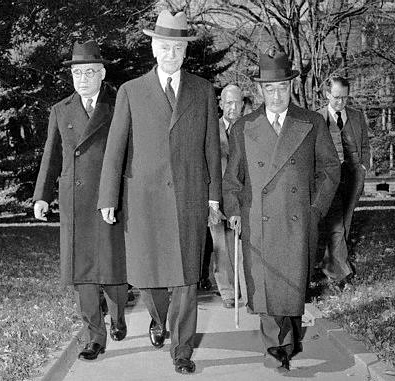
November 17, 1941. Cordell Hull, center, with Special Envoy Saburo Kurusu at right. Kurusu would be imprisoned at Hot Springs, NY until war’s end.
______________________________
The above is by no means any-wheres near a complete accounting of the events leading up to Pearl Harbor. And yes, there will be blanks in information flows, other communications that will show things countering the above, etc. But it does show how a government can disguise the truth or create lies for whatever purpose…even if it involved the deaths of human beings.
You can imagine what is going on today. Benghazi. The complete killing of SEAL Team Six. Fast and Furious. It goes on.
But some questions may be in order to perhaps counter what you believed in or were taught until now? Perhaps you can ask yourself:
Did FDR blind the commanders at Pearl Harbor?
Were Kimmel and Short set up to be the fall guys by denying them very critical intelligence or lead them to believe war was not imminent?
Was Pearl Harbor alerted to the location of the attacking Japanese fleet?
Points to ponder, indeed.
And to close this (long) story, a Hollywood movie depicted Kimmel and Short receiving a telegram of all things alerting them of the possible attack on Pearl Harbor – many hours after it was over. That is true. However, how it became a late telegram is another story all together. By all accounts, Chief of Staff George C. Marshall orchestrated a delicate ballet to delay even sending that telegram for the critical few last hours. In fact, he was difficult to nail down during the critical hours before the attack, arriving late to his office to go over the critical Ultimatum. Although known for near photographic memory, he claimed he was horseback riding but his aides testified after the war that he wasn’t. Further, his aides urged him to contact Pearl Harbor but delayed that decision by reading then re-reading the ultimatum and then asking superfluous questions about what method of communicating with Pearl would be faster, for example – several times. He chose not to use the “telephone” nor use a fast, secure Navy system but sent the warning through commercial wire, of all things. Even then, the warning language he dispatched was watered down.
____________________________
So what do you think?
What did FDR know? What do you think he did not know?
More to follow in Part 4 – key naval battles, code breaking and what really happened on the waters of the Pacific.
Henceforth, we would like to have you make reports concerning vessels along the following lines insofar as possible:
1. The waters (of Pearl Harbor) are to be divided roughly into five subareas (We have no objections to your abbreviating as much as you like.)
Area A. Waters between Ford Island and the Arsenal.
Area B. Waters adjacent to the Island south and west of Ford Island. (This area is on the opposite side of the Island from Area A.)
Area C. East Loch.
Area D. Middle Loch.
Area E. West Loch and the communication water routes.
2. With regard to warships and aircraft carriers, we would like to have you report on those at anchor (these are not so important) tied up at wharves, buoys and in docks. (Designate types and classes briefly. If possible we would like to have you make mention of the fact when there are two or more vessels alongside the same wharf.)”
There is nothing unusual about spies watching ship movements — but reporting precise whereabouts of ships in dock has only one implication. Charles Willoughby, Douglas MacArthur’s chief of intelligence and my dad’s big boss in the US 8th Army, later wrote that the “reports were on a grid system of the inner harbor with coordinate locations of American men of war … coordinate grid is the classical method for pinpoint target designation; our battleships had suddenly become targets.” This information was never sent to Kimmel or Short.
(2) Per his book, “The Secret War Against Hitler”.
(3) There are strategic evaluations asserting that not having US fighter aircraft sortied in great number against the invading Japanese fleet was “best” in the long run. Some armchair strategists claim that if the US carriers had “gone after” Nagumo’s fleet, indeed, our two vital carriers and her invaluable pilots would have been sunk, never to be recovered. That, however, is another story.
(4) The Hewitt Report, page 474.
(5) “Day of Deceit”, page 209.
(6) There is some bickering between opposing viewpoints as to the validity of this point. After the war, Japan stated it never issued such a broadcast. Other historians doubt Briggs’ testimony as there are no documents.
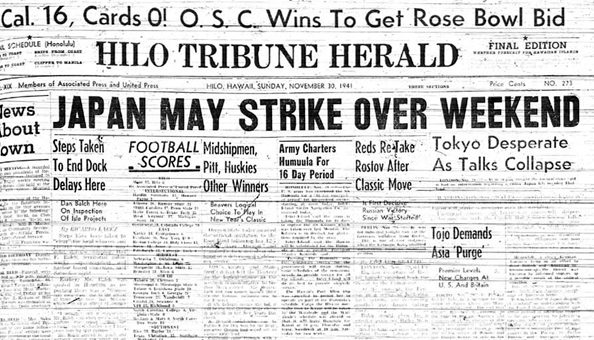
The above: a front page published one week BEFORE Pearl Harbor.
OK… So the newspaper was published on Hilo.
Well, then, how about a second front page? And from a different island this time – Oahu.
Pearl Harbor is on Oahu.
Honolulu Advertiser, November 31, 1941.
______________________________
To continue with “What Did FDR Know?”, let’s go over some once secret stuff, shall we?
And stuff that wasn’t so secret – like the headlines above. These NEWSPAPERS were in newsstands or tossed onto front lawns a WEEK before the attack on Pearl Harbor. How can that be when our textbooks and history tell us our Navy and Army were caught with their pants down?
It may be fascinating and perhaps eye opening for some of you. To some of you old hats in military history, not so eye opening.
This story will be centered on “MAGIC”, the cover name given to the secret diplomatic messages sent between Japanese diplomats and intercepted.(¹)
MAGIC intercepts will be the foundation for this story and subsequent ones.
The Japanese diplomats sent message after message believing their code was secure.
They were wrong.
______________________________
But first, some background on Pearl Harbor itself. It’s important in your quest to conclude on “What Did FDR Know?”
Adm. Richardson
Before December 7, 1941 and as we read in Part I of this series, did you know the Pacific Fleet was based in San Diego? The powers to be moved the fleet from San Diego to Pearl Harbor. Even the decision to move the Pacific Fleet to Pearl Harbor was suspect at that time. And have you thought about who was commanding the fleet before the hapless Admiral Husband Kimmel at Pearl Harbor?
Admiral J. O. Richardson was Commander in Chief, CINCPAC as of January 1940. Per the “Final Secret of Pearl Harbor”, Richardson was the foremost expert on Japan and studied ad finitum Pacific naval warfare and mostly, of Japanese naval strategies. He also knew well of Japan’s pattern of secret attacks.
Richardson disagreed with FDR’s opinion that basing the Pacific Fleet at Pearl Harbor was indispensable towards protecting American interests. Richardson stoutly disagreed and said, “I came away with the impression that, despite his spoken word, the President was fully determined to put the United States into the war if Great Britain could hold out until he was reelected.”
He asserted that Pearl Harbor would be a “… g_d d_mned mousetrap”. His belief was the fleet should remain on the West Coast in San Diego; out at Pearl Harbor, the fleet would be a strategic target for any Japanese surprise attack which he correctly foresaw. His opinion was because not only did Pearl Harbor lack adequate fuel dumps and repair facilities, the Fleet lacked sufficient personnel and the waters around Pearl were unsuitable for training. The fleet would need to return to San Diego and the like for such purposes.
Those who chose to ignore Richardson’s educated opinion did so by saying Pearl’s shallow harbor would preclude torpedo plane attacks amongst other things.
Adm. Kimmel
Richardson asserted too strongly. Although Richardson was highly qualified militarily, FDR removed him from command on January 19, 1941. (Similar events are taking place notionally even today; about 200 top military commanders have been removed or forced out by the current Adminstration.) FDR replaced Richardson with the more amenable Admiral Kimmel. He was far down the list of able commanders but was still selected by FDR to run the Pacific Fleet. While he somewhat shared Richardson’s belief, he was obedient as FDR expected. Kimmel also wrongly assumed he would be “kept in the loop” by FDR insofar as military necessities, including intel. Was he expendable career-wise?
…and that is how Kimmel ended up in command of the Pacific Fleet on December 7, 1941.
__________________________
This is a copy of the actual PURPLE message and is the first part of the 14-part message which was delivered by the Japanese to the US Government on December 7, 1941 – late.
BACKGROUND ON JAPANESE CODES
The Japanese military, just like the US military, had “secret codes” as did diplomats. For the purposes of this blog, we will concentrate on two groups of code: the Imperial Japanese Navy’s code (JN-25) and of the Japanese Foreign Office (code named “Purple”).
Talking about Communications Intelligence, or “COMINT”, would take a number of blogs; indeed, entire books and papers are written about COMINT during this time. For purposes of this blog, allow me to say COMINT is the acronym covering the analysis and usage of an enemy’s radio communications. Codes are when words are replaced by groups of letters or digits and are usually manual. A cipher, however, is the replacement of individual letters or groups of letters according to a plan; it is much more complex and are based on machines.
During this time, US COMINT was somewhat loosely organized, largely due to the rivalry between the US Navy and Army.
However, the cover name “MAGIC” was given to the intelligence obtained by both services involving the Japanese Foreign Ministry radio messages. While at the embassy level, great amounts of military information – and espionage – was disclosed in these secret messages and were therefore at the disposal of the US Government and military.
Imperial Japanese Navy JN-25
The US Navy began its covert intelligence gathering in the early ’20s when they actually broke into the Japanese Consulate in NYC and copied the secret Japanese code in use at that time. By 1926, the US Navy had broken the Japanese navy’s “Flag Officer’s Code”. The Imperial Japanese Navy at that time conducted fleet maneuvers about every three years; they would send coded messages throughout the maneuvers. The US Navy, by virtue of having broken the Flag Officer’s Code, easily listened in on them.
Their “listening in” on the Japanese fleet was so extensive that the US Navy knew of the capabilities of the Japanese warships. The US Navy knew the speeds, armaments, designs, etc., of the Japanese warships, so much so that the US Navy made improvements to their own warships to counter them.
During this period, the US Navy established a small group within the Office of Naval Communications called “OP-20-G”. It was formed without extensive knowledge of the US Army as infighting was common. The same was true for the Japanese military. Think of the Army-Navy rivalry in football – just grow it tremendously.
While the Japanese navy changed their code along the way, the OP-20-G had little difficulty breaking those, too… until late in 1940. Knowing they were headed to war with the US, the Japanese navy prudently introduced an entirely new code, the JN-25. It was much, much more complex than its predecessor. It proved difficult to crack but they had made progress when… the Japanese navy once again made amendments to JN-25 immediately before the attack on Pearl Harbor.
The US Navy, therefore, was pretty much “blind” intel-wise for pretty much a week before Pearl Harbor. It would not be broken until March 13, 1942.
But there was another group of cryptanalysts… an ace in the hole.
__________________________________
“Purple”
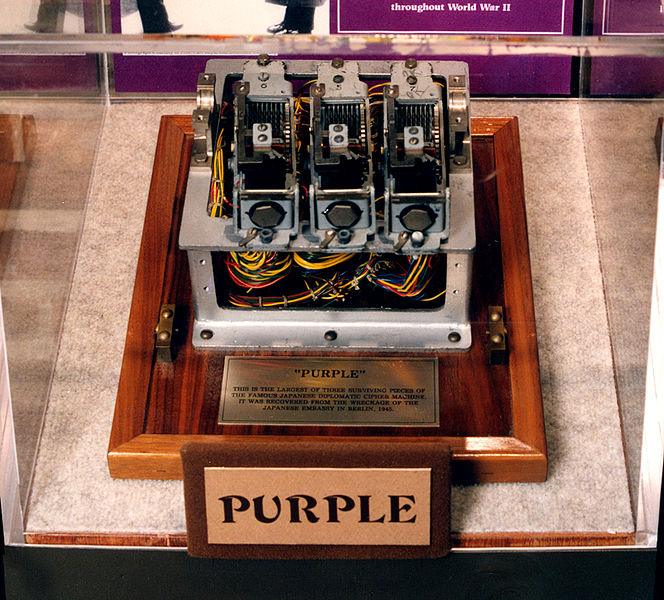
As the Purple machines were destroyed by the Japanese, this is the only surviving section of an actual Purple machine. National Archives
Alongside OP-20-G, the US Army’s cryptanalysis group called “Signal Intelligence Service”, or SIS, focused their energies on the Japanese diplomatic code. The group was headed up by William F. Friedman; he was very successful in designing our own encrypted codes.
Japanese diplomats (NOT military commanders) communicated with each other using an existing code designed in 1932; the US cryptanalysts called this code “Red”.(²) In 1937, the diplomats began using a newer, more complex code; the US referred to this code as “Purple”. In total, there were fourteen codes used by the Japanese diplomats; two of these were of the most value, Purple and “J-19”. Purple was used at the embassy level; J-19 was used at the consular level. Both were machine crypts.
The Purple machine, built from readily available parts. It supposedly cost $684.65. Eight were made. National Archives.
In September 1939, the “unbreakable” Purple code, in the defective thinking of the Japanese, was broken; a key contributor to Friedman breaking Purple was that the Japanese had sent the same message using BOTH Red and Purple codes, a huge blunder in the cryptanalysis arena. In eighteen months, the SIS, headed up by Friedman, cracked the code(³). They even BUILT an analog machine from a blank chalkboard which quickly deciphered the “secret” messages. (The code was so complex that the machine contained 25 connections, which could be arranged 6 pairs of connections, yielding over 70,000,000,000,000 possible arrangements which would determine the method of encryption.) This was an AMAZING feat to have built a deciphering machine since SIS had not even seen the Japanese one. Remember, this was 1938. Nevertheless, these intense eighteen months landed Friedman in the hospital for four months from exhaustion and emotional strain.
With Purple broken, the US was able to immediately decipher all highly secret messages between all top level members of the Japanese diplomats located worldwide… and most importantly, without them knowing. Given the originators of the messages, they had nearly indisputable validity. The reach of MAGIC extended to the European Theater of war as well as briefly mentioned in Part I.
These diplomatic communications also clearly indicated espionage was taking place on the west coast of the United States.
Part 3 and 4 will show the contents of MAGIC intercepts so that you can answer on your own, “What did FDR know?”
(¹) Unbelievably, Secretary of State Stimson was definitely upset when he learned we were intercepting messages. He championed the statement, “Gentlemen, do not read each others mail.” At the same time, consider the Snowden/NSA “scandals” of today.
(²) Ironically, Hitler had loved Baron Oshima so much he allowed Oshima to purchase a commercial version of Nazi Germany’s famous Enigma machine. The machine used for Red was based on this Enigma construct.
(³) While Friedman was the man burdened with the responsibility of deciphering PURPLE, it is acknowledged that a man named Frank B. Rowlett was the man who actually broke the code.
The more frequent readers of this blog, “Masako and Spam Musubi”, likely see that my main focus is on World War II and my family’s involvement on both sides of the Pacific. Although I definitely am not a historian by any means, stories here are based on family records supplemented by tidbits of historical “facts”.
And some of these historical facts are public knowledge…while some are kept or suppressed from public knowledge.
Some were destroyed.
The White House also has perhaps the most insurmountable power over what is written – or how events are presented to or withheld from the public. At times, this leads to the distrust of the very government the people have elected into power. This distrust continues today and arguably, the worst its been in our country’s history.
This is a knotty topic without a doubt…about FDR’s involvement – or even orchestration – in what happened during these critical years. But these factual conflicts have perplexed me for years. Conflicts between what we were taught versus what wasn’t.
I wish to express some facts here and in the next couple of stories about the Pacific war and allow you to come to your own conclusions about FDR. They will center around Pearl Harbor and the interment of my dad’s family in “war relocation centers”. Please note that entire books and research papers have been written on this general topic so my blog will do as best possible to reveal the facts involving FDR – before Pearl Harbor, immediately after and up to his death late in the war.
So… What did FDR know?
Let’s get into it, shall we?
____________________________
BACKGROUND
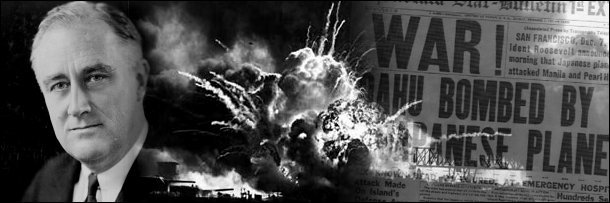
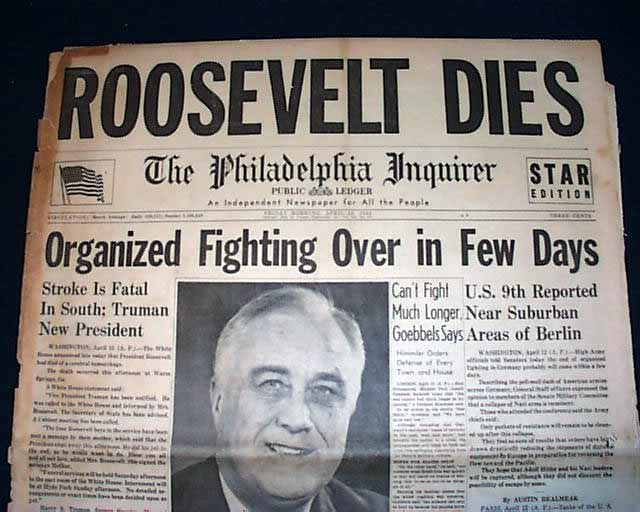
FDR was our only president to be elected to four terms in office. He passed away while serving his fourth term on April 12, 1945, just weeks before the surrender of Nazi Germany. The nation was distracted from the war for that moment. They mourned his passing. Indeed, there was great stress being President of the United States in time of World War. Some general background before I get into it:
He was a politician.
FDR was liked by a significant majority of Americans as proven by his being elected to a fourth term.
He made a statement to America during his 1940 re-election campaign, “I have said this before, but I shall say it again and again and again: Your boys are not going to be sent into any foreign war.” (1)
A pre-war Gallup poll disclosed 88% of those Americans polled opposed US involvement in the European war. Britain was fighting for her life. FDR supported isolationism publicly.
Perhaps the best kept secret prior to Pearl Harbor and up to immediately after World War II ended was that an elite cryptology group (members of the US Army Signal Intelligence Service, or SIS) had broken the Japanese diplomatic code in early 1939. Any intelligence that was gathered was kept secret and under the cover name of “MAGIC”. (One huge single diplomatic source of detailed enemy information was Baron Hiroshi Oshima, Japan’s ambassador to Nazi Germany. Nearly all of Oshima’s messages from Berlin to Tokyo were intercepted and deciphered.) (2)
Beginning in 1940 and then continuing, FDR and the League of Nations placed an economic embargo on Japan in reaction to their attacks in Asia. Items were added weekly to the embargo list – except for oil.
Tyler Kent
In 1940, Tyler Kent, a 29 year old code clerk at the U.S. embassy in London, discovered secret dispatches between Roosevelt and Churchill. These revealed that FDR — despite contrary campaign promises — was determined to engage America in the war. Kent smuggled some of the documents out of the embassy, hoping to alert the American public — but was caught. With U.S. government approval, he was tried in a secret British court and confined to a British prison until the war’s end. FDR approved to carefully associate the term “German spy” to his name in a further coverup. (3)
FDR authorized British and American military staff members to meet during January through March 1941; the purpose was to plan ahead military strategy in the event the U.S. entered war against Germany. They determined that Germany was to be first defeated, while the U.S. would stand on the defensive toward Japan in the Pacific.
The Lend-Lease Bill was passed in March 1941, a major shift in FDR’s foreign policy.
At the Nov. 25, 1941 White House conference, just weeks before Pearl Harbor, Secretary Stimson reported that FDR had said “The President said the Japanese were notorious for making an attack without warning and stated that we might be attacked, say next Monday, for example.” FDR knew historically that on three different occasions since 1894, Japan had made surprise attacks coinciding with breaks in diplomatic relations. (4)
On November 29th, Secretary of State Cordell Hull secretly met with newspaper reporter Joseph Leib. Hull knew him and felt he was a news man he could trust. The Secretary of State handed him secret MAGIC copies concerning Pearl Harbor. Hull told him the Japanese were planning to strike Pearl Harbor and that FDR planned to let it happen. Due to the incredibility, only one newspaper published the story.
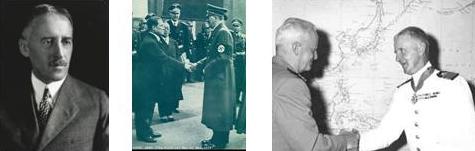
(L to R) Stimson, Oshima greeting Hitler, and Ranneft (in white) shaking hands with Chester Nimitz, 1946.
On December 2, 1941, days before Pearl Harbor, Captain Johann Ranneft, a Dutch naval attaché in Washington, visited the Office of Naval Intelligence (ONI). Two junior ONI officers pointed to a wall map and said, “This is the Japanese Task Force proceeding East.” (He was referring to Admiral Nagumo’s carrier strike force heading towards Pearl Harbor.) The officer had pointed to a spot midway between Japan and Hawaii. On December 6th, Ranneft returned and asked where the Japanese carriers were. He was shown a position on the map about 300-400 miles northwest of Pearl Harbor personally by Admiral Wilkinson, ONI chief. (5)
The key battles and events during World War II post-Pearl Harbor from the American perspective were (NOTE: I had to center the bullet points below as WordPress does not allow you to use tab stops):
♦ The Battle of Coral Sea
♦ The Battle of Midway
♦ The Solomon Islands Campaign
♦ Battles for Pelileu, Iwo Jima and Okinawa
♦ The shootdown of Admiral Yamamoto.
(Flights to and from the shootdown point occurred before and
continued afterwards, solely to conceal the fact we broke their code.)
_______________________________
The above tries to give you an at altitude look down on what was happening prior to the attack on Pearl Harbor. In the ensuing stories, I hope to present “things to think about”… Things like secret codes, espionage, internment and even D-Day in a roundabout way. Things that FDR knew then orchestrated actions as a politician should.
I hope you will stay tuned… then come to your own conclusions as to what FDR knew.
(1) However, the following comment was not part of his speech: Of course, we’ll fight if we’re attacked. If someone attacks us, then it isn’t a foreign war. – Yale University
(2) There were several codes being used by the Japanese Army and Navy in addition to the diplomatic code mentioned above. All were broken by US cryptologists. The Japanese also had their cryptologists but were nowhere’s near as successful in breaking US or British codes.
(3) It is important to note that CHAMBERLAIN was the Prime Minister of England, not Churchill. Yet, FDR and Churchill were secretly making promises unbeknownst to Chamberlain.
(4) Source: Henry Lewis Stimson diaries.
(5) “Military Intelligence Blunders and Cover-Ups: New Revised Edition”
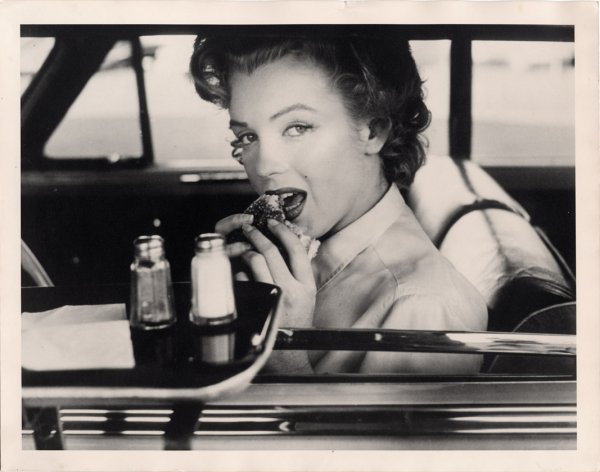
Marilyn Monroe eating an old-fashioned hamburger at a drive-in hamburger stand. Photo by Philippe Halsman.
Nearly all Americans would agree that hamburgers are the All-American icon. A simple grilled ground beef patty, salted and peppered, slathered with mayo, mustard and ketchup then sandwiched in a plain bun.
At least that’s how I know them. Oh, hold the pickles, please.
Now, us kids that grew up watching “Bewitched” and “I Dream of Jeannie” have given birth to a generation that has taken a simple thing and made them into $15 gourmet, fancied-up, mushroom-covered (expensive) cuisine. Do you think I like Elizabeth Montgomery and Barbara Eden? Drool…
But I don’t know if I like the “change”.
Back to this in a minute, folks.
The fancy hamburgers – not the drool.
___________________________
Dad had always owned Fords when he could finally afford getting a car. I guess that’s where I get my Ford passion from.
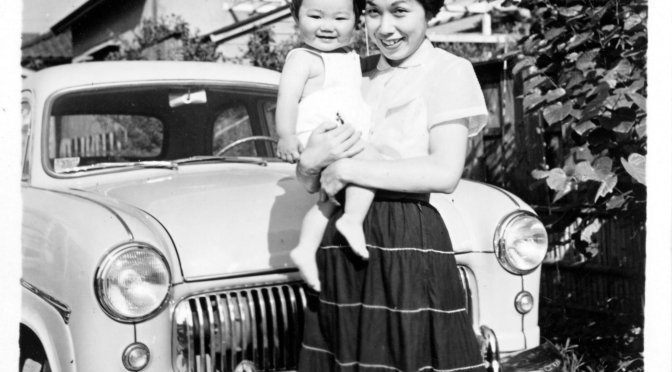
Aunt Eiko holding me in front of my dad’s Ford Consul automobile. If you are reading my past stories about WWII, you will know that only the occupying Americans could afford to buy a car. Her husband was awarded the Congressional Gold Medal. Occupied Japan, Tokyo, July 5, 1955.My dad’s ’57 Ford Fairlane parked on Enoshima Beach, Tokyo. I’m thinking it was a dark green. April 1957.
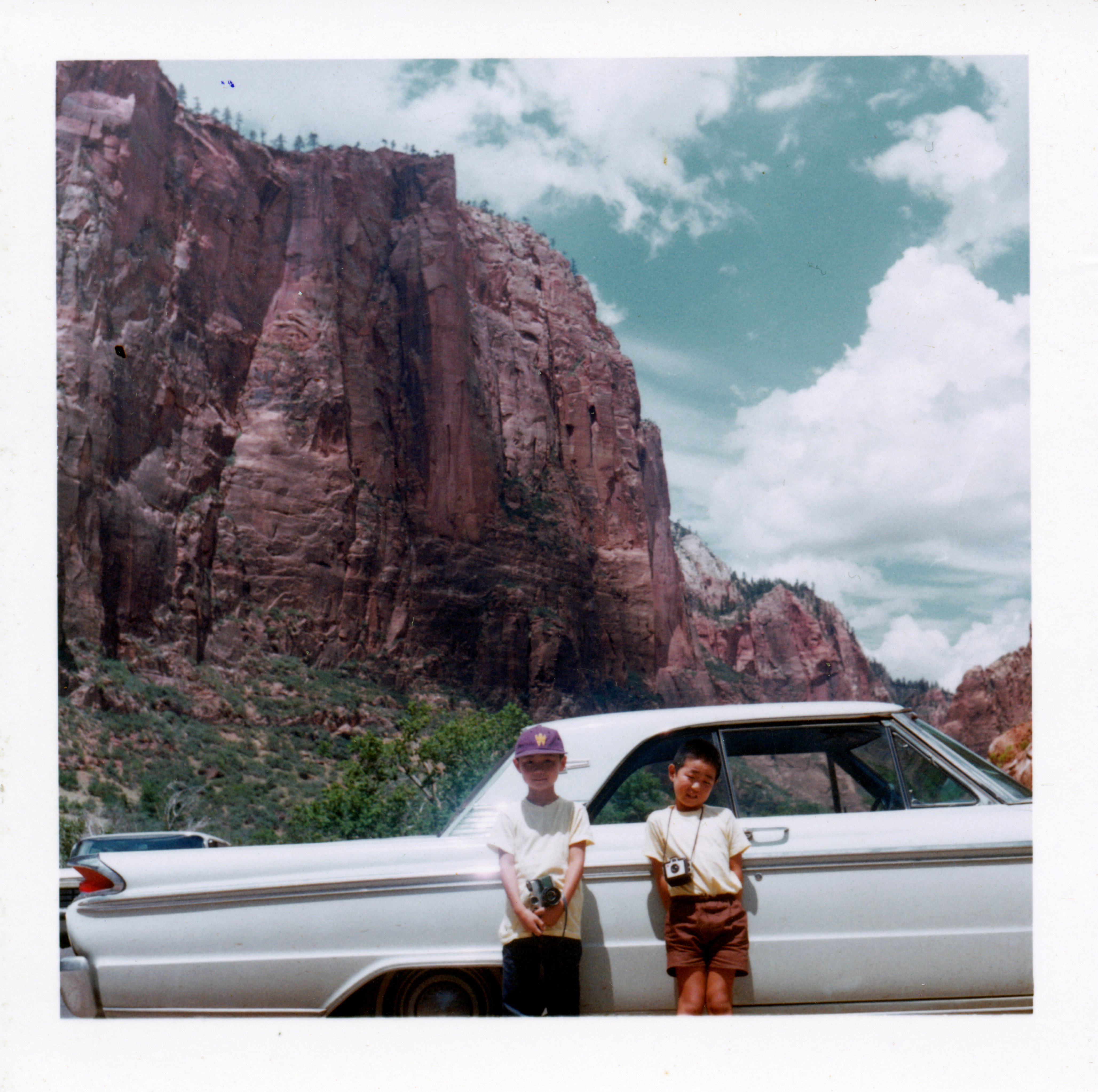
After leaving Japan for the last time in the late ‘50’s after the Occupation ended, my pop bought his first new car stateside in 1963 – he was 44 years old. It was a two door Cascade Blue 1963 Mercury Meteor custom hardtop; a king of obscurity to say the least, but to a kid of about ten, it was Flash Gordon’s rocket ship. Unlike Hillary, it was easy to love this car.
On a road trip to Chicago in 1964. I’m still holding onto my Fujipet camera with dad’s 1963 Mercury Meteor behind us. This may have been in Utah.
Don’t get me wrong. It wouldn’t get a choice spot if valet parked. I say wouldn’t as my old man couldn’t afford valet, let alone a family dinner out. But to me, the rocket ship had a chrome finish AM push-button radio – turn the dial on the right, find a station, pull out a button, then push it back in to set it. Trouble is I did it a dozen times each time I got into the car. But all I cared about was KFI 640 AM, the Dodgers’ station. The golden voice of Vin Scully… and Fairly, Gilliam, Wills and I forget who played third. They were World Series champs that year.
Six adults could get into this rocket ship with room to spare – eight of us little Japanese folks and a dog. The cargo hold in back swallowed up my Sears JC Higgins bike in one gulp with enough space leftover for Frank Howard. (I saw him hit the scoreboard in right field with a home run.)
Unless my aging grey matter is dissolving at warp speed (maybe it is), there were ash trays with shiny covers in each armrest…and this was for the back seats. It was a favorite depository for my Bazooka chewing gum but I kept the wax covered cartoon that came with it.
Pop kept it for quite some time. I passed my driver’s license test in it on my 16th birthday. I got a 96 only because she claimed I never looked in the rear view mirror. Poppy cock. I always look in the rear view mirror for cops. Even back then.
And as it was the only car we had back then, I also drove my date to one of my senior proms in it (I went to two.). And the answer is, “No,” if anyone was wondering…but I’m sure she was disappointed. Well, maybe not.
The four-wheel drum brakes were spectacular…not. Instead of rubber meets the road, it was like rubber met the world’s supply of Vaseline while fighting the pull to the left… and this was at 25 mph. Steering? An oil tanker’s captain would do well. Turn the wheel a lot; see the slight change in direction a few seconds later. Pat Brady and Nellybelle turned better – and that was out in the desert on sand.
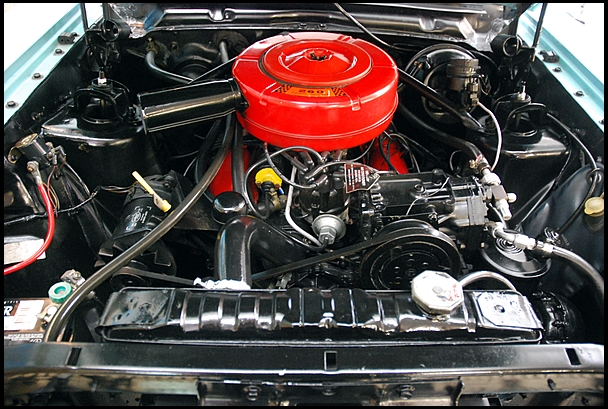
The Mercury Meteor’s 260 cid V-8.
I overhauled the epoch 164 hp 260 cid V8 sometime around 1976 in our garage. At 13 years of age, she had become an old girl. She had become a V6, meaning it had lost compression in two cylinders. I remember setting zero lash, then three-quarters turn of the ratchet for the hydraulic lifters during the overhaul. The distributor was the biggest headache, of all things. It was like extracting an impacted molar and only after using copious amounts of Liquid Wrench in place of laughing gas did it finally come out. “Older” Blue Oval guys know what I’m describing.
___________________________
Back to today’s elegant hamburgers and change.
Instead of the push-pull AM radio, my youngest son – who was seven when I bought it – similarly discovered my ’08 Mustang GT had a “My Color” dashboard light feature. Now I know how my pop felt as my son forced me to experience every color of the rainbow while driving at night – every time. It was like being at an all-night disco club.
Bazooka bubble gum and ashtrays are no more but treasure hunters will be pleased after exploring the map pockets. No disappointments there. I promise… especially after my little Cake Boss had sat in the back. Latex gloves are highly recommended before exploring.
Overhaul it? After all, my GT’s got a 281 V8, only twenty-one more cubes than my pop’s…but it pumps out a magnificent 505 hp thanks to her Roush supercharger and Carmen pulley. Hell, I’m afraid to change spark plugs. Who would imagine in 1963 there would be a TSB on just how to R&R spark plugs?
My Roush supercharger and gizmos.
And unlike my pop’s ’63 Merc which ran on simple mechanical principles (but threw physics principles out the window for the so-called braking), the computing power in my Mustang would cause Einstein to strike a pose like Captain Morgan.
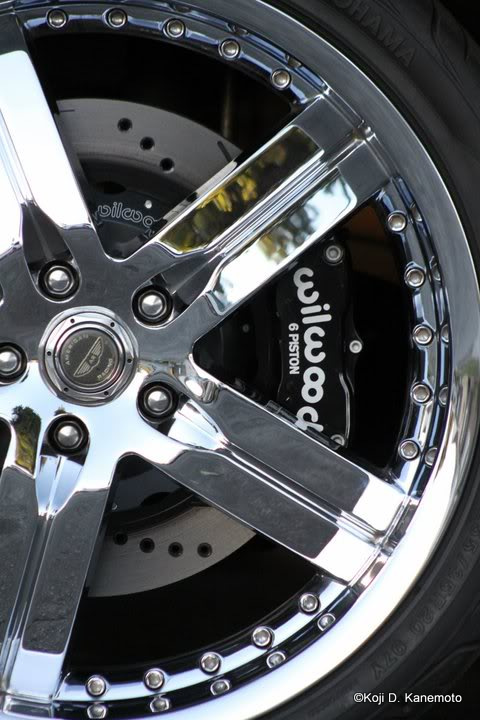
And today’s stunning braking power is the true reason for seat belts – it compassionately keeps your head from being continually used to redesign the windshield. The aftermarket Wilwood six-piston disc brakes I installed with slotted and cross-drilled rotors exacerbates the stop-on-a-dime tendencies… which is a good thing.
The Wilwood Six Piston disc brakes on my Mustang.
____________________________
So it appears the delicious, basic hamburger of the 1960’s has been brought into the 21st Century. Kids that watched Elizabeth Montgomery and Barbara Eden fooled with the wonderfully simple ground beef and bread formula to give us today’s foodie gourmet burger…and we can still listen to Vinny’s golden voice, to boot. Glorious.
And well, with 505 hp at the crank instead of 164 hp, it’s hard to complain. Neither do my kids when they hear the whine of my Roush supercharger. They like to scream. But it’s a shame my pop’s ’63 Mercury Meteor won’t be swept into anyone’s museum.
“When it comes to giving, some people stop at nothing.”
– Vernon McLellan
That was Aunt Michie. She gave all of herself and of her life strength to others because her heart knew no other way.
_________________________
At the moment Aunt Michie watched the ugly mushroom cloud rise from her field that day, her older siblings – my dad, Aunt Shiz and Uncle Yutaka – were all imprisoned in the “war relocation centers” scattered about the United States. These were truly prisons and the popular view is that FDR imprisoned them “for their protection” because they looked like the enemy.(¹)
Life within these “camps” was “sub-standard”. They were forced to live in small, shoddily built wooden barracks covered only with tar paper with little or no privacy. No running water inside their barracks – they had to go wait in line outside, whether it be rain, snow, dust storm or searing desert sun to use public latrines or showers. Food was served in mess halls on pot metal plates at specific times, just like in the military. The food was miserable according to Dad and worse yet, they had to wait in line again. For the first month or so of imprisonment, he said all they had was liver, powdered eggs and potatoes.
But then again, he said it was food.
Aunt Michie and her family were near starving in Hiroshima while dad was imprisoned in the good ol’ US of A.
_________________________
Taken at the Kanemoto home in Hiroshima, 1951 and soon after my parents wed. (L to R) Sadako, Namie, Aunt Michie holding a young Kiyoshi, Grandma Kono, Masako, mom and dad. Courtesy of Kiyoshi Aramaki.
It is assumed like for the rest of America, Dad and his older siblings heard the news of the atomic bombing but while in the camps on or about August 8th… that one enormous bomb had wiped out Hiroshima. There must have high anxiety and anger as many of the inmates in Dad’s camp (Minidoka) were from Seattle; they had family in Hiroshima as their parents had immigrated from there.
My cousins tell me that sometime after war’s end, Michie’s “American” siblings – my dad, Uncle Yutaka and Aunt Shiz – managed to re-establish contact with Grandmother Kono and Michie. With the Japanese infrastructure destroyed, it was a miracle. And it was no easy task as letters to and from Japan were not only prohibited, it was impossible. There was no telephone in the villages where Grandmother and Michie lived.
But her American siblings somehow managed to send much needed clothing to them. When my father finally reached Hiroshima while a sergeant in the US 8th Army, he carried two duffle bags full of C-rations, candy and Spam. They said it was a feast for them after years of hunger.
Dad in front of his Hiroshima home – April 1948
Sadako (who savored the white rice Michie made them on the day of the bomb) told me at a farewell dinner two years ago that she fondly remembered my dad taking them to a market of some kind where he bought her a little coin purse. She remembered Dad gave her the money to buy the little purse and was told she could keep the change. She remembers then handing the change – which was a LOT of money back then – to Michie who humbly accepted it. Sadako said she cherished that little coin purse for years.
______________________________
EPILOGUE
From exhaustive laboring on her farm… to taking precious sashimi to her brother Suetaro… to walking ten miles with children in tow to care for Grandmother Kono after her stroke… to the pain of learning of her brother being killed in action… to being thrown onto the ground and watching a huge mushroom cloud rise over a small hill… to pulling a wooden cart over a hill… to tirelessly aiding the victims… and most of all, sacrificing her own health for the sake of others…
She never gave up in those thirty years. Would you have? I don’t believe I would have had the fortitude.
But because her soul would not quit, she got everyone to tomorrow… but in doing so, her own tomorrows dwindled.
Michie is still here. The fruit of her sacrifices can be seen today in her six children, all of whom have lived – and are still living – full, joyous lives.
Four of Michie’s children with my son and I. The four at the left front were at Aunt Michie’s farmhouse after the atomic bomb; Hitoshi was there as a burn victim. Hiroshima – September 8, 2012At breakfast – Endaijisou Hot Springs, November 2013. Tomiko was at home when the atomic bomb went off; the house was destroyed.
They have their mother, Michie, to thank and they cherish that… and that they were all there at the farmhouse when she looked at each one of them intently one last time before leaving this world.
A most grand mother.
And yes…
They all love food to this very day.
________________________________
I wish to deeply thank my Hiroshima cousins for sharing their memories of their life with Michie with us.
Like all Hiroshima citizens I have met, they simply pray for peace.
NOTES:
(¹) There are declassified US intelligence documents which show that a small number of Japanese and Japanese-Americans were performing espionage. Intelligence was able to determine this by intercepting and decoding secret Japanese communications. This information was given a cover name of MAGIC and these documents were typed up for FDR and a very small number of trusted officials. However, rounding up the spies would clearly indicate to the Japanese that their code had been cracked. These documents present another view contra to the widespread belief that FDR imprisoned the Japanese and Japanese-Americans from discrimination and war time hysteria. In other words, FDR used that hysteria as a cover story; by doing so, he was able to remove the “spies” from the West Coast without alerting the Japanese. FDR also stated in communications that there would be “repercussions” from such action.
A mother holding her child in Ebisu, a part of Tokyo, and in front of her corrugated tin hut. 1946. National Archives.
Indeed, the difficult struggle for food in enough quantities and quality continued. Black markets for food flourished, particularly in larger cities.
Housing in the cities, however, was extremely tough. As an example, after many cities were bombed out, millions flocked to Kyoto. MacArthur and other Allied military leaders omitted Kyoto as a target for its ancient cultural richness. Many Japanese had heard of that by war’s end and trekked to Kyoto in hopes of finding a roof over their heads. Unfortunately, all living spaces were occupied. No rooms were available, even at a huge premium.
Even in 1948 – three years after war’s end – Tokyo still had tremendous scars as can be seen in one of my father’s photographs below:
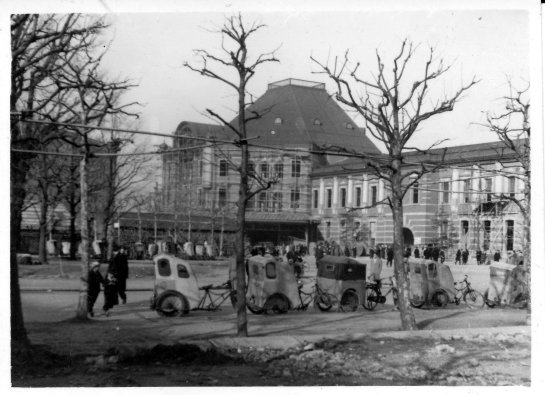
The trees bear the scars of the firebombing. Tokyo Station is in the background being rebuilt with the aid of the US military. Notice the “jinrikisha” lined up in front; they were the equivalent of taxis today and were pulled or pedaled by Japanese men to make a living. Cars will not be available for about ten more years. Taken by my father in March 1948 while serving in the US 8th Army under General Eichelberger.
______________________________
Soon after the bomb was dropped, the hostilities finally ended. However, food and essential goods continued to be largely absent. Amazingly, my cousins who went through that hell choose to reflect on these post-war years positively. That is, reflecting on it as a miserable time will but cause a wound to fester. They had seen enough of festering wounds.
But let us step back a year in Aunt Michie’s life.
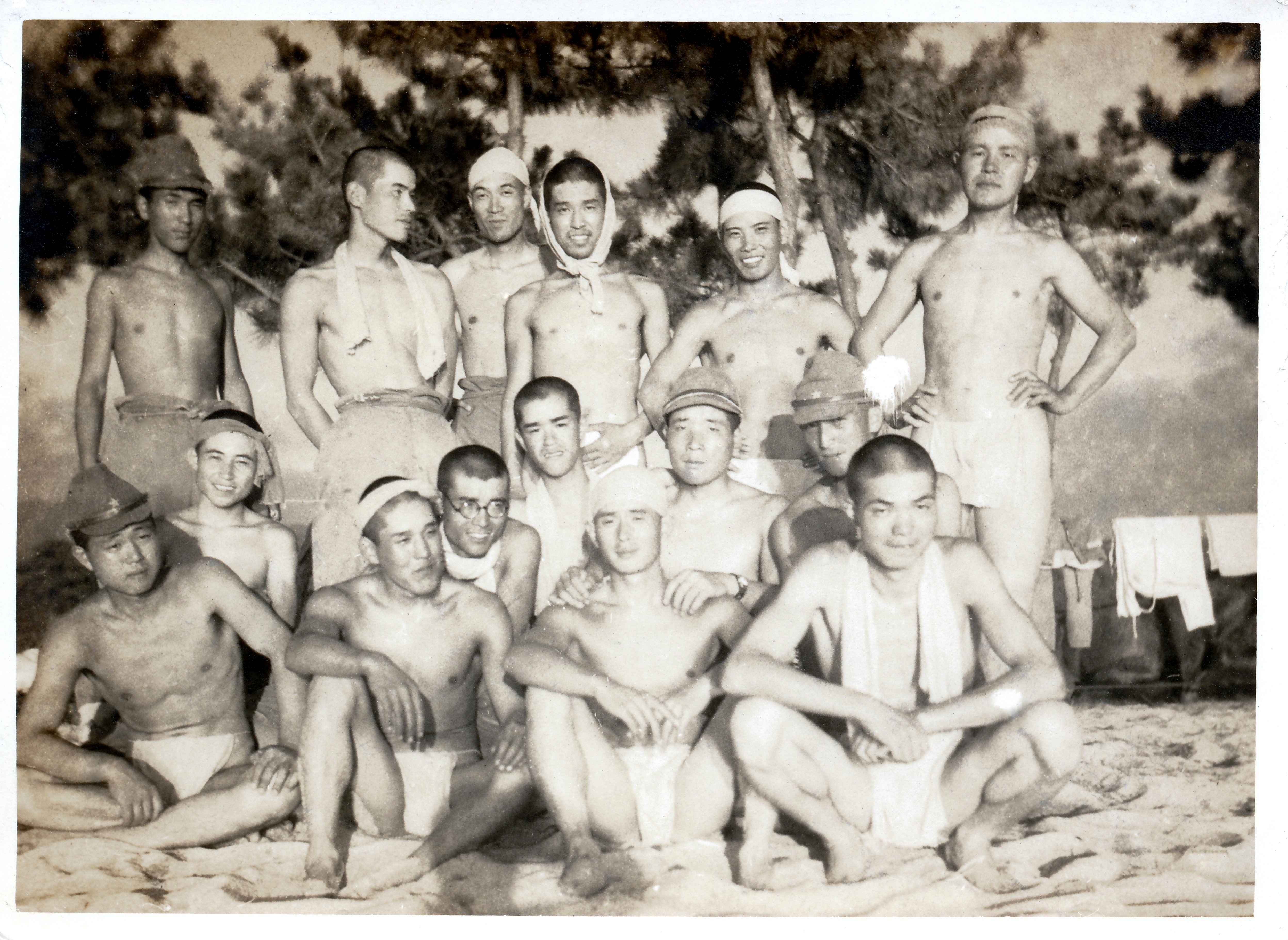
Uncle Suetaro is pictured at the bottom left with his Army buddies. You can see how lean they are due to insufficient nutrition. August 11. 1943.
One month before the surrender, Grandmother Kono was informed by the remnants of the Japanese military that her son Suetaro was killed on Leyte fighting as an Imperial Japanese soldier. The date of death was recorded as July 15, 1945. The Emperor capitulated just one month later. Of course, we have no record of that communication nor when Grandmother Kono was actually told, but the bomb was dropped just around this time, we believe.
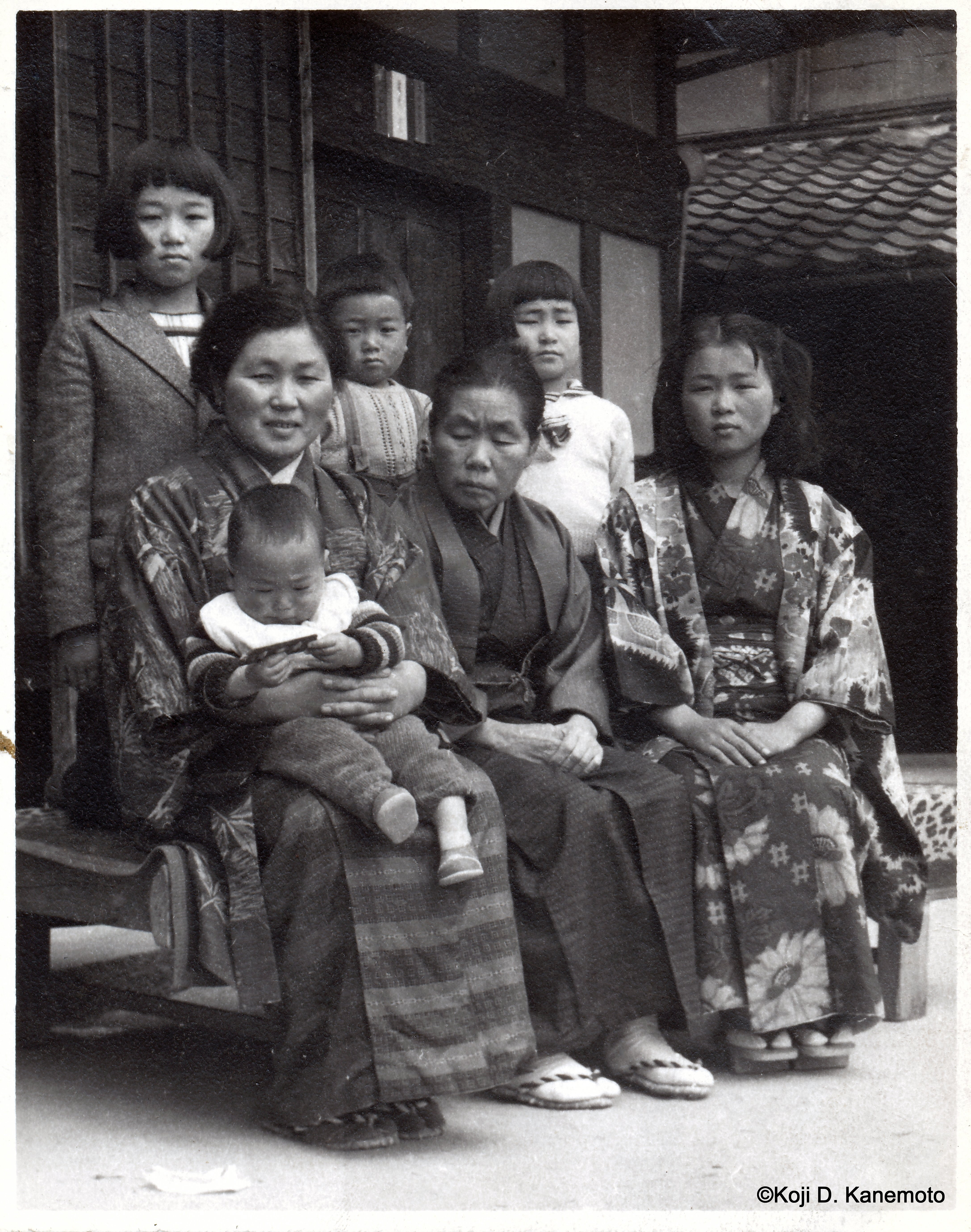
A little more than a year earlier, around March 3, 1944, Suetaro walked to Tomo and Masako’s school. He wrote a farewell note on a chalkboard at Masako’s elementary school to say good bye as he was off to war. Masako remembers he had written to be a good girl and that he was sorry he couldn’t say good bye in person. The family took their last family picture with Suetaro (Part 2); he was flanked by his older sister Michie and Mikizo.
We believe the next day, Aunt Michie went to the train depot to say good bye to Suetaro. She was very fond of him and “his American citizenship”. Everyone loved the fun Suetaro and she apparently talked of him often after his death. But at that farewell, deep down, she knew it would be the last time she would see him. I wonder how she felt watching the train disappear.
This photo was in Grandmother Kono’s photo album. Flag waving school girls stand on the right. After talking about it with Kiyoshi, we believe this was the send-off Aunt Michie went to – to see her brother Suetaro go off to war and certain death. Kiyoshi indicates that a professional photographer took these types of photos at the train station and that the pictures would be offered for sale. 1943.
Soldiers rarely came back. Per tradition, he had left Grandma Kono some of his nail clippings and some of his hair. That is what is in the family crypt.
For hundreds of thousands, entire bodies would never be found. This was true for America, England, Australia, Russia or Germany.
But at least part of him remains there in Hiroshima.
The cousins tell me Aunt Michie grieved for days after his departure… and that she was torn apart when she learned of his death.
The bomb would fall just days later.
______________________________
According to the family, even shortly after the bedlam caused by the bomb, Aunt Michie continued to care for her stricken mother by walking to her house five miles away when she could. My dad said the road was “pretty” level but that since it is Japan, there were hills along the way, especially near Ishiuchi, a small village.
Taken by my father in April 1948 in front of the Hiroshima family home. Holding the baby Kiyoshi, who was born in the home, is Aunt Michie then clockwise – Sadako (who savored the white rice), Masataka, Namie (who pulled maggots out with chopsticks), Masako (who was thrown across her classroom by the shockwave, and Grandmother Kono (who did shaves at her Seattle barbershop).
In December 1947, Aunt Michie started to have contractions while walking over such a hill. She was able to make it to Grandmother Kono’s house where she gave birth to Kiyoshi, right then and there. No, no doctor…no nurse… and Grandmother Kono could not help due to her stroke. It is said she was very happy that the birth took place at her childhood home. She grew up there along with her American siblings. She had felt safe.
___________________________
My cousins believe their mother, Aunt Michie, gave all of herself for her children and her family. In spite of malnourishment, she toiled in her farm’s fields, cared for Grandmother Kono, gave her all in the bomb’s aftermath, set the example for her children. She put everyone before her.
But soon after giving birth to Kiyoshi, she developed kidney problems.
They tell me that medical care then was still pretty non-existent so she had no choice but to ride it out. However, she pushed herself back into working the farm too soon to care for her children, her own stricken mother and other household duties. That was Aunt Michie.
Cousin Kiyoshi remembers massaging his mother’s swollen legs after a day’s work. He also fondly remembers perspiring trying to keep up with Aunt Michie on a hot, humid summer day as they walked up a hill overgrown with thick, green wild grass. There was a “石じぞう”, or a stone figure representing Buddha, alongside a ridge overlooking a blue Hiroshima Bay. Kiyoshi will always remember that moment, looking at his mother with perspiration running down her face and the blueness of the bay.
In retrospect, they feel that if Michie had taken some time to rest and more often that she may have regained her health.
On May 29, 1963, she was laying in the same farmhouse in which she nursed the 23 injured people that fateful day. Her kidneys were giving out. She opened her eyes one last time and looked lovingly at each of her children who were gathered about her then closed them. Thirty years after her father gave away her hand in marriage at 19, after 30 years of a life heaped with physical and emotional demands one after another, world changing events and family tragedies… After enduring the pain of survival, Aunt Michie left this world. She was but 48.
In September 2012, I visited Aunt Michie for the first time. Masako is flanked by her daughter Izumi and my son Takeshi. Similar to the hot summer morning when she was knocked down by the shockwave, it was hot and humid that day. Now, I feel it was appropriate.
Aunt Michie conquered all and gave her life to others so they could get to tomorrow… and she did that with dignity and unconditional love for her children.
Sixty-nine years ago today, the B-29 Superfortress “Dinah Mite” made the first emergency landing on Iwo Jima. The battle for the tiny sulfur island was still raging as she landed.
7,000 young US Marines and 21,000 young Japanese soldiers died violent deaths for this tiny sulfur island.
(Note: Combat was still going on the left side of the makeshift runway as they were landing. Although the B-29 was repaired and left the same day, she returned a month later for another emergency landing. She was so heavily damaged that Dinah Might was abandoned.)
A rare photograph taken after listening to the Emperor’s surrender speech, August 15, 1945. There was a coup attempt the night before the speech was broadcast.
Although the violence of World War II was nearing an end, other aspects of the war could continue against Japanese civilians for years to come.
Their infrastructure was gone. Essential assets such as manufacturing plants, machinery, trains, roads, housing, utilities, even fishing boats had been destroyed.
And most of all, food.
And Aunt Michie’s dignity – the entire family’s dignity – will continue to be tested until the late 1940’s.
____________________________
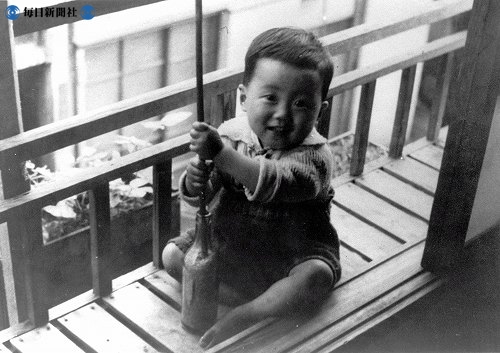
Dated April 1943. A boy poses holding a stick in a bottle filled with unpolished brown rice. This is not the polished brown rice you eat today at Panda Express. It was more wild. Japanese would insert a stick into a bottle partially filled with brown rice then repeatedly jab at the rice until the husk came off. It was low grade rice with the germ still on. (From the Mainichi Shimbun archives.)
For eons, Japan has been unable to produce enough rice for their people let alone food. In fact, it was not until about the time Japan hosted the 1964 Olympics that Japan could produce enough rice for themselves.
The war took a terrible toll on regular folks from getting their “rice fix” – they were just not able to eat it. This deprived them savoring it, the mental and biological satisfaction of just eating it. Think of it this way – what if not just bread itself was kept from you but also the sweet smell of the freshly baked bread with the perfect crust..with melting butter? Talk about attacks on your psyche: deprivation. Deprivation for years. Prolonged sensual deprivation makes for huge changes in one’s outlook on life.
Like the photo of the little boy, millions of civilians would acquire a wild form of brown rice (玄米 genmai) and de-husk them as shown. Along with barley, it served as a substitute for the flavorful white rice with the higher calories.
_____________________________
Confronted by not only the absence of medical supplies, Aunt Michie’s house was now filled with 23 men, women and children with varying degrees of burns. I doubt emergency rooms could handle such a sudden load of burn victims… but Michie’s family did. On top of that, her house was damaged by the atomic bomb’s shockwave. It pains me to even see in my mind what they had to do to make the house habitable enough so quickly to nurse the injured.
It was mayhem and Michie personally did not ask for this horrific situation… but now, on top of trying to provide medical care for 23 people, she was confronted with one ominous problem: how to feed them all. There was no food left in the city of Hiroshima and it was just over the hill. And any food left in the village of Tomo was fresh. It would spoil quickly anyways in the heat as there was no refrigeration. No supermarket. No canned goods either.
She did as Aunt Michie only could. She used her precious reserve of rice and only served it to the ailing victims. I am sure she believed that would be the only way to truly help them survive as all of them were malnourished. As a result of rationing the remaining rice to the victims, her own children who weren’t physically injured were delegated to survive on cooked pumpkins, stems, stalks or taro roots for the duration.
A huge, gut wrenching decision for Aunt Michie, I’m sure.
Some of the wild grass or other vegetation boiled for emergency eating can be seen behind my father and Uncle Suetaro. Hiroshima, circa 1929. Copyright Koji Kanemoto
To help this dire situation, the Hiroshima aunt who was not badly injured went about the area with Mikizo’s parents scavenging for wild grass and other vegetation to boil. That, too, became part of their food. Although likely not very nutritious to say the least, there was no other alternative. And it is important to note such wild vegetation they boiled or ate had been subjected to the black rain…
In spite of all Aunt Michie could do, my cousins tell me some of the burn victims’ injuries wouldn’t heal. They had worsened. Their wounds began to fester or decay for lack of a better description. Pus formed. There was nothing they could do.
The odor of the decaying flesh permeated out of the house. They say you could smell it from the dirt road immediately outside.
It became so intense that people would hold their noses to scurry past the house.
None of my cousins who were there tell me they will ever forget that vulgar smell of rotting flesh… or death. Never.
Just like Old Man Jack.
___________________________
From Aunt Michie clockwise: Aunt Michie (holding Kiyoshi), Namie, Mikizo’s father, Masataka, Sadako, Masako, Mikizo and Mikizo’s mother. Taken in 1948 at their farmhouse where they cared for 23 victims. Courtesy of Kiyoshi Aramaki.
My cousins tell me some didn’t make it.
Others would pass away in the next couple of years from the effects of their injuries or radiation.
Nevertheless, the struggle for food and other essentials would continue…but my Aunt Michie’s immediate family survived. Even Tomiko who was in Hiroshima proper.
And Aunt Michie’s dignity and strength reigned supreme.
They all made it to tomorrow.
__________________________
The surrender documents were signed by Emperor Hirohito’s representatives aboard the USS Missouri on September 2, 1945.
Unbelievably, Mikizo also survived the war. Although taken prisoner upon Japan’s surrender as a soldier in the Imperial Japanese Army, he was released from Manchuria and allowed to return to his Hiroshima farm in late 1946.
You can hardly tell this is a young girl anymore. As Masako and Mr. Tsukamoto told me, they were walking dead. Flesh literally melted off their bodies and dangled. Grotesque forms which were once human beings.
The aftermath of the bombing was no different from hell. Not that I’ve seen hell nor that I would want to…
But Aunt Michie and my very young cousins saw it.
They visited hell.
_____________________________
Atomic bomb survivors. Perhaps this is what Aunt Michie and her cousins saw in their search for relatives on the other side of the hill. If you notice the flask the young girl is holding to her lips. It was likely filled with radioactive water.
Nearly all doctors and nurses within the city had been killed or seriously wounded on August 6, 1945. If they survived the blast, they were likely to fall ill from radiation poisoning and they themselves would die within days. All remaining medical supplies – which had been nearly non-existent due to the war – had been destroyed as well. Most food – even unpicked fruits or vegetables – were contaminated with radiation as was water(¹). Thousands of corpses plugged the rivers as they would go in to soothe their burns but would soon perish.
It is important to note that food rationing in Japan was much more extreme than what was imposed on the American public. While the rationing in America began in May 1942, it started with just coffee and sugar. In Japan, rationing of a far more extensive reach began in 1939 if not earlier. It extended to nearly all first quality food stuffs. Rice, barley, seafood, meat, soy bean paste and soy sauce, vegetables, fruit, seafood, etc. Groups called “tonari-gumi” were established in villages and the like; they monitored and rationed food to the Japanese families based on what work they were doing, e.g., war production, number of family members along with their age and sex. The rationing was so severe that when one family member died, the family did not report it. The average caloric daily intake was cut down to less than 2,000 a day by 1945.
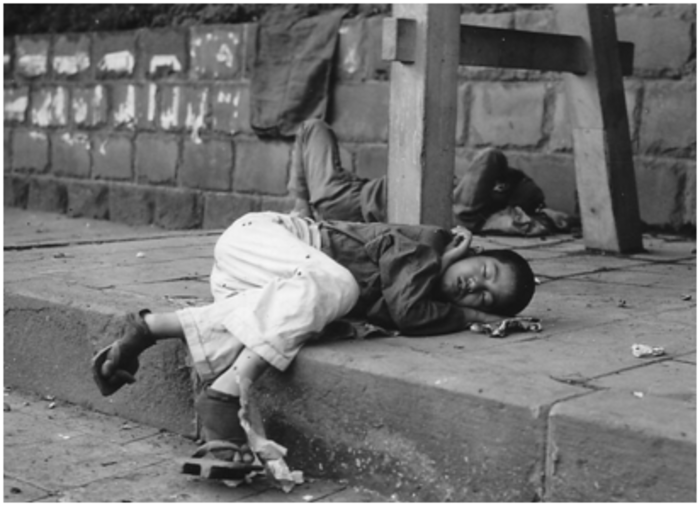
Homeless orphan in Tokyo. He would have to be determined if he was to survive.
The Japanese civilians were starving, so to speak, and were without question malnourished.
Aunt Michie was no different. She was hungry like everyone else and likely tired easily due to low nutritional intake and daily physical and emotional demands upon her. It is important to have an understanding of her condition at this crucial moment in history.
________________________________
Sadako – taken in early 1948 by my father while on furlough. She would marry a distant cousin (common cultural practice at that time) who was also badly burned in the atomic explosion. She is wearing clothing my father bought for her at the Tokyo PX.
After the shock and black rain subsided, Aunt Michie’s thoughts immediately went to her treasured family. According to my cousins, she went into her priceless family rice reserves and cooked real rice for the children. Sadako, the second oldest, remembers to this day how she savored that bowl of rice, a definite luxury at that time. While but a child of ten years and filled with anxiety about eating such a fine meal, she saw at that moment her mother’s love and affection for them was unconditional.
Aunt Michie’s thoughts went to the Aramaki family (aunt and uncle’s family) who lived in Hiroshima. She had no way of knowing that day but they had become direct victims of the atomic bombing. They had been burned over most of their bodies and had even been trapped under their destroyed house. They managed to struggle with their searing injuries to Aunt Michie’s house to seek refuge and care. They had realized that only strong family support would allow them to live.
Grotesquely, the path going over the 300 meter high hill which the relatives traveled became littered with scores of dead people. Masako said they were unrecognizable lumps of flesh and died where they crumpled. Many had their clothes burned away. While thousands were killed instantly, other thousands suffered for days before dying from intense burns, radioactive poisoning and other injuries. As radiation poisoning was unheard of amongst them, some were told they had dysentery and the like. Many before dying oozed pus from their ears and blood ran from their noses. You will not read this in any Western textbook. In fact, the gruesome information about the days, months and years after August 6th was suppressed for a couple of decades by both governments.
While the dazed and immensely pained adults struggled to Michie’s farm, there were young children of the family unaccounted for(²). Without hesitation and unbelievably, Aunt Michie – in her weakened state – pulled a two wheel cart over the hill to Hiroshima to look for them.
Over a hill.
I believe this to be the type of cart Aunt Michie pulled to Hiroshima to look for the unaccounted for children of the family. Kiyoshi called it a 大八車, or large two wheeled wooden cart.
Miraculously and while the details are lost, she found some of them and hauled them back to the farm on the cart, now laden with the additional weight of the children… on the same road that was further littered with dead and dying people. Think of the mental anguish Michie had to endure when dying people came up to her and asked for her help… It would be difficult to not look at them. It was more difficult to ignore them, I’m sure.
According to my cousins, a total of 23 people got refuge and care at Aunt Michie’s farm. I understand many were relatives from the Aramaki side of the family.
There were more hurdles for Michie and her children immediately ahead – caring for the injured and dying.
_____________________________
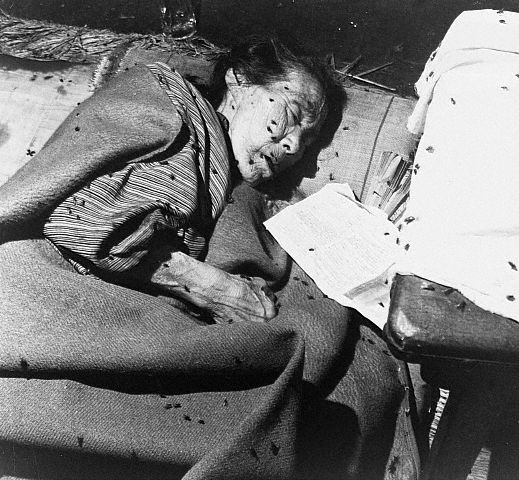
You can tell which way this woman was facing when the bomb went off. Her left side is burned. Photo was likely taken after August 6, 1945.A mother looks after her child. This photo was also likely taken after August 6, 1945.An elderly woman lies dying on the floor covered with flies. Perhaps this is just one of the sickening sights Michie and her children have buried in their conscious.
The preceding photographs may show what Michie and the children were faced with. And the children were just that – children.
How old are your children, by the way?
The older cousins recall that they, Michie, Mikizo’s parents and the less injured relatives took on a 24 hour a day field hospital of sorts to treat the injured. It was stifling hot and humid; yet, they had to be given constant attention and there were so many of them. I cannot imagine how exhausting this task could have been, especially when you are hungry and malnourished yourself.
Taken sometime after August 6, 1945. The side of her you see is what had faced the atomic explosion. The patterns are from her clothing she wore that day. It was where the dark patterns of her clothing had been in contact with her skin. Masako recalls vividly this type of pattern among the burn victims and that the maggots followed that pattern.
The common injury were burns. Severe burns…and they had no medicine whatsoever.(³) No Bactine. No Motrin. No aloe. All Michie could do was to coat the burns with a type of cooking oil and bandage them with pieces of cloth. She must have endured unlimited anguish in knowing she could not measurably lessen their pain and suffering. There must have been constant crying and unbearable moans of pain.
And on their hands, blood from human beings.
Namie – taken in early 1948 by my father while on furlough.
Six year old Namie could never forget what she had to do. Flies were swarming having sensed dying flesh. Namie was tasked with shooing them away with a fan but they wouldn’t stay away. And worse yet – time and time again, she had to remove the maggots that were feeding on dead flesh…with chopsticks. I do not know if I could have done that…but Namie did.
The turmoil that must have stormed inside Aunt Michie to tell her daughters to do what they had to do for the sake of survival…and then to be stern with them and tell them to continue when they wavered or cried… must have been punishing to her as a loving mother. She must have wanted to cry.
(1) Per my 2012 meeting with Mr. Tsukamoto in Hiroshima, water is the main theme of the Cenotaph at the Peace Park. Survivors clamored for water. Where there was well water, many survivors were suffocated as dozens more pressed against them for the precious liquid. Please see “A 1937 Yearbook, the Atomic Bomb and Hiroshima” for further information and links to their personal story.
(2) The number of unaccounted for children is unclear.


























 Masako and Spam Musubi