Tag Archives: japan

Sands of Manzanar


Image
What remains of the cemetery out in the middle of nowhere.

It wasn’t the deadly black sand that greeted the US Marines on Iwo Jima.

But as we stood on out on the desert, white powdery dust would swirl up in the softly blowing arid wind…  and I then realized it was upon this gawd-awful sand that my Aunt Shiz and Uncle John built their future for their family.

It was their Iwo Jima…  It was called the “Manzanar War Relocation Center” by our government back during World War II.

They were forced onto these forsaken sands by FDR in April of 1942 but made the most of it.  Quietly.  仕方が無い…  我慢.  Shikataganai and gaman.

A

FDR called it relocation centers.

It’s just my opinion but political correctness be damned.

It was a prison.  Complete with eight guard towers and soldiers manning .30 caliber Browning machine guns.  Barbed wire fencing all around.  No freedoms.  Chow at specific times.  Public toilets and showers.  No running water in your “cell”.  No cars.  No soda jerks.  You were classified as “Enemy Alien” even though you said your Pledge of Allegiance or were a Boy Scout.

There were ten well known ones like Manzanar.  But quite a number of smaller or special purpose prisons were scattered about the US – some of which have been long forgotten.  But one thing in common was they held Americans incarcerated just because they looked Japanese.  Not one was ever convicted of spying for Japan.
Image
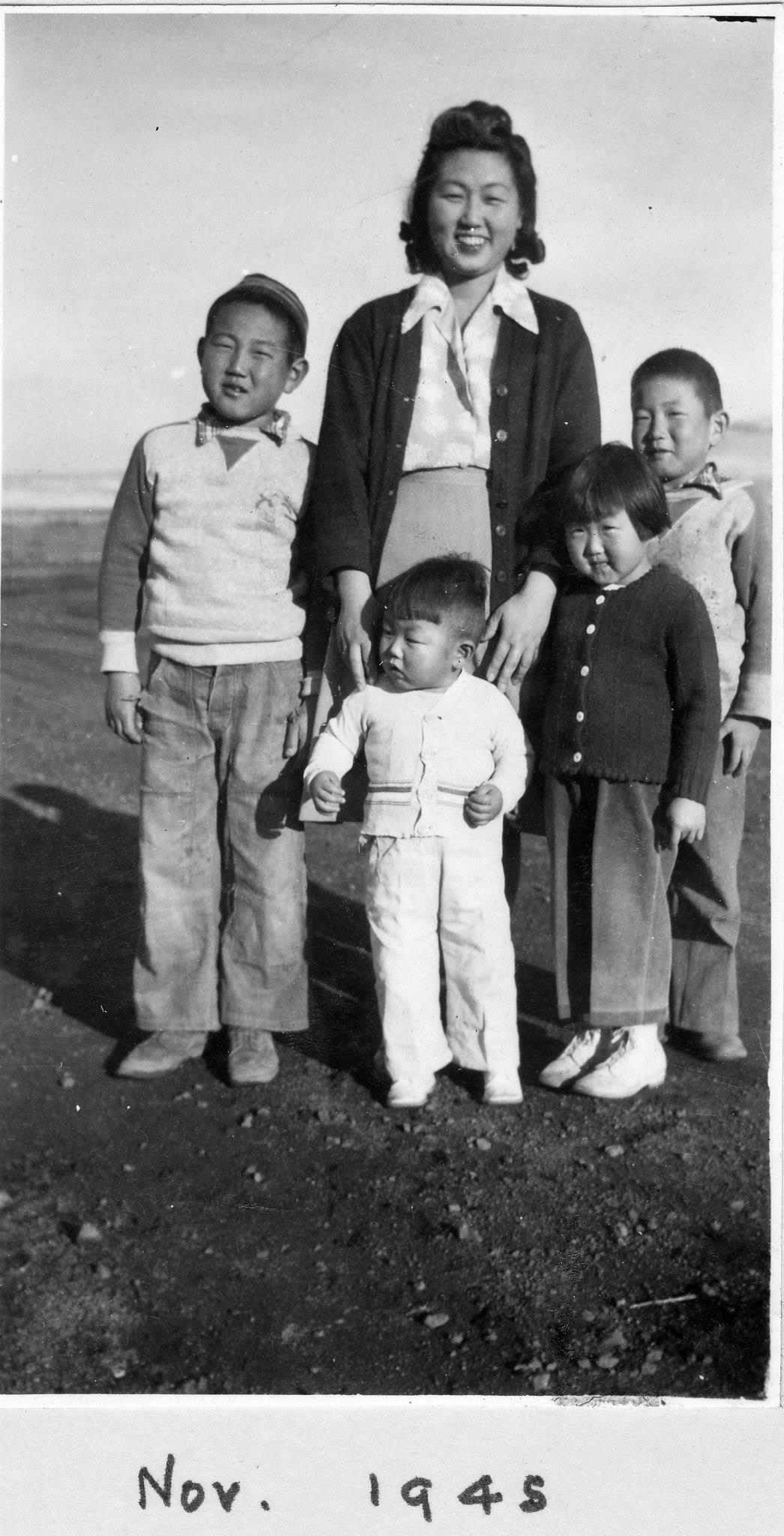
Pictured: Aunt Shiz and my four cousins.  There was no notation other than the date but if I were to take a wild guess, this may have been taken as they left Manzanar the second prison they were moved to: Tule Lake. I base it upon the barrenness of the area surrounding them. (Edit 9/27/2013)

I had never been to Manzanar.  However, since Aunt Shiz passed away at the age of 95 last year at this time, I heard a call to visit.  So my friend and I decided to make the 500 mile+ round trip the Friday before Labor Day weekend.  It was time to go.

_____________________________

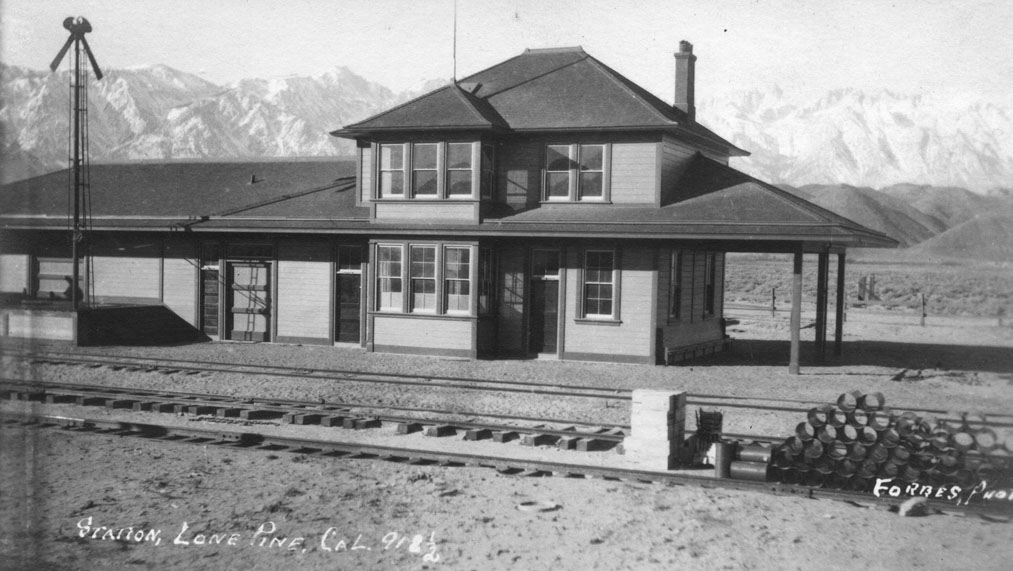
Manzanar back in 1942 was an isolated, desolate desert wilderness.  Hell, it still is for the most part.  The 2010 Census only reported about 2,000 residents; imagine how uninhabited it may have been seventy years ago.  Temperatures soar to over 110F in the summer and plummet to the 20’s in the winter.  It was exactly 100F and humid when we arrived that Friday.  It lies between Lone Pine and Independence on US 395.
Lone P Station
The lonely Lone Pine train station, perhaps the 1930’s?

If you haven’t heard of these prison camps during WWII, FDR signed Executive Order 9066 (There’s those danged Executive Orders again!) ordering Japanese (Issei) and Japanese-Americans (Nisei) to evacuate from the West Coast of the United States.  The FBI and the US Army were there to ensure they left.  These families could only take what they could carry with many everyday items prohibited.  Knives, guns, tools…and cameras because they were looked upon as the enemy.

Many family heirloom photos and letters were burned or tossed.  Favorite dolls.  Bicycles.  Silverware.  Dishes.  All gone.

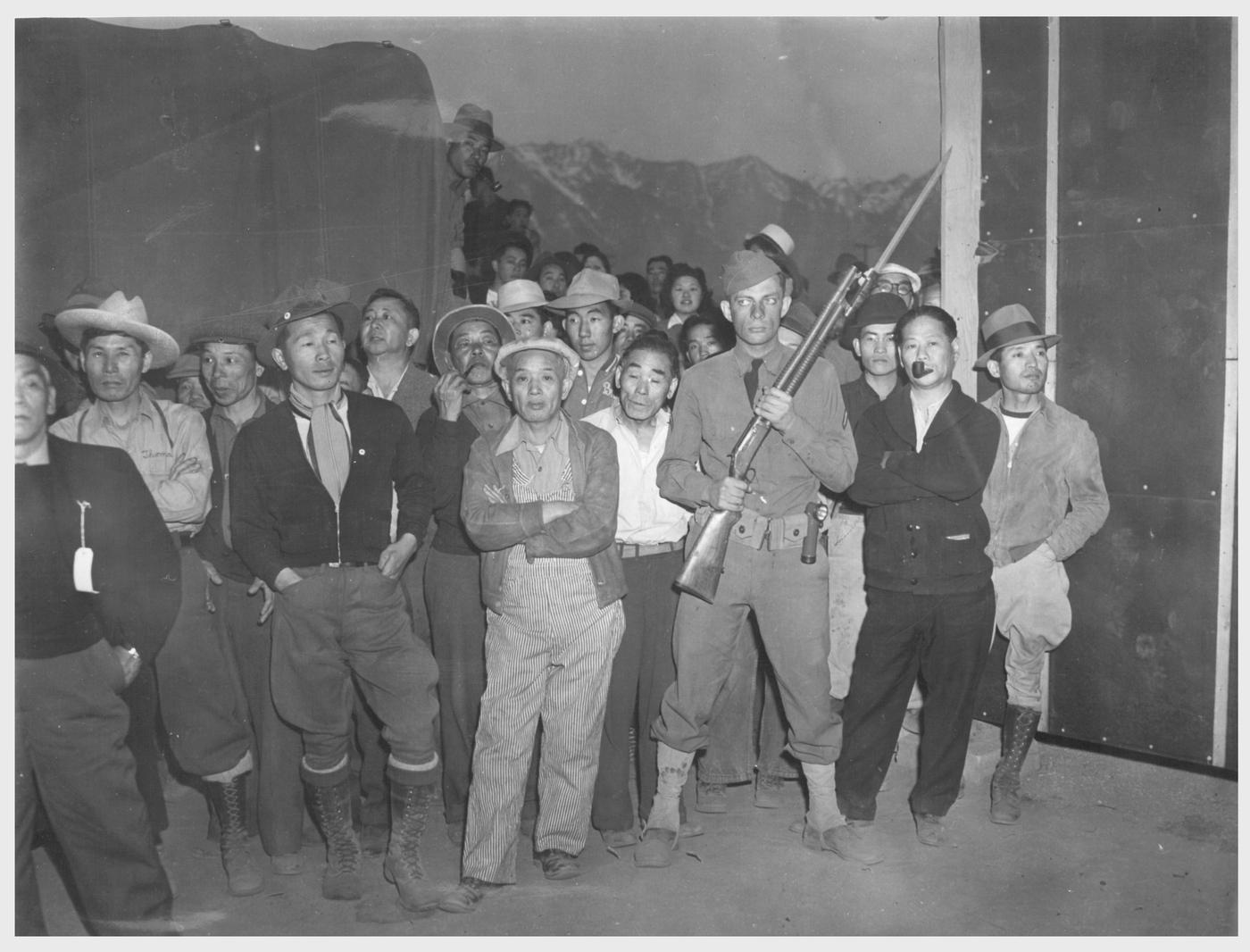
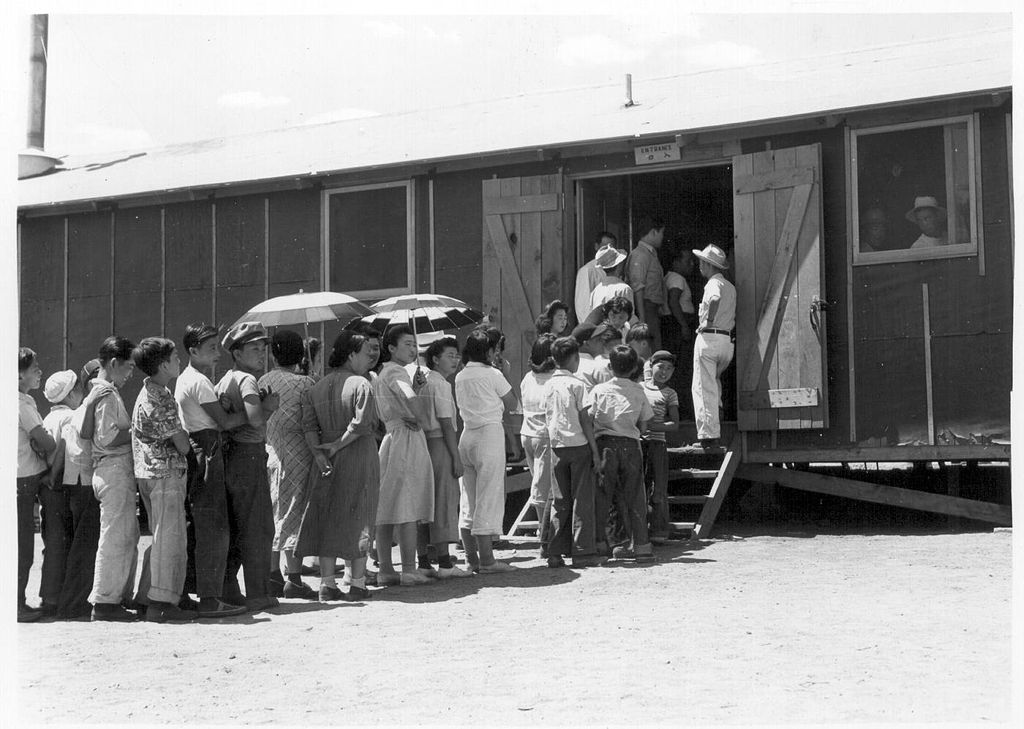
Here are some official US Government photos (except for my color one) from that period; please note many of these were taken by the Government and were meant to appease the public:
1261px-Barrack_Construction
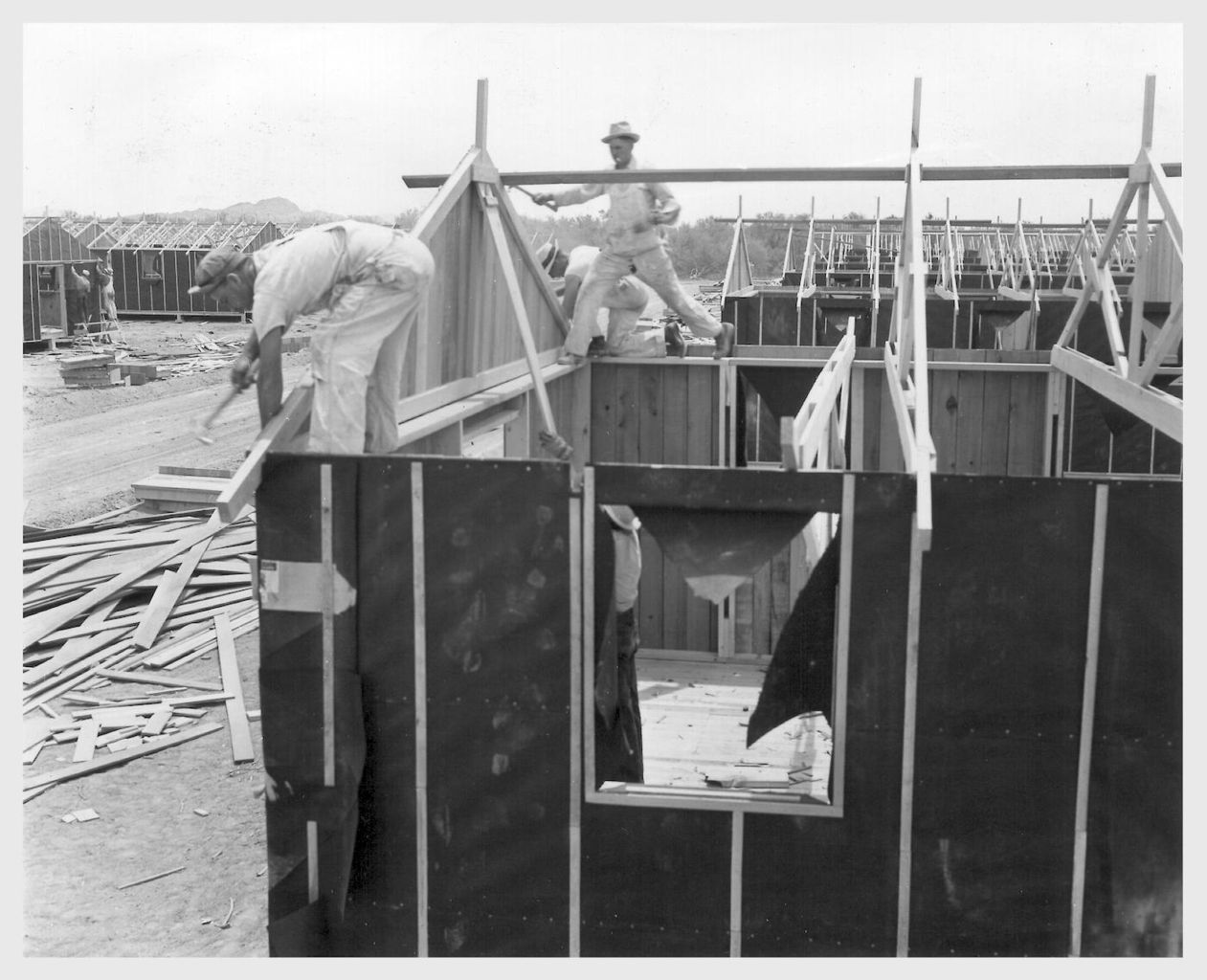
American workers putting together the shoddily built barracks. They only had tar paper on the outside to keep out the elements. Big gaps existed between the boards – walls or floor boards.
2013-08-10 11.51.50
My two littlest kids and a friend stand in front of an actual barrack from a WWII prison camp. Notice the tar paper remnants and the gaps between the wooden planks. Families actually were forced to live in these shacks.
littletokyo
Japanese Americans were loaded onto buses or railroad cars under armed guard to be transported to the prison camps. This April 1942 photo was taken in “Little Tokyo”, an area in Downtown, Los Angeles.
20-1471a
Japanese-Americans disembark from the railroad cars at Lone Pine, CA and are now waiting for buses to take them to their new “homes” at Manzanar. My aunt’s family may just be in the photograph.
bus
Boarding buses headed to Manzanar under guard.  The US Army soldier should be concerned someone would grab his holstered .45 ACP.  After all, he was amongst the “enemy” as FDR determined.
moving in
A new family brings in their worldly belongings into Manzanar. Notice the dust being blown up around them. Both Aunt Shiz and my dad talked about how everything in their assigned barracks would be covered with dust…down to their Army issue mattresses and sheets. Imagine that for days on end.
guard
Arrivees at Manzanar. Note the ID tag on the evacuee at left. Everyone got one…even babies.
1024px-Mess_Hall_Line
Mess Hall chow line. You ate here whether or not it was freezing or scorching outside.

As general information, a relative said the latrines were so cramped that you almost touched each other while sitting on the toilet and that there weren’t any stalls.  Just holes when the first arrivees showed up or after toilets were finally installed a little later.  It was hot and stuffy inside with the stench and flies unbearable.  They had to wait in line to use the latrines, take a shower or eat.

During the war, Manzanar internee Pfc Sadao Munemori – through his brave actions on the battlefield – was bestowed the Congressional Medal of Honor…posthumously.  (Twenty-one Japanese-American soldiers were bestowed the Medal of Honor.)

Interestingly, two-thirds of the Japanese Americans interned at Manzanar were under the age of 18 per the National Park Service.   There were 541 babies born at Manzanar; my cousin Roy was one of them.  (Another cousin, Neil, was born in Tule Lake, CA while his older brother Bobby perished at another camp at six years of age.)

_______________________________

It is still difficult to believe all of my stateside relatives of that time – all American citizens – were subjected to the degrading treatment depicted above.  But I think my Aunt Shiz had the toughest experience raising four children – with one born in camp.

As we walked through the museum, I perspired profusely even though it had a cooling system.  While my friend was intently reading a number of exhibits, I tried to occupy my mind with other thoughts; I still didn’t know how I would react to being here.

Then, I saw several faces in photographs lining a hallway honoring Toyo Miyatake.  I had often seen them in my youth walking about Little Tokyo or at the temple (I am Buddhist.).  The familiar faces somehow made me “feel at home” or secure in a way.
M
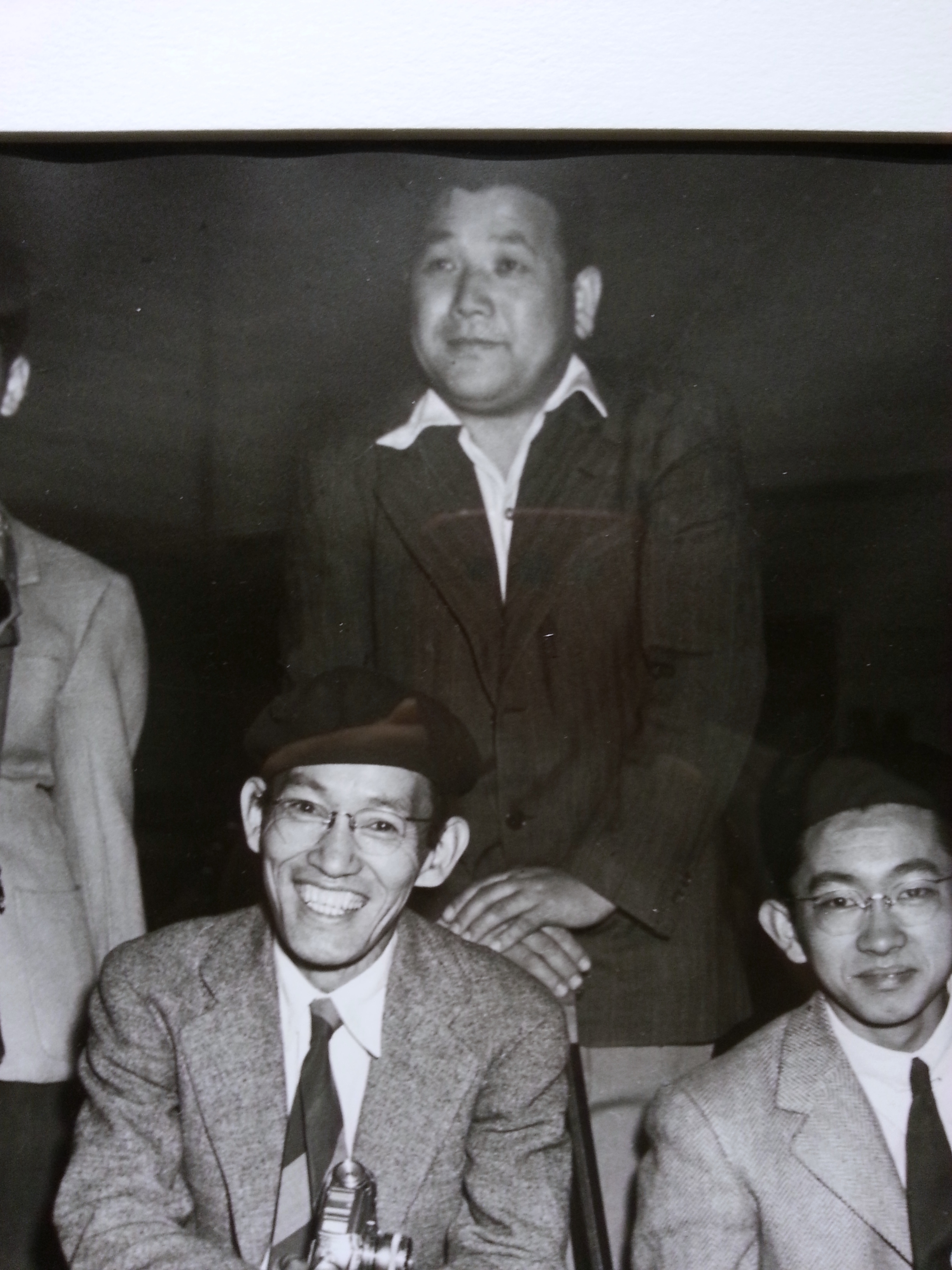
Standing is Hisao Kimura, the father of my good friend Sadao. They founded Kimura Photomart where I worked in Little Tokyo. Toyo Miyatake (seated at left) frequently came to Kimura Photomart to sit on a stool after retiring. Toyo’s son, Archie, is on his right. Please click on this link to learn more of the Miyatake heritage and connection to my family. Toyo Miyatake

Here are some other snapshots taken during the visit:

IMG_5277
My friend intently read the information on the exhibits during our brief visit. I feel she learned “stuff” that is not in our textbooks.  I was happy she took interest.
IMG_5282
At the very bottom left of the camp model, you will see a “greener” area. It housed the US Military as well as administrative staff. These barracks were more thoroughly constructed with running water and toilets.
IMG_5280
This is one bit of information that can be drawn up to the CPU. However, I am at a loss when it shows that Aunt Shiz was moved to Tule Lake.
IMG_5281
My friend appears to have a solemn look on her face while looking at the prison camp’s layout.  Over 11,000 men, women, children and babies were made prisoners and incarcerated at Manzanar – all civilians.
P
Our good friend Toyo Miyatake, who had illegally snuck in a lens, fashioned a self-made camera around it to take historical pictures from inside the camp. However, photography had been forbidden. For a more complete history on Toyo Miyatake, please click on this link: Toyo’s Camera.
IMG_5289
A recreated barrack stands alone on the desert sand beneath spectacular clouds.  These recreations were MUCH better made than the original barracks as the National Park Service had to build these to Code.  They even had fire alarms and exit signs. 🙂
IMG_5292
Inside of one of the re-created barracks. According to the National Park Service website, “Any combination of eight individuals was allotted a 20-by-25-foot room. An oil stove, a single hanging light bulb, cots, blankets, and mattresses filled with straw were the only furnishings provided.”
IMG_5301
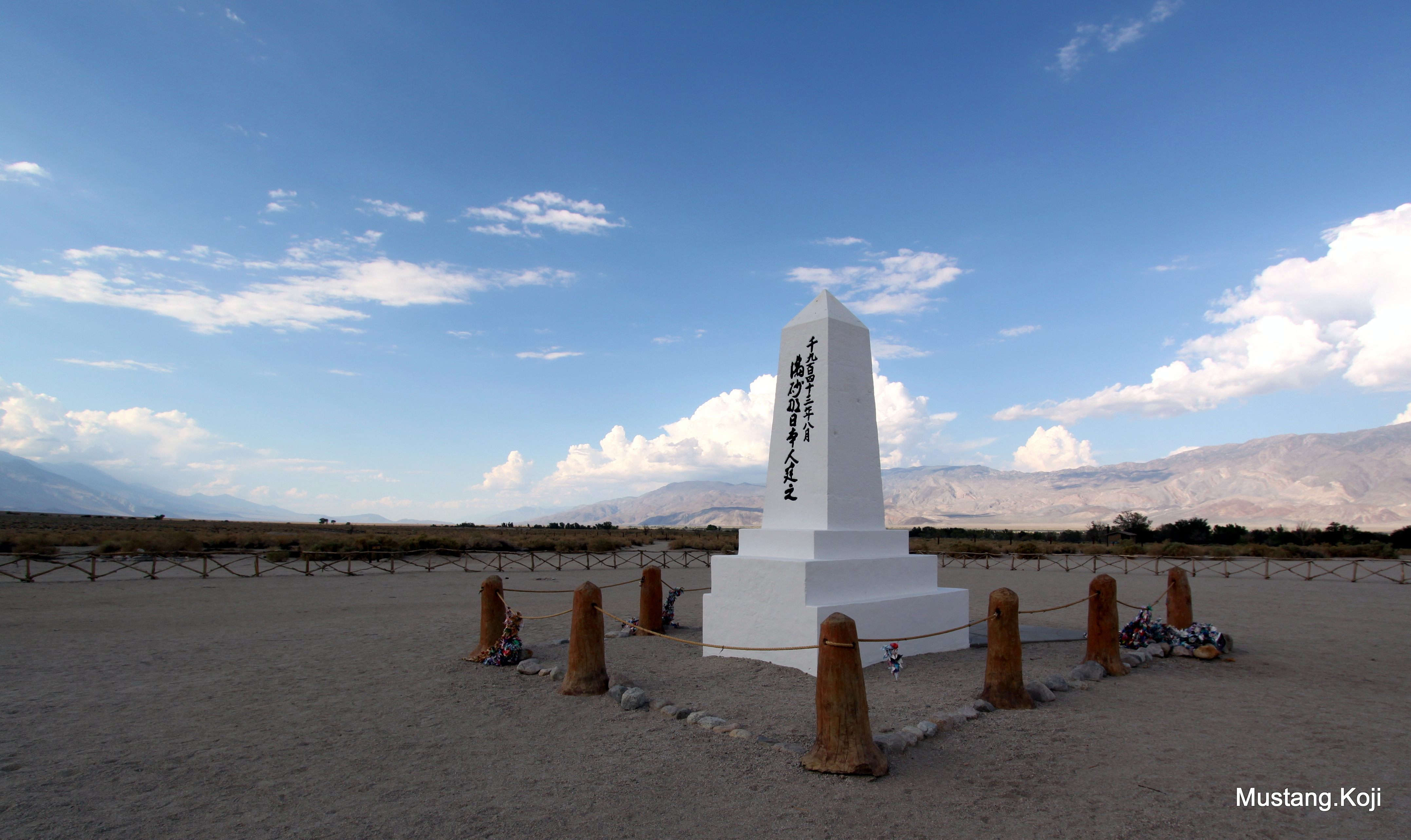
The backside of the memorial at the Manzanar cemetery. I would not have appreciated being buried in such a desert to be forgotten. On the other hand, many of those killed in action were never found as well.
IMG_5302
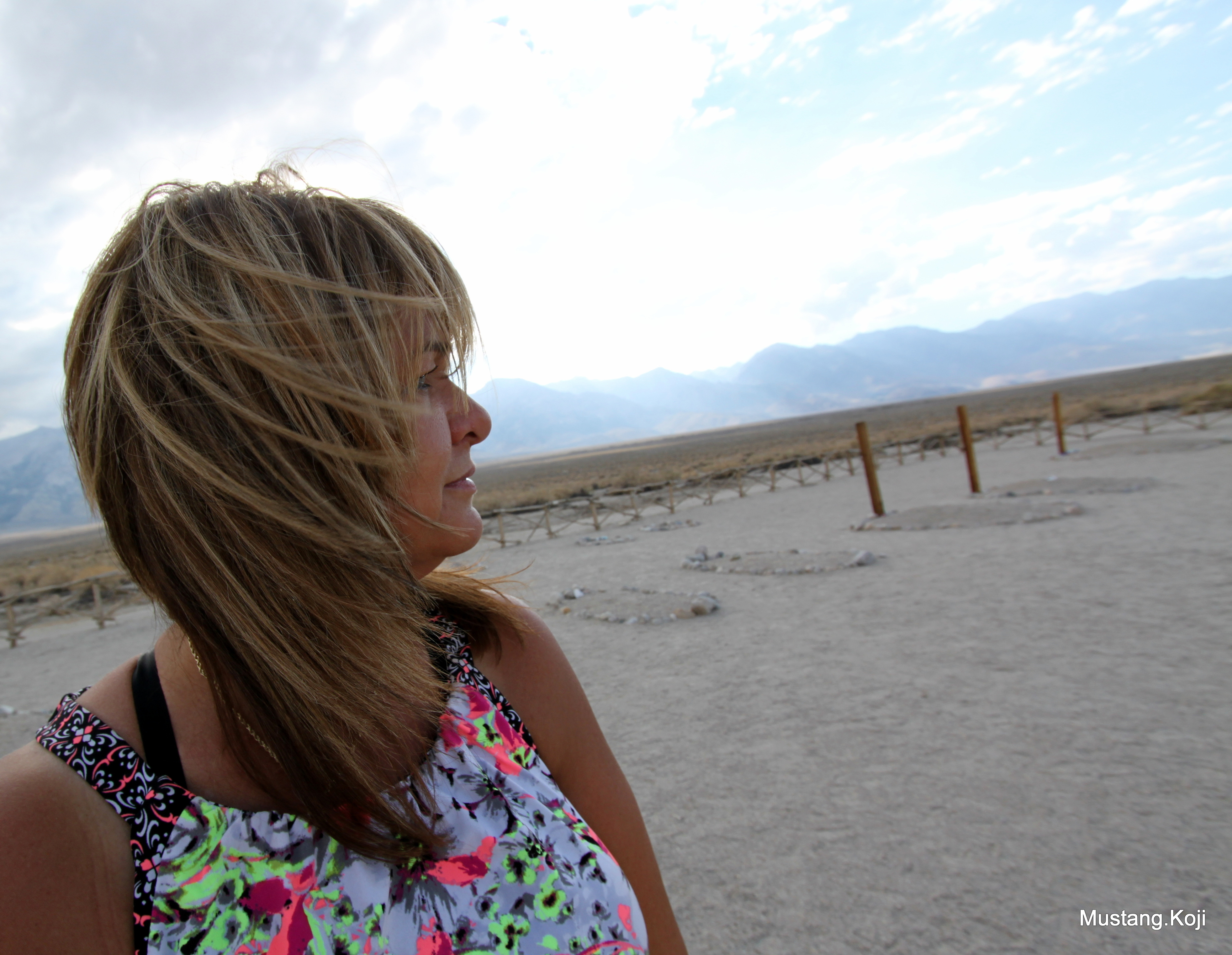
The slightly humid desert wind blows through my friend’s hair as we stand by the memorial erected in 1943 marking the cemetery.

Lastly, a recreation of a tag each individual had clipped on his/her person to be incarcerated.  While the Nazis tatoo’d ID numbers INTO the flesh of Jews, this tag served essentially the same purpose.  This one reflects Toyo Miyatake:
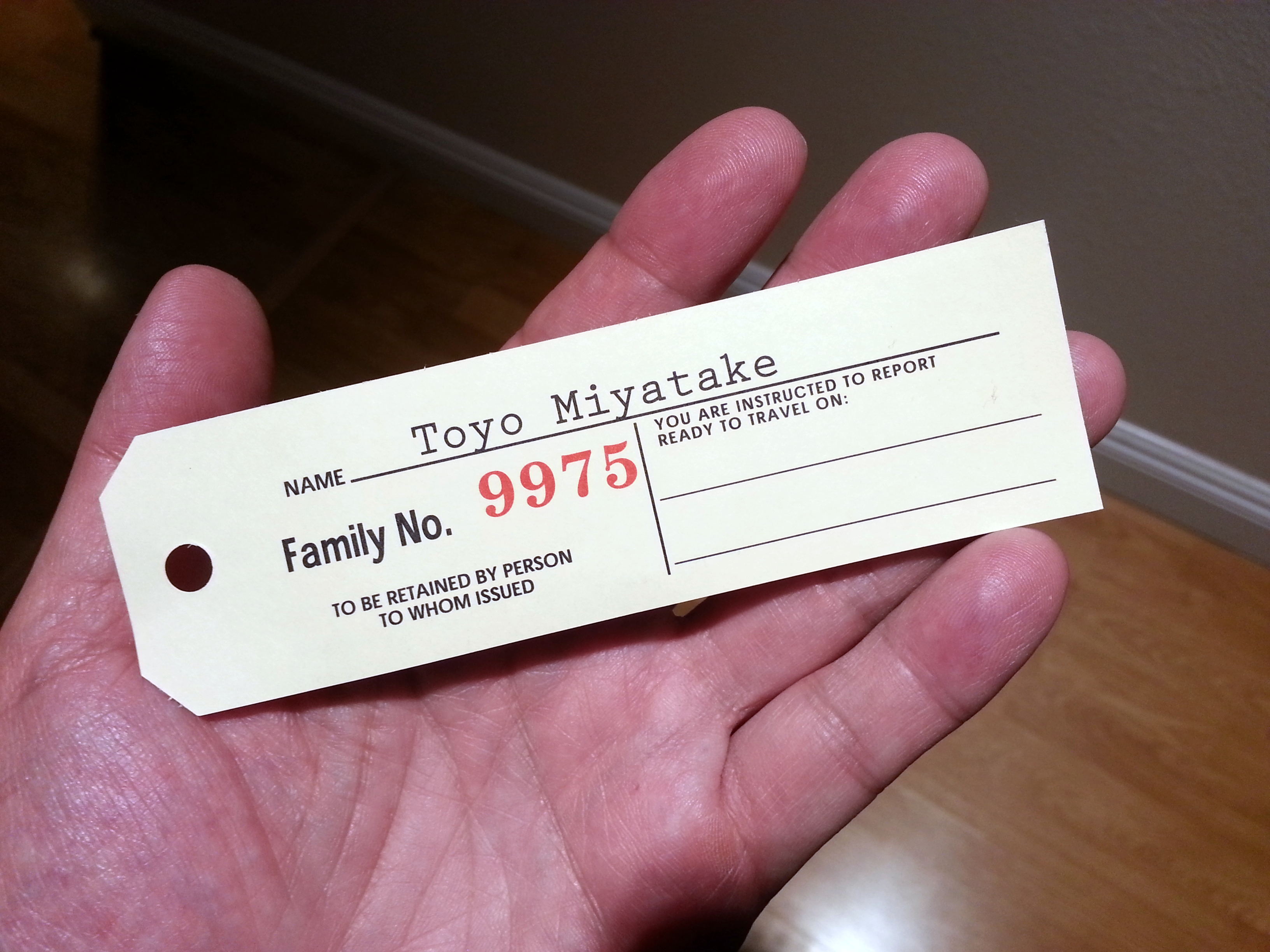
2013-09-03 20.28.50___________________________________

We walked on the same sand that Aunt Shiz, Uncle John, Hiroshi, Bessie, Shozo and Roy walked on for 3-1/2 years.  We experienced the heat, although it was but 100F when we arrived there and partly cloudy.  The dust that got kicked up by the warm gusts did swirl around a bit as Aunt Shiz described.  My Subaru Outback was coated with that fine dust.  It was almost like the powder law enforcement uses to bring out latent fingerprints.  And perhaps it is TMI, but I did step inside a modern “port-a-potty” set up out in the desert.  Believe me…  it was hot and stuffy in there.  That will suffice.  But I think that they all endured that for all those years…  Unbelievable.

___________________________________

As we drove home, my friend asked me how I felt.  I had mentioned to her I might shed a tear or two (from the dust, of course, as real men don’t cry) before we went.  After pondering her question, I answered, “Elated.”

Bizarre answer?  Perhaps.  But I was elated I got to slightly experience what they all did 70 years ago.  No, I did not have to sleep on straw mattresses in stifling cramped rooms nor eat prison-grade quality food at the beginning of incarceration.  Nor line up for chow or to take a shower… Nor have to fear .30 caliber Browning machine guns pointed at me…

But I did finally see that my aunt and uncle built their future upon what they had lost – and what they learned to be important for family – on these white sands of Manzanar.
Another Prison Camp Discovered


Not to bore anyone but a few of you readees may recall my dad abd older siblings were in essentially peison camps during WWII just for looking like the enemy.

Well, researchers found another prison almost forgotten due to obscurity. This prison camp was not far from Spokane.

While the prisoners were paid up ti $60 a month, they did build many mikes of road.

History is what we make of it.

But blogs like ours are sure better than the misguided media.

http://m.huffpost.com/us/entry/3663446

An Eight Decade Circle


image0-014
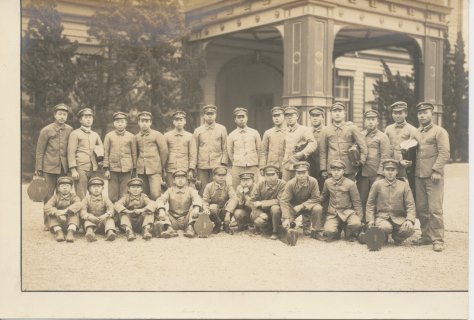
Unretouched image of Uncle Suetaro’s band.

My father’s decades old story about how he broke his elbow became the topic in the earlier story, “正覚時” (Shoukakuji).

Shoukakuji is the name of the Buddhist temple – a hop, skip and a jump from my father’s family home in Hiroshima.

Temple entrance.  My father's home is behind me and to the right.
Temple entrance. My father’s home is behind me and to the right.

The temple’s reverends supported my family’s religious needs for over a century now.

Aunt Michie’s wedding.

Funeral services for my grandparents and my father’s siblings.  Including my Aunt Shiz just this last September in “The Spirit of Aunt Shiz and Kharma“.

Including my Uncle Suetaro who was killed in action as an Imperial Japanese Army soldier on Leyte in the Philippines.

____________________________

When Masako-san, my son Takeshi and I walked to the temple in 2013 to investigate my dad’s story of how he broke his elbow, we were greeted by the Reverend.  He was 90 years old and still had his wits about him.

While he did not recollect my father, he validated the placement of a large round rock under the pine tree that hasn’t been touched for as long as he’s lived at the temple…. And that’s a loooong time.  I’m sure he was born there.

And that there was a big branch of a pine tree that has since broken off recently.

He said he knew my Aunt Mieko who died in 1939.

And miraculously, he mentioned Uncle Suetaro.  The reverend said they played together as children and that he was always a jokester and smiling…and that he could hear him playing his “fue”, or flute, from his second story room at the house.

Until then, not even Masako-san knew Uncle Suetaro played a flute…but there was no proof.

Just the recollection of a 90 year old reverend.

____________________________

My tennis elbow pain kept me from retouching the old vintage photographs I had brought back from Hiroshima last September.

And the project was at a standstill since late October.  That was as depressing as Obama V2.0.

But from three weeks ago, I am attempting to slowly restart the retouching project as my elbow pain has subsided greatly…and I came across the group photo you saw at the beginning here.

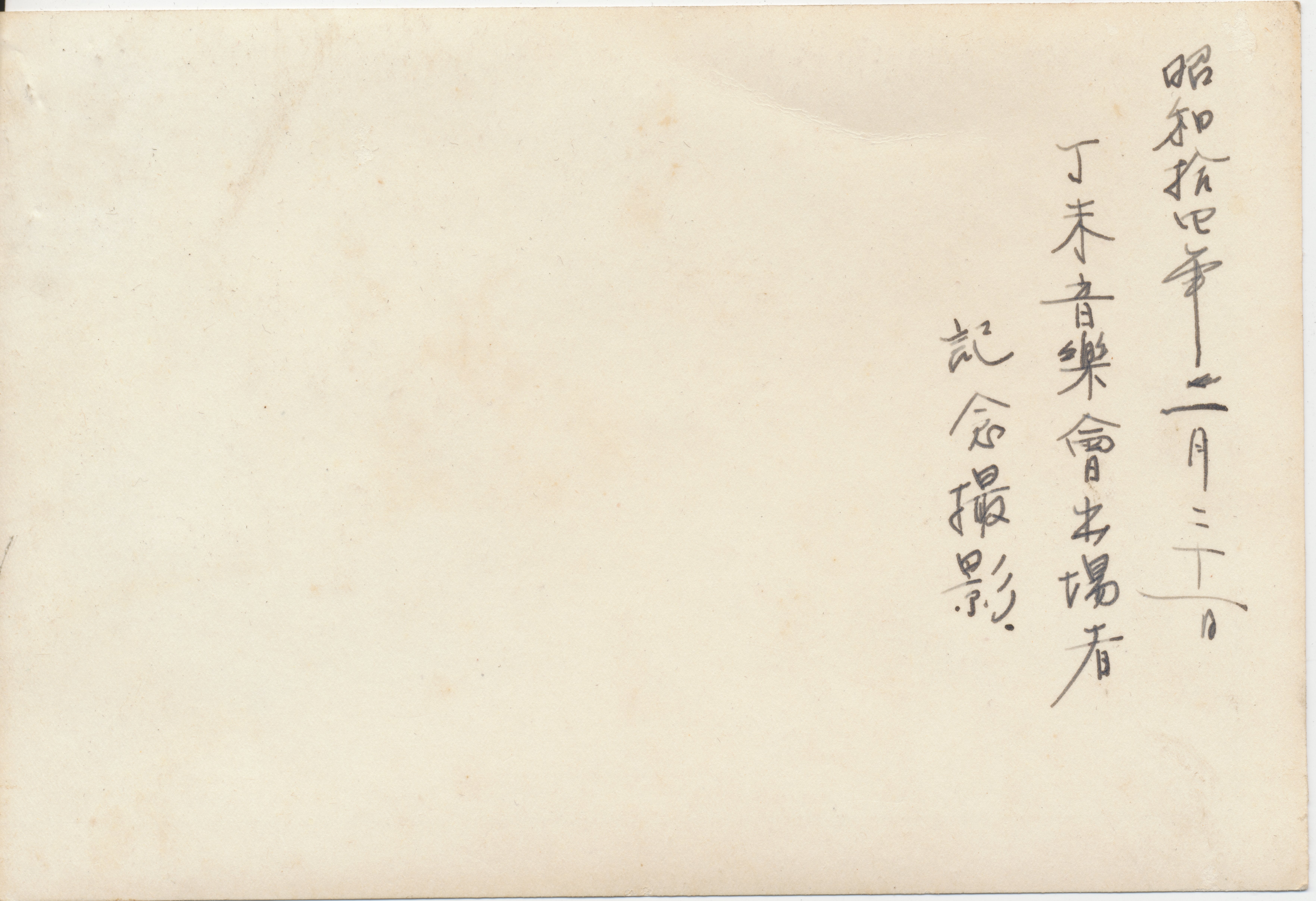
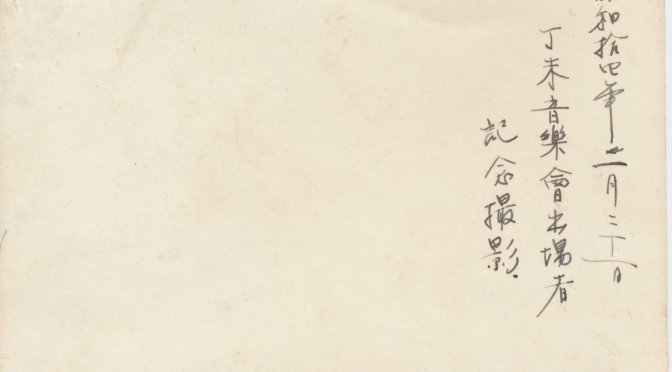
This was the backside since I know you ALL can read ancient Japanese:

image0-014back
Written by Uncle Suetaro himself.  I believe – BELIEVE – it says, “February 21, 1939. Performed for First Sino-Japanese War anniversary.”

As retouched:

image0-014retouched
As retouched. Uncle Suetaro is the slightly taller one just to the left of center.  If you click on the image, it will enlarge.  Look in his right hand.

But as I enlarged the image to begin retouching, something caught my (old) eye.

I noticed Uncle Suetaro was clutching something in his right hand.

A case.

A case more slender than the others in the group picture.

It’s not a trumpet or a trombone, that’s for sure.

Or for a cue stick.

It sure looks like a flute case.

Oh, heck.  It IS a flute case.

I say so.

_______________________________

So words from the mouth of an old reverend started an eighty year old circle… to this vintage photograph of young boys.

All of whom likely lost their lives in a violent war.

As did my uncle who played a flute.

Iwo Jima


DC
My two smallest kids had the honor to see the memorial first hand in June 2010.

Life has been quite unpredictable for me for the past six weeks or so – as well as tiring.  I am quite behind in reading many of your fine blogs and that is on my priority to-do list.  But it is a hollow descriptive for me to say I am tired.

I am still alive.

Twenty-nine thousand are not.

_____________________________________

The battle for Iwo Jima began 68 years ago on February 19, 1945.

Sixty-eight years ago.  Just yesterday for many.

Sixty-eight years ago, about 29,000 young men met horrible deaths on that demonic volcanic island – 22,000 Japanese soldiers and 7,000 Marines.  That unforgiving island still has not given up all of her dead to this day…  American and Japanese.

Kan
Japanese Prime Minister Kan in blue visited Iwo Jima (now renamed Iwo To) in 2010 to help find and exhume Japanese remains. He is the only Japanese Prime Minister to do so.

Indeed, the camaraderie amongst the survivors as well as those linked to the battle by relation or history is rightfully still strong.  It is vital to the preservation of bravery, courage and love of country.

Picture1
Please click on image to see a brief yet touching video.

_________________________________

As mentioned in an earlier blog, the US Army also participated but not in a manner you would expect.

Per Dr. James McNaughton’s authoritative book, “Nisei Linguists”, Tech Sgt. 5g Terry Takeshi Doi “landed with the assault waves on 19 February 1945”.  Doi was a member of the US Army’s top secret Military Intelligence Service (MIS).  Doi would be awarded the Silver Star for his actions on Iwo Jima; he went into cave after cave armed only with a flashlight and knife to persuade Japanese soldiers to come out. I believe he is still alive.

Another MIS Nisei, Tech Sgt 3g James Yoshinobu, was fighting in his second world war; he had fought for the US in WW I (that’s ONE) and was 47 years of age while fighting on Iwo Jima.  He landed with the 4th Marine Division and was later awarded the Silver Star.

One MIS Nisei, Sgt. Mike Masato Deguchi, was seriously wounded by a land mine and died of his wounds shortly after war’s end.

_____________________________

Oddly, these Nisei may have never joined the task force sailing out of Pearl for the invasion of Iwo Jima.  The Nisei contingent was stopped at the security gate and were prohibited from proceeding because they “looked Japanese”.  Only with the accompaniment and support of a few Caucasian officers were they finally allowed to pass and board their transport ships.

____________________________

Sixty-eight years later, let us today deeply and reverently remember these brave boys… whether they be American or Japanese…or both.  The iconic flag-raising would be tomorrow, February 23.

Cluster
US Marines killed in action.

OMG Samurai Truths 第一


John Wayne.  Clint Eastwood.  Kirk Douglas.

All familiar names to us with a common thread – they helped create the lore of the rough and tough cowboy.

Killing eight bad guys with their Colt .45 six-shooters.  Without reloading.  Bullets would glance off them as if they were slickered with the world’s supply of Vaseline.

Make that a non-stick coating.

With that, let’s get into the lore – and the truths – of the samurai.

_____________________________

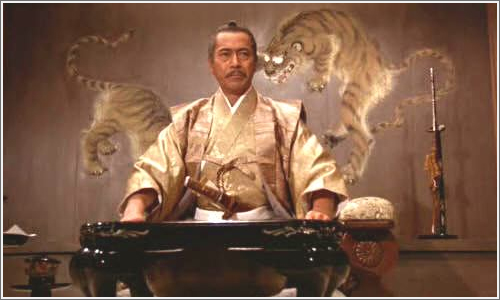
Toshiro Mifune portraying Lord Toranaga in "Shogun"
Toshiro Mifune portraying Lord Toranaga in “Shogun”

Yes, Japan had their John Wayne, Clint Eastwood and Kirk Douglas creating the samurai lore.  Not to bore you with the names of key Japanese actors portraying samurai, but Toshiro Mifune is their John Wayne.  You may have seen him playing Lord Toranaga in the 1980 TV mini-series “Shogun” opposite Richard Chamberlain.

Let’s give you a taste of the movie “lore” created in Japan.  This compilation is of “Zatoichi” (座頭一), a blind swordsman of all things.  He is portrayed by Katsu Shintaro, another famous actor.  Think of him as Sean Connery in a series of films; instead of James Bond, it is Zatoichi.

His character is a very entertaining combination of John Wayne, Clint Eastwood and Jackie Chan, all rolled into one fantasy character.  The lore.  No need to watch the entire thing, of course; its intent is to expose you to the samurai lore.

In these fictional fight sequences (What am I saying?  It’s a movie!), Zatoichi slays up to 40 bad guys with his one sword, i.e., eight guys with a six shooter.

Incorrect.  More like 20 bad guys with a six-shooter.

Yes, Zatoichi is smothered in Japan’s supply of Vaseline…and there is no guard (tsuba 鍔) on the sword to protect his pinky.

Anyways, I’m sure you have a flavor of the samurai lore by now.

Did any of you watch the entire clip?  Better than the Gunfight at the O.K. Corral (which really didn’t happen in the O.K. Corral, by the way)?

_______________________________

Let’s begin the first OMG Samurai Truth with a simple question based on Western culture:

When Colt made a six shooter, how did they test its accuracy?  After all, no cowboy would want to aim at a bad guy and have it miss by a couple of feet when it counted.  Only Bob Hope.

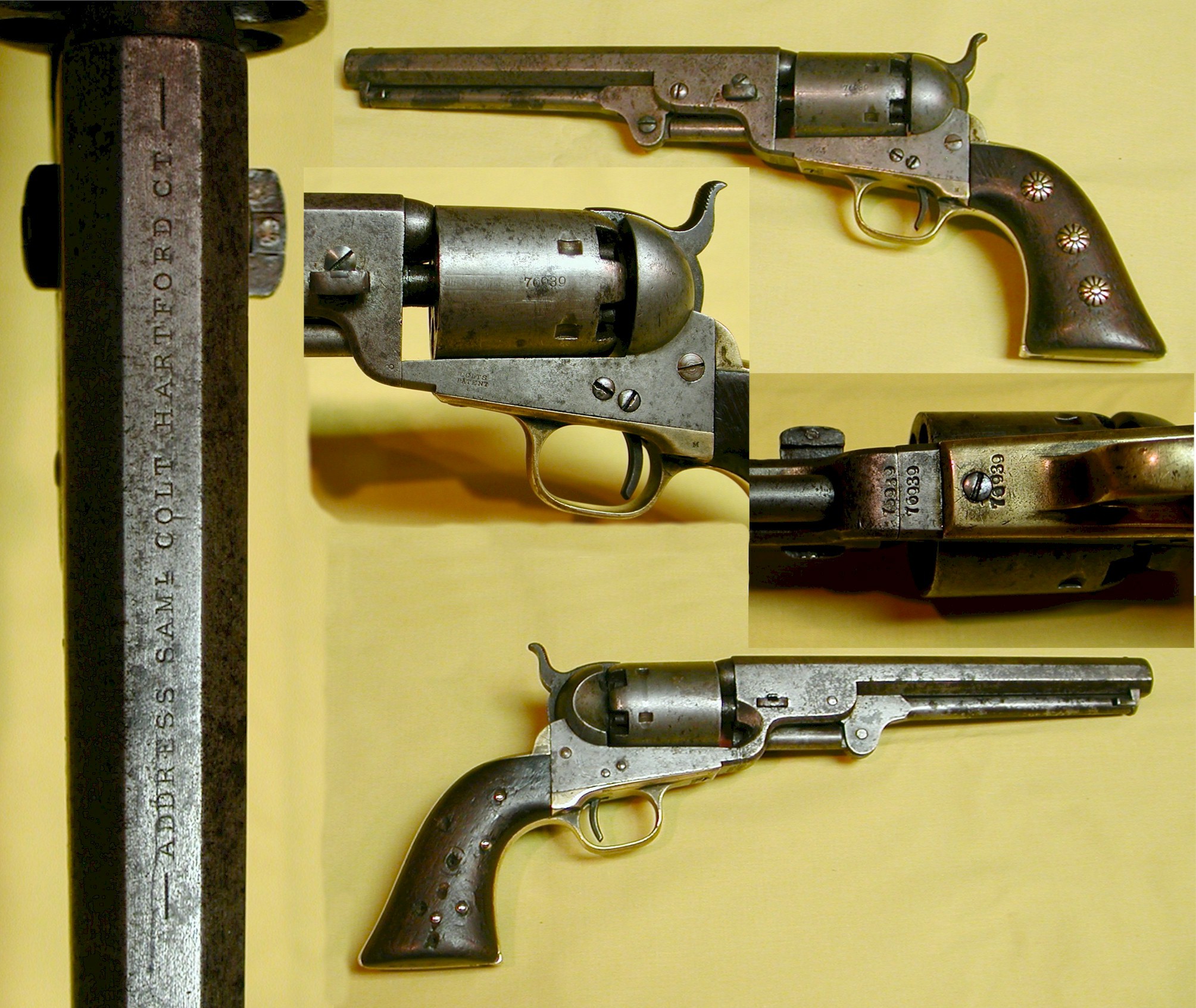
Colt pistol, 1851
Colt pistol, 1851

They test fired the pistol, of course.  Likely at a target with a bulls-eye.

And its resulting level of accuracy also made for higher selling prices.  They would be prized possessions.

Well, second question: how did the samurai know his samurai sword, or “katana” (刀) was sharp?

Jabbing a bulls-eye would be unthinkable.  Where’s the fun?

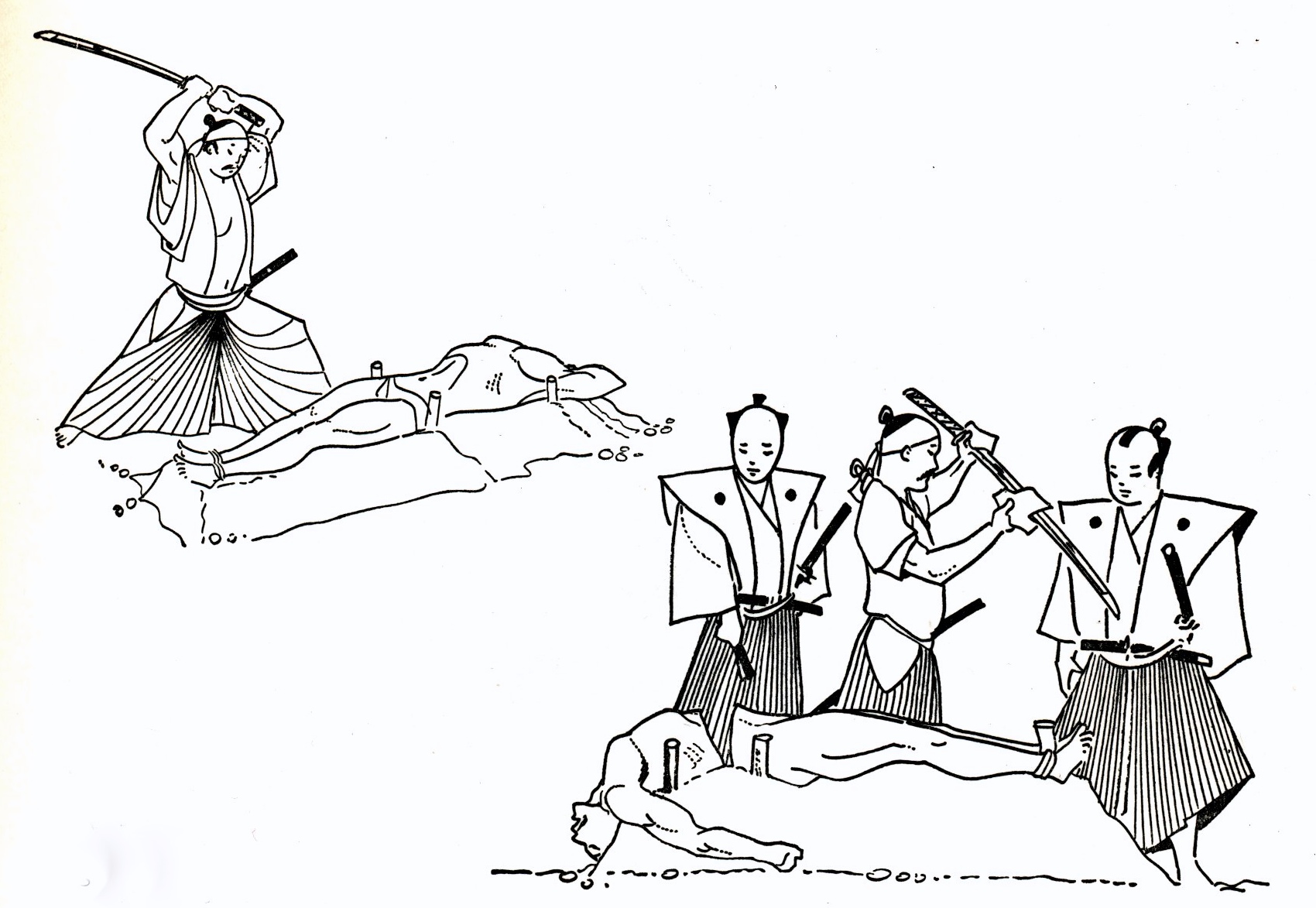
They would test the katana out on an executed criminal.

Testing out a new katana (From "Secrets of the Samurai", 1973)
Testing out a new katana (From “Secrets of the Samurai”, 1973)

Cut off a limb.  Perhaps an arm or a leg.

Well, that’s mostly true.

If a samurai was of high enough ranking (perhaps one of my samurai ancestors), he can pay……for a live one.

While the “lore” varies, there is one documented story – but who knows?  The story is a criminal was being taken to his execution when he spied a high ranking samurai with a vassal carrying his brand-spanking new katana.

The criminal asked, “Are you going to try out your new katana on me?” to which the samurai replied in the affirmative.  The samurai said he would try a slashing diagonal cut on him from the shoulder down.

The soon-to-be executed criminal then replied something to the effect of, “Well, I wish I would have known beforehand as I would have swallowed some stones to dull your blade.”

_____________________________

A grisly first “OMG Samurai Truth”, perhaps, but truth nonetheless. Not lore.

But one thing is for certain: the consequence of execution did not defray criminals from doing their dastardly deeds even in the 1600’s.  And they did indeed carry out the sentences.  No ACLU.

_____________________________

Stay tuned for more OMG Samurai Truths.  More to come.

Gyoza Anyone?


Gyoza anyone?  I guess we call them “dumplings” here in the US of A…

Simple to make.

Tastes great (or at least that’s what my kids say).

And it’s FREEEEE at Chez Mustang.Koji’s!  LOL

_______________________________

Completed gyoza
Completed gyoza

Ingredients:

  1. Ground pork (kurobuta type preferred!)
  2. Green onions
  3. Napa cabbage or regular cabbage is just as fine
  4. Sesame oil
  5. Crushed garlic (raw)
  6. Sugar
  7. Salt and pepper
  8. Shredded ginger if you like
  9. Chopped water chestnuts if you like
Do not press meat mixture.

Combine ingredients but do not press.  Spoon about a tablespoon of mixture into gyoza skin.  Fold.  Add a touch of oil to coat bottom of cast iron skillet (non-stick does not work!), medium high heat.  Cover, add about 2-3 tablespoons of water to steam.  Remove when botton is browned.

Serve with a dipping sauce made of soy sauce, “ra-yu” or chili oil, and Japanese vinegar if you like.

So simple, a mechanic can do it.

Oh…  Chopsticks are expected.

My “Top Ten” Reasons Why Japan Lost the Pacific War…so Quickly


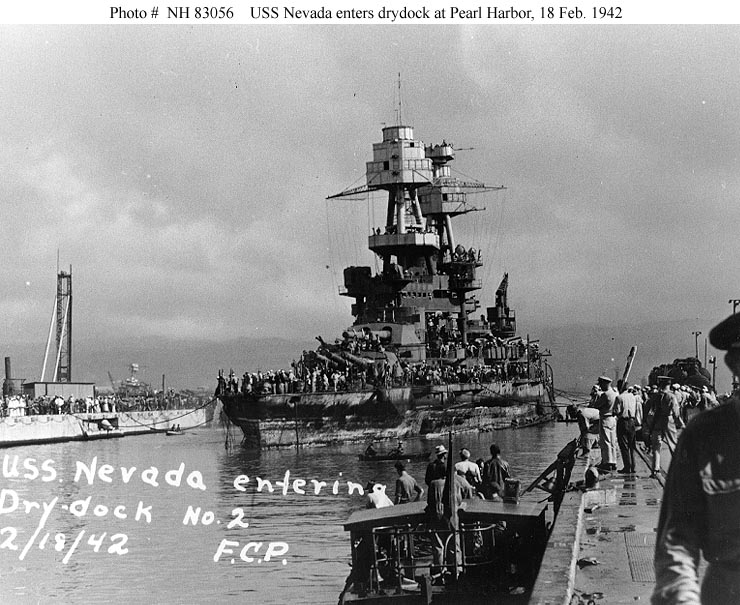
USS Nevada

OK.  Relatively speaking.  “Quickly”.

But we’ve been “at war” against terrorism – both foreign and now domestic – since 2001.  More than 11 years.

But the war against Japan started officially for us on December 7, 1941.  We were caught flat-footed.

Yet it was over by August 15, 1945.

Incredible.  In 3 years, 8 months, 8 days.  How could that have happened so quickly (relatively speaking)?  Have you ever thought of this timeline?

________________________

Well, I have removed my Kevlar flak vest for all you bloggers who love history – and who are immensely more versed and intelligent than I…or is it me?

Below herein is my “Top Ten” list of the reasons why Japan lost the Pacific War…so quickly.

I’d like to hear your opinions, corrections, or teachings.

Hunting season is open.  Rubber bullets are most suitable.

_______________________________

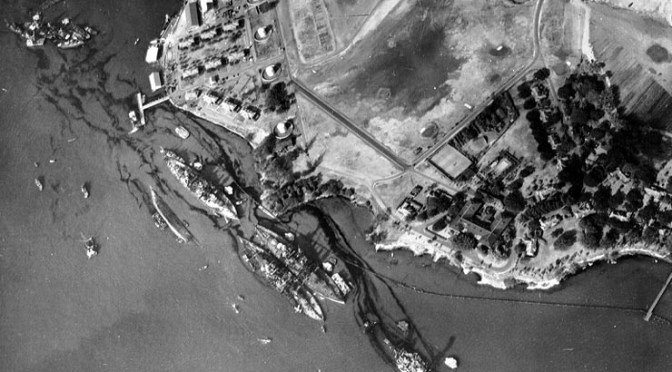
Damage from overhead – Pearl Harbor aftermath

1. Long Range Failure of Pearl Harbor Attack

a. Admiral Nagumo – placed in charge of the attack force by the Japanese Imperial Navy and NOT by Admiral Yamamoto –  failed to fully execute the direct orders issued to him by Yamamoto.

b. Attack plans skewed towards sinking of carriers (which were not there). Genda wanted to insure carriers were sent to bottom and therefore be unsalvageable. Because our carriers were not there, pilots overly concentrated on battleships or other less tactically important ships.

c. The ordnance used by the attacking Japanese was inappropriate for sinking battleships.  Besides, Pearl Harbor is way to shallow to allow for “sinking to the bottom of the ocean,” so to speak.

d. The first wave of Japanese torpedo bombers – although a complete tactical surprise – was a dismal failure with very few hits.

e. Failed to destroy dry docks and fuel dumps (Hawaii is an island country and had to import all fuel…like Japan).  Although there is the fog of battle, Nagumo (overly cautious) did not heed the strong advice from Fuchida who urged a third wave just for such purpose.

f. In light of “e” above, Yamamoto himself had one weakness: he did not see his submarine force has an OFFENSIVE weapon.  He failed to deploy them between Pearl Harbor and the West Coast of the US to target supply ships – which would have been carrying fuel, materiel and supplies to rebuild Pearl Harbor.

g. Nearly all ships damaged by the attack were refloated.

h. Insufficient training by Japanese Navy in preparation for attack.

i. Lastly – and for some foolish reason – they attacked on a Sunday morning.

2. Breaking of the Japanese Naval Code and the failure of the Japanese to accept it was broken.

3. 24-hour Repair of USS Yorktown after Coral Sea in Preparation for Battle of Midway.

USS Yorktown afire
USS Yorktown afire

4. Innovation of US Navy to Use CO2 for Fire Suppression.

a. US Navy would flood fuel tanks on ships with carbon dioxide thereby displacing oxygen before battle.

b. Japanese ships had useless fire suppression systems with fuel right alongside ordnance.

5. Innovation of Rubber-lined Fuel Tanks and Armor Protection for Pilots on US Aircraft

An example of the advantage of self-sealing fuel tanks and armoring.
An example of  survivability with self-sealing fuel tanks and armoring.  F6F Hellcat.

a. “Self-sealing tanks” in wings.

b. Impressive armor shielding for the pilot (especially in the Grumman F6F Hellcat).

c. Japanese planes had neither, leading to insurmountable casualties and easy shoot-downs, i.e., Japanese aircraft would “flame” or disintegrate under withering fire from .50 caliber guns.

Japanese planes did not have self-sealing fuel tanks

6. Battle of Midway

a. Huge tactical gamble by Nimitz in usage of Spruance as task force commander.

b. Tactical decision to launch torpedo planes early on by Spruance. While all but one pilot perished and no torpedoes hit, Mitsubishi Zeroes assigned to combat air patrol were at low altitudes since they shot down the torpedo planes.

c. Dauntless dive bombers (with US fighter cover) were able to dive relatively uncontested and caught Nagumo between launchings with ordnance scattered about.

d. Confusion by Japanese pilots that two US carriers were sunk. In actuality and while eventually sunk, the USS Yorktown had been hit in the first wave but the fires had been put out before the second wave attacked.

e. With the sinking of four Japanese carriers (see Fire Suppression above) and loss of valuable pilots, the Japanese Navy ceased to be an offensive force.

7. Production Might of the US

a. We had eight carriers at time of Pearl Harbor (in the Pacific and the Atlantic) but were down to two after the Battle of Midway.

b. We lost the Wasp, Hornet, Lexington and Yorktown by then.

c. The USS Enterprise was the last operational carrier. The “other” carrier, the USS Langley, was used only for training purposes and was out in the Atlantic.

d. By the time of the invasion of Okinawa in 1945, however, we had over 40 carriers as part of the assault fleet alone.

8. Semi-automatic M1 Garand rifle and the M-2 Flamethrower

a. Japanese military were burdened with reliable but bolt action Arisaka or failure-prone Nambu armaments.  (Bolt-action implies the shooter must lower his rifle to load the next round and then re-sight.)

b. The M-1 Garand took an eight-round clip.  The round had tremendous stopping power, was rugged and a rifle squad could lay down withering fire with the semi-automatic.  The shooter did not have to lower his rifle to load the next round and re-sight.

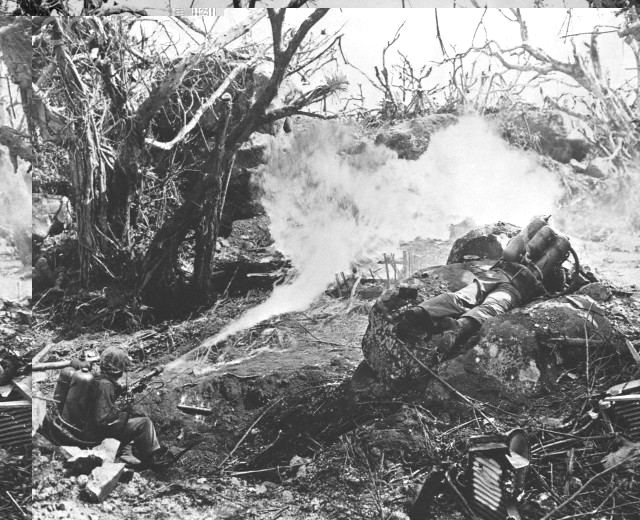
c. On Iwo Jima and other island battles, the Japanese were rarely seen. As such, the flamethrower was critical for success although accompanied by high mortality rates.

Marines carry the M1 Garand into battle at Tarawa Nov 1943
Marines Using Flame Thrower on Iwo Jima
US Marines using M-2 flamethrower against entrenched enemy on Iwo Jima

9. The Japanese-American (or “Nisei”) Soldiers in the Top Secret Military Intelligence Service (MIS)

Two of the Nisei secretly attached to Merrill's Marauders plan with General Stillwell.
Two of the Nisei secretly attached to Merrill’s Marauders plan with General Stillwell.

a. MIS secretly accompanied Marines and soldiers for every Pacific Theater amphibious assault or parachuted in with Airborne troops.

b. Nisei’s were the actual soldiers that listened in on Japanese Navy radio transmissions and NOT US Navy personnel. One transmission disclosed details on Admiral Yamamoto’s flight schedule which led to his shootdown.

c. Quickly translated captured major Japanese battle plans for Leyte Gulf (Z-Plan) and allowed for the lop-sided victory at the “Great Marianas Turkey Shoot”.

d. The invaluable intel provided by the MIS proved to the (generally unsupportive) top echelon that the Japanese military was near operational collapse in many combat areas.

10. The US Marine Corps

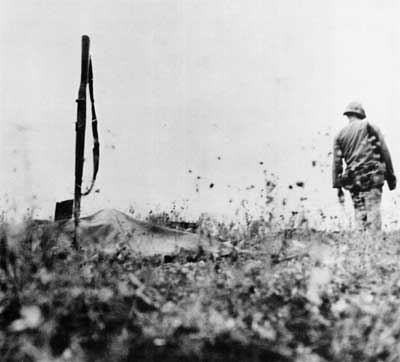
Marine catches up to comrades after covering fallen buddy with tarp and marking it with his M-1

____________________________

OK.  So what about the B-29’s or the atomic bombs/fire bombings?  Aren’t they some of the reasons Japan lost the Pacific War?

No.  Not in my humble opinion.

Tinian
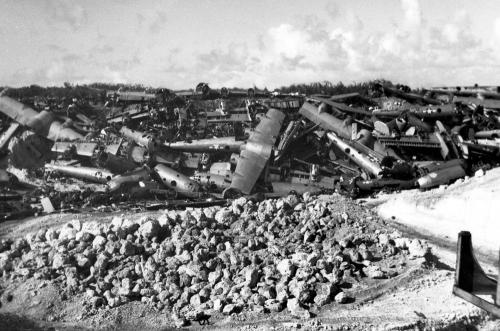
B-29 boneyard, Tinian

Historical facts will show that the B-29s were largely ineffective until the time LeMay unleashed the firebombing campaign on March 9, 1945.  The first B-29s were deployed out of India and China in the summer of 1944.  For the first missions, about 20% failed to reach their target due largely to mechanical trouble.  Of the approximately 80% that made it to target, only a couple of bombs actually hit target.  Therefore, ineffective results.

Their engines were also prone to overheating in flight.  Criminy.

As for the firebombings/atomic bombings, it is my opinion Japan had already lost the Pacific War due to the ten summarized reasons above.  Intelligence obtained by the US Army MIS Nisei’s like my dad’s predecessors support that conclusion.  When the Nisei interrogated Japanese prisoners at the front lines, it was clear they were nearly without food, water, medical supplies or ammunition.   Their morale was also devastated.  For instance, Japanese soldiers that surrendered would say, “We were terrified.  For every mortar round we would fire at the Marines, ten rounds would come back.”  The Japanese needed to make every round count; the Americans didn’t.

Japanese soldiers – dead, wounded or captured – would have uncensored letters from home on their person.  After the Nisei translated those letters on the battlefront, they disclosed that their families, too, were without much food or water…and that morale was extremely low.

____________________________

So some Greek dude said centuries ago that, “In war, truth is the first casualty.”

Pretty smart.  But that applies even today – and certainly during World War II.

We were raised with certain textbooks for our history classes.  We believed in them.  We had no reason not to.

But the truth is, there are many versions of history.  Factual versions.  Incorrect versions.  Factual versions “edited” by the victors.  Factual versions written by the losers.  And new versions.  And versions to further patriotism.

But there is one thing for sure…  Said by one of the most brilliant minds this world has known:

“I do not know with what weapons World War III will be fought, but World War IV will be fought with sticks and stones.”

ALBERT EINSTEIN

Mr. Johnson, USMC – Part III


I figured if Mr. Johnson wanted to tell me more, he would have.

But as with Old Man Jack, I never asked for more.

I believe that’s how these combat vets want it.

They don’t want to be quizzed about what they said or asked to describe more.

They will tell you some things of what they experienced.  Probably to let the devils out that have been eating away at them for 70 years.

They have a built in limiter to keep more memories from popping back up…the things they saw or did that they try so hard to suppress to stay sane.  Every minute for the rest of their lives.

They deserve that respect.  Always.  And you feel honored they felt enough confidence in your character that you would accept what they were telling you as is.

I feel they appreciated that.

___________________________

I was alone with Old Man Jack during visitation. It was good as I was able to say good-bye in private… The mortuary didn’t invest in good quality Kleenex, though.

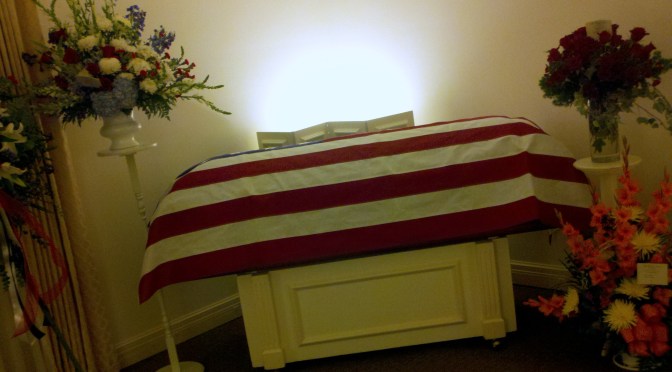
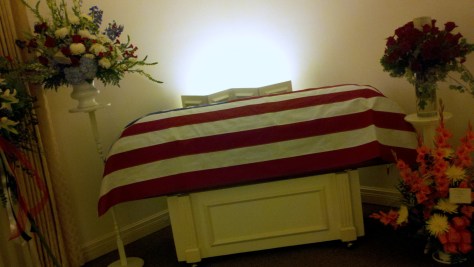
Mr. Johnson and I walked together into the little chapel where Old Man Jack’s funeral service was being held.  His flag-draped coffin was proudly presented up front.

It was mostly relatives as all his friends had passed away before him.  I felt distant as I don’t recall ever seeing them visiting with Old Man Jack.  But they were relatives.

Mr. Johnson and I were likely the only ones there outside of family besides a daughter of one of his fellow employees from the old Northrop plant.  We had met once when Old Man Jack was in ICU from a tremendously bad intestinal infection.

His only daughter Karen was busy going over things with the reverend.  You will have to excuse me if I used the wrong term for him; it was a Christian service and I am not.

Mr. Johnson and I sat next to each other in the back row.

__________________________

Here is Old Man Jack on our tiny patio deck, in his trademark blue plaid shirt losing another “chat” with his only child, Karen. I’m sure – in spite of his boasts – he lost to his lovely wife in a similar fashion through the years… Hence, “A man ain’t got a chance.

Karen finally approached us.  It was good to see her again.  I hadn’t seen her since she moved Old Man Jack up to their mountain home just five months earlier.

We greeted and it was already tough not to shed a tear.  She then said, “Koji, we have enough young relatives here to be pallbearers but I know you and dad were close.  I think he would like it very much if you would be one of his pallbearers.”

I looked at Mr. Johnson.  I guess I was unknowingly seeking his acceptance knowing they both fought a bitter war together.

Mr. Johnson smiled and nodded his head as if he knew I was asking him if it would be OK.

It was emotional.  My eye plumbing was already leaking a bit before but it broke loose.

After Old Man Jack fought on “those stinkin’ islands” and had nightmares for the remainder of his life, I was now going to help carry this great American on his last journey.

I kept the gloves in memory of Old Man Jack and the honor he allowed me.

It is a mark of the Greatest Generation.  Forgiveness.  Honor to the end.

_________________________

Just a short vid of the flag presentation to Jack’s daughter.  (I apologize for the video quality but they only sell the video cameras with the little swing out screen now.  It’s hard to get used to and hard to see the image in bright sun…and impossible to hold still…but towards the end, you can see Mr. Johnson sitting right behind her.)

I wondered what was going through Mr. Johnson’s mind after saying to me earlier “…funerals don’t do a damn thing for me anymore”.

He didn’t get teary-eyed once.  A true Marine, I thought.  I also briefly felt he had his mind on other pressing matters.

I was about to find out.

__________________________

After the ceremony, I helped Mr. Johnson back to my car.  He hadn’t said much at all nor showed ANY emotion.

I opened the car door for him; it would be a struggle for him to get back into my low-slung machine with his bad back and unsteady legs.

But he stopped short of getting in.  He towered over the roof of the car as he was standing on the curb next to other graves.  I remember clearly his right arm was on the roof of the car and his left was seeking support from the top of the passenger door glass.

Then he spoke.

“Koji, I’m sorry I was so curt with you in the car…when I said funerals don’t do a damn for me anymore.  I hope you’ll let me explain why.”

I didn’t know what was coming.  He continued but he had that look on his face.  The same glassed-over gaze Old Man Jack had when he was going to talk about something he was trying to forget.

“Koji, the Japs jumped us and they jumped us good.  Real good.  We were caught out in the open.  We had fighter cover but there was just a shit load of them.  Just too many.  They were coming down at us from every which way.”

He mimicked with his right hand that he had elevated towards the sky toy planes – just like we did when we were kids.  But these weren’t toys that day.  He was reliving a battle…but he didn’t say where or when.  Just like Old Man Jack.

“They just kept coming and coming.  We took a bad licking.  A real bad one.  We just kept reloading and firing at them.

We lost a lot of good men.”

He stopped for a moment.  He never once said he was on the Big E.

“I got put in charge of the Burial Detail.  There weren’t too many of us left that could get around.”  He was, I assume, talking about his fellow Marines.  He was a Private at that time and at the Battle of Santa Cruz; you will find out later how I discovered that.  But it’s not good when a young Marine private who was in boot camp just months earlier gets put in charge of a burial detail on board the greatest lady of the sea.

“I don’t know who the son-of-a-bitches were.  They were wrapped up in canvas and a shell would be put inside at their feet to weight them down.  Then we’d dump them over the side.  We’d salute.  Then we’d do it again…and again…and again.  I don’t remember how many times I saluted.  I didn’t keep count.  But that’s why funerals don’t do much for me anymore.  I had been in enough of them.”

__________________________

I was left humbled and voiceless.  Too late I realized Mr. Johnson WAS having sickening thoughts running through his mind – from the time when I asked him to help hold ME together.

And I was ignorant to even think he had his mind on other pressing matters during the funeral.

With that selfish request, I instead helped unleash some vile memories within him.

__________________________

Mr. Johnson himself would pass away shortly thereafter.

More to come in Part IV.  I hope you’ll stay tuned.

Mr. Johnson, USMC – Part I


“Koji, funerals don’t do a damn thing for me anymore.”

That was Mr. Johnson’s reply while I was driving us to Old Man Jack’s funeral.  I had asked him to help hold me together as I knew I would fall apart.

“Oh-oh,” I thought to myself when I heard that curt reply.  “I guess I hit a nerve…”

_____________________________

Old man Jack on the left, Mr. Johnson on the right. Taken June 30, 2005.

Mr. Johnson was Old Man Jack’s next door neighbor.

Since 1953.

Nearly SIXTY years.  Hell, I ain’t that old yet.  Well, I’m close.

They got along real well for those 60 years… except Jack was a WWII sailor… and Mr. Johnson was a WWII Marine.  They reminded each other of it often.

Lovingly, of course.

Old Man Jack happily reminisced that “…us white caps would also tussle with them Marines ‘cuz they thought they were better than us”.  But Jack would have gotten the short end of the stick if he took on Mr. Johnson.  He towered over Jack and me…

And Mr. Johnson was a decorated WWII Marine.

Decorated twice…that I know of.

_____________________________

Our cozy neighborhood called him “Johnnie”.  I always addressed him as Mr. Johnson…He used to say, “Damn it, Koji.  I wish you’d stop calling me that.”

I never did call him Johnnie. I just couldn’t.

But in the end, we found out his real name was Doreston.  Doreston Johnson.

Born August 1, 1923 in Basile, Louisiana.  A tiny town, he said, and everyone was dirt broke.

I wish I knew why he wanted to go by “Johnnie” but later, I discovered Doreston was his father’s name.

_____________________________

After Jack passed away, I visited with him.  He opened up a bit.

The Depression made it tough on everybody but then war…

When war broke out, he was gung ho like many young boys at that time.

It was expected.  You were branded a coward if you didn’t enlist or eluded the draft.  You were at the bottom of the heap if you got classified 4F.

He said went to the Army recruiting station.  They said they met their quota, couldn’t take him right away and to try again next week.

He then went to the Navy recruiter.  They also said pretty much the same thing but that there was an outfit “over there that’ll take ya”.

It was the United States Marine Corps.

Notice the 1903 Springfield in this 1942 recruiting poster.

The Marines “took him”…right then and there, he said.

Mr. Johnson said, “I was a dumb, stupid kid at that time”  – slowly shaking his head…but with a boyish little grin.

____________________________

It was 1941…  When the United States Navy had their backs against the beaches…  MacArthur blundered after Pearl Harbor and thousands of soldiers were taken prisoner in the Philippines.

The country’s military was poorly equipped and poorly trained.  With outdated equipment like the 1903 Springfield and the Brewster Buffalo.  And most gravely, the US Navy was outgunned.

Mr. Johnson was in for it.

To be continued.  Mr. Johnson, USMC – Part II here

Obsession, Time and Retouching


What an off-the-wall title.

But you have to be obsessed…when time is working against you.

_____________________

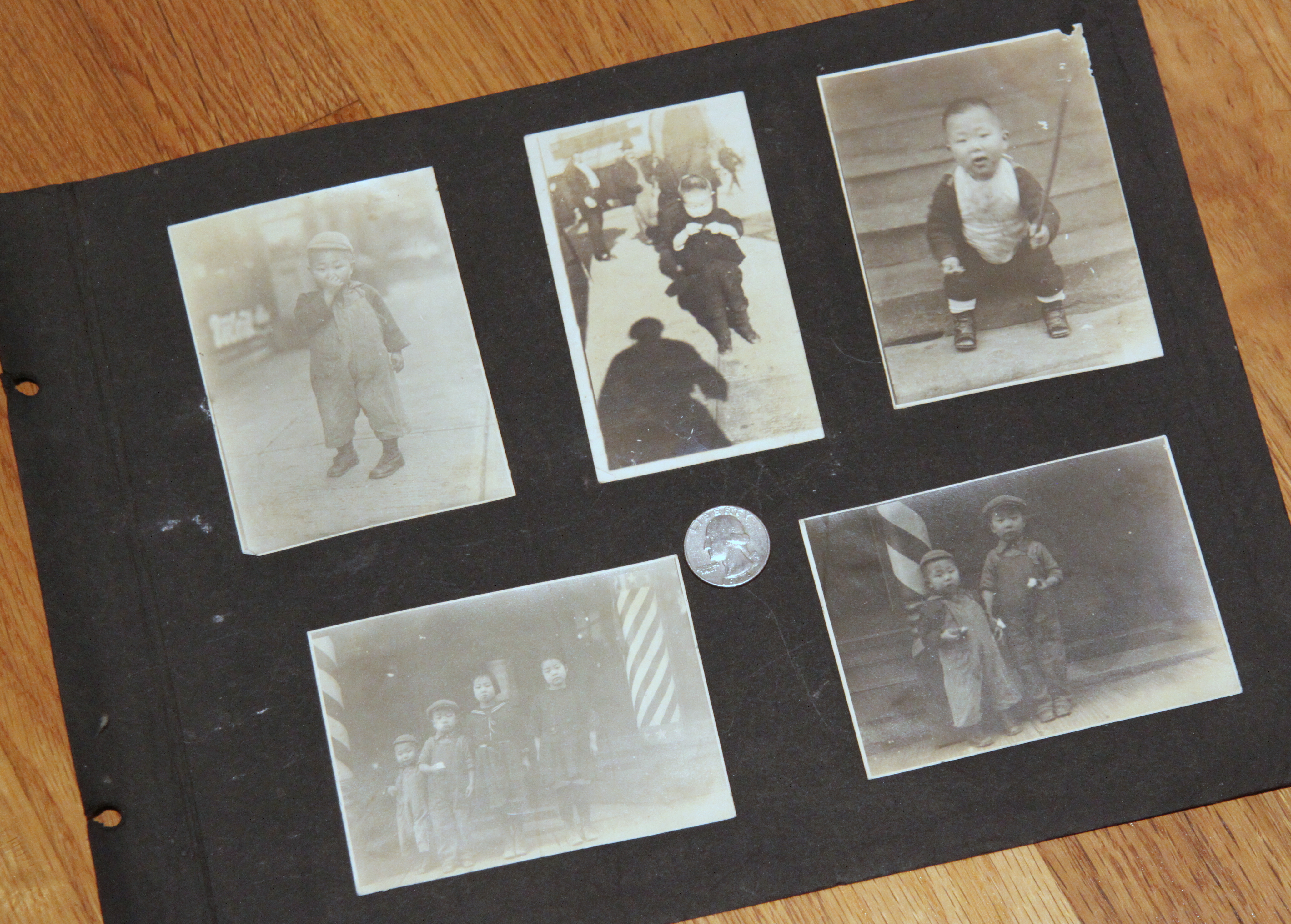
A single page from my Grandmother’s precious photo album

Retouching faded or damaged family photographs can become a labor of love.

Perhaps the finished product is meaningless to people outside of your family.  Maybe to some within your own family as well.  But somehow, you become obsessed with it because in spite what others feel, you know in your heart it is important… and perhaps more important as the years roll by.

Family members come into this world, live, then pass on.  How did they live?  Where?  What was it like “back then”?

That’s my mission.  To leave hints of what it was like for my descendants as well as interested family.

To let others see what “they” looked like.  How “they” smiled.  How “they” grew up.

________________________

The first snapshot above is but a page from my Grandmother Kono’s photo album.

Brittle pages.  Photos that were lovingly pasted onto those pages by my Grandmother.  Photos now eaten by insects.  Faded.  Damaged.

Now is the time.  Restore and retouch.  Hundreds of them.  That’s the mission.  Before all knowledge of their lives disappear.

They are disappearing today.

________________________

Having but free software, the retouching being done is surely amateur.  Basic at the best.  I wish I could afford professional software but then again, there would be a tremendous learning curve.  Make do with what you have…as “they” did.

And when you finish one photograph, you receive gifts.  Gifts of seeing what would have been lost.  Lost to their descendents forever.

Here is one example from that page:

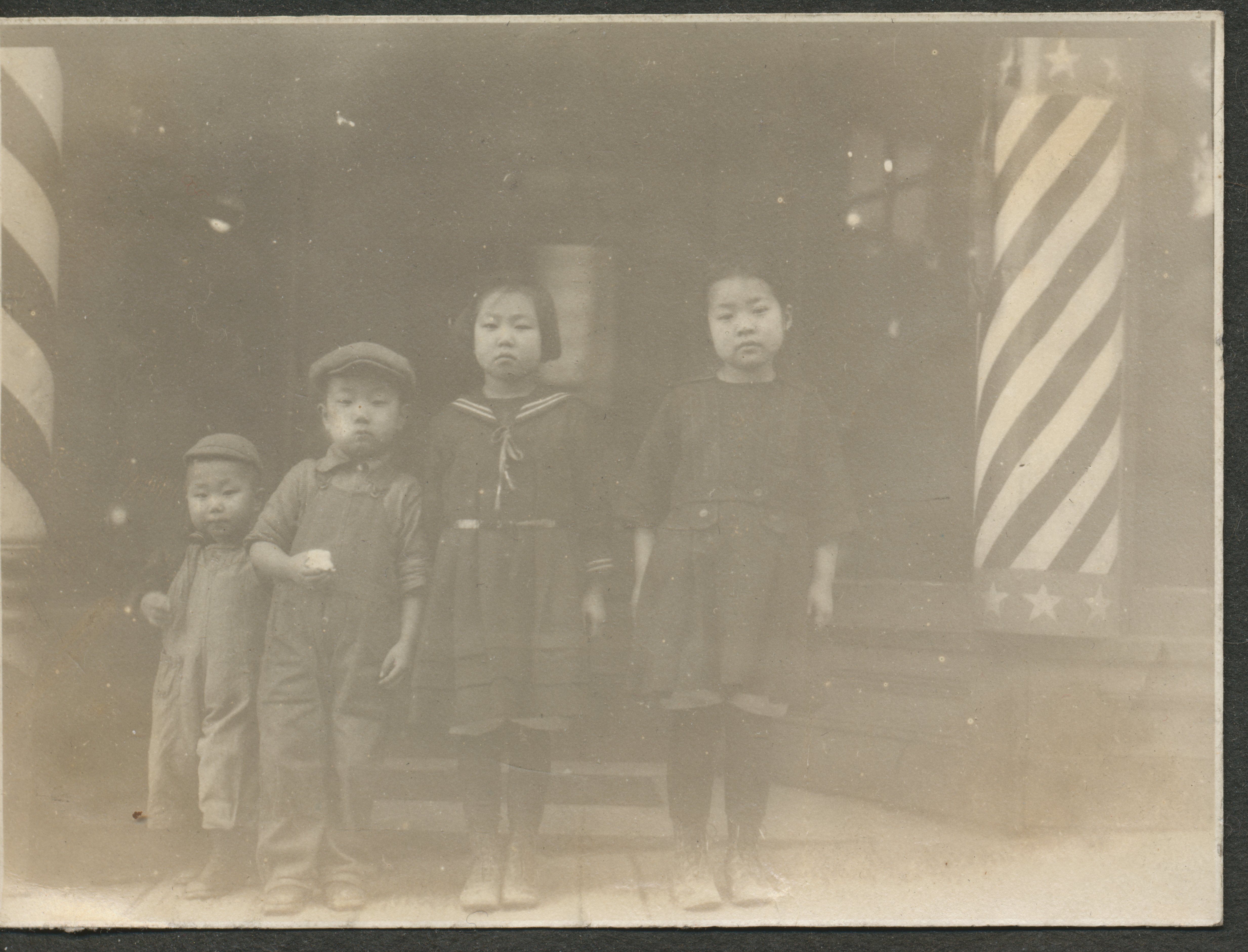
(L to R) Suetaro, my dad, Aunt Shiz and an unknown friend. Circa 1923 at 620 S. King Street in Seattle, WA.

While the detail is surely not “lost”, it is hard to make out things.  The print is small to begin with; a quarter was placed for size reference.

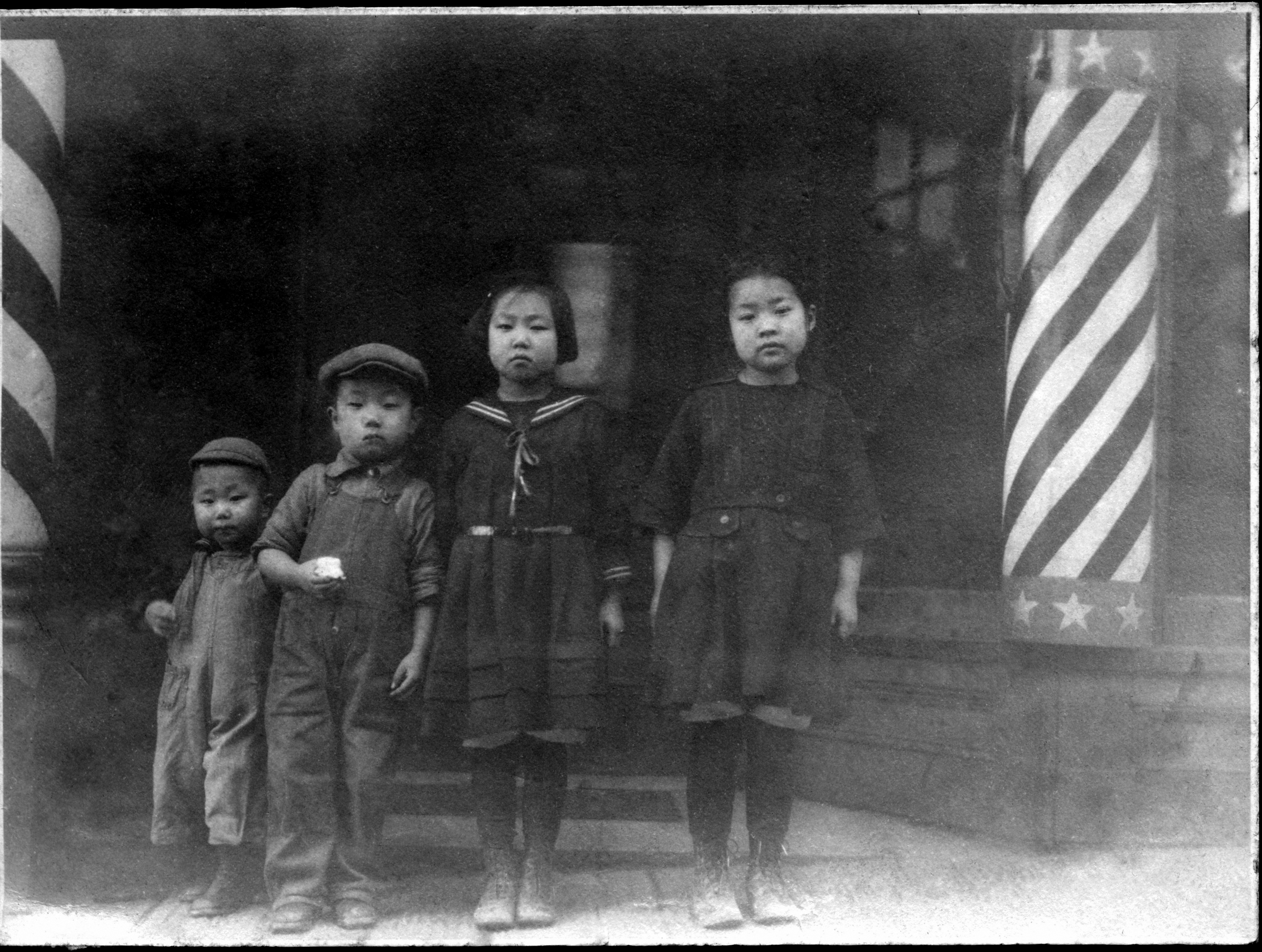
But after restoring and retouching, some fun things come into clearer view – especially if there is a companion print to compare with:

In another pose on the same album page, you can see both my dad and Suetaro were holding food in their hands and dad had a bandaged thumb.  Here, after restoration, you can more clearly see the food but it blends into his bandaged thumb which would have been hard to separate.  I’m pretty sure Dad is eating an “onigiri” or rice ball, likely wrapped in seaweed.  Uncle Suetaro had already devoured his.  Minor detail, yes.  But now we have an idea of what Grandmother fed them in Seattle while growing up.

Aunt Shiz…well, it appears she would rather have been playing with her friend but we know she wore a uniform to school.  And she has a hair clip.  Berets for boys were in fashion, also, it seems.  Funny as Dad doesn’t like to wear hats much.  We also know that on that day, they wore very Western clothes…down to his overalls.

One barber pole is also different than the other.  When dad saw this today, for some reason, he just proudly blurted out, “620 S. King Street”, and very happily.  I think he was amazed at himself for remembering.  But the confirmation of the address came from retouching the print.  He also said, “That’s wood (referring to the sidewalk),” implying he doesn’t remember a wooden sidewalk.  But I mentioned to him it was cement when you look at it carefully and he was happy that he wasn’t a “pumpkin head”.

From this retouched print, Dad also added one startling comment out of the blue.  He said a number of “hakujin”, or Caucasians, came to the shop, even though it was in “Japanese Town”.  I asked him why.  His reply was, “I don’t know…  but Japanese are more attentive, I guess, than the other barbers…especially in shaving.”  I know what he means.

________________________

So all this “stuff” came from retouching a faded photo… Things that would have been otherwise lost.  Face it.  Dad isn’t the little boy eating that onigiri anymore.  But he still eats like a horse.  A good sign.  Aunt Shiz didn’t feel like eating much the day she quietly passed away.

Obsession and time.

And time is running out.