Tag Archives: Navy

What Did FDR Know? – Part 2


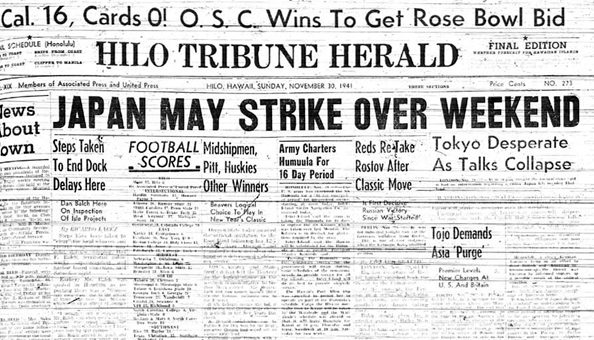
HTH Nov 30 1941
Hilo Tribune Herald, November 30, 1941.

The above: a front page published one week BEFORE Pearl Harbor.

OK… So the newspaper was published on Hilo.

Well, then, how about a second front page?  And from a different island this time – Oahu.

Pearl Harbor is on Oahu.

Honolulu Advertiser
Honolulu Advertiser, November 31, 1941.

______________________________

To continue with “What Did FDR Know?”, let’s go over some once secret stuff, shall we?

And stuff that wasn’t so secret – like the headlines above.  These NEWSPAPERS were in newsstands or tossed onto front lawns a WEEK before the attack on Pearl Harbor.  How can that be when our textbooks and history tell us our Navy and Army were caught with their pants down?

It may be fascinating and perhaps eye opening for some of you.  To some of you old hats in military history, not so eye opening.

This story will be centered on “MAGIC”, the cover name given to the secret diplomatic messages sent between Japanese diplomats and intercepted.(¹)

MAGIC intercepts will be the foundation for this story and subsequent ones.

The Japanese diplomats sent message after message believing their code was secure.

They were wrong.

______________________________

But first, some background on Pearl Harbor itself.  It’s important in your quest to conclude on “What Did FDR Know?”

JamesRichardson
Adm. Richardson

Before December 7, 1941 and as we read in Part I of this series, did you know the Pacific Fleet was based in San Diego?  The powers to be moved the fleet from San Diego to Pearl Harbor.  Even the decision to move the Pacific Fleet to Pearl Harbor was suspect at that time.  And have you thought about who was commanding the fleet  before the hapless Admiral Husband Kimmel  at Pearl Harbor?

Admiral J. O. Richardson was Commander in Chief, CINCPAC as of January 1940.  Per the “Final Secret of Pearl Harbor”, Richardson was the foremost expert on Japan and studied ad finitum Pacific naval warfare and mostly, of Japanese naval strategies.  He also knew well of Japan’s pattern of secret attacks.

Richardson disagreed with FDR’s opinion that basing the Pacific Fleet at Pearl Harbor was indispensable towards protecting American interests.  Richardson stoutly disagreed and said, “I came away with the impression that, despite his spoken word, the President was fully determined to put the United States into the war if Great Britain could hold out until he was reelected.”

He asserted that Pearl Harbor would be a “… g_d d_mned mousetrap”.  His belief was the fleet should remain on the West Coast in San Diego; out at Pearl Harbor, the fleet would be a strategic target for any Japanese surprise attack which he correctly foresaw.  His opinion was because not only did Pearl Harbor lack adequate fuel dumps and repair facilities, the Fleet lacked sufficient personnel and the waters around Pearl were unsuitable for training.  The fleet would need to return to San Diego and the like for such purposes.

Those who chose to ignore Richardson’s educated opinion did so by saying Pearl’s shallow harbor would preclude torpedo plane attacks amongst other things.

kimmel
Adm. Kimmel

Richardson asserted too strongly.  Although Richardson was highly qualified militarily, FDR removed him from command on January 19, 1941.  (Similar events are taking place notionally even today; about 200 top military commanders have been removed or forced out by the current Adminstration.)  FDR replaced Richardson with the more amenable Admiral Kimmel.  He was far down the list of able commanders but was still selected by FDR to run the Pacific Fleet.  While he somewhat shared Richardson’s belief, he was obedient as FDR expected.  Kimmel also wrongly assumed he would be “kept in the loop” by FDR insofar as military necessities, including intel.  Was he expendable career-wise?

…and that is how Kimmel ended up in command of the Pacific Fleet on December 7, 1941.

__________________________

Purplemsg
This is a copy of the actual PURPLE message and is the first part of the 14-part message which was delivered by the Japanese to the US Government on December 7, 1941 – late.

 BACKGROUND ON JAPANESE CODES

The Japanese military, just like the US military, had “secret codes” as did diplomats.  For the purposes of this blog, we will concentrate on two groups of code: the Imperial Japanese Navy’s code (JN-25) and of the Japanese Foreign Office (code named “Purple”).

Talking about Communications Intelligence, or “COMINT”, would take a number of blogs; indeed, entire books and papers are written about COMINT during this time.  For purposes of this blog, allow me to say COMINT is the acronym covering the analysis and usage of an enemy’s radio communications.  Codes are when words are replaced by groups of letters or digits and are usually manual.  A cipher, however, is the replacement of individual letters or groups of letters according to a plan; it is much more complex and are based on machines.

During this time, US COMINT was somewhat loosely organized, largely due to the rivalry between the US Navy and Army.

However, the cover name “MAGIC” was given to the intelligence obtained by both services involving the Japanese Foreign Ministry radio messages.  While at the embassy level, great amounts of military information – and espionage – was disclosed in these secret messages and were therefore at the disposal of the US Government and military.

Imperial Japanese Navy JN-25

The US Navy began its covert intelligence gathering in the early ’20s when they actually broke into the Japanese Consulate in NYC and copied the secret Japanese code in use at that time.  By 1926, the US Navy had broken the Japanese navy’s “Flag Officer’s Code”.  The Imperial Japanese Navy at that time conducted fleet maneuvers about every three years; they would send coded messages throughout the maneuvers.  The US Navy, by virtue of having broken the Flag Officer’s Code, easily listened in on them.

Their “listening in” on the Japanese fleet was so extensive that the US Navy knew of the capabilities of the Japanese warships.  The US Navy knew the speeds, armaments, designs, etc., of the Japanese warships, so much so that the US Navy made improvements to their own warships to counter them.

During this period, the US Navy established a small group within the Office of Naval Communications called “OP-20-G”.  It was formed without extensive knowledge of the US Army as infighting was common.  The same was true for the Japanese military.  Think of the Army-Navy rivalry in football – just grow it tremendously.

While the Japanese navy changed their code along the way, the OP-20-G had little difficulty breaking those, too… until late in 1940.  Knowing they were headed to war with the US, the Japanese navy prudently introduced an entirely new code, the JN-25.  It was much, much more complex than its predecessor.  It proved difficult to crack but they had made progress when… the Japanese navy once again made amendments to JN-25 immediately before the attack on Pearl Harbor.

The US Navy, therefore, was pretty much “blind” intel-wise for pretty much a week before Pearl Harbor.  It would not be broken until March 13, 1942.

But there was another group of cryptanalysts… an ace in the hole.

__________________________________

“Purple”
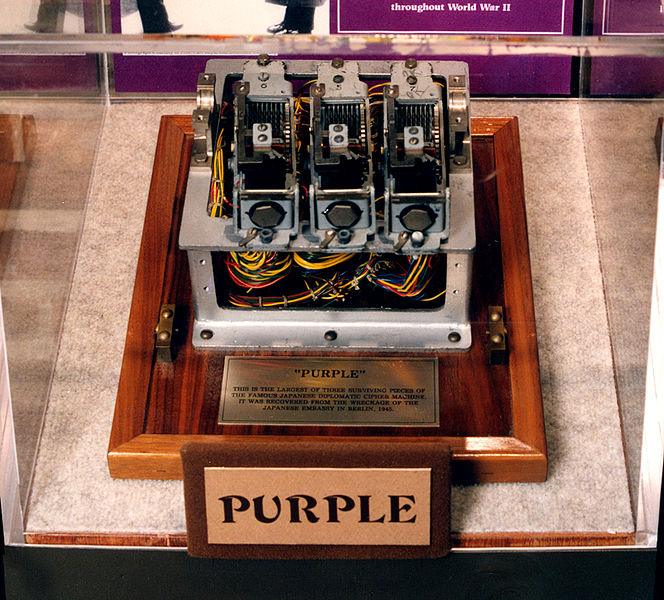
japanese purple fragment
As the Purple machines were destroyed by the Japanese, this is the only surviving section of an actual Purple machine. National Archives

Alongside OP-20-G, the US Army’s cryptanalysis group called “Signal Intelligence Service”, or SIS, focused their energies on the Japanese diplomatic code.  The group was headed up by William F. Friedman; he was very successful in designing our own encrypted codes.

Japanese diplomats (NOT military commanders) communicated with each other using an existing code designed in 1932; the US cryptanalysts called this code “Red”.(²)  In 1937, the diplomats began using a newer, more complex code; the US referred to this code as “Purple”.  In total, there were fourteen codes used by the Japanese diplomats; two of these were of the most value, Purple and “J-19”.  Purple was used at the embassy level; J-19 was used at the consular level.  Both were machine crypts.

purple analog
The Purple machine, built from readily available parts. It supposedly cost $684.65. Eight were made.  National Archives.

In September 1939, the “unbreakable” Purple code, in the defective thinking of the Japanese, was broken; a key contributor to Friedman breaking Purple was that the Japanese had sent the same message using BOTH Red and Purple codes, a huge blunder in the cryptanalysis arena.  In eighteen months, the SIS, headed up by Friedman, cracked the code(³).  They even BUILT an analog machine from a blank chalkboard which quickly deciphered the “secret” messages.  (The code was so complex that the machine contained 25 connections, which could be arranged 6 pairs of connections, yielding over 70,000,000,000,000 possible arrangements which would determine the method of encryption.)  This was an AMAZING feat to have built a deciphering machine since SIS had not even seen the Japanese one.  Remember, this was 1938.  Nevertheless, these intense eighteen months landed Friedman in the hospital for four months from exhaustion and emotional strain.

With Purple broken, the US was able to immediately decipher all highly secret messages between all top level members of the Japanese diplomats located worldwide… and most importantly, without them knowing.  Given the originators of the messages, they had nearly indisputable validity.  The reach of MAGIC extended to the European Theater of war as well as briefly mentioned in Part I.

These diplomatic communications also clearly indicated espionage was taking place on the west coast of the United States.

Part 3 and 4 will show the contents of MAGIC intercepts so that you can answer on your own, “What did FDR know?”

I hope you will stay tuned.

Part 3 is here.

NOTES:

(¹) Unbelievably, Secretary of State Stimson was definitely upset when he learned we were intercepting messages.  He championed the statement, “Gentlemen, do not read each others mail.”  At the same time, consider the Snowden/NSA “scandals” of today.

(²) Ironically, Hitler had loved Baron Oshima so much he allowed Oshima to purchase a commercial version of Nazi Germany’s famous Enigma machine.  The machine used for Red was based on this Enigma construct.

(³) While Friedman was the man burdened with the responsibility of deciphering PURPLE, it is acknowledged that a man named Frank B. Rowlett was the man who actually broke the code.
What Did FDR Know? – Part 1


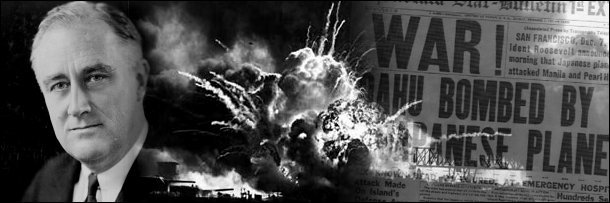
fdr ph

Good day, everyone.

The more frequent readers of this blog, “Masako and Spam Musubi”, likely see that my main focus is on World War II and my family’s involvement on both sides of the Pacific.  Although I definitely am not a historian by any means, stories here are based on family records supplemented by tidbits of historical “facts”.

And some of these historical facts are public knowledge…while some are kept or suppressed from public knowledge.

Some were destroyed.

The White House also has perhaps the most insurmountable power over what is written – or how events are presented to or withheld from the public.  At times, this leads to the distrust of the very government the people have elected into power.  This distrust continues today and arguably, the worst its been in our country’s history.

This is a knotty topic without a doubt…about FDR’s involvement – or even orchestration – in what happened during these critical years.  But these factual conflicts have perplexed me for years.  Conflicts between what we were taught versus what wasn’t.

I wish to express some facts here and in the next couple of stories about the Pacific war and allow you to come to your own conclusions about FDR.  They will center around Pearl Harbor and the interment of my dad’s family in “war relocation centers”.  Please note that entire books and research papers have been written on this general topic so my blog will do as best possible to reveal the facts involving FDR – before Pearl Harbor, immediately after and up to his death late in the war.

So…  What did FDR know?

Let’s get into it, shall we?

____________________________

fdr paper

BACKGROUND

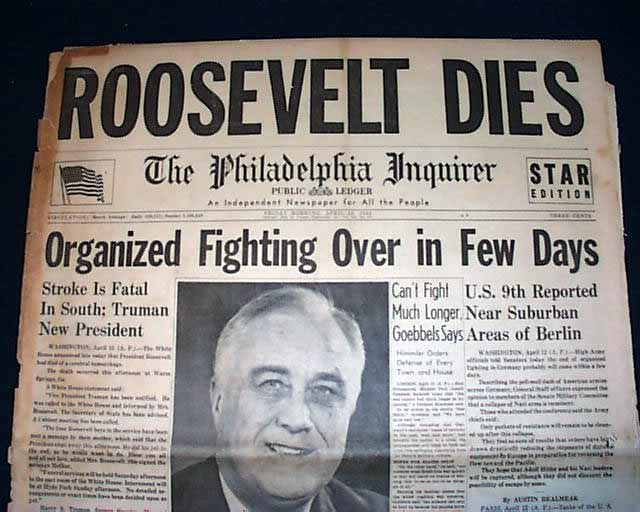
FDR was our only president to be elected to four terms in office.  He passed away while serving his fourth term on April 12, 1945, just weeks before the surrender of Nazi Germany.  The nation was distracted from the war for that moment.  They mourned his passing.  Indeed, there was great stress being President of the United States in time of World War. Some general background before I get into it:

  • He was a politician.
  • FDR was liked by a significant majority of Americans as proven by his being elected to a fourth term.
  • He made a statement to America during his 1940 re-election campaign, “I have said this before, but I shall say it again and again and again: Your boys are not going to be sent into any foreign war.” (1)
  • A pre-war Gallup poll disclosed 88% of those Americans polled opposed US involvement in the European war.  Britain was fighting for her life.  FDR supported isolationism publicly.
  • Perhaps the best kept secret prior to Pearl Harbor and up to immediately after World War II ended was that an elite cryptology group (members of the US Army Signal Intelligence Service, or SIS) had broken the Japanese diplomatic code in early 1939.  Any intelligence that was gathered was kept secret and under the cover name of “MAGIC”.  (One huge single diplomatic source of detailed enemy information was Baron Hiroshi Oshima, Japan’s ambassador to Nazi Germany.  Nearly all of Oshima’s messages from Berlin to Tokyo were intercepted and deciphered.) (2)
  • Beginning in 1940 and then continuing, FDR and the League of Nations placed an economic embargo on Japan in reaction to their attacks in Asia.  Items were added weekly to the embargo list – except for oil.
Kent
Tyler Kent
  • In 1940, Tyler Kent, a 29 year old code clerk at the U.S. embassy in London, discovered secret dispatches between Roosevelt and Churchill.  These revealed that FDR — despite contrary campaign promises — was determined to engage America in the war. Kent smuggled some of the documents out of the embassy, hoping to alert the American public — but was caught.  With U.S. government approval, he was tried in a secret British court and confined to a British prison until the war’s end.  FDR approved to carefully associate the term “German spy” to his name in a further coverup. (3)
  • FDR authorized British and American military staff members to meet during January through March 1941; the purpose was to plan ahead military strategy in the event the U.S. entered war against Germany. They determined that Germany was to be first defeated, while the U.S. would stand on the defensive toward Japan in the Pacific.
  • The Lend-Lease Bill was passed in March 1941, a major shift in FDR’s foreign policy.
  • At the Nov. 25, 1941 White House conference, just weeks before Pearl Harbor, Secretary Stimson reported that FDR had said “The President said the Japanese were notorious for making an attack without warning and stated that we might be attacked, say next Monday, for example.”  FDR knew historically that on three different occasions since 1894, Japan had made surprise attacks coinciding with breaks in diplomatic relations.  (4)
  • On November 29th, Secretary of State Cordell Hull secretly met with newspaper reporter Joseph Leib.  Hull knew him and felt he was a news man he could trust. The Secretary of State handed him secret MAGIC copies concerning Pearl Harbor.  Hull told him the Japanese were planning to strike Pearl Harbor and that FDR planned to let it happen.  Due to the incredibility, only one newspaper published the story.
wwii portraits
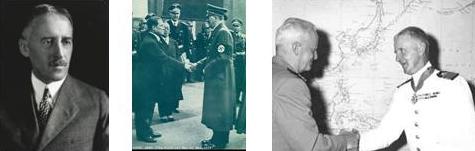
(L to R) Stimson, Oshima greeting Hitler, and Ranneft (in white) shaking hands with Chester Nimitz, 1946.
  • On December 2, 1941, days before Pearl Harbor, Captain Johann Ranneft, a Dutch naval attaché in Washington, visited the Office of Naval Intelligence (ONI).  Two junior ONI officers pointed to a wall map and said, “This is the Japanese Task Force proceeding East.”  (He was referring to Admiral Nagumo’s carrier strike force heading towards Pearl Harbor.)  The officer had pointed to a spot midway between Japan and Hawaii.  On December 6th, Ranneft returned and asked where the Japanese carriers were.  He was shown a position on the map about 300-400 miles northwest of Pearl Harbor personally by Admiral Wilkinson, ONI chief. (5)
  • The key battles and events during World War II post-Pearl Harbor from the American perspective were (NOTE: I had to center the bullet points below as WordPress does not allow you to use tab stops):

♦ The Battle of Coral Sea

♦ The Battle of Midway

♦  The Solomon Islands Campaign

♦  Battles for Pelileu, Iwo Jima and Okinawa

♦ The shootdown of Admiral Yamamoto.
(Flights to and from the shootdown point occurred before and
continued afterwards, solely to conceal the fact we broke their code.)

_______________________________

The above tries to give you an at altitude look down on what was happening prior to the attack on Pearl Harbor.  In the ensuing stories, I hope to present “things to think about”…  Things like secret codes, espionage, internment and even D-Day in a roundabout way.  Things that FDR knew then orchestrated actions as a politician should.

I hope you will stay tuned… then come to your own conclusions as to what FDR knew.

To be continued… Part 2 is here.

NOTES:

(1) However, the following comment was not part of his speech: Of course, we’ll fight if we’re attacked. If someone attacks us, then it isn’t a foreign war. – Yale University

(2) There were several codes being used by the Japanese Army and Navy in addition to the diplomatic code mentioned above.  All were broken by US cryptologists.  The Japanese also had their cryptologists but were nowhere’s near as successful in breaking US or British codes.

(3) It is important to note that CHAMBERLAIN was the Prime Minister of England, not Churchill.  Yet, FDR and Churchill were secretly making promises unbeknownst to Chamberlain.

(4) Source: Henry Lewis Stimson diaries.

(5) “Military Intelligence Blunders and Cover-Ups: New Revised Edition”

The Pain of Survival and Aunt Michie – Part 7


“When it comes to giving, some people stop at nothing.”

– Vernon McLellan

That was Aunt Michie.  She gave all of herself and of her life strength to others because her heart knew no other way.

_________________________

At the moment Aunt Michie watched the ugly mushroom cloud rise from her field that day, her older siblings – my dad, Aunt Shiz and Uncle Yutaka – were all imprisoned in the “war relocation centers” scattered about the United States.  These were truly prisons and the popular view is that FDR imprisoned them “for their protection” because they looked like the enemy.(¹)

Life within these “camps” was “sub-standard”.  They were forced to live in small, shoddily built wooden barracks covered only with tar paper with little or no privacy.  No running water inside their barracks – they had to go wait in line outside, whether it be rain, snow, dust storm or searing desert sun to use public latrines or showers. Food was served in mess halls on pot metal plates at specific times, just like in the military.  The food was miserable according to Dad and worse yet, they had to wait in line again.  For the first month or so of imprisonment, he said all they had was liver, powdered eggs and potatoes.

But then again, he said it was food.

Aunt Michie and her family were near starving in Hiroshima while dad was imprisoned in the good ol’ US of A.

_________________________

IMG_5864
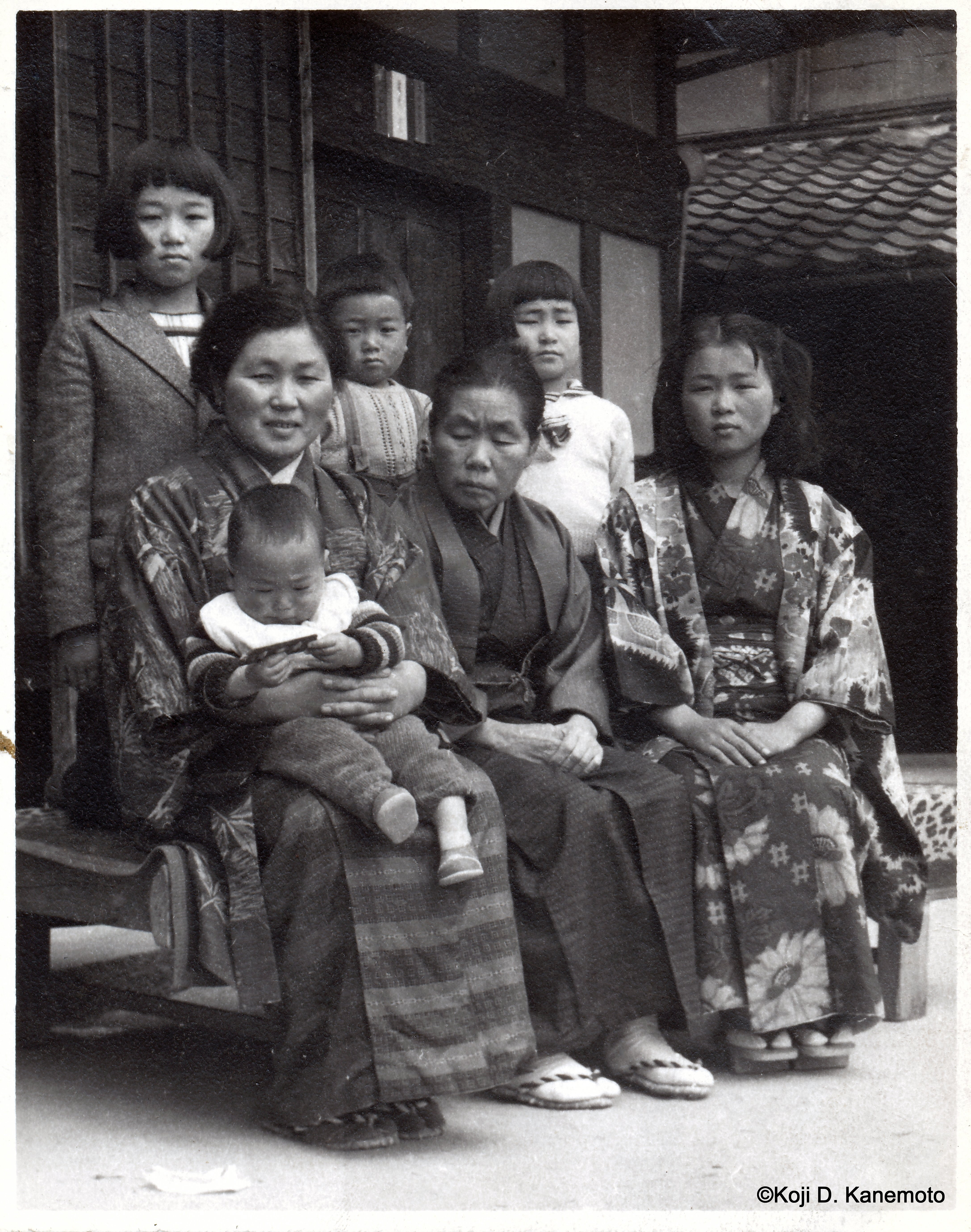
Taken at the Kanemoto home in Hiroshima, 1951 and soon after my parents wed. (L to R) Sadako, Namie, Aunt Michie holding a young Kiyoshi, Grandma Kono, Masako, mom and dad. Courtesy of Kiyoshi Aramaki.

It is assumed like for the rest of America, Dad and his older siblings heard the news of the atomic bombing but while in the camps on or about August 8th… that one enormous bomb had wiped out Hiroshima.  There must have high anxiety and anger as many of the inmates in Dad’s camp (Minidoka) were from Seattle; they had family in Hiroshima as their parents had immigrated from there.

My cousins tell me that sometime after war’s end, Michie’s “American” siblings – my dad, Uncle Yutaka and Aunt Shiz – managed to re-establish contact with Grandmother Kono and Michie.  With the Japanese infrastructure destroyed, it was a miracle.  And it was no easy task as letters to and from Japan were not only prohibited, it was impossible.  There was no telephone in the villages where Grandmother and Michie lived.

But her American siblings somehow managed to send much needed clothing to them.  When my father finally reached Hiroshima while a sergeant in the US 8th Army, he carried two duffle bags full of C-rations, candy and Spam.  They said it was a feast for them after years of hunger.

051912_0639_4.jpg
Dad in front of his Hiroshima home – April 1948

Sadako (who savored the white rice Michie made them on the day of the bomb) told me at a farewell dinner two years ago that she fondly remembered my dad taking them to a market of some kind where he bought her a little coin purse.  She remembered Dad gave her the money to buy the little purse and was told she could keep the change.  She remembers then handing the change – which was a LOT of money back then – to Michie who humbly accepted it.  Sadako said she cherished that little coin purse for years.

______________________________

EPILOGUE

From exhaustive laboring on her farm… to taking precious sashimi to her brother Suetaro… to walking ten miles with children in tow to care for Grandmother Kono after her stroke… to the pain of learning of her brother being killed in action… to being thrown onto the ground and watching a huge mushroom cloud rise over a small hill… to pulling a wooden cart over a hill…  to tirelessly aiding the victims… and most of all, sacrificing her own health for the sake of others…

She never gave up in those thirty years.  Would you have? I don’t believe I would have had the fortitude.

But because her soul would not quit, she got everyone to tomorrow… but in doing so, her own tomorrows dwindled.

Michie is still here.  The fruit of her sacrifices can be seen today in her six children, all of whom have lived – and are still living – full, joyous lives.
Soubetsukai Picture
Four of Michie’s children with my son and I. The four at the left front were at Aunt Michie’s farmhouse after the atomic bomb; Hitoshi was there as a burn victim. Hiroshima – September 8, 2012
Entaijisou Meal
At breakfast – Endaijisou Hot Springs, November 2013.  Tomiko was at home when the atomic bomb went off; the house was destroyed.

They have their mother, Michie, to thank and they cherish that… and that they were all there at the farmhouse when she looked at each one of them intently one last time before leaving this world.

A most grand mother.

And yes…

They all love food to this very day.

________________________________

I wish to deeply thank my Hiroshima cousins for sharing their memories of their life with Michie with us.

Like all Hiroshima citizens I have met, they simply pray for peace.

NOTES:

(¹) There are declassified US intelligence documents which show that a small number of Japanese and Japanese-Americans were performing espionage.  Intelligence was able to determine this by intercepting and decoding secret Japanese communications. This information was given a cover name of MAGIC and these documents were typed up for FDR and a very small number of trusted officials.  However, rounding up the spies would clearly indicate to the Japanese that their code had been cracked.  These documents present another view contra to the widespread belief that FDR imprisoned the Japanese and Japanese-Americans from discrimination and war time hysteria.  In other words, FDR used that hysteria as a cover story; by doing so, he was able to remove the “spies” from the West Coast without alerting the Japanese.  FDR also stated in communications that there would be “repercussions” from such action.

The Pain of Survival and Aunt Michie – Part 6


Ebisu-woman
A mother holding her child in Ebisu, a part of Tokyo, and in front of her corrugated tin hut. 1946. National Archives.

Indeed, the difficult struggle for food in enough quantities and quality continued.  Black markets for food flourished, particularly in larger cities.

Housing in the cities, however, was extremely tough.  As an example, after many cities were bombed out, millions flocked to Kyoto.  MacArthur and other Allied military leaders omitted Kyoto as a target for its ancient cultural richness.  Many Japanese had heard of that by war’s end and trekked to Kyoto in hopes of finding a roof over their heads.  Unfortunately, all living spaces were occupied.  No rooms were available, even at a huge premium.

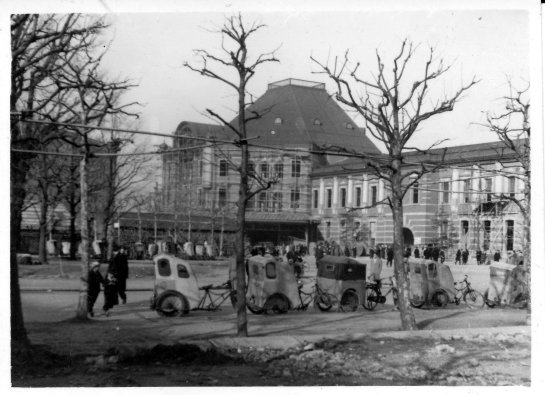
Even in 1948 – three years after war’s end – Tokyo still had tremendous scars as can be seen in one of my father’s photographs below:

image0-11
The trees bear the scars of the firebombing. Tokyo Station is in the background being rebuilt with the aid of the US military. Notice the “jinrikisha” lined up in front; they were the equivalent of taxis today and were pulled or pedaled by Japanese men to make a living. Cars will not be available for about ten more years.  Taken by my father in March 1948 while serving in the US 8th Army under General Eichelberger.

______________________________

Soon after the bomb was dropped, the hostilities finally ended.  However, food and essential goods continued to be largely absent.  Amazingly, my cousins who went through that hell choose to reflect on these post-war years positively.  That is, reflecting on it as a miserable time will but cause a wound to fester.  They had seen enough of festering wounds.

But let us step back a year in Aunt Michie’s life.

image0-059
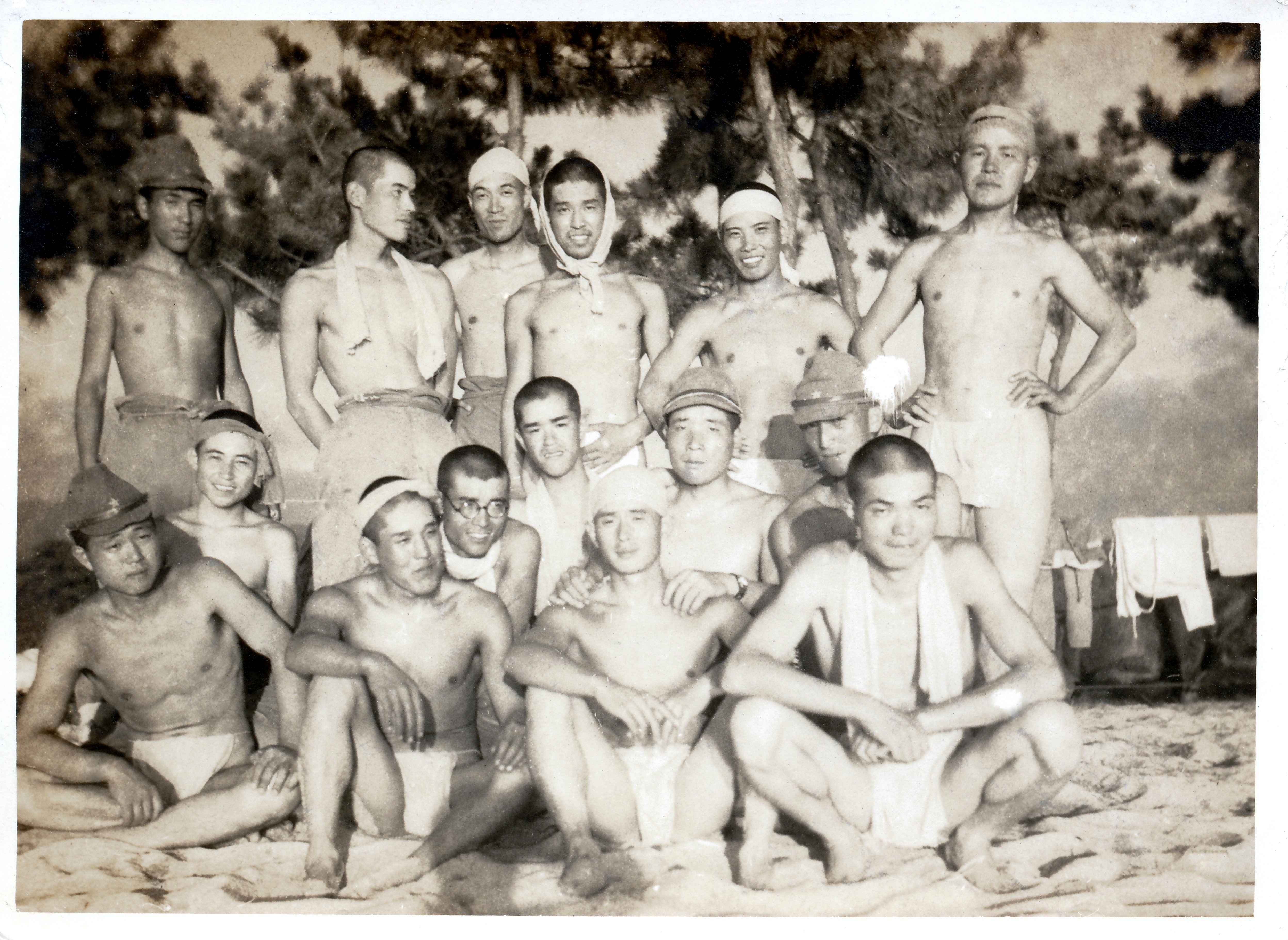
Uncle Suetaro is pictured at the bottom left with his Army buddies. You can see how lean they are due to insufficient nutrition.  August 11. 1943.

One month before the surrender, Grandmother Kono was informed by the remnants of the Japanese military that her son Suetaro was killed on Leyte fighting as an Imperial Japanese soldier.  The date of death was recorded as July 15, 1945.  The Emperor capitulated just one month later.  Of course, we have no record of that communication nor when Grandmother Kono was actually told, but the bomb was dropped just around this time, we believe.

A little more than a year earlier, around March 3, 1944, Suetaro walked to Tomo and Masako’s school.  He wrote a farewell note on a chalkboard at Masako’s elementary school to say good bye as he was off to war.  Masako remembers he had written to be a good girl and that he was sorry he couldn’t say good bye in person.  The family took their last family picture with Suetaro (Part 2); he was flanked by his older sister Michie and Mikizo.

We believe the next day, Aunt Michie went to the train depot to say good bye to Suetaro.  She was very fond of him and “his American citizenship”.  Everyone loved the fun Suetaro and she apparently talked of him often after his death.  But at that farewell, deep down, she knew it would be the last time she would see him.  I wonder how she felt watching the train disappear.

image0-073 retouched
This photo was in Grandmother Kono’s photo album. Flag waving school girls stand on the right.  After talking about it with Kiyoshi, we believe this was the send-off Aunt Michie went to – to see her brother Suetaro go off to war and certain death. Kiyoshi indicates that a professional photographer took these types of photos at the train station and that the pictures would be offered for sale.  1943.

Soldiers rarely came back.  Per tradition, he had left Grandma Kono some of his nail clippings and some of his hair.  That is what is in the family crypt.

For hundreds of thousands, entire bodies would never be found.  This was true for America, England, Australia, Russia or Germany.

But at least part of him remains there in Hiroshima.

The cousins tell me Aunt Michie grieved for days after his departure… and that she was torn apart when she learned of his death.

The bomb would fall just days later.

______________________________

According to the family, even shortly after the bedlam caused by the bomb, Aunt Michie continued to care for her stricken mother by walking to her house five miles away when she could.  My dad said the road was “pretty” level but that since it is Japan, there were hills along the way, especially near Ishiuchi, a small village.

Taken by my father in April 1948 in front of the Hiroshima family home. Holding the baby Kiyoshi, who was born in the home, is Aunt Michie then clockwise – Sadako (who savored the white rice), Masataka, Namie (who pulled maggots out with chopsticks), Masako (who was thrown across her classroom by the shockwave, and Grandmother Kono (who did shaves at her Seattle barbershop).

In December 1947, Aunt Michie started to have contractions while walking over such a hill.  She was able to make it to Grandmother Kono’s house where she gave birth to Kiyoshi, right then and there.  No, no doctor…no nurse… and Grandmother Kono could not help due to her stroke.  It is said she was very happy that the birth took place at her childhood home.  She grew up there along with her American siblings.  She had felt safe.

___________________________

My cousins believe their mother, Aunt Michie, gave all of herself for her children and her family.  In spite of malnourishment, she toiled in her farm’s fields, cared for Grandmother Kono, gave her all in the bomb’s aftermath, set the example for her children.  She put everyone before her.

But soon after giving birth to Kiyoshi, she developed kidney problems.

They tell me that medical care then was still pretty non-existent so she had no choice but to ride it out.  However, she pushed herself back into working the farm too soon to care for her children, her own stricken mother and other household duties.  That was Aunt Michie.

IMG_6220
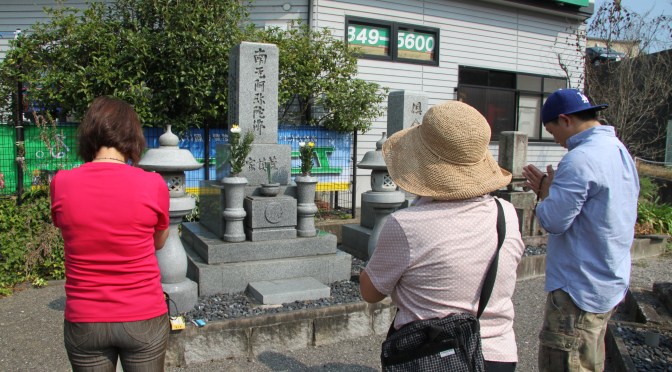
An “石じぞう”, or a stone buddha, along a pathway in Hiroshima. ©Koji Kanemoto 2013

Cousin Kiyoshi remembers massaging his mother’s swollen legs after a day’s work.  He also fondly remembers perspiring trying to keep up with Aunt Michie on a hot, humid summer day as they walked up a hill overgrown with thick, green wild grass.  There was a “石じぞう”, or a stone figure representing Buddha, alongside a ridge overlooking a blue Hiroshima Bay.  Kiyoshi will always remember that moment, looking at his mother with perspiration running down her face and the blueness of the bay.

In retrospect, they feel that if Michie had taken some time to rest and more often that she may have regained her health.

On May 29, 1963, she was laying in the same farmhouse in which she nursed the 23 injured people that fateful day.  Her kidneys were giving out.  She opened her eyes one last time and looked lovingly at each of her children who were gathered about her then closed them.  Thirty years after her father gave away her hand in marriage at 19, after 30 years of a life heaped with physical and emotional demands one after another, world changing events and family tragedies…  After enduring the pain of survival, Aunt Michie left this world.  She was but 48.

IMG_3387
In September 2012, I visited Aunt Michie for the first time. Masako is flanked by her daughter Izumi and my son Takeshi. Similar to the hot summer morning when she was knocked down by the shockwave, it was hot and humid that day. Now, I feel it was appropriate.

IMG_3378

Aunt Michie conquered all and gave her life to others so they could get to tomorrow… and she did that with dignity and unconditional love for her children.

____________________________

An epilogue will follow for Part 7….

The Pain of Survival and Aunt Michie – Part 5


japansurrender88
A rare photograph taken after listening to the Emperor’s surrender speech, August 15, 1945. There was a coup attempt the night before the speech was broadcast.

Although the violence of World War II was nearing an end, other aspects of the war could continue against Japanese civilians for years to come.

Their infrastructure was gone.  Essential assets such as manufacturing plants, machinery, trains, roads, housing, utilities, even fishing boats had been destroyed.

And most of all, food.

And Aunt Michie’s dignity – the entire family’s dignity – will continue to be tested until the late 1940’s.

____________________________

boy genmai mainichi
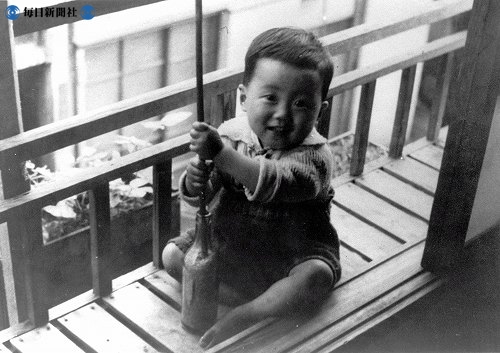
Dated April 1943. A boy poses holding a stick in a bottle filled with unpolished brown rice. This is not the polished brown rice you eat today at Panda Express. It was more wild. Japanese would insert a stick into a bottle partially filled with brown rice then repeatedly jab at the rice until the husk came off. It was low grade rice with the germ still on. (From the Mainichi Shimbun archives.)

For eons, Japan has been unable to produce enough rice for their people let alone food.  In fact, it was not until about the time Japan hosted the 1964 Olympics that Japan could produce enough rice for themselves.

The war took a terrible toll on regular folks from getting their “rice fix” – they were just not able to eat it.  This deprived them savoring it, the mental and biological satisfaction of just eating it.  Think of it this way – what if not just bread itself was kept from you but also the sweet smell of the freshly baked bread with the perfect crust..with melting butter?  Talk about attacks on your psyche: deprivation.  Deprivation for years.  Prolonged sensual deprivation makes for huge changes in one’s outlook on life.

Like the photo of the little boy, millions of civilians would acquire a wild form of brown rice (玄米 genmai) and de-husk them as shown.  Along with barley, it served as a substitute for the flavorful white rice with the higher calories.

_____________________________

Confronted by not only the absence of medical supplies, Aunt Michie’s house was now filled with 23 men, women and children with varying degrees of burns.  I doubt emergency rooms could handle such a sudden load of burn victims… but Michie’s family did.  On top of that, her house was damaged by the atomic bomb’s shockwave.  It pains me to even see in my mind what they had to do to make the house habitable enough so quickly to nurse the injured.

It was mayhem and Michie personally did not ask for this horrific situation… but now, on top of trying to provide medical care for 23 people, she was confronted with one ominous problem: how to feed them all.  There was no food left in the city of Hiroshima and it was just over the hill.  And any food left in the village of Tomo was fresh.  It would spoil quickly anyways in the heat as there was no refrigeration.  No supermarket.  No canned goods either.

She did as Aunt Michie only could.  She used her precious reserve of rice and only served it to the ailing victims.  I am sure she believed that would be the only way to truly help them survive as all of them were malnourished.  As a result of rationing the remaining rice to the victims, her own children who weren’t physically injured were delegated to survive on cooked pumpkins, stems, stalks or taro roots for the duration.

A huge, gut wrenching decision for Aunt Michie, I’m sure.

image0-012
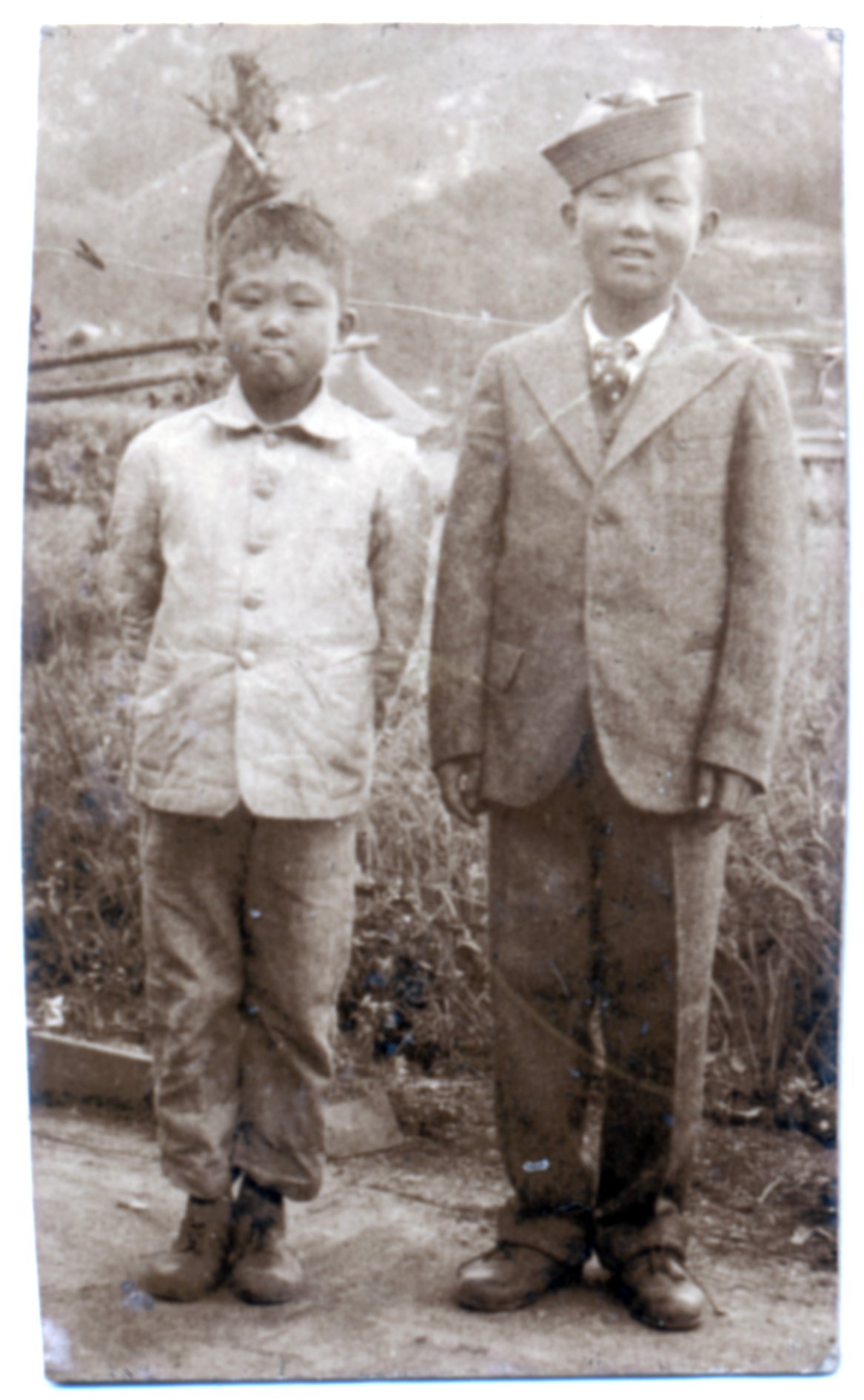
Some of the wild grass or other vegetation boiled for emergency eating can be seen behind my father and Uncle Suetaro. Hiroshima, circa 1929. Copyright Koji Kanemoto

To help this dire situation, the Hiroshima aunt who was not badly injured went about the area with Mikizo’s parents scavenging for wild grass and other vegetation to boil.  That, too, became part of their food.  Although likely not very nutritious to say the least, there was no other alternative.  And it is important to note such wild vegetation they boiled or ate had been subjected to the black rain…

What do you have in your yard?

Perhaps you can somewhat understand why my cousin Masako thought Spam was the most delicious thing she ever ate.

____________________________

In spite of all Aunt Michie could do, my cousins tell me some of the burn victims’ injuries wouldn’t heal.  They had worsened.  Their wounds began to fester or decay for lack of a better description.  Pus formed.  There was nothing they could do.

The odor of the decaying flesh permeated out of the house.  They say you could smell it from the dirt road immediately outside.

It became so intense that people would hold their noses to scurry past the house.

None of my cousins who were there tell me they will ever forget that vulgar smell of rotting flesh… or death.  Never.

Just like Old Man Jack.

___________________________

IMG_5861
From Aunt Michie clockwise: Aunt Michie (holding Kiyoshi), Namie, Mikizo’s father, Masataka, Sadako, Masako, Mikizo and Mikizo’s mother. Taken in 1948 at their farmhouse where they cared for 23 victims. Courtesy of Kiyoshi Aramaki.

My cousins tell me some didn’t make it.

Others would pass away in the next couple of years from the effects of their injuries or radiation.

Nevertheless, the struggle for food and other essentials would continue…but my Aunt Michie’s immediate family survived.  Even Tomiko who was in Hiroshima proper.

And Aunt Michie’s dignity and strength reigned supreme.

They all made it to tomorrow.

__________________________

The surrender documents were signed by Emperor Hirohito’s representatives aboard the USS Missouri on September 2, 1945.

Unbelievably, Mikizo also survived the war.  Although taken prisoner upon Japan’s surrender as a soldier in the Imperial Japanese Army, he was released from Manchuria and allowed to return to his Hiroshima farm in late 1946.

To be continued in Part 6….

The Pain of Survival and Aunt Michie – Part 3


Japanese-home-defense-training_1945
Japanese women being given “home defense training”. My grandmother on my mother’s side underwent such training on a Tokyo schoolground. 1945.

The Japanese home front had essentially collapsed by 1945.  Instead of focusing on food, supplies, building air raid shelters and organizing orderly evacuations of civilians, Japanese military leadership focused on misleading news reports and propaganda.  Millions fled the cities into safer rural areas(¹) on their own initiative but once there, supplies of daily sustenance was meager.

_______________________

In one’s own life, you are tested.  A good human being will at times prove oneself to be a good brother or sister, son or daughter, friend or life partner.  Some fail.  Some pass.

Aunt Michie was one who passed; her heart led her to care for others before herself.  It is as if she knew being good to others was the way to have a good life.

As an example, US air and naval forces ruled the skies and the seas.  A key staple of the Japanese diet – fish – had been nearly cut off  as fishing boats were attacked once out to sea.  Yet, when Aunt Michie came across sashimi, she traveled hours with Masako in tow to take a precious portion to her brother Suetaro at his army base in Fukuoka:

“…(Masako) remembers a couple of trips (to see Suetaro). It was not easy travel in war-torn Japan.  For one trip, Aunt Michie managed to take sashimi – in this time of little food, it was a tremendous treat and gift. On that trip, Masako remembers her mother stealthily sliding over to Uncle Suetaro the wrapped sashimi. He was being stared at by many of his fellow soldiers – they were not well fed either.  She remembers Uncle slowly turning so that the others could not see and quickly devoured the treat.”

(From Masako and Spam Musubi)

Aunt Michie could have eaten the precious sashimi herself…but didn’t.

___________________________

With her husband taken by the Imperial Japanese Army then dispatched to war in Manchuria, she was burdened with running the farm… still laboring to produce crops only to be taken by the military.  She would get up before sunrise, help prepare meals, tend to the family then toil in the fields.  And when her mother became partially paralyzed and alone in her own home five miles away, Aunt Michie knew she had to take care of her, too.  Michie was the last of her children left in Japan.

My Grandmother Kono – having suffered a stroke – is propped up from behind by Japanese “shiki-futon” for the picture. She would not see her son alive again. Taken in Hiroshima, May 3,1944.

While Michie and Grandmother Kono managed to get part-time care, Aunt Michie still took it upon herself to check in on her stricken mother.  My cousins tell me their mother Aunt Michie would take them along for the ten mile round trip to her Kanemoto family home.

No car.  No bus.  No taxi.  No trains or bicycles.  They had to walk.  After all, it was 1944 and fuel was a huge luxury.  One memory the youngest happily recollect is that they would take turns riding in some kind of baby stroller that Michie would push to Grandmother Kono’s.  Neverthless, it was still a great deal of effort and sacrifice on Michie’s part in any case… and she did this after working in the fields, too.

Masako will eventually end up caring for Grandmother Kono.

___________________________

IMG_5869
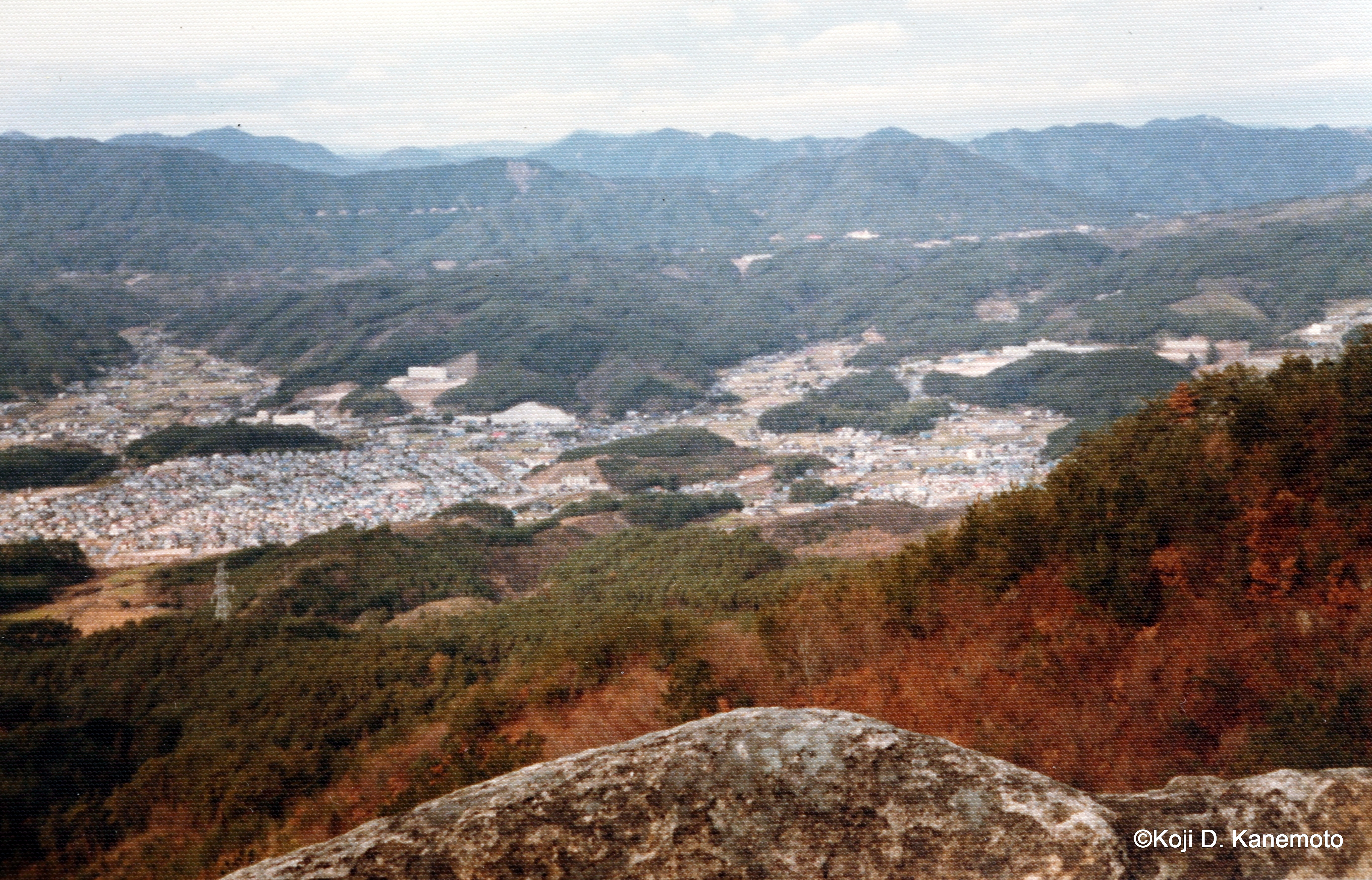
Family photo taken of the town of Tomo about 35 years ago atop the 300 meter tall hill separating it from Hiroshima. Hiroshima is directly behind. This short hill served to partially deflect the atomic bomb’s shockwave. Courtesy of Kiyoshi Aramaki.
IMG_5870
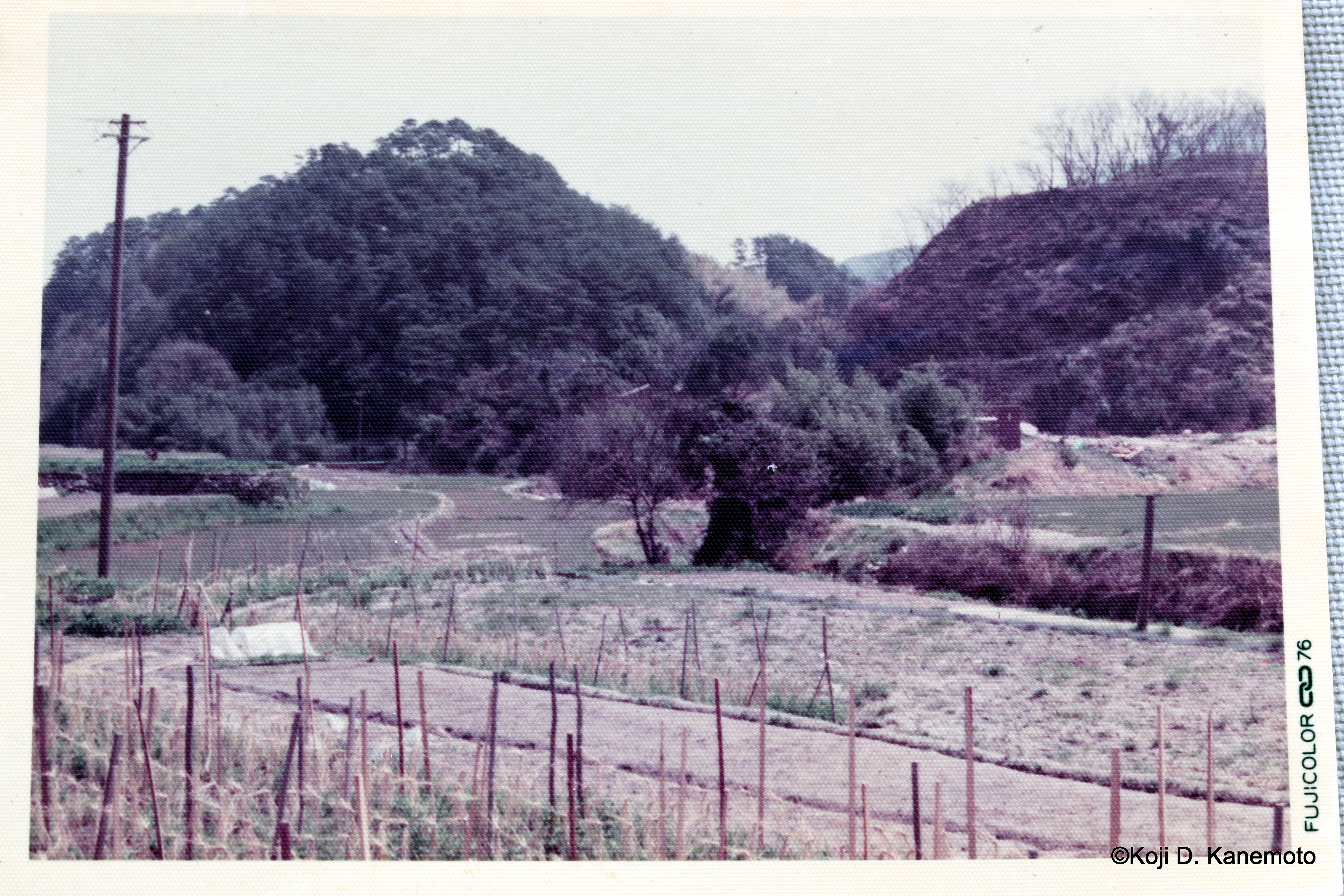
Per Kiyoshi, this was taken from the house and shows some of the field Michie had to cultivate. She was here when the shockwave hit. While the one on the right is no longer there, the family burial plot was between the two small mounds you see here. Courtesy of Kiyoshi Aramaki and dated 1976.

After picking herself off the ground, Aunt Michie saw an evil yet mystifying mushroom cloud slowly rising up beyond the 300 meter tall hill separating her village from Hiroshima proper.  At that instant, she knew her life had taken a wrenching turn for the worse… as if it could get any worse.

I cannot imagine what was going through her mind and heart watching that mushroom cloud rising.  She could not have even dreamed that it was one massive bomb, a couple of kilometers away, that could cause this sort of force and devastation.  It must have defied belief.

Hiroshima_10
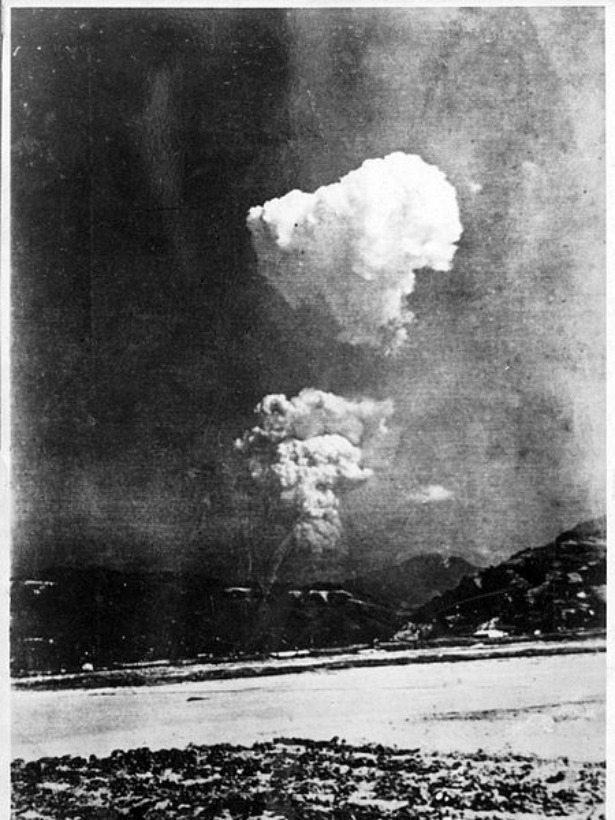
A relatively unseen image of the explosion, taken from a Kataitaichi, six miles east of Hiroshima. Michie was nearly due west and on the other side of the cloud. The cloud would reach 40,000 feet in just four minutes. It would ultimately rise to 60,000 feet. (Horikawa Elementary School)

According to Michie and my cousins, the shockwave blew out all the sliding doors, all the tatami mats were flung and the ceiling was shoved up in the house.  Try to imagine yourself being inside the house.  The same thing happened to Grandmother Kono’s house five miles south (See map in Part 1).

As per their daily air raid drill, they apparently all ran to the air raid shelter in the small hill behind their house.  After about half an hour and with the mushroom cloud still rising, a black, syrupy rain began to fall on them.  According to the cousins, Michie believed that the Americans were dropping oil from space.

She could not have fathomed it was contaminated with over 200 kinds of radioactive isotopes.  We now call it black rain.

IMG_6116
I took this photo of a preserved wall section stained with actual black rain from that fateful day. Hiroshima Peace Museum, November 2013.

Sadako, who was ten years old, clearly remembers their white blouses had turned black from the rain.  No one – absolutely no one – knew that other than staining skin, clothing, and buildings, but that ingesting black rain by breathing and by consumption of contaminated food or water, would lead to radiation poisoning.  Even flowers would bloom in distorted shapes and forms from the radiation.

_______________________________

With the enormity and the suddenness of the brilliant flash of light followed by a shockwave and the swirling mushroom cloud, Michie deep inside knew her world had forever changed.

Horror was to literally come into hand shortly to enforce that foreboding thought.

_______________________________

To be continued in Part 4….

(1) Albeit late, my mother’s family fled to the Fukui Prefecture in early July 1945 to escape the bombing of Tokyo.

The Pain of Survival and Aunt Michie – Part 2


Taken in 1945 after a B-29 bombing attack on Tokyo. There is little left of the city and many, many families were without food and homes. Sadly, there were thousands of orphans as well, many of whom would perish.

Human dignity is as crucial to an earnest life as is air, water and food.

Aunt Michie drew upon that dignity inside her to help her family and others survive the day to day ruthlessness of life during war and ultimately, the atomic bombing.

While her dignity was larger than life, Michie would ultimately sacrifice her health and well-being to ensure her family and others would survive…and survive strongly.

___________________________

obaachan
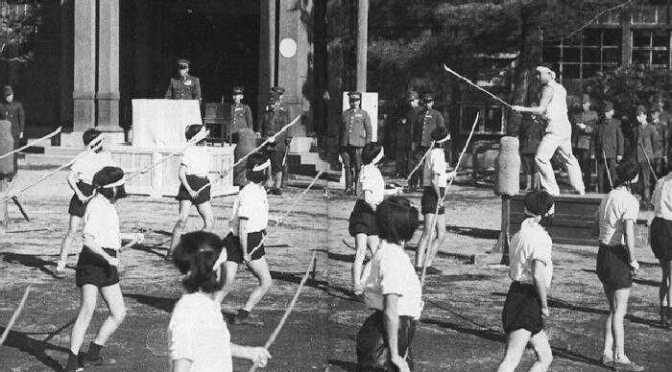
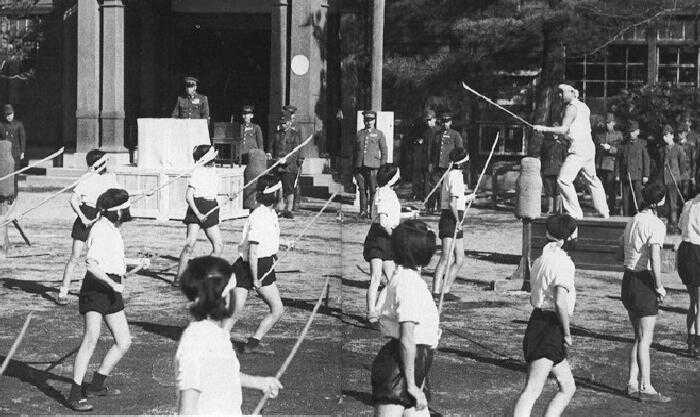
Japanese high school girls being drilled on how to use bamboo spears to ultimately repel “the invaders”. Notice the presence of the Imperial Japanese Army in the background observing.  Tokyo 1944.

By January 1945, Japan had already lost the war.  While the Japanese military leaders controlled the country and its path to ultimate destruction, the civilians took the brunt of war.  Many cities had been destroyed by US bombing raids leaving millions of families homeless.  There was not enough food to go around.  Many starved to death, especially orphaned children, if not from neglect as others would shut their eyes to them.

However, Hiroshima was largely spared from aerial attack.  The US did carry out bombing raids in March and April 1945 against military targets in Hiroshima but it was not frequent…but it was frequent enough to require air raid drills  The naval port of Kure though, where the battleship Yamato was built, was essentially destroyed in June 1945 by US Army and Navy bombing attacks.

HiroshimaBombingMap
A hand drawn map showing targets and damage to Hiroshima by US bombing raids including the atomic bombing. For a zoomable map, please copy and paste this link into your search bar: http://www.digital.archives.go.jp/DAS/meta/DGDetail_en_0000000611
Source: National Archives of Japan

___________________________

After her marriage in 1933, Michie was tasked to arduous farm labor at the Aramaki farm.  Their primary crop was rice.  She also gave birth to five children before war’s end: Masako (1933), Sadako (1936), Namie (1939), Tomiko (1942) and Masataka (1944).  Kiyoshi would follow in 1947.  She loved them unconditionally.

Michie image1
A happy Aunt Michie and likely Tomiko. Tomiko would soon be adopted by another family in the actual city of Hiroshima.  Undated but perhaps 1943.

On the farm lived Mikizo, his parents and Michie.  The four of them – and eventually three of her oldest daughters (a total of seven family members) – would work the land from a little before sunrise to sunset.  It was hard, arduous labor.  Back breaking work.  They did not have John Deere tractors or combines to aid them but had an ox to plow the fields with.  This was 24/7.

After all that hard labor, nearly the entire crop was taken by the Japanese military for the war.  They were allowed to retain a small portion of the crop for their own use.  As a result, rice was even further rationed for family consumption.  They had no choice.  On top of that, there was little else to eat.  They lived a meager life per my cousins.

__________________________

As the war dragged on, Japan was descending into the abyss…and it kept getting more and more darker.

In the story “Dear Mama”, Michie’s youngest brother Suetaro (my uncle) hurriedly wrote a somber good bye letter to Grandmother Kono in his war diary.  He was being sent off to war and certain death.

Farewell
Farewell sendoff for Suetaro who was heading to certain death. Michie is to his left and holding Masataka; Mikizo to his right. It is only an educated guess but the older man to the right of Mikizo is his father.  May 3, 1944.

I wonder how she really felt, knowing that Suetaro was going to fight to his death against the country in which his two older brothers and sister were imprisoned.  They were her brothers and sister, too.  An ugly internal conflict.

______________________________

The area around Tomo was nearly barren of younger, physically capable men.  All the men up to 35 years of age were taken by the army, regardless of their family status.  Mikizo was no exception.

In late 1944, at 35 years of age, he was taken by the Imperial Japanese Army.  Suetaro foresaw that happening in his farewell letter; he warned Mikizo to fully cooperate with the officers and to do exactly as he was ordered.  This was because it was brutal even within the non-commissioned ranks of the Imperial Japanese Army; the training officers routinely beat recruits into submission.  These recruits were largely the men who were ordered to their deaths in “banzai charges” by the thousands.  They greatly outnumbered the “hard core” Japanese officers.

banzai killed
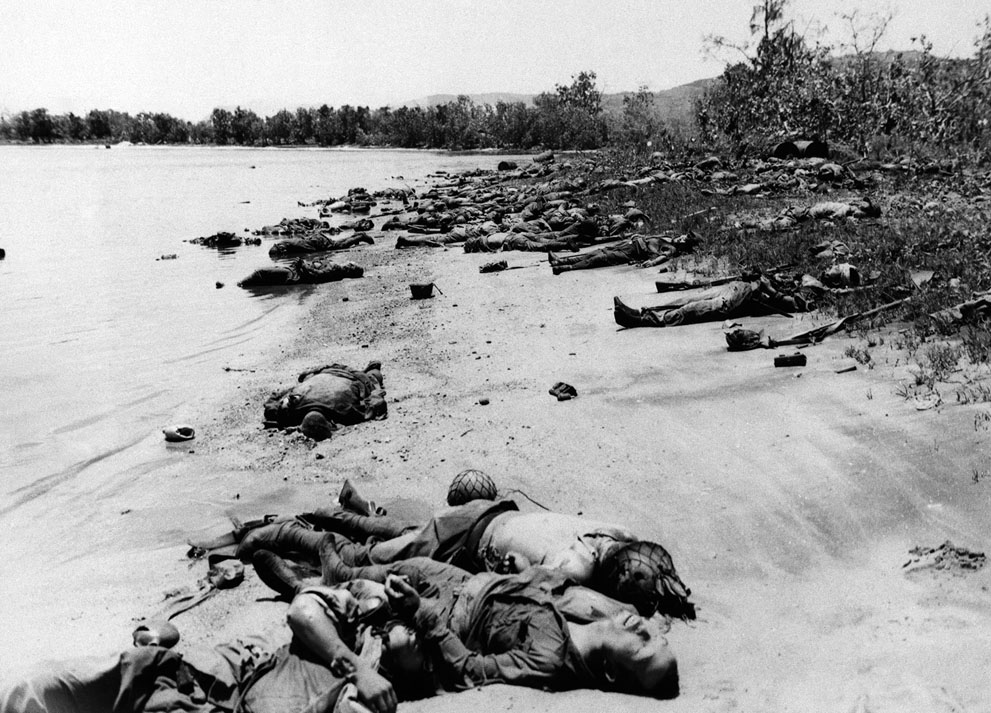
Aftermath of a banzai charge.

Aunt Michie’s family who tended to the back breaking labor on the farm was now lessened by one.  As with her brother Suetaro, she foresaw never seeing Mikizo again.

To make matters worse, her mother (my Grandmother Kono) suffered a cerebral infarction the day she learned Suetaro was being sent off to war.  She became paralyzed on her left side.  To get about the now empty house, she would have to pull herself around with her right arm.

On top of everything else – tending to the crops, the house and the children – Aunt Michie now had to care for her disabled mother.

Michie’s daily life was now further strained with even more stress…  Life must have appeared darker to Aunt Michie.

Michie’s willpower and dignity will now be on trial and severely tested.

But the struggles she will endure will have purpose.

She would not let her family down.

____________________________

To be continued in Part 3….

A Father-ly Invasion


Imagine being a Marine. You’re in Afghanistan.  You see your buddies getting blown up by the cowardly enemy’s IED or killed after an ambush. Then, after a bitter, maniacal all-out war, their religious leader capitulates.

Now, suddenly, you are standing out in the desert, outside of Fallujah, waiting to go in as part of the “occupying force”. Your feelings and emotions are going amok – anger coupled with fear of the unknown… You will be surrounded by the enemy who also fought the exact same bitter war against you.

USMC
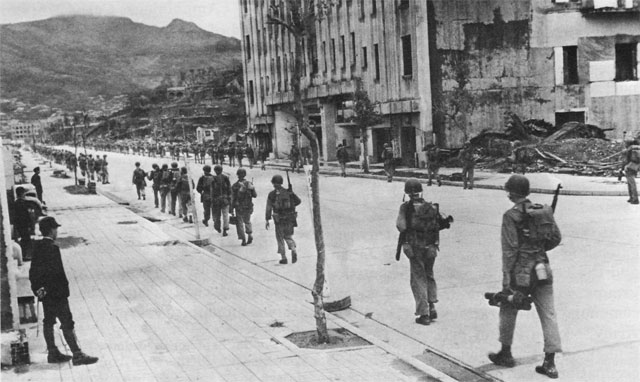
US 26th Marines marching into Sasebo, Japan – August 1945. Notice the Japanese standing to the left and the general absence of civilians.

Now… imagine you are a young Marine on a troop ship off the Japanese coast. It is August 30, 1945. A few weeks earlier, you became acquainted with the term atomic bomb. The Emperor of Japan just capitulated.

You are to go ashore onto the Japanese homeland.  But in this case, you are not wading ashore to occupy a city. You are wading ashore to occupy an entire country.

_______________________

As we now know, the initial “invasion” of Japan by Allied forces ended up being entirely peaceful; no one was killed. Perhaps there was a small incident or two, but I have not read anything to indicate a single shot was fired. How could that be? How could hundreds of thousands of Marines, soldiers and sailors have stormed ashore – under an assault mindset – onto a homeland populated with maniacal military and millions of civilians – and not erupt in combat?

army report 98th

Per a report of the US Army’s 98th Infantry Division dated December 20, 1945:

“The mission assigned the Division was participation in the occupation of Japan; however, due to uncertainty as to the attitude of the people, the real intentions of the Japanese army, and the possibility of treachery or sabotage, the Division was directed to be combat loaded and prepared for any eventuality. Thus planning for the occupation of Japan was based upon an assault landing rather than an administrative movement…”

(Click here to see actual report.)

______________________

There is no single answer. The peaceful invasion was the result of hundreds of contributing influences.

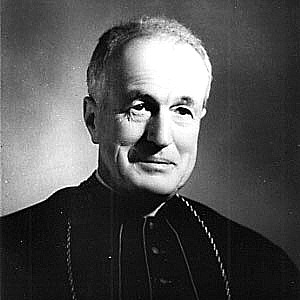
One came from Father Patrick Byrne, a Catholic priest in a country dominated by Buddhism.

patrick byrne
Father Patrick Byrne. He was elevated to Bishop prior to his death.

Father Byrne had been sent to Kyoto in 1935 to set up a mission. As he was respectful of the peoples, he was put under house arrest (confinement) when war broke out. Of course, it was very harsh. His only companions were a cat and a parrot. Food was poor and scarce, just like it was for the unfortunate civilians.

Per “Escape from Manchuria” by Paul K. Maruyama (USAF, Ret.), he emphasizes the importance of the role fulfilled by Father Byrne immediately after the Emperor broadcast his surrender. Although in very poor health, Father Byrne with the aid of a newspaper reporter and a Father Furuya, hurriedly put together a radio broadcast intended for TWO audiences: (1) one for the Japanese homeland and (2) one for the “invading” Allied forces.

As hordes of civilians were escaping to the countryside, getting from Kyoto to Tokyo in the few available trains was hard but after 15 hours, he made it being escorted by police. He then recorded his speech on or about August 20, 1945, which was re-broadcast many times via radio and shortwave…to the Japanese people and to the countless number of Allied occupying forces staging off-shore.

His radio broadcast:

“The war is over. What can I say first of all to the Japanese people whom I have loved and who love me as a brother for more than 10 years? I share their grief when the Emperor spoke to them and told them that they had fought a good fight but now he wanted them to give up the war and turn to peace. I, an American, speak to you Japanese in the name of those soldiers about to enter your land to assure you that you need to have no fear. They are not coming to the shores as invaders, with tanks, bayonets and bullets, but merely as representatives of their country, taking occupation of Japan to help you once more to reconstruct and build on the new foundation of democracy. The eyes of the world are on this occupying army. You may rest assured they come peaceably.

What can I say to you, the soldiers of my native land, regarding these people? Their feelings will naturally be mixed with emotions as you look up on the victors entering their land, where the homes have been destroyed or burned, their sons and fathers of families killed or maimed and wounded. It is only natural that you look with anger, fear, mistrust, and frustration at your arrival. Should you add to their present feelings by any any ruthless attacks upon the women and young people in this land, I am afraid of what the consequences might be. So I urge you to cooperate with me as I assure the Japanese people that you will commit no degradations, that you would have goodwill and charity in trying to realize what these people, the real victims of the war, have suffered and will not do anything to add to the pain they endure.

You are on trial before the eyes of the world. Any violence or immorality, any unjust or criminal act on your part will not only be a stain on your character but on that the nation you represent.

I believe I may assure you people of Japan that the army chaplains would do everything they can to remind our soldiers of their moral responsibility. The Military Police, too, will carefully protect your interests and will arrest anyone found violating the law. If there seems to be any violation of this protection which is your due, I have been assured by the Archbishop of Tokyo that he will appeal to the Holy Father in Rome who in turn will make known to the whole world by radio and the press any form of injustice. Freedom of the press in the United States will cooperate so that such news will not be suppressed.

I am not afraid because I know these Americans and trust them, but I can understand the fears of the Japanese people. Soldiers coming into Japan, I strongly urge you to come with kind hearts and be good friends of these people. You have fought hard and want a victory. I know you want to enjoy it and want to be proud of it, but please try to understand the distress of the Japanese and make your behavior calm and warm as representatives of a great nation. Perhaps after two or three months, they will begin to understand you better, and then I think there will come an intimate friendship between you and them.”

________________________

The Allied Forces – with the words of Father Bryne questioned in many soldiers’ minds as to intent – stormed ashore on August 30, 1945 on many beaches all around Japan. Once ashore, they were largely astonished to learn over the next few hours the truth in Father Byrne’s words.

fig16
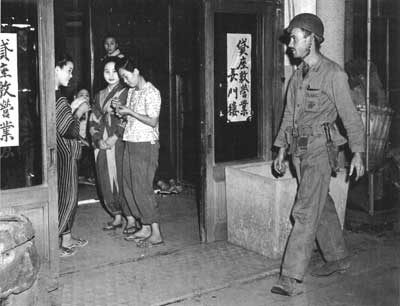
A Marine walks past young Japanese women on a routine patrol.  Thousands of vials of poison were distributed to thousands of young girls in preparation for the “invasion”. (USMC Photo)

________________________

According to “Escape from Manchuria”, Father Byrne made a recovery back in the United States after the war and was elevated to Bishop when he was sent to Korea in 1947. In 1950, he was captured by the North Koreans and once again was subjected to horrifying treatment and captivity before being put on the Korean War equivalent of the Bataan Death March.

He fell ill during the march in freezing conditions and when he could not continue, he was taken to a shack. There, on a frozen floor and without any warmth, he passed away on November 20, 1950 at a place called Ha Chang Ri, North Korea.

(Note: Edited Feb. 2, 2014.  For some reason, the photo of Father Patrick Bryne had been removed.)

“Dear Courageous Sailor” – a Letter from 1943


Marines82large
Marines escort Saipan civilians. It was estimated that 22,000 civilians died, most by suicide. It was traumatic for our young Marines to witness, too.

There is personal pain in a full-fledged war that only those who were fully involved can feel.  Those feelings will differ by how that person was involved.

We somewhat understand through survivors that a soldier, airman, sailor or Marine near or on the front lines will have an intimate kinship with instantaneous fear.  They know combat is immediate, unfair, cruel, and barbaric.  But hopefully, they know their families and country are behind them – perhaps giving them the edge to overcome their fears and survive.

And this is true for the enemy as well.  As I become more knowledgeable on the Pacific Theater during WWII, I have learned the young Japanese combatants had the same fears (please see “There’s No Toilet Paper in the Jungle of Burma“).  But unlike the Allied forces who had millions of tons of war materiel, food and medical care backing them, the Japanese military fell way short.

But what about the Japanese home front?  Have you paused to ponder that?  Were their countrymen any different from us in their ways of supporting their young men dying by the hundreds of thousands?

I never did myself until recently.

____________________________

I met Rob on the internet through his facebook page, “WWII U.S. Capture Photos“.  He focuses on the spoils of war, bringing back to the forefront the war souvenirs seized by military personnel.

He acquired a letter from a now elderly Marine who was fighting on Saipan in mid-1944. He had told Rob that he removed it from a Japanese corpse.

japaneselet2
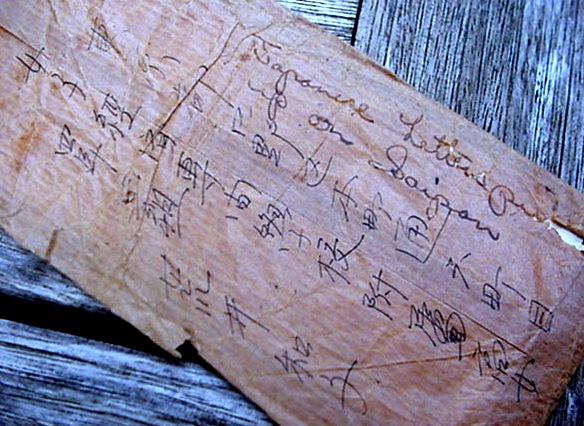
The now tattered envelope is anonymously addressed to”海軍の勇士様” or “Dear Courageous Sailor”.

Apparently, this letter had ended up to haunt the Marine who was at time very young and fighting for his life on Saipan.  The once young Marine is pictured in the center of this photo:

Marine Saipan
The young Marine who seized this letter is pictured in the middle. For an original image, please click on the picture.

Rob asked if my father could read the letter and translate it.

The letter was haunting Rob, too.

______________________________

My friend and I went to see Dad in October 2013.  Below, Dad is reading the letter taken by the then young Marine from Saipan in 1944.

IMG_1032

The backside of the envelope is below showing the sender’s name and return address.  The image was enhanced to bring out the writing.  The Marine had written “Japanese letter picked up on Saipan”.

The letter was anonymously addressed and sent by a young girl named “Kazuko Arai (荒井和子)”.  The return address shows she was a student of a girl’s economics school in Tokyo, Nakano City, town of Honcho (東京都中野区本町通六丁目女子経済専門学校 – 附属高女).  While I believe the school may have been at least damaged by the fire bombings, I may have located the successor school. It is called “Nitobe Bunka Gakuen” with its current address as 東京都中野区本町6-38-1.  (While I did send a blind email of inquiry to them in my far from perfect Japanese, there has been no response.  I doubt that there will be given the Japanese culture.)

culetter1

While the scans were of low resolution, the two pages of the letter are as follows:

japaneselet3
japaneselet4

Because my father  will be 95 next month, it was difficult to keep him on course.  In spite of reminding him to just read the letter in Japanese (I would understand most of it), he continually tried to translate its sentences into English.  Perhaps somewhere in his buried conscious, he is doing as he was trained by the US Army’s Military Intelligence Service.  Admittedly, there were about a half-dozen characters that were just tough to make out due to creases and lack of clarity.  And he wasn’t able to figure out one paragraph in particular…but I did!  Got one on my old man.

I also sought out help from my good Hiroshima cousin, Kiyoshi, and he filled in the blanks.

Kazuko wrote:

夏も過ぎさり戰局は日一日と厳しく今こそ物心はおらか私どもう総べてを国家に捧げつくすべきと秋となりました。
As summer passes and turns into autumn, the war situation is getting more severe and now we must physically and mentally dedicate ourselves for our country.

海上での勇士様にはお変わりなく軍務に御精勵(励)の事を存じます。
As a courageous sailor out at sea, I know your unwavering fighting spirit continues.

大東亜の全戦線に於いては、今や彼我の攻防戦は、まことに熾烈極めて居るという事等、すでに日々の報道により私共の耳に刻々傳えられてをります。
Per our (radio) broadcasts, we hear that the intensity of battle and such has increased for both sides at all the front lines in the Far East Asia theater of war.

山崎保代部陽長以下二千名ついに全員北海の島に於いて玉砕したこの事をラジオが私達に傳へるや私達は唯聲をのみ頭をたれるばかりでした。
A radio broadcast announced that Lt. General Yasuyo Yamasaki and 2,000 of his  garrison died honorably defending an island in the North Sea.  All we could do was bow our heads (in honor) and swallow our  grief (voices).

– – – – – – – – – – – – – – – – – –

[ NOTE: In researching this report, I discovered that Lt. General Yamasaki was assigned to defend the island of Attu.  He was killed with his remaining garrison in a banzai charge on May 29, 1943.  Please click on the following for more information:
My cousin Kiyoshi also found an extensive accounting of the Battle of Attu in Japanese with English translations for those who are interested.

– – – – – – – – – – – – – – – – – –

(Letter continues)

今私達は本当に容易ならぬ戰争の只中におかれている事を強く感じました。
Now, with the daily war situation, we strongly feel as if we are in the midst of the battle and realize (winning) will not be easy.

学校ではもうじき秋の軍動會が開かれますので一生懸命身体をきたへてをります。
Soon, it will be time for the autumn (military) athletic meet; I will train hard to strengthen my physique.

断じて米英女性には贁けない覧唔です。
We resolve to not lose against the American and English women.

ではどうぞう勇士様くれぐれ御身体御大事に大切にお国の為しっかり戰って下さい。御武軍を祈り致します。
So please, courageous sailor, sincerely take good care of yourself and fight hard.  I pray for your fighting spirit.

さよなら
Good bye.

_____________________

So now we realize that Japan also had a “home front”.

Perhaps they did not have a “Rosie the Riveter” like we did.

But the Japanese homeland did endure pain, fear and sorrow as we did…and depression.  They were not the inhuman creatures depicted on war posters and in propaganda of that time.  And thanks to Rob and the young Marine, we see a letter written in Tokyo by a high school girl named Kazuko Arai in the autumn of 1943 and simply addressed to an anonymous sailor.  Kiyoshi also believes that the watermarked stationery was of high quality and issued out of military stock for this purpose.

Sadly, we do not know the name of the sailor from whose corpse the letter was removed from, nor do we know if Ms. Arai survived the war and raised a family.

showa8
Picture taken at Kazuko’s school pre-war.

Things like this sort aren’t evident in our (current) history textbooks.  Now, WWII has pretty much been erased from school textbooks altogether, replaced by “politically correct” topics…that there was simply a war between Japan and America.  A disgrace to those who endured or died.

In closing, there is a diary written by a young Japanese doctor up to the time of the final banzai charge on Attu.  He was one of the attackers who was killed.  As mentioned in my other posts about the Military Intelligence Service, Japanese military forces were allowed to write diaries.  When these diaries were taken from the battlefield, the Japanese-Americans (Nisei) soldiers were able to read then extract valuable intel on the enemy – both for their battle front and their homeland.  In his last entry, the young doctor writes a goodbye to his wife and two small children back home.

Young Japanese doctor’s war diary

Big Time Sucky


I’m sorry, nice-minded bloggers…

But this REALLY a prime-time sucky.

Worse than a twerky even.

___________________________

It’s not just Obama approving a paltry 1% pay increase for our military… It’s that a military man or woman can’t support his or her family.  Paltry pay.  And it keeps getting worse.

Please view the related short news broadcast and news print by clicking on the image below…  Hear the extent of the horrendous impact on our military and veterans – AND THEIR FAMILIES.

vet pay cut

And remember, they got SEQUESTERED earlier this year.  More cuts in household income.

Alternate direct link: http://video.foxnews.com/v/2966371566001/growing-need-for-govt-assistance-among-military-men-women/#

_______________________________

You don’t need to be accurate to get your point across.

Congress people pay themselves somewheres over $150,000 a year – certainly no ILLICIT income, of course – and don’t get shot at or maimed.  They take LONG recesses (i.e., vacations), too.

And Obama sends these poor guys and gals to get shot at?  At less than a $20,000 salary?  (And he takes vacations to Hawai’i costing us MILLIONS each time.)

But wounded or disabled vets?  THEY should get lifetime pay.

Period.

Not the self-centered bozos in Washington, DC.

Period.

Rant over.

Sorry.