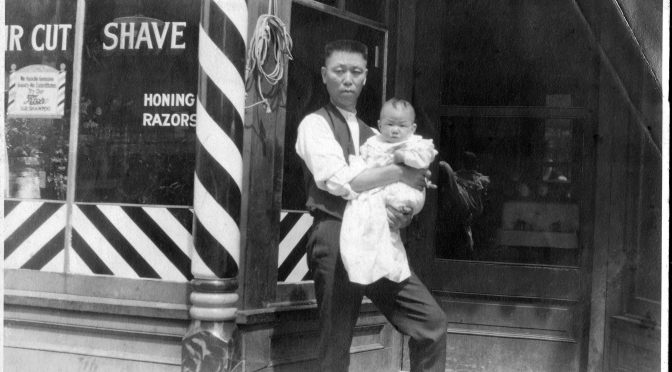
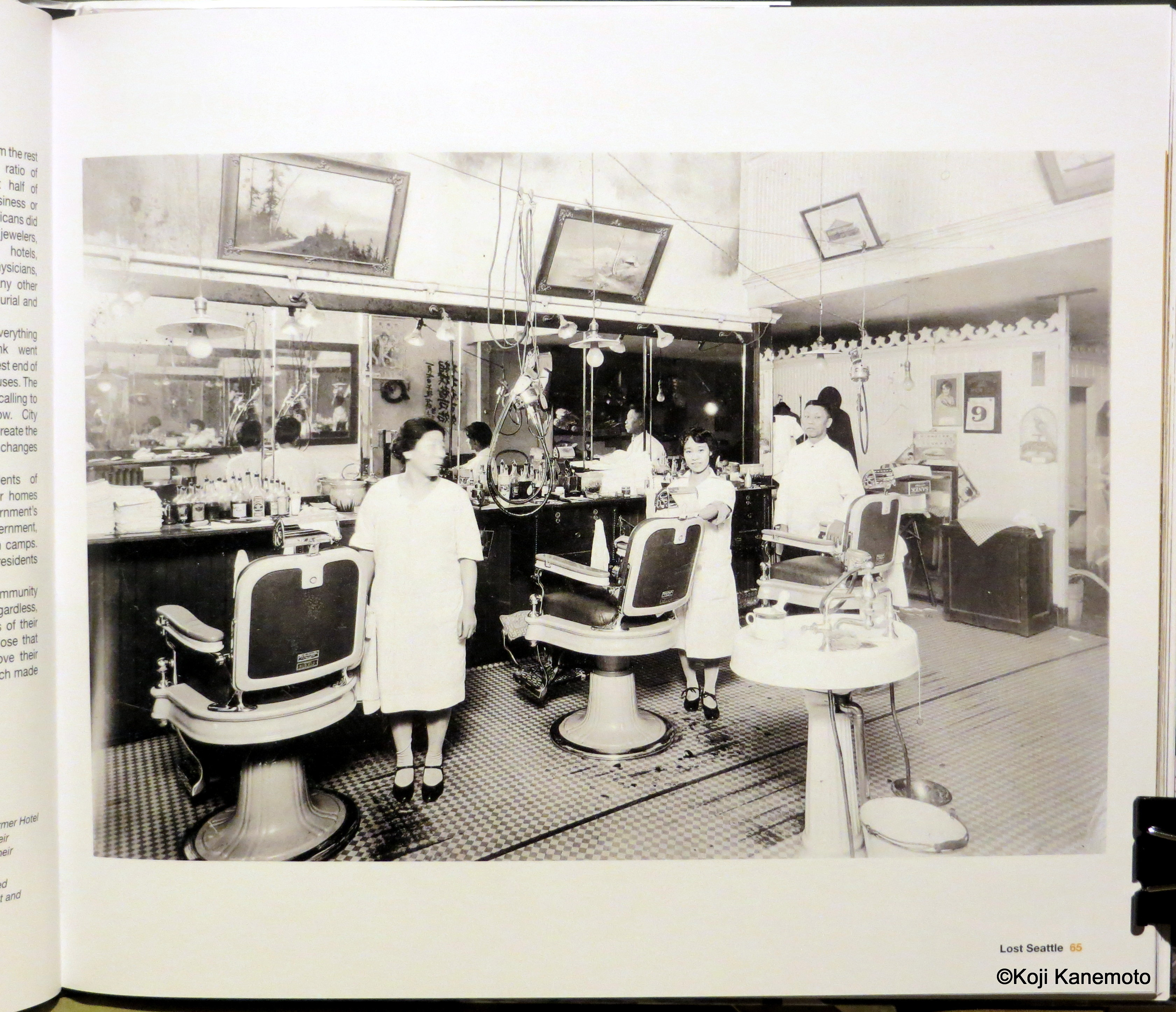
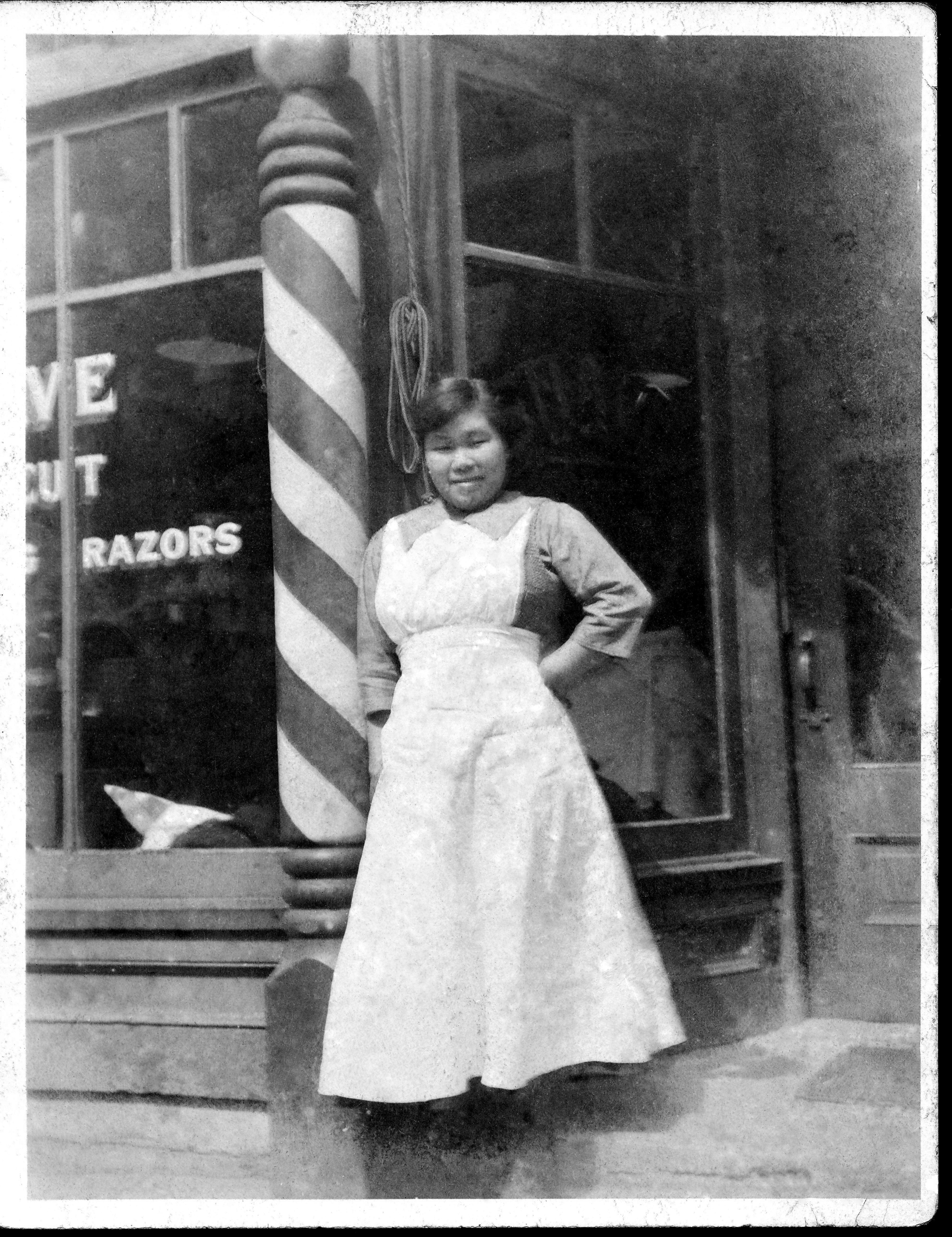
Eighty years or so after he posed for a photo, my Grandfather Hisakichi is in an American book.
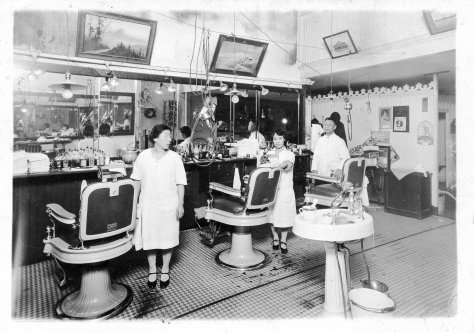
Standing “Marine-esque” in his Seattle barbershop.
Incredible to me.
_________________________________
I had come to know Rob Ketcherside from flickr. We had helped each other out looking at some old photos he had of Seattle – where all my aunts and uncles were born (except one). He had some fascinating tidbits on some of my Grandmother’s photos.
Well, it turned out he was an author. He had been doing a ton of research into “lost Seattle” – skylines and communities now long gone. With his fascination for “what was” (me, too!), those sights are now basking in sunlight once again through this mesmerizing book.
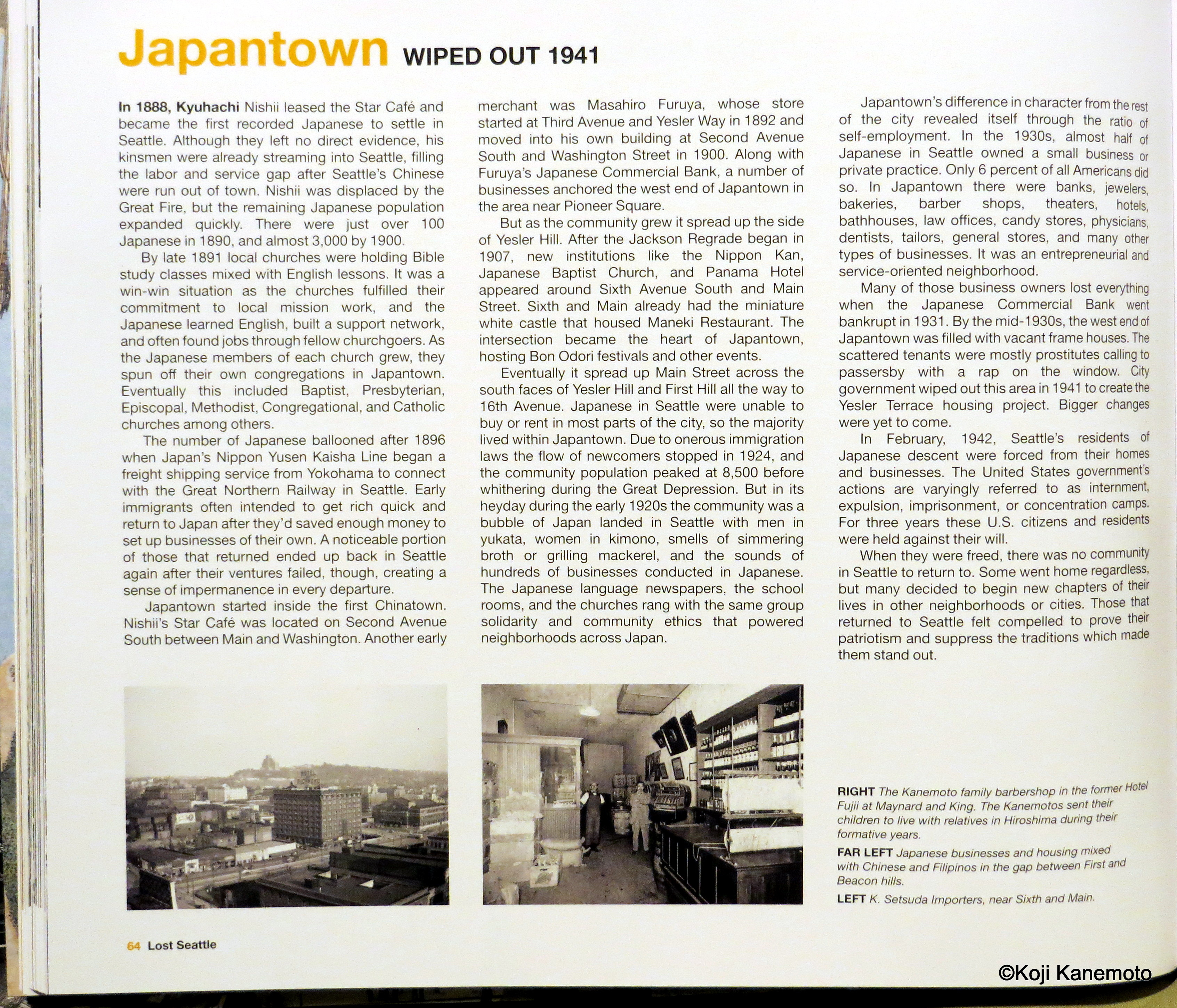
It was boosting to me when he asked if he could use one of the family’s vintage photos in his book; specifically, the photo of my grandfather’s barbershop. It is on loan to me from my cousin Masako (yes, the Masako after whom my blog is named) who luckily kept these family treasures all these years. It is more wonderful in that the home in which the photos were in survived the atomic blast – as did my family.
I hope Rob (and his publisher) don’t mind a couple of pages of his book are shown herein…and I’ll be picking up a few more copies to take back to Hiroshima in a few weeks.
In the description below, Rob also mentions Masahiro Furuya and his business. As it turns out, both my dad’s oldest brother Yutaka and his best friend John Tanaka worked for Furuya… And yes, that is the same John Tanaka my Aunt Shiz married. Small world, yes? Actually, Uncle Yutaka was the matchmaker.
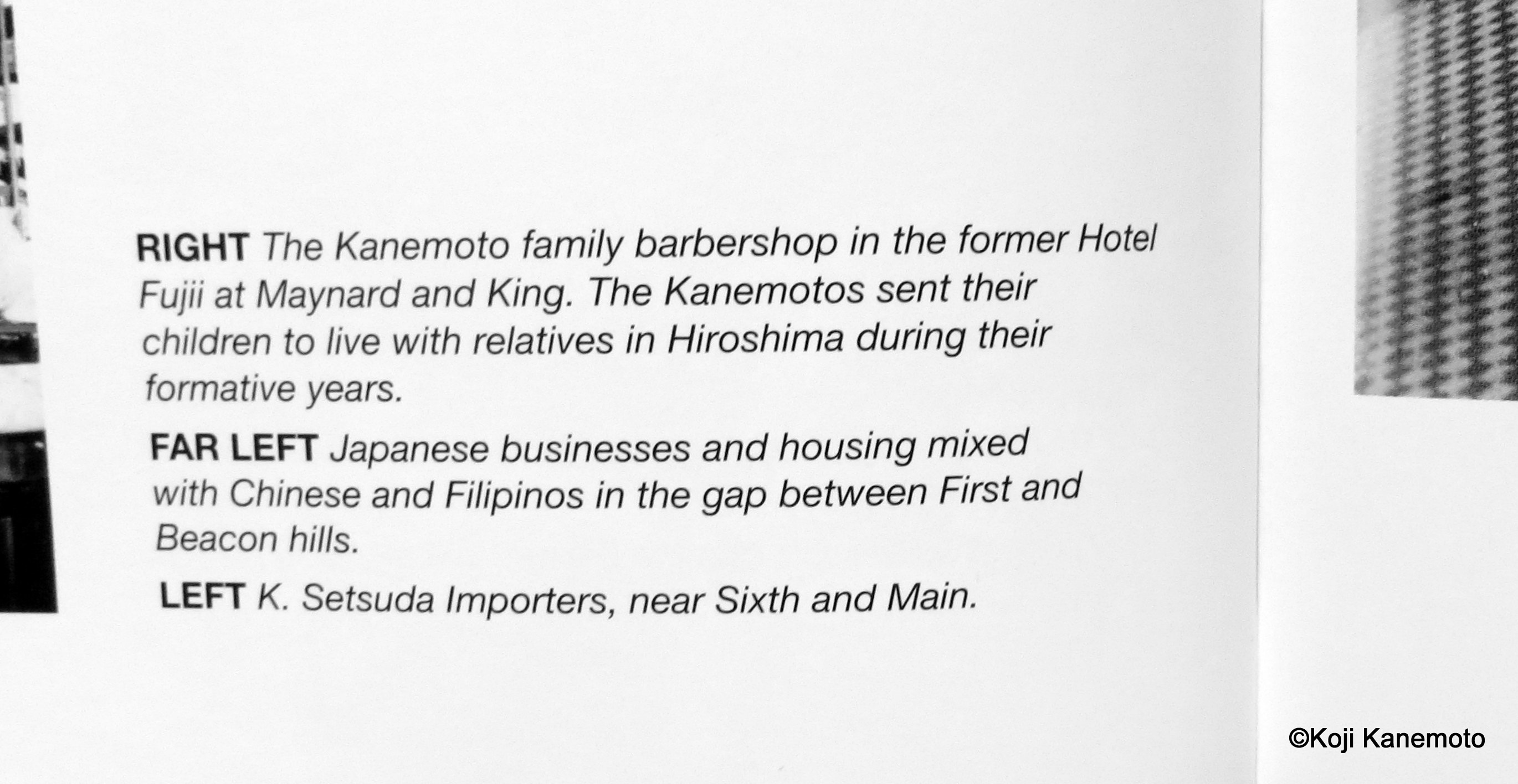
A close up of his photo caption from above:
Grandfather is standing at the right-rear of his barbershop. And the photo is a full pager in Rob’s book! Cool! Grandfather should be pleased. In the original print, you can see the brand names of the hair tonics popular at that time. The gal in the middle was quite a cutie, too. I wonder what happened to her. If she was still there in Seattle when war broke out, it is likely she went to the same prison camp my dad and uncle were incarcerated in.
On an interesting note, the consensus is the calendar shows January 9, 1930.
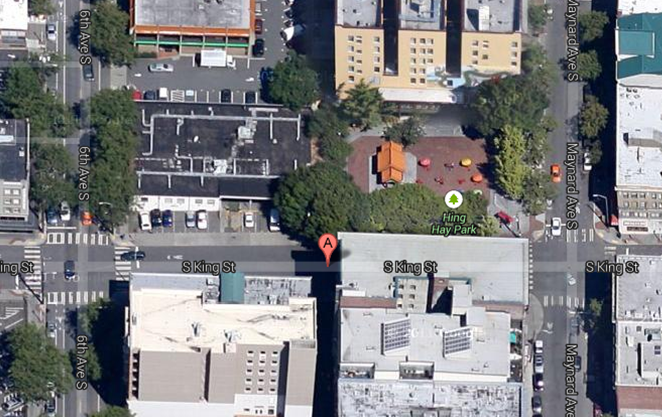
In concert with Rob’s massive research effort, gone is my father’s precious Hotel Fujii and my grandfather’s pride and joy barber shop. It was demolished to make room for “Hing Hay Park” taking its place.
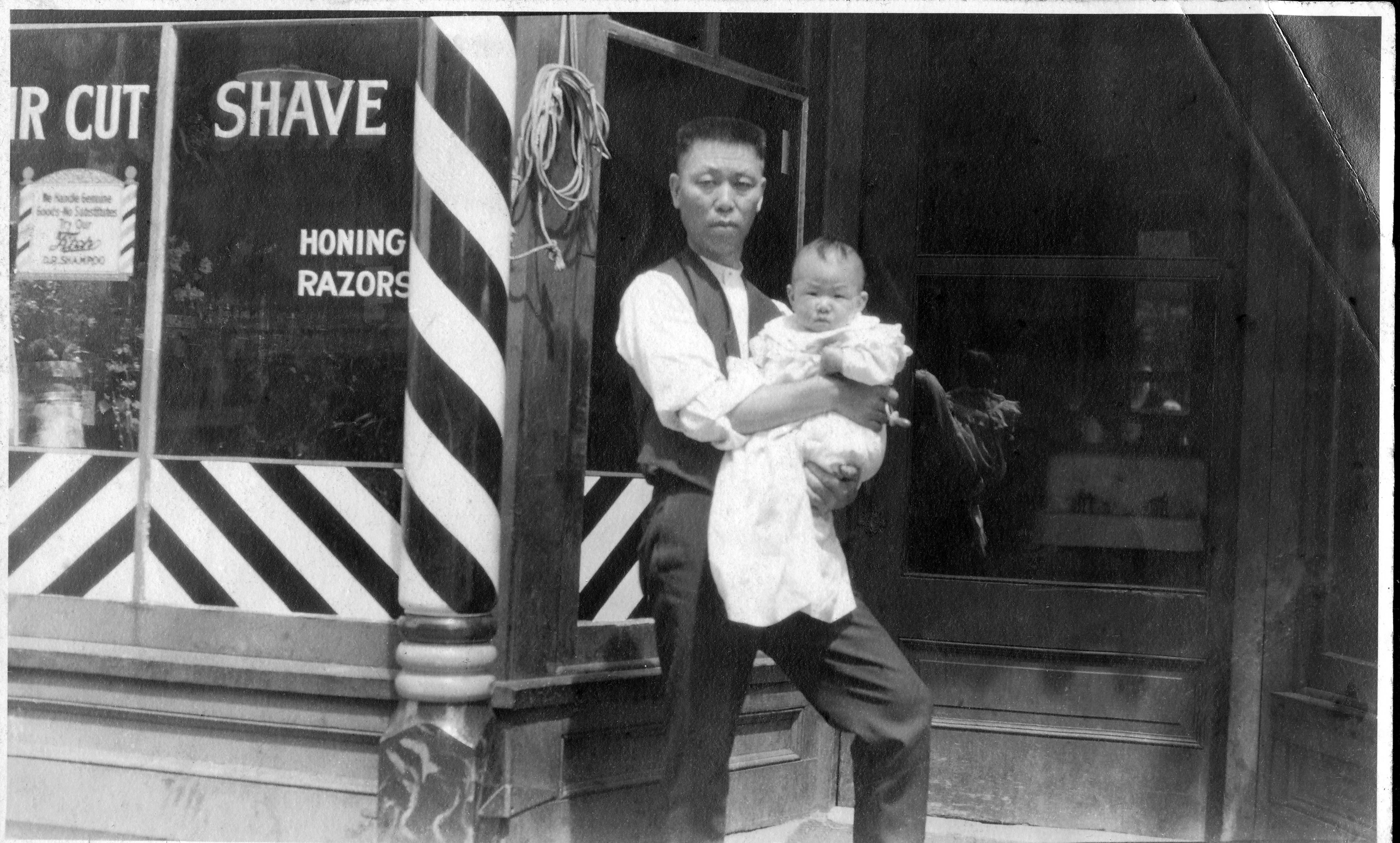
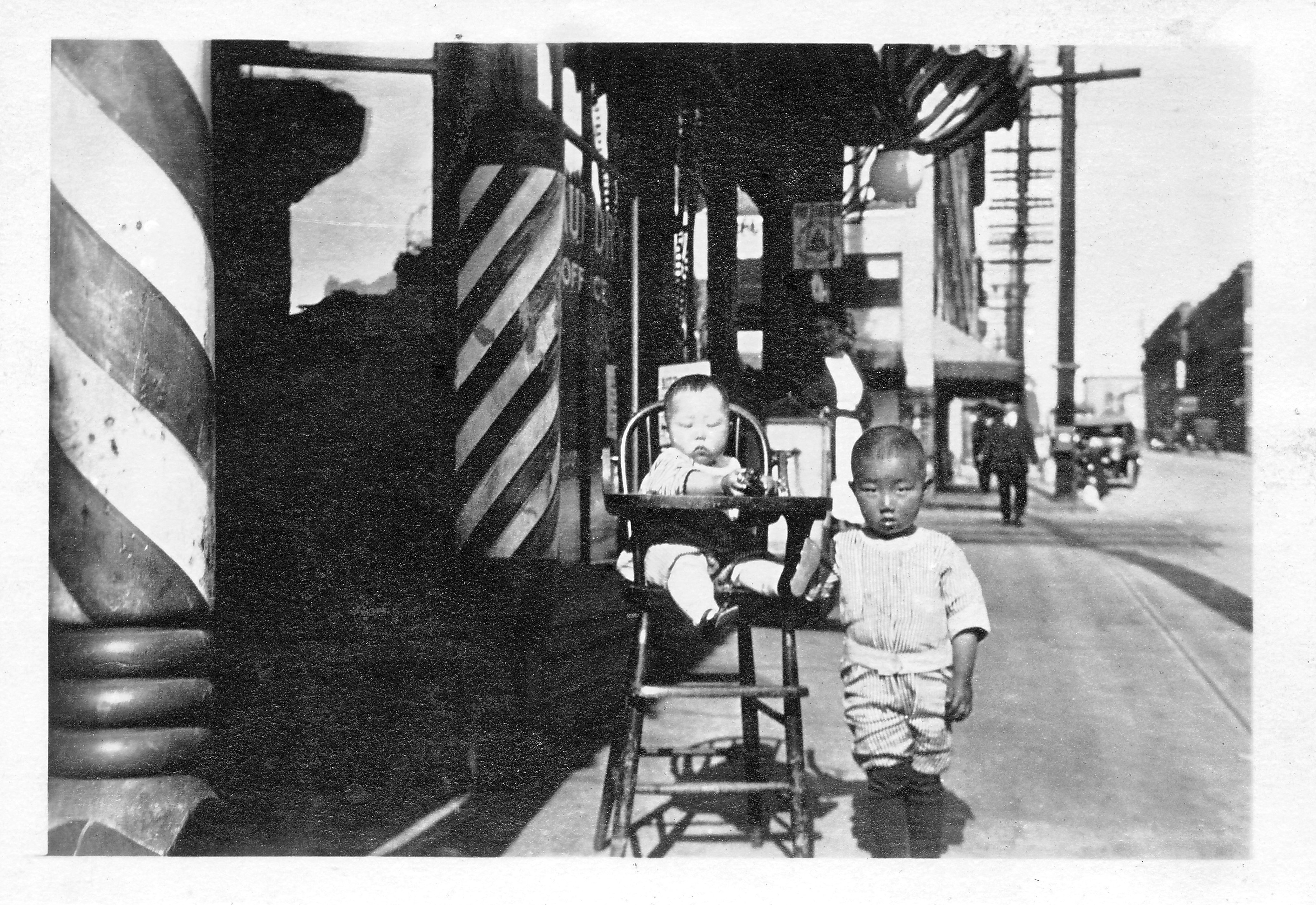
Grandfather Hisakichi holding Aunt Shiz in front of the barbershop. Circa 1918.Dad on right with his youngest brother Suetaro in front of the barbershop (circa 1922). They are likely standing where the label “Hing Hay Park” is on the map above. As readers know, Uncle Suetaro was killed as a Japanese soldier by the US Army on Leyte on July 15, 1945. Dad was imprisoned in Minidoka, ID at the time of his death.
Eighty years later.
My gosh.
And like the barbershop and Hotel Fujii, my dad is the last one standing out of seven siblings and two courageous grandparents.
Thanks, Masako-san and Rob.
I kinda wish my grandparents could have seen this.
My father’s decades old story about how he broke his elbow became the topic in the earlier story, “正覚時” (Shoukakuji).
Shoukakuji is the name of the Buddhist temple – a hop, skip and a jump from my father’s family home in Hiroshima.
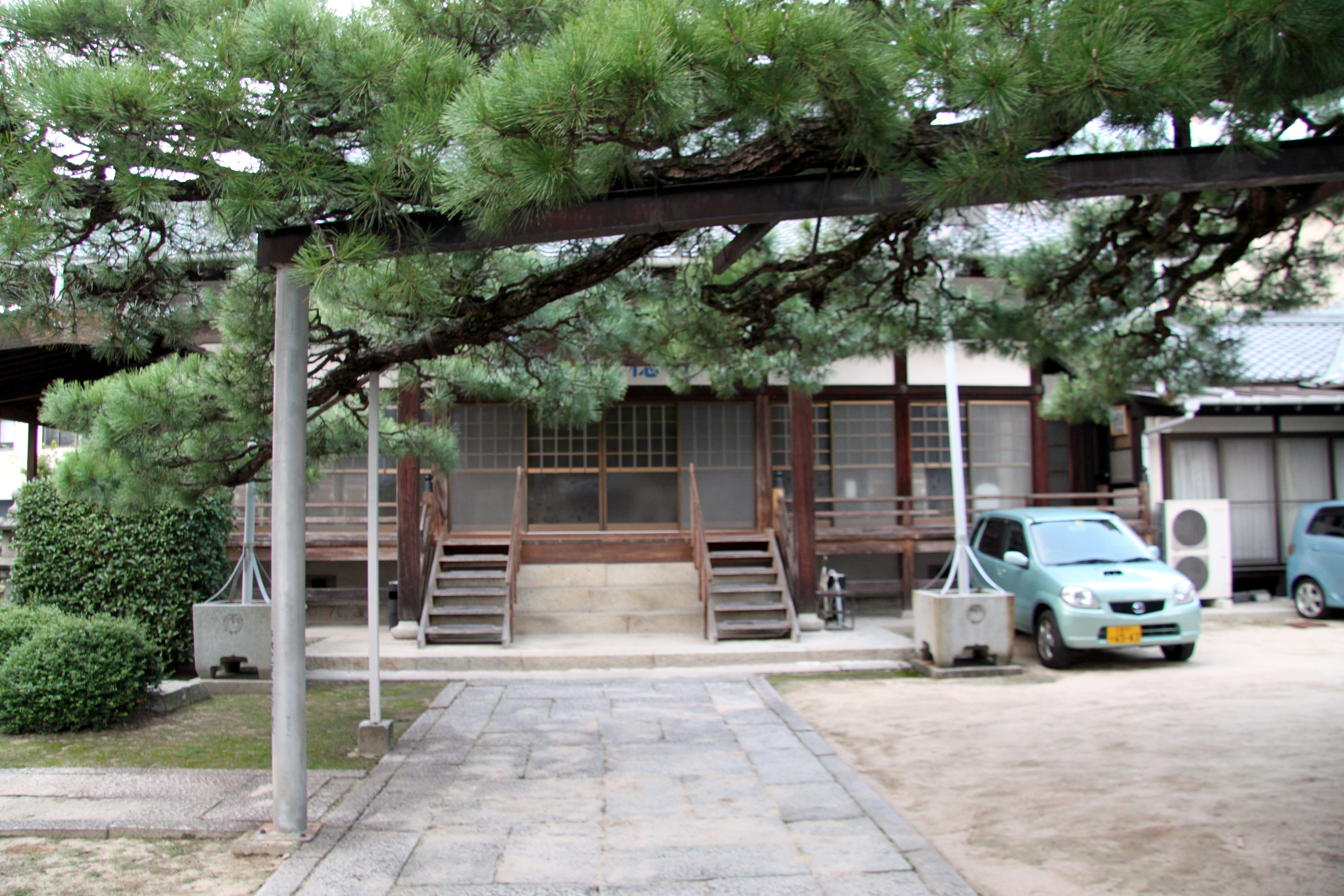
Temple entrance. My father’s home is behind me and to the right.
The temple’s reverends supported my family’s religious needs for over a century now.
Aunt Michie’s wedding.
Funeral services for my grandparents and my father’s siblings. Including my Aunt Shiz just this last September in “The Spirit of Aunt Shiz and Kharma“.
Including my Uncle Suetaro who was killed in action as an Imperial Japanese Army soldier on Leyte in the Philippines.
____________________________
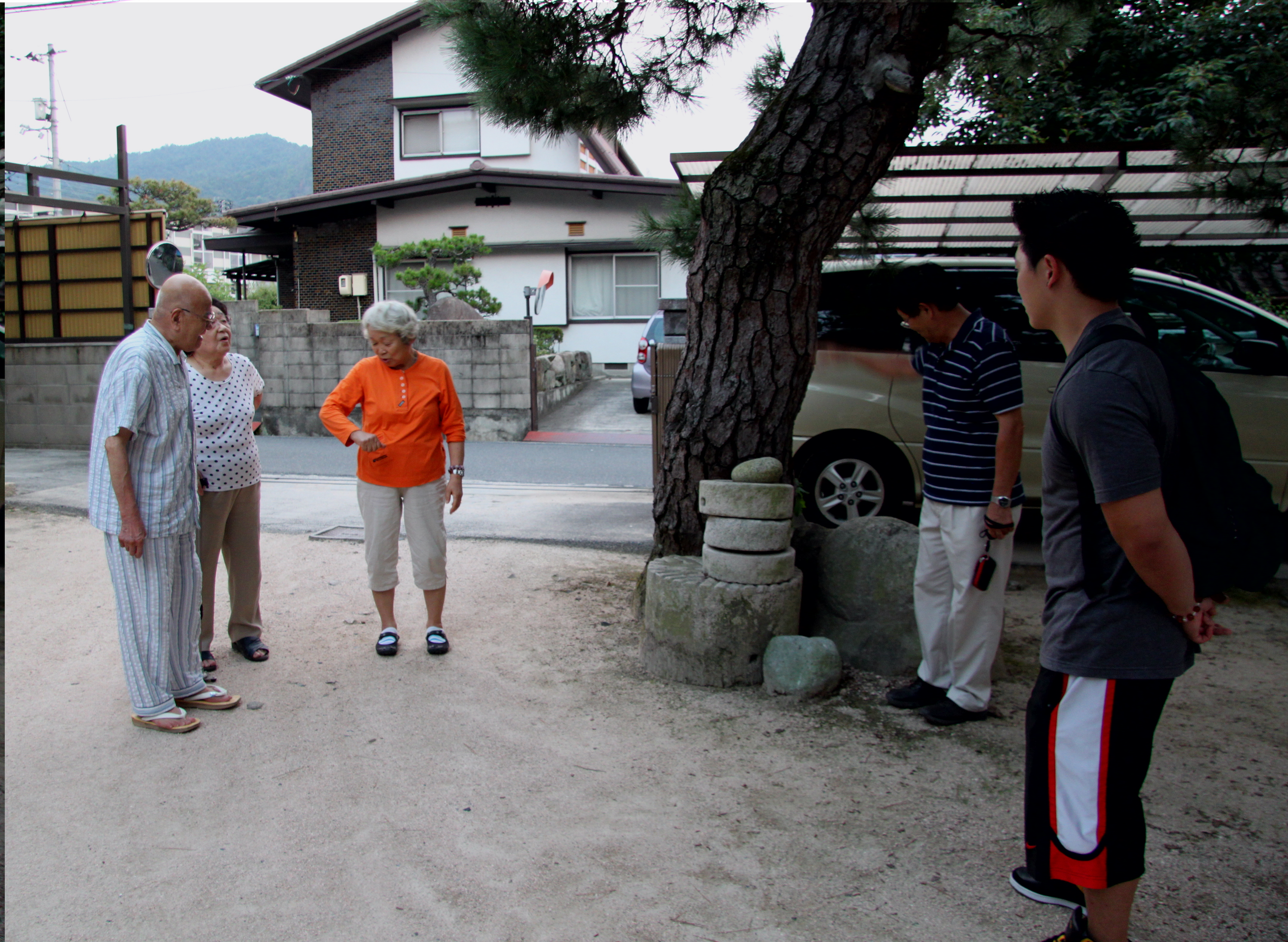
When Masako-san, my son Takeshi and I walked to the temple in 2013 to investigate my dad’s story of how he broke his elbow, we were greeted by the Reverend. He was 90 years old and still had his wits about him.
While he did not recollect my father, he validated the placement of a large round rock under the pine tree that hasn’t been touched for as long as he’s lived at the temple…. And that’s a loooong time. I’m sure he was born there.
And that there was a big branch of a pine tree that has since broken off recently.
He said he knew my Aunt Mieko who died in 1939.
And miraculously, he mentioned Uncle Suetaro. The reverend said they played together as children and that he was always a jokester and smiling…and that he could hear him playing his “fue”, or flute, from his second story room at the house.
Until then, not even Masako-san knew Uncle Suetaro played a flute…but there was no proof.
Just the recollection of a 90 year old reverend.
____________________________
My tennis elbow pain kept me from retouching the old vintage photographs I had brought back from Hiroshima last September.
And the project was at a standstill since late October. That was as depressing as Obama V2.0.
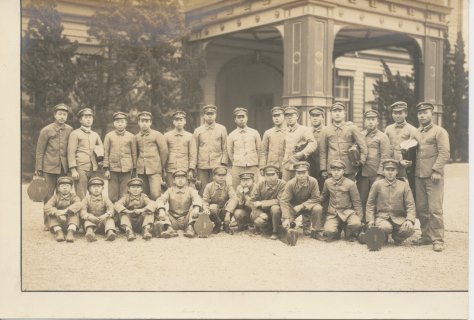
But from three weeks ago, I am attempting to slowly restart the retouching project as my elbow pain has subsided greatly…and I came across the group photo you saw at the beginning here.
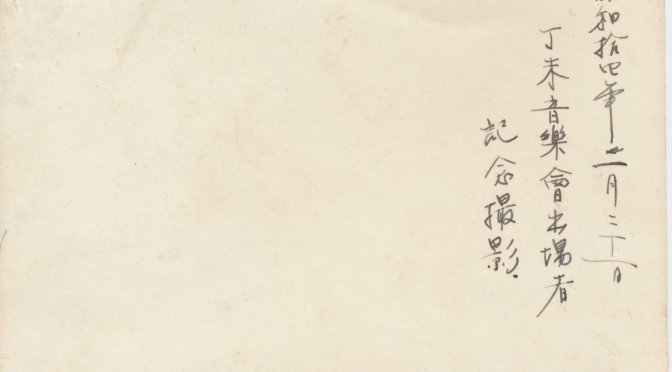
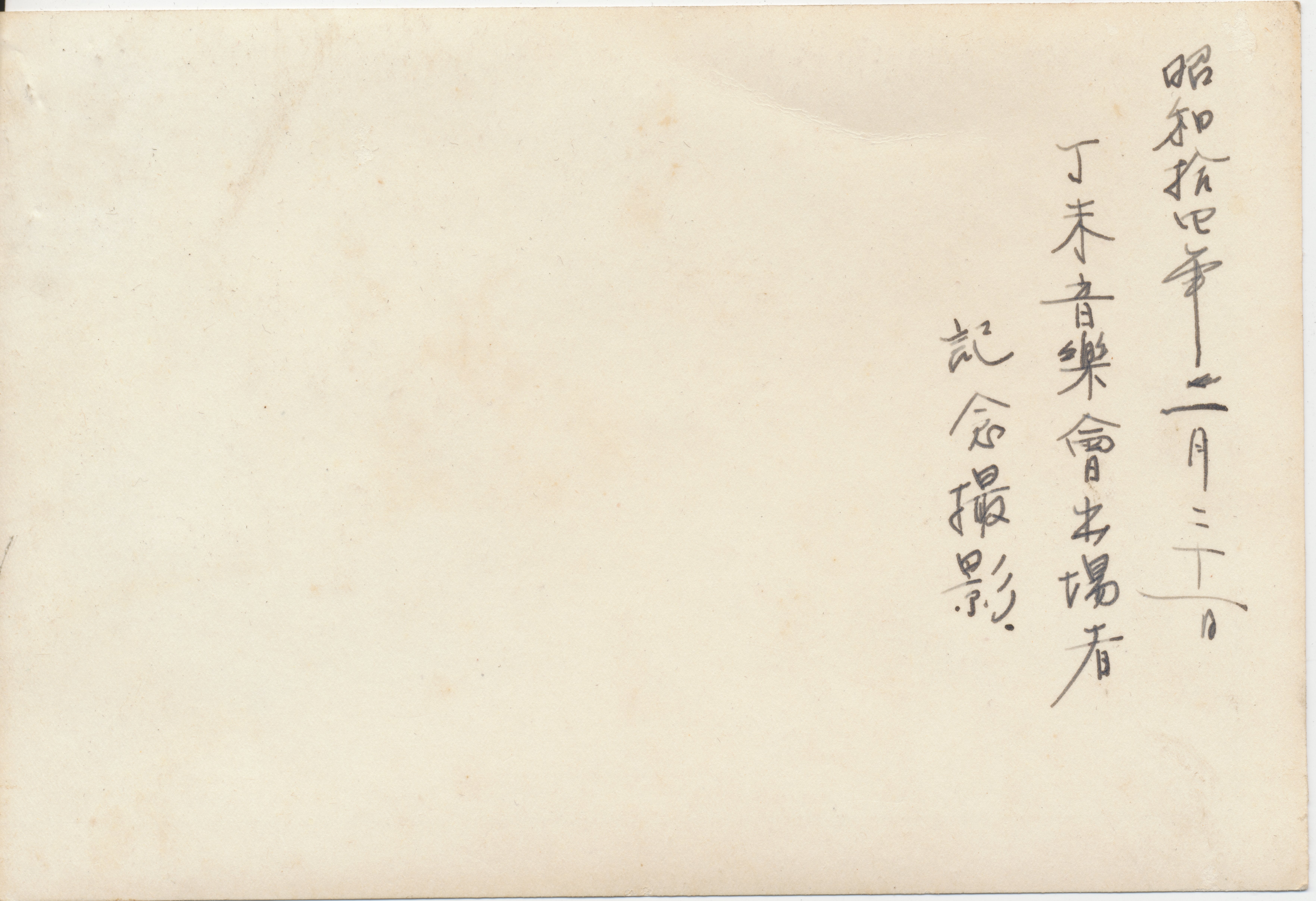
This was the backside since I know you ALL can read ancient Japanese:
Written by Uncle Suetaro himself. I believe – BELIEVE – it says, “February 21, 1939. Performed for First Sino-Japanese War anniversary.”
As retouched:
As retouched. Uncle Suetaro is the slightly taller one just to the left of center. If you click on the image, it will enlarge. Look in his right hand.
But as I enlarged the image to begin retouching, something caught my (old) eye.
I noticed Uncle Suetaro was clutching something in his right hand.
A case.
A case more slender than the others in the group picture.
It’s not a trumpet or a trombone, that’s for sure.
Or for a cue stick.
It sure looks like a flute case.
Oh, heck. It IS a flute case.
I say so.
_______________________________
So words from the mouth of an old reverend started an eighty year old circle… to this vintage photograph of young boys.
All of whom likely lost their lives in a violent war.
But you have to be obsessed…when time is working against you.
_____________________
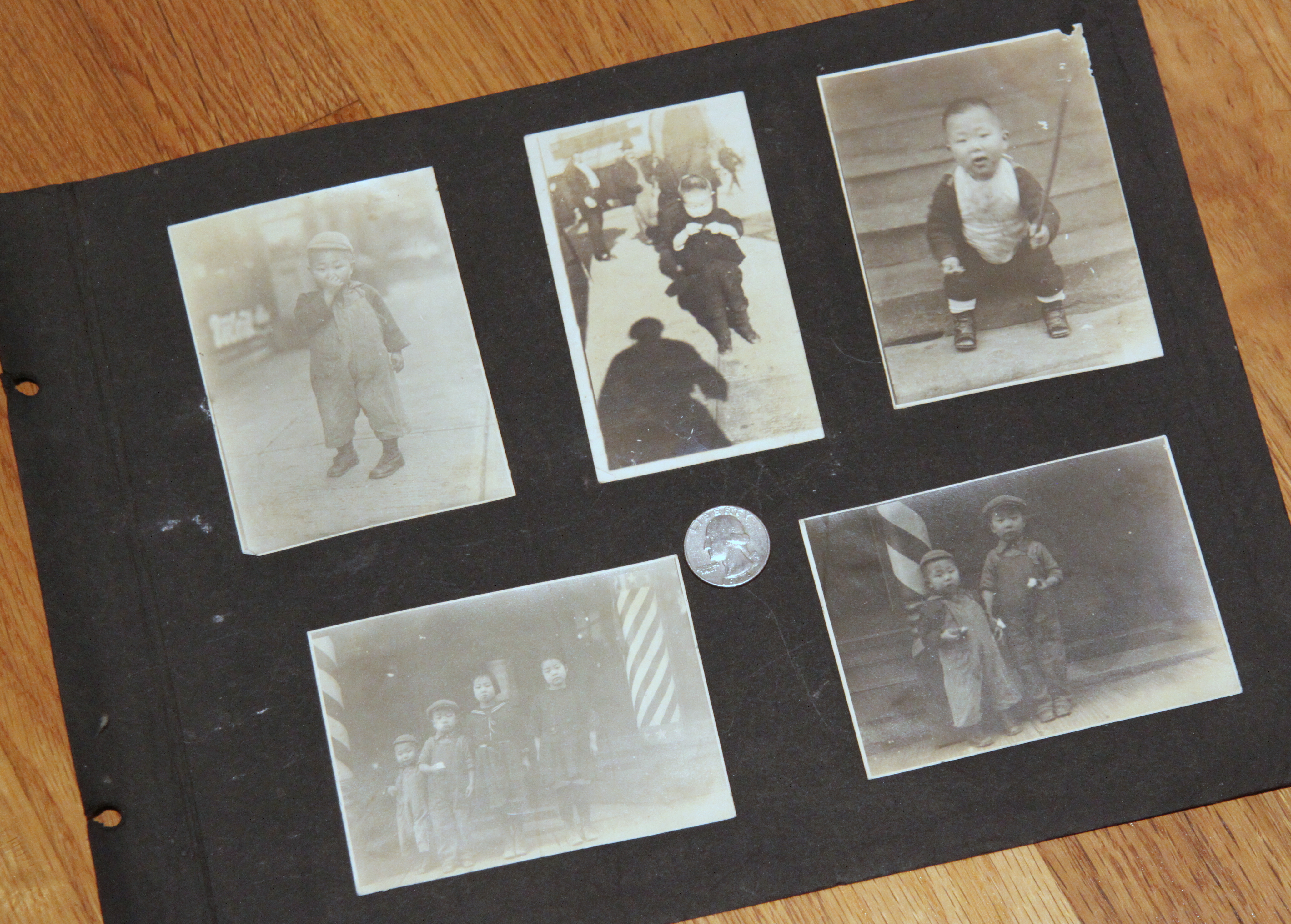
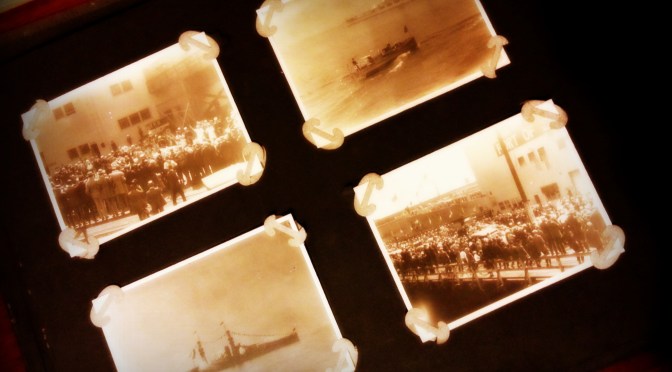
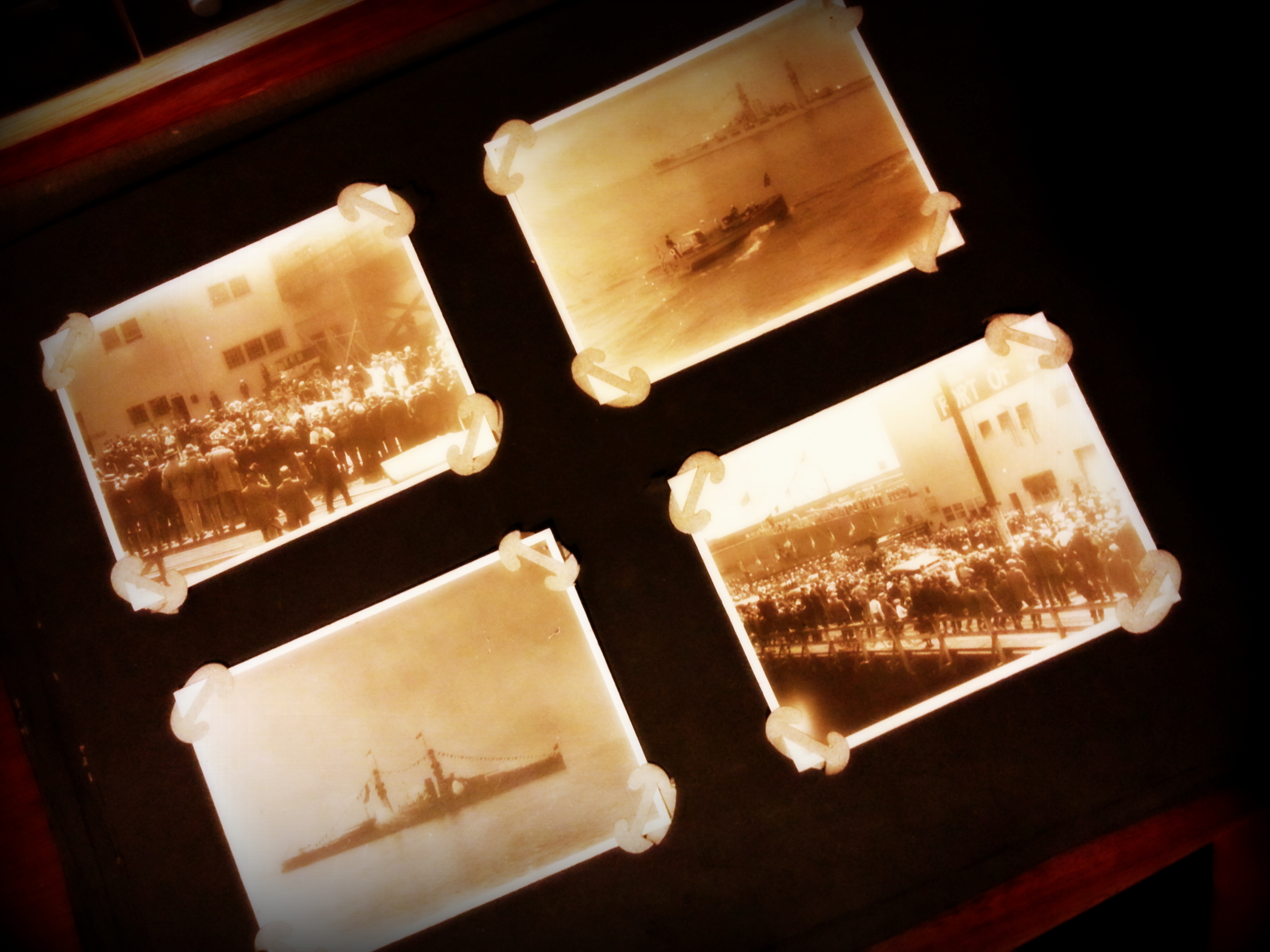
A single page from my Grandmother’s precious photo album
Retouching faded or damaged family photographs can become a labor of love.
Perhaps the finished product is meaningless to people outside of your family. Maybe to some within your own family as well. But somehow, you become obsessed with it because in spite what others feel, you know in your heart it is important… and perhaps more important as the years roll by.
Family members come into this world, live, then pass on. How did they live? Where? What was it like “back then”?
That’s my mission. To leave hints of what it was like for my descendants as well as interested family.
To let others see what “they” looked like. How “they” smiled. How “they” grew up.
________________________
The first snapshot above is but a page from my Grandmother Kono’s photo album.
Brittle pages. Photos that were lovingly pasted onto those pages by my Grandmother. Photos now eaten by insects. Faded. Damaged.
Now is the time. Restore and retouch. Hundreds of them. That’s the mission. Before all knowledge of their lives disappear.
They are disappearing today.
________________________
Having but free software, the retouching being done is surely amateur. Basic at the best. I wish I could afford professional software but then again, there would be a tremendous learning curve. Make do with what you have…as “they” did.
And when you finish one photograph, you receive gifts. Gifts of seeing what would have been lost. Lost to their descendents forever.
Here is one example from that page:
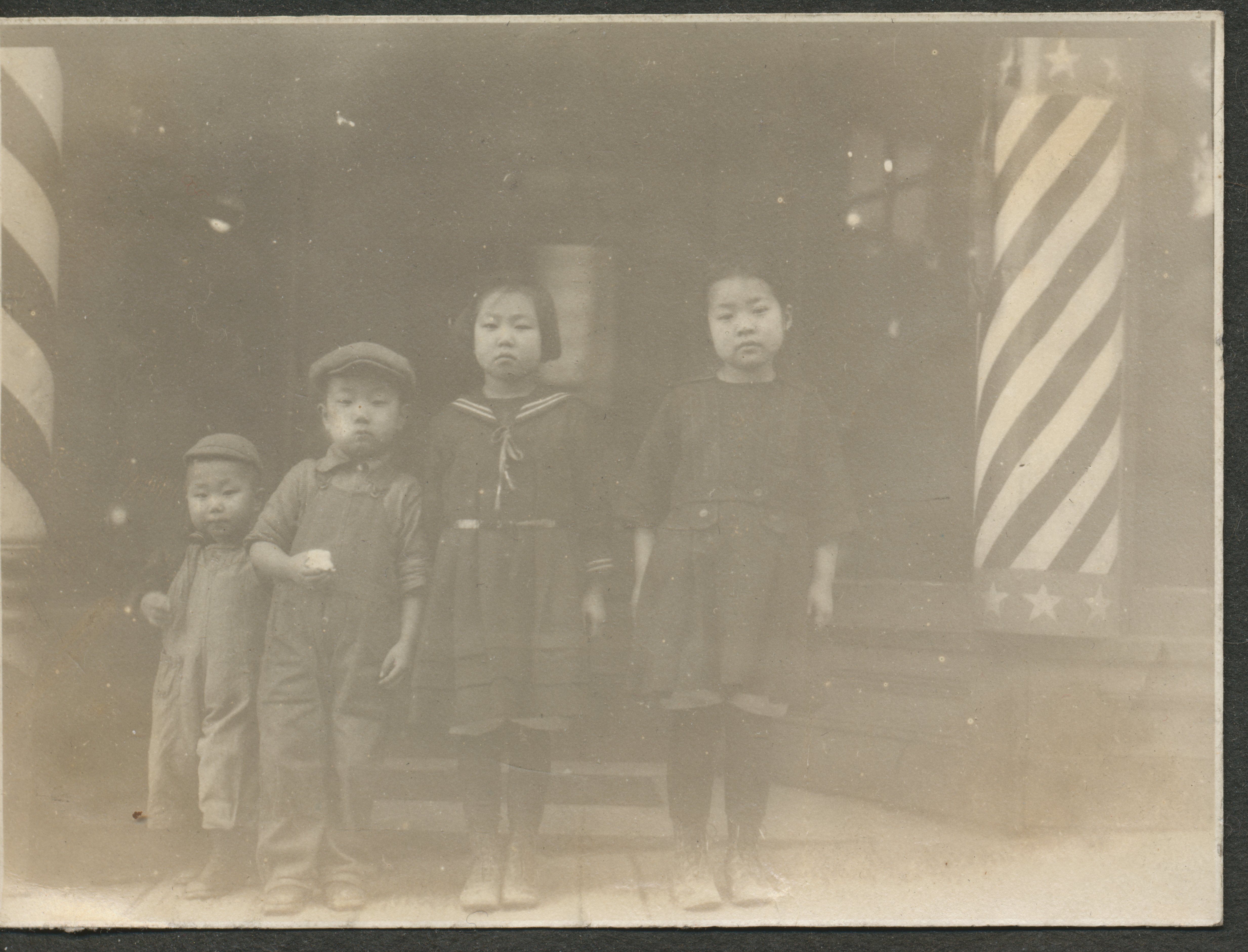
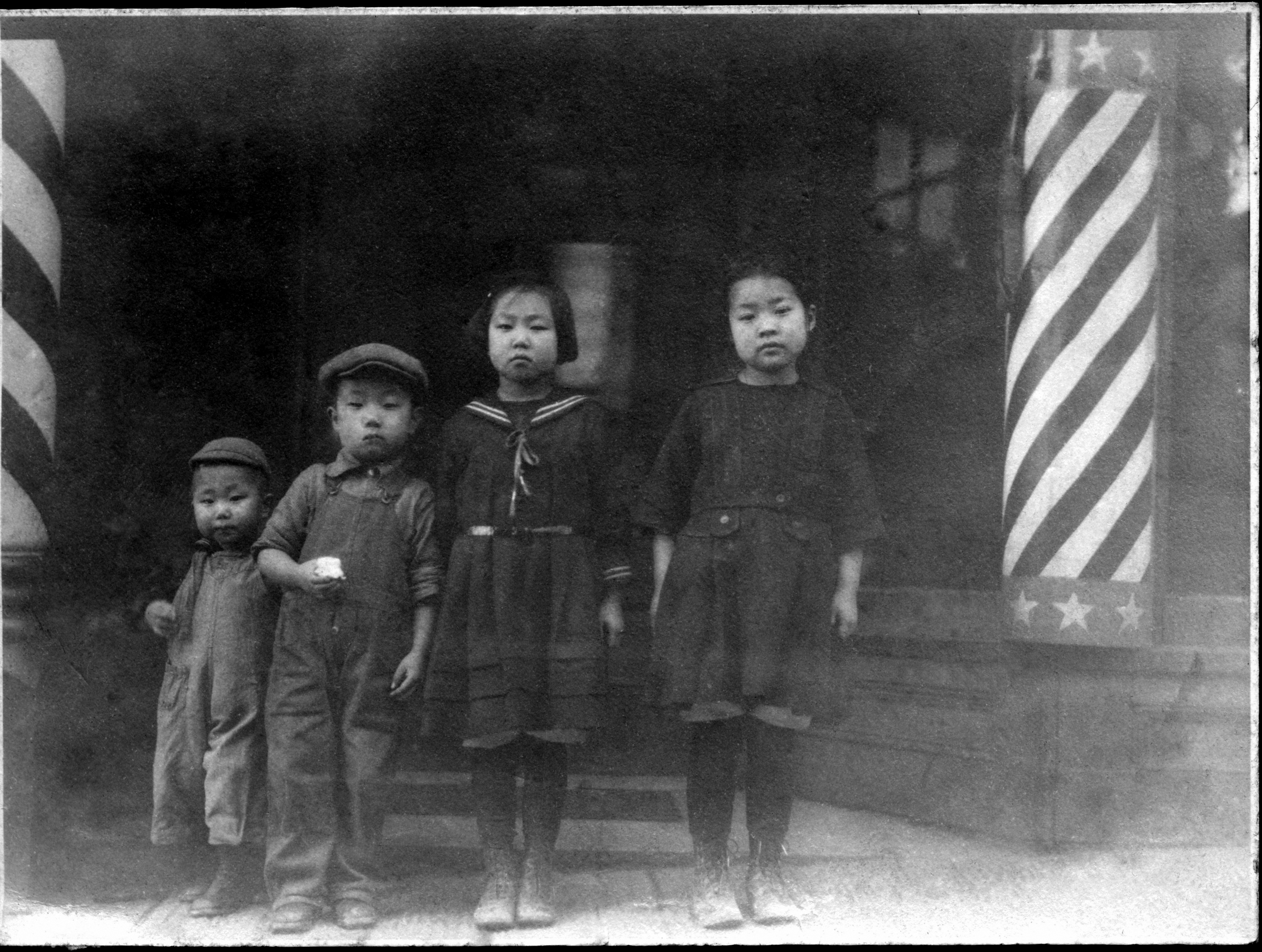
(L to R) Suetaro, my dad, Aunt Shiz and an unknown friend. Circa 1923 at 620 S. King Street in Seattle, WA.
While the detail is surely not “lost”, it is hard to make out things. The print is small to begin with; a quarter was placed for size reference.
But after restoring and retouching, some fun things come into clearer view – especially if there is a companion print to compare with:
In another pose on the same album page, you can see both my dad and Suetaro were holding food in their hands and dad had a bandaged thumb. Here, after restoration, you can more clearly see the food but it blends into his bandaged thumb which would have been hard to separate. I’m pretty sure Dad is eating an “onigiri” or rice ball, likely wrapped in seaweed. Uncle Suetaro had already devoured his. Minor detail, yes. But now we have an idea of what Grandmother fed them in Seattle while growing up.
Aunt Shiz…well, it appears she would rather have been playing with her friend but we know she wore a uniform to school. And she has a hair clip. Berets for boys were in fashion, also, it seems. Funny as Dad doesn’t like to wear hats much. We also know that on that day, they wore very Western clothes…down to his overalls.
One barber pole is also different than the other. When dad saw this today, for some reason, he just proudly blurted out, “620 S. King Street”, and very happily. I think he was amazed at himself for remembering. But the confirmation of the address came from retouching the print. He also said, “That’s wood (referring to the sidewalk),” implying he doesn’t remember a wooden sidewalk. But I mentioned to him it was cement when you look at it carefully and he was happy that he wasn’t a “pumpkin head”.
From this retouched print, Dad also added one startling comment out of the blue. He said a number of “hakujin”, or Caucasians, came to the shop, even though it was in “Japanese Town”. I asked him why. His reply was, “I don’t know… but Japanese are more attentive, I guess, than the other barbers…especially in shaving.” I know what he means.
________________________
So all this “stuff” came from retouching a faded photo… Things that would have been otherwise lost. Face it. Dad isn’t the little boy eating that onigiri anymore. But he still eats like a horse. A good sign. Aunt Shiz didn’t feel like eating much the day she quietly passed away.
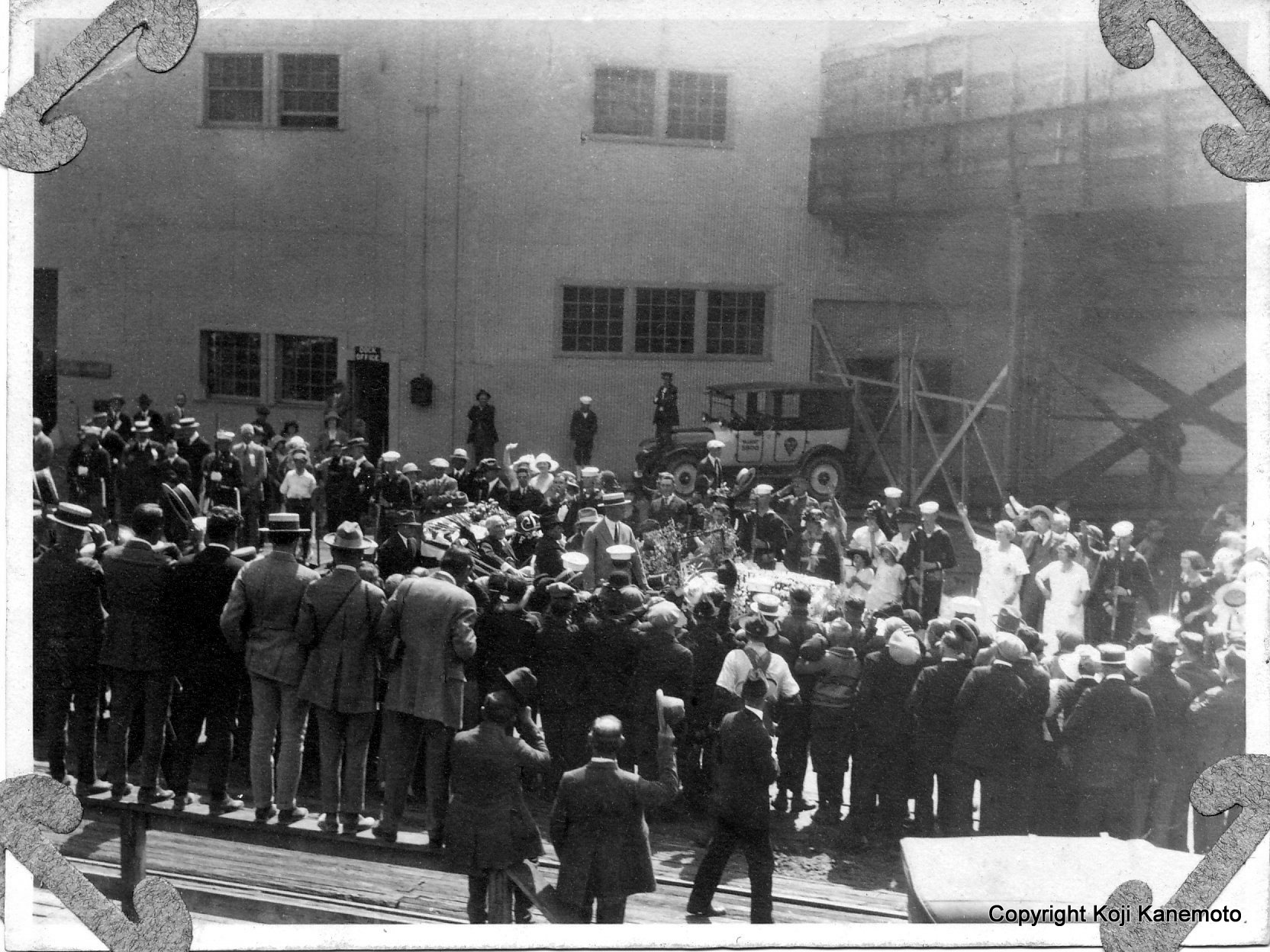
Yes. President Harding’s last photos in my grandmother’s album.
OMG. Leave it alone!
________________________
I found a copy of the actual event flyer from July 1923.
Now we can see an overview. See what the Bell Street Pier looked like when President Harding rode in his motorcade.
You can make out train tracks. Look at the far left – you can see the window locations on the building and…a pole. You can also see blackness under what appears to be a short bridge and a railing that abruptly ends. Important stuff.
The “PORT OF SEATTLE” with “BELL STREET PIER” signage can be signage can be seen at the far left.
Upon studying “Grandma’s” photos further and in comparison to the “press” photo (below), I feel BOTH were taken within seconds of each other – but from opposite side of the motorcade. Please note my scribbles:
“Grandma’s” on top, “press” below.
And note the following obervations:
Pole – also painted white at the bottom;
The prominent roof of a car (circled) parked along the pier and next to the pole;
The group of four men marked with the proverbial “X marks the spot(s)”;
The wooden railing in both of Grandma Kono’s photos; and,
The US Marine Corps on one side of the motorcade, the US Navy on the other.
Amazing. These are two rare images taken from different sides of President Harding and within seconds of each other.
BUT…….
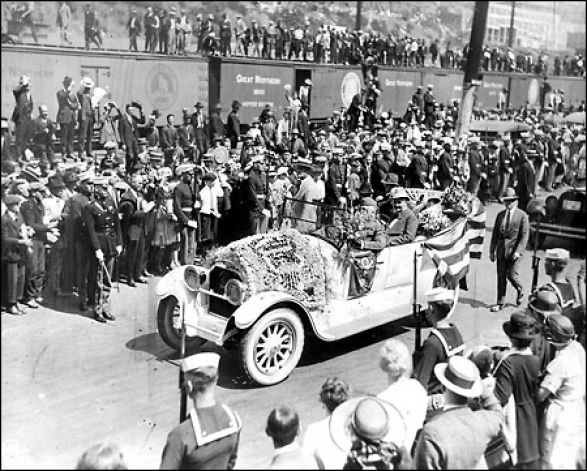
With the flyer image, we now know train tracks ran along the pier. Trains are also visible in the press photo. There are MEN atop the rail cars.
Due to the angle, it is believed the photos in Grandma Kono’s album were taken from atop the rail cars. Off to the left just outside the field of view in the picture (just like the grassy knoll in the famous Zapruder film of JFK’s assassination).
Ergo, I cannot fathom Grandma Kono climbing atop a rail car…let alone in a dress as was customary at that time for ladies.
It was hard not to get caught up on the surprising photos Grandma Kono took of President Harding.
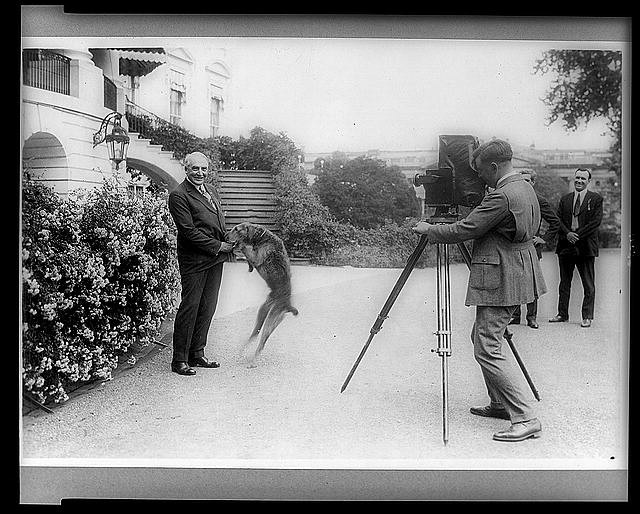
Taken in 1922 at the White House.
July 27, 1923.
Six days before the sudden death of President Harding.
I just couldn’t deny my natural tendency to research…with no goal to speak of.
And while I have hundreds of other vintage family photographs taken of up to a century ago to scan and retouch, I just had retouch President Harding’s pictures. To bring back the excitement of that warm day in Seattle.
I was a bad boy.
And this story is unexciting unless you are into the past…and into a family’s past as well.
__________________________
It was most fortunate Flickr friend, US Navy veteran and author M. Shawn Hennessy (author of “Freedom’s Fortress“) offered assistance without any prompting. What a guy…especially since he is on the mend after a bad spill on his bike. He is sure to make a lot of friends with the TSA getting through airport security now.
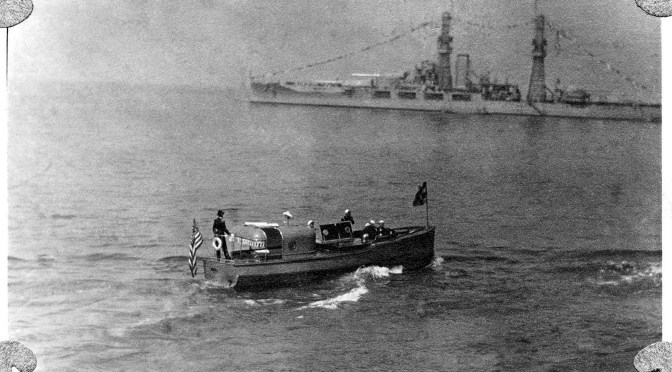
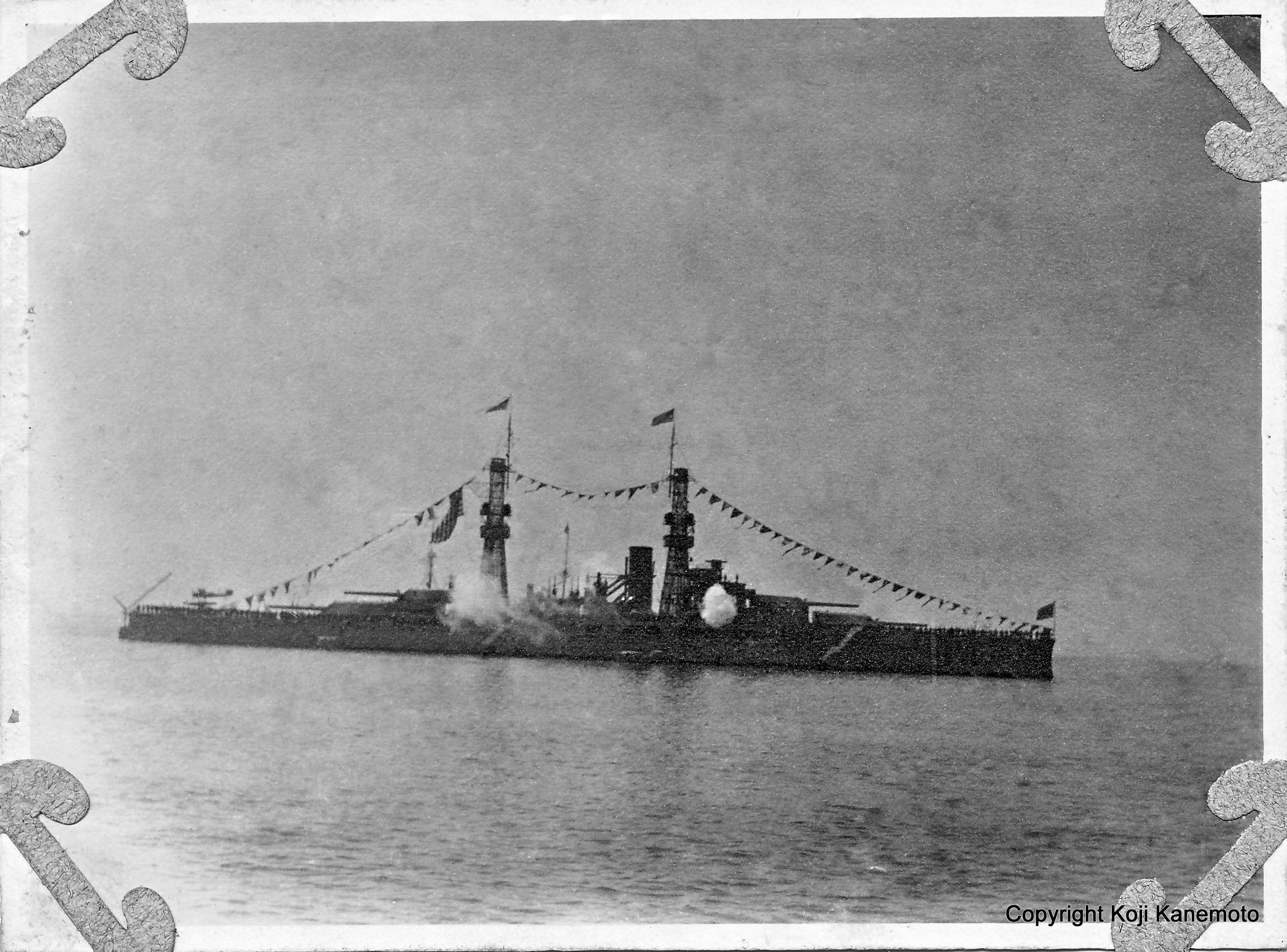
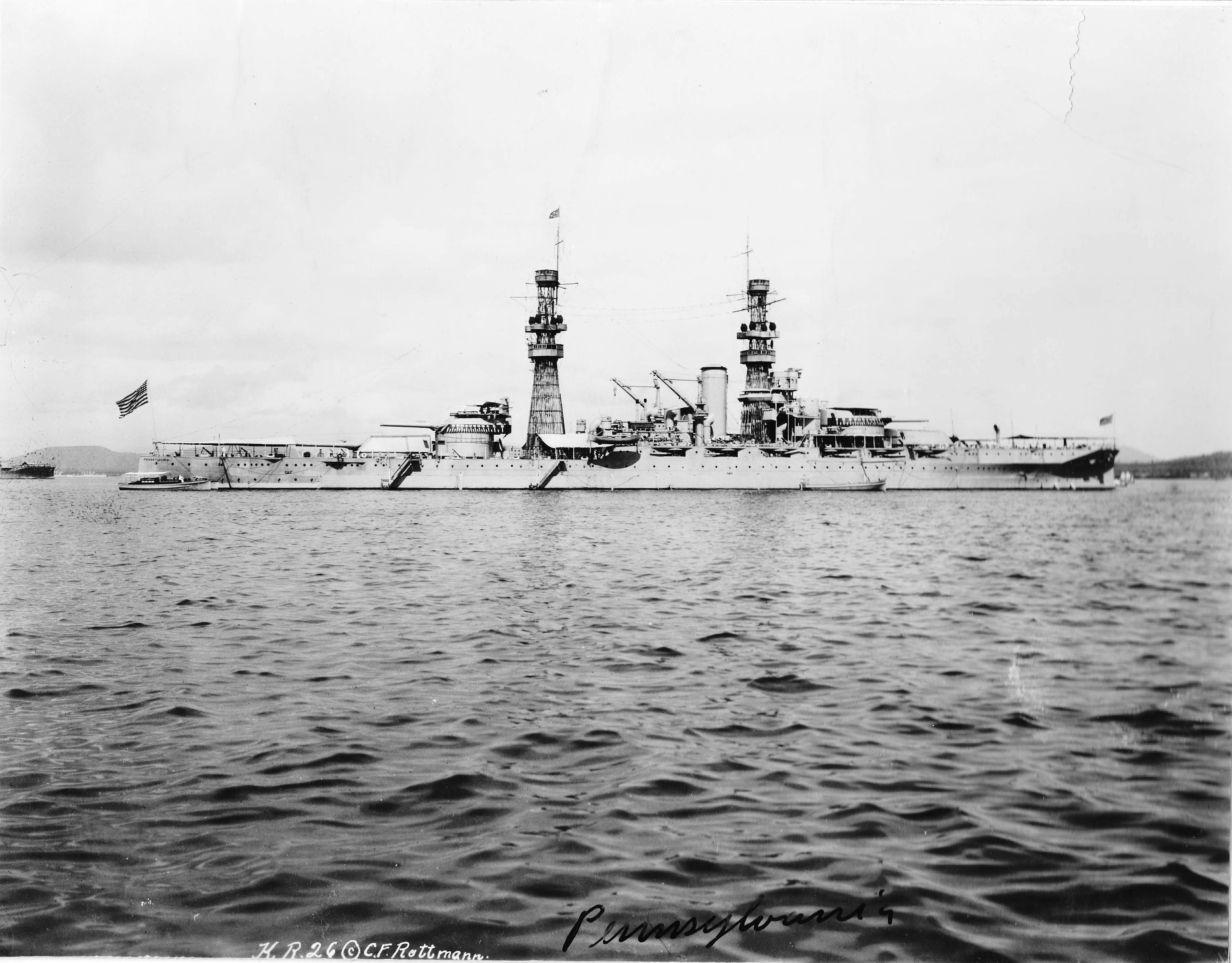
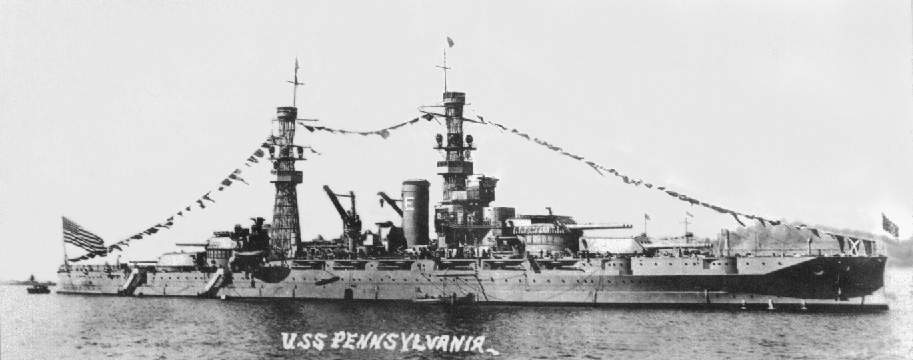
After some researching on his own, Shawn classified the battleship in Grandma Kono’s photo album as one from the Pennsylvania class.
After Shawn’s assist made it easy, she was identified as BB-38 – the USS Pennsylvania. Interestingly, another battleship, the USS Idaho, was part of President Harding’s naval review – not the USS Pennsylvania. It appears that President Harding boarded the USS Pennsylvania in Puget Sound for dinner although she was a frequent visitor to that area.
Grandma Kono’s picture as retouched:
A couple of vintage naval photographs of the USS Pennsylvania on the internet for comparison:
Archival photographArchival photograph
(Note: After FDR signed the Executive Order to imprison Japanese citizens on the west coast after Pearl Harbor, the FBI went into many private homes in search of “spy material” which definitely would have included any happenstance photo of the military. It would be interesting to contemplate of what may have happened if my grandparents had remained in Seattle and the FBI came across these photographs in their home after Pearl Harbor.)
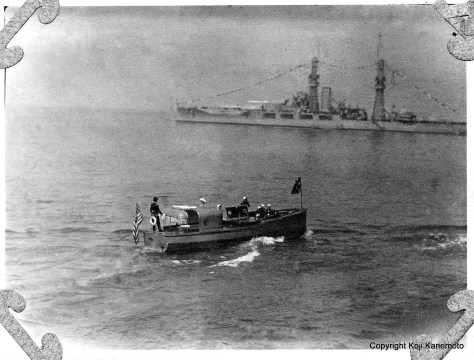
Her other picture of the USS Pennsylvania as retouched. The shuttle does not have a civilian standing at aft as I previously noted. We now see that he is a naval officer with his cocked hat and shoulder paulettes.
Admiral’s Barge
The photos in Grandma Kono’s album of President Harding’s motorcade were taken from a distance – not streetside. That would become an interesting point.
The retouched photos in Grandma’s album; in the first image, the limousine is between the US Marine Corps recruiting truck and a car’s rooftop. Shawn identified the ship at dockside as the destroyer USS Hendersen:
The closest view of the President in Grandma Kono’s album as retouched.
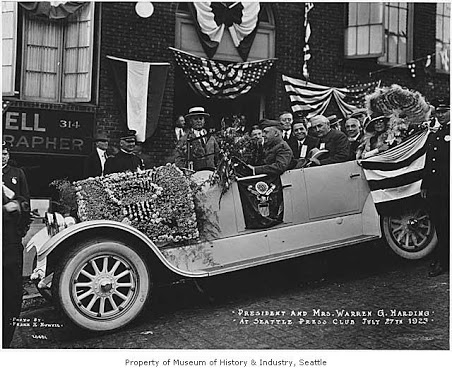
In scanning the internet, Shawn and I came across a few “press-type” professional photographs of the event; they were mostly taken from streetside. Up close and personal. The best image showing the details of President Harding’s limousine – down to the carpet of flowers on the hood – and the First Lady’s hat found by Shawn on the internet:
A professional press photo
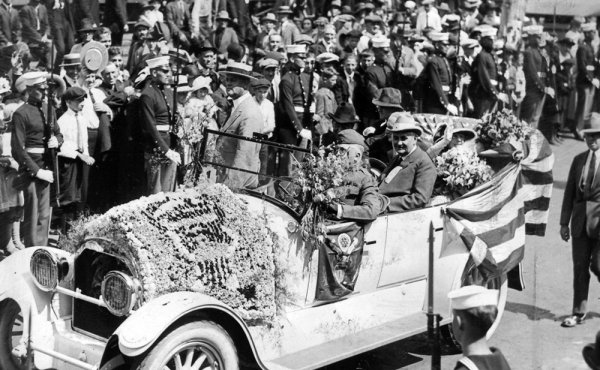
Another view:
Scan the bystanders. This is also a cropped image of the next photo.This is the uncropped image of the previous photo. Scan the bystanders.
If you enlarge the images and scan the bystanders, I did not see one individual with a camera to his or her face. Many of the males were doffing their hat with one hand which further decreases the number of individuals capable of taking a photo.
As for the cameras of that time, they would have been of the collapsible bellows type or an early Brownie – which would have been literally a box with a small hole for the lens. Both required two hands to operate properly. In the family photos while camping somewhere near Seattle, I noticed a bellows-type camera. Also important to note that is it was unlikely her camera would have been a Speed Graphic (4×5 film requires a dark slide thereby too much time) or a TLR (square negative with a reverse image in viewfinder). It would be more likely she used 620 or 127 film in my opinion.
_______________________________
I also did not notice obvious non-whites in the crowds.
The significance of seeing only Caucasian bystanders? Perhaps minorities may have decided to not be in the way…or there was no interest…or had to work as it was a Monday. That leads me to the question of whether or not my grandmother was there to snap the pictures. If not, from whom would she have received copies of these pictures?
_______________________________
My conclusively unsupportable conclusions? That’s a sentence for sure.
No matter how you look at Grandma Kono’s pictures, they appear to be rare, personally taken photos outside of “authorized” photographs – military, government or newspaper. They also show the “ambience” of the event being taken from a distance.
I also believe Grandfather Hisakichi would have been unlikely to have snapped the photos if he were there. He was known to be strict and would have honored customs – like doffing his hat. That would remove him from have taken the pictures of the motorcade as it required two hands to operate a camera of that era. That leaves Grandma Kono – IF she was there.
Lastly, I believe the film used was either 620 or 127 (or similar) and not large format. It is further supported by the print size (roughtly 2-1/2 x 3-1/2). That would tend to support the belief that the photo was taken by an ordinary bystander and not a professional photographer. It was also not taken by a Speed Graphic.
_____________________________
Hmmm… After all this research, should I have been doing something else after all?
All I know for sure was that the photos of President Harding were taken on July 27, 1923 at the Bell Street Pier in Seattle.
That he was already ill.
That our 29th President would be dead six days later.
That I couldn’t spot any civilians snapping a picture.
And a desire to believe my Grandma Kono took these rare pictures of President Harding.
The last few privately taken photos of an American president before his death were in an old Japanese lady’s photo album.
My grandmother’s.
________________________________
These four photos had intrigued me. They had caught my eye earlier but there were other precious photographs to scan and retouch.
But the curiosity killed this old sourpuss.
I had to scan them… and there were fantastic discoveries.
_______________________________
President Harding, our 29th president, arrived in Seattle on July 27, 1923. He was on a 40-day tour of the Western United States.
He would pass away just six days later.
_______________________________
After collaborating with a flickr buddy and author, Shawn Hennessey, we came to the conclusion that this indeed was President Harding’s motorcade at the Port of Seattle. Of course, we will never know for sure who took these photos but they are of the same size and finish of many of Grandmother Kono’s other photos of that time period. Still, they are remarkably an incredible capture historically.
They are unretouched. I thought they look better as-is.
A shuttle bears the colors and a civilian stands at the aft. US Navy sailors are at the fore.Shawn Hennessy believes this to be a Pennsylvania class battleship due to the single stack. President Harding did review the fleet in the harbor (about 50 ships).
You can clearly make out the Port of Seattle signage with the beginning of “Bell Street Pier” on the building. Note the US Marine and US Navy color guards. It is likely President Harding’s destroyer that is docked at pier’s end. The blanket of flowers can be seen on the hood of the President’s limousine, too.
Motorcade begins
The President can be seen closer below. Of note is the agent standing on the limousine’s running board – or more specifically, his clothing. Compare his clothing to other images you can find on the web. You will see gentlemen doffing their hats to the President as he passes by.
President Harding. He will pass away six days later in San Francisco.
__________________________________
Just a glimpse into American history – from a Hiroshima photo album.
I hope you all won’t mind if I feel Grandmother Kono took these pictures in 1923.
One of the finds from the 100 year old shed were photos from my Grandfather Hisakichi’s barbershop. It would appear these are from about 1917 through 1930.
His shop was in the Hotel Fujii at 620 South King Street in Seattle, WA. Being raised here in America, it is not only striking to see my grandparent’s barbershop but it is so unlike those of other barbershop photographs of that time being manned by “non-Caucasians”. Is that best way of putting it? You can see the hair tonics that were used as well as the Koch porcelain barber chairs. Through the help of my friends interested in WWII history, we believe the calendar indicates shows “Thursday, October 9, 1930”.
Grandfather Hisakichi is at right. Due to the blur, we are uncertain if the lady on the left is Grandmother Kono…but the gal in the center is very attractive.
In this picture below, a “no nonsense” Grandfather Hisakichi is holding my Aunt Shiz; this would put the photo as being taken in 1917.
According to my dad a couple of weeks ago, Grandfather would work the shop by himself during the slow times but would bring in others as the season changed. They lived upstairs in a room at the hotel.
It is difficult to imagine he supported the family with this one barber shop but you would think he worked hard and was a sound businessman in a foreign country.
Oh… Since WWI was raging, he registered for the draft.
In the past several years, as his dementia progresses, Dad is repeating many times how he broke his elbow as a young boy… “Many times” like as in every four minutes. No…every two.
I thought, “He doesn’t remember he ate like a horse ten minutes ago… How can he remember something that happened 80+ years ago?”
Well, I just HAD to find out about his story… and I did.
_______________________________
The story (which never varies) is/was he was playing “oninga”, or tag, with the neighborhood kids. “There was nothing else to do then,” he would tell me. They would end up in the yard of 正覚寺 – pronounced “Shoukakuji” – the Buddhist temple which is a hop, skip and a jump from his home. No wonder he excelled in the triple jump at Nichu.
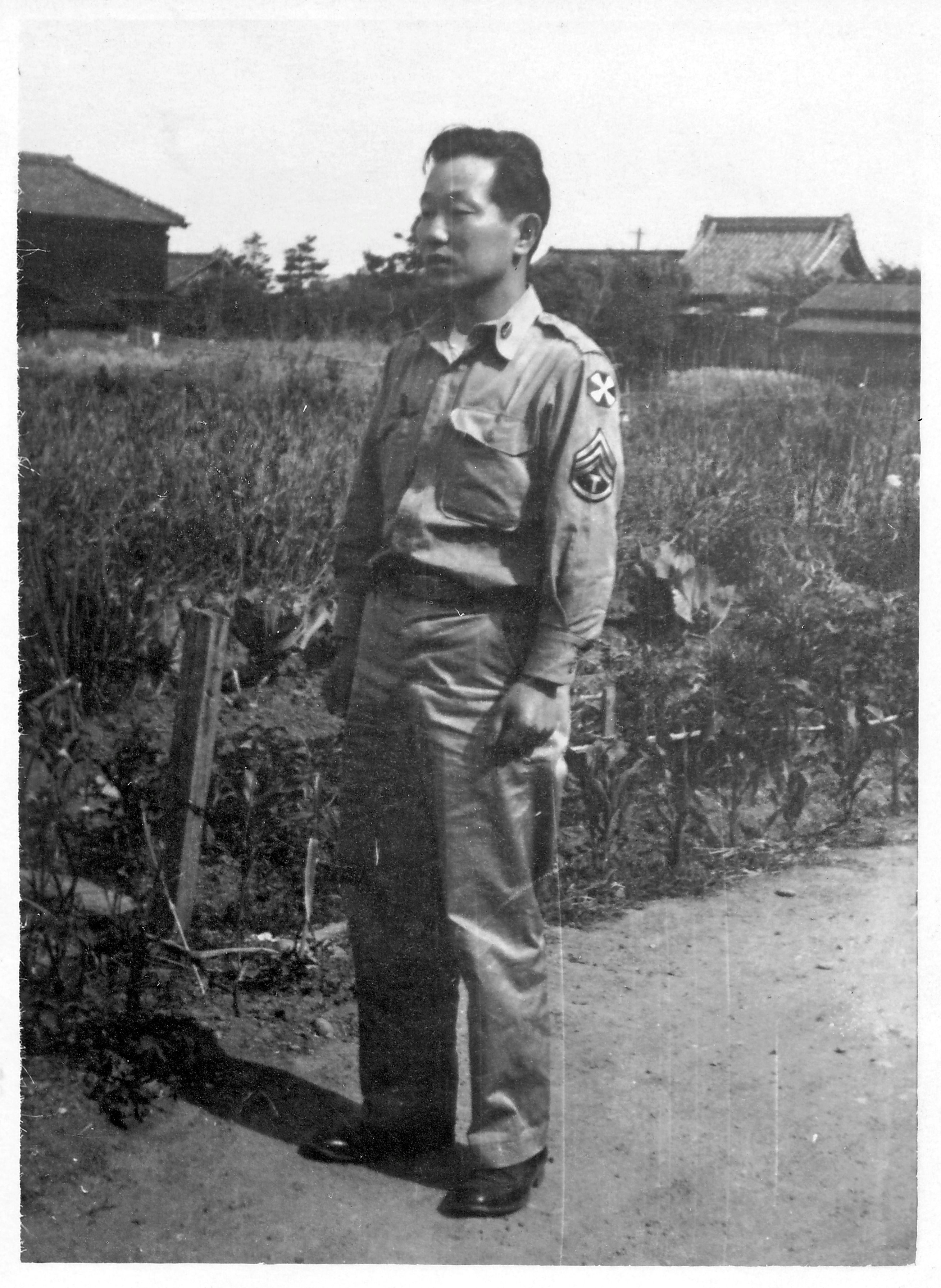
You can see a tiled roof on the tallest structure to the right of him. That is 正覚寺.
The tiled roof of “Shoukakuji” can be seen behind and to the right of Dad in this 1948 photo. He is standing alongside his childhood home.
For those who like visuals:
Satellite view of home and Shoukakuji, 2012.
He would tell me (over and over) that while playing tag, “…I tried to get away so I jumped on this big round stone then leaped up to a branch on big a pine tree in front of 正覚寺.”
Now that I know he did the broad jump at Nichu, I thought this jumping thing was therefore plausible. (Did I mention I’m a writer for “Mythbusters”?)
“Trouble is, I jumped too far so my hands couldn’t grab onto the branch. I slipped off the branch then broke my elbow when I hit the ground”.
OK. So now, after “An Atomic Spark From a 1937 Yearbook“, I also know he excelled in the triple jump at Nichu. Plausible. (See… More proof I am a writer for “Mythbusters”.)
To this day, he cannot completely straighten out his right arm. It’s crooked. He now tells this story to my youngest kids, Jack and Brooke… Every four minutes.
______________________________________
On September 7, 2012, I had to know. Off to 正覚時… But unlike my agile father of the 1920’s, I was walking very gingerly. There were four humongous blisters on my toes from walking in Japan and (from being tricked into) climbing Mt. Misen on Miyajima.
The sign at the entry gate, or “mon”. Shoukakuji’s middle character is written with an old Japanese character.
Indeed, there was a Japanese pine tree, or “matsu”. A huge one. You couldn’t miss it as you walk through the “mon”, or gate. It was so huge, the temple had steel braces installed to help hold these majestic branches up.
Steel posts and braces were installed to help hold up these ancient branches.
Off the to right, was the base of the tree. A puny trunk in relation to the Goliath branches… It was hard to believe at first this small trunk was the heart for this proud tree.
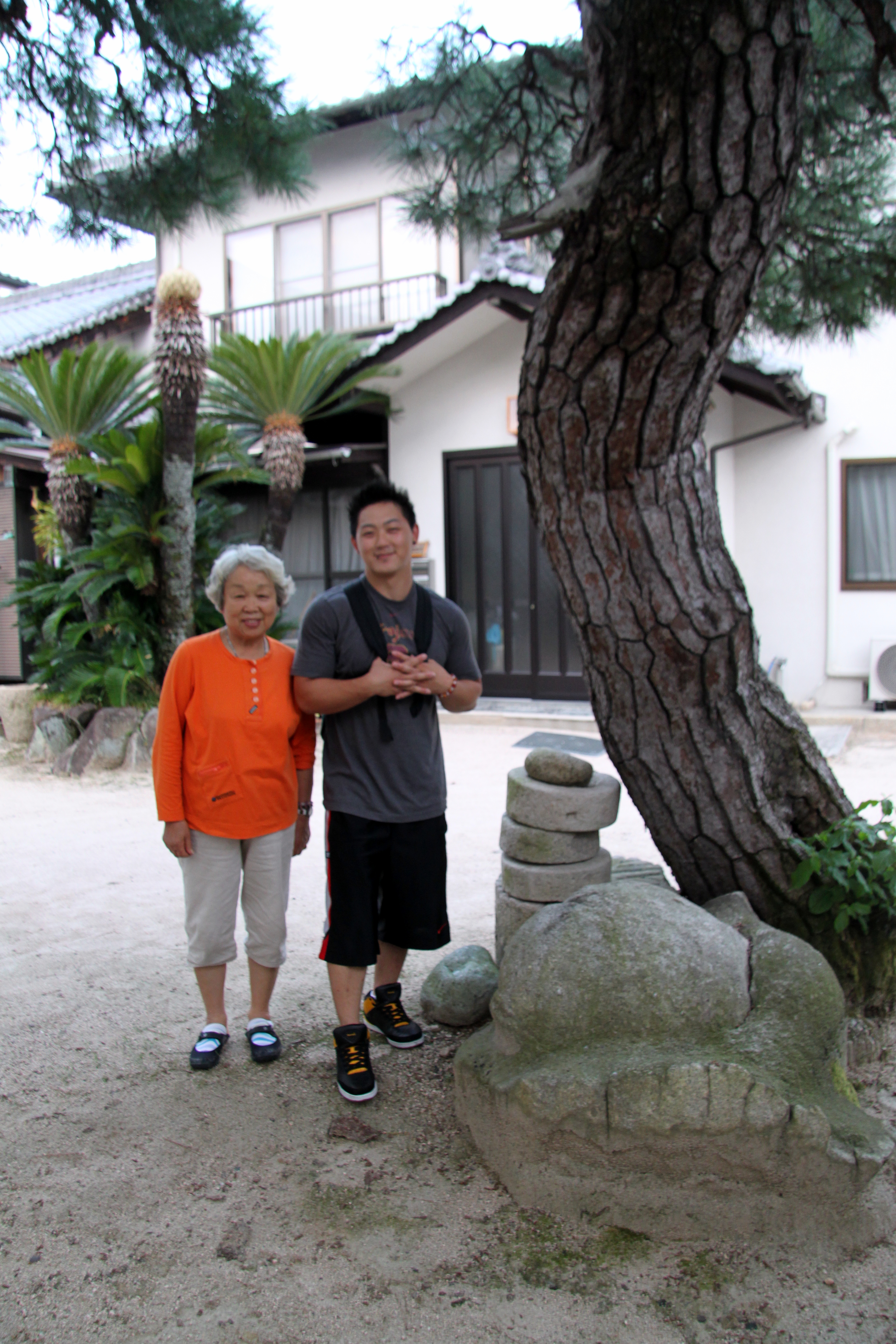
Then… at the base… was a large round stone. Could it possibly be? Plausible as we don’t know how long the stone was there… Am I tough?
Masako and my son Takeshi stand next to the large round stone and pine tree made famous by my father some eighty-plus years ago.
But where’s the branch my father jumped for? Myth: Busted!… or so I thought.
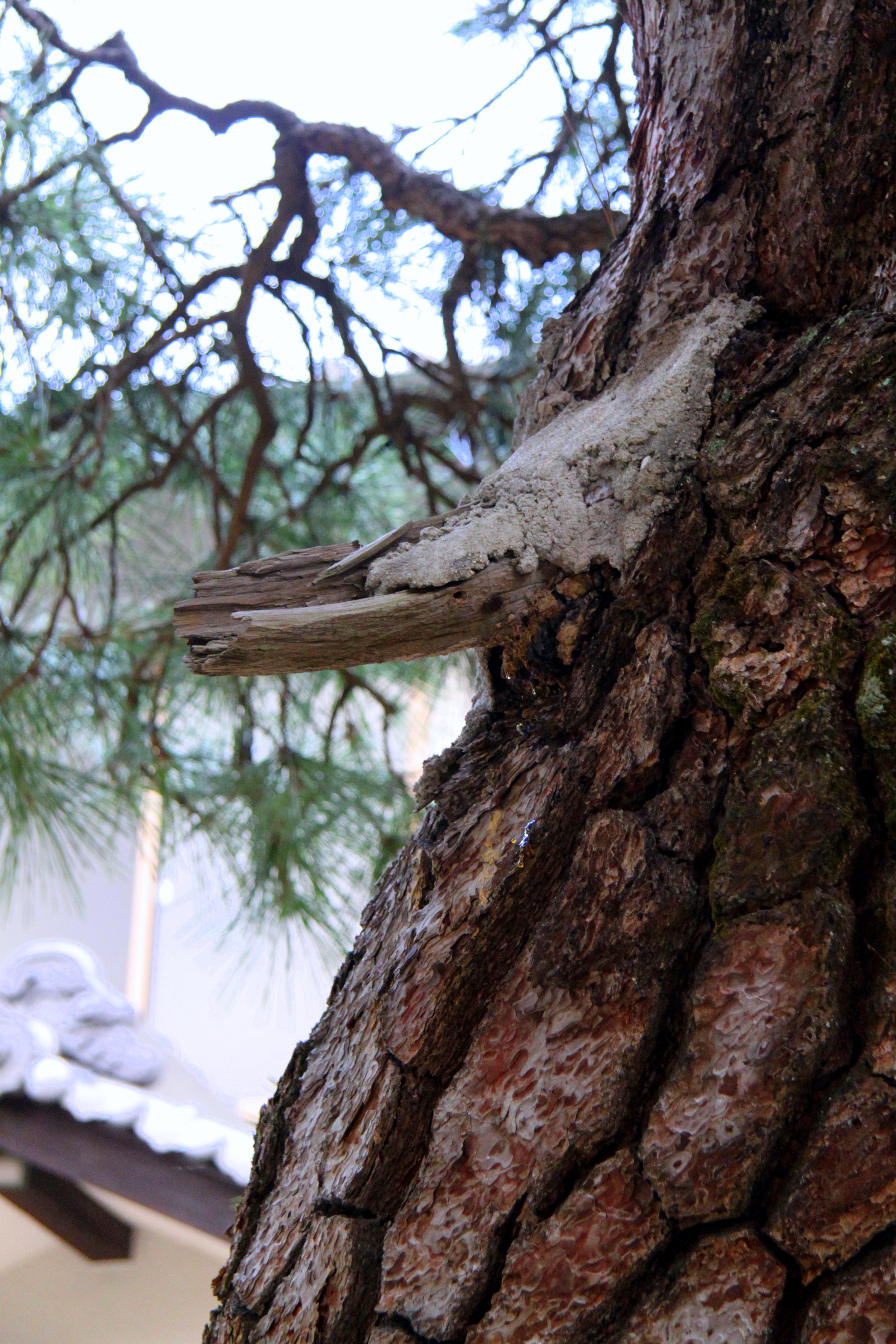
Then we saw it. Above my son Takeshi in the picture. The base of a broken branch. It was at the right height! OK… Myth: Plausible.
Here is the branch that Dad supposedly leaped for 80+ years ago…but fell and broke his elbow.
But conclusive proof was just beyond reach. There was no evidence as to age of the tree or how long the stone was there…
Then, as if Aunt Shiz summoned him, the reverend of 正覚寺 came out…with his wife. He was about 90 years old. Almost as old as my dad but he still had his wits about him. Thank goodness.
He told us he didn’t know my father personally…but that he played with Suetaro and Mieko, Dad’s youngest brother and sister! He knew Suetaro well, he said. He listened to Suetaro blow on his flute from the house in the evenings.
My Japanese wasn’t good enough so Masako stepped in… She explained to the elderly reverend how my dad (her uncle) had jumped from a large round stone at the base of a pine tree here 80+ years ago and broke his elbow.
Masako is mimicking my father’s broken right elbow and his story while my son Takeshi and cousin Kiyoshi watch. Kiyoshi was pointing to the stone to supplement the story.
Unbelievably, the reverend said with pride, “The pine tree is about 400 years old…and that stone has been there for as long as I can remember. It hasn’t been moved, either.”
Then the wife said that a number of years ago, the branch had broken off but it was very long. Then after it broke off, “…a swarm of bees made a home inside. We had to seal the crack unfortunately,” to account for the mortar on the branch.
Was his story a myth? Busted? Plausible? Confirmed?
Myth: Confirmed.
Dad wasn’t imagining ANYTHING. His memory is intact from that time.
A young Grandmother Kono takes a modeling pose in front of her Seattle barbershop. She cannot possibly have foreseen what the future holds in store for her.
The most wicked risk of a mother’s love for a child is loss, and the price of loss is grief… But the sheer passion of grief can become indescribable if a mother ponders on her decisions.
_________________________________
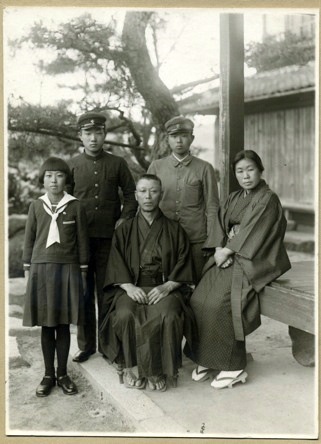
In Part I, we left when my father returned to Seattle to stay while leaving behind in Hiroshima his two youngest siblings and his parents. This was 1937. Before leaving, the family took this portrait with Grandmother Kono sitting on the sakura wood at the house. Suetaro is standing next to her:
One of the last portraits of the three siblings and my grandparents. Grandmother Kono is sitting on the sakura wood written about in “Souls of Wood“. Circa 1937
My father says that their younger sister Mieko was ill often. Indeed, she passed away in 1939 at just 15 years of age from an apparent kidney infection. Since my father was already in Seattle by that time, only his youngest brother Suetaro was left along with my grandparents. Most decisively, Grandmother decided Suetaro was not to return to Seattle when he turned 18. In “Masako and Spam Musubi,” she was very concerned over the harassment and intimidation she had received due to the threat of war against Japan. I also “feel” that Grandmother knew Grandfather was ill by the time she made the decision.
Sure enough, the very next year (1940), Grandfather Hisakichi passed away from stomach cancer. He was 59 years old. After raising Mieko for 15 years and marrying Hisakichi 31 years earlier in Seattle as a picture bride, only she and Suetaro were left in their home. War with America would start the following year. A war in which her three oldest surviving children called America home.
One family. One war. Two countries… One mother.
_________________________________
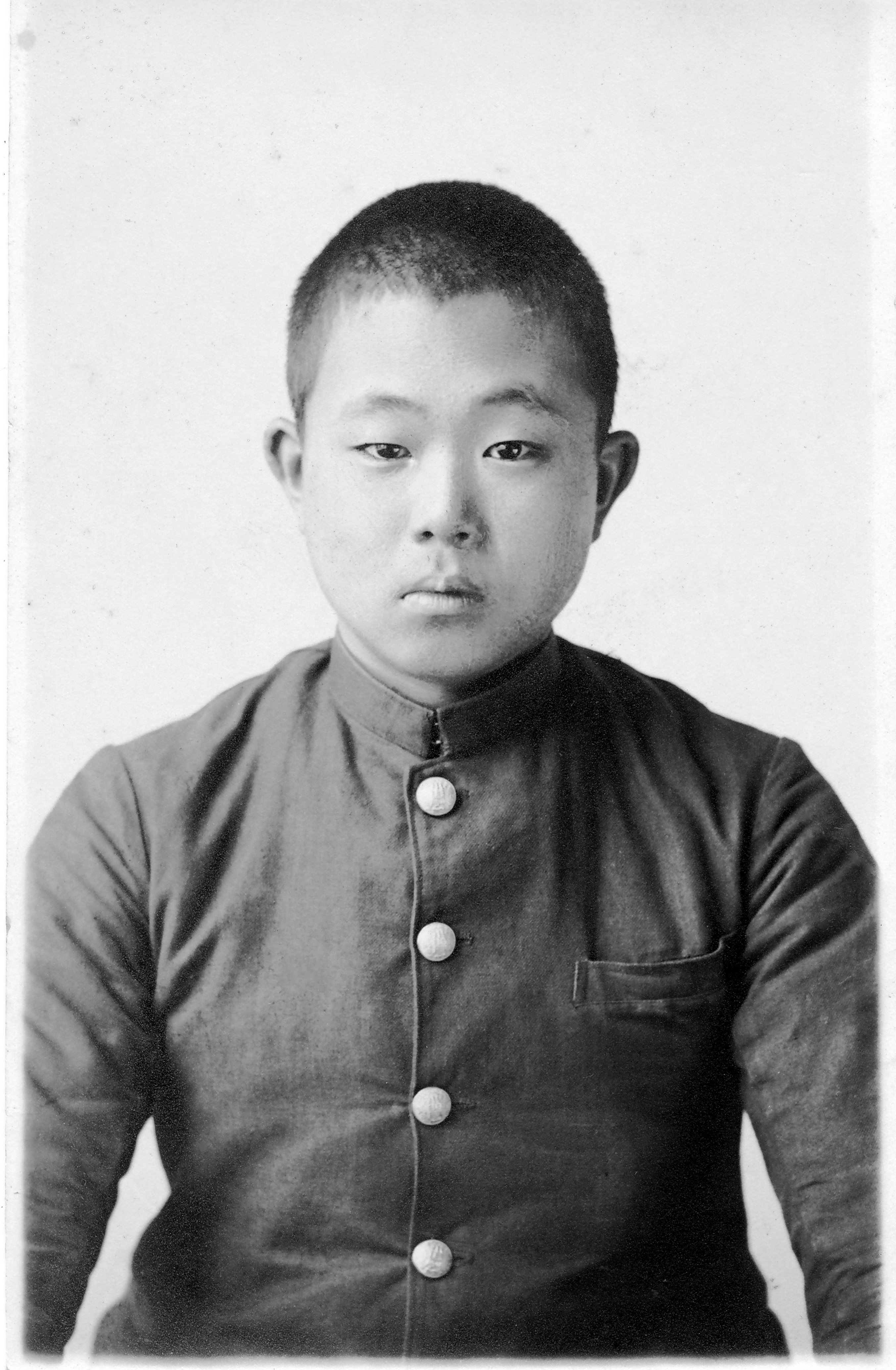
An undated school portrait of Suetaro. He looks to be about 14 years old.
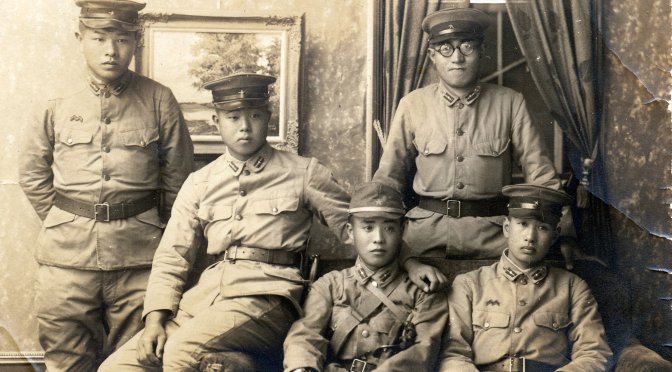
For reasons I have been unable to document, Suetaro became part of the Imperial Japanese Army. All Dad will say now is being taken by the Imperial Army was “part of life” back then. Below, he is sitting on the sofa’s arm to celebrate the young man in the center being sent to China’s Army HQs.
According to the handwritten date on the back, this photo of Suetaro below (on right manning a non-combat grade light machine gun made for training) was taken on May 10, 1939 at the “Hara Mura Training Grounds”:
Suetaro on the right. Dated May 10, 1939. I wonder what Grandmother Kono was feeling.
Here is Suetaro, perhaps in a posed photograph for PR purposes. It is of professional quality and taken on the same day as above:
Likely a professionally taken photograph of Suetaro. It was also taken on May 10, 1939 in Hara Mura.
I have a strong belief this was taken at the Fukuyama training grounds for his regiment, the 41st Infantry Regiment (unverified):
A proud looking Suetaro in his full Army uniform. I cannot tell if the handle on his katana, or “samurai sword”, is wrapped in silk or machine stamped. All military issued swords were numbered, by the way.
Another piece of his elusive history then emerged – but it was not from the 100 year old woodshed.
____________________________
Readers know that my Uncle Suetaro was killed in action as a Japanese soldier on Leyte. His regiment – the 41st Infantry Regiment – was annihilated by the US Army on Leyte. My Grandmother Kono was told he perished on July 15, 1945 – just a month before Japan surrendered. My father’s secret US Army unit, the Military Intelligence Service (MIS), had a direct hand in the high number of Japanese casualties – and the low number of American casualties. In other words, the MIS likely had a direct hand in the annihilation of Suetaro’s regiment. The MIS was comprised of Americans…of Japanese descent.
Dad as part of the MIS in post-war Japan.
It is not known if Grandmother knew of this fact. It would have been an overwhelming of her heart.
____________________________________
However, this is not a story on Suetaro’s life but about his life with his mother. In “Masako and Spam Musubi”, we know she had her second stroke after being informed by the remnants of the Japanese military of her beloved Suetaro’s death. The last Kanemoto in the family home was now… herself.
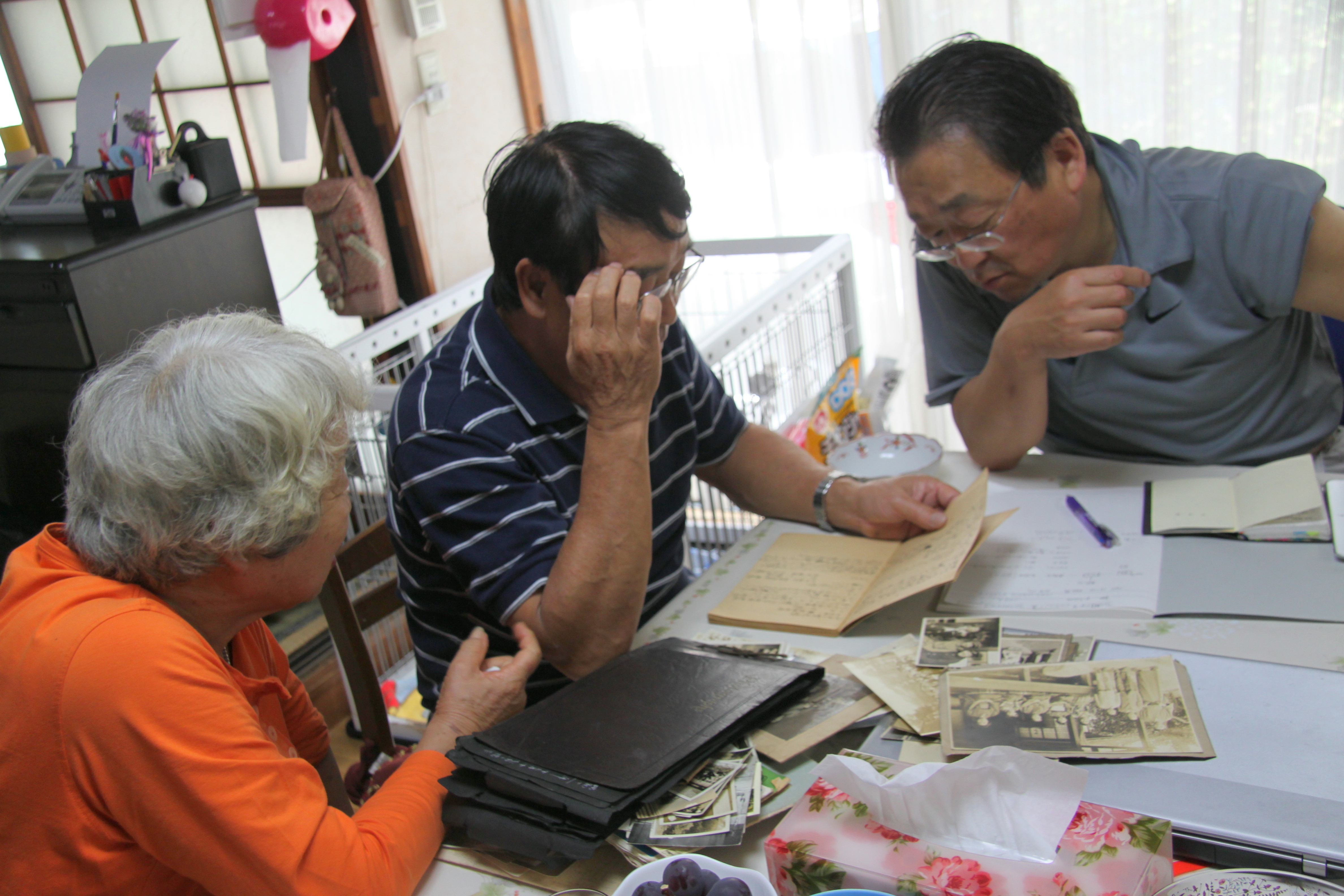
During my trip to the family home in September, my cousin Masako, her younger brother Kiyoshi, her son Toshiro along with my son were looking at vintage photos Toshiro uncovered just a couple weeks prior in the shed. A number were of Suetaro with my father and Grandmother. We were all quite emotional by then. Masako removed herself from the table; I assumed she was overcome. I didn’t stop her from quietly leaving thinking that.
Instead, she came back a few minutes later with something in her hand. It was a small notebook. Aged and frayed at the bindings. Her eyes were red.
It was Suetaro’s war diary. We were simply stunned. Masako had it secreted away. For decades. She chose to bring it out now. For closure. It was the right time.
Masako shocked all of us when she brought out Suetaro’s Army diary. (L to R) Masako, Kiyoshi and Toshiro, her son. The Kleenex box is there for my use.
It took us a few moments to realize what she had brought. It was brittle and smelled of old books. The paperstock was of low quality – more like newspaper stock – as paper was in very limited supply during the war years. We handled it as gently as possible.
The first few pages were of what he did during a short period of time; Suetaro’s writing was neat and in black ink.
Then the handwriting changed. Suddenly. It was hurried. Rushed. And in pencil.
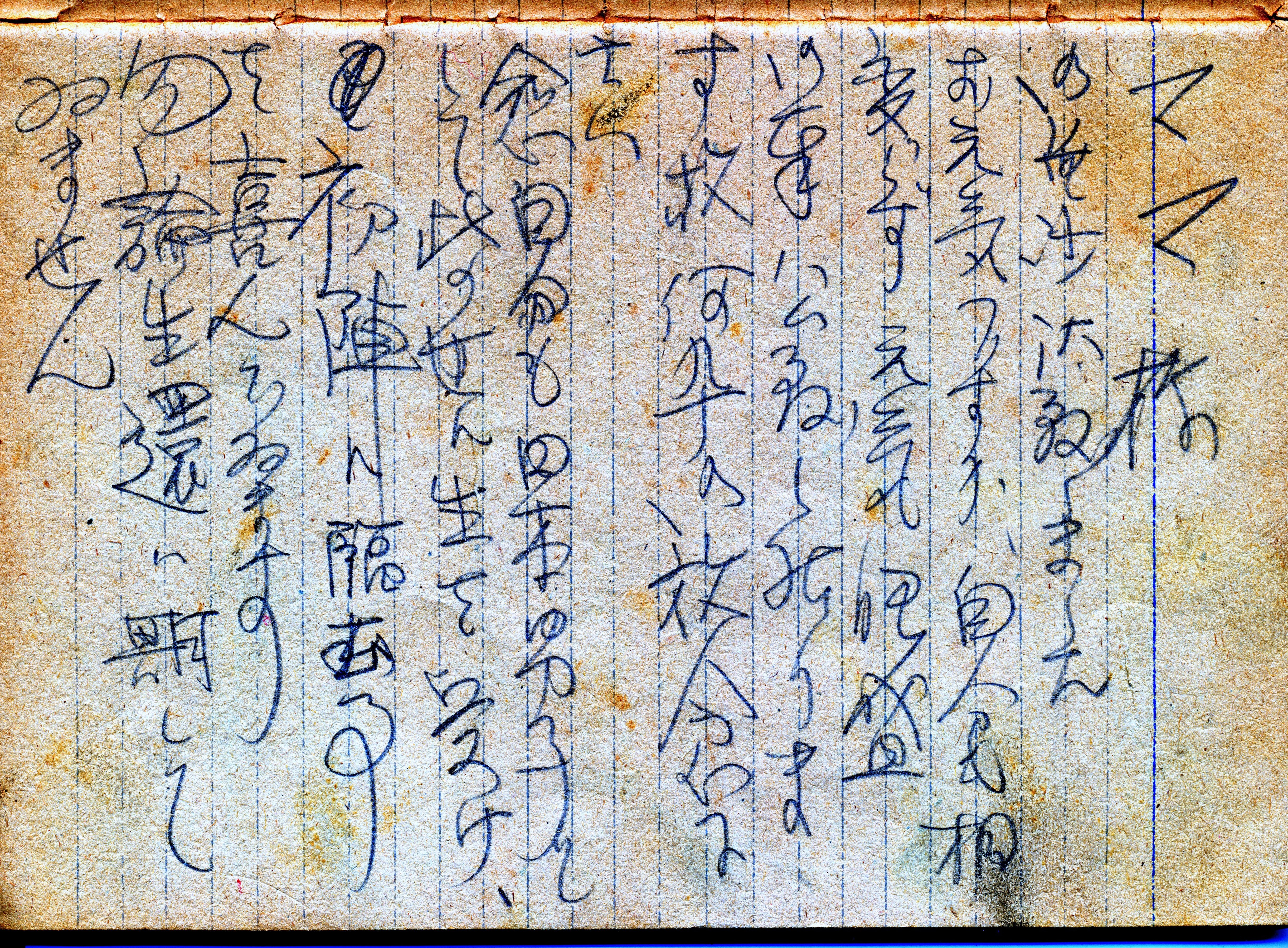
It was his farewell letter to his mother. My dad’s mother. My grandmother. It was dated March 3, 1944.
Kiyoshi is holding Suetaro’s farewell letter. It starts with “Dearest Mama” on the right.
Kiyoshi tried to read it; it was difficult as it not only was in his hurried cursive but in pre-MacArthur Japanese. Many characters are simply not used any more. Unused since 1945. Only a few people can read it – like my father. Suetaro’s brother. But we managed to read critical passages. I will include two pages as reference. However, these are very literal translations of a few sentences but needs be read in its entire context considering the environment was when he wrote this. It is easy to misunderstand or misconstrue his heart and soul at that moment.
Towards the left, it states, “初陣に臨むことを喜んでいます. 勿論, 生還を期してはいません”, or literally, “I am glad to be going to war and facing my first combat. Of course, I do not expect to be coming back.”
He writes, “今の時局は日本が起つか亡びるかの境です。どうしてもやり抜かねばいけないのです。兄さん達を救い出すことも夢見てます,” or “At this time, Japan is at the point of either winning or perishing. We must persevere as I still dream that we will free our older brothers.”
I stress this abbreviated presentation can be misunderstood. My interpretation is, “I willingly go to war for Japan as we are on the brink of winning or losing. By winning, Japan will free my older brothers from the concentration camps in the US.”
He will fight – and die – so that Japan will win. If Japan wins, they would take over the United States and by doing so, free my Dad and his older brother Yutaka from the concentration camp. At the time of his writing, both were imprisoned at the camp in Minidoka, Idaho after being relocated from Tule Lake, CA. (His nephew, Bobby, had already perished in Minidoka at the young age of six.) His older sister, my Aunt Shiz who passed away last month, was imprisoned at Manzanar.
Man, my eyes welled up. Everybody was in shock…even Masako once again.
_______________________________
I am unable to comprehend how my Grandmother must have felt reading that letter in 1944. Suetaro had secreted it away in the “butsudan”, or family altar. She had decided Suetaro was not to return to Seattle to join his elder siblings. Now, having read this letter, her regret must have been immense. Grief. She lost a piece of herself. A beloved piece.
Mieko had passed away. So did her husband in 1940. Now her youngest son writes he does not expect to return.
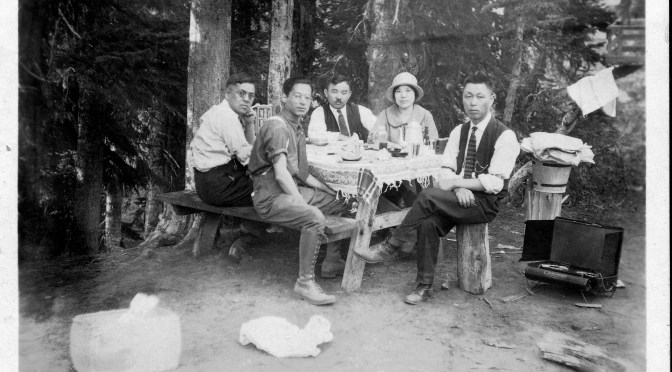
Could she have foreseen this fate while she happily stood in front of her Seattle barbershop near King St. and Maynard in Seattle in the 1910’s? I doubt it.
She would be alone. To ponder. To possibly regret to her last day.
A mother’s anguished solitude.
It is dated April 9th on the back with no year indicated. However, as my father took it when he was in the MIS, I will assume it is around 1948. Her face is worn.
They walked on it. They posed for family portraits on it. They passed away on it. It felt as if their souls were infused in it.
Although my ancestors have come and gone through that house for about a hundred years, the old sakura wood shared their souls with me.
______________________________________
Then:
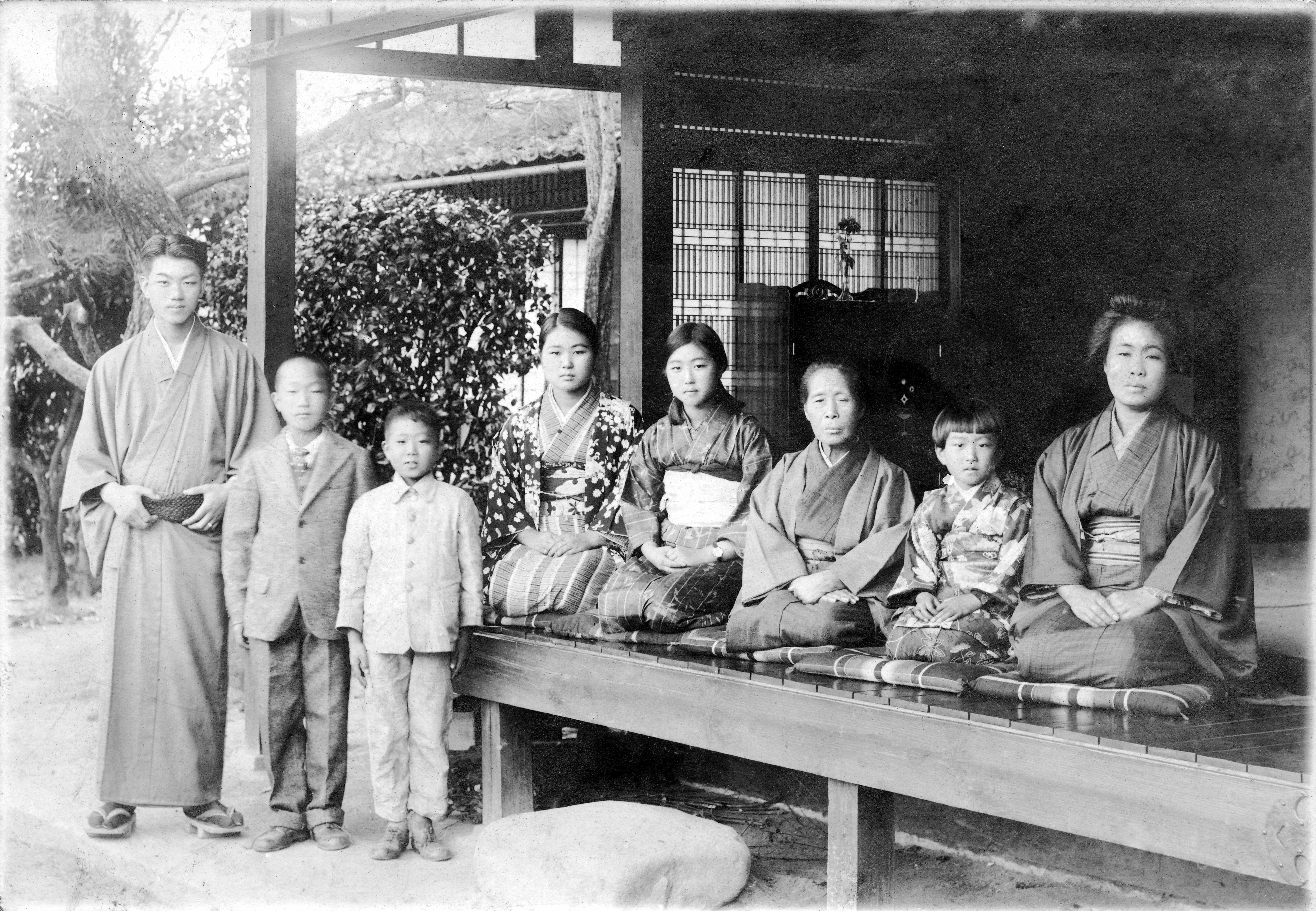
The Kanemoto’s sat on the cherry wood walkway for a portrait. Notice the glass paneling at the center-rear. My father (second from left) is sadly all who remains from that generation. Circa 1928, Hiroshima, Japan.
Now:
Although aged and weathered, the sakura (Japanese cherry) wood upon which my ancestors sat upon for family portraits is unchanged. Even the glass paneling in the background is the same.
____________________________
While I am certainly not in the construction industry, my father’s family home is based on the Edo design era. Generally speaking, they are built on stone foundations, with supporting square timbers and a raised floor. “Tatami” mats were used for flooring.
My father, while now 93 and suffering from dementia, fondly recalled the floor plan of the Kanemoto house…especially of the main room seen the family portrait. He said it had a “tokonoma”, or a small alcove alongside the altar, or “butsudan”. He also clearly recalled the floor space measured by the number of tatami mats used; in this case, “hachijyou” or eight mats.
This is the room in which my cousin Masako “saw” Aunt Shiz a few days before she passed away.
____________________________
The house was indeed damaged from the atomic bomb’s shock wave. This same shock wave shook the Enola Gay violently even while trying to escape the blast at about 30,000 feet altitude. She was 11-1/2 miles away.
The house is about 4-1/2 miles away by way the crow flies. Almost due west of the hypocenter. Masako was knocked down by the hard-hitting shock wave while in her classroom.
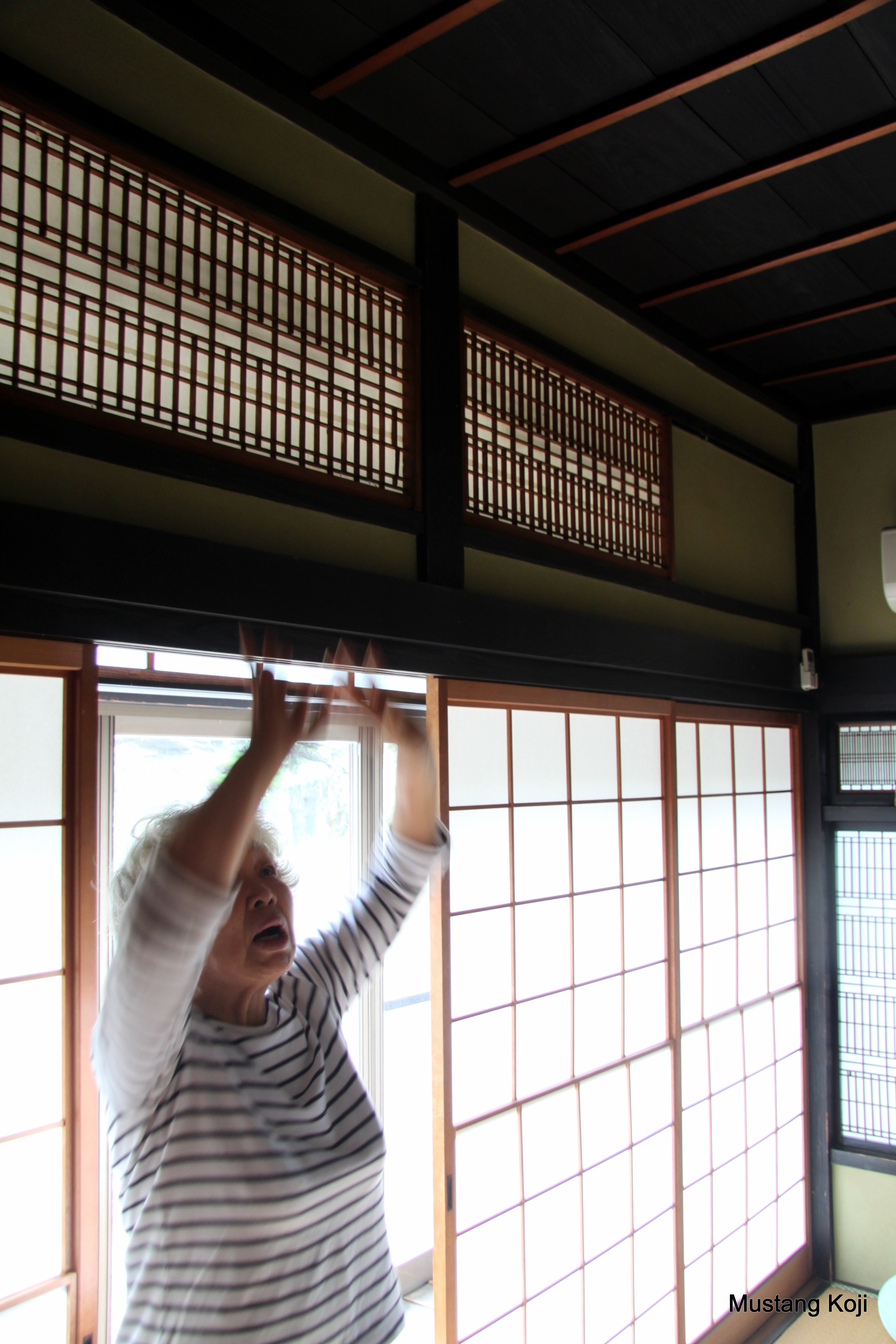
A low lying hill called Mt. Suzugamine served somewhat as a barrier, deflecting the shock wave. Still, nearly all of the sliding door panels were knocked down and the ceiling was sucked up more than a foot per Masako. Roof tiling was also blown away from the force.
Masako is trying to show how the atomic bomb’s shock wave lifted the ceiling up over a foot. It is repaired now but was left as-is for decades.Masako in the process of trying to show how far the ceiling was lifted by the blast on August 6, 1945.
My Uncle Suetaro took one of his last photos in front of this house in May 1944. My grandmother already had her stroke and is not in this photo but his sister, Michie, is standing to his right.
One of the family treasures found during our journey to the family home in Hiroshima this month. Uncle Suetaro is going to war and his death.
Grandmother Kono’s funeral in 1954; my father can be seen in the lighter suit to the left standing next to Michie and Masako (hidden by the flowers):
Grandmother Kono’s funeral at the house. 1954
The home does have spirits within. It’s not cornball. It is an incredible sensation. We were called to those souls in the wood this month. Seriously.
________________________________________
When I saw my son in front of the home, I saw that I’m in the last half of my journey in life… but I came back to myself on that old sakura wood.
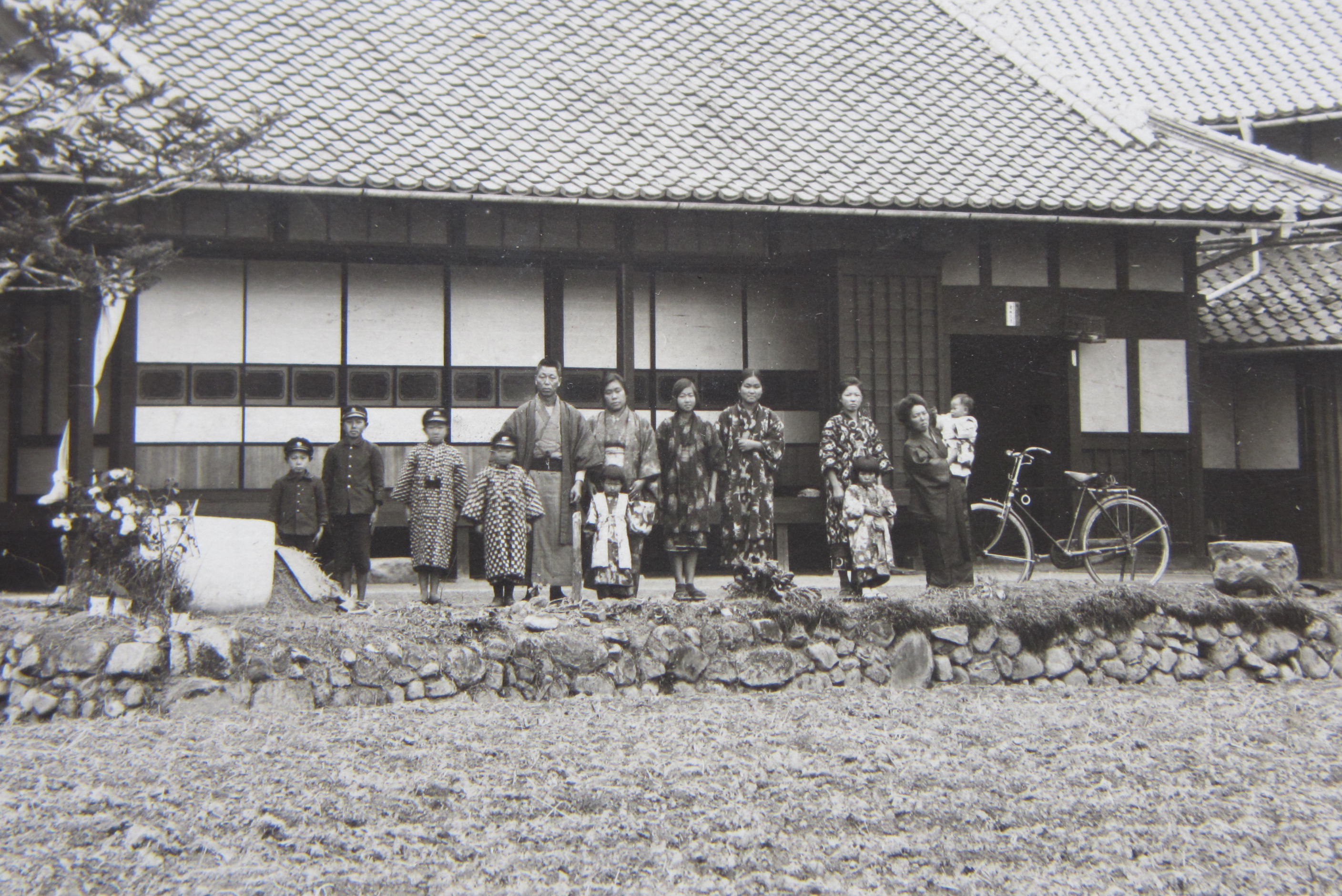
Early family picture in front of the house. The entry is on the right.My son Takeshi standing next to the Kanemoto name in front of the house just this month. The entry can be seen behind him.




















 Masako and Spam Musubi