Tag Archives: WWII

The Firebombing of Tokyo – Epilogue


YOKOTA AIR BASE, Japan — Lt. Gen. Burton Field, United States Forces Japan commander and 5th Air Force commander, gives Tomo Ishikawa, Gakushuin Women’s College student, a hug after she presented him 1,000 origami cranes March 16, 2012. The students made a total of 4,000 origami cranes and gave 1,000 to a member of each service. This was in appreciation for all the help given by the 5th Air Force to the Japanese citizens stranded by the tsunami.  (U.S. Air Force photo/Staff Sgt. Chad C. Strohmeyer)

The Firebombing of Tokyo – Epilogue

War is hell.

Vile.

Scars are left on those who had to endure the horror…

Those who witnessed it…

Those who fought in it…

But then hopefully there is a healing.

Perhaps it will take a generation or two.

But it will happen.
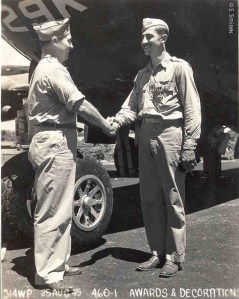
Capt. Ray Smisek receiving his second Distinguished Flying Cross on Guam, August 25, 1945. Incredible bravery indeed. Courtesy S. Smisek.

Perhaps one will never forget… but one can forgive.

Perhaps is it wrong of me – a person who never endured war – to say it so simply.  Forgive.

But I have witnessed forgiving with Old Man Jack… Mr. Johnson…

Warriors have forgiven and tried to move on with their life in spite of nightmares for the rest of their lives.

Civilians, too.

The result is endearing friendship.  The same USAF that bombed Japan assisted thousands of stranded Japanese civilians after the tsunami.  The world has benefited but at the cost of the sanity of single souls so many decades ago.

Captain Ray B. Smisek

On Sept. 2, 1945, Captain Ray Smisek once again made a round trip flight to Tokyo.

air_superfortress17
A glimpse at a formation of B-29s flying over the USS Missouri on Sept. 2, 1945. Perhaps Capt. Smisek’s B-29 is pictured. National Archives.

This time, it was as a member of one of the great air armadas ever assembled in history.  Over 300 carrier based Navy planes and hundreds of B-29s.  MacArthur rightfully wanted to make an impression upon the Japanese people by ordering a huge flyover Tokyo Bay and the USS Missouri, where the formal surrender documents were signed.  (They were to fly over at the moment of the signing but were late, upwards of ten minutes.  MacArthur apparently whispered to General Hap Arnold of the USAAF something to the effect of, “Now would be a good time, Hap,” with respect to his missing armada.)

It was the crew’s 21st mission.  They were going home.
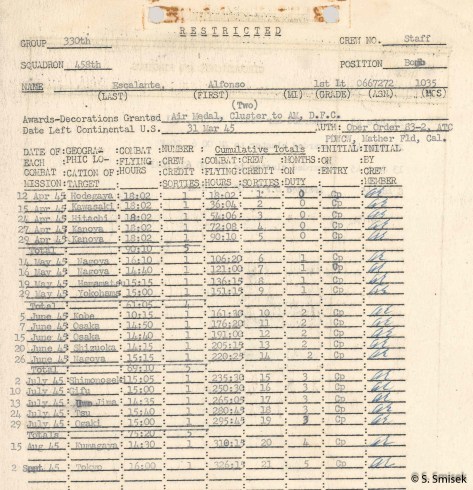
smisek-1-4
Official Mission List, retained by Capt. Smisek’s bombadier, Capt. Alfonso Escalante. Courtesy of S. Smisek.

______________________________

In Part 1, son S. Smisek said of his father that he hated to kill anything – even bugs.  That was his character.

Capt. Ray Smisek returned home to his parents after the war and tried his hand in the Los Angeles real estate market; he also worked as a cook in a restaurant.  He must have made one heckuva Sauerkraut, one of his favorites.

smisek-10-11
Capt. Ray Smisek with his parents after returning home. They must have been proud. Photo courtesy of S. Smisek (Copyright).

But…  Ray Smisek had met a young woman while he and a back-seater were on a cross-country training flight in 1942.  They were flying from Greenville, Mississippi when the BT-13 trainer developed engine trouble.  To make matters worse, there was a bad storm.  Not swell conditions when you’re training to be a pilot.  Fortunately, the clouds miraculously parted and a small town below was bathed in forgiving sunlight.  He said he did a barrel roll and dove through the break in the clouds.  It turned out to be a rural airport in Springfield, MO (now known at the Springfield-Branson National Airport).

On the USAAF’s dime, he was put up in a posh hotel.  After noticing “this sweet thing walk by” per his son, Ray Smisek asked a desk clerk if he knew who she was.  Seeing the twinkle in his eye, the clerk contacted the gal’s father who agreed to let him meet his daughter…but under the father’s mindful eye.  She apparently “had a guy”, so to speak, but they still ended up becoming pen pals.  Those letters must have been so important to a young man off in a faraway place facing death at any time.  It may have been fate but her beau tragically perished in a B-24 Liberator accident in England.
She was a singer in the “big bands” era of the 40’s and traveled extensively.  Remembering there was no internet, Ray finally tracked her down in 1947.  She was in Houston for a gig.  His son tells me he drove for two days straight to get to where she was performing.  Ray had a note he had written and asked a waiter to hand it to her.  It said, “Let me take you home and love you forever.  Ray!”  The note is a precious heirloom; the family still has it.
After getting married, Ray re-enlisted in the newly organized USAF (It was separated from the US Army.).  He flew for 16 more years in service of our country and retired from the USAF as a Colonel in 1963.  Along the way, they had five children; one was born at each station at which he was assigned.  Talk about the hardships of a military family.
smisek-10-10
Family picture taken in the 1980’s, with Ray (plaid shirt) and his wife (red blouse), five children and the grandparents to the right of center. Courtesy of S. Smisek.

S. Smisek explained to me that his father rarely, if ever, talked about his time at war while he was growing up.  That was very typical, you see.  His son wrote very eloquently:

When I was growing up, he never spoke much of his time during the war. When asked about those times, I could see a sullenness come over his face, then he would most often ask me another question just to change the subject. In those rare exchanges when he would answer, he made it very clear that he desired no recognition for what he had done. He desired no contact with his fellow comrades, felt no honor for the devastation he had helped cause, and amazingly to me, felt no affection whatsoever for the incredible aircraft which had brought he and his crew back safely from so many missions over so many horrible places.

He, along with the rest of these brave young men, was an ordinary and yet an extraordinary human being – a person who offered some of his life’s most vital years in the service of his country, and who sacrificed his ambitions so that countless others would have the freedom to accomplish theirs.

Raymond B. Smisek was diagnosed with a very aggressive cancer in 1989 and passed away at home, surrounded by his family, in August 1990.  He was just 70 years old.  His son believes his father also suffered from another cancer – one related to unhealed scars from war.  His son said they were cancers of the soul and spirit, much more damaging than those of the body.  His wife – the singer in the big bands of the ’40s – passed away in 2001.

____________________________________

Please visit his son’s tribute to the men of the 330th Bombardment Group at www.330th.org.  For the sake of the families of the WWII airmen, S. Smisek has researched and brought many of the pieces together of what it was like for their fathers at war.  Through his website and in a sterling triumph several years ago, S. Smisek played a key role in coordinating the meeting of a Japanese gentleman living in Canada with a B-29 pilot from his father’s squadron. Seventy years earlier, the Japanese gentleman was in Kumagaya Japan as an eight year old, running from the bombs being dropped from the pilot’s aircraft.  The two finally met and it was moving and emotional moment per S. Smisek.  For an article of the meeting, please click here.

____________________________________

Aunt Eiko
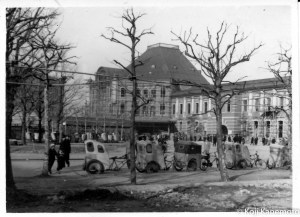
tokyo station-1
Dad took this picture of the Tokyo Station in 1947. His G-2 HQ was to his left in front of the Palace. The station was being rebuilt, courtesy of the US. Notice the rickshaws lined up in front; the Japanese had no cars until the late 50’s. Also note the trees; they are burned.

There was no escaping bombardment for Aunt Eiko, even after moving to Fukui slightly inland from the Japan Sea; the US Navy shelled their farming neighborhood heavily.  She also vividly remembers a small group of high school aged Japanese soldiers relaxing at the nearby beach and still cries inside knowing their fate.

Preceded by my mother, Aunt Eiko and grandma returned to Tokyo sometime in mid-September to find it in shambles.  People were living in lean-to’s, she said, and running water still had not yet been re-established in devastated areas.  Food was a tremendous daily hurdle.  She cannot recall when but she remembers it was such a relief when MacArthur began rationing out beans and drinkable water…but it was American beans.  Still, the beans were appreciated.
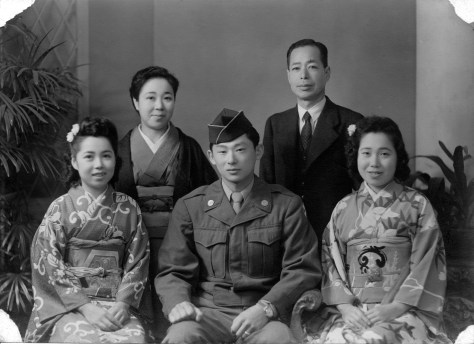
image0-108
PFC Taro Tanji seated in center flanked by (from left) mom, grandparents and Aunt Eiko. You can make out Taro’s US 8th Army emblem. Taken in Tokyo, December 8, 1946.
image0-38
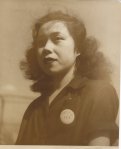
Aunt Eiko got a job at the Tokyo PX, working out of the Matsuzakaya Department Store in the Ginza. You can see “Tokyo PX” on her badge. 1947, Tokyo. Copyright Koji D. Kanemoto.

But their greatest savior surviving the first few months after war’s end was another relative – an American.  An American of Japanese descent that is.  Taro Tanji was born in Livingston, CA but was drafted out of the Amache War Relocation Center in Colorado by the US Army.  He became a member of the famed Military Intelligence Service.

He arrived in Tokyo at war’s end as part of the US 8th Army’s Occupation Force.  Through his intelligence connections, he was able to track down Aunt Eiko and family in a suburb called “Toritsu Daigaku”.  Some of it had miraculously escaped burning.

Driving up in his US Army jeep, he stayed at their house every weekend.  Each time, he would bring a duffle bag filled with C-rations, instant coffee and American cigarettes for my Grandfather (which he reluctantly accepted – funny story).  Yes, Aunt Eiko ate the Spam and deviled ham.  Taro managed to get in a good word and found both Aunt Eiko and my mother jobs at the PX.

TouritsuDaigaku - Summer 1952
Aunt Eiko and her love in her life, Puri. Circa 1952, Toritsu Gakuen, Tokyo. Copyright Koji D. Kanemoto

Things were tough until the early 50’s.  Dogs as pets were still rare as they also needed to be fed…but Aunt Eiko wanted dearly to achieve one of her dreams – to have a dog.

And so she did… She named him “Prince”, or “Puri” when you shorten “Pu-ri-un-su” pronounced in Japanese.  She loved him until he passed away in 1968.  She was devastated, of course.  I think Puri was an escape from the war’s ugliness for her.

She met Paul Sakuma sometime in the late 60’s; he was a Hawaiian born Sansei who was also drafted by the US Army into the Military Intelligence Service by the US Army.  He was attached to the 720th MP Battalion to serve as a translator.  He told a funny story to Aunt Eiko where the MPs frequently raided certain types of “houses”…  You know…  GI’s were prohibited from “fraternizing with the enemy” so they would raid them.  One time, there was a fellow MIS Nisei caught inside.  He made sure the “howlies” couldn’t escape…but held the door open for the Nisei.  After being discharged, he decided to stay in Tokyo to live and worked for the USAF as a civilian employee, using his knowledge of Japanese as a go-between.
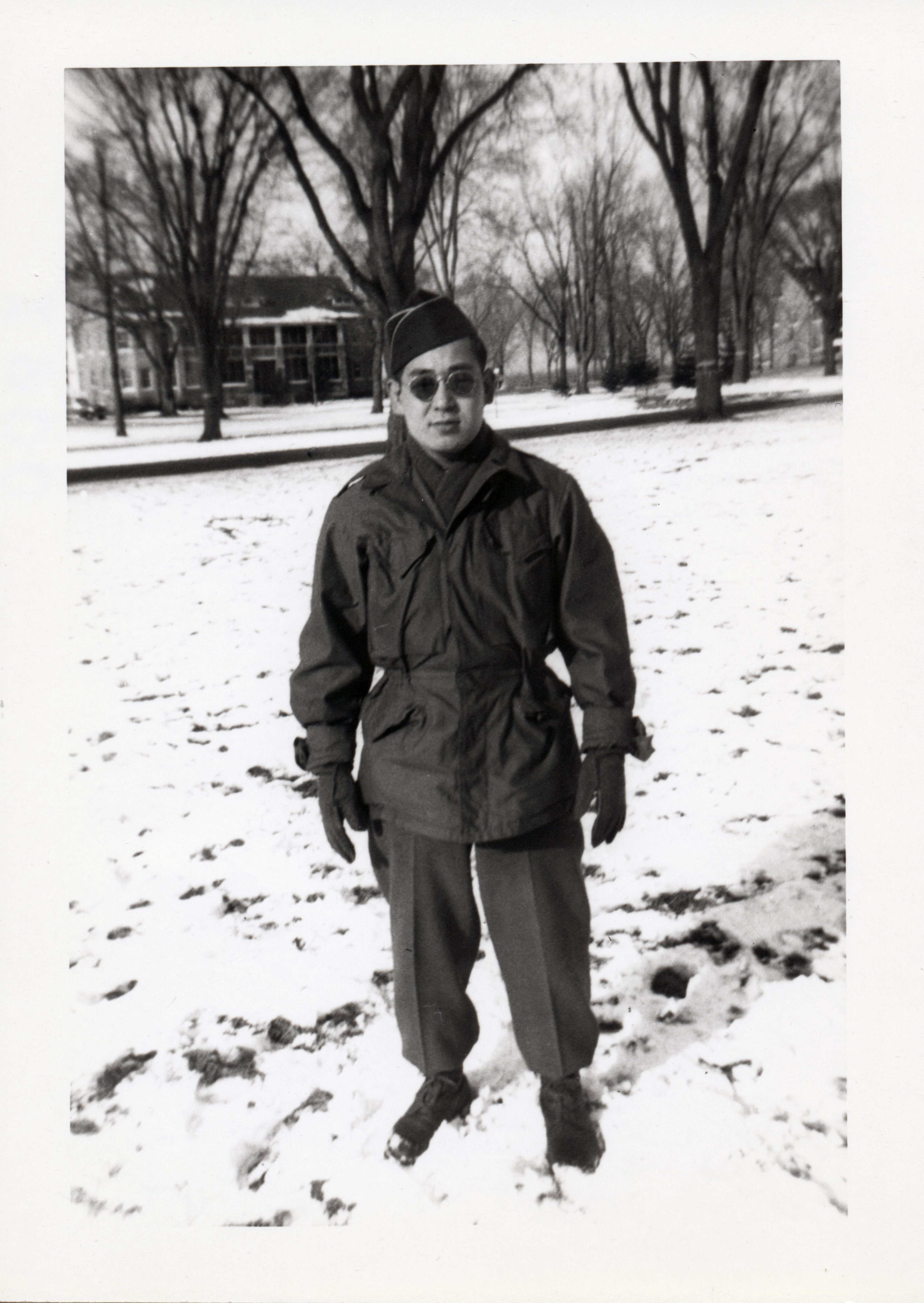
Uncle Paul at Ft. Snelling's top secret Military Intelligence Service Language School, circa Winter 1945.  The old barracks is seen in the background.
Uncle Paul at Ft. Snelling’s top secret Military Intelligence Service Language School, circa Winter 1945. The old barracks is seen in the background.

They married but had no children – but a week before my first marriage in 1980, I got a phone call from Aunt Eiko in Tokyo.  She was sobbing uncontrollably.

Uncle Paul had gone upstairs in their beautiful home he just had built for them after washing her car.  He screamed, “Eiko!”  It would be his last word; he suffered a massive heart attack and died, right there at the top of the stairs in his brand new home.

Soon after his death, Aunt Eiko immigrated to the US along with my grandmother.  She became an US citizen about a dozen years ago.

In an irony, the country that bombed her city to ashes in 1945 bestowed upon her beloved husband Uncle Paul (as well as to Uncle Taro) the Congressional Gold Medal in 2010 for their service to the country.  While both had passed away before the award, Aunt Eiko cried for happy when I surprised her with the medal.  She said, “Even after all these years, Paul still brings me happiness.”
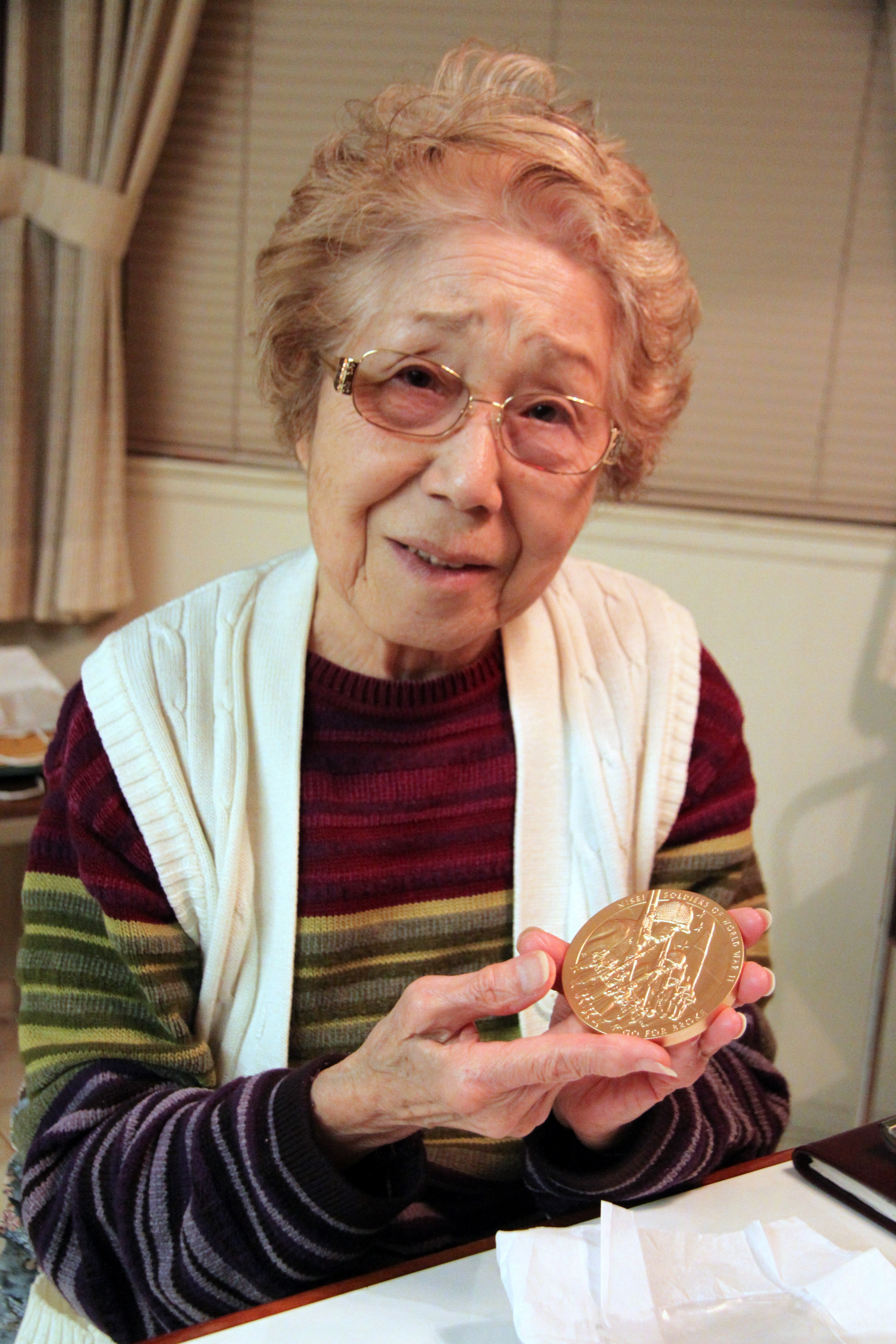
Holding Uncle Paul's Congressional Gold Medal for the first time, Aunt Eiko cried for happy.  Incidentally, she became an American citizen about ten years ago.
Holding Uncle Paul’s Congressional Gold Medal for the first time, Aunt Eiko cried for happy. Incidentally, she became an American citizen about a dozen years ago. Copyright Koji D. Kanemoto.
With her best friend - August 1963
Aunt Eiko with her childhood friend – the one who was burned during a firebombing. August 1963, Tokyo. Copyright Koji D. Kanemoto

As for her childhood friends, she is all who remains now at 88 years of age, just like Old Man Jack.  Her friend who was burned during the firebombings was one of the last to pass away.  She was the tall girl standing behind Aunt Eiko atop the Asahi Newspaper Building on October 30, 1937 and shown here in 1963.

__________________________

A most sincere thank you to S. Smisek without whom this series would not have been possible.  I wish him continued fortune with his 330th Bomb Group’s website, helping those descendants piece together their father’s contribution in World War II.

IMG_3413
My two youngest kids standing beneath the Enola Gay in 2010, the most famous B-29. Her single bomb destroyed my father’s Hiroshima high school and damaged my grandmother’s home as well. Read the story by clicking on the photo.  Copyright Koji D. Kanemoto.

Previous parts can be found by clicking on the links below:

The Firebombing of Tokyo – Part 1

The Firebombing of Tokyo – Part 2

The Firebombing of Tokyo – Part 3

The Firebombing of Tokyo – Part 4

The Firebombing of Tokyo – Part 4


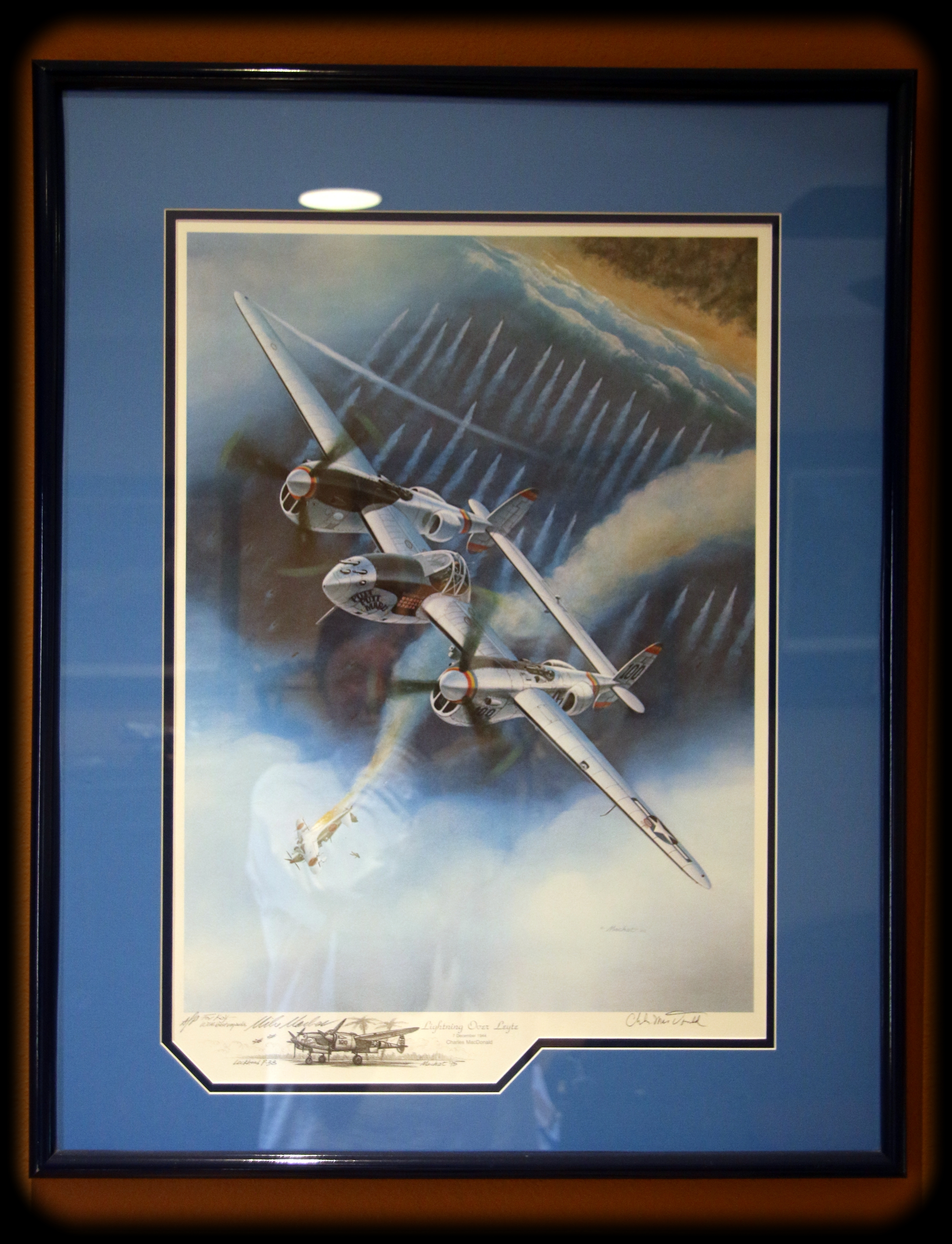
p38
One of my WWII aviation lithographs; it shows a P-38 Lightning ironically over Leyte where my uncle was killed. Drawn by my good friend Mike Machat.

The View From the Ground

“うわぁ。。。二つの尻尾。。。それはその時代の飛行機だ。。。”, my Aunt Eiko said. “Oh, my… The twin tails… Its that plane from (the war).”

She just saw my lithograph of a WWII P-38 Lightning.  She and my parents had come for the first time after we moved into our house across the street from Old Man Jack. I had just put up my WWII aviation art gallery and she immediately recognized this US fighter plane with its distinctive twin tails from the war.  She said it strafed the high school that she was walking near.  She was about 18 years old.

Funny how things stick in your mind from war.

___________________________

Circa 1930
(L to R) Mom and Aunt Eiko, circa 1931. Tokyo.

Along with my mom and grandparents, Aunt Eiko lived within walking distance of the Imperial Palace in Shimbashi, Tokyo.  Back then, the Emperor was god.  To live so close to the Imperial Palace meant your family had some extra change.

Although a photo of their house from that time no longer exists, the home was typical of that time.  Beams and floors made of wood. Doors called “shoji” (framed in light wood with paper “windows”) slid open and close.  By sliding, they saved space as regular doors would have to swing open and close, taking away precious space.  The floors were “tatami”, or boards wound with rice straw.  Believe me, they are uncomfortable to sit on to say the least.  Many homes still sported thatched roofs, or kusabuki, made with layers of a type of reed.  But all in all, the homes were made with wood products or straw.  Not exactly fireproof.

image0-017retouched
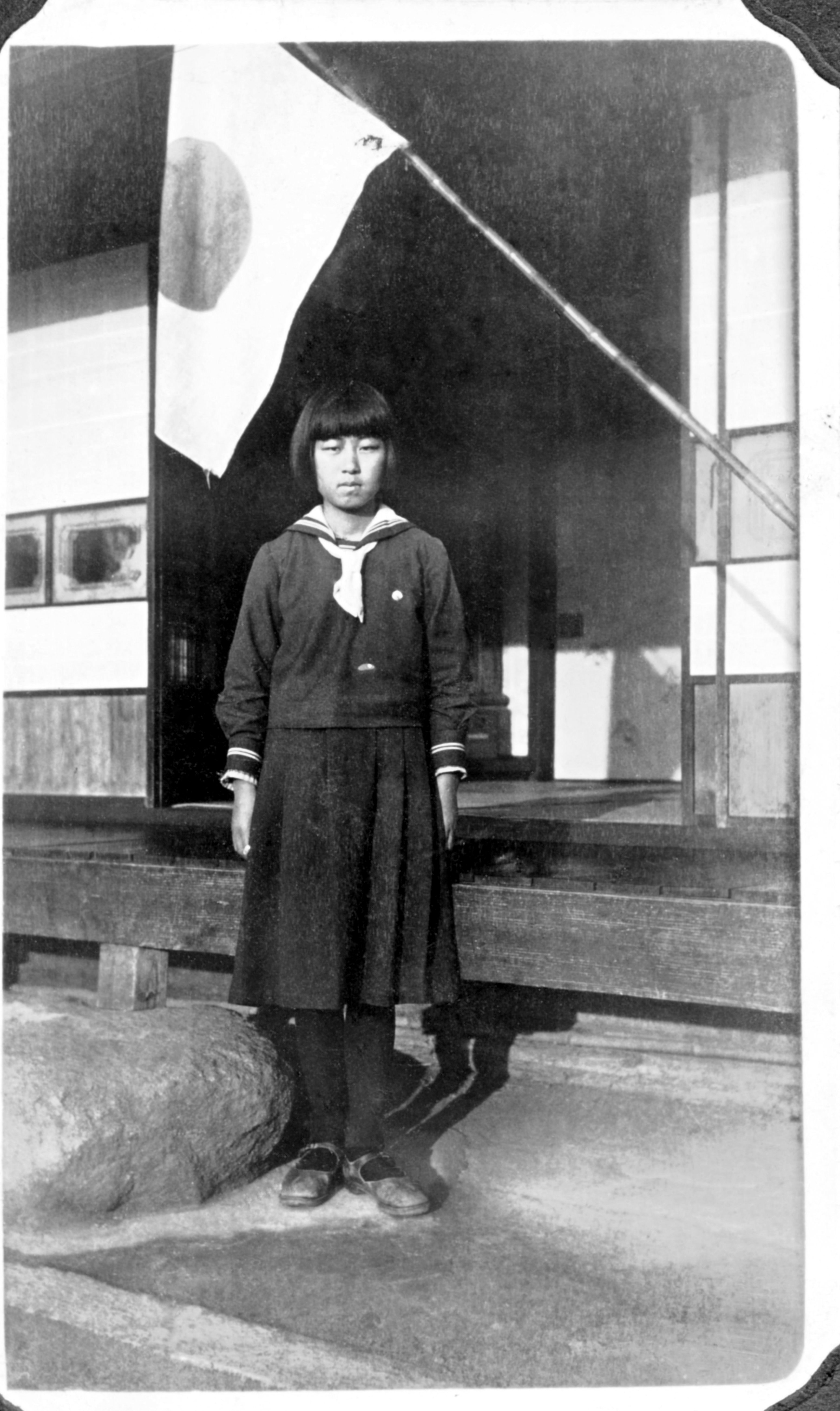
My Aunt Mieko (dad’s side of family) standing in front of our traditional style home, circa 1936. Although my dad’s home shown here is in Hiroshima, the construction is the same as my aunt’s: wood and paper. Behind her are the “shoji”, or sliding door panels as well as the hard tatami mats. As a side note, all these shoji were blown out by the atomic shock wave.

________________________________

As three generations usually lived in a family home, Aunt Eiko had the same close knit circle of girl friends having stayed together through high school.  Families rarely moved back then.  The girls took classes in “kimono”, shamisen (a guitar of sorts) and cooking – very traditional fare for a Japanese girl.  To them, etiquette was to be followed, never to be broken.  I would think she had a crush on someone just as any girl would have…but she has not said.

image0-34
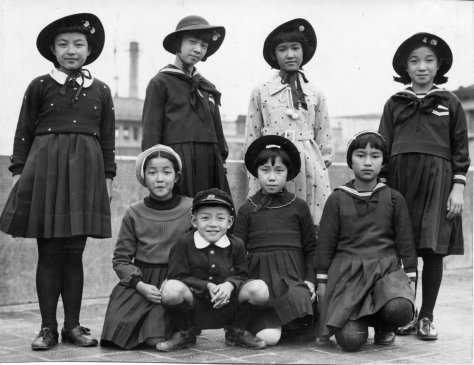
Aunt Eiko, front row, third from left, and circle of close friends. Her closest friend, standing to the left of her, was slightly burned during a firebombing.  Taken atop the Asahi Newspaper Building, Tokyo, Oct. 30, 1937.

__________________________________

Before the Firebombing

Sometime in late 1943, my aunt says my grandfather decided to move the family, a rarity, due to her illnesses.  Apparently, my grandfather thought the unhealthy downtown Tokyo air was exacerbating her ills so they moved into another wooden frame home in Higashi Senzoku, a couple of kilometers south of Shimbashi.  It does not appear potential bombings by US planes was the reason to move at this time.

Soon thereafter, though, the family received mandatory evacuation orders (強制疎開). My Aunt believes this to be late in 1944… Times were tough.  Food supplies had already dwindled to nearly nothing. To make it worse, only older doctors remained as many younger ones were conscripted into the Imperial Japanese Army as well.

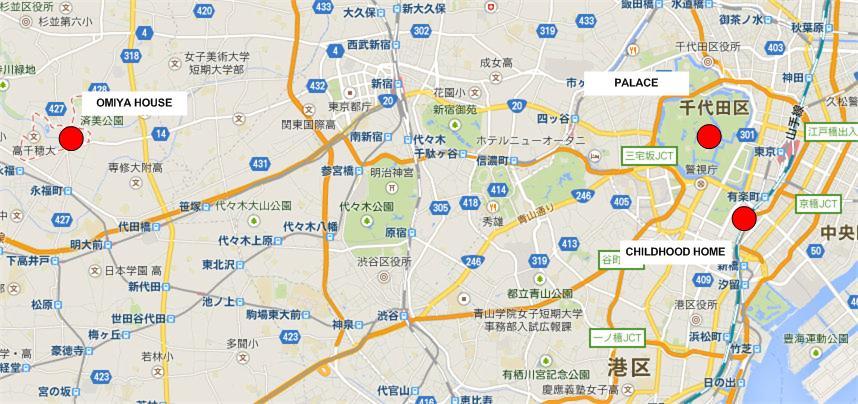
They moved to her grandfather’s home in Omiya, Tokyo; it is about a mile due west of the Imperial Palace:

omiya visio
Omiya, the Imperial Palace and childhood home.

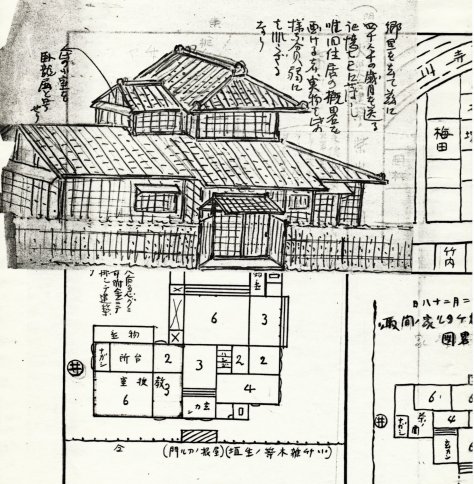
A drawing of the wood home in Omiya:

keizu crp
The actual traditional wooden home (立ての木) in Omiya, Tokyo where my family took refuge during the bombings. It is about a mile west of the Imperial Palace. This was drawn on extremely thin paper – much thinner than the old tracing paper we had here in the States – by my great-grandfather, Wakio Shibayama. Undated but post-war.

The Firebombing

bakudan1
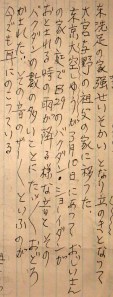
My aunt’s writing. (Copyright Koji Kanemoto)

March 9, 1945 was about two weeks before my Aunt Eiko’s 19th birthday.  Due to the strenuous and meager living conditions, I doubt any birthday party was in the works.  I doubt there were many birthday parties at all.  There was little to be had as Japan was losing… and losing badly.

Aunt Eiko was at their grandfather’s house in Omiya that night when the pathfinders found their mark.  She says they all gathered in the front yard to gaze towards the Imperial Palace after hearing the first explosions.

She notes on the left:

東京大空襲が3月10日にあっておじいさんの家の庭でB-29の爆弾、焼夷弾が落とされる時の雨が降る様な音とその爆弾の数の多いことにだいたいおどかされた。そのおとのザ~ザ~というのが今でも耳にのこっている。

In doing my best at translating, she says:

We were in the front yard of my grandfather’s house when the firebombing started on March 10.  The B-29s were dropping shocking amounts of bombs and firebombs – so many that they sounded like heavy rain coming down.  I will never forget that sound (of the falling bombs); it is still vivid in my ears even today.

A year earlier, my youngest daughter was interviewing her for a 5th grade family biography project.  One requirement was that the family member’s history was interesting or unusual.  Naturally, since experiences like my aunt’s are not found in school textbooks today, I recommended she interview Aunt Eiko about her war experiences in Tokyo.

ちょうちん
提灯 or paper lantern.

During the interview, Aunt Eiko said the (AN-M69) incendiary sticks were like thousands of 撥 (bachi, or the drumsticks used for taiko drums) raining down from the sky… that there were so many of them that it looked like swarms of insects.  She also described the thousands of trailing streamers (attached to each stick) reminded her of ribbons fluttering in the breeze.¹  Unlike what many of us believe, she said the B-29s came for hours… that there would be a rash of explosions then the B-29s would disappear only to hear the now familiar drone of more B-29s approaching then more bombs.

In earlier conversations², she described seeing hundreds of flashes of light at roof top level during the firebombings.  It wasn’t clear to me then but it is clear now that the flashes she witnessed were likely the smaller high explosive bombs dropped from the B-29s hitting structures and exploding.  She also sadly described the homes burned like 提灯 (chouchin, or paper lanterns) and that the waves of heat distorted distances (like looking through the heat waves rising from your street in summer).  It made it hard to judge how far – or how close – the fires were.

The Firestorm

The main concentrations of fire occurred not just in the area behind and to the left of the Imperial Palace; Aunt Eiko said incendiaries (possibly dispersed due to the heat thermals) ignited neighborhoods just to the left of her Omiya house where they were staying. (Embers would have achieved the same results, however, and may be more likely.)

Screen
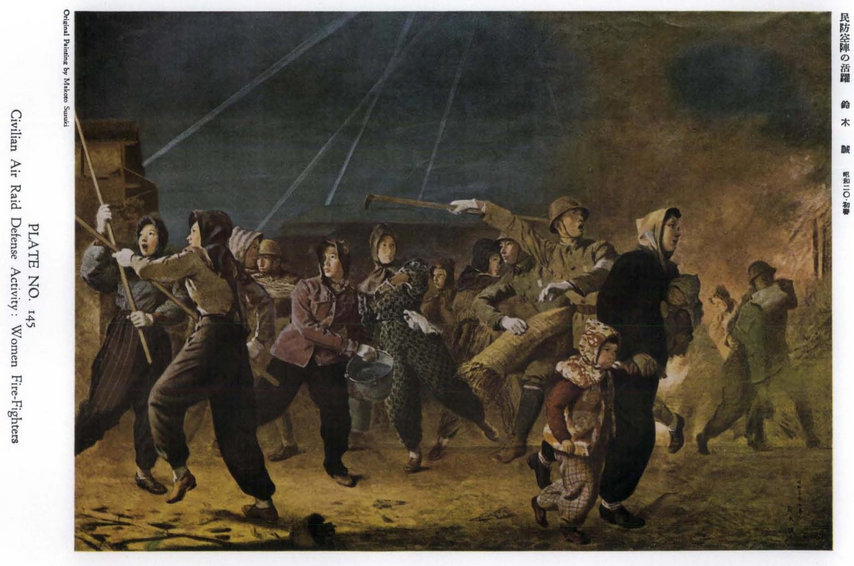
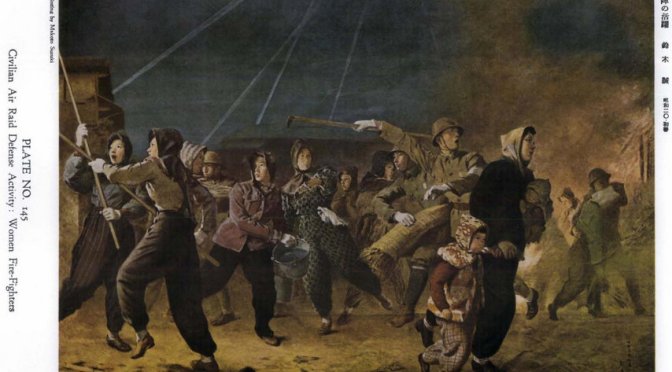
The city’s fire department was largely staffed by women who were not professional firefighters. Importantly, note the clothing worn by the mother and child in the forefront. Source: “The Reports of General MacArthur“.

According to studies, death occurred through suffocation, incineration, and heat.

Fed by winds and with a fire department largely staffed by women volunteers, the fires spread rapidly and raged out of control. These firefighters attempted throwing dirt or sand on the incendiaries, a hopeless effort. When there was water pressure, the water pressure was low.  Reports indicated the firefighters tried to douse the civilians as they fled but the water would soon evaporate from the heat.

Suffocation occurred as the great fires sucked all the oxygen out of the air. They just couldn’t breathe.  Those that were able to find cooler river water tried to keep their faces above the water; but they, too, simply suffocated due to the lack of oxygen. In some instances, fleeing civilians attempted to seek shelter in areas that had pretty much burned but their bodies were found later in a small cluster.  They suffocated to death together as oxygen became depleted.

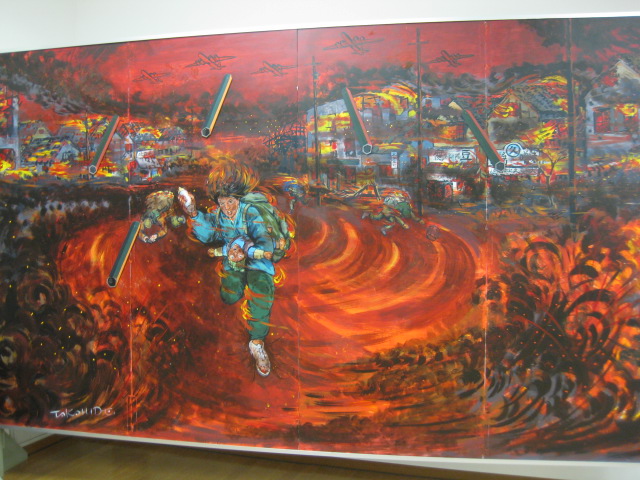
Extreme heat was another cause of death as temperatures soared to 1,800F.  Asphalt bubbled and steel bridges became frying pans.  People panicking ran or were herded towards bridges or rivers only to be pushed into the waters by the ensuing masses of humanity trying to flee.  Unfortunately, the water was at boiling temperatures and they were essentially boiled to death once they fell in.  Escape paths were blocked with debris, downed power poles, burning trees…and bodies.  If one could not escape the heat, that person simply burst into flames.  Horrifically, superheated air swirled down towards street level.  People would then literally burn from the feet up when their pants would catch fire.

taka-hide
A Japanese artist’s depiction. Note the pants on fire and the swirling heat.  While unsure, the name appears to be Takahide.

Incineration was the worst, the most painful death I would assume.  One aspect not widely known by the general populace is their type of clothing contributed greatly to their demise of burning to death.  Their cloth-based head gear (see painting of women firefighters shown earlier) was meant to protect their ears and head from bomb explosions – not a firestorm.  In the end, this protective head gear easily caught fire as did their loose fitting trousers.  Aunt Eiko reported a girl she knew ran from the fires with a baby strapped onto her back in traditional Japanese style.  Through all the noise, screaming, running and panic, the girl was unable to notice until too late that burning jellied gasoline had landed on the baby’s face and had died.

No photos of corpses are deemed necessary here.

Aftermath

tokyofires
A wall exhibit at the Tokyo History Museum, showing the extent of the area destroyed by firebombing. The Imperial Palace is just right of center. The Omiya house is in the burned zone, in the very center.

Aunt Eiko has never said whether the Omiya home survived the firebombings and I don’t intend to ask.  While this Tokyo raid was the first of several, I cannot understand why my great-grandfather would have sketched the home out, apparently from memory, unless it no longer existed.

Japanese reports of the aftermath indicate that due to the thousands of burned corpses or of those who suffocated, it was nearly impossible to walk through Tokyo without stepping on bodies.  Further, as the seared corpses disintegrated, their ashes would swirl up into the air.

She, my mother and grandmother finally fled the city on or about July 1, 1945; grandfather stayed behind for reasons never known to her.  They lived at another cousin’s yam farm in Fukui, helping to farm the fields while living on meager rations.

The war ended six weeks later.  What happened in between is another story altogether.

Part 5 of “The Firebombing of Tokyo” will be an epilogue.

I hope you will stay tuned.

Part 1 is here.

Part 2 is here.

Part 3 is here.

Part 5 (Epilogue) is here.

__________________________________

NOTES:

1. That even surprised me as I didn’t know the incendiaries had streamers, so much so that I asked her what she was talking about.

2. Just like Old Man Jack and many other combat veterans, Aunt Eiko (along with my father) suppresses many of the horrific war experiences she witnessed.  She “gives” things out little by little.

The Firebombing of Tokyo – Part 2

Fifi 1
Fifi – the last flying B-29 Superfortress in the world. Taken by me flying over my house on November 13, 2010. Copyright Koji D. Kanemoto

Superfortress.

Or the “Superfort”.

That’s what we called them here in the States; nicknames for the Boeing B-29 bomber.

My aunt called them “地獄からのトンボ” or dragonfly from hell.

______________________________

Development

The development of the B-29 actually started before WWII began for the US – in 1939.  Perhaps there were some shenanigans back then but Boeing had engineered a pressurized cockpit for their B-17 Flying Fortress (from whence the nickname Superfortress hailed from) for the USAAF.  Conveniently, the USAAF put together in 1939 a call for a new bomber capable of 400 mph while carrying a 20,000 pound payload.  The B-29 was born.

frye
Destroyed Frye Packing Plant. Boeing archives.

Her development was not smooth.  Indeed, it was the most advanced aircraft design of its time with its pressurized crew compartment and ten remote control dual .50 caliber Browning machine guns.  The second prototype YB-29 crashed into the Frye Packing Plant in Seattle killing her pilot, Eddie Allen, all ten of her crew of engineers as well as 19 workers on the ground.  (In fact, two engineers managed to bail out over Seattle but they were too low for their parachutes to deploy.)  As an indication of things to come, an engine caught fire 20 minutes into the flight causing the horrendous crash.  As the plane was secret, there was a tremendous cover-up as well.

BI219398
Test pilot Eddie Allen from his cockpit of the XB-29. Boeing archives.

The production of the B-29 was a nightmare.  Due to immensity of the aircraft for its time, there were no manufacturing facilities large enough to house it let alone build it.  Four assembly plants were utilized with Boeing’s Wichita plant eventually becoming the hub.  The plane’s complexity exacerbated the production; over a thousand sub-contractors were involved.  Production changes were so prevalent, numerous and on-going that even when a B-29 had been assembled, it was towed to a holding area in Wichita to have major modifications done post-production.  The freezing weather also made work a nightmare.  Production was so poor that even when about 97 were delivered in 1943, only about 15 were flyable.

80172
Source unknown.
b29-superfortress-engine-assembly-line
Posed photograph of workers working on B-29 cockpit module. National archives. Undated.
b-29 hecd
First B-29 out of Wichita, Kansas, Fall 1943. National Archives.

Some examples of these major flaws included:

  1.  Defective pressure seals around cockpit windows and gunner blisters;
  2.  As each plane had about ten miles of wiring and electronics, there were numerous failures;
  3.  Wing structure needed post-production modifications;
  4.  Cockpit glass were distorted;
  5.  The analog computers used for the new “remote control” machine guns were problematic; and,
  6.  As as mentioned, the engines overheated to the point of being set on fire during flight.

Because production of the first B-29’s were done “on the run”, the first 100 built were really built by hand by unskilled laborers.  Each one differed from another.  One end result of this production on the run was that there were significant differences in weight between supposedly identical bombers.

Only personal intervention by the great General Hap Arnold improved the production problem… but it took months.

________________________________

The first combat deployment of the B-29 occurred from the China-Burma-India theater of war on June 4, 1944.  Ninety-eight B-29s flew to targets in Thailand.  However, the results were dismal (Reports indicate perhaps one bomb hit target. Most bombs landed two kilometers off target.).  As another indicator of things to come, five B-29s were lost during the mission.  They were not lost due to enemy fire; they crashed due to mechanical failure.

Under the command of Curtis “Iron Pants” LeMay, the first bombing mission to Japan occurred on June 15, 1944.  Sixty-eight B-29s took off from bases around Chengdu and bombed a steel plant in Yahata, Japan.  As a first indicator of an ugly pattern, only 47  of the 68 B-29’s reached their target.

As in the XB-29 prototype crash, the engines were the most serious operational defect.  They utilized the 2,200 hp Wright R-3350 Duplex-Cyclone radial engine with 18 cylinders in two rows. One central design defect rested within the top five cylinders of the radial engine.  These radial engines needed massive air flow to cool them off.  Unfortunately, engine shortcomings, i.e., engine failures, led to a number of crashes at take off when the planes were fully loaded with ordnance or at other unfortunate times during their long flights.  Engines needed overhaul or replacement only after about 75 hours of operation to give you an idea of their unreliability.  Bombing missions to Tokyo averaged 15 hours in the air.

Later models – the B-29B or ‘”Silverplate”¹ – would be stripped of all defensive armament except for the tail gun.

Imagine being on the plane during that time flying over thousands of miles of ocean…exponentially worsened if you were under attack.

I wonder what unpleasant thoughts kept gnawing at Capt. Ray Smisek and his crew during one of their missions.

He was flying the Chevy Citation of the skies.

__________________________

Ordnance

A38767
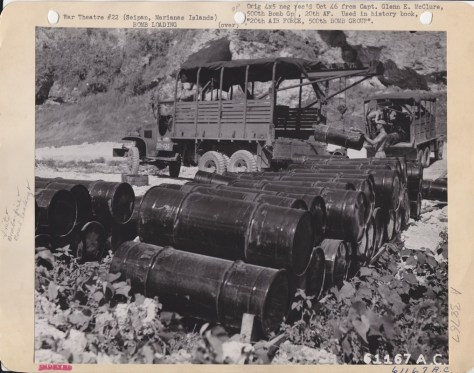
AN-M69 cluster incendiaries were shipped in metal tubes. Source: http://www.japanairraids.org/?page_id=3242.

AN-M69s

In essence, there were many combinations of bombs used in the bombing of Tokyo.  For the purposes of this blog, we will focus on a couple.

The AN-M69 Incendiary Bomb was a cluster-type jellied gasoline (napalm) weapon; the gel would be contained in a cheesecloth sack then enclosed in a metal tube.  The Standard Oil Development Company started work on the weapon two months before Pearl Harbor.  The engineering goal was to develop an incendiary device with as little magnesium as possible due to supply constraints.  The objective of this weapon was to simply burn things (and the enemy) up.  Ironically, German buildings were the initial target but as the war progressed, use against Japanese targets became the focus.

Test of an AN-M69 incendiary device against a “Japanese style” building. Undated.

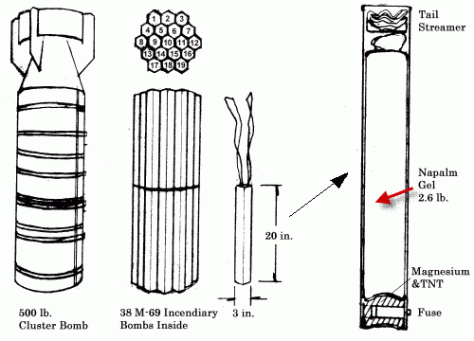
The most common cluster assembly (the M19) held 38 individual AN-M69s, nicknamed “Tokyo Calling Cards” by her crews; the B-29s would release the M19s 5,000 feet above a target. As the M19 canister would break open, the force of the wind would deploy the streamer attached to each AN-M69 stick.  As the individual AN-M69s scattered in the air stream, they would orient themselves to the nose-down position.  The M1 fuse would activate after hitting the ground or target, then would lay there 3 to 5 seconds allowing the stick to lay on its side. After those seconds, the explosive charge would disperse the burning jellied gasoline, clinging to anything it touched.

ssms4
An excellent schematic of the AN-M69 with a 38 stick cluster. Courtesy of S. Smisek.
ssms7
A close up of an actual AN-M69 incendiary bomb. Courtesy of S. Smisek.

For a USAAF film taken of its assembly and testing:

Each B-29 could carry 40 M19 canisters in their bomb bays with each canister carrying 38 AN-M69s. Using simple (non-common core) multiplication, that would be 1,520 AN-M69s per each B-29.  A raid could involve hundreds of B-29s.

There were other variations of this concept, such as the M17s.

AN-M41

We have all been camping at one time or another.  When we try to start a campfire “the old way”, the kids would be sent about looking for smaller twigs and branches to be used as kindling.  Larger logs would then be placed upon the then burning kindling.

The AN-M41 was a 20 pound fragmentation bomb, held in clusters.  There is nothing very unique about this weapon.  Upon hitting a target, it’s mission was to simply break things up upon impact.  Smaller pieces would then be easier to burn, much like kindling in concept.

ssms5
A cluster of AN-M41 20 pound fragmentation bombs. Copyright and courtesy of S. Smisek.
ssms6
AN-M41 clusters above an armorer being readied in a B-29 bomb bay. They are flanked by M-19s each containing 38 sticks of the AN-M69 incendiary bombs. Copyright and courtesy of S. Smisek. (For another rare image courtesy of S. Smisek of the M-19s being assembled by her armorers, please click https://flic.kr/p/j2tpA7

__________________________________

I would think it would take immense courage to be flying in an aircraft being shot at while carrying these explosives.  In colloquial terms, it took balls.

Lots of it.  You were in a flying gasoline tanker.

ssms1
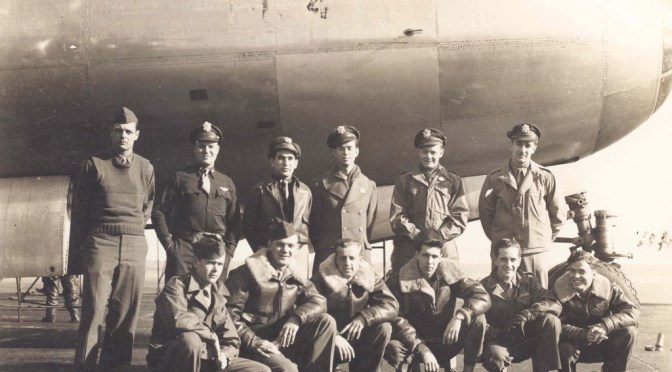
Captain Ray B. Smisek, standing at far right, and his gallant crew. Guam 1945. Copyright and courtesy of S. Smisek.

_________________________________

The perilous B-29 missions will be coming next in Part 3.

Hope you’ll stay tuned.

Edit: You can find the other chapters in the links below:

The Firebombing of Tokyo – Part 1

The Firebombing of Tokyo – Part 3

The Firebombing of Tokyo – Part 4

The Firebombing of Tokyo – Epilogue

NOTES:

1 Ironically, the secret codeword Colonel Paul Tibbetts of the Enola Gay was given by General Hap Arnold while assembling his atomic bombing group was “Silverplate”.  If Tibbetts encountered any administrative SNAFU, he could get anything ordered by using the secret codeword.

The Firebombing of Tokyo – Part 1


A View From Both Sides

IMG_5039-1
From left: Grandmother, Dad in US Army uniform 1947 and his youngest brother (seated), circa 1943. The writing is my aunt’s; you can see “B-29”.  Copyright Koji D. Kanemoto

My Aunt Eiko called me in April of 2011; you can tell she was crying.

“I’ve seen this before,” she said in Japanese.  She was watching the TV footage of the disaster caused by the 9.0 earthquake and tsunami in Japan.

Dumbfounded, I asked, “How could you have seen this before?  The earthquake just happened.”

“完全な破壊。。。戦争思い出したわぁ。。。” or loosely translated, “From the war…  I remember seeing this (complete destruction) from the war…”

Ironically, she was recalling what she saw exactly 66 years earlier – April 1945 – when Tokyo and many other cities were firebombed in an all out world war.

She was there.

And so was someone else from the other side of the Pacific.

________________________________

Through the miracle of WordPress, many of us here have met in the most peculiar of ways –  the hub being World War II…  Perhaps ironic but nevertheless destiny.

For instance, pacificparatrooper‘s father was in the US Army’s 11th Airborne and parachuted into combat over the Philippines with my Dad’s youngest brother killed later on Leyte as a Japanese soldier.  JeanneRene‘s father fought on the wretched islands as a critical Seabee.  Of course, my neighbor Old Man Jack was a sailor fighting to survive in the thick of things on those “stinkin’ islands” – Guadalcanal, Rabaul, Okinawa and Green Island.  Mr. Johnson fought and was wounded on-board CV-6, the USS Enterprise, manning the 20mm AA guns as a US Marine.  Although they returned, they did not return home unscathed.

None of them did.

The Main “Human Beings” of this Story

This series hopes to present the ugliness of war as personally experienced by two human beings – one who was on the ground and one who was in the air.

…The scarring of a Tokyo teen-aged girl on the ground: my Aunt Eiko.

Circa 1932
(L to R) Aunt Eiko, Mom, Grandpa and Grandma. Circa 1938, Tokyo. Copyright Koji D. Kanemoto

…AND the scarring of a young B-29 Superfortress pilot in the US Army Air Force’s 330th Bomber Wing: Capt. Ray B. Smisek who flew bombing missions over Japan.

Capt Smisek 2
Ray B. Smisek (to right of nose gear) after a safe return from a bombing mission to Gifu. Behind him is the B-29 he captained with a crew of ten young men, the “City of San Francisco”. 1945. Courtesy of son S. Smisek (copyright).

There is one sad, dreadful thing about their fateful relationship: neither had asked for it.

Neither had asked for war.

A very bitter war.

________________________________

Ray B. Smisek, the Gent

Capt Smisek Catalina island
A “life is good” portrait of Ray Smisek on Catalina Island. Copyrighted photo courtesy of S. Smisek.

One person I met online was S. Smisek.  He has an extensive photo collection on flickr of his father’s service during World War II; that is where our paths crossed (his photo link is here).  His father was Capt. Smisek, the captain of “City of San Francisco”, a B-29 bomber flying out of Guam as part of the 330th Bombardment Group, 458th Squadron.  Born in Minnesota in 1920, he was also a lead pilot – a very heavy responsibility let alone if under attack.

His son shared with me his remembrances of his father.  He shared that Capt. Smisek liked flying above all else – especially open cockpit.

“(His dad) liked Czech and German food, like Sauerkraut, sausage and beer. Polka music. Baseball and football.  He loved baking bread and pastry.  Made amazing sourdough pancakes and Christmas bread. He loved gardening.  He could grow ANYTHING and liked to tinker on anything and everything around the house.  Fix it… or break it if it already was fixed.

Capt Smisek Football at 18 yo Thrid from front right
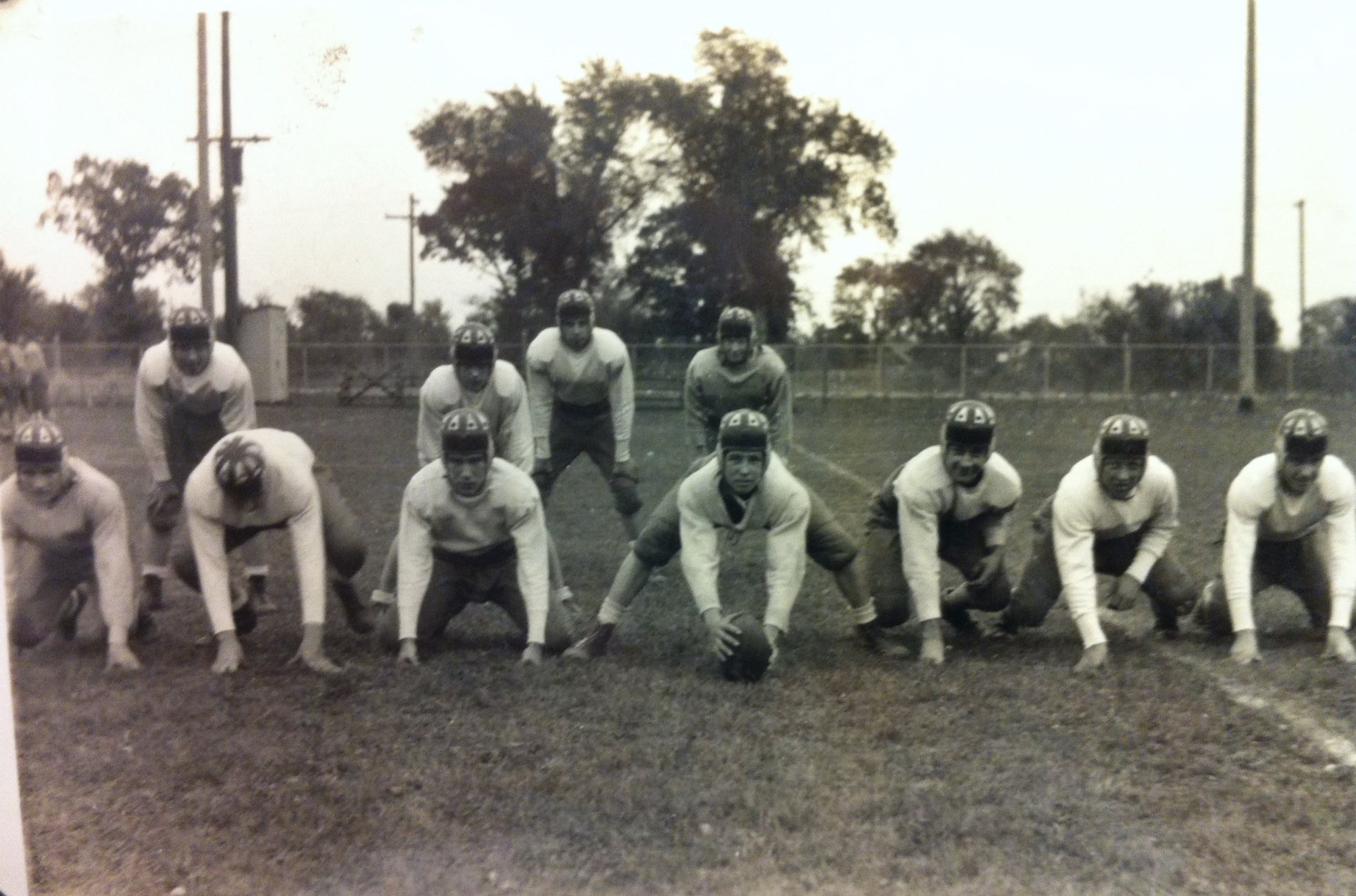
A young Ray Smisek, third from right. Copyrighted photo courtesy of S. Smisek.

He hated hunting. Did not like to kill anything.  He would pick up bugs and release them outside.  Used to freak us kids out!

He liked his newspaper and watching the news.  He occasionally smoked a pipe.  Wore Old Spice aftershave all the time I knew him (I keep some around to this day.).  He loved licorice. 

He was honest as the day is long.  A man of his word.  A handshake was an agreement.  A promise.  A very strong Republican who loved Richard Nixon and John Wayne.  He liked Louis L’Amour books.  I think he dreamed of being a cowboy.

(Dad) hated racists.  Always gave everyone a chance. Maybe two and that’s it.”

Aunt Eiko, the Teenager

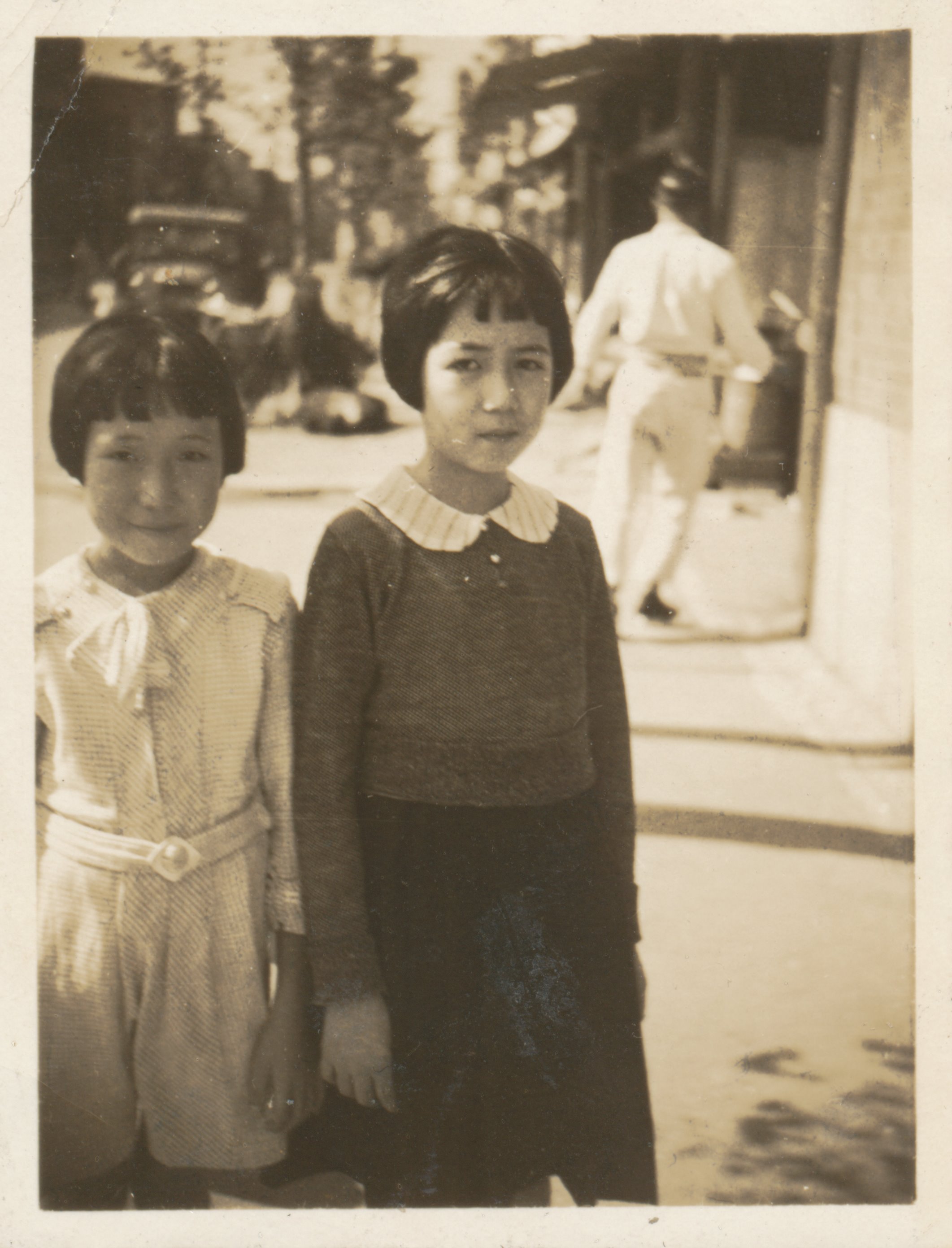
(L to R) Aunt Eiko and mom. Circa 1932, Shimbashi, Tokyo.

My Aunt Eiko and my mother had lived with my grandparents in Tokyo since their births in the mid-1920’s. Their childhood home was next to the Ginza at Shimbashi 5 Chome; think of it as Japan’s Beverly Hills.  It is within walking distance from the Imperial Palace.  My aunt says the picture to the left was taken near their Shimbashi home and next to a relative’s kimono shop in the Ginza.

As a child, she was apparently sickly.  They say she was quite skinny from this ailment and that ailment; the food shortage didn’t help much although my grandfather reportedly had black market connections to obtain food once in a while.  Nevertheless, she had a weak digestive system.  She has it to this day.

Like most Japanese “upper society” girls of that time, she was required to know how to play the shamisen, or a Japanese stringed instrument.  She was also trained on the silk kimono – it was an elaborate dress that took a couple of hours to put on properly.

Showa 14 Aki - Fall 1939 / Grandma in center, Aunt Eiko on right
Aunt Eiko on right playing the “shamisen”. Tokyo, Autumn 1939.

Aunt Eiko didn’t disappoint anyone’s ear drums when she saw a bug.  She screamed really loud when a bug got near her.  It was easy to see them since they get as big as footballs there in Japan.  Ok, I’m exaggerating – a little.

She had an artistic flair, with her grandfather being a noted painter and art professor.  She loved “ikebana”, or flower arranging.  In fact, she made it her career after war’s end, becoming one of the top ranked ikebana instructors in Tokyo.

Amazingly, in spite of her stomach ailments, she liked cooking; unfortunately, she had a knack for burning things.  I know.

Most of all, she loved dogs.  After feeding one with her chopsticks, she’d just go right back to using them to feed herself… but with food a scarcity, her love for dogs would have to wait until quite a while after war’s end.

________________________________

In Part 2, we will visit the B-29 Superfortress, her crews and the ordnance she would typically carry into battle above Japan.

Hope you’ll stay tuned.

Edit: You can find the other chapters in the links below:

The Firebombing of Tokyo – Part 2
The Firebombing of Tokyo – Part 3

The Firebombing of Tokyo – Part 4

The Firebombing of Tokyo – Epilogue

Fairy Tales, Dragons and MacArthur – Part 2


Screen
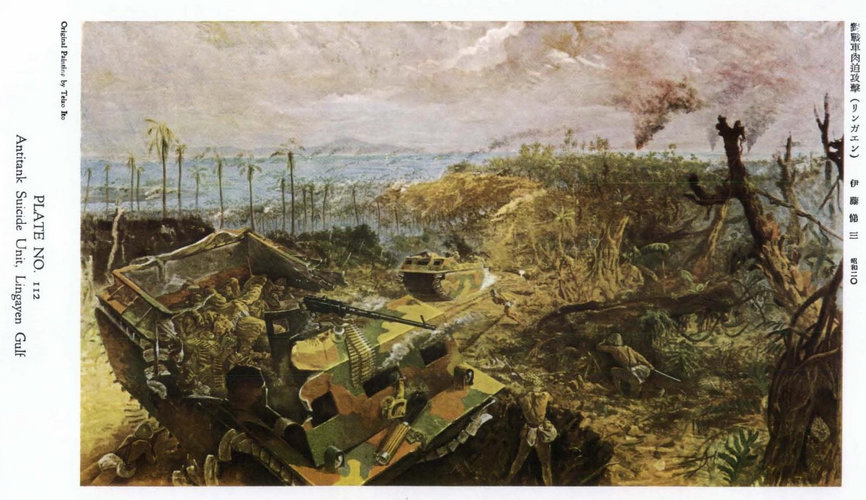
Japanese artwork from “Reports of General MacArthur – Japanese Operations in the Southwest Pacific Area Volume II Part II”, Page 595. US Army

(Continuation from Part 1)

Mitsuko went about Tokyo seeking artists to paint war scenes from the Japanese point of view.  This task was made much easier as Willoughby gave her permission to ride about in her own private jeep.  This was a definite indicator of his affection for Mitsuko as all Japanese women were prohibited from even riding in any Allied military vehicle, let alone have one assigned to her.¹  With her purse flush with cash from Willoughby, Mitsuko paid starving artists large sums of money for art pieces depicting the war from the Japanese point of view.  It was reported that she paid these artists up to several hundred dollars for one piece; this caused great dissension amongst the Japanese men who were assigned to compile the history.  At that time, a year’s average salary rarely exceeded $150.  Many of these men were also former Japanese military and were required to address their superiors as if they were still in the military.  Kawabe ran the group as if it were still his army.  Some of them found it dishonorable to be even working “for the invaders”, as my Tokyo grandmother liked to say.

Screen Pg 533
Japanese artwork from “Reports of General MacArthur Japanese Operations in the Southwest Pacific Area Volume II Part II”, Page 472. US Army

Fraud was suspected with respect to Kawabe and Arisue.  To further their spying, they asked for and received a tidy sum of money from Willoughby to supposedly increase spying activities on the Communists in the surrounding Asiatic regions.  Similar to what is happening today but on a grander scale, some of these supposed spies just “disappeared” after receiving a supposed cash payment.  While the CIA apparently came to the conclusion there was a scam going on, they failed to take remedial action.

In a further documented twist, the subservient Hattori was himself pursuing his own agenda in secret.  Actually, he had two secret and separate agendas.

taihei
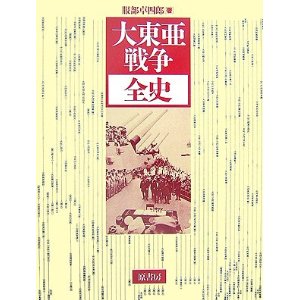
Hattori’s condensed 大東亜戦争前史 , or “The Complete History of the Great East Asia War”. It is also in DVD.

First, as he solely determined what would go into the Japanese-version of the history, Hattori was absconding with selected crucial documents that came across his desk.  He had schemed that once “the invaders” left, he would write his way into history by publishing his own “true” version of the war against the Allies. By 1953, he was partly successful in that he did put together an eight volume history entitled “大東亜戦争全史”, or “The Complete History of the Great East Asia War”.

Second, he was gung-ho to re-arm the new Japan.  It is reported that by 1949, the brilliant planner Hattori had drawn up a four division army with key officer positions already determined, complete with detailed arms and logistics laid out.

He passed away in 1960.  In another twist of fate, his original publication was condensed into a thousand page book and published five years later under the same title.²

________________________________

As for Willoughby, he also pursued his own agenda.  Yes, he was motivated to glorify his commanding officer, General MacArthur, in the history books.  Using the funding from G-2, the project moved along out in the open.  Most anyone knew about it although it was done under a military intelligence umbrella.

However, in late 1947, G-2’s history department requested copies of the documented history.  In a bewildering response, Willoughby replied by saying it was not ready; he also replied in like for the Japanese volumes.  But what made it bizarre was that he stated it was but MacArthur’s personal record – a report, if you will – of what happened during the war…  Essentially, that it was not an official US Army publication.  As such, it would not be subject to review and approval by the US Army prior to publication.  However, in a kind gesture, Willoughby indicated they would receive copies once it was published.

Willoughby went to a former Army officer, General Stackpole, in 1948; he owned a publishing company specializing in military history.  Due to the immenseness of the volumes, Stackpole declined participation on the grounds it was too large a printing effort for his company.  Willoughby then sought out Japanese printing companies but they were still in shambles from the war.  He was unsuccessful.  It was reported unofficially that MacArthur had known, at least, of the attempt.

Eventually, five samples of the “report” were published in 1950 by a Japanese printing company with the assistance of Washington.  However, during this time, Willoughby – for (their) mutual protection – ordered all extraneous documentation collected during this five-year project that may jeopardize MacArthur’s hero status destroyed… and they were.  Even notes and drafts were burned.  The burning was supervised on March 2, 1951 by two US Army officers assigned to Willoughby’s history detachment.

The reasoning and significance behind this burning at that time is now clear.  On April 11, 1951, President Truman relieved General MacArthur of his duties for his handling of the Korean War.  To give you an idea of the volumes of documentation collected yet remaining after the burning, MacArthur brought back 32 footlockers full of documentation.  Willoughby himself brought three more which apparently contained the galley proofs.  He claimed these were MacArthur’s personal property… a diary of sorts.  Willoughby managed to convince the government to finally print the “report” in 1953; however, MacArthur intervened and squashed the agreement citing the documentation was full of errors and was just a draft.  It was not printed.

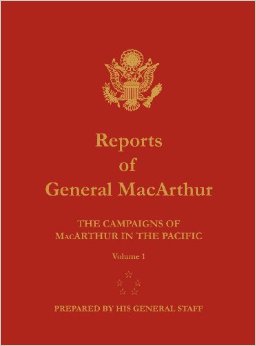
book cover macMacArthur did sell his memoirs for nearly $1 million in 1963 but like Hattori, MacArthur passed away soon thereafter in April 1964 and ironically never saw his memoirs published.

Nevertheless, the US Army finally did publish the two-sided “history” of WWII in 1967 after MacArthur’s death.  The publication is entitled “Reports of General MacArthur” and can be read online at several websites.  Previously owned hard copies are also available online.  It is immense.  From what I understand, the Army disclaimed any responsibility over its accuracy throughout its four volumes.  It does contain the original Japanese artwork sought out by Mitsuko.³

Willoughby passed away in October 1972 in Naples, Florida.  He is buried in Arlington.

_________________________________

Villaba1
“Reports of General MacArthur”. Page 533. While the Imperial Japanese Army informed my grandmother Uncle Suetaro was killed on July 15, 1945 at Villaba, this battle report is unfortunately dated for March 1945.

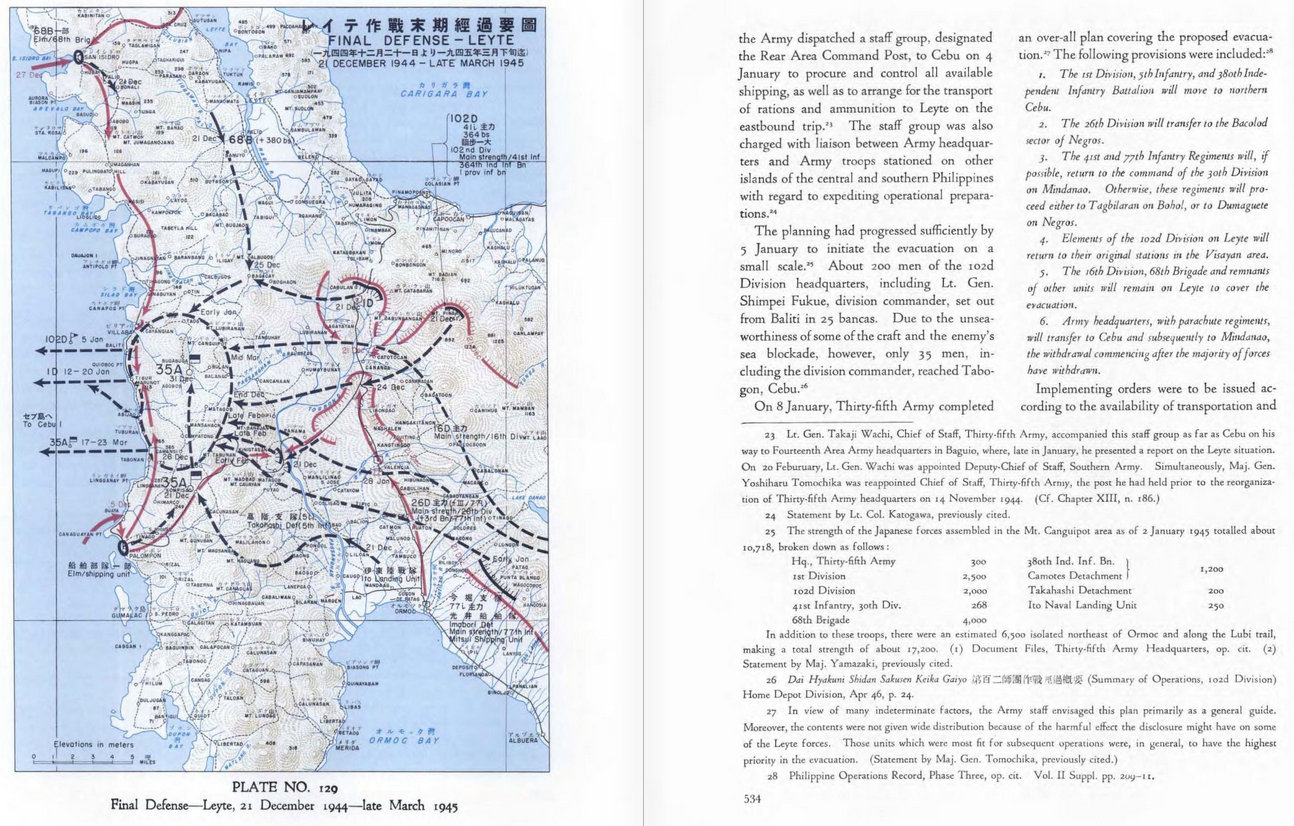
In closing, I came across some information in the “Reports of General MacArthur” as to the action that potentially led to the combat death of my own Uncle Suetaro on Leyte near a village called Villaba…on Page 533 of Volume 2, Part 2.  My Hiroshima cousins believe he was assigned to the Imperial Japanese Army’s 41st Mixed Regiment; it had been annihilated on Leyte.  He was reportedly killed on July 15, 1945 but it is clear per MacArthur’s “report” that centralized Japanese army command on Leyte had ceased in March 1945 per this Japanese record.

Perhaps finding out exactly what happened to my Uncle Suetaro will only occur in a fairy tale.  To realize I will never find out is my dragon to slay.

____________________________

Footnote:

1  Though I have yet to see one photo, my mother and aunt claim our Uncle Taro took them around what was left of Tokyo in his US Army jeep.  Uncle Taro was a Private in the US 8th Army’s Military Intelligence Service.

2  Unbelievably, it is available on Amazon Japan.
3  Although I have scoured Japanese websites, only scant sentences can be found about Mitsuko.  Her fate is unknown to me except for her grave marker.

Fairy Tales, Dragons and MacArthur – Part 1


http://www.wall321.com

As I watched “How to Train Your Dragon” on Blu-Ray for the third time with my kids, it became clear that knights in shining armor kill dragons…and only in fairy tales.

A tremendous Einstein moment for this old geezer.

But then I realized that sometimes, what we read about WWII history can be sort of a fairy tale, complete with a knight in shining armor trying to slay a dragon… the dragon being what truly happened in war.

History becomes what the writer – or a leader – wants it to be in the public domain.

_____________________________

Unknown to many is that another battle raged after the surrender of Japan.  It was about what was to be recorded as an official history of WWII.  It was a battle involving glorification, greed and politics of both the victors and the defeated.

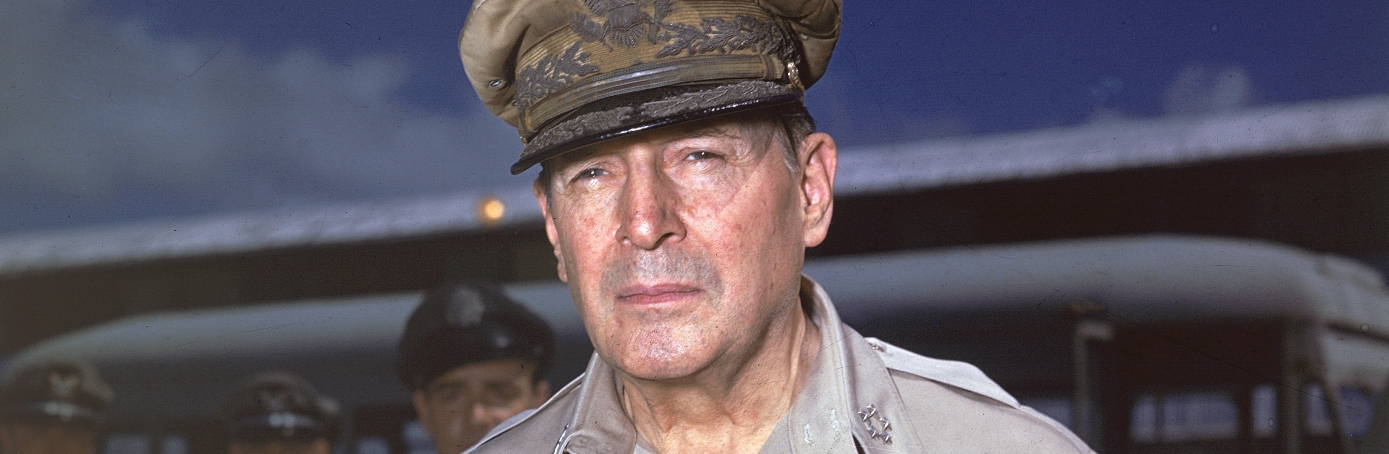
And of course, it involved General of the Army Douglas MacArthur.

General of the Army Douglas MacArthur www.historychannel.com
General of the Army Douglas MacArthur
http://www.historychannel.com

First, a quick opinion and summary of MacArthur from this arm-chair (amateur) historian’s viewpoint.

MacArthur had a helluva an ego as did George Patton and Bernard Montgomery.  He was suspicious, short tempered, short on patience and embittered.  MacArthur – as did Patton – studied military history extensively; he loved Napoleon.  As commander, he failed to appropriately alert the troops under his command in the Philippines immediately prior to Pearl and worse yet, in the hours after.  He had to flee the Philippines on a PT boat along with his family to avoid capture leaving behind his troops.  However, supported by a brilliant, top notch staff and highly critical intel derived from intercepted then deciphered Japanese transmissions, he was highly successful in winning the war in the Pacific.  He was a hero at war’s end to his great gratification.  He was so loved by the American public that quite a few babies were named Douglas.

____________________________

Primarily due to a ridiculously small and inexperienced staff, only a relatively short written history of WWII in the Pacific emerged in late 1946 to the chagrin of MacArthur.  He immediately then placed Major General Charles Willoughby in charge of generating an “official” history.

willoughby kawabe
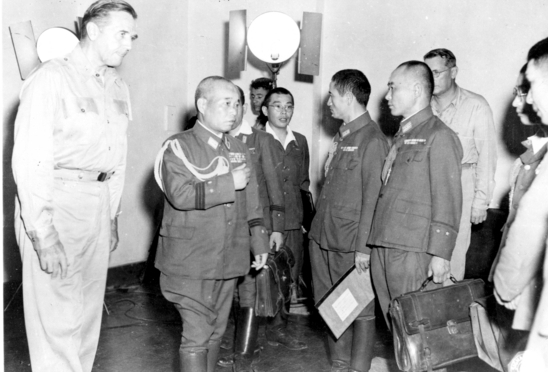
Willoughby (left) then Kawabe. http://www.trumanlibrary.org

Willoughby was in charge of the US Army’s G-2 (i.e., military intelligence) in the Southwest Pacific theater of war and was trusted by MacArthur.  (I briefly reported on Willougby in “Ike, a German-American Soldier”.)  Having a heavy German accent, Willoughby was very loyal to MacArthur, pompous and stoutly anti-Communist.  He seized the opportunity to “write the history” on victory in the Pacific under MacArthur’s leadership.
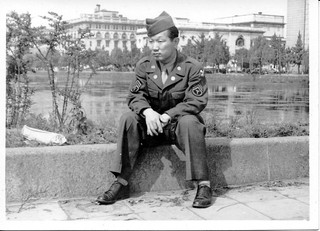
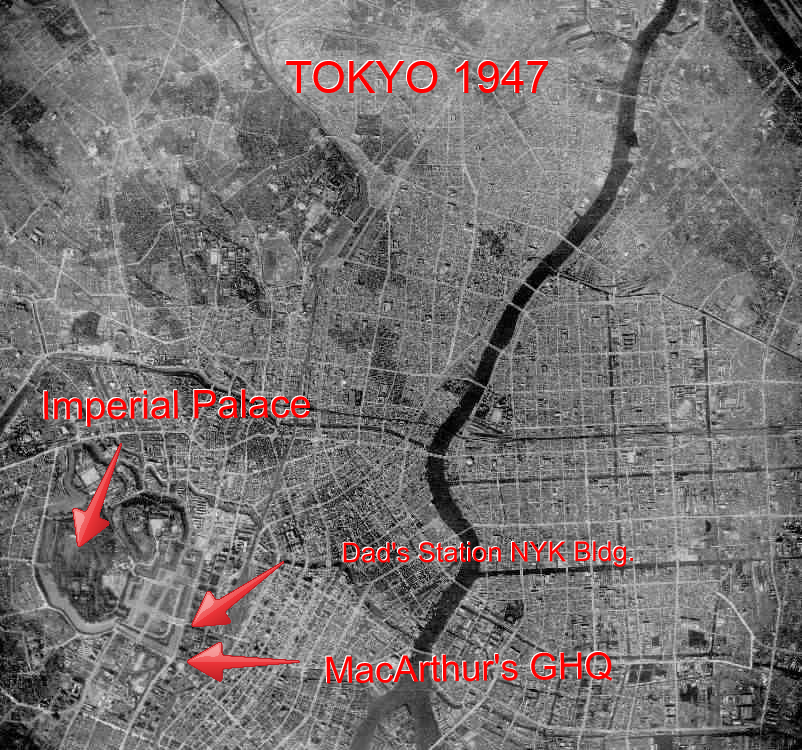
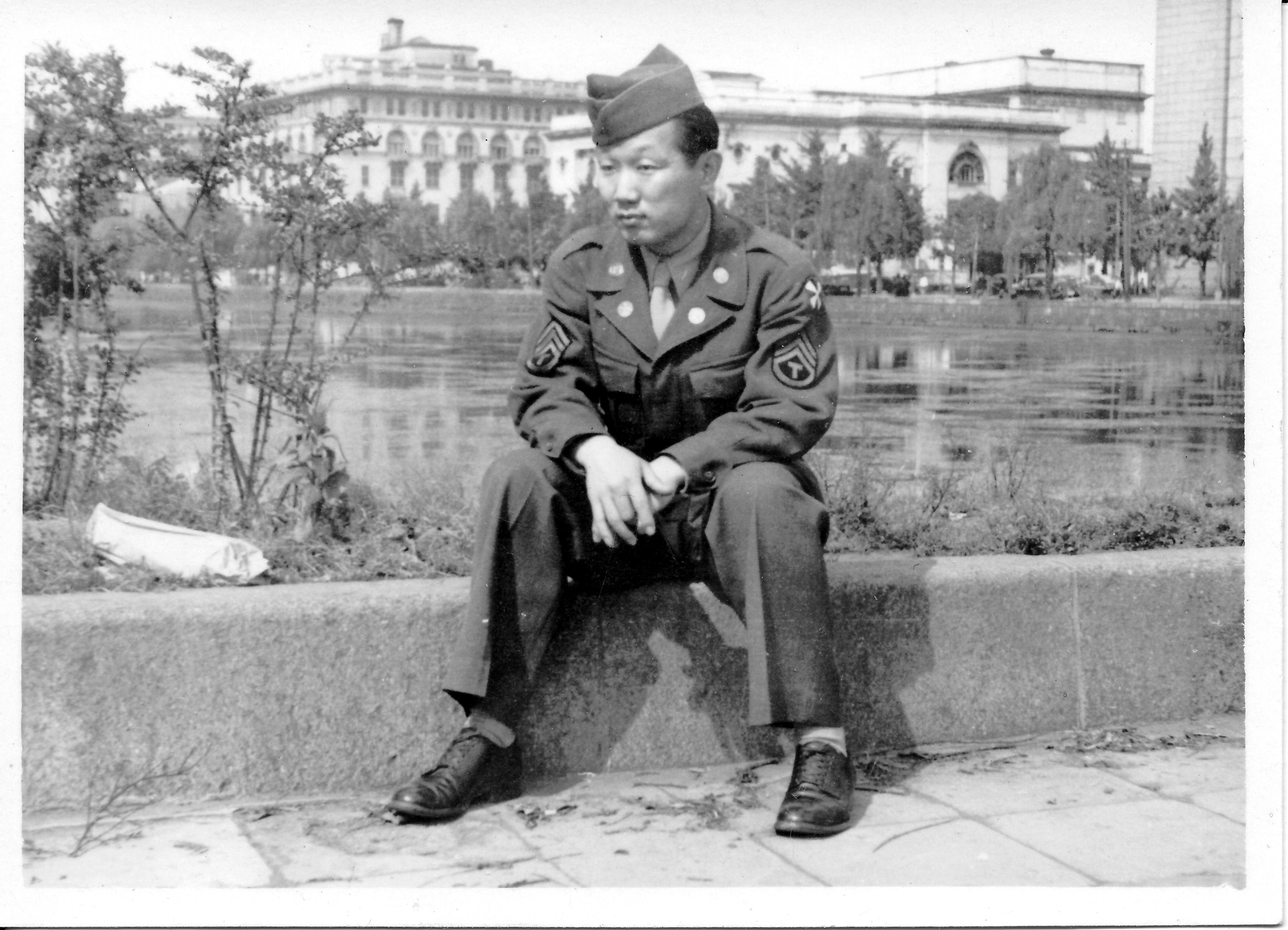
The tiny staff then blossomed under Willoughby to over 100 and was headquartered on the 3rd floor of the “NYK Building (Nippon Yusen Kaisha)” just a block from MacArthur’s GHQ in the Dai-Ichi Seimei Building; both are situated directly across the Imperial Palace.  (Coincidentally, my dad was stationed in the NYK Building on the 4th Floor as a US 8th Army Technical Sergeant, 3rd Grade in Willoughby’s G-2. He is pictured below with the edge of MacArthur’s GHQ seen on the extreme right. The NYK Building is off the picture to his left.  Behind him is the moat of the Imperial Palace.)

By the Emperor's Palace 1947

Aviary Photo_130579620590287532
You can clearly see the devastation caused by firebombing. http://www.geocities.jp/torikai016/map/P0229tokyo-tokyo1947.jpg

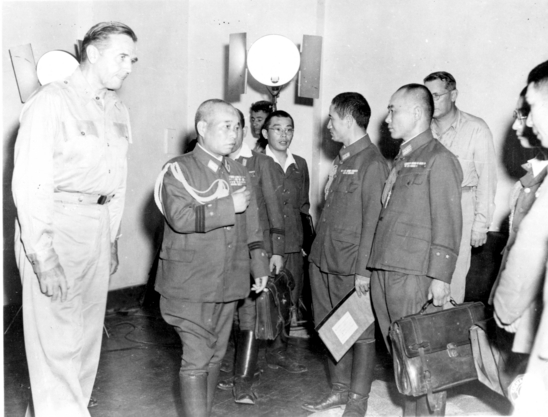
Seeking glory in this mission, Willoughby recruited by the end of 1946 top Japanese military officers, spies and even war criminals.  Each had their own personal goals and copious amounts of US money flowed into these Japanese hands.  One Japanese officer who Willoughby met in Manila was the Imperial Japanese Army’s Lt. General Torashiro Kawabe (photo above).  Amazingly, because Kawabe also spoke German very well and was anti-Communist, he and Willoughby struck it off well.

A short time later, still in 1946, Willoughby met Lt. General Seizo Arisue who was the intelligence chief for the Imperial Japanese Army.  By sheer luck, Arisue was also fluent in German and a staunch anti-Communist and reported he had the extensive spy network in place mentioned above.  A triad had thus formed and the project to document history took off but with a twist: to Willoughby’s credit, he foresaw a “dual” history.  As history always gets written by the victor, Willoughby wanted two volumes.   One would be the US side of the story, the second volume to be Japan’s.

In early 1947, Willoughby was introduced to a former colonel who served at the Imperial General Headquarters in Tokyo during the war.  His name was Col. Takuhiro Hattori.  Hattori was known to both Kawabe and Arisue as a genius in planning and organizing.  Hattori eventually became the person from Japan’s side to determine what went into the war history.

araki_mi2
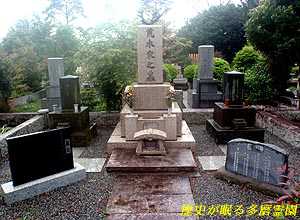
Crypt, or ohaka, of the Araki’s in Japan. Click on link to a Japanese website, “History Sleeps in This Cemetery”. http://www6.plala.or.jp/guti/cemetery/PERSON/A/araki_mi.html

Generous money flowed through Willoughby to Kawabe and Arisue, reportedly to help fund the spy network.  Along the way, they brought in an “Issei” (a Japan-born first generation immigrant to the US like my grandfather) plus a university professor named Mitsutaro Araki.  He also received education in Germany but no history would be complete without sexual escapades.  Professor Araki’s wife was a socialite who used her beauty to charm others, primarily men.  Her name was Mitsuko Araki. As a bit of trivia, Mitsuko was the only Japanese who was allowed free, unhindered entry/exit to GHQ.  It was believed the CIA concluded she and Willoughby were having an affair.

In his efforts to make his recorded history unique, Willoughby paid Mitsuko to find and compensate artists who could paint battle scenes from Japanese eyes.  He felt photos were too ordinary plus many were from US sources.

To be continued in Part 2.

What Did FDR Know? – Part 5


Minidoka_1
My dad’s oldest brother, Uncle Yutaka, in the back row, center. He is posing with the Block kitchen crew at the Minidoka, Idaho “War Relocation Center”, circa 1944. Notice their living quarters behind them.  They lived in plywood barracks covered only with tar paper.  There was no plumbing nor toilets installed.  Photo courtesy of my stateside cousin, Janice (Kanemoto) Hew.

So you likely see from reading Parts 1 through 4 of “What Did FDR Know” that Japan really never had a chance…  A chance to win WWII.

Their chances were nearly nil largely due to the US breaking two key Japanese codes.  One was JN-25, the code used by the Imperial Japanese Navy.  The other, as we’ve read, was “Purple”, the secret cipher used by the Japanese diplomats.  Simply put, we knew exactly what they were doing as well as what they were going to do in all aspects.

____________________________

 A Family Example of What Happened

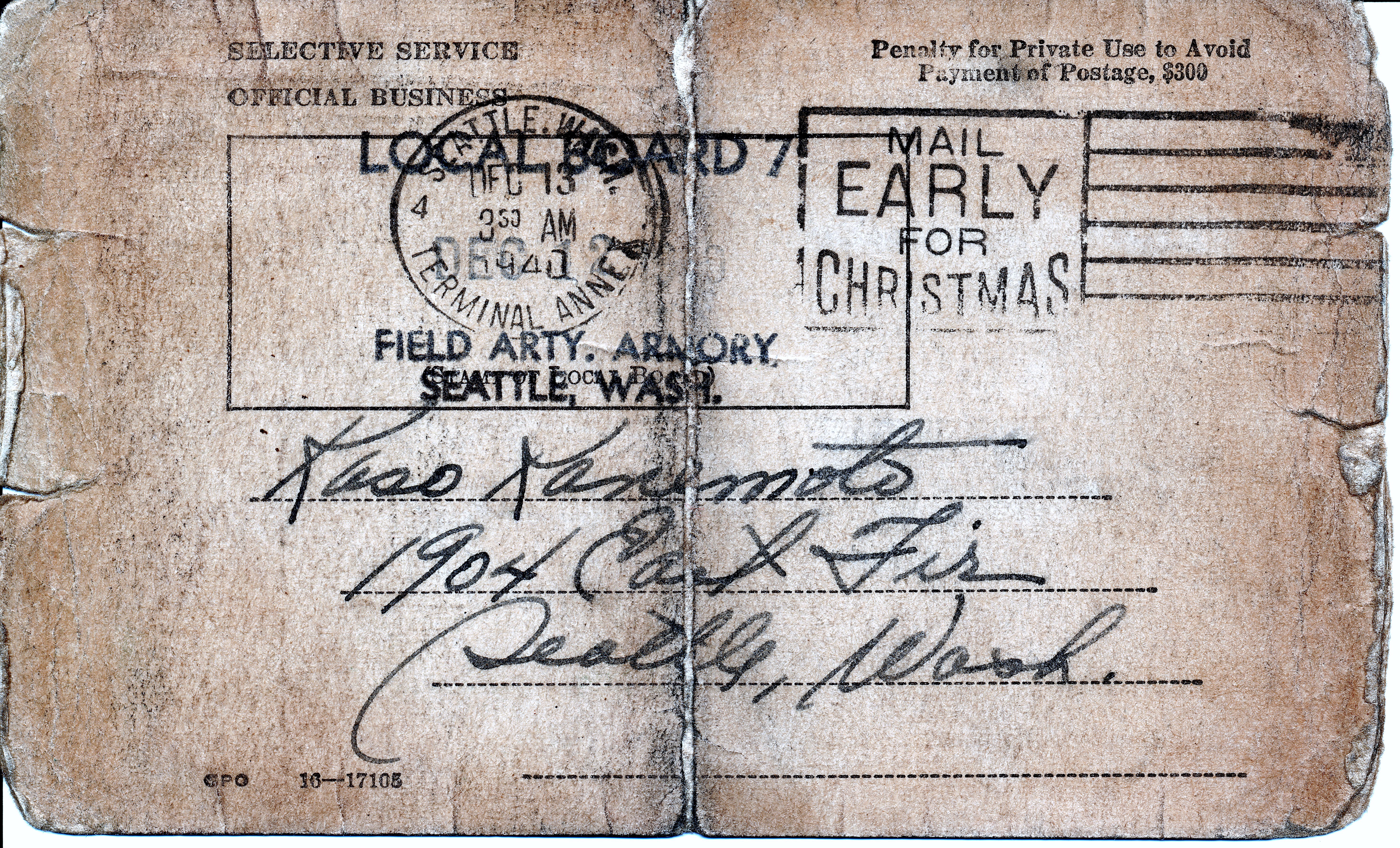
My father’s draft card before Pearl Harbor, postmarked December 13, 1940.  As a US citizen, he was eligible for the draft and classified 1(A):

image0-81

image0-82

My dad’s revised draft card mailed to him while imprisoned at the Tule Lake “War Relocation Center”, postmarked January 19, 1943.  This is now official notice he was now classified 4(C) – Enemy Alien.  The address bears his address (block number) at the Tule Lake “War Relocation Center”:

image0-83

image0-84

Interestingly, the cards are creased as he was required to carry it in his wallet at all times.  All American males of draft age were…even if they were imprisoned in a dusty, barren dry lake bed in California stripped of all rights.

tule lake guard
Armed guard at the Tule Lake Concentration Camp. My father, uncle, aunt and cousins were there so he was guarding them. US Army Signal Corps, May 23, 1943.

Ironic, isn’t it?

___________________________

But what did FDR know about “suspect” activities by people of Japanese descent living in the US on the West Coast before Pearl Harbor?  Most importantly, of the extent and magnitude of their “suspect” activities?  We’re talking espionage.  What could have prompted his ordering the “evacuation” of such people from the west coast of America?

But don’t get me wrong; it was not just the Japanese.  People of German descent loyal to Nazi Germany also did spy…as did people of Italian descent.  Some were loyal to their homeland, not the US.  But certainly it was not ALL of them.  Let’s not forget the famous East Coast docks were run by the Italians, too.  Certainly, if one wished to “spy” and report on ship movements, there could not have been a better way.  Being dock workers, they know what supply ship left when…and with what.  After all, they loaded them.  A number were sent to the bottom of the Atlantic by the waiting U-boats.

Let’s explore this a bit further.

____________________________

Since we are addressing “suspect” activities, here’s an interesting sidebar to this story.

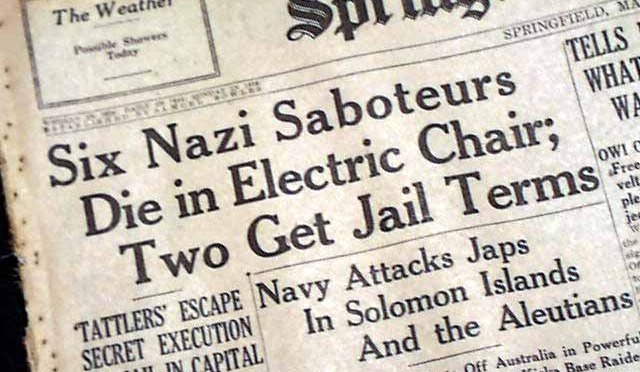
Did you know that eight German saboteurs were caught on American soil whose combined cases were brought before a special session of the Supreme Court on July 29, 1942?  Did you know they came ashore from submarines in mid-June with greenbacks worth over $2 million today, explosives and even James Bond-like devices?  The case was referred to as the Ex parte Quirin.  It was named as such because of the lead saboteur, Richard Quirin. Quirin had lived in the US for a dozen years and became the first spy “trainee” of this group once he returned to Germany.

nazi electric chair

In short, six of the eight got to sit in the electric chair just about ten days later…  On top of that, a one saboteur (Herbert Haupt) actually went to live with his father in Chicago.  The father also helped him apply for a job and get a car.  Another saboteur, Werner Thiel, actually handed some of the money over to his once room mate and business partner, Anthony Cramer; they owned a deli but it had failed.  But it is interesting to note that in spite of this event, there was not a mass imprisonment of German nationals or their American-born offspring from this incident which made the US Supreme Court.

__________________________

The MAGIC Intercepts Distribution Process

Because the US had broken the ultra-complex “Purple” code in 1939 used by the Japanese diplomats, FDR was able to at least see exactly what the Japanese diplomatic corps was doing before Pearl Harbor.

McCollum Arthur
Lt. Cmdr. Arthur McCollum. US Navy Photo

ONI (Office of Naval Intelligence) had established a secret delivery system for the intercepted Japanese military and diplomatic intelligence (MAGIC) for FDR in the winter of 1940. Lt. Com. Arthur H. McCollum of ONI, and the author of the “McCollum Memo”, was the distribution officer; his name was on 151 USN routing slips in the National Archives.(¹) These routing slips provided a trail to a large collection of Army and Navy MAGIC ultra secret deciphers from monitoring Japanese communications; these were presented to FDR, the top military chiefs and several key members of the Administration between February 1940 and December 7, 1941. Sometimes, when McCollum deemed he had a “hot” item, he would personally deliver the message to FDR; otherwise the President’s naval aide made the delivery as per below.

According to Stinnett (1):

The Japanese intercepts destined for FDR were placed in special folders.  Captain Callaghan (Naval Aide to FDR) was responsible for the safety of the documents. Roosevelt read the original copy but did not retain any of the intercepts. Each original was eventually returned to the folder and stored in McCollum’s safe at Station US in Washington. There they remained, available for White House review. Shortly after December 7, when Congressional critics began to question the administration’s failure to prevent the Hawaii attack, all records involving the Japanese radio intercept program—including the White House route logs and their secret content—were locked away in vaults controlled by Navy communications officials.

These intercepts would include those related to Japanese espionage efforts.  This twenty-two month monitoring program prior to Pearl Harbor also allowed FDR and key staff to anticipate and analyze Japan’s reaction to the provocations advocated in the McCollum Memo.(²)

________________________

So what did some of the MAGIC intercepts and other investigative reports include before Pearl Harbor and up to the imprisonment of about 117,000 people of Japanese descent against their will?  We already know per “What Did FDR Know – Part 3” that Tokyo instructed its American-based diplomats to covertly begin putting together an espionage network.  In fact, because we had broken the Japanese codes, the US “listened in” on Admiral Isoroku Yamamoto in February 1941; he clued in Captain Kanji Ogawa, Japan’s top intelligence officer, of the intentions of attacking Pearl Harbor.  Yamamoto wanted to give Ogawa enough time to put together his own military-based network in the event of war.

20140510_212549
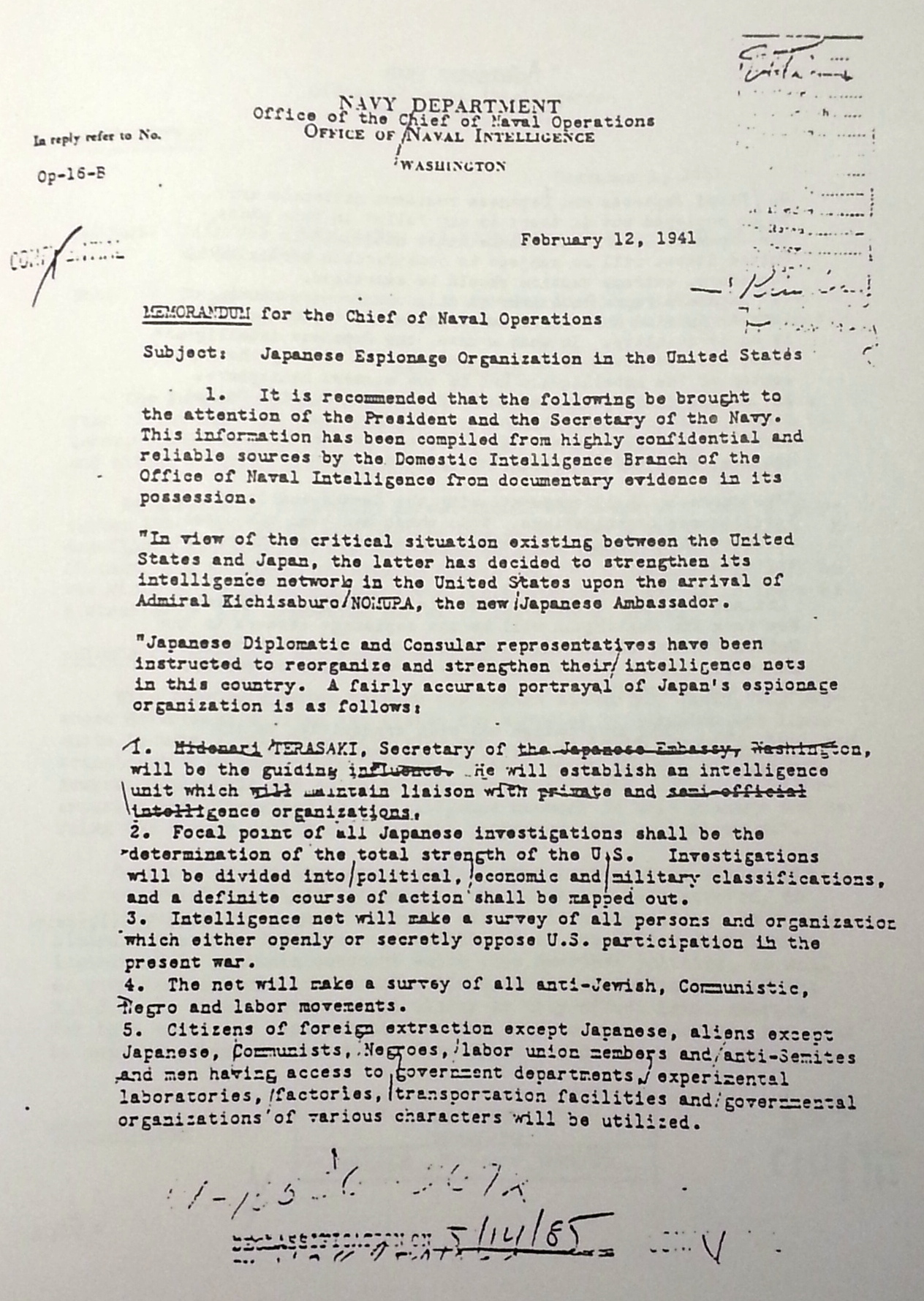
ONI memo generated for FDR, dated February 12, 1941. This was based upon the Purple deciphers, with Tokyo instructing American-based diplomats to set up their espionage nets. Source: “Magic” by David D. Lowman.

Prior to the message instructing diplomats to energetically strengthen their espionage efforts, there were already Japanese spies living on the west coast.  Under the disguise of language students, Japanese military agents (primarily IJN) had already established their network including a small number of Issei and Nisei, militaristic Japanese organizations, Japanese clubs and business fronts.  This facet was led by Lt. Cmdr. Itaru Tachibana of the IJN.  In June 1941, however, this ring was smashed.  Tachibana, and unbelievably a former chauffeur and business secretary to Charlie Chaplin named Toraichi Kono, had tried to recruit a former US Navy seaman (Al Blake) but Blake turned him in.  While Tachibana and his lieutenants were deported, detailed searches of their living quarters provided detailed records of their espionage network.  This detail included names of residents of Japanese descent as well as a number of organizations.

While not a historian, the following is a summary of what I deem to be key MAGIC intercepts in addition to other information gathered by other entities such as the FBI.  In addition to information contained in the previous four parts, the thirst for intelligence by the Japanese was high:

  1. February 5, 1941 – Tokyo instructed the diplomats to come up with a contingency plan in the event something were to happen (i.e., war).  To always exercise due care and to look at Central/South America for continuing intelligence efforts.
  2. February 15, 1941 – Tokyo directly asked for intelligence on materiel movement (especially planes and ships), non-military cargo vessels, troop movements, production of planes and arms, military training activities, etc.
  3. April 24, 1941 – This intercept disclosed that Tokyo wanted a status update of its previous orders in regards to: (1) keying in on intelligence instead of propaganda, (2) recruiting of agents for the ring, and (3) established standards for reporting such information.
  4. May 9, 1941 – The Los Angeles office reported that they “…have already established contacts with absolutely reliable Japanese in the San Pedro and San Diego area, who will keep a close watch on all shipments of airplanes and other war materials…”  Further, they shall “…maintain close connections with the Japanese Association, the Chamber of Commerce and the newspapers.”
  5. May 19, 1941 – the Japanese Embassy in Washington requested $500,000 more cash to further their recruiting for intelligence gathering purposes, i.e., entertainment, bribery, etc.
  6. June 10, 1941 – To prevent an international scandal, this intercept recommended that it be made to look as if Kono’s friends were supporting him financially for his defense and to keep the IJN out of further suspicion on the arrest of Tachibana.  It was recommended $25,000 be offered as a bribe to Kono; the memo stated  in part “…in view of the danger that he might give evidence unsatisfactory  to TACHIBANA.”
  7. October 4, 1941 – specifically asked for intelligence on any change in sea or air patrols or warship movements and the immediate reporting thereof.
  8. October 28, 1941 – in one of many transmissions reporting naval ship movements, the Seattle diplomats reported in detail the sailing of fifteen Coast Guard vessels.  They also reported their four-inch guns were upgraded to five-inch guns.
  9. November 29, 1941 – Tokyo ordered the San Francisco diplomats to report in detail all arrivals, departure dates and destinations of ALL commercial and war ships in the Pacific, Indian Ocean and South China Sea. (Note: this was not transcribed until December 4, 1941.)
  10. December 6, 1941 – Seattle diplomats reported the departure of the carrier USS Saratoga from Bremerton, WA.

japanese espionage

Please note there were hundreds of these types of transmissions, both from and to Tokyo.  In addition, there were quite a few official FBI reports detailing espionage activities.  These reports also included names and businesses that were involved.  The FBI was not privy to MAGIC intercepts.

______________________________

FDR signed Executive Order 9066 on February 19, 1942 which had the effect of forcibly relocating all persons of Japanese ancestry – both citizens and aliens – out of the west coast’s Pacific military zone and into War Relocation Centers. The much later publicized objectives of the order were to prevent espionage and to protect persons of Japanese descent from harm at the hands of Americans who had bitter anti-Japanese attitudes.

______________________________

image0-15
Dad in his US Army duds, Tokyo 1947. The Emperor’s Palace is behind him to his left. MacArthur’s GHQ is off to the right (Dai-Ichi Sei Mei Building).

So what is the point of this story, the last installment of “What Did FDR Know?”

Some say people like my dad were imprisoned because of their race.  In other words, they were discriminated against, pure and simple.³

Some say people like my dad were imprisoned because “FDR wanted to protect the Japanese from hate crimes”.  After all, my grandmother was egged while she lived in Seattle.  Some Japanese girls were taunted or worse, molested, assaulted or raped.  Indeed, there was hysteria.

Some say people like my dad were imprisoned because of the espionage activities.  And from the above, we do see some were taking part in espionage activities.  In other words, the US wanted to ensure we won the war in the Pacific with the fewest amount of lost lives as possible and espionage was certainly a risk.  But if that were the case, how would the US go about removing Japanese suspected of espionage?  Just knock on specific homes and businesses and arrest specific men…but leave the others to go about their daily lives?

If they did that, wouldn’t Tokyo suspect their “secret” transmissions were being intercepted?  How else would the US have known who to arrest?  And if Tokyo did suspect that, what if they changed their codes?  We’d be in the dark again intel-wise.  More of our military would therefore possibly lose their lives.  (NOTE: It is true not one person of Japanese descent was tried and convicted of espionage.  However, it is my amateur opinion that they were NOT tried to maintain secrecy about the broken codes.  Case in point: the Supreme Court above.  Certainly, the fact we listened in on their espionage activities would have become public knowledge from testimony.)

So what do you think?  How does this compare to what you were taught?

(ADDENDUM – July 23, 2014

As a good fellow mentioned, the third paragraph immediately above can be read to imply my dad was suspected of espionage activities.  He was not.)

___________________________

In my opinion, our breaking of the Japanese codes was America’s greatest secret weapon.

It was not the atomic bomb.

___________________________

NOTES:

(1) Per “Day of Deceit: The Truth About FDR and Pearl Harbor” by Robert Stinnett.

(2) There was a brief period in 1941 when FDR himself was removed from the MAGIC distribution list.

(3) In 1988, President Reagan signed the Civil Liberties Act.  The Act approved paying each surviving Japanese or Japanese-American $20,000 each for being unlawfully stripped of their rights for no reason other than race.  (My dad, four uncles, four aunts and seven cousins each did receive payment as did other more distant relatives.)

President Reagan and Private Zanatta


It is hard to believe thirty years have passed since President Reagan commemorated the 40th Anniversary of D-Day – in person.

I feel his love and support for our military – and Nancy – is without question.

But few people recall that President Reagan gave not one, but TWO stirring and emotional speeches that day at Normandy.

The first and most replayed speech was the one at Pointe du Hoc, flanked by surviving soldiers of the United States Army Ranger Assault Group.

Below is an average shell crater at Pointe du Hoc; that is my daughter standing in it back in 1999:


Shortly afterwards, President Reagan gave a second speech… in front of The Wall of the Missing at Normandy American Cemetery and Memorial.  Private Zanatta was in the first wave hitting Omaha Beach; his daughter Liz wrote to President Reagan about what her father told her about that day.  During this speech and while reading passages from the letter, even the unflappable President Reagan becomes overwhelmed with emotion.  While the beginning of the video contains important recordings from that day in 1944, his emotion-laden speech begins at the 0:30 mark:


I feel this is one of his most moving speeches.  At the end, he says, “…a D-Day veteran has shown us the meaning of this day far better than any President can.”

I pray in my own way for those young souls who were killed – on both sides – as well as their families.

We will not see a mass of humanity assembled for such purposes ever again…and the remaining representatives of that humanity are leaving us each day.


Two Old Keys to Memorial Day


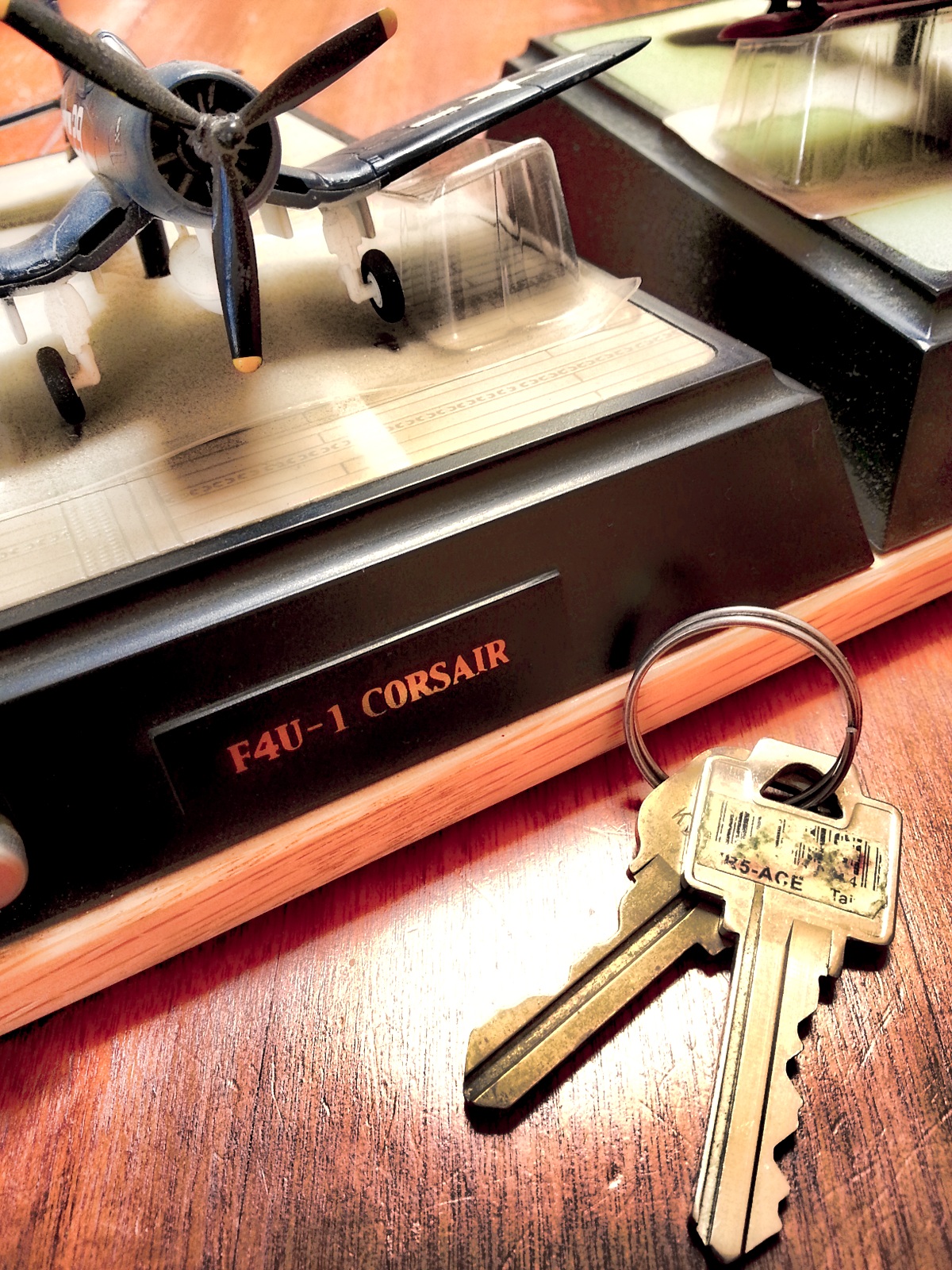
2014-05-21-12-17-02
Old Man Jack entrusted me with his house keys “…in case he shot himself in the foot” as he put it. Now covered in dust is Old Man Jack’s favorite baby – the F4U Corsair albeit a toy. He would push that button in once in a while, listen to this toy’s engine sound and watch the prop spin… It would echo a bit in my hallway…

I looked at these two old keys in my hand.  They belonged to Old Man Jack and the thought of Memorial Day instantly crossed my mind.

Two old keys to Memorial Day.

__________________________

A year ago, I had written a blog about Memorial Day (“It” and Memorial Day).

At times, I feel the meaning of Memorial Day has either faded or has changed.

In essence, many people living in today’s “politically correct” society have taken the sacrifices of our fallen to mean a three day weekend.

Sad…but that’s how I feel.. and it angers me.

__________________________

When I looked at those two keys, my mind raced to some of the things Old Man Jack said.

But mostly, to the things he could not say.

In the twelve years I was honored to know him, he would abruptly blurt out something once in a while when we were talking in his garage… while sitting in the blue wheelchair that belonged to his wife.

There was no story associated with these mutterings.

“Boys got killed on those stinkin’ islands…” then raise his thick, white eyebrows.

Or, “Hell, I pissed in my pants.”

Or once in a while, he would make a muffled smack with his lips then slowly shake his head left and right… and not say anything more.

_________________________

One such utterance was mentioned in “Old Man Jack’s Love”.

Upon gazing upon his beloved Corsair in front of him after over 60 years, he began weeping.

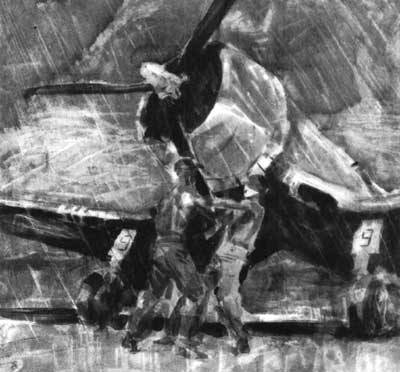
sketch
Ground crew working on a Corsair in heavy rain.

After recovering and meandering next to his plane, he simply let out, “Some of (the pilots) just didn’t come back.  I could never stop thinking, ‘Did a Jap get him… or was it me?’”

He said that because as Ground Crew Chief, he was responsible for the airworthiness of the plane a young Navy or Marine pilot would take out on a mission…to shoot at the enemy…or be shot at.  These planes had to be in the best fighting condition as lives depended on it.  But he frequently said “they had to make do” because they never had enough spare parts… so they HAD to improvise.

One time, he said a bushing had been shot out on a plane that had to go on a mission the next morning.  Old Man Jack did what he could.  What he must.  He soaked two pieces of coconut logs in engine oil overnight.  When it came time for the pilot to take off, he clamped the oil soaked wood around the cabling and used baling wire to clamp them together as tightly as he could.  The plane left on its mission – with the young pilot behind the stick…in a plane with oil soaked coconut log as a bushing.

Unbelievable.

Now perhaps you understand the depth of his utterance of, “…or was it me?”

_________________________

11588442153_2dec5b0551_o
Old Glory shimmering off a P-51 Mustang at the Chino Planes of Fame Museum.

I will never have an answer because the question could never have been asked of him.

But I feel Old Man Jack carried tremendous guilt in his heart about something that happened on those stinkin’ islands.

Not just bad; real bad.

Deep down, my heart tugs at me that someone within Old Man Jack’s reach died that shouldn’t have… and that Old Man Jack feels personally responsible for his death… and he carried that anguish for all these years.

Torment.

Grief.

Guilt.

_______________________

As Old Man Jack said, some of the young pilots didn’t come back.

They were killed or are forever missing in action.

That is for whom Memorial Day is all about.

To remember and honor those that did not come back…and not a Memorial Day sale.

Two old keys to Memorial Day…

When America – and the Press – Was Supporting Our Troops 100%


111461184.jpg

This was from a time when the entire nation was 100% behind our troops…  even our media.

March 1942… here in southern California.

She, an aspiring starlet named Marilyn Hare, was determined to kiss 10,000 soldiers in early 1942 and while doing so, boost morale…  Not only for the troops facing an uncertain future but the country.  At this time, the news was filled with the conquests of the Japanese military in the Pacific.  The Doolittle Raid and the Battle of the Coral Sea would not happen until the following month.

Times have changed yet our young are still sent to war.

For the uplifting photo series of this kissing wonder in LIFE, please click here.