Category Archives: Aircraft

What Did FDR Know? – Part 4


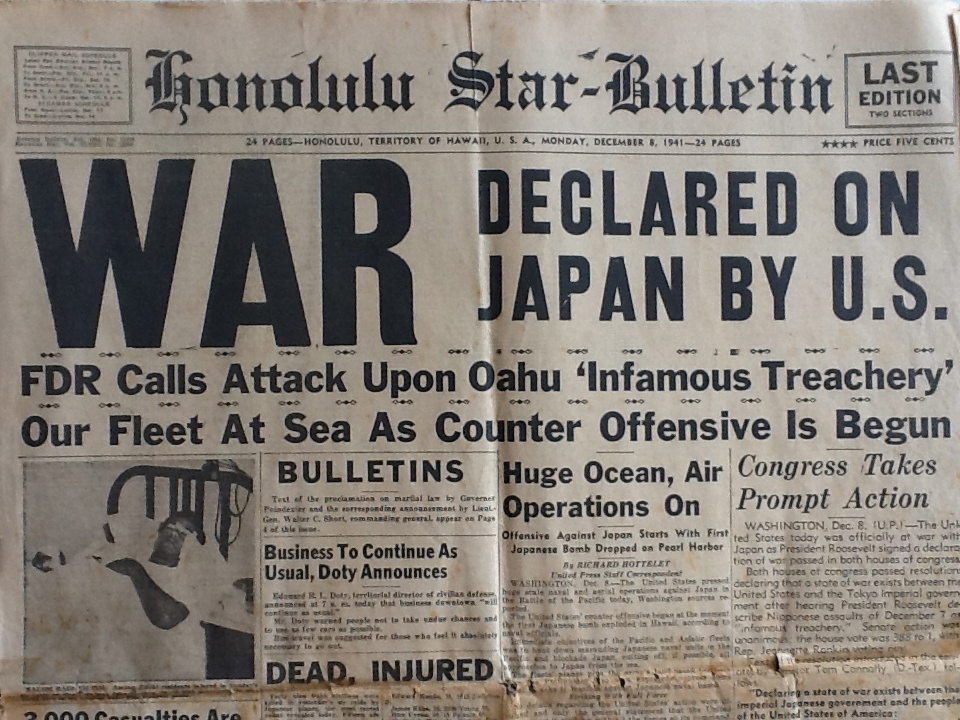
honolulu headline

As we saw in Part 3, Japan and America are now at war.

While not directly related to the question of “What did FDR know?”, it is deemed critical for readers to understand the damages suffered by the US military – and specifically its naval and air assets – on December 7, 1941.  It is also important to realize the huge advantage the Japanese Imperial Navy had over the U.S. Navy.  Lastly, it is important for readers to note the unbridled successes of the Japanese military at that time… and what unbelievably followed.

For the vast majority, Americans are under the belief that the US was caught flat-footed with the surprise attack on Pearl Harbor.  Indeed, 21 ships of the U.S. Pacific Fleet were sunk or damaged.

Of those ships damaged, all but three of the ships at Pearl Harbor were refloated and repaired (Note: Pearl Harbor at its deepest is about 50′.):

  • The USS Arizona – too badly damaged to be salvaged,
  • The USS Oklahoma – raised but considered too obsolete to be worth repairing, and,
  • The USS Utah – also considered obsolete.

In addition, the US had 188 aircraft destroyed plus 159 were damaged; the majority were hit before they had a chance to take off.

uss calif

There were a total of 2,403 American casualties, including 68 civilians.  Most of the military killed were on the USS Arizona (1,177 killed).  Most of the civilians killed were from improperly fused anti-aircraft shells fired by US batteries hitting in Honolulu.  There were 1,178 wounded military personnel and civilians combined. (1)

crashed zero
A downed Zero in a Hawaiian neighborhood.

Japanese naval forces sailing for the raid included four heavy aircraft carriers, two battleships, two heavy cruisers, two light cruisers, 35 submarines, and 11 destroyers.  Indeed, a powerful fleet projecting tremendous offensive firepower.  All survived unscathed; all but 29 Japanese aircraft returned to their carriers.

In the Pacific Theater, Japanese forces were rolling over Allied forces at will with victories in Thailand, Malaya, Wake Island, Guam Island, the Philippines, Hong Kong, Singapore, Burma, Dutch Indonesia and the invasion New Guinea.  The Imperial Japanese Navy dominated in the Pacific, attacking Allied bases in Australia and Ceylon; they even bombed or shelled coast of North America at will albeit with minimal effect.

But, the great sea battle of the Coral Sea and more specifically at Midway essentially put a halt to the wave of Japanese victories… barely five months after Pearl Harbor.

How could that possibly be?  Wasn’t our Pacific fleet crippled?

____________________________

So… how DID the US Navy stop the Japanese advance at these critical battles at Coral Sea and Midway?  After all, at the time of Pearl Harbor, the US Navy only had three aircraft carriers in the Pacific: the USS Enterprise, USS Lexington, and USS Saratoga.  (The USS Hornet was still on shakedown cruise and the USS Yorktown and USS Wasp were deployed in the Atlantic.)

Of course, the heroics of our sailors and Marines played a most dominant role but you may wish to ask yourself:

  • Were American aircraft and ships better than their Japanese counterparts?  No, production of new classes of ships and aircraft would not arrive in the Pacific until 1943.
  • Did American forces have more men, aircraft and ships? Again no, the tide of the American industrial strength would not be felt in the Pacific until 1943.
  • Was it better leadership?  No.  Admiral Chester W. Nimitz was arguably equally matched by Admiral Isoroku Yamamoto, the overall commander of Japanese forces during the battles of Coral Sea and Midway.
  • Did our navy stumble upon the enemy out in the Pacific by sheer luck or happenstance?

If it wasn’t the above, how was the US Navy able to engage the Imperial Japanese Navy at Coral Sea and Midway then stop them?

It was MAGIC.

___________________________

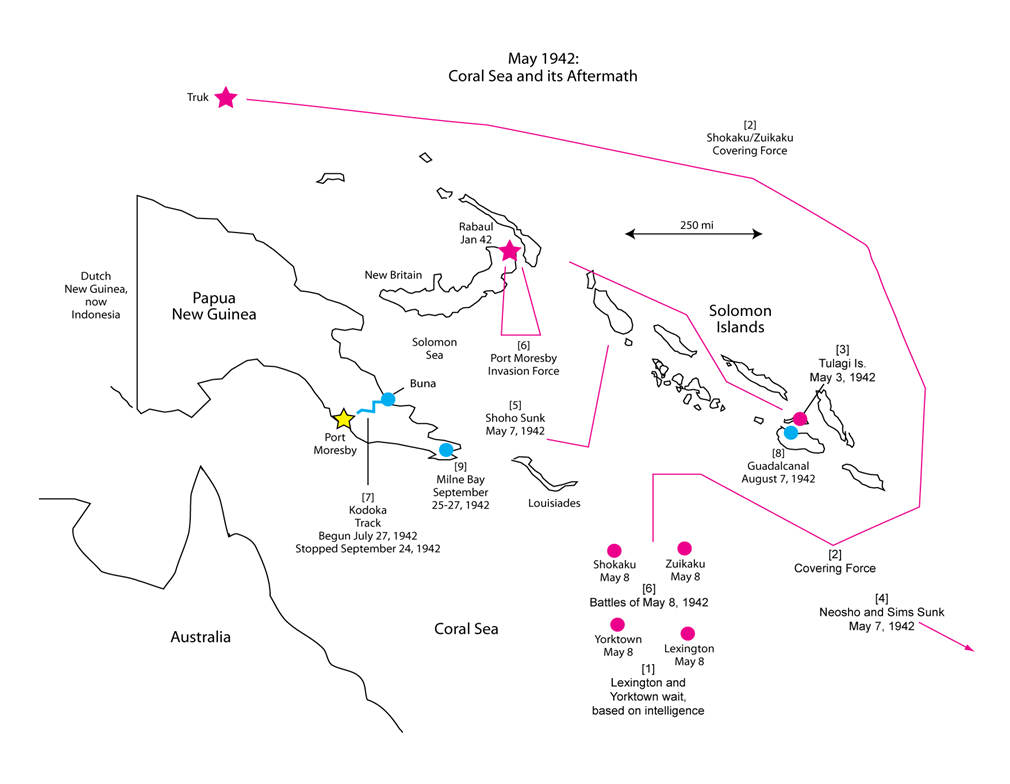
Battle of Coral Sea, May 4 – 8, 1942
coral sea map
Battle of the Coral Sea, May 1942.  Source: Pacific War Museum.

By March 13, 1942, OP-G-20 had completely broken JN-25.  Until then, about 10% to 15% of a JN-25 message that was intercepted could be read. (2)  However, enough could be deciphered to understand the Japanese were gearing up to attack Port Moresby in Papua, New Guinea on May 7, 1942.  By taking Port Moresby, Japan could extend its reach beyond northern Australia and further south.

Upon receiving the intelligence from the deciphered JN-25 messages, Admiral Chester Nimitz decided to move a fleet into position in between Port Moresby and Australia.  He issued such orders on April 17, 1942.  However, he had but two carriers available for action – the USS Lexington and the USS Yorktown.  This battle was definitely NOT a chance encounter; it was planned.
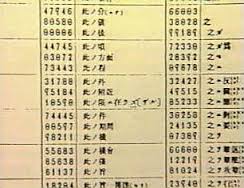
jn25 sampleIn fact, deciphered messages allowed the US Task Force 17 to be in position before the Japanese fleets arrived to attack.  But lacking sufficient capital ships and aircraft that were inferior to the Japanese Zero, the outcome was far from certain.  The sailors and Marines were largely untested as well.  (The USS Hornet and USS Enterprise were unavailable due to their critical roles in the Doolittle Raid on Tokyo; it took place two days later on April 18, 1942.)

With but two carriers and support ships, the US fleet was outgunned especially considering our aircraft was obsolete.  The Japanese fleet sailed with a Shoho (a carrier), several cruisers and destroyers, and a dozen transports filled with troops.  A smaller invasion force would move down the Solomons, which laid on New Guinea’s eastern flank, with the target being Tulagi. To protect these two invasion fleets, the Japanese carriers Zuikaku and Shokaku would spearhead yet a third fleet to provide air protection.

coral-lex01s
The USS Lexington explodes and sinks. (US Navy archival photo)

While the ensuing two-day Battle of Coral Sea was considered a draw, U.S. forces inflicted enough damage on the Japanese navy to force it to withdraw.  In addition, as the Japanese were unable to secure the port, their military was forced to fight in land warfare, which proved disastrous for the Japanese.  Of most importance, the fruit of the battle saw the Japanese carrier Shoho sunk, with both the Zuikaku and Shokaku damaged and forced to retire.  Therefore, they were made unavailable for the critical Battle of Midway, just about four weeks later.

However, we lost the USS Lexington, a major loss. And while the USS Yorktown suffered heavy damage as well, the Japanese believed her to have been sunk; instead, the USS Yorktown was made seaworthy through the extreme efforts of repair crews at Pearl Harbor.  While two weeks had been estimated for repairs, the repair crews had her back on the seas in just 48 hours.

This strategic victory was made entirely possible because of secret MAGIC intercepts.  The Japanese still did not believe their complex JN-25 had been broken.

Battle of Midway, June 4 – 7, 1942

rochefort
Captain Joseph Rochefort, USN, head of OIC, Pearl Harbor (Photo NSA)

Arguably, the paramount triumph from the breaking of JN-25 on March 13, 1942 was the Battle of Midway.  This is one battle that my neighbor, Mr. Johnson, fought on board the USS Enterprise as a very young US Marine.  From decrypting the Japanese naval messages, the U.S. naval commanders knew the general battle plans of Admiral Yamamoto – even the timetable.  Yamamoto’s strategy was to have aircraft carrier task forces launch both a diversionary raid off the Aleutian Islands then lure the U.S. Navy to Midway Island.  His goal was to decimate once and for all what remained of the American fleet after Pearl Harbor.

Yes, the deciphered intercepts did not state in the clear Midway was the target; the messages simply designated “AF.”  While CINCPAC felt strongly it was Midway, it was Captain Joseph Rochefort of OP-20-G who wily suggested how to establish for certain what “AF” stood for.

Rochefort was Officer in Charge (OIC) of Station Hypo in Pearl Harbor, the nerve station in Hawaii for deciphering JN-25 intercepts.  An expert Japanese linguist and during the most critical month of May 1942, Rochefort reviewed, analyzed, and reported on as many as 140 decrypted messages per day. These reports were directly piped to the highest-ranking fleet commanders.  He brilliantly strategized for American forces on Midway to send out a radio message saying that they were running short of fresh water.  Rochefort and his group waited anxiously to see if Japan would take the bait. Finally, OP-G-20 intercepted a Japanese message: AF was running short of fresh water.

Establishing Midway as the target, the U.S. Navy assembled what it could.  America was still short on capital ships and better aircraft.  After a 48 hour turnaround, the USS Yorktown joined the USS Enterprise and USS Hornet.

While remembering that by virtue of deciphering coded Japanese messages, the Japanese Imperial Navy had three less carriers to deploy after their losses at Coral Sea – a very critical fact.  After a fierce three-day battle at Midway, U.S. naval aviators sank all four Japanese aircraft carriers in Yamamoto’s task force – the Hiryu, Soryu, Akagi and Kaga.  All four participated in the assault on Pearl Harbor, effectively turning the tide in the Pacific.  Yes, luck was involved during the actual battle but certainly, the courage of our young men at sea and in the air was incredible.  They had proven themselves but at great cost in lives and materiel… including the USS Yorktown.

Unbelievably, the Chicago Tribune published a darned story revealing that the U.S. had known about Japanese battle plans in advance.  They had, in effect, revealed that JN–25 had been broken. Inexplicably, key Japanese leaders never found out about the article.  Darned media – even back then.

Assassination of Admiral Yamamoto

State funeral Yamamoto
State funeral procession for Admiral Yamamoto, 1943.

As school history books had once shown, the battle planner of the Pearl Harbor attack was Admiral Yamamoto.  He did know of the might of the U.S. having attended Harvard University – yes, Harvard – from 1919 to 1921, studying English.  He did, in fact, oppose taking on the U.S.  But Yamamoto had one trait which would lead directly to his death: his intense desire to be punctual.  The US counted on this.

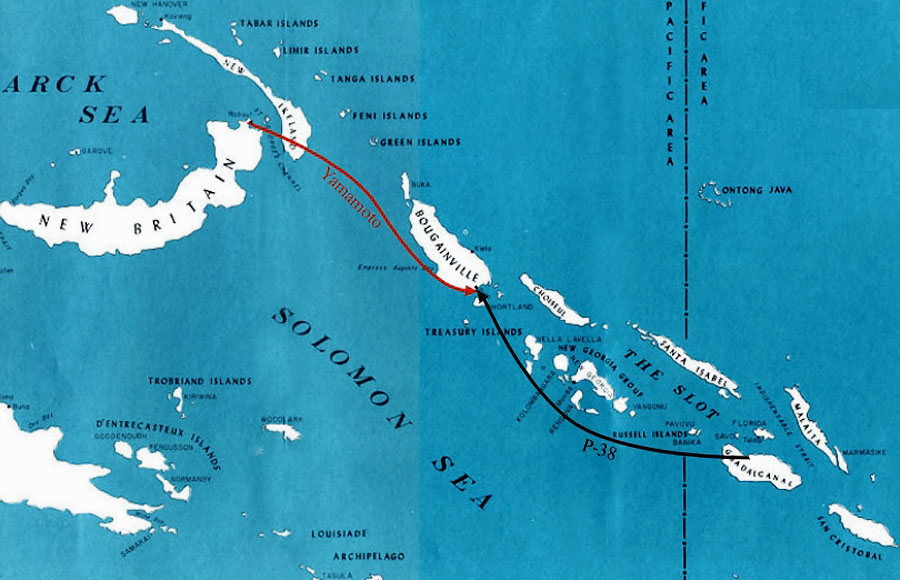
Codebreakers intercepted then learned after deciphering messages that the admiral was scheduled to inspect a naval base on Bougainville in the Solomon Islands on April 18, 1943.  The detail even included his minute by minute itinerary.  Some top US officials were hesitant to use this information for fear that doing so would tip off the Japanese that their codes had been broken. Nevertheless, the decision was made to assassinate Yamamoto. That morning, eighteen P–38 fighters left their base at Guadalcanal at the other end of the Solomon chain and arrived at Bougainville precisely ten minutes before Yamamoto’s plane was making its approach. The admiral was killed in the attack, depriving Japan of its most experienced and accomplished admiral and sapping Japanese morale.
yamamoto flight
Flights paths: Yamamoto (red) and USAAF (black). Also notice “Green Island” north of Bouganville. This was “Old Man Jack’s” last battle station. USN Archives

To mislead the Japanese that the fighters had arrived purely by chance, the air force flew other risky patrols to the area, both before and after the attack.  It was not a “one shot in the dark” mission.  It was deeply thought over and planned out – because we were able to intercept and decipher coded Japanese messages.(3)  They also spread “rumors” that the information was from coast watchers.

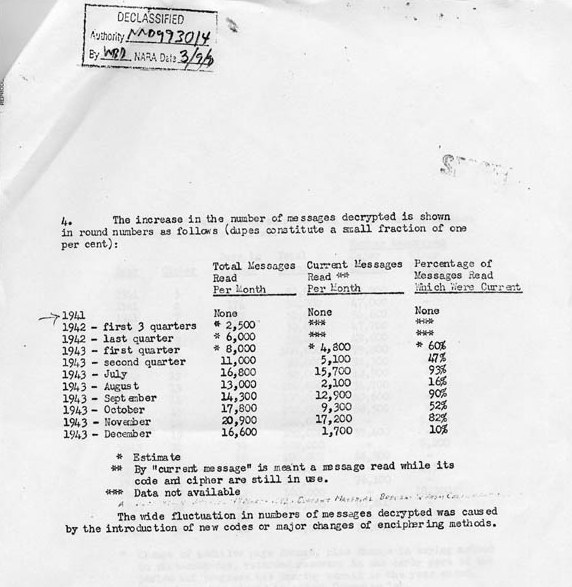
The Japanese did not change JN–25, and for the remainder of the war, U.S. intelligence intercepted and read thousands of Japanese messages.  A portion of a secret OP-20-G report, circa 1943, is below listing the number of coded Japanese messages intercepted:

Japan’s Plan

Early in 1942, Japan decided to block the Allies from setting up bases in Australia. Operation MO would send a large invasion force to Port Moresby, the capital of New Guinea. From Port Moresby, the Japanese would be able to project air power beyond the northern tip of Australia and establish bases even further south (Hearn).

The Port Moresby landing force sailed with about a dozen transports filled with troops, several cruisers and destroyers, and a half-size carrier, Shoho (Bennett, Hearn). A smaller invasion force would move down the Solomons, which lay on New Guinea’s eastern flank. The specific target in the Solomons was Tulagi, which was the colonial capital. To protect these two invasion fleets, Zuikaku and Shokaku would lead a separate covering force to create a blanket of air protection (Bennett).

The U.S. Prepares

By March 1942, the United States had cracked part of the current Japanese Naval (JN) code, JN-25. However, U.S. intelligence could intercept only about 60 percent of all Japanese transmissions and had the resources to analyze only about 40 percent of the messages it did intercept (Parshall and Tully). Even then, code breakers typically could read only 10 to 15 percent of the code groups in a message (Parshall and Tully). U.S. intelligence primarily used direction-finding equipment to learn where many Japanese ships were and where they were heading (Parshall and Tully).

Beginning on April 16, U.S. intelligence began using this spotty information to piece together an understanding of a Japanese plan to move south with carriers (Parshall and Tully). On April 17, Nimitz ordered the carrier Lexington to join Yorktown in the Coral Sea (Bennett). If Halsey had been able to move Enterprise and Hornet there too, the U.S. might have been able to destroy the Japanese fleet. But Enterprise and Hornet needed refitting after the Doolittle raid of April 18, 1942, and could not get there in time for the fight (Parshall and Tully).

– See more at: http://www.pacificaviationmuseum.org/pearl-harbor-blog/battle-of-the-coral-sea#sthash.P5voInlO.dpuf
Japan’s Plan

Early in 1942, Japan decided to block the Allies from setting up bases in Australia. Operation MO would send a large invasion force to Port Moresby, the capital of New Guinea. From Port Moresby, the Japanese would be able to project air power beyond the northern tip of Australia and establish bases even further south (Hearn).

The Port Moresby landing force sailed with about a dozen transports filled with troops, several cruisers and destroyers, and a half-size carrier, Shoho (Bennett, Hearn). A smaller invasion force would move down the Solomons, which lay on New Guinea’s eastern flank. The specific target in the Solomons was Tulagi, which was the colonial capital. To protect these two invasion fleets, Zuikaku and Shokaku would lead a separate covering force to create a blanket of air protection (Bennett).

The U.S. Prepares

By March 1942, the United States had cracked part of the current Japanese Naval (JN) code, JN-25. However, U.S. intelligence could intercept only about 60 percent of all Japanese transmissions and had the resources to analyze only about 40 percent of the messages it did intercept (Parshall and Tully). Even then, code breakers typically could read only 10 to 15 percent of the code groups in a message (Parshall and Tully). U.S. intelligence primarily used direction-finding equipment to learn where many Japanese ships were and where they were heading (Parshall and Tully).

Beginning on April 16, U.S. intelligence began using this spotty information to piece together an understanding of a Japanese plan to move south with carriers (Parshall and Tully). On April 17, Nimitz ordered the carrier Lexington to join Yorktown in the Coral Sea (Bennett). If Halsey had been able to move Enterprise and Hornet there too, the U.S. might have been able to destroy the Japanese fleet. But Enterprise and Hornet needed refitting after the Doolittle raid of April 18, 1942, and could not get there in time for the fight (Parshall and Tully).

– See more at: http://www.pacificaviationmuseum.org/pearl-harbor-blog/battle-of-the-coral-sea#sthash.P5voInlO.dpuf

Crane Library, National Archives, College Park
National Archives

Purple and D-Day

The importance of MAGIC and the breaking of the “Purple” Japanese consulate code cannot be understated.  For non-historian readers, the reach and military value extends far beyond the waters of the Pacific.  It extends to Europe…specifically D-Day and the shores of Normandy.

As revealed in “What Did FDR Know? – Part 2” of this blog series, the US broke the code for this cipher before the attack at Pearl Harbor.  The US did their best to keep the wraps over this great intelligence triumph.  However, Nazi Germany’s own intelligence had good evidence that SIS had broken Purple and informed the Japanese.  Unbelievably, Japan refused to believe it.  (I believe this is part of the Japanese culture – to not place importance on “water cooler” talk.)   Only when Congressional hearings and investigations into who knew of the Pearl Harbor attack reveal this did the Japanese accept it.  Unfortunately, is was much after war’s end.(4)
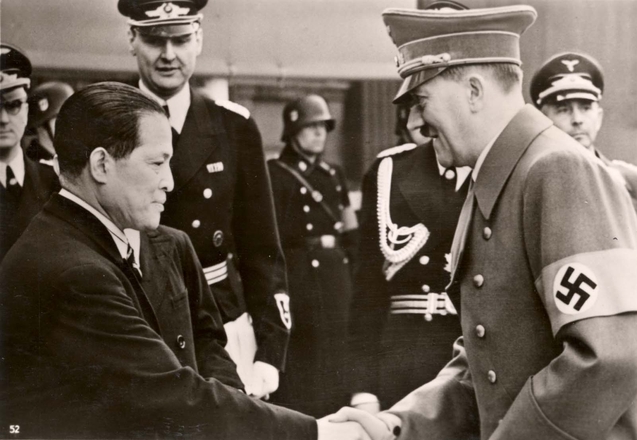
oshima 1
Baron Hiroshi Oshima, 1939.

Per “What Did FDR Know? – Part 1”, Baron Hiroshi Oshima was the Japanese envoy to Berlin and used his Purple machine to communicate frequently with Tokyo.  Luckily for the US, Oshima was also an Imperial Army colonel at the time of appointment and loved war strategy and armaments.  He followed intimately the German conquests in Europe and their latest technologies. He sent very detailed reports to his superiors in Tokyo of what he had learned using the purple cipher machine, which the US was able to intercept and decipher immediately.

Oshima became a favorite and a confidant of Hitler.  Hitler – being so full of himself and pompous – shared with Oshima the most secret and sensitive of his war plans with him.  Hitler even gave Oshima a tour of the German defenses in Normandy!  As per his character and routine, Oshima transmitted very detailed reports of the Nazi defenses at Normandy.  This was obviously key in the preparations for D-Day, so much so the deciphered intel was immediately transmitted to General Eisenhower.  Not quite what we read in our textbooks…

And while the public is led to believe the U.S. did not know if the German commanders took the bait that the D-Day invasion would take place at Pas-de-Calais, Oshima secretly gave the US confidence that the Germans had taken the deception through his messages to Tokyo.  The Nazis were preparing for the landing at the wrong beaches.  (Note: this is not to lessen the somberness of those killed or missing in action at Normandy.  Further, this is not to lessen the importance of wartime security.)  Further, with their true belief that the invasion at Normandy was a diversion, the Panzer divisions were not immediately released to engage the Allied invading forces until too late.

In recognition of this value to Japan, he was promoted in a few short years from Colonel to Lt. General.  Oshima’s prolific reporting prompted US General George C. Marshall to say Oshima was, “…our main basis of information regarding Hitler’s intentions in Europe” in 1944. (5)

_____________________________

Final Query for Part 4

Why did the U.S. decide to take intense preparatory military action for Coral Sea based only on partial deciphers of JN-25?  As stated, OP-20-G did not break JN-25 completely until March 1942.  However, OP-20-G was able to adequately decipher JN-25 messages – even one sent by Yamamoto himself – only until about one week before Pearl Harbor when a code key was changed.  What could the reasons be for the U.S. not taking similar defensive or offensive action at Pearl Harbor before the actual attack commenced?  Was it because of incomplete intel?  Were deciphered messages not of importance to FDR… or they not reach FDR at all?  Were diplomatic deciphers not important?  Did top brass feel their carriers would be sunk facing tremendous attacks and therefore, the Pacific War would be lost from the get-go?  Or…?

Of course, there can be as many reasons as there are people.

_____________________________

NOTES:

(1) National Park Service

(2) “At the Interface” documentary based on interviews of Donald M. Showers, USN, ret.

(3) Public teaching in the past was true at the surface – that the US had intercepted a radio message “sent out in the open” by a brash young officer.  Now you know it was the work of cryptanalysts working under tremendous secrecy.

(4) National Cryptologic Museum

(5) “Hitler’s Japanese Confidant” by Carl Boyd
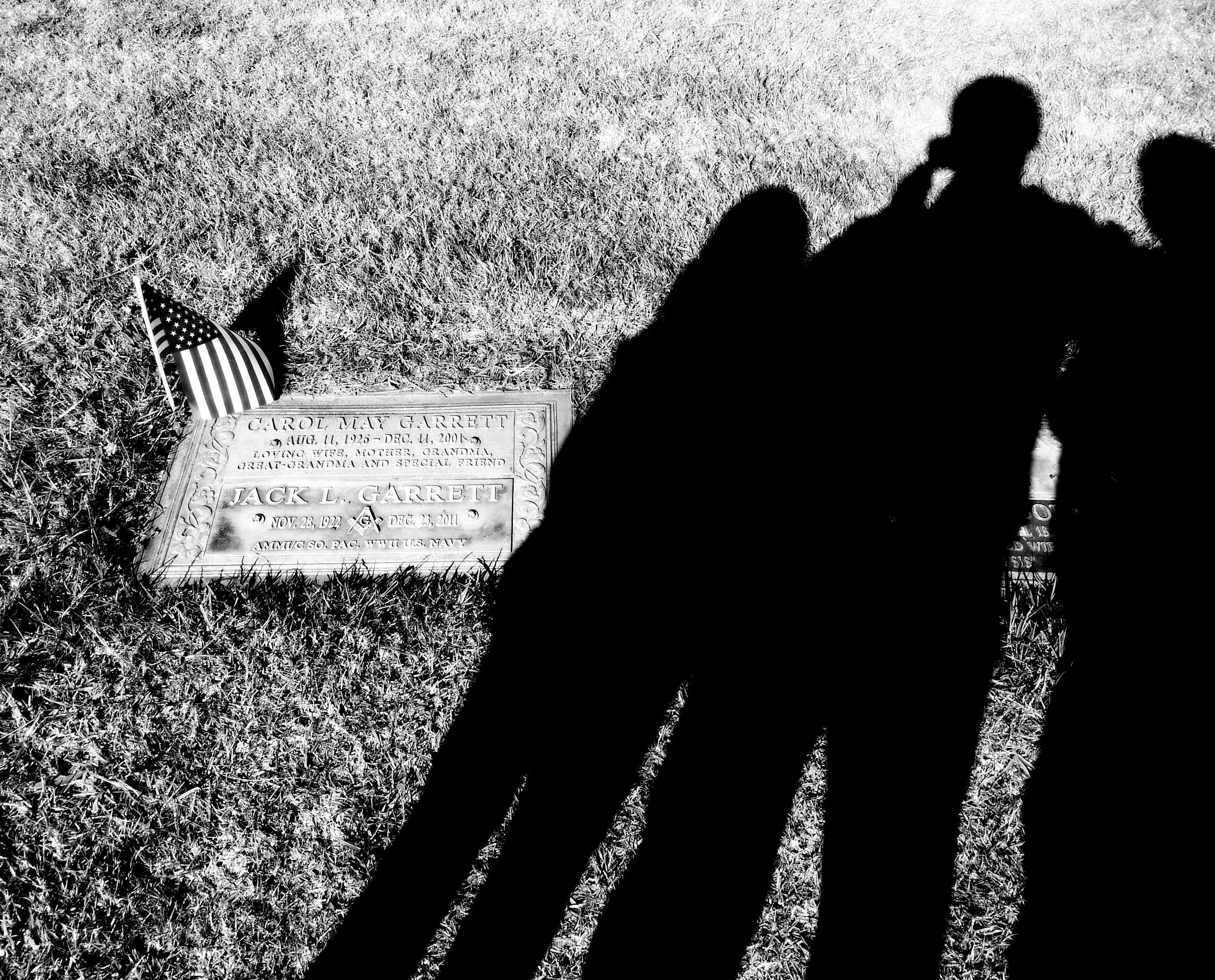
Cee’s Fun Foto Challenge: Shadows


For “Cee’s Fun Foto Challenge: Shadows” of this week…

Loyal readers know of my love for WWII combat veteran “Old Man Jack”.

After suffering through seven decades of nightmares of war, he is now finally at peace.  Hopefully, he is resting comfortably beneath these shadows cast by my two youngest kids and I:

jack shadow

And a shadow cast by Old Glory:

jack shadow 2

For new visitors, please feel free to click and read one story of this great American who is now all but being forgotten in our new “Common Core” history textbooks.  He earned the honor to be remembered:

“Old Man Jack-ism #4”

“Cee’s Fun Foto Challenge” – Shine


In response to Cee’s Fun Foto Challenge of this week: SHINE

Steven F. Udvar-Hazy Center, June 28, 2010
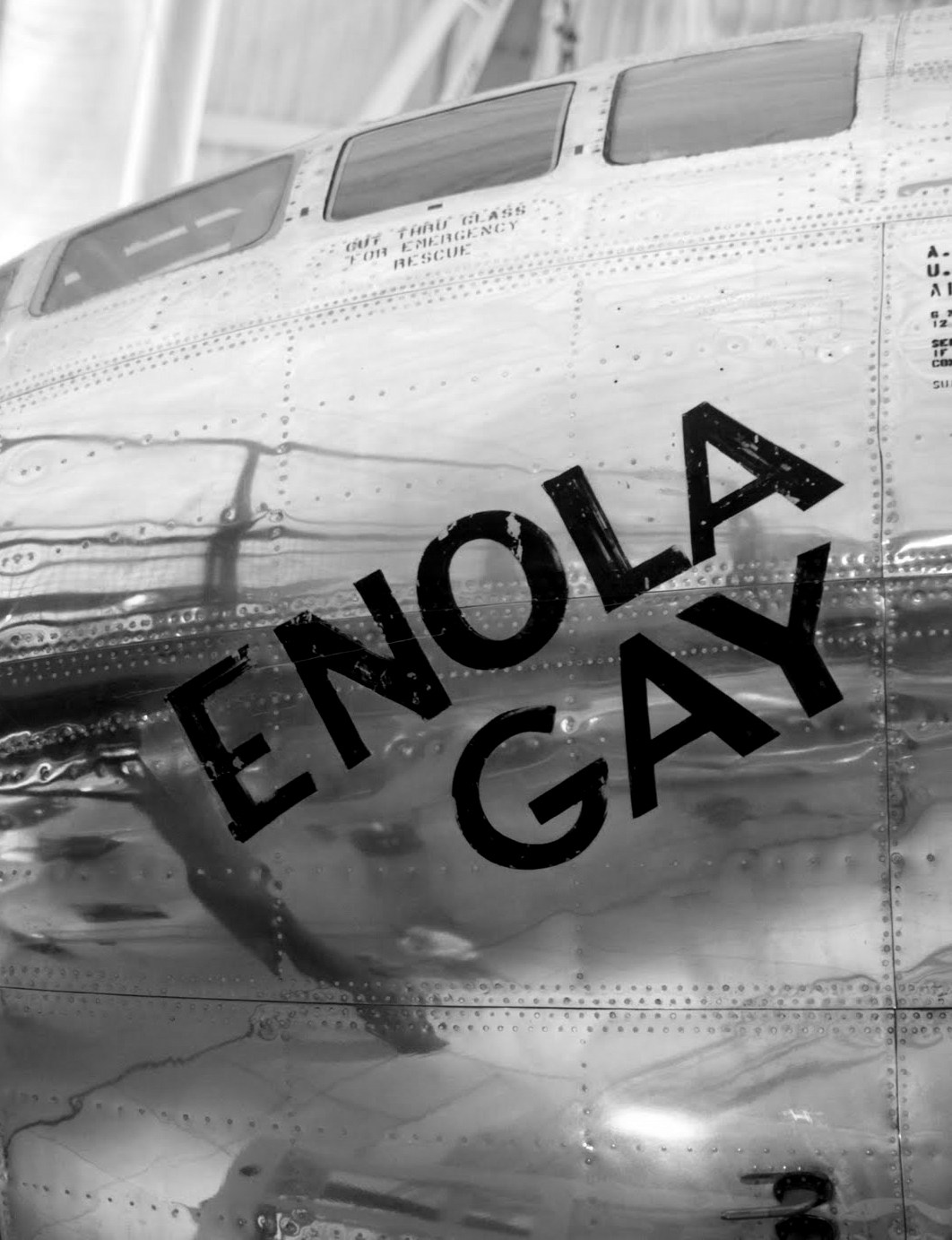
The Enola Gay (For a short computer animation of the atomic bomb’s explosion, please click.


carbs99
Custom downdraft carburetors in a hot rod.


shine arnold
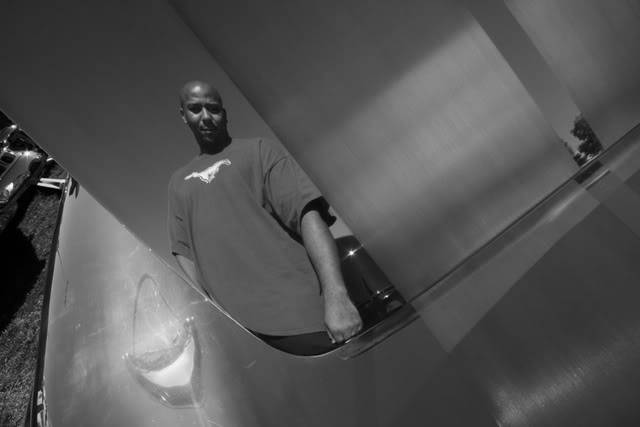
My car enthusiast bud Prof. Arnold is reflecting off a meticulously polished all-aluminum Cobra.  That’s the hood’s surface propped open, folks.

Cee’s Photo Challenge: Patterns


Steven F. Udvar-Hazy Center, June 28, 2010
Steven F. Udvar-Hazy Center, part of the Smithsonian Museums.

Here’s an entry in response to “Cee’s Fun Foto Challenge” entry: Patterns.

The entry way is so serene yet powerful and honors all aviators.

What Did FDR Know? – Part 3


sis friedman army
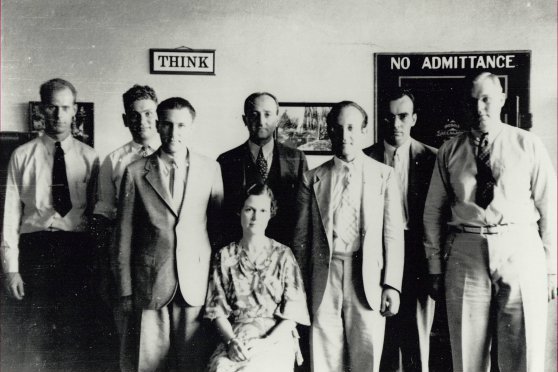
William F. Friedman, standing in center. Friedman was charged with the responsibility of cracking the highly complex “Purple” diplomatic code. This SIS team did so in eighteen months. Friedman was hospitalized for four months from the strain. (US Army)

In Part 1 of “What Did FDR Know?”, I submitted tidbits that FDR – in spite of his campaign promises of not sending American boys to war – DID secretly plan with Churchill on how to get America into war without damaging their political images.  Their secret discussions were nearly made public by Tyler Kent but he was tried secretly in a British court and admonished to prison until war’s end.  Secretary of State Cordell Hull, on November 29, 1941, tried to leak to a major newspaper man intelligence gathered about the Imperial Japanese Navy heading towards Pearl Harbor.

In Part 2 of “What Did FDR Know?”, some history at Pearl Harbor before December 7, 1941 was provided as well as a brief history into cryptanalysis, the Japanese JN-25 and Purple codes and how the US Army and Navy broke them before and after Pearl Harbor.

In this Part 3, I will attempt to present evidence on intelligence gathered BEFORE the surprise attack on Pearl Harbor.

Part 4 will attempt to present evidence on the extent of our “listening in” on Imperial Japanese Navy battle plans post Pearl Harbor.

Part 5 will attempt to present evidence on the imprisonment of Japanese and Japanese-Americans in the “war relocation centers”, as FDR called them.

The goal is to allow you to come to your own conclusion as to “What Did FDR Know?”

___________________________

We learned that the US Navy struggled to break the JN-25 code that was changed immediately before the attack.  However, OP-20-G was able to decipher coded messages immediately prior to a reasonable extent.  The number of JN-25 messages intercepted between just September 1 and December 4, 1941 numbered 26,581.  Of these, 2,413 were released by the (now famous) NSA in 1979.  Although there were more than 1,000 just between Tokyo and the attack fleet, only 20 are reportedly in the National Archives.  (So much for the IJN operating under “strict radio silence” during the voyage to Pearl Harbor.)

The Purple code also became another critical source of intelligence, especially the week before Pearl Harbor.  Luckily, we had been intercepting and deciphering them since September 1939…  more than two years before Pearl Harbor.

Oval Office 1933
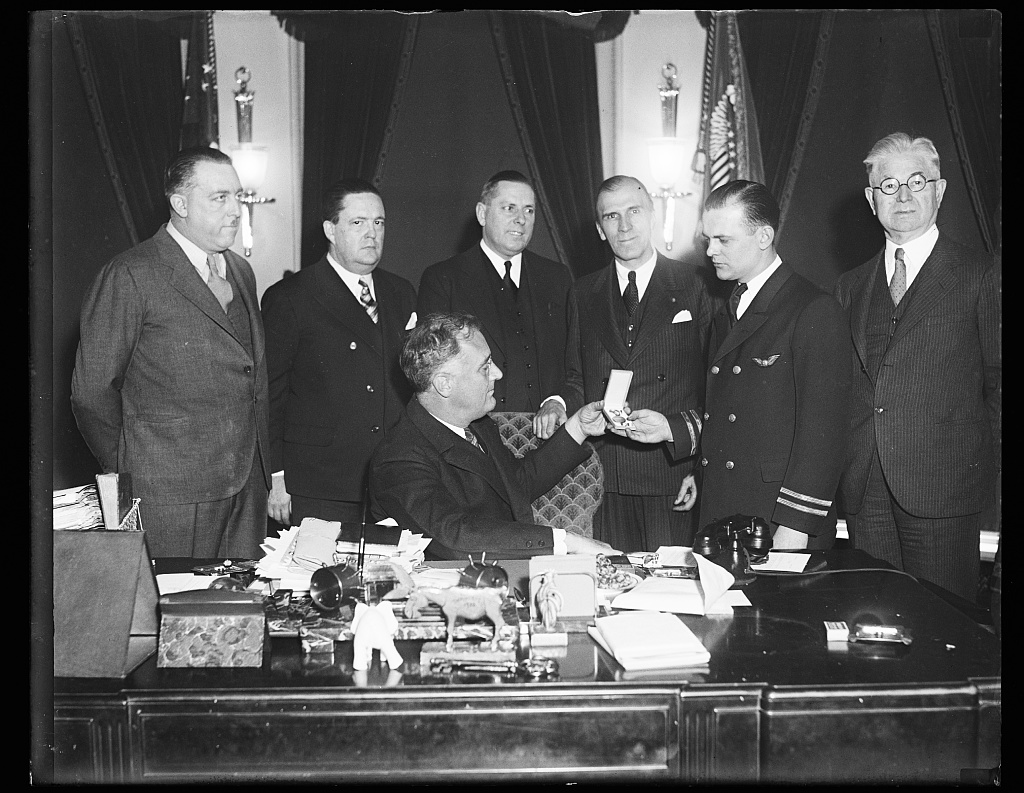
The Oval Office, 1933. Criminy, isn’t that a telephone on FDR’s desk?

Just what was transmitted by the Japanese diplomats about Pearl Harbor and intercepted through MAGIC?  What other events occurred either in relation to the intercepts or the looming signs of the attack on Pearl Harbor?  Please note that in 1941, they did not have emails, fax machines, TV, FedEx or SMARTphones.  However, they did have TELEphones.  Remember those things?

As shown above, there were more than 26,000 in JN-25 messages alone so going into detail about what was known in total would not be appropriate for this blog.  However, if I were to summarize:

mccollum

  1. With respect to the Purple analog machines built from scratch, eight were made by the Naval Gun Factory in DC.  Two each were used by OP-20-G and SIS; two were sent to the British.  One was sent to Cavite in the Philippines.  The last one was intended for Pearl Harbor – it was instead given to the British.  It is likely true that even if Pearl had a Purple machine, it may not have been of too much value as it is reported the Japanese Consulate there did not have a deciphering machine.
  2. Selected MAGIC ciphers were indeed placed into locked briefcases then shown to the top ten men in power over war – including FDR, just like in the movies.
  3. Lt. Com. Arthur H. McCollum of Office of Naval Intelligence signed an eight point memo for FDR on how to coerce Japan into war with the US (aka “McCollum Memo”, the first page of which is shown at right).  It was presented to FDR on October 7, 1940; FDR began implementing them the next day; all eight were eventually put into place.
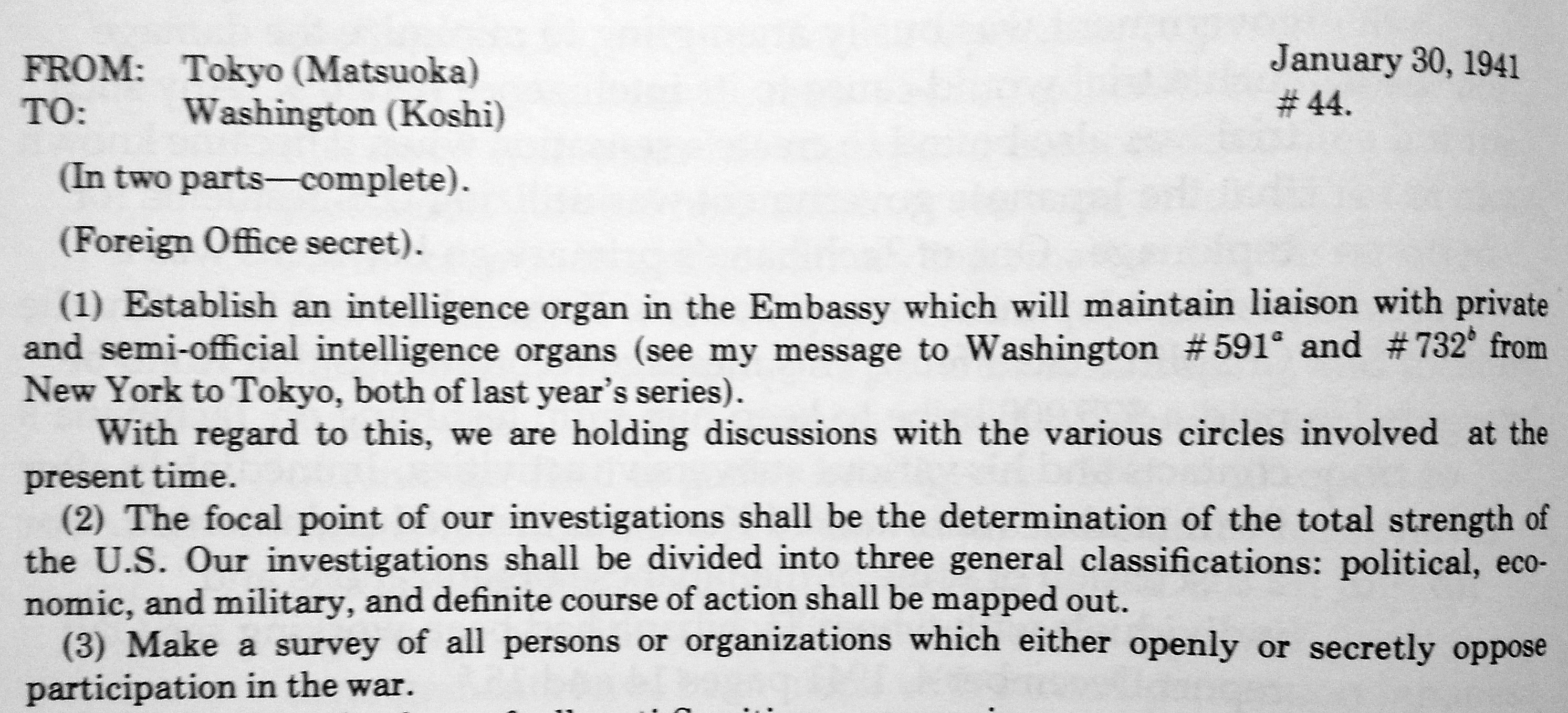
  4. A Purple message was intercepted on January 30, 1941. Tokyo instructed its diplomats to recruit agents covertly to spy on Allied movements and production.  Issei and Nisei were mentioned for recruiting in the message.  This espionage net could be for no other reason than to supply military information to Tokyo.

    1-30-1941
    Typed copy of the Purple transmission of January 30, 1941.
  5. Per “President Roosevelt and the Coming of War 1941”, FDR actually proposed losing six cruisers and two carriers at Manila in order to get into war but was stopped by Navy Chief Stark.
  6. On July 10, 1941, the US Military Attache in Japan reported the Imperial Japanese Navy was conducting secret training missions at Ariake Bay involving torpedo runs at moored ships.
  7. After the Atlantic Conference and meeting with FDR, Prime Minister Churchill cabled his Cabinet on August 14, 1941 that FDR was intent on getting into the war.
  8. A high level US Navy report was submitted on March 31, 1941 clearly stating that Pearl Harbor would be targeted, even so far as stating the Japanese Navy would utilize six carriers and surprise attack at dawn.  That was because Japan strategically had few options and definitely could not have the Pacific Fleet to contend with.
  9. A Korean agent by the name of Kilsoo Haan met with Eric Severeid of CBS that there was solid evidence that Japan would attack before Christmas.  In October, Haan was able to convince US Senator Guy Gillette of these plans.  Gillette alerted the State Department, Army and Navy Intelligence and FDR personally.
  10. A coded message of September 24, 1941, from Japanese Naval Intelligence headquarters in Tokyo to the Japanese consul general in Honolulu, was intercepted and deciphered.(1) It requested the exact locations of all US Navy ships in Pearl Harbor; it even specifically asked to know if two ships were moored alongside each other.  It was a map.  Such detailed information would only be required if the Japanese were planning an attack on the ships at their moorings. The Japanese had not asked for such detailed information before.  However, two top US officers, Stark and Turner, prohibited informing Pearl Harbor and Kimmel of this critical intelligence.
  11. A JN-25 message was deciphered on November 1, 1941.  It ordered the Japanese fleet practicing the attack to continue drills against anchored warships at at Ariake Bay. Words included “to ambush and completely destroy the US enemy.”  References to using armor-piercing bombs and “near surface torpedoes” was also mentioned.
  12. A Purple message of November 5th: Tokyo notified its Washington ambassadors that November 25th was the deadline for an agreement with the U.S. (to avoid war).
  13. A Purple message of November 11th from Tokyo to its diplomats warned, “The situation is nearing a climax, and the time is getting short.”
  14. Admiral Kimmel, following established Naval doctrines concerning unstable international conditions, ordered 46 (roughly one-half) of the Pacific Fleet out to sea in late November – specifically into the North Pacific.  He did not inform Washington and when FDR found out, he ordered the fleet back to port under the guise such an exercise would provoke the Japanese.  Undaunted, Kimmel had Admiral “Bull” Halsey put together a carrier-focused plan to protect Pearl Harbor which was never carried out.  Instead, on November 26, 1941, Admiral Stark in Washington ordered Halsey to take to sea with his carriers; their mission was to ferry fighter planes to Midway and Wake Islands.  Now you know why the carriers – the main target of the Imperial Japanese Navy – were “by luck” not at Pearl on December 7th.
  15. A JN25 order of November 23 – “The first air attack has been set for 0330 hours on X-day.” (Tokyo time)
  16. Another Purple message November 16th changed the deadline to November 29th.  However, it stated, “The deadline absolutely cannot be changed.  After that, things are automatically going to happen.”
  17. The Japanese fleet left Japan (Hitokappu Bay) on November 25th.  Remembering we were intercepting all Japanese Naval transmissions, about one hour after the Japanese attack force left port for Hawaii, the U.S. Navy issued an order forbidding U.S. and Allied shipping to travel via the north-west Pacific. All transpacific shipping was rerouted through the South Pacific.  It should be easy to figure out why.  If any commercial ship accidentally stumbled on the Japanese task force, it might alert Pearl Harbor. As Rear Admiral Richmond K. Turner, the Navy’s War Plans officer in 1941, stated: “We were prepared to divert traffic when we believed war was imminent. We sent the traffic down via the Torres Strait, so that the track of the Japanese task force would be clear of any traffic.”

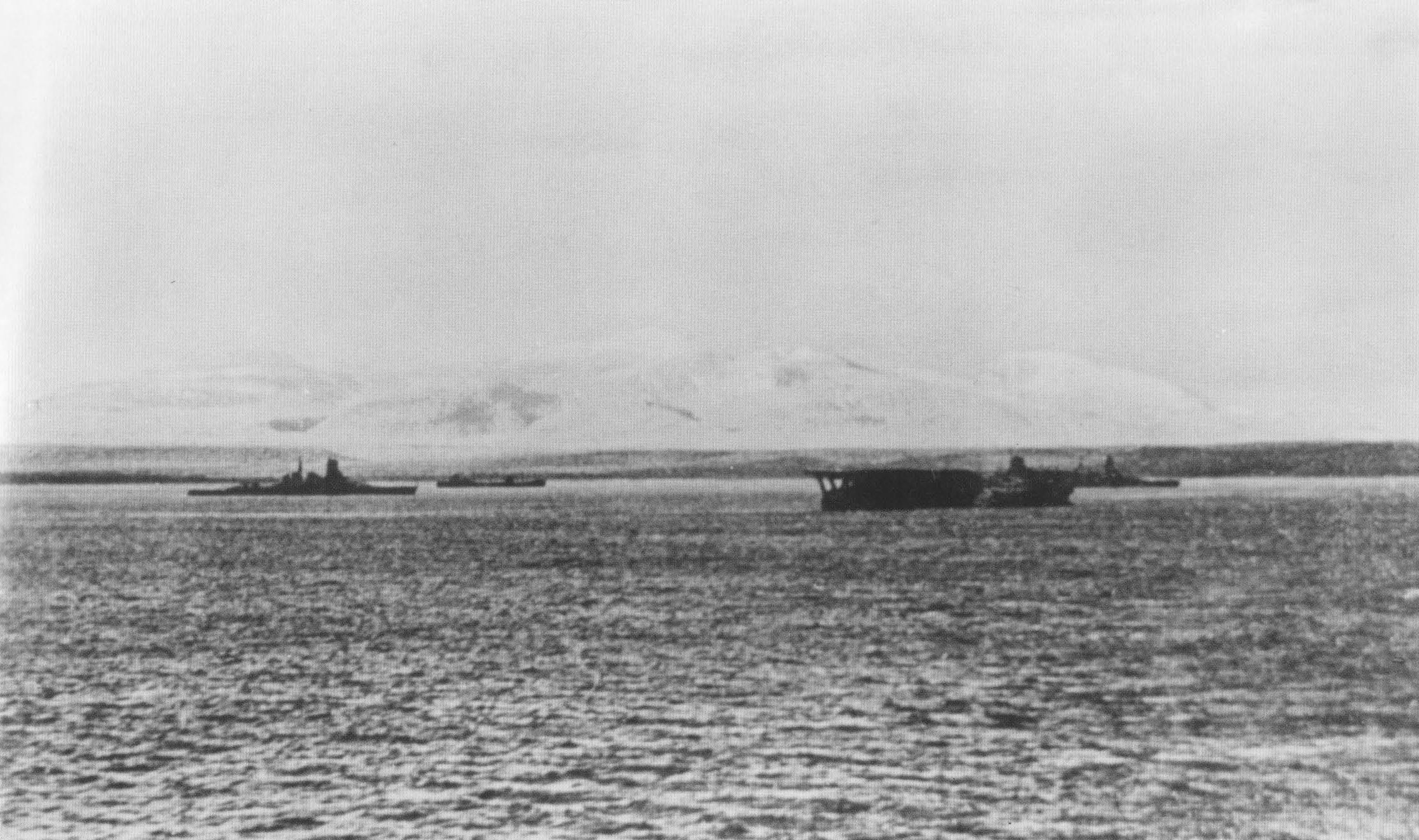
    carrier kaga hitokappu
    Imperial Japanese Navy’s carrier Kaga and battleship Kirishima at Hitokappa Bay, November 23, 1941. They would set sail in a couple of days for Pearl Harbor. Kaga would be sunk at the Battle of Midway. Kirishima would be attacked and would capsize on November 15, 1942 in Ironbottom Sound.
  18. British initially decrypted a message sent Nov. 19 setting up the “Winds” alert.  The US decoded it Nov. 28.  The message stated there would be an attack and that the signal would come over Radio Tokyo as a weather report – rain meaning war, east (Higashi no kaze ame) meaning the US.
  19. On November 25, 1941, the great Admiral Isoroku Yamamoto himself, using the cracked JN-25 code, sent this message to his fleet:
    “(a) The task force, keeping its movements strictly secret and maintaining close guard against submarines and aircraft, shall advance into Hawaiian waters and upon the very opening of hostilities, shall attack the main force of the United States Fleet in Hawaii and deal it a mortal blow. The raid is planned for dawn on X-day — exact date to be given by later order. (b) Should the negotiations with the US prove successful, the task force shall hold itself in readiness forthwith to return and reassemble. (c) The task force will move out of Hitokappu Wan on the morning of 26 November and advance to the standing-by position on the afternoon of 4 December and speedily complete refueling.”
    This was decoded by the British on November 25 and the Dutch on November 27.  WHEN it was decoded by the US is still a national secret; however, on November 26, ONI reported the concentration of units of the Japanese fleet at an “unknown port” ready for offensive action.  ONI knew the fleet had been assembled at Hittokappu Bay since November 22, 1941.
  20. pearlwarning
    Actual message sent to the Pacific on November 27, 1941 by Admiral Stark, Chief of Naval Operations. Please read the alert carefully and see if Pearl Harbor is mentioned. Kimmel and Short received this alert.

    In reaction to #17 above, Churchill himself sent FDR a secret message likely warning him about war erupting; this was presumably in response to British intelligence decoding Yamamoto’s message.  (Note: Likely due to implications even today and in spite of the enumerable messages sent between them, this is the only message that has not been released.)  C.I.A. Director William Casey, who was in the OSS in 1941, wrote, “The British had sent word that a Japanese fleet was steaming east toward Hawaii.”(2)  In response to Churchill’s message, FDR secretly cabled him that afternoon, “Negotiations off. Services expect action within two weeks.” Note that the only way FDR could have linked negotiations with military action, let alone have known the timing of the action, was if he had read the message to set sail. In other words, the only service action contingent on negotiations was Pearl Harbor.  Regardless, can it be coincidence that on Nov 26, Washington ordered both US aircraft carriers, the USS Enterprise and the USS Lexington out of Pearl Harbor? On board were 50 fighter planes diminishing Pearl Harbor’s already inadequate fighter protection.(3)

  21. emperor 20140412_171251
    A Purple intercept from Emperor Hirohito himself to the Combined Fleet commander – Admiral Isoroku Yamamoto. Sent on December 6, 1941 (Tokyo time).

    The FBI had put in wire taps on the Japanese Embassy phone lines.  The FBI listened in on an uncoded Japanese telephone conversation on November 29 in which Special Envoy Saburo Kurusu asked, ‘Tell me, what zero hour is. Otherwise, I won’t be able to carry on diplomacy.”  The voice from Tokyo (later identified as K. Yamamoto) said softly, ‘Well then, I will tell you.  Zero hour is December 8 (Tokyo time, ie, December 7 US time) at Pearl Harbor.” (US Navy translation 29 Nov)

  22. On December 1, 1941, the Japanese tanker Shiriya radioed she was “proceeding to a position 30.00 N, 154.20 E. Expect to arrive at that point on 3 December.”  Key those coordinates into Google Maps yourself.  This message in the National Archives destroys the myth that the  attacking fleet maintained radio silence.  Transmission serial numbers prove that the Striking Force sent over 663 radio messages between Nov 16 and Dec 7 or about 1 per hour.  (The NSA has not released any raw intercepts because the headers would prove that the Striking Force did not maintain radio silence. On Nov 29 the Hiyei sent one message to the Commander of the 3rd fleet; on Nov 30 the Akagi sent several messages to its tankers.)(4)  There are over 100 messages from the Striking Force in the National Archives.(5)  Reports from Dec 5 show messages sent from the Striking Force picked up by Station Cast, P.I.
  23. ONI located Japanese fleet on December 1, 1941 by correlating reports from the four wireless news services and several shipping companies that they were getting strange signals west of Hawaii. Remember Johann Ranneft visiting ONI and being shown the location of the Japanese fleet north-west of Hawaii in Part 1?  The Soviet Union also knew the exact location of the Japanese fleet because they asked the Japanese in advance to let one of their ships pass.
  24. On December 2 and 3, the passenger liner SS Lurline was en route from San Francisco to Honolulu.  Its radio operator, following standard operating procedures, intercepted strong signals from the IJN fleet.  The messages were so lengthy and numerous that the radio operator made out “JCS”, the call sign for the IJN HQ.  The signals were plotted and showed the fleet’s location heading eastward and was north-west of Hawaii.  When the USS Lurline docked in Hawaii on December 5, the radio intercept logs were immediately taken to the Office of Naval Intelligence at Kimmel’s Pacific Fleet HQs.  The logs were never recorded as received nor ever seen again.
  25. Ralph Briggs was a qualified Japanese-speaking radio intercept operator and was working at the Navy’s signals intercept station early in the morning of December 4.  Buried inside the official IJN weather broadcast was the code “Higashi no kaze ame (東の風雨)”, or “East winds, rain”.  (See #18 above.) The operators had been briefed to listen for those words.  Per SOP, he logged it then transmitted via a secure channel to Commander Safford, in charge of the Fleet Intelligence Office in Pearl.  To substantiate this, he was given four days’ leave as a reward.(6)  On December 7, he was already back stateside in his Ohio home and was noted to have said something to the effect that the Japanese must have taken a licking (because he had intercepted the coded message and mistakenly believed the Navy was ready).  After the attack, both the log and related communications were “lost” as well many other documents that were in safes.
  26. While there were many other events and intercepted secret communications, the most famous one is the 14 part Purple transmission from Tokyo to Kurusu.  It officially terminated diplomatic relations with the US, i.e., it is war.  Amazingly, the first 13 parts had already been deciphered by MAGIC on December 6th.  When Lieutenant Lester Schulz delivered to FDR his copy of the intercept later that day, Schulz heard FDR say to his advisor Harry Hopkins, “This means war.”
  27. As the story goes, Kurusu failed to type up the Japanese ultimatum in time.  However, Secretary of State Cordell Hull had already read the Purple intercept decoded the day before as did FDR.  In essence, Hull had to look…surprised… when Kurusu handed him the ultimatum on December 7, 1941 albeit late.  But at least, he was indeed angry.

We are now at war.

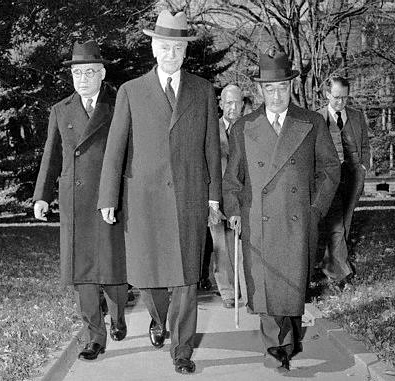
Officials Arriving at The White House
November 17, 1941. Cordell Hull, center, with Special Envoy Saburo Kurusu at right. Kurusu would be imprisoned at Hot Springs, NY until war’s end.

______________________________

The above is by no means any-wheres near a complete accounting of the events leading up to Pearl Harbor.  And yes, there will be blanks in information flows, other communications that will show things countering the above, etc.  But it does show how a government can disguise the truth or create lies for whatever purpose…even if it involved the deaths of human beings.

You can imagine what is going on today.  Benghazi.  The complete killing of SEAL Team Six.  Fast and Furious.  It goes on.

But some questions may be in order to perhaps counter what you believed in or were taught until now?  Perhaps you can ask yourself:

  1. Did FDR blind the commanders at Pearl Harbor?
  2. Were Kimmel and Short set up to be the fall guys by denying them very critical intelligence or lead them to believe war was not imminent?
  3. Was Pearl Harbor alerted to the location of the attacking Japanese fleet?

Points to ponder, indeed.

And to close this (long) story, a Hollywood movie depicted Kimmel and Short receiving a telegram of all things alerting them of the possible attack on Pearl Harbor – many hours after it was over.  That is true.  However, how it became a late telegram is another story all together.  By all accounts, Chief of Staff George C. Marshall orchestrated a delicate ballet to delay even sending that telegram for the critical few last hours.  In fact, he was difficult to nail down during the critical hours before the attack, arriving late to his office to go over the critical Ultimatum.  Although known for near photographic memory, he claimed he was horseback riding but his aides testified after the war that he wasn’t.  Further, his aides urged him to contact Pearl Harbor but delayed that decision by reading then re-reading the ultimatum and then asking superfluous questions about what method of communicating with Pearl would be faster, for example – several times.  He chose not to use the “telephone” nor use a fast, secure Navy system but sent the warning through commercial wire, of all things.  Even then, the warning language he dispatched was watered down.

____________________________

So what do you think?

What did FDR know?  What do you think he did not know?

More to follow in Part 4 – key naval battles, code breaking and what really happened on the waters of the Pacific.

I hope you’ll stay tuned. Part 4 is here.

____________________________

NOTES:

(1) Coded message of September 24, 1941:

Strictly secret.

Henceforth, we would like to have you make reports concerning vessels along the following lines insofar as possible:

1. The waters (of Pearl Harbor) are to be divided roughly into five subareas (We have no objections to your abbreviating as much as you like.)

Area A. Waters between Ford Island and the Arsenal.

Area B. Waters adjacent to the Island south and west of Ford Island. (This area is on the opposite side of the Island from Area A.)

Area C. East Loch.

Area D. Middle Loch.

Area E. West Loch and the communication water routes.

2. With regard to warships and aircraft carriers, we would like to have you report on those at anchor (these are not so important) tied up at wharves, buoys and in docks. (Designate types and classes briefly. If possible we would like to have you make mention of the fact when there are two or more vessels alongside the same wharf.)”

There is nothing unusual about spies watching ship movements — but reporting precise whereabouts of ships in dock has only one implication. Charles Willoughby, Douglas MacArthur’s chief of intelligence and my dad’s big boss in the US 8th Army, later wrote that the “reports were on a grid system of the inner harbor with coordinate locations of American men of war … coordinate grid is the classical method for pinpoint target designation; our battleships had suddenly become targets.” This information was never sent to Kimmel or Short.

(2) Per his book, “The Secret War Against Hitler”.

(3) There are strategic evaluations asserting that not having US fighter aircraft sortied in great number against the invading Japanese fleet was “best” in the long run.  Some armchair strategists claim that if the US carriers had “gone after” Nagumo’s fleet, indeed, our two vital carriers and her invaluable pilots would have been sunk, never to be recovered.  That, however, is another story.

(4) The Hewitt Report, page 474.

(5) “Day of Deceit”, page 209.

(6) There is some bickering between opposing viewpoints as to the validity of this point.  After the war, Japan stated it never issued such a broadcast.  Other historians doubt Briggs’ testimony as there are no documents.


What Did FDR Know? – Part 2


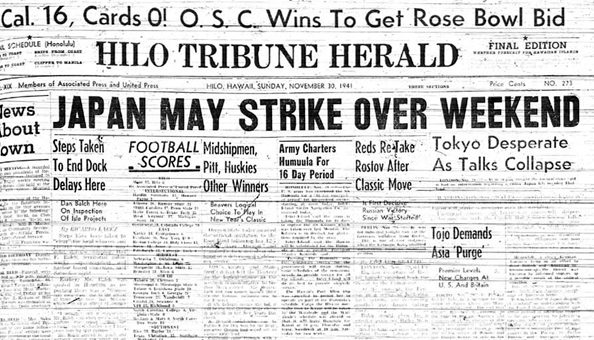
HTH Nov 30 1941
Hilo Tribune Herald, November 30, 1941.

The above: a front page published one week BEFORE Pearl Harbor.

OK… So the newspaper was published on Hilo.

Well, then, how about a second front page?  And from a different island this time – Oahu.

Pearl Harbor is on Oahu.

Honolulu Advertiser
Honolulu Advertiser, November 31, 1941.

______________________________

To continue with “What Did FDR Know?”, let’s go over some once secret stuff, shall we?

And stuff that wasn’t so secret – like the headlines above.  These NEWSPAPERS were in newsstands or tossed onto front lawns a WEEK before the attack on Pearl Harbor.  How can that be when our textbooks and history tell us our Navy and Army were caught with their pants down?

It may be fascinating and perhaps eye opening for some of you.  To some of you old hats in military history, not so eye opening.

This story will be centered on “MAGIC”, the cover name given to the secret diplomatic messages sent between Japanese diplomats and intercepted.(¹)

MAGIC intercepts will be the foundation for this story and subsequent ones.

The Japanese diplomats sent message after message believing their code was secure.

They were wrong.

______________________________

But first, some background on Pearl Harbor itself.  It’s important in your quest to conclude on “What Did FDR Know?”

JamesRichardson
Adm. Richardson

Before December 7, 1941 and as we read in Part I of this series, did you know the Pacific Fleet was based in San Diego?  The powers to be moved the fleet from San Diego to Pearl Harbor.  Even the decision to move the Pacific Fleet to Pearl Harbor was suspect at that time.  And have you thought about who was commanding the fleet  before the hapless Admiral Husband Kimmel  at Pearl Harbor?

Admiral J. O. Richardson was Commander in Chief, CINCPAC as of January 1940.  Per the “Final Secret of Pearl Harbor”, Richardson was the foremost expert on Japan and studied ad finitum Pacific naval warfare and mostly, of Japanese naval strategies.  He also knew well of Japan’s pattern of secret attacks.

Richardson disagreed with FDR’s opinion that basing the Pacific Fleet at Pearl Harbor was indispensable towards protecting American interests.  Richardson stoutly disagreed and said, “I came away with the impression that, despite his spoken word, the President was fully determined to put the United States into the war if Great Britain could hold out until he was reelected.”

He asserted that Pearl Harbor would be a “… g_d d_mned mousetrap”.  His belief was the fleet should remain on the West Coast in San Diego; out at Pearl Harbor, the fleet would be a strategic target for any Japanese surprise attack which he correctly foresaw.  His opinion was because not only did Pearl Harbor lack adequate fuel dumps and repair facilities, the Fleet lacked sufficient personnel and the waters around Pearl were unsuitable for training.  The fleet would need to return to San Diego and the like for such purposes.

Those who chose to ignore Richardson’s educated opinion did so by saying Pearl’s shallow harbor would preclude torpedo plane attacks amongst other things.

kimmel
Adm. Kimmel

Richardson asserted too strongly.  Although Richardson was highly qualified militarily, FDR removed him from command on January 19, 1941.  (Similar events are taking place notionally even today; about 200 top military commanders have been removed or forced out by the current Adminstration.)  FDR replaced Richardson with the more amenable Admiral Kimmel.  He was far down the list of able commanders but was still selected by FDR to run the Pacific Fleet.  While he somewhat shared Richardson’s belief, he was obedient as FDR expected.  Kimmel also wrongly assumed he would be “kept in the loop” by FDR insofar as military necessities, including intel.  Was he expendable career-wise?

…and that is how Kimmel ended up in command of the Pacific Fleet on December 7, 1941.

__________________________

Purplemsg
This is a copy of the actual PURPLE message and is the first part of the 14-part message which was delivered by the Japanese to the US Government on December 7, 1941 – late.

 BACKGROUND ON JAPANESE CODES

The Japanese military, just like the US military, had “secret codes” as did diplomats.  For the purposes of this blog, we will concentrate on two groups of code: the Imperial Japanese Navy’s code (JN-25) and of the Japanese Foreign Office (code named “Purple”).

Talking about Communications Intelligence, or “COMINT”, would take a number of blogs; indeed, entire books and papers are written about COMINT during this time.  For purposes of this blog, allow me to say COMINT is the acronym covering the analysis and usage of an enemy’s radio communications.  Codes are when words are replaced by groups of letters or digits and are usually manual.  A cipher, however, is the replacement of individual letters or groups of letters according to a plan; it is much more complex and are based on machines.

During this time, US COMINT was somewhat loosely organized, largely due to the rivalry between the US Navy and Army.

However, the cover name “MAGIC” was given to the intelligence obtained by both services involving the Japanese Foreign Ministry radio messages.  While at the embassy level, great amounts of military information – and espionage – was disclosed in these secret messages and were therefore at the disposal of the US Government and military.

Imperial Japanese Navy JN-25

The US Navy began its covert intelligence gathering in the early ’20s when they actually broke into the Japanese Consulate in NYC and copied the secret Japanese code in use at that time.  By 1926, the US Navy had broken the Japanese navy’s “Flag Officer’s Code”.  The Imperial Japanese Navy at that time conducted fleet maneuvers about every three years; they would send coded messages throughout the maneuvers.  The US Navy, by virtue of having broken the Flag Officer’s Code, easily listened in on them.

Their “listening in” on the Japanese fleet was so extensive that the US Navy knew of the capabilities of the Japanese warships.  The US Navy knew the speeds, armaments, designs, etc., of the Japanese warships, so much so that the US Navy made improvements to their own warships to counter them.

During this period, the US Navy established a small group within the Office of Naval Communications called “OP-20-G”.  It was formed without extensive knowledge of the US Army as infighting was common.  The same was true for the Japanese military.  Think of the Army-Navy rivalry in football – just grow it tremendously.

While the Japanese navy changed their code along the way, the OP-20-G had little difficulty breaking those, too… until late in 1940.  Knowing they were headed to war with the US, the Japanese navy prudently introduced an entirely new code, the JN-25.  It was much, much more complex than its predecessor.  It proved difficult to crack but they had made progress when… the Japanese navy once again made amendments to JN-25 immediately before the attack on Pearl Harbor.

The US Navy, therefore, was pretty much “blind” intel-wise for pretty much a week before Pearl Harbor.  It would not be broken until March 13, 1942.

But there was another group of cryptanalysts… an ace in the hole.

__________________________________

“Purple”

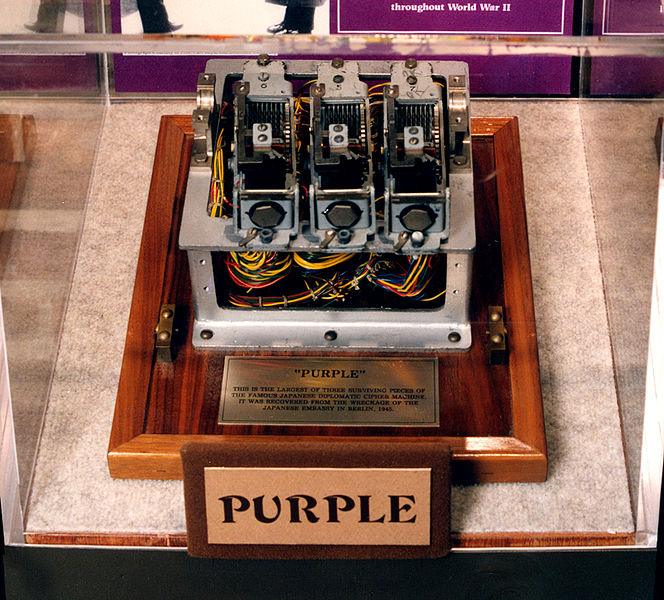
japanese purple fragment
As the Purple machines were destroyed by the Japanese, this is the only surviving section of an actual Purple machine. National Archives

Alongside OP-20-G, the US Army’s cryptanalysis group called “Signal Intelligence Service”, or SIS, focused their energies on the Japanese diplomatic code.  The group was headed up by William F. Friedman; he was very successful in designing our own encrypted codes.

Japanese diplomats (NOT military commanders) communicated with each other using an existing code designed in 1932; the US cryptanalysts called this code “Red”.(²)  In 1937, the diplomats began using a newer, more complex code; the US referred to this code as “Purple”.  In total, there were fourteen codes used by the Japanese diplomats; two of these were of the most value, Purple and “J-19”.  Purple was used at the embassy level; J-19 was used at the consular level.  Both were machine crypts.

purple analog
The Purple machine, built from readily available parts. It supposedly cost $684.65. Eight were made.  National Archives.

In September 1939, the “unbreakable” Purple code, in the defective thinking of the Japanese, was broken; a key contributor to Friedman breaking Purple was that the Japanese had sent the same message using BOTH Red and Purple codes, a huge blunder in the cryptanalysis arena.  In eighteen months, the SIS, headed up by Friedman, cracked the code(³).  They even BUILT an analog machine from a blank chalkboard which quickly deciphered the “secret” messages.  (The code was so complex that the machine contained 25 connections, which could be arranged 6 pairs of connections, yielding over 70,000,000,000,000 possible arrangements which would determine the method of encryption.)  This was an AMAZING feat to have built a deciphering machine since SIS had not even seen the Japanese one.  Remember, this was 1938.  Nevertheless, these intense eighteen months landed Friedman in the hospital for four months from exhaustion and emotional strain.

With Purple broken, the US was able to immediately decipher all highly secret messages between all top level members of the Japanese diplomats located worldwide… and most importantly, without them knowing.  Given the originators of the messages, they had nearly indisputable validity.  The reach of MAGIC extended to the European Theater of war as well as briefly mentioned in Part I.

These diplomatic communications also clearly indicated espionage was taking place on the west coast of the United States.

Part 3 and 4 will show the contents of MAGIC intercepts so that you can answer on your own, “What did FDR know?”

I hope you will stay tuned.

Part 3 is here.

NOTES:

(¹) Unbelievably, Secretary of State Stimson was definitely upset when he learned we were intercepting messages.  He championed the statement, “Gentlemen, do not read each others mail.”  At the same time, consider the Snowden/NSA “scandals” of today.

(²) Ironically, Hitler had loved Baron Oshima so much he allowed Oshima to purchase a commercial version of Nazi Germany’s famous Enigma machine.  The machine used for Red was based on this Enigma construct.

(³) While Friedman was the man burdened with the responsibility of deciphering PURPLE, it is acknowledged that a man named Frank B. Rowlett was the man who actually broke the code.

Dinah Mite


Dinah_Might_at_Iwo_Jima

Dina_Might

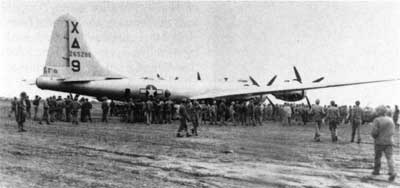
Sixty-nine years ago today, the B-29 Superfortress “Dinah Mite” made the first emergency landing on Iwo Jima. The battle for the tiny sulfur island was still raging as she landed.

7,000 young US Marines and 21,000 young Japanese soldiers died violent deaths for this tiny sulfur island.

(Note: Combat was still going on the left side of the makeshift runway as they were landing.  Although the B-29 was repaired and left the same day, she returned a month later for another emergency landing.  She was so heavily damaged that Dinah Might was abandoned.)

The Pain of Survival and Aunt Michie – Part 5


japansurrender88
A rare photograph taken after listening to the Emperor’s surrender speech, August 15, 1945. There was a coup attempt the night before the speech was broadcast.

Although the violence of World War II was nearing an end, other aspects of the war could continue against Japanese civilians for years to come.

Their infrastructure was gone.  Essential assets such as manufacturing plants, machinery, trains, roads, housing, utilities, even fishing boats had been destroyed.

And most of all, food.

And Aunt Michie’s dignity – the entire family’s dignity – will continue to be tested until the late 1940’s.

____________________________

boy genmai mainichi
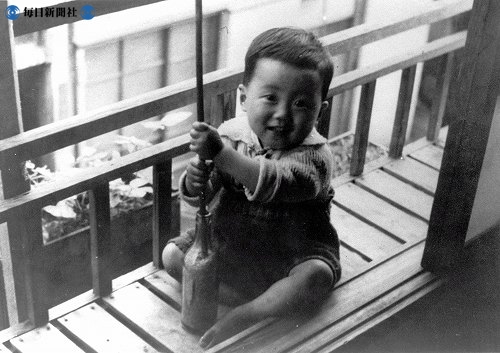
Dated April 1943. A boy poses holding a stick in a bottle filled with unpolished brown rice. This is not the polished brown rice you eat today at Panda Express. It was more wild. Japanese would insert a stick into a bottle partially filled with brown rice then repeatedly jab at the rice until the husk came off. It was low grade rice with the germ still on. (From the Mainichi Shimbun archives.)

For eons, Japan has been unable to produce enough rice for their people let alone food.  In fact, it was not until about the time Japan hosted the 1964 Olympics that Japan could produce enough rice for themselves.

The war took a terrible toll on regular folks from getting their “rice fix” – they were just not able to eat it.  This deprived them savoring it, the mental and biological satisfaction of just eating it.  Think of it this way – what if not just bread itself was kept from you but also the sweet smell of the freshly baked bread with the perfect crust..with melting butter?  Talk about attacks on your psyche: deprivation.  Deprivation for years.  Prolonged sensual deprivation makes for huge changes in one’s outlook on life.

Like the photo of the little boy, millions of civilians would acquire a wild form of brown rice (玄米 genmai) and de-husk them as shown.  Along with barley, it served as a substitute for the flavorful white rice with the higher calories.

_____________________________

Confronted by not only the absence of medical supplies, Aunt Michie’s house was now filled with 23 men, women and children with varying degrees of burns.  I doubt emergency rooms could handle such a sudden load of burn victims… but Michie’s family did.  On top of that, her house was damaged by the atomic bomb’s shockwave.  It pains me to even see in my mind what they had to do to make the house habitable enough so quickly to nurse the injured.

It was mayhem and Michie personally did not ask for this horrific situation… but now, on top of trying to provide medical care for 23 people, she was confronted with one ominous problem: how to feed them all.  There was no food left in the city of Hiroshima and it was just over the hill.  And any food left in the village of Tomo was fresh.  It would spoil quickly anyways in the heat as there was no refrigeration.  No supermarket.  No canned goods either.

She did as Aunt Michie only could.  She used her precious reserve of rice and only served it to the ailing victims.  I am sure she believed that would be the only way to truly help them survive as all of them were malnourished.  As a result of rationing the remaining rice to the victims, her own children who weren’t physically injured were delegated to survive on cooked pumpkins, stems, stalks or taro roots for the duration.

A huge, gut wrenching decision for Aunt Michie, I’m sure.

image0-012
Some of the wild grass or other vegetation boiled for emergency eating can be seen behind my father and Uncle Suetaro. Hiroshima, circa 1929. Copyright Koji Kanemoto

To help this dire situation, the Hiroshima aunt who was not badly injured went about the area with Mikizo’s parents scavenging for wild grass and other vegetation to boil.  That, too, became part of their food.  Although likely not very nutritious to say the least, there was no other alternative.  And it is important to note such wild vegetation they boiled or ate had been subjected to the black rain…

What do you have in your yard?

Perhaps you can somewhat understand why my cousin Masako thought Spam was the most delicious thing she ever ate.

____________________________

In spite of all Aunt Michie could do, my cousins tell me some of the burn victims’ injuries wouldn’t heal.  They had worsened.  Their wounds began to fester or decay for lack of a better description.  Pus formed.  There was nothing they could do.

The odor of the decaying flesh permeated out of the house.  They say you could smell it from the dirt road immediately outside.

It became so intense that people would hold their noses to scurry past the house.

None of my cousins who were there tell me they will ever forget that vulgar smell of rotting flesh… or death.  Never.

Just like Old Man Jack.

___________________________

IMG_5861
From Aunt Michie clockwise: Aunt Michie (holding Kiyoshi), Namie, Mikizo’s father, Masataka, Sadako, Masako, Mikizo and Mikizo’s mother. Taken in 1948 at their farmhouse where they cared for 23 victims. Courtesy of Kiyoshi Aramaki.

My cousins tell me some didn’t make it.

Others would pass away in the next couple of years from the effects of their injuries or radiation.

Nevertheless, the struggle for food and other essentials would continue…but my Aunt Michie’s immediate family survived.  Even Tomiko who was in Hiroshima proper.

And Aunt Michie’s dignity and strength reigned supreme.

They all made it to tomorrow.

__________________________

The surrender documents were signed by Emperor Hirohito’s representatives aboard the USS Missouri on September 2, 1945.

Unbelievably, Mikizo also survived the war.  Although taken prisoner upon Japan’s surrender as a soldier in the Imperial Japanese Army, he was released from Manchuria and allowed to return to his Hiroshima farm in late 1946.

To be continued in Part 6….

The Pain of Survival and Aunt Michie – Part 3


Japanese-home-defense-training_1945
Japanese women being given “home defense training”. My grandmother on my mother’s side underwent such training on a Tokyo schoolground. 1945.

The Japanese home front had essentially collapsed by 1945.  Instead of focusing on food, supplies, building air raid shelters and organizing orderly evacuations of civilians, Japanese military leadership focused on misleading news reports and propaganda.  Millions fled the cities into safer rural areas(¹) on their own initiative but once there, supplies of daily sustenance was meager.

_______________________

In one’s own life, you are tested.  A good human being will at times prove oneself to be a good brother or sister, son or daughter, friend or life partner.  Some fail.  Some pass.

Aunt Michie was one who passed; her heart led her to care for others before herself.  It is as if she knew being good to others was the way to have a good life.

As an example, US air and naval forces ruled the skies and the seas.  A key staple of the Japanese diet – fish – had been nearly cut off  as fishing boats were attacked once out to sea.  Yet, when Aunt Michie came across sashimi, she traveled hours with Masako in tow to take a precious portion to her brother Suetaro at his army base in Fukuoka:

“…(Masako) remembers a couple of trips (to see Suetaro). It was not easy travel in war-torn Japan.  For one trip, Aunt Michie managed to take sashimi – in this time of little food, it was a tremendous treat and gift. On that trip, Masako remembers her mother stealthily sliding over to Uncle Suetaro the wrapped sashimi. He was being stared at by many of his fellow soldiers – they were not well fed either.  She remembers Uncle slowly turning so that the others could not see and quickly devoured the treat.”

(From Masako and Spam Musubi)

Aunt Michie could have eaten the precious sashimi herself…but didn’t.

___________________________

With her husband taken by the Imperial Japanese Army then dispatched to war in Manchuria, she was burdened with running the farm… still laboring to produce crops only to be taken by the military.  She would get up before sunrise, help prepare meals, tend to the family then toil in the fields.  And when her mother became partially paralyzed and alone in her own home five miles away, Aunt Michie knew she had to take care of her, too.  Michie was the last of her children left in Japan.

My Grandmother Kono – having suffered a stroke – is propped up from behind by Japanese “shiki-futon” for the picture. She would not see her son alive again. Taken in Hiroshima, May 3,1944.

While Michie and Grandmother Kono managed to get part-time care, Aunt Michie still took it upon herself to check in on her stricken mother.  My cousins tell me their mother Aunt Michie would take them along for the ten mile round trip to her Kanemoto family home.

No car.  No bus.  No taxi.  No trains or bicycles.  They had to walk.  After all, it was 1944 and fuel was a huge luxury.  One memory the youngest happily recollect is that they would take turns riding in some kind of baby stroller that Michie would push to Grandmother Kono’s.  Neverthless, it was still a great deal of effort and sacrifice on Michie’s part in any case… and she did this after working in the fields, too.

Masako will eventually end up caring for Grandmother Kono.

___________________________

IMG_5869
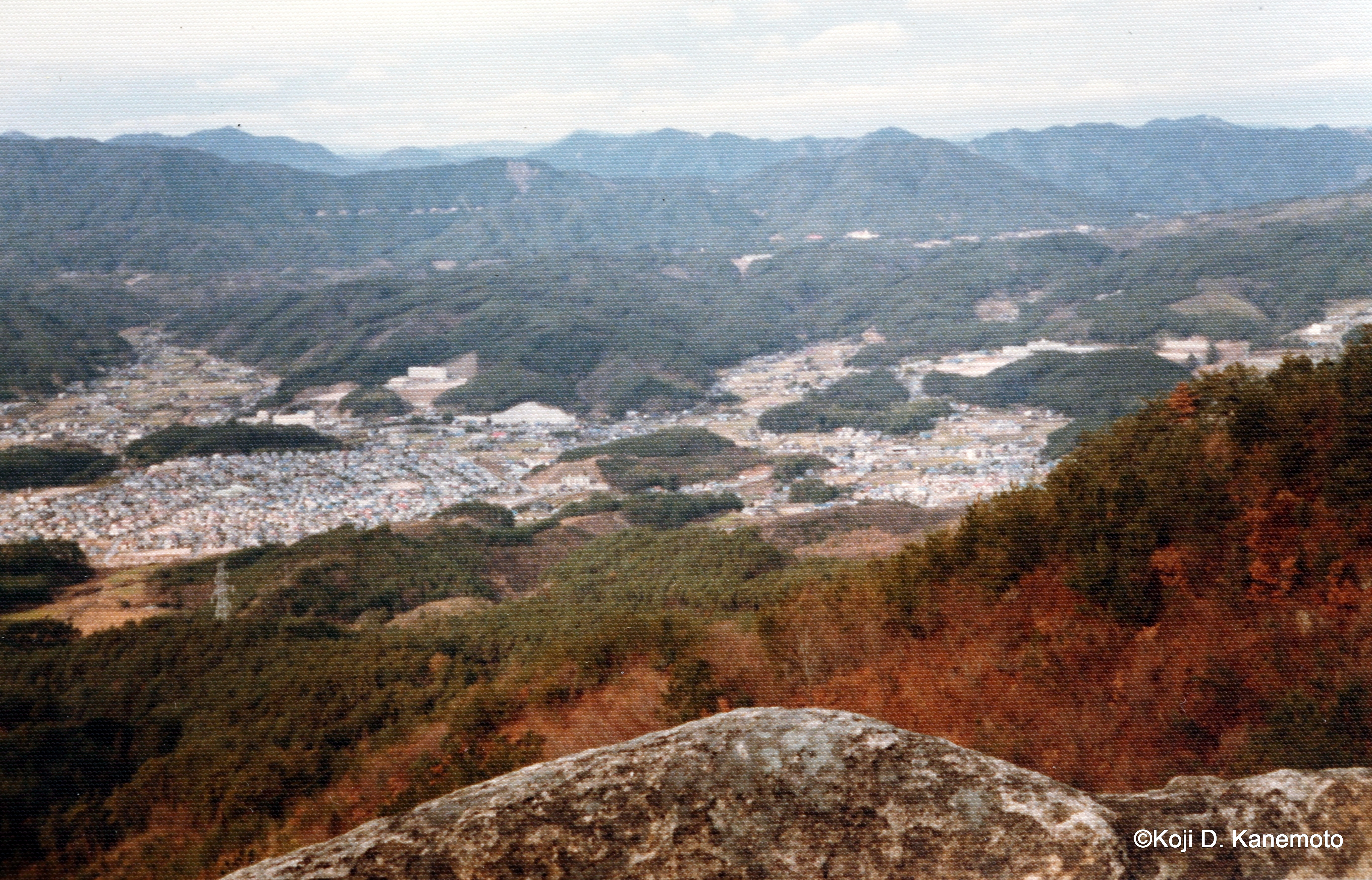
Family photo taken of the town of Tomo about 35 years ago atop the 300 meter tall hill separating it from Hiroshima. Hiroshima is directly behind. This short hill served to partially deflect the atomic bomb’s shockwave. Courtesy of Kiyoshi Aramaki.
IMG_5870
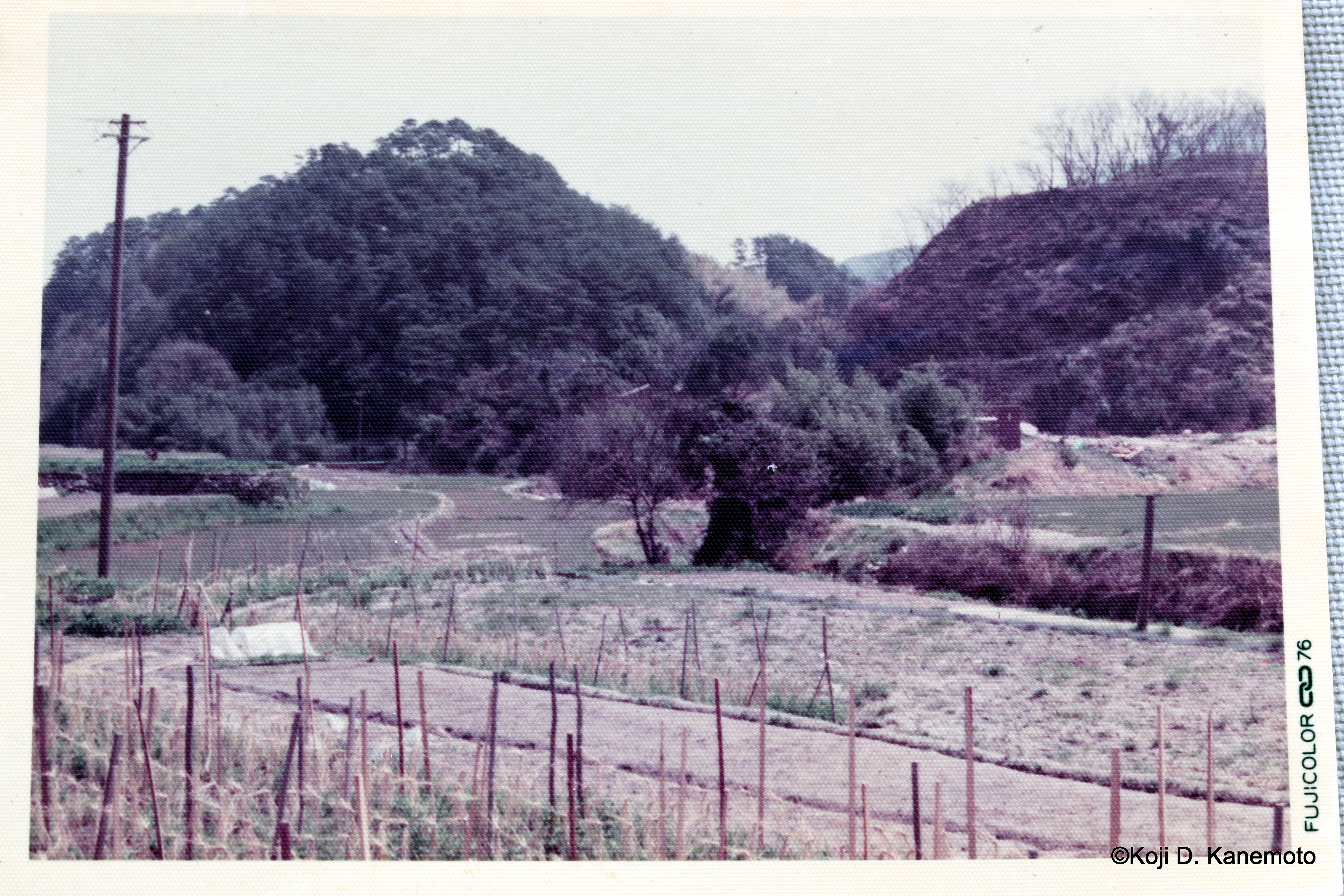
Per Kiyoshi, this was taken from the house and shows some of the field Michie had to cultivate. She was here when the shockwave hit. While the one on the right is no longer there, the family burial plot was between the two small mounds you see here. Courtesy of Kiyoshi Aramaki and dated 1976.

After picking herself off the ground, Aunt Michie saw an evil yet mystifying mushroom cloud slowly rising up beyond the 300 meter tall hill separating her village from Hiroshima proper.  At that instant, she knew her life had taken a wrenching turn for the worse… as if it could get any worse.

I cannot imagine what was going through her mind and heart watching that mushroom cloud rising.  She could not have even dreamed that it was one massive bomb, a couple of kilometers away, that could cause this sort of force and devastation.  It must have defied belief.

Hiroshima_10
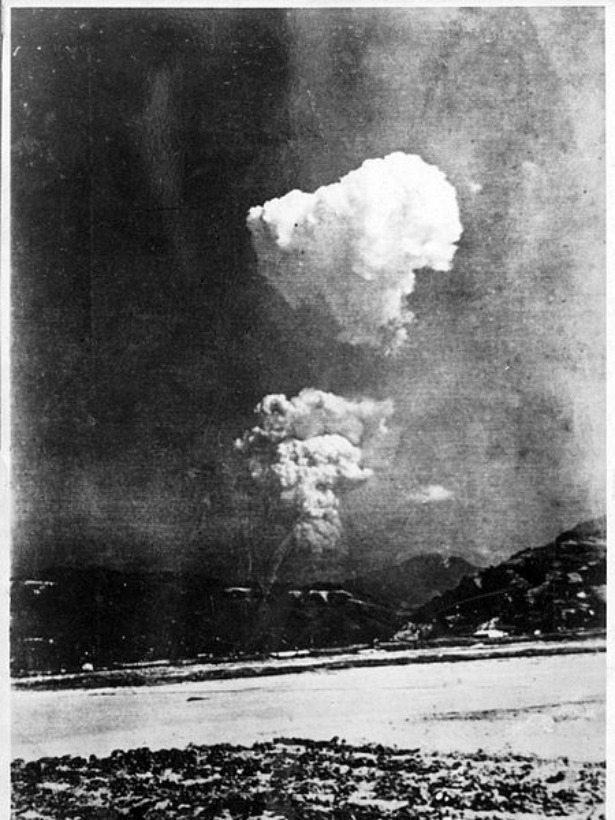
A relatively unseen image of the explosion, taken from a Kataitaichi, six miles east of Hiroshima. Michie was nearly due west and on the other side of the cloud. The cloud would reach 40,000 feet in just four minutes. It would ultimately rise to 60,000 feet. (Horikawa Elementary School)

According to Michie and my cousins, the shockwave blew out all the sliding doors, all the tatami mats were flung and the ceiling was shoved up in the house.  Try to imagine yourself being inside the house.  The same thing happened to Grandmother Kono’s house five miles south (See map in Part 1).

As per their daily air raid drill, they apparently all ran to the air raid shelter in the small hill behind their house.  After about half an hour and with the mushroom cloud still rising, a black, syrupy rain began to fall on them.  According to the cousins, Michie believed that the Americans were dropping oil from space.

She could not have fathomed it was contaminated with over 200 kinds of radioactive isotopes.  We now call it black rain.

IMG_6116
I took this photo of a preserved wall section stained with actual black rain from that fateful day. Hiroshima Peace Museum, November 2013.

Sadako, who was ten years old, clearly remembers their white blouses had turned black from the rain.  No one – absolutely no one – knew that other than staining skin, clothing, and buildings, but that ingesting black rain by breathing and by consumption of contaminated food or water, would lead to radiation poisoning.  Even flowers would bloom in distorted shapes and forms from the radiation.

_______________________________

With the enormity and the suddenness of the brilliant flash of light followed by a shockwave and the swirling mushroom cloud, Michie deep inside knew her world had forever changed.

Horror was to literally come into hand shortly to enforce that foreboding thought.

_______________________________

To be continued in Part 4….

(1) Albeit late, my mother’s family fled to the Fukui Prefecture in early July 1945 to escape the bombing of Tokyo.

The Pain of Survival and Aunt Michie – Part 2


Taken in 1945 after a B-29 bombing attack on Tokyo. There is little left of the city and many, many families were without food and homes. Sadly, there were thousands of orphans as well, many of whom would perish.

Human dignity is as crucial to an earnest life as is air, water and food.

Aunt Michie drew upon that dignity inside her to help her family and others survive the day to day ruthlessness of life during war and ultimately, the atomic bombing.

While her dignity was larger than life, Michie would ultimately sacrifice her health and well-being to ensure her family and others would survive…and survive strongly.

___________________________

obaachan
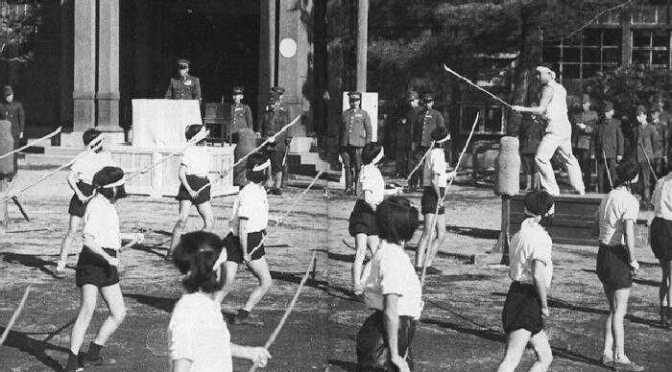
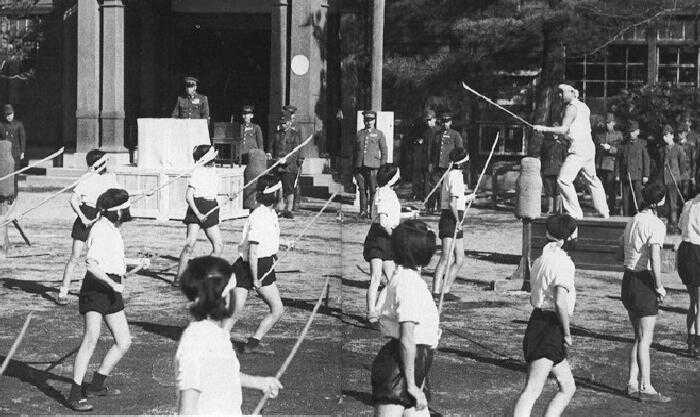
Japanese high school girls being drilled on how to use bamboo spears to ultimately repel “the invaders”. Notice the presence of the Imperial Japanese Army in the background observing.  Tokyo 1944.

By January 1945, Japan had already lost the war.  While the Japanese military leaders controlled the country and its path to ultimate destruction, the civilians took the brunt of war.  Many cities had been destroyed by US bombing raids leaving millions of families homeless.  There was not enough food to go around.  Many starved to death, especially orphaned children, if not from neglect as others would shut their eyes to them.

However, Hiroshima was largely spared from aerial attack.  The US did carry out bombing raids in March and April 1945 against military targets in Hiroshima but it was not frequent…but it was frequent enough to require air raid drills  The naval port of Kure though, where the battleship Yamato was built, was essentially destroyed in June 1945 by US Army and Navy bombing attacks.

HiroshimaBombingMap
A hand drawn map showing targets and damage to Hiroshima by US bombing raids including the atomic bombing. For a zoomable map, please copy and paste this link into your search bar: http://www.digital.archives.go.jp/DAS/meta/DGDetail_en_0000000611
Source: National Archives of Japan

___________________________

After her marriage in 1933, Michie was tasked to arduous farm labor at the Aramaki farm.  Their primary crop was rice.  She also gave birth to five children before war’s end: Masako (1933), Sadako (1936), Namie (1939), Tomiko (1942) and Masataka (1944).  Kiyoshi would follow in 1947.  She loved them unconditionally.

Michie image1
A happy Aunt Michie and likely Tomiko. Tomiko would soon be adopted by another family in the actual city of Hiroshima.  Undated but perhaps 1943.

On the farm lived Mikizo, his parents and Michie.  The four of them – and eventually three of her oldest daughters (a total of seven family members) – would work the land from a little before sunrise to sunset.  It was hard, arduous labor.  Back breaking work.  They did not have John Deere tractors or combines to aid them but had an ox to plow the fields with.  This was 24/7.

After all that hard labor, nearly the entire crop was taken by the Japanese military for the war.  They were allowed to retain a small portion of the crop for their own use.  As a result, rice was even further rationed for family consumption.  They had no choice.  On top of that, there was little else to eat.  They lived a meager life per my cousins.

__________________________

As the war dragged on, Japan was descending into the abyss…and it kept getting more and more darker.

In the story “Dear Mama”, Michie’s youngest brother Suetaro (my uncle) hurriedly wrote a somber good bye letter to Grandmother Kono in his war diary.  He was being sent off to war and certain death.

Farewell
Farewell sendoff for Suetaro who was heading to certain death. Michie is to his left and holding Masataka; Mikizo to his right. It is only an educated guess but the older man to the right of Mikizo is his father.  May 3, 1944.

I wonder how she really felt, knowing that Suetaro was going to fight to his death against the country in which his two older brothers and sister were imprisoned.  They were her brothers and sister, too.  An ugly internal conflict.

______________________________

The area around Tomo was nearly barren of younger, physically capable men.  All the men up to 35 years of age were taken by the army, regardless of their family status.  Mikizo was no exception.

In late 1944, at 35 years of age, he was taken by the Imperial Japanese Army.  Suetaro foresaw that happening in his farewell letter; he warned Mikizo to fully cooperate with the officers and to do exactly as he was ordered.  This was because it was brutal even within the non-commissioned ranks of the Imperial Japanese Army; the training officers routinely beat recruits into submission.  These recruits were largely the men who were ordered to their deaths in “banzai charges” by the thousands.  They greatly outnumbered the “hard core” Japanese officers.

banzai killed
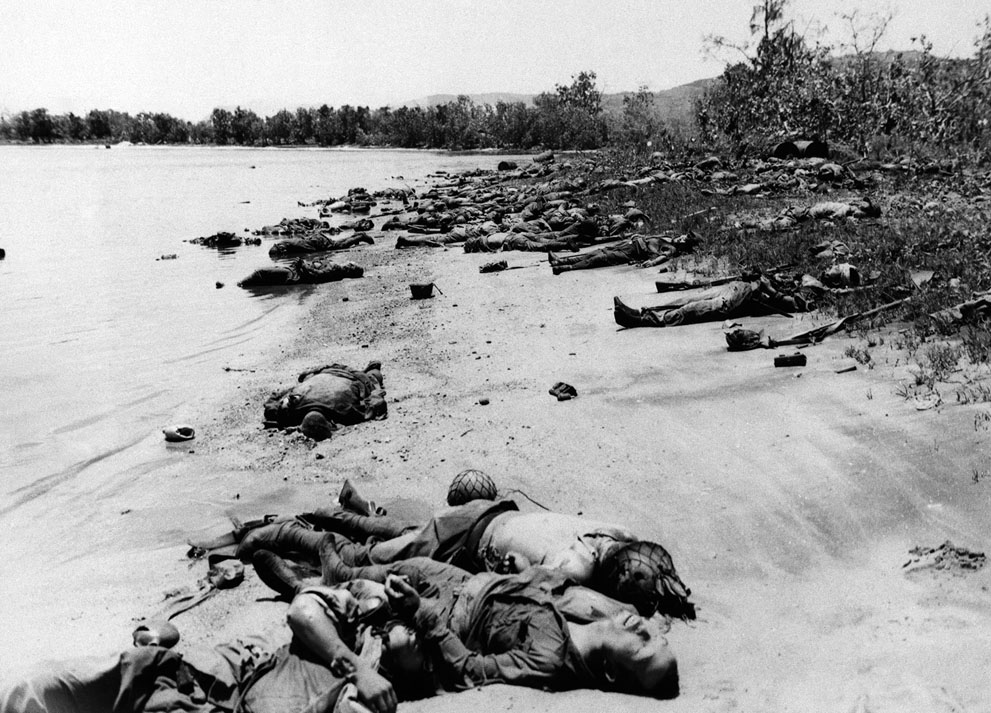
Aftermath of a banzai charge.

Aunt Michie’s family who tended to the back breaking labor on the farm was now lessened by one.  As with her brother Suetaro, she foresaw never seeing Mikizo again.

To make matters worse, her mother (my Grandmother Kono) suffered a cerebral infarction the day she learned Suetaro was being sent off to war.  She became paralyzed on her left side.  To get about the now empty house, she would have to pull herself around with her right arm.

On top of everything else – tending to the crops, the house and the children – Aunt Michie now had to care for her disabled mother.

Michie’s daily life was now further strained with even more stress…  Life must have appeared darker to Aunt Michie.

Michie’s willpower and dignity will now be on trial and severely tested.

But the struggles she will endure will have purpose.

She would not let her family down.

____________________________

To be continued in Part 3….