They walked on it. They posed for family portraits on it. They passed away on it. It felt as if their souls were infused in it.
Although my ancestors have come and gone through that house for about a hundred years, the old sakura wood shared their souls with me.
______________________________________
Then:
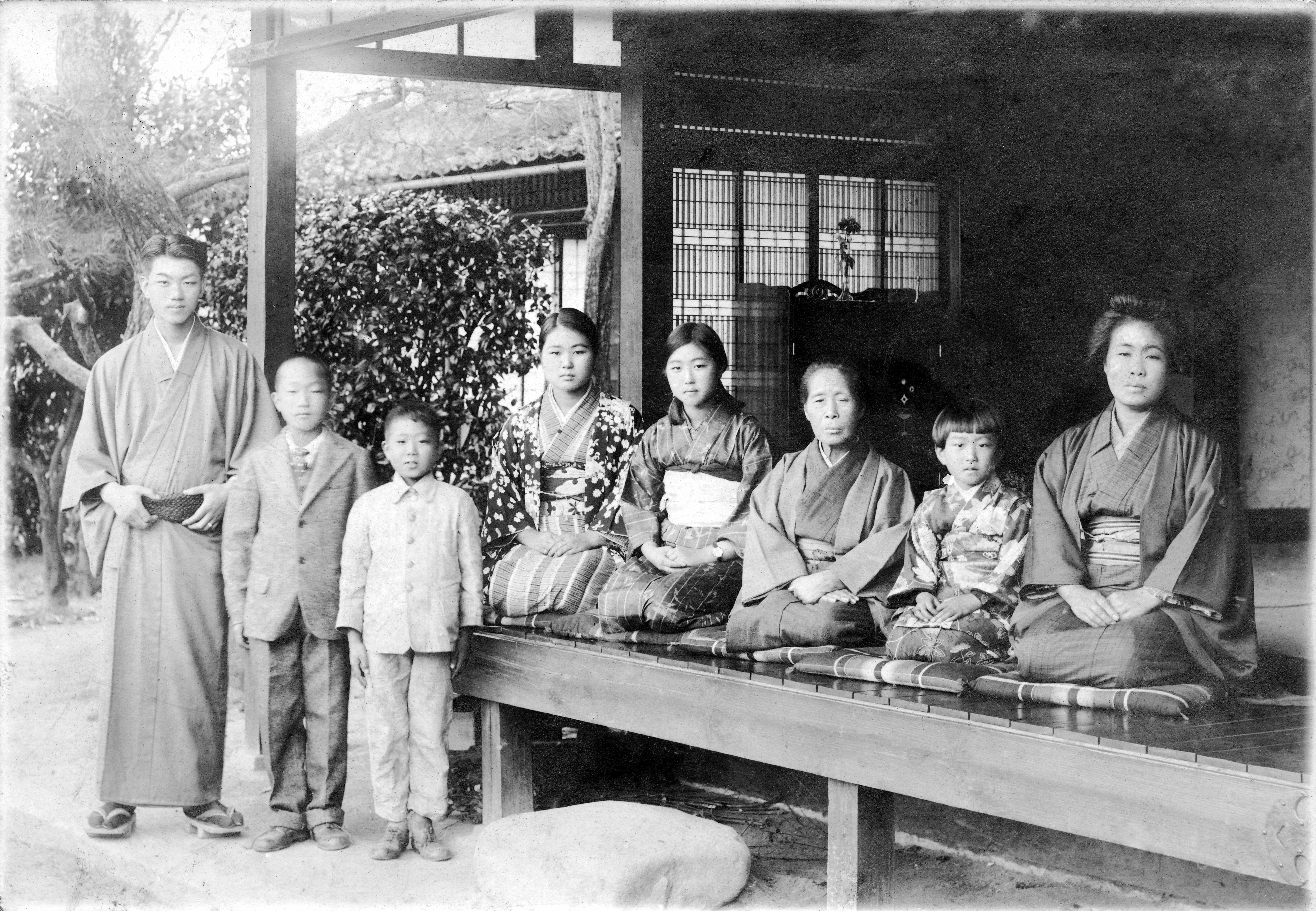
The Kanemoto’s sat on the cherry wood walkway for a portrait. Notice the glass paneling at the center-rear. My father (second from left) is sadly all who remains from that generation. Circa 1928, Hiroshima, Japan.
Now:
Although aged and weathered, the sakura (Japanese cherry) wood upon which my ancestors sat upon for family portraits is unchanged. Even the glass paneling in the background is the same.
____________________________
While I am certainly not in the construction industry, my father’s family home is based on the Edo design era. Generally speaking, they are built on stone foundations, with supporting square timbers and a raised floor. “Tatami” mats were used for flooring.
My father, while now 93 and suffering from dementia, fondly recalled the floor plan of the Kanemoto house…especially of the main room seen the family portrait. He said it had a “tokonoma”, or a small alcove alongside the altar, or “butsudan”. He also clearly recalled the floor space measured by the number of tatami mats used; in this case, “hachijyou” or eight mats.
This is the room in which my cousin Masako “saw” Aunt Shiz a few days before she passed away.
____________________________
The house was indeed damaged from the atomic bomb’s shock wave. This same shock wave shook the Enola Gay violently even while trying to escape the blast at about 30,000 feet altitude. She was 11-1/2 miles away.
The house is about 4-1/2 miles away by way the crow flies. Almost due west of the hypocenter. Masako was knocked down by the hard-hitting shock wave while in her classroom.
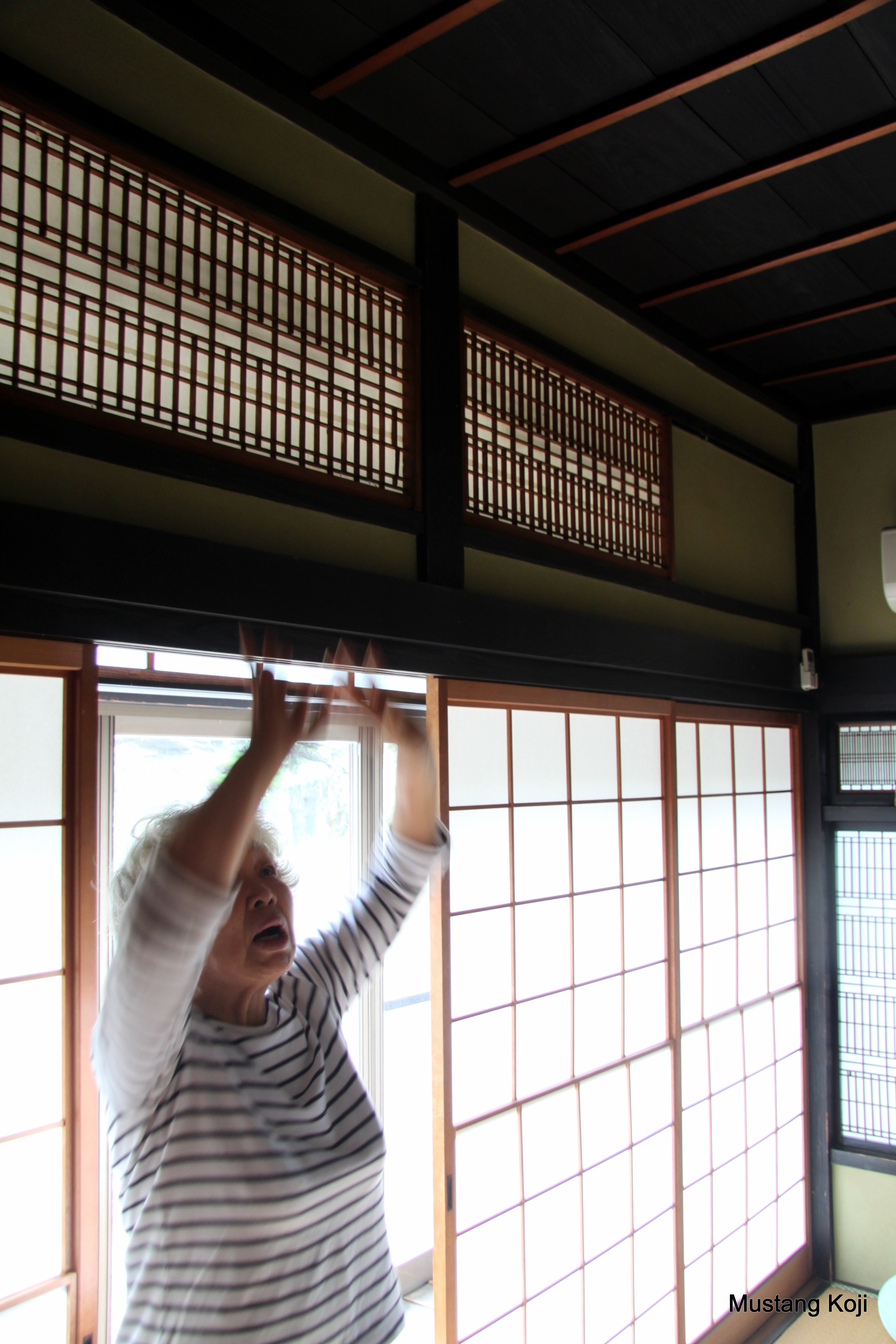
A low lying hill called Mt. Suzugamine served somewhat as a barrier, deflecting the shock wave. Still, nearly all of the sliding door panels were knocked down and the ceiling was sucked up more than a foot per Masako. Roof tiling was also blown away from the force.
Masako is trying to show how the atomic bomb’s shock wave lifted the ceiling up over a foot. It is repaired now but was left as-is for decades.Masako in the process of trying to show how far the ceiling was lifted by the blast on August 6, 1945.
My Uncle Suetaro took one of his last photos in front of this house in May 1944. My grandmother already had her stroke and is not in this photo but his sister, Michie, is standing to his right.
One of the family treasures found during our journey to the family home in Hiroshima this month. Uncle Suetaro is going to war and his death.
Grandmother Kono’s funeral in 1954; my father can be seen in the lighter suit to the left standing next to Michie and Masako (hidden by the flowers):
Grandmother Kono’s funeral at the house. 1954
The home does have spirits within. It’s not cornball. It is an incredible sensation. We were called to those souls in the wood this month. Seriously.
________________________________________
When I saw my son in front of the home, I saw that I’m in the last half of my journey in life… but I came back to myself on that old sakura wood.
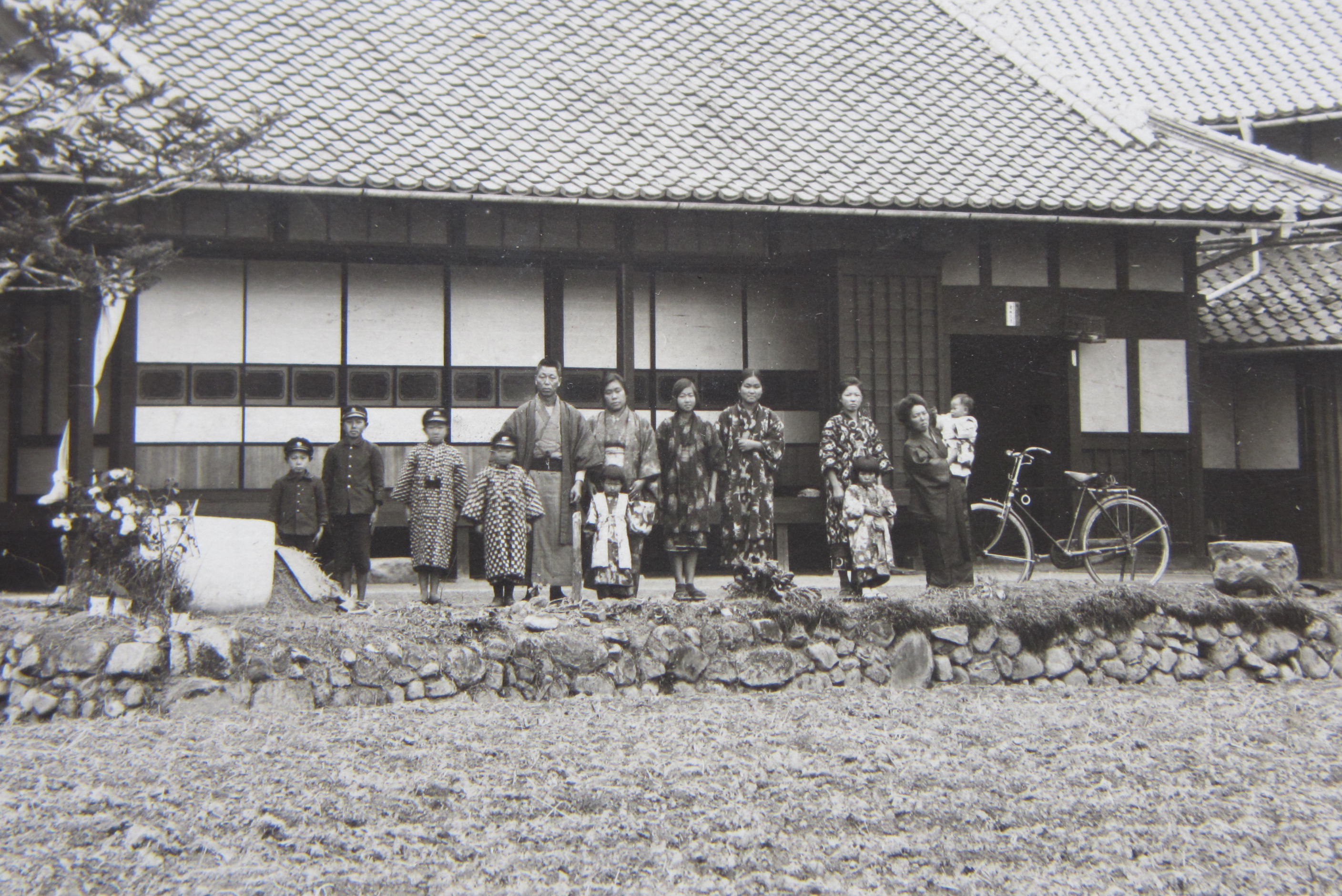
Early family picture in front of the house. The entry is on the right.My son Takeshi standing next to the Kanemoto name in front of the house just this month. The entry can be seen behind him.
There is living proof of forgiveness from a few – and they let out a resounding message of world peace for us.
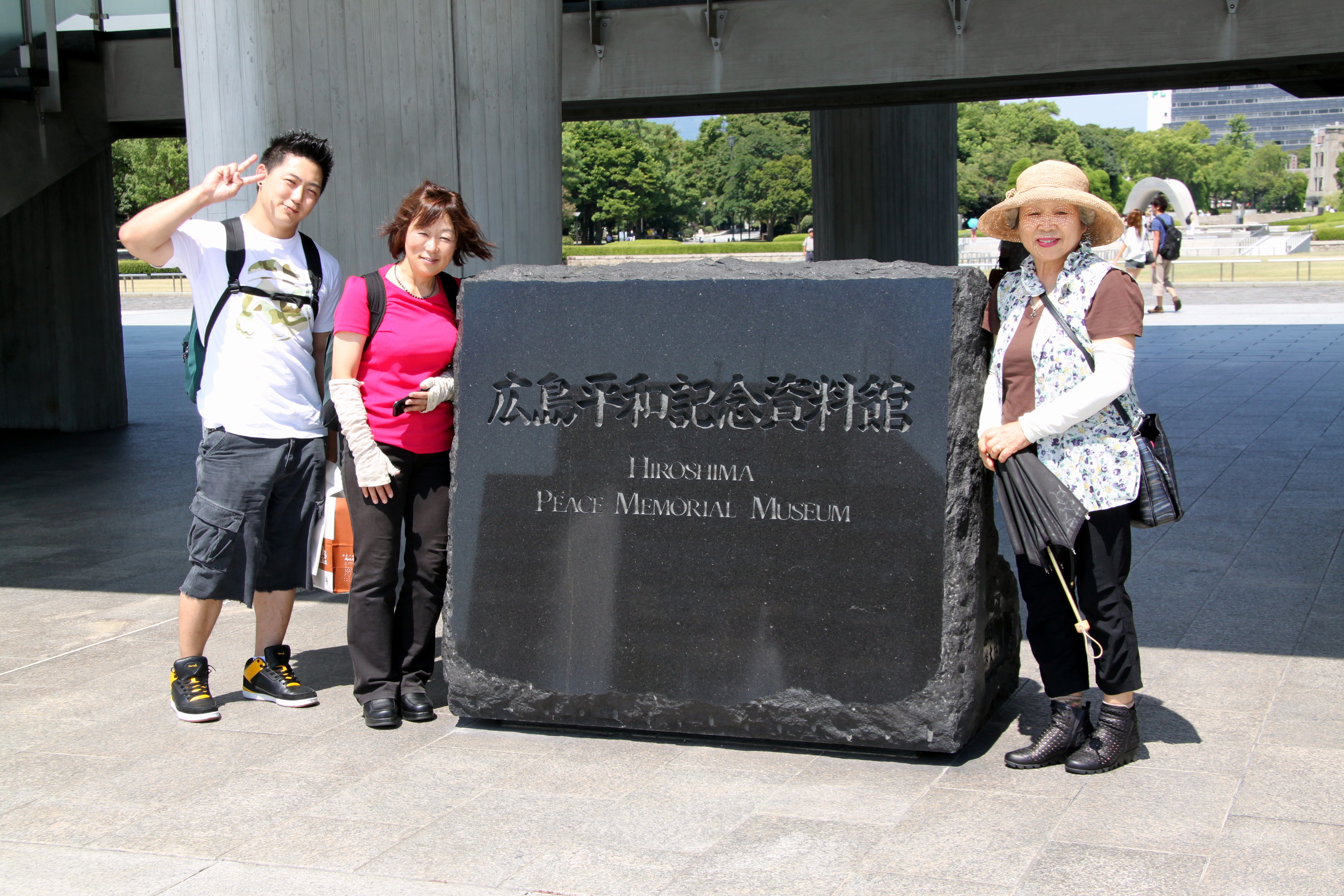
My son Takeshi, second cousin Izumi and my cousin Masako at the Hiroshima Peace Memorial Museum.
_______________________
It was an extreme emotional experience – not just for my oldest son Takeshi and I but for the kind souls who joyfully spent their afternoons with us on a hot September day in Hiroshima. I was able to finally meet – and thank – the people who were kind enough to seek out my father’s 1937 high school yearbook and thereby give my father a joyous remembrance of his most happiest days of youth in the sunset of his long life.
_______________________
Not being a writer, putting this experience into words is an endeavor. But on September 6, 2012, we were able to meet in person Mr. Tsukamoto, Ms. Kanetou, Ms. Tanaka and Mr. Aramaki.
From left: Ms. Tanaka of the Hiroshima Chugoku Shimbun newspaper, myself, Ms. Kanetou who tracked down my dad’s 1937 yearbook, my cousins Izumi and Masako, Mr. Tsukamoto who first answered my blind email and set things into motion, Mr. Aramaki our guide and my son Takeshi. Messrs. Tsukamoto and Aramaki are survivors of the atomic bombing.
__________________________
Any guided tour is exceptional. A personally guided tour of a peace memorial and museum of a man-made event of unparalleled violence cannot be surpassed. Both gentlemen were severely burned as young children. With all doctors killed in the city, they had to resort to mashed yam salve to soothe their wounds. (To see a VERY well written piece on their atomic experiences translated into English, please feel free to read it here.) Imagine doing that yourself as a youngster.
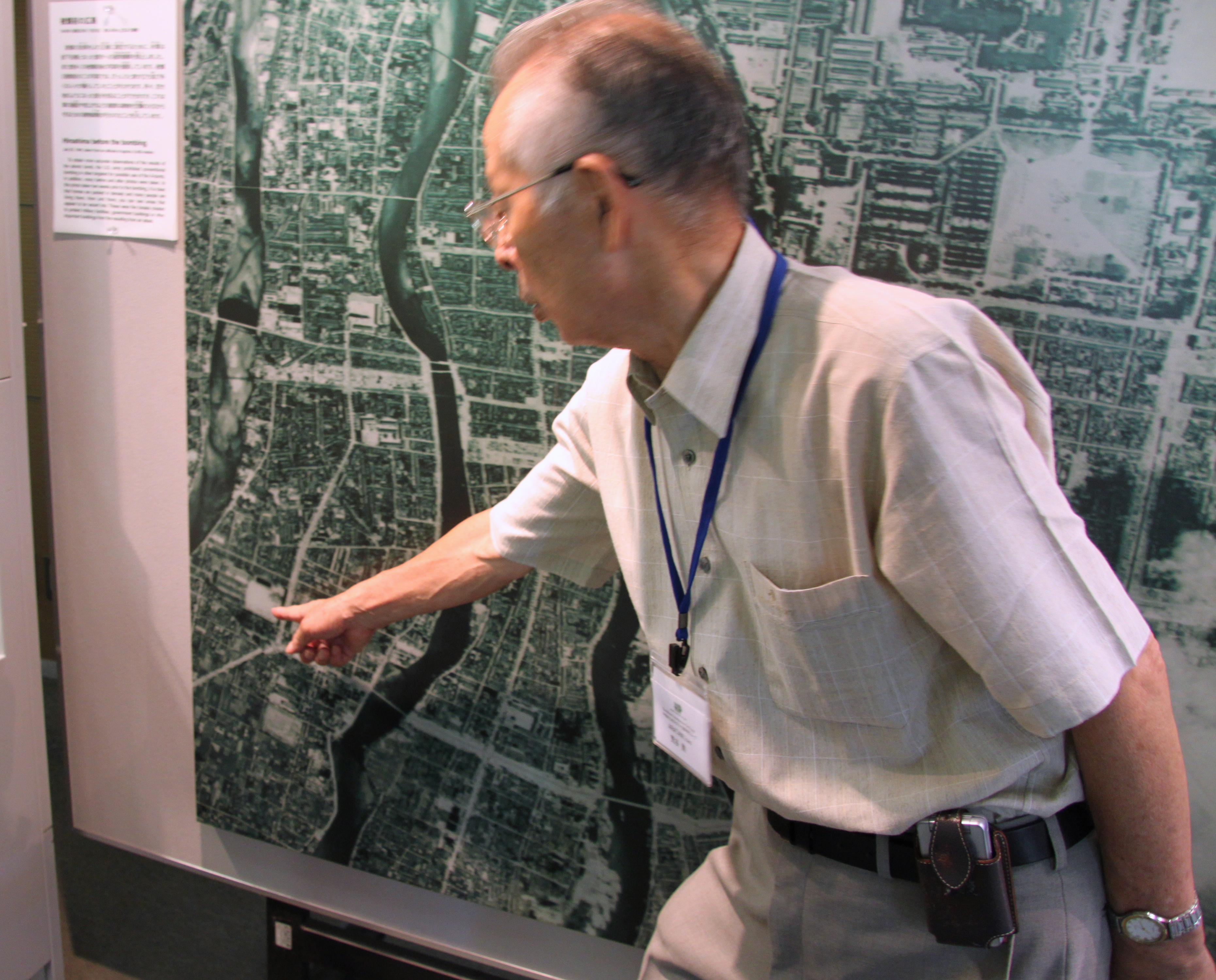
They first pointed out where my father’s beloved high school, Nichuu, was situated in relation to the hypocenter. It is one thing to see it on your monitor. It is another thing to see it on a large wall map. Overwhelming. I knew it was close but it was not much further than one of my father’s triple jumps in Track and Field. It ceased to exist – as did over 320 of their young classmates.
Mr. Aratani points to the now vacant square lot that was once his school – and my father’s.
By destiny, both men – young children at that time being forced into laboring for Japan’s war effort – were saved by the decision of their instructor, Mr. Sekimoto. Mr. Sekimoto decided it would be best for small group of them (which included another one of my relatives) to clear a large parade ground to the southeast (東練兵場) for the next crop of sweet potatoes. The other classmates were sent to work on building a firebreak near Nichu – which sealed their fate. They were erased from the face of this earth in a second.
Mr. Aratani and Mr. Tsukamoto point out the Eastern Parade Ground to my cousin Masako where they were to pull weeds that fateful morning. I subsequently learned another relative of mine, Hitoshi Kubo, was also with them. His burns were more severe.
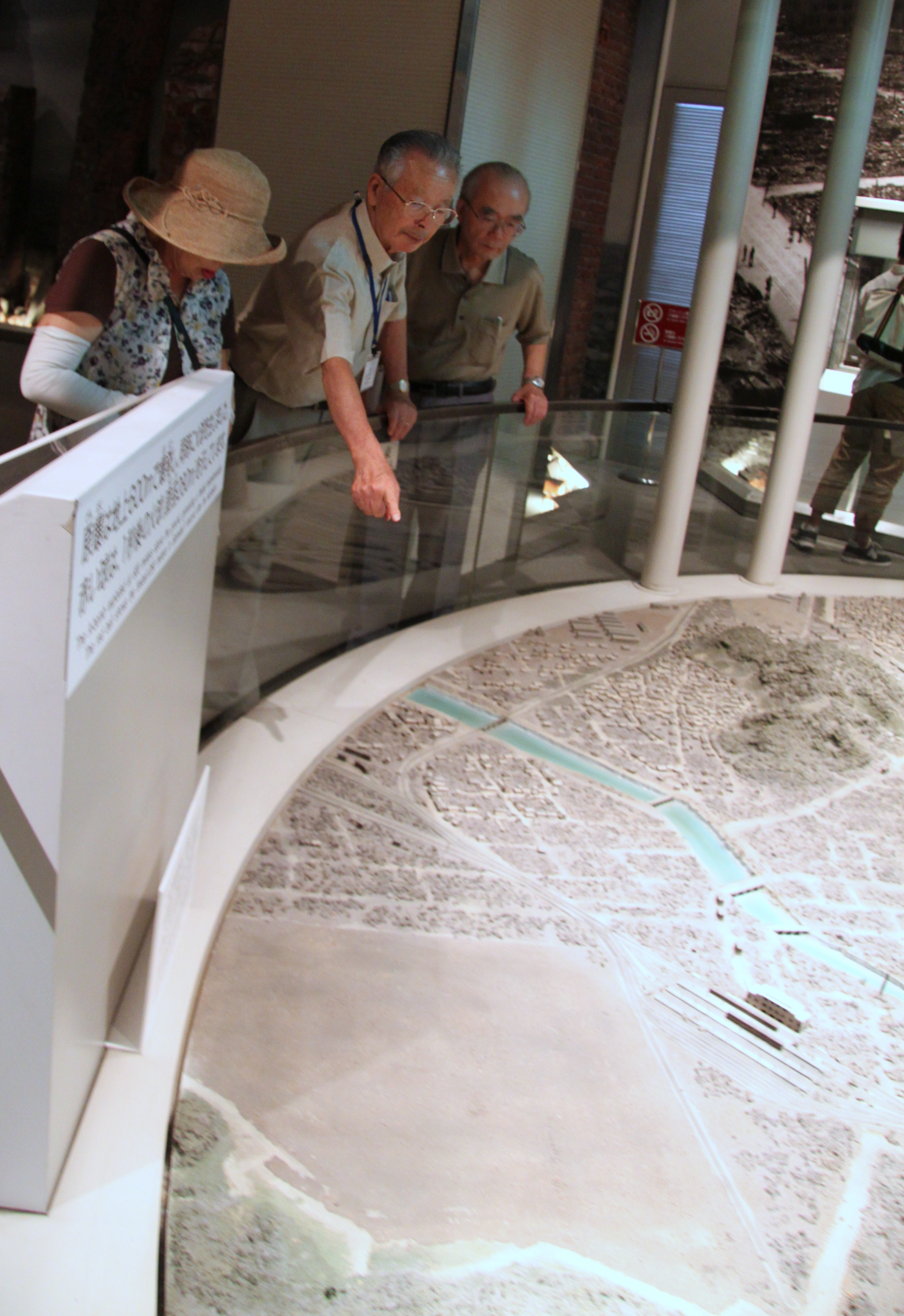
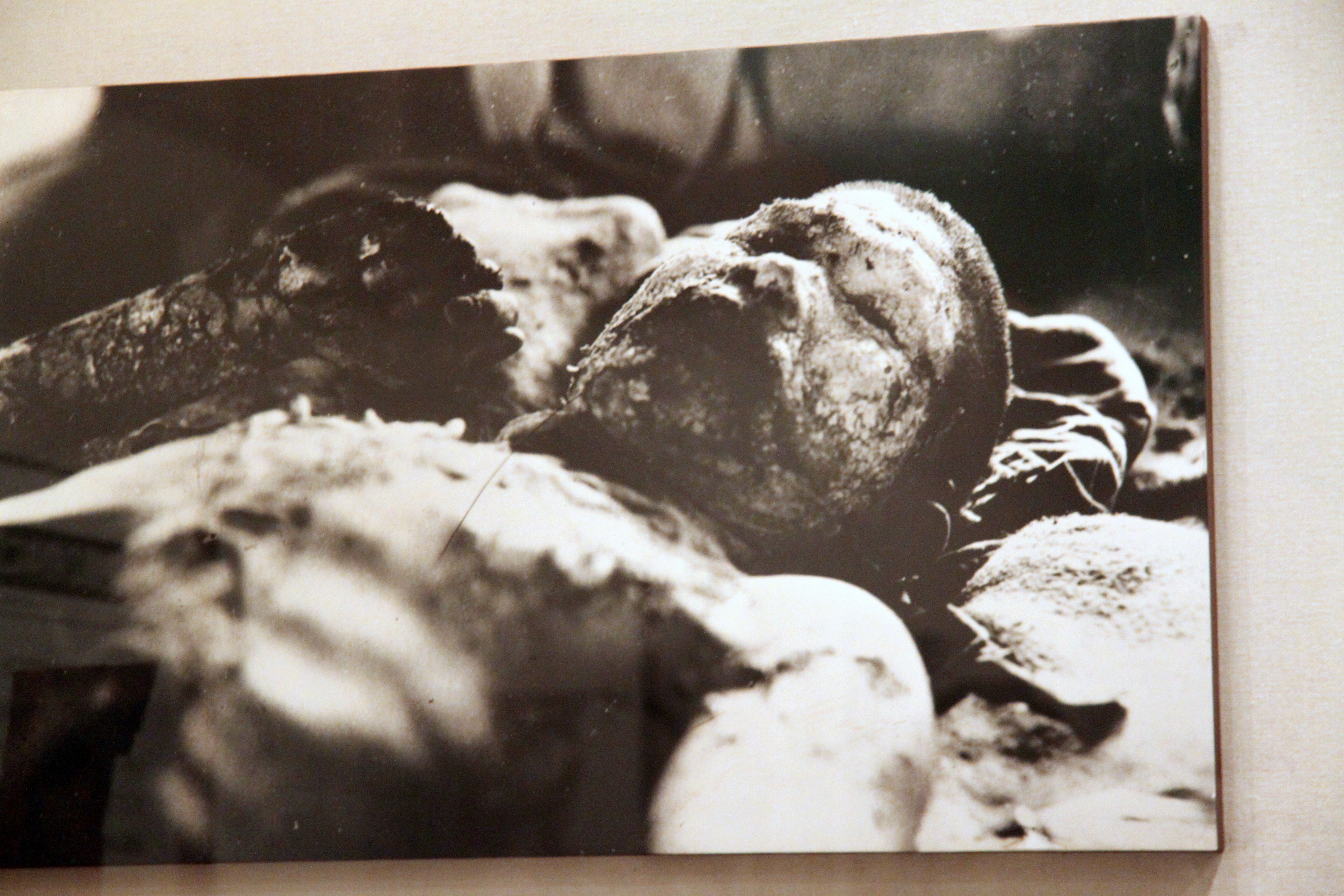
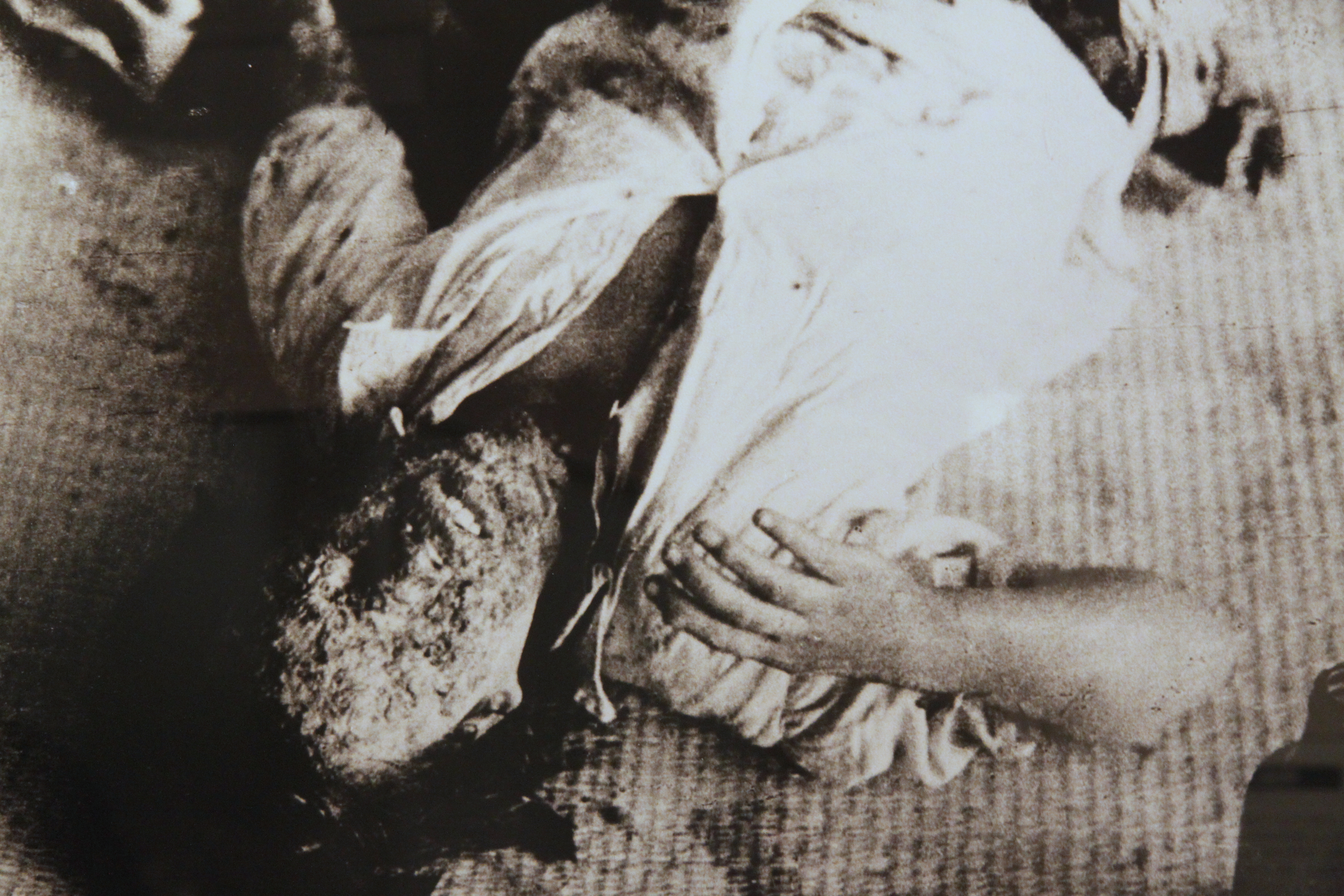
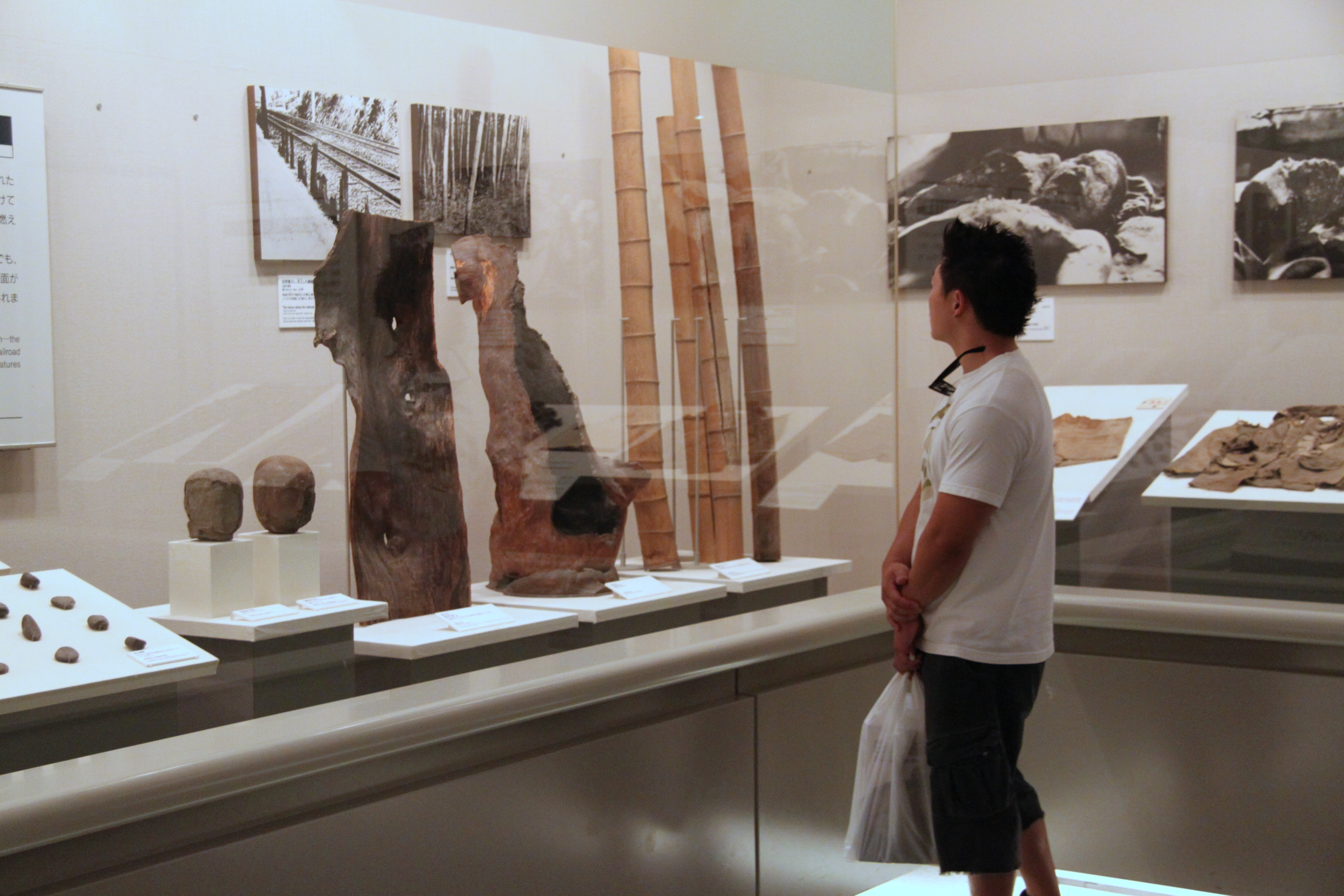
Due to time, we journeyed outside with these two 81 year old gentlemen for further education. However, without any inference of what was right or what was wrong 70 years ago, just a couple of images from within the Memorial Museum:
My son Takeshi, I believe, was very focused on the many displays. I believe the message of the Peace Museum was completely absorbed into his psyche.
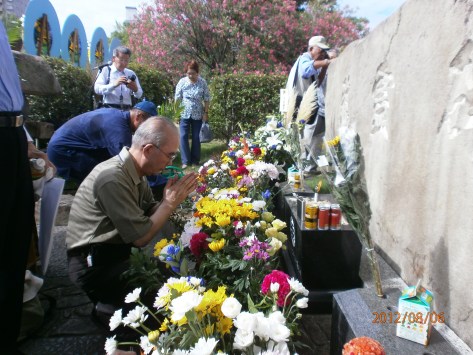
Messrs. Tsukamoto and Aratani guided us to the Nichuu High School Memorial, emblazoned with the 321 fellow students who perished. As did Mr. Tsukamoto on August 6th, 2012, I offered water; my son Takeshi also without any urging whatsoever left his precious water bottle on that hot and humid day which is a glorious gesture. There is a reason for the water as will be explained shortly.
Mr. Aratani, Mr. Tsukamoto and myself offer water to the Memorial and a prayer for their young Nichuu classmates and souls. 321 of them.My son leaves his water bottle for the young souls.
We journeyed towards the cenotaph. On the way through a park, Mr. Tsukamoto began to cry. I asked him what was wrong. He replied, “Your father is very fortunate to have family that think of his well-being. My soul is now filled with joy.” We hugged each other under the shade of a tree and cried together. As it turns out, his father died at a young age; he was never able to thank his father for raising him through a most horrible period.
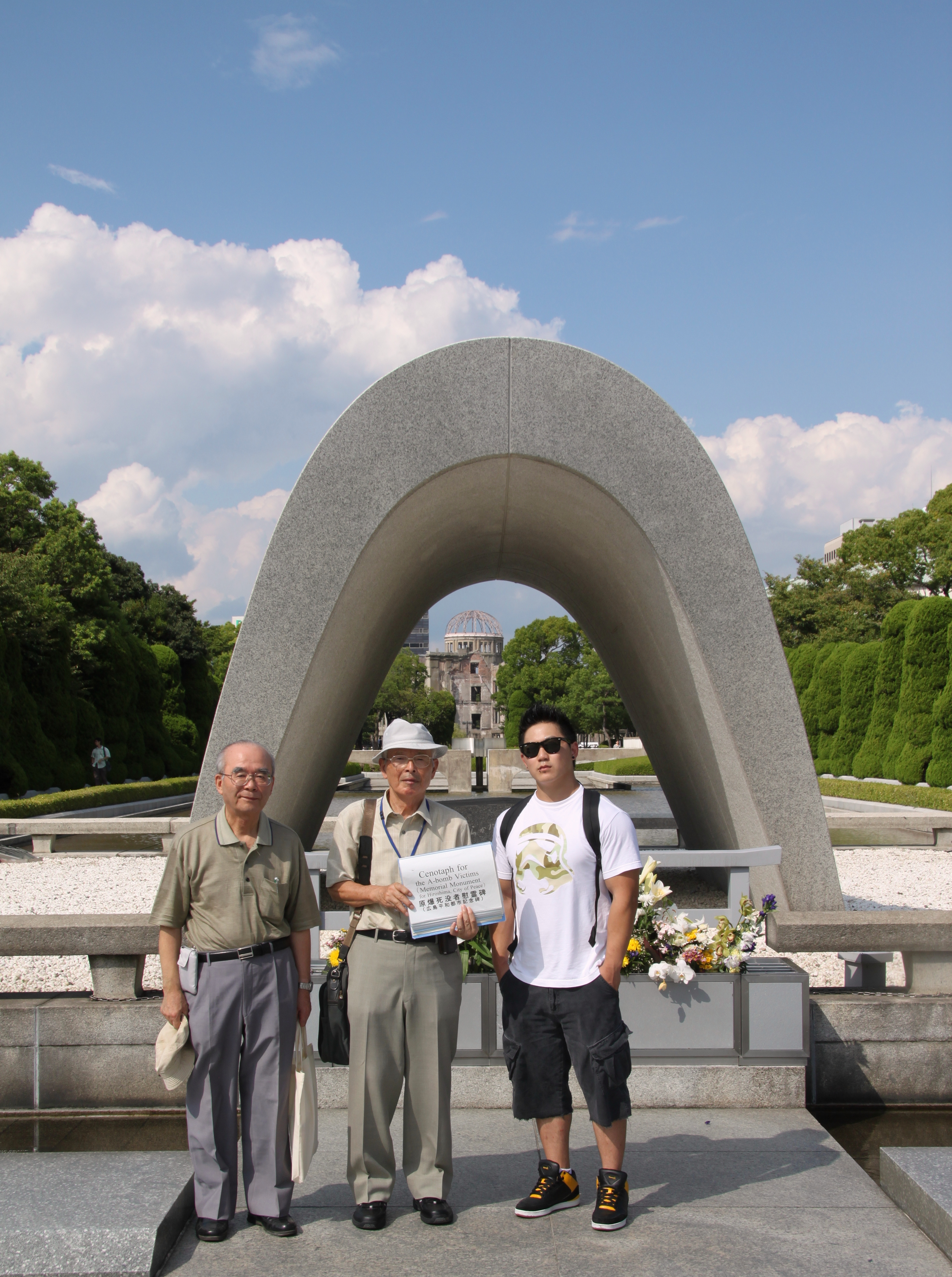
We arrived at the cenotaph; the inscription was designed and written by Mr. Tsubokawa’s and Aratani’s good friend, Prof. Saika Tadayoshi. In English, it says, “For to repeat the fault we shall cease for we shall not repeat the evil.” It was purposely written with no subject. It is for the reader to decide. Mr. Tsukamoto subsequently sent this image of the actual manuscript of Prof. Tadayoshi written in calligraphy (brush and carbon ink).
From Mr. Tsukamoto.
The Atomic Dome can be seen perfectly centered through the arch. He explained the “eternal flame” is not truly meant to be eternal. It is to be extinguished when all nuclear weapons are abolished.
Cenotaph
Just beyond the cenotaph can be seen a pool of refreshing water. The water symbolizes all the cries for water from the victims who survived the atomic blast. Nearly all would perish. Remember the water we poured on Nichu’s Memorial Stone?
We then walked to the actual hypocenter. The atomic bomb exploded about 1,900 feet directly above.
The atomic bomb exploded directly above this spot.
There are several rivers flowing through Hiroshima. We all know through books that the rivers were engorged with corpses and debris. However, there are no photos in existence as it was when the city was destroyed. There was no film let alone medical care. However, before the US scientists came to measure radiation levels about two months later, a huge typhoon hit the devastated city. While the rain tore through the rivers carrying the corpses out to sea, the rain also largely washed away radiation levels. Therefore, when the US scientists did measure the radiation levels, it was tremendously lower than what it truly was. You won’t find that written in any of our school history books.
This river was engorged with victims and were washed out to sea by a huge typhoon. There are no photos of this horrible scene as witnessed by our two survivors.
We returned from the very enlightening tour to join Masako, Izumi, Ms. Kanetou and Ms. Tanaka. My father was bestowed with many kind gifts one of which was a compilation of years past of Nichu – including images of when dad’s class was digging the pool at the school in the early 30’s. But lastly, as a small token of peace, fellow blogger Seapunk2 sent me some artistic pieces representing peace and serenity. One was presented Ms. Kanetou. I explained it to her that the artist said a sense of peace may be coming “…directly from her actions. You may feel the spirit contained within them. (I) sat so long and quietly, collecting those tiny pieces, sometimes with tweezers. It’s a beautiful experience, to listen to the shore birds, seals, waves and take in the Pacific while I gather the otherwise unnoticed gifts from the earth and sea. Then, once I got the idea for containing them, that, too, was peaceful and gave me a lovely sense of satisfaction…”
Peace token from seapunk2!
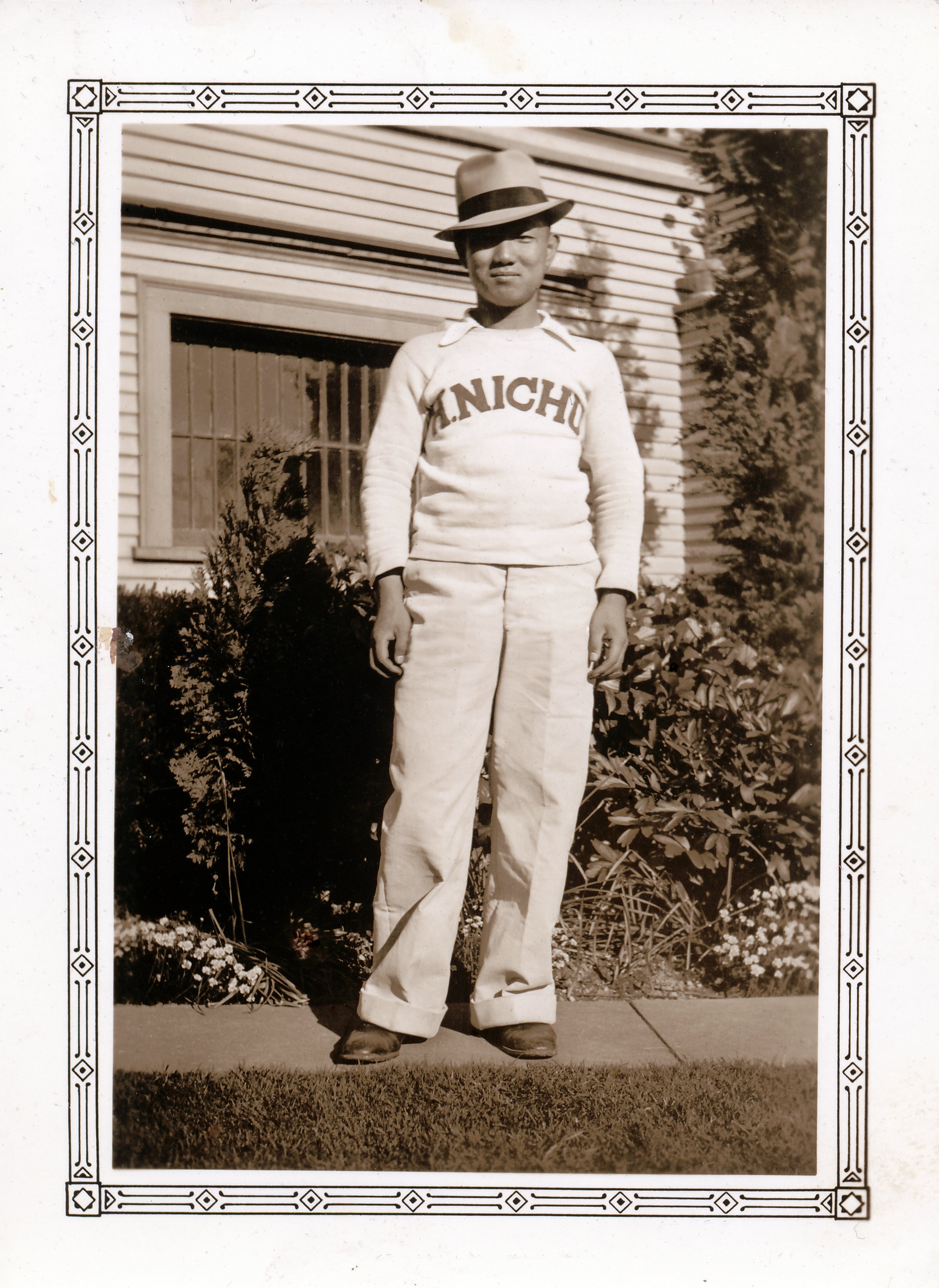
Lastly, in a photo discovery made just a few hours before meeting them, I came across a photo of dad taken in 1937 soon after he arrived back in Seattle after spending ten years in Hiroshima and graduating from Nichu. He’s sporting his Nichu varsity sweater. The attendees were overjoyed to see Dad’s pride in Nichu – even across the ocean.
Dad in his pride and joy Nichu varsity sweater taken in Seattle, 1937. You can also see his bent right elbow. That is another discovery story.
__________________________________
The men were burned severely as children working in a field for their country’s victory. While their country lost, it was but a moment in their lifetime. They still attained victory for the world.
More to come on one family, two countries and World War II.
The main Hiroshima newspaper yesterday ran a story on my Dad and his yearbook – and of international kindness. Fittingly, it was the anniversary of the atomic bombing.
The main newspaper in Hiroshima (Chugoku Shimbun) ran an article on my father and his 1937 yearbook. (A) Mr. Tsukamoto 塚本, the man who kindly helped locate my father’s yearbook, (B) me 金本光司, (C) my father Koso 康三, and (D) my father’s beloved Nichuu High School 広島二中. (Since you all can read Japanese, in this case, it is read top/down, right to left.)
__________________________
Hiroshima conducts an annual, somber peace ceremony each year on August 6th. A peace ceremony. That’s the message. Peace. Nothing more. Nothing less. Just peace.
They are not calling attention to themselves seeking pity or repentance. While there are still many who feel the Japanese brought this on to themselves, the citizens of Hiroshima have moved beyond forgiveness and are simply seeking to spread a strong global message for peace.
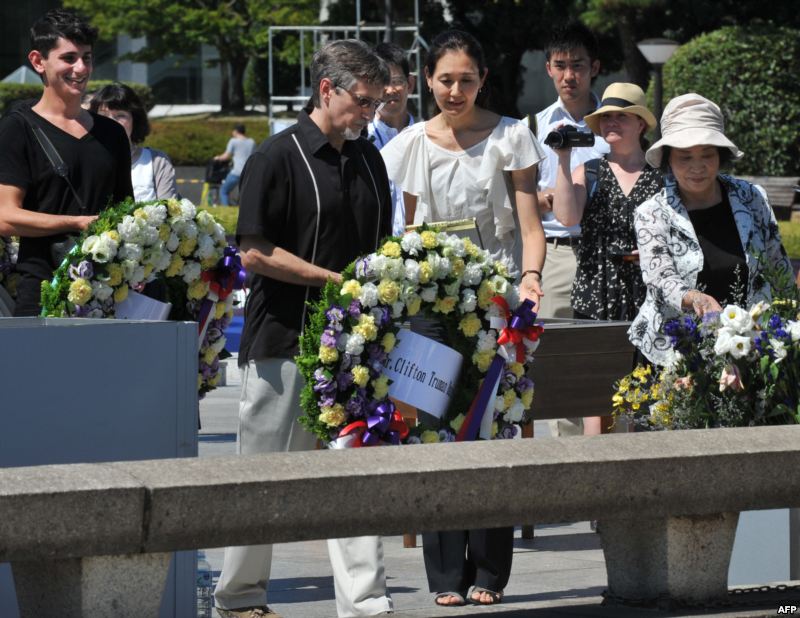
This year, the grandson of President Truman (below) was in attendance. Ari Beser was there, too. His grandfather was Jacob Beser – Enola Gay’s bombardier. Wonderful.
Clifton Truman Daniel (center) lays a wreath during the peace ceremony in Hiroshima. His grandfather was President Truman.
__________________________
In my short story, “An Atomic Spark and a 1937 Yearbook“, it tells of how two complete strangers from Hiroshima – without hesitation – sought out my father’s yearbook from 1937. They miraculously found one, made a digital copy and mailed it to me through my cousin, Masako, who still lives in my father’s childhood home in Hiroshima. I printed it out and showed it to him a week before Father’s Day this year.
Dad – who is suffering from progressing dementia at 93 years of age – was overjoyed. He recalled so many things from the most happiest years of his life…including being a track star. Riding on the train to get to school with his friend Aoki… The school song. Dementia was put on the back seat for that morning.
_________________________
In a small expression of thanks, I had sent to Mr. Tsukamoto a flask etched with “Nichuu High School, August 6, 1945”. I also asked he offer a prayer to the students of Dad’s high school on August 6th. Dad’s beloved high school was but 1,500 yards from the bomb’s hypocenter.
Think about it. 1,500 yards from the hypocenter. A Marine Corps sniper armed with a Barrett .50 caliber rifle can take out a target over 2,000 yards away. The school ceased to exist.
As part of the peace ceremonies yesterday in Hiroshima, Mr. Tsukamoto visited the school’s memorial wall. You can see the stainless steel flask on the black center stone in front of a praying Mr. Tsukamoto.
Mr. Tsukamoto offering a prayer for world-wide peace and in memory of my father’s high school’s students who died that morning in 1945. The flask can be seen directly in front of him.
In this photo, Mr. Tsukamoto is offering a symbolic toast with water from the flask.
Mr. Tsukamoto offers a symbolic toast at the school’s memorial wall during the annual Peace Ceremony. It was unbelievably hot that day as well. The newspaper’s white building can be seen in the background.
I will be showing the article to my father this next weekend.
___________________________
I wish to thank Mr. Tsukamoto, Ms. Kanetou and Ms. Michiko Tanaka, the reporter who authored this article on international kindness, forgiveness and peace.
To say it is incredible falls short. 1,500 yards short.
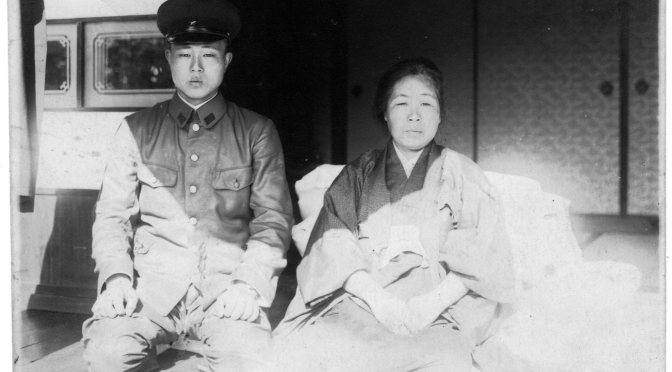
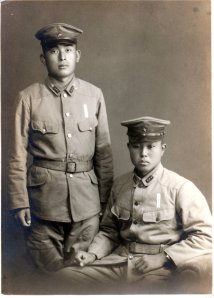
The last known photo of my Uncle Suetaro. He did not return from Leyte during the final stages of World War II. My Grandmother Kono – having suffered a stroke – is propped up by Japanese “shiki-futon” for the picture. Taken in Hiroshima, 1944.
Yes, a small percentage of Japanese soldiers were anxious to die for their emperor.
But a vast majority was frightened of having to go to war. My opinion, of course.
Young Japanese boys were drafted from farms and fishing villages – just like we did here in the US of A during that time. Boys from Parsons, Kansas or from a sea coast shrimping town in Louisiana.
And they all had moms.
__________________________
Like all Americans of my age, we were taught that the Japanese soldiers of WWII were fanatics. That they all were hell-bent to charge into a hail of Allied machine gun fire. To willingly die.
We were also taught that when a US Marine charged well entrenched Japanese soldiers with a satchel charge, he was a hero. Not a fanatic. He was John Wayne or Kirk Douglas. Was Esprit de Corps driving the young Marine to offer his life to save his buddies?
There is no intent to question our American values of valor or honor. Just a quandary.
_________________________
My Hiroshima cousin Masako mentioned in Hawai’i having seen a photo of Uncle Suetaro and Grandmother. It was taken the day before Uncle shipped out for war (1944). Masako said Grandmother – having suffered a stroke the day before – was propped up by “shiki-futon”, or Japanese bedding for the picture. She felt strongly it was the last picture taken of Uncle Suetaro but doesn’t know what happened to it.
_________________________
A few weeks ago, my California cousin Janice came across a number of old photos; she had forgotten about them. She said there were some family photos from Hiroshima. Her father – Uncle Suetaro’s and my Dad’s oldest brother – had apparently been able to hold on to them through the decades.
I asked Janice if there were any photos of my Dad’s two youngest siblings, Suetaro and Mieko, or of Michie (Masako’s mother). Janice then described a picture of Uncle Suetaro in a uniform and Grandmother (seen at the beginning of this story).
I was stunned. Topo Giggio meets Godzilla. It was the photo Masako vividly recalled seeing decades ago.
Is there an air of fearfulness…of fright? You can decide. But as we were led to believe, all Japanese soldiers were fanatics…yes?
The kindness continues to flow from Hiroshima. As written in a prior short story, “An Atomic Spark from a 1937 Yearbook“, Ms. Kanetou was credited with locating the last copy of my dad’s 1937 high school yearbook. It was amazing she found that copy as Dad’s cherished high school and the city itself was obliterated on August 6, 1945.
While Dad is suffering from dementia, he cheerfully recalled his high school track days in detail while looking through his yearbook… He went so far as to say he won 1st and 2nd places at track and field events. Needless to say, I was a bit leery given his status.
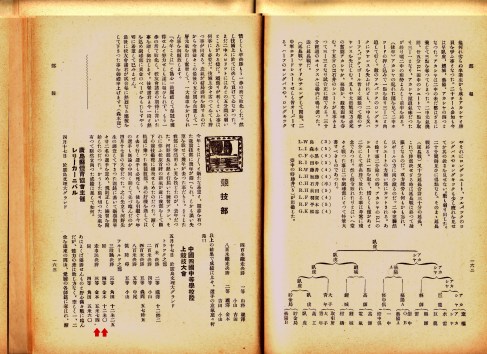
Well, dumbfounded is the best word in this case. Ms. Kanetou – after learning of Dad’s recollections of his competitions – actually tracked down (yes, a pun) records of the track events from 1936. Such kindness and devotion is just phenomenal. They are below; since I know you all can read Japanese, my Dad’s name is above the red arrows (金本).
Hiroshima Track and Field results from 1936. (I did miss Dad placing 2nd in a 800 meter relay race.)Hiroshima Track and Field results from 1936.
Yes, he DID take 1st and 2nd places in the triple-jump, broad jump, 100 meter dash and the 800 meter relay! He did place lower in what I think are more regional competitions but its clear he was quite an athlete.
But when I showed him these reports, his comment was, “5th place? Did I do that bad? I don’t remember that. Pumpkin head!”
The Atomic Peace Dome, 1,500 yards from Dad’s high school.
The atomic bombing of Hiroshima left a spark – a spark which grew into universal forgiveness and kindness. From that unbounded forgiveness and kindness came a 1937 high school yearbook from a school that no longer existed – but its soul survived intact and gloriously
_________________
Dad is simply a very quiet man. For every word he spoke, mom must have said a bazillion words. No wonder he was quiet. (You know, it may have been better to write “every word he tried to speak”.)
But this past Sunday, June 10, dad was a songbird in Spring…even though mom was there.
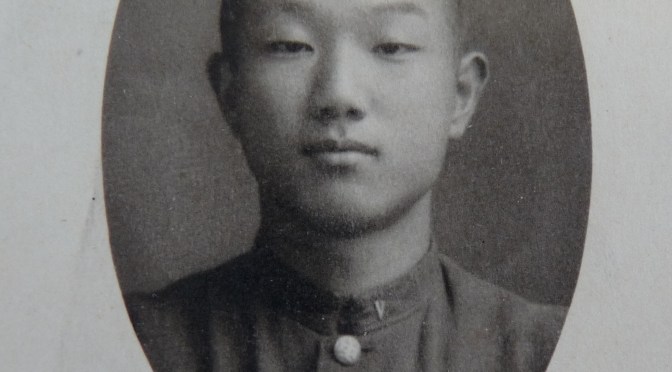
Dad was eighteen again and back in Hiroshima, riding the train to school with his friend Aoki. Carefree. Young. After 75 years, Dad was looking through his high school yearbook he probably never saw.
How I got that yearbook from 1937 for Dad is a story of unbounded kindness and a love for peace – and driven by a unwavering desire to honor those that perished in Hiroshima.
_________________
All Dad had said in the past was that he ran track in his high school days and that the school was called “Nichu”. I thought it was a nickname. He wasn’t enthusiastic to share much more.
I was determined to find out more of my Dad’s past he was keeping hidden.
In Dad’s shoebox: a Nichu High School Pennant flying for an athletic meet in 1937.
All I had to start with had been a 1930’s photo (above) of a pennant Dad had stashed away in a shoebox and a couple of class photos. After some exploring, I figured out the Japanese symbol on the flag was a melding of “二” and “中”, or “Nichu”, the name Dad mentioned.
Researching in the Japanese language was an endeavor. I finally came across a possible lead and sent a blind e-mail… In spite of considerable odds, I received a reply from a man in Hiroshima.
_________________
Mr. Akira Tsukamoto is a survivor.
In the waning days of the war, school children were put to work for their nation’s war effort in factories and fields. That was their destiny. Mr. Tsukamoto was one of those children.
Their teacher was Mr. Sekimoto; they had a nickname for him, “Mr. Pale”, because of his pale complexion. The night before that fateful morning, Mr. Sekimoto had decided that it would be better for the class to tend a field and clear it of weeds. Preparing the field for crops was more important than having class, he determined. They would be in the northwest area of Hiroshima.
My two littlest kids standing in front of the Enola Gay in 2010. I always viewed her as part of history. Now I see a personal link.
Then came the morning and they were in the field while the other classes fatefully went to school. Then they heard the familiar drone of B-29 engines. They all saw what appeared to be three parachutes and a B-29 flying away. One student recalls seeing something black in shape tumbling towards the earth.
There was a terrible blue and yellow flash. A shock wave blew them down. They covered their eyes and mouths as they had been trained. But the heat from the blast was so searing, they could hear their skin and hair burning.
Their faces and bodies were burned on the left sides; in addition to searing pain, their skin slipped off. All they could use was mashed raw potatoes as a salve. It would take two months for their wounds to heal. They say they were spared for a greater cause.
Mr. Tsukamoto’s story – translated into English – can be read here. It is gripping and without malice. Just kindness.
___________________
Fast forward 67 years. Mr. Tsukamoto – the child who was pulling weeds in a field – was the one who kindly responded to my blind e-mail. It turns out he graduated after the war from the school that rose out of the ashes of Nichu.
He did not know me but his survivor’s heart – driven now for world peace and in honor of 300+ young classmates that perished – propelled him to our communicating.
After learning of my search for information on my father’s high school years, he found Ms. Tomoko Kanetou. Ms. Kanetou is an administrative manager at Dad’s successor school. Together, they tracked down an actual copy of dad’s yearbook from 1937. It is the last copy in existence. She conscientiously made high resolution scans of the 48 page yearbook and sent a CD to me here in the United States through my cousin Masako.
They did all this without pause. For a complete stranger across the Pacific. An American. Just incredible.
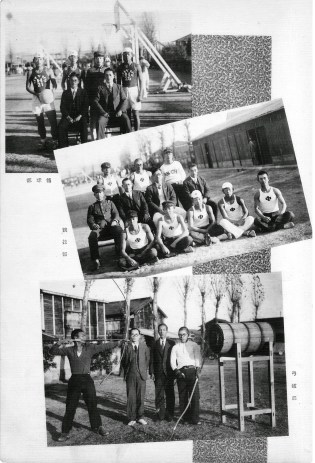
In the middle picture is Dad’s track team with him at front row, center. Mr. Sekimoto, the one whose decision saved Mr. Tsukamoto, is in the bottom photo, standing next to the archer on the left.
___________________
This past weekend, my oldest daughter hosted an early Father’s Day breakfast at her first home. My father went through the yearbook I assembled page by page. Not once. Not twice…but for almost three hours during last Sunday morning.
He remembered the school song. He said he was on their track team and won 1st or 2nd places in the 100m, 200m, broad jump and triple-jump. He was even pictured, front and center, in Nichu’s track team yearbook photo (right).
Other pages struck me with disbelief and astonishment. They gave a glimpse into life during the “pre-war” days in Hiroshima. He talked about the influence of war on schooling. That will be saved for a later story but further explains why his love and remembrances of his youngest brother are buried so deep in his hidden memories.
My ever-quiet father was not quiet that morning. I have never heard him talk so much and for so long… Truly an atomic spark from a 1937 yearbook. All arising from a peace-fueled and unsolicited joint effort by complete strangers, Mr. Tsukamoto and Ms. Kanetou. Perhaps they weren’t complete strangers after all.
_______________________
At day’s end with the yearbook… A smile the world’s supply of pistachios couldn’t buy.
In an earlier story, I praised old man Jack for being a giant in forgiving.
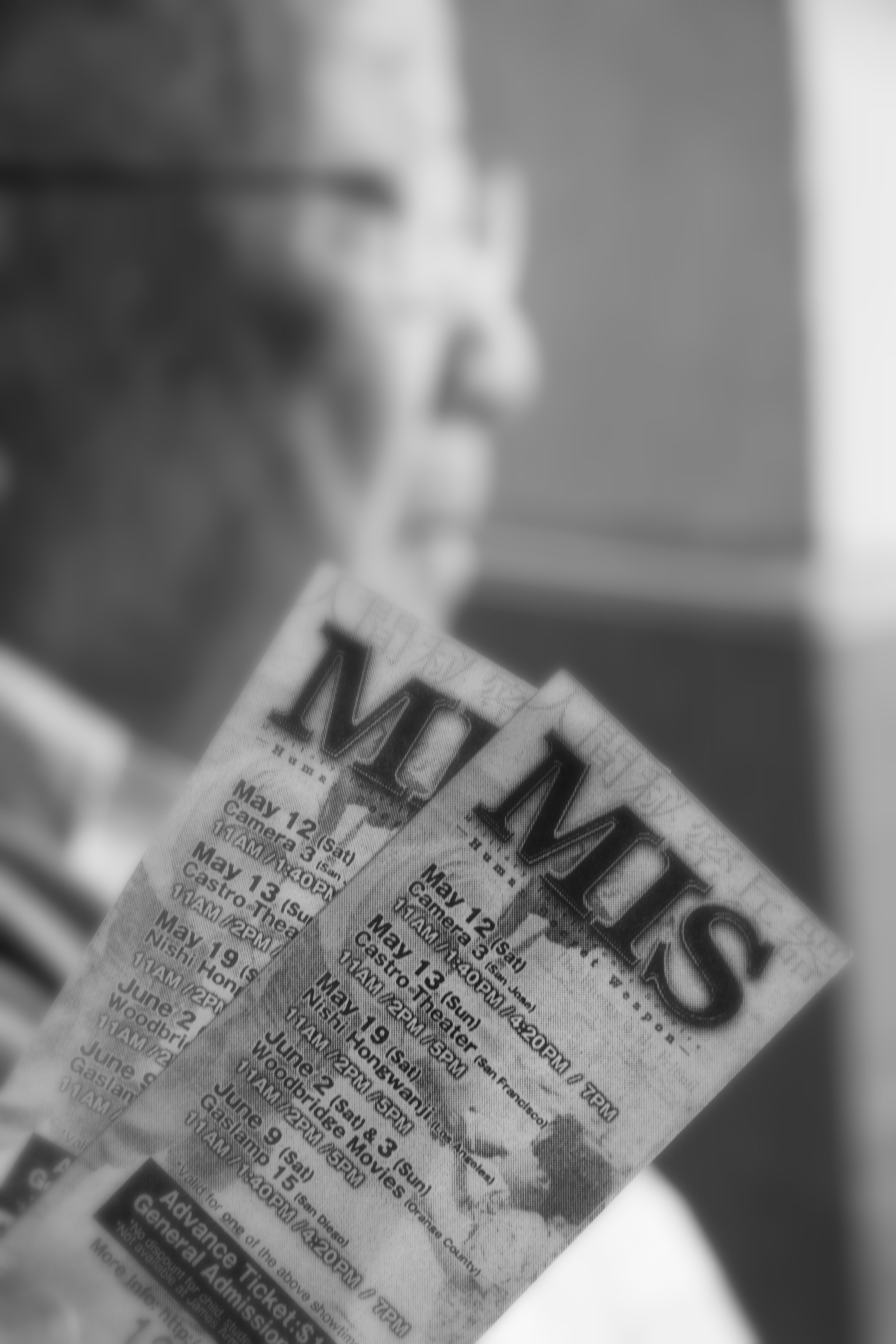
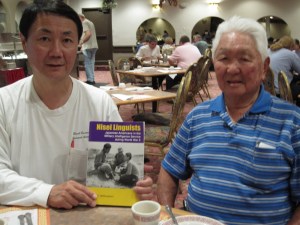
“War is no good,” he said as we left the small community movie theater near his assisted living home today; we had just watched the limited release documentary “MIS: Human Secret Weapon”. It was about his highly classified World War II US Army unit. He had silently watched and with a ghostly stillness. But I saw him wipe his eyes twice after gently lifting his glasses. Others openly wept…but I had never, ever seen him shed a tear before today.
I was ignorant. Combat isn’t necessary for the ugliness of war to be buried in a person’s mind. The documentary made it clear that it is also easily dug out. All one needs to do is scratch.
Official US Army document certifying his Military Intelligence Service days.
___________________
The documentary reveals the conflicted state of mind of the then young Japanese-Americans who made up the US Army’s Military Intelligence Service (MIS). About 3,000 of them – including two of my uncles – secretly and faithfully served the red, white and blue, hastening the Japanese surrender on board the USS Missouri.
Another 3,000 served during the Occupation of Japan. My dad was one and worked out of General Eichelberger’s US 8th Army’s GHQ in Yokohama. That’s when he was able to journey to Hiroshima and see his mother for the first time in ten years…and when a hungry Masako first relished the flavor of Spam.
__________________
Grant Ichikawa, MIS, CGM and me. 2010
One Nisei veteran interviewed was Grant Ichikawa. He was gracious enough to not only greet me and my family in 2010 near his home in Rosslyn, VA, he also secretly treated us to lunch. Pun intended. He had lost his wife Millie just months before. She was an even rarer female member of the MIS as well.
He and Terry Shima (also interviewed in the documentary) gave me the jump start in finding out about Dad’s involvement in the MIS. During that all too brief get together, Grant did touch on what he did on the battlefront in a GI uniform. He also said it “got dicey”.
In this documentary, you learn of one such experience. He was told there were Japanese soldiers who had agreed to surrender. Grant said he was the point man. They proceeded to the rendezvous point where he met the Japanese commander; they were in the middle of an open field.
It turns out there were 200 to 250 of them; all their weapons were in good working order he says in the documentary. Grant suddenly realized – out in the middle of this field – that these Japanese soldiers were “toukoutai”, or “suicide corps”. Grant just as quickly and with great consternation realized there were only ten of them… GI’s, that is, armed only with rifles. I’m sure Grant picked his words wisely. He is still alive.
“Dicey” was a definite understatement.
_______________________
In a lighter moment, Ken Akune described how they were searching a Japanese soldier that had surrendered in the jungle of Burma. They came across one of the American propaganda leaflets promising safe passage for those Japanese soldiers that surrendered. It was neatly folded in a pocket.
Surrender Propaganda Written by MIS Nisei.
Akune asked the Japanese soldier if he believed what the leaflet promised since the MIS Nisei wrote it. The Japanese soldier said no but that it made for good toilet paper. “There was no toilet paper in the jungle of Burma,” said the prisoner.
_______________________
Thomas Tsubota broke down at the end of his interview. Many did.
Tsubota was one of the top secret MIS members of Merrill’s Marauders.
They had just stumbled across ten Japanese soldiers in a small jungle clearing, he says. “Boom,” he said, in a split second they killed them all. He described how his commander, Colonel Beach, called him over to inspect a photo album taken off one of the now dead Japanese soldiers
They looked through the album. Tsubota told Col. Beach there was nothing of military importance in it but as they came upon the last page of the album, there was a picture of a mother and a daughter.
Tsubota said Colonel Beach’s eyes got red, filled with tears and he said, “Thank you, Tom.”
While crying, Tsubota ended the interview by saying this is why he isn’t enthusiastic about talking about the war. Too painful. He doesn’t want to think about that sad moment. Tsubota is 96 years old. I thought Dad was old.
______________________
The documentary intensely yet humanely describes the internal turmoil within these young American GIs of Japanese descent. Quite a few had brothers who were left in Japan when war broke out and were killed as Japanese soldiers. Deep down, many carried guilt that their own secret actions led to the deaths of their own brothers. My Dad’s youngest brother – my Uncle Suetaro – was one of those casualties.
But these 3,000 young American boys of Japanese heritage did their job as did millions of other young American boys…but in secret. They translated diaries covered with blood or offered cigarettes to Japanese prisoners to extract military intelligence while battles were raging.
They endured years of discrimination and intimidation to boot – both from GI’s fighting alongside them as well as back home. A barber in Chicago wouldn’t cut Dad’s hair because of his race – and he was wearing his perfectly creased US Army uniform with sergeant’s stripes, sleeve highlighted by the proud shoulder patch of the US 8th Army.
The secrecy was officially lifted in 1972 by Executive Order 11652.
______________________
Uncle Suetaro on right.
Just the two of us, I thought, were going to see this movie and that this may help Dad slow down his growing dementia.
I was wrong.
His quiet tears and with his exiting comment, I am sure Uncle Suetaro was there, too, in Dad’s heart – as if it was 1937 in Hiroshima when he last saw his brother alive.
Over the past two years, I’ve asked, “Dad, tell me about what you worked on in the MIS. What was the one thing you remember the most? A picture? A diary?” Each time, the answer was vague or “I don’t know.” I chalked it up to senility.
He doesn’t want to talk about it…just like Tsubota painfully recalling Col. Beach and the photo of a mother and a daughter taken from a Japanese soldier they had just killed.
Ugly recollections from war wanting to be masked need not come from battlefields, bullets or bombs.
It was Monday, Valentines’ Day 2001. My wife was five months pregnant at the time we moved into this wonderful neighborhood smothered in US Naval glory. After I came back from work the next day, she told me a kind old man stopped her as she was wheeling out the trash bin. She said he hobbled from across our quiet street lined with peppercorn trees then kindly wheeled them out for her.
I found out the “old man” was a World War II combat vet. Worse yet, he was a sailor in the Pacific – he fought the Japanese in World War II.
“Holy crap,” flashed through my mind, “What if he finds out we’re Japanese?”
Twelve years later, I was honored to have been a pallbearer at his funeral.
I was so far off base about my first thoughts on Old Man Jack that even George Burns could have picked me off without being called for a balk…and this while he was in his grave.
I felt so ashamed.
_____________________________
I snapped this picture of a happy Jack Garrett when we went to the Chino Planes of Fame in 2003.
“Young man, get over here and plant your butt in that chair,” barked old man Jack from his cluttered garage across the street. Having lived in that house since 1953, it was filled with his life history.
“But I have my stogie going, Jack,” said I.
“Well, I can see it and I sure as hell can smell it. Now shut up and sit down. I want to tell you something.”
That was Old Man Jack, my dear neighbor who lived across the street. I like to think we were close.
He was 87 years old by that summer’s day in 2010 when he called me over. While he had become feeble, his barrel chest was still prominent. He was a rabble-rouser in his youth. He was always “mixing it up” throughout his young years… Well, he was mixing it up even while working at Northrup in the 50’s. That makes me grin.
His handshake was always firm and warm; you didn’t need to be psychic to sense his insight and outlook on life. He always spoke his mind. He earned that right having been shot at, strafed, and bombed on “those stinkin’ islands” in the Southwest Pacific as he so often said during a most bitter war.
___________________________
Taken on Father’s Day 2010
I had invited Jack to Father’s Day dinner that summer just two years ago; my Dad who was 91 was coming as well.
Jack knew my dad was US Army but I fretted over what they would say to each other when they first met. Or how they would react to one another. It was more than just a concern over the centuries old rivalry between Army and Navy. It was the bitter war.
Dad was in the front room when Jack rang the bell – right on time as always. Jack had on his favorite blue plaid shirt; he wore it often as it had a pocket for his glasses. I often wondered how often he washed it, though. Jack and Dad are shown here on Father’s Day 2010.
“Dad,” I said, “This is Jack, US Navy, Aviation Machinist’s Mate, First Class, the Pacific.”
“Jack, this is my Dad. US 8th Army, sergeant, Military Intelligence Service.”
Although not as agile as they once were, they immediately saluted each other.
_______________________
You didn’t need a sound system to hear them. Dad and Jack are both hard of hearing.
It was easy to hear Jack ask Dad what he did in the Army. During the Occupation of Japan, Dad said he went into a room once a week that reeked of dry cleaning to retrieve a crate. (The crates contained documents, photos and other personal items such as war diaries written by Japanese soldiers. They were removed from a WWII battlefield – read on.) He would then translate the contents for military intelligence (below).
Dad translating captured war documents in the U.S. 8th Army HQ’s, Yokohama, Japan. 1947.
I had to tend to cooking so I lost track of the conversation. It was regretful I didn’t keep tuned in.
_______________________
So back to being called over by Jack on that summer’s day.
He was sitting in his favorite blue wheelchair. He didn’t need it but it belonged to his beloved wife Carol who passed away ten years before. They married during the waning days of the war. They had been married for 55 strong years.
“So what did you want to tell me, Jack?” I asked.
He then went into his trance – one signaling evident anguish and wretched remembrances. When he went into these trances, he always started by staring at his hands while picking at his right thumbnail with his left ring finger. He would lift his once thick eyebrows now turned snow white with age, then begin talking in a slow, deliberate pace, never taking his eyes off his hands.
“I went on ID patrol…” Jack rasply whispered while ever so slightly drawing out his words.
“ID patrol? What is that?” I asked.
He ignored me. It was as if I wasn’t sitting next to him… He had already left the present. He had stepped foot onto that violent SW Pacific jungle of 70 years ago. I’m sure its smell was as vivid to him in his tormented subconscious as it was seven decades ago.
“They would issue six of us white caps M1’s with bayonets… Then we’d follow two Marines on a patrol into the jungle.”
“Patrol? You? You were ground crew, Jack,” I remarked.
“Ain’t enough of them (Marines) to go around on those stinkin’ islands so we got picked,” he said, still speaking in a lifeless yet pained monotone. He added, “If you got killed, you rotted real quick in that jungle heat. And if you got killed with shit in your pants, you got buried with shit in your pants.”
His stare doesn’t change. His eyes have glassed over. He is in a different world now – one of 70 years ago in a stifling jungle, his youthful, sweaty hands trying to grip onto his Garand rifle while wearing a smelly steel helmet… Listening in terror for any sound that may signal a Japanese soldier concealed in ambush knowing that the enemy was just there shortly before. A world that only combat veterans understand. Thankfully, you and I never will. Never.
“The Marines had two bags – one small one and a big one. When we found one, the two Marines would stand guard. We’d hold the rifle by the butt end and use the fixed bayonet to fish out the tags.”
It was then when I realized what he was painfully regurgitating.
This is what he meant by “I.D. patrol”. They were going back into the jungle to locate the dead Marines they had to leave behind after a “tussle” with the enemy as Jack liked to say – a life or death firefight. Old Man Jack was only 20 years old. The Marines were likely younger. Ponder that thought.
“We weren’t allowed to touch the dead (Marine) as the Japs would booby-trap ‘em. We’d hand over the tags hanging on the the end of the bayonet to one of the Marines who would put a tag in the small bag. They marked a map for the graves registration guys to come back later.”
Jack’s anguished delivery dimmed even further. “But we’d come across a dead Jap. Nobody cared about them so they rotted where they were. But we’d have to stick the bayonet into the rotting goo and try to fish stuff out. The prize was a pouch or a satchel. Those would go into the big duffel bag just as they were, covered with rot and maggots. We headed back to CP and that’s the last I saw of those bags,” he said.
He abruptly ended but his unconscious stare didn’t change. He was still in the jungle, scared out of his wits. He was still picking at his thumbnail all this time. His head hardly moved while he sat in the blue wheelchair that belonged to his beloved wife.
I thought to myself, “Is that the end, Jack? That’s it? Why did you tell me this?” I knew not to pry any more so I kept the thoughts to myself. He was in torment already. Seventy years had passed but he was reliving the awfulness of a brutal war. Nevertheless, I wondered why he chose that time to tell me about this horrific recall of something he experienced so very young.
It bugged me for several weeks.
____________________
About a month later, I understood why Jack told me the story after I communicated with Mr. Grant Ichikawa, a more well known veteran of the famed US Army’s Military Intelligence Service and combat veteran himself. Apparently, the items they recovered from Japanese corpses were dry cleaned to remove the rotting body fluids. After getting dry cleaned, they ended up in the crates that were in the room my Dad went into once a week when he was in the Military Intelligence Service…and why the room reeked of dry cleaning.
The brief chat with my dad on Father’s Day sparked that vile memory back to life. It had been eating at Old Man Jack since that day. He wanted to get it off his once mightily barreled chest.
I lament to this day that an invitation to a Father’s Day dinner had resulted in an unwanted recall of horror Jack was very much trying to forget. More so, I lament he relived such horrors each night for the last 70 years of his life. Seventy years.
Jack was a great man to have endured combat in the Pacific during World War II. He was an immeasurable giant in learning to forgive – although he was never able to forget.
I miss him greatly. I thanked him for all we have when I visited him today at his grave on this glorious Memorial Day.























 Masako and Spam Musubi