“Koji, funerals don’t do a damn thing for me anymore.”
That was Mr. Johnson’s reply while I was driving us to Old Man Jack’s funeral. I had asked him to help hold me together as I knew I would fall apart.
“Oh-oh,” I thought to myself when I heard that curt reply. “I guess I hit a nerve…”
_____________________________
Old man Jack on the left, Mr. Johnson on the right. Taken June 30, 2005.
Mr. Johnson was Old Man Jack’s next door neighbor.
Since 1953.
Nearly SIXTY years. Hell, I ain’t that old yet. Well, I’m close.
They got along real well for those 60 years… except Jack was a WWII sailor… and Mr. Johnson was a WWII Marine. They reminded each other of it often.
Lovingly, of course.
Old Man Jack happily reminisced that “…us white caps would also tussle with them Marines ‘cuz they thought they were better than us”. But Jack would have gotten the short end of the stick if he took on Mr. Johnson. He towered over Jack and me…
And Mr. Johnson was a decorated WWII Marine.
Decorated twice…that I know of.
_____________________________
Our cozy neighborhood called him “Johnnie”. I always addressed him as Mr. Johnson…He used to say, “Damn it, Koji. I wish you’d stop calling me that.”
I never did call him Johnnie. I just couldn’t.
But in the end, we found out his real name was Doreston. Doreston Johnson.
Born August 1, 1923 in Basile, Louisiana. A tiny town, he said, and everyone was dirt broke.
I wish I knew why he wanted to go by “Johnnie” but later, I discovered Doreston was his father’s name.
_____________________________
After Jack passed away, I visited with him. He opened up a bit.
The Depression made it tough on everybody but then war…
When war broke out, he was gung ho like many young boys at that time.
It was expected. You were branded a coward if you didn’t enlist or eluded the draft. You were at the bottom of the heap if you got classified 4F.
He said went to the Army recruiting station. They said they met their quota, couldn’t take him right away and to try again next week.
He then went to the Navy recruiter. They also said pretty much the same thing but that there was an outfit “over there that’ll take ya”.
It was the United States Marine Corps.
Notice the 1903 Springfield in this 1942 recruiting poster.
The Marines “took him”…right then and there, he said.
Mr. Johnson said, “I was a dumb, stupid kid at that time” – slowly shaking his head…but with a boyish little grin.
____________________________
It was 1941… When the United States Navy had their backs against the beaches… MacArthur blundered after Pearl Harbor and thousands of soldiers were taken prisoner in the Philippines.
The country’s military was poorly equipped and poorly trained. With outdated equipment like the 1903 Springfield and the Brewster Buffalo. And most gravely, the US Navy was outgunned.
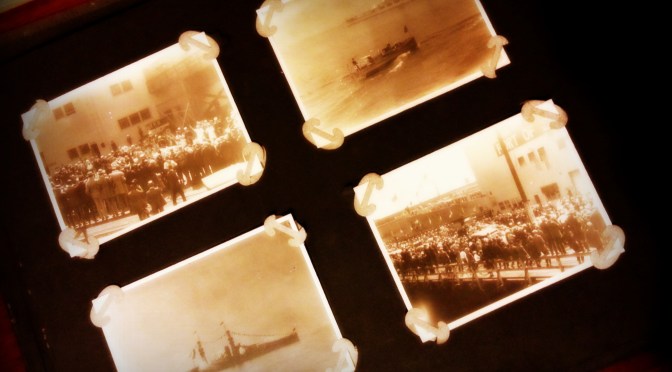
Yes. President Harding’s last photos in my grandmother’s album.
OMG. Leave it alone!
________________________
I found a copy of the actual event flyer from July 1923.
Now we can see an overview. See what the Bell Street Pier looked like when President Harding rode in his motorcade.
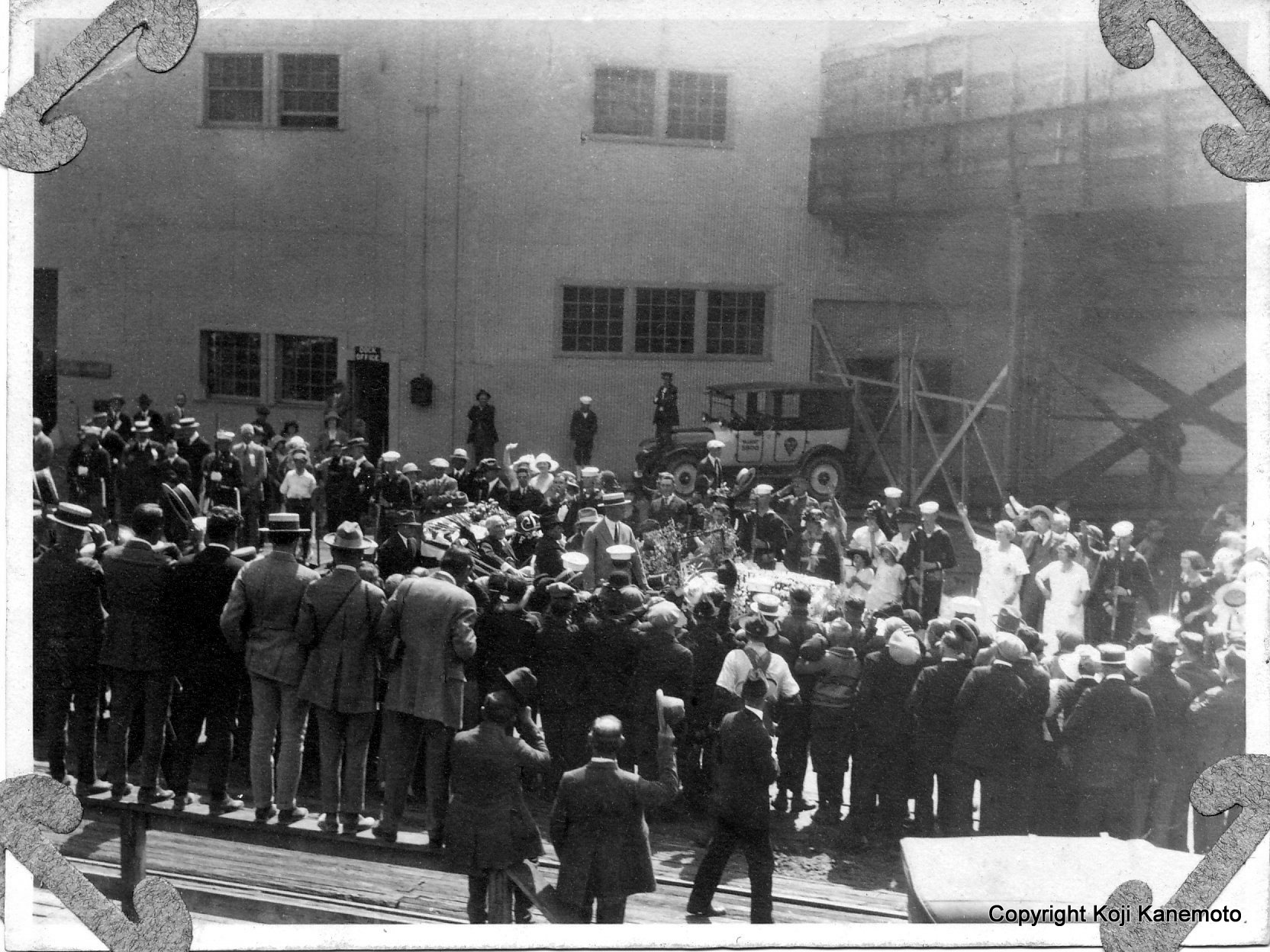
You can make out train tracks. Look at the far left – you can see the window locations on the building and…a pole. You can also see blackness under what appears to be a short bridge and a railing that abruptly ends. Important stuff.
The “PORT OF SEATTLE” with “BELL STREET PIER” signage can be signage can be seen at the far left.
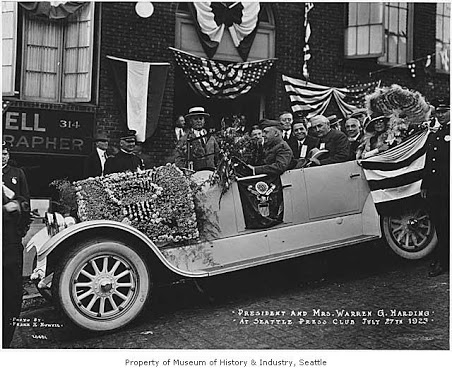
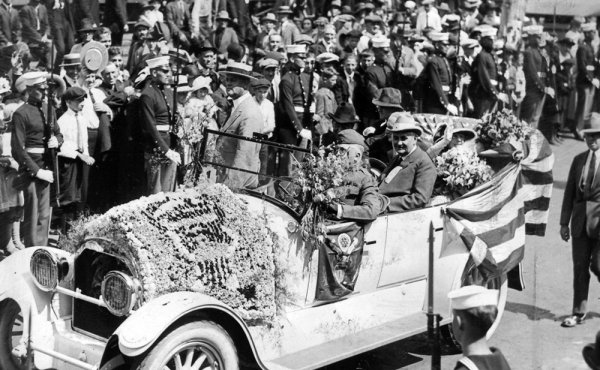
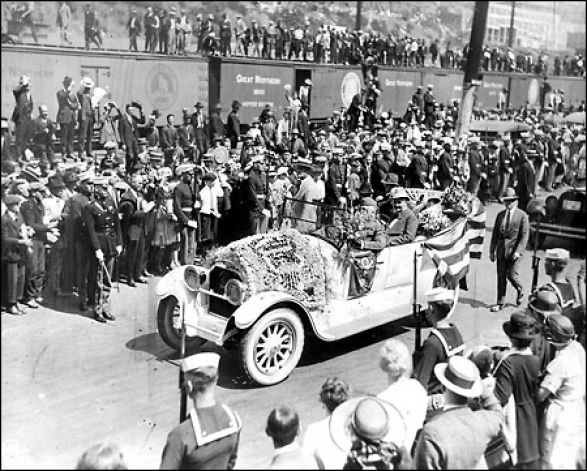
Upon studying “Grandma’s” photos further and in comparison to the “press” photo (below), I feel BOTH were taken within seconds of each other – but from opposite side of the motorcade. Please note my scribbles:
“Grandma’s” on top, “press” below.
And note the following obervations:
Pole – also painted white at the bottom;
The prominent roof of a car (circled) parked along the pier and next to the pole;
The group of four men marked with the proverbial “X marks the spot(s)”;
The wooden railing in both of Grandma Kono’s photos; and,
The US Marine Corps on one side of the motorcade, the US Navy on the other.
Amazing. These are two rare images taken from different sides of President Harding and within seconds of each other.
BUT…….
With the flyer image, we now know train tracks ran along the pier. Trains are also visible in the press photo. There are MEN atop the rail cars.
Due to the angle, it is believed the photos in Grandma Kono’s album were taken from atop the rail cars. Off to the left just outside the field of view in the picture (just like the grassy knoll in the famous Zapruder film of JFK’s assassination).
Ergo, I cannot fathom Grandma Kono climbing atop a rail car…let alone in a dress as was customary at that time for ladies.
It was hard not to get caught up on the surprising photos Grandma Kono took of President Harding.
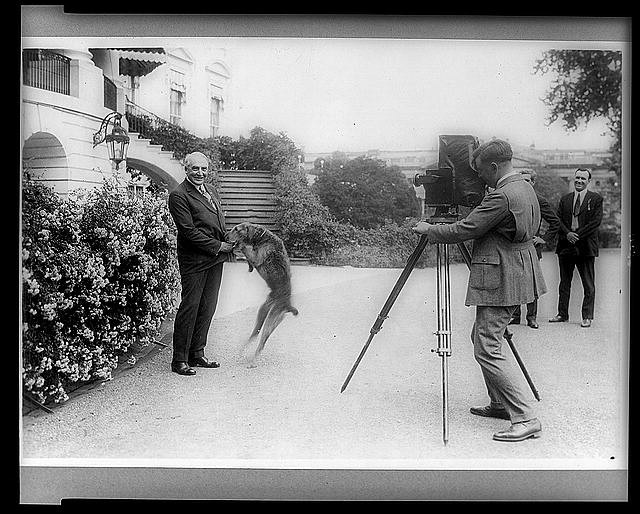
Taken in 1922 at the White House.
July 27, 1923.
Six days before the sudden death of President Harding.
I just couldn’t deny my natural tendency to research…with no goal to speak of.
And while I have hundreds of other vintage family photographs taken of up to a century ago to scan and retouch, I just had retouch President Harding’s pictures. To bring back the excitement of that warm day in Seattle.
I was a bad boy.
And this story is unexciting unless you are into the past…and into a family’s past as well.
__________________________
It was most fortunate Flickr friend, US Navy veteran and author M. Shawn Hennessy (author of “Freedom’s Fortress“) offered assistance without any prompting. What a guy…especially since he is on the mend after a bad spill on his bike. He is sure to make a lot of friends with the TSA getting through airport security now.
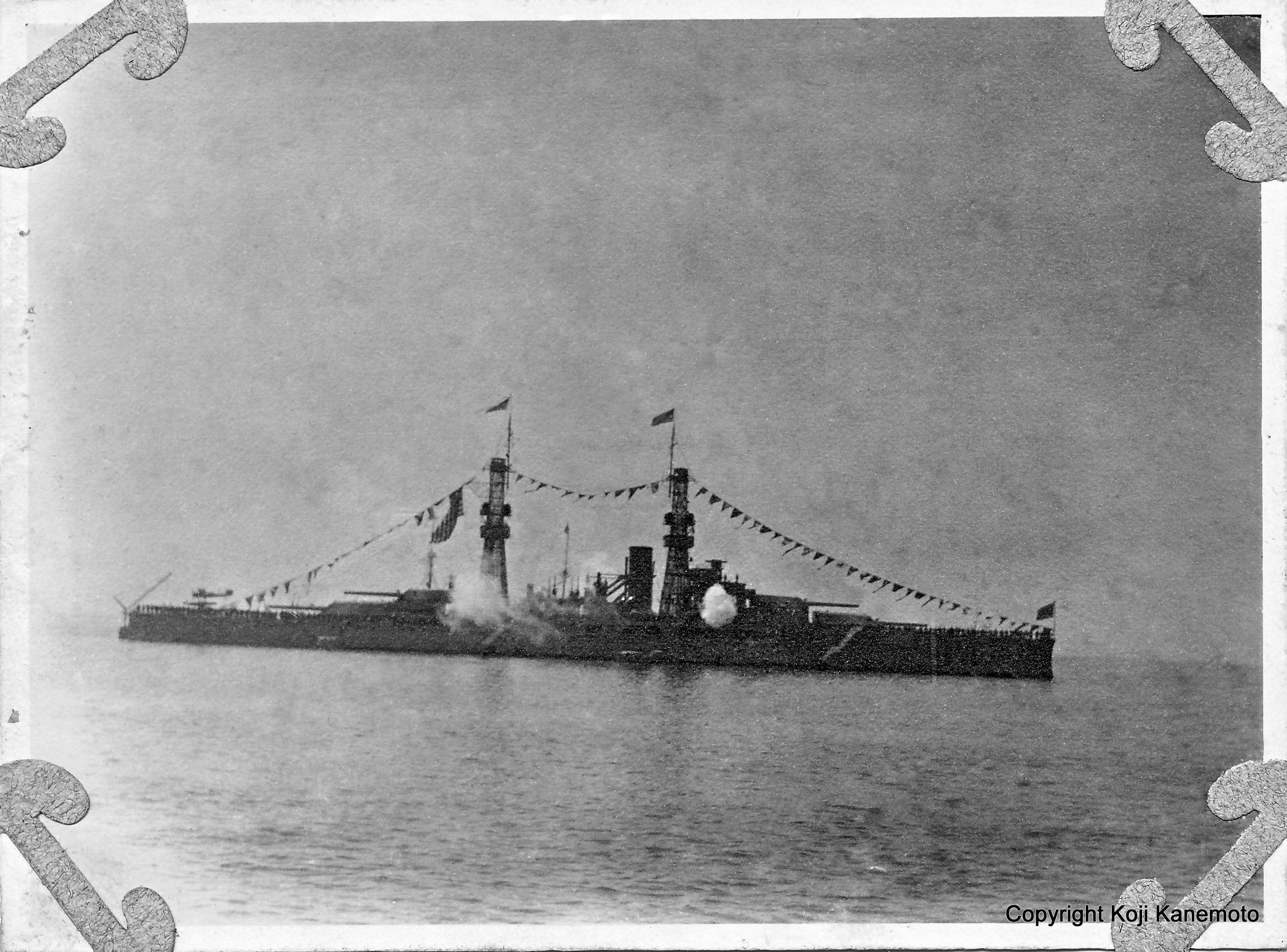
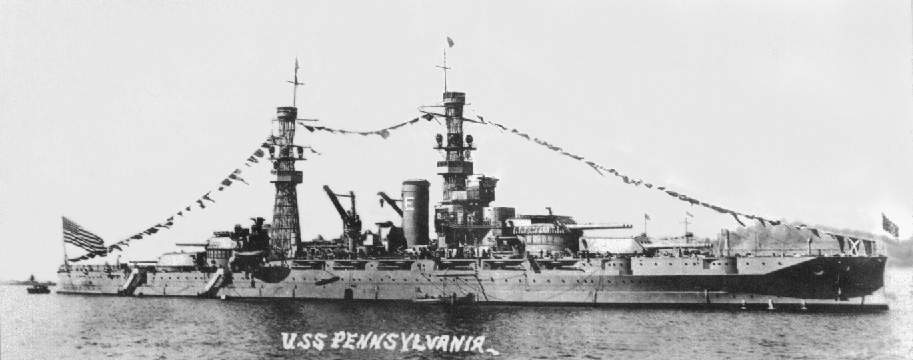
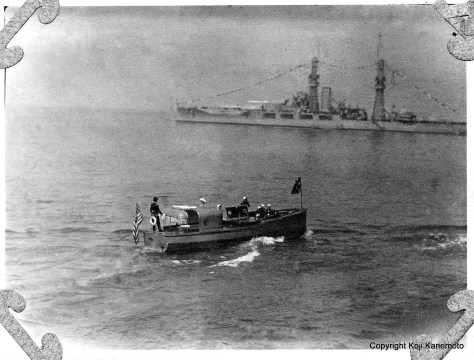
After some researching on his own, Shawn classified the battleship in Grandma Kono’s photo album as one from the Pennsylvania class.
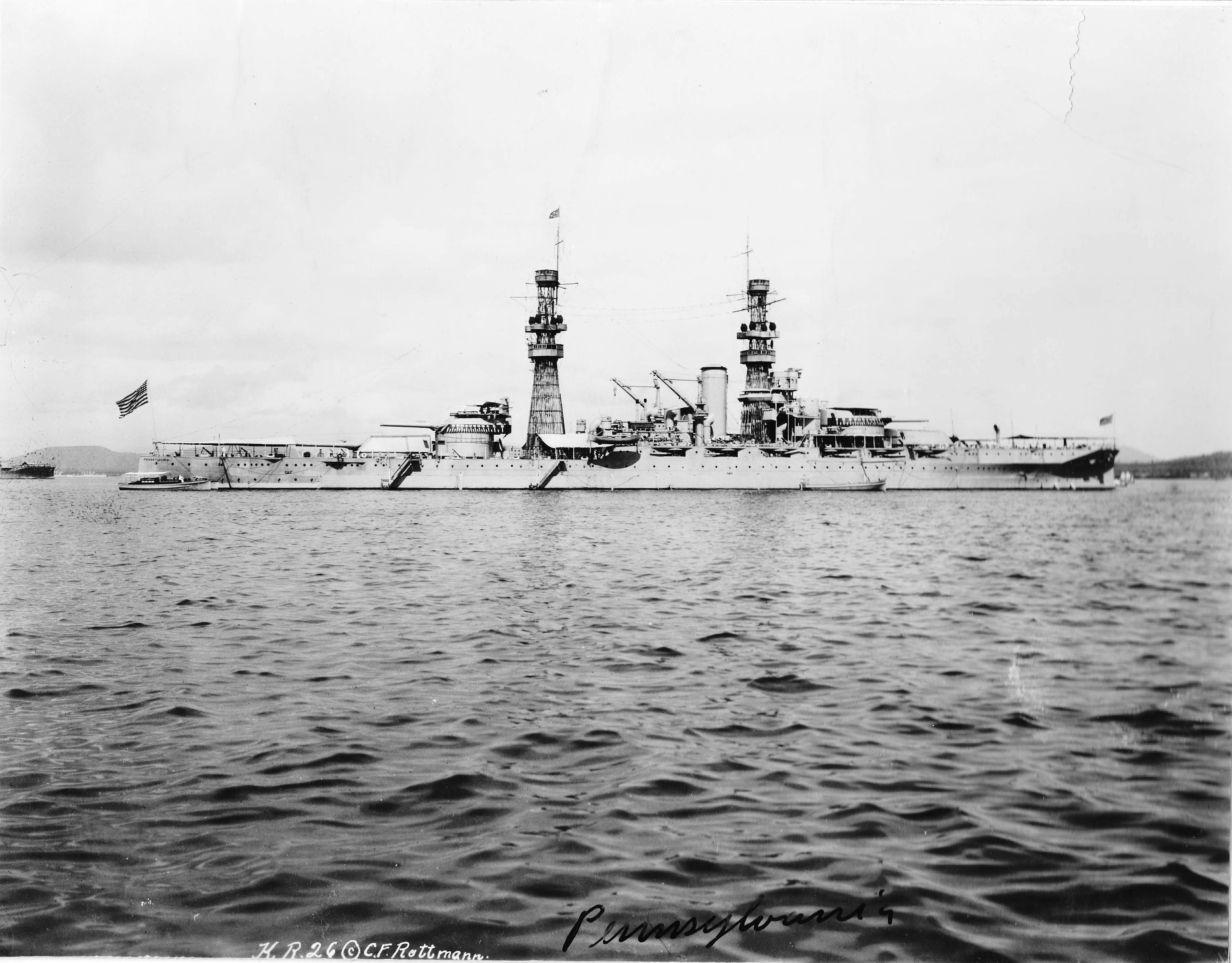
After Shawn’s assist made it easy, she was identified as BB-38 – the USS Pennsylvania. Interestingly, another battleship, the USS Idaho, was part of President Harding’s naval review – not the USS Pennsylvania. It appears that President Harding boarded the USS Pennsylvania in Puget Sound for dinner although she was a frequent visitor to that area.
Grandma Kono’s picture as retouched:
A couple of vintage naval photographs of the USS Pennsylvania on the internet for comparison:
Archival photographArchival photograph
(Note: After FDR signed the Executive Order to imprison Japanese citizens on the west coast after Pearl Harbor, the FBI went into many private homes in search of “spy material” which definitely would have included any happenstance photo of the military. It would be interesting to contemplate of what may have happened if my grandparents had remained in Seattle and the FBI came across these photographs in their home after Pearl Harbor.)
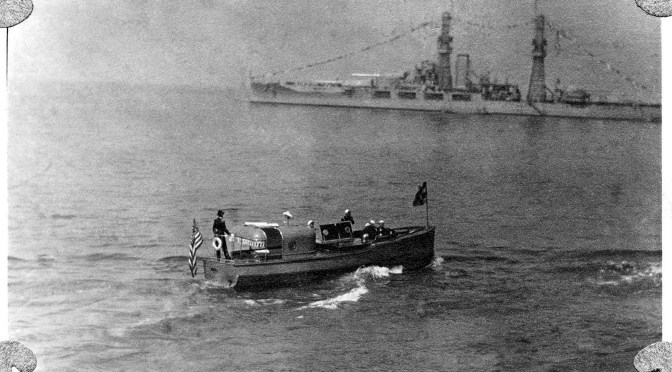
Her other picture of the USS Pennsylvania as retouched. The shuttle does not have a civilian standing at aft as I previously noted. We now see that he is a naval officer with his cocked hat and shoulder paulettes.
Admiral’s Barge
The photos in Grandma Kono’s album of President Harding’s motorcade were taken from a distance – not streetside. That would become an interesting point.
The retouched photos in Grandma’s album; in the first image, the limousine is between the US Marine Corps recruiting truck and a car’s rooftop. Shawn identified the ship at dockside as the destroyer USS Hendersen:
The closest view of the President in Grandma Kono’s album as retouched.
In scanning the internet, Shawn and I came across a few “press-type” professional photographs of the event; they were mostly taken from streetside. Up close and personal. The best image showing the details of President Harding’s limousine – down to the carpet of flowers on the hood – and the First Lady’s hat found by Shawn on the internet:
A professional press photo
Another view:
Scan the bystanders. This is also a cropped image of the next photo.This is the uncropped image of the previous photo. Scan the bystanders.
If you enlarge the images and scan the bystanders, I did not see one individual with a camera to his or her face. Many of the males were doffing their hat with one hand which further decreases the number of individuals capable of taking a photo.
As for the cameras of that time, they would have been of the collapsible bellows type or an early Brownie – which would have been literally a box with a small hole for the lens. Both required two hands to operate properly. In the family photos while camping somewhere near Seattle, I noticed a bellows-type camera. Also important to note that is it was unlikely her camera would have been a Speed Graphic (4×5 film requires a dark slide thereby too much time) or a TLR (square negative with a reverse image in viewfinder). It would be more likely she used 620 or 127 film in my opinion.
_______________________________
I also did not notice obvious non-whites in the crowds.
The significance of seeing only Caucasian bystanders? Perhaps minorities may have decided to not be in the way…or there was no interest…or had to work as it was a Monday. That leads me to the question of whether or not my grandmother was there to snap the pictures. If not, from whom would she have received copies of these pictures?
_______________________________
My conclusively unsupportable conclusions? That’s a sentence for sure.
No matter how you look at Grandma Kono’s pictures, they appear to be rare, personally taken photos outside of “authorized” photographs – military, government or newspaper. They also show the “ambience” of the event being taken from a distance.
I also believe Grandfather Hisakichi would have been unlikely to have snapped the photos if he were there. He was known to be strict and would have honored customs – like doffing his hat. That would remove him from have taken the pictures of the motorcade as it required two hands to operate a camera of that era. That leaves Grandma Kono – IF she was there.
Lastly, I believe the film used was either 620 or 127 (or similar) and not large format. It is further supported by the print size (roughtly 2-1/2 x 3-1/2). That would tend to support the belief that the photo was taken by an ordinary bystander and not a professional photographer. It was also not taken by a Speed Graphic.
_____________________________
Hmmm… After all this research, should I have been doing something else after all?
All I know for sure was that the photos of President Harding were taken on July 27, 1923 at the Bell Street Pier in Seattle.
That he was already ill.
That our 29th President would be dead six days later.
That I couldn’t spot any civilians snapping a picture.
And a desire to believe my Grandma Kono took these rare pictures of President Harding.
The last few privately taken photos of an American president before his death were in an old Japanese lady’s photo album.
My grandmother’s.
________________________________
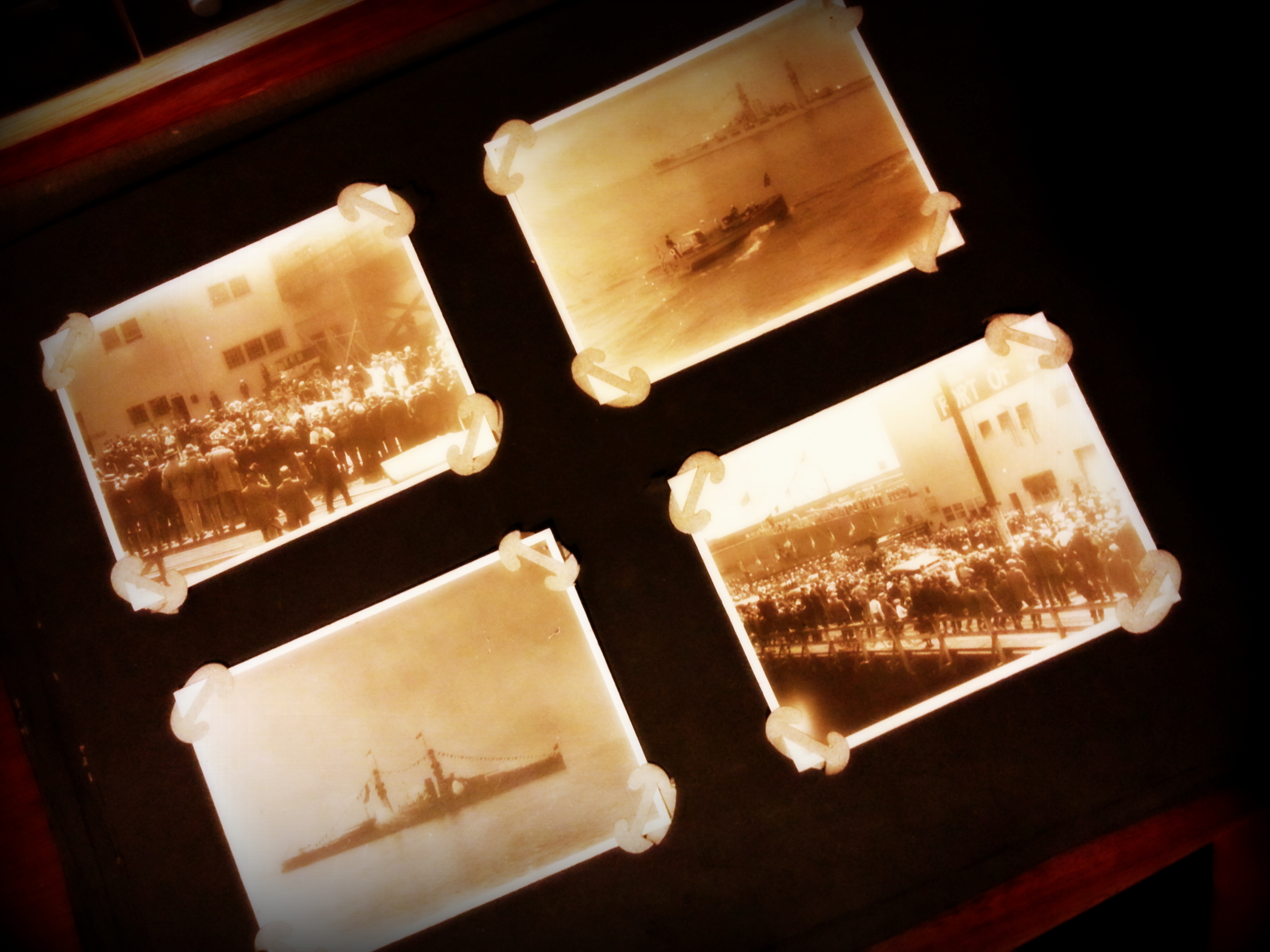
These four photos had intrigued me. They had caught my eye earlier but there were other precious photographs to scan and retouch.
But the curiosity killed this old sourpuss.
I had to scan them… and there were fantastic discoveries.
_______________________________
President Harding, our 29th president, arrived in Seattle on July 27, 1923. He was on a 40-day tour of the Western United States.
He would pass away just six days later.
_______________________________
After collaborating with a flickr buddy and author, Shawn Hennessey, we came to the conclusion that this indeed was President Harding’s motorcade at the Port of Seattle. Of course, we will never know for sure who took these photos but they are of the same size and finish of many of Grandmother Kono’s other photos of that time period. Still, they are remarkably an incredible capture historically.
They are unretouched. I thought they look better as-is.
A shuttle bears the colors and a civilian stands at the aft. US Navy sailors are at the fore.Shawn Hennessy believes this to be a Pennsylvania class battleship due to the single stack. President Harding did review the fleet in the harbor (about 50 ships).
You can clearly make out the Port of Seattle signage with the beginning of “Bell Street Pier” on the building. Note the US Marine and US Navy color guards. It is likely President Harding’s destroyer that is docked at pier’s end. The blanket of flowers can be seen on the hood of the President’s limousine, too.
Motorcade begins
The President can be seen closer below. Of note is the agent standing on the limousine’s running board – or more specifically, his clothing. Compare his clothing to other images you can find on the web. You will see gentlemen doffing their hats to the President as he passes by.
President Harding. He will pass away six days later in San Francisco.
__________________________________
Just a glimpse into American history – from a Hiroshima photo album.
I hope you all won’t mind if I feel Grandmother Kono took these pictures in 1923.
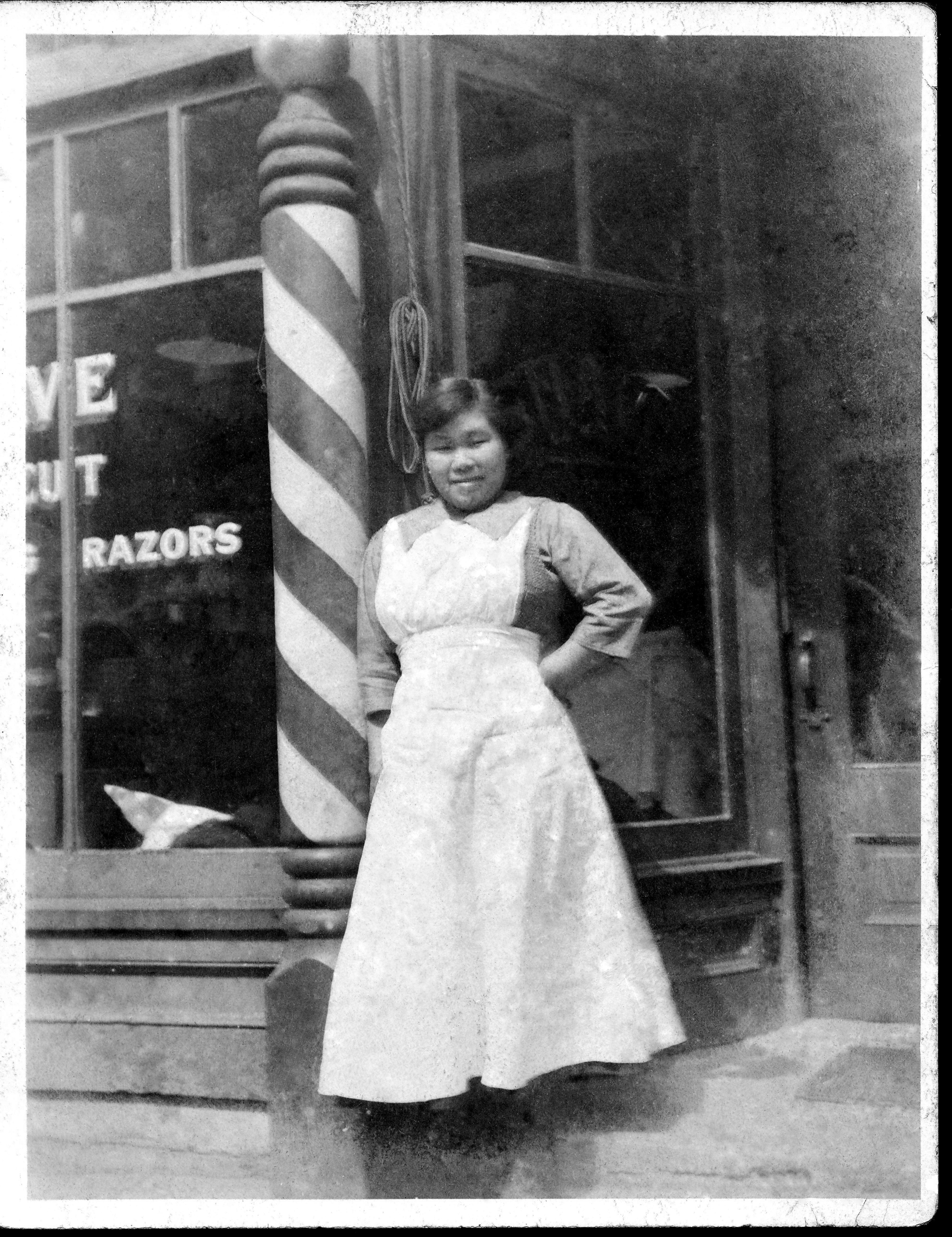
A young Grandmother Kono takes a modeling pose in front of her Seattle barbershop. She cannot possibly have foreseen what the future holds in store for her.
The most wicked risk of a mother’s love for a child is loss, and the price of loss is grief… But the sheer passion of grief can become indescribable if a mother ponders on her decisions.
_________________________________
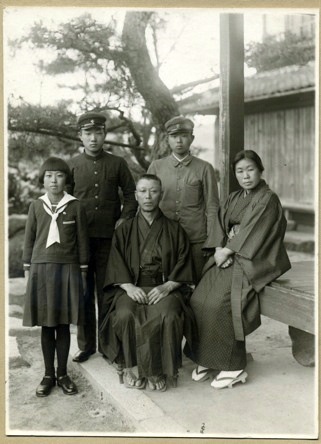
In Part I, we left when my father returned to Seattle to stay while leaving behind in Hiroshima his two youngest siblings and his parents. This was 1937. Before leaving, the family took this portrait with Grandmother Kono sitting on the sakura wood at the house. Suetaro is standing next to her:
One of the last portraits of the three siblings and my grandparents. Grandmother Kono is sitting on the sakura wood written about in “Souls of Wood“. Circa 1937
My father says that their younger sister Mieko was ill often. Indeed, she passed away in 1939 at just 15 years of age from an apparent kidney infection. Since my father was already in Seattle by that time, only his youngest brother Suetaro was left along with my grandparents. Most decisively, Grandmother decided Suetaro was not to return to Seattle when he turned 18. In “Masako and Spam Musubi,” she was very concerned over the harassment and intimidation she had received due to the threat of war against Japan. I also “feel” that Grandmother knew Grandfather was ill by the time she made the decision.
Sure enough, the very next year (1940), Grandfather Hisakichi passed away from stomach cancer. He was 59 years old. After raising Mieko for 15 years and marrying Hisakichi 31 years earlier in Seattle as a picture bride, only she and Suetaro were left in their home. War with America would start the following year. A war in which her three oldest surviving children called America home.
One family. One war. Two countries… One mother.
_________________________________
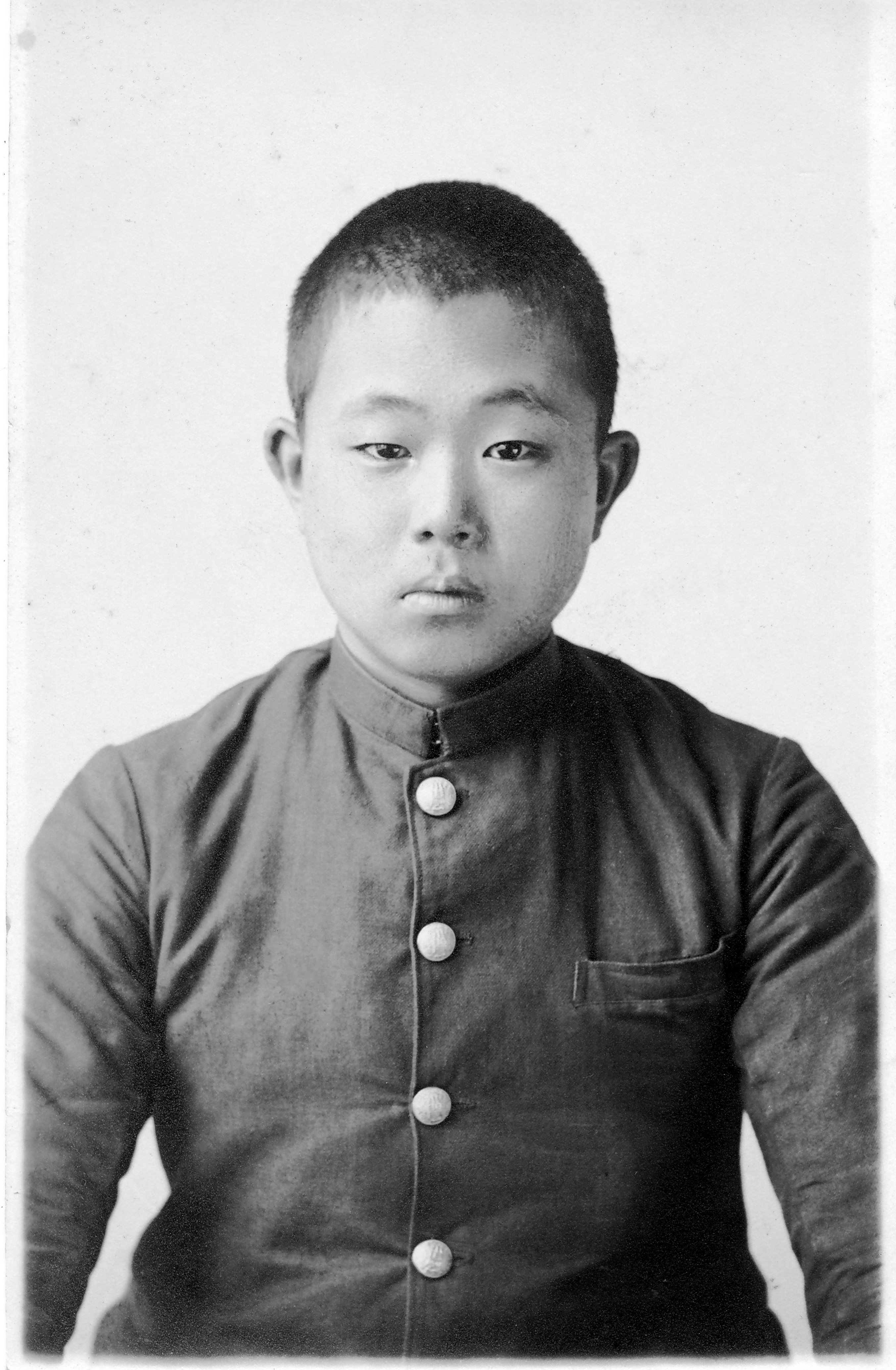
An undated school portrait of Suetaro. He looks to be about 14 years old.
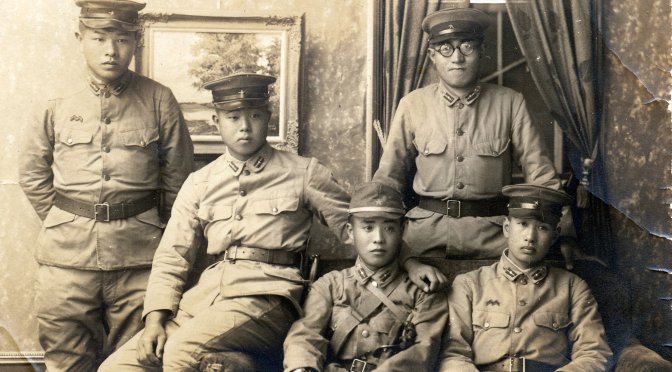
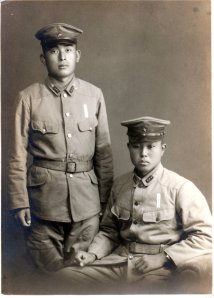
For reasons I have been unable to document, Suetaro became part of the Imperial Japanese Army. All Dad will say now is being taken by the Imperial Army was “part of life” back then. Below, he is sitting on the sofa’s arm to celebrate the young man in the center being sent to China’s Army HQs.
According to the handwritten date on the back, this photo of Suetaro below (on right manning a non-combat grade light machine gun made for training) was taken on May 10, 1939 at the “Hara Mura Training Grounds”:
Suetaro on the right. Dated May 10, 1939. I wonder what Grandmother Kono was feeling.
Here is Suetaro, perhaps in a posed photograph for PR purposes. It is of professional quality and taken on the same day as above:
Likely a professionally taken photograph of Suetaro. It was also taken on May 10, 1939 in Hara Mura.
I have a strong belief this was taken at the Fukuyama training grounds for his regiment, the 41st Infantry Regiment (unverified):
A proud looking Suetaro in his full Army uniform. I cannot tell if the handle on his katana, or “samurai sword”, is wrapped in silk or machine stamped. All military issued swords were numbered, by the way.
Another piece of his elusive history then emerged – but it was not from the 100 year old woodshed.
____________________________
Readers know that my Uncle Suetaro was killed in action as a Japanese soldier on Leyte. His regiment – the 41st Infantry Regiment – was annihilated by the US Army on Leyte. My Grandmother Kono was told he perished on July 15, 1945 – just a month before Japan surrendered. My father’s secret US Army unit, the Military Intelligence Service (MIS), had a direct hand in the high number of Japanese casualties – and the low number of American casualties. In other words, the MIS likely had a direct hand in the annihilation of Suetaro’s regiment. The MIS was comprised of Americans…of Japanese descent.
Dad as part of the MIS in post-war Japan.
It is not known if Grandmother knew of this fact. It would have been an overwhelming of her heart.
____________________________________
However, this is not a story on Suetaro’s life but about his life with his mother. In “Masako and Spam Musubi”, we know she had her second stroke after being informed by the remnants of the Japanese military of her beloved Suetaro’s death. The last Kanemoto in the family home was now… herself.
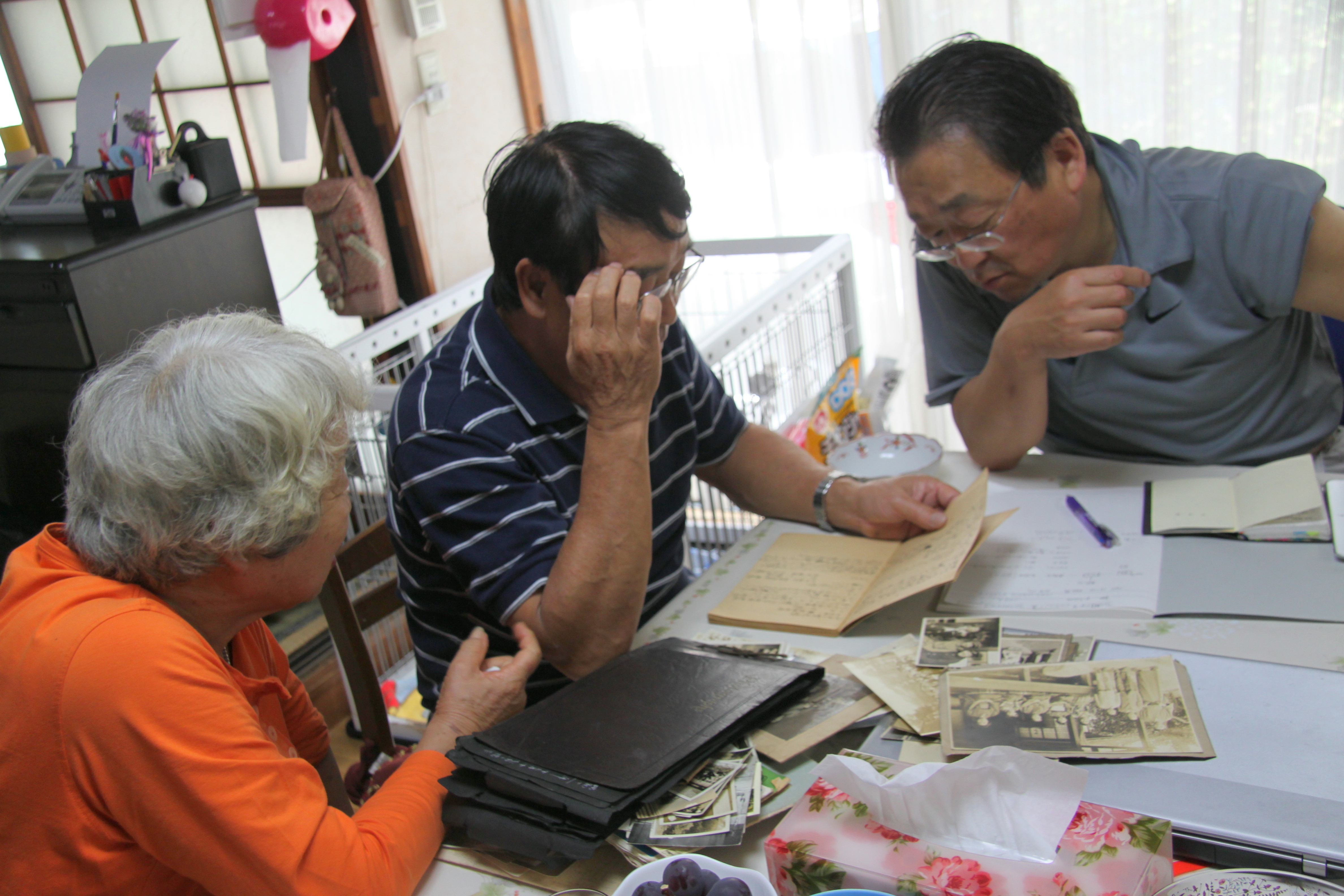
During my trip to the family home in September, my cousin Masako, her younger brother Kiyoshi, her son Toshiro along with my son were looking at vintage photos Toshiro uncovered just a couple weeks prior in the shed. A number were of Suetaro with my father and Grandmother. We were all quite emotional by then. Masako removed herself from the table; I assumed she was overcome. I didn’t stop her from quietly leaving thinking that.
Instead, she came back a few minutes later with something in her hand. It was a small notebook. Aged and frayed at the bindings. Her eyes were red.
It was Suetaro’s war diary. We were simply stunned. Masako had it secreted away. For decades. She chose to bring it out now. For closure. It was the right time.
Masako shocked all of us when she brought out Suetaro’s Army diary. (L to R) Masako, Kiyoshi and Toshiro, her son. The Kleenex box is there for my use.
It took us a few moments to realize what she had brought. It was brittle and smelled of old books. The paperstock was of low quality – more like newspaper stock – as paper was in very limited supply during the war years. We handled it as gently as possible.
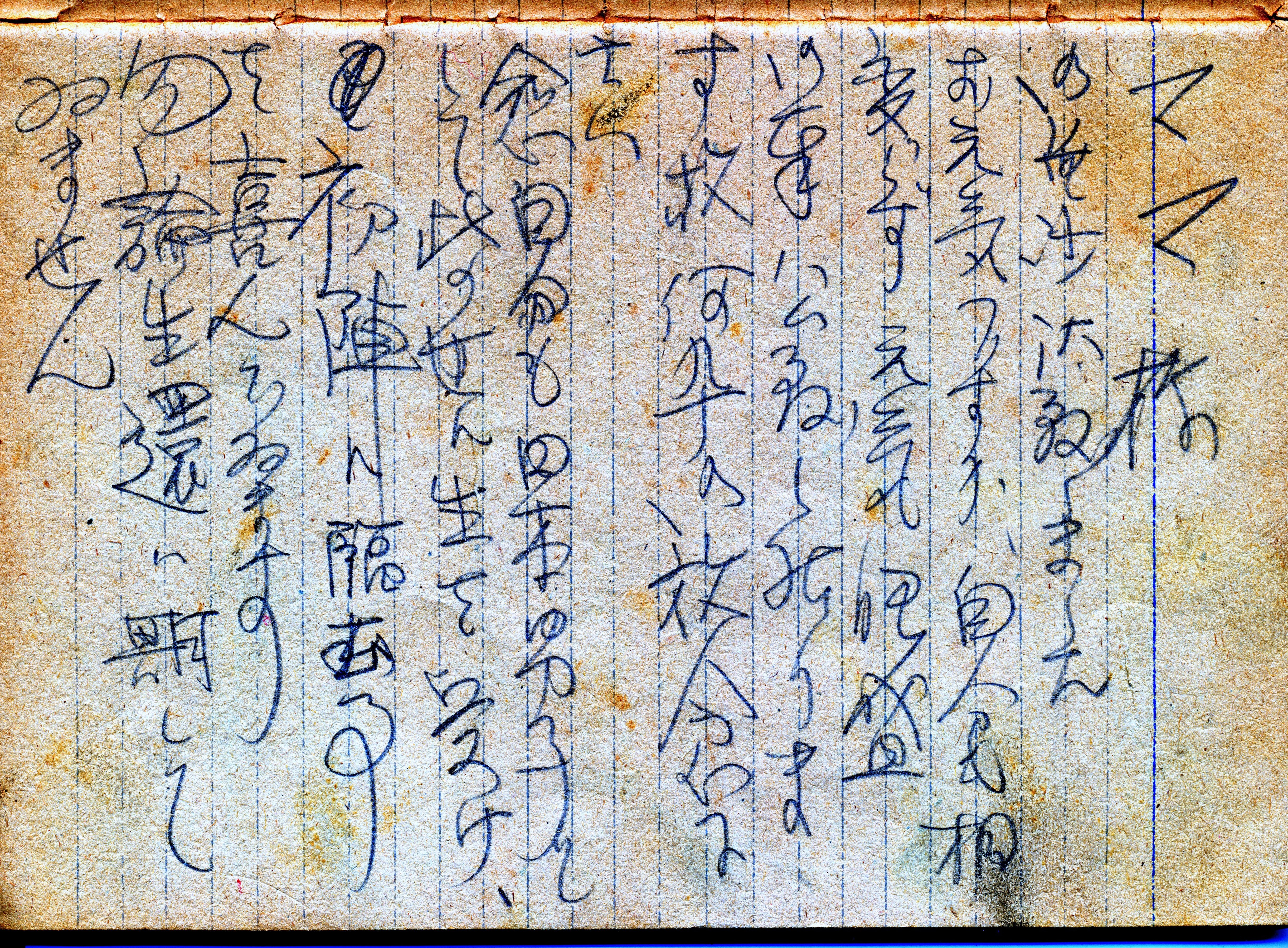
The first few pages were of what he did during a short period of time; Suetaro’s writing was neat and in black ink.
Then the handwriting changed. Suddenly. It was hurried. Rushed. And in pencil.
It was his farewell letter to his mother. My dad’s mother. My grandmother. It was dated March 3, 1944.
Kiyoshi is holding Suetaro’s farewell letter. It starts with “Dearest Mama” on the right.
Kiyoshi tried to read it; it was difficult as it not only was in his hurried cursive but in pre-MacArthur Japanese. Many characters are simply not used any more. Unused since 1945. Only a few people can read it – like my father. Suetaro’s brother. But we managed to read critical passages. I will include two pages as reference. However, these are very literal translations of a few sentences but needs be read in its entire context considering the environment was when he wrote this. It is easy to misunderstand or misconstrue his heart and soul at that moment.
Towards the left, it states, “初陣に臨むことを喜んでいます. 勿論, 生還を期してはいません”, or literally, “I am glad to be going to war and facing my first combat. Of course, I do not expect to be coming back.”
He writes, “今の時局は日本が起つか亡びるかの境です。どうしてもやり抜かねばいけないのです。兄さん達を救い出すことも夢見てます,” or “At this time, Japan is at the point of either winning or perishing. We must persevere as I still dream that we will free our older brothers.”
I stress this abbreviated presentation can be misunderstood. My interpretation is, “I willingly go to war for Japan as we are on the brink of winning or losing. By winning, Japan will free my older brothers from the concentration camps in the US.”
He will fight – and die – so that Japan will win. If Japan wins, they would take over the United States and by doing so, free my Dad and his older brother Yutaka from the concentration camp. At the time of his writing, both were imprisoned at the camp in Minidoka, Idaho after being relocated from Tule Lake, CA. (His nephew, Bobby, had already perished in Minidoka at the young age of six.) His older sister, my Aunt Shiz who passed away last month, was imprisoned at Manzanar.
Man, my eyes welled up. Everybody was in shock…even Masako once again.
_______________________________
I am unable to comprehend how my Grandmother must have felt reading that letter in 1944. Suetaro had secreted it away in the “butsudan”, or family altar. She had decided Suetaro was not to return to Seattle to join his elder siblings. Now, having read this letter, her regret must have been immense. Grief. She lost a piece of herself. A beloved piece.
Mieko had passed away. So did her husband in 1940. Now her youngest son writes he does not expect to return.
Could she have foreseen this fate while she happily stood in front of her Seattle barbershop near King St. and Maynard in Seattle in the 1910’s? I doubt it.
She would be alone. To ponder. To possibly regret to her last day.
A mother’s anguished solitude.
It is dated April 9th on the back with no year indicated. However, as my father took it when he was in the MIS, I will assume it is around 1948. Her face is worn.
One of the few times Old Man Jack would tell me what island something happened on, it would be humorous – as humorous as he could make it.
He HAD to laugh off some of the horror. He needed to survive being under attack by his own thoughts.
_______________________
On January 16, 2011, eleven months before he passed away, we decided to go to Denny’s for breakfast. He hated that place – except for their (gawd awful) coffee. He loved their coffee. And he complained about the coffee on the islands. Imagine that. Denny’s coffee couldn’t have tasted that much different. Denny’s uses ocean water, too, you know, for their distinctive flavor. Perhaps that is why he liked their coffee.
Jack with “Green Island” story and his tradmark grin – Jan. 16, 2011.
“Green Island” was Jack’s last combat station when he earned enough points to be rotated back home. He told me when they yelled out his name, he just ran straight onto this makeshift pier where a PBy was starting up. He jumped in wearing only his shorts and boots. They took off. He was on his way home.
(Click here if you wish to see official US Navy photos of Green Island when Old Man Jack was stationed there.)
In my internet research, I did come across some detailed battle history of Green Island. I printed it out and not knowing how he would react (even after 11 years of friendship), I presented it to him before the (gawd awful) coffee came. I didn’t want him to be TOO alert in case things didn’t go well. 🙂
Well, you can see his reaction. He was “tickled and pickled” I went through the trouble.
________________________________
During breakfast, he told me about one detail he was assigned to on Green Island – the digging of new holes for latrines. Never mind my eggs were over-easy. But he’s gone through hell whereas I was spared. This was everyday fare for him.
He told me he picked out two “dumb new guys” who thought they knew everything for the detail. They went out where the other “used up” latrines were. He ordered them to start digging new holes in this hard coral-like stuff not too far from the other “used up” holes while he “supervised”.
I knew I would get his goat if I interrupted him. That was part of the fun.
So I interrupted him. For fun.
“Jack…dig? Why didn’t you just have them make a small hole then throw in a grenade?”
Well, I asked for it… in Denny’s… on a busy Saturday morning.
“You dumb shit,” he declared with that boyish grin. “YOU could have been one of the dumb new guys. YOU would have fit right in. We didn’t need any more craters! We had LOTS of craters – all around us! So we dug holes like we were ordered to. So shut up and listen!”
Whooo-ee. That was fun… in Denny’s… on a busy Saturday morning.
______________________
I never asked him if he read the history on Green Island. Later on, though, Old Man Jack said he had wanted to go back to those “stinkin’ islands” just to see. It felt as if he wanted to let some demons out.
He never made it back.
Perhaps he’s there now saluting his young buddies he had to leave behind.
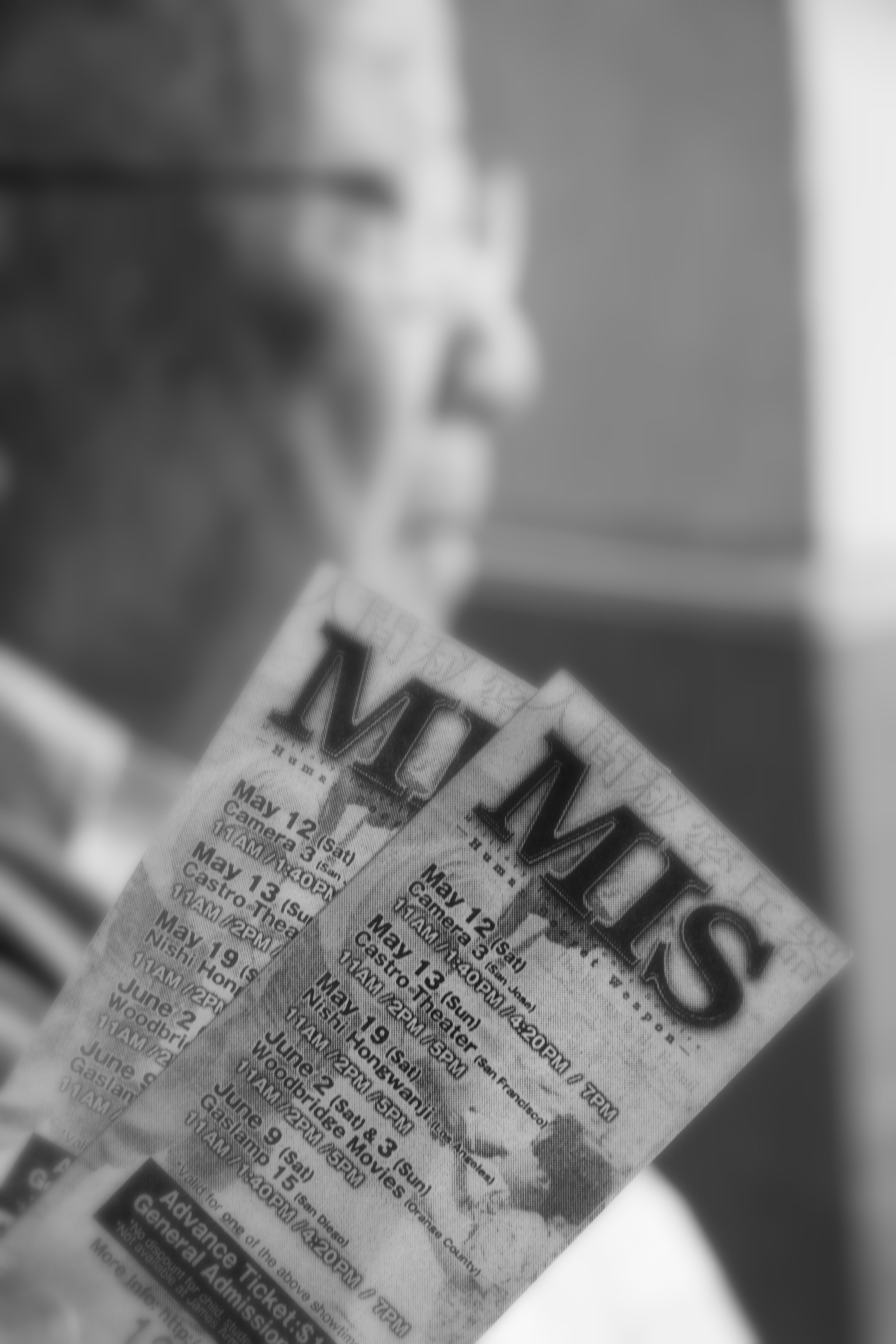
“War is no good,” he said as we left the small community movie theater near his assisted living home today; we had just watched the limited release documentary “MIS: Human Secret Weapon”. It was about his highly classified World War II US Army unit. He had silently watched and with a ghostly stillness. But I saw him wipe his eyes twice after gently lifting his glasses. Others openly wept…but I had never, ever seen him shed a tear before today.
I was ignorant. Combat isn’t necessary for the ugliness of war to be buried in a person’s mind. The documentary made it clear that it is also easily dug out. All one needs to do is scratch.
Official US Army document certifying his Military Intelligence Service days.
___________________
The documentary reveals the conflicted state of mind of the then young Japanese-Americans who made up the US Army’s Military Intelligence Service (MIS). About 3,000 of them – including two of my uncles – secretly and faithfully served the red, white and blue, hastening the Japanese surrender on board the USS Missouri.
Another 3,000 served during the Occupation of Japan. My dad was one and worked out of General Eichelberger’s US 8th Army’s GHQ in Yokohama. That’s when he was able to journey to Hiroshima and see his mother for the first time in ten years…and when a hungry Masako first relished the flavor of Spam.
__________________
Grant Ichikawa, MIS, CGM and me. 2010
One Nisei veteran interviewed was Grant Ichikawa. He was gracious enough to not only greet me and my family in 2010 near his home in Rosslyn, VA, he also secretly treated us to lunch. Pun intended. He had lost his wife Millie just months before. She was an even rarer female member of the MIS as well.
He and Terry Shima (also interviewed in the documentary) gave me the jump start in finding out about Dad’s involvement in the MIS. During that all too brief get together, Grant did touch on what he did on the battlefront in a GI uniform. He also said it “got dicey”.
In this documentary, you learn of one such experience. He was told there were Japanese soldiers who had agreed to surrender. Grant said he was the point man. They proceeded to the rendezvous point where he met the Japanese commander; they were in the middle of an open field.
It turns out there were 200 to 250 of them; all their weapons were in good working order he says in the documentary. Grant suddenly realized – out in the middle of this field – that these Japanese soldiers were “toukoutai”, or “suicide corps”. Grant just as quickly and with great consternation realized there were only ten of them… GI’s, that is, armed only with rifles. I’m sure Grant picked his words wisely. He is still alive.
“Dicey” was a definite understatement.
_______________________
In a lighter moment, Ken Akune described how they were searching a Japanese soldier that had surrendered in the jungle of Burma. They came across one of the American propaganda leaflets promising safe passage for those Japanese soldiers that surrendered. It was neatly folded in a pocket.
Surrender Propaganda Written by MIS Nisei.
Akune asked the Japanese soldier if he believed what the leaflet promised since the MIS Nisei wrote it. The Japanese soldier said no but that it made for good toilet paper. “There was no toilet paper in the jungle of Burma,” said the prisoner.
_______________________
Thomas Tsubota broke down at the end of his interview. Many did.
Tsubota was one of the top secret MIS members of Merrill’s Marauders.
They had just stumbled across ten Japanese soldiers in a small jungle clearing, he says. “Boom,” he said, in a split second they killed them all. He described how his commander, Colonel Beach, called him over to inspect a photo album taken off one of the now dead Japanese soldiers
They looked through the album. Tsubota told Col. Beach there was nothing of military importance in it but as they came upon the last page of the album, there was a picture of a mother and a daughter.
Tsubota said Colonel Beach’s eyes got red, filled with tears and he said, “Thank you, Tom.”
While crying, Tsubota ended the interview by saying this is why he isn’t enthusiastic about talking about the war. Too painful. He doesn’t want to think about that sad moment. Tsubota is 96 years old. I thought Dad was old.
______________________
The documentary intensely yet humanely describes the internal turmoil within these young American GIs of Japanese descent. Quite a few had brothers who were left in Japan when war broke out and were killed as Japanese soldiers. Deep down, many carried guilt that their own secret actions led to the deaths of their own brothers. My Dad’s youngest brother – my Uncle Suetaro – was one of those casualties.
But these 3,000 young American boys of Japanese heritage did their job as did millions of other young American boys…but in secret. They translated diaries covered with blood or offered cigarettes to Japanese prisoners to extract military intelligence while battles were raging.
They endured years of discrimination and intimidation to boot – both from GI’s fighting alongside them as well as back home. A barber in Chicago wouldn’t cut Dad’s hair because of his race – and he was wearing his perfectly creased US Army uniform with sergeant’s stripes, sleeve highlighted by the proud shoulder patch of the US 8th Army.
The secrecy was officially lifted in 1972 by Executive Order 11652.
______________________
Uncle Suetaro on right.
Just the two of us, I thought, were going to see this movie and that this may help Dad slow down his growing dementia.
I was wrong.
His quiet tears and with his exiting comment, I am sure Uncle Suetaro was there, too, in Dad’s heart – as if it was 1937 in Hiroshima when he last saw his brother alive.
Over the past two years, I’ve asked, “Dad, tell me about what you worked on in the MIS. What was the one thing you remember the most? A picture? A diary?” Each time, the answer was vague or “I don’t know.” I chalked it up to senility.
He doesn’t want to talk about it…just like Tsubota painfully recalling Col. Beach and the photo of a mother and a daughter taken from a Japanese soldier they had just killed.
Ugly recollections from war wanting to be masked need not come from battlefields, bullets or bombs.
It was Monday, Valentines’ Day 2001. My wife was five months pregnant at the time we moved into this wonderful neighborhood smothered in US Naval glory. After I came back from work the next day, she told me a kind old man stopped her as she was wheeling out the trash bin. She said he hobbled from across our quiet street lined with peppercorn trees then kindly wheeled them out for her.
I found out the “old man” was a World War II combat vet. Worse yet, he was a sailor in the Pacific – he fought the Japanese in World War II.
“Holy crap,” flashed through my mind, “What if he finds out we’re Japanese?”
Twelve years later, I was honored to have been a pallbearer at his funeral.
I was so far off base about my first thoughts on Old Man Jack that even George Burns could have picked me off without being called for a balk…and this while he was in his grave.
I felt so ashamed.
_____________________________
I snapped this picture of a happy Jack Garrett when we went to the Chino Planes of Fame in 2003.
“Young man, get over here and plant your butt in that chair,” barked old man Jack from his cluttered garage across the street. Having lived in that house since 1953, it was filled with his life history.
“But I have my stogie going, Jack,” said I.
“Well, I can see it and I sure as hell can smell it. Now shut up and sit down. I want to tell you something.”
That was Old Man Jack, my dear neighbor who lived across the street. I like to think we were close.
He was 87 years old by that summer’s day in 2010 when he called me over. While he had become feeble, his barrel chest was still prominent. He was a rabble-rouser in his youth. He was always “mixing it up” throughout his young years… Well, he was mixing it up even while working at Northrup in the 50’s. That makes me grin.
His handshake was always firm and warm; you didn’t need to be psychic to sense his insight and outlook on life. He always spoke his mind. He earned that right having been shot at, strafed, and bombed on “those stinkin’ islands” in the Southwest Pacific as he so often said during a most bitter war.
___________________________
Taken on Father’s Day 2010
I had invited Jack to Father’s Day dinner that summer just two years ago; my Dad who was 91 was coming as well.
Jack knew my dad was US Army but I fretted over what they would say to each other when they first met. Or how they would react to one another. It was more than just a concern over the centuries old rivalry between Army and Navy. It was the bitter war.
Dad was in the front room when Jack rang the bell – right on time as always. Jack had on his favorite blue plaid shirt; he wore it often as it had a pocket for his glasses. I often wondered how often he washed it, though. Jack and Dad are shown here on Father’s Day 2010.
“Dad,” I said, “This is Jack, US Navy, Aviation Machinist’s Mate, First Class, the Pacific.”
“Jack, this is my Dad. US 8th Army, sergeant, Military Intelligence Service.”
Although not as agile as they once were, they immediately saluted each other.
_______________________
You didn’t need a sound system to hear them. Dad and Jack are both hard of hearing.
It was easy to hear Jack ask Dad what he did in the Army. During the Occupation of Japan, Dad said he went into a room once a week that reeked of dry cleaning to retrieve a crate. (The crates contained documents, photos and other personal items such as war diaries written by Japanese soldiers. They were removed from a WWII battlefield – read on.) He would then translate the contents for military intelligence (below).
Dad translating captured war documents in the U.S. 8th Army HQ’s, Yokohama, Japan. 1947.
I had to tend to cooking so I lost track of the conversation. It was regretful I didn’t keep tuned in.
_______________________
So back to being called over by Jack on that summer’s day.
He was sitting in his favorite blue wheelchair. He didn’t need it but it belonged to his beloved wife Carol who passed away ten years before. They married during the waning days of the war. They had been married for 55 strong years.
“So what did you want to tell me, Jack?” I asked.
He then went into his trance – one signaling evident anguish and wretched remembrances. When he went into these trances, he always started by staring at his hands while picking at his right thumbnail with his left ring finger. He would lift his once thick eyebrows now turned snow white with age, then begin talking in a slow, deliberate pace, never taking his eyes off his hands.
“I went on ID patrol…” Jack rasply whispered while ever so slightly drawing out his words.
“ID patrol? What is that?” I asked.
He ignored me. It was as if I wasn’t sitting next to him… He had already left the present. He had stepped foot onto that violent SW Pacific jungle of 70 years ago. I’m sure its smell was as vivid to him in his tormented subconscious as it was seven decades ago.
“They would issue six of us white caps M1’s with bayonets… Then we’d follow two Marines on a patrol into the jungle.”
“Patrol? You? You were ground crew, Jack,” I remarked.
“Ain’t enough of them (Marines) to go around on those stinkin’ islands so we got picked,” he said, still speaking in a lifeless yet pained monotone. He added, “If you got killed, you rotted real quick in that jungle heat. And if you got killed with shit in your pants, you got buried with shit in your pants.”
His stare doesn’t change. His eyes have glassed over. He is in a different world now – one of 70 years ago in a stifling jungle, his youthful, sweaty hands trying to grip onto his Garand rifle while wearing a smelly steel helmet… Listening in terror for any sound that may signal a Japanese soldier concealed in ambush knowing that the enemy was just there shortly before. A world that only combat veterans understand. Thankfully, you and I never will. Never.
“The Marines had two bags – one small one and a big one. When we found one, the two Marines would stand guard. We’d hold the rifle by the butt end and use the fixed bayonet to fish out the tags.”
It was then when I realized what he was painfully regurgitating.
This is what he meant by “I.D. patrol”. They were going back into the jungle to locate the dead Marines they had to leave behind after a “tussle” with the enemy as Jack liked to say – a life or death firefight. Old Man Jack was only 20 years old. The Marines were likely younger. Ponder that thought.
“We weren’t allowed to touch the dead (Marine) as the Japs would booby-trap ‘em. We’d hand over the tags hanging on the the end of the bayonet to one of the Marines who would put a tag in the small bag. They marked a map for the graves registration guys to come back later.”
Jack’s anguished delivery dimmed even further. “But we’d come across a dead Jap. Nobody cared about them so they rotted where they were. But we’d have to stick the bayonet into the rotting goo and try to fish stuff out. The prize was a pouch or a satchel. Those would go into the big duffel bag just as they were, covered with rot and maggots. We headed back to CP and that’s the last I saw of those bags,” he said.
He abruptly ended but his unconscious stare didn’t change. He was still in the jungle, scared out of his wits. He was still picking at his thumbnail all this time. His head hardly moved while he sat in the blue wheelchair that belonged to his beloved wife.
I thought to myself, “Is that the end, Jack? That’s it? Why did you tell me this?” I knew not to pry any more so I kept the thoughts to myself. He was in torment already. Seventy years had passed but he was reliving the awfulness of a brutal war. Nevertheless, I wondered why he chose that time to tell me about this horrific recall of something he experienced so very young.
It bugged me for several weeks.
____________________
About a month later, I understood why Jack told me the story after I communicated with Mr. Grant Ichikawa, a more well known veteran of the famed US Army’s Military Intelligence Service and combat veteran himself. Apparently, the items they recovered from Japanese corpses were dry cleaned to remove the rotting body fluids. After getting dry cleaned, they ended up in the crates that were in the room my Dad went into once a week when he was in the Military Intelligence Service…and why the room reeked of dry cleaning.
The brief chat with my dad on Father’s Day sparked that vile memory back to life. It had been eating at Old Man Jack since that day. He wanted to get it off his once mightily barreled chest.
I lament to this day that an invitation to a Father’s Day dinner had resulted in an unwanted recall of horror Jack was very much trying to forget. More so, I lament he relived such horrors each night for the last 70 years of his life. Seventy years.
Jack was a great man to have endured combat in the Pacific during World War II. He was an immeasurable giant in learning to forgive – although he was never able to forget.
I miss him greatly. I thanked him for all we have when I visited him today at his grave on this glorious Memorial Day.
February 19, 1945 – Men with names like Kuwahara and Koyanagi were with the US Marines on the sands of Iwo Jima.
No, not the Japanese soldiers within the concrete fortifications led by General Tadamichi Kuribayashi of the Japanese Imperial Army. These were Americans of Japanese descent, or Japanese-Americans. Nisei. And to make matters worse, they were in the uniforms of the US Army. GI Joes. The Japanese were trying to kill them, too.
Sorry, Marines. It wasn’t all your show – lightheatedly, of course. (One of the greatest US Marines, John Basilone, CMH, Navy Cross gave his life on those black talcum powder-like sands.)
Having said that, ever watch the iconic B&W World War II classic, “The Sands of Iwo Jima”? John Wayne might just be turning over in his grave. But to his credit, the movie is one of my faves. It’s theme song, “The Marine’s Hymm”, gives me goosebumps even to this day.
________________________
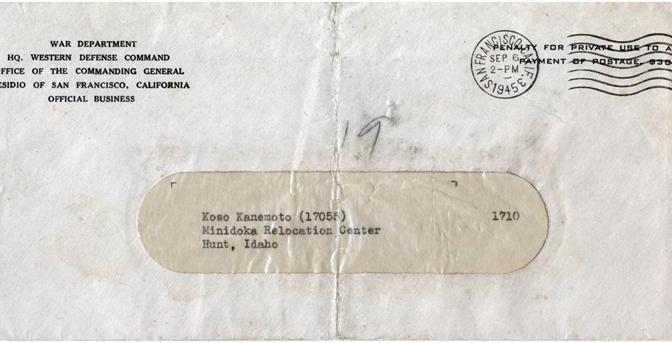
The envelope immediately caught my attention. Aside from a crease, the envelope looked pristine. It was addressed to my Dad while he was in Minidoka, an Idaho prison camp where he and over 10,000 Japanese-Americans were imprisoned by FDR. It was postmarked September 6, 1945 – just about seven months after the bloody fight for Iwo Jima. The return address was the “War Department”.
If you’ll get past the lawyer speak, the letter says Dad is now free to go about America as he chooses.
___________________________
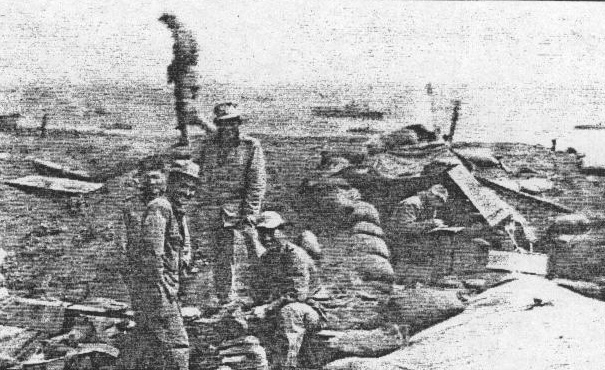
Because of secrecy, photos of Japanese-Americans in the US Army’s MIS are rare. This one shows Nisei on the sands of Iwo Jima.
About one thousand young Nisei men volunteered for the US Army while their families remained imprisoned in Minidoka. That’s about ten percent of the total camp’s population. Most who volunteered were from my Dad’s home state, Washington. While Dad was not one of those volunteers, 71 of these young men from Minidoka were killed fighting for the red, white and blue. Two were bestowed the Medal of Honor – posthumously. Silent patriots to this day.
“Kibei” were amongst those 1,000 men. Kibei’s were a sub-set of Nisei’s as a whole. A Kibei is a Japanese-American who actually spent time being raised in Japan. One result was they were absolutely fluent in Japanese – read, write, speak. Even slang and dirty words. No land-locked Nisei could come close. Dad was a Kibei.
___________________________
During the war, over 6,000 Nisei became part of the Military Intelligence Service (MIS). The MIS were top secret. They were largely all volunteers.
But the Kibei – they formed the crucial core of the group. The most fluent. The decisive secret weapon. As luck would have it, many of these Kibei were from Hiroshima. Their fathers came to Hawaii or Washington in droves from Hiroshima for a better life – just like my Grandfather Hisakichi. (Dad is pictured here standing next to his Hiroshima home in 1947.)
MIS Kibei were the ones who intercepted and swiftly translated the Japanese Imperial Navy radio transmissions that led to the shoot down of Admiral Yamamoto’s transport. Kibei also swiftly and accurately translated captured critical secret military plans written in Japanese (“Z-Plan“) for the defense of the Marianas Islands and the Philippines; this led to the lopsided American naval victory called the “Marianas Turkey Shoot” in 1944 – as well as to the death of my Seattle-born Uncle Suetaro. My dad’s youngest brother.
Interestingly, due to continuing suspicions, the US Navy and the Marine Corps refused to enlist the Nisei. Their loss.
___________________________
Actual “Z-Plan” report translated by Nisei of the top secret MIS.
The cloak and dagger actions of the MIS were only declassified in the 1972 by Executive Order 11652. That’s a long time. And true to their oaths, these Nisei kept their heroics to themselves for all those decades. They sought no honor or recognition.
____________________________
But back to the letter of 1945 – mailed to my Dad just seven months after the vicious fight for Iwo Jima. While my father finally volunteered for duty in February 1947 and became part of the famed MIS, his silent and patriotic Nisei brothers that preceded him hastened the end of war and saved millions of casualties – for both sides.
In recognition for their patriotism, sacrifices and loyalty, Congress bestowed upon the MIS and other Nisei who fought for the US in 2010 the Congressional Gold Medal. Two of my uncles were recipients although they had passed away.
By the way, the first recipient of the Congressional Gold Medal was George Washington. I believe the Nisei are in pretty good company.
__________________________
No credit is being taken from the young Marines who fought and died for Iwo Jima. The Marines did take Iwo Jima with their blood…but they were not alone. About 50 Nisei MIS’ers landed in the first assault waves alongside the Marines.
Just ask Mineo Yamagata, a MIS veteran of Saipan and Tinian. He accompanied the 28th Marines to the summit of Mt. Suribachi and witnessed the flag raising.
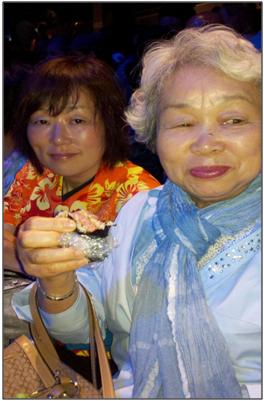
Masako savoring her Spam Musubi Kailua. Her daughter Izumi looks on.
It was a small yet precious family reunion. My 78 year old cousin Masako Kanemoto, who flew in from Hiroshima, took a bite out of a “Spam™ musubi” while we were taking a snack break in Kailua, Hawai’i. It’s a slice of Spam sandwiched in between some rice and wrapped in seaweed. “How mundane,” I thought.
Masako then beamed. “We had very little food for so many years. After the war, your father brought us food and clothing when he was in the US Army…” My dad was part of the US 8th Army’s Military Intelligence Service.
She continued, “He brought us much as he could carry. I was so hungry and I will always remember that first bite. I couldn’t believe how something could be so delicious.” She was referring to something my father had brought along with him 65 years ago – Spam.
Emotions tore through me and my eyes welled rapidly. I felt so selfish and ignorant for taking the Spam for granted. I fumbled but snapped the photo of Masako enjoying the Spam musubi.
__________________________
My grandfather Hisakichi Kanemoto immigrated from Hiroshima to Seattle in the late 1890’s. My grandmother Kono Kanemoto was a true picture bride for my grandfather. Grandmother gave birth to a total of seven children of which my father was the fifth; all but one was born in Seattle – they were US citizens.
My grandparents struggled to survive; the family lived in the Fujii Hotel in downtown Seattle. They worked a basement barber shop in the hotel with Grandfather cutting the hair and Grandmother expertly working the straight razor. A cousin said Grandmother made the customers feel appreciated and made them feel at ease with her people skills. It certainly wasn’t Grandfather – if there were a Japanese Marine, he could have been their poster boy. “By the book”, as they say.
As was customary during that time, many Japanese-American children (“Nisei”) were rotated back to Hiroshima by ship to learn the Japanese language and customs when they were about eight years old. It was no easy cruise has they were crammed into the cargo hold for the lowest fares. They spent about ten years in Hiroshima then returned by themselves when they turned 18. Dad was no exception.
By around 1930, the grandparents and five of the siblings were in Hiroshima; the oldest (Uncle Yutaka) was forced to live in America alone at a young age. I understand he was sad and frightened about that. Their second son, Hisao, passed away in Seattle from encephalitis when he was only about two.
Now fluent in Japanese, dad returned to Seattle on his own in 1937 at 18 years of age, preceded by an older sister Shizue in 1934. Dad was apparently very bright as he graduated from Hiroshima’s Nichuu High School – it was for the higher achievers. He excelled in mathematics as well as in track and swimming. He helped dig the school’s pool. No union labor back then.
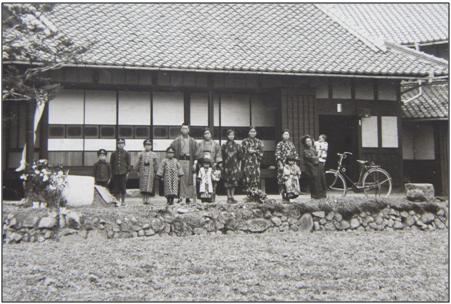
Dad is standing, third from left in this rare family portrait taken in front of his family’s new Hiroshima home, circa 1929.
_______________________
After dad returned to Seattle, Grandmother made the decision to remain in Hiroshima. It was a fateful decision.
In the 1930’s, Japan had already began their invasions of China, Manchuria and Burma; they were on their quest to secure raw materials for their industries and ultimately for their military. National pride was at its peak; military conquests filled the news and the world was taking notice with great consternation. When Japan was condemned for their aggressions by the League of Nations, she withdrew and shocked the world.
The threat of war with America loomed. Anti-Japanese sentiment grew – Americans in Seattle routinely harassed or even attacked Japanese in public. Unfortunately, many of the “Japanese” they harassed were American citizens like my dad, uncles and aunts. Some young Nisei girls were also groped, molested or raped. Folks knew where Hawai’i was at this time but Pearl Harbor was Timbuktu.
They all had the misfortune of looking Japanese, similar to how some Americans look upon Muslims today.
My Grandmother was not exempt from the harassment. She was called “Jap” many times. She was even egged. While she was a fighter, she decided the threats and discrimination were too much.
______________________________
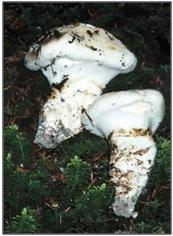
Matsutake
My dad was close to his youngest brother, Suetaro. They farmed the mushroom property Grandfather owned in Hiroshima; the special mushroom delicacy called “matsutake” grew only during a brief season. Dad, Uncle Suetaro and perhaps three other boys strapped on woven baskets onto their backs and filled them with the precious matsutake. Grandmother would sell them as quickly and as best she could – they had no refrigeration. The earnings would make up the bulk of their income for the year.
While dad had returned to Seattle in 1937, Uncle Suetaro was anxiously awaiting his turn to go back to Seattle. He was to turn 18 in 1939. However, Dad’s youngest sister Mieko died earlier in 1939 of a kidney infection; she was about 15 years old. By that time, Grandmother knew Grandfather was suffering from stomach cancer. His older sister (and the only one not born in the United States) Michie had married and had given birth to a daughter – Masako, my cousin. They lived in another village called “Tomo” some distance away.
Having decided to remain in Japan due to the harassment and threats she experienced, Grandmother then made the fateful decision to not allow Uncle Suetaro to return to Seattle. After all, there was no other Kanemoto left to inherit the house and land. Uncle Suetaro was dejected and very upset but obeyed Grandmother. He was a loyal son.
Grandfather died the next year. With Mieko also gone, only Grandmother and Uncle Suetaro remained in the house.
______________________________
Uncle Suetaro was drafted into the Japanese Imperial Army. His regiment was training in Fukuyama, Hiroshima. Aunt Michie with her nine year old daughter (and my cousin) Masako in tow went to visit Uncle Suetaro when they could. She remembers a couple of trips. It was not easy travel in war-torn Japan. For one trip, Aunt Michie managed to take sashimi – in this time of little food, it was a tremendous treat and gift.
On that trip, Masako remembers her mother stealthily sliding over to Uncle Suetaro the wrapped sashimi. He was being stared at by many of his fellow soldiers – they were not well fed either. She remembers Uncle slowly turning so that the others could not see and quickly devoured the treat.
Masako also knows Uncle was well respected by his fellow soldiers due to his knowledge of English in a wicked twist of fate as my father’s top secret US Army unit used their knowledge of Japanese to kill as many of the enemy and to save American lives.
_______________________________
Uncle Suetaro (sitting on the sofa arm) received his orders to ship out to Leyte Gulf in the Philippines; the family recalls it to be 1944. As tradition called, they had a farewell celebration. In such celebrations, the soldier who was facing certain death received a Japanese flag signed by relatives and friends to carry into battle.
Uncle Suetaro was to ship out the next day. Grandmother was like any other mother – she was anguished. More so, she knew that soldiers sent off to war rarely returned unless maimed. Her decision to not allow her youngest son to return to Seattle in 1939 now deeply stabbed at her heart…so much so that she suffered her first stroke the next day.
______________________________
Grandmother only had use of her right arm; Masako said she would pull herself around the now empty house with that one good arm. Aunt Michie – after working a grueling day at her husband’s farm – would likely have walked several miles to Grandmother’s house to tend to her needs which included feeding her as well as changing and washing her diapers.
This was war time; they used old clothing for diapers. Tide laundry soap? They didn’t have any soap to speak off. A washing machine? They didn’t have one let alone electricity. Aunt Michie washed them by hand with well water on a washboard. She then walked miles back to her farm only to get up a few hours later before dawn to work the farm.
______________________________
Transport Kashii Maru under attack at Ormoc Bay 1944
No one truly knows how Uncle Suetaro died.
Perhaps he was killed during one of the numerous Allied artillery barrages or bombings, or was cut down in a futile banzai charge. Perhaps he died in a cave from starvation or illness – or from committing suicide.
Perhaps he never made it ashore and met his death when he was on a troopship being strafed or sunk by airplanes from land-based US Marine Corsairs or carrier-launched US Navy F6F Hellcats or a US Army Air Force P-38 Lightning. The Allies ruled the skies and wrecked havoc on Japanese ships.
Tragically, he was American. While his oldest siblings were imprisoned in US concentration camps for “looking Japanese”, Uncle was thrust into desperate circumstances and was clothed in the uniform of the 14th Japanese Imperial Army, 41st Infantry Regiment… Eerily similar to his mother who was egged and called a Jap while in Seattle, his own countrymen were now trying to kill him with 75mm shells launched from miles away or .50 caliber machine gun rounds in a closer encounter. Not eggs this time.
It is more troubling knowing Ike was of German ancestry and MacArthur’s right hand man General Willoughby was of ROYAL German lineage and spoke fluent German but English with a pronounced accent. His birth name was Weidenbach; imagine if they were imprisoned in Tule Lake with my Dad for “looking German”. No political comment being made; its just historical fact.
Uncle Suetaro’s 41st Infantry Regiment – likely including the other young men who watched him stealthily eat sashimi – was annihilated by the US Army on Leyte. His body was never recovered. Ironically, when I used to watch the B&W news reels of the war on TV or see combat photos of dead Japanese soldiers, I would see them with purely American eyes. Now, I earnestly review them in hopes of seeing a glimpse of Uncle Suetaro…as my Aunt Shizue did for many, many years. She still does at 95 years of age near Downtown, LA.
__________________________
Eleven year old Masako was sitting in her classroom on August 6, 1945; her school was partially behind Mt. Suzugamine just west of Hiroshima’s center. Some windows were opened as it was in the middle of summer.
There was an indescribable, blinding white flash. There was no noise except for some of the girls screaming, Masako recalls. They all left their seats and ran towards the windows to see what had happened. Masako ended up standing behind a couple of girls at an open window.
It was like an invisible wrecking ball slammed into their school. All of her classmates that ran to a closed window to look were pierced by shards of shattered window glass as the shock wave hit, she said. All were hurled backwards by the force. Even the girls in front of Masako were pierced by debris being hurled at supersonic speeds…
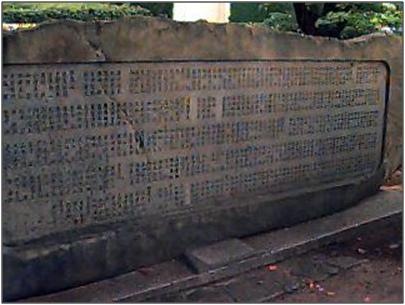
This wall is what remains of Dad’s high school in Hiroshima. It is inscribed with the names of the students who ceased to exist on Aug. 6, 1945.
As she looked through openings that were once windows to her classroom, they were now windows to a demonic swirling dark mass of blackness. Ironically, she described it as a “matsutake no kumo”, or “matsutake cloud”… The same mushroom my father and uncle had picked as children.
Now, the same hill they picked matsutake from saved Masako’s life. It provided the school partial shielding from the atomic blast. There was nothing left of Hiroshima just around the bend. All that was left of my father’s beloved “Nichuu High School” was a short span of a wall. It was about 1,500 meters from the hypocenter (left).
Masako saw horribly disfigured bodies over the next few days. They had aimlessly wandered from around the bend after the blast. They perished where their bodies laid. Masako was also covered in a thin oily, sticky substance called black rain.
______________________________
From before the blast, ten year old Masako was tending to the care of Grandmother; by war’s end, there were only shreds of material left that could be used for diapers. It was brown under her fingernails from having to wash her soiled diapers by hand.
While Grandmother had made a partial recovery, she still only had use of her right arm. Then sometime after war’s end, a representative of the Japanese military came to visit Grandmother. Uncle Suetaro would not be returning home. Masako says her anguished scream was one only a mother can own, made horribly worse knowing she forbid Uncle Suetaro returning to Seattle. She suffered her second stroke.
_______________________________
Dad and the rest of the imprisoned siblings and the grandchildren of Grandmother and Grandfather were released from camp in September 1945. A year after, Dad found out he was going to be drafted by the same government that took his passport, fingerprinted him, put him and his family behind barbed wire and made him keep on his person all the time a draft card (on the left) that classified him as an Enemy Alien (4C). There were also guard towers manned by soldiers with Browning machine guns.
According to Masako and other family members, his oldest brother Yutaka (and now heading up the remaining family) then nearly begged him to volunteer for the Military Intelligence Service so he could check up on Grandmother. Dad tells me, “Well, if I get drafted, I’ll be a buck private. If I volunteer, I can be a sergeant – more pay.”
I tend to believe my other family members.
______________________________
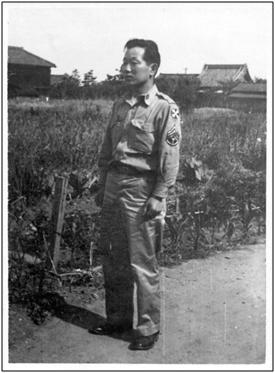
Dad arrived in Yokohama on December 7, 1947 and was assigned to the 8th US Army’s G-2, 166th Language Detachment; this was the Military Intelligence Service. It was kept top secret during the war; nearly all of them were Japanese-Americans. The accomplishments and heroics of his predecessors were not declassified until the 1970’s. Dad was one of the early graduates of the Army’s language school (“DLI”) in the Presidio. He was a Technical Sergeant, 3rd Grade – I’m sure the young Japanese ladies thought his chevrons were captain’s bars.
Dad and Masako in 1948. Itsukushima Shrine, Hiroshima. Dad remembers this was taken by a photography vendor.
At his first opportunity, he took a train down to Hiroshima then somehow made it to Grandmother’s home. Masako was a young girl 14 years of age by then. He carried two large Army duffle bags full of food and clothing – including the Spam. They are in the photo on the left.
None of the surviving Kanemoto family members from that time period know how Dad learned of the news of Uncle Suetaro’s death. Regardless, the death of his favorite brother scarred his mind and heart for eternity. Even today, when I see him, he asks, “How is Suetaro?” He never asks of his other siblings.
______________________________
Masako and I finish our Spam musubi. She tells me of how kind my father was to her, Grandmother and Aunt Michie. My dad does remember how indebted they all were to Masako for giving up a lot of her youth to care for Grandmother.
Masako enjoys Spam even to this day.
On a side street in Kailua, Oahu, Spam had also become a cherished delicacy for me.





















 Masako and Spam Musubi