Tag Archives: japan

The Pain of Survival and Aunt Michie – Part 3


Japanese-home-defense-training_1945
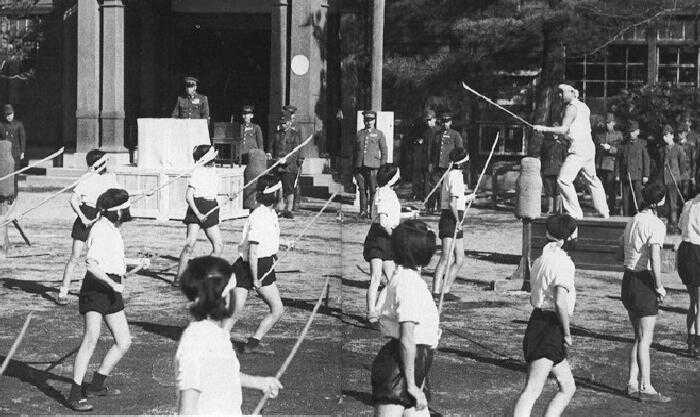
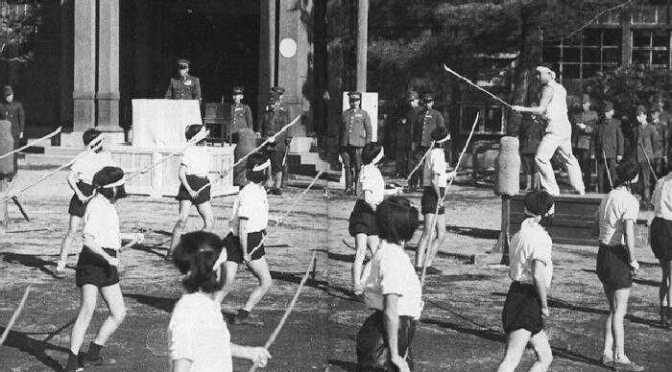
Japanese women being given “home defense training”. My grandmother on my mother’s side underwent such training on a Tokyo schoolground. 1945.

The Japanese home front had essentially collapsed by 1945.  Instead of focusing on food, supplies, building air raid shelters and organizing orderly evacuations of civilians, Japanese military leadership focused on misleading news reports and propaganda.  Millions fled the cities into safer rural areas(¹) on their own initiative but once there, supplies of daily sustenance was meager.

_______________________

In one’s own life, you are tested.  A good human being will at times prove oneself to be a good brother or sister, son or daughter, friend or life partner.  Some fail.  Some pass.

Aunt Michie was one who passed; her heart led her to care for others before herself.  It is as if she knew being good to others was the way to have a good life.

As an example, US air and naval forces ruled the skies and the seas.  A key staple of the Japanese diet – fish – had been nearly cut off  as fishing boats were attacked once out to sea.  Yet, when Aunt Michie came across sashimi, she traveled hours with Masako in tow to take a precious portion to her brother Suetaro at his army base in Fukuoka:

“…(Masako) remembers a couple of trips (to see Suetaro). It was not easy travel in war-torn Japan.  For one trip, Aunt Michie managed to take sashimi – in this time of little food, it was a tremendous treat and gift. On that trip, Masako remembers her mother stealthily sliding over to Uncle Suetaro the wrapped sashimi. He was being stared at by many of his fellow soldiers – they were not well fed either.  She remembers Uncle slowly turning so that the others could not see and quickly devoured the treat.”

(From Masako and Spam Musubi)

Aunt Michie could have eaten the precious sashimi herself…but didn’t.

___________________________

With her husband taken by the Imperial Japanese Army then dispatched to war in Manchuria, she was burdened with running the farm… still laboring to produce crops only to be taken by the military.  She would get up before sunrise, help prepare meals, tend to the family then toil in the fields.  And when her mother became partially paralyzed and alone in her own home five miles away, Aunt Michie knew she had to take care of her, too.  Michie was the last of her children left in Japan.

My Grandmother Kono – having suffered a stroke – is propped up from behind by Japanese “shiki-futon” for the picture. She would not see her son alive again. Taken in Hiroshima, May 3,1944.

While Michie and Grandmother Kono managed to get part-time care, Aunt Michie still took it upon herself to check in on her stricken mother.  My cousins tell me their mother Aunt Michie would take them along for the ten mile round trip to her Kanemoto family home.

No car.  No bus.  No taxi.  No trains or bicycles.  They had to walk.  After all, it was 1944 and fuel was a huge luxury.  One memory the youngest happily recollect is that they would take turns riding in some kind of baby stroller that Michie would push to Grandmother Kono’s.  Neverthless, it was still a great deal of effort and sacrifice on Michie’s part in any case… and she did this after working in the fields, too.

Masako will eventually end up caring for Grandmother Kono.

___________________________
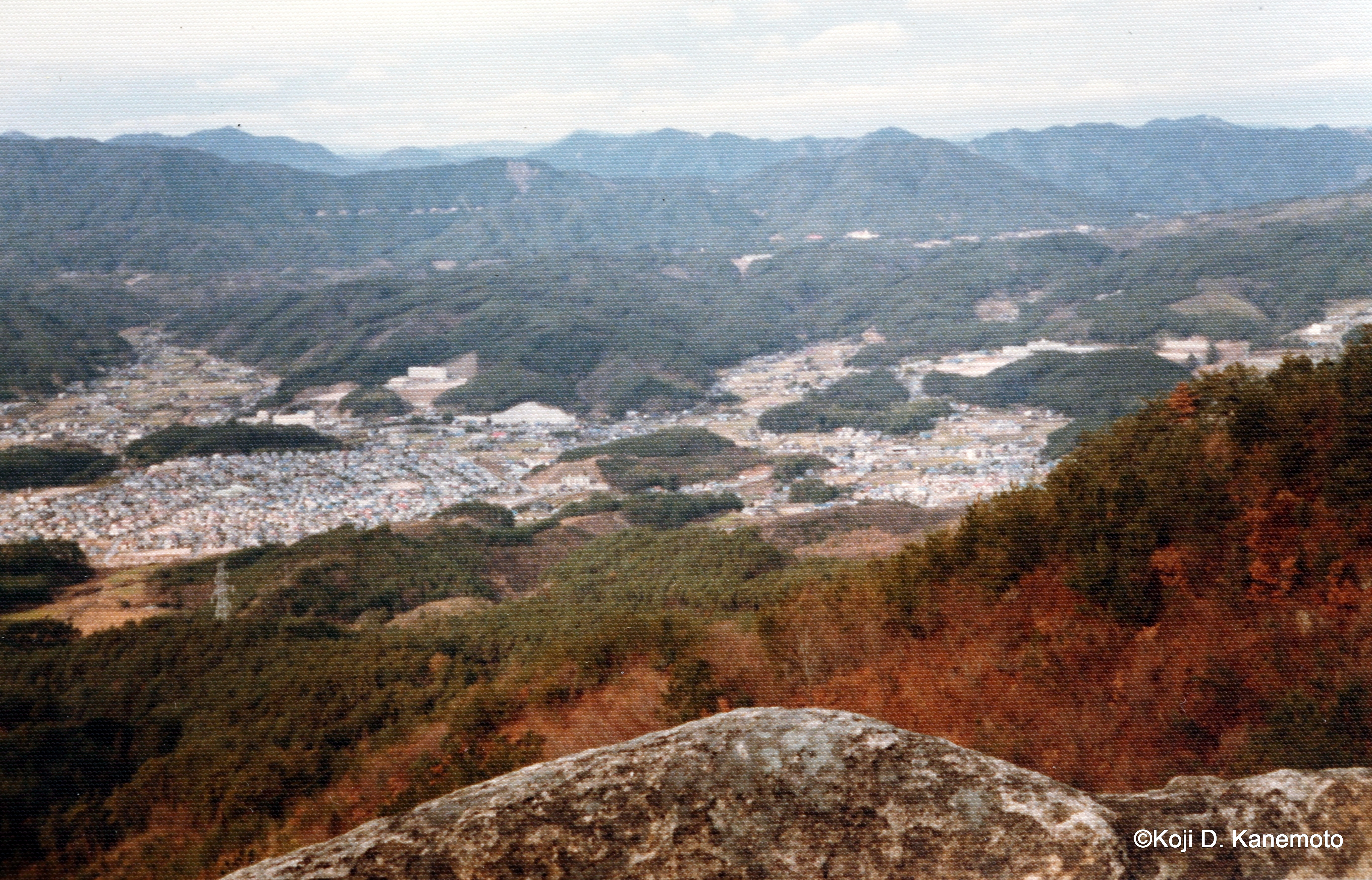
IMG_5869
Family photo taken of the town of Tomo about 35 years ago atop the 300 meter tall hill separating it from Hiroshima. Hiroshima is directly behind. This short hill served to partially deflect the atomic bomb’s shockwave. Courtesy of Kiyoshi Aramaki.
IMG_5870
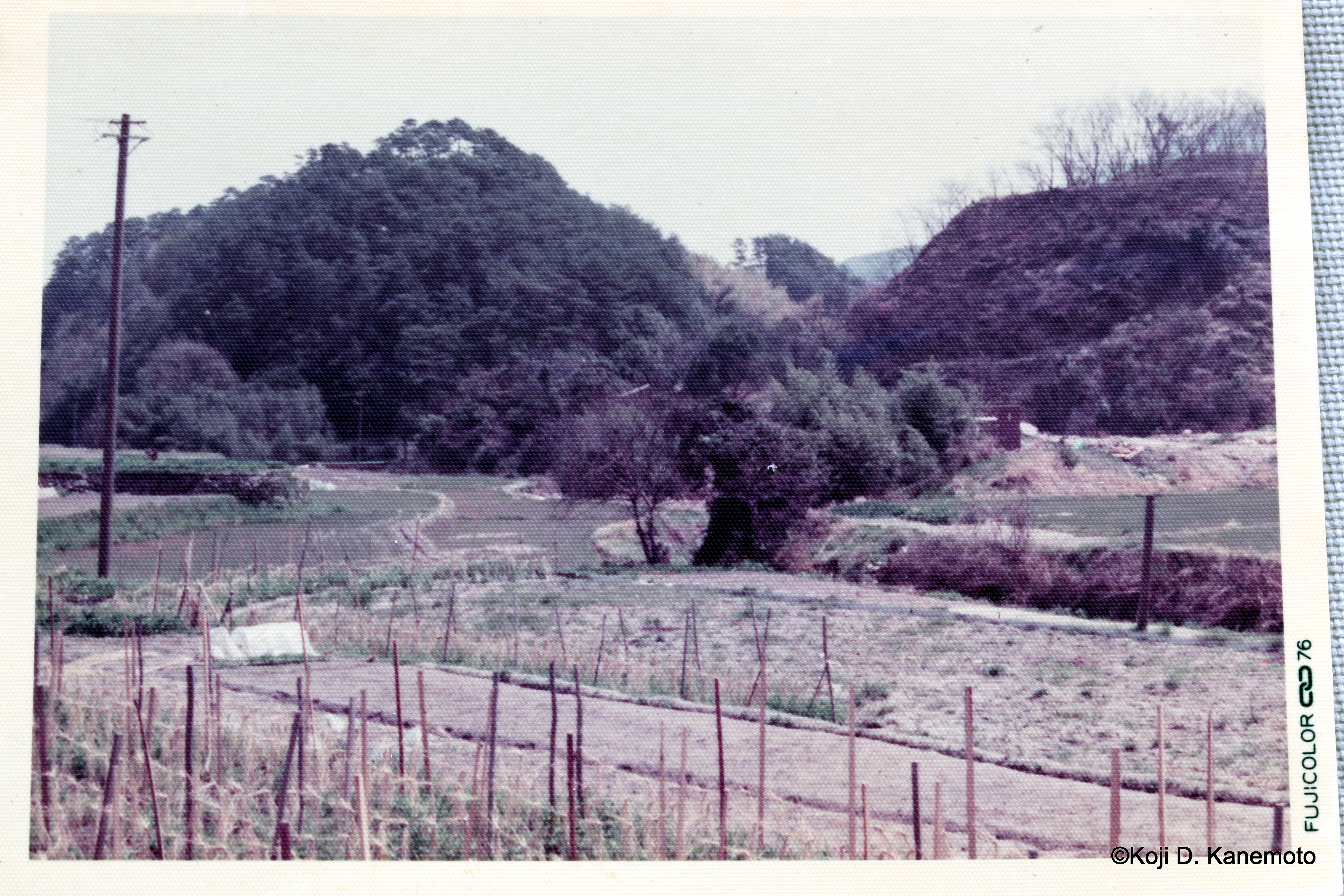
Per Kiyoshi, this was taken from the house and shows some of the field Michie had to cultivate. She was here when the shockwave hit. While the one on the right is no longer there, the family burial plot was between the two small mounds you see here. Courtesy of Kiyoshi Aramaki and dated 1976.

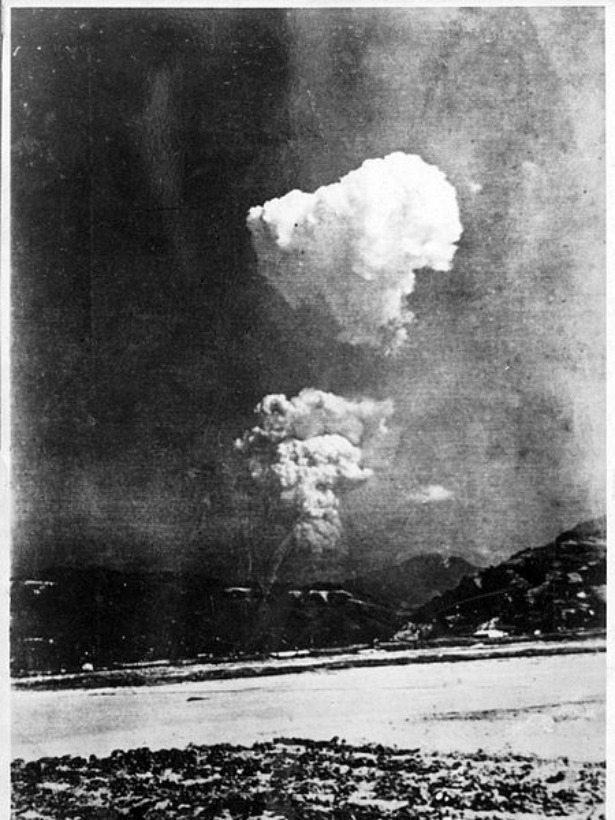
After picking herself off the ground, Aunt Michie saw an evil yet mystifying mushroom cloud slowly rising up beyond the 300 meter tall hill separating her village from Hiroshima proper.  At that instant, she knew her life had taken a wrenching turn for the worse… as if it could get any worse.

I cannot imagine what was going through her mind and heart watching that mushroom cloud rising.  She could not have even dreamed that it was one massive bomb, a couple of kilometers away, that could cause this sort of force and devastation.  It must have defied belief.
Hiroshima_10
A relatively unseen image of the explosion, taken from a Kataitaichi, six miles east of Hiroshima. Michie was nearly due west and on the other side of the cloud. The cloud would reach 40,000 feet in just four minutes. It would ultimately rise to 60,000 feet. (Horikawa Elementary School)

According to Michie and my cousins, the shockwave blew out all the sliding doors, all the tatami mats were flung and the ceiling was shoved up in the house.  Try to imagine yourself being inside the house.  The same thing happened to Grandmother Kono’s house five miles south (See map in Part 1).

As per their daily air raid drill, they apparently all ran to the air raid shelter in the small hill behind their house.  After about half an hour and with the mushroom cloud still rising, a black, syrupy rain began to fall on them.  According to the cousins, Michie believed that the Americans were dropping oil from space.

She could not have fathomed it was contaminated with over 200 kinds of radioactive isotopes.  We now call it black rain.

IMG_6116
I took this photo of a preserved wall section stained with actual black rain from that fateful day. Hiroshima Peace Museum, November 2013.

Sadako, who was ten years old, clearly remembers their white blouses had turned black from the rain.  No one – absolutely no one – knew that other than staining skin, clothing, and buildings, but that ingesting black rain by breathing and by consumption of contaminated food or water, would lead to radiation poisoning.  Even flowers would bloom in distorted shapes and forms from the radiation.

_______________________________

With the enormity and the suddenness of the brilliant flash of light followed by a shockwave and the swirling mushroom cloud, Michie deep inside knew her world had forever changed.

Horror was to literally come into hand shortly to enforce that foreboding thought.

_______________________________

To be continued in Part 4….

(1) Albeit late, my mother’s family fled to the Fukui Prefecture in early July 1945 to escape the bombing of Tokyo.
The Pain of Survival and Aunt Michie – Part 2


Taken in 1945 after a B-29 bombing attack on Tokyo. There is little left of the city and many, many families were without food and homes. Sadly, there were thousands of orphans as well, many of whom would perish.
Human dignity is as crucial to an earnest life as is air, water and food.

Aunt Michie drew upon that dignity inside her to help her family and others survive the day to day ruthlessness of life during war and ultimately, the atomic bombing.

While her dignity was larger than life, Michie would ultimately sacrifice her health and well-being to ensure her family and others would survive…and survive strongly.

___________________________

obaachan
Japanese high school girls being drilled on how to use bamboo spears to ultimately repel “the invaders”. Notice the presence of the Imperial Japanese Army in the background observing.  Tokyo 1944.

By January 1945, Japan had already lost the war.  While the Japanese military leaders controlled the country and its path to ultimate destruction, the civilians took the brunt of war.  Many cities had been destroyed by US bombing raids leaving millions of families homeless.  There was not enough food to go around.  Many starved to death, especially orphaned children, if not from neglect as others would shut their eyes to them.

However, Hiroshima was largely spared from aerial attack.  The US did carry out bombing raids in March and April 1945 against military targets in Hiroshima but it was not frequent…but it was frequent enough to require air raid drills  The naval port of Kure though, where the battleship Yamato was built, was essentially destroyed in June 1945 by US Army and Navy bombing attacks.

HiroshimaBombingMap
A hand drawn map showing targets and damage to Hiroshima by US bombing raids including the atomic bombing. For a zoomable map, please copy and paste this link into your search bar: http://www.digital.archives.go.jp/DAS/meta/DGDetail_en_0000000611
Source: National Archives of Japan

___________________________

After her marriage in 1933, Michie was tasked to arduous farm labor at the Aramaki farm.  Their primary crop was rice.  She also gave birth to five children before war’s end: Masako (1933), Sadako (1936), Namie (1939), Tomiko (1942) and Masataka (1944).  Kiyoshi would follow in 1947.  She loved them unconditionally.

Michie image1
A happy Aunt Michie and likely Tomiko. Tomiko would soon be adopted by another family in the actual city of Hiroshima.  Undated but perhaps 1943.

On the farm lived Mikizo, his parents and Michie.  The four of them – and eventually three of her oldest daughters (a total of seven family members) – would work the land from a little before sunrise to sunset.  It was hard, arduous labor.  Back breaking work.  They did not have John Deere tractors or combines to aid them but had an ox to plow the fields with.  This was 24/7.

After all that hard labor, nearly the entire crop was taken by the Japanese military for the war.  They were allowed to retain a small portion of the crop for their own use.  As a result, rice was even further rationed for family consumption.  They had no choice.  On top of that, there was little else to eat.  They lived a meager life per my cousins.

__________________________

As the war dragged on, Japan was descending into the abyss…and it kept getting more and more darker.

In the story “Dear Mama”, Michie’s youngest brother Suetaro (my uncle) hurriedly wrote a somber good bye letter to Grandmother Kono in his war diary.  He was being sent off to war and certain death.

Farewell
Farewell sendoff for Suetaro who was heading to certain death. Michie is to his left and holding Masataka; Mikizo to his right. It is only an educated guess but the older man to the right of Mikizo is his father.  May 3, 1944.

I wonder how she really felt, knowing that Suetaro was going to fight to his death against the country in which his two older brothers and sister were imprisoned.  They were her brothers and sister, too.  An ugly internal conflict.
______________________________

The area around Tomo was nearly barren of younger, physically capable men.  All the men up to 35 years of age were taken by the army, regardless of their family status.  Mikizo was no exception.

In late 1944, at 35 years of age, he was taken by the Imperial Japanese Army.  Suetaro foresaw that happening in his farewell letter; he warned Mikizo to fully cooperate with the officers and to do exactly as he was ordered.  This was because it was brutal even within the non-commissioned ranks of the Imperial Japanese Army; the training officers routinely beat recruits into submission.  These recruits were largely the men who were ordered to their deaths in “banzai charges” by the thousands.  They greatly outnumbered the “hard core” Japanese officers.

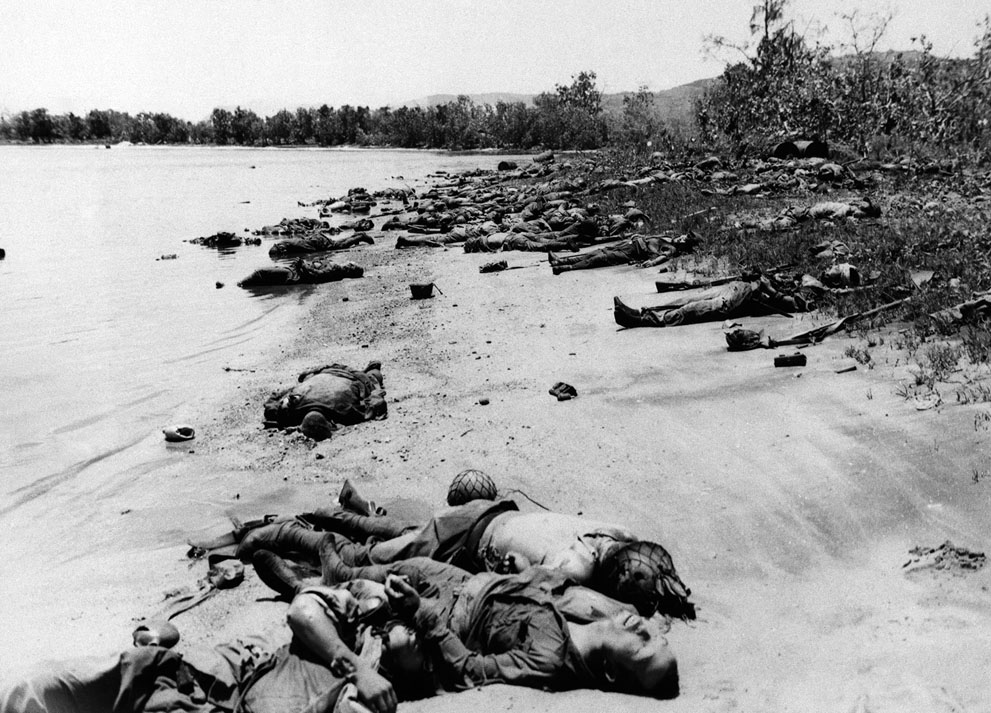
banzai killed
Aftermath of a banzai charge.

Aunt Michie’s family who tended to the back breaking labor on the farm was now lessened by one.  As with her brother Suetaro, she foresaw never seeing Mikizo again.

To make matters worse, her mother (my Grandmother Kono) suffered a cerebral infarction the day she learned Suetaro was being sent off to war.  She became paralyzed on her left side.  To get about the now empty house, she would have to pull herself around with her right arm.

On top of everything else – tending to the crops, the house and the children – Aunt Michie now had to care for her disabled mother.

Michie’s daily life was now further strained with even more stress…  Life must have appeared darker to Aunt Michie.

Michie’s willpower and dignity will now be on trial and severely tested.

But the struggles she will endure will have purpose.

She would not let her family down.

____________________________

To be continued in Part 3….

The Pain of Survival and Aunt Michie – Part I


img_0152_1_original
Uncle Yutaka and darling little Aunt Michie in Hiroshima. Circa 1918.

Life in Hiroshima was uncertain and grueling in 1945 – especially for women and children.  It is a fact that nearly all the men up to the age of 35 had been taken by the Japanese military.  For many, it was truly day to day.

Little food, clothing and medical care.  It all went to the military…and then there were the B-29’s and the bombings.  Devils associated with being on the losing side of war.

But at 8:15 AM on August 6, 1945, my Aunt Michie’s already tough life would be cast into wretchedness to test her mortal soul.  She was in her farm’s field clearing old crops on that hot summer morning.  There was an intense flash of light then the atomic bomb’s shockwave traveling close to the speed of sound slammed into her.  She was catapulted and hit the ground.

At the same instant, her oldest daughter and my cousin Masako – who was eleven and in her classroom nearby – was hurled across the classroom by the same shockwave.  The schoolgirls that were standing in front of her were pierced by shards of glass and debris.

Below is an eye opening re-enactment supplemented by computer simulation of the atomic blast in 1945.  Perhaps you can put yourself into Aunt Michie’s or Masako’s shoes on that morning and experience what they did:

After years of a most grueling life, Aunt Michie and her children would now face the searing pain of surviving.

__________________________

Even while giving shaves at my Grandfather’s barbershop in Seattle, Grandma Kono was busy in her early years of marriage.  She gave birth to Yutaka (1910), Hisao (1912) then Michie in 1914.  Other children followed: Shizue (1917), Dad (1919), Suetaro (c. 1921) and Mieko (c. 1924).  A total of seven.

y-image00-001
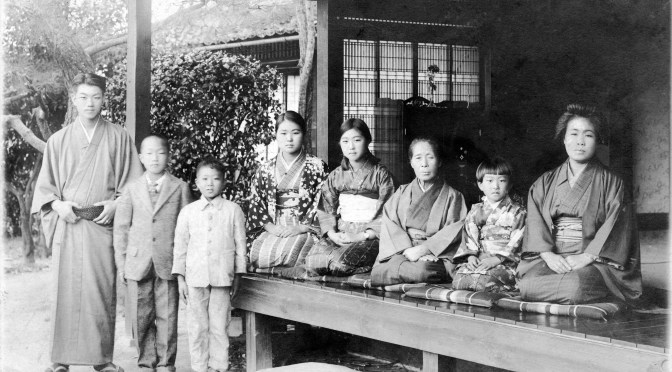
(L to R) Yutaka, Dad, Suetaro, MICHIE, Shizue, Great Grandmother Kame, Mieko and Grandmother Kono. Circa 1928, Hiroshima.

All seven of the siblings were born in Seattle…  All except for Michie who was born in Hiroshima.

My cousins tell me their mother Michie told them she would wistfully ask her family, “Why couldn’t I have been born in America like everyone else?!”  Lovingly, of course.

Aunt Michie never did get a chance to visit America.

__________________________

Dad’s siblings came to Hiroshima and half of them were able to return to Seattle to continue their lives as Americans before war with America.  But Michie lived her entire life in Japan.  She was the oldest sister to the siblings and helped Grandma Kono raise them.

Michie’s father (my Grandfather Hisakichi) was a devout Buddhist.  He required the family to chant Buddhist mantras daily; it was not “praying” but a way through which a follower “energized” himself to the teachings of Buddha.  Dad’s Hiroshima home to this day has the altar in the main room where they chanted; it is unchanged in nearly a hundred years having survived the shockwave from the atomic blast.

Fullscreen capture 2262014 120800 AM
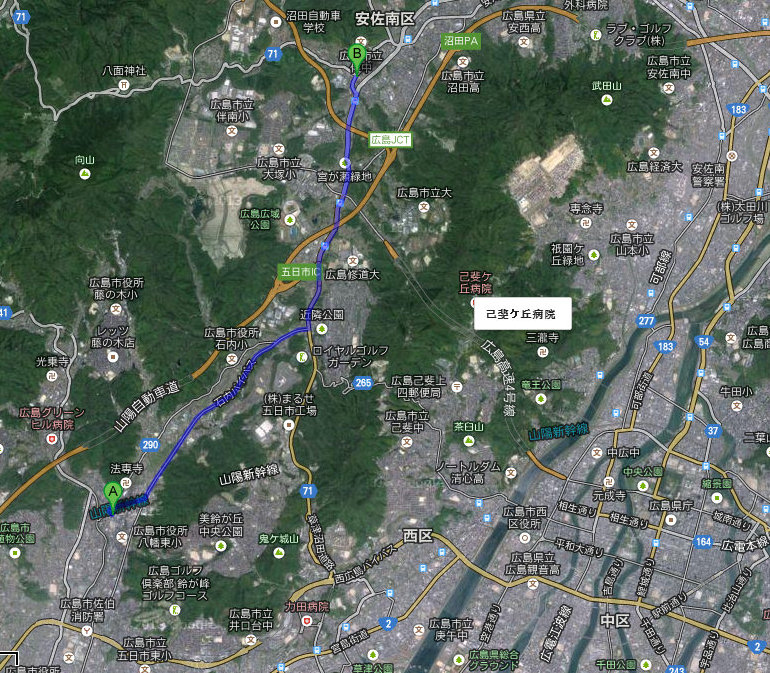
My father’s family home is at “A”; Aunt Michie’s home in the village of Tomo is at “B”.  About five miles separates the two homes.  The atomic bomb’s hypocenter is towards the bottom right where rivers split up.

According to well accepted family lore, a man from a village called Tomo came to the house one fateful day apparently to seek one of his daughter’s hand in marriage.  His name was Mikizo Aramaki.  He immediately went to the altar and chanted.  Grandfather Hisakichi was so impressed by his devotion to the Buddhist way of life that he immediately gave his daughter away in marriage…but apparently, Grandather gave away the wrong daughter – Aunt Michie.  It is said Mikizo had come seeking the hand of my Aunt Shiz.  (Aunt Shiz was the prize of the village according to my cousin Masako.)

Being of farming heritage, Mikizo had acreage and a home.  After Aunt Michie was told she was to marry Mikizo, she was, to say the least, not very happy.  I guess that is a slight understatement if I say so myself.  She argued – pleaded – with my Grandfather that she didn’t want to marry him and that she was not raised to be a farmer…but to no avail.

Aunt Michie was given away in marriage.  Done deal.

They wed in 1933.  She was nineteen years old.

_______________________

To be continued in Part II

A Father-ly Invasion


Imagine being a Marine. You’re in Afghanistan.  You see your buddies getting blown up by the cowardly enemy’s IED or killed after an ambush. Then, after a bitter, maniacal all-out war, their religious leader capitulates.

Now, suddenly, you are standing out in the desert, outside of Fallujah, waiting to go in as part of the “occupying force”. Your feelings and emotions are going amok – anger coupled with fear of the unknown… You will be surrounded by the enemy who also fought the exact same bitter war against you.

USMC
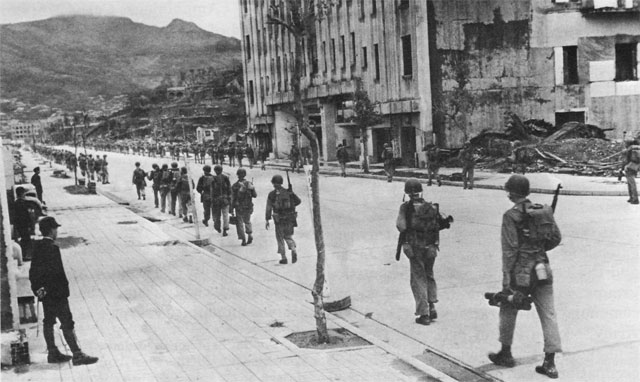
US 26th Marines marching into Sasebo, Japan – August 1945. Notice the Japanese standing to the left and the general absence of civilians.

Now… imagine you are a young Marine on a troop ship off the Japanese coast. It is August 30, 1945. A few weeks earlier, you became acquainted with the term atomic bomb. The Emperor of Japan just capitulated.

You are to go ashore onto the Japanese homeland.  But in this case, you are not wading ashore to occupy a city. You are wading ashore to occupy an entire country.

_______________________

As we now know, the initial “invasion” of Japan by Allied forces ended up being entirely peaceful; no one was killed. Perhaps there was a small incident or two, but I have not read anything to indicate a single shot was fired. How could that be? How could hundreds of thousands of Marines, soldiers and sailors have stormed ashore – under an assault mindset – onto a homeland populated with maniacal military and millions of civilians – and not erupt in combat?

army report 98th

Per a report of the US Army’s 98th Infantry Division dated December 20, 1945:

“The mission assigned the Division was participation in the occupation of Japan; however, due to uncertainty as to the attitude of the people, the real intentions of the Japanese army, and the possibility of treachery or sabotage, the Division was directed to be combat loaded and prepared for any eventuality. Thus planning for the occupation of Japan was based upon an assault landing rather than an administrative movement…”

(Click here to see actual report.)

______________________

There is no single answer. The peaceful invasion was the result of hundreds of contributing influences.

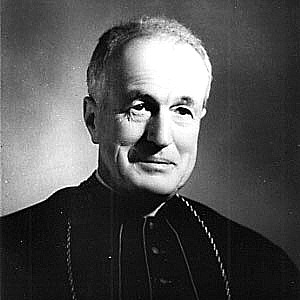
One came from Father Patrick Byrne, a Catholic priest in a country dominated by Buddhism.

patrick byrne
Father Patrick Byrne. He was elevated to Bishop prior to his death.

Father Byrne had been sent to Kyoto in 1935 to set up a mission. As he was respectful of the peoples, he was put under house arrest (confinement) when war broke out. Of course, it was very harsh. His only companions were a cat and a parrot. Food was poor and scarce, just like it was for the unfortunate civilians.

Per “Escape from Manchuria” by Paul K. Maruyama (USAF, Ret.), he emphasizes the importance of the role fulfilled by Father Byrne immediately after the Emperor broadcast his surrender. Although in very poor health, Father Byrne with the aid of a newspaper reporter and a Father Furuya, hurriedly put together a radio broadcast intended for TWO audiences: (1) one for the Japanese homeland and (2) one for the “invading” Allied forces.

As hordes of civilians were escaping to the countryside, getting from Kyoto to Tokyo in the few available trains was hard but after 15 hours, he made it being escorted by police. He then recorded his speech on or about August 20, 1945, which was re-broadcast many times via radio and shortwave…to the Japanese people and to the countless number of Allied occupying forces staging off-shore.

His radio broadcast:

“The war is over. What can I say first of all to the Japanese people whom I have loved and who love me as a brother for more than 10 years? I share their grief when the Emperor spoke to them and told them that they had fought a good fight but now he wanted them to give up the war and turn to peace. I, an American, speak to you Japanese in the name of those soldiers about to enter your land to assure you that you need to have no fear. They are not coming to the shores as invaders, with tanks, bayonets and bullets, but merely as representatives of their country, taking occupation of Japan to help you once more to reconstruct and build on the new foundation of democracy. The eyes of the world are on this occupying army. You may rest assured they come peaceably.

What can I say to you, the soldiers of my native land, regarding these people? Their feelings will naturally be mixed with emotions as you look up on the victors entering their land, where the homes have been destroyed or burned, their sons and fathers of families killed or maimed and wounded. It is only natural that you look with anger, fear, mistrust, and frustration at your arrival. Should you add to their present feelings by any any ruthless attacks upon the women and young people in this land, I am afraid of what the consequences might be. So I urge you to cooperate with me as I assure the Japanese people that you will commit no degradations, that you would have goodwill and charity in trying to realize what these people, the real victims of the war, have suffered and will not do anything to add to the pain they endure.

You are on trial before the eyes of the world. Any violence or immorality, any unjust or criminal act on your part will not only be a stain on your character but on that the nation you represent.

I believe I may assure you people of Japan that the army chaplains would do everything they can to remind our soldiers of their moral responsibility. The Military Police, too, will carefully protect your interests and will arrest anyone found violating the law. If there seems to be any violation of this protection which is your due, I have been assured by the Archbishop of Tokyo that he will appeal to the Holy Father in Rome who in turn will make known to the whole world by radio and the press any form of injustice. Freedom of the press in the United States will cooperate so that such news will not be suppressed.

I am not afraid because I know these Americans and trust them, but I can understand the fears of the Japanese people. Soldiers coming into Japan, I strongly urge you to come with kind hearts and be good friends of these people. You have fought hard and want a victory. I know you want to enjoy it and want to be proud of it, but please try to understand the distress of the Japanese and make your behavior calm and warm as representatives of a great nation. Perhaps after two or three months, they will begin to understand you better, and then I think there will come an intimate friendship between you and them.”

________________________

The Allied Forces – with the words of Father Bryne questioned in many soldiers’ minds as to intent – stormed ashore on August 30, 1945 on many beaches all around Japan. Once ashore, they were largely astonished to learn over the next few hours the truth in Father Byrne’s words.

fig16
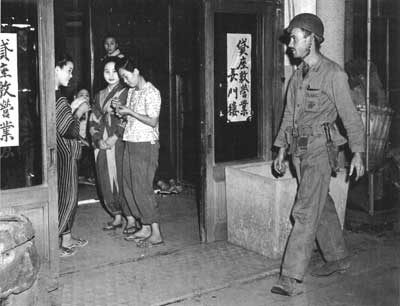
A Marine walks past young Japanese women on a routine patrol.  Thousands of vials of poison were distributed to thousands of young girls in preparation for the “invasion”. (USMC Photo)

________________________

According to “Escape from Manchuria”, Father Byrne made a recovery back in the United States after the war and was elevated to Bishop when he was sent to Korea in 1947. In 1950, he was captured by the North Koreans and once again was subjected to horrifying treatment and captivity before being put on the Korean War equivalent of the Bataan Death March.

He fell ill during the march in freezing conditions and when he could not continue, he was taken to a shack. There, on a frozen floor and without any warmth, he passed away on November 20, 1950 at a place called Ha Chang Ri, North Korea.

(Note: Edited Feb. 2, 2014.  For some reason, the photo of Father Patrick Bryne had been removed.)

“Dear Courageous Sailor” – a Letter from 1943


Marines82large
Marines escort Saipan civilians. It was estimated that 22,000 civilians died, most by suicide. It was traumatic for our young Marines to witness, too.

There is personal pain in a full-fledged war that only those who were fully involved can feel.  Those feelings will differ by how that person was involved.

We somewhat understand through survivors that a soldier, airman, sailor or Marine near or on the front lines will have an intimate kinship with instantaneous fear.  They know combat is immediate, unfair, cruel, and barbaric.  But hopefully, they know their families and country are behind them – perhaps giving them the edge to overcome their fears and survive.

And this is true for the enemy as well.  As I become more knowledgeable on the Pacific Theater during WWII, I have learned the young Japanese combatants had the same fears (please see “There’s No Toilet Paper in the Jungle of Burma“).  But unlike the Allied forces who had millions of tons of war materiel, food and medical care backing them, the Japanese military fell way short.

But what about the Japanese home front?  Have you paused to ponder that?  Were their countrymen any different from us in their ways of supporting their young men dying by the hundreds of thousands?

I never did myself until recently.

____________________________

I met Rob on the internet through his facebook page, “WWII U.S. Capture Photos“.  He focuses on the spoils of war, bringing back to the forefront the war souvenirs seized by military personnel.

He acquired a letter from a now elderly Marine who was fighting on Saipan in mid-1944. He had told Rob that he removed it from a Japanese corpse.

japaneselet2
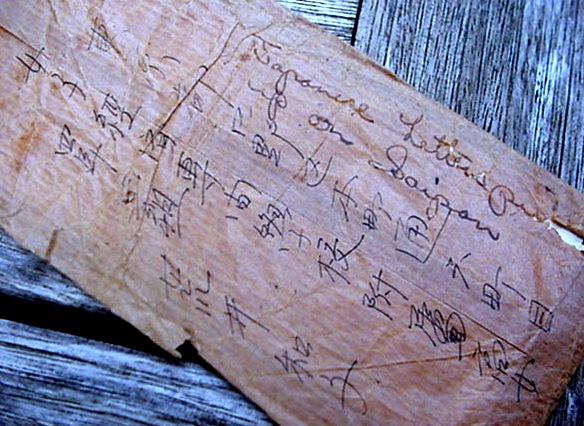
The now tattered envelope is anonymously addressed to”海軍の勇士様” or “Dear Courageous Sailor”.

Apparently, this letter had ended up to haunt the Marine who was at time very young and fighting for his life on Saipan.  The once young Marine is pictured in the center of this photo:

Marine Saipan
The young Marine who seized this letter is pictured in the middle. For an original image, please click on the picture.

Rob asked if my father could read the letter and translate it.

The letter was haunting Rob, too.

______________________________

My friend and I went to see Dad in October 2013.  Below, Dad is reading the letter taken by the then young Marine from Saipan in 1944.

IMG_1032

The backside of the envelope is below showing the sender’s name and return address.  The image was enhanced to bring out the writing.  The Marine had written “Japanese letter picked up on Saipan”.

The letter was anonymously addressed and sent by a young girl named “Kazuko Arai (荒井和子)”.  The return address shows she was a student of a girl’s economics school in Tokyo, Nakano City, town of Honcho (東京都中野区本町通六丁目女子経済専門学校 – 附属高女).  While I believe the school may have been at least damaged by the fire bombings, I may have located the successor school. It is called “Nitobe Bunka Gakuen” with its current address as 東京都中野区本町6-38-1.  (While I did send a blind email of inquiry to them in my far from perfect Japanese, there has been no response.  I doubt that there will be given the Japanese culture.)

culetter1

While the scans were of low resolution, the two pages of the letter are as follows:

japaneselet3
japaneselet4

Because my father  will be 95 next month, it was difficult to keep him on course.  In spite of reminding him to just read the letter in Japanese (I would understand most of it), he continually tried to translate its sentences into English.  Perhaps somewhere in his buried conscious, he is doing as he was trained by the US Army’s Military Intelligence Service.  Admittedly, there were about a half-dozen characters that were just tough to make out due to creases and lack of clarity.  And he wasn’t able to figure out one paragraph in particular…but I did!  Got one on my old man.

I also sought out help from my good Hiroshima cousin, Kiyoshi, and he filled in the blanks.

Kazuko wrote:

夏も過ぎさり戰局は日一日と厳しく今こそ物心はおらか私どもう総べてを国家に捧げつくすべきと秋となりました。
As summer passes and turns into autumn, the war situation is getting more severe and now we must physically and mentally dedicate ourselves for our country.

海上での勇士様にはお変わりなく軍務に御精勵(励)の事を存じます。
As a courageous sailor out at sea, I know your unwavering fighting spirit continues.

大東亜の全戦線に於いては、今や彼我の攻防戦は、まことに熾烈極めて居るという事等、すでに日々の報道により私共の耳に刻々傳えられてをります。
Per our (radio) broadcasts, we hear that the intensity of battle and such has increased for both sides at all the front lines in the Far East Asia theater of war.

山崎保代部陽長以下二千名ついに全員北海の島に於いて玉砕したこの事をラジオが私達に傳へるや私達は唯聲をのみ頭をたれるばかりでした。
A radio broadcast announced that Lt. General Yasuyo Yamasaki and 2,000 of his  garrison died honorably defending an island in the North Sea.  All we could do was bow our heads (in honor) and swallow our  grief (voices).

– – – – – – – – – – – – – – – – – –

[ NOTE: In researching this report, I discovered that Lt. General Yamasaki was assigned to defend the island of Attu.  He was killed with his remaining garrison in a banzai charge on May 29, 1943.  Please click on the following for more information:
My cousin Kiyoshi also found an extensive accounting of the Battle of Attu in Japanese with English translations for those who are interested.

– – – – – – – – – – – – – – – – – –

(Letter continues)

今私達は本当に容易ならぬ戰争の只中におかれている事を強く感じました。
Now, with the daily war situation, we strongly feel as if we are in the midst of the battle and realize (winning) will not be easy.

学校ではもうじき秋の軍動會が開かれますので一生懸命身体をきたへてをります。
Soon, it will be time for the autumn (military) athletic meet; I will train hard to strengthen my physique.

断じて米英女性には贁けない覧唔です。
We resolve to not lose against the American and English women.

ではどうぞう勇士様くれぐれ御身体御大事に大切にお国の為しっかり戰って下さい。御武軍を祈り致します。
So please, courageous sailor, sincerely take good care of yourself and fight hard.  I pray for your fighting spirit.

さよなら
Good bye.

_____________________

So now we realize that Japan also had a “home front”.

Perhaps they did not have a “Rosie the Riveter” like we did.

But the Japanese homeland did endure pain, fear and sorrow as we did…and depression.  They were not the inhuman creatures depicted on war posters and in propaganda of that time.  And thanks to Rob and the young Marine, we see a letter written in Tokyo by a high school girl named Kazuko Arai in the autumn of 1943 and simply addressed to an anonymous sailor.  Kiyoshi also believes that the watermarked stationery was of high quality and issued out of military stock for this purpose.

Sadly, we do not know the name of the sailor from whose corpse the letter was removed from, nor do we know if Ms. Arai survived the war and raised a family.

showa8
Picture taken at Kazuko’s school pre-war.

Things like this sort aren’t evident in our (current) history textbooks.  Now, WWII has pretty much been erased from school textbooks altogether, replaced by “politically correct” topics…that there was simply a war between Japan and America.  A disgrace to those who endured or died.

In closing, there is a diary written by a young Japanese doctor up to the time of the final banzai charge on Attu.  He was one of the attackers who was killed.  As mentioned in my other posts about the Military Intelligence Service, Japanese military forces were allowed to write diaries.  When these diaries were taken from the battlefield, the Japanese-Americans (Nisei) soldiers were able to read then extract valuable intel on the enemy – both for their battle front and their homeland.  In his last entry, the young doctor writes a goodbye to his wife and two small children back home.

Young Japanese doctor’s war diary

Vintage Japanese Art


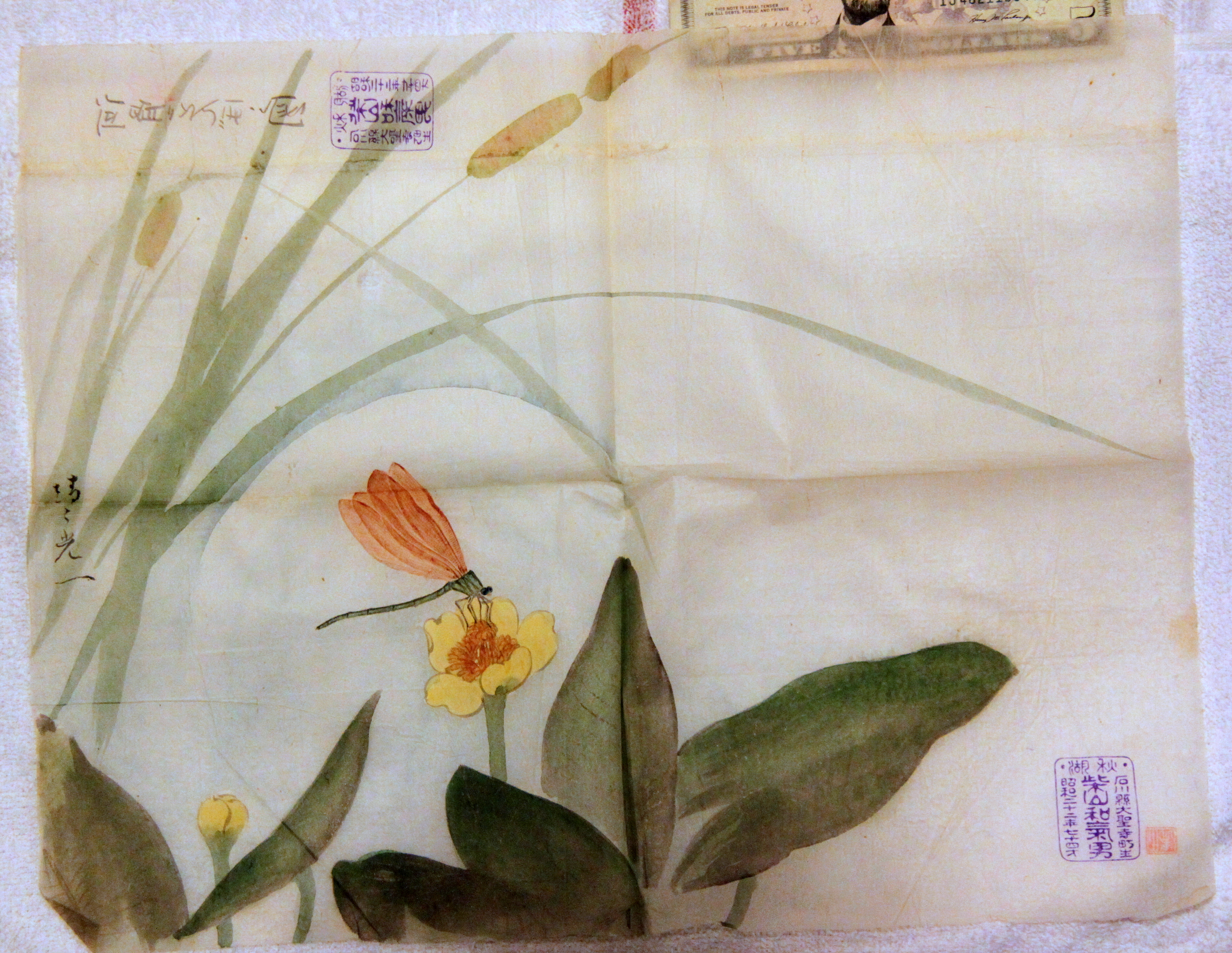
dragonfly

My Aunt Eiko had these in a brown paper bag of all things.

Hundreds of old Japanese artwork kept by my Great-Grandfather Wakio Shibabayama.  Born August 17, 1874 in Kaga City of the Ishikawa Prefecture.

Sumi-e.  Watercolors.  Sketches.  On thinner-than-tissue rice paper.  Dog-eared from what appears to be many years of handling by my Great-Grandfather.

________________________

My Aunt Eiko’s knowledge of Wakio (her grandfather on her mother’s side) is unfortunately sketchy.  No pun intended.

Her knowledge of these paintings is even sketchier unfortunately.

But they survived the war and I don’t know how they did.  They are so fragile to say the least.

Surprisingly, some artwork was painted on several sheets of rice paper glued together.  I don’t know what kind of glue it was but it sure beats Krazy Glue.  And it’s non-toxic to boot.  I think.

_______________________

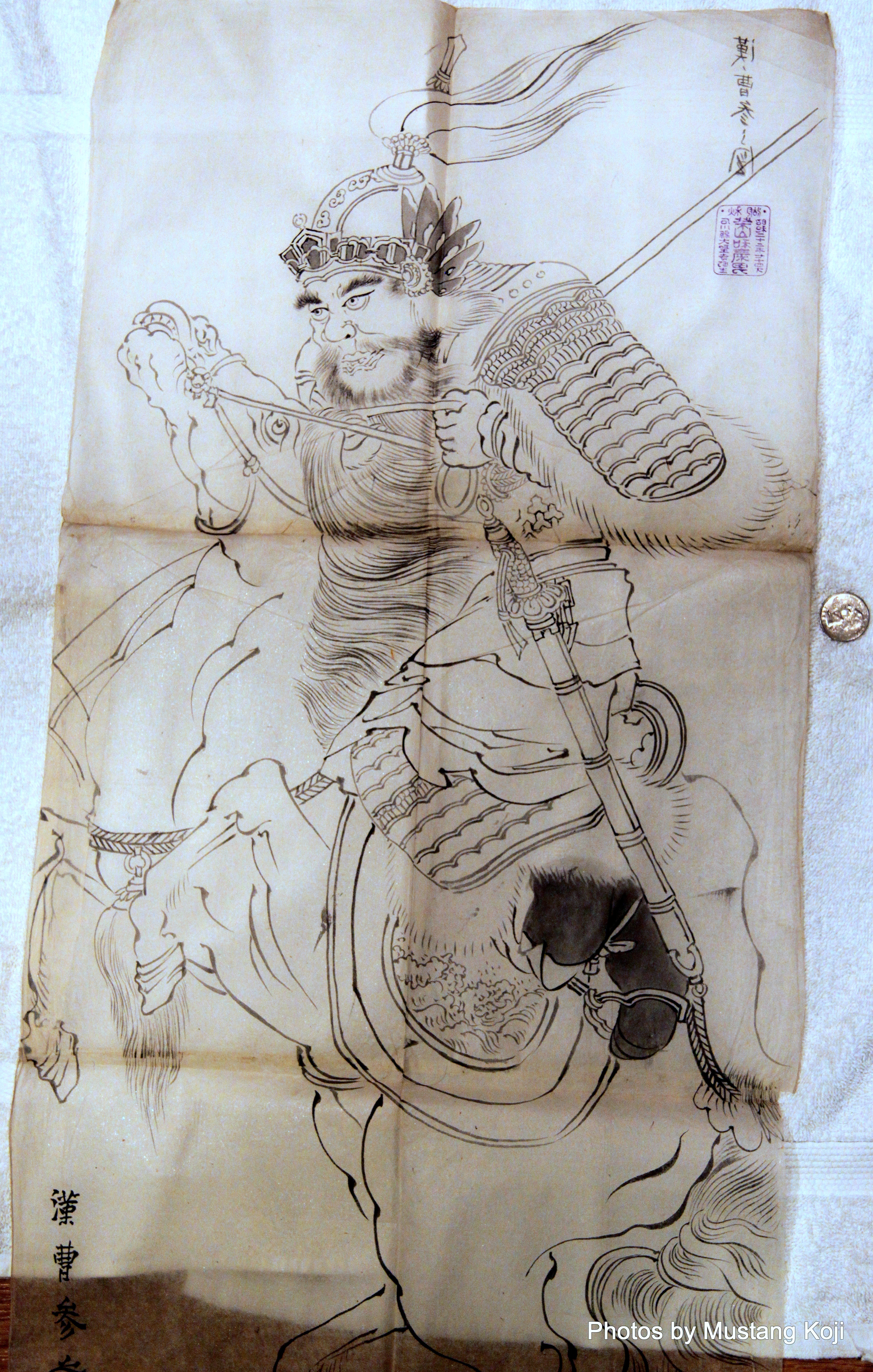
armor
An apparent samurai in full armor.

Aunt Eiko knows Wakio was an accomplished artist and that he taught art in his senior years.  In Japan (and unlike here), professors were elite.  And quite a few of them were samurai towards the end of the 1800’s.  Unbeknownst to many Westerners, the Japanese government began banning the samurai around 1870 to bring civility to society… but by then, the samurai had begun transitioning to a peaceful life philosophy.  Many took up art.

And I’m not saying Wakio was samurai… but my mother drummed it into my head that “her” family heritage WAS samurai. lol

Aunt Eiko remembers Wakio passing away when he was about 80.  (It does appear that long life is in one’s genes.)

She has little information about this collection.  She recalls these sketches and watercolors were done by his students…perhaps as assignments.  I can read some of their names.

But my Great-Grandfather’s “hanko 判子”, or seal, is stamped on all of them.  In fact, there are several variations of his seal through the years.  You can see them on the samples.

Aunt Eiko also remembers that “a couple of his students” became well-known artists but cannot recall their names.

Here are some samples.  Currency can be seen for reference; in some photos, you can actually see how thin the rice paper is:

goose
This appears to be one of the oldest in his collection. Undated.
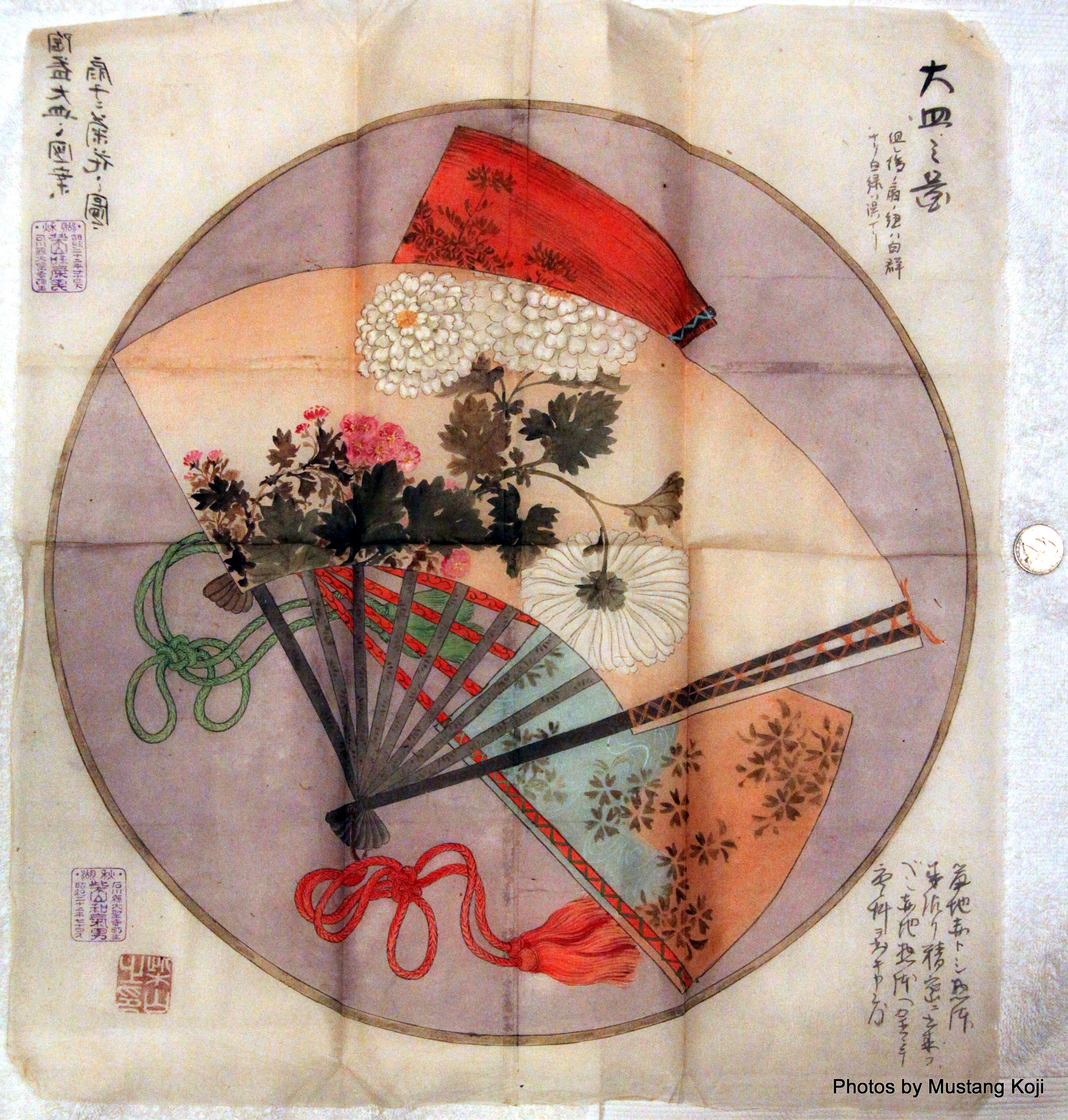
fan
Detail of the brush work can be seen immediately below.
fan close up
A close up of the brush detail from the fan painting immediately above.
turtle
In spite of being folded for decades, the serenity of this piece still shines. You can see right through it, too.
performers
Appears to be street performers from old Japan.  You can also see it was painted on several sheets glued together.
warrior
A dramatic sketch of what appears to be a non-Japanese warrior. Undated.
gorge
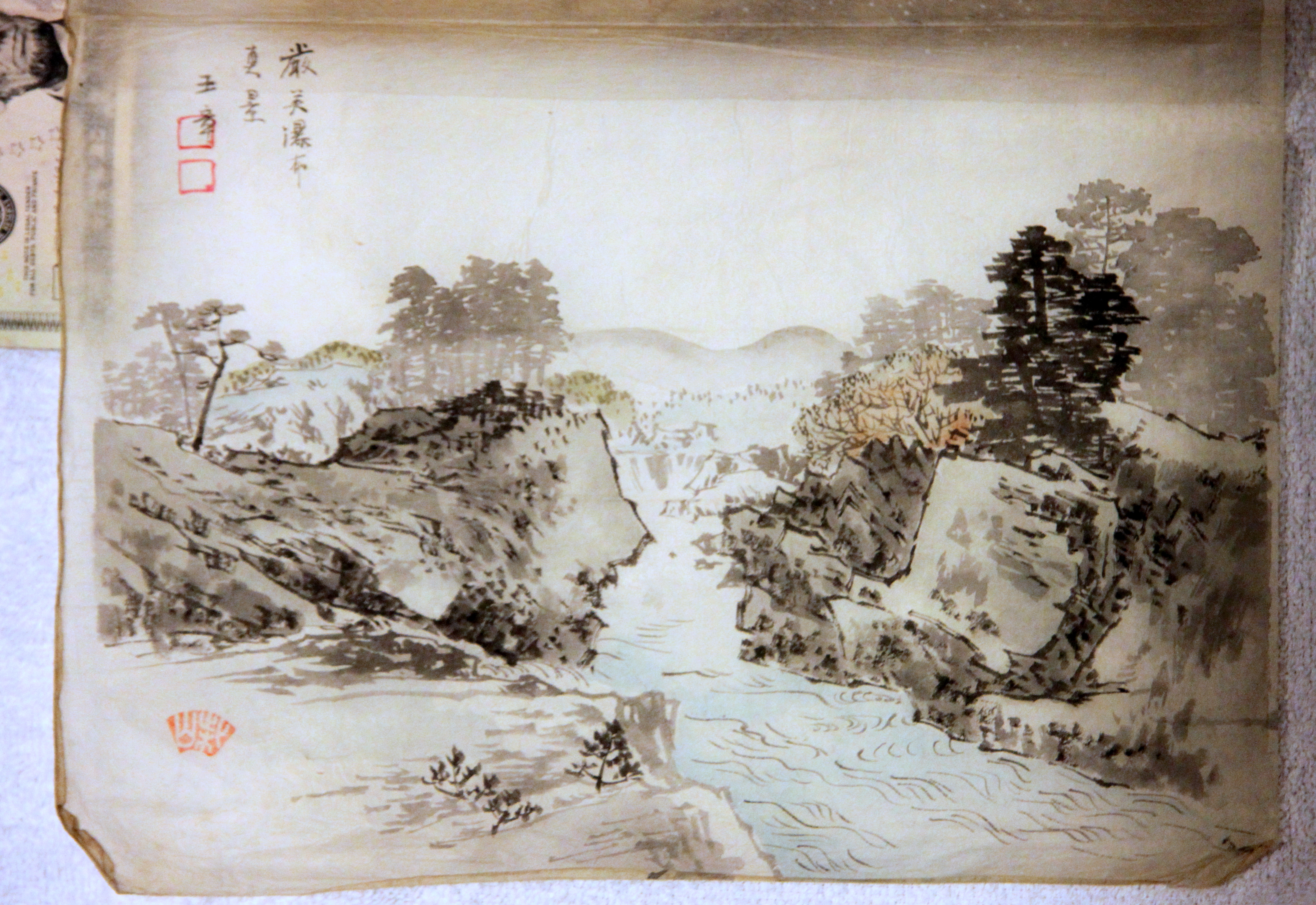
A serene painting of a gorge.

dragon lily

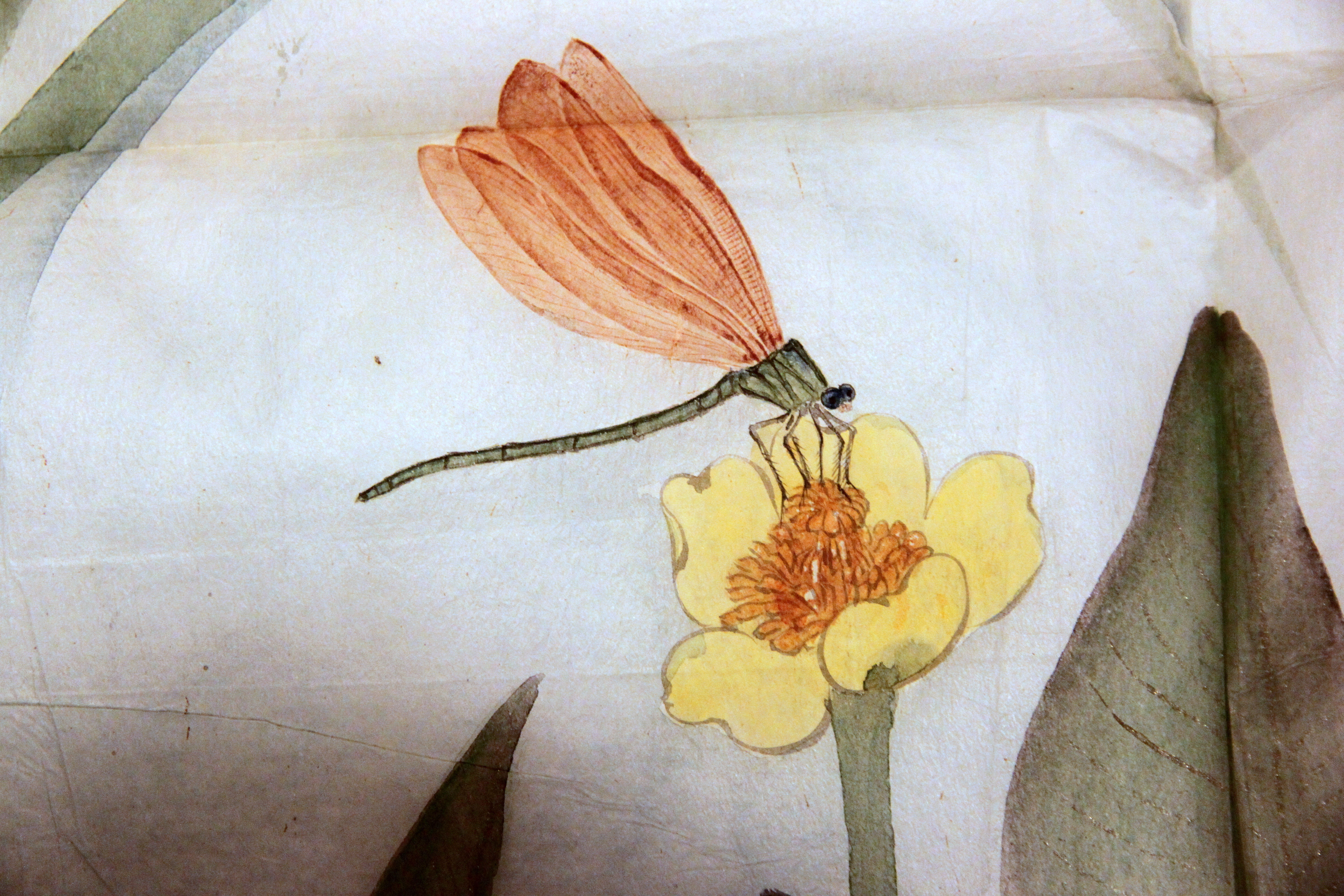
dragonfly closeup
You can see the remarkable attention to the detail in this close-up…down to individual brush strokes.
syllabus
A fragile rice paper booklet written in Wakio’s hand… all with a brush and carbon ink. You can also see ties at the right. I don’t know exactly what it is but there is a reference to the “43rd Class” in red at the upper right. Perhaps this was his syllabus.  The seal in blue states 1947 and he was 74 years old.  The red seal apparently functions more like a signature.

________________________

But as mentioned, Wakio was an accomplished artist.  Not to say he was famous.  Just accomplished.  My family has several of his original silk paintings, one of which is shown below.

wakio painting

We don’t exactly know where Wakio sought refuge during World War II but these delicate art pieces from long ago survived.  My aunt believes my grandmother inherited these from him upon his death.

And here is the one photo I have of my Great-Grandfather Wakio Shibayama.  You can see it on the scroll above.

wakio1

Too bad Sony hadn’t invented portable digital voice recorders.  I would have liked to have heard the story behind these remnants Old Japan.

“Old Man Jack-ism” #4


Day after tomorrow – two years ago – Old Man Jack left us. He would be free of his nightmares of war which plagued him nightly for seventy years. While it is self-serving to reblog your own story, I am reblogging this for the sake of men like him who gave away their youth to serve in hell. People today need to KNOW and REMEMBER.  I regret the huge majority of Americans today are ignorant of what people had to do so that we can enjoy – and complain – of what we have today.
Rest in peace, Jack. I will try to visit you today to say hi.

Mustang.Koji's avatarMasako and Spam Musubi

“Koji, don’t let anyone tell you different.  War makes good boys do crazy things.”

That was the first time Old Man Jack shared something with me about the war in a voice of unfeigned remorse.  In turn, it was one of my first journeys in his time machine in which he allowed me to ride along.

Front row seats.  Free of charge.

It was in 2002 to the best of my recollection.  It was just before my littlest firecracker was born.

__________________________

KA-BAR.  If you are a World War II US Marine who served on “those stinkin’ islands”, there is no explanation necessary.

A KA-BAR was a Marine’s most prized personal possession.  It was always at their side.

They opened their C-rations with it.  Dug foxholes with it.  Chopped coconut logs with it.  Hammered nails with it.  Indestructible.

Most importantly, for killing.  Designed for slashing and stabbing.  Desperate hand-to-hand combat.  To the death.

The KA-BAR…

View original post 472 more words

Graciousness, Gratefulness and Grandeur


q00893001u00132
From http://www.entaijisou.com

My girl friend Linda fretted for a couple of weeks before going to Japan with me.

She fretted about the (we-know-they’re-coming) typhoons.

She fretted about the (we-don’t-know-they’re-coming) earthquakes.

But what did she fret about the most?  She fretted about getting butt-naked in front of my cousins for a Japanese-style bath at a hot spring in Japan.

Silly lady…  All Japanese do that.

Oops.  I forgot.  She is Irish with blue eyes.

Well, I guess if I were her and experiencing a panic attack, I’d just put a brown paper bag over my mouth… and drink all the scotch inside.

That would help.  After all, she is Irish.

___________________________

IMG_6615
The hot spring inn, “Entaijisou” or 延対寺荘.

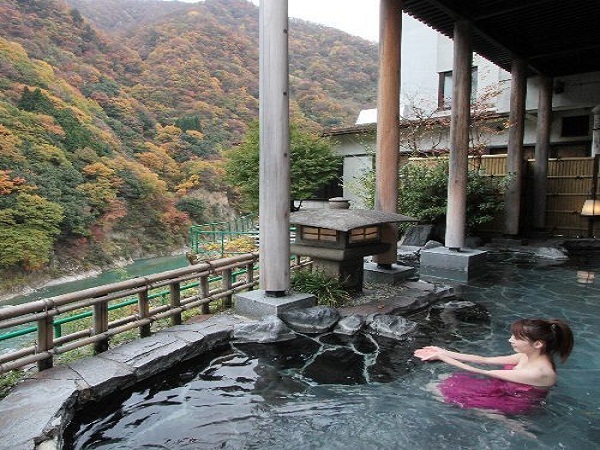
During our ten-day visit to Japan in November, my cousin Kiyoshi (Masako‘s youngest brother) treated us to a most wonderful journey to Toyama Prefecture, just inland from the Sea of Japan.  One such destination was famous for its hot springs and a beautiful gorge. We stayed at the inn called “Entaijiso (延対寺荘)” near “Unazuki Hot Springs (宇奈月温泉).”  Started in 1900, the hot spring’s water is naturally heated to a most perfect temperature and has an open-air spa area called a “rotenburo (露天風呂)”.  Literally, you are soaking outside under the heavens.  Butt-naked.

Of course, I was unable to take photos inside the bathing area for obvious reasons but here are other photos from their website to give you a taste of the relaxation that can be had.

qspa004   355206239

Yes, my Irish lady did go in with my (female) cousins!  In a form of endearment, my cousin Masako even washed her back.  Butt naked.  After relaxing in the water for a while then dry off, you notice your skin is just ultra silky smooth.  My cousins did say the geothermically heated ground water has therapeutic powers…  That there is some kind of magical healing power bubbling up.  I kind of doubted it.  But there IS something in the water. 🙂

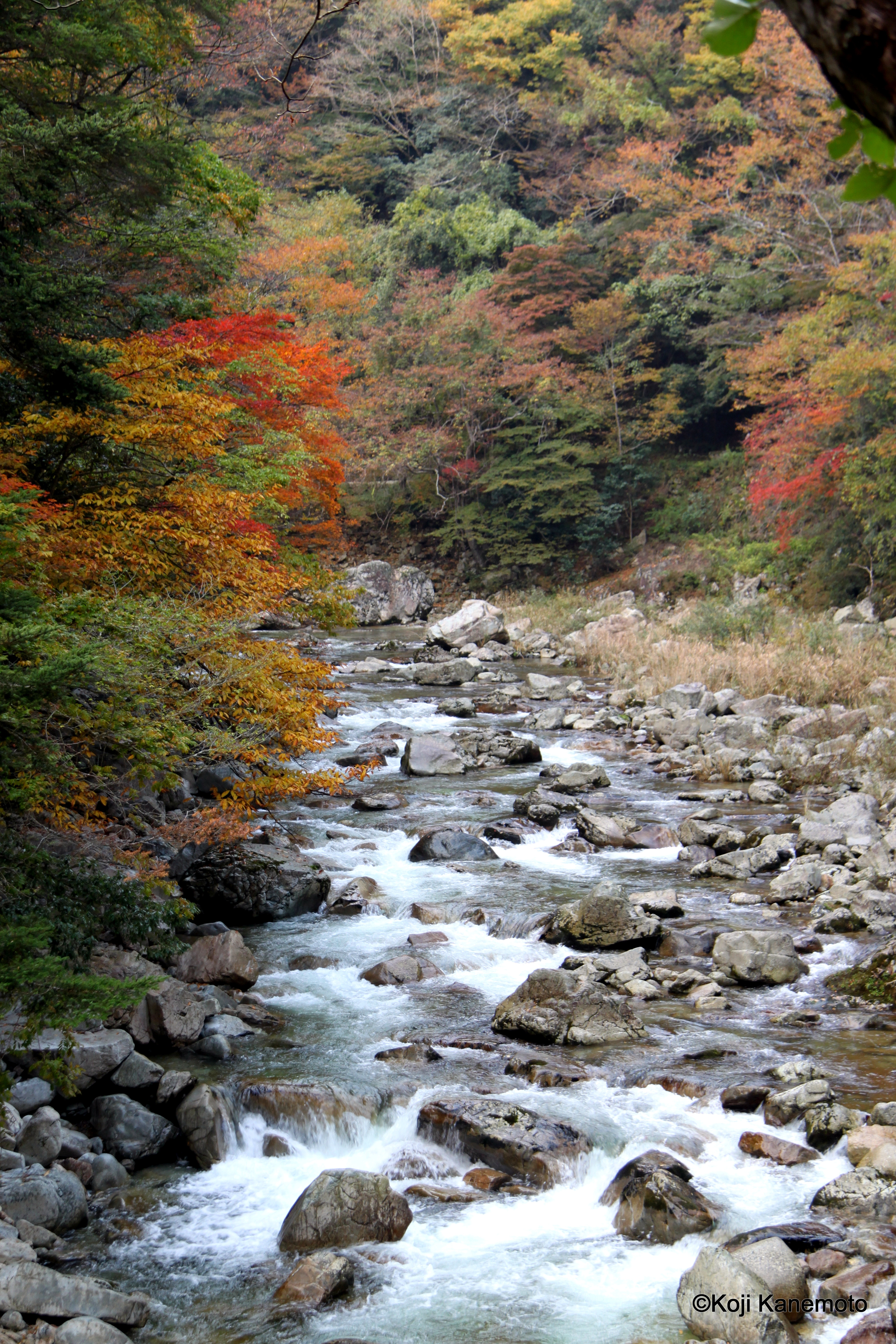
Their dining area was spectacular; just outside is the river and magnificent mosaic-colored hillsides – a post card panorama.

IMG_6623

IMG_6611

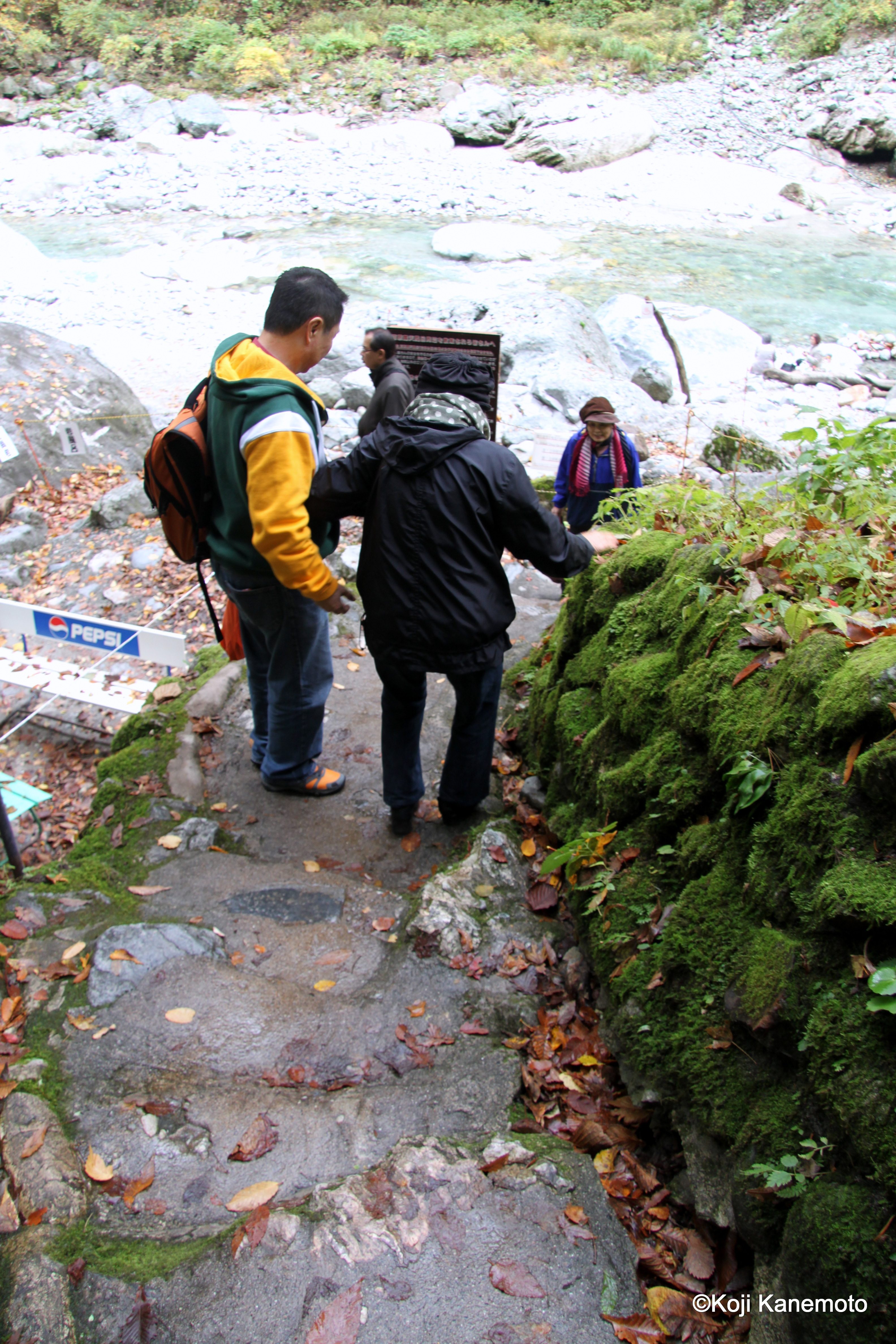
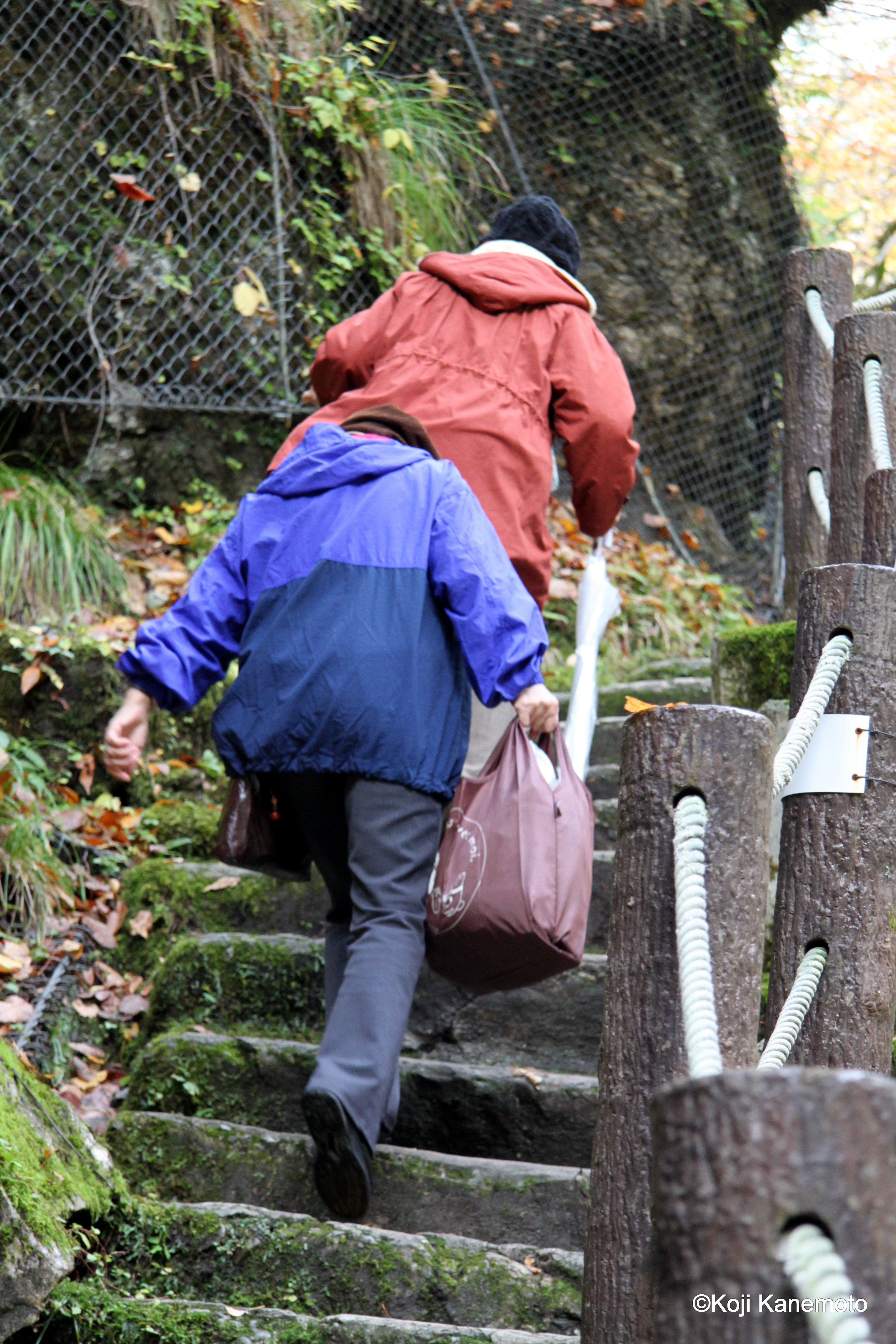
Kiyoshi’s gracious treat continued on the Kurobe Gorge Tram (黒部峡谷トロッコ).  It is a a sightseeing train running on a very narrow track originally built to aid the construction of the Kurobe Dam.  It follows a winding path along the river – something like 20 kilometers from the base station of Unazuki to the end.  We we there unbelievably at their peak of the autumn color change.  It is important to note we hiked a bit after getting off the tram at Kanetsuri Station – and my cousins below LED the way.  While Masako has difficulty going DOWN stairs, she was a jack rabbit going up.  Amazing.  At 80 years of age.

IMG_6628
My cousins (L to R): Tomiko (71), Masako (80), Namie (74) and Kiyoshi (65).

I will let the photos show you the grandeur we were so fortunate to experience.  (Please note many of these were taken from the moving tram.)

IMG_6919

IMG_6736

IMG_6789

IMG_6812

IMG_6850

IMG_6731

IMG_6982

IMG_6725

IMG_6985

IMG_6977

IMG_6988

IMG_7024

IMG_7029

IMG_6943

IMG_7047

IMG_7050

IMG_7015

IMG_7070cif76nib_original

IMG_7020

IMG_7080

11045645333_cf1fd0d47e_o

11045483675_ce338a3c77_o

IMG_7176

AND A “I SPY WITH MY LITTLE EYE”…  Can you spot it?  There is a wild red faced monkey below.

IMG_7167

__________________________

Prior to getting into the hot spring and public bath, I tried to relieve her anxiety.

I said, “When in Rome, do as the Romans do.”

She replied, “They sinned.”

__________________________

I was proud of my blue-eyed Irish lady friend.  She got into the public bath and hot springs butt naked.

And even got her back scrubbed by Masako, a survivor of an atomic blast.

Imagine that.

From a Japanese hot spring, I have learned that spreading peace for the world starts as a power that emanates from within one person.

Ten Beautiful Days


Embarking on a ten day vacation to a land far, far away needs a lot of one’s time to prepare… one reason for my recent absence from WordPress.  Not that anyone would notice, of course.

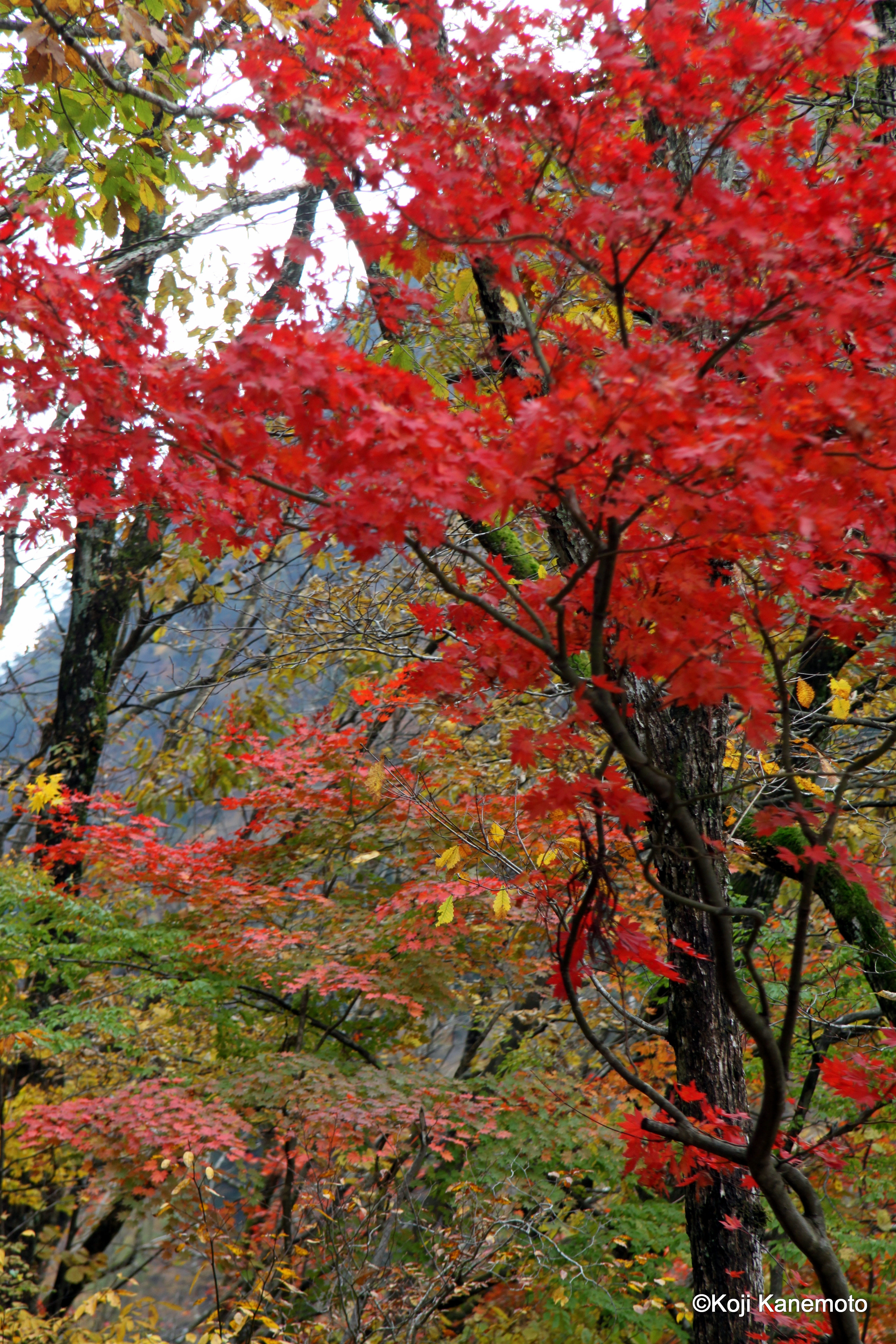
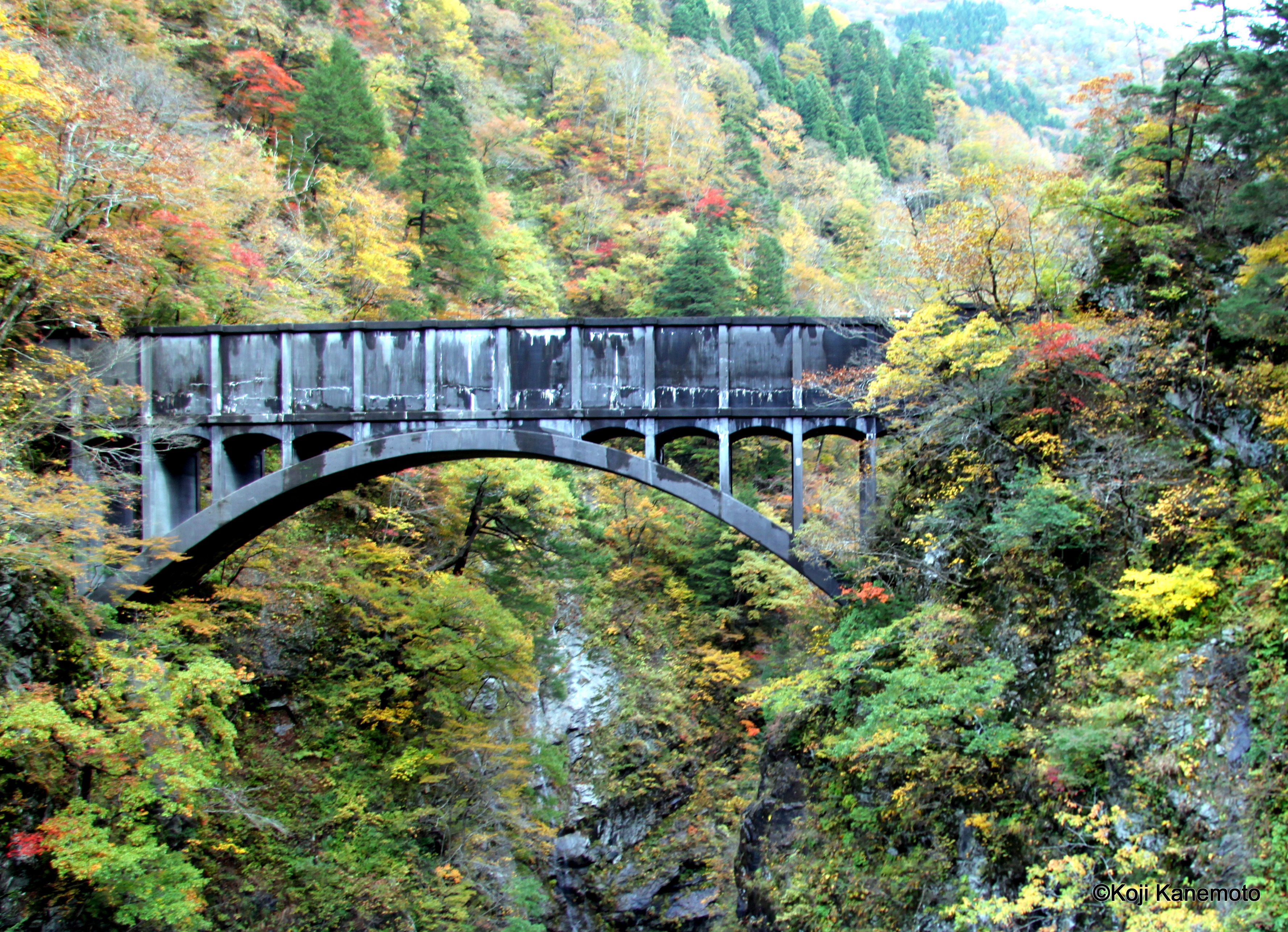
For now, just some colorful images of nature taken during the journey to Japan I immensely enjoyed… which would not have been possible without the unqualified help from my Hiroshima cousin Masako – after whom this blog is named – and her extended family.  Hopefully, time will permit sharing more of this glorious journey – and enlightening in ways I could never have imagined.

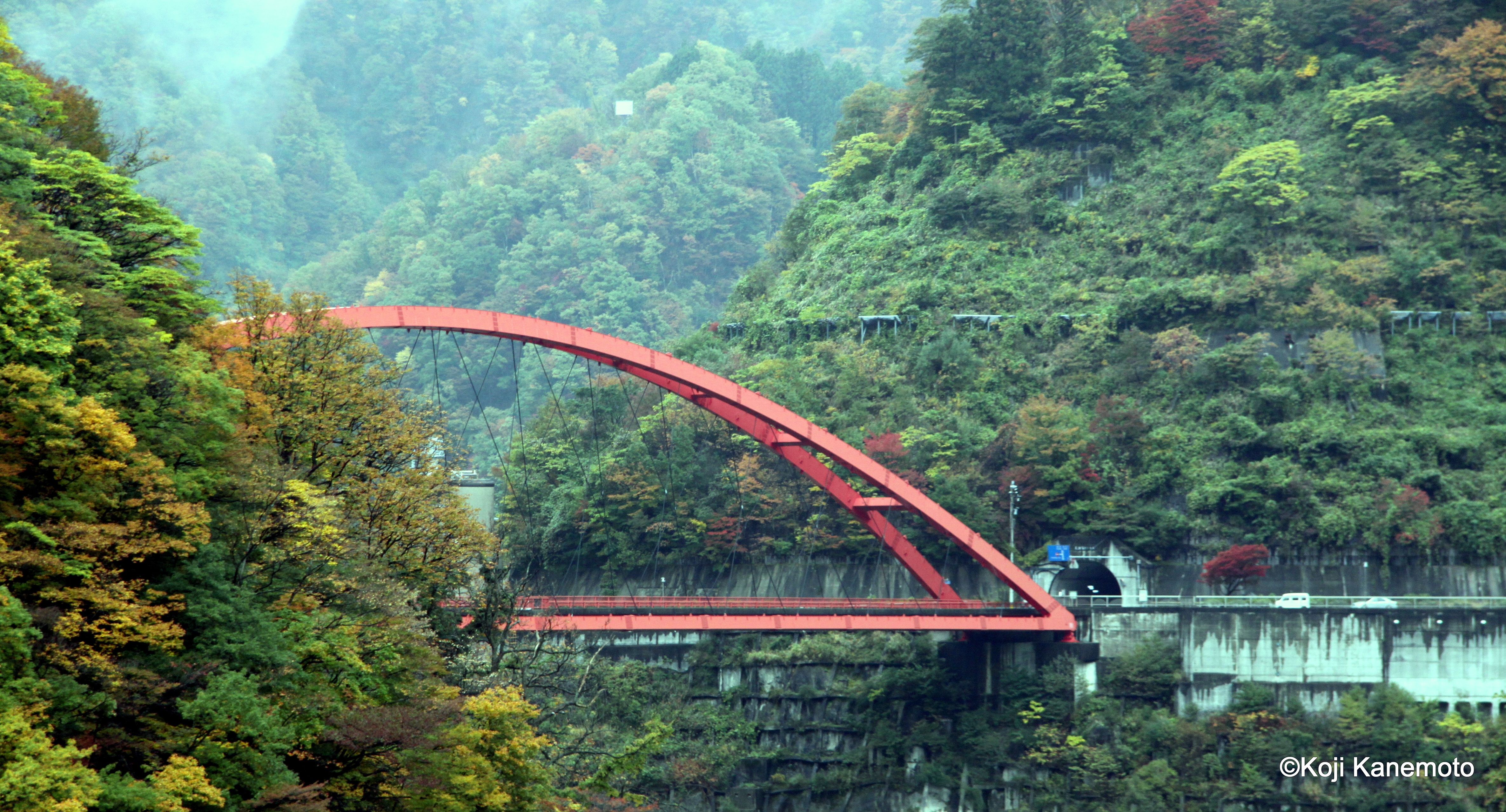
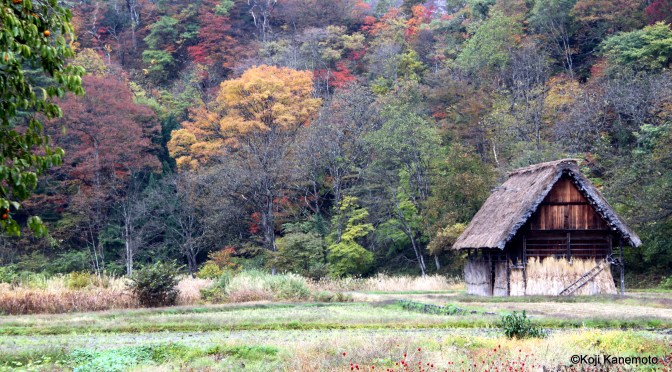
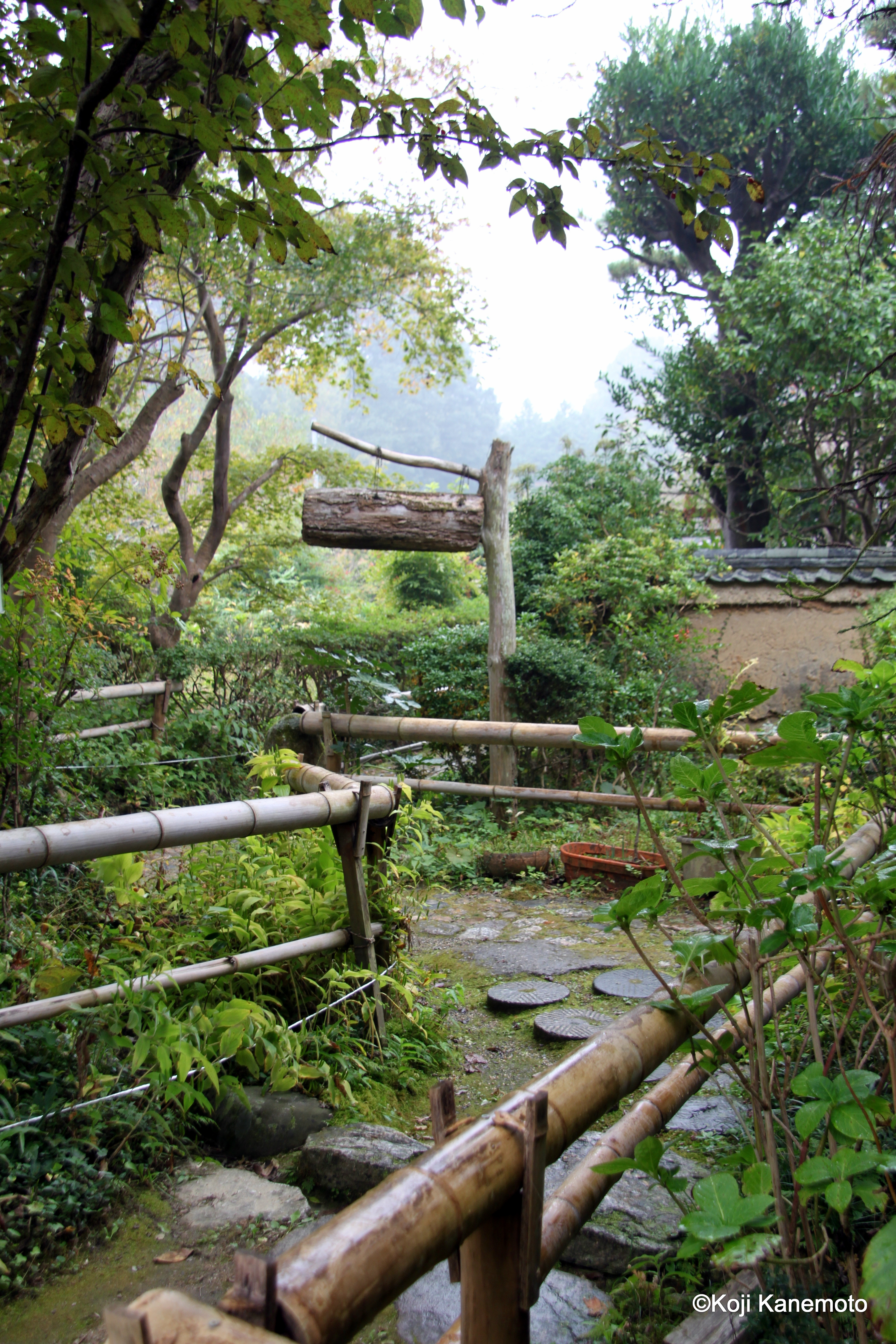
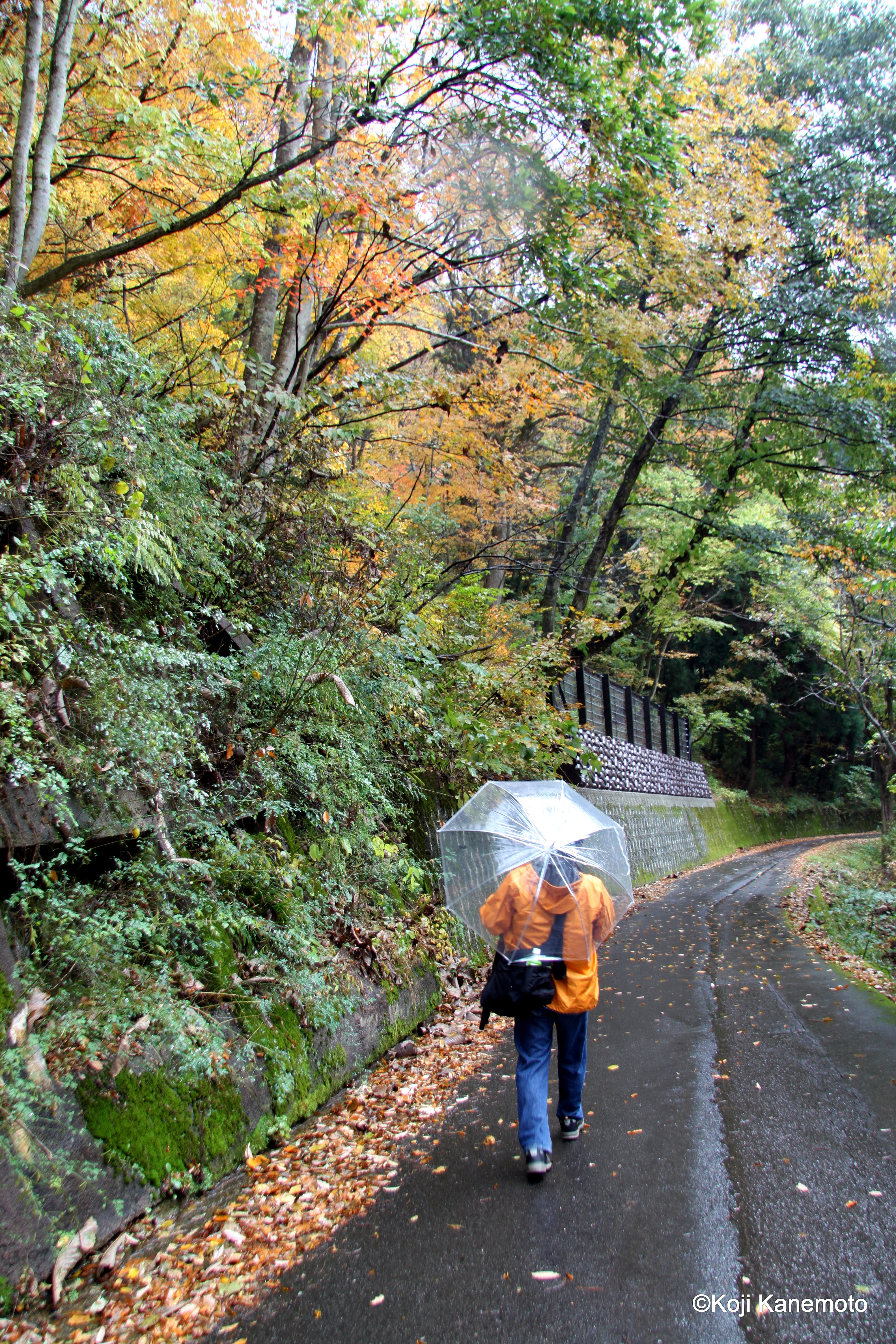
So for now… Japan in autumn.

IMG_6581

IMG_6066

IMG_6010

IMG_6210

1399582_464136303707487_401056106_o

IMG_6485

IMG_6164

IMG_6158

IMG_6207

IMG_6505

IMG_6052

IMG_6735

IMG_6154


Dear Mama – A Farewell Letter


image0-012
Uncle Suetaro (L) and my dad (R). Taken from the Hiroshima house with Mt. Suzugamine in background. Circa 1929

During my visit to my father’s childhood home in Hiroshima last summer, I was entrusted with hundreds of vintage family photos and mementos.  I brought them back here stateside, promising my Hiroshima family I would “restore” them.

Well, after a good start, I developed a painful case “tennis elbow” from using the mouse so much during the retouching process.  Sadly, it came to a screeching halt sometime in November last year.

But one very, very special item was entrusted with me – my Uncle Suetaro’s war diary.

Although born an American citizen in Seattle with the rest of his siblings, he was writing this war diary as a sergeant in the Japanese Imperial Army.

The last entry was a farewell letter to his Mother.

______________________________

The photo above had been secreted away behind another photo that was in Uncle Suetaro’s album.  He meticulously kept the album up to the time of war.  His oldest brother, my Uncle Yutaka, had conscientiously sent him family photos they had taken in Chicago and Los Angeles before imprisonment.  Suetaro complimented the photos with his beautiful Japanese calligraphy, written in a silver, whitish ink.

20131007_183754

The photo of Uncle Suetaro and my dad shown at the beginning was so very tiny – but there was something Uncle Suetaro loved about it to keep it.  I wish I knew what it was.

IMG_0451
Actual size

__________________________________

Uncle Suetaro was killed as a sergeant major of the Japanese Imperial Army on Leyte apparently near a town called “Villaba”.  Below is an actual page from a “war diary”, an official report written and published by the US Army.  Villaba is located on the western shore of Leyte but not far from Ormoc Bay, which was a killing field for Japanese ships by US aircraft.

Page 109
Source: US Army 81st Infantry Division Headquarters / Report of Operations

His remains were never recovered.  In the family grave are his tiny pieces of his fingernails and a lock of hair.  It was custom at that time to leave parts of your earthly body with your family as returning was unlikely.

Not much to bury… but it was better than not returning at all.

In a spiritualistic way, he had never left.

____________________________________

This is his farewell letter to his Mother (my Grandmother).

It is clear it was very hurriedly written.

With the help of my cousin Kiyoshi in Hiroshima and my dad, we’ve typed up Uncle Suetaro’s farewell letter – complete with old Japanese characters and translated as best possible into English.  When reading this, please remember these are the words as written as a soldier going off to fight the Americans – but he was once a young American boy born in Seattle, WA.

image0-038_originalhigh
Cover. His name is at the bottom.
金本 末太郎
image0-034_original
ママ様
Dear Mama,
御無沙汰致しました。
I am sorry for not writing for a while.
お元気ですか。 自分も相変わらず元気旺盛御奉公致しております故、何卒ご放念く
ださい。
How are you? As usual, I am full of life fulfilling my duty to my country so please feel at ease.
(元気で国のために力を尽くしてるので心配しないでください)
愈(いよいよ)自分も日本男子としてこの世に生を受け、初陣に臨むことを喜んでいます.
More and more, as I realize I was born into this world as a Japanese male, I am overjoyed to be going into my first combat.
勿論(もちろん)生還を期してはいません(生きて帰ることは思ってはいません)。
Of course, I do not expect to come back alive.
image0-035_original
併せ(しかしながら)自分に何事があっても決して驚かないように、また決して力を
落とさないよう平素より力強く暮らしてください。
And for you, Mother, whatever happens, do not be taken by surprise and please fight back with even more energy than you normally would.
24年の長いあいだスネかじりにて非常にご心配をかけ誠にすいませんでした。
I deeply apologize for these 24 years of worry and concern I have caused you.
お赦し下さい(おゆるし下さい)。
Please forgive me.
今の時局は日本が起つか亡びるかの境です。
At this time, Japan is at the boundary of either winning or perishing.
どうしてもやり抜かねばいけないのです。
We must persevere.
兄さん達を救い出すことも夢見てます。
I still dream that we can free our older brothers (from forced imprisonment in America by FDR – Ed.).
自分のことは決して心配せずお体をくれぐれも気をつけて無理をしないよう長生きを
してください。
Please do not worry about me but instead, please take it easy on yourself and live a long life.

(Note: Green indicates an edit inserted for clarification purposes.)

image0-036_original
何事あっても荒槇、小林の方に相談して下さい。
If something comes up, please discuss it with the Kobayashis or Aramakis.
金本家は絶対に倒してはいけないのです。
No matter what, do not allow the Kanemoto name be extinguished.
伴の兄さんもお召の日が必ずあることと思います。
Mikizou-san will also be drafted.
(荒槇幹造さんも必ず徴兵されることと思う)
歳はとっていても軍隊に入れば初年兵です。一年生です。
Although he is much older in age, he will be treated like any other draftee. As a young recruit.
絶対服従を旨とするようよく言って下さい。
Implore upon him to obey every command without question.
近所の皆さん、河野,倉本、白井、武田、永井、正覚寺、梶田、山城、山根、杉本、
辻、河野…、橋本,西本、松本繁人、小林、中本、新宅、武蔵、水入、土井、堀田、住岡、見崎、長尾、加藤、三好、内藤、島本、(Writing continues next page from here) 宮本先生、谷口先生、慶雲寺などの人によろしくよろしくお伝えください。
image0-037_original
ではこれにて失礼します。
With that, I will say farewell.
何時までも何時までもお達者のほどお祈り致しております。
I pray for all eternity for your good health and prosperity.
南無阿弥陀仏の御6文字と共に行きます。
I go blessed with the six realms of Namu Amida Butsu.
サヨウナラ
Sayonara
昭和19年5月3日
May 3, 1944
末太郎より   ママ様へ
From Suetaro To Mama-san

His farewell send-off is pictured below.  Masako-san believes Suetaro wrote the letter around this time.  It was at gatherings such as this when a Japanese soldier was given a “good luck” battle flag – the ones that many WWII combat veterans “removed from the battlefield” as souvenirs.  There are many cases now where their sons and daughters – or grandchildren – are making efforts to return such flags to the Japanese families.

One of the treasures found during our journey to the family home in Hiroshima this month. Uncle Suetaro is going to war and his death.
Uncle Suetaro (center) is pictured just before going off to war and his death.  You will notice my grandmother is missing from the photo; that is because she suffered her first stroke knowing her last son was going to his death.

_______________________________________

Bertrand Russell wrote, “War does not determine who is right – only who is left.”

He is correct.

On a much smaller scale, though, Grandmother Kono was all who was left in that house when war’s end came.  Her precious son Suetaro – who she kept from returning to America for the purpose of keeping the Kanemoto name going – was dead.  She was now alone.  I wonder how she felt.

A mother’s anguished solitude.

image1-007retouched
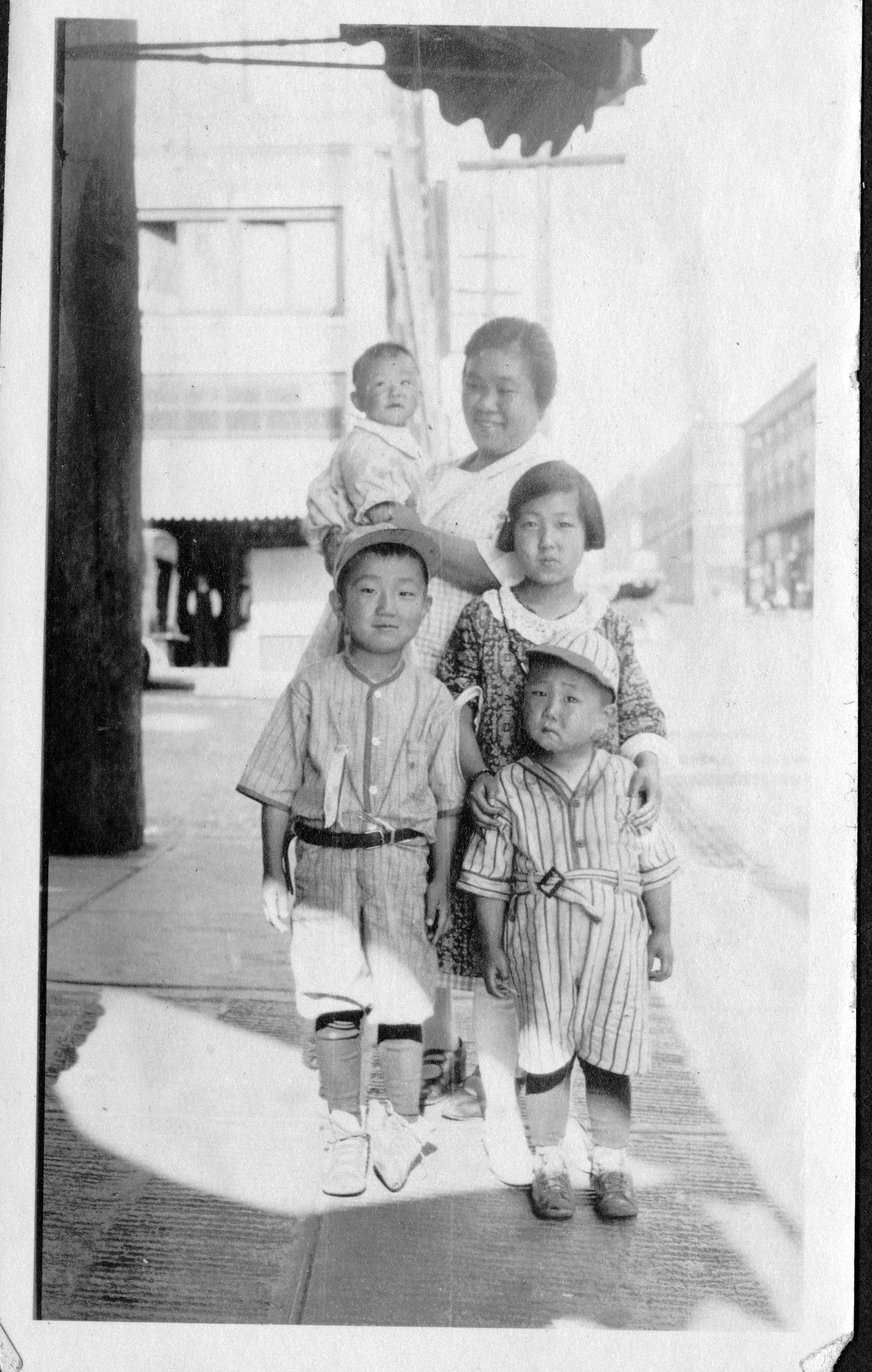
Grandma and four youngest children at the corner of King and Maynard in Seattle, circa 1926. From clockwise right-front: Suetaro, dad, Mieko, Grandmother Kono and Shizue.

(For other related stories:

A Mother’s Anguished Solitude, Part I

A Mother’s Anguished Solitude, Part II

Were Japanese Soldier’s Frightened?