She is never, NEVER ready on time. Have I said never yet?
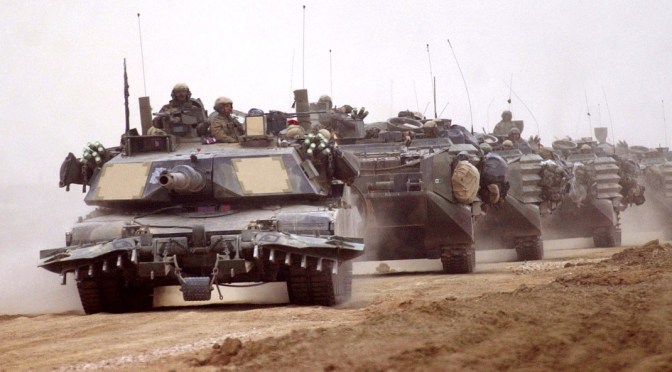
This morning was no different. I plead with her to be ready at 8:45 am, five minutes earlier because it is pouring outside. Raindrops the size of watermelons. And that means the world’s supply of crazed mothers and grandparents in their M1A1 battle tanks in desert camouflage will be assaulting the three or four dropoff places at school – all at 8:55 am. Our Marines should be embarrassed these mothers can assault the beach head on time – every time. But unlike the Marines, its every mom for herself. Damn the others. 🙂
As usual, my son is ready. He is always ready. Sometimes he forgets things like his homework – but he is always ready.
Jack is always ready – this morning at 8:45 am as I asked… The lunch box and water bottle belong to the child who always keeps us waiting…til PAST the last minute. Notice the girl shoes with the feet missing from them?
Then I begin to yell at her. “Brooke! What are you doing?? Get in the car!”
Then she procrastinates even more… She’ll do the exact opposite – like my ex does even today. She’ll run to the bathroom or decide to wear a different pair of socks or whatever. I yell at her even more as I will have to drive like a NASCAR driver just to get near the school that is a bazillion miles away. Tokyo’s closer.
It’s 8:48 am and Jack is waiting in the car as usual…for his sister. Reluctantly, I haul her 100 ton backpack to the car. It must be filled with Walmart’s entire inventory of nail polish. Well, there are books in there at least.
She finally runs to the car – in her bare feet – in the rainwater left by the watermelon-sized raindrops – while holding her socks, shoes and… hairbrush.
We get to the school as the bell rings. Jack jumps out…but not Brooke. Of course not.
Brooke suddenly remembers her mama didn’t sign an assignment sheet that was due yesterday. Crazed Marines (aka as mothers) are honking at me…while my Little Cake Boss struggles to put her Converse on while searching for that paper. I sign it. She finally jumps out but her shoes are still not completely on. Criminy.
I get home.
I see something pink and white on the back seat under her hair brush she carried into the car instead of her backpack I lugged for her.
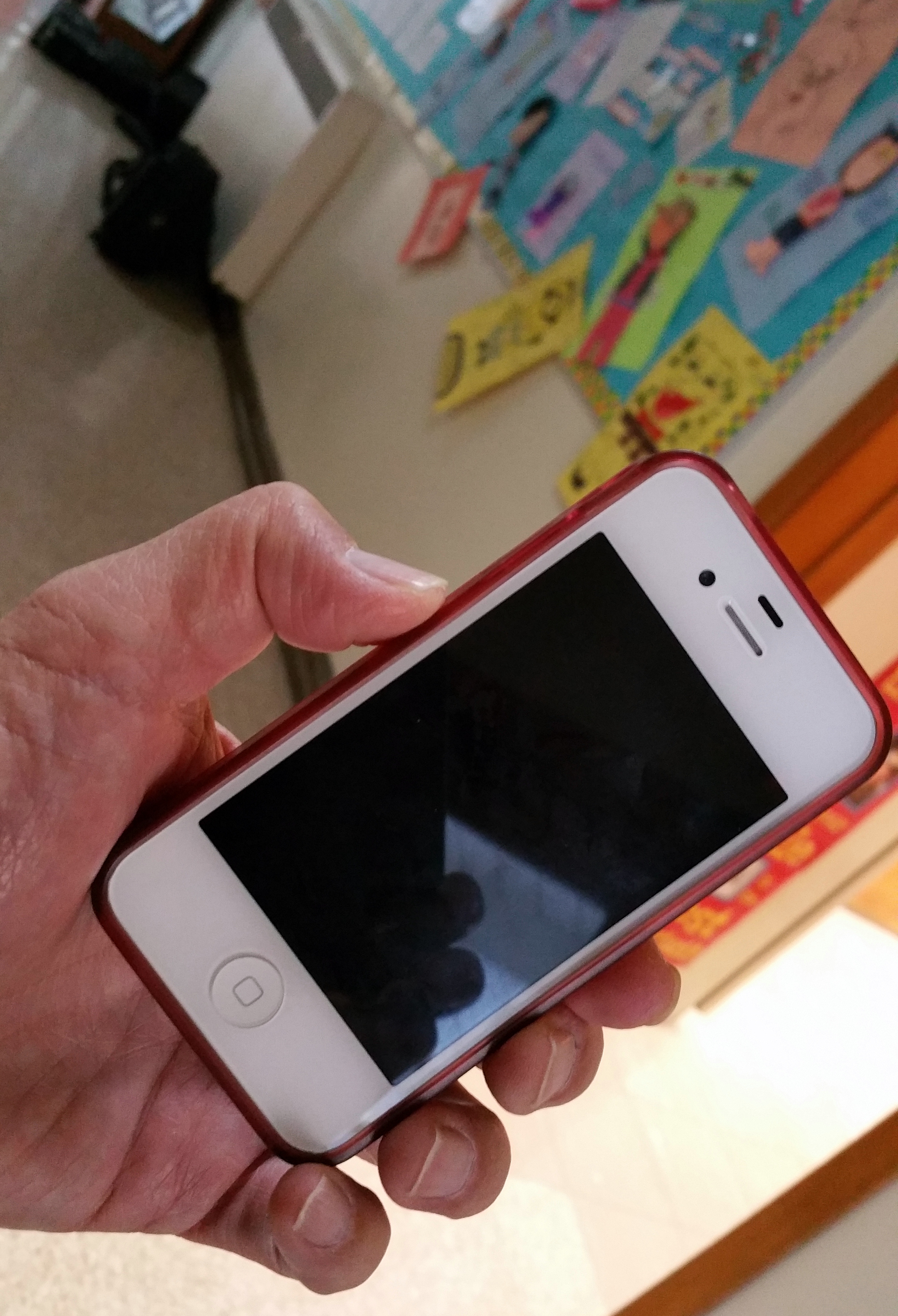
It’s the Text Princess’ iPhone.
So I go back…to take the Text Princess her phone.
They page her. I wait in the hallway. She comes. I hand her the phone. “Papa! You didn’t have to bring it-aaah…” in her trade-mark Valley-girl way of talking… but she knows she’d have a heart attack without it. It’s like the little notes girls used to pass around in class when I was her age.
Watch this… The first thing she’s gonna do is lecture me when she gets picked up…after she’s the last one to leave the school, of course, texting as she walks.
As I watched “How to Train Your Dragon” on Blu-Ray for the third time with my kids, it became clear that knights in shining armor kill dragons…and only in fairy tales.
A tremendous Einstein moment for this old geezer.
But then I realized that sometimes, what we read about WWII history can be sort of a fairy tale, complete with a knight in shining armor trying to slay a dragon… the dragon being what truly happened in war.
History becomes what the writer – or a leader – wants it to be in the public domain.
_____________________________
Unknown to many is that another battle raged after the surrender of Japan. It was about what was to be recorded as an official history of WWII. It was a battle involving glorification, greed and politics of both the victors and the defeated.
And of course, it involved General of the Army Douglas MacArthur.
First, a quick opinion and summary of MacArthur from this arm-chair (amateur) historian’s viewpoint.
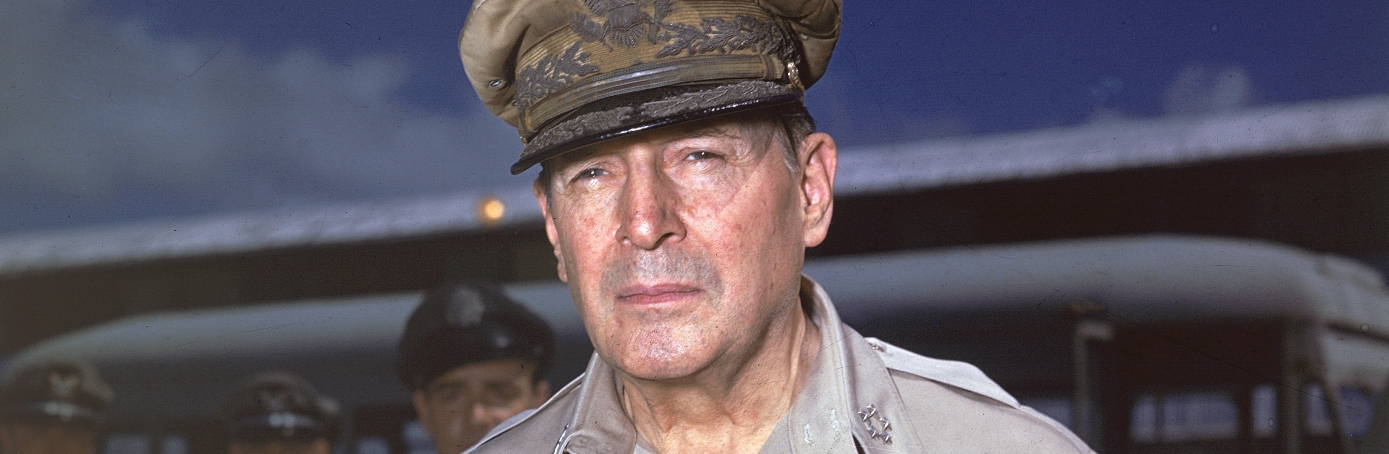
MacArthur had a helluva an ego as did George Patton and Bernard Montgomery. He was suspicious, short tempered, short on patience and embittered. MacArthur – as did Patton – studied military history extensively; he loved Napoleon. As commander, he failed to appropriately alert the troops under his command in the Philippines immediately prior to Pearl and worse yet, in the hours after. He had to flee the Philippines on a PT boat along with his family to avoid capture leaving behind his troops. However, supported by a brilliant, top notch staff and highly critical intel derived from intercepted then deciphered Japanese transmissions, he was highly successful in winning the war in the Pacific. He was a hero at war’s end to his great gratification. He was so loved by the American public that quite a few babies were named Douglas.
____________________________
Primarily due to a ridiculously small and inexperienced staff, only a relatively short written history of WWII in the Pacific emerged in late 1946 to the chagrin of MacArthur. He immediately then placed Major General Charles Willoughby in charge of generating an “official” history.
Willoughby was in charge of the US Army’s G-2 (i.e., military intelligence) in the Southwest Pacific theater of war and was trusted by MacArthur. (I briefly reported on Willougby in “Ike, a German-American Soldier”.) Having a heavy German accent, Willoughby was very loyal to MacArthur, pompous and stoutly anti-Communist. He seized the opportunity to “write the history” on victory in the Pacific under MacArthur’s leadership.
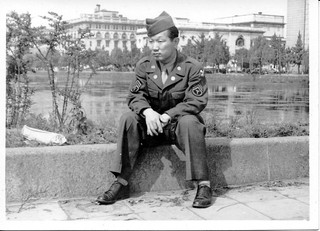
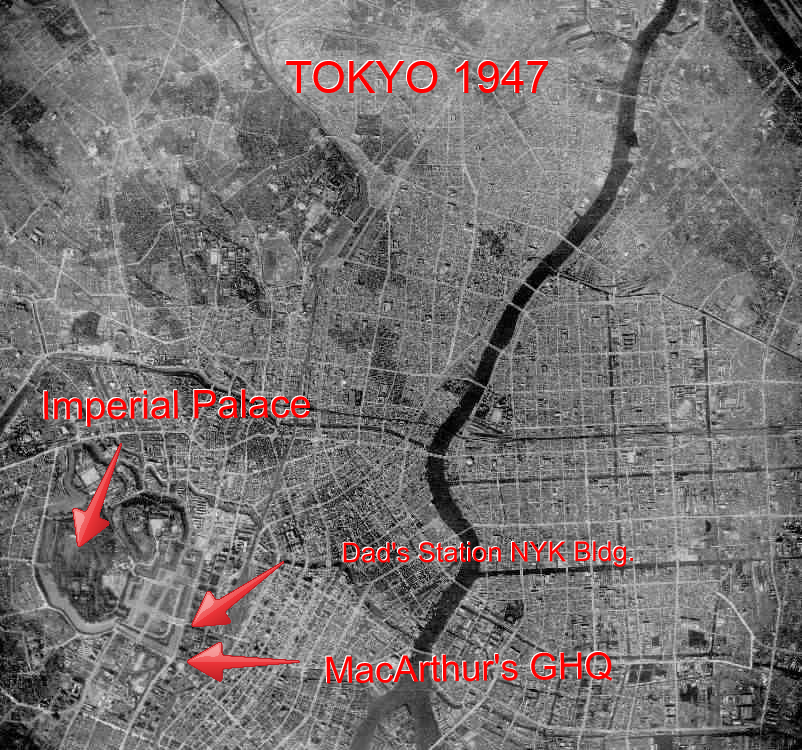
The tiny staff then blossomed under Willoughby to over 100 and was headquartered on the 3rd floor of the “NYK Building (Nippon Yusen Kaisha)” just a block from MacArthur’s GHQ in the Dai-Ichi Seimei Building; both are situated directly across the Imperial Palace. (Coincidentally, my dad was stationed in the NYK Building on the 4th Floor as a US 8th Army Technical Sergeant, 3rd Grade in Willoughby’s G-2. He is pictured below with the edge of MacArthur’s GHQ seen on the extreme right. The NYK Building is off the picture to his left. Behind him is the moat of the Imperial Palace.)
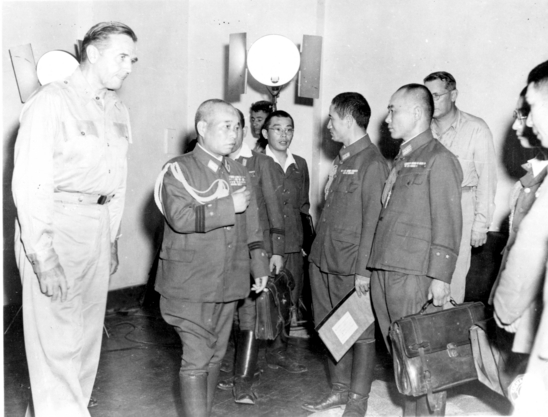
Seeking glory in this mission, Willoughby recruited by the end of 1946 top Japanese military officers, spies and even war criminals. Each had their own personal goals and copious amounts of US money flowed into these Japanese hands. One Japanese officer who Willoughby met in Manila was the Imperial Japanese Army’s Lt. General Torashiro Kawabe (photo above). Amazingly, because Kawabe also spoke German very well and was anti-Communist, he and Willoughby struck it off well.
A short time later, still in 1946, Willoughby met Lt. General Seizo Arisue who was the intelligence chief for the Imperial Japanese Army. By sheer luck, Arisue was also fluent in German and a staunch anti-Communist and reported he had the extensive spy network in place mentioned above. A triad had thus formed and the project to document history took off but with a twist: to Willoughby’s credit, he foresaw a “dual” history. As history always gets written by the victor, Willoughby wanted two volumes. One would be the US side of the story, the second volume to be Japan’s.
In early 1947, Willoughby was introduced to a former colonel who served at the Imperial General Headquarters in Tokyo during the war. His name was Col. Takuhiro Hattori. Hattori was known to both Kawabe and Arisue as a genius in planning and organizing. Hattori eventually became the person from Japan’s side to determine what went into the war history.
Generous money flowed through Willoughby to Kawabe and Arisue, reportedly to help fund the spy network. Along the way, they brought in an “Issei” (a Japan-born first generation immigrant to the US like my grandfather) plus a university professor named Mitsutaro Araki. He also received education in Germany but no history would be complete without sexual escapades. Professor Araki’s wife was a socialite who used her beauty to charm others, primarily men. Her name was Mitsuko Araki. As a bit of trivia, Mitsuko was the only Japanese who was allowed free, unhindered entry/exit to GHQ. It was believed the CIA concluded she and Willoughby were having an affair.
In his efforts to make his recorded history unique, Willoughby paid Mitsuko to find and compensate artists who could paint battle scenes from Japanese eyes. He felt photos were too ordinary plus many were from US sources.
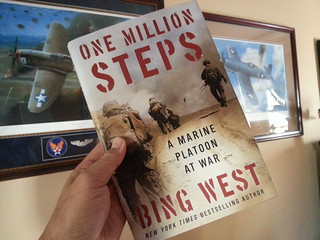
Through the recommendation of a patriot, educator, military historian, WordPress blogger and friend Mustang USMC, I read “One Million Steps” in a one day marathon. I only put it down to tend to my kids or chores.
It was riveting.
It had sad moments.
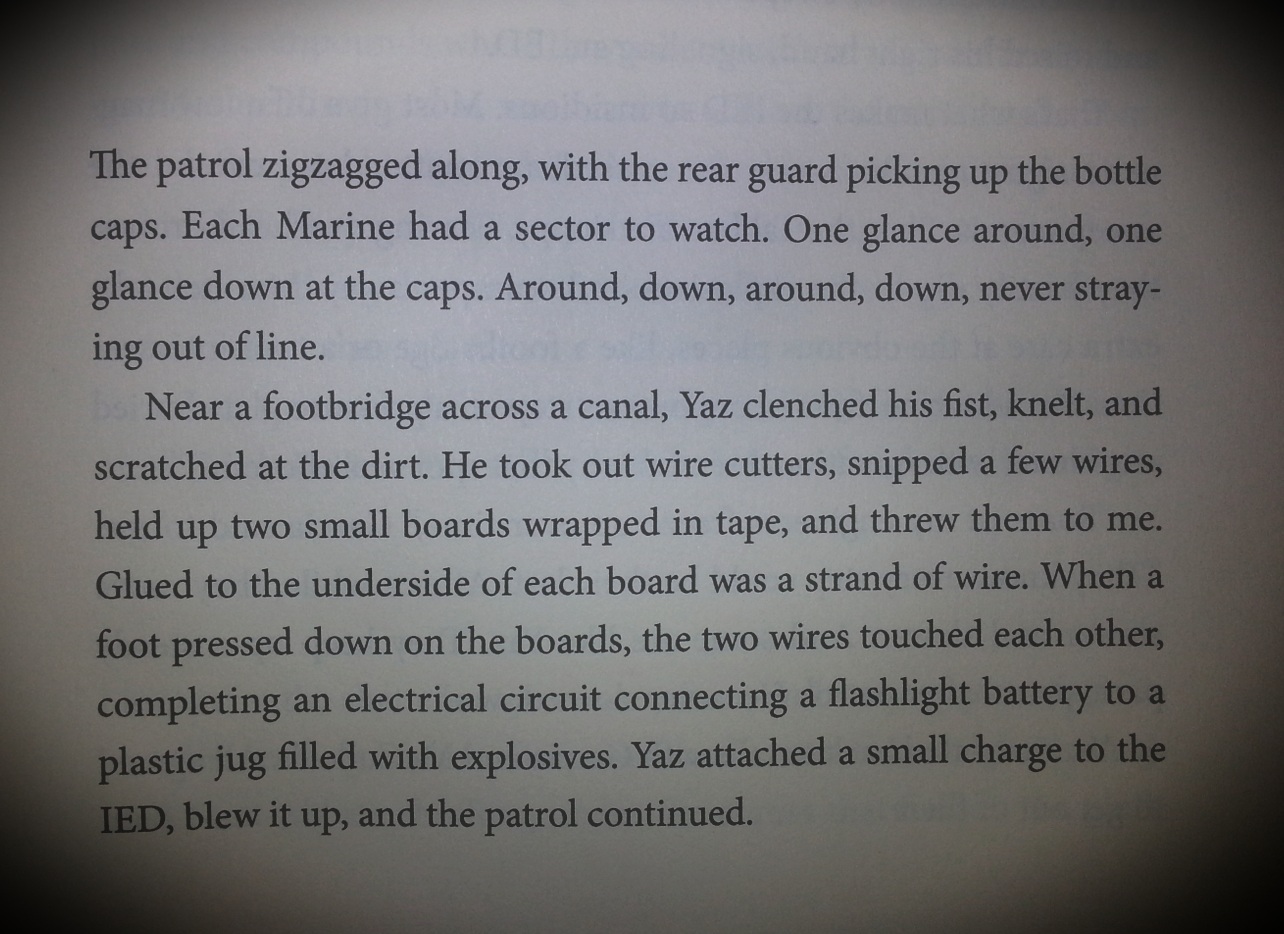
It describes how our young Marines would have to patrol through fields of opium poppy and marijuana to seek out the Taliban intent on killing them and not be able to do anything about it.
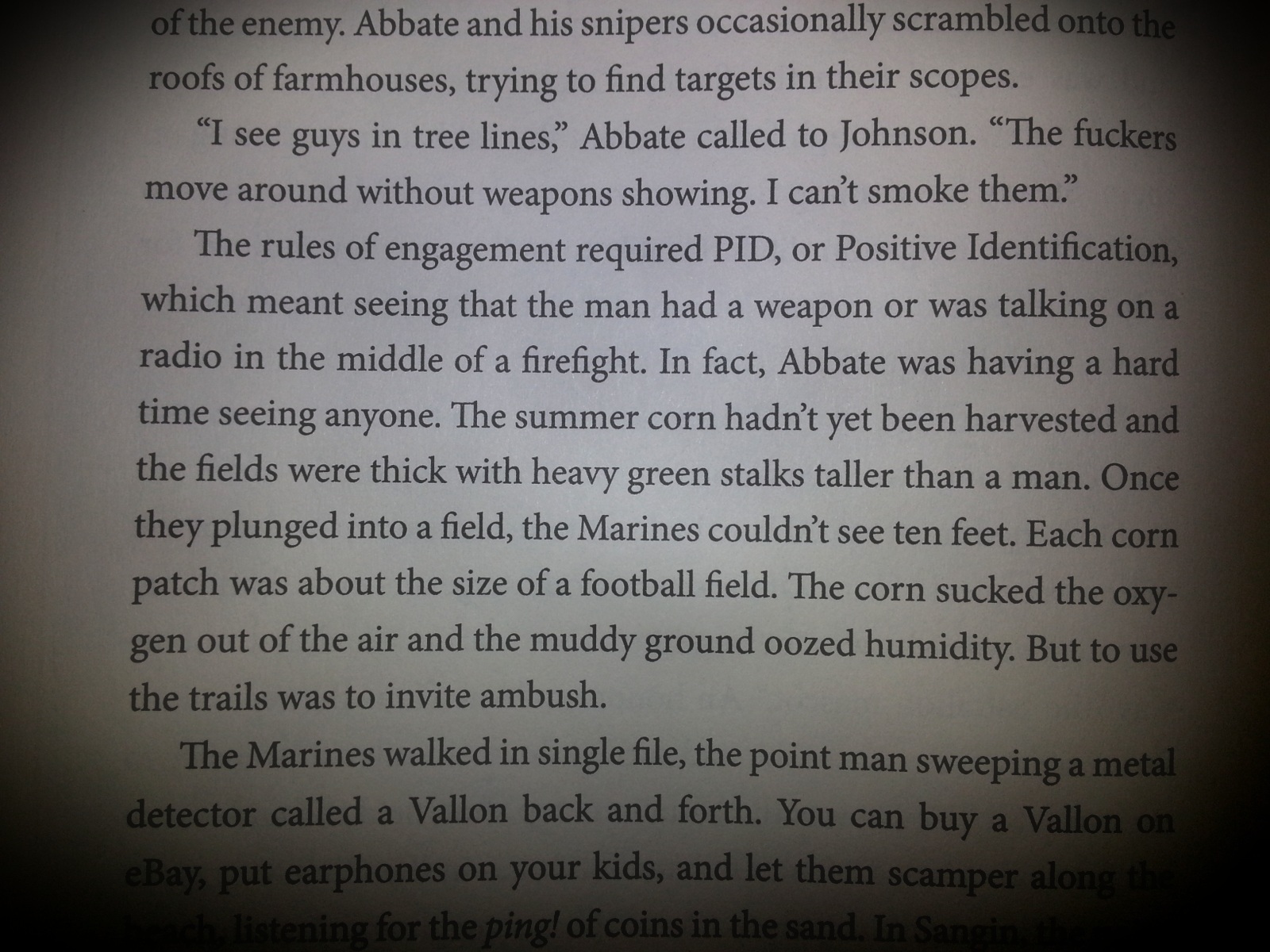
It tells of how they had to resort to using Walmart metal detectors, called Vallons, to keep them scant inches from stepping on an IED.
It tells about how policies established by the White House “for” conducting war collide head on with the Marines’ job – “to” conduct war – at the cost of our young boys’ lives.
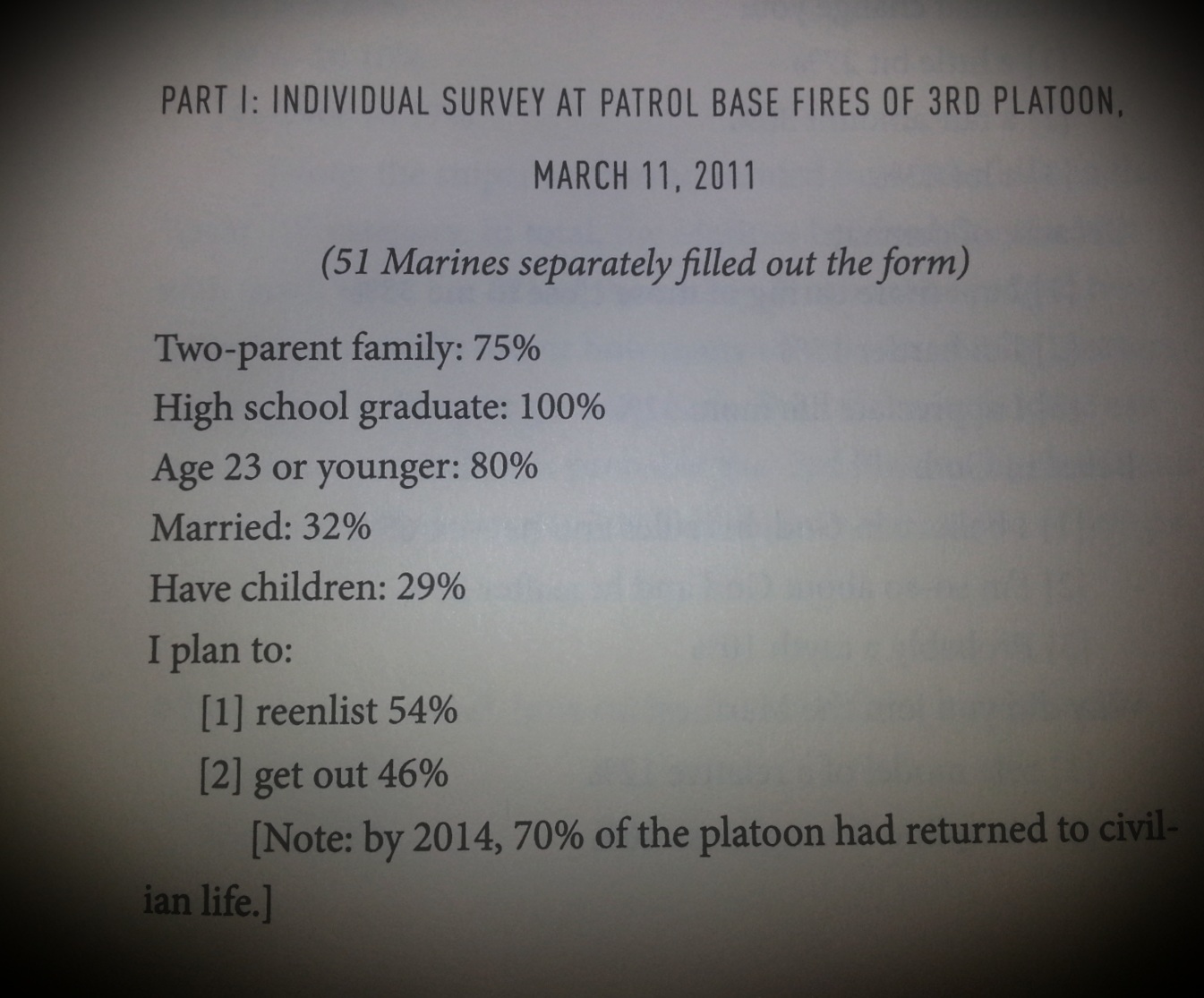
It showed that 75% of our volunteer Marines of the Third Platoon in 3/5 – the 3rd Battalion, Fifth Marines, 1st Division – came from two parent families. Think about that for a minute.
And it is humbling to see what Marines are all about: Semper Fidelis.
Always Faithful.
___________________________
A short civilian’s look into the honored history of 3/5, and more specifically, the Third Platoon…
The 3rd Battalion, Fifth Marines was organized in 1917 in preparation for WWI combat, just one of which was the Battle of Balleau Wood.
During WWII, they endured and won in costly combat at Guadalcanal, New Guinea, Peleliu, and Okinawa. E. B. Sledge, or “Sledgehammer”, scribbled notes in an Old Testament during combat as a mortarman on Pelilieu and Okinawa. At the urging of his family, his notes became the foundation for his historic book, “With the Old Breed”. Sledgehammer was part of the Third Platoon.
During the Korean War, they left their bloodied mark in history once again at battlefields called Inchon and Chosin Reservoir to name just two.
Called again into action during the Viet Nam War, they heroically fought at god-forsaken places such as Chu-Lai, DaNang, Quang Nam and Que Son. A few of our readers served in that war and are thanked greatly.
After waging war in Operation Desert Storm, they now have Sangin in Afghanistan to add to their battle history. This is where the story takes place.
This high school wrestler on top is Matt Abbate. He would be awarded the Navy Cross for his actions in 2010 but was later KIA in Sangin. The award would be posthumous. Photo: http://www.thefoothillsfocus.com/010511-cswrestling.asp
_____________________________________
I do not wish to steal the thunder from Mustang in case he wanted to write about the excellent book… Indeed, he would do a much better job. But I could not NOT write something about it as I hope a few of you would read it. Our boys dying in combat for YOU deserve your support, understanding and compassion.
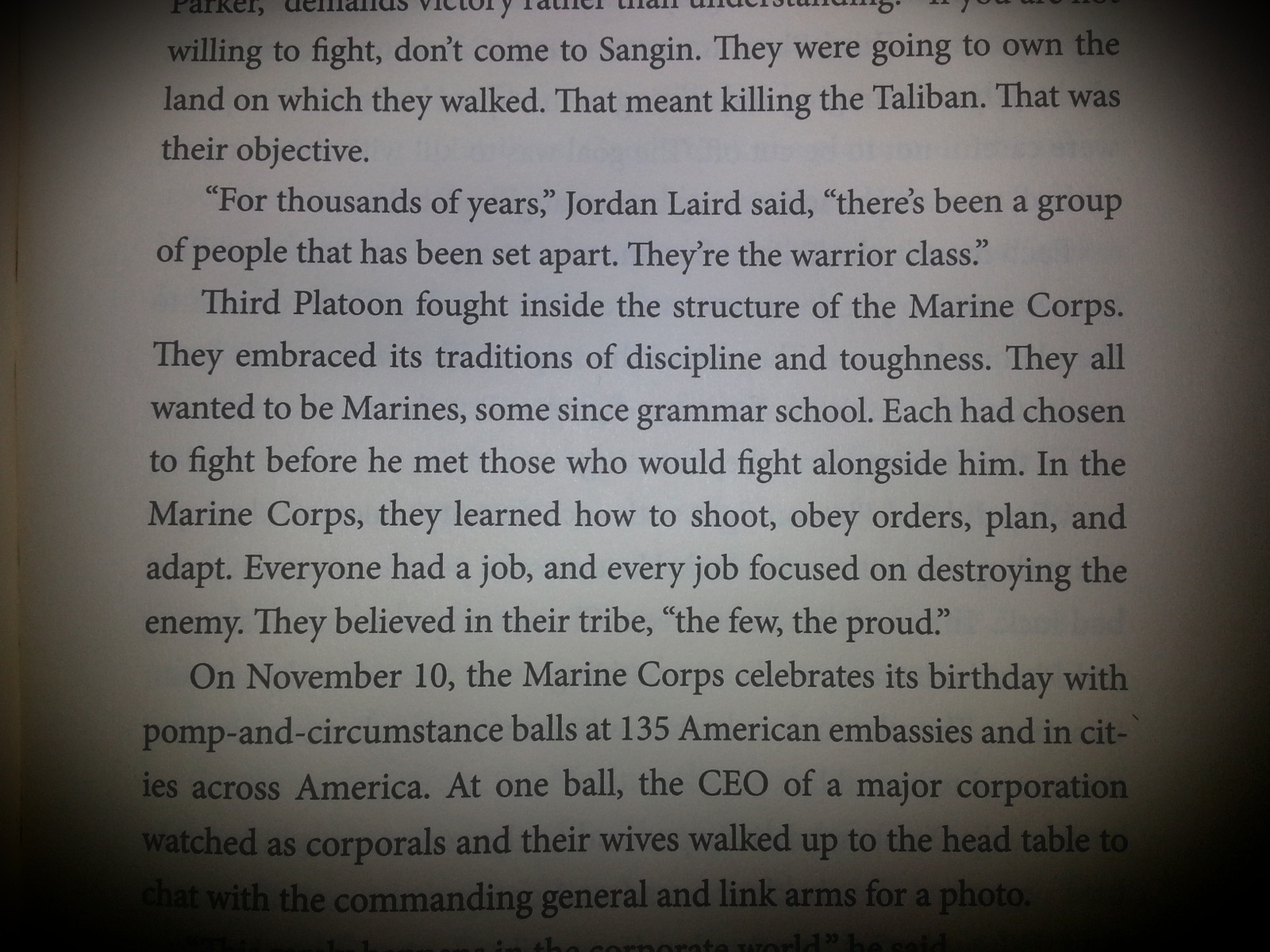
As I do not wish to taint the book’s message with opinion, what I propose to do (if it’s legal – I’m no lawyer nor writer) is just reference a few passages from “One Million Steps”, a book by Bing West. Perhaps it will tempt you into also picking up a copy (also available for Kindle):
Excerpt from “One Million Steps” by Bing West. Random House, 277 pagesLaird would return home. Excerpt from “One Million Steps” by Bing West. Random House, 277 pagesExcerpt from “One Million Steps” by Bing West. Random House, 277 pagesEspinoza returned home an amputee. Laird suffered two crushed vertebrae while rescuing Espinoza. Always Faithful. Excerpt from “One Million Steps” by Bing West. Random House, 277 pagesExcerpt from “One Million Steps” by Bing West. Random House, 277 pagesYaz would also return home as an amputee. Excerpt from “One Million Steps” by Bing West. Random House, 277 pages
These boys are fighting under orders from the White House…
They WILL be fighting for you under orders from the White House.
There is something enchanting about the Corps. The United States Marine Corps.
It’s the only branch of service where the first letter is capitalized.
Marine.
Yes, we owe our current freedoms to ALL of our branches of service, especially during WWII (It seems, however, that our current leadership do not value that.). Don’t get me wrong. Many of you had fathers or grandfathers fight in the Army, Navy, USAAF during WWII. Two of my uncles served in the US 8th Army as part of the then secret Military Intelligence Service. I just place the US Marine Corps at the top of my own personal list… I am but a citizen and like Obama and Clinton, I have never served although I got close in 1973…but I sure the hell didn’t flee the draft like a former President we know.¹
Yet, why does our media castrate or belittle the Marines so much? I just do not understand.
______________________________
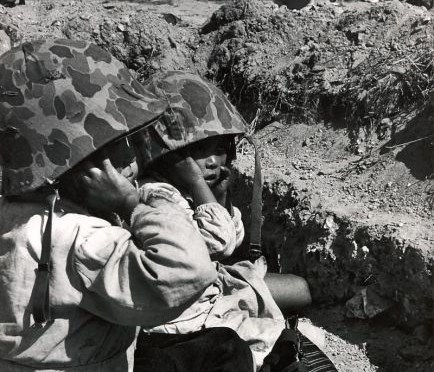
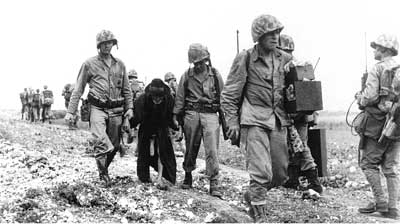
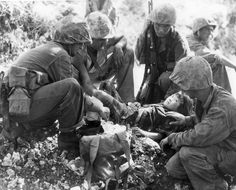
Definitely not Iwo Jima, Saipan or Guadalcanal but perhaps Okinawa. These Japanese children are wearing Marine helmets given to them for protection; you can see the Marines in combat behind them.US Marines on Saipan helping a very old Japanese man to safety.US Marines rendering aid to a Japanese child.US Marines rendering aid to a Japanese child.
Old Man Jack endured combat in the SW Pacific during WWII as a sailor. Put it this way: for whatever reason, he volunteered for duty in 1942, soon after Pearl. One very piercing and ugly flashback he would endure while describing what truly went on in war was, “If you got killed with shit in your pants, you got buried with shit in your pants.”
I think of all the boys and young men who were killed on those “stinkin’ islands” as Old Man Jack called them. One step to the left or just taking that step one second earlier or later meant instant death. And on Iwo Jima, there was no “front line”. The enemy hid in caves or were secreted away by camouflage or were in well hidden concrete fortifications that they had years to build. They would pop out of a tunnel that the Marines just “cleared”. Death came from all directions for very young Marines. Same at Pelileu. At Guadalcanal. At Saipan. Many other small islands.
Yet, they fought – and died for their buddies – to be buried with soiled dungarees in that black talcum-powder like sand like Old Man Jack horribly recollected. Or in an unmarked grave deep in a jungle on Guadalcanal, forever lost.
But why does the media today showcase to no end an instance when front line Marines urinate on dead Taliban? Because it isn’t PC? Or because its a paycheck? And the injustice – yes, injustice – served upon the Marines by the media during Viet Nam? I, for one, thank each and every one of the military who were in Viet Nam.
But most importantly, why DOESN’T the media showcase all of the other gazillion humanitarian acts performed by the Marines?
______________________________
At least the Japanese media appreciated the US Marines during the tsunami’s aftermath.
Well, since in my opinion CNN and other outlets have their own agenda, I will write about just one of the HUGE US Marine humanitarian efforts here. In my tiny corner of this blogging universe.
Because the Obama tainted media won’t and I think that sucks.
When the devastating tsunami hit Japan in 2011, who were the first ones to render aid to the pockets of isolated Japanese civilians?
It was the United States Marine Corps. In the typical and expected norm for Marines, they were the first ones there… even before Japan’s own relief efforts reached them.
Did you know that? They got to many of the isolated survivors before their own government did.
(Note: some of the footage immediately above will be of the USN)
And one thing you will also notice about these desperate Japanese people in the footage.
There was no rioting. No looting. No screams about, “You need to bring us more. We are entitled to it,” when the desperately needed supplies were unexpectedly choppered in.
The exact opposite. The shocked, hungry and cold Japanese formed chains to help unload the desperately needed water, food, clothing, medicine and kerosene… then distributed them amongst themselves in an orderly fashion.
It was all for one… and the Japanese appreciated the Marines.
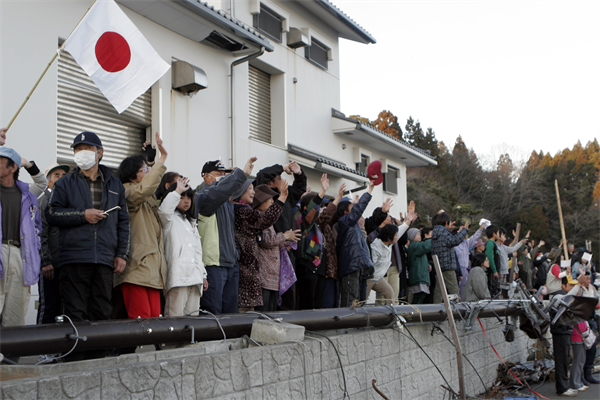
Dozens of those rescued by the US Marines wave their thanks energetically to the departing Marines. http://www.31stmeu.marines.mil
______________________________
But how much footage of the Marines’ relief efforts did you see on TV back then? Very little, I think. I wager that you likely didn’t even HEAR of the US Marine relief efforts.
Excuse me. Anderson Cooper was there on a Japanese street corner in the evening, broadcasting for CNN. But he didn’t report about our military helping tremendously in their relief efforts.
He was stirring up the media pot. He was accusing alluding to the Japanese government hiding the truth about the Fukushima nuclear power plant meltdown.
Right there on a Japanese street corner.
______________________________
Old Man Jack fondly recollected “tussling” with the Marines back then because “they thought they were better than us white caps”. But he followed that up real quick by saying there was no one better than the Marines to protect his sorry ass with theirs when it came time.
Well, if we are stranded somewhere like the tsunami victims, I’m sure the Marines will be coming.
They’ll even help Anderson Cooper…reluctantly.
Footnote:
1 You can decide for yourself about Clinton and the draft. You cannot argue you didn’t agree with the war. It was a duty, plain and simple. Senator Fulbright pressured the officer in charge of the ROTC program at the University of Arkansas to accept Clinton. By doing so, Clinton’s induction would be delayed. Instead, he fled to England to further his studies at Oxford. Google “Clinton letter to Col. Holmes”.
A journey to the Riverside National Cemetery for this Memorial Day weekend was deemed in order.
Just my way of saying “Thank you” to three men… and Marge Johnson as well.
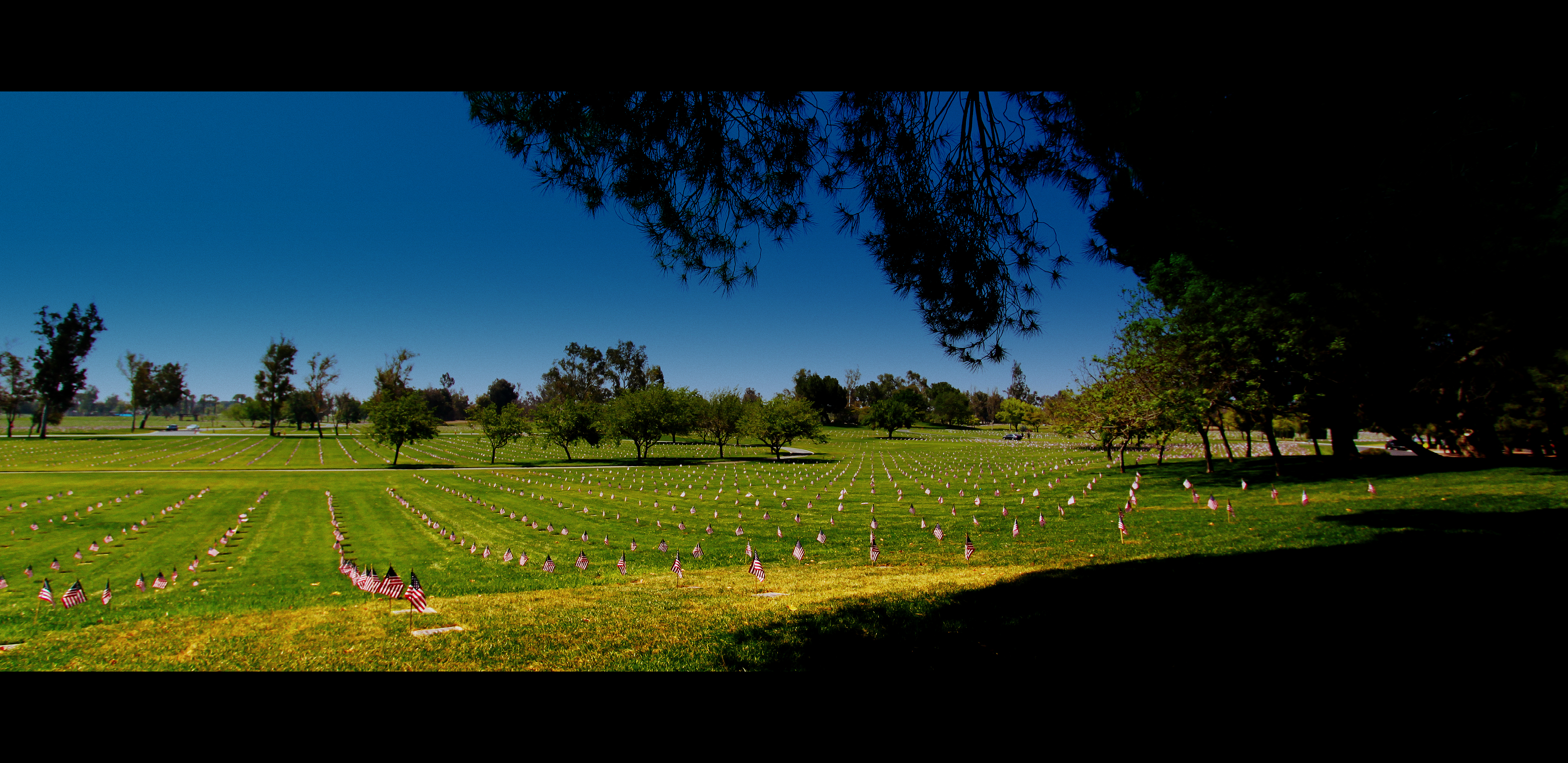
I was told that the Boy Scouts planted over 200,000 flags for this weekend. Well, there’s a few more flags now… albeit just small tokens of appreciation from me, they are recognition of what America deeply owes them.
If you never served (like me), you should be grateful that these men did… instead of you.
In a documentary, a paralyzed Marine who made it back from Iwo Jima said one indescribable smell resonates in him to that day: the sweet, distinct smell of fresh blood squirting out from a wound to the jugular vein. He said if you smelled that, it signaled a dying Marine.
The Riverside National Cemetery is the third-largest cemetery managed by the National Cemetery Administration. It is also home of the Medal of Honor Memorial and only one of four sites recognized as a National Medal of Honor Memorial Site. The Medal of Honor Memorial’s walls feature the names of all medal recipients.
(Note: By clicking on the images, you should be able to download full rez image files.)
_______________________________
The uncle of one of our most patriotic bloggers, “pacificparatrooper“, is interred here.
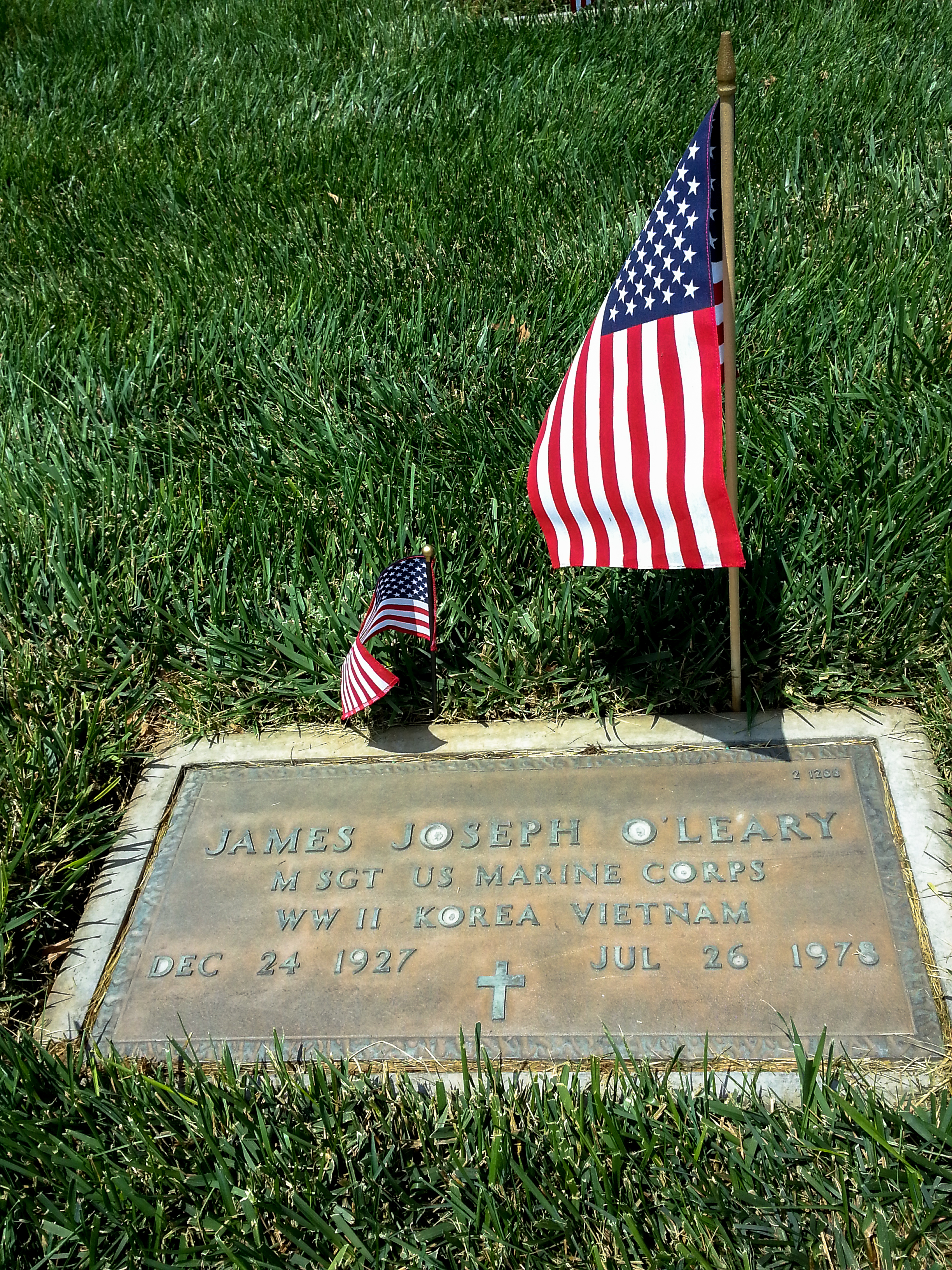
Master Sergeant James O’Leary, USMC.
He rests in this peaceful grassy knoll next to our other patriots…
To learn about MSgt. O’Leary’s military service, please click on this link to read one of gpcox’s stories about her uncle: MSgt James O’Leary. You will also learn how gpcox’s family has been serving our country for many decades, including her father “Smitty” who endured combat with the famed 11th Airborne during WWII.
____________________________
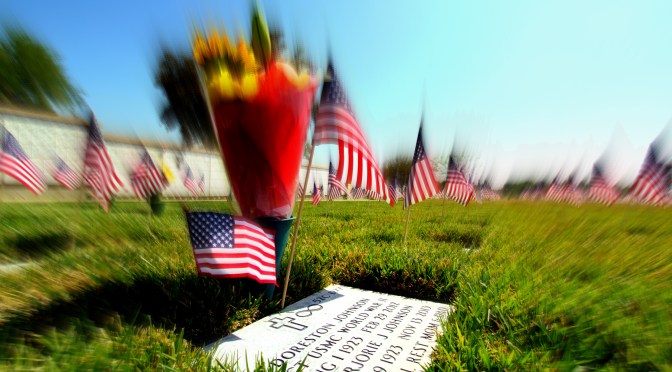
Of course, a visit to Mr. and Mrs. Johnson was in order.
Mr. Johnson was a decorated Marine fighting on board CV-6, the USS Enterprise, during the Battle of Midway and the most brutal Solomon Islands campaign in WWII.
Marge recently passed away; I was unable to fulfill my promise to take her again to visit with her husband… but then again, they are together for eternity now. I felt Marge would like some flowers and took an Old Glory for Mr. Johnson. He loved the Corps. You can read about Mr. Johnson, USMC here: Mr. Johnson, USMC.
Interestingly, I learned something about Mr. Johnson’s service in the US Marine Corps. His enlistment was longer than what I was led to believe. He was but 16 when he “got suckered” into enlisting. I’ll need to write about that later, I guess.
May they both happily rest in peace together.
________________________________
I have come to know Grace and her husband Bernie though a close knit national Mustang club. No, not the horse. The car.
Her first husband was US Army Staff Sergeant Robert Hartsock. His name is etched into the Medal of Honor Memorial wall. He was killed in action at just 24 years of age in Viet Nam. He was but two months away from ending his tour of duty and left a son, Dion.
Staff Sergeant Hartsock’s official Medal of Honor citation reads:
For conspicuous gallantry and intrepidity in action at the risk of his life above and beyond the call of duty. S/Sgt. Hartsock, distinguished himself in action while serving as section leader with the 44th Infantry Platoon. When the Dau Tieng Base Camp came under a heavy enemy rocket and mortar attack, S/Sgt. Hartsock and his platoon commander spotted an enemy sapper squad which had infiltrated the camp undetected. Realizing the enemy squad was heading for the brigade tactical operations center and nearby prisoner compound, they concealed themselves and, although heavily outnumbered, awaited the approach of the hostile soldiers. When the enemy was almost upon them, S/Sgt. Hartsock and his platoon commander opened fire on the squad. As a wounded enemy soldier fell, he managed to detonate a satchel charge he was carrying. S/Sgt. Hartsock, with complete disregard for his life, threw himself on the charge and was gravely wounded. In spite of his wounds, S/Sgt. Hartsock crawled about 5 meters to a ditch and provided heavy suppressive fire, completely pinning down the enemy and allowing his commander to seek shelter. S/Sgt. Hartsock continued his deadly stream of fire until he succumbed to his wounds. S/Sgt. Hartsock’s extraordinary heroism and profound concern for the lives of his fellow soldiers were in keeping with the highest traditions of the military service and reflect great credit on him, his unit, and the U.S. Army.
_____________________________
May they all rest in peace.
Blooms at Riverside National Cemetery near MSgt. O’Leary.
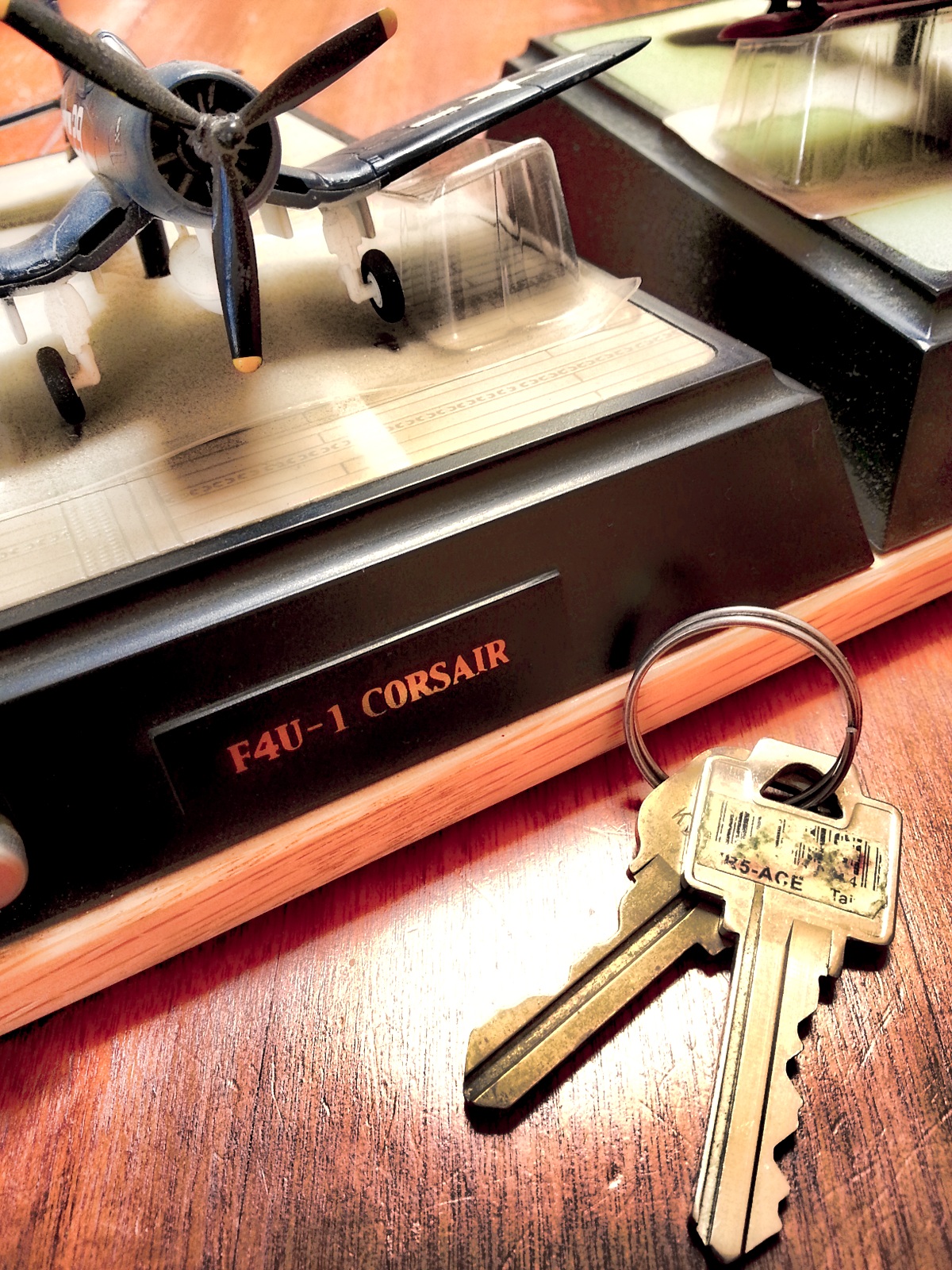
Old Man Jack entrusted me with his house keys “…in case he shot himself in the foot” as he put it. Now covered in dust is Old Man Jack’s favorite baby – the F4U Corsair albeit a toy. He would push that button in once in a while, listen to this toy’s engine sound and watch the prop spin… It would echo a bit in my hallway…
I looked at these two old keys in my hand. They belonged to Old Man Jack and the thought of Memorial Day instantly crossed my mind.
At times, I feel the meaning of Memorial Day has either faded or has changed.
In essence, many people living in today’s “politically correct” society have taken the sacrifices of our fallen to mean a three day weekend.
Sad…but that’s how I feel.. and it angers me.
__________________________
When I looked at those two keys, my mind raced to some of the things Old Man Jack said.
But mostly, to the things he could not say.
In the twelve years I was honored to know him, he would abruptly blurt out something once in a while when we were talking in his garage… while sitting in the blue wheelchair that belonged to his wife.
There was no story associated with these mutterings.
“Boys got killed on those stinkin’ islands…” then raise his thick, white eyebrows.
Or, “Hell, I pissed in my pants.”
Or once in a while, he would make a muffled smack with his lips then slowly shake his head left and right… and not say anything more.
After recovering and meandering next to his plane, he simply let out, “Some of (the pilots) just didn’t come back. I could never stop thinking, ‘Did a Jap get him… or was it me?’”
He said that because as Ground Crew Chief, he was responsible for the airworthiness of the plane a young Navy or Marine pilot would take out on a mission…to shoot at the enemy…or be shot at. These planes had to be in the best fighting condition as lives depended on it. But he frequently said “they had to make do” because they never had enough spare parts… so they HAD to improvise.
One time, he said a bushing had been shot out on a plane that had to go on a mission the next morning. Old Man Jack did what he could. What he must. He soaked two pieces of coconut logs in engine oil overnight. When it came time for the pilot to take off, he clamped the oil soaked wood around the cabling and used baling wire to clamp them together as tightly as he could. The plane left on its mission – with the young pilot behind the stick…in a plane with oil soaked coconut log as a bushing.
Unbelievable.
Now perhaps you understand the depth of his utterance of, “…or was it me?”
_________________________
Old Glory shimmering off a P-51 Mustang at the Chino Planes of Fame Museum.
I will never have an answer because the question could never have been asked of him.
But I feel Old Man Jack carried tremendous guilt in his heart about something that happened on those stinkin’ islands.
Not just bad; real bad.
Deep down, my heart tugs at me that someone within Old Man Jack’s reach died that shouldn’t have… and that Old Man Jack feels personally responsible for his death… and he carried that anguish for all these years.
Torment.
Grief.
Guilt.
_______________________
As Old Man Jack said, some of the young pilots didn’t come back.
They were killed or are forever missing in action.
That is for whom Memorial Day is all about.
To remember and honor those that did not come back…and not a Memorial Day sale.
As we saw in Part 3, Japan and America are now at war.
While not directly related to the question of “What did FDR know?”, it is deemed critical for readers to understand the damages suffered by the US military – and specifically its naval and air assets – on December 7, 1941. It is also important to realize the huge advantage the Japanese Imperial Navy had over the U.S. Navy. Lastly, it is important for readers to note the unbridled successes of the Japanese military at that time… and what unbelievably followed.
For the vast majority, Americans are under the belief that the US was caught flat-footed with the surprise attack on Pearl Harbor. Indeed, 21 ships of the U.S. Pacific Fleet were sunk or damaged.
Of those ships damaged, all but three of the ships at Pearl Harbor were refloated and repaired (Note: Pearl Harbor at its deepest is about 50′.):
The USS Arizona – too badly damaged to be salvaged,
The USS Oklahoma – raised but considered too obsolete to be worth repairing, and,
The USS Utah – also considered obsolete.
In addition, the US had 188 aircraft destroyed plus 159 were damaged; the majority were hit before they had a chance to take off.
There were a total of 2,403 American casualties, including 68 civilians. Most of the military killed were on the USS Arizona (1,177 killed). Most of the civilians killed were from improperly fused anti-aircraft shells fired by US batteries hitting in Honolulu. There were 1,178 wounded military personnel and civilians combined. (1)
A downed Zero in a Hawaiian neighborhood.
Japanese naval forces sailing for the raid included four heavy aircraft carriers, two battleships, two heavy cruisers, two light cruisers, 35 submarines, and 11 destroyers. Indeed, a powerful fleet projecting tremendous offensive firepower. All survived unscathed; all but 29 Japanese aircraft returned to their carriers.
In the Pacific Theater, Japanese forces were rolling over Allied forces at will with victories in Thailand, Malaya, Wake Island, Guam Island, the Philippines, Hong Kong, Singapore, Burma, Dutch Indonesia and the invasion New Guinea. The Imperial Japanese Navy dominated in the Pacific, attacking Allied bases in Australia and Ceylon; they even bombed or shelled coast of North America at will albeit with minimal effect.
But, the great sea battle of the Coral Sea and more specifically at Midway essentially put a halt to the wave of Japanese victories… barely five months after Pearl Harbor.
How could that possibly be? Wasn’t our Pacific fleet crippled?
____________________________
So… how DID the US Navy stop the Japanese advance at these critical battles at Coral Sea and Midway? After all, at the time of Pearl Harbor, the US Navy only had three aircraft carriers in the Pacific: the USS Enterprise, USS Lexington, and USS Saratoga. (The USS Hornet was still on shakedown cruise and the USS Yorktown and USS Wasp were deployed in the Atlantic.)
Of course, the heroics of our sailors and Marines played a most dominant role but you may wish to ask yourself:
Were American aircraft and ships better than their Japanese counterparts? No, production of new classes of ships and aircraft would not arrive in the Pacific until 1943.
Did American forces have more men, aircraft and ships? Again no, the tide of the American industrial strength would not be felt in the Pacific until 1943.
Was it better leadership? No. Admiral Chester W. Nimitz was arguably equally matched by Admiral Isoroku Yamamoto, the overall commander of Japanese forces during the battles of Coral Sea and Midway.
Did our navy stumble upon the enemy out in the Pacific by sheer luck or happenstance?
If it wasn’t the above, how was the US Navy able to engage the Imperial Japanese Navy at Coral Sea and Midway then stop them?
It was MAGIC.
___________________________
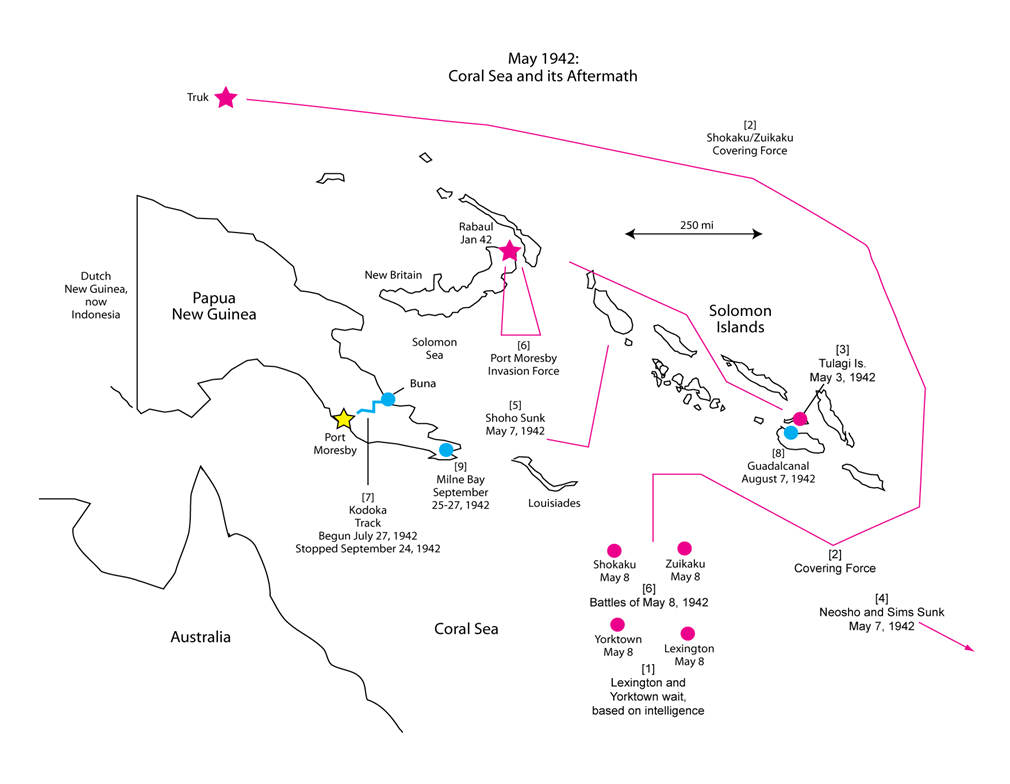
Battle of Coral Sea, May 4 – 8, 1942
Battle of the Coral Sea, May 1942. Source: Pacific War Museum.
By March 13, 1942, OP-G-20 had completely broken JN-25. Until then, about 10% to 15% of a JN-25 message that was intercepted could be read. (2) However, enough could be deciphered to understand the Japanese were gearing up to attack Port Moresby in Papua, New Guinea on May 7, 1942. By taking Port Moresby, Japan could extend its reach beyond northern Australia and further south.
Upon receiving the intelligence from the deciphered JN-25 messages, Admiral Chester Nimitz decided to move a fleet into position in between Port Moresby and Australia. He issued such orders on April 17, 1942. However, he had but two carriers available for action – the USS Lexington and the USS Yorktown. This battle was definitely NOT a chance encounter; it was planned.
In fact, deciphered messages allowed the US Task Force 17 to be in position before the Japanese fleets arrived to attack. But lacking sufficient capital ships and aircraft that were inferior to the Japanese Zero, the outcome was far from certain. The sailors and Marines were largely untested as well. (The USS Hornet and USS Enterprise were unavailable due to their critical roles in the Doolittle Raid on Tokyo; it took place two days later on April 18, 1942.)
With but two carriers and support ships, the US fleet was outgunned especially considering our aircraft was obsolete. The Japanese fleet sailed with a Shoho (a carrier), several cruisers and destroyers, and a dozen transports filled with troops. A smaller invasion force would move down the Solomons, which laid on New Guinea’s eastern flank, with the target being Tulagi. To protect these two invasion fleets, the Japanese carriers Zuikaku and Shokaku would spearhead yet a third fleet to provide air protection.
The USS Lexington explodes and sinks. (US Navy archival photo)
While the ensuing two-day Battle of Coral Sea was considered a draw, U.S. forces inflicted enough damage on the Japanese navy to force it to withdraw. In addition, as the Japanese were unable to secure the port, their military was forced to fight in land warfare, which proved disastrous for the Japanese. Of most importance, the fruit of the battle saw the Japanese carrier Shoho sunk, with both the Zuikaku and Shokaku damaged and forced to retire. Therefore, they were made unavailable for the critical Battle of Midway, just about four weeks later.
However, we lost the USS Lexington, a major loss. And while the USS Yorktown suffered heavy damage as well, the Japanese believed her to have been sunk; instead, the USS Yorktown was made seaworthy through the extreme efforts of repair crews at Pearl Harbor. While two weeks had been estimated for repairs, the repair crews had her back on the seas in just 48 hours.
This strategic victory was made entirely possible because of secret MAGIC intercepts. The Japanese still did not believe their complex JN-25 had been broken.
Battle of Midway, June 4 – 7, 1942
Captain Joseph Rochefort, USN, head of OIC, Pearl Harbor (Photo NSA)
Arguably, the paramount triumph from the breaking of JN-25 on March 13, 1942 was the Battle of Midway. This is one battle that my neighbor, Mr. Johnson, fought on board the USS Enterpriseas a very young US Marine. From decrypting the Japanese naval messages, the U.S. naval commanders knew the general battle plans of Admiral Yamamoto – even the timetable. Yamamoto’s strategy was to have aircraft carrier task forces launch both a diversionary raid off the Aleutian Islands then lure the U.S. Navy to Midway Island. His goal was to decimate once and for all what remained of the American fleet after Pearl Harbor.
Yes, the deciphered intercepts did not state in the clear Midway was the target; the messages simply designated “AF.” While CINCPAC felt strongly it was Midway, it was Captain Joseph Rochefort of OP-20-G who wily suggested how to establish for certain what “AF” stood for.
Rochefort was Officer in Charge (OIC) of Station Hypo in Pearl Harbor, the nerve station in Hawaii for deciphering JN-25 intercepts. An expert Japanese linguist and during the most critical month of May 1942, Rochefort reviewed, analyzed, and reported on as many as 140 decrypted messages per day. These reports were directly piped to the highest-ranking fleet commanders. He brilliantly strategized for American forces on Midway to send out a radio message saying that they were running short of fresh water. Rochefort and his group waited anxiously to see if Japan would take the bait. Finally, OP-G-20 intercepted a Japanese message: AF was running short of fresh water.
Establishing Midway as the target, the U.S. Navy assembled what it could. America was still short on capital ships and better aircraft. After a 48 hour turnaround, the USS Yorktown joined the USS Enterprise and USS Hornet.
While remembering that by virtue of deciphering coded Japanese messages, the Japanese Imperial Navy had three less carriers to deploy after their losses at Coral Sea – a very critical fact. After a fierce three-day battle at Midway, U.S. naval aviators sank all four Japanese aircraft carriers in Yamamoto’s task force – the Hiryu, Soryu, Akagi and Kaga. All four participated in the assault on Pearl Harbor, effectively turning the tide in the Pacific. Yes, luck was involved during the actual battle but certainly, the courage of our young men at sea and in the air was incredible. They had proven themselves but at great cost in lives and materiel… including the USS Yorktown.
Unbelievably, the Chicago Tribune published a darned story revealing that the U.S. had known about Japanese battle plans in advance. They had, in effect, revealed that JN–25 had been broken. Inexplicably, key Japanese leaders never found out about the article. Darned media – even back then.
Assassination of Admiral Yamamoto
State funeral procession for Admiral Yamamoto, 1943.
As school history books had once shown, the battle planner of the Pearl Harbor attack was Admiral Yamamoto. He did know of the might of the U.S. having attended Harvard University – yes, Harvard – from 1919 to 1921, studying English. He did, in fact, oppose taking on the U.S. But Yamamoto had one trait which would lead directly to his death: his intense desire to be punctual. The US counted on this.
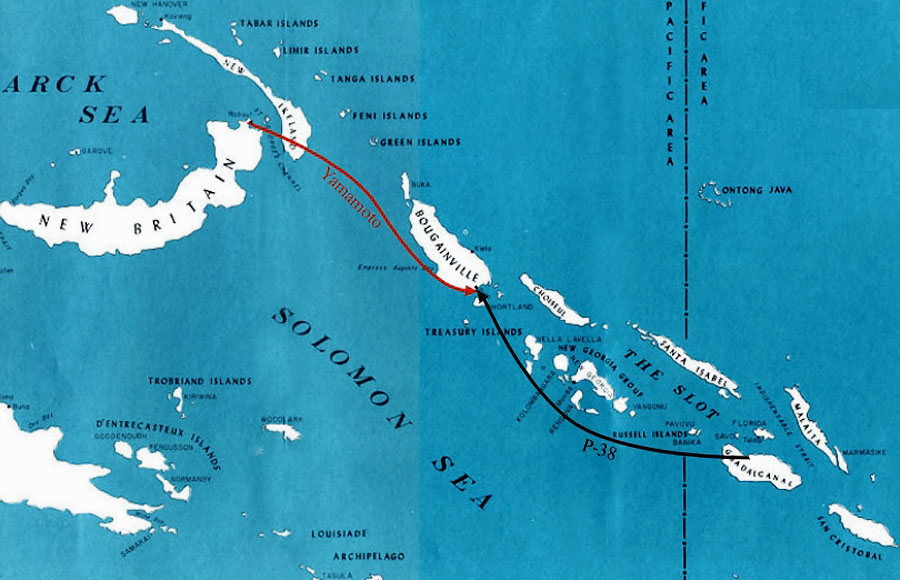
Codebreakers intercepted then learned after deciphering messages that the admiral was scheduled to inspect a naval base on Bougainville in the Solomon Islands on April 18, 1943. The detail even included his minute by minute itinerary. Some top US officials were hesitant to use this information for fear that doing so would tip off the Japanese that their codes had been broken. Nevertheless, the decision was made to assassinate Yamamoto. That morning, eighteen P–38 fighters left their base at Guadalcanal at the other end of the Solomon chain and arrived at Bougainville precisely ten minutes before Yamamoto’s plane was making its approach. The admiral was killed in the attack, depriving Japan of its most experienced and accomplished admiral and sapping Japanese morale.
Flights paths: Yamamoto (red) and USAAF (black). Also notice “Green Island” north of Bouganville. This was “Old Man Jack’s” last battle station. USN Archives
To mislead the Japanese that the fighters had arrived purely by chance, the air force flew other risky patrols to the area, both before and after the attack. It was not a “one shot in the dark” mission. It was deeply thought over and planned out – because we were able to intercept and decipher coded Japanese messages.(3) They also spread “rumors” that the information was from coast watchers.
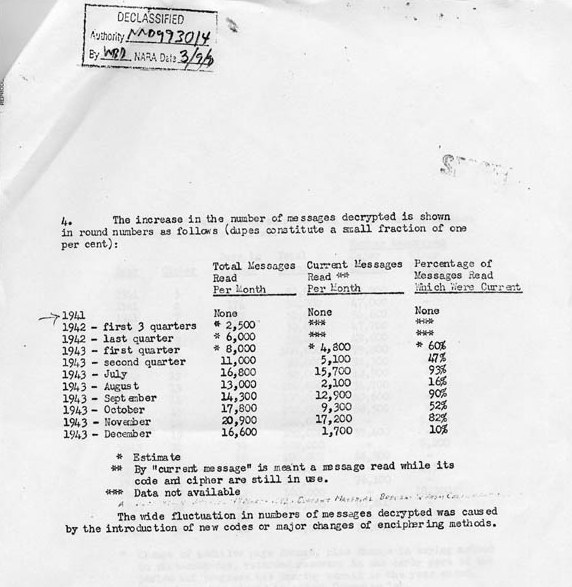
The Japanese did not change JN–25, and for the remainder of the war, U.S. intelligence intercepted and read thousands of Japanese messages. A portion of a secret OP-20-G report, circa 1943, is below listing the number of coded Japanese messages intercepted:
Japan’s Plan
Early in 1942, Japan decided to block the Allies from setting up bases in Australia. Operation MO would send a large invasion force to Port Moresby, the capital of New Guinea. From Port Moresby, the Japanese would be able to project air power beyond the northern tip of Australia and establish bases even further south (Hearn).
The Port Moresby landing force sailed with about a dozen transports filled with troops, several cruisers and destroyers, and a half-size carrier, Shoho (Bennett, Hearn). A smaller invasion force would move down the Solomons, which lay on New Guinea’s eastern flank. The specific target in the Solomons was Tulagi, which was the colonial capital. To protect these two invasion fleets, Zuikaku and Shokaku would lead a separate covering force to create a blanket of air protection (Bennett).
The U.S. Prepares
By March 1942, the United States had cracked part of the current Japanese Naval (JN) code, JN-25. However, U.S. intelligence could intercept only about 60 percent of all Japanese transmissions and had the resources to analyze only about 40 percent of the messages it did intercept (Parshall and Tully). Even then, code breakers typically could read only 10 to 15 percent of the code groups in a message (Parshall and Tully). U.S. intelligence primarily used direction-finding equipment to learn where many Japanese ships were and where they were heading (Parshall and Tully).
Beginning on April 16, U.S. intelligence began using this spotty information to piece together an understanding of a Japanese plan to move south with carriers (Parshall and Tully). On April 17, Nimitz ordered the carrier Lexington to join Yorktown in the Coral Sea (Bennett). If Halsey had been able to move Enterprise and Hornet there too, the U.S. might have been able to destroy the Japanese fleet. But Enterprise and Hornet needed refitting after the Doolittle raid of April 18, 1942, and could not get there in time for the fight (Parshall and Tully).
Early in 1942, Japan decided to block the Allies from setting up bases in Australia. Operation MO would send a large invasion force to Port Moresby, the capital of New Guinea. From Port Moresby, the Japanese would be able to project air power beyond the northern tip of Australia and establish bases even further south (Hearn).
The Port Moresby landing force sailed with about a dozen transports filled with troops, several cruisers and destroyers, and a half-size carrier, Shoho (Bennett, Hearn). A smaller invasion force would move down the Solomons, which lay on New Guinea’s eastern flank. The specific target in the Solomons was Tulagi, which was the colonial capital. To protect these two invasion fleets, Zuikaku and Shokaku would lead a separate covering force to create a blanket of air protection (Bennett).
The U.S. Prepares
By March 1942, the United States had cracked part of the current Japanese Naval (JN) code, JN-25. However, U.S. intelligence could intercept only about 60 percent of all Japanese transmissions and had the resources to analyze only about 40 percent of the messages it did intercept (Parshall and Tully). Even then, code breakers typically could read only 10 to 15 percent of the code groups in a message (Parshall and Tully). U.S. intelligence primarily used direction-finding equipment to learn where many Japanese ships were and where they were heading (Parshall and Tully).
Beginning on April 16, U.S. intelligence began using this spotty information to piece together an understanding of a Japanese plan to move south with carriers (Parshall and Tully). On April 17, Nimitz ordered the carrier Lexington to join Yorktown in the Coral Sea (Bennett). If Halsey had been able to move Enterprise and Hornet there too, the U.S. might have been able to destroy the Japanese fleet. But Enterprise and Hornet needed refitting after the Doolittle raid of April 18, 1942, and could not get there in time for the fight (Parshall and Tully).
The importance of MAGIC and the breaking of the “Purple” Japanese consulate code cannot be understated. For non-historian readers, the reach and military value extends far beyond the waters of the Pacific. It extends to Europe…specifically D-Day and the shores of Normandy.
As revealed in “What Did FDR Know? – Part 2” of this blog series, the US broke the code for this cipher before the attack at Pearl Harbor. The US did their best to keep the wraps over this great intelligence triumph. However, Nazi Germany’s own intelligence had good evidence that SIS had broken Purple and informed the Japanese. Unbelievably, Japan refused to believe it. (I believe this is part of the Japanese culture – to not place importance on “water cooler” talk.) Only when Congressional hearings and investigations into who knew of the Pearl Harbor attack reveal this did the Japanese accept it. Unfortunately, is was much after war’s end.(4)
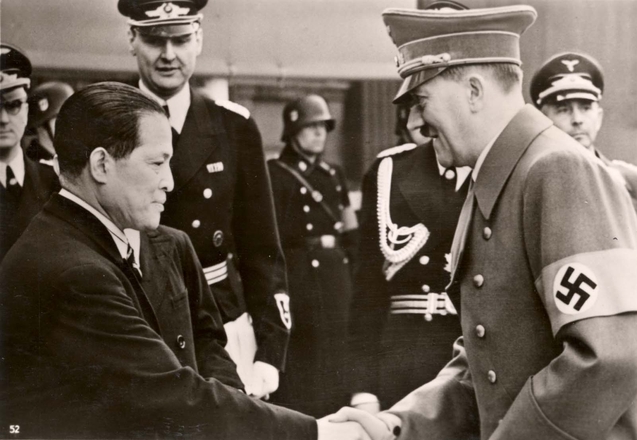
Baron Hiroshi Oshima, 1939.
Per “What Did FDR Know? – Part 1”, Baron Hiroshi Oshima was the Japanese envoy to Berlin and used his Purple machine to communicate frequently with Tokyo. Luckily for the US, Oshima was also an Imperial Army colonel at the time of appointment and loved war strategy and armaments. He followed intimately the German conquests in Europe and their latest technologies. He sent very detailed reports to his superiors in Tokyo of what he had learned using the purple cipher machine, which the US was able to intercept and decipher immediately.
Oshima became a favorite and a confidant of Hitler. Hitler – being so full of himself and pompous – shared with Oshima the most secret and sensitive of his war plans with him. Hitler even gave Oshima a tour of the German defenses in Normandy! As per his character and routine, Oshima transmitted very detailed reports of the Nazi defenses at Normandy. This was obviously key in the preparations for D-Day, so much so the deciphered intel was immediately transmitted to General Eisenhower. Not quite what we read in our textbooks…
And while the public is led to believe the U.S. did not know if the German commanders took the bait that the D-Day invasion would take place at Pas-de-Calais, Oshima secretly gave the US confidence that the Germans had taken the deception through his messages to Tokyo. The Nazis were preparing for the landing at the wrong beaches. (Note: this is not to lessen the somberness of those killed or missing in action at Normandy. Further, this is not to lessen the importance of wartime security.) Further, with their true belief that the invasion at Normandy was a diversion, the Panzer divisions were not immediately released to engage the Allied invading forces until too late.
In recognition of this value to Japan, he was promoted in a few short years from Colonel to Lt. General. Oshima’s prolific reporting prompted US General George C. Marshall to say Oshima was, “…our main basis of information regarding Hitler’s intentions in Europe” in 1944. (5)
_____________________________
Final Query for Part 4
Why did the U.S. decide to take intense preparatory military action for Coral Sea based only on partial deciphers of JN-25? As stated, OP-20-G did not break JN-25 completely until March 1942. However, OP-20-G was able to adequately decipher JN-25 messages – even one sent by Yamamoto himself – only until about one week before Pearl Harbor when a code key was changed. What could the reasons be for the U.S. not taking similar defensive or offensive action at Pearl Harbor before the actual attack commenced? Was it because of incomplete intel? Were deciphered messages not of importance to FDR… or they not reach FDR at all? Were diplomatic deciphers not important? Did top brass feel their carriers would be sunk facing tremendous attacks and therefore, the Pacific War would be lost from the get-go? Or…?
Of course, there can be as many reasons as there are people.
_____________________________
NOTES:
(1) National Park Service
(2) “At the Interface” documentary based on interviews of Donald M. Showers, USN, ret.
(3) Public teaching in the past was true at the surface – that the US had intercepted a radio message “sent out in the open” by a brash young officer. Now you know it was the work of cryptanalysts working under tremendous secrecy.
Loyal readers know of my love for WWII combat veteran “Old Man Jack”.
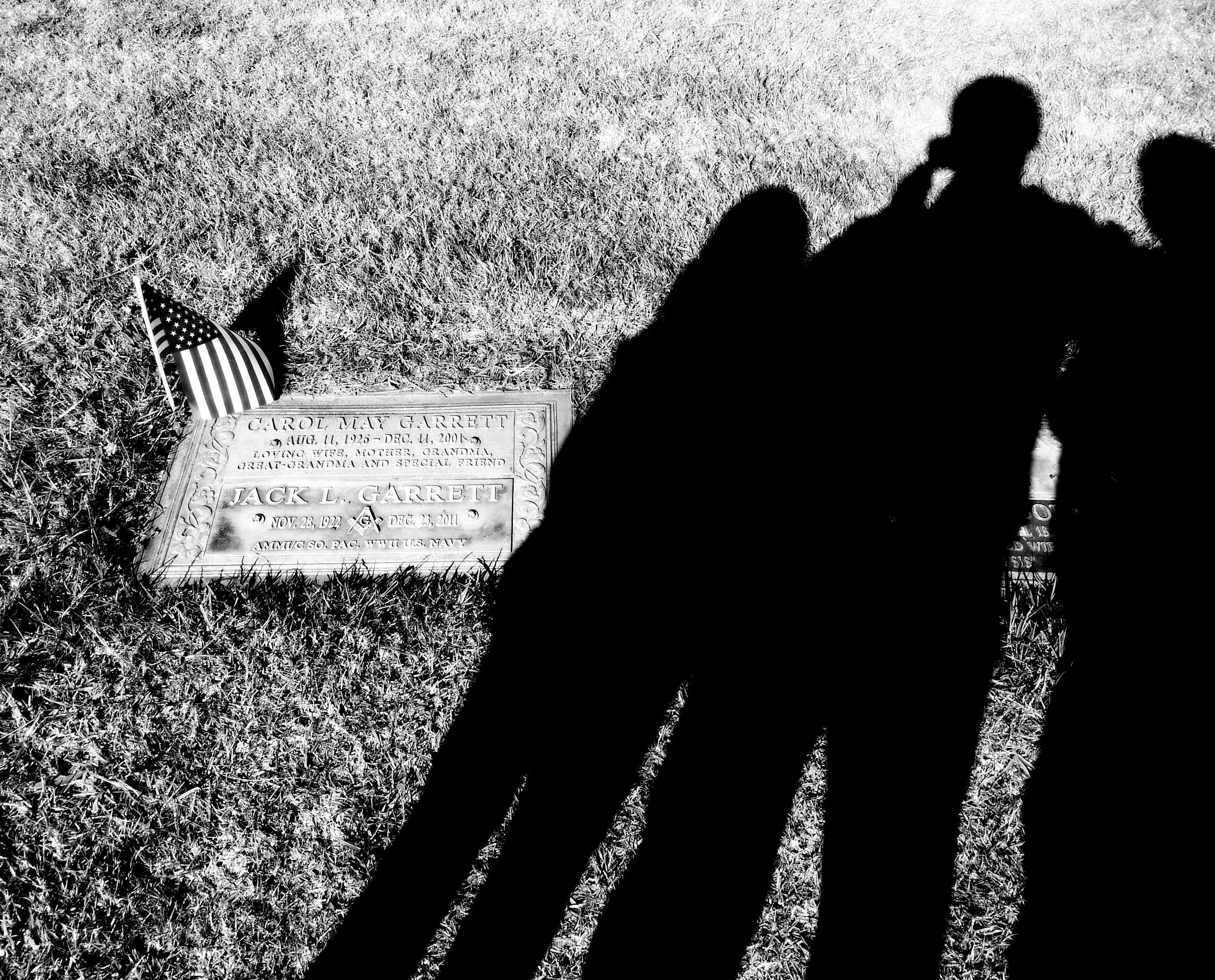
After suffering through seven decades of nightmares of war, he is now finally at peace. Hopefully, he is resting comfortably beneath these shadows cast by my two youngest kids and I:
And a shadow cast by Old Glory:
For new visitors, please feel free to click and read one story of this great American who is now all but being forgotten in our new “Common Core” history textbooks. He earned the honor to be remembered:
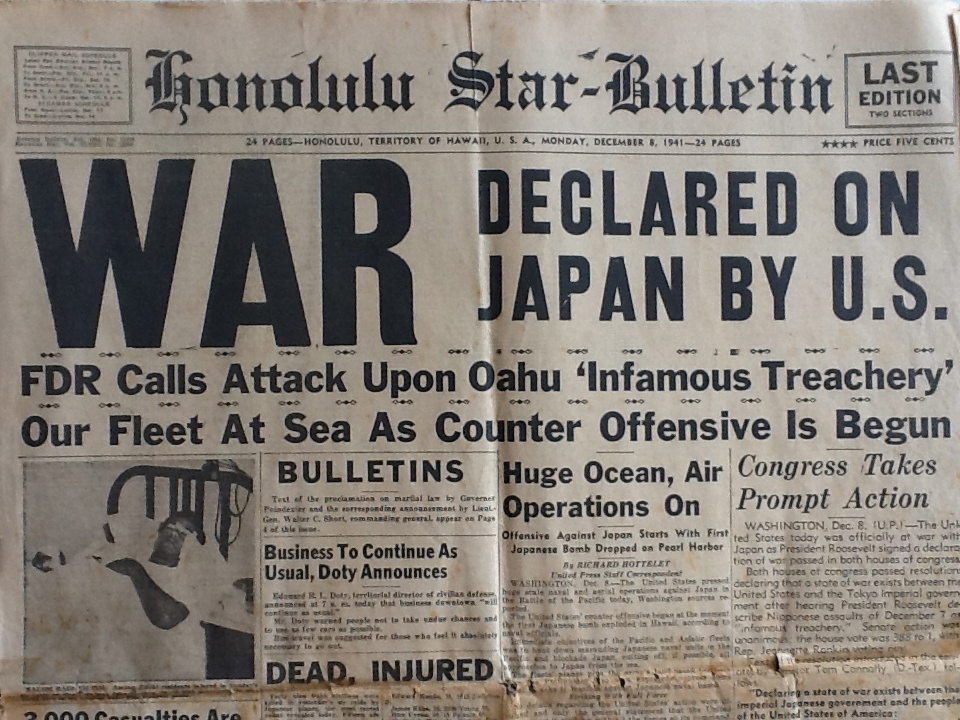
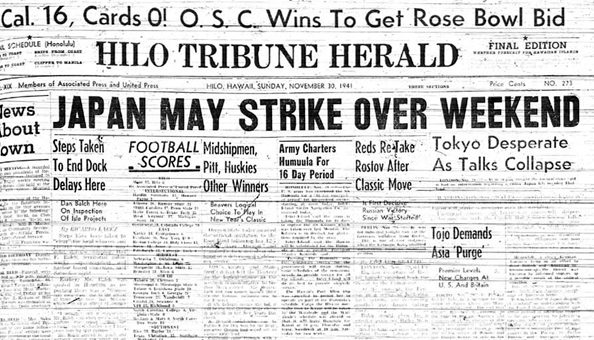
The above: a front page published one week BEFORE Pearl Harbor.
OK… So the newspaper was published on Hilo.
Well, then, how about a second front page? And from a different island this time – Oahu.
Pearl Harbor is on Oahu.
Honolulu Advertiser, November 31, 1941.
______________________________
To continue with “What Did FDR Know?”, let’s go over some once secret stuff, shall we?
And stuff that wasn’t so secret – like the headlines above. These NEWSPAPERS were in newsstands or tossed onto front lawns a WEEK before the attack on Pearl Harbor. How can that be when our textbooks and history tell us our Navy and Army were caught with their pants down?
It may be fascinating and perhaps eye opening for some of you. To some of you old hats in military history, not so eye opening.
This story will be centered on “MAGIC”, the cover name given to the secret diplomatic messages sent between Japanese diplomats and intercepted.(¹)
MAGIC intercepts will be the foundation for this story and subsequent ones.
The Japanese diplomats sent message after message believing their code was secure.
They were wrong.
______________________________
But first, some background on Pearl Harbor itself. It’s important in your quest to conclude on “What Did FDR Know?”
Adm. Richardson
Before December 7, 1941 and as we read in Part I of this series, did you know the Pacific Fleet was based in San Diego? The powers to be moved the fleet from San Diego to Pearl Harbor. Even the decision to move the Pacific Fleet to Pearl Harbor was suspect at that time. And have you thought about who was commanding the fleet before the hapless Admiral Husband Kimmel at Pearl Harbor?
Admiral J. O. Richardson was Commander in Chief, CINCPAC as of January 1940. Per the “Final Secret of Pearl Harbor”, Richardson was the foremost expert on Japan and studied ad finitum Pacific naval warfare and mostly, of Japanese naval strategies. He also knew well of Japan’s pattern of secret attacks.
Richardson disagreed with FDR’s opinion that basing the Pacific Fleet at Pearl Harbor was indispensable towards protecting American interests. Richardson stoutly disagreed and said, “I came away with the impression that, despite his spoken word, the President was fully determined to put the United States into the war if Great Britain could hold out until he was reelected.”
He asserted that Pearl Harbor would be a “… g_d d_mned mousetrap”. His belief was the fleet should remain on the West Coast in San Diego; out at Pearl Harbor, the fleet would be a strategic target for any Japanese surprise attack which he correctly foresaw. His opinion was because not only did Pearl Harbor lack adequate fuel dumps and repair facilities, the Fleet lacked sufficient personnel and the waters around Pearl were unsuitable for training. The fleet would need to return to San Diego and the like for such purposes.
Those who chose to ignore Richardson’s educated opinion did so by saying Pearl’s shallow harbor would preclude torpedo plane attacks amongst other things.
Adm. Kimmel
Richardson asserted too strongly. Although Richardson was highly qualified militarily, FDR removed him from command on January 19, 1941. (Similar events are taking place notionally even today; about 200 top military commanders have been removed or forced out by the current Adminstration.) FDR replaced Richardson with the more amenable Admiral Kimmel. He was far down the list of able commanders but was still selected by FDR to run the Pacific Fleet. While he somewhat shared Richardson’s belief, he was obedient as FDR expected. Kimmel also wrongly assumed he would be “kept in the loop” by FDR insofar as military necessities, including intel. Was he expendable career-wise?
…and that is how Kimmel ended up in command of the Pacific Fleet on December 7, 1941.
__________________________
This is a copy of the actual PURPLE message and is the first part of the 14-part message which was delivered by the Japanese to the US Government on December 7, 1941 – late.
BACKGROUND ON JAPANESE CODES
The Japanese military, just like the US military, had “secret codes” as did diplomats. For the purposes of this blog, we will concentrate on two groups of code: the Imperial Japanese Navy’s code (JN-25) and of the Japanese Foreign Office (code named “Purple”).
Talking about Communications Intelligence, or “COMINT”, would take a number of blogs; indeed, entire books and papers are written about COMINT during this time. For purposes of this blog, allow me to say COMINT is the acronym covering the analysis and usage of an enemy’s radio communications. Codes are when words are replaced by groups of letters or digits and are usually manual. A cipher, however, is the replacement of individual letters or groups of letters according to a plan; it is much more complex and are based on machines.
During this time, US COMINT was somewhat loosely organized, largely due to the rivalry between the US Navy and Army.
However, the cover name “MAGIC” was given to the intelligence obtained by both services involving the Japanese Foreign Ministry radio messages. While at the embassy level, great amounts of military information – and espionage – was disclosed in these secret messages and were therefore at the disposal of the US Government and military.
Imperial Japanese Navy JN-25
The US Navy began its covert intelligence gathering in the early ’20s when they actually broke into the Japanese Consulate in NYC and copied the secret Japanese code in use at that time. By 1926, the US Navy had broken the Japanese navy’s “Flag Officer’s Code”. The Imperial Japanese Navy at that time conducted fleet maneuvers about every three years; they would send coded messages throughout the maneuvers. The US Navy, by virtue of having broken the Flag Officer’s Code, easily listened in on them.
Their “listening in” on the Japanese fleet was so extensive that the US Navy knew of the capabilities of the Japanese warships. The US Navy knew the speeds, armaments, designs, etc., of the Japanese warships, so much so that the US Navy made improvements to their own warships to counter them.
During this period, the US Navy established a small group within the Office of Naval Communications called “OP-20-G”. It was formed without extensive knowledge of the US Army as infighting was common. The same was true for the Japanese military. Think of the Army-Navy rivalry in football – just grow it tremendously.
While the Japanese navy changed their code along the way, the OP-20-G had little difficulty breaking those, too… until late in 1940. Knowing they were headed to war with the US, the Japanese navy prudently introduced an entirely new code, the JN-25. It was much, much more complex than its predecessor. It proved difficult to crack but they had made progress when… the Japanese navy once again made amendments to JN-25 immediately before the attack on Pearl Harbor.
The US Navy, therefore, was pretty much “blind” intel-wise for pretty much a week before Pearl Harbor. It would not be broken until March 13, 1942.
But there was another group of cryptanalysts… an ace in the hole.
__________________________________
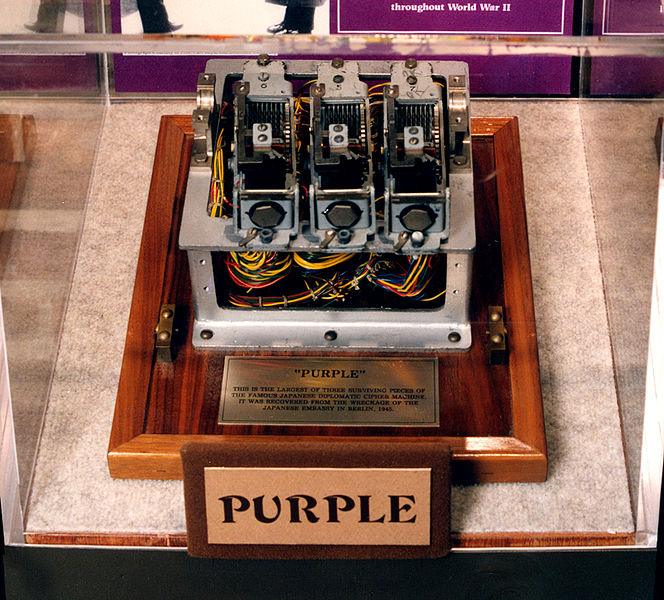
“Purple”
As the Purple machines were destroyed by the Japanese, this is the only surviving section of an actual Purple machine. National Archives
Alongside OP-20-G, the US Army’s cryptanalysis group called “Signal Intelligence Service”, or SIS, focused their energies on the Japanese diplomatic code. The group was headed up by William F. Friedman; he was very successful in designing our own encrypted codes.
Japanese diplomats (NOT military commanders) communicated with each other using an existing code designed in 1932; the US cryptanalysts called this code “Red”.(²) In 1937, the diplomats began using a newer, more complex code; the US referred to this code as “Purple”. In total, there were fourteen codes used by the Japanese diplomats; two of these were of the most value, Purple and “J-19”. Purple was used at the embassy level; J-19 was used at the consular level. Both were machine crypts.
The Purple machine, built from readily available parts. It supposedly cost $684.65. Eight were made. National Archives.
In September 1939, the “unbreakable” Purple code, in the defective thinking of the Japanese, was broken; a key contributor to Friedman breaking Purple was that the Japanese had sent the same message using BOTH Red and Purple codes, a huge blunder in the cryptanalysis arena. In eighteen months, the SIS, headed up by Friedman, cracked the code(³). They even BUILT an analog machine from a blank chalkboard which quickly deciphered the “secret” messages. (The code was so complex that the machine contained 25 connections, which could be arranged 6 pairs of connections, yielding over 70,000,000,000,000 possible arrangements which would determine the method of encryption.) This was an AMAZING feat to have built a deciphering machine since SIS had not even seen the Japanese one. Remember, this was 1938. Nevertheless, these intense eighteen months landed Friedman in the hospital for four months from exhaustion and emotional strain.
With Purple broken, the US was able to immediately decipher all highly secret messages between all top level members of the Japanese diplomats located worldwide… and most importantly, without them knowing. Given the originators of the messages, they had nearly indisputable validity. The reach of MAGIC extended to the European Theater of war as well as briefly mentioned in Part I.
These diplomatic communications also clearly indicated espionage was taking place on the west coast of the United States.
Part 3 and 4 will show the contents of MAGIC intercepts so that you can answer on your own, “What did FDR know?”
(¹) Unbelievably, Secretary of State Stimson was definitely upset when he learned we were intercepting messages. He championed the statement, “Gentlemen, do not read each others mail.” At the same time, consider the Snowden/NSA “scandals” of today.
(²) Ironically, Hitler had loved Baron Oshima so much he allowed Oshima to purchase a commercial version of Nazi Germany’s famous Enigma machine. The machine used for Red was based on this Enigma construct.
(³) While Friedman was the man burdened with the responsibility of deciphering PURPLE, it is acknowledged that a man named Frank B. Rowlett was the man who actually broke the code.
“When it comes to giving, some people stop at nothing.”
– Vernon McLellan
That was Aunt Michie. She gave all of herself and of her life strength to others because her heart knew no other way.
_________________________
At the moment Aunt Michie watched the ugly mushroom cloud rise from her field that day, her older siblings – my dad, Aunt Shiz and Uncle Yutaka – were all imprisoned in the “war relocation centers” scattered about the United States. These were truly prisons and the popular view is that FDR imprisoned them “for their protection” because they looked like the enemy.(¹)
Life within these “camps” was “sub-standard”. They were forced to live in small, shoddily built wooden barracks covered only with tar paper with little or no privacy. No running water inside their barracks – they had to go wait in line outside, whether it be rain, snow, dust storm or searing desert sun to use public latrines or showers. Food was served in mess halls on pot metal plates at specific times, just like in the military. The food was miserable according to Dad and worse yet, they had to wait in line again. For the first month or so of imprisonment, he said all they had was liver, powdered eggs and potatoes.
But then again, he said it was food.
Aunt Michie and her family were near starving in Hiroshima while dad was imprisoned in the good ol’ US of A.
_________________________
Taken at the Kanemoto home in Hiroshima, 1951 and soon after my parents wed. (L to R) Sadako, Namie, Aunt Michie holding a young Kiyoshi, Grandma Kono, Masako, mom and dad. Courtesy of Kiyoshi Aramaki.
It is assumed like for the rest of America, Dad and his older siblings heard the news of the atomic bombing but while in the camps on or about August 8th… that one enormous bomb had wiped out Hiroshima. There must have high anxiety and anger as many of the inmates in Dad’s camp (Minidoka) were from Seattle; they had family in Hiroshima as their parents had immigrated from there.
My cousins tell me that sometime after war’s end, Michie’s “American” siblings – my dad, Uncle Yutaka and Aunt Shiz – managed to re-establish contact with Grandmother Kono and Michie. With the Japanese infrastructure destroyed, it was a miracle. And it was no easy task as letters to and from Japan were not only prohibited, it was impossible. There was no telephone in the villages where Grandmother and Michie lived.
But her American siblings somehow managed to send much needed clothing to them. When my father finally reached Hiroshima while a sergeant in the US 8th Army, he carried two duffle bags full of C-rations, candy and Spam. They said it was a feast for them after years of hunger.
Dad in front of his Hiroshima home – April 1948
Sadako (who savored the white rice Michie made them on the day of the bomb) told me at a farewell dinner two years ago that she fondly remembered my dad taking them to a market of some kind where he bought her a little coin purse. She remembered Dad gave her the money to buy the little purse and was told she could keep the change. She remembers then handing the change – which was a LOT of money back then – to Michie who humbly accepted it. Sadako said she cherished that little coin purse for years.
______________________________
EPILOGUE
From exhaustive laboring on her farm… to taking precious sashimi to her brother Suetaro… to walking ten miles with children in tow to care for Grandmother Kono after her stroke… to the pain of learning of her brother being killed in action… to being thrown onto the ground and watching a huge mushroom cloud rise over a small hill… to pulling a wooden cart over a hill… to tirelessly aiding the victims… and most of all, sacrificing her own health for the sake of others…
She never gave up in those thirty years. Would you have? I don’t believe I would have had the fortitude.
But because her soul would not quit, she got everyone to tomorrow… but in doing so, her own tomorrows dwindled.
Michie is still here. The fruit of her sacrifices can be seen today in her six children, all of whom have lived – and are still living – full, joyous lives.
Four of Michie’s children with my son and I. The four at the left front were at Aunt Michie’s farmhouse after the atomic bomb; Hitoshi was there as a burn victim. Hiroshima – September 8, 2012At breakfast – Endaijisou Hot Springs, November 2013. Tomiko was at home when the atomic bomb went off; the house was destroyed.
They have their mother, Michie, to thank and they cherish that… and that they were all there at the farmhouse when she looked at each one of them intently one last time before leaving this world.
A most grand mother.
And yes…
They all love food to this very day.
________________________________
I wish to deeply thank my Hiroshima cousins for sharing their memories of their life with Michie with us.
Like all Hiroshima citizens I have met, they simply pray for peace.
NOTES:
(¹) There are declassified US intelligence documents which show that a small number of Japanese and Japanese-Americans were performing espionage. Intelligence was able to determine this by intercepting and decoding secret Japanese communications. This information was given a cover name of MAGIC and these documents were typed up for FDR and a very small number of trusted officials. However, rounding up the spies would clearly indicate to the Japanese that their code had been cracked. These documents present another view contra to the widespread belief that FDR imprisoned the Japanese and Japanese-Americans from discrimination and war time hysteria. In other words, FDR used that hysteria as a cover story; by doing so, he was able to remove the “spies” from the West Coast without alerting the Japanese. FDR also stated in communications that there would be “repercussions” from such action.

 So I go back…to take the Text Princess her phone.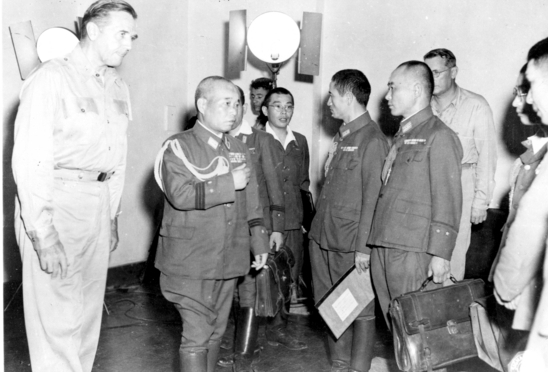





















 Masako and Spam Musubi
