Category Archives: Nisei

“Dear Courageous Sailor” – a Letter from 1943


Marines82large
Marines escort Saipan civilians. It was estimated that 22,000 civilians died, most by suicide. It was traumatic for our young Marines to witness, too.

There is personal pain in a full-fledged war that only those who were fully involved can feel.  Those feelings will differ by how that person was involved.

We somewhat understand through survivors that a soldier, airman, sailor or Marine near or on the front lines will have an intimate kinship with instantaneous fear.  They know combat is immediate, unfair, cruel, and barbaric.  But hopefully, they know their families and country are behind them – perhaps giving them the edge to overcome their fears and survive.

And this is true for the enemy as well.  As I become more knowledgeable on the Pacific Theater during WWII, I have learned the young Japanese combatants had the same fears (please see “There’s No Toilet Paper in the Jungle of Burma“).  But unlike the Allied forces who had millions of tons of war materiel, food and medical care backing them, the Japanese military fell way short.

But what about the Japanese home front?  Have you paused to ponder that?  Were their countrymen any different from us in their ways of supporting their young men dying by the hundreds of thousands?

I never did myself until recently.

____________________________

I met Rob on the internet through his facebook page, “WWII U.S. Capture Photos“.  He focuses on the spoils of war, bringing back to the forefront the war souvenirs seized by military personnel.

He acquired a letter from a now elderly Marine who was fighting on Saipan in mid-1944. He had told Rob that he removed it from a Japanese corpse.

japaneselet2
The now tattered envelope is anonymously addressed to”海軍の勇士様” or “Dear Courageous Sailor”.

Apparently, this letter had ended up to haunt the Marine who was at time very young and fighting for his life on Saipan.  The once young Marine is pictured in the center of this photo:

Marine Saipan
The young Marine who seized this letter is pictured in the middle. For an original image, please click on the picture.

Rob asked if my father could read the letter and translate it.

The letter was haunting Rob, too.

______________________________

My friend and I went to see Dad in October 2013.  Below, Dad is reading the letter taken by the then young Marine from Saipan in 1944.

IMG_1032

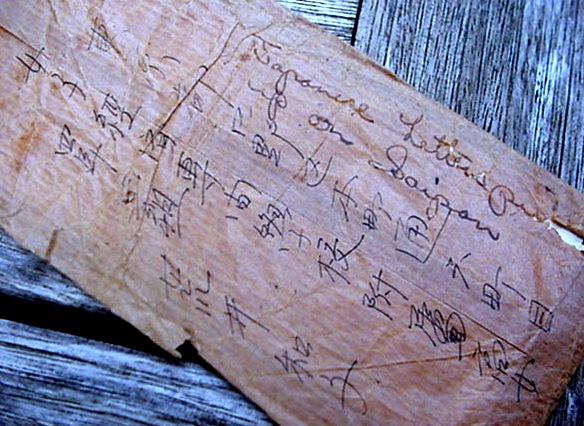
The backside of the envelope is below showing the sender’s name and return address.  The image was enhanced to bring out the writing.  The Marine had written “Japanese letter picked up on Saipan”.

The letter was anonymously addressed and sent by a young girl named “Kazuko Arai (荒井和子)”.  The return address shows she was a student of a girl’s economics school in Tokyo, Nakano City, town of Honcho (東京都中野区本町通六丁目女子経済専門学校 – 附属高女).  While I believe the school may have been at least damaged by the fire bombings, I may have located the successor school. It is called “Nitobe Bunka Gakuen” with its current address as 東京都中野区本町6-38-1.  (While I did send a blind email of inquiry to them in my far from perfect Japanese, there has been no response.  I doubt that there will be given the Japanese culture.)
culetter1

While the scans were of low resolution, the two pages of the letter are as follows:

japaneselet3
japaneselet4

Because my father  will be 95 next month, it was difficult to keep him on course.  In spite of reminding him to just read the letter in Japanese (I would understand most of it), he continually tried to translate its sentences into English.  Perhaps somewhere in his buried conscious, he is doing as he was trained by the US Army’s Military Intelligence Service.  Admittedly, there were about a half-dozen characters that were just tough to make out due to creases and lack of clarity.  And he wasn’t able to figure out one paragraph in particular…but I did!  Got one on my old man.

I also sought out help from my good Hiroshima cousin, Kiyoshi, and he filled in the blanks.

Kazuko wrote:

夏も過ぎさり戰局は日一日と厳しく今こそ物心はおらか私どもう総べてを国家に捧げつくすべきと秋となりました。
As summer passes and turns into autumn, the war situation is getting more severe and now we must physically and mentally dedicate ourselves for our country.

海上での勇士様にはお変わりなく軍務に御精勵(励)の事を存じます。
As a courageous sailor out at sea, I know your unwavering fighting spirit continues.

大東亜の全戦線に於いては、今や彼我の攻防戦は、まことに熾烈極めて居るという事等、すでに日々の報道により私共の耳に刻々傳えられてをります。
Per our (radio) broadcasts, we hear that the intensity of battle and such has increased for both sides at all the front lines in the Far East Asia theater of war.

山崎保代部陽長以下二千名ついに全員北海の島に於いて玉砕したこの事をラジオが私達に傳へるや私達は唯聲をのみ頭をたれるばかりでした。
A radio broadcast announced that Lt. General Yasuyo Yamasaki and 2,000 of his  garrison died honorably defending an island in the North Sea.  All we could do was bow our heads (in honor) and swallow our  grief (voices).

– – – – – – – – – – – – – – – – – –

[ NOTE: In researching this report, I discovered that Lt. General Yamasaki was assigned to defend the island of Attu.  He was killed with his remaining garrison in a banzai charge on May 29, 1943.  Please click on the following for more information:
My cousin Kiyoshi also found an extensive accounting of the Battle of Attu in Japanese with English translations for those who are interested.

– – – – – – – – – – – – – – – – – –

(Letter continues)

今私達は本当に容易ならぬ戰争の只中におかれている事を強く感じました。
Now, with the daily war situation, we strongly feel as if we are in the midst of the battle and realize (winning) will not be easy.

学校ではもうじき秋の軍動會が開かれますので一生懸命身体をきたへてをります。
Soon, it will be time for the autumn (military) athletic meet; I will train hard to strengthen my physique.

断じて米英女性には贁けない覧唔です。
We resolve to not lose against the American and English women.

ではどうぞう勇士様くれぐれ御身体御大事に大切にお国の為しっかり戰って下さい。御武軍を祈り致します。
So please, courageous sailor, sincerely take good care of yourself and fight hard.  I pray for your fighting spirit.

さよなら
Good bye.

_____________________

So now we realize that Japan also had a “home front”.

Perhaps they did not have a “Rosie the Riveter” like we did.

But the Japanese homeland did endure pain, fear and sorrow as we did…and depression.  They were not the inhuman creatures depicted on war posters and in propaganda of that time.  And thanks to Rob and the young Marine, we see a letter written in Tokyo by a high school girl named Kazuko Arai in the autumn of 1943 and simply addressed to an anonymous sailor.  Kiyoshi also believes that the watermarked stationery was of high quality and issued out of military stock for this purpose.

Sadly, we do not know the name of the sailor from whose corpse the letter was removed from, nor do we know if Ms. Arai survived the war and raised a family.

showa8
Picture taken at Kazuko’s school pre-war.

Things like this sort aren’t evident in our (current) history textbooks.  Now, WWII has pretty much been erased from school textbooks altogether, replaced by “politically correct” topics…that there was simply a war between Japan and America.  A disgrace to those who endured or died.

In closing, there is a diary written by a young Japanese doctor up to the time of the final banzai charge on Attu.  He was one of the attackers who was killed.  As mentioned in my other posts about the Military Intelligence Service, Japanese military forces were allowed to write diaries.  When these diaries were taken from the battlefield, the Japanese-Americans (Nisei) soldiers were able to read then extract valuable intel on the enemy – both for their battle front and their homeland.  In his last entry, the young doctor writes a goodbye to his wife and two small children back home.
Young Japanese doctor’s war diary

Graciousness, Gratefulness and Grandeur


q00893001u00132
From http://www.entaijisou.com

My girl friend Linda fretted for a couple of weeks before going to Japan with me.
She fretted about the (we-know-they’re-coming) typhoons.

She fretted about the (we-don’t-know-they’re-coming) earthquakes.

But what did she fret about the most?  She fretted about getting butt-naked in front of my cousins for a Japanese-style bath at a hot spring in Japan.

Silly lady…  All Japanese do that.

Oops.  I forgot.  She is Irish with blue eyes.

Well, I guess if I were her and experiencing a panic attack, I’d just put a brown paper bag over my mouth… and drink all the scotch inside.

That would help.  After all, she is Irish.

___________________________

IMG_6615
The hot spring inn, “Entaijisou” or 延対寺荘.

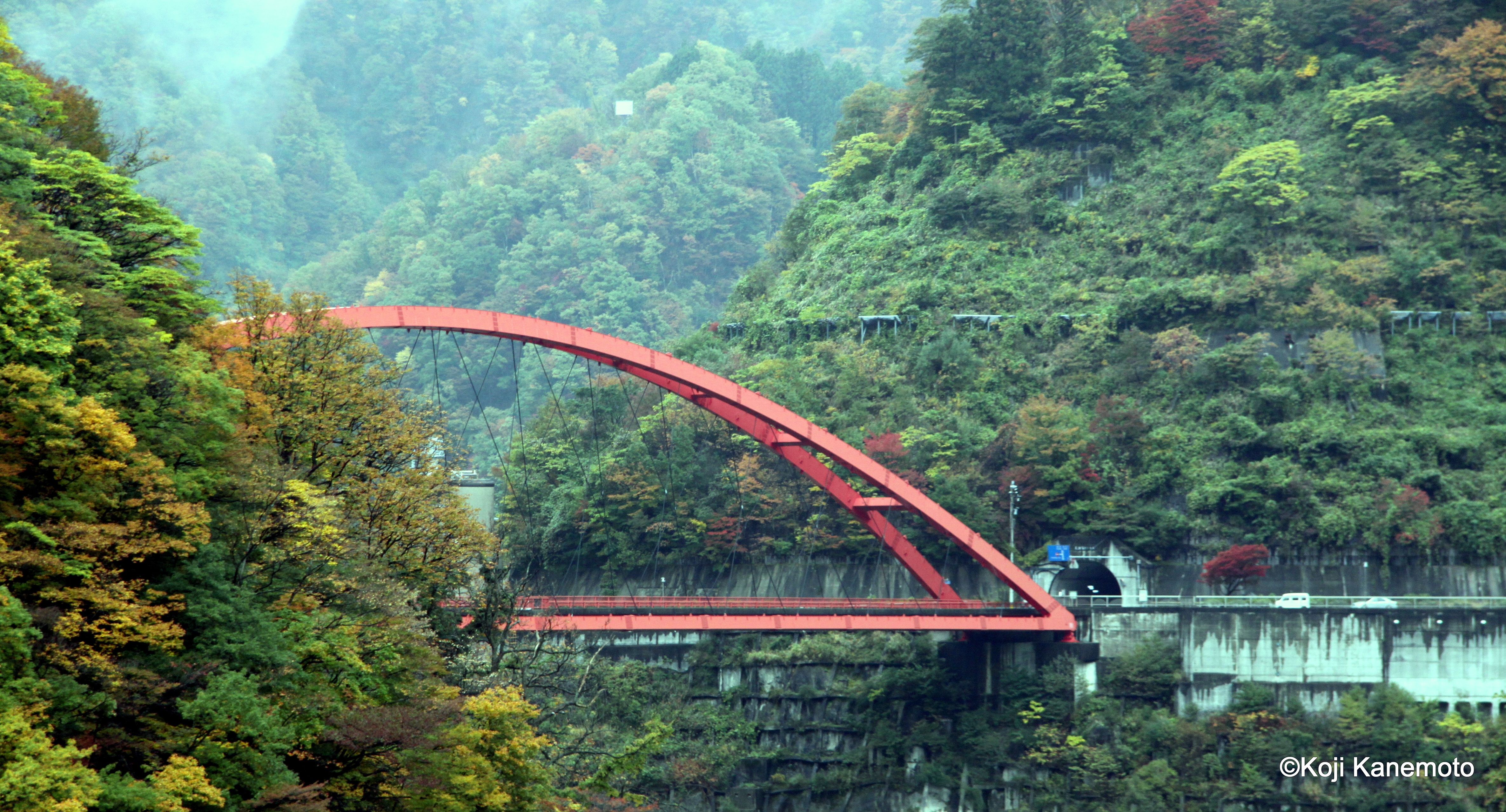
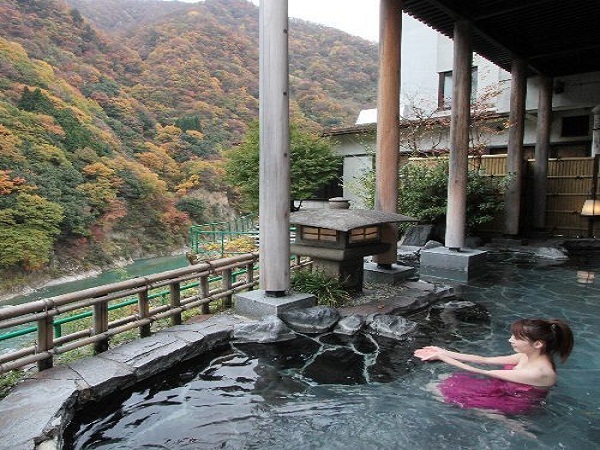
During our ten-day visit to Japan in November, my cousin Kiyoshi (Masako‘s youngest brother) treated us to a most wonderful journey to Toyama Prefecture, just inland from the Sea of Japan.  One such destination was famous for its hot springs and a beautiful gorge. We stayed at the inn called “Entaijiso (延対寺荘)” near “Unazuki Hot Springs (宇奈月温泉).”  Started in 1900, the hot spring’s water is naturally heated to a most perfect temperature and has an open-air spa area called a “rotenburo (露天風呂)”.  Literally, you are soaking outside under the heavens.  Butt-naked.

Of course, I was unable to take photos inside the bathing area for obvious reasons but here are other photos from their website to give you a taste of the relaxation that can be had.

qspa004   355206239

Yes, my Irish lady did go in with my (female) cousins!  In a form of endearment, my cousin Masako even washed her back.  Butt naked.  After relaxing in the water for a while then dry off, you notice your skin is just ultra silky smooth.  My cousins did say the geothermically heated ground water has therapeutic powers…  That there is some kind of magical healing power bubbling up.  I kind of doubted it.  But there IS something in the water. 🙂

Their dining area was spectacular; just outside is the river and magnificent mosaic-colored hillsides – a post card panorama.

IMG_6623

IMG_6611

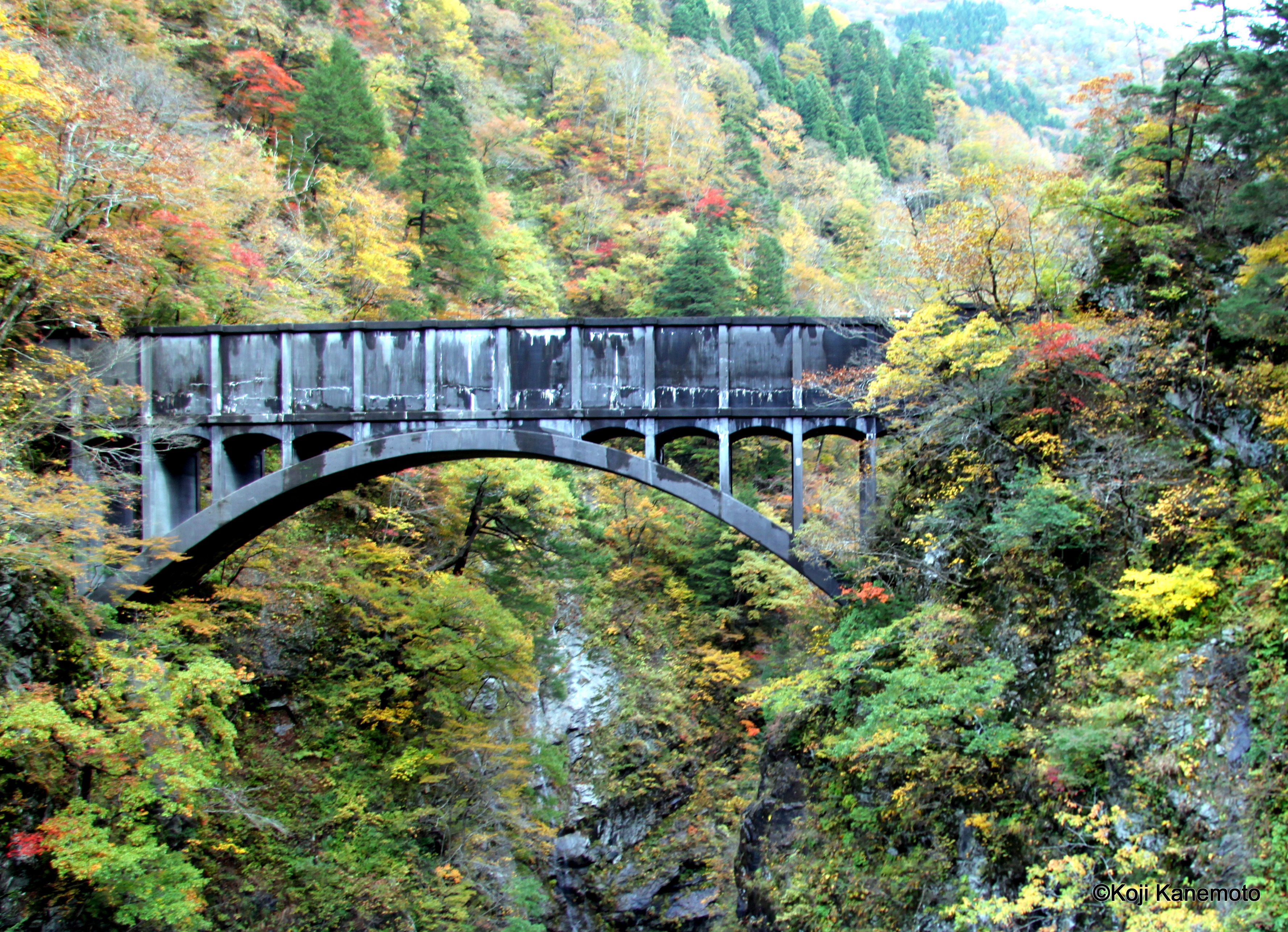
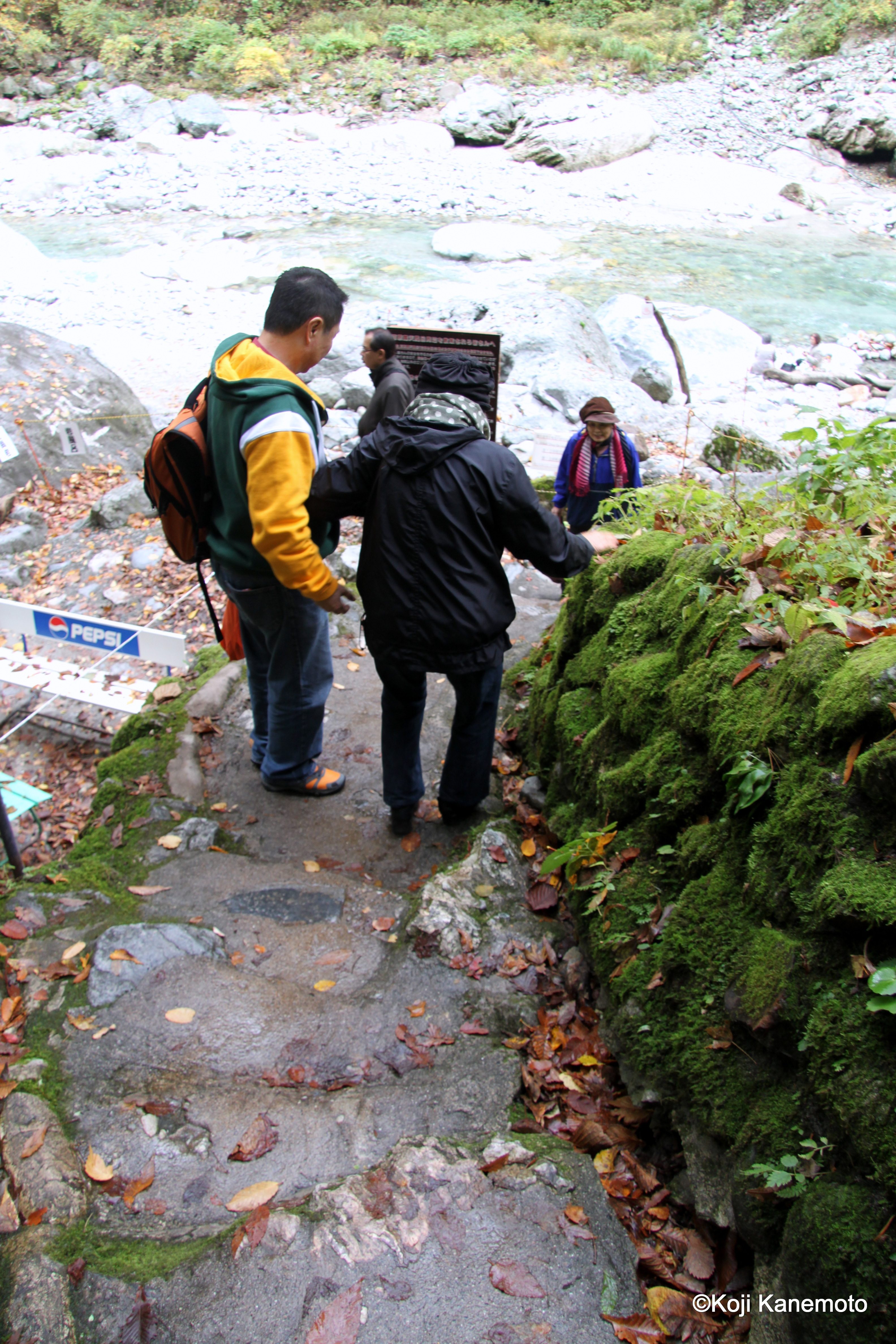
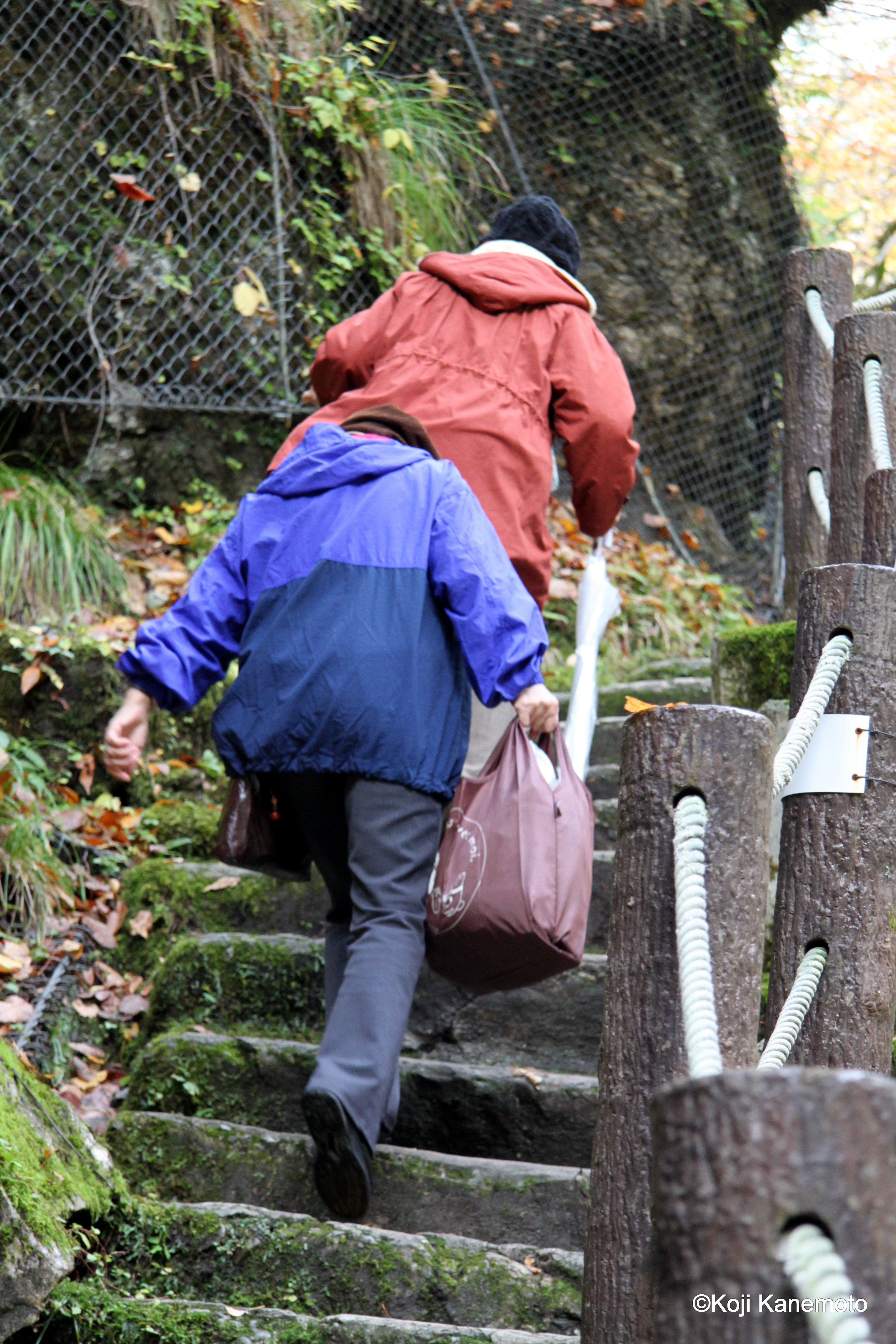
Kiyoshi’s gracious treat continued on the Kurobe Gorge Tram (黒部峡谷トロッコ).  It is a a sightseeing train running on a very narrow track originally built to aid the construction of the Kurobe Dam.  It follows a winding path along the river – something like 20 kilometers from the base station of Unazuki to the end.  We we there unbelievably at their peak of the autumn color change.  It is important to note we hiked a bit after getting off the tram at Kanetsuri Station – and my cousins below LED the way.  While Masako has difficulty going DOWN stairs, she was a jack rabbit going up.  Amazing.  At 80 years of age.

IMG_6628
My cousins (L to R): Tomiko (71), Masako (80), Namie (74) and Kiyoshi (65).

I will let the photos show you the grandeur we were so fortunate to experience.  (Please note many of these were taken from the moving tram.)

IMG_6919

IMG_6736

IMG_6789

IMG_6812

IMG_6850

IMG_6731

IMG_6982

IMG_6725

IMG_6985

IMG_6977

IMG_6988

IMG_7024

IMG_7029

IMG_6943

IMG_7047

IMG_7050

IMG_7015

IMG_7070cif76nib_original

IMG_7020

IMG_7080

11045645333_cf1fd0d47e_o

11045483675_ce338a3c77_o

IMG_7176

AND A “I SPY WITH MY LITTLE EYE”…  Can you spot it?  There is a wild red faced monkey below.

IMG_7167

__________________________

Prior to getting into the hot spring and public bath, I tried to relieve her anxiety.

I said, “When in Rome, do as the Romans do.”

She replied, “They sinned.”

__________________________

I was proud of my blue-eyed Irish lady friend.  She got into the public bath and hot springs butt naked.

And even got her back scrubbed by Masako, a survivor of an atomic blast.

Imagine that.

From a Japanese hot spring, I have learned that spreading peace for the world starts as a power that emanates from within one person.

Dear Mama – A Farewell Letter


image0-012
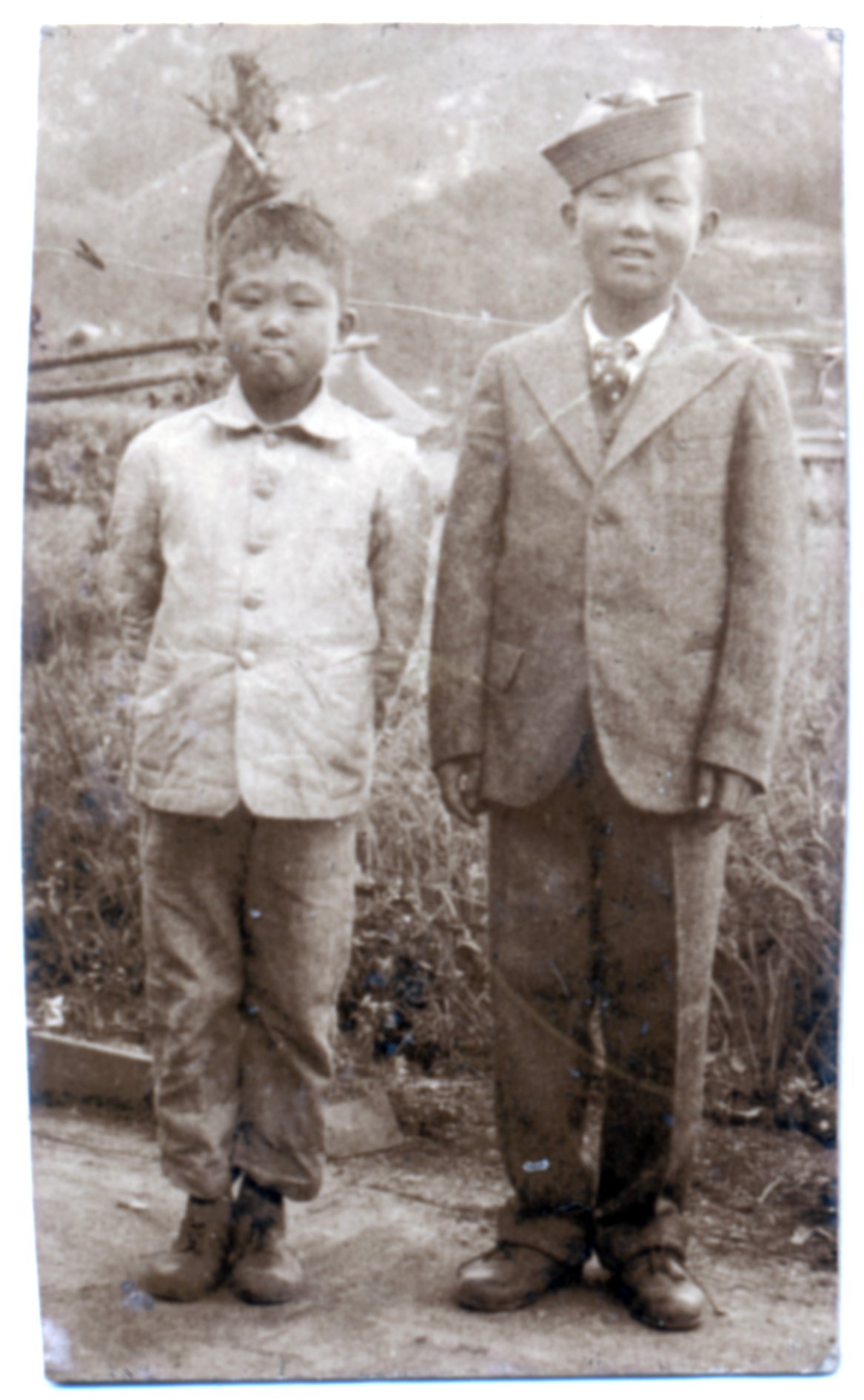
Uncle Suetaro (L) and my dad (R). Taken from the Hiroshima house with Mt. Suzugamine in background. Circa 1929

During my visit to my father’s childhood home in Hiroshima last summer, I was entrusted with hundreds of vintage family photos and mementos.  I brought them back here stateside, promising my Hiroshima family I would “restore” them.

Well, after a good start, I developed a painful case “tennis elbow” from using the mouse so much during the retouching process.  Sadly, it came to a screeching halt sometime in November last year.

But one very, very special item was entrusted with me – my Uncle Suetaro’s war diary.

Although born an American citizen in Seattle with the rest of his siblings, he was writing this war diary as a sergeant in the Japanese Imperial Army.

The last entry was a farewell letter to his Mother.

______________________________

The photo above had been secreted away behind another photo that was in Uncle Suetaro’s album.  He meticulously kept the album up to the time of war.  His oldest brother, my Uncle Yutaka, had conscientiously sent him family photos they had taken in Chicago and Los Angeles before imprisonment.  Suetaro complimented the photos with his beautiful Japanese calligraphy, written in a silver, whitish ink.

20131007_183754

The photo of Uncle Suetaro and my dad shown at the beginning was so very tiny – but there was something Uncle Suetaro loved about it to keep it.  I wish I knew what it was.

IMG_0451
Actual size

__________________________________

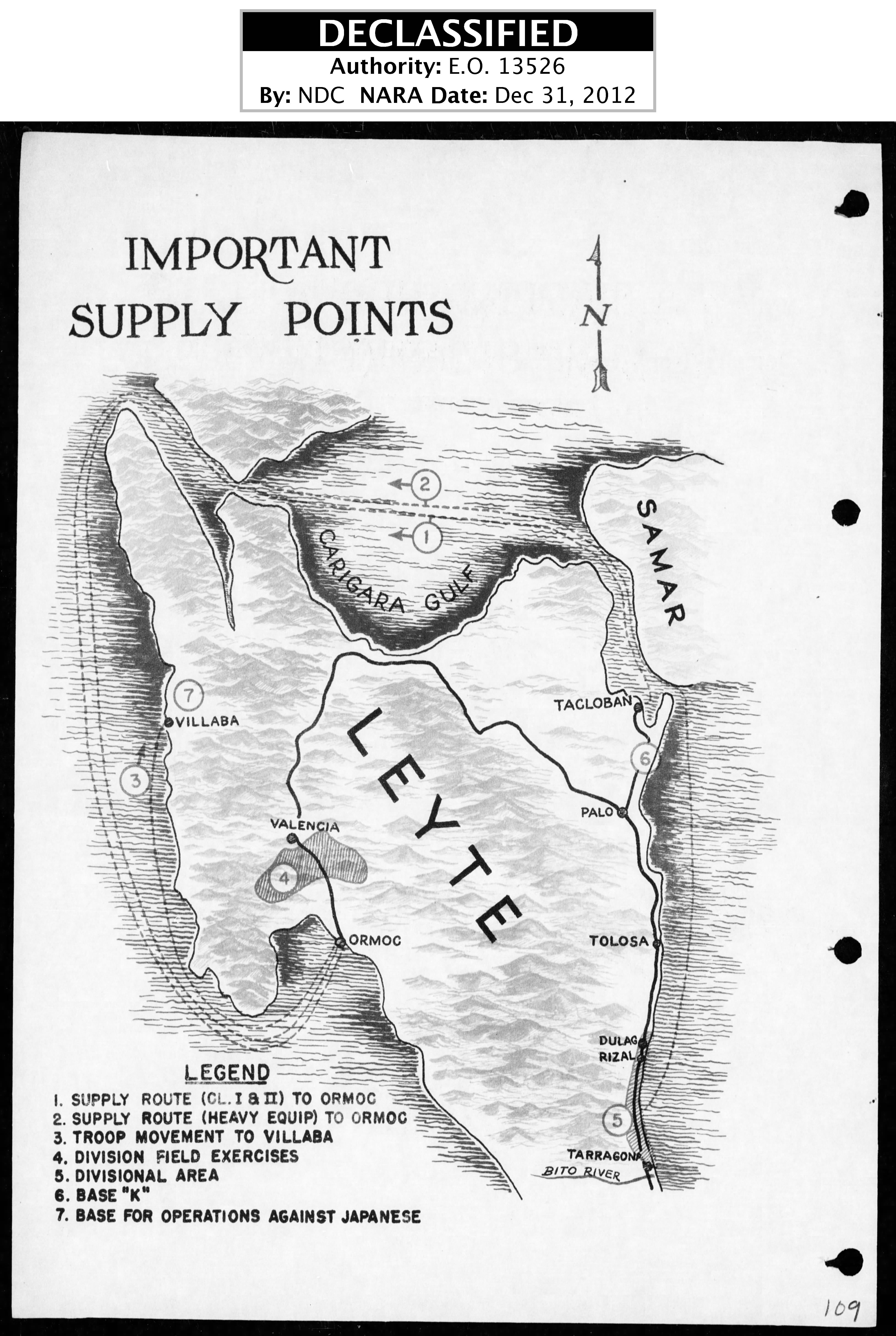
Uncle Suetaro was killed as a sergeant major of the Japanese Imperial Army on Leyte apparently near a town called “Villaba”.  Below is an actual page from a “war diary”, an official report written and published by the US Army.  Villaba is located on the western shore of Leyte but not far from Ormoc Bay, which was a killing field for Japanese ships by US aircraft.

Page 109
Source: US Army 81st Infantry Division Headquarters / Report of Operations

His remains were never recovered.  In the family grave are his tiny pieces of his fingernails and a lock of hair.  It was custom at that time to leave parts of your earthly body with your family as returning was unlikely.

Not much to bury… but it was better than not returning at all.

In a spiritualistic way, he had never left.

____________________________________

This is his farewell letter to his Mother (my Grandmother).

It is clear it was very hurriedly written.

With the help of my cousin Kiyoshi in Hiroshima and my dad, we’ve typed up Uncle Suetaro’s farewell letter – complete with old Japanese characters and translated as best possible into English.  When reading this, please remember these are the words as written as a soldier going off to fight the Americans – but he was once a young American boy born in Seattle, WA.

image0-038_originalhigh
Cover. His name is at the bottom.
金本 末太郎
image0-034_original
ママ様
Dear Mama,
御無沙汰致しました。
I am sorry for not writing for a while.
お元気ですか。 自分も相変わらず元気旺盛御奉公致しております故、何卒ご放念く
ださい。
How are you? As usual, I am full of life fulfilling my duty to my country so please feel at ease.
(元気で国のために力を尽くしてるので心配しないでください)
愈(いよいよ)自分も日本男子としてこの世に生を受け、初陣に臨むことを喜んでいます.
More and more, as I realize I was born into this world as a Japanese male, I am overjoyed to be going into my first combat.
勿論(もちろん)生還を期してはいません(生きて帰ることは思ってはいません)。
Of course, I do not expect to come back alive.
image0-035_original
併せ(しかしながら)自分に何事があっても決して驚かないように、また決して力を
落とさないよう平素より力強く暮らしてください。
And for you, Mother, whatever happens, do not be taken by surprise and please fight back with even more energy than you normally would.
24年の長いあいだスネかじりにて非常にご心配をかけ誠にすいませんでした。
I deeply apologize for these 24 years of worry and concern I have caused you.
お赦し下さい(おゆるし下さい)。
Please forgive me.
今の時局は日本が起つか亡びるかの境です。
At this time, Japan is at the boundary of either winning or perishing.
どうしてもやり抜かねばいけないのです。
We must persevere.
兄さん達を救い出すことも夢見てます。
I still dream that we can free our older brothers (from forced imprisonment in America by FDR – Ed.).
自分のことは決して心配せずお体をくれぐれも気をつけて無理をしないよう長生きを
してください。
Please do not worry about me but instead, please take it easy on yourself and live a long life.

(Note: Green indicates an edit inserted for clarification purposes.)

image0-036_original
何事あっても荒槇、小林の方に相談して下さい。
If something comes up, please discuss it with the Kobayashis or Aramakis.
金本家は絶対に倒してはいけないのです。
No matter what, do not allow the Kanemoto name be extinguished.
伴の兄さんもお召の日が必ずあることと思います。
Mikizou-san will also be drafted.
(荒槇幹造さんも必ず徴兵されることと思う)
歳はとっていても軍隊に入れば初年兵です。一年生です。
Although he is much older in age, he will be treated like any other draftee. As a young recruit.
絶対服従を旨とするようよく言って下さい。
Implore upon him to obey every command without question.
近所の皆さん、河野,倉本、白井、武田、永井、正覚寺、梶田、山城、山根、杉本、
辻、河野…、橋本,西本、松本繁人、小林、中本、新宅、武蔵、水入、土井、堀田、住岡、見崎、長尾、加藤、三好、内藤、島本、(Writing continues next page from here) 宮本先生、谷口先生、慶雲寺などの人によろしくよろしくお伝えください。
image0-037_original
ではこれにて失礼します。
With that, I will say farewell.
何時までも何時までもお達者のほどお祈り致しております。
I pray for all eternity for your good health and prosperity.
南無阿弥陀仏の御6文字と共に行きます。
I go blessed with the six realms of Namu Amida Butsu.
サヨウナラ
Sayonara
昭和19年5月3日
May 3, 1944
末太郎より   ママ様へ
From Suetaro To Mama-san

His farewell send-off is pictured below.  Masako-san believes Suetaro wrote the letter around this time.  It was at gatherings such as this when a Japanese soldier was given a “good luck” battle flag – the ones that many WWII combat veterans “removed from the battlefield” as souvenirs.  There are many cases now where their sons and daughters – or grandchildren – are making efforts to return such flags to the Japanese families.

One of the treasures found during our journey to the family home in Hiroshima this month. Uncle Suetaro is going to war and his death.
Uncle Suetaro (center) is pictured just before going off to war and his death.  You will notice my grandmother is missing from the photo; that is because she suffered her first stroke knowing her last son was going to his death.

_______________________________________

Bertrand Russell wrote, “War does not determine who is right – only who is left.”

He is correct.

On a much smaller scale, though, Grandmother Kono was all who was left in that house when war’s end came.  Her precious son Suetaro – who she kept from returning to America for the purpose of keeping the Kanemoto name going – was dead.  She was now alone.  I wonder how she felt.

A mother’s anguished solitude.

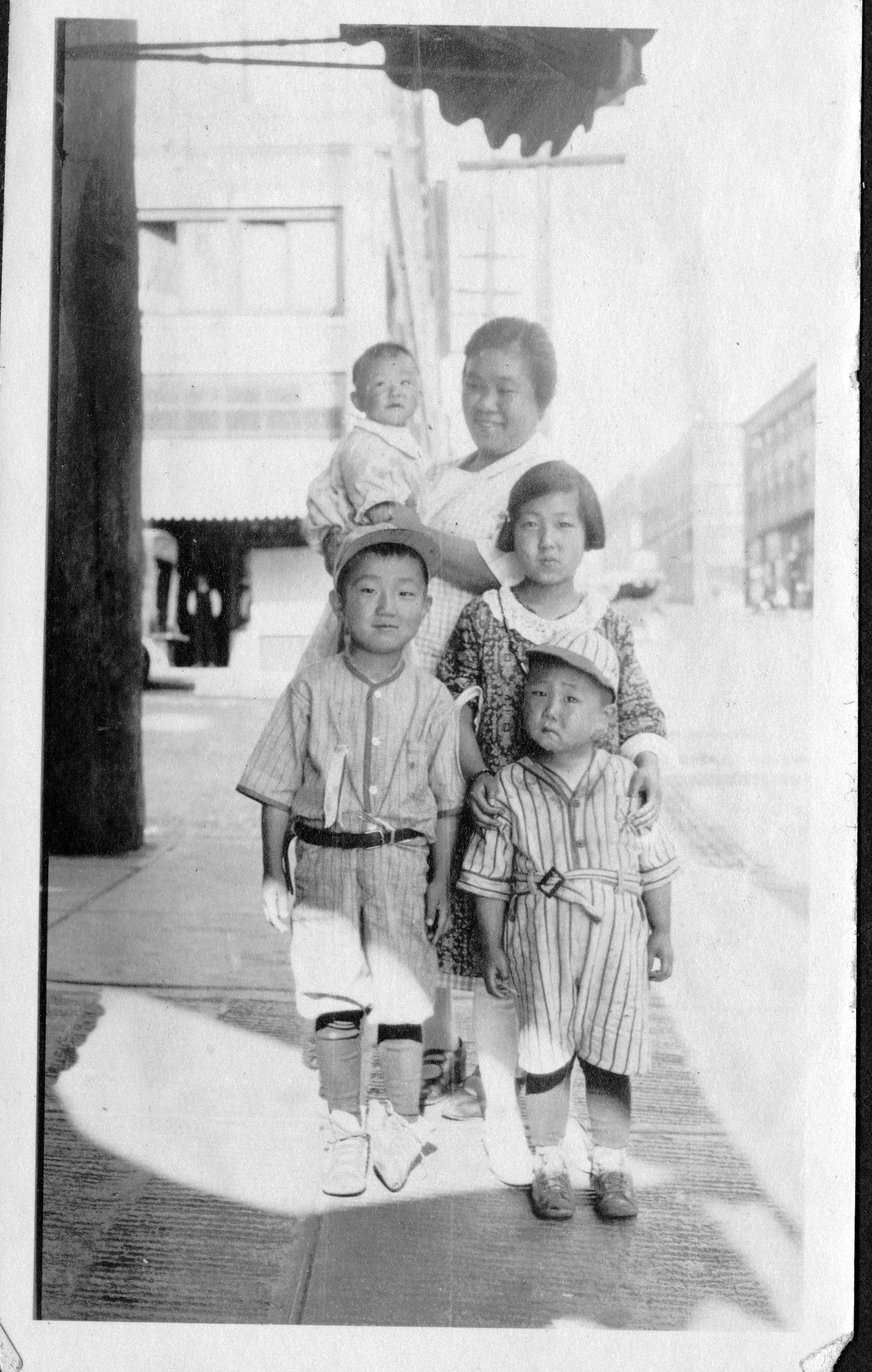
image1-007retouched
Grandma and four youngest children at the corner of King and Maynard in Seattle, circa 1926. From clockwise right-front: Suetaro, dad, Mieko, Grandmother Kono and Shizue.

(For other related stories:

A Mother’s Anguished Solitude, Part I

A Mother’s Anguished Solitude, Part II

Were Japanese Soldier’s Frightened?

Eighty Years Later…


Image

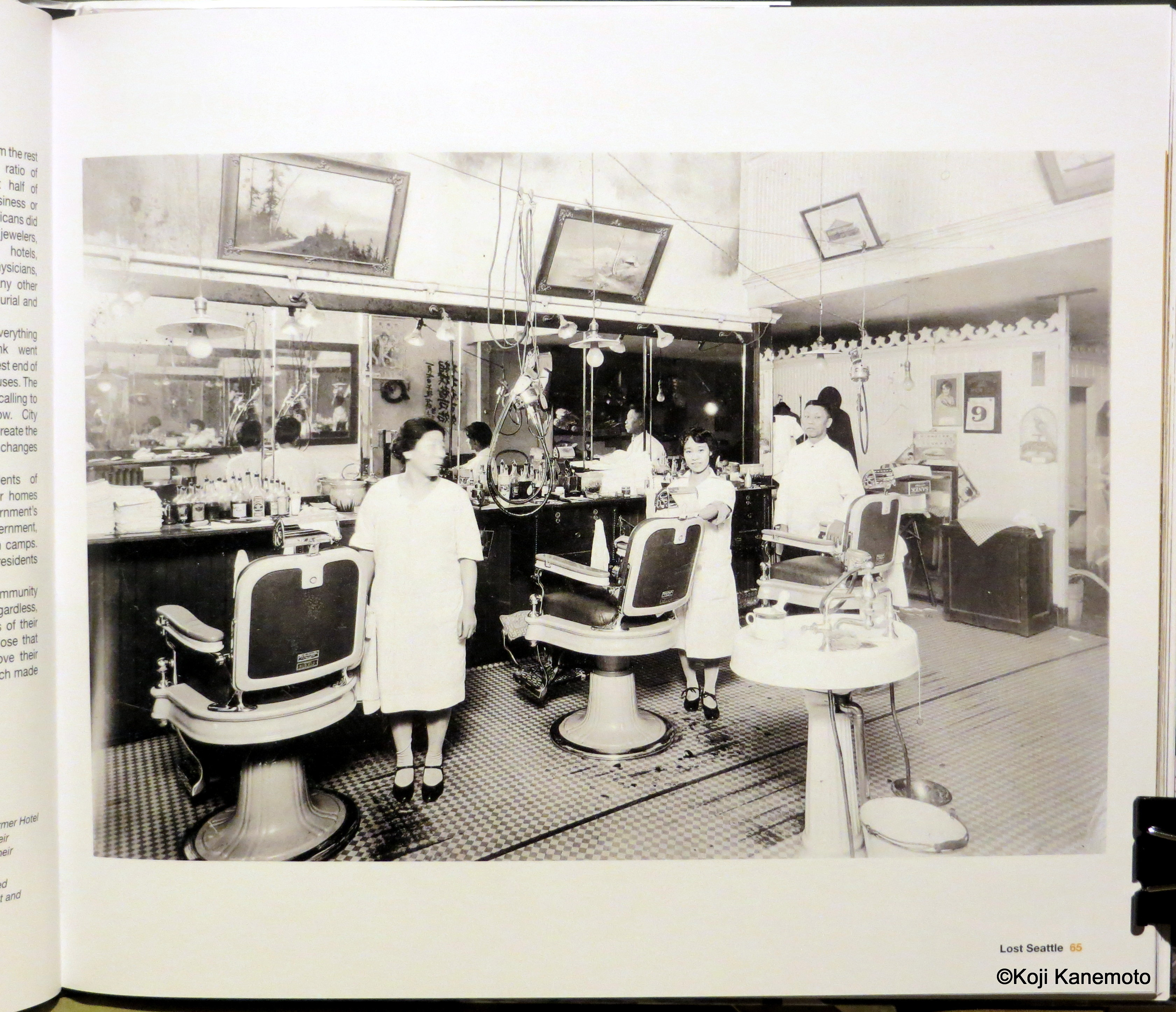
Eighty years or so after he posed for a photo, my Grandfather Hisakichi is in an American book.

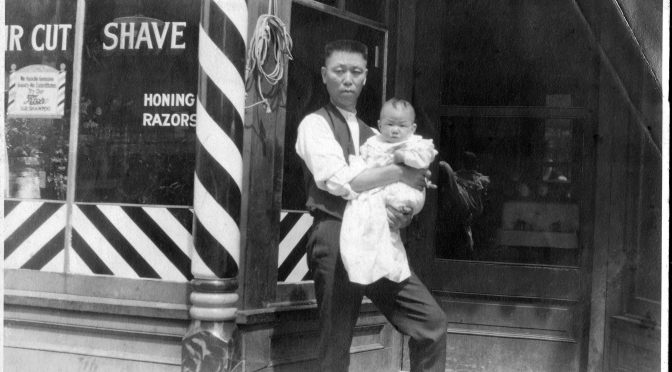
Standing “Marine-esque” in his Seattle barbershop.

Incredible to me.

_________________________________

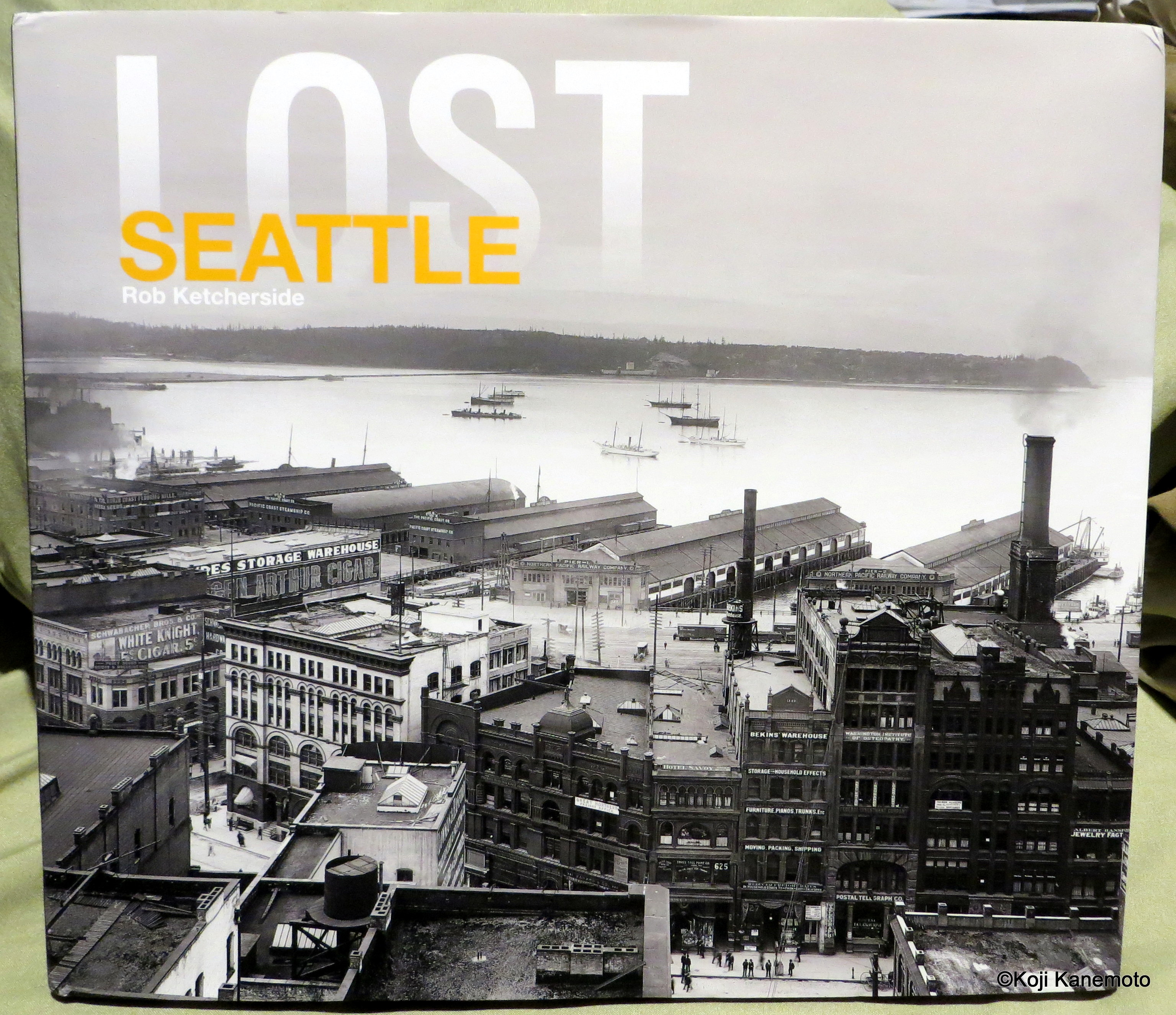
I had come to know Rob Ketcherside from flickr.  We had helped each other out looking at some old photos he had of Seattle – where all my aunts and uncles were born (except one).  He had some fascinating tidbits on some of my Grandmother’s photos.

Well, it turned out he was an author.  He had been doing a ton of research into “lost Seattle” – skylines and communities now long gone.  With his fascination for “what was” (me, too!), those sights are now basking in sunlight once again through this mesmerizing book.

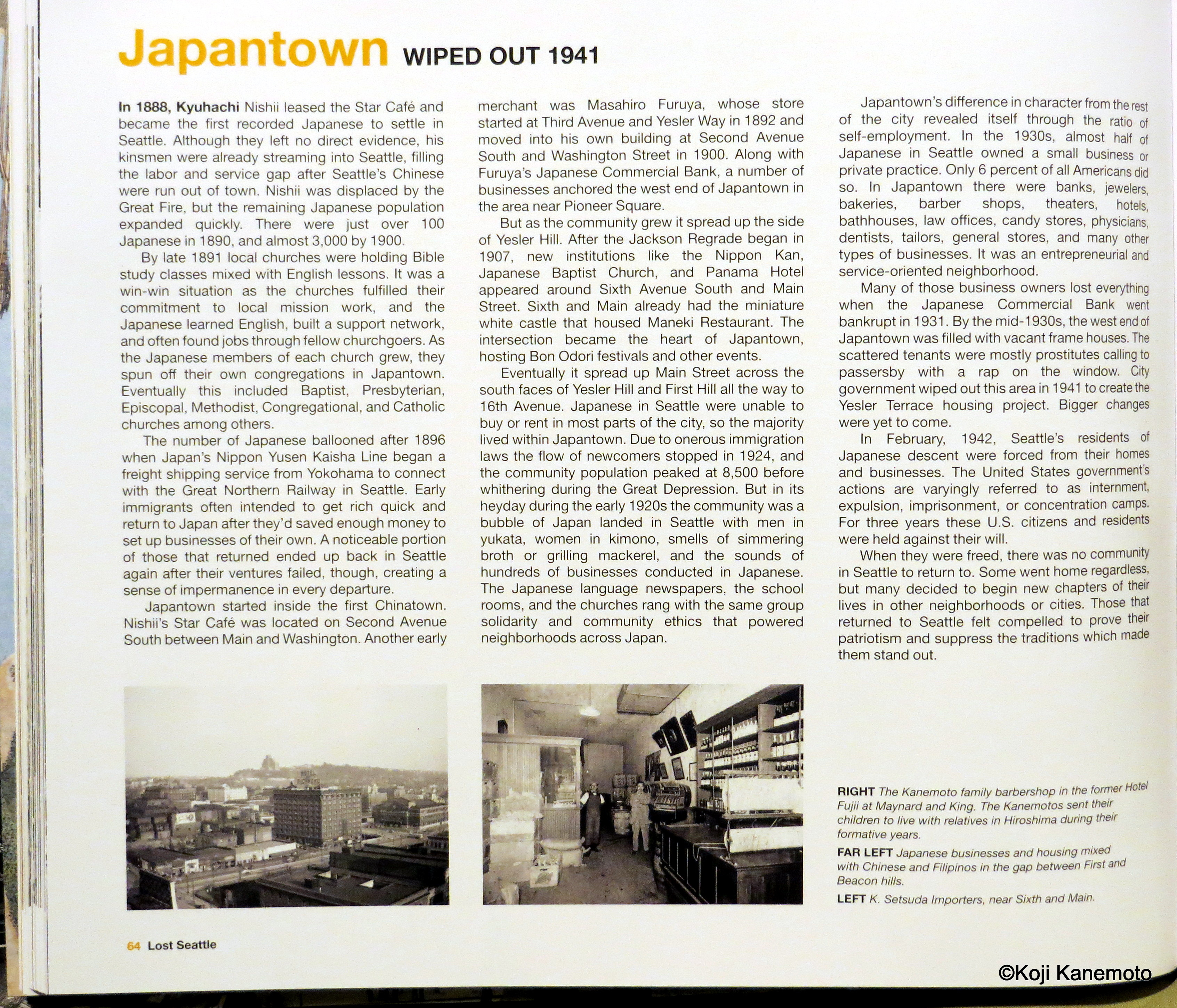
It was boosting to me when he asked if he could use one of the family’s vintage photos in his book; specifically, the photo of my grandfather’s barbershop.  It is on loan to me from my cousin Masako (yes, the Masako after whom my blog is named) who luckily kept these family treasures all these years.  It is more wonderful in that the home in which the photos were in survived the atomic blast – as did my family.

I hope Rob (and his publisher) don’t mind a couple of pages of his book are shown herein…and I’ll be picking up a few more copies to take back to Hiroshima in a few weeks.

In the description below, Rob also mentions Masahiro Furuya and his business.  As it turns out, both my dad’s oldest brother Yutaka and his best friend John Tanaka worked for Furuya…  And yes, that is the same John Tanaka my Aunt Shiz married.  Small world, yes?  Actually, Uncle Yutaka was the matchmaker.

Image

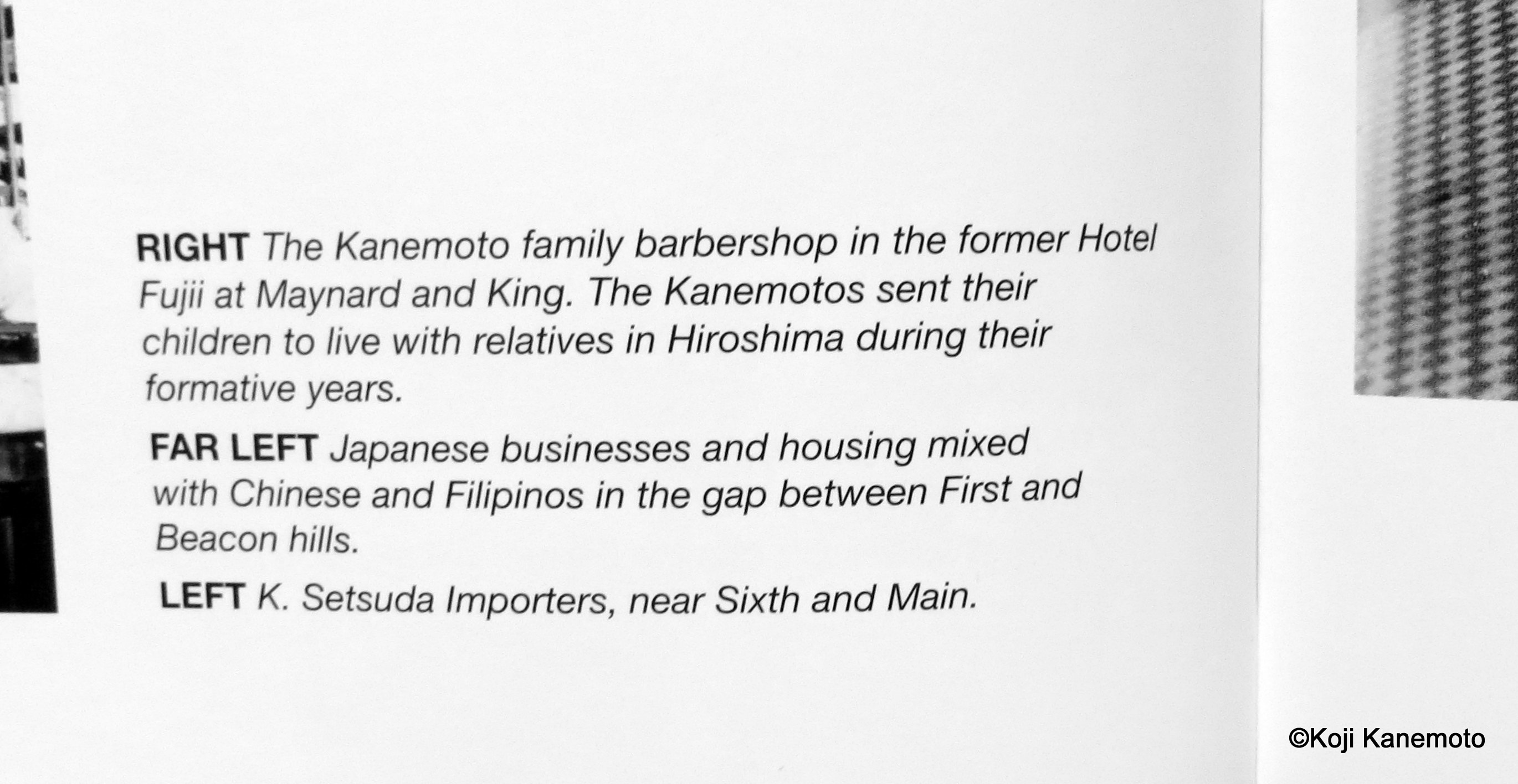
A close up of his photo caption from above:

Image

Grandfather is standing at the right-rear of his barbershop.  And the photo is a full pager in Rob’s book!  Cool!  Grandfather should be pleased.  In the original print, you can see the brand names of the hair tonics popular at that time.  The gal in the middle was quite a cutie, too.   I wonder what happened to her.  If she was still there in Seattle when war broke out, it is likely she went to the same prison camp my dad and uncle were incarcerated in.

Image
On an interesting note, the consensus is the calendar shows January 9, 1930.

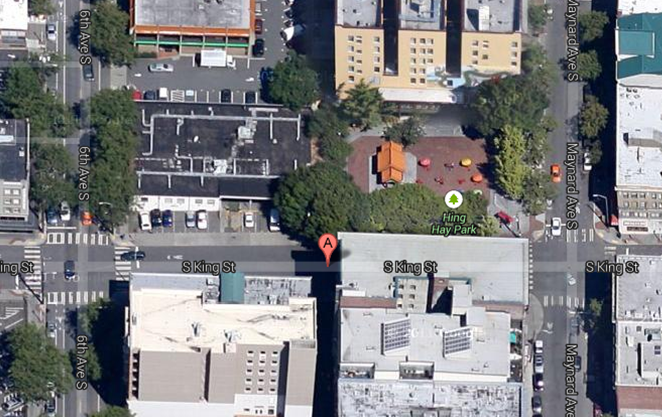
In concert with Rob’s massive research effort, gone is my father’s precious Hotel Fujii and my grandfather’s pride and joy barber shop.  It was demolished to make room for “Hing Hay Park” taking its place.

king st

Front of Barbershop
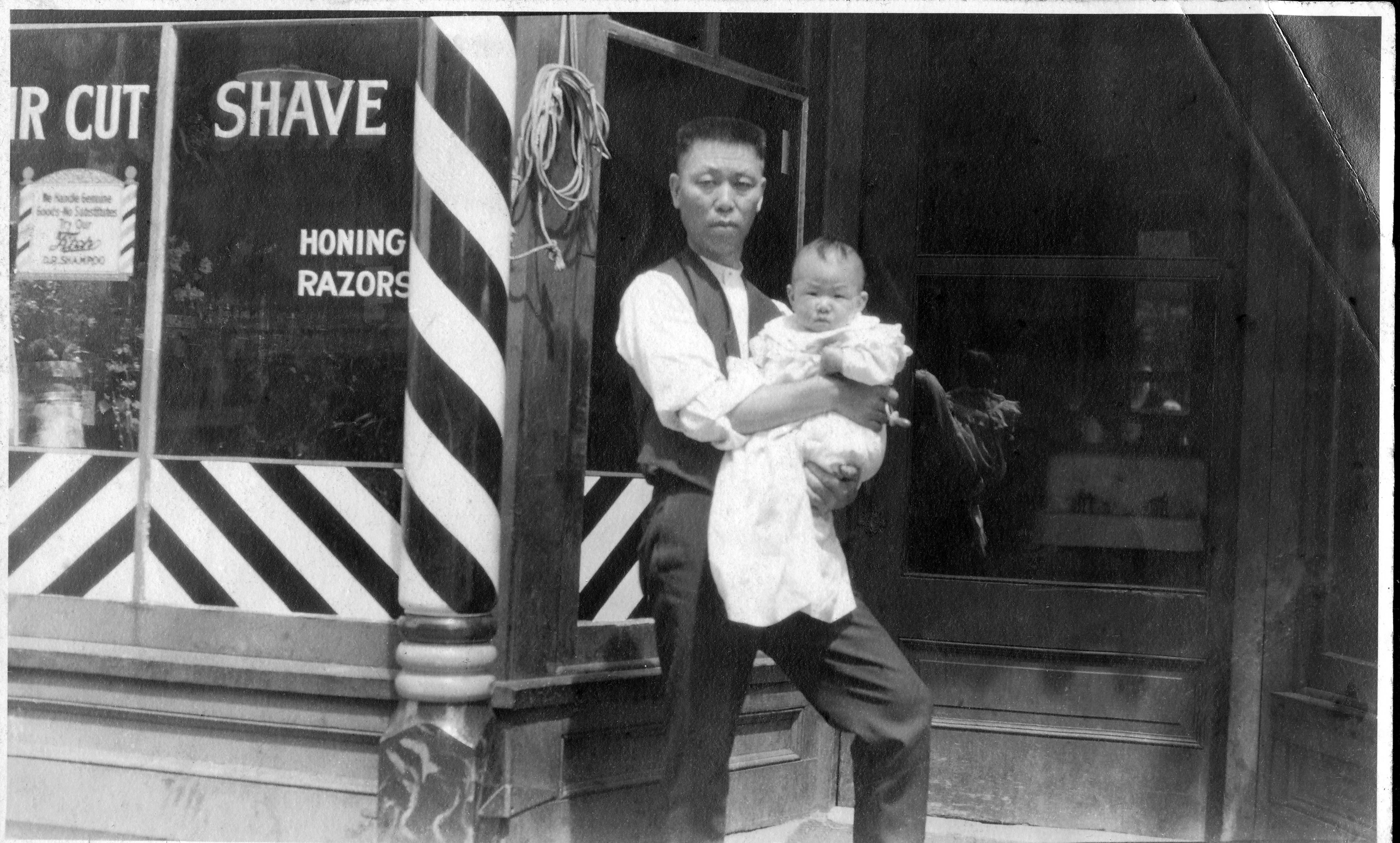
Grandfather Hisakichi holding Aunt Shiz in front of the barbershop. Circa 1918.
image0-005_original
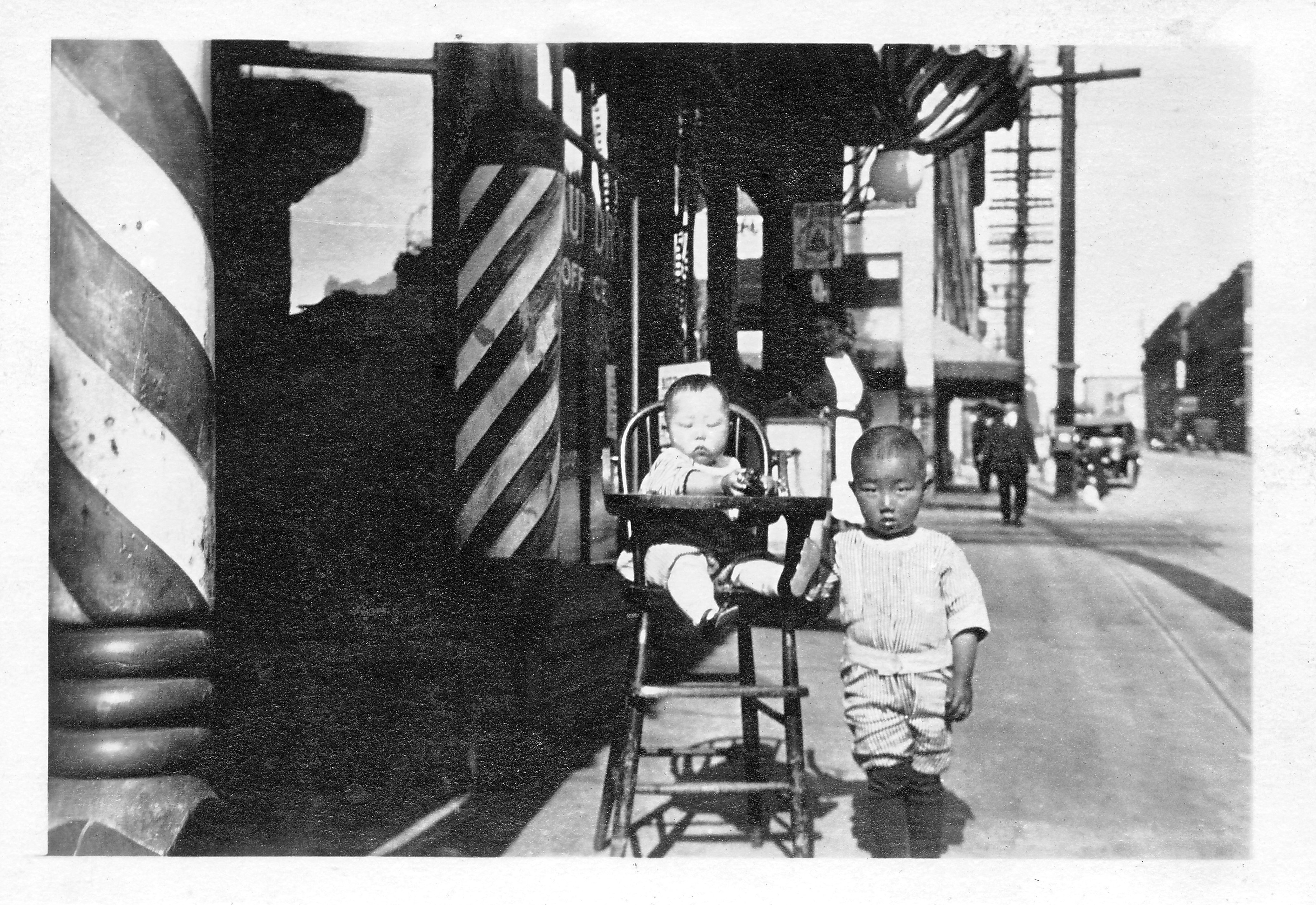
Dad on right with his youngest brother Suetaro in front of the barbershop (circa 1922).  They are likely standing where the label “Hing Hay Park” is on the map above. As readers know, Uncle Suetaro was killed as a Japanese soldier by the US Army on Leyte on July 15, 1945.  Dad was imprisoned in Minidoka, ID at the time of his death.

Eighty years later.

My gosh.

And like the barbershop and Hotel Fujii, my dad is the last one standing out of seven siblings and two courageous grandparents.

Thanks, Masako-san and Rob.

I kinda wish my grandparents could have seen this.

Thank You, CNN. Thank You.


Thank you, CNN.

Thank you for blowing up this “Government Shutdown” bull shit way out of proportion.

You know.  It’s no shutdown.  It’s a slimdown.  It doesn’t even qualify for a Weight Watcher’s sign-up special.

Image
Copyright Gulflive.com

CNN, your exaggerated threats on world TV and the internet – and by siding with the White House – did negatively affect a diminishing group of our most patriotic citizens…  Our Greatest Generation.

Yessiree, CNN.  You made them break laws.  Shame on you, CNN

Read about these WWII veterans in the sunset of their lives not willing to be denied their last and only chance to visit their own memorial erected in their name.  Just as they stormed the hedgerows in France 70 years ago, they stormed stupid barricades set up by their own Government.  Just click on this link:  WWII Memorial   Read about their triumphant last skirmish…against their own Government’s stupidity.  The Government their comrades in arms gave their lives for.

________________________________

And answer me this, CNN…  Who does Michelle have on HER payroll…and NOT furloughed?

Report on that, please.

Nah…  Of course you won’t.

Weekly Photo Challenge: Inside


PicsArt_1371399451167

Inside my heart is sadness… But that sadness is happily interrupted by great respect and smiles of good times gone by…

https://p47koji.wordpress.com/2012/05/28/two-old-men-and-a-fathers-day-anguish-2/

Sands of Manzanar


Image
What remains of the cemetery out in the middle of nowhere.

It wasn’t the deadly black sand that greeted the US Marines on Iwo Jima.

But as we stood on out on the desert, white powdery dust would swirl up in the softly blowing arid wind…  and I then realized it was upon this gawd-awful sand that my Aunt Shiz and Uncle John built their future for their family.

It was their Iwo Jima…  It was called the “Manzanar War Relocation Center” by our government back during World War II.

They were forced onto these forsaken sands by FDR in April of 1942 but made the most of it.  Quietly.  仕方が無い…  我慢.  Shikataganai and gaman.

A

FDR called it relocation centers.

It’s just my opinion but political correctness be damned.

It was a prison.  Complete with eight guard towers and soldiers manning .30 caliber Browning machine guns.  Barbed wire fencing all around.  No freedoms.  Chow at specific times.  Public toilets and showers.  No running water in your “cell”.  No cars.  No soda jerks.  You were classified as “Enemy Alien” even though you said your Pledge of Allegiance or were a Boy Scout.

There were ten well known ones like Manzanar.  But quite a number of smaller or special purpose prisons were scattered about the US – some of which have been long forgotten.  But one thing in common was they held Americans incarcerated just because they looked Japanese.  Not one was ever convicted of spying for Japan.

Image
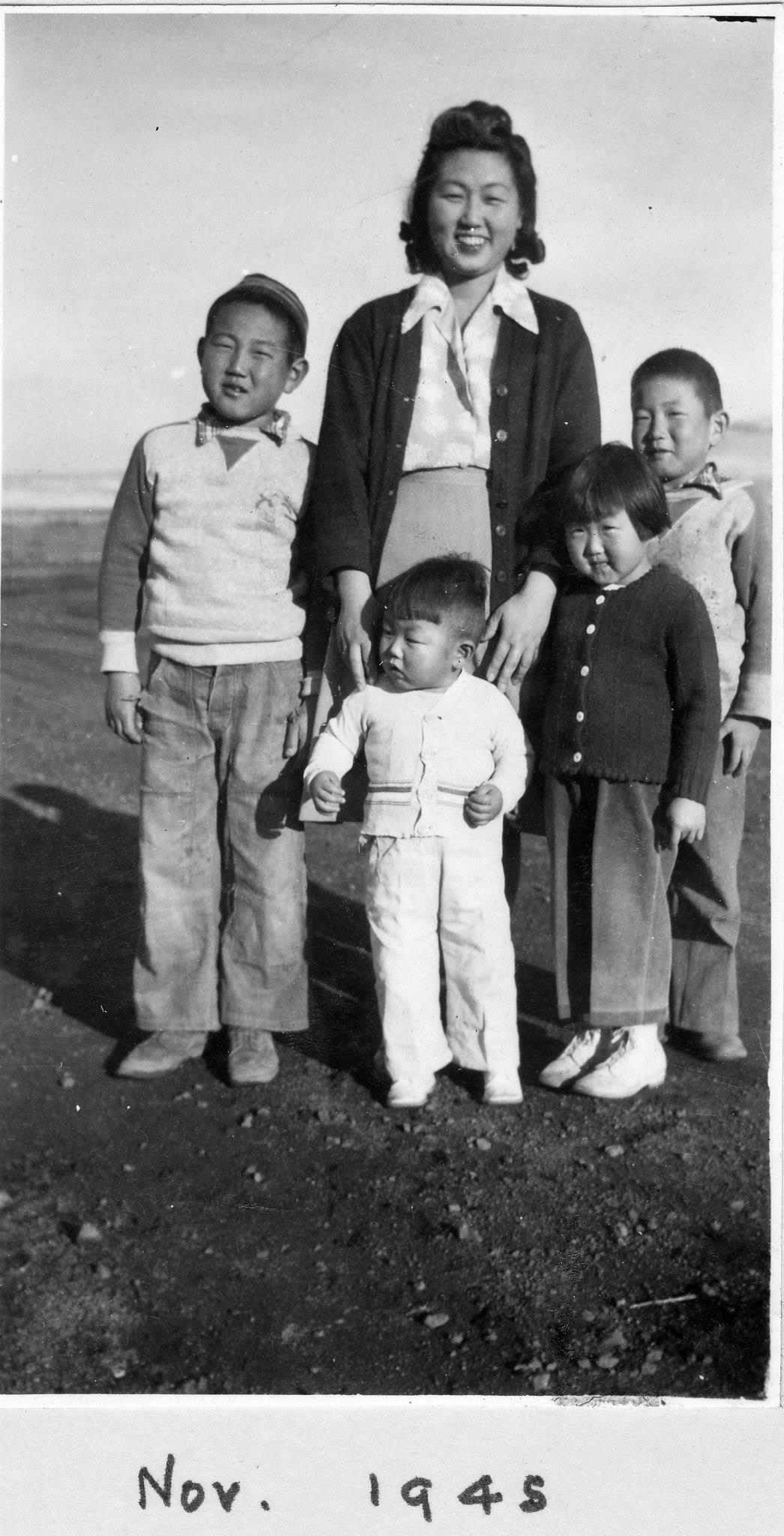
Pictured: Aunt Shiz and my four cousins.  There was no notation other than the date but if I were to take a wild guess, this may have been taken as they left Manzanar the second prison they were moved to: Tule Lake. I base it upon the barrenness of the area surrounding them. (Edit 9/27/2013)

I had never been to Manzanar.  However, since Aunt Shiz passed away at the age of 95 last year at this time, I heard a call to visit.  So my friend and I decided to make the 500 mile+ round trip the Friday before Labor Day weekend.  It was time to go.

_____________________________

Manzanar back in 1942 was an isolated, desolate desert wilderness.  Hell, it still is for the most part.  The 2010 Census only reported about 2,000 residents; imagine how uninhabited it may have been seventy years ago.  Temperatures soar to over 110F in the summer and plummet to the 20’s in the winter.  It was exactly 100F and humid when we arrived that Friday.  It lies between Lone Pine and Independence on US 395.

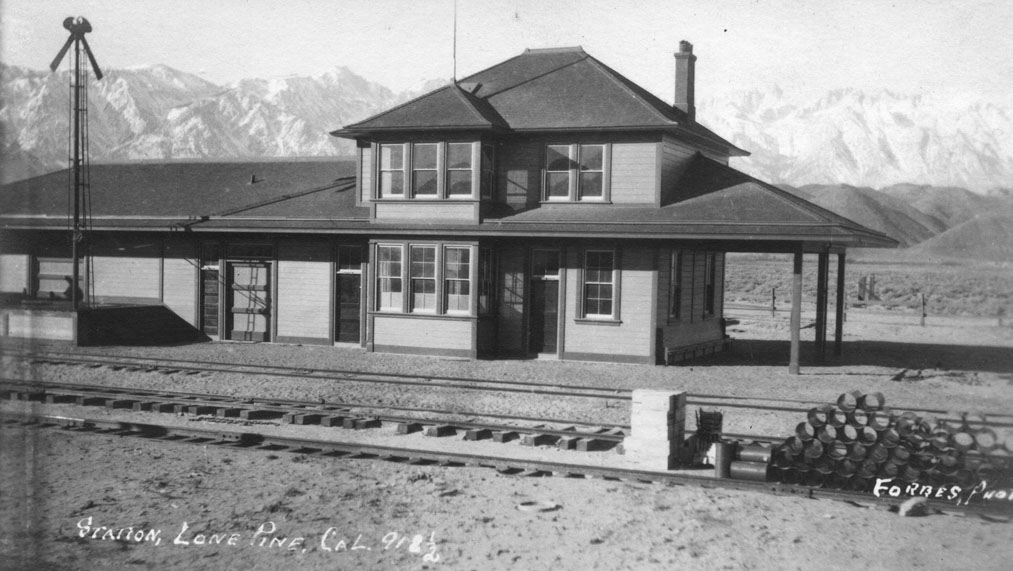
Lone P Station
The lonely Lone Pine train station, perhaps the 1930’s?

If you haven’t heard of these prison camps during WWII, FDR signed Executive Order 9066 (There’s those danged Executive Orders again!) ordering Japanese (Issei) and Japanese-Americans (Nisei) to evacuate from the West Coast of the United States.  The FBI and the US Army were there to ensure they left.  These families could only take what they could carry with many everyday items prohibited.  Knives, guns, tools…and cameras because they were looked upon as the enemy.

Many family heirloom photos and letters were burned or tossed.  Favorite dolls.  Bicycles.  Silverware.  Dishes.  All gone.

Here are some official US Government photos (except for my color one) from that period; please note many of these were taken by the Government and were meant to appease the public:

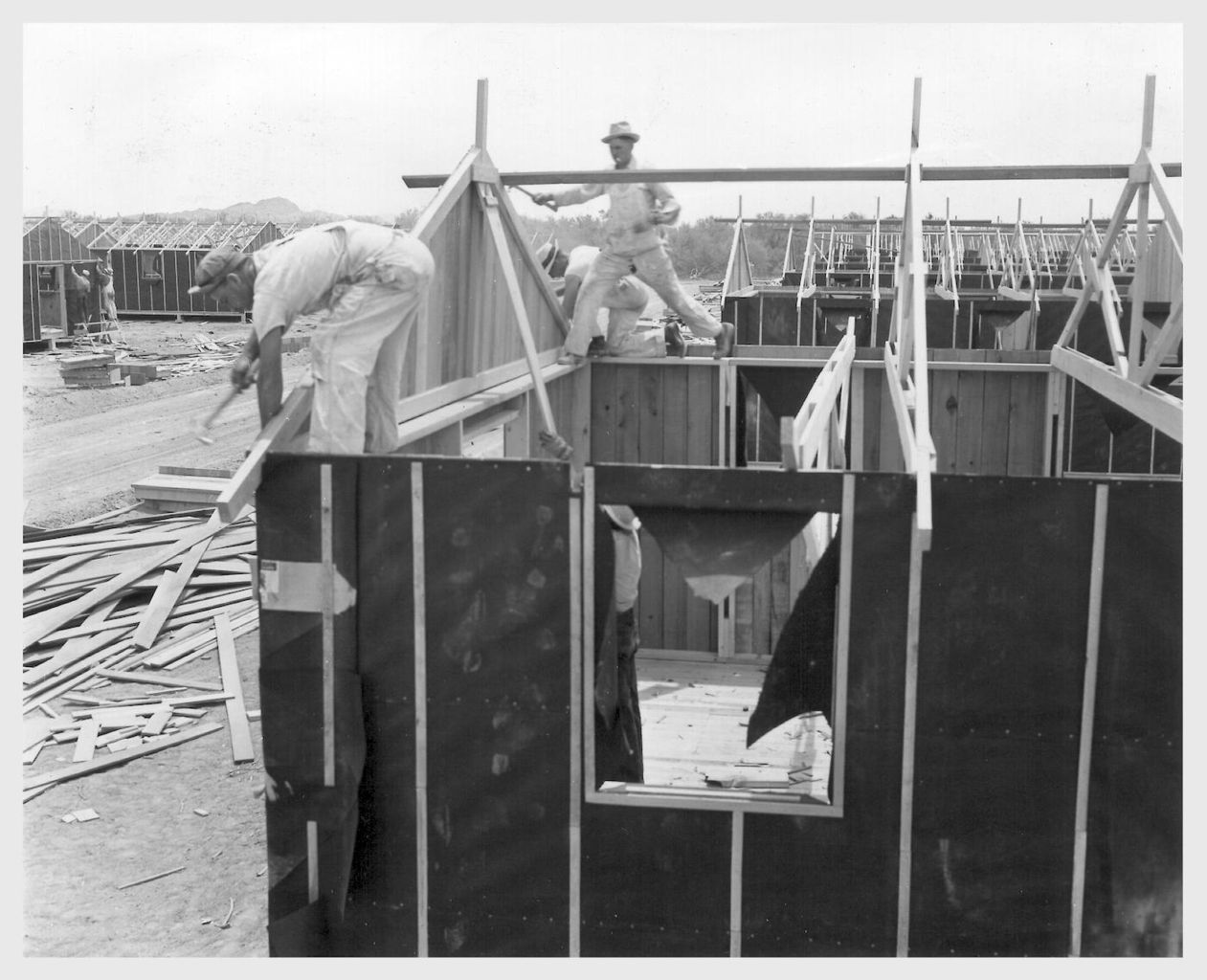
1261px-Barrack_Construction
American workers putting together the shoddily built barracks. They only had tar paper on the outside to keep out the elements. Big gaps existed between the boards – walls or floor boards.
2013-08-10 11.51.50
My two littlest kids and a friend stand in front of an actual barrack from a WWII prison camp. Notice the tar paper remnants and the gaps between the wooden planks. Families actually were forced to live in these shacks.
littletokyo
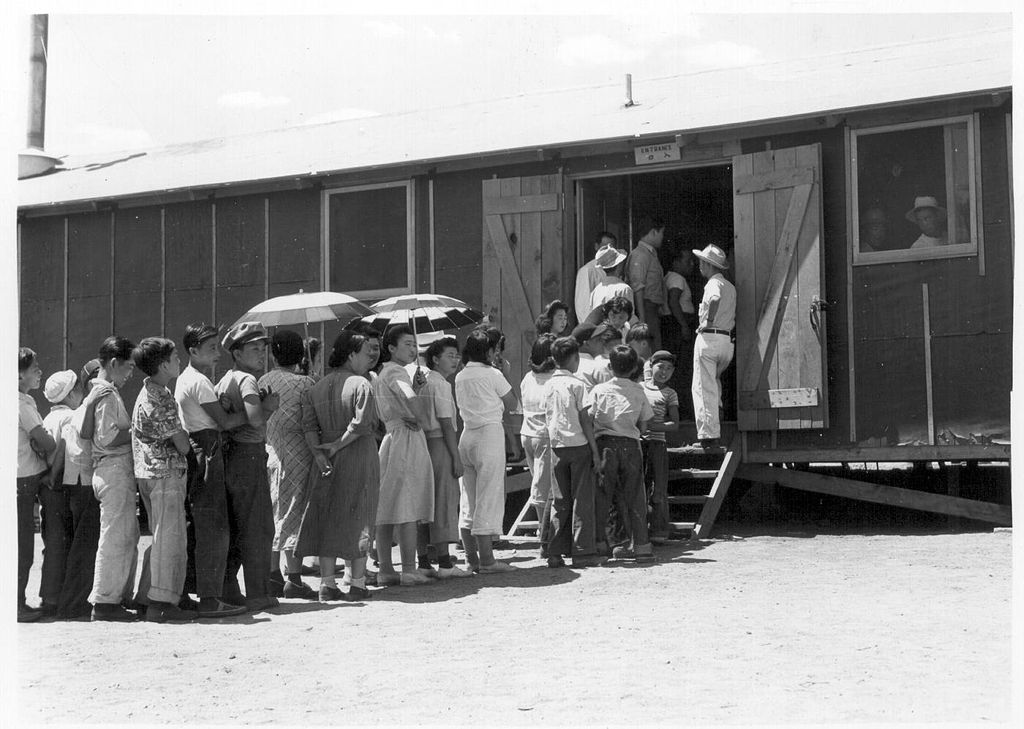
Japanese Americans were loaded onto buses or railroad cars under armed guard to be transported to the prison camps. This April 1942 photo was taken in “Little Tokyo”, an area in Downtown, Los Angeles.
20-1471a
Japanese-Americans disembark from the railroad cars at Lone Pine, CA and are now waiting for buses to take them to their new “homes” at Manzanar. My aunt’s family may just be in the photograph.
bus
Boarding buses headed to Manzanar under guard.  The US Army soldier should be concerned someone would grab his holstered .45 ACP.  After all, he was amongst the “enemy” as FDR determined.
moving in
A new family brings in their worldly belongings into Manzanar. Notice the dust being blown up around them. Both Aunt Shiz and my dad talked about how everything in their assigned barracks would be covered with dust…down to their Army issue mattresses and sheets. Imagine that for days on end.
guard
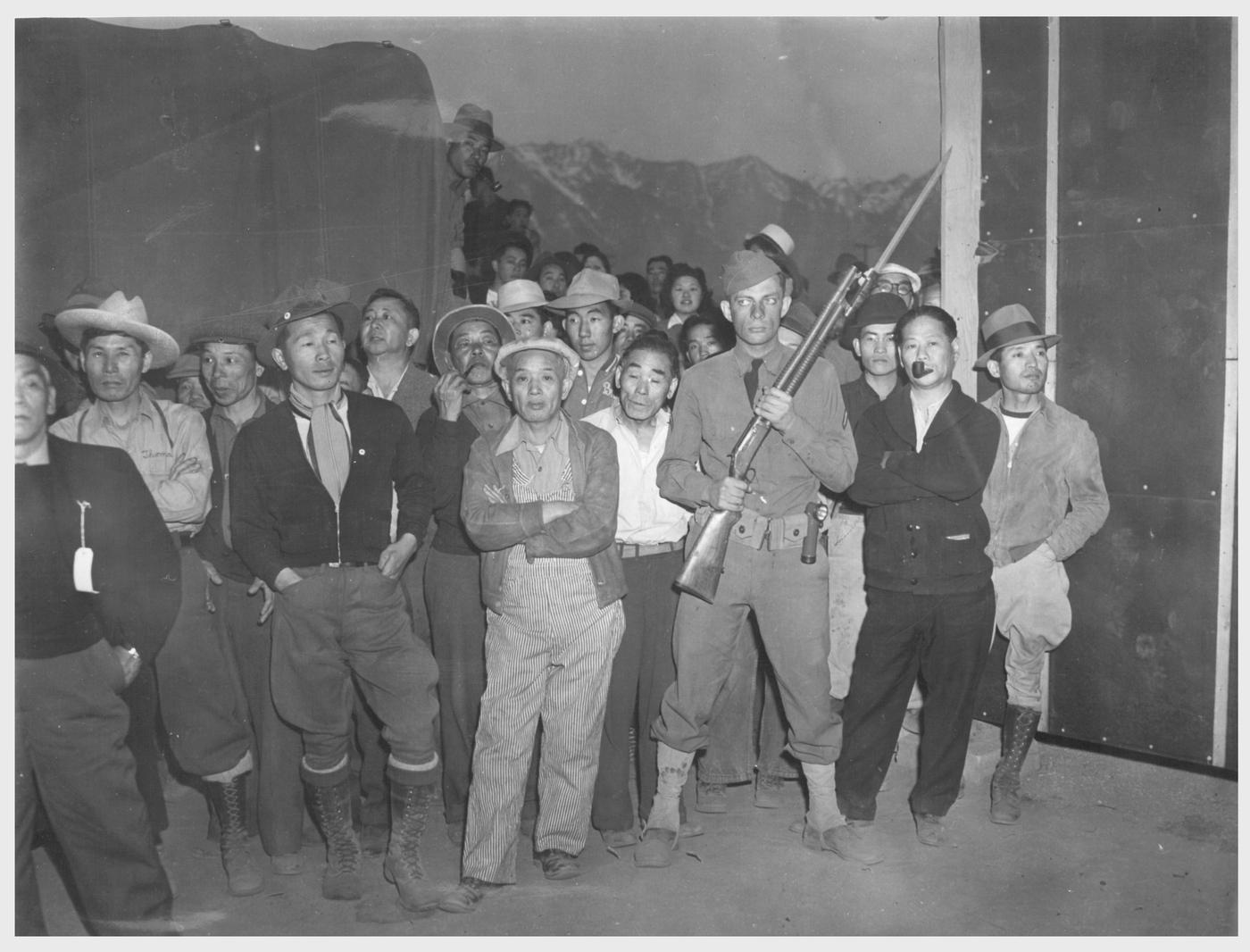
Arrivees at Manzanar. Note the ID tag on the evacuee at left. Everyone got one…even babies.
1024px-Mess_Hall_Line
Mess Hall chow line. You ate here whether or not it was freezing or scorching outside.

As general information, a relative said the latrines were so cramped that you almost touched each other while sitting on the toilet and that there weren’t any stalls.  Just holes when the first arrivees showed up or after toilets were finally installed a little later.  It was hot and stuffy inside with the stench and flies unbearable.  They had to wait in line to use the latrines, take a shower or eat.

During the war, Manzanar internee Pfc Sadao Munemori – through his brave actions on the battlefield – was bestowed the Congressional Medal of Honor…posthumously.  (Twenty-one Japanese-American soldiers were bestowed the Medal of Honor.)

Interestingly, two-thirds of the Japanese Americans interned at Manzanar were under the age of 18 per the National Park Service.   There were 541 babies born at Manzanar; my cousin Roy was one of them.  (Another cousin, Neil, was born in Tule Lake, CA while his older brother Bobby perished at another camp at six years of age.)

_______________________________

It is still difficult to believe all of my stateside relatives of that time – all American citizens – were subjected to the degrading treatment depicted above.  But I think my Aunt Shiz had the toughest experience raising four children – with one born in camp.

As we walked through the museum, I perspired profusely even though it had a cooling system.  While my friend was intently reading a number of exhibits, I tried to occupy my mind with other thoughts; I still didn’t know how I would react to being here.

Then, I saw several faces in photographs lining a hallway honoring Toyo Miyatake.  I had often seen them in my youth walking about Little Tokyo or at the temple (I am Buddhist.).  The familiar faces somehow made me “feel at home” or secure in a way.

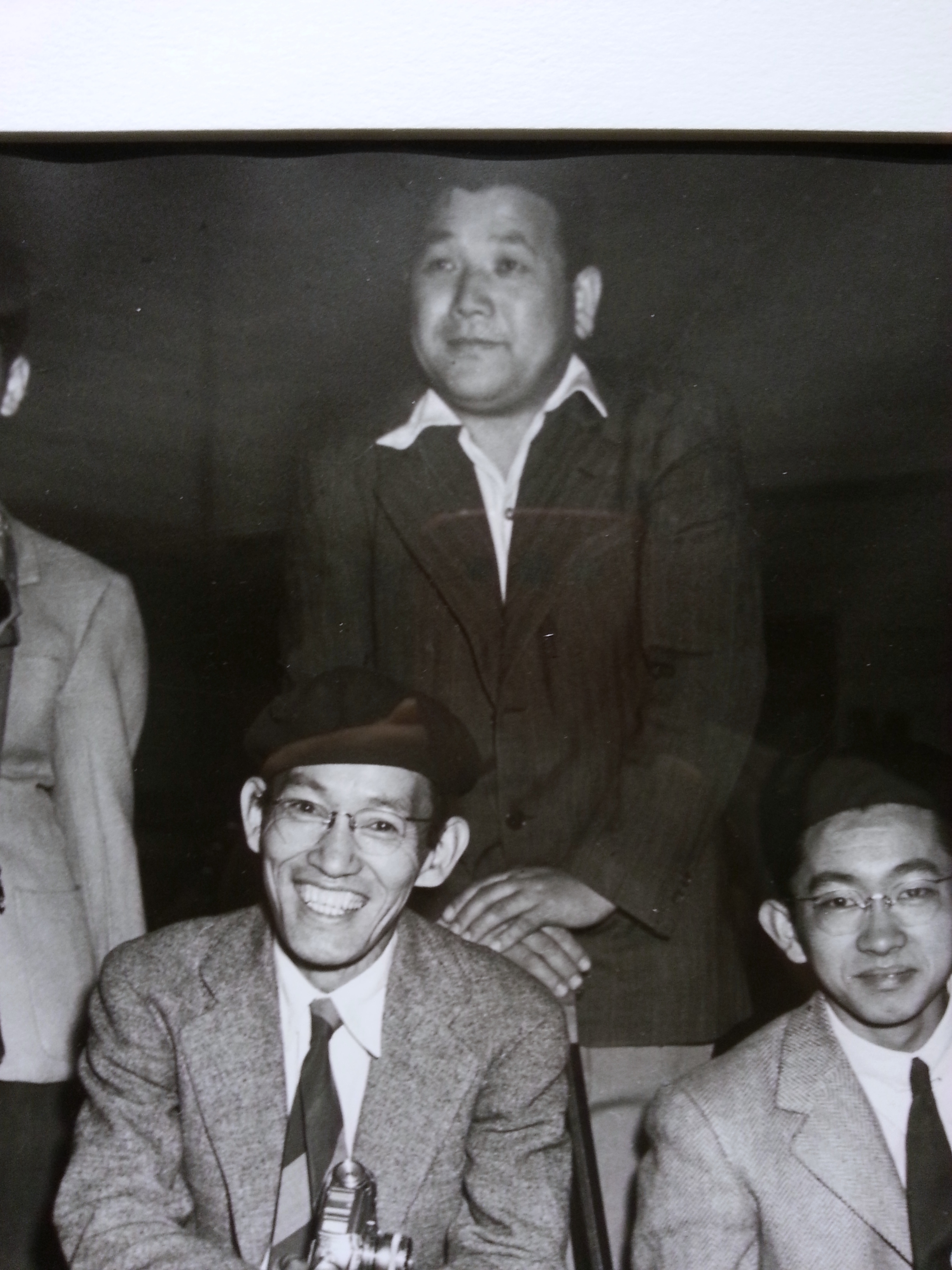
M
Standing is Hisao Kimura, the father of my good friend Sadao. They founded Kimura Photomart where I worked in Little Tokyo. Toyo Miyatake (seated at left) frequently came to Kimura Photomart to sit on a stool after retiring. Toyo’s son, Archie, is on his right. Please click on this link to learn more of the Miyatake heritage and connection to my family. Toyo Miyatake

Here are some other snapshots taken during the visit:

IMG_5277
My friend intently read the information on the exhibits during our brief visit. I feel she learned “stuff” that is not in our textbooks.  I was happy she took interest.
IMG_5282
At the very bottom left of the camp model, you will see a “greener” area. It housed the US Military as well as administrative staff. These barracks were more thoroughly constructed with running water and toilets.
IMG_5280
This is one bit of information that can be drawn up to the CPU. However, I am at a loss when it shows that Aunt Shiz was moved to Tule Lake.
IMG_5281
My friend appears to have a solemn look on her face while looking at the prison camp’s layout.  Over 11,000 men, women, children and babies were made prisoners and incarcerated at Manzanar – all civilians.
P
Our good friend Toyo Miyatake, who had illegally snuck in a lens, fashioned a self-made camera around it to take historical pictures from inside the camp. However, photography had been forbidden. For a more complete history on Toyo Miyatake, please click on this link: Toyo’s Camera.
IMG_5289
A recreated barrack stands alone on the desert sand beneath spectacular clouds.  These recreations were MUCH better made than the original barracks as the National Park Service had to build these to Code.  They even had fire alarms and exit signs. 🙂
IMG_5292
Inside of one of the re-created barracks. According to the National Park Service website, “Any combination of eight individuals was allotted a 20-by-25-foot room. An oil stove, a single hanging light bulb, cots, blankets, and mattresses filled with straw were the only furnishings provided.”
IMG_5301
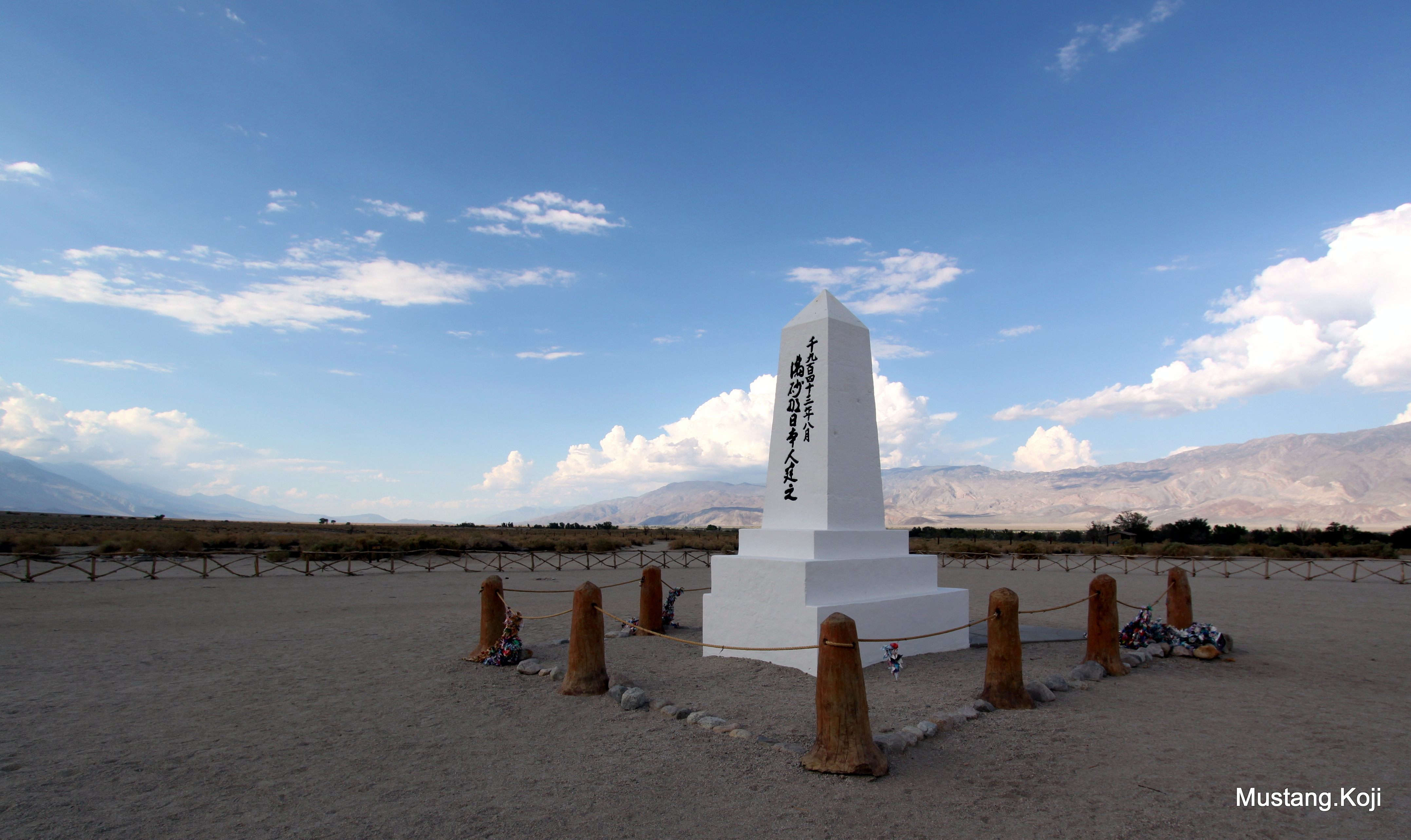
The backside of the memorial at the Manzanar cemetery. I would not have appreciated being buried in such a desert to be forgotten. On the other hand, many of those killed in action were never found as well.
IMG_5302
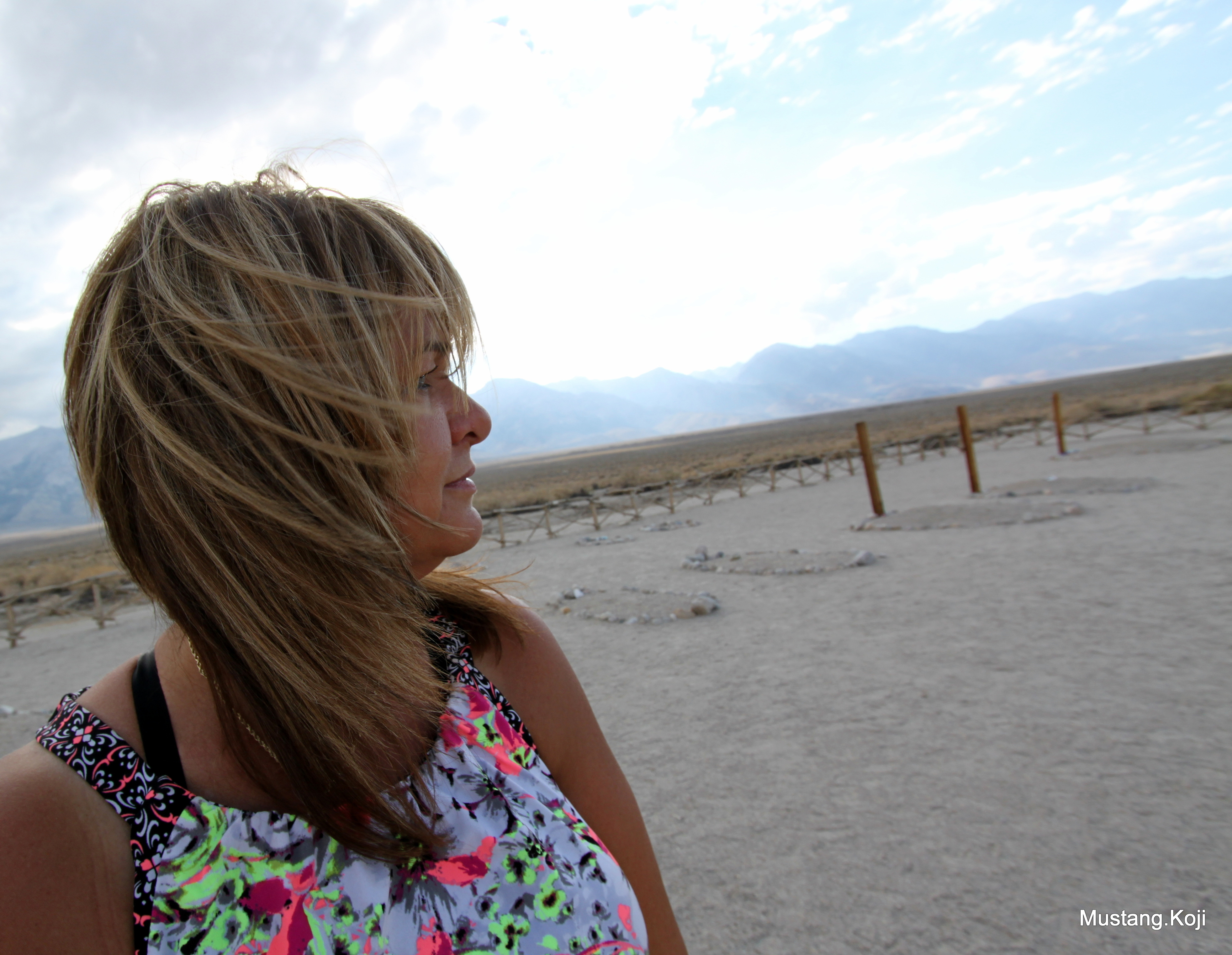
The slightly humid desert wind blows through my friend’s hair as we stand by the memorial erected in 1943 marking the cemetery.

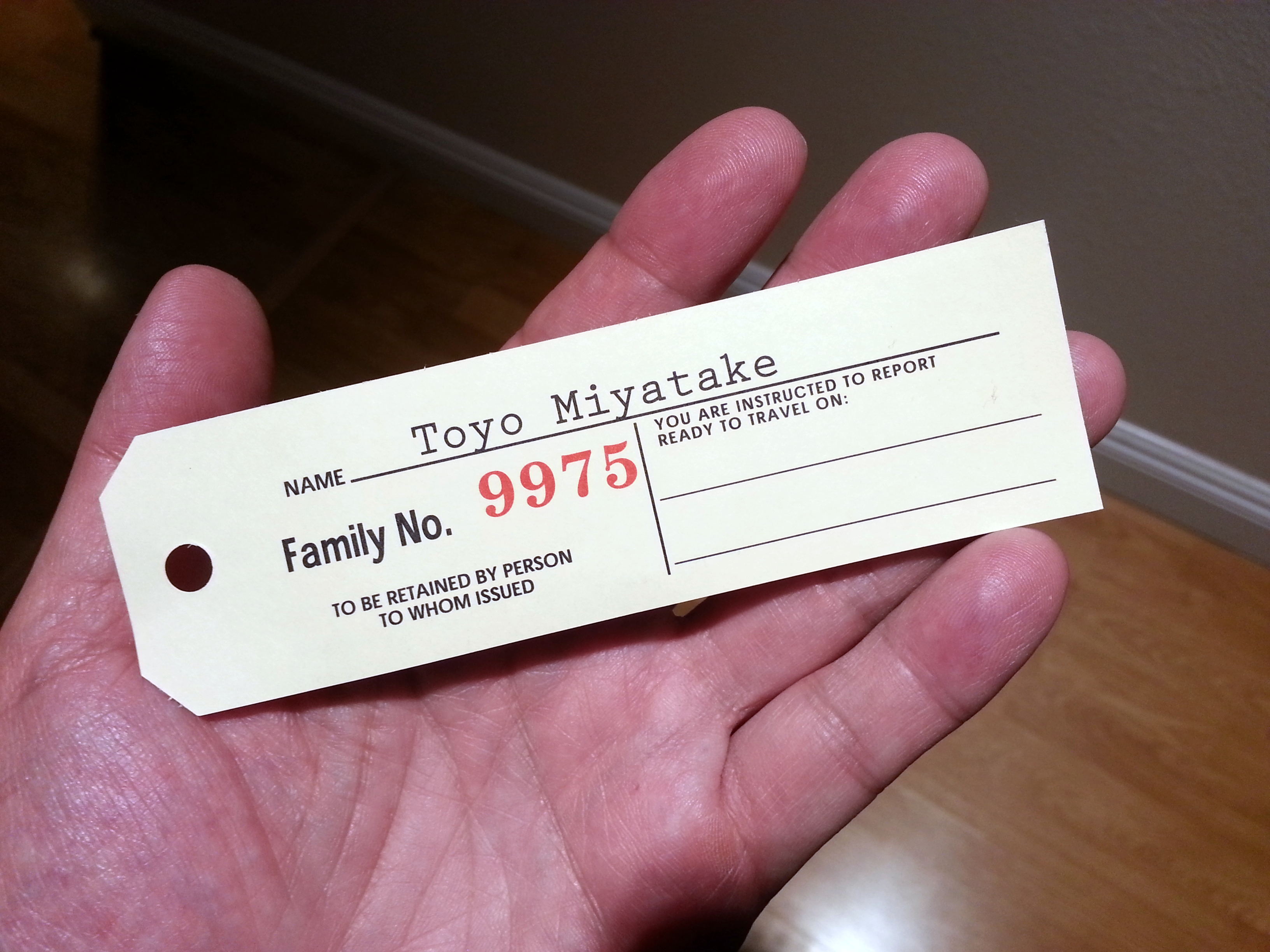
Lastly, a recreation of a tag each individual had clipped on his/her person to be incarcerated.  While the Nazis tatoo’d ID numbers INTO the flesh of Jews, this tag served essentially the same purpose.  This one reflects Toyo Miyatake:

2013-09-03 20.28.50___________________________________

We walked on the same sand that Aunt Shiz, Uncle John, Hiroshi, Bessie, Shozo and Roy walked on for 3-1/2 years.  We experienced the heat, although it was but 100F when we arrived there and partly cloudy.  The dust that got kicked up by the warm gusts did swirl around a bit as Aunt Shiz described.  My Subaru Outback was coated with that fine dust.  It was almost like the powder law enforcement uses to bring out latent fingerprints.  And perhaps it is TMI, but I did step inside a modern “port-a-potty” set up out in the desert.  Believe me…  it was hot and stuffy in there.  That will suffice.  But I think that they all endured that for all those years…  Unbelievable.

___________________________________

As we drove home, my friend asked me how I felt.  I had mentioned to her I might shed a tear or two (from the dust, of course, as real men don’t cry) before we went.  After pondering her question, I answered, “Elated.”

Bizarre answer?  Perhaps.  But I was elated I got to slightly experience what they all did 70 years ago.  No, I did not have to sleep on straw mattresses in stifling cramped rooms nor eat prison-grade quality food at the beginning of incarceration.  Nor line up for chow or to take a shower… Nor have to fear .30 caliber Browning machine guns pointed at me…

But I did finally see that my aunt and uncle built their future upon what they had lost – and what they learned to be important for family – on these white sands of Manzanar.

Spunk


Spunk.  It’s not a word per Merriam-Webster.

But since English is my second language, I can use it out of naivete.

And I feel it means “internal spirit” or “internal push to do something”…

Like “Man, it took a lot of spunk to work like that.”

Of course, I understand it can refer to something else… You know, foreigners learn bad words first.

_________________________

So why bring up this word?  Are you afraid of getting spunked?

Well, America now has 478 million people that need to be spunkified.  That’s 478,000,000, folks.

Why?

All of these 478 million people are on food stamps.  That’s a lot of missing spunk.

First_food_stamps
Original food stamps.

Food stamp butter

I don’t know how many of them are citizens or have green cards or are “undocumented”.

Of course, there’s a number of the 478,000,000 folks just down on their luck…  But for the most part, the remainder have no spunk.

That’s how they live day to day.  On food stamps.  That the people WITH spunk for the most part are paying for.

________________________

Did you think 478 million was a big number?  Well, how about 78 billion…  That’s in dollars.  $78,000,000,000.  Three more zeros than 478,000,000.

That’s how much this food stamp program is costing us.

That’s how much of us “with spunk” are losing out of our paychecks.

Would you like to hear something more sickening?

$3,000,000,000 – three BILLION dollars – of that $78,000,000,000 is spent on ADMINISTRATION.  To me, that is plain sick.  Stupidity.  Unnecessary staff to meet stupid legalities.

_______________________

Obama said at the beginning that he believes food stamps is an economic stimulant.

Bull pucky.

The food stamp program started in 1939.  We were in the Depression.  People were hungry and crops and food stuffs were stockpiling on the farmlands.

food stamp old
One of the original food stamps poster. Circa 1939

So FDR came to a startling and brilliant idea – let’s give out free money to those that are hungry.  It’s free to them as working people had taxes taken from their pay.  Then the hungry can then buy the food stuffs stockpiling on our farms!  Win-Win-(Lose)!

Well, thank goodness, World War II began.  The Depression ended with the American will power to… work.  The food stamp program – which was experimental – officially ended in 1943.  About 4 million Americans received assistance in those four years.

______________________

Well…  Guess what JFK did in his first day in office in 1960.

Yup.  He signed an Executive Order.  (The same type of directive that put my father into those prison camps during WWII.  I hate those suckers.)

This Executive Order reinstated the food stamp program.  After, it was one of his campaign promises.

…And that’s all she wrote.  Now, one out of seven six Americans are on food stamps (called the SNAP program now).

1 out of 76.

And you know what?  It is true.  You can live a better life with food stamps and NOT working.  You even get free health benefits!

Food-Stamps-Monthly________________________

To some, this post will cause irritation if not anger.  For others, they are irritated or angry.  They are angry because the country’s majority has voted for this, in one way, shape or form… This minority of voters didn’t believe in an endless entitlement mentality…nor want it.

Indeed, a heckuva a people need to get spunkified.

Face it.  Our country is clearly headed in the wrong direction.  We are even furloughing our military.

Damn the lawyers and damn the minority rights activists.  It has moved too far towards the extreme in the past six years.

Make it hard to get free food.  Make them work for it.

This needs to be stopped…

(ps  This is just an opinion.  There is no right or wrong.  There is no intent to rile anybody and all constructive comments will be appreciated.)

Another Prison Camp Discovered


Not to bore anyone but a few of you readees may recall my dad abd older siblings were in essentially peison camps during WWII just for looking like the enemy.

Well, researchers found another prison almost forgotten due to obscurity. This prison camp was not far from Spokane.

While the prisoners were paid up ti $60 a month, they did build many mikes of road.

History is what we make of it.

But blogs like ours are sure better than the misguided media.

http://m.huffpost.com/us/entry/3663446

A Belated Father’s Day Post…


A few of you know I’ve been in a little bit of “funk” the past month or so…

No real reason…  just things.

But I had a GREAT Father’s Day!  So a belated and short post.

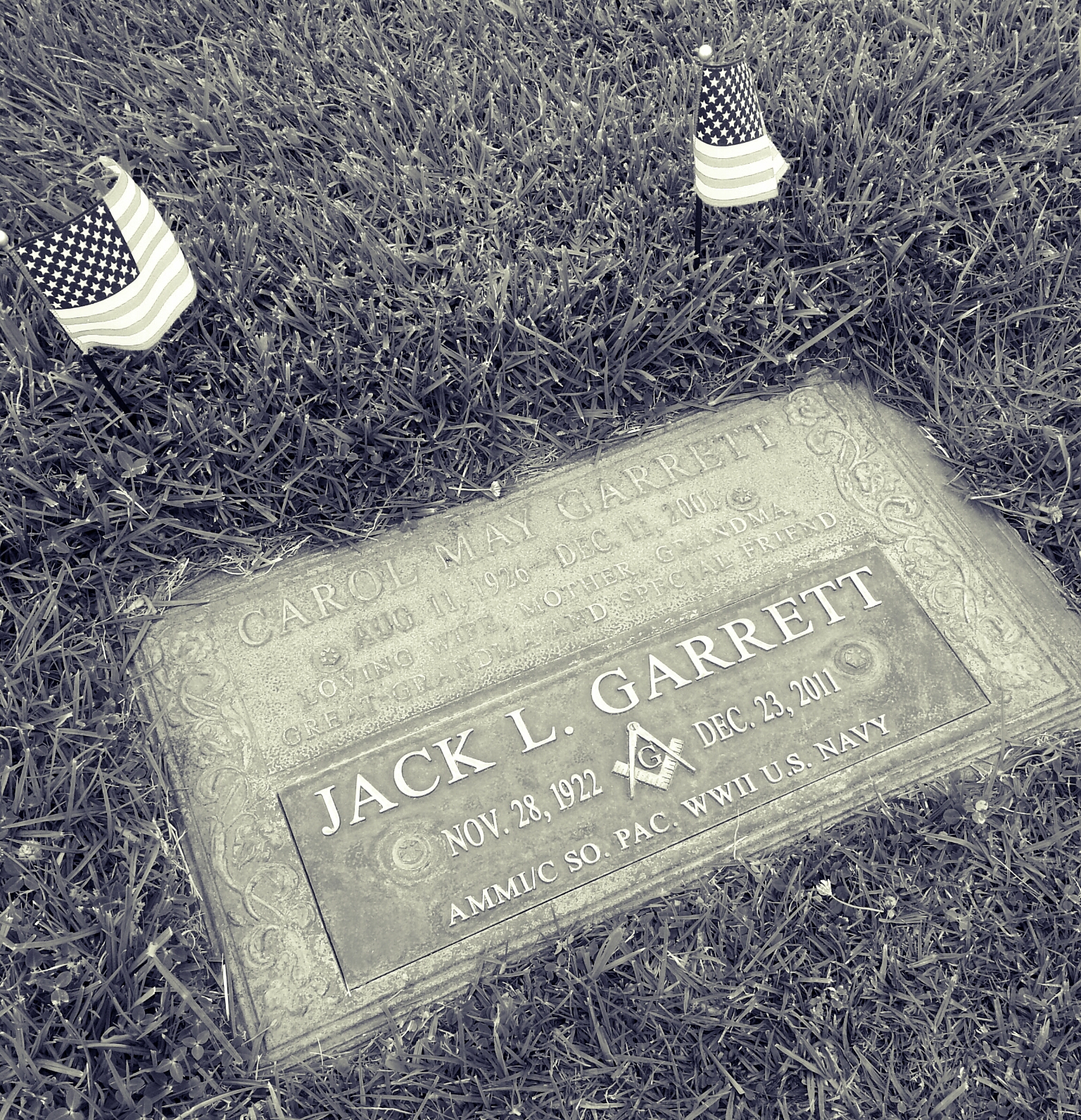
It started out with seeing my “second” dad – Old Man Jack.  I last visited Jack on Memorial Day…  but it was a bit saddening to see that his only daughter hadn’t been by.

It’s always good to see him – although I didn’t stop by in my LOUD supercharged Mustang he loved so much.

Image

Of course, you can only have one dad… and mine’s 94.  We had a Father’s Day Brunch at his assisted living center and his luckily, his appetite was back.  We enjoyed a special Father’s Day brunch.  Meat and potatoes!  His fave!

Image

He then finished off his lunch with…sweets!  Man, he’s got a sweet tooth!  These were Japanese candies sent to him from my cousin Masako (and Izumi) in Hiroshima.  (He had four. lol)

Image

Does he look content?  LOL

IMG_0842And someone “special” had called… and wanted to give me a Father’s Day hug!  Ou-la-la!  She is a gal with one of the sweetest souls around…and she shall remain nameless. 🙂

Picture1She’s had a positive impact on me. 🙂

And then…  the grand finale…

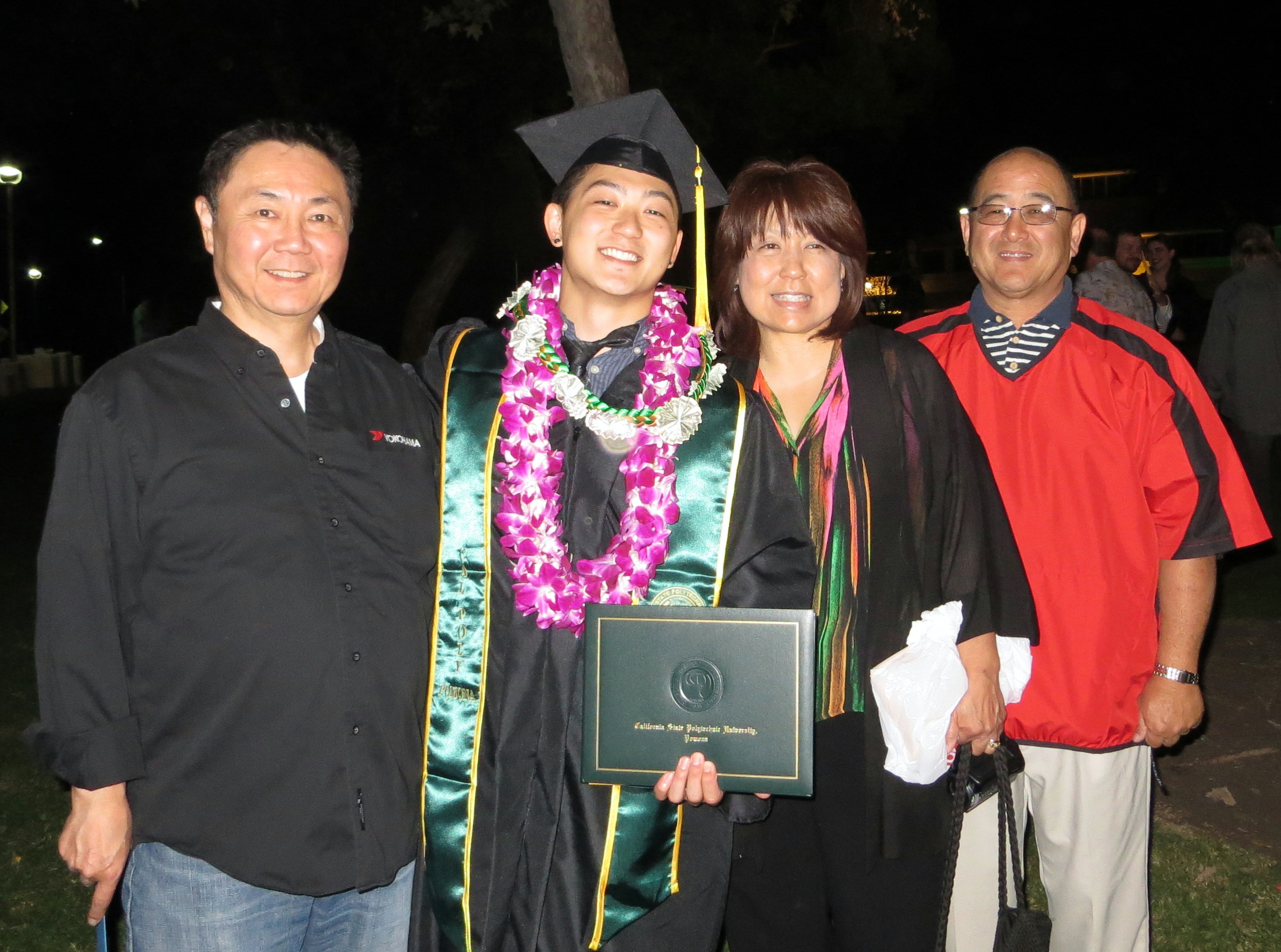
I headed up from Fashion Island in Newport Beach to Pomona…My oldest son, Takeshi……graduated from Cal Poly Pomona!  He’s even got a straight A streak going!  And he BEAT his brilliant sister in Organic Chemistry by getting an A!  She will never hear the end of that one…  🙂

Congratulations, son!  And a BIG thanks to my ex and his step-dad.  I couldn’t ask for a better guy.

IMG_0848

I don’t think an old man can ask for anything greater than that superific day!