The Spirit of Aunt Shiz and Kharma


Although my Aunt Shiz passed away ten days before my son and I were to travel to her childhood home in Hiroshima, I believe it was her caring soul that made our journey eerily complete.

Time for heebie-jeebies.

______________________
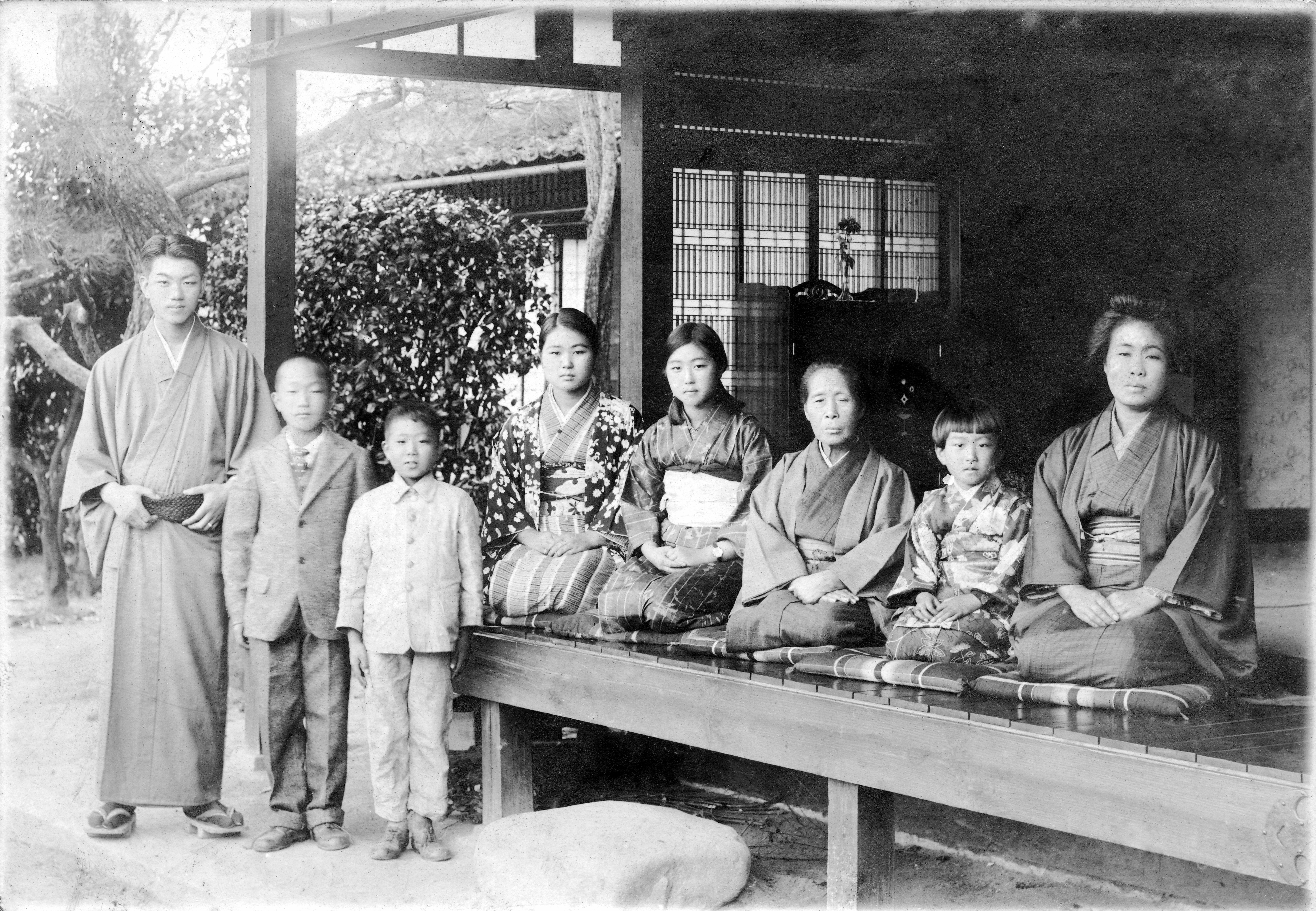
L to R: Uncle Yutaka, Dad, Uncle Suetaro, Aunt Michie, Aunt Shiz, Great Grandmother Kame, Aunt Mieko and Grandmother Kono at the Hiroshima home. Circa 1928.

Like all but one of the siblings, Aunt Shiz was born in Seattle in 1916.  My grandparents operated a barbershop as mentioned in “Masako and Spam Musubi“, the first story in this blog.  In the picture below likely taken early in 1918, she is standing in front of her mother Kono at their barbershop in Hotel Fujii near King and Maynard in downtown Seattle.  Grandma Kono is smiling while looking on; she appears to be holding a straight razor.  My relatives tell me Grandma was great with the customers and gave excellent shaves. (If it is a straight edge razor, she’s holding it in her left hand. We have a number of lefties in our family. Hmmm.) Notice the wooden sidewalk:
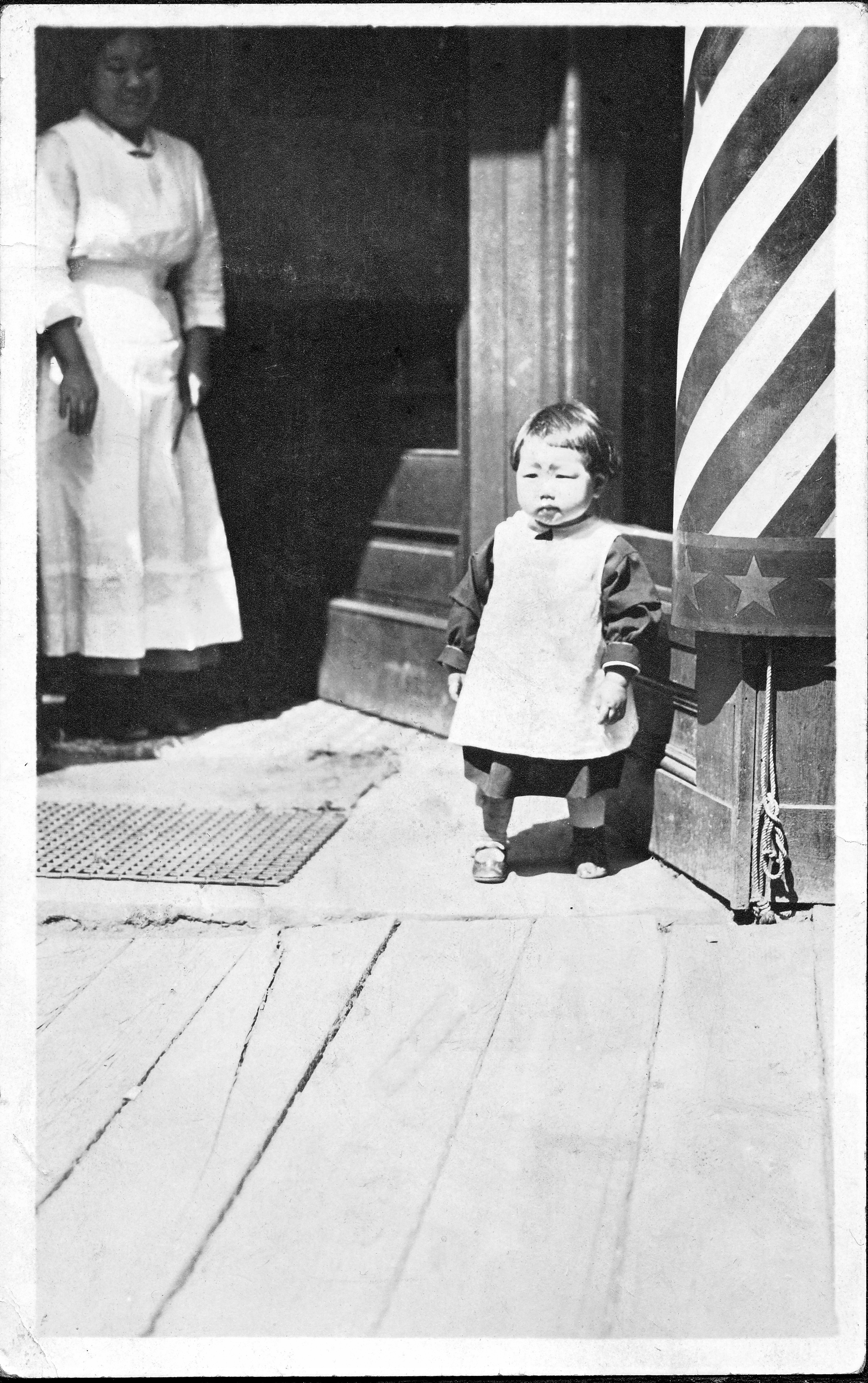
Aunt Shiz standing out in front of the barbershop; her mother (my grandmother) Kono smiles while looking on. Kono is holding a straight razor; she apparently gave great shaves and the customers enjoyed her friendliness.

In this photo taken about five or six years later, the wooden sidewalk has been replaced with concrete.  Aunt Shiz shows her friendly character while dancing on the left.  You can make out “Fujii” on the sign hanging overhead in the background:

A happy and smiling Aunt Shiz dancing on the left. The barbershop’s poles can be seen behind her. Circa 1923 in downtown Seattle.

Masako tells me Aunt Shiz was the village “hottie” as she grew up back in those days.  It made us laugh but it was true.  Surely, she broke a lot of the young boys’ hearts in the village.

She returned to Seattle on April 7, 1935, a vibrant young lady.  Amazingly (well, really not), her granddaughter looks very much like her at that age.  Genes.

She married and had three boys and one girl.  All but one were imprisoned during World War II.  They had the dehumanizing horror of having to first stay in vacated horse stalls at the Santa Anita Racetrack in Los Angeles before being transported under armed guard in blacked out trains to Manzanar where they stayed until war’s end.  They were American citizens.  Incredible, isn’t it?

_______________________

Aunt Shiz, who was my dad’s older sister and last lving sibling, was a true “Kanemoto” as the saying goes.  They were much alike…especially when they talked in their “Hiroshima dialect”.  Funny they aren’t able to remember when their birthdays are but they sure remember their happy days as children in that Hiroshima home.  Both loved to eat.  And eat they did.  Most of all, they loved sweets.  Don’t ask why.

When I see Dad now, I always take him Japanese treats – mainly “manjyu” and “youkan”.

Typical Japanese sweet treat called “manjyu”. Aunt Shiz and Dad love them.
Sweet Japanese treat made out of sweet beans, or “yokan”.

Last October, shortly after her 95th birthday, I took Dad to visit with Aunt Shiz.  It is a long drive to and from.  While Dad had great difficulty remembering why he was in my car – not just once but several times – there was no hesitation by either of them when they first got a glimpse of each other at Aunt Shiz’s senior home:

Yes, I took a bag of yokan.  Its on the front right in the video in a cellophane bag.  There were three different flavors, too.  They ate them ALL.  Really.

But they couldn’t remember who was older.  Absolutely precious to our family.

At her funeral service in Los Angeles, her grandson described her perfectly as a very warm person.  She loved to hug and give her young relatives a peck on the cheek.  That was Aunt Shiz.

_____________________

But back to the story…  Some heebie-jeebie stuff.  You know…  Stuff that gives you a year’s supply of chicken skin.

Our journey to Hiroshima was planned for months.  My decision to do so was made after I met with Masako and the others in Hawaii in May and returned home…or so I thought I made that decision.  It was as if something took over my thoughts and actions.  It was kharma.  I was also going to take my oldest son Takeshi (24 years old – very important.  Remember that.) who had NEVER been out of the country.

As the time neared, our Hiroshima family was excited my son and I were going.  Although those of us here in the States were unaware, in the extreme heat and humidity of Japan, my cousin Toshiro went deep into a 100 year old wooden shed which still exists in a last ditch effort to uncover past family information.  He found it…about a thousand pictures from the late 1800’s through shortly after war’s end.  That is where the photos of Aunt Shiz and the barbershop emerged from although all were damaged by mildew and insects.  They were extremely elated and flabbergasted to have found these vintage family treasures still existing.  They began to go through them in the main family room where their “butsudan”, or family altar was.  The altar is also about a hundred years old.

A few days after they looked over the treasure, Aunt Shiz passed away quietly…  She had fallen asleep in her wheelchair like she frequently did but this time, just didn’t wake up.  Oddly, her daughter and my cousin Bessie, who diligently and energetically cared for her for many years, said “…she said she wasn’t that hungry that evening then just passed away”.  Not having an appetitite is NOT Kanemoto.  I will have to remember that.

_____________________

Bessie immediately notified the family in Hiroshima at which time Masako immediately said, “I saw Shiz in the room while we were looking at the pictures.  She passed through the house.”  We all got chicken skin when we heard that.  Masako does not make things up and is as sharp as a tack at 78 years of age.  She has all her wits about her.  (That last trait is NOT typical Kanemoto, by the way.)  We don’t doubt her.

Bessie suddenly requested I take some of her ashes back with me to the family home for interment.  I was honored.

After my son and I arrived at the family home with Aunt Shiz, my cousin Toshiro immediately placed her ashes on the 100 year old altar…in the same room where Masako saw Aunt Shiz.  Again, Masako said to us she saw Aunt Shiz in that room before she passed through the house.  Creepies.
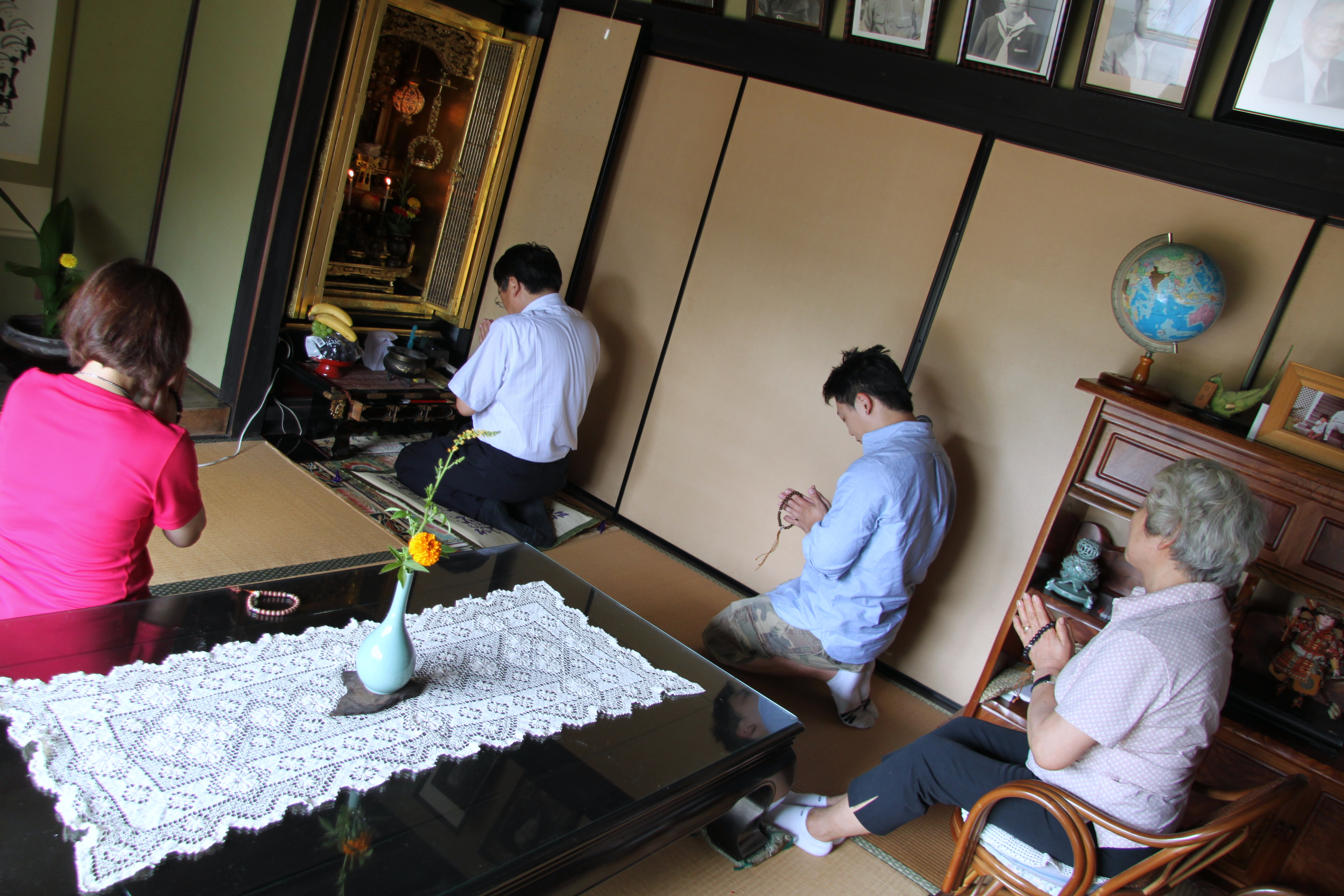
Toshiro placed Aunt Shiz’s ashes on the family altar. The room is basically the same as it was when Aunt Shiz lived here about 80 years earlier.

Shortly thereafter, my Hiroshima family surprised my son and I with the many, many vintage photos.  Then to add to the heebie-jeebies, Toshiro remarked, “We know Masako saw Aunt Shiz’s spirit in this room shortly before she died while we were looking over our ancestors’ pictures.  Aunt Shiz could have passed away two months ago or next year.  But she knew you were coming and in her soul, she wanted to come home now with you.  She arranged for all this to happen at this time.  She is happy now.”

Wow.  I felt like if a day’s worth of chicken skin out of Foster Farms was thrown on my arms.  Really creepie-crawly.

_________________________

Not over yet…  We had her official interment into the family crypt a few days later.  My other cousin Kiyoshi – another kind hearted person and the man who invented the first EDM device – came with us to the family burial plot, or “ohaka”.  The stone ohaka holds the ashes of my grandparents and their deceased children – including my Uncle Suetaro who was killed on Leyte in the Philippines during World War II as a soldier of the Japanese Imperial Army.

As my son was cleaning the ohaka prior to the interment, Kiyoshi said to my son and I, “Suetaro was 24 years old when he was killed.  Now, your son is meeting Suetaro for the first time.  Your son is 24 years old.  It was all planned for by Aunt Shiz.  She picked this time to come home and for Takeshi to be here and to meet Suetaro.  It was meant to be this way.  To help strengthen our ancestral family bonds although an ocean separates us.”
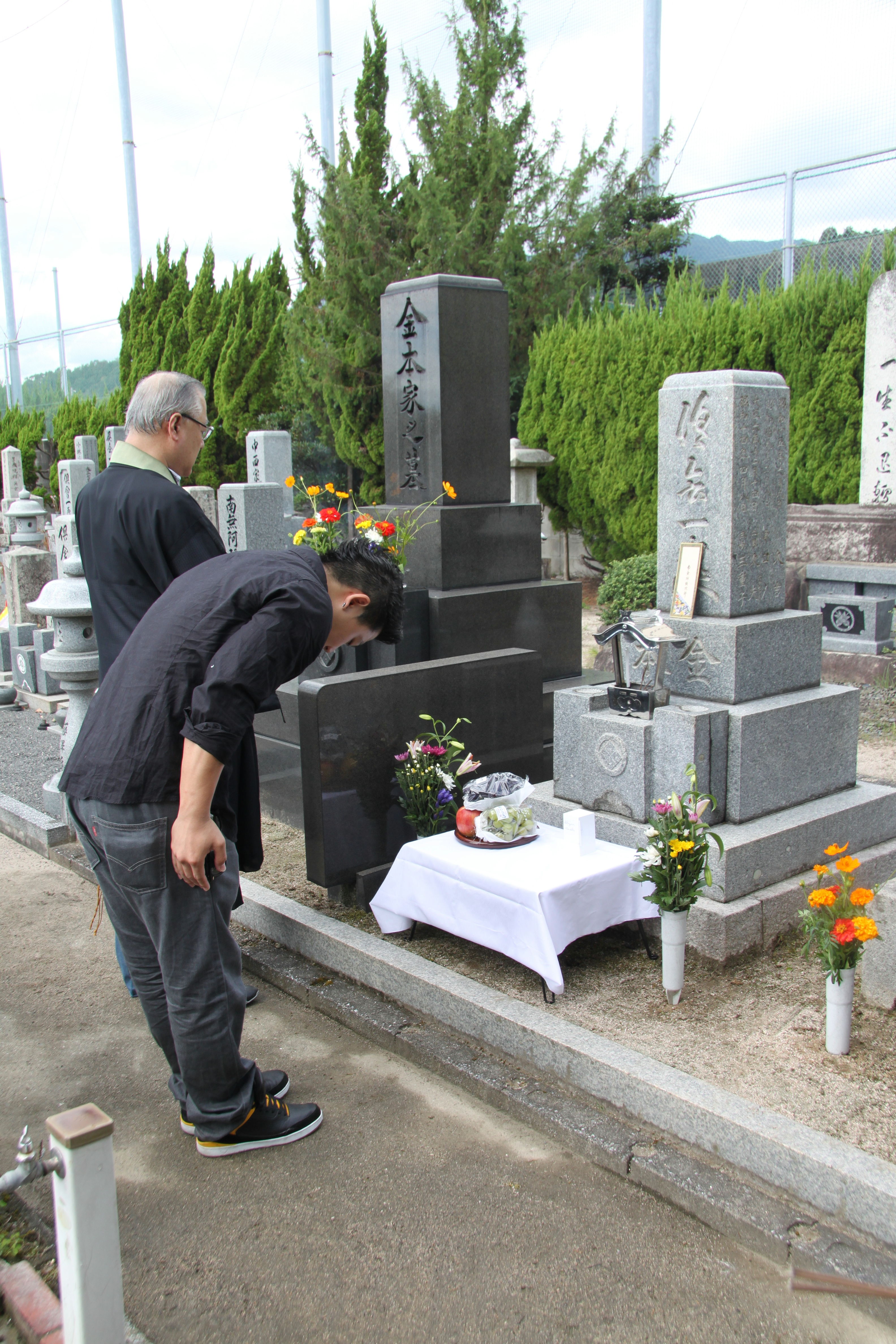
My 24 year old son bows deeply and reverently in front of the family crypt holding the ashes of Suetaro who was killed at 24 years of age.  The ashes of Aunt Shiz can be seen in the small white box on top of the white cloth.

_________________________

He was right.  Masako and Toshiro are right.  Aunt Shiz picked this time to come home.  She knew we were going.  She decided Takeshi was to come.  She made everything happen as they did.  My son was very moved and affected by this coming together of family…so much so he cried at our farewell dinner.

Do I believe in spirits and kharma?

Yes.

A 1937 Yearbook, the Atomic Bomb and Hiroshima


(Please see An Atomic Spark and a 1937 Yearbook and Dad Was in the Newspaper for background information.)

There is living proof of forgiveness from a few – and they let out a resounding message of world peace for us.

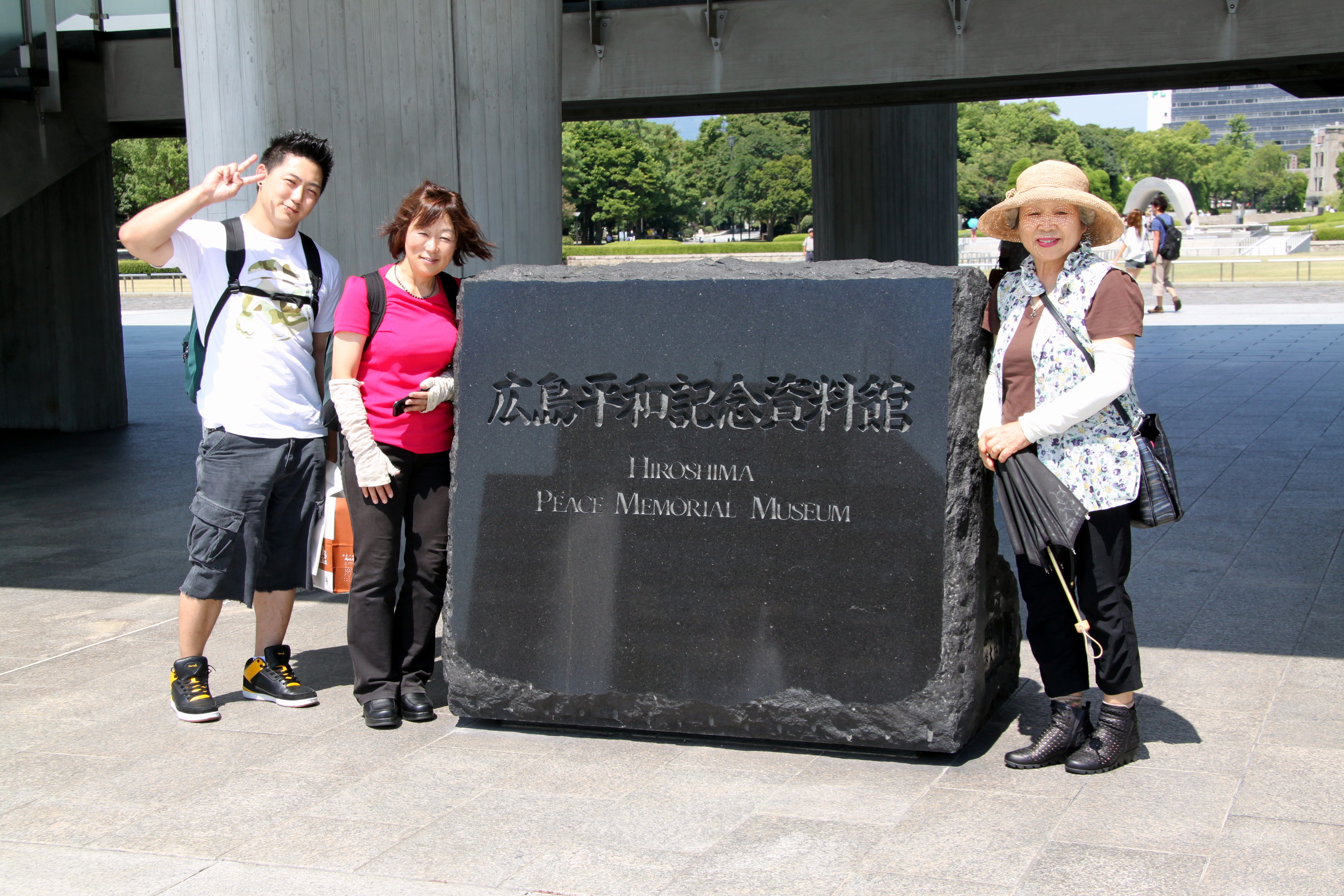
My son Takeshi, second cousin Izumi and my cousin Masako at the Hiroshima Peace Memorial Museum.

_______________________

It was an extreme emotional experience – not just for my oldest son Takeshi and I but for the kind souls who joyfully spent their afternoons with us on a hot September day in Hiroshima.  I was able to finally meet – and thank – the people who were kind enough to seek out my father’s 1937 high school yearbook and thereby give my father a joyous remembrance of his most happiest days of youth in the sunset of his long life.

_______________________

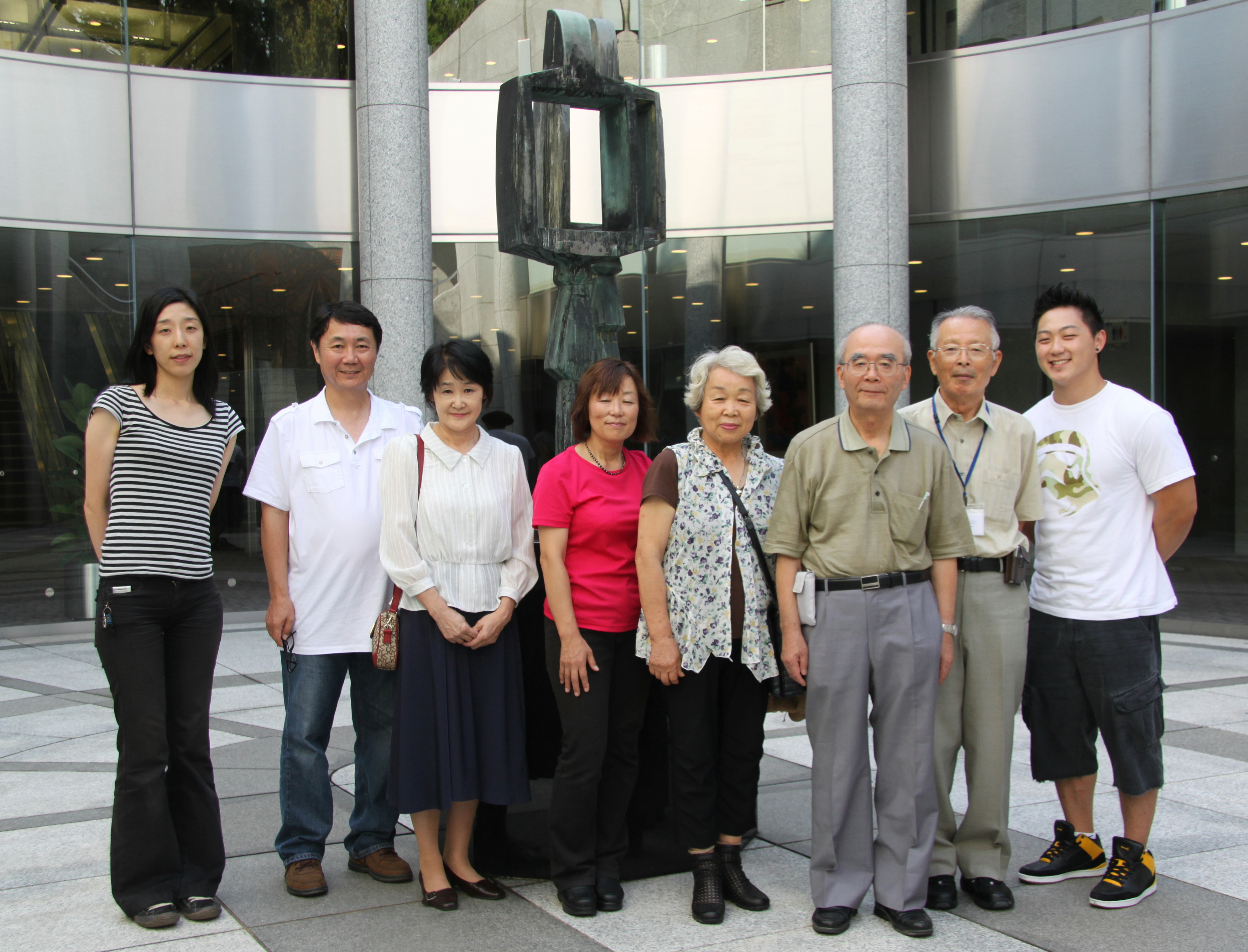
Not being a writer, putting this experience into words is an endeavor.  But on September 6, 2012, we were able to meet in person Mr. Tsukamoto, Ms. Kanetou, Ms. Tanaka and Mr. Aramaki.

From left: Ms. Tanaka of the Hiroshima Chugoku Shimbun newspaper, myself, Ms. Kanetou who tracked down my dad’s 1937 yearbook, my cousins Izumi and Masako, Mr. Tsukamoto who first answered my blind email and set things into motion, Mr. Aramaki our guide and my son Takeshi. Messrs. Tsukamoto and Aramaki are survivors of the atomic bombing.

__________________________

Any guided tour is exceptional.  A personally guided tour of a peace memorial and museum of a man-made event of unparalleled violence cannot be surpassed. Both gentlemen were severely burned as young children.  With all doctors killed in the city, they had to resort to mashed yam salve to soothe their wounds. (To see a VERY well written piece on their atomic experiences translated into English, please feel free to read it here.)  Imagine doing that yourself as a youngster.

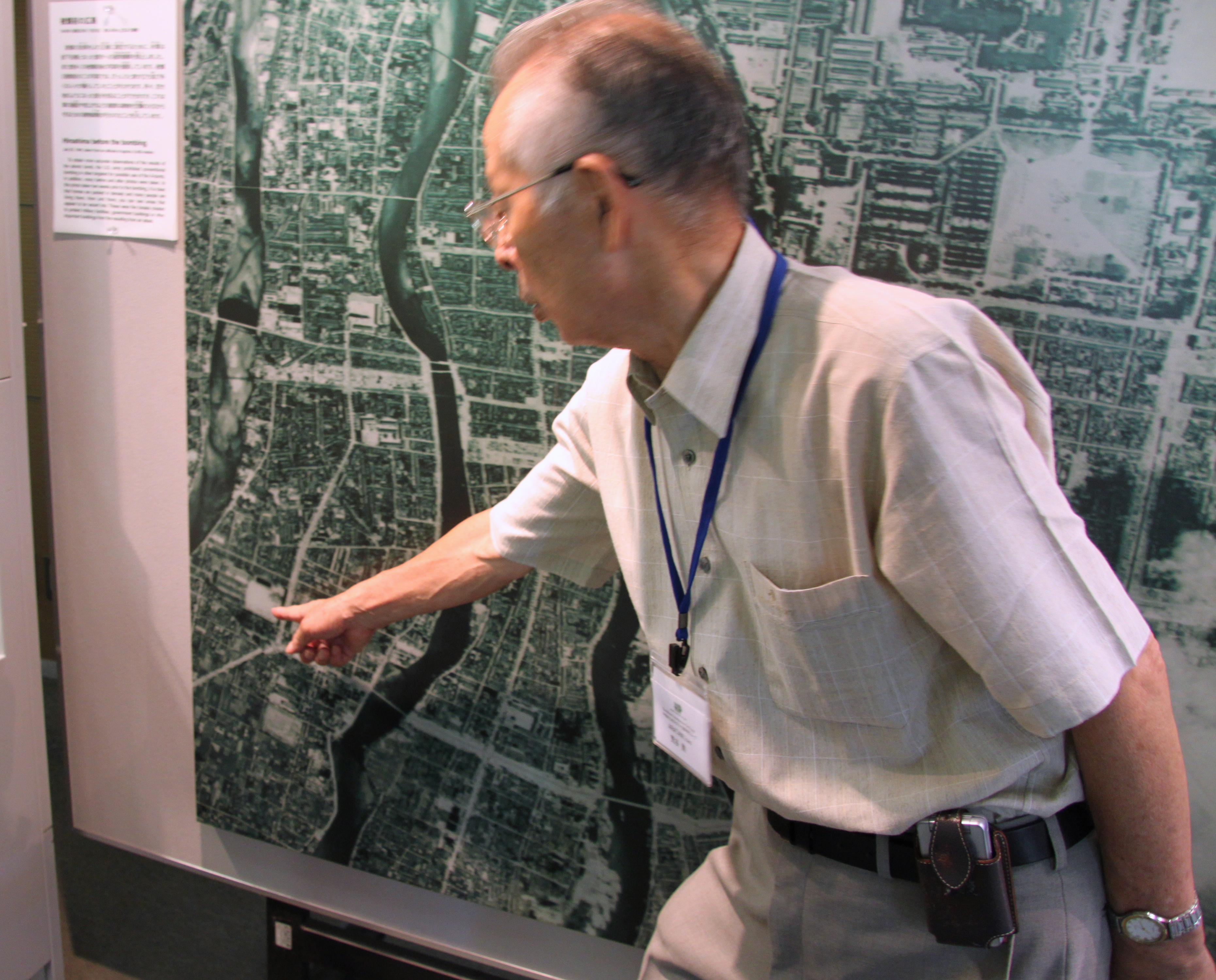
They first pointed out where my father’s beloved high school, Nichuu, was situated in relation to the hypocenter.  It is one thing to see it on your monitor.  It is another thing to see it on a large wall map.  Overwhelming.  I knew it was close but it was not much further than one of my father’s triple jumps in Track and Field.  It ceased to exist – as did over 320 of their young classmates.
Mr. Aratani points to the now vacant square lot that was once his school – and my father’s.

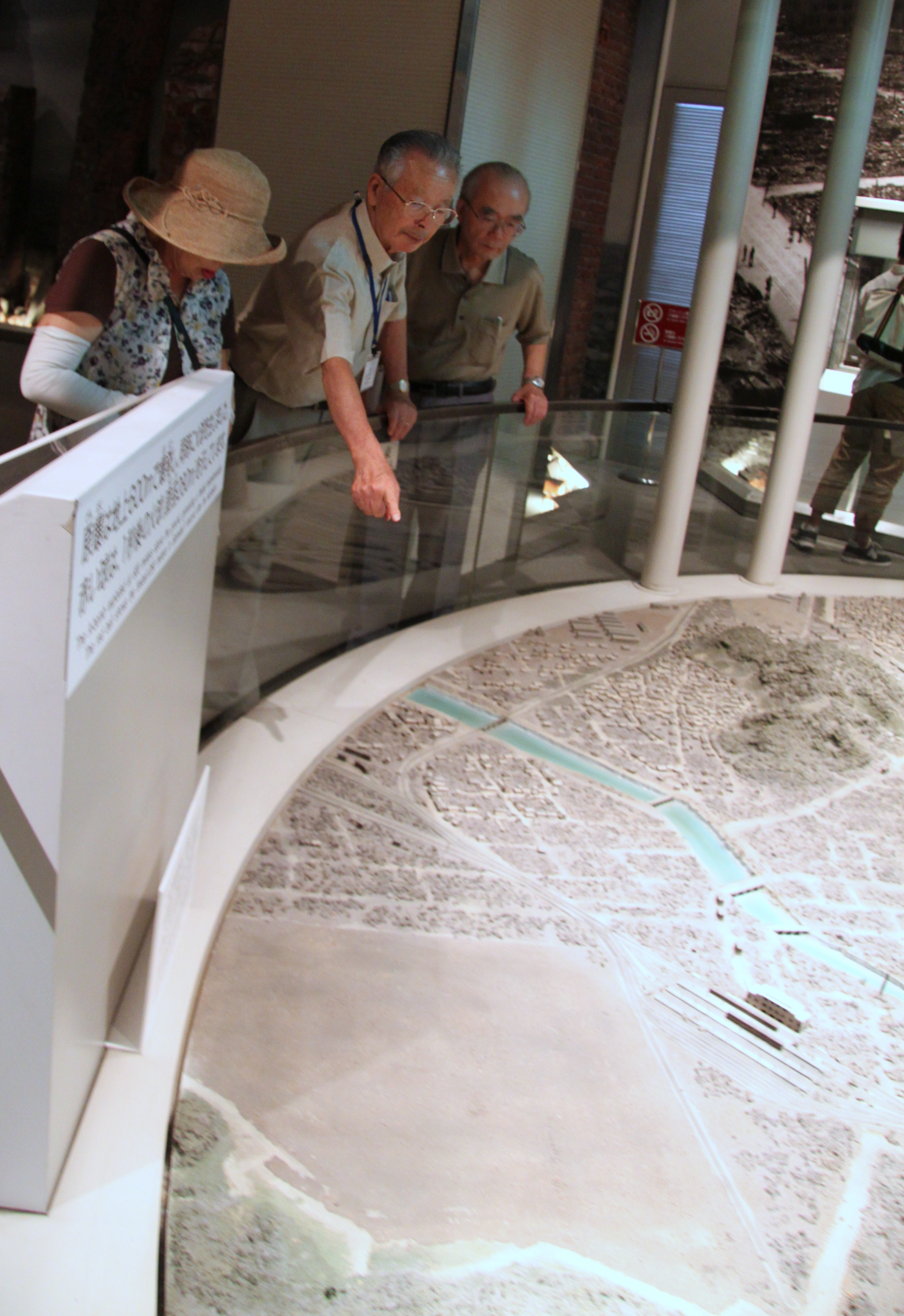
By destiny, both men – young children at that time being forced into laboring for Japan’s war effort – were saved by the decision of their instructor, Mr. Sekimoto.  Mr. Sekimoto decided it would be best for small group of them (which included another one of my relatives) to clear a large parade ground to the southeast (東練兵場) for the next crop of sweet potatoes.  The other classmates were sent to work on building a firebreak near Nichu – which sealed their fate.  They were erased from the face of this earth in a second.

Mr. Aratani and Mr. Tsukamoto point out the Eastern Parade Ground to my cousin Masako where they were to pull weeds that fateful morning. I subsequently learned another relative of mine, Hitoshi Kubo, was also with them. His burns were more severe.

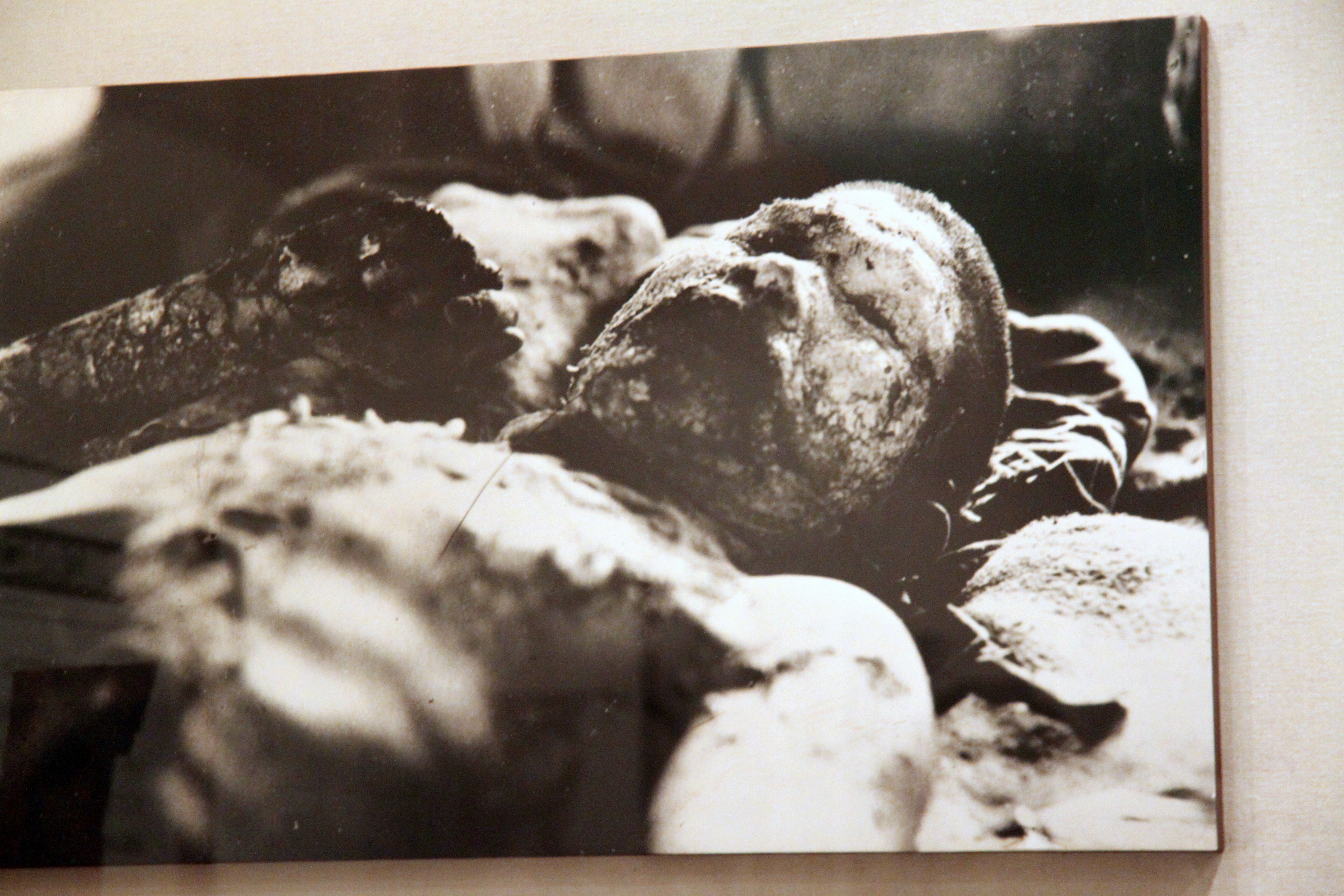
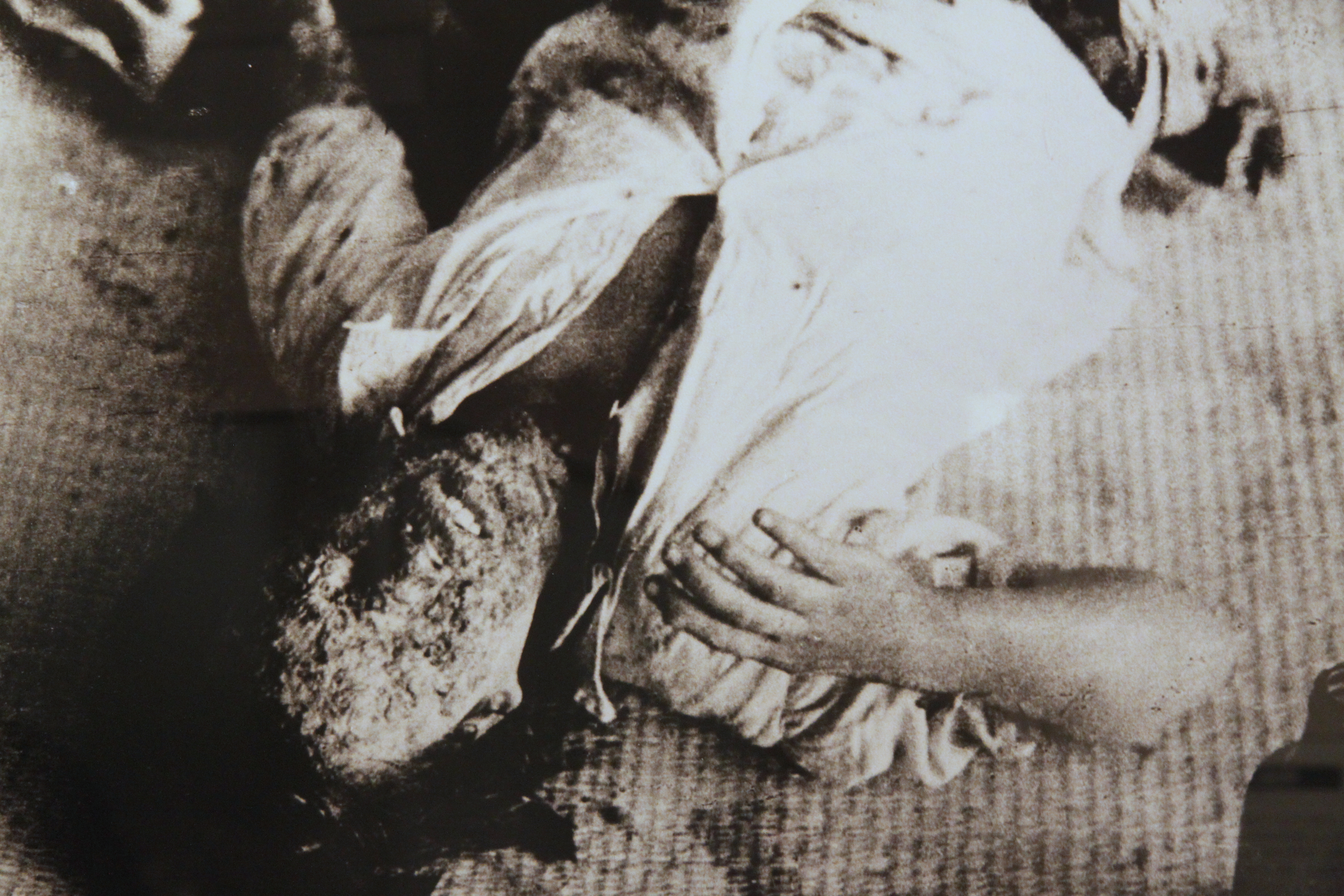
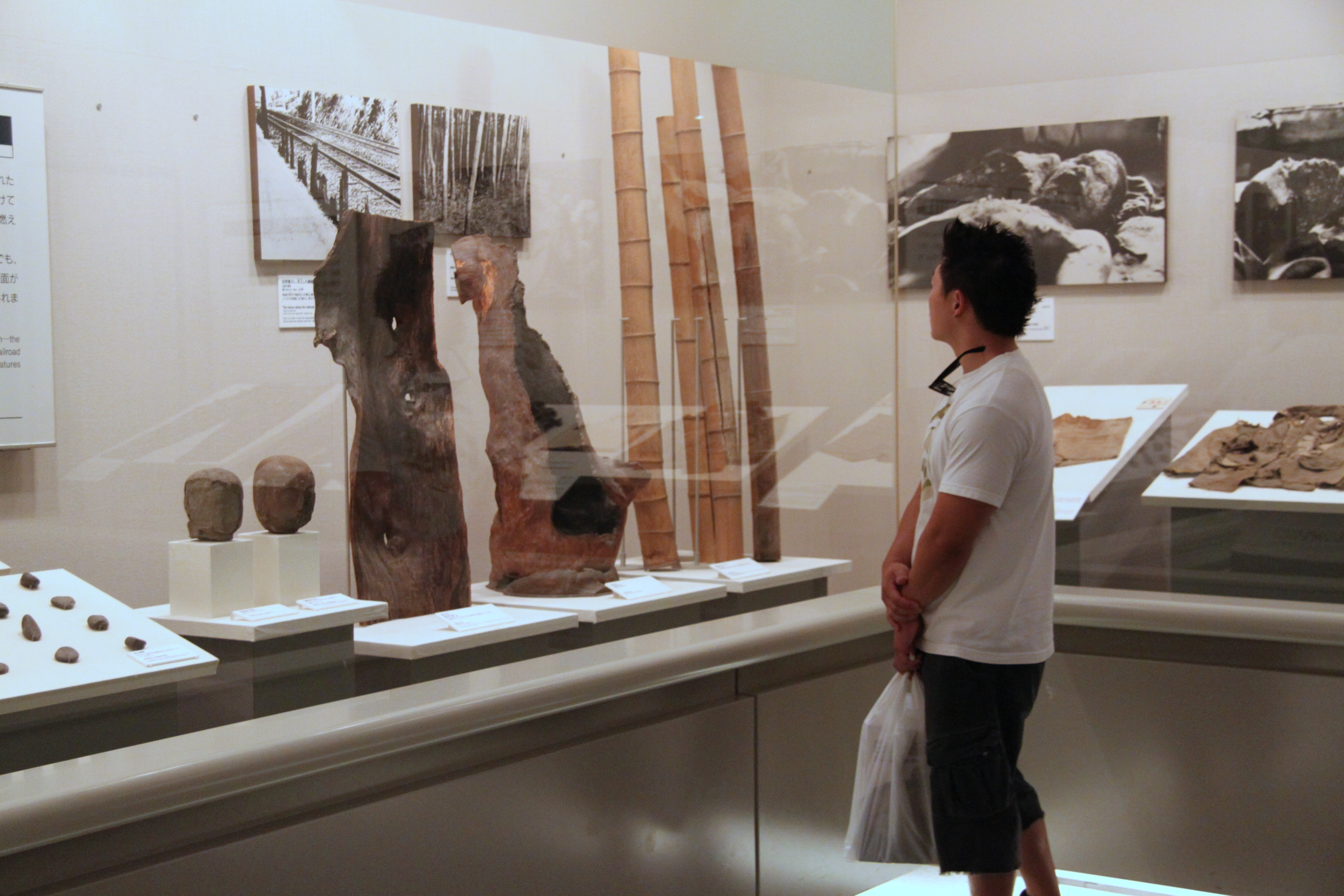
Due to time, we journeyed outside with these two 81 year old gentlemen for further education.  However, without any inference of what was right or what was wrong 70 years ago, just a couple of images from within the Memorial Museum:

My son Takeshi, I believe, was very focused on the many displays. I believe the message of the Peace Museum was completely absorbed into his psyche.

Messrs. Tsukamoto and Aratani guided us to the Nichuu High School Memorial, emblazoned with the 321 fellow students who perished.  As did Mr. Tsukamoto on August 6th, 2012, I offered water; my son Takeshi also without any urging whatsoever left his precious water bottle on that hot and humid day which is a glorious gesture.  There is a reason for the water as will be explained shortly.

Mr. Aratani, Mr. Tsukamoto and myself offer water to the Memorial and a prayer for their young Nichuu classmates and souls.  321 of them.
My son leaves his water bottle for the young souls.

We journeyed towards the cenotaph.  On the way through a park, Mr. Tsukamoto began to cry.  I asked him what was wrong.  He replied, “Your father is very fortunate to have family that think of his well-being.  My soul is now filled with joy.”  We hugged each other under the shade of a tree and cried together.  As it turns out, his father died at a young age; he was never able to thank his father for raising him through a most horrible period.

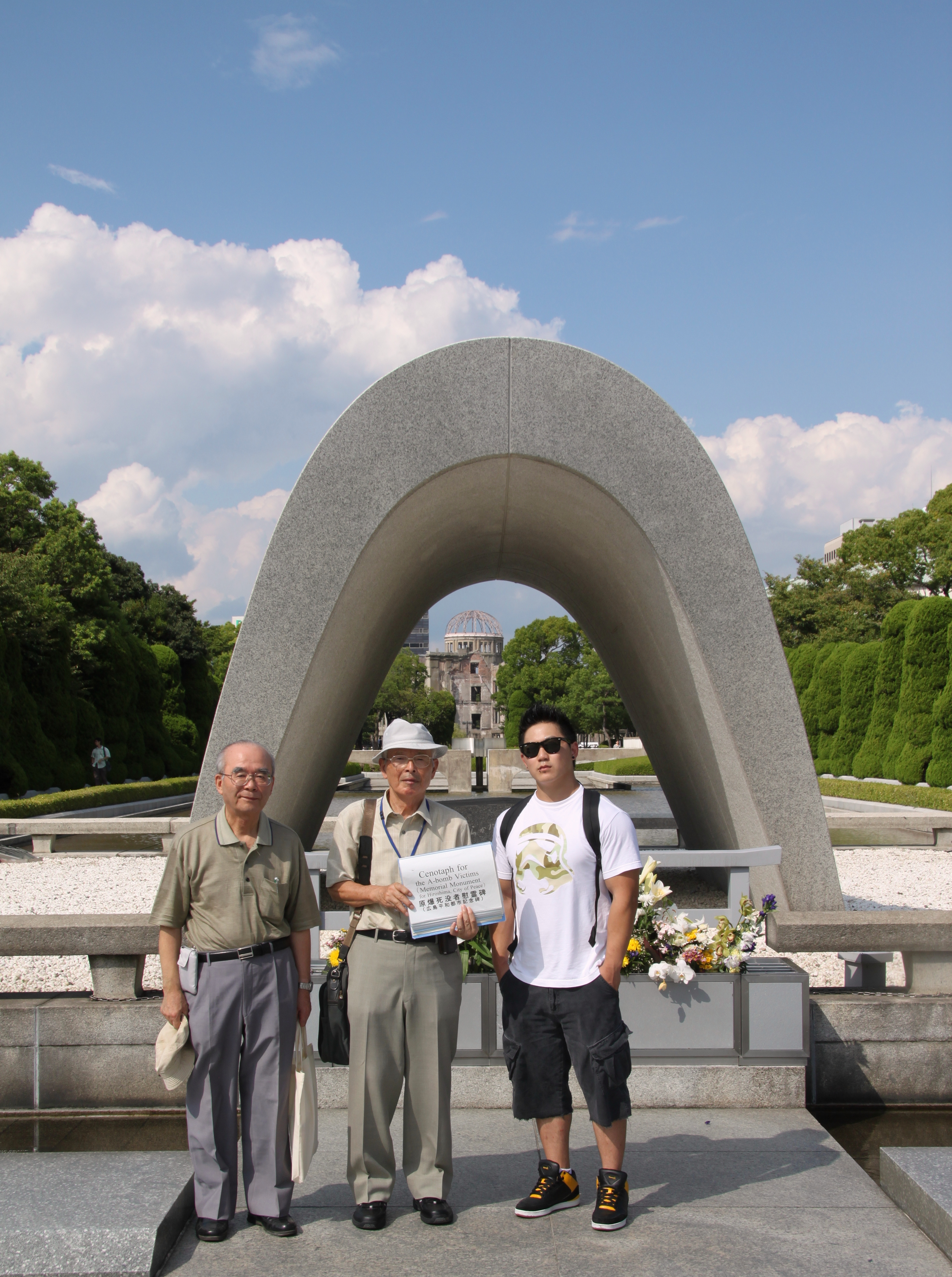
We arrived at the cenotaph; the inscription was designed and written by Mr. Tsubokawa’s and Aratani’s good friend, Prof. Saika Tadayoshi.  In English, it says, “For to repeat the fault we shall cease for we shall not repeat the evil.”  It was purposely written with no subject.  It is for the reader to decide.  Mr. Tsukamoto subsequently sent this image of the actual manuscript of Prof. Tadayoshi written in calligraphy (brush and carbon ink).

From Mr. Tsukamoto.

The Atomic Dome can be seen perfectly centered through the arch.  He explained the “eternal flame” is not truly meant to be eternal.  It is to be extinguished when all nuclear weapons are abolished.

Cenotaph

Just beyond the cenotaph can be seen a pool of refreshing water.  The water symbolizes all the cries for water from the victims who survived the atomic blast.  Nearly all would perish.  Remember the water we poured on Nichu’s Memorial Stone?

We then walked to the actual hypocenter.  The atomic bomb exploded about 1,900 feet directly above.

The atomic bomb exploded directly above this spot.

There are several rivers flowing through Hiroshima.  We all know through books that the rivers were engorged with corpses and debris.  However, there are no photos in existence as it was when the city was destroyed.  There was no film let alone medical care.  However, before the US scientists came to measure radiation levels about two months later, a huge typhoon hit the devastated city.  While the rain tore through the rivers carrying the corpses out to sea, the rain also largely washed away radiation levels.  Therefore, when the US scientists did measure the radiation levels, it was tremendously lower than what it truly was.  You won’t find that written in any of our school history books.

This river was engorged with victims and were washed out to sea by a huge typhoon. There are no photos of this horrible scene as witnessed by our two survivors.

We returned from the very enlightening tour to join Masako, Izumi, Ms. Kanetou and Ms. Tanaka.  My father was bestowed with many kind gifts one of which was a compilation of years past of Nichu – including images of when dad’s class was digging the pool at the school in the early 30’s.  But lastly, as a small token of peace, fellow blogger Seapunk2 sent me some artistic pieces representing peace and serenity.  One was presented Ms. Kanetou.  I explained it to her that the artist said a sense of peace may be coming “…directly from her actions. You may feel the spirit contained within them.  (I) sat so long and quietly, collecting those tiny pieces, sometimes with tweezers. It’s a beautiful experience, to listen to the shore birds, seals, waves and take in the Pacific while I gather the otherwise unnoticed gifts from the earth and sea. Then, once I got the idea for containing them, that, too, was peaceful and gave me a lovely sense of satisfaction…”

Peace token from seapunk2!

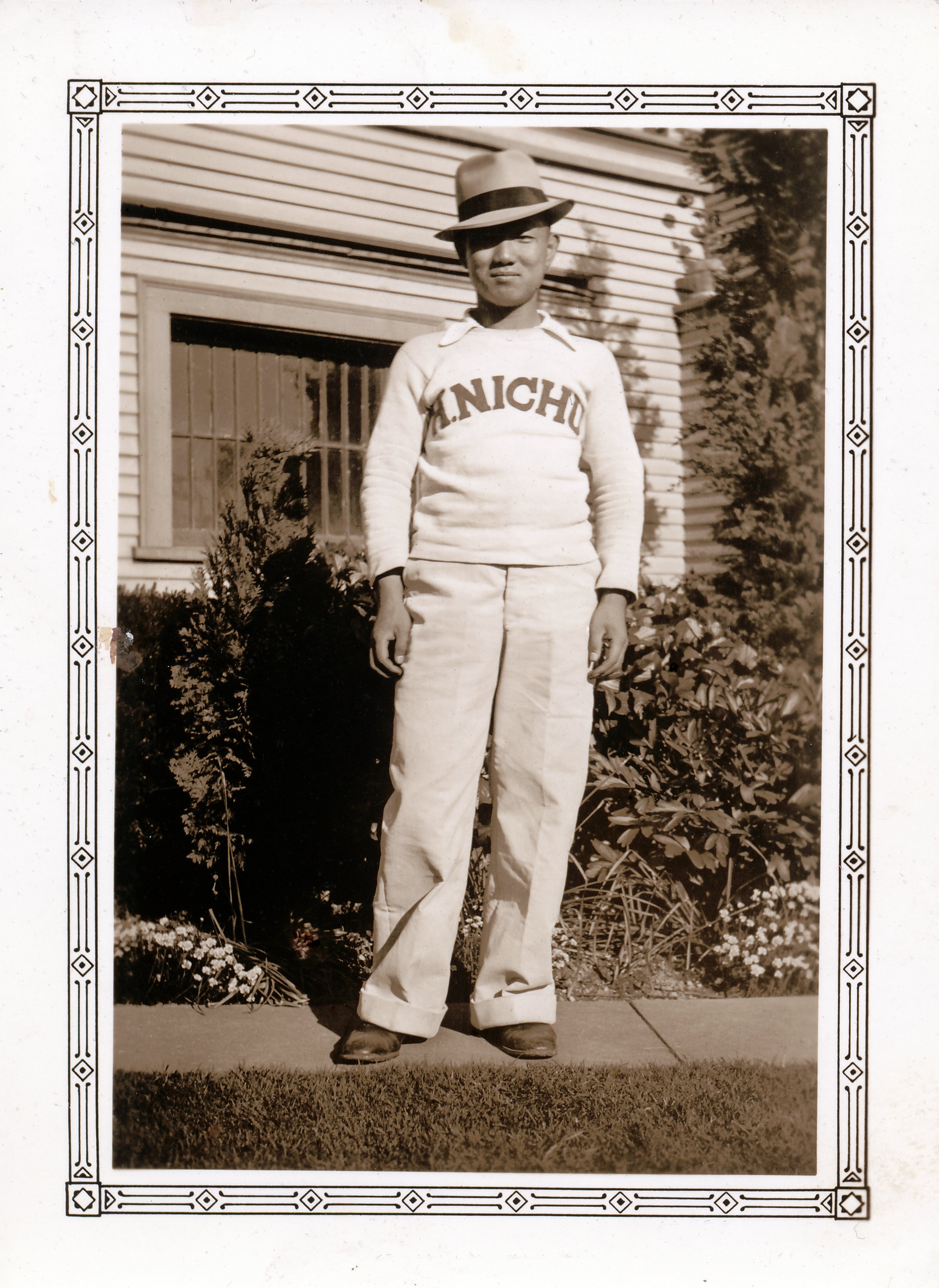
Lastly, in a photo discovery made just a few hours before meeting them, I came across a photo of dad taken in 1937 soon after he arrived back in Seattle after spending ten years in Hiroshima and graduating from Nichu.  He’s sporting his Nichu varsity sweater.  The attendees were overjoyed to see Dad’s pride in Nichu – even across the ocean.

Dad in his pride and joy Nichu varsity sweater taken in Seattle, 1937. You can also see his bent right elbow. That is another discovery story.

__________________________________

The men were burned severely as children working in a field for their country’s victory.  While their country lost, it was but a moment in their lifetime.  They still attained victory for the world.

More to come on one family, two countries and World War II.

LIFE and GENERATIONS – Backwards and Forward


Life can be fulfilling, emotional, filled with awe…and eerie.  All at once.  In ten short days.  In a country far away.

But life and its generations help you live it backwards and forward.

__________________________

Ten great days were spent in Tokyo and Hiroshima with my oldest son, Takeshi.  He is 24 years old.  We had never been on vacation together.  My loss.  I admit to being worried he was not going to enjoy himself.

There is so much to write about for family and friends but jet lag affects more than sleep.  There is a cavernous disconnect between my (normally minimally functioning) brain and my fingers.

__________________________

But during this trip…

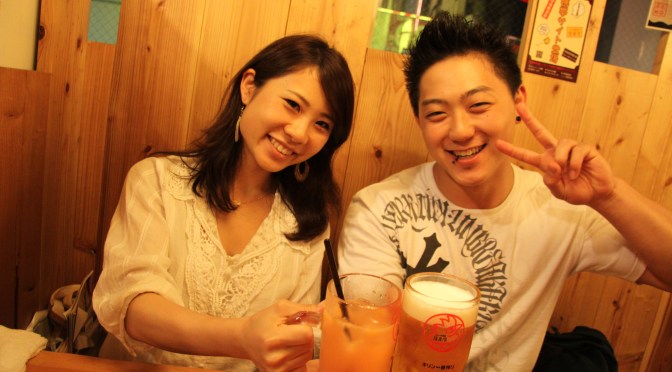
My son enjoyed his time with my dad’s side of the family immensely – so much so he shed a few tears at a farewell dinner they threw for us.  He even found a new drinking buddy – my cousin’s intelligent and beautiful granddaughter, Yuu-chan:

My son Takeshi and Yuu-chan in Tokyo

With my cousin Toshio Nakano, we saw my father’s station he served in as part of the 8th US Army’s G-2, Military Intelligence Service in Yokohama; because I carried some photos of him in uniform inside, the Public Relations Officer escorted us to a view from the (unrestricted) roof:

Dad’s Army station while in the US 8th Army in Yokohama

Was able to meet my cousin Masako (78) once again and the family – and we were royally treated:

Great fun with family in Hiroshima

Took the cremated remains of my Aunt Shiz (95) for internment; she was my dad’s last living sibling.  He is now the last one:

Ceremony for Aunt Shiz

Saw the most beautiful parts of Japan:

Miyajima’s grand Tori’i

A most EMOTIONAL meeting with those responsible for finding my dad’s 1937 high school yearbook:

A most wonderful meeting of peace-loving people

And the most STARTLING and tear-jerking finds of generations past – including those of my father’s younger brother who was KIA as part of the Japanese Imperial Army:

Unbelievable family discoveries

I hope you’ll stay tuned until this old mind functions again.  Not that it ever did.  Thought it best to say that before someone did.


A very profound piece of wisdom and writing, I feel.

Laughter – Honest Laughter


I need a laugh today after some not-so-good things happening…

Where has this lovely kind of humor gone?  I yearn for the simpler, good ol’ days.  Don’t you?

Just Some Snapshots 1


Pointless snapshots from my tiny front yard.

I really feel Autumn is around the bend here.

“Old Man Jack-ism” #4


“Koji, don’t let anyone tell you different.  War makes good boys do crazy things.”

That was the first time Old Man Jack shared something with me about the war in a voice of unfeigned remorse.  In turn, it was one of my first journeys in his time machine in which he allowed me to ride along.

Front row seats.  Free of charge.

It was in 2002 to the best of my recollection.  It was just before my littlest firecracker was born.

__________________________

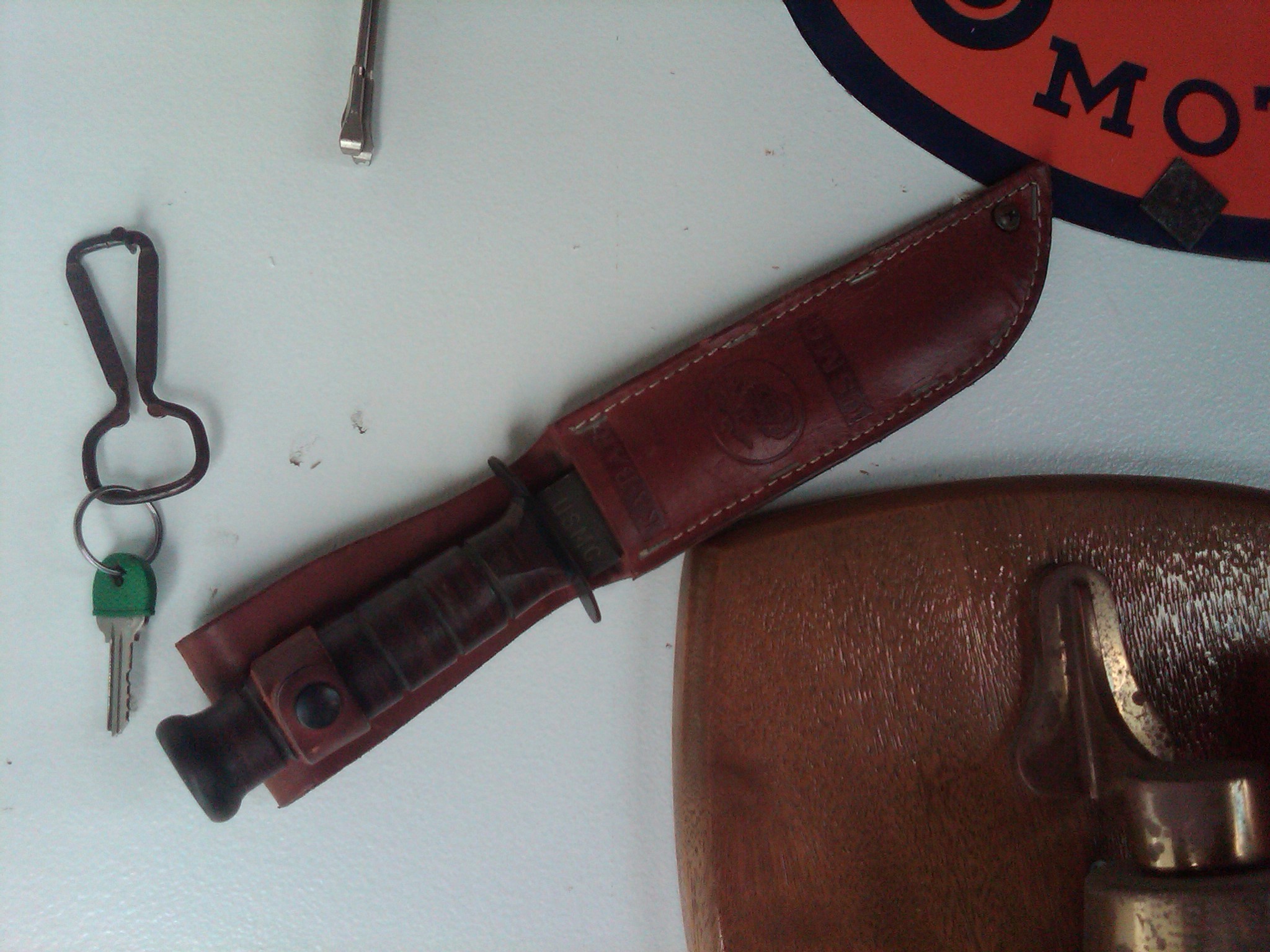
KA-BAR.  If you are a World War II US Marine who served on “those stinkin’ islands”, there is no explanation necessary.

My friend’s KA-BAR. He stated it was his grandfather’s who had served in the Pacific Theater. He allowed me to hold it. Its mass will stun you.

A KA-BAR was a Marine’s most prized personal possession.  It was always at their side.

They opened their C-rations with it.  Dug foxholes with it.  Chopped coconut logs with it.  Hammered nails with it.  Indestructible.

Most importantly, for killing.  Designed for slashing and stabbing.  Desperate hand-to-hand combat.  To the death.

The KA-BAR served them so well that many Marines who survived passed it down to their children.

Old Man Jack said several times, “I’ll tell ya – us white caps always tussled with the Marines ‘cuz they thought they were better than us…but there wasn’t anyone better at protecting your sorry asses with theirs when it came time.”

_________________________

(If you are prone to nausea, you should not continue to read this Old Man Jack story.)

I did not know this free ride was coming.  It was unexpected and spontaneous.  I recall that clearly.

That afternoon, he began describing something vile he witnessed during the war.  Today, I fully realize he was trying to vomit demons out from his soul.

He needed to.

Jack visiting at my house on Sept. 23, 2006. He would fall gravely ill about a year later.

________________________

He didn’t tell me what island; that would be his pattern up until his death.  If he was talking about something a young man should never have witnessed, he would never say what island he was on.  However, my educated guess as to the year would be late 1943 or early 1944.

Old Man Jack said to the best of my recollection that “…the Japs broke through our perimeter”.

“When the fighting broke out, most of us (the ground crew servicing Marine Corsairs) dove straight into the nearest foxholes.  I only had a .45 and I kept my head down except for a dumb ass split second or two…”  He tried to mimic what he did by extending his neck a bit and flicking his head left and right.

“All hell was breaking loose.  Men were screaming all over the place.  You could tell which rounds were from us and which ones were theirs.”

It was all over in a couple of minutes, Jack said.  “I did hear moaning then a CRACK from a .45 or a M1…”  A Marine apparently dispensed a wounded enemy soldier.

“I got up.  There was still a little yelling going on.  And I ain’t ashamed to say I started shaking real bad.  Then I see this kid (i.e., a Marine) dragging this wounded Jap; he was hit pretty bad but I could tell he was still alive.  The Marine grabbed his KA-BAR and sliced open that son-of-a-bitch’s mouth.  I could see the Jap was flinching.  The kid was trying to gouge out gold (from his teeth).”

Another Marine came over and shot the Jap dead with his .45.  The kid yelled, ‘Hey!  Why’d you have to go do that for?!’

The other Marine just looked at him for a split second and walked away.  I stopped looking.”

Jack then just slowly shook his head.

________________________

I remember Old Man Jack was looking down when he finished.  He had on a grey sweatshirt as winter was coming on.

Front row seats in his time machine of nightmares.  He just forgot to mention it was on his roller coaster he kept hidden inside.

He had other free tickets for me in the years that followed.

Union Strike Averted


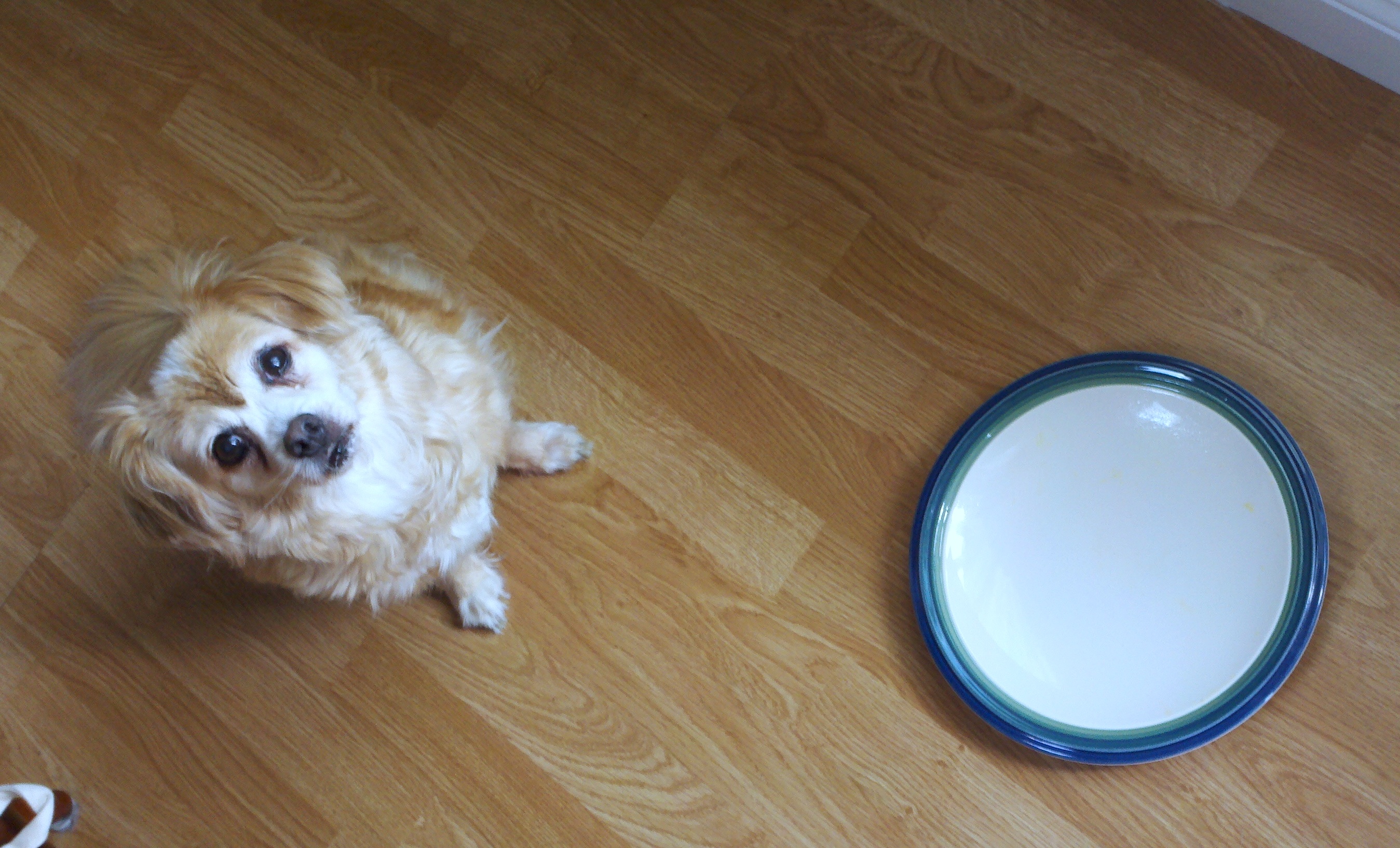
If you recall, I had hired the unemployed.  She was given the position of dishwasher.

The work she was to do was in complete accordance with the job description.  She was content.  She didn’t even want to clock out.

She was happy to be contributing to society once again.

Then the unthinkable happened.  She complained that no dry dog food be served on the dish to be washed.  She even complained on video.  It went viral.

She complained that the dry dog food disagreed with her schloppy tongue.

This ungrateful employee who was unemployed until she was hired filed a grievance.  A grievance with the Union.

It got ugly.  She made protest signs.

She made a bazillion protest signs and planted them surrounding the house.

She even staged work slow-downs.  Played on the job.  Dastardly.

She got into my face.  Up close and personal.  Pee-eww.  I almost gave in.

She got into my face.

I fought back.  Nothing but dry dog food was served.

After a few days, the strike was averted.  She eventually realized the wrong of her ways.  She no longer whimpers or makes videos of her grievances.

Success.  No harm.  More money in my pocket that has had a big hole.

At least she works in exchange for receiving something.

Julia Child in World War II


Julia Child in Kandy, Ceylon during WWII and as part of the OSS.

I am a bit of a World War II history buff.  While primarily focusing on the Pacific War due to my family’s connections, I thought this may interest the foodies here.

Julia Child was a member of the OSS – Office of Strategic Services.  Spying.  Intelligence.  James Bond.  Well, maybe not James Bond.  But she was in some dastardly conditions.

http://www.nww2m.com/2012/08/julia-child-at-100/

Enjoy.

Happy Birthday #100, Julia Child.


The artist who drew the “Sgt Rock” comic book has passed. I loved that comic.

jimpageadmin's avatarJim's World and Welcome To It

I never met Joe Kubert in either of my stints in the comic-book world, but I spoke with him on the phone a few times. Mr. Kubert, a pioneering artist who worked mainly for DC Comics, had started a school for cartooning and graphic arts in Dover, New Jersey. There were two young friends and employees of mine in whom I saw great potential.

I spoke with Mr. Kubert about them both. These conversations were about ten years apart, but Mr. Kubert had the same two questions about the young men I was touting: “Are they good? Will they listen?”

Both young men attended his school to their decided benefit. He and his staff taught them what they needed to know to augment their talent with real-world chops. After a couple of years at the Kubert School, both these young men were not only pro-level cartoonists, but could handle any…

View original post 249 more words

True stories about World War II – One war. Two Countries. One Family