Category Archives: America

Hamburgers and a ’63 Merc


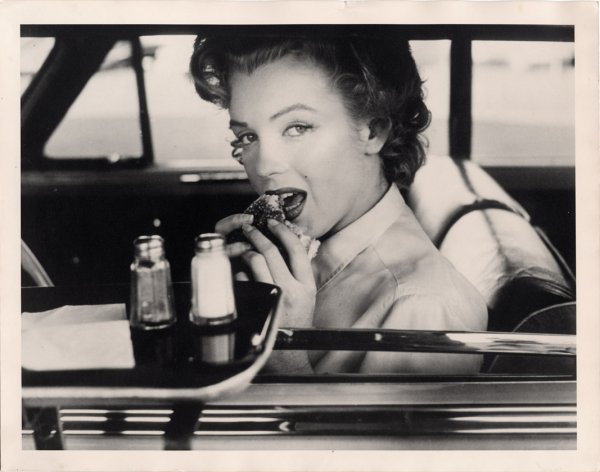
MM burger
Marilyn Monroe eating an old-fashioned hamburger at a drive-in hamburger stand. Photo by Philippe Halsman.

Nearly all Americans would agree that hamburgers are the All-American icon.  A simple grilled ground beef patty, salted and peppered, slathered with mayo, mustard and ketchup then sandwiched in a plain bun.

At least that’s how I know them.  Oh, hold the pickles, please.

Now, us kids that grew up watching “Bewitched” and “I Dream of Jeannie” have given birth to a generation that has taken a simple thing and made them into $15 gourmet, fancied-up, mushroom-covered (expensive) cuisine.  Do you think I like Elizabeth Montgomery and Barbara Eden?  Drool…

But I don’t know if I like the “change”.

Back to this in a minute, folks.

The fancy hamburgers – not the drool.

___________________________

Dad had always owned Fords when he could finally afford getting a car.  I guess that’s where I get my Ford passion from.

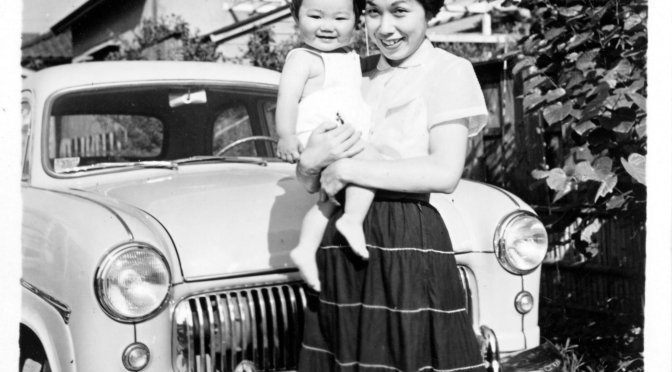
July 5, 1955
Aunt Eiko holding me in front of my dad’s Ford Consul automobile. If you are reading my past stories about WWII, you will know that only the occupying Americans could afford to buy a car. Her husband was awarded the Congressional Gold Medal.  Occupied Japan, Tokyo, July 5, 1955.
Enoshima Beach, Tokyo - April 1957
My dad’s ’57 Ford Fairlane parked on Enoshima Beach, Tokyo. I’m thinking it was a dark green. April 1957.

After leaving Japan for the last time  in the late ‘50’s after the Occupation ended, my pop bought his first new car stateside in 1963 – he was 44 years old.  It was a two door Cascade Blue 1963 Mercury Meteor custom hardtop; a king of obscurity to say the least, but to a kid of about ten, it was Flash Gordon’s rocket ship.  Unlike Hillary, it was easy to love this car.
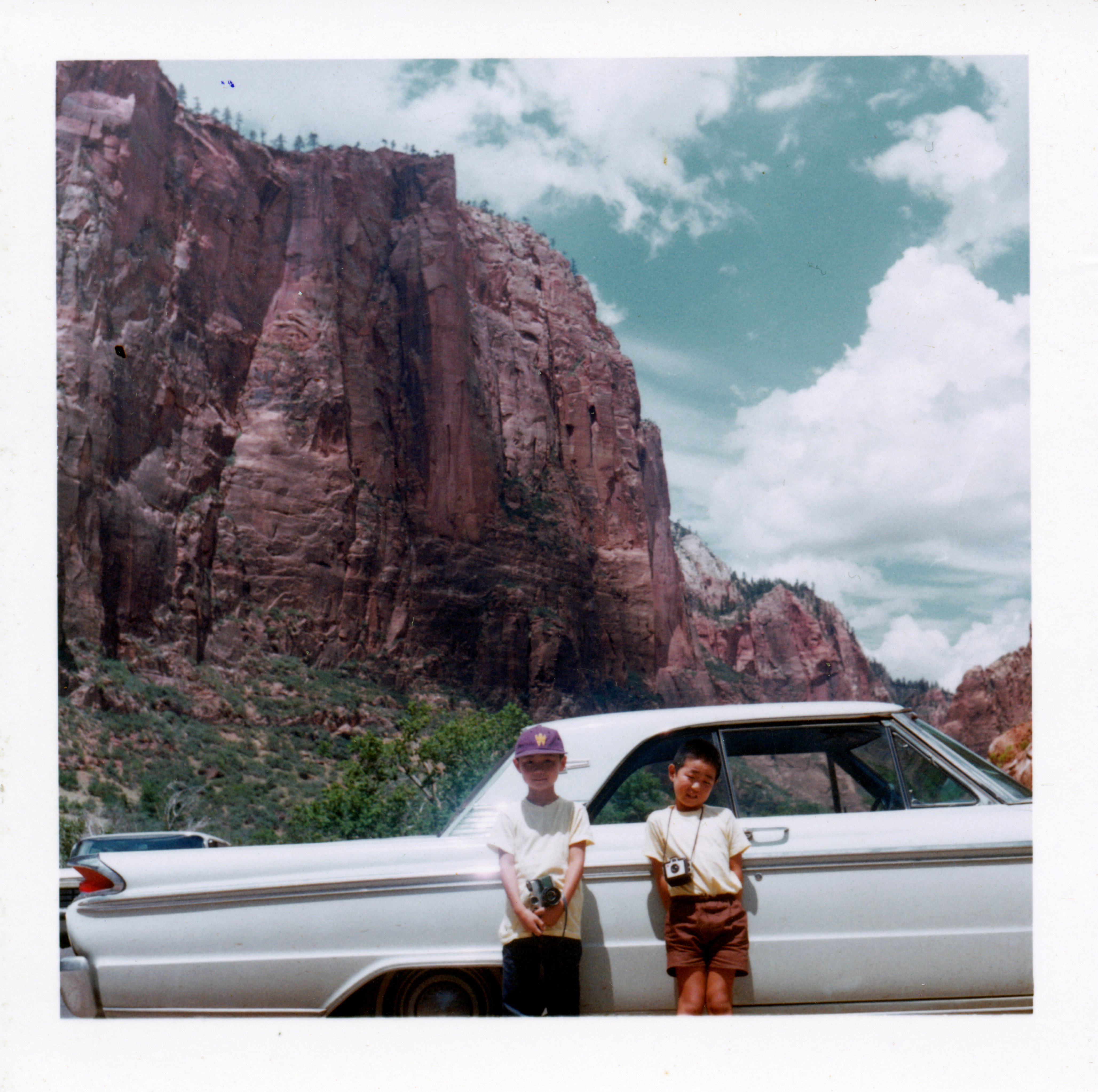
1964 or 1965 / Dad's new 1963 Mercury Meteor
On a road trip to Chicago in 1964. I’m still holding onto my Fujipet camera with dad’s 1963 Mercury Meteor behind us. This may have been in Utah.

Don’t get me wrong.  It wouldn’t get a choice spot if valet parked.  I say wouldn’t as my old man couldn’t afford valet, let alone a family dinner out.  But to me, the rocket ship had a chrome finish AM push-button radio – turn the dial on the right, find a station, pull out a button, then push it back in to set it.  Trouble is I did it a dozen times each time I got into the car.  But all I cared about was KFI 640 AM, the Dodgers’ station.  The golden voice of Vin Scully… and Fairly, Gilliam, Wills and I forget who played third.  They were World Series champs that year.

Six adults could get into this rocket ship with room to spare – eight of us little Japanese folks and a dog.  The cargo hold in back swallowed up my Sears JC Higgins bike in one gulp with enough space leftover for Frank Howard.  (I saw him hit the scoreboard in right field with a home run.)

Unless my aging grey matter is dissolving at warp speed (maybe it is), there were ash trays with shiny covers in each armrest…and this was for the back seats.  It was a favorite depository for my Bazooka chewing gum but I kept the wax covered cartoon that came with it.

Pop kept it for quite some time.  I passed my driver’s license test in it on my 16th birthday.  I got a 96 only because she claimed I never looked in the rear view mirror.  Poppy cock.  I always look in the rear view mirror for cops.  Even back then.

And as it was the only car we had back then, I also drove my date to one of my senior proms in it (I went to two.).  And the answer is, “No,” if anyone was wondering…but I’m sure she was disappointed.  Well, maybe not.

The four-wheel drum brakes were spectacular…not.  Instead of rubber meets the road, it was like rubber met the world’s supply of Vaseline while fighting the pull to the left… and this was at 25 mph.  Steering?  An oil tanker’s captain would do well.  Turn the wheel a lot; see the slight change in direction a few seconds later.  Pat Brady and Nellybelle turned better – and that was out in the desert on sand.
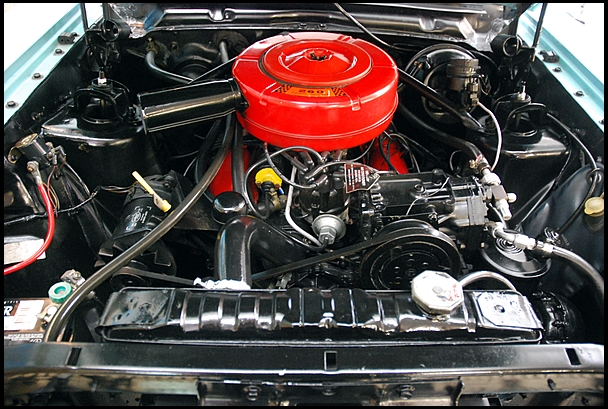
meteor engine
The Mercury Meteor’s 260 cid V-8.

I overhauled the epoch 164 hp 260 cid V8 sometime around 1976 in our garage.  At 13 years of age, she had become an old girl.  She had become a V6, meaning it had lost compression in two cylinders.  I remember setting zero lash, then three-quarters turn of the ratchet for the hydraulic lifters during the overhaul.  The distributor was the biggest headache, of all things.  It was like extracting an impacted molar and only after using copious amounts of Liquid Wrench in place of laughing gas did it finally come out.  “Older” Blue Oval guys know what I’m describing.

___________________________

Back to today’s elegant hamburgers and change.

Instead of the push-pull AM radio, my youngest son – who was seven when I bought it – similarly discovered my ’08 Mustang GT had a “My Color” dashboard light feature.  Now I know how my pop felt as my son forced me to experience every color of the rainbow while driving at night – every time.  It was like being at an all-night disco club.

Bazooka bubble gum and ashtrays are no more but treasure hunters will be pleased after exploring the map pockets.  No disappointments there.  I promise… especially after my little Cake Boss had sat in the back.  Latex gloves are highly recommended before exploring.

Overhaul it?  After all, my GT’s got a 281 V8, only twenty-one more cubes than my pop’s…but it pumps out a magnificent 505 hp thanks to her Roush supercharger and Carmen pulley.  Hell, I’m afraid to change spark plugs.  Who would imagine in 1963 there would be a TSB on just how to R&R spark plugs?

roush blower
My Roush supercharger and gizmos.

And unlike my pop’s ’63 Merc which ran on simple mechanical principles (but threw physics principles out the window for the so-called braking), the computing power in my Mustang would cause Einstein to strike a pose like Captain Morgan.

And today’s stunning braking power is the true reason for seat belts – it compassionately keeps your head from being continually used to redesign the windshield.  The aftermarket Wilwood six-piston disc brakes I installed with slotted and cross-drilled rotors exacerbates the stop-on-a-dime tendencies… which is a good thing.
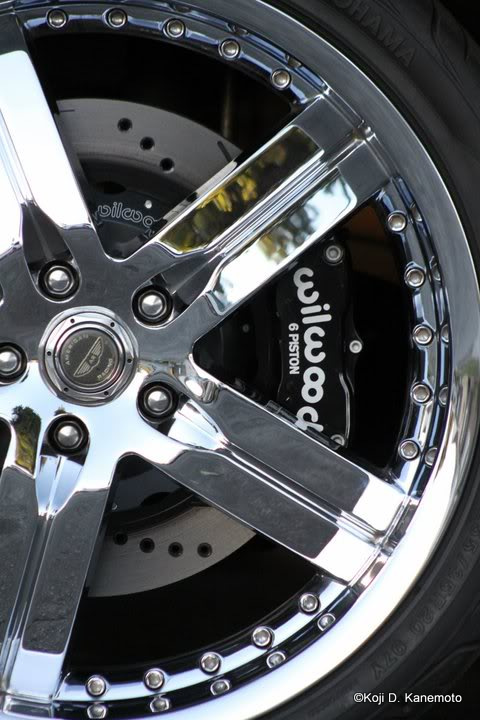
270768_1922679229805_1326818011_31876806_6107098_n
The Wilwood Six Piston disc brakes on my Mustang.

____________________________

So it appears the delicious, basic hamburger of the 1960’s has been brought into the 21st Century.  Kids that watched Elizabeth Montgomery and Barbara Eden fooled with the wonderfully simple ground beef and bread formula to give us today’s foodie gourmet burger…and we can still listen to Vinny’s golden voice, to boot.  Glorious.

And well, with 505 hp at the crank instead of 164 hp, it’s hard to complain.  Neither do my kids when they hear the whine of my Roush supercharger.  They like to scream.  But it’s a shame my pop’s ’63 Mercury Meteor won’t be swept into anyone’s museum.

__________________________

I guess technology has its benefits.

I’ll take a gourmet burger in the end after all.

Pass the Heinz ketchup, please.

At least that hasn’t changed.

Busy Baker


IMG_8263-1
My Triple-Chocolate Espresso Brownies and Classic Pound Cake from scratch.

For the first time, this former mechanic and amateur baker attempted TWO desserts within a four hour window.

Success!

Well, at least everyone who ate them are still alive and kicking…so far.

Just Some Snapshots 3


IMG_7912-2
Cobra Strike
IMG_7855-1
New Hampshire Bright
basilfairy-1
Basil Fairy
13248070085_0f923eefd6_o
Redbud Memories
succulents04-4
March Pastels
succulents05-5
Intensity
20140320_091526-2
A Shrimper. Forrest Gump would be happy with this one.
IMG_7809
March Jingle Bells

(Almost) Pie Crust From Scratch


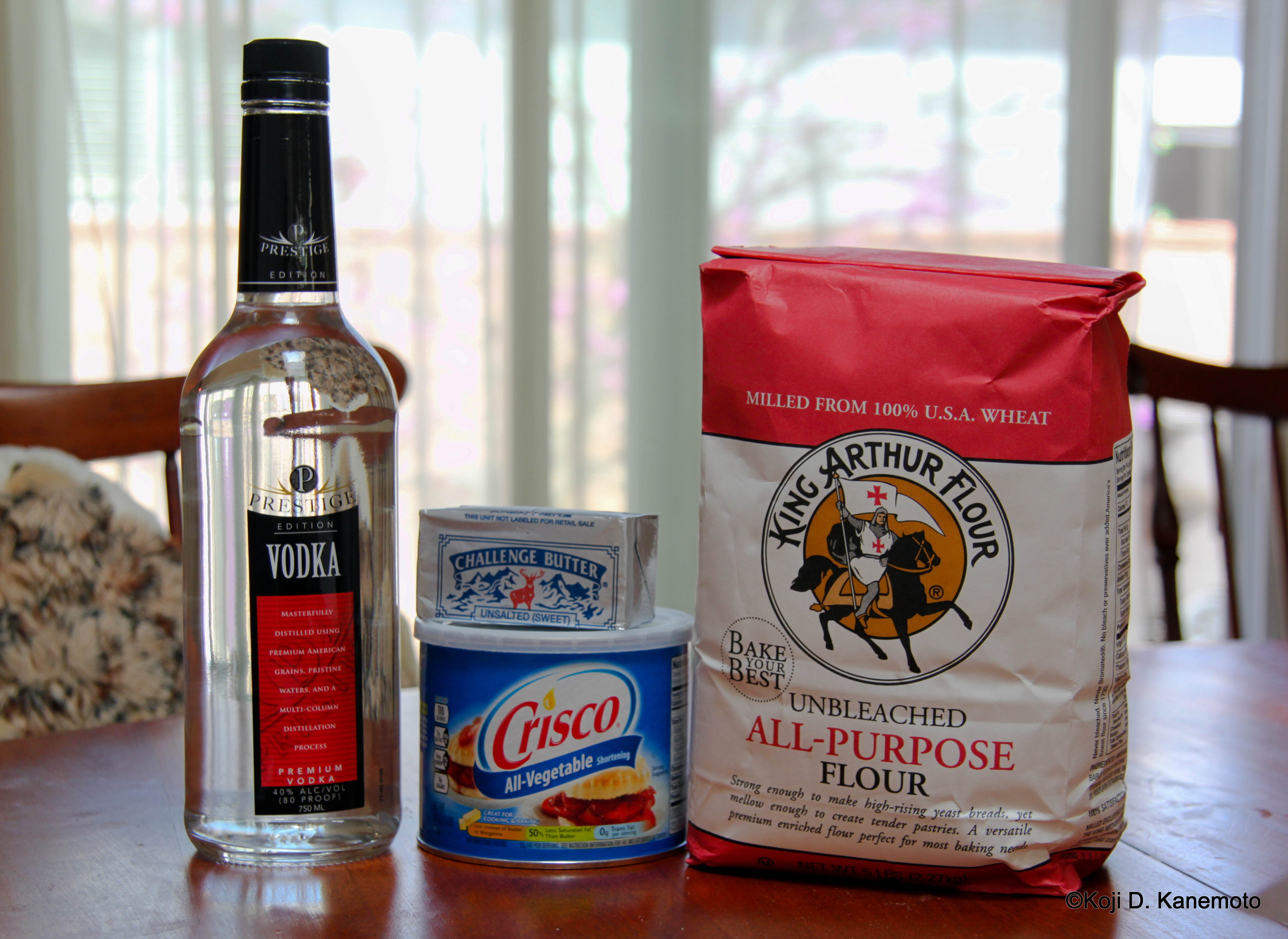
P C 1

Making a pie crust from scratch is really pretty easy.  Tried it for the first time.

But rolling out the pie dough… Now that’s a bitch.  (Pardon my French.)

But I did it…  Sorta.

____________________________

Yes, the Cook’s Illustrated recipe called for vodka.  No sense paraphrasing it so this is what they said:

“The problem is that dry pie dough is impossible to roll out. We needed a soft, pliable dough for rolling—that is, one with plenty of liquid—but a dry dough when it came to baking. The solution turned out to be, surprisingly, vodka. By using a quarter cup of ice water mixed with the same amount of chilled vodka, we could add a high amount of liquid and create a dough that was moist enough to roll out easily, but still tender after baking. While gluten forms readily in water, it doesn’t form in alcohol, and vodka is 40 percent alcohol. The alcohol vaporizes in the oven, so that no trace of vodka is detectable in the finished crust.”

Well, it really worked except when this old former mechanic decided to deviate from said recipe by leaving it in the oven to bake for three extra minutes.

And letting the dough get too warm while rolling it… if you call it rolling.  LOL  Instead of being circular, it ended up looking more like Patrick Star of Spongebob.

Oh well.

__________________________

Let’s get down to the evidence:

P C 2
Pulse 2/3rds of the unbleached flour together with the sugar and salt.
P C 3
After adding the chilled vegetable shortening and unsalted butter, process no more than ten seconds. Separate dough into two or three sections then add remaining flour. Watch out for the cloud.
P C 4
After adding the remaining flour and about four to six pulses, dough should look like this. Don’t overdo it.
P C 5
Transfer to mixing bowl, add water and vodka, and fold. Should be tacky.
P C 6
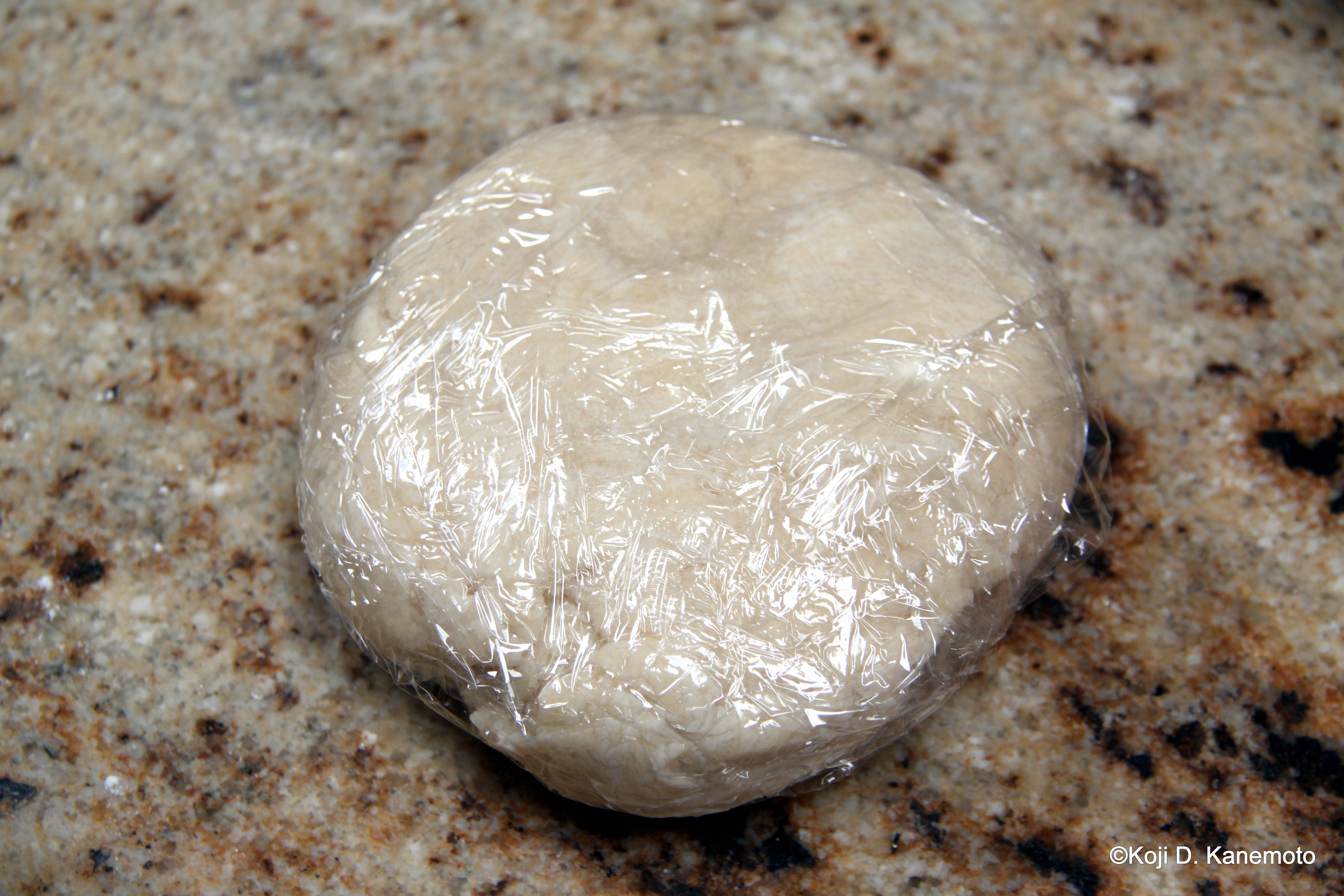
Form a four inch circle, wrap in plastic wrap then refrigerate at least 45 minutes.
P C 7
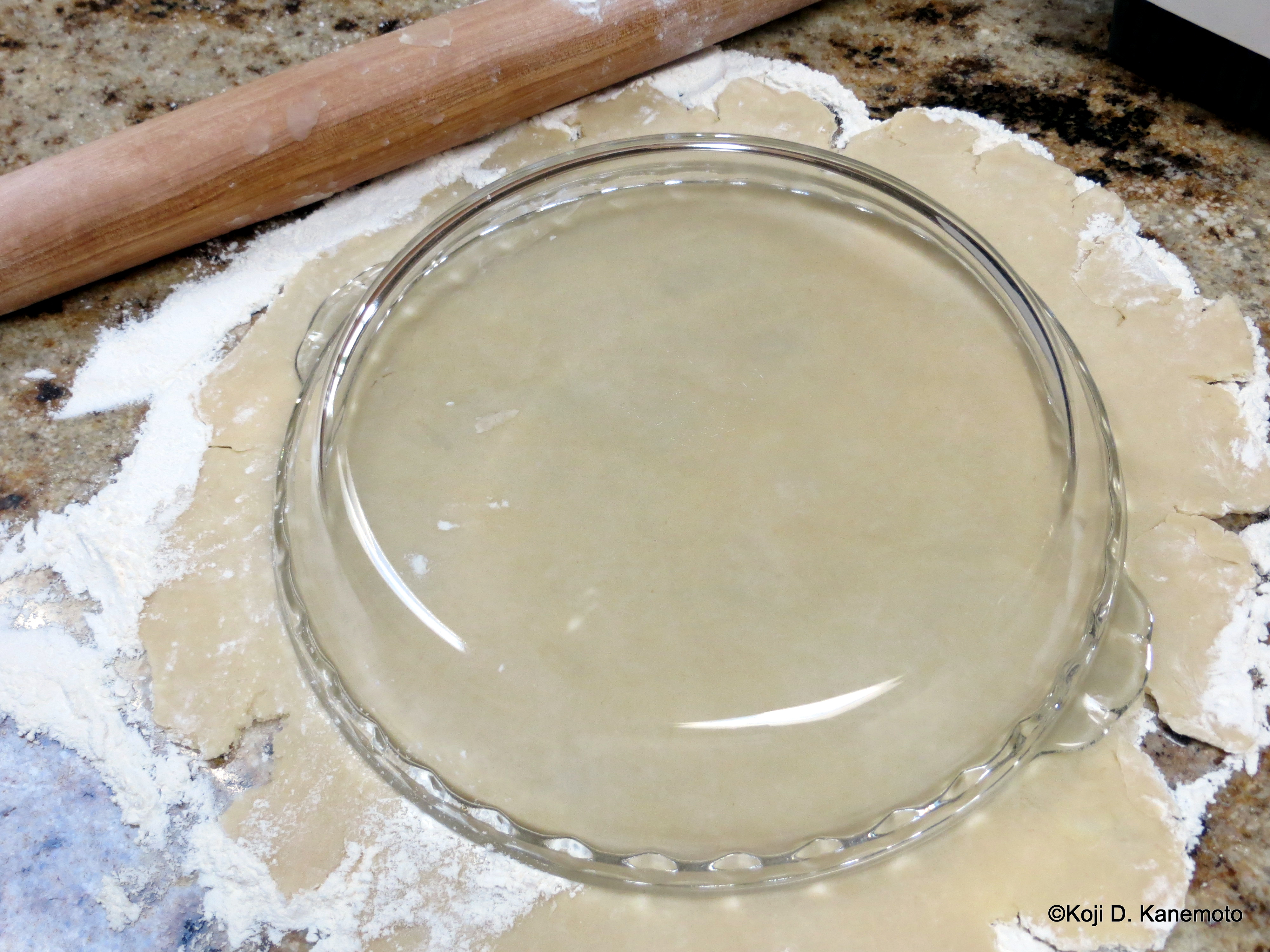
Liberally dust. I was dumb enough to use my granite counter top…which was still warm from basking in the afternoon sun. I also forgot to dust the top before rolling. 🙂
P C 9
Patrick Star in disguise. Making the dough til now was a snap. Rolling it? HA!
P C 9a
It needs plastic surgery…but don’t laugh. 🙂
P C 9b
A burned fait accompli. You can see the results of my uneven rolling! In fact, the right side slid down! I actually had to throw it back into the oven as that section was still moist… The bottom ended up looking like graham crackers it was so toasted!
P C 9c
It didn’t look TOO bad when it was filled up with strawberries covered in PERFECT glaze… not like jello and certainly not runny! Anyways, my good USAF neighbors got half of it; I think he may have flung out the pie crust from 30 Angels as a lethal weapon.

_______________________________

Well, the dough certainly was easy to put together.

This (aging) former mechanic did it…but didn’t follow the instructions at the end.  In short:

  1. Dust the top of the dough before rolling. LOL
  2. Learn to roll out the dough evenly. Double LOL
  3. Roll it in the early morning before the granite counter top feels like the Sahara. Duh

The secret is the vodka and keeping the ingredients chilled.

Oh.  Don’t burn the crust nor watch Spongebob before rolling.

Dinah Mite


Dinah_Might_at_Iwo_Jima

Dina_Might

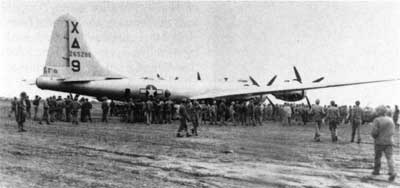
Sixty-nine years ago today, the B-29 Superfortress “Dinah Mite” made the first emergency landing on Iwo Jima. The battle for the tiny sulfur island was still raging as she landed.

7,000 young US Marines and 21,000 young Japanese soldiers died violent deaths for this tiny sulfur island.

(Note: Combat was still going on the left side of the makeshift runway as they were landing.  Although the B-29 was repaired and left the same day, she returned a month later for another emergency landing.  She was so heavily damaged that Dinah Might was abandoned.)

The Pain of Survival and Aunt Michie – Part 5


japansurrender88
A rare photograph taken after listening to the Emperor’s surrender speech, August 15, 1945. There was a coup attempt the night before the speech was broadcast.

Although the violence of World War II was nearing an end, other aspects of the war could continue against Japanese civilians for years to come.

Their infrastructure was gone.  Essential assets such as manufacturing plants, machinery, trains, roads, housing, utilities, even fishing boats had been destroyed.

And most of all, food.

And Aunt Michie’s dignity – the entire family’s dignity – will continue to be tested until the late 1940’s.

____________________________

boy genmai mainichi
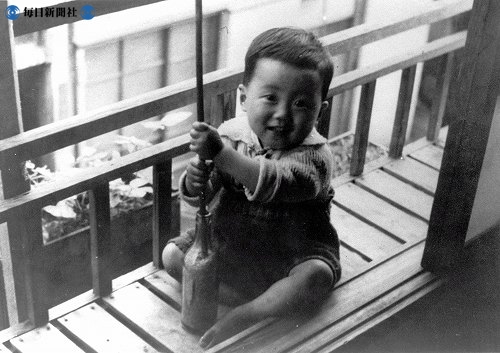
Dated April 1943. A boy poses holding a stick in a bottle filled with unpolished brown rice. This is not the polished brown rice you eat today at Panda Express. It was more wild. Japanese would insert a stick into a bottle partially filled with brown rice then repeatedly jab at the rice until the husk came off. It was low grade rice with the germ still on. (From the Mainichi Shimbun archives.)

For eons, Japan has been unable to produce enough rice for their people let alone food.  In fact, it was not until about the time Japan hosted the 1964 Olympics that Japan could produce enough rice for themselves.

The war took a terrible toll on regular folks from getting their “rice fix” – they were just not able to eat it.  This deprived them savoring it, the mental and biological satisfaction of just eating it.  Think of it this way – what if not just bread itself was kept from you but also the sweet smell of the freshly baked bread with the perfect crust..with melting butter?  Talk about attacks on your psyche: deprivation.  Deprivation for years.  Prolonged sensual deprivation makes for huge changes in one’s outlook on life.

Like the photo of the little boy, millions of civilians would acquire a wild form of brown rice (玄米 genmai) and de-husk them as shown.  Along with barley, it served as a substitute for the flavorful white rice with the higher calories.

_____________________________

Confronted by not only the absence of medical supplies, Aunt Michie’s house was now filled with 23 men, women and children with varying degrees of burns.  I doubt emergency rooms could handle such a sudden load of burn victims… but Michie’s family did.  On top of that, her house was damaged by the atomic bomb’s shockwave.  It pains me to even see in my mind what they had to do to make the house habitable enough so quickly to nurse the injured.

It was mayhem and Michie personally did not ask for this horrific situation… but now, on top of trying to provide medical care for 23 people, she was confronted with one ominous problem: how to feed them all.  There was no food left in the city of Hiroshima and it was just over the hill.  And any food left in the village of Tomo was fresh.  It would spoil quickly anyways in the heat as there was no refrigeration.  No supermarket.  No canned goods either.

She did as Aunt Michie only could.  She used her precious reserve of rice and only served it to the ailing victims.  I am sure she believed that would be the only way to truly help them survive as all of them were malnourished.  As a result of rationing the remaining rice to the victims, her own children who weren’t physically injured were delegated to survive on cooked pumpkins, stems, stalks or taro roots for the duration.

A huge, gut wrenching decision for Aunt Michie, I’m sure.

image0-012
Some of the wild grass or other vegetation boiled for emergency eating can be seen behind my father and Uncle Suetaro. Hiroshima, circa 1929. Copyright Koji Kanemoto

To help this dire situation, the Hiroshima aunt who was not badly injured went about the area with Mikizo’s parents scavenging for wild grass and other vegetation to boil.  That, too, became part of their food.  Although likely not very nutritious to say the least, there was no other alternative.  And it is important to note such wild vegetation they boiled or ate had been subjected to the black rain…

What do you have in your yard?

Perhaps you can somewhat understand why my cousin Masako thought Spam was the most delicious thing she ever ate.

____________________________

In spite of all Aunt Michie could do, my cousins tell me some of the burn victims’ injuries wouldn’t heal.  They had worsened.  Their wounds began to fester or decay for lack of a better description.  Pus formed.  There was nothing they could do.

The odor of the decaying flesh permeated out of the house.  They say you could smell it from the dirt road immediately outside.

It became so intense that people would hold their noses to scurry past the house.

None of my cousins who were there tell me they will ever forget that vulgar smell of rotting flesh… or death.  Never.

Just like Old Man Jack.

___________________________

IMG_5861
From Aunt Michie clockwise: Aunt Michie (holding Kiyoshi), Namie, Mikizo’s father, Masataka, Sadako, Masako, Mikizo and Mikizo’s mother. Taken in 1948 at their farmhouse where they cared for 23 victims. Courtesy of Kiyoshi Aramaki.

My cousins tell me some didn’t make it.

Others would pass away in the next couple of years from the effects of their injuries or radiation.

Nevertheless, the struggle for food and other essentials would continue…but my Aunt Michie’s immediate family survived.  Even Tomiko who was in Hiroshima proper.

And Aunt Michie’s dignity and strength reigned supreme.

They all made it to tomorrow.

__________________________

The surrender documents were signed by Emperor Hirohito’s representatives aboard the USS Missouri on September 2, 1945.

Unbelievably, Mikizo also survived the war.  Although taken prisoner upon Japan’s surrender as a soldier in the Imperial Japanese Army, he was released from Manchuria and allowed to return to his Hiroshima farm in late 1946.

To be continued in Part 6….

The Pain of Survival and Aunt Michie – Part 4


You can hardly tell this is a young girl anymore. As Masako and Mr. Tsukamoto told me, they were walking dead. Flesh literally melted off their bodies and dangled. Grotesque forms which were once human beings.

The aftermath of the bombing was no different from hell.  Not that I’ve seen hell nor that I would want to…

But Aunt Michie and my very young cousins saw it.

They visited hell.

_____________________________

a-bomb1
Atomic bomb survivors. Perhaps this is what Aunt Michie and her cousins saw in their search for relatives on the other side of the hill. If you notice the flask the young girl is holding to her lips.  It was likely filled with radioactive water.

Nearly all doctors and nurses within the city had been killed or seriously wounded on August 6, 1945.  If they survived the blast, they were likely to fall ill from radiation poisoning and they themselves would die within days.  All remaining medical supplies – which had been nearly non-existent due to the war – had been destroyed as well.  Most food – even unpicked fruits or vegetables – were contaminated with radiation as was water(¹).  Thousands of corpses plugged the rivers as they would go in to soothe their burns but would soon perish.

It is important to note that food rationing in Japan was much more extreme than what was imposed on the American public.  While the rationing in America began in May 1942, it started with just coffee and sugar.  In Japan, rationing of a far more extensive reach began in 1939 if not earlier.  It extended to nearly all first quality food stuffs.  Rice, barley, seafood, meat, soy bean paste and soy sauce, vegetables, fruit, seafood, etc.  Groups called “tonari-gumi” were established in villages and the like; they monitored and rationed food to the Japanese families based on what work they were doing, e.g., war production, number of family members along with their age and sex.  The rationing was so severe that when one family member died, the family did not report it.  The average caloric daily intake was cut down to less than 2,000 a day by 1945.

homeless_orphan_in_postwar_tokyo
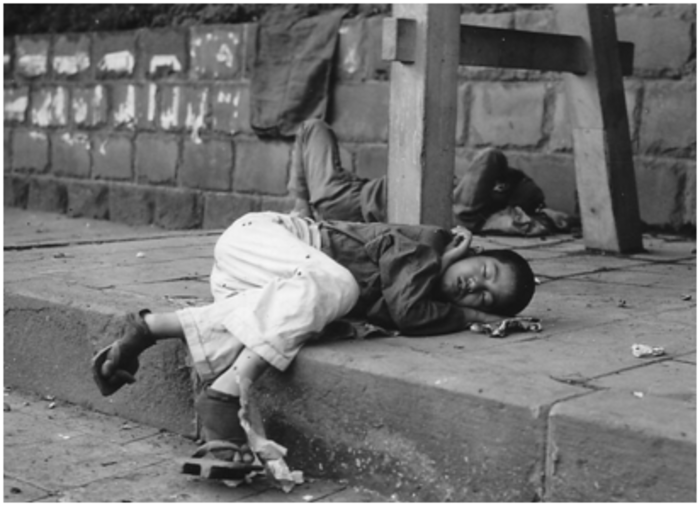
Homeless orphan in Tokyo. He would have to be determined if he was to survive.

The Japanese civilians were starving, so to speak, and were without question malnourished.

Aunt Michie was no different.  She was hungry like everyone else and likely tired easily due to low nutritional intake and daily physical and emotional demands upon her.  It is important to have an understanding of her condition at this crucial moment in history.

________________________________

2-sadako1
Sadako – taken in early 1948 by my father while on furlough. She would marry a distant cousin (common cultural practice at that time) who was also badly burned in the atomic explosion.  She is wearing clothing my father bought for her at the Tokyo PX.

After the shock and black rain subsided, Aunt Michie’s thoughts immediately went to her treasured family.  According to my cousins, she went into her priceless family rice reserves and cooked real rice for the children.  Sadako, the second oldest, remembers to this day how she savored that bowl of rice, a definite luxury at that time.  While but a child of ten years and filled with anxiety about eating such a fine meal, she saw at that moment her mother’s love and affection for them was unconditional.

Aunt Michie’s thoughts went to the Aramaki family (aunt and uncle’s family) who lived in Hiroshima.  She had no way of knowing that day but they had become direct victims of the atomic bombing.  They had been burned over most of their bodies and had even been trapped under their destroyed house.  They managed to struggle with their searing injuries to Aunt Michie’s house to seek refuge and care.  They had realized that only strong family support would allow them to live.

Grotesquely, the path going over the 300 meter high hill which the relatives traveled became littered with scores of dead people.  Masako said they were unrecognizable lumps of flesh and died where they crumpled.  Many had their clothes burned away.  While thousands were killed instantly, other thousands suffered for days before dying from intense burns, radioactive poisoning and other injuries.  As radiation poisoning was unheard of amongst them, some were told they had dysentery and the like.  Many before dying oozed pus from their ears and blood ran from their noses.  You will not read this in any Western textbook.  In fact, the gruesome information about the days, months and years after August 6th was suppressed for a couple of decades by both governments.

While the dazed and immensely pained adults struggled to Michie’s farm, there were young children of the family unaccounted for(²).  Without hesitation and unbelievably, Aunt Michie – in her weakened state – pulled a two wheel cart over the hill to Hiroshima to look for them.

Over a hill.

大八車
I believe this to be the type of cart Aunt Michie pulled to Hiroshima to look for the unaccounted for children of the family. Kiyoshi called it a 大八車, or large two wheeled wooden cart.

Miraculously and while the details are lost, she found some of them and hauled them back to the farm on the cart, now laden with the additional weight of the children…  on the same road that was further littered with dead and dying people.  Think of the mental anguish Michie had to endure when dying people came up to her and asked for her help…  It would be difficult to not look at them.  It was more difficult to ignore them, I’m sure.

According to my cousins, a total of 23 people got refuge and care at Aunt Michie’s farm.  I understand many were relatives from the Aramaki side of the family.

There were more hurdles for Michie and her children immediately ahead – caring for the injured and dying.

_____________________________

526
You can tell which way this woman was facing when the bomb went off. Her left side is burned. Photo was likely taken after August 6, 1945.
Caring for Victim of Hiroshima Bombing
A mother looks after her child. This photo was also likely taken after August 6, 1945.
Victim of Hiroshima Bombing
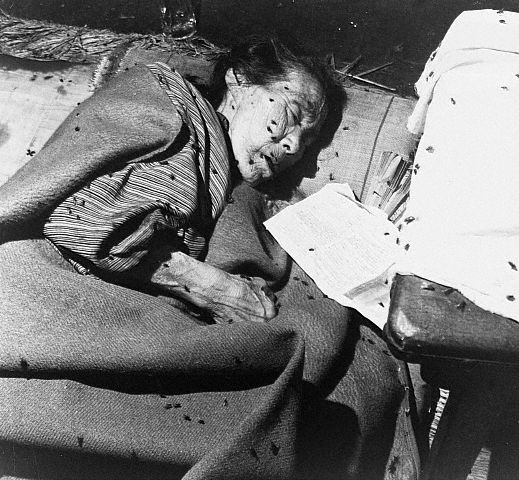
An elderly woman lies dying on the floor covered with flies. Perhaps this is just one of the sickening sights Michie and her children have buried in their conscious.

The preceding photographs may show what Michie and the children were faced with.  And the children were just that – children.

How old are your children, by the way?

The older cousins recall that they, Michie, Mikizo’s parents and the less injured relatives took on a 24 hour a day field hospital of sorts to treat the injured.  It was stifling hot and humid; yet, they had to be given constant attention and there were so many of them.  I cannot imagine how exhausting this task could have been, especially when you are hungry and malnourished yourself.

pattern
Taken sometime after August 6, 1945. The side of her you see is what had faced the atomic explosion. The patterns are from her clothing she wore that day. It was where the dark patterns of her clothing had been in contact with her skin. Masako recalls vividly this type of pattern among the burn victims and that the maggots followed that pattern.

The common injury were burns.  Severe burns…and they had no medicine whatsoever.(³)  No Bactine.  No Motrin.  No aloe.  All Michie could do was to coat the burns with a type of cooking oil and bandage them with pieces of cloth.  She must have endured unlimited anguish in knowing she could not measurably lessen their pain and suffering.  There must have been constant crying and unbearable moans of pain.

And on their hands, blood from human beings.

3-namie1
Namie – taken in early 1948 by my father while on furlough.

Six year old Namie could never forget what she had to do.  Flies were swarming having sensed dying flesh.  Namie was tasked with shooing them away with a fan but they wouldn’t stay away.  And worse yet – time and time again, she had to remove the maggots that were feeding on dead flesh…with chopsticks.  I do not know if I could have done that…but Namie did.

The turmoil that must have stormed inside Aunt Michie to tell her daughters to do what they had to do for the sake of survival…and then to be stern with them and tell them to continue when they wavered or cried…  must have been punishing to her as a loving mother.  She must have wanted to cry.

Aunt Michie was the point woman.

And she fulfilled that role.

Her goal was to get everyone to tomorrow.

_____________________________

To be continued in Part 5….

Notes:

(1) Per my 2012 meeting with Mr. Tsukamoto in Hiroshima, water is the main theme of the Cenotaph at the Peace Park.  Survivors clamored for water.  Where there was well water, many survivors were suffocated as dozens more pressed against them for the precious liquid.  Please see “A 1937 Yearbook, the Atomic Bomb and Hiroshima” for further information and links to their personal story.

(2) The number of unaccounted for children is unclear.

(3) Mr. Tsukamoto recounted how they had to constantly mash yams and place them over their burns to temporarily lessen the pain.  They did that for over a month, he says.

The Pain of Survival and Aunt Michie – Part 3


Japanese-home-defense-training_1945
Japanese women being given “home defense training”. My grandmother on my mother’s side underwent such training on a Tokyo schoolground. 1945.

The Japanese home front had essentially collapsed by 1945.  Instead of focusing on food, supplies, building air raid shelters and organizing orderly evacuations of civilians, Japanese military leadership focused on misleading news reports and propaganda.  Millions fled the cities into safer rural areas(¹) on their own initiative but once there, supplies of daily sustenance was meager.

_______________________

In one’s own life, you are tested.  A good human being will at times prove oneself to be a good brother or sister, son or daughter, friend or life partner.  Some fail.  Some pass.

Aunt Michie was one who passed; her heart led her to care for others before herself.  It is as if she knew being good to others was the way to have a good life.

As an example, US air and naval forces ruled the skies and the seas.  A key staple of the Japanese diet – fish – had been nearly cut off  as fishing boats were attacked once out to sea.  Yet, when Aunt Michie came across sashimi, she traveled hours with Masako in tow to take a precious portion to her brother Suetaro at his army base in Fukuoka:

“…(Masako) remembers a couple of trips (to see Suetaro). It was not easy travel in war-torn Japan.  For one trip, Aunt Michie managed to take sashimi – in this time of little food, it was a tremendous treat and gift. On that trip, Masako remembers her mother stealthily sliding over to Uncle Suetaro the wrapped sashimi. He was being stared at by many of his fellow soldiers – they were not well fed either.  She remembers Uncle slowly turning so that the others could not see and quickly devoured the treat.”

(From Masako and Spam Musubi)

Aunt Michie could have eaten the precious sashimi herself…but didn’t.

___________________________

With her husband taken by the Imperial Japanese Army then dispatched to war in Manchuria, she was burdened with running the farm… still laboring to produce crops only to be taken by the military.  She would get up before sunrise, help prepare meals, tend to the family then toil in the fields.  And when her mother became partially paralyzed and alone in her own home five miles away, Aunt Michie knew she had to take care of her, too.  Michie was the last of her children left in Japan.

My Grandmother Kono – having suffered a stroke – is propped up from behind by Japanese “shiki-futon” for the picture. She would not see her son alive again. Taken in Hiroshima, May 3,1944.

While Michie and Grandmother Kono managed to get part-time care, Aunt Michie still took it upon herself to check in on her stricken mother.  My cousins tell me their mother Aunt Michie would take them along for the ten mile round trip to her Kanemoto family home.

No car.  No bus.  No taxi.  No trains or bicycles.  They had to walk.  After all, it was 1944 and fuel was a huge luxury.  One memory the youngest happily recollect is that they would take turns riding in some kind of baby stroller that Michie would push to Grandmother Kono’s.  Neverthless, it was still a great deal of effort and sacrifice on Michie’s part in any case… and she did this after working in the fields, too.

Masako will eventually end up caring for Grandmother Kono.

___________________________

IMG_5869
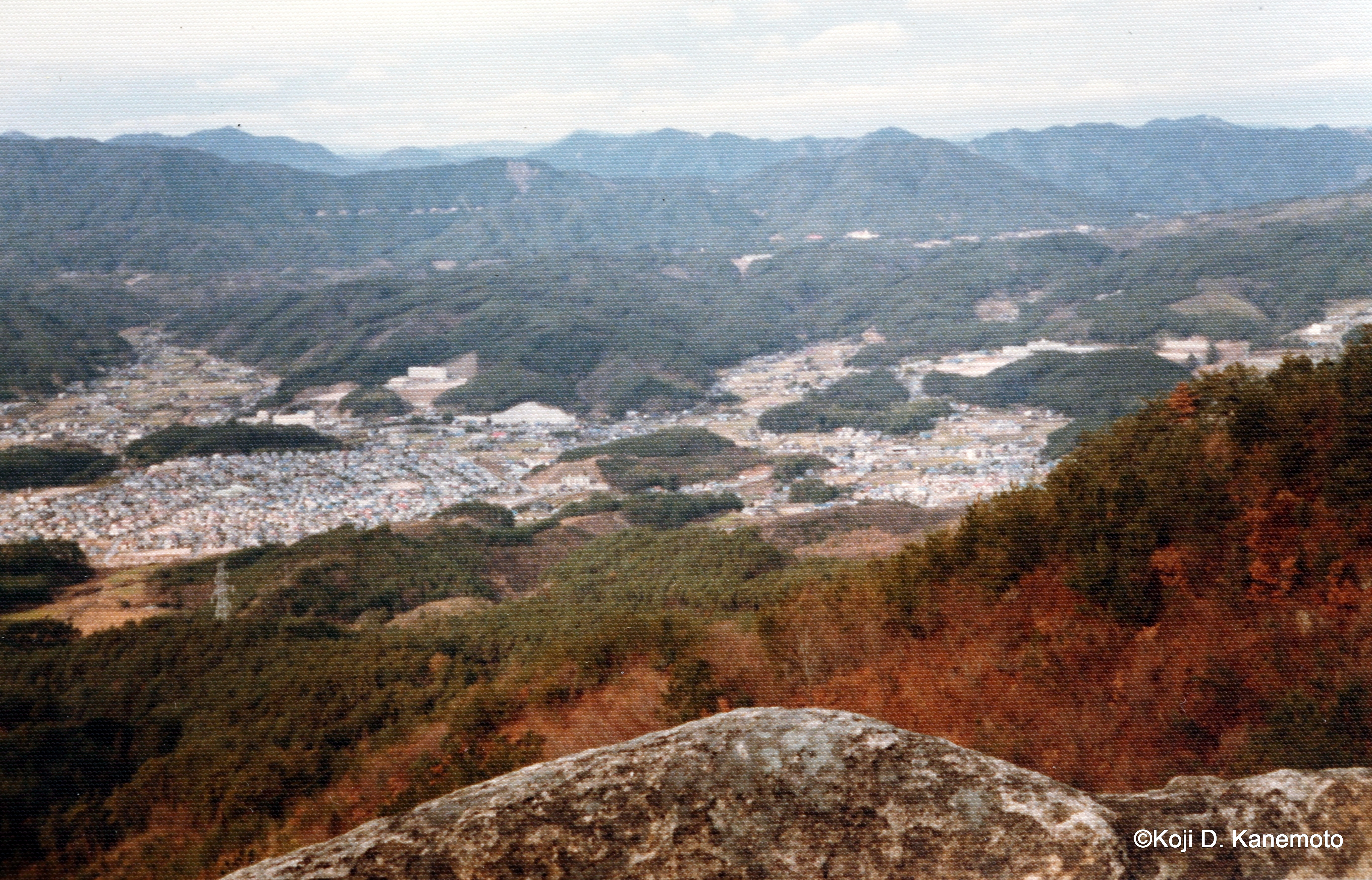
Family photo taken of the town of Tomo about 35 years ago atop the 300 meter tall hill separating it from Hiroshima. Hiroshima is directly behind. This short hill served to partially deflect the atomic bomb’s shockwave. Courtesy of Kiyoshi Aramaki.
IMG_5870
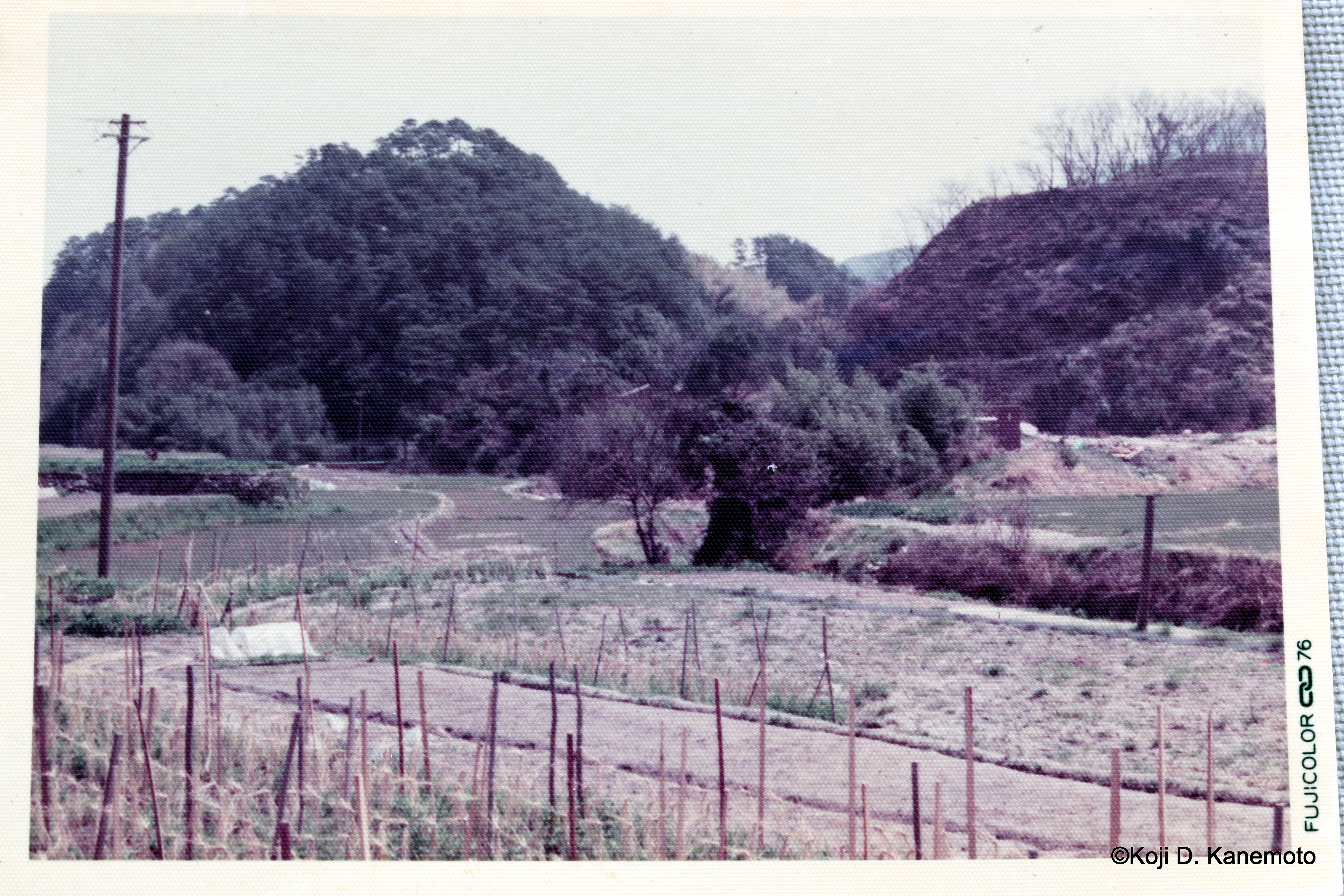
Per Kiyoshi, this was taken from the house and shows some of the field Michie had to cultivate. She was here when the shockwave hit. While the one on the right is no longer there, the family burial plot was between the two small mounds you see here. Courtesy of Kiyoshi Aramaki and dated 1976.

After picking herself off the ground, Aunt Michie saw an evil yet mystifying mushroom cloud slowly rising up beyond the 300 meter tall hill separating her village from Hiroshima proper.  At that instant, she knew her life had taken a wrenching turn for the worse… as if it could get any worse.

I cannot imagine what was going through her mind and heart watching that mushroom cloud rising.  She could not have even dreamed that it was one massive bomb, a couple of kilometers away, that could cause this sort of force and devastation.  It must have defied belief.

Hiroshima_10
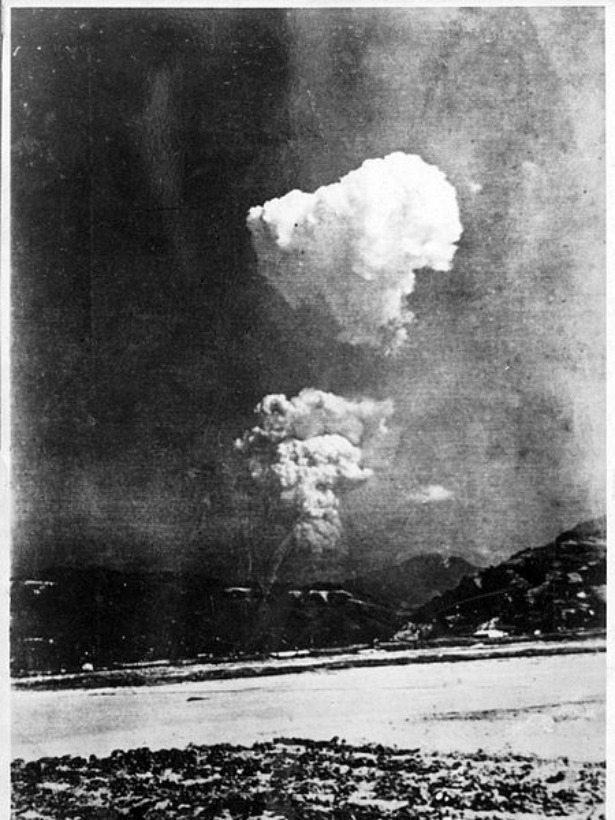
A relatively unseen image of the explosion, taken from a Kataitaichi, six miles east of Hiroshima. Michie was nearly due west and on the other side of the cloud. The cloud would reach 40,000 feet in just four minutes. It would ultimately rise to 60,000 feet. (Horikawa Elementary School)

According to Michie and my cousins, the shockwave blew out all the sliding doors, all the tatami mats were flung and the ceiling was shoved up in the house.  Try to imagine yourself being inside the house.  The same thing happened to Grandmother Kono’s house five miles south (See map in Part 1).

As per their daily air raid drill, they apparently all ran to the air raid shelter in the small hill behind their house.  After about half an hour and with the mushroom cloud still rising, a black, syrupy rain began to fall on them.  According to the cousins, Michie believed that the Americans were dropping oil from space.

She could not have fathomed it was contaminated with over 200 kinds of radioactive isotopes.  We now call it black rain.

IMG_6116
I took this photo of a preserved wall section stained with actual black rain from that fateful day. Hiroshima Peace Museum, November 2013.

Sadako, who was ten years old, clearly remembers their white blouses had turned black from the rain.  No one – absolutely no one – knew that other than staining skin, clothing, and buildings, but that ingesting black rain by breathing and by consumption of contaminated food or water, would lead to radiation poisoning.  Even flowers would bloom in distorted shapes and forms from the radiation.

_______________________________

With the enormity and the suddenness of the brilliant flash of light followed by a shockwave and the swirling mushroom cloud, Michie deep inside knew her world had forever changed.

Horror was to literally come into hand shortly to enforce that foreboding thought.

_______________________________

To be continued in Part 4….

(1) Albeit late, my mother’s family fled to the Fukui Prefecture in early July 1945 to escape the bombing of Tokyo.

The Pain of Survival and Aunt Michie – Part I


img_0152_1_original
Uncle Yutaka and darling little Aunt Michie in Hiroshima. Circa 1918.

Life in Hiroshima was uncertain and grueling in 1945 – especially for women and children.  It is a fact that nearly all the men up to the age of 35 had been taken by the Japanese military.  For many, it was truly day to day.

Little food, clothing and medical care.  It all went to the military…and then there were the B-29’s and the bombings.  Devils associated with being on the losing side of war.

But at 8:15 AM on August 6, 1945, my Aunt Michie’s already tough life would be cast into wretchedness to test her mortal soul.  She was in her farm’s field clearing old crops on that hot summer morning.  There was an intense flash of light then the atomic bomb’s shockwave traveling close to the speed of sound slammed into her.  She was catapulted and hit the ground.

At the same instant, her oldest daughter and my cousin Masako – who was eleven and in her classroom nearby – was hurled across the classroom by the same shockwave.  The schoolgirls that were standing in front of her were pierced by shards of glass and debris.

Below is an eye opening re-enactment supplemented by computer simulation of the atomic blast in 1945.  Perhaps you can put yourself into Aunt Michie’s or Masako’s shoes on that morning and experience what they did:

After years of a most grueling life, Aunt Michie and her children would now face the searing pain of surviving.

__________________________

Even while giving shaves at my Grandfather’s barbershop in Seattle, Grandma Kono was busy in her early years of marriage.  She gave birth to Yutaka (1910), Hisao (1912) then Michie in 1914.  Other children followed: Shizue (1917), Dad (1919), Suetaro (c. 1921) and Mieko (c. 1924).  A total of seven.

y-image00-001
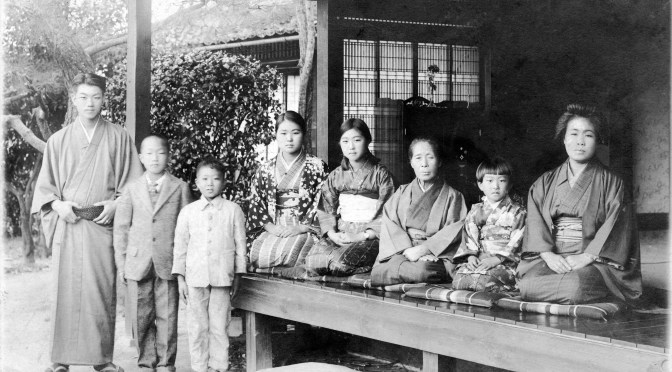
(L to R) Yutaka, Dad, Suetaro, MICHIE, Shizue, Great Grandmother Kame, Mieko and Grandmother Kono. Circa 1928, Hiroshima.

All seven of the siblings were born in Seattle…  All except for Michie who was born in Hiroshima.

My cousins tell me their mother Michie told them she would wistfully ask her family, “Why couldn’t I have been born in America like everyone else?!”  Lovingly, of course.

Aunt Michie never did get a chance to visit America.

__________________________

Dad’s siblings came to Hiroshima and half of them were able to return to Seattle to continue their lives as Americans before war with America.  But Michie lived her entire life in Japan.  She was the oldest sister to the siblings and helped Grandma Kono raise them.

Michie’s father (my Grandfather Hisakichi) was a devout Buddhist.  He required the family to chant Buddhist mantras daily; it was not “praying” but a way through which a follower “energized” himself to the teachings of Buddha.  Dad’s Hiroshima home to this day has the altar in the main room where they chanted; it is unchanged in nearly a hundred years having survived the shockwave from the atomic blast.

Fullscreen capture 2262014 120800 AM
My father’s family home is at “A”; Aunt Michie’s home in the village of Tomo is at “B”.  About five miles separates the two homes.  The atomic bomb’s hypocenter is towards the bottom right where rivers split up.

According to well accepted family lore, a man from a village called Tomo came to the house one fateful day apparently to seek one of his daughter’s hand in marriage.  His name was Mikizo Aramaki.  He immediately went to the altar and chanted.  Grandfather Hisakichi was so impressed by his devotion to the Buddhist way of life that he immediately gave his daughter away in marriage…but apparently, Grandather gave away the wrong daughter – Aunt Michie.  It is said Mikizo had come seeking the hand of my Aunt Shiz.  (Aunt Shiz was the prize of the village according to my cousin Masako.)
Being of farming heritage, Mikizo had acreage and a home.  After Aunt Michie was told she was to marry Mikizo, she was, to say the least, not very happy.  I guess that is a slight understatement if I say so myself.  She argued – pleaded – with my Grandfather that she didn’t want to marry him and that she was not raised to be a farmer…but to no avail.

Aunt Michie was given away in marriage.  Done deal.

They wed in 1933.  She was nineteen years old.

_______________________

To be continued in Part II

Our America Divided


America Divided
My feeble attempt to express my opinion…

Our United States has become less of a nation.

It is more than just split in half.  A nation cannot survive split in two.

Think of our country being not much more than local drug gangs fighting for their drug turf.

Their own street corner in their perceived territories.

Each gang with their own beliefs, their own mini-economies, their own cultures and in-fighting for control.

And killing those who invade their boundaries.

One gang is right.  The other gangs are wrong.

And they choose to ignore their neighborhood if not hold them hostage.

_________________________

To me, our nation no longer has collective major goals.

Heck, we Americans now may actually have less commonage with other Americans than ever before.

In my opinion, segregation by race fueled the beginning of disunion.

No.  I don’t condone segregation.  Of course not.  However, since the intense focus on racial segregation began – heightened by media beliefs and TV – in the 1950’s, a new mutated “segregation” has been kindled…and it is a roaring wildfire.

It’s no longer just the color of our skin.

We’re segregated by how we think and see things – in totality.

It’s about how we live and how we look upon how others live.  That’s segregation.

Religion.  Culture.  Even what language should be spoken.  Or is it languageS?  All segregation.

Look at our children’s textbooks.  Our views of their content and what is taught in the classroom varies drastically by how you think – or were raised.  Segregation.

____________________

We can’t even talk about certain subjects with people you meet.  You have fear of setting them off.

Health insurance.  Welfare.  Guns.  Executive Orders.  Terrorism.  Foreign policy.  Even approving driver’s licenses for illegal immigrants.

You name it.  I think it is absurd.

____________________

flag stars

This mutated concept of segregation is inflamed by our own political leaders and on a daily basis.  And the media, unfortunately, incite the segregation amongst peoples here, American citizen or not.  There is no reason to explain why here.

Every key event is made more severe, more infinitely dismembered by the politicians and media to suit THEIR agendas.  As government grows, we everyday people strongly contract to share our own beliefs only amongst small groups.  Not as a collective community of Americans.  A type of ugly segregation actually encouraged by those who lead us and by those “reporters” who elect to report an incomplete story to benefit their revenues or popularity.

And as national and state governments grow uncontrolled, our leaders go further blind and deaf, mired in their own re-elections, partisanship and haughty view of themselves.  So much so that never since the Civil War has there been so much movement towards secession.  And if not by state, by breaking up within a state.

_____________________________

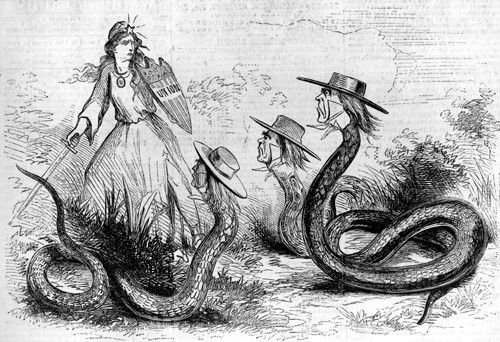
union attacked
The union being attacked by deadly snakes.

Is there a civil war in store?  In 1861, it is written these were likely the major causes for the Civil War:

  1. Income and social disparity between the “North” and the “South”
  2. State versus federal rights
  3. Strong disagreement between pro- and anti-slavery states
  4. The election of Abraham Lincoln as President.

Sound familiar?  Look at my illustration at the top.  I’m no artist but I hope the message is clear.

I believe we will have another Gettysburg.  No, not with cannon and Gatling guns… Besides by that time, only the criminals will have guns.  But our union will become irreparably weak in all significant aspects if something doesn’t heal our wounds.  The upcoming elections will be key, in one way or another, no matter what your beliefs are.

I think we are in deep shit.

What about you?