“She’s the most beautiful thing I had ever seen,” said Old Man Jack in a trembling voice and with very wet eyes.
On March 3, 2003. Truly.
______________________
He was referring to the F4U Corsair. I had taken him to the Chino Planes of Fame Museum in Chino, CA. The WWII aircraft there – all of them – fly.
That’s right. They get up in the air.
Planes that were engineered with a minimal lifespan as they were meant for combat were still spinning their props for the men who flew them – or worked on them.
Old Man Jack was one of them.
Do you know what these beautiful planes look like? What they may have sounded like to Old Man Jack 70 years ago? Ever see one fly? A vid I took at the Planes of Fame Airshow:
In case you haven’t figured it out, his Corsair is “on the tail” of a famed Zero of the Imperial Japanese Navy in this mock dogfight. I filmed it almost ten years ago at an air show there at Chino Planes of Fame.
______________________
Old Man Jack was an “AMM 1/C” during WWII, or “Aviation Machinist Mate First Class”. He could have re-upped after the war and been promoted to Chief Petty Officer but like Mrs. Johnson, Carol would have none of that.
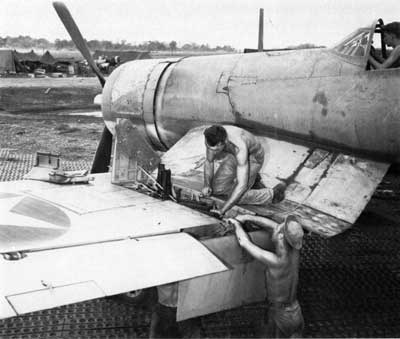
I am not positively sure as Old Man Jack would only give tidbits here and there but he was responsible for the aircraft. Before flight – and while remembering this was at the front lines on “those stinkin’ islands” – he would get into the cockpit and make sure all essential bells and whistles worked after his crew worked on it all night. I also believe he was to pilot one on occasion to maintain his certs. Very simplistically said on my part.
US Navy ground crew servicing a Corsair on what appears to be Guadalcanal – where Old Man Jack was. National Archives 127-N-55431
The pilot was headed off into harm’s way. The pilot’s life depended on Jack and his crew. It’s airworthiness.
But one thing is for certain – Old Man Jack said many times “there just weren’t enough spare parts so we had to make do.”
______________________
But back to the story…
Our friendship had begun to solidify by then… I had mentioned to him that I was a member of the museum and that he wouldn’t have to worry about me paying for his entry. But that wasn’t why he hesitated. You will see why. And I found out later myself why he was so hesitant.
Back then, the museum’s WWII hangars were divided into the two main theaters of operation: the European and the Pacific – where Old Man Jack was stationed during the thick of things.
We meandered through the European Theater hangar. He recognized them right away. The P-51. The P-47. Others.
He had brought along his “walking chair”; it was light and when folded up, it was a walking aid. If you press down on it a certain way, it would spread out into a little chair. Well, he was doing good…and I was happy.
______________________
To get to the Pacific Theater hangar, you would leave the European Theater hangar and mosey across a tarmac.
Chino Planes of Fame and “X” marks the spot.
It was a hot day. Old Man Jack was in a t-shirt. Blue, of course.
We were slowly making it across the tarmac. I knew a Corsair was in there – pretty as the day she rolled off the assembly line. As the hangar door was cracked open, you could see the wing spar.
Then Old Man Jack stopped. At the white “X” marked in the map above. Dead in his tracks.
He propped open his chair.
He sat down.
I was wondering if he was tired. We were out in the sun. Why’d he stop there?
I walked back to him. His hands that still firmly shook your hands were on his knees. His head was bowed down.
Then I saw it.
His shoulders were shuddering a bit at first, then began to bob up and down.
The man who had a barrel chest…the man who worked on these planes as a young man whose bushy eyebrows had turned white with age …was crying.
Deeply. No sounds. He was holding it in…
_________________________
I walked away.
The plumbing in my eyes broke too.
I think he cried quietly for about a couple of minutes. Out there on the tarmac. In the sun.
Old Man Jack then straightened up. He wiped his eyes.
“Young man, earn your pay. Give me your hand and help me up.”
Old Man Jack was back.
_________________________
We walked over to her – Jack’s beloved Corsair. His eyes were still wet.
I remember him saying very quietly while trying very hard to hold back his now visible anguish, “I knew a lot of young boys who flew them,” his voice cracking with 70 years of nightmares tormenting him. “Some of them just didn’t come back. I could never stop thinking, ‘Did a Jap get him… or was it me?'”
Nothing more need be said.
A very, VERY proud Jack Garrett, AMM 1/C showing off his barrel chest as best he could.
_________________________
That’s when he told me she was the most beautiful girl in the sky. But like any woman, she was a pain to keep happy.
“We didn’t wear shirts because it was so _ucking hot; I’d burn my stomach and chest on that hot metal.” He pointed at the wing spar (the bottom of the “gull wing”) and said, “We would always slip on those damn spars. You never had good footing.”
He then recollected other things. He told me “We’d stick a shotgun shell into a breech under the cowling and fire it off to turn over the engine.” As I surely didn’t know much better back then, I asked why. “Because the dumb son-of-a-bitch who designed the plane didn’t put in a starter. That’s why.” Oh, boy (with a smile). “And if she didn’t turn over, you only had a couple more tries at it before you had to let it cool off.”
Old Man Jack then smiled a bit when he admitted he fell off the wing while taxiing once. “Like a dumb smart ass kid, I stood up on the wing when the pilot was taxiing. You were taught to lay on the wing to point which way to go but (the wing’s surface) was too damn hot so I stood up. We hit a bump and off I came.” (Note: the Corsair’s nose was long to accommodate the powerful engine. It was so long that it obscured the pilot’s forward view during taxi and landing.)
One more thing he said. “There was nothing better than seeing the flight come back after a patrol at wave top, do victory rolls then peel off.” He was a bit choked up.
_________________________
When we got home, he said to me, “I didn’t know how I would react if I saw something and that’s why I put you off in going. But I feel good about it now. Thank you, young man.”
He gave me that solid Jack Garrett handshake…and a hug.
I think he enjoyed the visit…and no better way to end my first six months of blogging.
All familiar names to us with a common thread – they helped create the lore of the rough and tough cowboy.
Killing eight bad guys with their Colt .45 six-shooters. Without reloading. Bullets would glance off them as if they were slickered with the world’s supply of Vaseline.
Make that a non-stick coating.
With that, let’s get into the lore – and the truths – of the samurai.
_____________________________
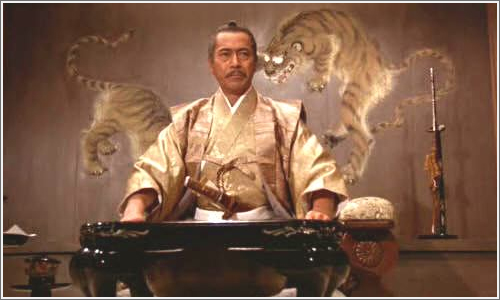
Toshiro Mifune portraying Lord Toranaga in “Shogun”
Yes, Japan had their John Wayne, Clint Eastwood and Kirk Douglas creating the samurai lore. Not to bore you with the names of key Japanese actors portraying samurai, but Toshiro Mifune is their John Wayne. You may have seen him playing Lord Toranaga in the 1980 TV mini-series “Shogun” opposite Richard Chamberlain.
Let’s give you a taste of the movie “lore” created in Japan. This compilation is of “Zatoichi” (座頭一), a blind swordsman of all things. He is portrayed by Katsu Shintaro, another famous actor. Think of him as Sean Connery in a series of films; instead of James Bond, it is Zatoichi.
His character is a very entertaining combination of John Wayne, Clint Eastwood and Jackie Chan, all rolled into one fantasy character. The lore. No need to watch the entire thing, of course; its intent is to expose you to the samurai lore.
In these fictional fight sequences (What am I saying? It’s a movie!), Zatoichi slays up to 40 bad guys with his one sword, i.e., eight guys with a six shooter.
Incorrect. More like 20 bad guys with a six-shooter.
Yes, Zatoichi is smothered in Japan’s supply of Vaseline…and there is no guard (tsuba 鍔) on the sword to protect his pinky.
Anyways, I’m sure you have a flavor of the samurai lore by now.
Did any of you watch the entire clip? Better than the Gunfight at the O.K. Corral (which really didn’t happen in the O.K. Corral, by the way)?
_______________________________
Let’s begin the first OMG Samurai Truth with a simple question based on Western culture:
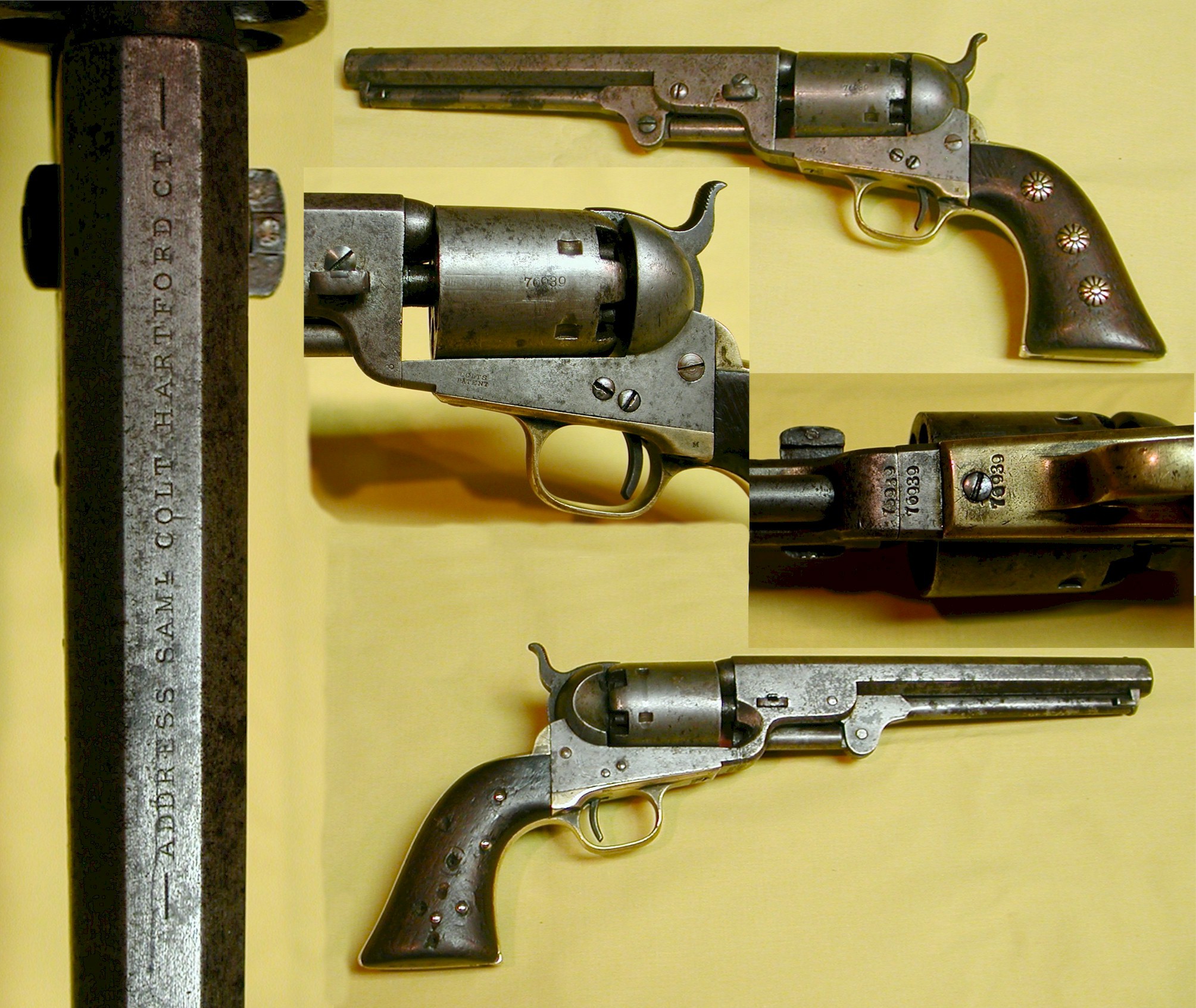
When Colt made a six shooter, how did they test its accuracy? After all, no cowboy would want to aim at a bad guy and have it miss by a couple of feet when it counted. Only Bob Hope.
Colt pistol, 1851
They test fired the pistol, of course. Likely at a target with a bulls-eye.
And its resulting level of accuracy also made for higher selling prices. They would be prized possessions.
Well, second question: how did the samurai know his samurai sword, or “katana” (刀) was sharp?
Jabbing a bulls-eye would be unthinkable. Where’s the fun?
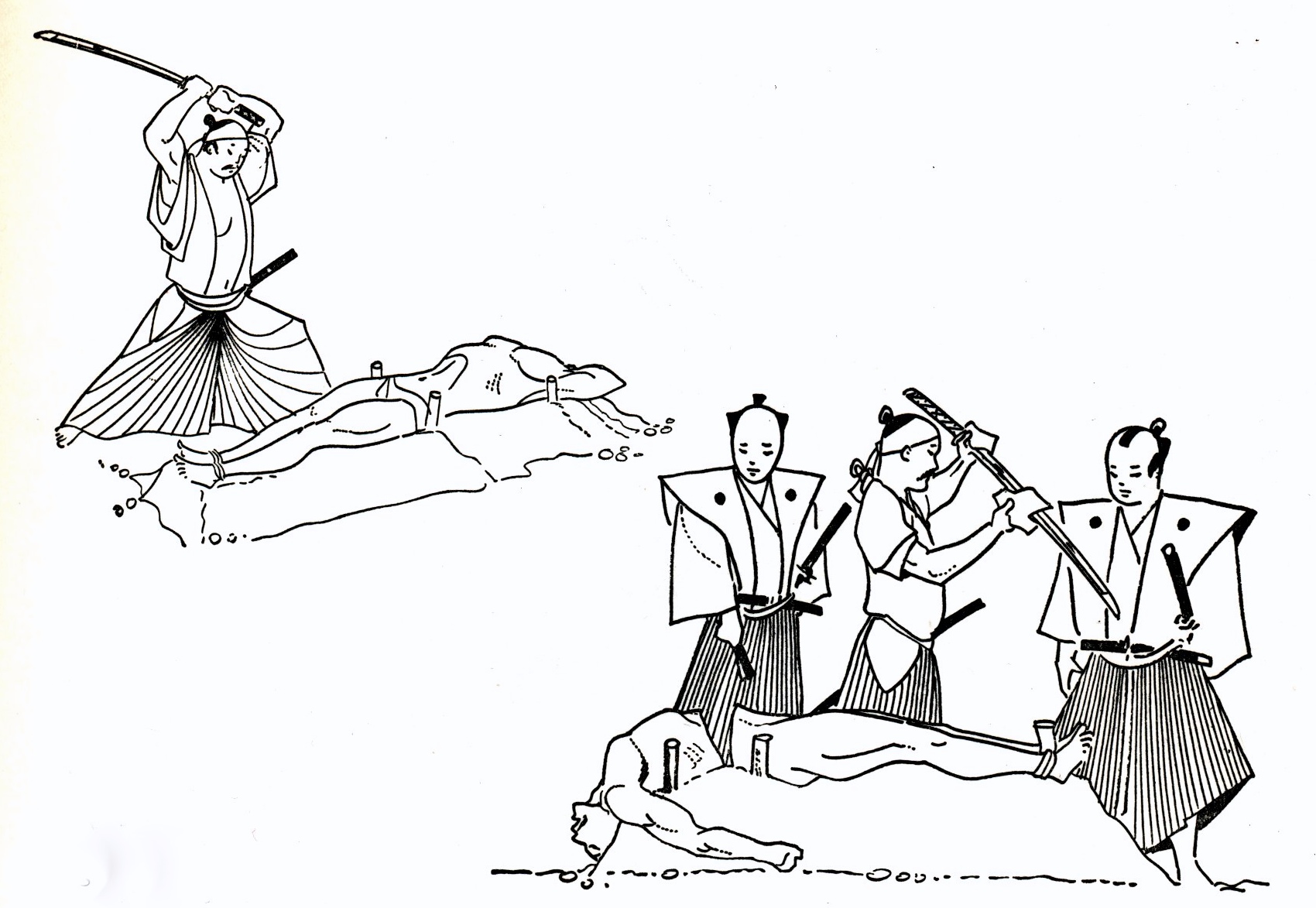
They would test the katana out on an executed criminal.
Testing out a new katana (From “Secrets of the Samurai”, 1973)
Cut off a limb. Perhaps an arm or a leg.
Well, that’s mostly true.
If a samurai was of high enough ranking (perhaps one of my samurai ancestors), he can pay……for a live one.
While the “lore” varies, there is one documented story – but who knows? The story is a criminal was being taken to his execution when he spied a high ranking samurai with a vassal carrying his brand-spanking new katana.
The criminal asked, “Are you going to try out your new katana on me?” to which the samurai replied in the affirmative. The samurai said he would try a slashing diagonal cut on him from the shoulder down.
The soon-to-be executed criminal then replied something to the effect of, “Well, I wish I would have known beforehand as I would have swallowed some stones to dull your blade.”
_____________________________
A grisly first “OMG Samurai Truth”, perhaps, but truth nonetheless. Not lore.
But one thing is for certain: the consequence of execution did not defray criminals from doing their dastardly deeds even in the 1600’s. And they did indeed carry out the sentences. No ACLU.
_____________________________
Stay tuned for more OMG Samurai Truths. More to come.
To be with his beloved wife Carol…and his comrades who were left behind “on those stinkin’ islands”.
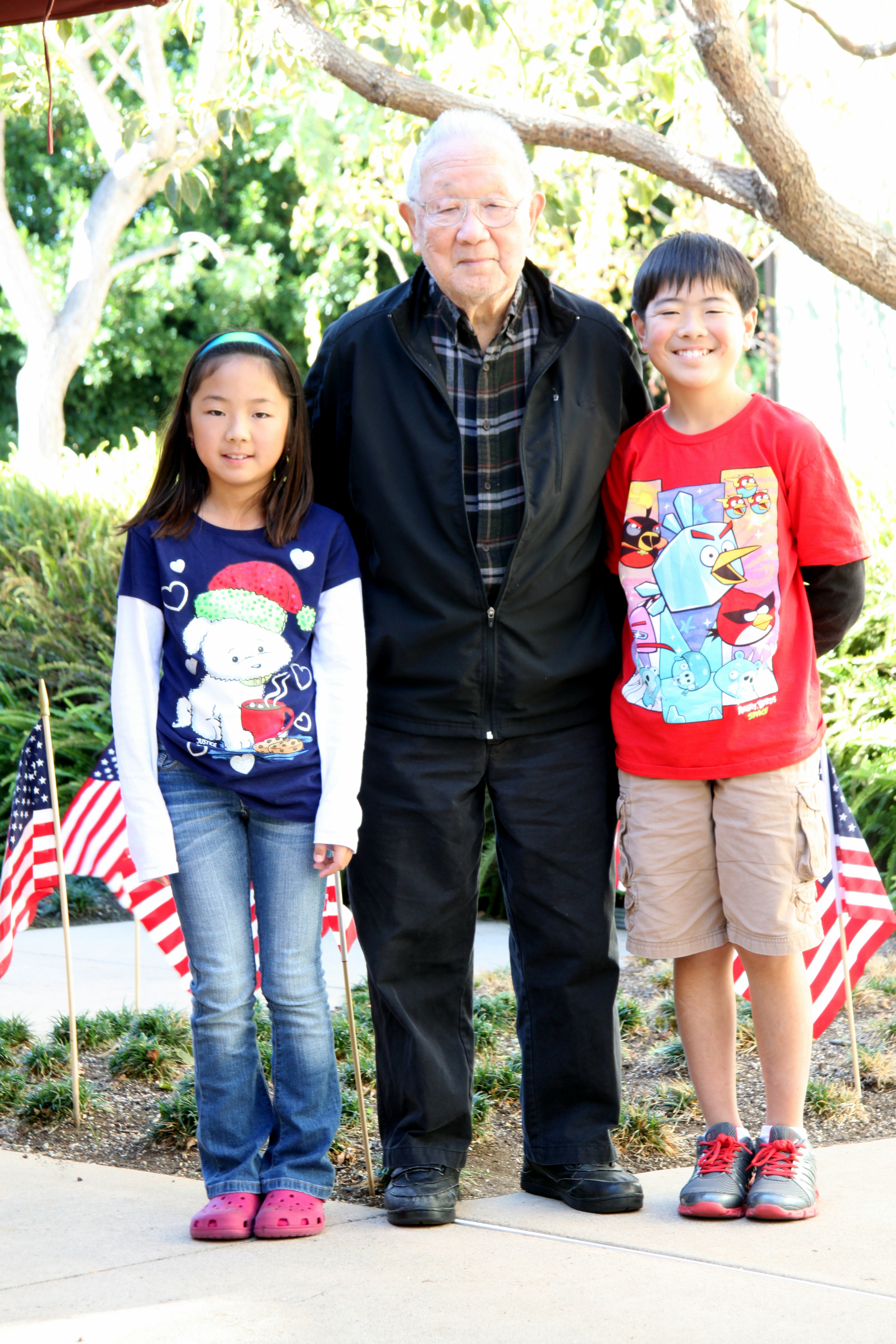
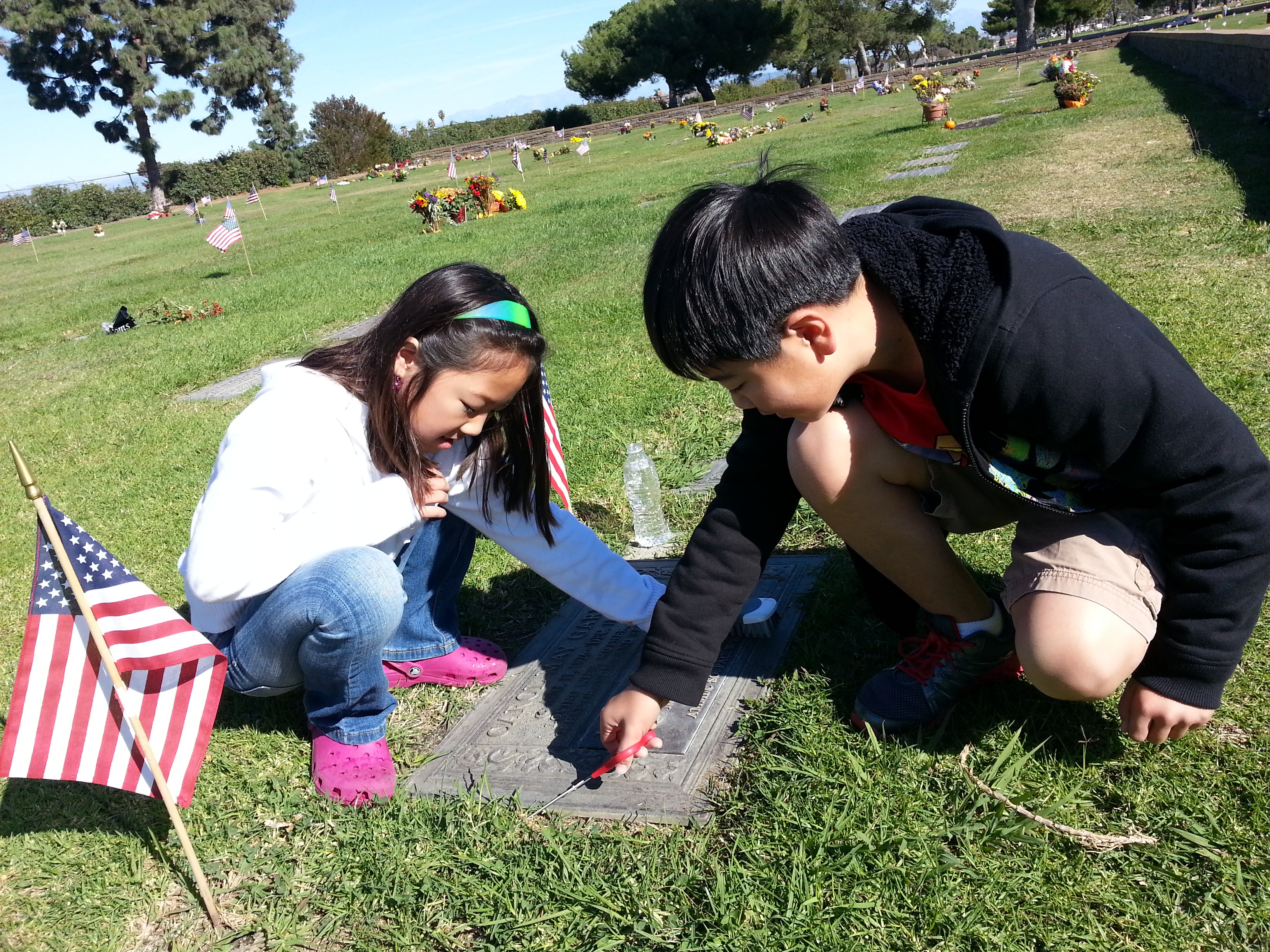
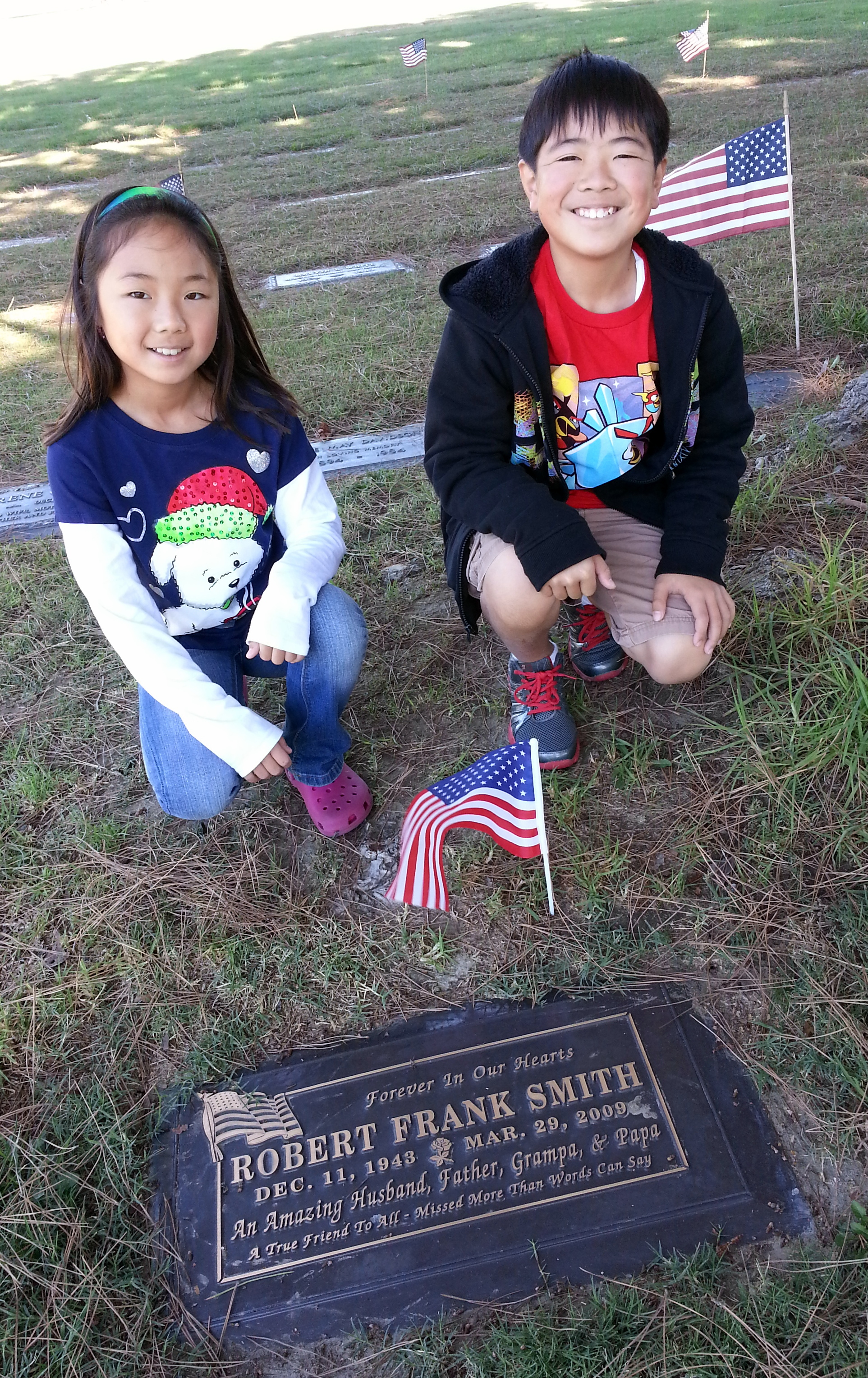
Came with two of my kids to say hi…and Merry Christmas, Jack
_____________________________
Life is so fleeting. Some people go through a whole lot. Some of us don’t.
Old man Jack was one of the former. I need to find the time to write more of what he experienced as a young man.
So that at least those that read this blog will know…and appreciate.
_____________________________
Old man Jack had his health problems in his last years.
But when he was a young sailor, he had malaria, dysentery…leeches between his toes, all from fighting on those damn islands in the Southwest Pacific during WWII.
And in 2009, he nearly died from a horrid intestinal infection. His abdomen had swollen. Fat Albert would have been jealous.
He was in ICU for a couple of weeks. After they transferred him to an extended care facility, I made it a point to see him every day…even if it was for brief time.
He looked forward to it as did I.
_____________________________
But soon after being transferred, he went into a depression. He wouldn’t eat – especially what he called the “Army slop” they had at his hospice.
Man, he complained about the chow – but his eyes lit up when I (secretly) took him a Mickey D’s burger and fries once in awhile. He’d smack his lips. But I’d make him eat the chow when I didn’t bring him his hamburger and as usual, he’d get pissed. But not really.
One evening, he was really weak. He wouldn’t raise his head off his pillow.
I told him, “Jack… What’s the matter? Haven’t you been eating?”
He never answered the question but he was off in a different world. While he realized I was there, he said to me softly, “Carol came down to see me last night. She sat right here,” gently patting the mattress on his gurney. “She said, ‘Honey, its about time now. I’m waiting for you.'”
Carol was his wife. He loved her greatly. She had passed away eight years before. I think he wanted to be with her.
_____________________________
Well, I pushed him to get better. And he did.
He finally consented to get into a wheel chair a couple of weeks or so later. I can’t exactly remember but it was June of 2009.
Perhaps you can get a flavor of Old Man Jack’s true character although my Blackberry did a lousy job of recording:
Soon after that, in spite of his pissing and moaning (which I loved as it meant he was getting better), I forced him to use his walker:
It was his way of saying, “Get lost,” by the way…but didn’t mean it as usual. He loved the attention.
Hilarious.
Old Man Jack was on the road to recovery.
_____________________________
Well, the recovery was short-lived.
He is now with his beloved Carol and eating her wonderful cooking. She cooked things exactly as he wanted.
Hamburger patties burned to a crisp. Scrambled eggs WELL done.
He never complained – as he knew he wouldn’t eat if he did.
Deep down, he knew who was the boss.
_____________________________
I miss you and your hollerin’ and moanin’, Jack.
And I knew you never meant it.
And as sad as I am, I also know you are now free of those horrible nightmares from combat that you endured for 70 years…and that you and Carol are on your second honeymoon.
You deserve no less.
You were a helluva representative of the Greatest Generation.
The carnage he was to experience would be absent even from the worst possible nightmare a nineteen year old boy can possibly have dreamed.
Violence no young boy of 19 should have to endure.
He would have two lives after he stepped into that Marine Corps recruiting station: one of reality during the day and of a nightmare he would never awaken from at night.
____________________________
I took them to breakfast for a belated 66th wedding anniversary and 88th birthdays. It’s softened as that’s how Marge wanted it. Seal Beach, CA. August 14, 2011.
I was not close to Mr. Johnson as I was to Old Man Jack; perhaps it was because for the first five years after I moved into this patriotic Naval neighborhood, he and his good wife Marge traveled about the US in their motorhome. They were gone for perhaps six to eight months out of the year. Man, did they enjoy seeing the US of A. After all, he fought for her.
He stayed indoors most of the time when at home while Marge would walkabout during the warm summer nights with her wine and chat with neighbors and me. She enjoyed her Chablis very much. Slowly, her legs would give way to age. Mr. Johnson’s, too.
____________________________
In the early part of 1942, Mr. Johnson found himself on a little boat out in the middle of the Pacific – the Big E.
The USS Enterprise.
CV-6.
She was one of only three operational carriers in the Pacific. The Enterprise, Hornet and Yorktown.
The Battle for Midway
He was on his way to the Battle of Midway (Mr. Johnson did not tell me that. Old Man Jack did.). June of 1942.
A tremendous gamble of scarce naval assets and young men by Admiral Nimitz.
PFC Doreston “Johnnie” Johnson manned her anti-aircraft batteries as a US Marine.
Thousands of young lives were lost during the most critical sea battle – on both sides. But the critical gamble paid off for the US. The Japanese Imperial Navy lost four carriers. They would never recover.
But we lost the Yorktown. A tremendous loss for the United States…but the tide of war changed.
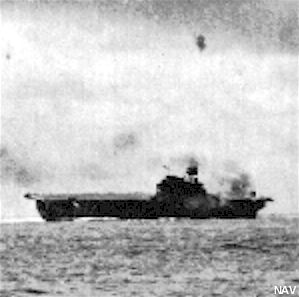
The USS Yorktown on fire at the crucial Battle of Midway. She would later be sunk.
Miraculously, the Enterprise escaped damage.
And as far as I understand, so did the young boy from Basile, Louisiana, Mr. Johnson.
At least physically.
_________________________
Guadalcanal and the Solomon Islands Campaign
His next trial would be Guadalcanal and the Solomon Islands campaign.
It would be an insult to to all the brave men that were there if I were to even try and express in writing what brutal sea combat was like.
I was not there. But every young man there thought – every second – that there was a bomb coming at him. Constantly.
Like hearing shrapnel from near bomb misses ricocheting off the batteries – or striking flesh. The deafening, unending thundering of “whump-whump-whump” from AA batteries. The yelling. The sound of a mortally wounded enemy plane crashing into the water nearby with a likewise young pilot. The screams of wounded or dying boys.
This is taken from a naval summary: “After a month of rest and overhaul, Enterprise sailed on 15 July for the South Pacific where she joined TF 61 to support the amphibious landings in the Solomon Islands on 8 August. For the next 2 weeks, the carrier and her planes guarded seaborne communication lines southwest of the Solomons. On 24 August a strong Japanese force was sighted some 200 miles north of Guadalcanal and TF 61 sent planes to the attack. An enemy light carrier was sent to the bottom and the Japanese troops intended for Guadalcanal were forced back. Enterprise suffered most heavily of the United States ships, 3 direct hits and 4 near misses killed 74, wounded 95, and inflicted serious damage on the carrier. But well-trained damage control parties, and quick, hard work patched her up so that she was able to return to Hawaii under her own power.”
“Repaired at Pearl Harbor from 10 September to 16 October, Enterprise departed once more for the South Pacific where with Hornet, she formed TF 61. On 26 October, Enterprise scout planes located a Japanese carrier force and the Battle of the Santa Cruz Island was underway. Enterprise aircraft struck carriers, battleships, and cruisers during the struggle, while the “Big E” herself underwent intensive attack. Hit twice by bombs, Enterprise lost 44 killed and had 75 wounded. Despite serious damage, she continued in action and took on board a large number of planes from Hornet when that carrier had to be abandoned. Though the American losses of a carrier and a destroyer were more severe than the Japanese loss of one light cruiser, the battle gained priceless time to reinforce Guadalcanal against the next enemy onslaught.
Regardless of who is correct – and we’ll never know for obvious reasons – Enterprise gunners shot down more planes at Eastern Solomons in 15 minutes and at Santa Cruz in 25 minutes than did the vast majority of all battleships, carriers, cruisers and destroyers throughout the entire war.
She was the last operating carrier in the Pacific.”
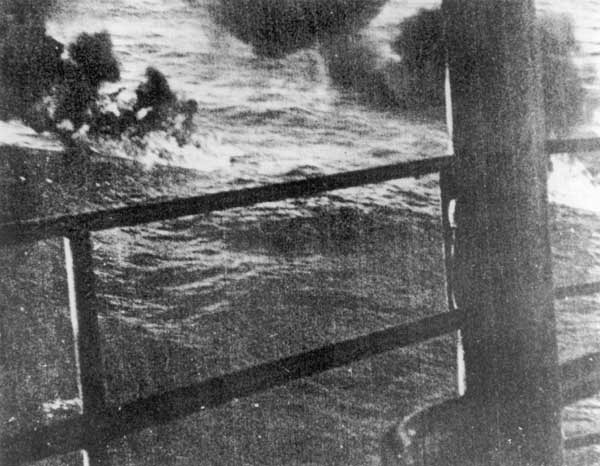
For those of you who are unfamiliar with the violence of World War II, perhaps these photos will give you an idea.
Try – just try – to imagine you are on that ship… Nineteen years old. The Japanese planes are shooting at you and dropping bombs on you. Dead and wounded boys are everywhere. Fires are raging… The ship is listing…and through all this, you must continue to man your anti-aircraft guns… Protecting the ship and the lives of your fellow Americans.
A Japanese bomb explodes on the USS EnterpriseOne of the direct bomb hits. All the young men in this area (Gun Group 3) were killed. Many could not be found.The USS Enterprise under attack. A near miss but men were killed or wounded by the shrapnel.The USS Enterprise on fire. August 24, 1942. Mr. Johnson was on her.A Val bomber on fire goes past the radar mast on the USS Enterprise. Perhaps one of Mr. Johnson’s rounds hit it.Damaged hull from one of the near misses.More hull damage from bomb shrapnel.The USS Enterprise listing from battle damage.Burning Japanese planes seen from the deck of the Enterprise. That’s how close they were. Up close and very personal. Aug. 24, 1942.Burial service at sea for 44 of the men after the battle at Santa Cruz. Oct 27 1942
Remember these young boys. I always will.
Mr. Johnson was one of them.
Mr. Johnson was one of those wounded.
Twice.
And I have proof of his valor and guts on board as a US Marine.
“Koji, funerals don’t do a damn thing for me anymore.”
That was Mr. Johnson’s reply while I was driving us to Old Man Jack’s funeral. I had asked him to help hold me together as I knew I would fall apart.
“Oh-oh,” I thought to myself when I heard that curt reply. “I guess I hit a nerve…”
_____________________________
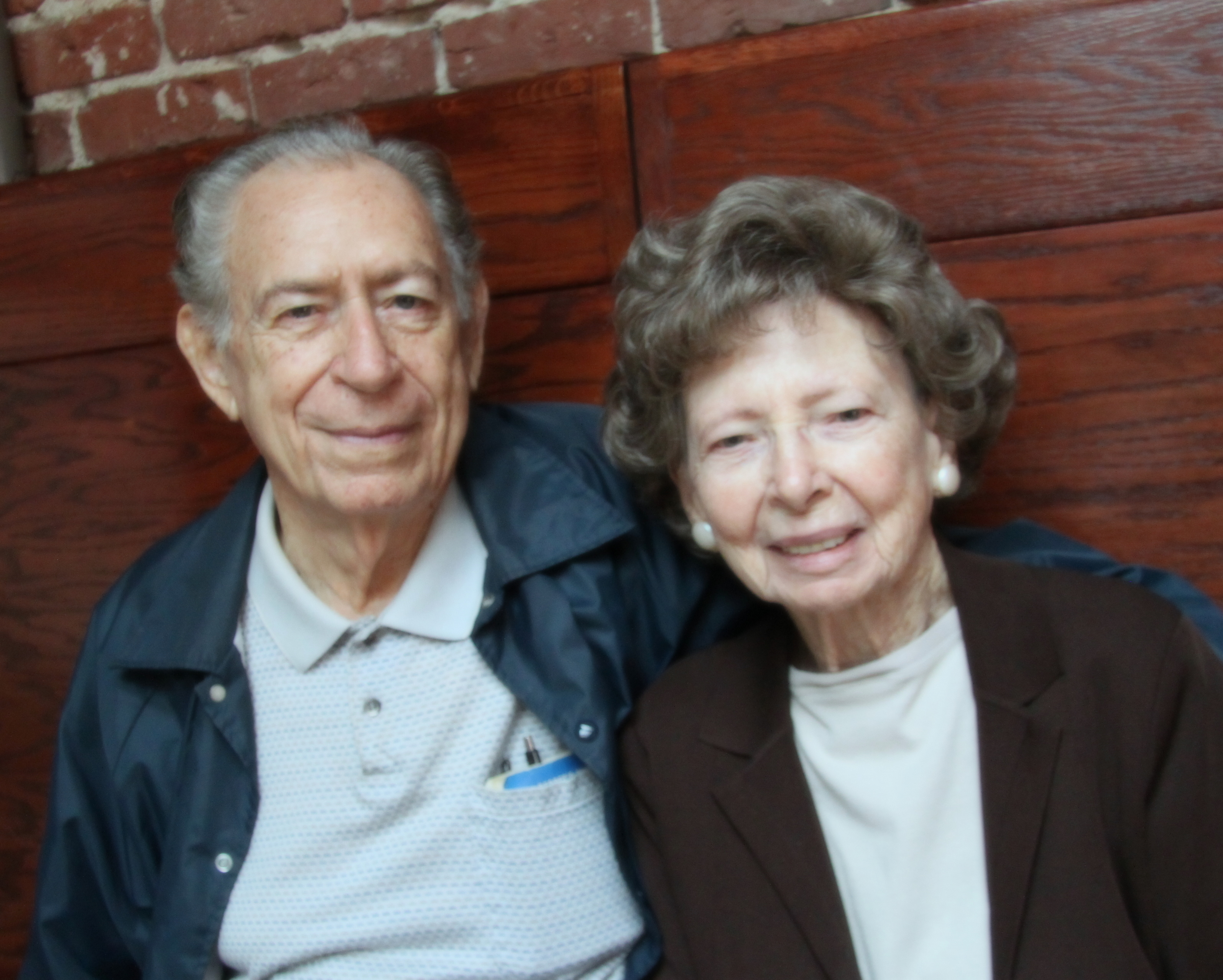
Old man Jack on the left, Mr. Johnson on the right. Taken June 30, 2005.
Mr. Johnson was Old Man Jack’s next door neighbor.
Since 1953.
Nearly SIXTY years. Hell, I ain’t that old yet. Well, I’m close.
They got along real well for those 60 years… except Jack was a WWII sailor… and Mr. Johnson was a WWII Marine. They reminded each other of it often.
Lovingly, of course.
Old Man Jack happily reminisced that “…us white caps would also tussle with them Marines ‘cuz they thought they were better than us”. But Jack would have gotten the short end of the stick if he took on Mr. Johnson. He towered over Jack and me…
And Mr. Johnson was a decorated WWII Marine.
Decorated twice…that I know of.
_____________________________
Our cozy neighborhood called him “Johnnie”. I always addressed him as Mr. Johnson…He used to say, “Damn it, Koji. I wish you’d stop calling me that.”
I never did call him Johnnie. I just couldn’t.
But in the end, we found out his real name was Doreston. Doreston Johnson.
Born August 1, 1923 in Basile, Louisiana. A tiny town, he said, and everyone was dirt broke.
I wish I knew why he wanted to go by “Johnnie” but later, I discovered Doreston was his father’s name.
_____________________________
After Jack passed away, I visited with him. He opened up a bit.
The Depression made it tough on everybody but then war…
When war broke out, he was gung ho like many young boys at that time.
It was expected. You were branded a coward if you didn’t enlist or eluded the draft. You were at the bottom of the heap if you got classified 4F.
He said went to the Army recruiting station. They said they met their quota, couldn’t take him right away and to try again next week.
He then went to the Navy recruiter. They also said pretty much the same thing but that there was an outfit “over there that’ll take ya”.
It was the United States Marine Corps.
Notice the 1903 Springfield in this 1942 recruiting poster.
The Marines “took him”…right then and there, he said.
Mr. Johnson said, “I was a dumb, stupid kid at that time” – slowly shaking his head…but with a boyish little grin.
____________________________
It was 1941… When the United States Navy had their backs against the beaches… MacArthur blundered after Pearl Harbor and thousands of soldiers were taken prisoner in the Philippines.
The country’s military was poorly equipped and poorly trained. With outdated equipment like the 1903 Springfield and the Brewster Buffalo. And most gravely, the US Navy was outgunned.
At times, I mix in Memorial Day with it… I don’t think there’s anything wrong with that.
They will always be veterans in my eyes.
____________________
Dad at Miyajima, Hiroshima in the spring of 1949. I now have a bad case of “tennis elbow” and can’t retouch:
He was part of the US 8th Army’s Military Intelligence Service and served during Occupied Japan. Being a “kibei”, he translated during the War Crimes trials, interrogated Japanese soldiers being released by Russia, Korea, Manchuria and China and translated Japanese war documents for intelligence.
Dad today with my two littlest kids:
Ninety-three years old.
Went to pay our respects to Old Man Jack. Sun was just too low in the sky for a good pic… 😦 Miss you, Jack.
And went to see good ol’ Bob, too… What a kind, great man he was.
Dad’s eyes got a teensy-weensy bit watery again today.
Perhaps its becoming a routine.
________________________________
Went to see Dad this morning. Took him his “bentou”, or Japanese lunch to-go, as a change of pace. They only serve America cuisine there.
Pork cutlet bento
Not that he complains. He doesn’t. But all the servers there know he WON’T eat fish. He makes sure of that.
Also took him “yokan”, “senbei”, “manjyuu”, and Morinaga caramel (his favorite from decades ago)… Oh. And “anpan”. Gotta feed his sweet tooth. Make him happy is all that matters now.
Another favorite of Dad’s – anpan
While he asked how “Sue-boh” is as usual (his favorite brother who was KIA), he – by coincidence – talked about how he broke his elbow again. 😉
But this time, I had the pictures I had taken last month with me! Blew his mind. He “kinda” remembered my son and I went to Japan, but he couldn’t comprehend how I got those pictures. Oh well. Anyways, the most important thing was that yes, that was the large stone he jumped from…but he asked, “Where’s the benjo? There was a benjo there behind the tree.” A “benjo” is kind of like an Japanese-style outhouse. 🙂 And that definitely was the (remnants of the) branch.
You should have seen his boyish smile.
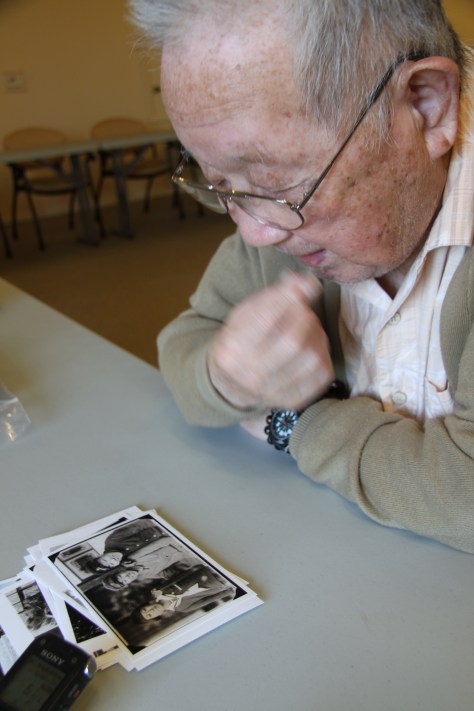
I took along what vintage pages I dared to from Grandmother Kono’s album today. I was concerned as they were so fragile… but Dad handled them gingerly.
He said there was a butcher shop in the brick building in the background. That brick building at King and Maynard is still standing.
He particularly liked the photo of him, Mieko and Suetaro… He had a nice smile. I wonder what was going through his thoughts then but I wasn’t going to interrupt.
He is smiling while looking at the three of them. By the way, the stone bracelet he is wearing was from Masako and Izumi. He says he doesn’t take it off but doesn’t remember where it came from. 😉
I think his eyes got a bit watery.
He said, “That was a long time ago,” and “懐かしい”
Just a teensy-weensy bit.
______________________________
About an hour later, he remembered looking at the vintage pictures.
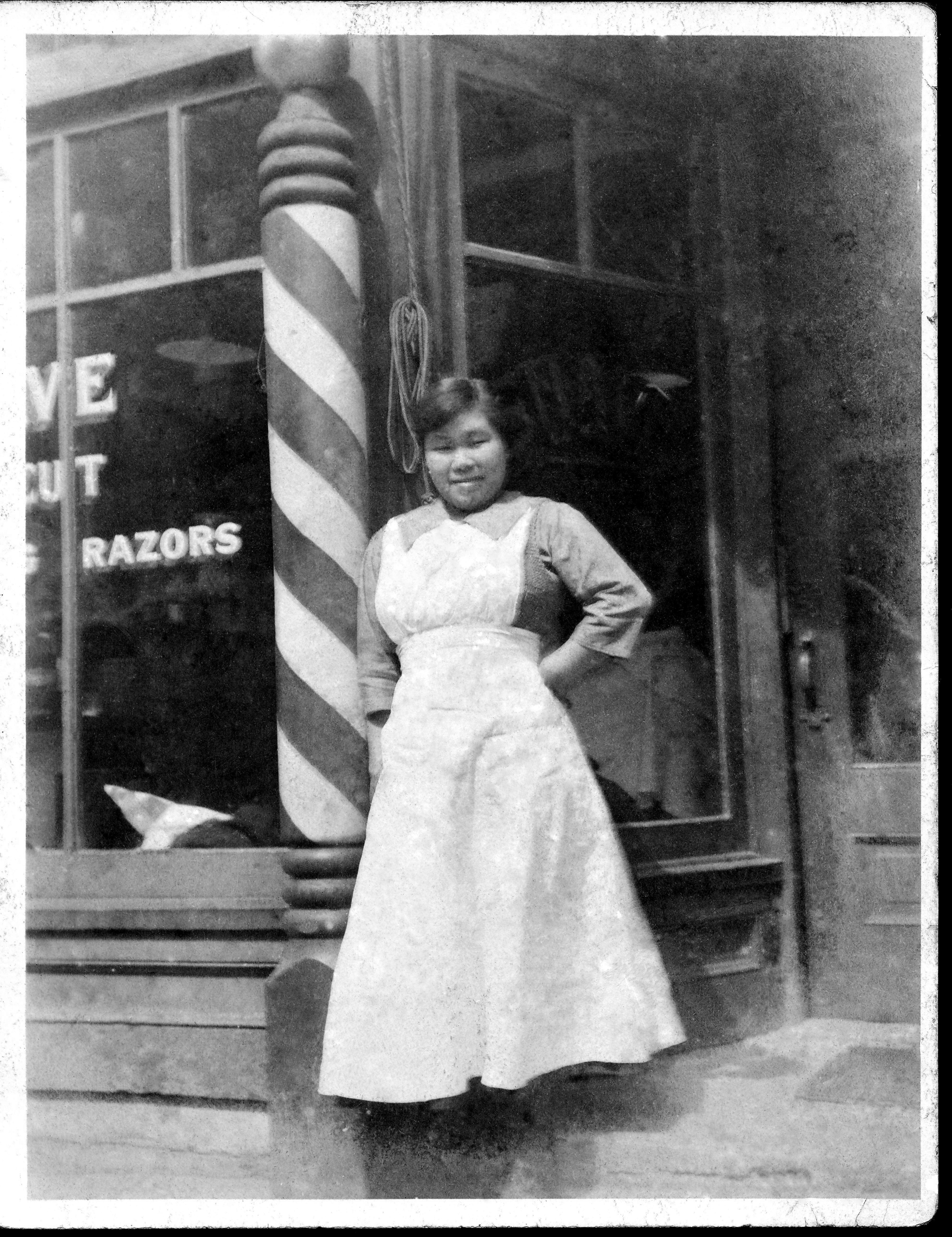
A young Grandmother Kono takes a modeling pose in front of her Seattle barbershop. She cannot possibly have foreseen what the future holds in store for her.
The most wicked risk of a mother’s love for a child is loss, and the price of loss is grief… But the sheer passion of grief can become indescribable if a mother ponders on her decisions.
_________________________________
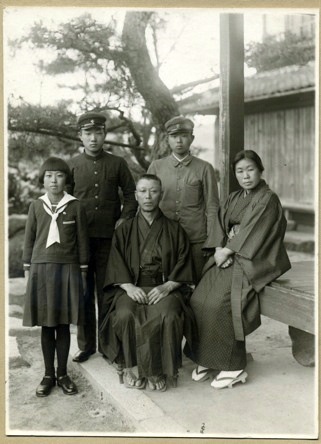
In Part I, we left when my father returned to Seattle to stay while leaving behind in Hiroshima his two youngest siblings and his parents. This was 1937. Before leaving, the family took this portrait with Grandmother Kono sitting on the sakura wood at the house. Suetaro is standing next to her:
One of the last portraits of the three siblings and my grandparents. Grandmother Kono is sitting on the sakura wood written about in “Souls of Wood“. Circa 1937
My father says that their younger sister Mieko was ill often. Indeed, she passed away in 1939 at just 15 years of age from an apparent kidney infection. Since my father was already in Seattle by that time, only his youngest brother Suetaro was left along with my grandparents. Most decisively, Grandmother decided Suetaro was not to return to Seattle when he turned 18. In “Masako and Spam Musubi,” she was very concerned over the harassment and intimidation she had received due to the threat of war against Japan. I also “feel” that Grandmother knew Grandfather was ill by the time she made the decision.
Sure enough, the very next year (1940), Grandfather Hisakichi passed away from stomach cancer. He was 59 years old. After raising Mieko for 15 years and marrying Hisakichi 31 years earlier in Seattle as a picture bride, only she and Suetaro were left in their home. War with America would start the following year. A war in which her three oldest surviving children called America home.
One family. One war. Two countries… One mother.
_________________________________
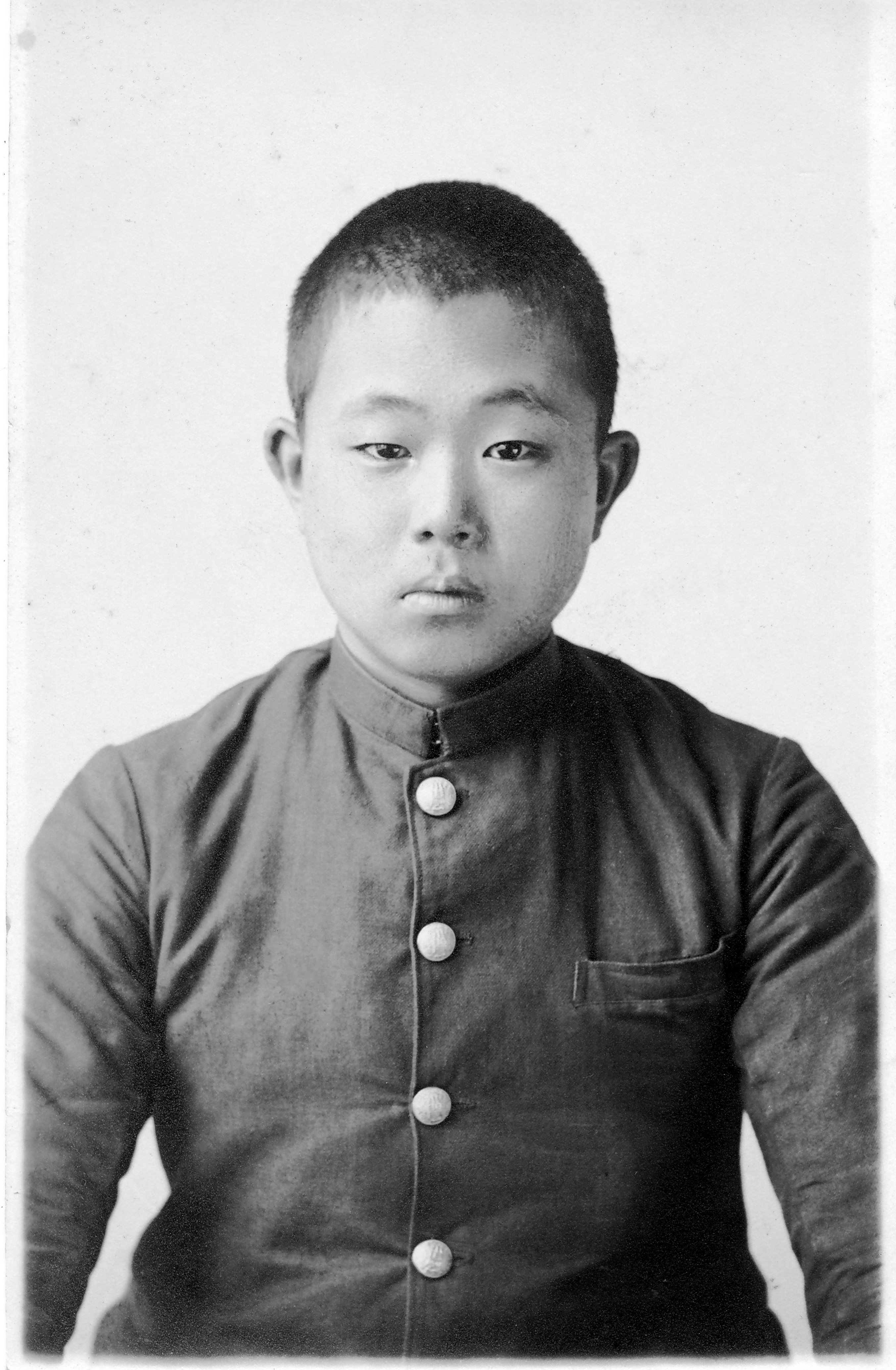
An undated school portrait of Suetaro. He looks to be about 14 years old.
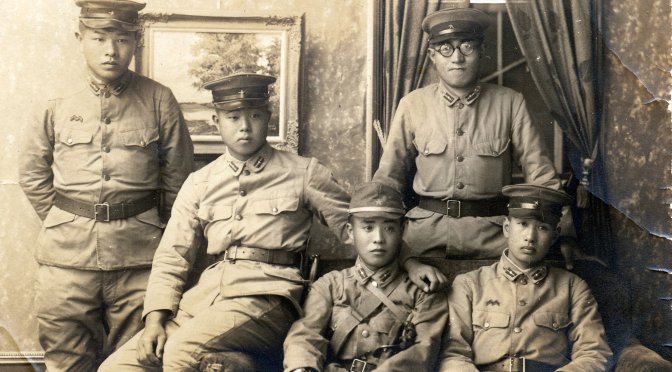
For reasons I have been unable to document, Suetaro became part of the Imperial Japanese Army. All Dad will say now is being taken by the Imperial Army was “part of life” back then. Below, he is sitting on the sofa’s arm to celebrate the young man in the center being sent to China’s Army HQs.
According to the handwritten date on the back, this photo of Suetaro below (on right manning a non-combat grade light machine gun made for training) was taken on May 10, 1939 at the “Hara Mura Training Grounds”:
Suetaro on the right. Dated May 10, 1939. I wonder what Grandmother Kono was feeling.
Here is Suetaro, perhaps in a posed photograph for PR purposes. It is of professional quality and taken on the same day as above:
Likely a professionally taken photograph of Suetaro. It was also taken on May 10, 1939 in Hara Mura.
I have a strong belief this was taken at the Fukuyama training grounds for his regiment, the 41st Infantry Regiment (unverified):
A proud looking Suetaro in his full Army uniform. I cannot tell if the handle on his katana, or “samurai sword”, is wrapped in silk or machine stamped. All military issued swords were numbered, by the way.
Another piece of his elusive history then emerged – but it was not from the 100 year old woodshed.
____________________________
Readers know that my Uncle Suetaro was killed in action as a Japanese soldier on Leyte. His regiment – the 41st Infantry Regiment – was annihilated by the US Army on Leyte. My Grandmother Kono was told he perished on July 15, 1945 – just a month before Japan surrendered. My father’s secret US Army unit, the Military Intelligence Service (MIS), had a direct hand in the high number of Japanese casualties – and the low number of American casualties. In other words, the MIS likely had a direct hand in the annihilation of Suetaro’s regiment. The MIS was comprised of Americans…of Japanese descent.
Dad as part of the MIS in post-war Japan.
It is not known if Grandmother knew of this fact. It would have been an overwhelming of her heart.
____________________________________
However, this is not a story on Suetaro’s life but about his life with his mother. In “Masako and Spam Musubi”, we know she had her second stroke after being informed by the remnants of the Japanese military of her beloved Suetaro’s death. The last Kanemoto in the family home was now… herself.
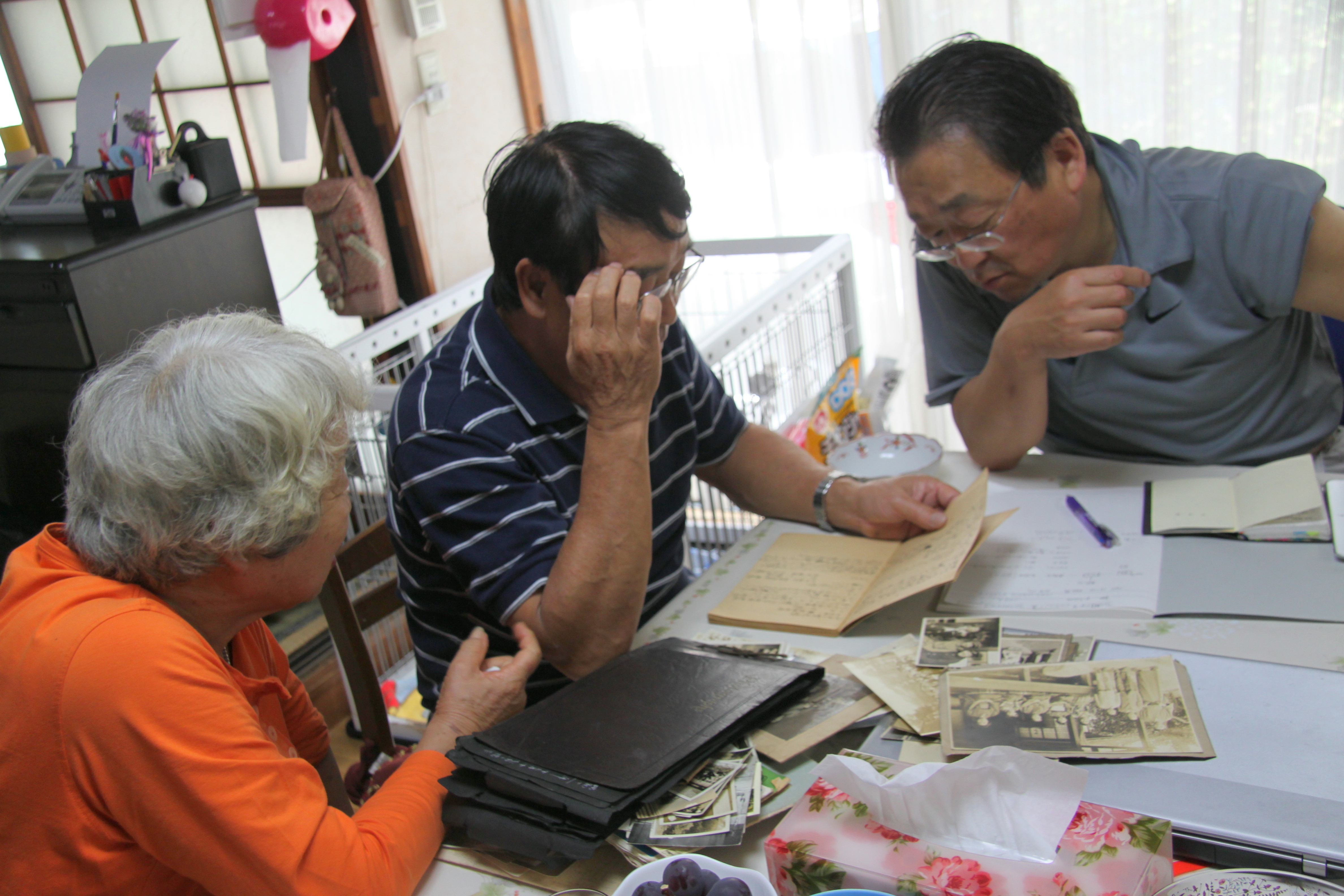
During my trip to the family home in September, my cousin Masako, her younger brother Kiyoshi, her son Toshiro along with my son were looking at vintage photos Toshiro uncovered just a couple weeks prior in the shed. A number were of Suetaro with my father and Grandmother. We were all quite emotional by then. Masako removed herself from the table; I assumed she was overcome. I didn’t stop her from quietly leaving thinking that.
Instead, she came back a few minutes later with something in her hand. It was a small notebook. Aged and frayed at the bindings. Her eyes were red.
It was Suetaro’s war diary. We were simply stunned. Masako had it secreted away. For decades. She chose to bring it out now. For closure. It was the right time.
Masako shocked all of us when she brought out Suetaro’s Army diary. (L to R) Masako, Kiyoshi and Toshiro, her son. The Kleenex box is there for my use.
It took us a few moments to realize what she had brought. It was brittle and smelled of old books. The paperstock was of low quality – more like newspaper stock – as paper was in very limited supply during the war years. We handled it as gently as possible.
The first few pages were of what he did during a short period of time; Suetaro’s writing was neat and in black ink.
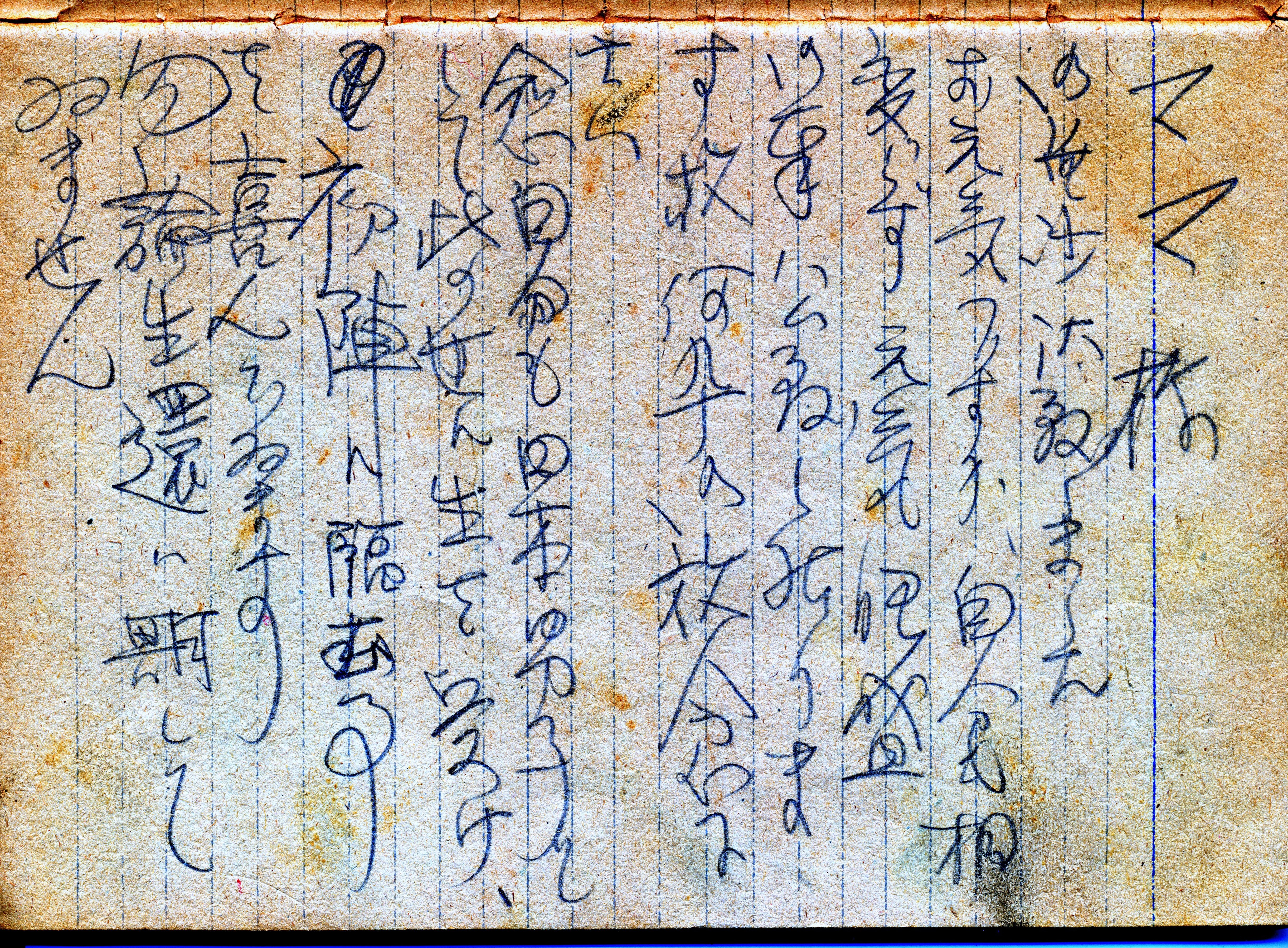
Then the handwriting changed. Suddenly. It was hurried. Rushed. And in pencil.
It was his farewell letter to his mother. My dad’s mother. My grandmother. It was dated March 3, 1944.
Kiyoshi is holding Suetaro’s farewell letter. It starts with “Dearest Mama” on the right.
Kiyoshi tried to read it; it was difficult as it not only was in his hurried cursive but in pre-MacArthur Japanese. Many characters are simply not used any more. Unused since 1945. Only a few people can read it – like my father. Suetaro’s brother. But we managed to read critical passages. I will include two pages as reference. However, these are very literal translations of a few sentences but needs be read in its entire context considering the environment was when he wrote this. It is easy to misunderstand or misconstrue his heart and soul at that moment.
Towards the left, it states, “初陣に臨むことを喜んでいます. 勿論, 生還を期してはいません”, or literally, “I am glad to be going to war and facing my first combat. Of course, I do not expect to be coming back.”
He writes, “今の時局は日本が起つか亡びるかの境です。どうしてもやり抜かねばいけないのです。兄さん達を救い出すことも夢見てます,” or “At this time, Japan is at the point of either winning or perishing. We must persevere as I still dream that we will free our older brothers.”
I stress this abbreviated presentation can be misunderstood. My interpretation is, “I willingly go to war for Japan as we are on the brink of winning or losing. By winning, Japan will free my older brothers from the concentration camps in the US.”
He will fight – and die – so that Japan will win. If Japan wins, they would take over the United States and by doing so, free my Dad and his older brother Yutaka from the concentration camp. At the time of his writing, both were imprisoned at the camp in Minidoka, Idaho after being relocated from Tule Lake, CA. (His nephew, Bobby, had already perished in Minidoka at the young age of six.) His older sister, my Aunt Shiz who passed away last month, was imprisoned at Manzanar.
Man, my eyes welled up. Everybody was in shock…even Masako once again.
_______________________________
I am unable to comprehend how my Grandmother must have felt reading that letter in 1944. Suetaro had secreted it away in the “butsudan”, or family altar. She had decided Suetaro was not to return to Seattle to join his elder siblings. Now, having read this letter, her regret must have been immense. Grief. She lost a piece of herself. A beloved piece.
Mieko had passed away. So did her husband in 1940. Now her youngest son writes he does not expect to return.
Could she have foreseen this fate while she happily stood in front of her Seattle barbershop near King St. and Maynard in Seattle in the 1910’s? I doubt it.
She would be alone. To ponder. To possibly regret to her last day.
A mother’s anguished solitude.
It is dated April 9th on the back with no year indicated. However, as my father took it when he was in the MIS, I will assume it is around 1948. Her face is worn.
















 Masako and Spam Musubi