Gyoza anyone? I guess we call them “dumplings” here in the US of A…
Simple to make.
Tastes great (or at least that’s what my kids say).
And it’s FREEEEE at Chez Mustang.Koji’s! LOL
_______________________________
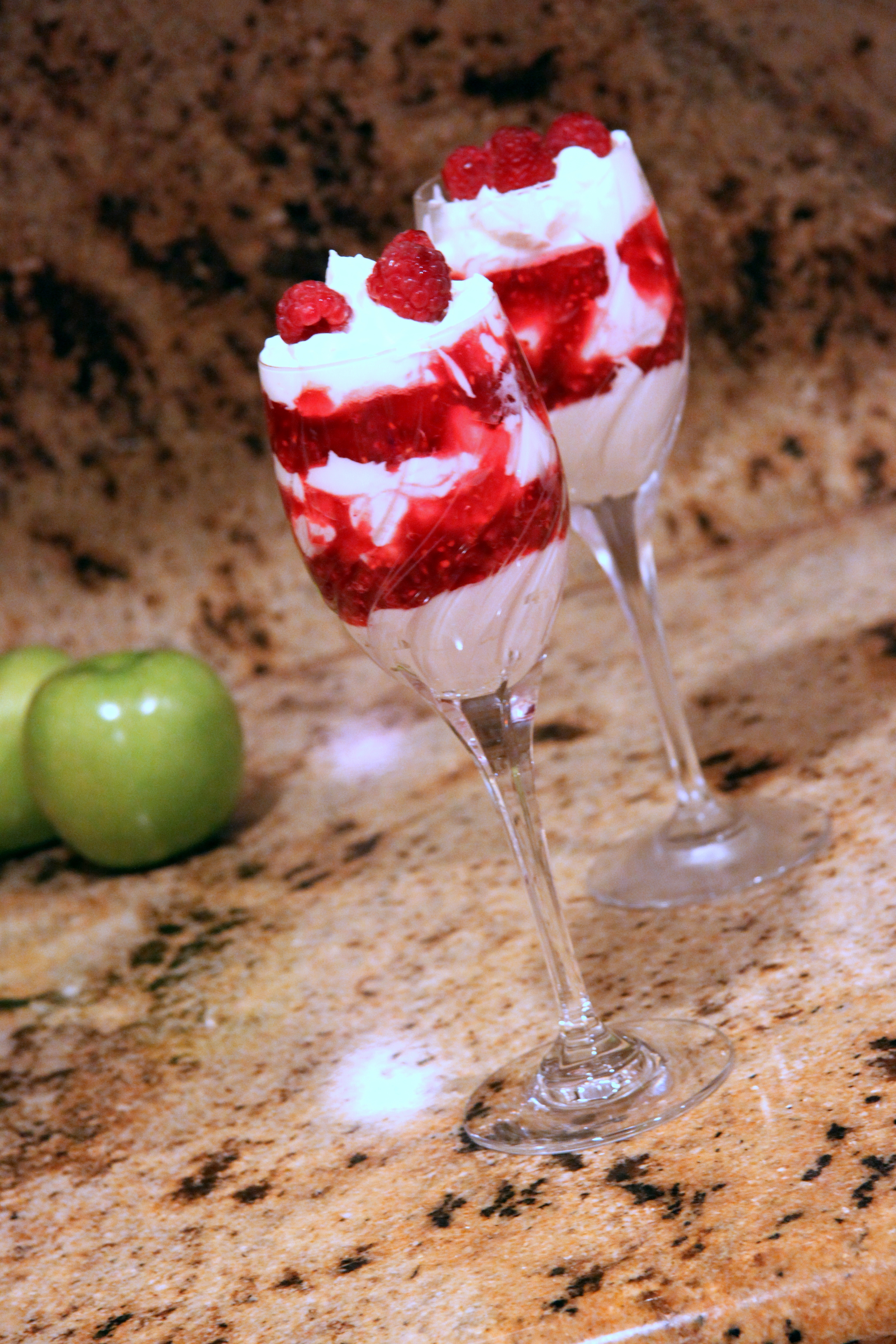
Completed gyoza
Ingredients:
Ground pork (kurobuta type preferred!)
Green onions
Napa cabbage or regular cabbage is just as fine
Sesame oil
Crushed garlic (raw)
Sugar
Salt and pepper
Shredded ginger if you like
Chopped water chestnuts if you like
Do not press meat mixture.
Combine ingredients but do not press. Spoon about a tablespoon of mixture into gyoza skin. Fold. Add a touch of oil to coat bottom of cast iron skillet (non-stick does not work!), medium high heat. Cover, add about 2-3 tablespoons of water to steam. Remove when botton is browned.
Serve with a dipping sauce made of soy sauce, “ra-yu” or chili oil, and Japanese vinegar if you like.
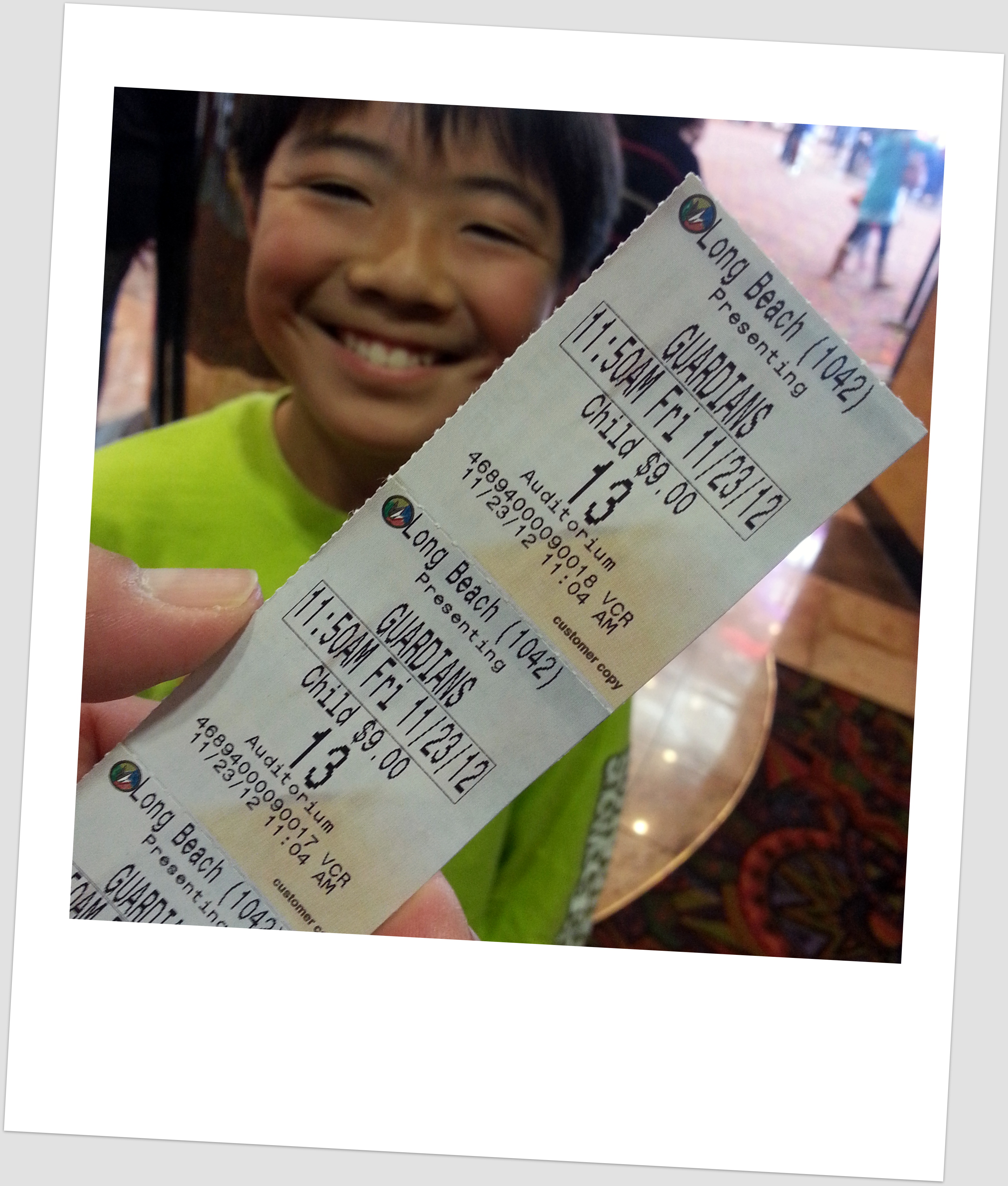
Being brother and sister, my two littlest ones can never agree on what to see at the movie theater. Today – on Black Friday of all days – was no exception.
After drawing first blood, my son won out. We saw “Rise of the Guardians”.
It was a good choice.
_________________________
Once and only once, Papa here won out.
Well, the two kids actually had no choice. We saw “Captain America”.
But the first movie I truly recall seeing – at a drive-in with my folks – was “War of the Worlds”. I still love it.
_________________________
But “back then”, a movie was a movie.
But before “back then”, a movie was truly magical. The director and cinematographer worked together to bring you into their minds.
You had to use your imagination and senses to enter it.
Plus costume design. Makeup. And “special effects”…primitive by today’s CGI mania standards yet so wonderful.
“Wizard of Oz” is likely the best of the best. Shot in 1938. Entirely on SETS. It sits at the top of my (humble) list.
________________________
Rise of the Guardians
Regardless, a movie is to entertain.
Pure and simple.
I don’t look for special subliminal meanings or hidden messages.
(I also don’t appreciate paying seven bucks for a bag of popcorn imported from China.)
While the theater wasn’t crowded (perhaps due to the seven buck bags of crappy popcorn from China…with fake butter) for our showing, there was a very cheerful round of applause at the end of the movie.
From children, parents and grandparents alike.
I guess they were entertained.
We were.
(ps If my oldest daughter were there, she’d be balling her eyes out.)
At times, I mix in Memorial Day with it… I don’t think there’s anything wrong with that.
They will always be veterans in my eyes.
____________________
Dad at Miyajima, Hiroshima in the spring of 1949. I now have a bad case of “tennis elbow” and can’t retouch:
He was part of the US 8th Army’s Military Intelligence Service and served during Occupied Japan. Being a “kibei”, he translated during the War Crimes trials, interrogated Japanese soldiers being released by Russia, Korea, Manchuria and China and translated Japanese war documents for intelligence.
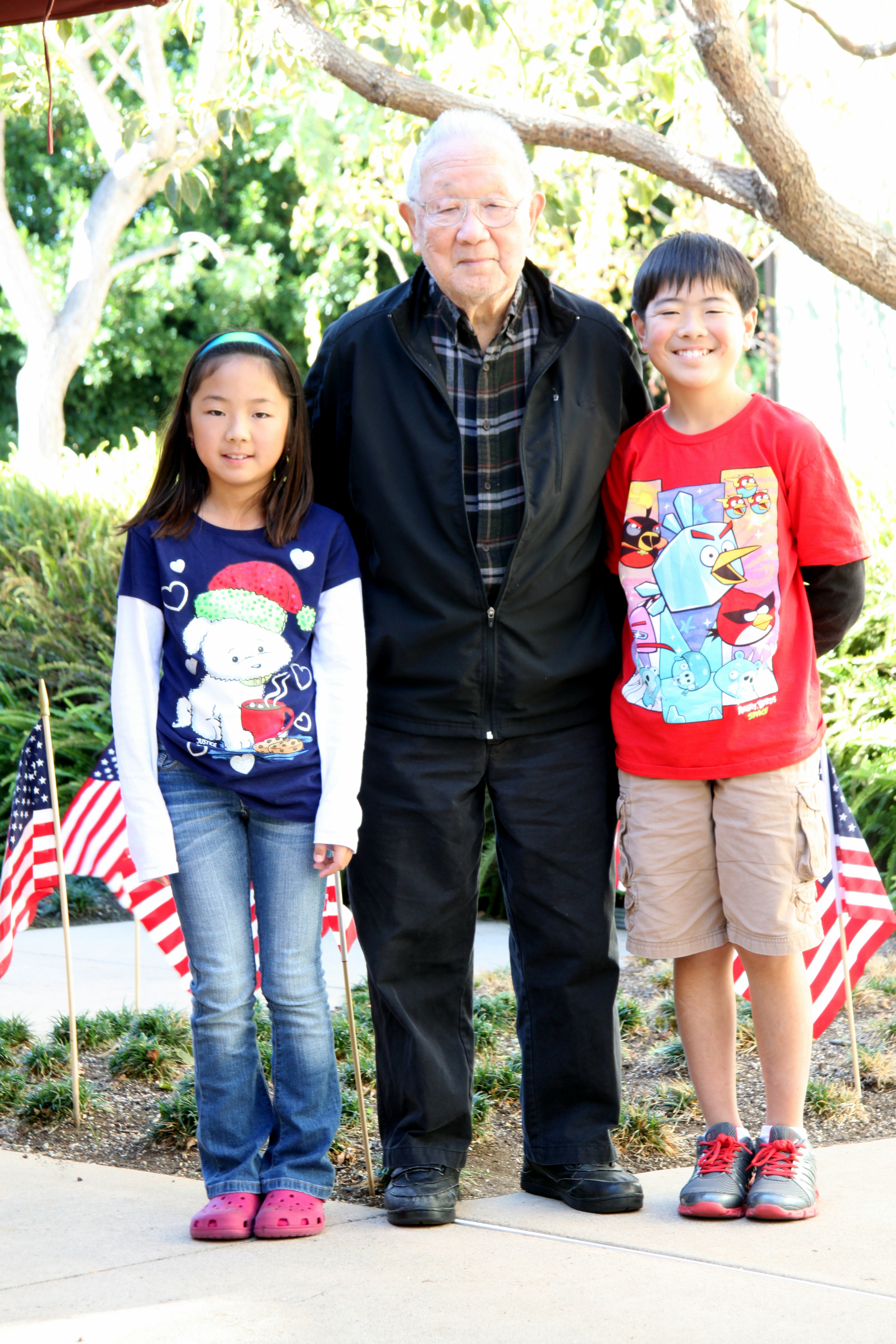
Dad today with my two littlest kids:
Ninety-three years old.
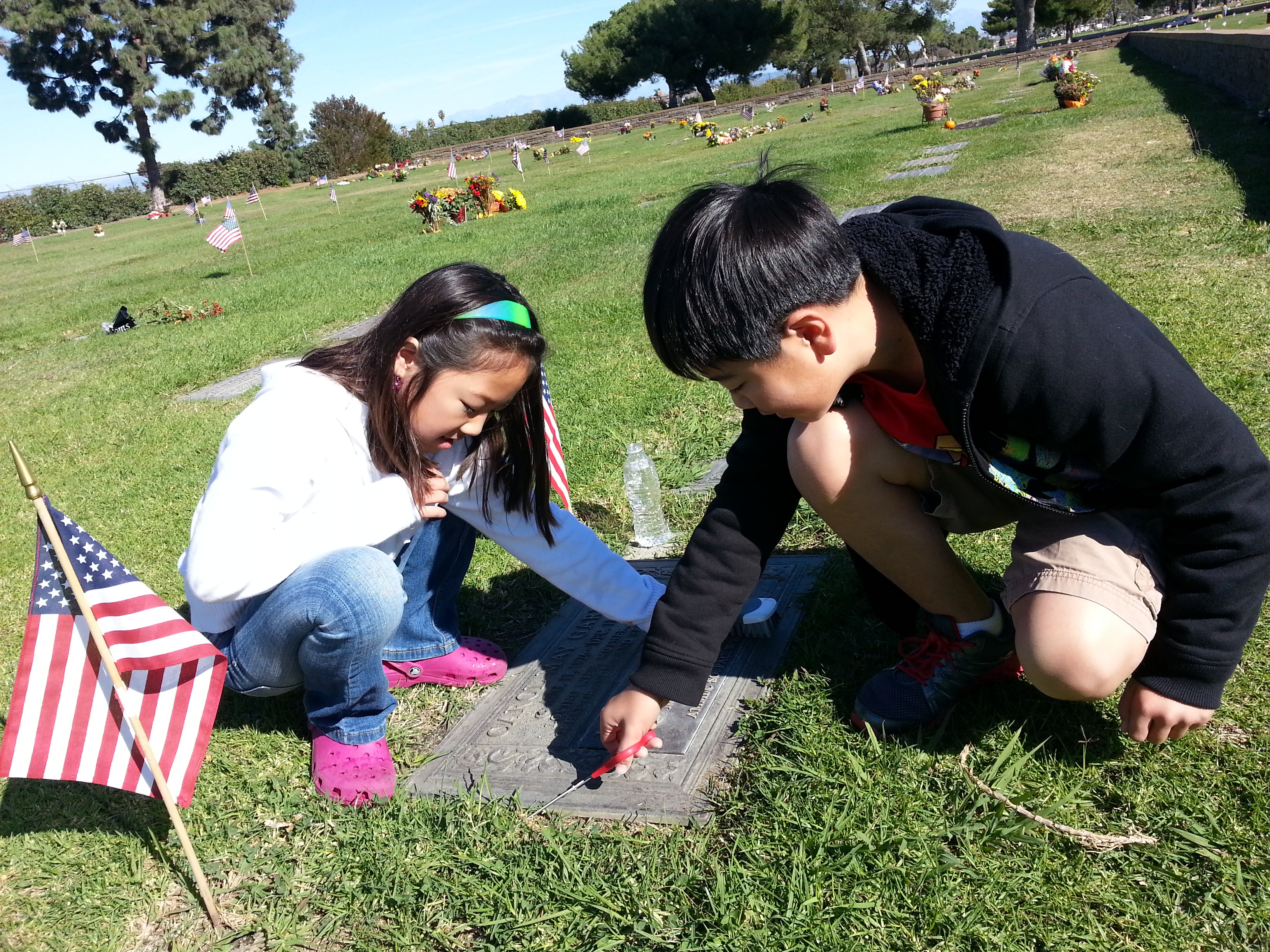
Went to pay our respects to Old Man Jack. Sun was just too low in the sky for a good pic… 😦 Miss you, Jack.
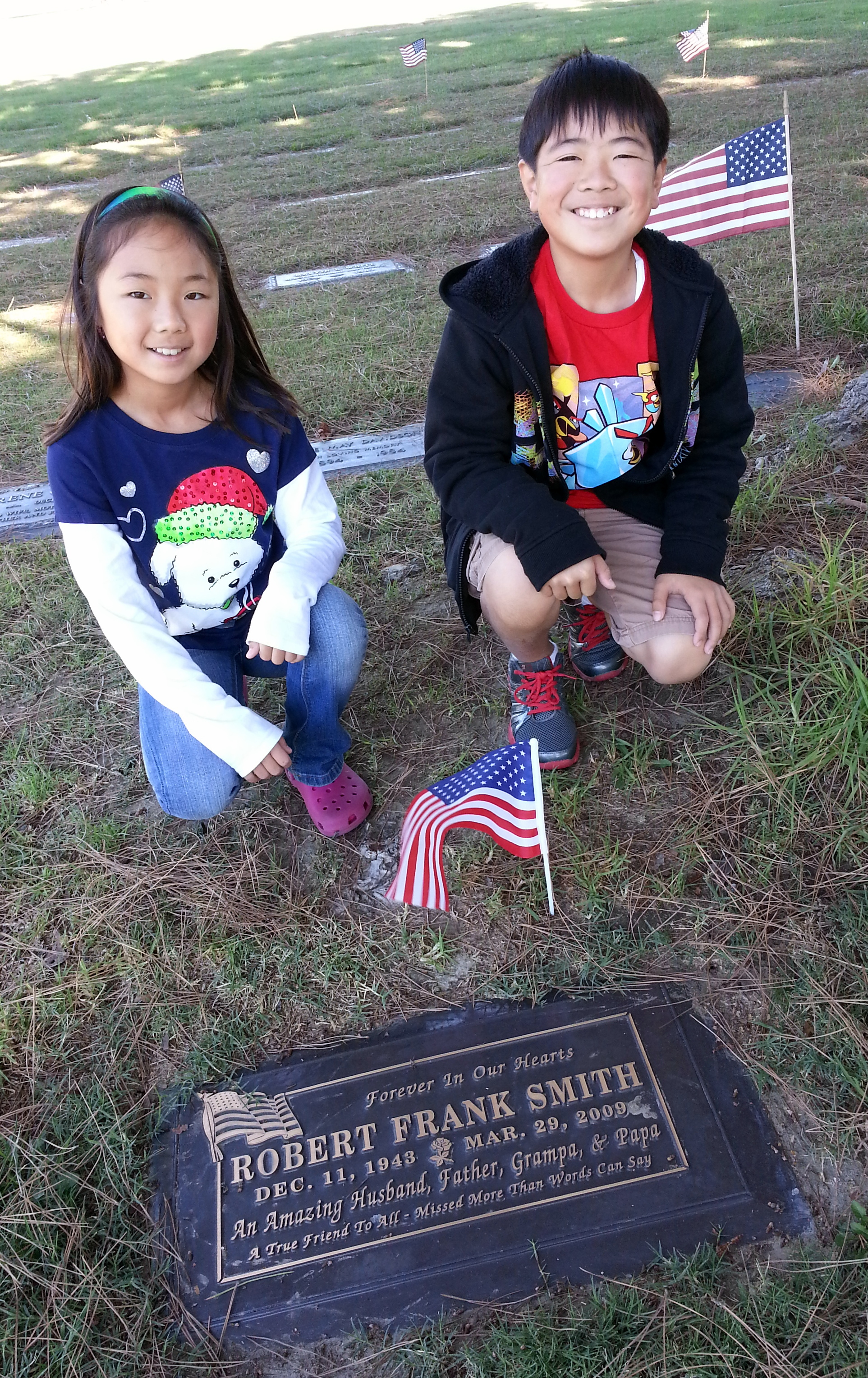
And went to see good ol’ Bob, too… What a kind, great man he was.
But you have to be obsessed…when time is working against you.
_____________________
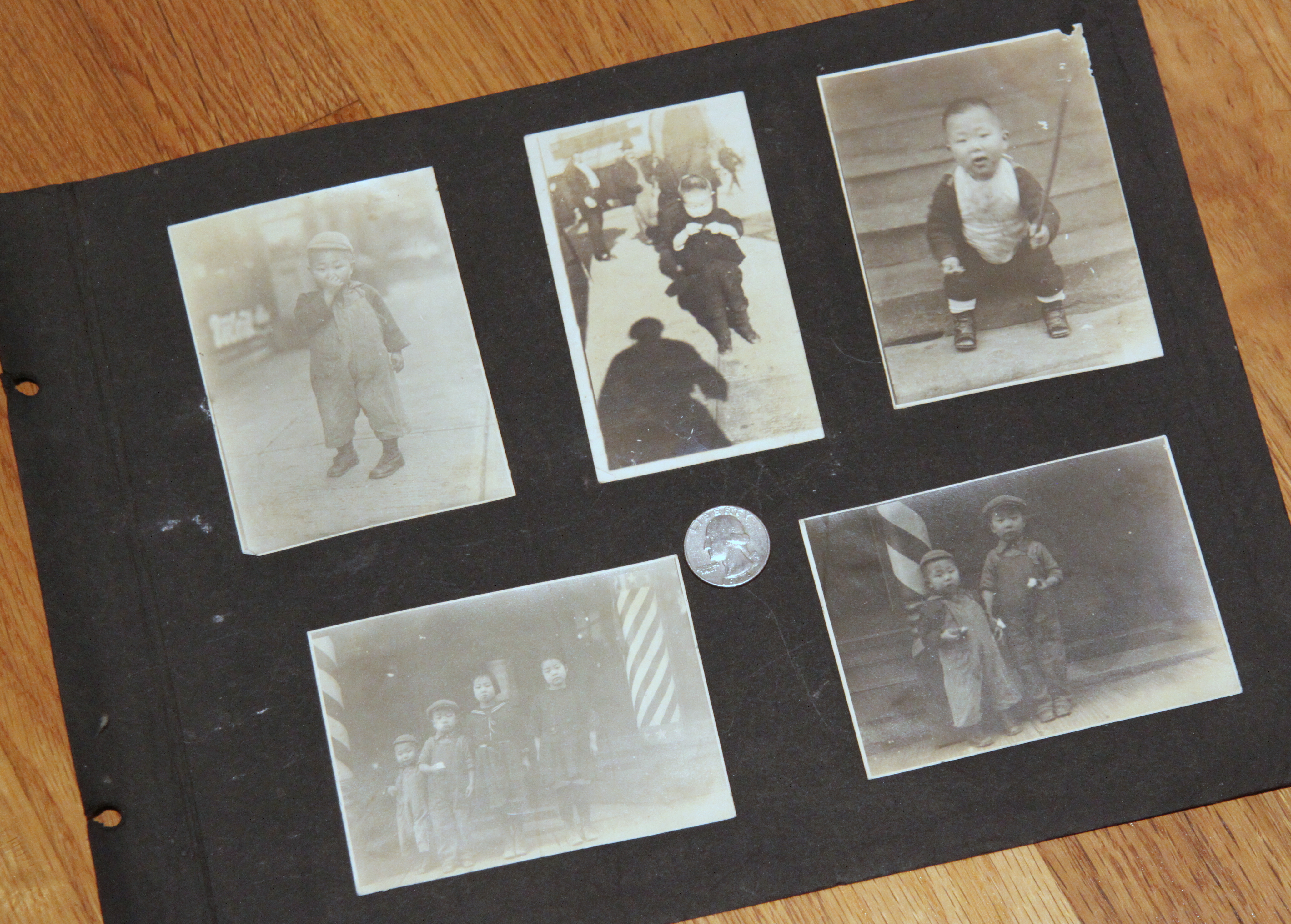
A single page from my Grandmother’s precious photo album
Retouching faded or damaged family photographs can become a labor of love.
Perhaps the finished product is meaningless to people outside of your family. Maybe to some within your own family as well. But somehow, you become obsessed with it because in spite what others feel, you know in your heart it is important… and perhaps more important as the years roll by.
Family members come into this world, live, then pass on. How did they live? Where? What was it like “back then”?
That’s my mission. To leave hints of what it was like for my descendants as well as interested family.
To let others see what “they” looked like. How “they” smiled. How “they” grew up.
________________________
The first snapshot above is but a page from my Grandmother Kono’s photo album.
Brittle pages. Photos that were lovingly pasted onto those pages by my Grandmother. Photos now eaten by insects. Faded. Damaged.
Now is the time. Restore and retouch. Hundreds of them. That’s the mission. Before all knowledge of their lives disappear.
They are disappearing today.
________________________
Having but free software, the retouching being done is surely amateur. Basic at the best. I wish I could afford professional software but then again, there would be a tremendous learning curve. Make do with what you have…as “they” did.
And when you finish one photograph, you receive gifts. Gifts of seeing what would have been lost. Lost to their descendents forever.
Here is one example from that page:
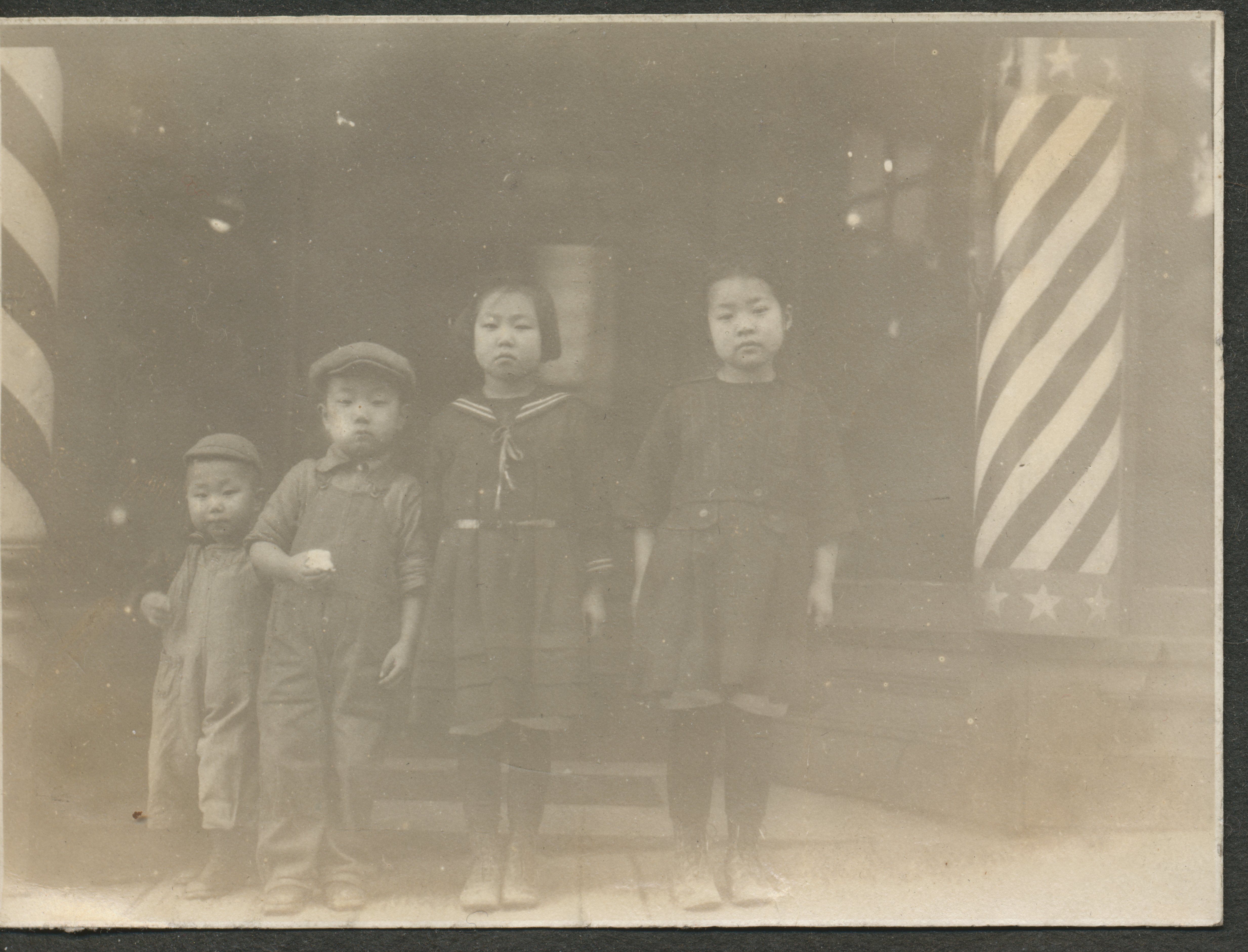
(L to R) Suetaro, my dad, Aunt Shiz and an unknown friend. Circa 1923 at 620 S. King Street in Seattle, WA.
While the detail is surely not “lost”, it is hard to make out things. The print is small to begin with; a quarter was placed for size reference.
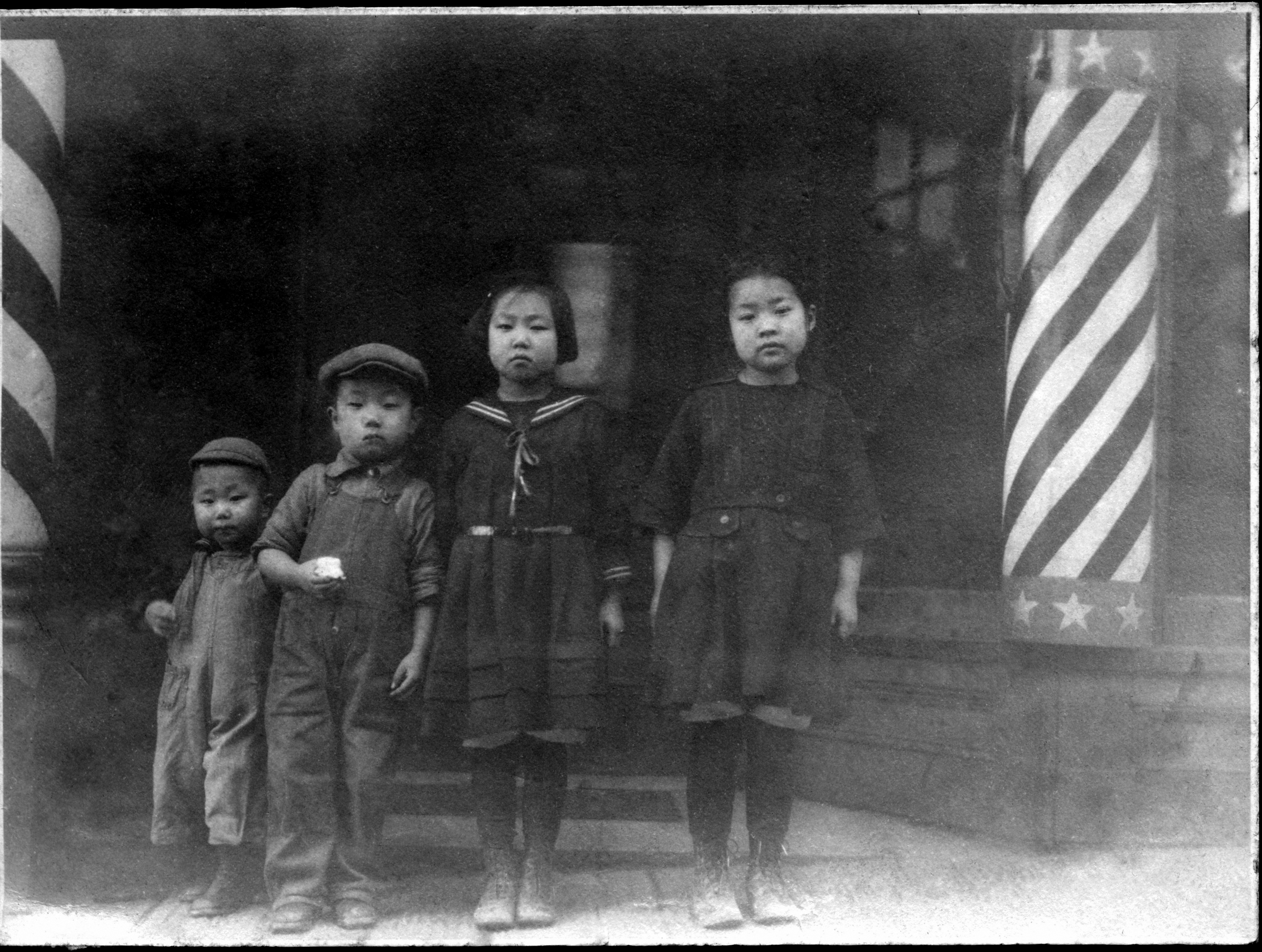
But after restoring and retouching, some fun things come into clearer view – especially if there is a companion print to compare with:
In another pose on the same album page, you can see both my dad and Suetaro were holding food in their hands and dad had a bandaged thumb. Here, after restoration, you can more clearly see the food but it blends into his bandaged thumb which would have been hard to separate. I’m pretty sure Dad is eating an “onigiri” or rice ball, likely wrapped in seaweed. Uncle Suetaro had already devoured his. Minor detail, yes. But now we have an idea of what Grandmother fed them in Seattle while growing up.
Aunt Shiz…well, it appears she would rather have been playing with her friend but we know she wore a uniform to school. And she has a hair clip. Berets for boys were in fashion, also, it seems. Funny as Dad doesn’t like to wear hats much. We also know that on that day, they wore very Western clothes…down to his overalls.
One barber pole is also different than the other. When dad saw this today, for some reason, he just proudly blurted out, “620 S. King Street”, and very happily. I think he was amazed at himself for remembering. But the confirmation of the address came from retouching the print. He also said, “That’s wood (referring to the sidewalk),” implying he doesn’t remember a wooden sidewalk. But I mentioned to him it was cement when you look at it carefully and he was happy that he wasn’t a “pumpkin head”.
From this retouched print, Dad also added one startling comment out of the blue. He said a number of “hakujin”, or Caucasians, came to the shop, even though it was in “Japanese Town”. I asked him why. His reply was, “I don’t know… but Japanese are more attentive, I guess, than the other barbers…especially in shaving.” I know what he means.
________________________
So all this “stuff” came from retouching a faded photo… Things that would have been otherwise lost. Face it. Dad isn’t the little boy eating that onigiri anymore. But he still eats like a horse. A good sign. Aunt Shiz didn’t feel like eating much the day she quietly passed away.
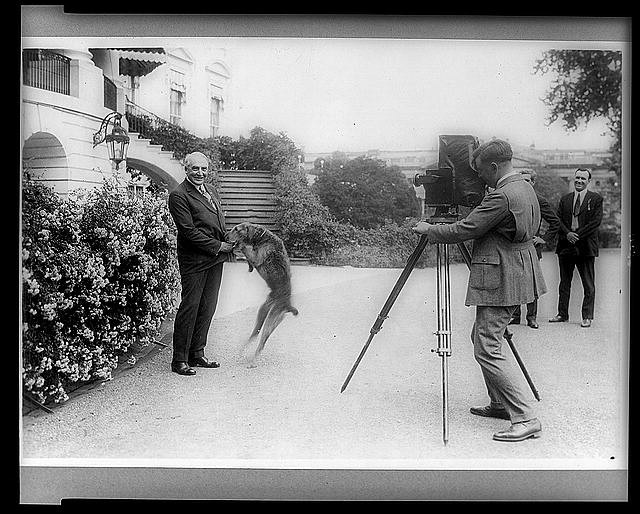
Yes. President Harding’s last photos in my grandmother’s album.
OMG. Leave it alone!
________________________
I found a copy of the actual event flyer from July 1923.
Now we can see an overview. See what the Bell Street Pier looked like when President Harding rode in his motorcade.
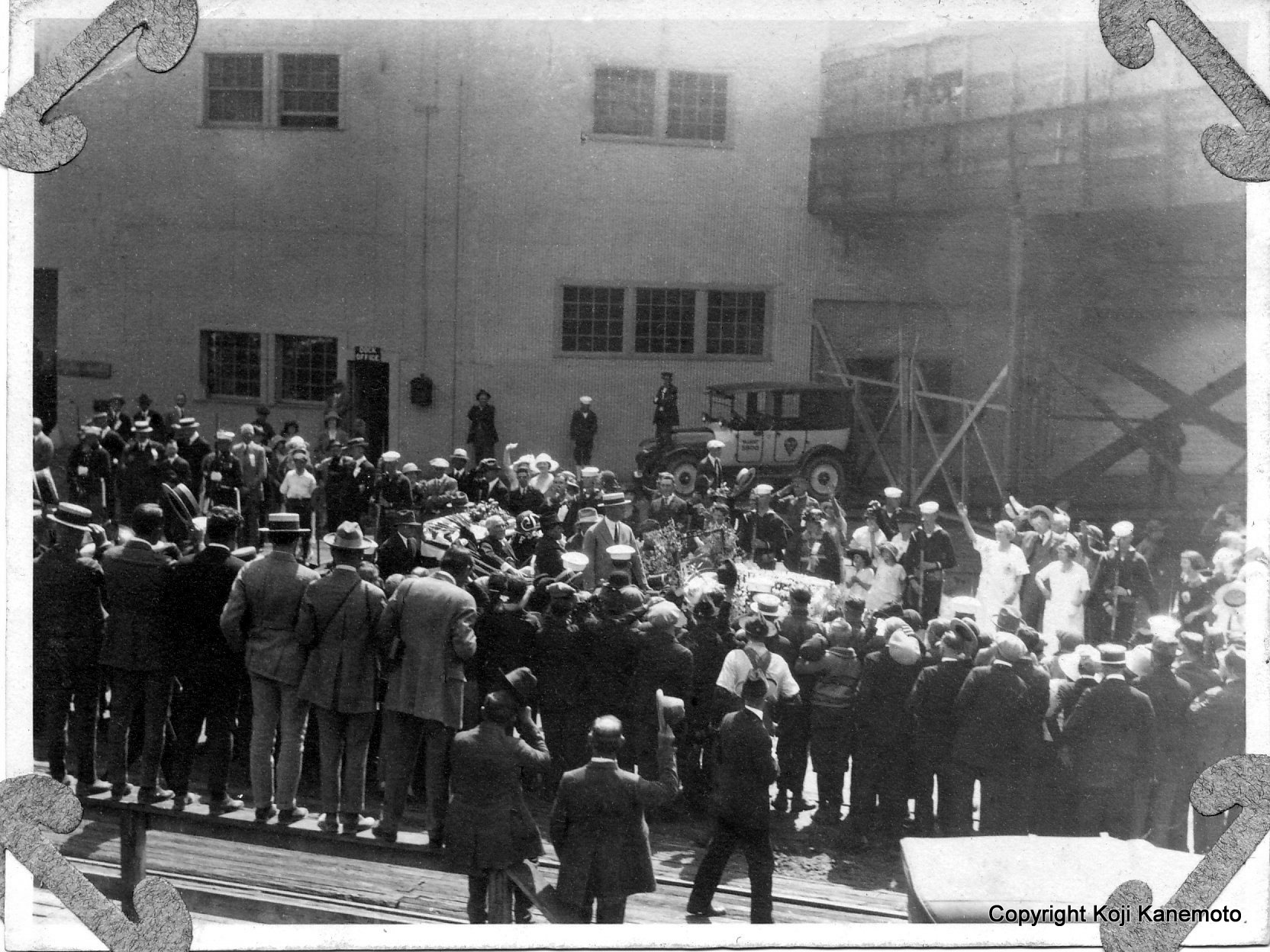
You can make out train tracks. Look at the far left – you can see the window locations on the building and…a pole. You can also see blackness under what appears to be a short bridge and a railing that abruptly ends. Important stuff.
The “PORT OF SEATTLE” with “BELL STREET PIER” signage can be signage can be seen at the far left.
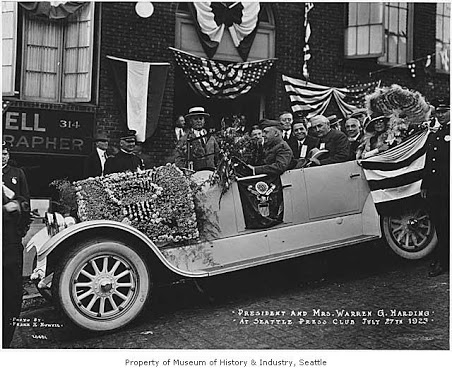
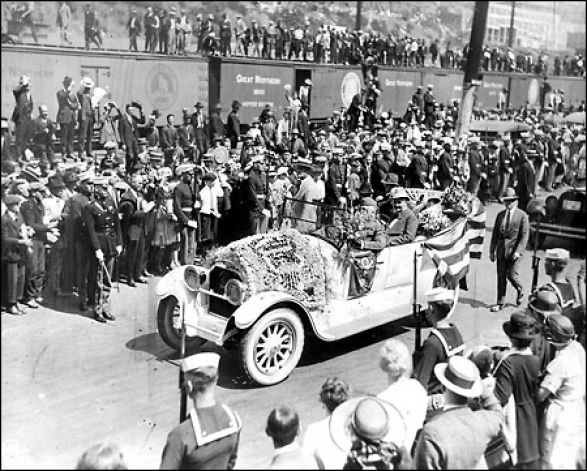
Upon studying “Grandma’s” photos further and in comparison to the “press” photo (below), I feel BOTH were taken within seconds of each other – but from opposite side of the motorcade. Please note my scribbles:
“Grandma’s” on top, “press” below.
And note the following obervations:
Pole – also painted white at the bottom;
The prominent roof of a car (circled) parked along the pier and next to the pole;
The group of four men marked with the proverbial “X marks the spot(s)”;
The wooden railing in both of Grandma Kono’s photos; and,
The US Marine Corps on one side of the motorcade, the US Navy on the other.
Amazing. These are two rare images taken from different sides of President Harding and within seconds of each other.
BUT…….
With the flyer image, we now know train tracks ran along the pier. Trains are also visible in the press photo. There are MEN atop the rail cars.
Due to the angle, it is believed the photos in Grandma Kono’s album were taken from atop the rail cars. Off to the left just outside the field of view in the picture (just like the grassy knoll in the famous Zapruder film of JFK’s assassination).
Ergo, I cannot fathom Grandma Kono climbing atop a rail car…let alone in a dress as was customary at that time for ladies.
It was hard not to get caught up on the surprising photos Grandma Kono took of President Harding.
Taken in 1922 at the White House.
July 27, 1923.
Six days before the sudden death of President Harding.
I just couldn’t deny my natural tendency to research…with no goal to speak of.
And while I have hundreds of other vintage family photographs taken of up to a century ago to scan and retouch, I just had retouch President Harding’s pictures. To bring back the excitement of that warm day in Seattle.
I was a bad boy.
And this story is unexciting unless you are into the past…and into a family’s past as well.
__________________________
It was most fortunate Flickr friend, US Navy veteran and author M. Shawn Hennessy (author of “Freedom’s Fortress“) offered assistance without any prompting. What a guy…especially since he is on the mend after a bad spill on his bike. He is sure to make a lot of friends with the TSA getting through airport security now.
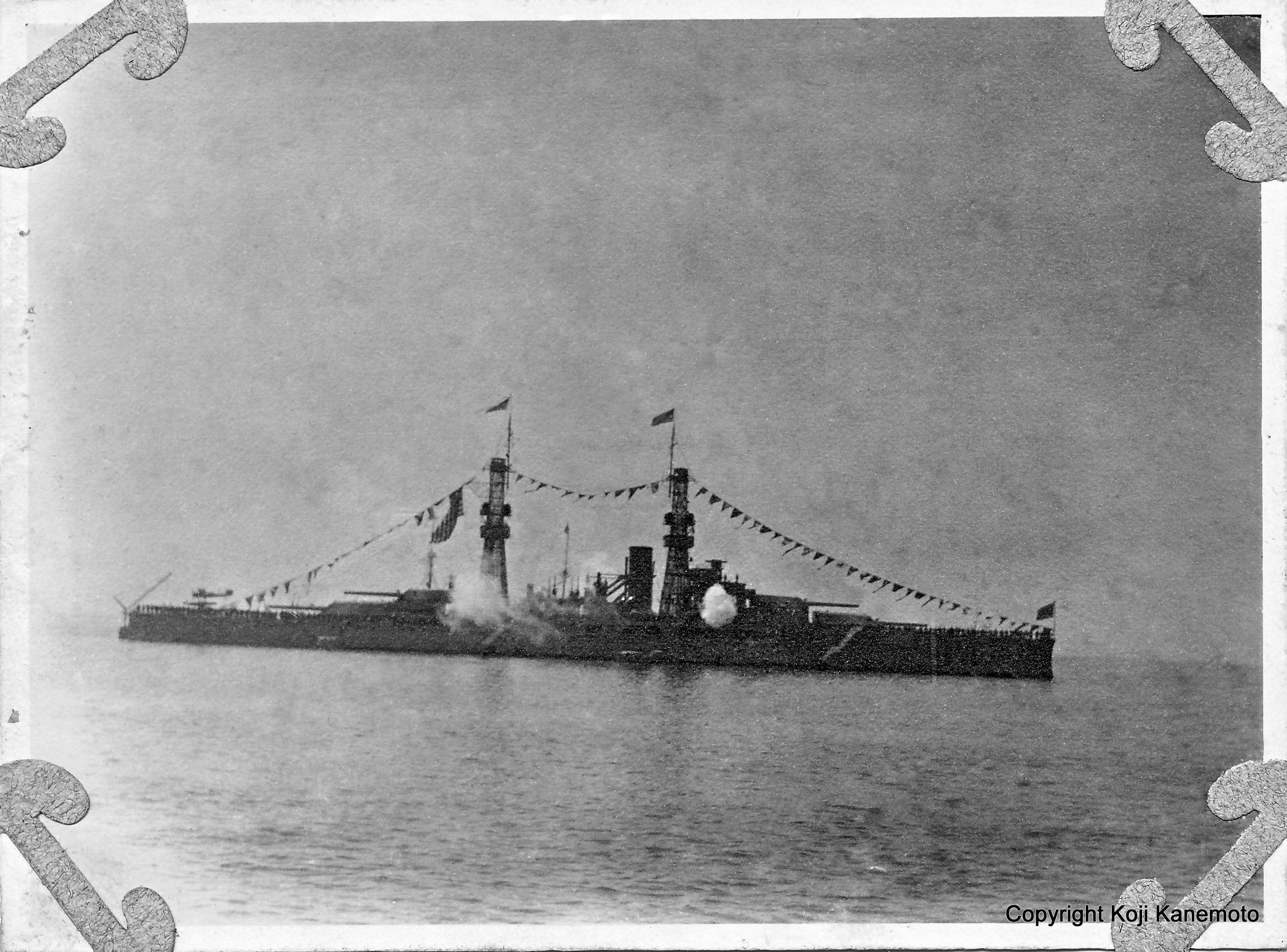
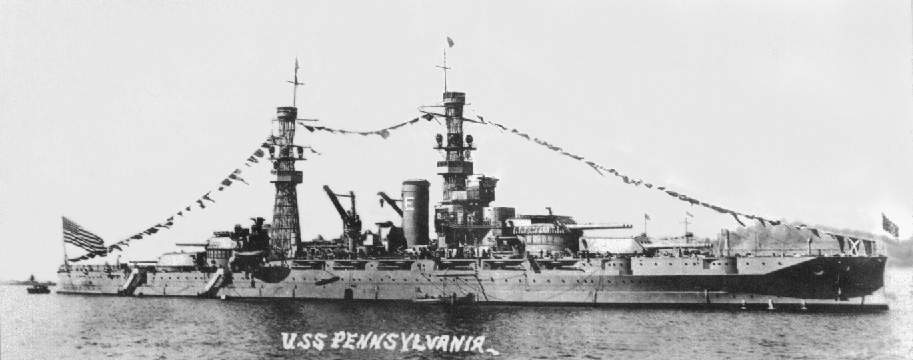
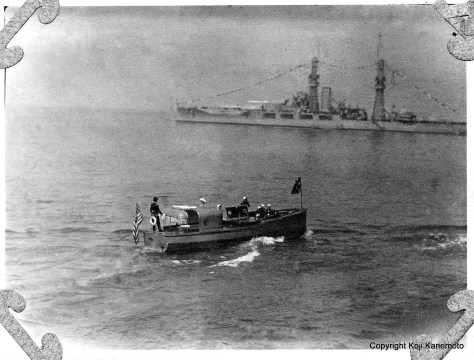
After some researching on his own, Shawn classified the battleship in Grandma Kono’s photo album as one from the Pennsylvania class.
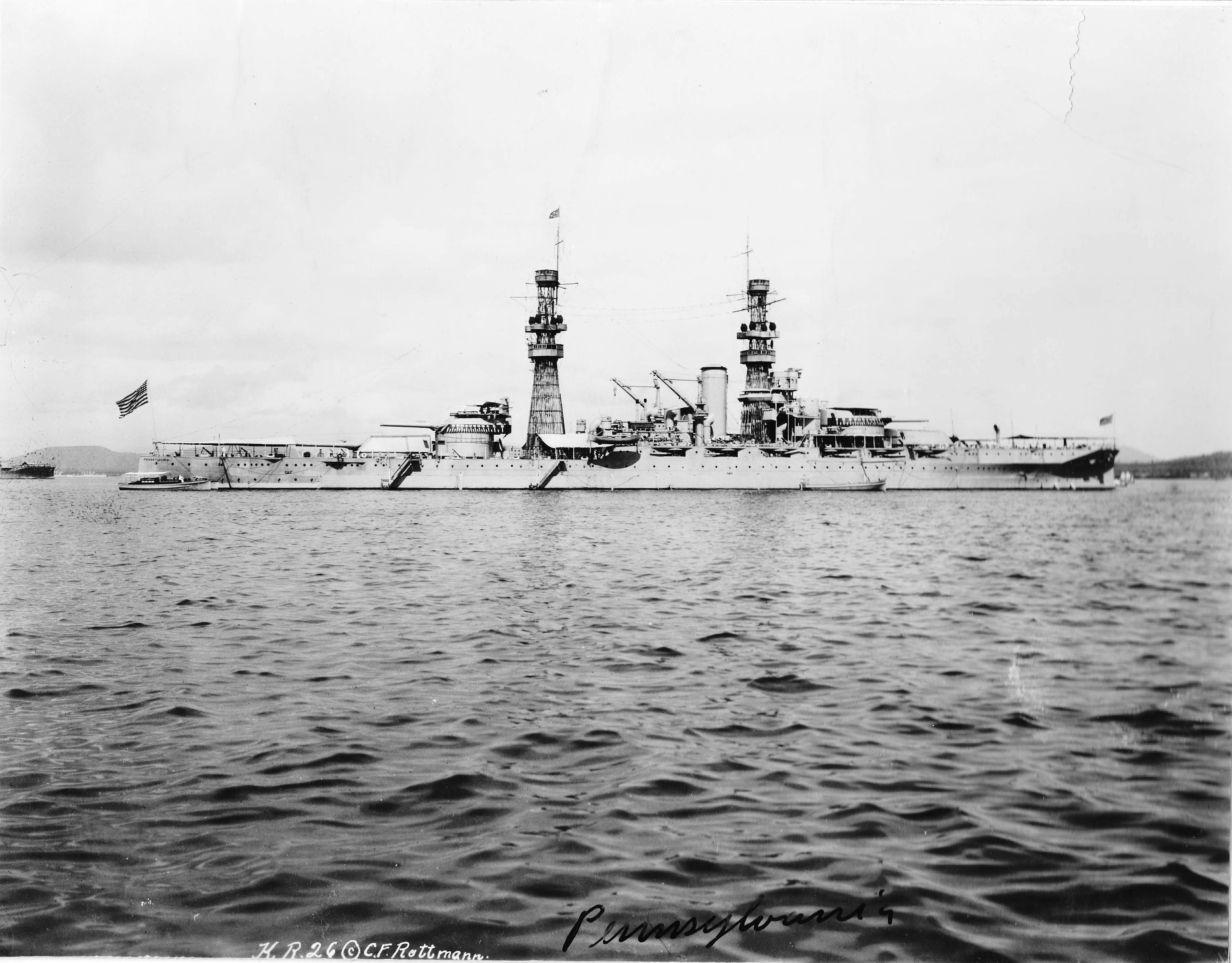
After Shawn’s assist made it easy, she was identified as BB-38 – the USS Pennsylvania. Interestingly, another battleship, the USS Idaho, was part of President Harding’s naval review – not the USS Pennsylvania. It appears that President Harding boarded the USS Pennsylvania in Puget Sound for dinner although she was a frequent visitor to that area.
Grandma Kono’s picture as retouched:
A couple of vintage naval photographs of the USS Pennsylvania on the internet for comparison:
Archival photographArchival photograph
(Note: After FDR signed the Executive Order to imprison Japanese citizens on the west coast after Pearl Harbor, the FBI went into many private homes in search of “spy material” which definitely would have included any happenstance photo of the military. It would be interesting to contemplate of what may have happened if my grandparents had remained in Seattle and the FBI came across these photographs in their home after Pearl Harbor.)
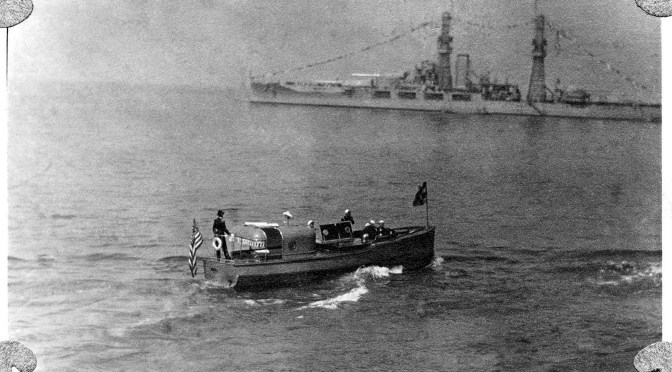
Her other picture of the USS Pennsylvania as retouched. The shuttle does not have a civilian standing at aft as I previously noted. We now see that he is a naval officer with his cocked hat and shoulder paulettes.
Admiral’s Barge
The photos in Grandma Kono’s album of President Harding’s motorcade were taken from a distance – not streetside. That would become an interesting point.
The retouched photos in Grandma’s album; in the first image, the limousine is between the US Marine Corps recruiting truck and a car’s rooftop. Shawn identified the ship at dockside as the destroyer USS Hendersen:
The closest view of the President in Grandma Kono’s album as retouched.
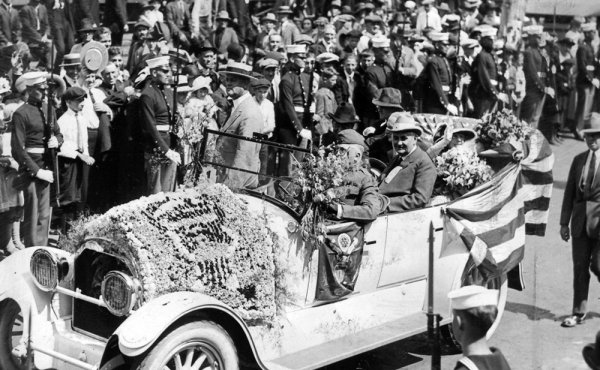
In scanning the internet, Shawn and I came across a few “press-type” professional photographs of the event; they were mostly taken from streetside. Up close and personal. The best image showing the details of President Harding’s limousine – down to the carpet of flowers on the hood – and the First Lady’s hat found by Shawn on the internet:
A professional press photo
Another view:
Scan the bystanders. This is also a cropped image of the next photo.This is the uncropped image of the previous photo. Scan the bystanders.
If you enlarge the images and scan the bystanders, I did not see one individual with a camera to his or her face. Many of the males were doffing their hat with one hand which further decreases the number of individuals capable of taking a photo.
As for the cameras of that time, they would have been of the collapsible bellows type or an early Brownie – which would have been literally a box with a small hole for the lens. Both required two hands to operate properly. In the family photos while camping somewhere near Seattle, I noticed a bellows-type camera. Also important to note that is it was unlikely her camera would have been a Speed Graphic (4×5 film requires a dark slide thereby too much time) or a TLR (square negative with a reverse image in viewfinder). It would be more likely she used 620 or 127 film in my opinion.
_______________________________
I also did not notice obvious non-whites in the crowds.
The significance of seeing only Caucasian bystanders? Perhaps minorities may have decided to not be in the way…or there was no interest…or had to work as it was a Monday. That leads me to the question of whether or not my grandmother was there to snap the pictures. If not, from whom would she have received copies of these pictures?
_______________________________
My conclusively unsupportable conclusions? That’s a sentence for sure.
No matter how you look at Grandma Kono’s pictures, they appear to be rare, personally taken photos outside of “authorized” photographs – military, government or newspaper. They also show the “ambience” of the event being taken from a distance.
I also believe Grandfather Hisakichi would have been unlikely to have snapped the photos if he were there. He was known to be strict and would have honored customs – like doffing his hat. That would remove him from have taken the pictures of the motorcade as it required two hands to operate a camera of that era. That leaves Grandma Kono – IF she was there.
Lastly, I believe the film used was either 620 or 127 (or similar) and not large format. It is further supported by the print size (roughtly 2-1/2 x 3-1/2). That would tend to support the belief that the photo was taken by an ordinary bystander and not a professional photographer. It was also not taken by a Speed Graphic.
_____________________________
Hmmm… After all this research, should I have been doing something else after all?
All I know for sure was that the photos of President Harding were taken on July 27, 1923 at the Bell Street Pier in Seattle.
That he was already ill.
That our 29th President would be dead six days later.
That I couldn’t spot any civilians snapping a picture.
And a desire to believe my Grandma Kono took these rare pictures of President Harding.
The last few privately taken photos of an American president before his death were in an old Japanese lady’s photo album.
My grandmother’s.
________________________________
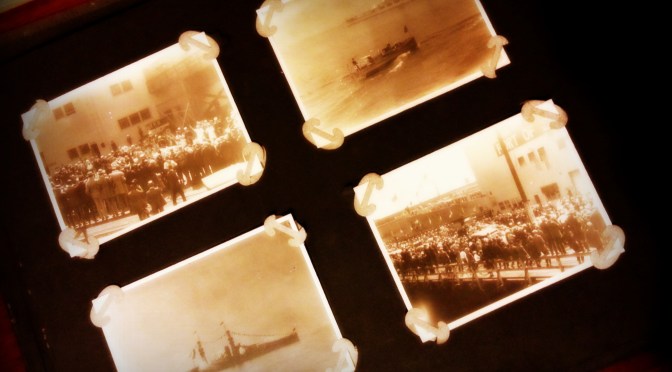
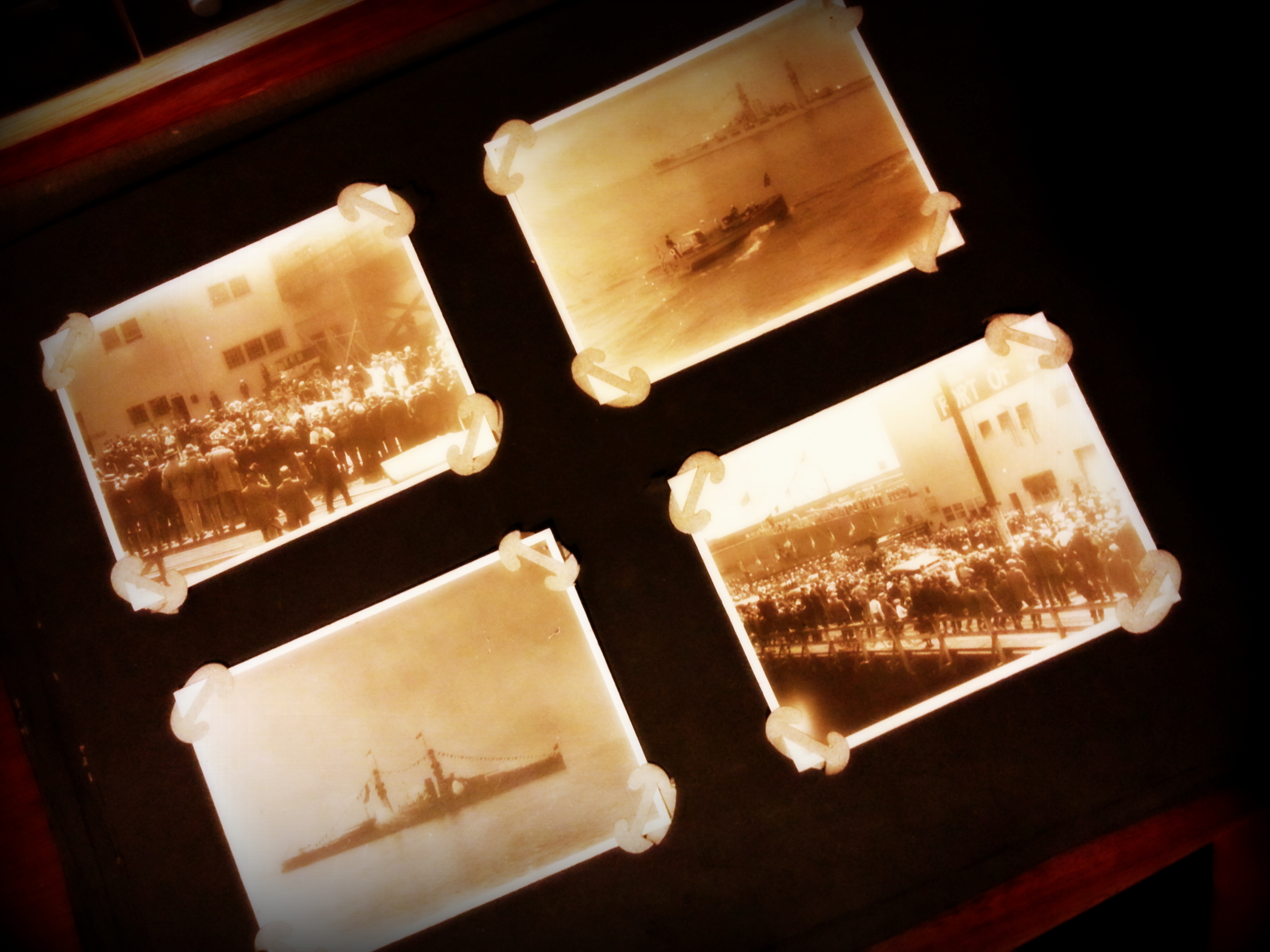
These four photos had intrigued me. They had caught my eye earlier but there were other precious photographs to scan and retouch.
But the curiosity killed this old sourpuss.
I had to scan them… and there were fantastic discoveries.
_______________________________
President Harding, our 29th president, arrived in Seattle on July 27, 1923. He was on a 40-day tour of the Western United States.
He would pass away just six days later.
_______________________________
After collaborating with a flickr buddy and author, Shawn Hennessey, we came to the conclusion that this indeed was President Harding’s motorcade at the Port of Seattle. Of course, we will never know for sure who took these photos but they are of the same size and finish of many of Grandmother Kono’s other photos of that time period. Still, they are remarkably an incredible capture historically.
They are unretouched. I thought they look better as-is.
A shuttle bears the colors and a civilian stands at the aft. US Navy sailors are at the fore.Shawn Hennessy believes this to be a Pennsylvania class battleship due to the single stack. President Harding did review the fleet in the harbor (about 50 ships).
You can clearly make out the Port of Seattle signage with the beginning of “Bell Street Pier” on the building. Note the US Marine and US Navy color guards. It is likely President Harding’s destroyer that is docked at pier’s end. The blanket of flowers can be seen on the hood of the President’s limousine, too.
Motorcade begins
The President can be seen closer below. Of note is the agent standing on the limousine’s running board – or more specifically, his clothing. Compare his clothing to other images you can find on the web. You will see gentlemen doffing their hats to the President as he passes by.
President Harding. He will pass away six days later in San Francisco.
__________________________________
Just a glimpse into American history – from a Hiroshima photo album.
I hope you all won’t mind if I feel Grandmother Kono took these pictures in 1923.









 Masako and Spam Musubi