At times, I mix in Memorial Day with it… I don’t think there’s anything wrong with that.
They will always be veterans in my eyes.
____________________
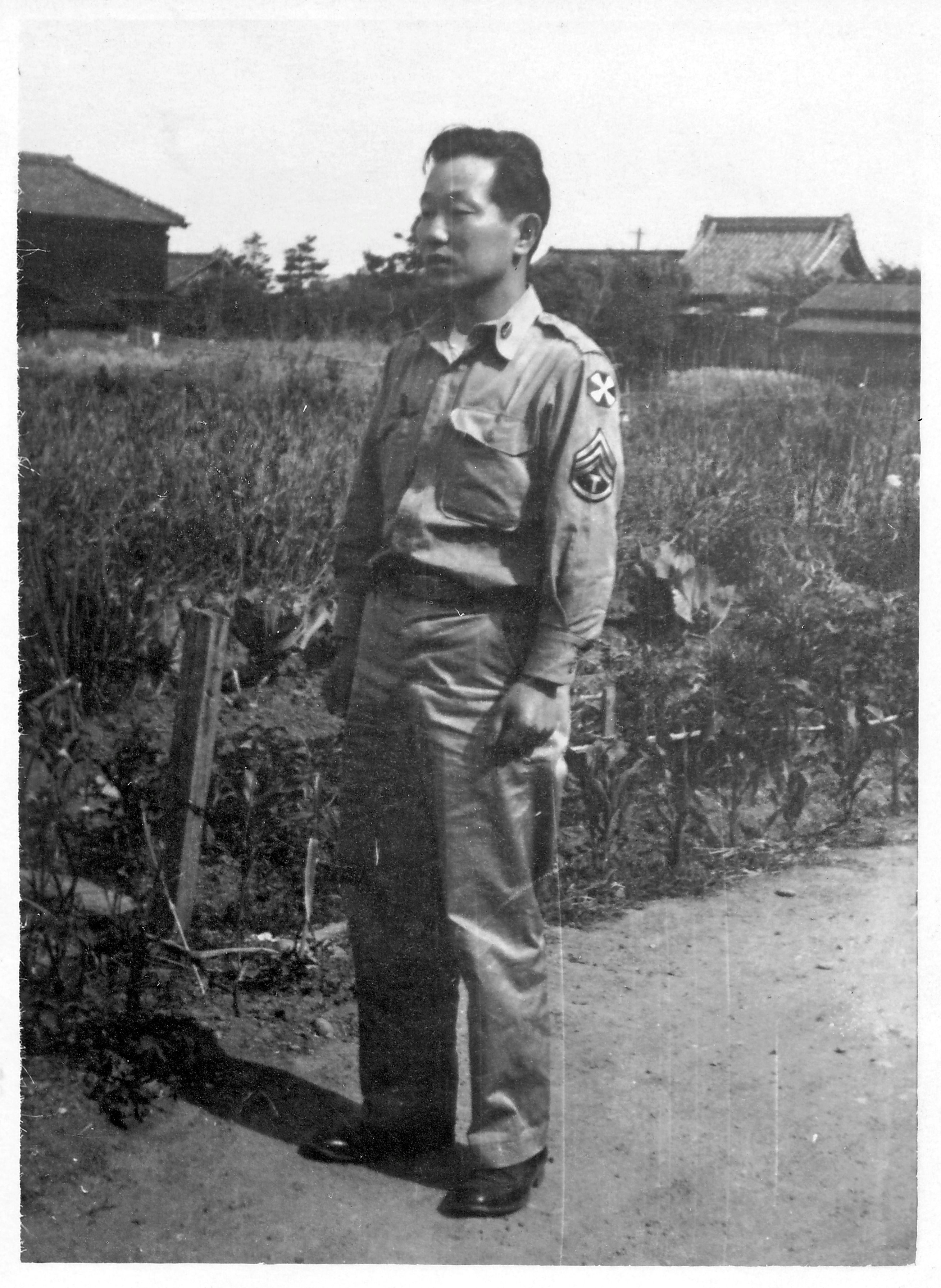
Dad at Miyajima, Hiroshima in the spring of 1949. I now have a bad case of “tennis elbow” and can’t retouch:
He was part of the US 8th Army’s Military Intelligence Service and served during Occupied Japan. Being a “kibei”, he translated during the War Crimes trials, interrogated Japanese soldiers being released by Russia, Korea, Manchuria and China and translated Japanese war documents for intelligence.
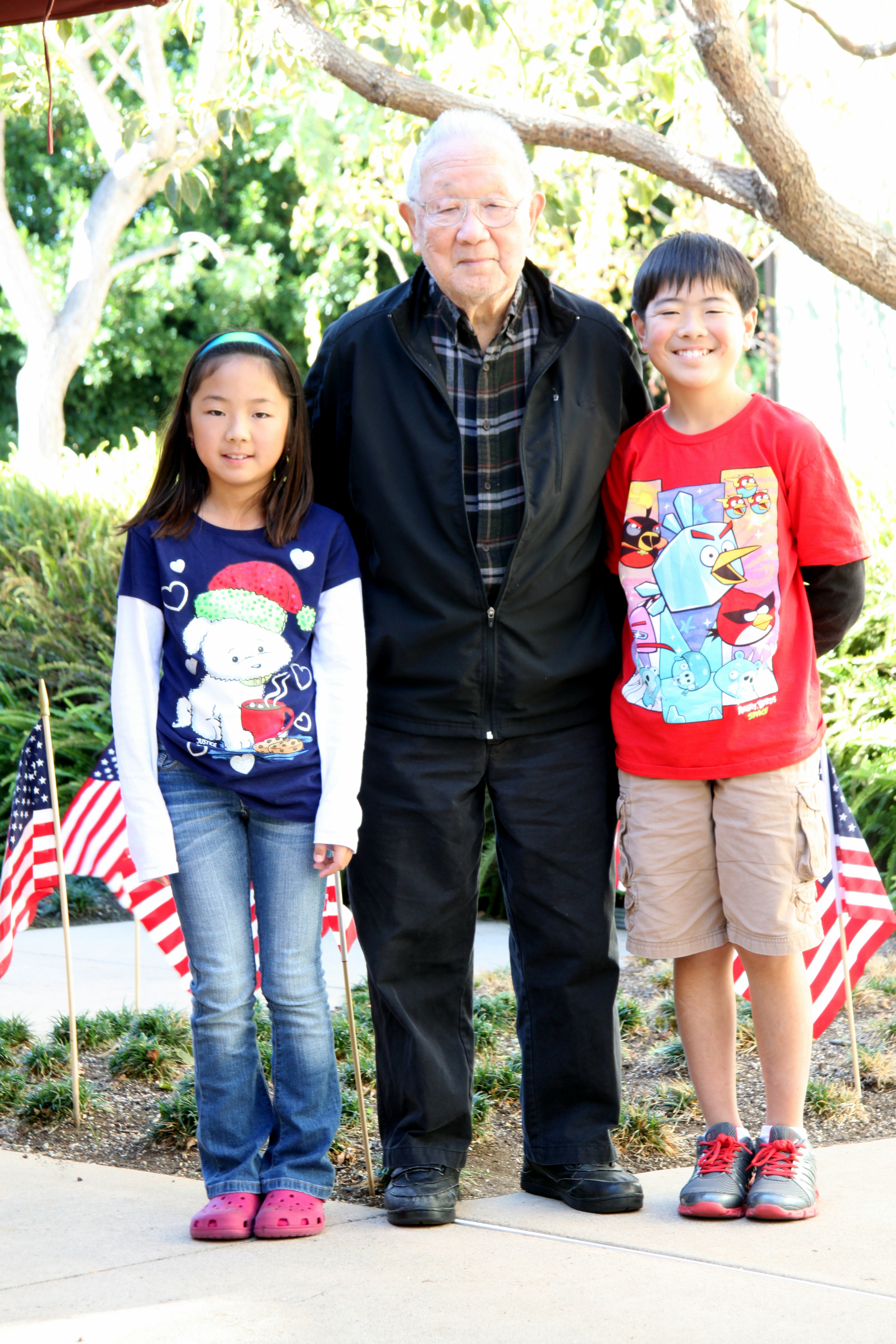
Dad today with my two littlest kids:
Ninety-three years old.
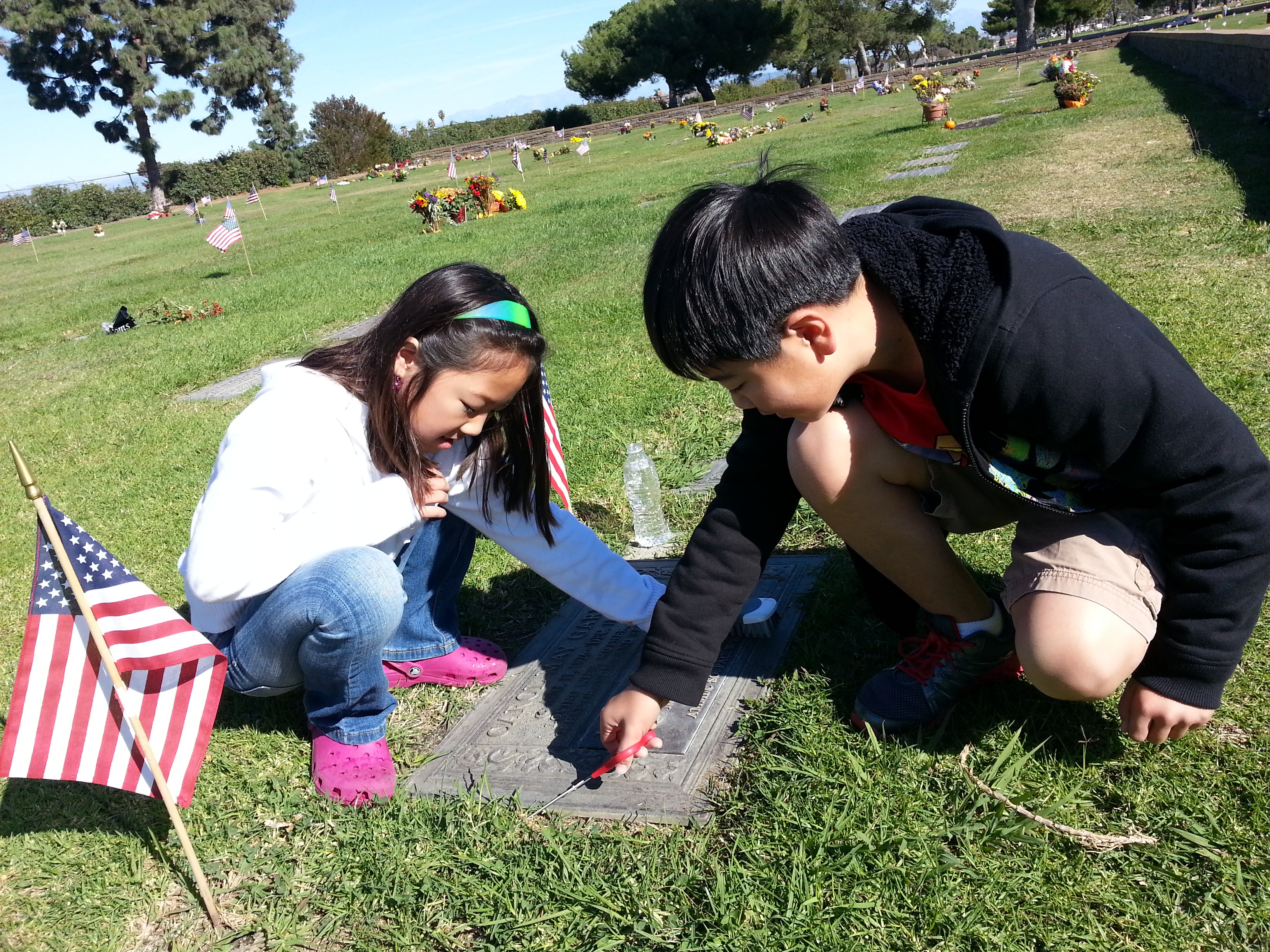
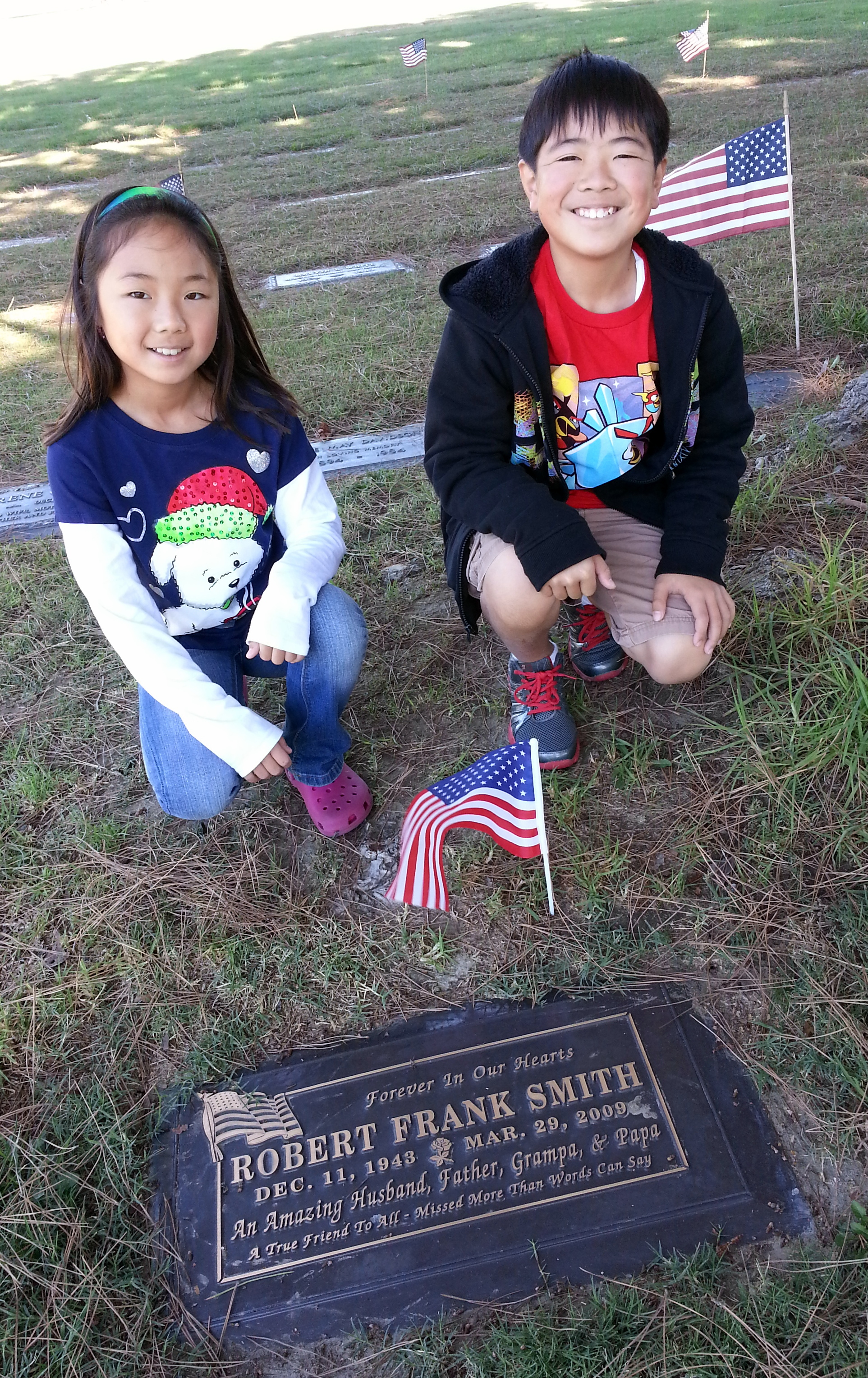
Went to pay our respects to Old Man Jack. Sun was just too low in the sky for a good pic… 😦 Miss you, Jack.
And went to see good ol’ Bob, too… What a kind, great man he was.
In the past several years, as his dementia progresses, Dad is repeating many times how he broke his elbow as a young boy… “Many times” like as in every four minutes. No…every two.
I thought, “He doesn’t remember he ate like a horse ten minutes ago… How can he remember something that happened 80+ years ago?”
Well, I just HAD to find out about his story… and I did.
_______________________________
The story (which never varies) is/was he was playing “oninga”, or tag, with the neighborhood kids. “There was nothing else to do then,” he would tell me. They would end up in the yard of 正覚寺 – pronounced “Shoukakuji” – the Buddhist temple which is a hop, skip and a jump from his home. No wonder he excelled in the triple jump at Nichu.
You can see a tiled roof on the tallest structure to the right of him. That is 正覚寺.
The tiled roof of “Shoukakuji” can be seen behind and to the right of Dad in this 1948 photo. He is standing alongside his childhood home.
For those who like visuals:
Satellite view of home and Shoukakuji, 2012.
He would tell me (over and over) that while playing tag, “…I tried to get away so I jumped on this big round stone then leaped up to a branch on big a pine tree in front of 正覚寺.”
Now that I know he did the broad jump at Nichu, I thought this jumping thing was therefore plausible. (Did I mention I’m a writer for “Mythbusters”?)
“Trouble is, I jumped too far so my hands couldn’t grab onto the branch. I slipped off the branch then broke my elbow when I hit the ground”.
OK. So now, after “An Atomic Spark From a 1937 Yearbook“, I also know he excelled in the triple jump at Nichu. Plausible. (See… More proof I am a writer for “Mythbusters”.)
To this day, he cannot completely straighten out his right arm. It’s crooked. He now tells this story to my youngest kids, Jack and Brooke… Every four minutes.
______________________________________
On September 7, 2012, I had to know. Off to 正覚時… But unlike my agile father of the 1920’s, I was walking very gingerly. There were four humongous blisters on my toes from walking in Japan and (from being tricked into) climbing Mt. Misen on Miyajima.
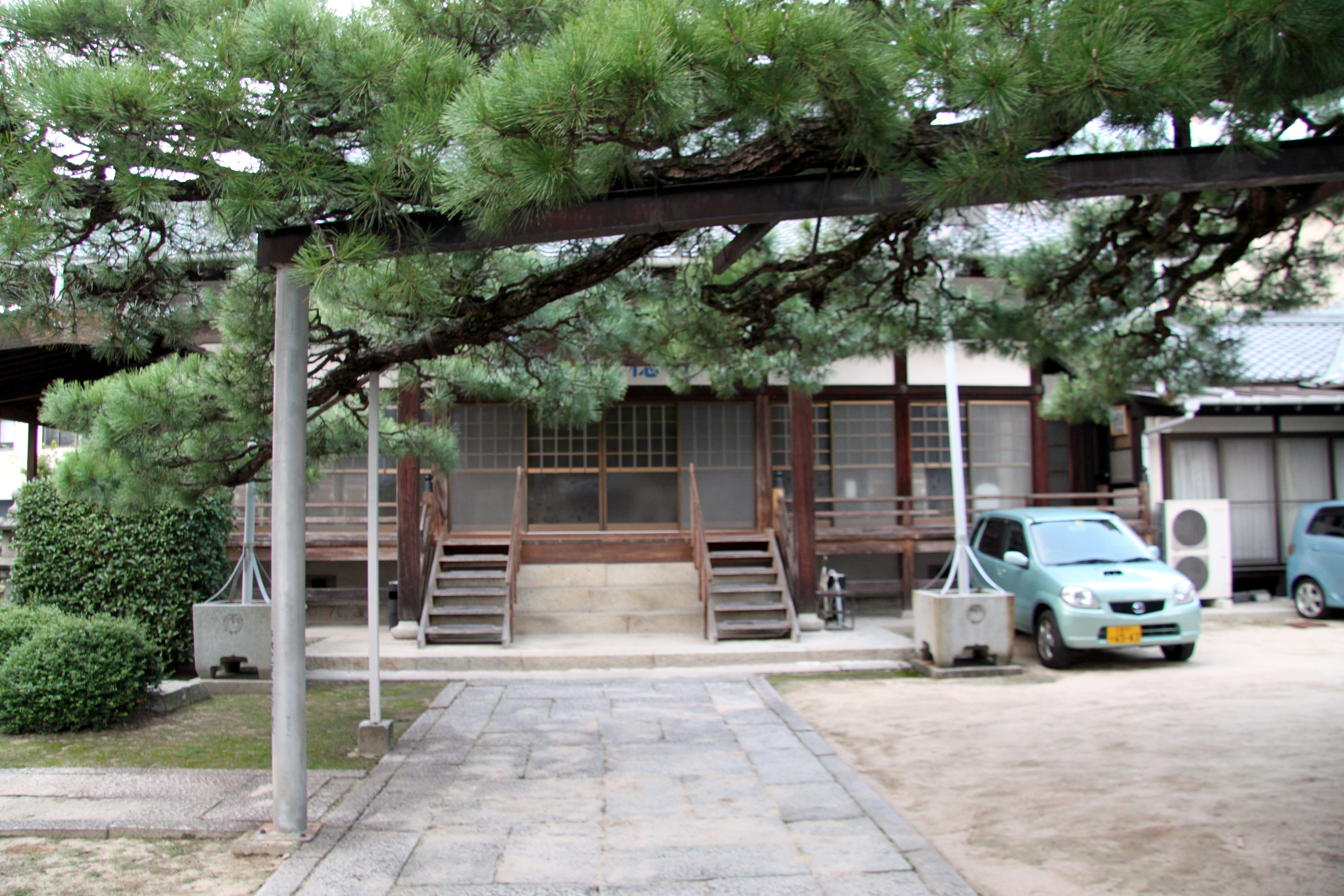
The sign at the entry gate, or “mon”. Shoukakuji’s middle character is written with an old Japanese character.
Indeed, there was a Japanese pine tree, or “matsu”. A huge one. You couldn’t miss it as you walk through the “mon”, or gate. It was so huge, the temple had steel braces installed to help hold these majestic branches up.
Steel posts and braces were installed to help hold up these ancient branches.
Off the to right, was the base of the tree. A puny trunk in relation to the Goliath branches… It was hard to believe at first this small trunk was the heart for this proud tree.
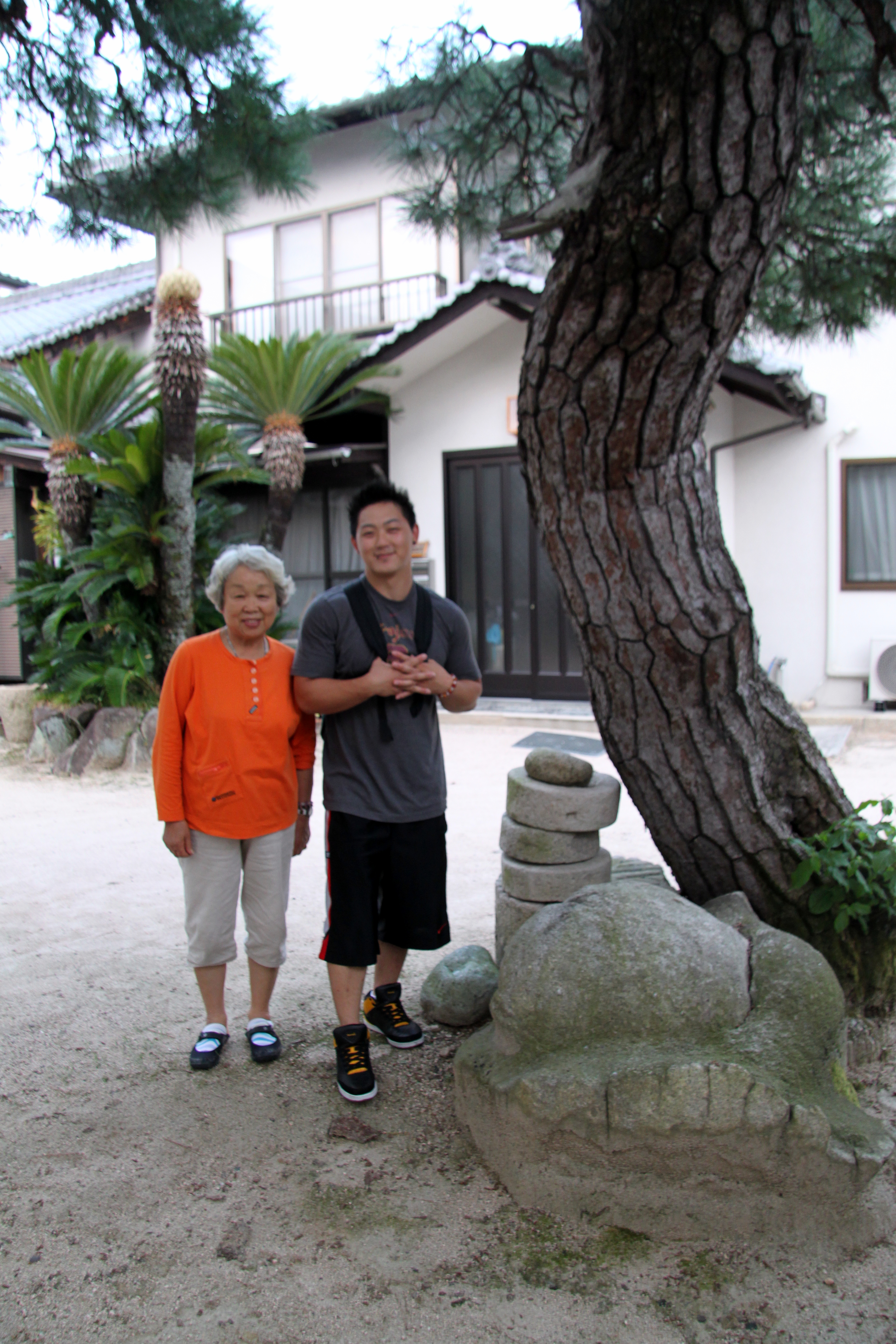
Then… at the base… was a large round stone. Could it possibly be? Plausible as we don’t know how long the stone was there… Am I tough?
Masako and my son Takeshi stand next to the large round stone and pine tree made famous by my father some eighty-plus years ago.
But where’s the branch my father jumped for? Myth: Busted!… or so I thought.
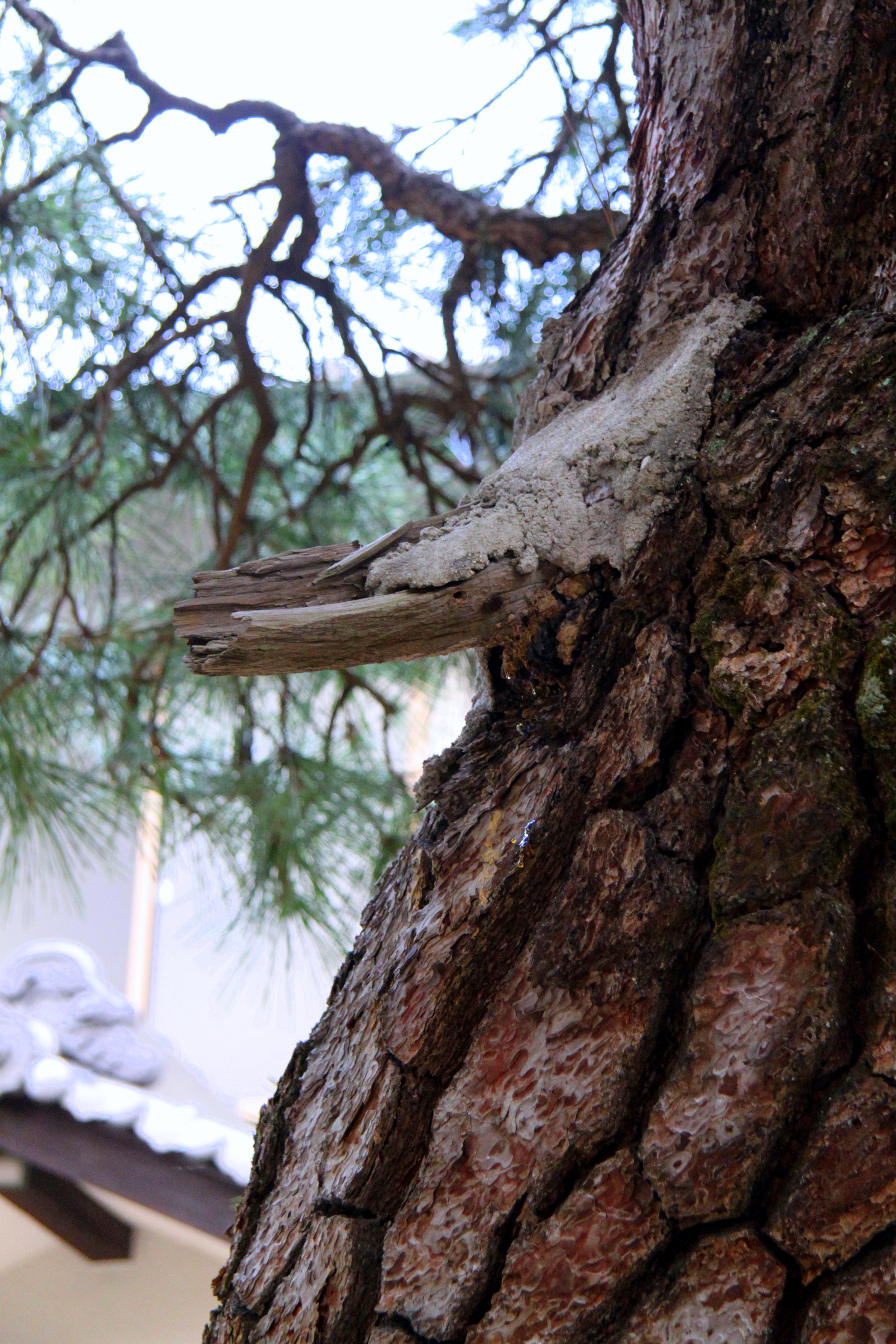
Then we saw it. Above my son Takeshi in the picture. The base of a broken branch. It was at the right height! OK… Myth: Plausible.
Here is the branch that Dad supposedly leaped for 80+ years ago…but fell and broke his elbow.
But conclusive proof was just beyond reach. There was no evidence as to age of the tree or how long the stone was there…
Then, as if Aunt Shiz summoned him, the reverend of 正覚寺 came out…with his wife. He was about 90 years old. Almost as old as my dad but he still had his wits about him. Thank goodness.
He told us he didn’t know my father personally…but that he played with Suetaro and Mieko, Dad’s youngest brother and sister! He knew Suetaro well, he said. He listened to Suetaro blow on his flute from the house in the evenings.
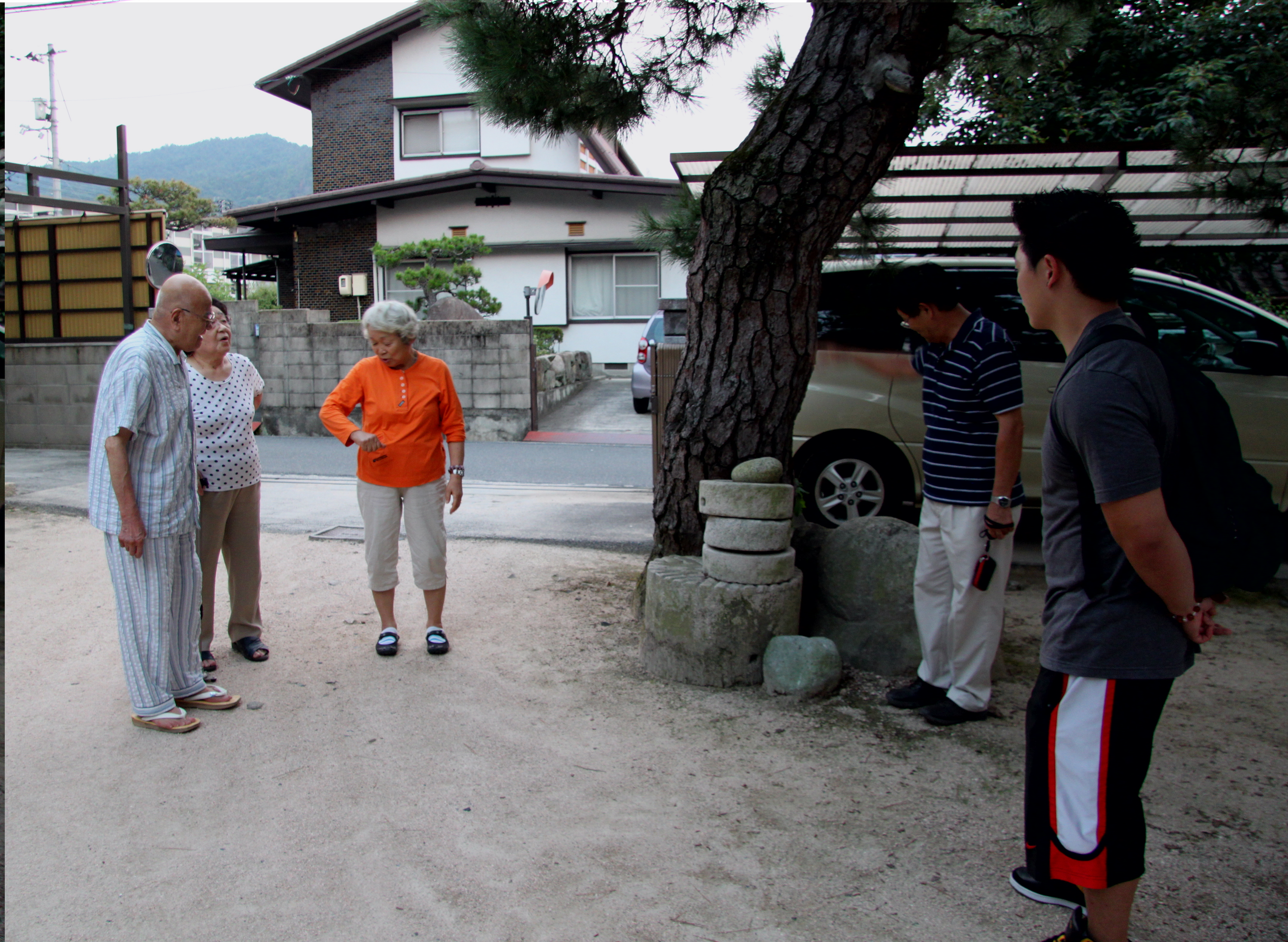
My Japanese wasn’t good enough so Masako stepped in… She explained to the elderly reverend how my dad (her uncle) had jumped from a large round stone at the base of a pine tree here 80+ years ago and broke his elbow.
Masako is mimicking my father’s broken right elbow and his story while my son Takeshi and cousin Kiyoshi watch. Kiyoshi was pointing to the stone to supplement the story.
Unbelievably, the reverend said with pride, “The pine tree is about 400 years old…and that stone has been there for as long as I can remember. It hasn’t been moved, either.”
Then the wife said that a number of years ago, the branch had broken off but it was very long. Then after it broke off, “…a swarm of bees made a home inside. We had to seal the crack unfortunately,” to account for the mortar on the branch.
Was his story a myth? Busted? Plausible? Confirmed?
Myth: Confirmed.
Dad wasn’t imagining ANYTHING. His memory is intact from that time.
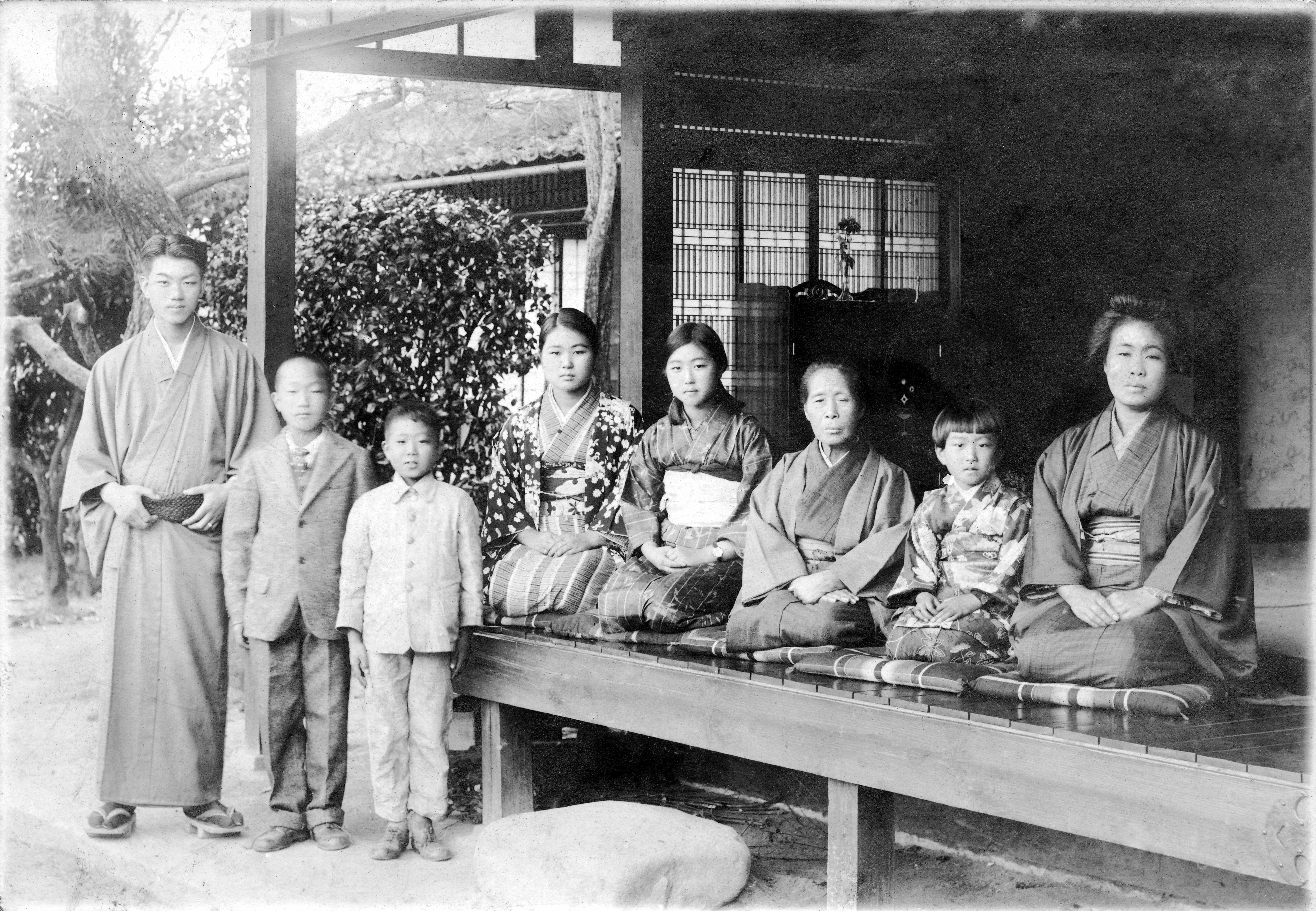
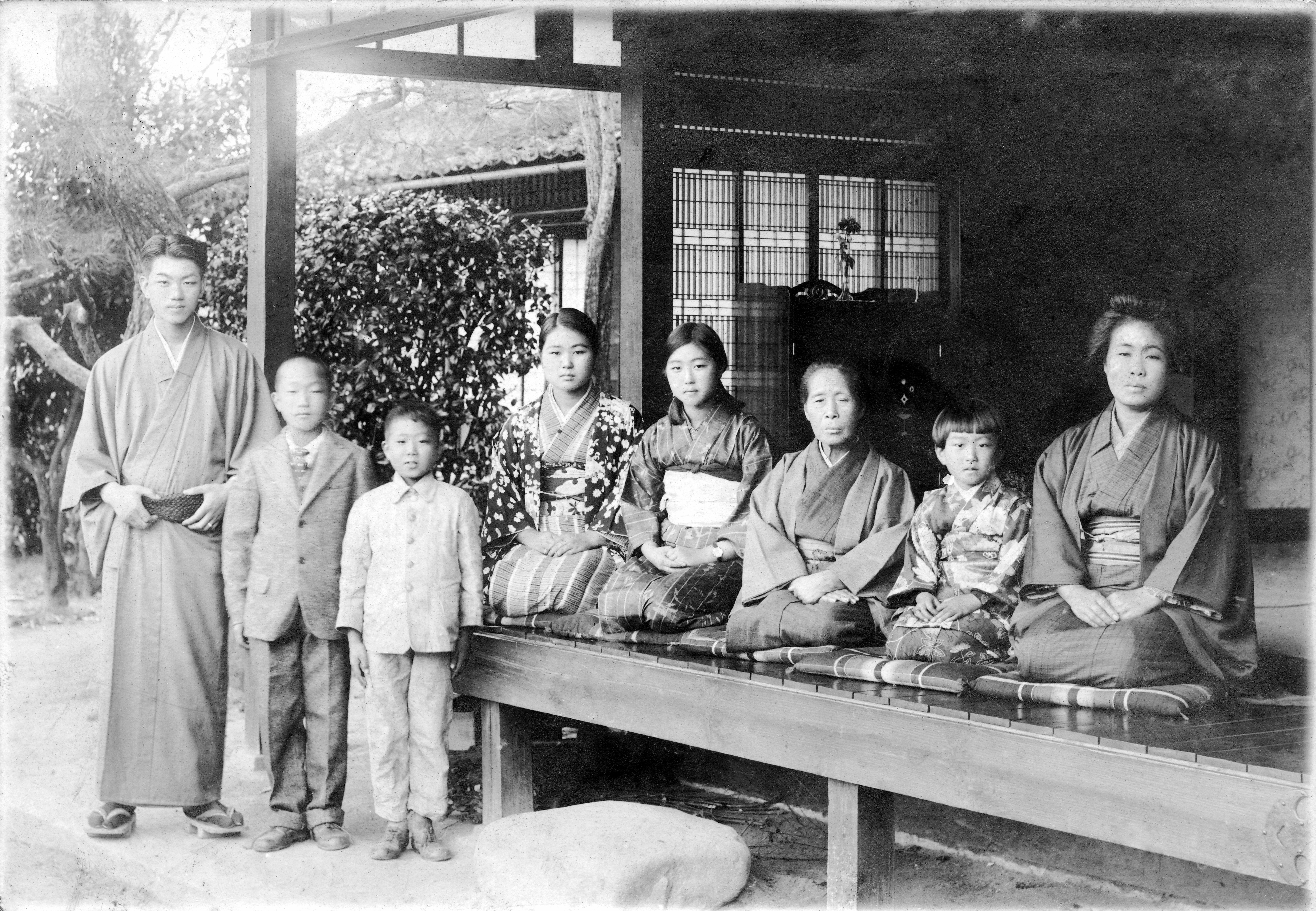
They walked on it. They posed for family portraits on it. They passed away on it. It felt as if their souls were infused in it.
Although my ancestors have come and gone through that house for about a hundred years, the old sakura wood shared their souls with me.
______________________________________
Then:
The Kanemoto’s sat on the cherry wood walkway for a portrait. Notice the glass paneling at the center-rear. My father (second from left) is sadly all who remains from that generation. Circa 1928, Hiroshima, Japan.
Now:
Although aged and weathered, the sakura (Japanese cherry) wood upon which my ancestors sat upon for family portraits is unchanged. Even the glass paneling in the background is the same.
____________________________
While I am certainly not in the construction industry, my father’s family home is based on the Edo design era. Generally speaking, they are built on stone foundations, with supporting square timbers and a raised floor. “Tatami” mats were used for flooring.
My father, while now 93 and suffering from dementia, fondly recalled the floor plan of the Kanemoto house…especially of the main room seen the family portrait. He said it had a “tokonoma”, or a small alcove alongside the altar, or “butsudan”. He also clearly recalled the floor space measured by the number of tatami mats used; in this case, “hachijyou” or eight mats.
This is the room in which my cousin Masako “saw” Aunt Shiz a few days before she passed away.
____________________________
The house was indeed damaged from the atomic bomb’s shock wave. This same shock wave shook the Enola Gay violently even while trying to escape the blast at about 30,000 feet altitude. She was 11-1/2 miles away.
The house is about 4-1/2 miles away by way the crow flies. Almost due west of the hypocenter. Masako was knocked down by the hard-hitting shock wave while in her classroom.
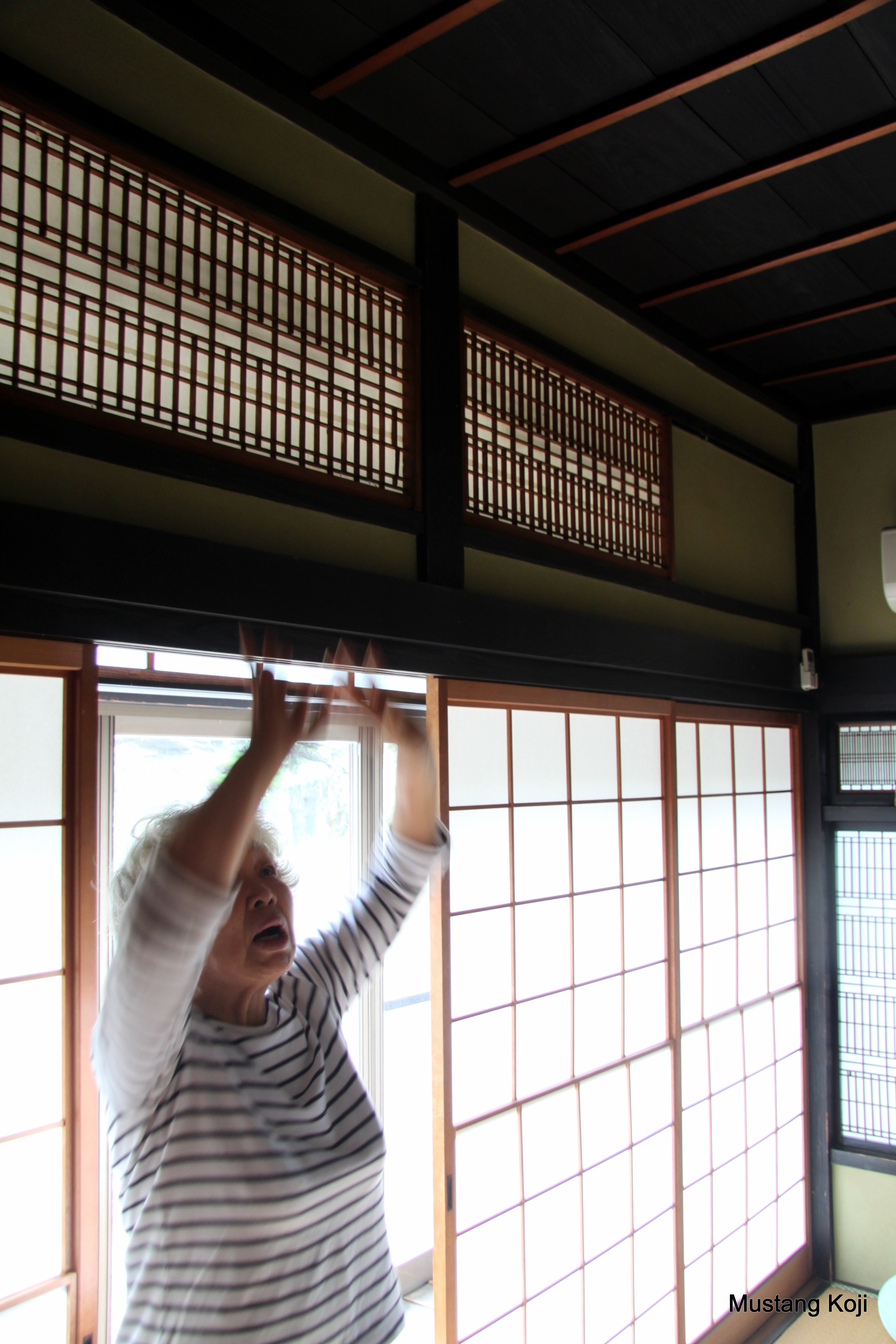
A low lying hill called Mt. Suzugamine served somewhat as a barrier, deflecting the shock wave. Still, nearly all of the sliding door panels were knocked down and the ceiling was sucked up more than a foot per Masako. Roof tiling was also blown away from the force.
Masako is trying to show how the atomic bomb’s shock wave lifted the ceiling up over a foot. It is repaired now but was left as-is for decades.Masako in the process of trying to show how far the ceiling was lifted by the blast on August 6, 1945.
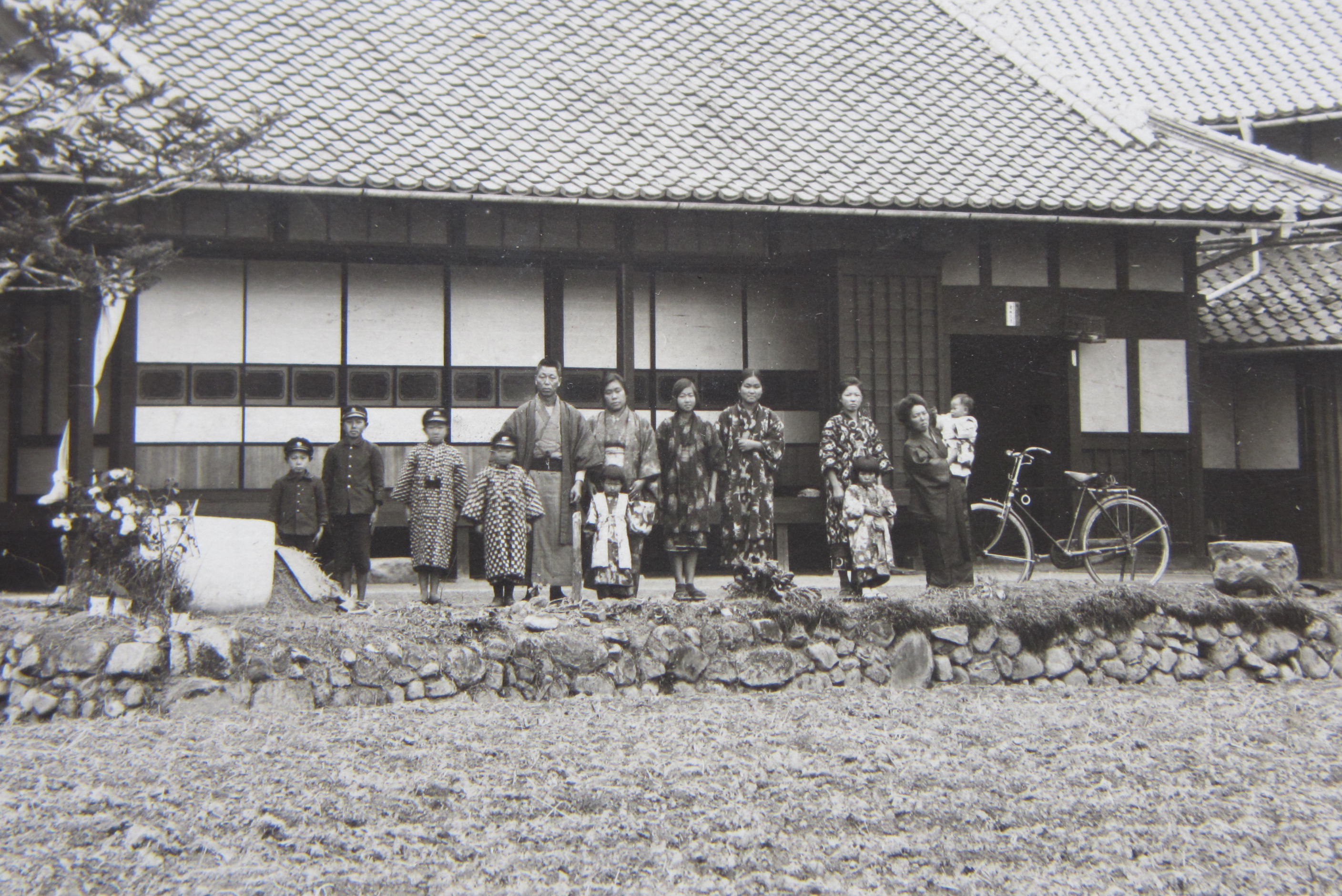
My Uncle Suetaro took one of his last photos in front of this house in May 1944. My grandmother already had her stroke and is not in this photo but his sister, Michie, is standing to his right.
One of the family treasures found during our journey to the family home in Hiroshima this month. Uncle Suetaro is going to war and his death.
Grandmother Kono’s funeral in 1954; my father can be seen in the lighter suit to the left standing next to Michie and Masako (hidden by the flowers):
Grandmother Kono’s funeral at the house. 1954
The home does have spirits within. It’s not cornball. It is an incredible sensation. We were called to those souls in the wood this month. Seriously.
________________________________________
When I saw my son in front of the home, I saw that I’m in the last half of my journey in life… but I came back to myself on that old sakura wood.
Early family picture in front of the house. The entry is on the right.My son Takeshi standing next to the Kanemoto name in front of the house just this month. The entry can be seen behind him.
Although my Aunt Shiz passed away ten days before my son and I were to travel to her childhood home in Hiroshima, I believe it was her caring soul that made our journey eerily complete.
Time for heebie-jeebies.
______________________
L to R: Uncle Yutaka, Dad, Uncle Suetaro, Aunt Michie, Aunt Shiz, Great Grandmother Kame, Aunt Mieko and Grandmother Kono at the Hiroshima home. Circa 1928.
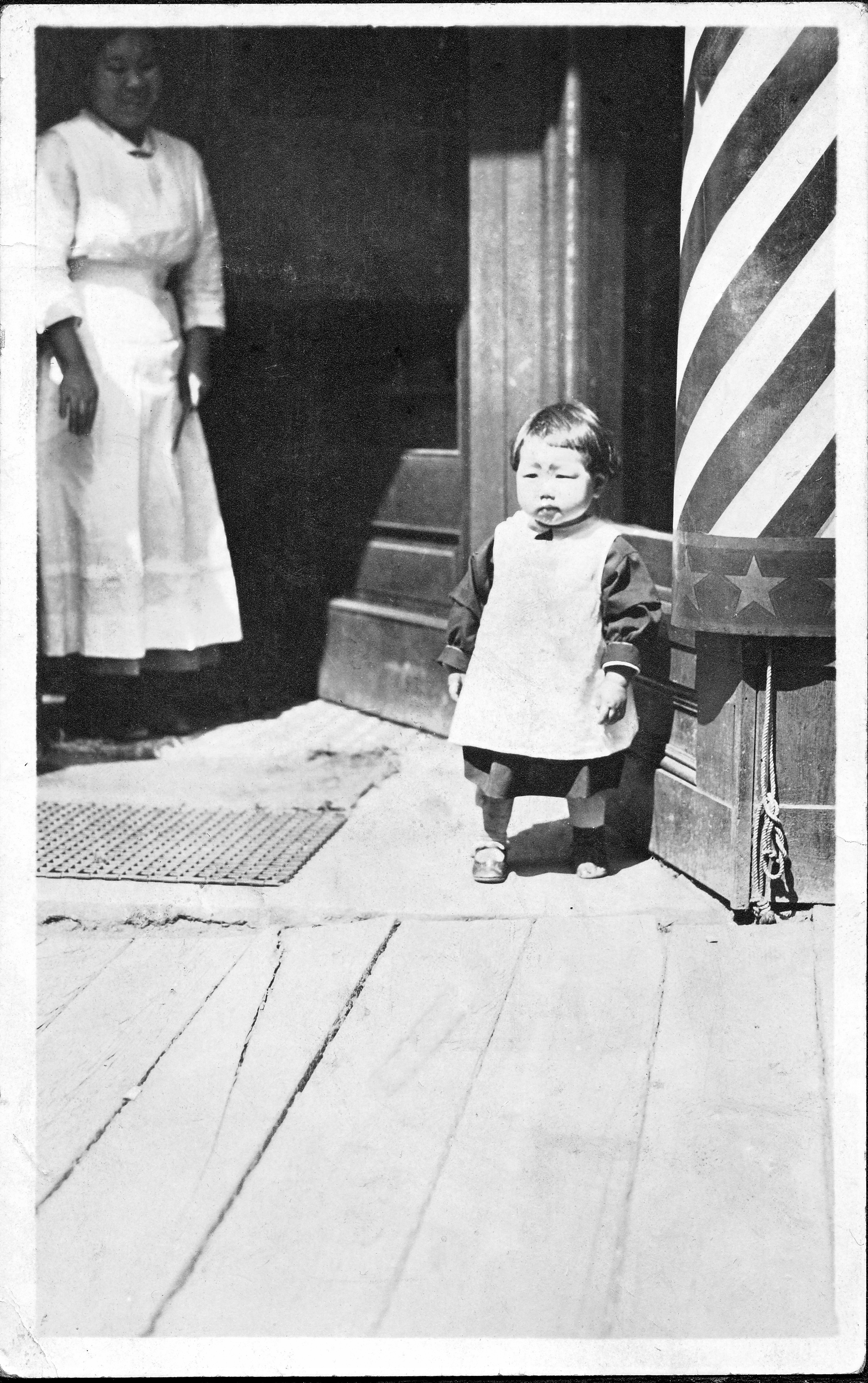
Like all but one of the siblings, Aunt Shiz was born in Seattle in 1916. My grandparents operated a barbershop as mentioned in “Masako and Spam Musubi“, the first story in this blog. In the picture below likely taken early in 1918, she is standing in front of her mother Kono at their barbershop in Hotel Fujii near King and Maynard in downtown Seattle. Grandma Kono is smiling while looking on; she appears to be holding a straight razor. My relatives tell me Grandma was great with the customers and gave excellent shaves. (If it is a straight edge razor, she’s holding it in her left hand. We have a number of lefties in our family. Hmmm.) Notice the wooden sidewalk:
Aunt Shiz standing out in front of the barbershop; her mother (my grandmother) Kono smiles while looking on. Kono is holding a straight razor; she apparently gave great shaves and the customers enjoyed her friendliness.
In this photo taken about five or six years later, the wooden sidewalk has been replaced with concrete. Aunt Shiz shows her friendly character while dancing on the left. You can make out “Fujii” on the sign hanging overhead in the background:
A happy and smiling Aunt Shiz dancing on the left. The barbershop’s poles can be seen behind her. Circa 1923 in downtown Seattle.
Masako tells me Aunt Shiz was the village “hottie” as she grew up back in those days. It made us laugh but it was true. Surely, she broke a lot of the young boys’ hearts in the village.
She returned to Seattle on April 7, 1935, a vibrant young lady. Amazingly (well, really not), her granddaughter looks very much like her at that age. Genes.
She married and had three boys and one girl. All but one were imprisoned during World War II. They had the dehumanizing horror of having to first stay in vacated horse stalls at the Santa Anita Racetrack in Los Angeles before being transported under armed guard in blacked out trains to Manzanar where they stayed until war’s end. They were American citizens. Incredible, isn’t it?
_______________________
Aunt Shiz, who was my dad’s older sister and last lving sibling, was a true “Kanemoto” as the saying goes. They were much alike…especially when they talked in their “Hiroshima dialect”. Funny they aren’t able to remember when their birthdays are but they sure remember their happy days as children in that Hiroshima home. Both loved to eat. And eat they did. Most of all, they loved sweets. Don’t ask why.
When I see Dad now, I always take him Japanese treats – mainly “manjyu” and “youkan”.
Typical Japanese sweet treat called “manjyu”. Aunt Shiz and Dad love them.Sweet Japanese treat made out of sweet beans, or “yokan”.
Last October, shortly after her 95th birthday, I took Dad to visit with Aunt Shiz. It is a long drive to and from. While Dad had great difficulty remembering why he was in my car – not just once but several times – there was no hesitation by either of them when they first got a glimpse of each other at Aunt Shiz’s senior home:
Yes, I took a bag of yokan. Its on the front right in the video in a cellophane bag. There were three different flavors, too. They ate them ALL. Really.
But they couldn’t remember who was older. Absolutely precious to our family.
At her funeral service in Los Angeles, her grandson described her perfectly as a very warm person. She loved to hug and give her young relatives a peck on the cheek. That was Aunt Shiz.
_____________________
But back to the story… Some heebie-jeebie stuff. You know… Stuff that gives you a year’s supply of chicken skin.
Our journey to Hiroshima was planned for months. My decision to do so was made after I met with Masako and the others in Hawaii in May and returned home…or so I thought I made that decision. It was as if something took over my thoughts and actions. It was kharma. I was also going to take my oldest son Takeshi (24 years old – very important. Remember that.) who had NEVER been out of the country.
As the time neared, our Hiroshima family was excited my son and I were going. Although those of us here in the States were unaware, in the extreme heat and humidity of Japan, my cousin Toshiro went deep into a 100 year old wooden shed which still exists in a last ditch effort to uncover past family information. He found it…about a thousand pictures from the late 1800’s through shortly after war’s end. That is where the photos of Aunt Shiz and the barbershop emerged from although all were damaged by mildew and insects. They were extremely elated and flabbergasted to have found these vintage family treasures still existing. They began to go through them in the main family room where their “butsudan”, or family altar was. The altar is also about a hundred years old.
A few days after they looked over the treasure, Aunt Shiz passed away quietly… She had fallen asleep in her wheelchair like she frequently did but this time, just didn’t wake up. Oddly, her daughter and my cousin Bessie, who diligently and energetically cared for her for many years, said “…she said she wasn’t that hungry that evening then just passed away”. Not having an appetitite is NOT Kanemoto. I will have to remember that.
_____________________
Bessie immediately notified the family in Hiroshima at which time Masako immediately said, “I saw Shiz in the room while we were looking at the pictures. She passed through the house.” We all got chicken skin when we heard that. Masako does not make things up and is as sharp as a tack at 78 years of age. She has all her wits about her. (That last trait is NOT typical Kanemoto, by the way.) We don’t doubt her.
Bessie suddenly requested I take some of her ashes back with me to the family home for interment. I was honored.
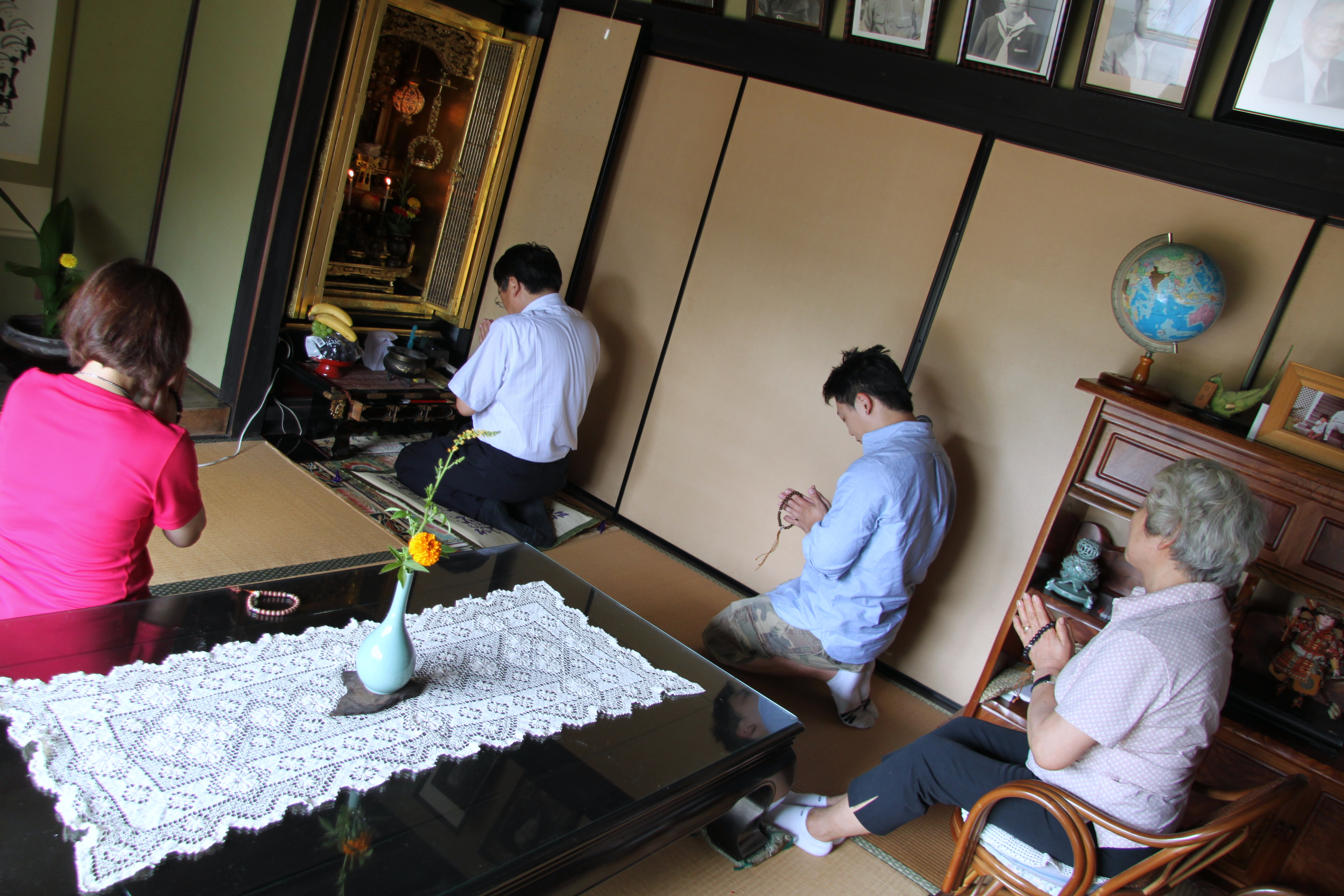
After my son and I arrived at the family home with Aunt Shiz, my cousin Toshiro immediately placed her ashes on the 100 year old altar…in the same room where Masako saw Aunt Shiz. Again, Masako said to us she saw Aunt Shiz in that room before she passed through the house. Creepies.
Toshiro placed Aunt Shiz’s ashes on the family altar. The room is basically the same as it was when Aunt Shiz lived here about 80 years earlier.
Shortly thereafter, my Hiroshima family surprised my son and I with the many, many vintage photos. Then to add to the heebie-jeebies, Toshiro remarked, “We know Masako saw Aunt Shiz’s spirit in this room shortly before she died while we were looking over our ancestors’ pictures. Aunt Shiz could have passed away two months ago or next year. But she knew you were coming and in her soul, she wanted to come home now with you. She arranged for all this to happen at this time. She is happy now.”
Wow. I felt like if a day’s worth of chicken skin out of Foster Farms was thrown on my arms. Really creepie-crawly.
_________________________
Not over yet… We had her official interment into the family crypt a few days later. My other cousin Kiyoshi – another kind hearted person and the man who invented the first EDM device – came with us to the family burial plot, or “ohaka”. The stone ohaka holds the ashes of my grandparents and their deceased children – including my Uncle Suetaro who was killed on Leyte in the Philippines during World War II as a soldier of the Japanese Imperial Army.
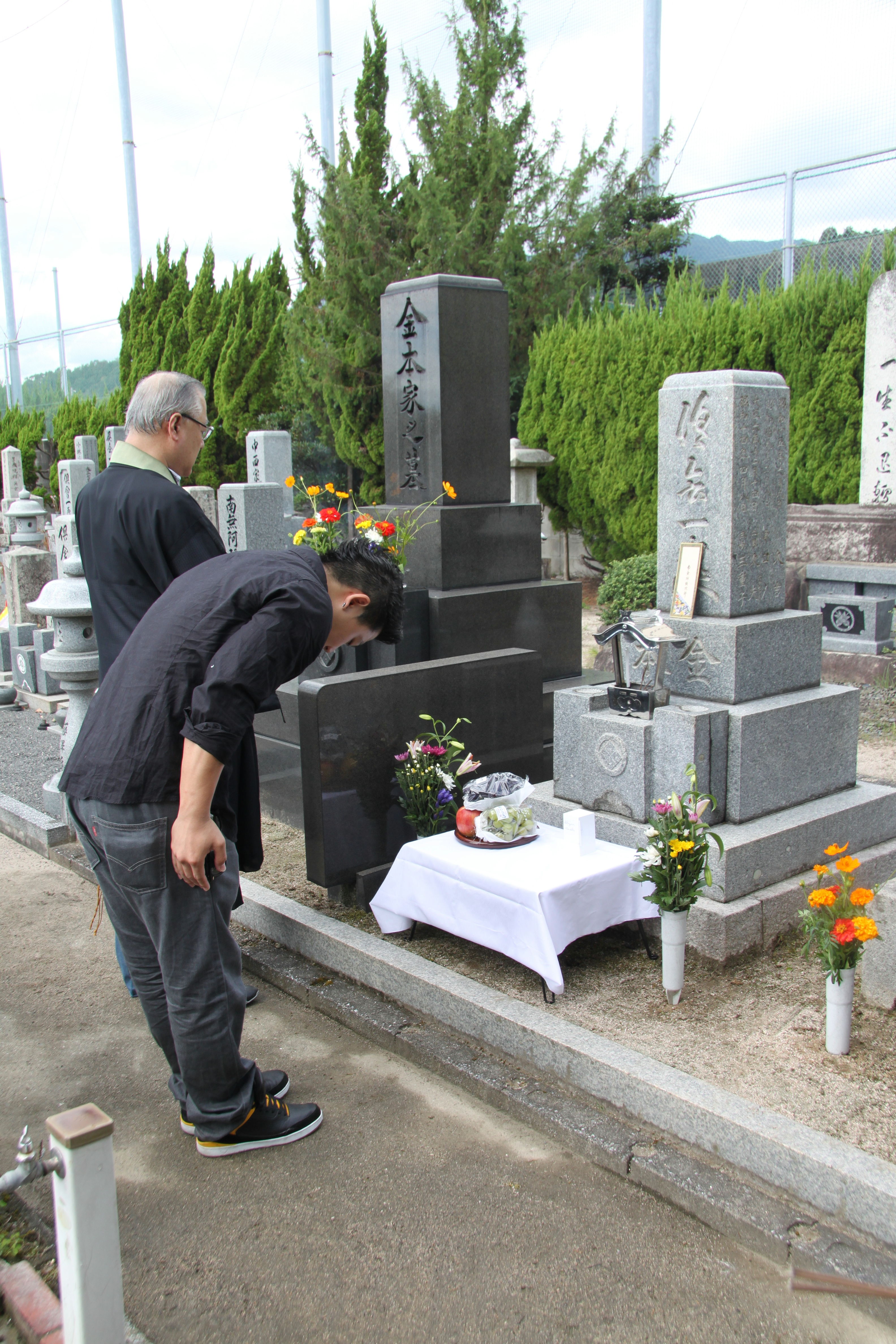
As my son was cleaning the ohaka prior to the interment, Kiyoshi said to my son and I, “Suetaro was 24 years old when he was killed. Now, your son is meeting Suetaro for the first time. Your son is 24 years old. It was all planned for by Aunt Shiz. She picked this time to come home and for Takeshi to be here and to meet Suetaro. It was meant to be this way. To help strengthen our ancestral family bonds although an ocean separates us.”
My 24 year old son bows deeply and reverently in front of the family crypt holding the ashes of Suetaro who was killed at 24 years of age. The ashes of Aunt Shiz can be seen in the small white box on top of the white cloth.
_________________________
He was right. Masako and Toshiro are right. Aunt Shiz picked this time to come home. She knew we were going. She decided Takeshi was to come. She made everything happen as they did. My son was very moved and affected by this coming together of family…so much so he cried at our farewell dinner.
“Koji, don’t let anyone tell you different. War makes good boys do crazy things.”
That was the first time Old Man Jack shared something with me about the war in a voice of unfeigned remorse. In turn, it was one of my first journeys in his time machine in which he allowed me to ride along.
Front row seats. Free of charge.
It was in 2002 to the best of my recollection. It was just before my littlest firecracker was born.
__________________________
KA-BAR. If you are a World War II US Marine who served on “those stinkin’ islands”, there is no explanation necessary.
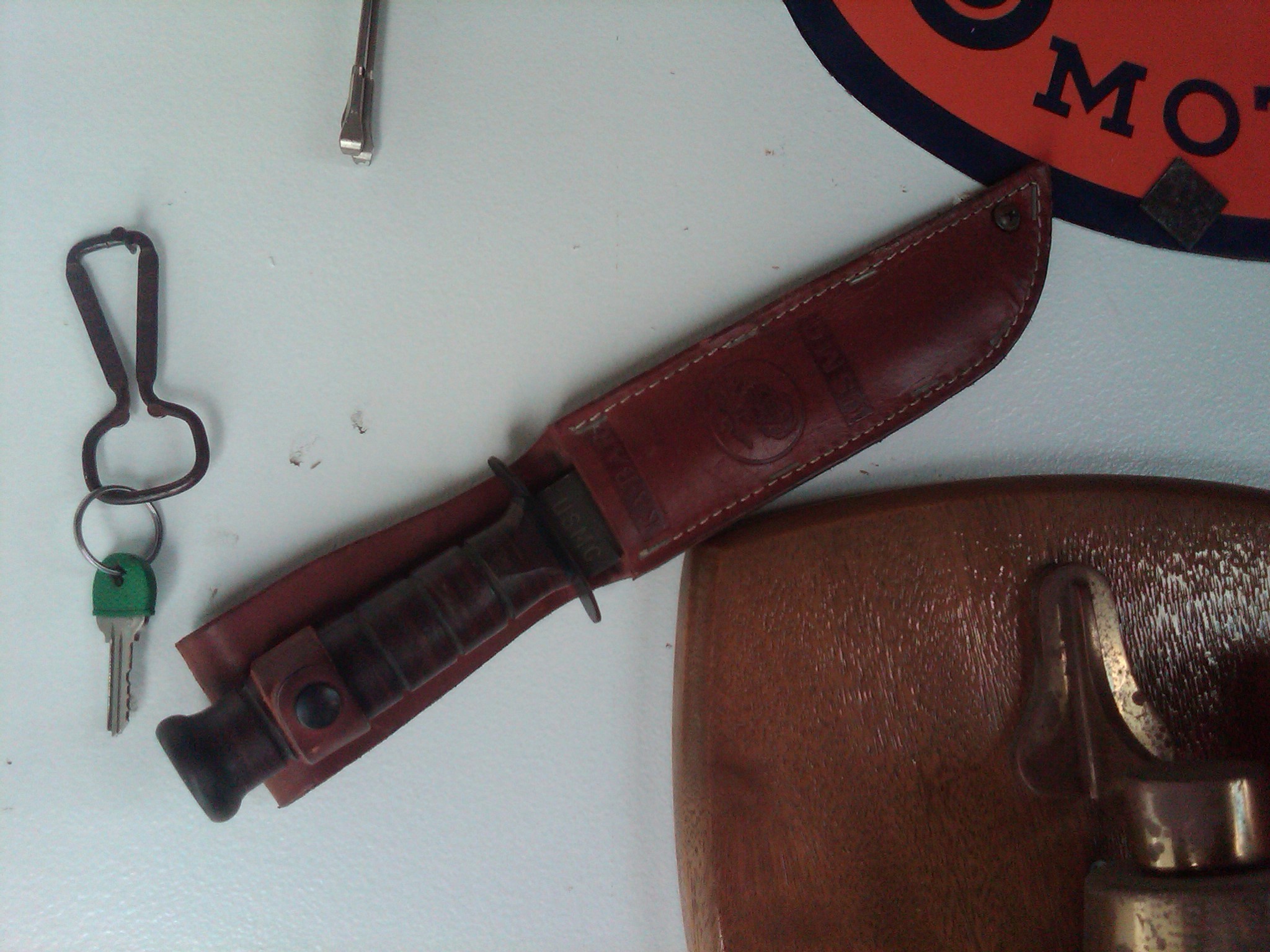
My friend’s KA-BAR. He stated it was his grandfather’s who had served in the Pacific Theater. He allowed me to hold it. Its mass will stun you.
A KA-BAR was a Marine’s most prized personal possession. It was always at their side.
They opened their C-rations with it. Dug foxholes with it. Chopped coconut logs with it. Hammered nails with it. Indestructible.
Most importantly, for killing. Designed for slashing and stabbing. Desperate hand-to-hand combat. To the death.
The KA-BAR served them so well that many Marines who survived passed it down to their children.
Old Man Jack said several times, “I’ll tell ya – us white caps always tussled with the Marines ‘cuz they thought they were better than us…but there wasn’t anyone better at protecting your sorry asses with theirs when it came time.”
_________________________
(If you are prone to nausea, you should not continue to read this Old Man Jack story.)
I did not know this free ride was coming. It was unexpected and spontaneous. I recall that clearly.
That afternoon, he began describing something vile he witnessed during the war. Today, I fully realize he was trying to vomit demons out from his soul.
He needed to.
Jack visiting at my house on Sept. 23, 2006. He would fall gravely ill about a year later.
________________________
He didn’t tell me what island; that would be his pattern up until his death. If he was talking about something a young man should never have witnessed, he would never say what island he was on. However, my educated guess as to the year would be late 1943 or early 1944.
Old Man Jack said to the best of my recollection that “…the Japs broke through our perimeter”.
“When the fighting broke out, most of us (the ground crew servicing Marine Corsairs) dove straight into the nearest foxholes. I only had a .45 and I kept my head down except for a dumb ass split second or two…” He tried to mimic what he did by extending his neck a bit and flicking his head left and right.
“All hell was breaking loose. Men were screaming all over the place. You could tell which rounds were from us and which ones were theirs.”
It was all over in a couple of minutes, Jack said. “I did hear moaning then a CRACK from a .45 or a M1…” A Marine apparently dispensed a wounded enemy soldier.
“I got up. There was still a little yelling going on. And I ain’t ashamed to say I started shaking real bad. Then I see this kid (i.e., a Marine) dragging this wounded Jap; he was hit pretty bad but I could tell he was still alive. The Marine grabbed his KA-BAR and sliced open that son-of-a-bitch’s mouth. I could see the Jap was flinching. The kid was trying to gouge out gold (from his teeth).”
Another Marine came over and shot the Jap dead with his .45. The kid yelled, ‘Hey! Why’d you have to go do that for?!’
The other Marine just looked at him for a split second and walked away. I stopped looking.”
Jack then just slowly shook his head.
________________________
I remember Old Man Jack was looking down when he finished. He had on a grey sweatshirt as winter was coming on.
Front row seats in his time machine of nightmares. He just forgot to mention it was on his roller coaster he kept hidden inside.
He had other free tickets for me in the years that followed.
Julia Child in Kandy, Ceylon during WWII and as part of the OSS.
I am a bit of a World War II history buff. While primarily focusing on the Pacific War due to my family’s connections, I thought this may interest the foodies here.
Julia Child was a member of the OSS – Office of Strategic Services. Spying. Intelligence. James Bond. Well, maybe not James Bond. But she was in some dastardly conditions.
One of the few times Old Man Jack would tell me what island something happened on, it would be humorous – as humorous as he could make it.
He HAD to laugh off some of the horror. He needed to survive being under attack by his own thoughts.
_______________________
On January 16, 2011, eleven months before he passed away, we decided to go to Denny’s for breakfast. He hated that place – except for their (gawd awful) coffee. He loved their coffee. And he complained about the coffee on the islands. Imagine that. Denny’s coffee couldn’t have tasted that much different. Denny’s uses ocean water, too, you know, for their distinctive flavor. Perhaps that is why he liked their coffee.
Jack with “Green Island” story and his tradmark grin – Jan. 16, 2011.
“Green Island” was Jack’s last combat station when he earned enough points to be rotated back home. He told me when they yelled out his name, he just ran straight onto this makeshift pier where a PBy was starting up. He jumped in wearing only his shorts and boots. They took off. He was on his way home.
(Click here if you wish to see official US Navy photos of Green Island when Old Man Jack was stationed there.)
In my internet research, I did come across some detailed battle history of Green Island. I printed it out and not knowing how he would react (even after 11 years of friendship), I presented it to him before the (gawd awful) coffee came. I didn’t want him to be TOO alert in case things didn’t go well. 🙂
Well, you can see his reaction. He was “tickled and pickled” I went through the trouble.
________________________________
During breakfast, he told me about one detail he was assigned to on Green Island – the digging of new holes for latrines. Never mind my eggs were over-easy. But he’s gone through hell whereas I was spared. This was everyday fare for him.
He told me he picked out two “dumb new guys” who thought they knew everything for the detail. They went out where the other “used up” latrines were. He ordered them to start digging new holes in this hard coral-like stuff not too far from the other “used up” holes while he “supervised”.
I knew I would get his goat if I interrupted him. That was part of the fun.
So I interrupted him. For fun.
“Jack…dig? Why didn’t you just have them make a small hole then throw in a grenade?”
Well, I asked for it… in Denny’s… on a busy Saturday morning.
“You dumb shit,” he declared with that boyish grin. “YOU could have been one of the dumb new guys. YOU would have fit right in. We didn’t need any more craters! We had LOTS of craters – all around us! So we dug holes like we were ordered to. So shut up and listen!”
Whooo-ee. That was fun… in Denny’s… on a busy Saturday morning.
______________________
I never asked him if he read the history on Green Island. Later on, though, Old Man Jack said he had wanted to go back to those “stinkin’ islands” just to see. It felt as if he wanted to let some demons out.
He never made it back.
Perhaps he’s there now saluting his young buddies he had to leave behind.
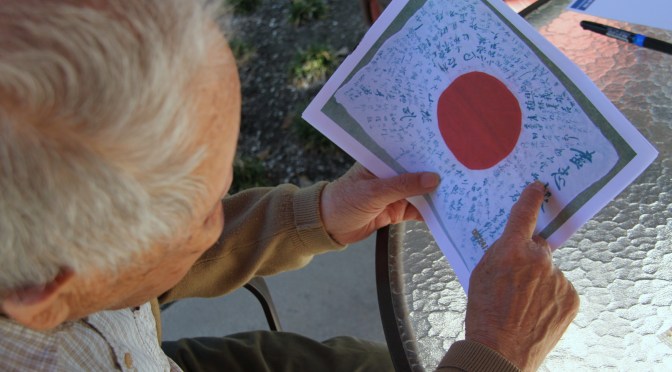
Dad is trying to read the name of the young man the Japanese war flag was signed for. It is not as easy as you may think but the Japanese characters are not only written with a brush and charcoal ink, it is written in an artsy handwriting style. Further, the characters used by pre-war Japan are largely not used anymore. (ps If you look hard enough, you can make out the bruising under his eye.)
World War II Military Intelligence techniques are still important and in use today – but for entirely different reasons.
___________________________
During the war in the Pacific, US military personnel were forbidden to keep notes or diaries in the event they were captured. Nothing more disillusioning to be captured or killed, then have the enemy read about the ammo dump you just left from. Especially for your buddies still stationed there.
On the other hand, Japanese soldiers were allowed to keep notes or diaries. Apparently, the Japanese military saw the diaries similar to “water cooler gossip” at the office.
That was their downfall as Americans like my father translated such documents. The Military Intelligence Service. It was from these diaries that the Allies first began to see that the enemy were not the samurai of lore.
They had gripes of their commander – even by name. They complained of starving, no ammunition, no water. They also had uncensored letters from home – their families were starving, sick or had no home left for the soldier to come back to.
A mortar crewman wrote of how terrified they were to launch a mortar shell at the Marines as for every round they fired, the Marines would send ten back their way.
The MIS did their job faithfully back then on those hell hole islands. Their job was to help kill the enemy.
______________________
The flag.
Today, albeit in a roundabout way, MIS veterans like my father are still doing their job.
Last week, a representative of the “Japanese American Veterans Association (JAVA.org)” contacted me again to enlist the help of my father. As mentioned in an earlier short story, Dad was a “kibei“, or an American of Japanese descent who got schooling in Japan. He was fluent. More so, he still is fluent in reading the pre-war Japanese writing. There really aren’t that many left with this ability. Dad is 93.
Unfortunately, Dad had a bad fall the day the request came in. He fell flat on his face and shattered his glasses in the process.
Apparently, a gentleman had in his family’s possession a captured Japanese flag. Presumably, someone in his family brought it back as a souvenir. Of course, if an Allied soldier brought one home, it may have been removed from a corpse. In the best case scenario, it was taken from a prisoner. You just didn’t find them laying around on the battlefield.
Dad on Saturday enjoying a “youkan”, or sweet bean jelly. He has a pretty good sweet tooth.
According to the request, the owner of the flag stated he wanted to return it if possible to the family. Not an easy task – even for “I Dream of Jeannie”. These flags were created at the farewell party of a soldier who was going to be dispatched to the war and certain death. There is usually the name of the person for whom the flag was presented. If you are lucky, the flag may have a city or town written. I’m sure my Uncle Suetaro received one.
Even for Dad, the complicating factor is not knowing how to read a Japanese character. It is HOW it was written. These were all signed by brush and charcoal ink. The ink lasts forever since it is carbon. But have you ever tried reading signatures? Try your hand at this one:
You get the picture.
_________________________
Anyways, Dad – and while his glasses were shattered in the fall – was able to say the person for which the flag was signed was likely for a Mr. Tokio Miyake. Unfortunately, there was no true town or city named specifically. Nevertheless, we were able to make out what appears to be “Kurayoshi Mayor”, or the mayor of “Kurayoshi”.
Last night, I did a little reserch and almost unbelievably did find a town named Kurayoshi. I tracked down the town’s website and sent a blind email (in my broken Japanese) to the mayor’s office and asked if there was a mayor named “Furuya” during the war.
We’ll see.
_________________________
While my Dad did not participate in the hostilities, his Nisei unit did their job and greatly shortened the war according to General MacArthur. The Nisei’s job was a true secret weapon.
Hopefully, this no longer secret weapon can serve some peacetime good and bring two families to peace.
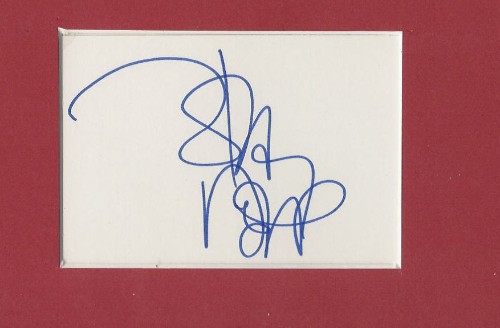
Oh. That was Johnny Depp’s signature. Thought you ladies may like that.
One of the rare photos of Jack and me together as I always snapped the photo… My little Brooke who was about seven at the time took it.
Listening to Old Man Jack’s wisdom was like cotton candy and a movie. The ones you will remember over time are the movies that get super-glued into the consciousness of the movie-goers in a good way.
A few years ago, I went to see Old Man Jack in the Board Room – his cluttered garage facing my house across our street lined by peppercorn trees. Well, actually, he always wanted me to come over. We’d always have a good chat about this and that or he’d let a demon out from enduring combat in the Pacific during WWII. That day, though, I just wanted to get something off my chest about the wife.
When I started to whine about what the wife did, he stopped me after a few words. Dead in my tracks. He knew what I was going to complain about.
He said, “You poked her. Live with it. Now shut the _uck up.”
Very little outdoes short blurts of wisdom from a World War II combat vet. Nothing fancy-shmancy. No big words. Just good ole salty sailor speak. To the point. He earned that right.
Some of his wisdom will be shared here and there without censorship to honor his generation. You will appreciate that. “If you don’t, I don’t give a shit,” as he would lovingly say.
But there is regret. Regret that I did not video Old Man Jack more often. I have excuses. Many excuses…but they all lead to regret.
___________________
A couple of months before he secretly moved away, he was lamenting. Lamenting on apparently losing his long battle with his daughter.
In short, he wanted to live out his life in his home of 58 years. His home across the street from me.
It wasn’t to be. His daughter wanted him to move “up” to Big Bear where she lived. So she could take care of him. That was the battle.
This day, he knew he would be leaving his beloved home. He knew in his heart.
___________________
I did have my Droid and managed to turn on the darn contraption in time as we were talking. I sensed an “Old Man Jack-ism” coming. It even recorded and properly saved it. I even uploaded it properly. Amazing. It was meant to be.
He was in his beloved wife’s wheel chair… In his beloved blue plaid shirt with a pocket for his glasses. I thought he was joking about women in general but realized after he moved the significance of what he said that day.
When arguing with women, “A man ain’t got a chance.”

















 Masako and Spam Musubi