As I was cutting down trees and chipping the cuttings in the backyard this past Good Friday, Marge’s caretaker drove Marge up to see me. What a pleasant surprise – besides, it gave me a great excuse to stop working. I hate yard work.
After chatting, she brought up her husband. It had been a year since his funeral with full military honors and that she hadn’t been back to see him.
She didn’t need to say anything more.
We agreed I would take her to see him two days later – Easter Sunday.
________________________________
Mostly, I will let the few pictures and short videos speak for themselves.
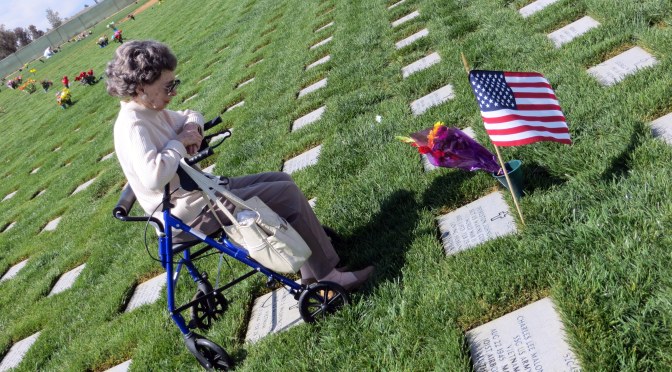
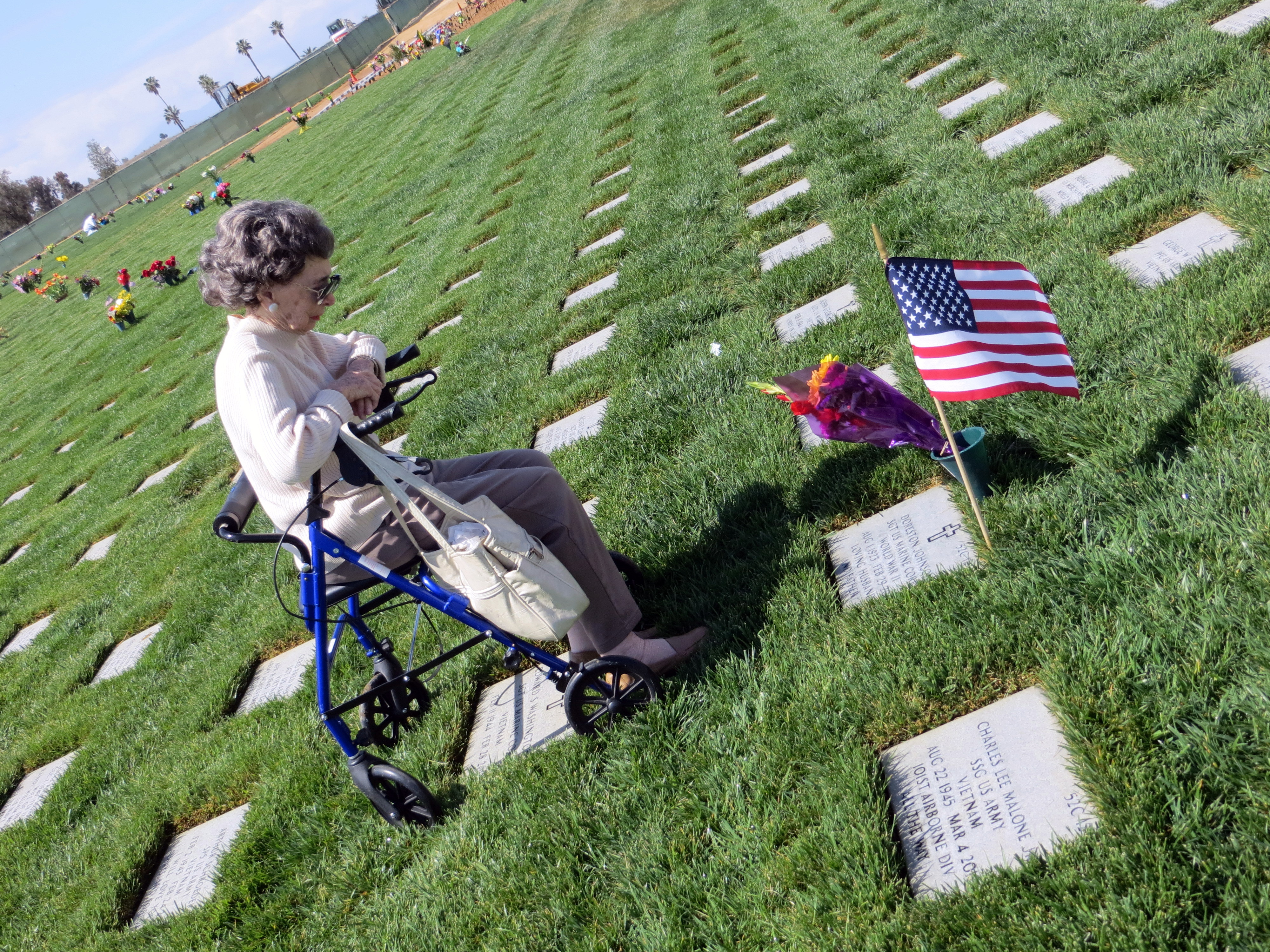
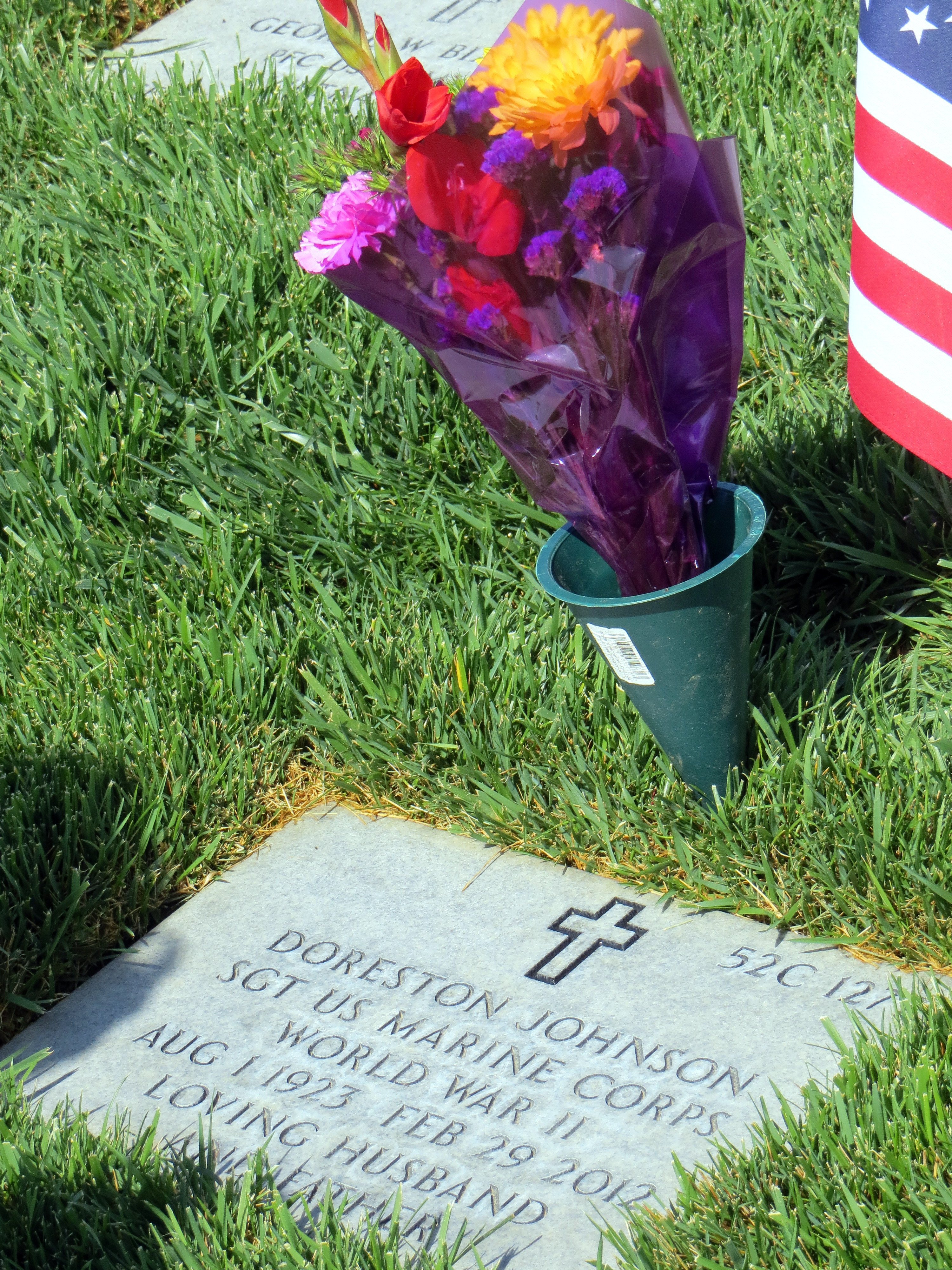
Her first words as she saw his gravestone: “Oh, my darling…” in a quivering voice.
They loved each other greatly.She sat there, talking to him, for about 45 minutes. I left her alone for most of the time.
She loved and missed him so much, she struggled out of her walker to kneel down and kiss his gravestone. I offered to help and she said, “This is something I have to do on my own…” Such fortitude.
After I DID help her back up (she said I could help her now), she reminisced with me at graveside before we departed:
On the way back to the car, we took a break (in the hot sun) as her legs are weak now. As any great lady from that great generation does, she thanked me over and over for taking her to see her husband, especially on Easter Sunday, while crying. I said to her that Mr. Johnson and Old Man Jack could never forget the horrors from combat but they were the greatest human beings – because they learned to forgive – and that it was an honor she asked ME… an American of Japanese descent, to escort her to visit with her husband.
These Americans from back then gave their all for our country… and nearly all of them have outlived their friends. They are now alone – after all that sacrifice that you nor I will EVER weather.
I think they deserve better.
We should all try to return the favor, no matter how small the gesture, when the opportunity presents itself.
This is what my monitor showed at 9:00 AM this morning.
For CNN:
For Fox:
If you click on the images, you can see the topics each news media “deems” important.
How can they be so different?
How can CNN essentially ignore the tremendous budget issues confronting the United States while concentrating on the election of the head of the Catholic religion? (Just being factual here – Catholicism is but one religion in this world. Just citing fact.) Well, Michelle Obama got a line in “for being in the vogue”.
Just weeks ago, CNN was headlining day after day Obama’s attack on the “GOP” as he greatly exaggerated the negative effects of the sequester. They even followed Obama when he went campaigning to bash the GOP…instead of trying to run this country.
I thought news was to be objective…or at least consistently applied?
________________________________
I will WRITE it.
Our country’s WOES are the result of two dictatorships… A dictatorship being defined as they do as they please as no one can challenge them. A form of Hitler-ism…
One dictatorship is the damn LAWYERS. We are better off without them. We don’t need lawyers representing jerks who go into small businesses just looking for minor violations. Attorneys WON’T restrict themselves as they feel they are “protecting us”. Pffft.
The other dictatorship is the MEDIA. Reporters are using it to spout off their personal feelings or agendas…or of their management…who gets revenue rewards of various “types”.
My two smallest kids had the honor to see the memorial first hand in June 2010.
Life has been quite unpredictable for me for the past six weeks or so – as well as tiring. I am quite behind in reading many of your fine blogs and that is on my priority to-do list. But it is a hollow descriptive for me to say I am tired.
I am still alive.
Twenty-nine thousand are not.
_____________________________________
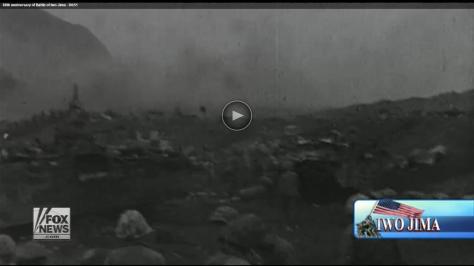
The battle for Iwo Jima began 68 years ago on February 19, 1945.
Sixty-eight years ago. Just yesterday for many.
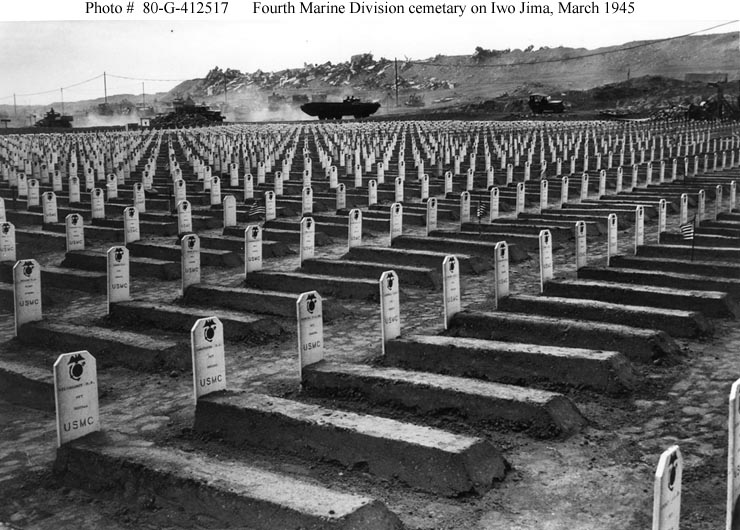
Sixty-eight years ago, about 29,000 young men met horrible deaths on that demonic volcanic island – 22,000 Japanese soldiers and 7,000 Marines. That unforgiving island still has not given up all of her dead to this day… American and Japanese.
Japanese Prime Minister Kan in blue visited Iwo Jima (now renamed Iwo To) in 2010 to help find and exhume Japanese remains. He is the only Japanese Prime Minister to do so.
Indeed, the camaraderie amongst the survivors as well as those linked to the battle by relation or history is rightfully still strong. It is vital to the preservation of bravery, courage and love of country.
Please click on image to see a brief yet touching video.
_________________________________
As mentioned in an earlier blog, the US Army also participated but not in a manner you would expect.
Per Dr. James McNaughton’s authoritative book, “Nisei Linguists”, Tech Sgt. 5g Terry Takeshi Doi “landed with the assault waves on 19 February 1945”. Doi was a member of the US Army’s top secret Military Intelligence Service (MIS). Doi would be awarded the Silver Star for his actions on Iwo Jima; he went into cave after cave armed only with a flashlight and knife to persuade Japanese soldiers to come out. I believe he is still alive.
Another MIS Nisei, Tech Sgt 3g James Yoshinobu, was fighting in his second world war; he had fought for the US in WW I (that’s ONE) and was 47 years of age while fighting on Iwo Jima. He landed with the 4th Marine Division and was later awarded the Silver Star.
One MIS Nisei, Sgt. Mike Masato Deguchi, was seriously wounded by a land mine and died of his wounds shortly after war’s end.
_____________________________
Oddly, these Nisei may have never joined the task force sailing out of Pearl for the invasion of Iwo Jima. The Nisei contingent was stopped at the security gate and were prohibited from proceeding because they “looked Japanese”. Only with the accompaniment and support of a few Caucasian officers were they finally allowed to pass and board their transport ships.
____________________________
Sixty-eight years later, let us today deeply and reverently remember these brave boys… whether they be American or Japanese…or both. The iconic flag-raising would be tomorrow, February 23.
When I was a youngster, the kids on our Oakford Drive in East Los Angeles would play after-school and certainly after homework was done.
Playing was comprised of two general categories:
1. Sports – like baseball (complete with broken windows) or football (on our lawns spotted with metal sprinkler heads), or,
2. War
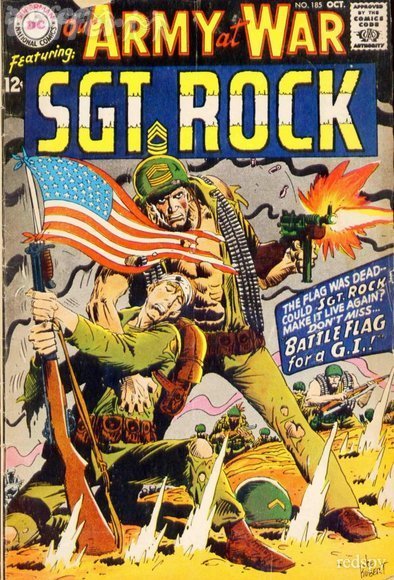
Needless to say, I was never a member of the US forces when we played war. (Oh, how I longed to be Sgt. Rock with his bulging biceps and Thompson machine gun blazing away…fighting for the red, white and blue.)
No, I was always the “J” or the “K”… You know what I mean.
To be killed over and over again.
Like with elaborate booby traps: a wooden clothes pin armed with a cap and taped onto a piece of wood. When I neared the booby trap (countless of times), Steve would pull the cord (countless of times) attached to a little string of metal from a spam can holding the clothes pin open..and “POP!” I would crumble to the ground. Very effective weapon if you ask me.
Or shot with John’s toy Winchester. Wait a minute. Winchesters were for cowboys and Indians. I wonder how that got into our (imaginary) war. Oh, well. We were just playing while building our love for country.
_______________________________
After all, this was only a little more than 15 years after a most bitter war’s end.
Toyota wasn’t even in our vocabulary.
Sony became part of our vocabulary only because of something called a transistor radio.
The gist of it? I hope you will read it and develop your own.
But…
Is this a case of hysteria? Of being afraid of being sued by spotlight-loving lawyers… or CNN making you out to look a villain to support Obama’s political agenda? Just my opinion, of course.
Of what HARM was it? The toy grenade didn’t even have a paper cap… Wait a minute. Was there EVEN a toy grenade? Or maybe it was a fuzzy tennis ball in place of his imaginary grenade?
OMFG.
Don’t punish the kid’s imagination.
Geezus H. Christ.
Maybe he just wants to be Sgt. Rock and save our country.
“She’s the most beautiful thing I had ever seen,” said Old Man Jack in a trembling voice and with very wet eyes.
On March 3, 2003. Truly.
______________________
He was referring to the F4U Corsair. I had taken him to the Chino Planes of Fame Museum in Chino, CA. The WWII aircraft there – all of them – fly.
That’s right. They get up in the air.
Planes that were engineered with a minimal lifespan as they were meant for combat were still spinning their props for the men who flew them – or worked on them.
Old Man Jack was one of them.
Do you know what these beautiful planes look like? What they may have sounded like to Old Man Jack 70 years ago? Ever see one fly? A vid I took at the Planes of Fame Airshow:
In case you haven’t figured it out, his Corsair is “on the tail” of a famed Zero of the Imperial Japanese Navy in this mock dogfight. I filmed it almost ten years ago at an air show there at Chino Planes of Fame.
______________________
Old Man Jack was an “AMM 1/C” during WWII, or “Aviation Machinist Mate First Class”. He could have re-upped after the war and been promoted to Chief Petty Officer but like Mrs. Johnson, Carol would have none of that.
I am not positively sure as Old Man Jack would only give tidbits here and there but he was responsible for the aircraft. Before flight – and while remembering this was at the front lines on “those stinkin’ islands” – he would get into the cockpit and make sure all essential bells and whistles worked after his crew worked on it all night. I also believe he was to pilot one on occasion to maintain his certs. Very simplistically said on my part.
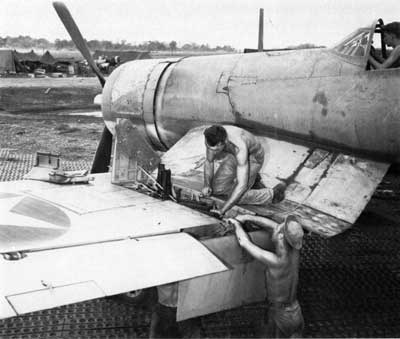
US Navy ground crew servicing a Corsair on what appears to be Guadalcanal – where Old Man Jack was. National Archives 127-N-55431
The pilot was headed off into harm’s way. The pilot’s life depended on Jack and his crew. It’s airworthiness.
But one thing is for certain – Old Man Jack said many times “there just weren’t enough spare parts so we had to make do.”
______________________
But back to the story…
Our friendship had begun to solidify by then… I had mentioned to him that I was a member of the museum and that he wouldn’t have to worry about me paying for his entry. But that wasn’t why he hesitated. You will see why. And I found out later myself why he was so hesitant.
Back then, the museum’s WWII hangars were divided into the two main theaters of operation: the European and the Pacific – where Old Man Jack was stationed during the thick of things.
We meandered through the European Theater hangar. He recognized them right away. The P-51. The P-47. Others.
He had brought along his “walking chair”; it was light and when folded up, it was a walking aid. If you press down on it a certain way, it would spread out into a little chair. Well, he was doing good…and I was happy.
______________________
To get to the Pacific Theater hangar, you would leave the European Theater hangar and mosey across a tarmac.
Chino Planes of Fame and “X” marks the spot.
It was a hot day. Old Man Jack was in a t-shirt. Blue, of course.
We were slowly making it across the tarmac. I knew a Corsair was in there – pretty as the day she rolled off the assembly line. As the hangar door was cracked open, you could see the wing spar.
Then Old Man Jack stopped. At the white “X” marked in the map above. Dead in his tracks.
He propped open his chair.
He sat down.
I was wondering if he was tired. We were out in the sun. Why’d he stop there?
I walked back to him. His hands that still firmly shook your hands were on his knees. His head was bowed down.
Then I saw it.
His shoulders were shuddering a bit at first, then began to bob up and down.
The man who had a barrel chest…the man who worked on these planes as a young man whose bushy eyebrows had turned white with age …was crying.
Deeply. No sounds. He was holding it in…
_________________________
I walked away.
The plumbing in my eyes broke too.
I think he cried quietly for about a couple of minutes. Out there on the tarmac. In the sun.
Old Man Jack then straightened up. He wiped his eyes.
“Young man, earn your pay. Give me your hand and help me up.”
Old Man Jack was back.
_________________________
We walked over to her – Jack’s beloved Corsair. His eyes were still wet.
I remember him saying very quietly while trying very hard to hold back his now visible anguish, “I knew a lot of young boys who flew them,” his voice cracking with 70 years of nightmares tormenting him. “Some of them just didn’t come back. I could never stop thinking, ‘Did a Jap get him… or was it me?'”
Nothing more need be said.
A very, VERY proud Jack Garrett, AMM 1/C showing off his barrel chest as best he could.
_________________________
That’s when he told me she was the most beautiful girl in the sky. But like any woman, she was a pain to keep happy.
“We didn’t wear shirts because it was so _ucking hot; I’d burn my stomach and chest on that hot metal.” He pointed at the wing spar (the bottom of the “gull wing”) and said, “We would always slip on those damn spars. You never had good footing.”
He then recollected other things. He told me “We’d stick a shotgun shell into a breech under the cowling and fire it off to turn over the engine.” As I surely didn’t know much better back then, I asked why. “Because the dumb son-of-a-bitch who designed the plane didn’t put in a starter. That’s why.” Oh, boy (with a smile). “And if she didn’t turn over, you only had a couple more tries at it before you had to let it cool off.”
Old Man Jack then smiled a bit when he admitted he fell off the wing while taxiing once. “Like a dumb smart ass kid, I stood up on the wing when the pilot was taxiing. You were taught to lay on the wing to point which way to go but (the wing’s surface) was too damn hot so I stood up. We hit a bump and off I came.” (Note: the Corsair’s nose was long to accommodate the powerful engine. It was so long that it obscured the pilot’s forward view during taxi and landing.)
One more thing he said. “There was nothing better than seeing the flight come back after a patrol at wave top, do victory rolls then peel off.” He was a bit choked up.
_________________________
When we got home, he said to me, “I didn’t know how I would react if I saw something and that’s why I put you off in going. But I feel good about it now. Thank you, young man.”
He gave me that solid Jack Garrett handshake…and a hug.
I think he enjoyed the visit…and no better way to end my first six months of blogging.
To be with his beloved wife Carol…and his comrades who were left behind “on those stinkin’ islands”.
Came with two of my kids to say hi…and Merry Christmas, Jack
_____________________________
Life is so fleeting. Some people go through a whole lot. Some of us don’t.
Old man Jack was one of the former. I need to find the time to write more of what he experienced as a young man.
So that at least those that read this blog will know…and appreciate.
_____________________________
Old man Jack had his health problems in his last years.
But when he was a young sailor, he had malaria, dysentery…leeches between his toes, all from fighting on those damn islands in the Southwest Pacific during WWII.
And in 2009, he nearly died from a horrid intestinal infection. His abdomen had swollen. Fat Albert would have been jealous.
He was in ICU for a couple of weeks. After they transferred him to an extended care facility, I made it a point to see him every day…even if it was for brief time.
He looked forward to it as did I.
_____________________________
But soon after being transferred, he went into a depression. He wouldn’t eat – especially what he called the “Army slop” they had at his hospice.
Man, he complained about the chow – but his eyes lit up when I (secretly) took him a Mickey D’s burger and fries once in awhile. He’d smack his lips. But I’d make him eat the chow when I didn’t bring him his hamburger and as usual, he’d get pissed. But not really.
One evening, he was really weak. He wouldn’t raise his head off his pillow.
I told him, “Jack… What’s the matter? Haven’t you been eating?”
He never answered the question but he was off in a different world. While he realized I was there, he said to me softly, “Carol came down to see me last night. She sat right here,” gently patting the mattress on his gurney. “She said, ‘Honey, its about time now. I’m waiting for you.'”
Carol was his wife. He loved her greatly. She had passed away eight years before. I think he wanted to be with her.
_____________________________
Well, I pushed him to get better. And he did.
He finally consented to get into a wheel chair a couple of weeks or so later. I can’t exactly remember but it was June of 2009.
Perhaps you can get a flavor of Old Man Jack’s true character although my Blackberry did a lousy job of recording:
Soon after that, in spite of his pissing and moaning (which I loved as it meant he was getting better), I forced him to use his walker:
It was his way of saying, “Get lost,” by the way…but didn’t mean it as usual. He loved the attention.
Hilarious.
Old Man Jack was on the road to recovery.
_____________________________
Well, the recovery was short-lived.
He is now with his beloved Carol and eating her wonderful cooking. She cooked things exactly as he wanted.
Hamburger patties burned to a crisp. Scrambled eggs WELL done.
He never complained – as he knew he wouldn’t eat if he did.
Deep down, he knew who was the boss.
_____________________________
I miss you and your hollerin’ and moanin’, Jack.
And I knew you never meant it.
And as sad as I am, I also know you are now free of those horrible nightmares from combat that you endured for 70 years…and that you and Carol are on your second honeymoon.
You deserve no less.
You were a helluva representative of the Greatest Generation.
But we’ve been “at war” against terrorism – both foreign and now domestic – since 2001. More than 11 years.
But the war against Japan started officially for us on December 7, 1941. We were caught flat-footed.
Yet it was over by August 15, 1945.
Incredible. In 3 years, 8 months, 8 days. How could that have happened so quickly (relatively speaking)? Have you ever thought of this timeline?
________________________
Well, I have removed my Kevlar flak vest for all you bloggers who love history – and who are immensely more versed and intelligent than I…or is it me?
Below herein is my “Top Ten” list of the reasons why Japan lost the Pacific War…so quickly.
I’d like to hear your opinions, corrections, or teachings.
Hunting season is open. Rubber bullets are most suitable.
_______________________________
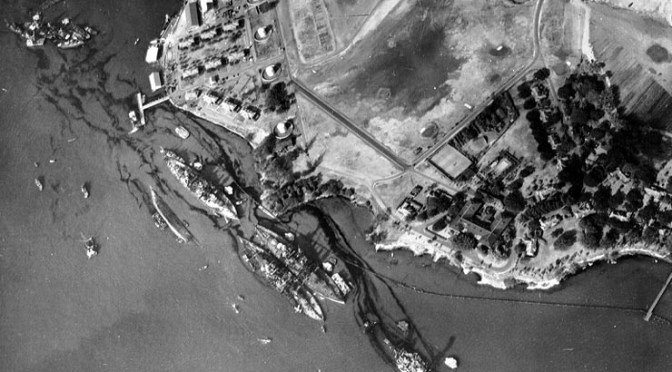
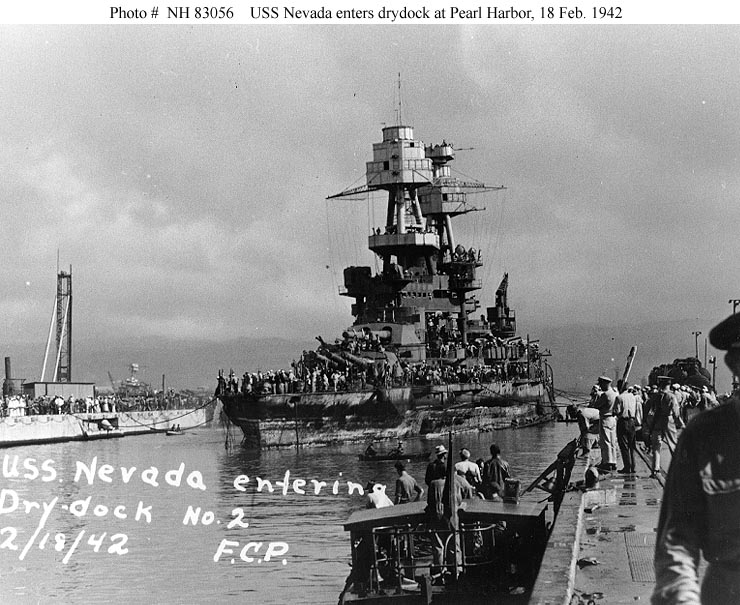
Damage from overhead – Pearl Harbor aftermath
1. Long Range Failure of Pearl Harbor Attack
a. Admiral Nagumo – placed in charge of the attack force by the Japanese Imperial Navy and NOT by Admiral Yamamoto – failed to fully execute the direct orders issued to him by Yamamoto.
b. Attack plans skewed towards sinking of carriers (which were not there). Genda wanted to insure carriers were sent to bottom and therefore be unsalvageable. Because our carriers were not there, pilots overly concentrated on battleships or other less tactically important ships.
c. The ordnance used by the attacking Japanese was inappropriate for sinking battleships. Besides, Pearl Harbor is way to shallow to allow for “sinking to the bottom of the ocean,” so to speak.
d. The first wave of Japanese torpedo bombers – although a complete tactical surprise – was a dismal failure with very few hits.
e. Failed to destroy dry docks and fuel dumps (Hawaii is an island country and had to import all fuel…like Japan). Although there is the fog of battle, Nagumo (overly cautious) did not heed the strong advice from Fuchida who urged a third wave just for such purpose.
f. In light of “e” above, Yamamoto himself had one weakness: he did not see his submarine force has an OFFENSIVE weapon. He failed to deploy them between Pearl Harbor and the West Coast of the US to target supply ships – which would have been carrying fuel, materiel and supplies to rebuild Pearl Harbor.
g. Nearly all ships damaged by the attack were refloated.
h. Insufficient training by Japanese Navy in preparation for attack.
i. Lastly – and for some foolish reason – they attacked on a Sunday morning.
2. Breaking of the Japanese Naval Code and the failure of the Japanese to accept it was broken.
3. 24-hour Repair of USS Yorktown after Coral Sea in Preparation for Battle of Midway.
USS Yorktown afire
4. Innovation of US Navy to Use CO2 for Fire Suppression.
a. US Navy would flood fuel tanks on ships with carbon dioxide thereby displacing oxygen before battle.
b. Japanese ships had useless fire suppression systems with fuel right alongside ordnance.
5. Innovation of Rubber-lined Fuel Tanks and Armor Protection for Pilots on US Aircraft
An example of survivability with self-sealing fuel tanks and armoring. F6F Hellcat.
a. “Self-sealing tanks” in wings.
b. Impressive armor shielding for the pilot (especially in the Grumman F6F Hellcat).
c. Japanese planes had neither, leading to insurmountable casualties and easy shoot-downs, i.e., Japanese aircraft would “flame” or disintegrate under withering fire from .50 caliber guns.
Japanese planes did not have self-sealing fuel tanks
6. Battle of Midway
a. Huge tactical gamble by Nimitz in usage of Spruance as task force commander.
b. Tactical decision to launch torpedo planes early on by Spruance. While all but one pilot perished and no torpedoes hit, Mitsubishi Zeroes assigned to combat air patrol were at low altitudes since they shot down the torpedo planes.
c. Dauntless dive bombers (with US fighter cover) were able to dive relatively uncontested and caught Nagumo between launchings with ordnance scattered about.
d. Confusion by Japanese pilots that two US carriers were sunk. In actuality and while eventually sunk, the USS Yorktown had been hit in the first wave but the fires had been put out before the second wave attacked.
e. With the sinking of four Japanese carriers (see Fire Suppression above) and loss of valuable pilots, the Japanese Navy ceased to be an offensive force.
7. Production Might of the US
a. We had eight carriers at time of Pearl Harbor (in the Pacific and the Atlantic) but were down to two after the Battle of Midway.
b. We lost the Wasp, Hornet, Lexington and Yorktown by then.
c. The USS Enterprise was the last operational carrier. The “other” carrier, the USS Langley, was used only for training purposes and was out in the Atlantic.
d. By the time of the invasion of Okinawa in 1945, however, we had over 40 carriers as part of the assault fleet alone.
8. Semi-automatic M1 Garand rifle and the M-2 Flamethrower
a. Japanese military were burdened with reliable but bolt action Arisaka or failure-prone Nambu armaments. (Bolt-action implies the shooter must lower his rifle to load the next round and then re-sight.)
b. The M-1 Garand took an eight-round clip. The round had tremendous stopping power, was rugged and a rifle squad could lay down withering fire with the semi-automatic. The shooter did not have to lower his rifle to load the next round and re-sight.
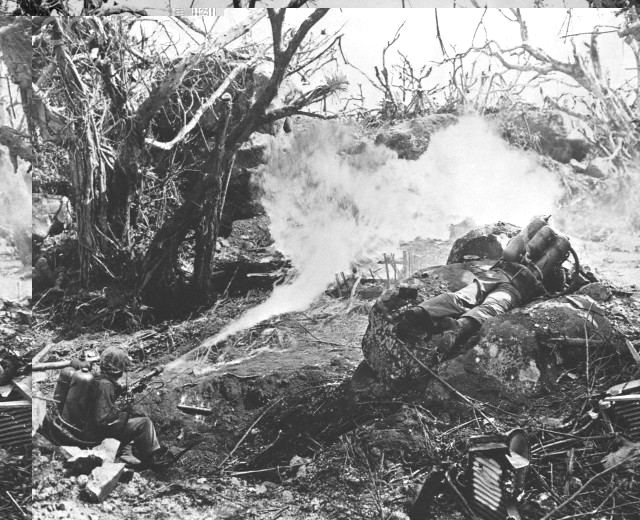
c. On Iwo Jima and other island battles, the Japanese were rarely seen. As such, the flamethrower was critical for success although accompanied by high mortality rates.
Marines carry the M1 Garand into battle at Tarawa Nov 1943US Marines using M-2 flamethrower against entrenched enemy on Iwo Jima
9. The Japanese-American (or “Nisei”) Soldiers in the Top Secret Military Intelligence Service (MIS)
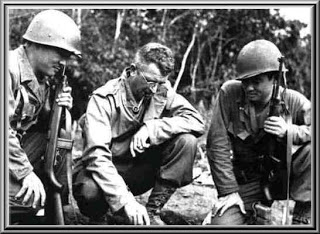
Two of the Nisei secretly attached to Merrill’s Marauders plan with General Stillwell.
a. MIS secretly accompanied Marines and soldiers for every Pacific Theater amphibious assault or parachuted in with Airborne troops.
b. Nisei’s were the actual soldiers that listened in on Japanese Navy radio transmissions and NOT US Navy personnel. One transmission disclosed details on Admiral Yamamoto’s flight schedule which led to his shootdown.
c. Quickly translated captured major Japanese battle plans for Leyte Gulf (Z-Plan) and allowed for the lop-sided victory at the “Great Marianas Turkey Shoot”.
d. The invaluable intel provided by the MIS proved to the (generally unsupportive) top echelon that the Japanese military was near operational collapse in many combat areas.
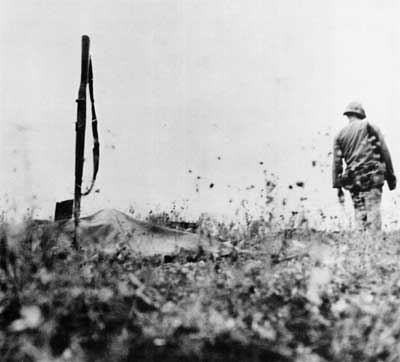
10. The US Marine Corps
Marine catches up to comrades after covering fallen buddy with tarp and marking it with his M-1
____________________________
OK. So what about the B-29’s or the atomic bombs/fire bombings? Aren’t they some of the reasons Japan lost the Pacific War?
No. Not in my humble opinion.
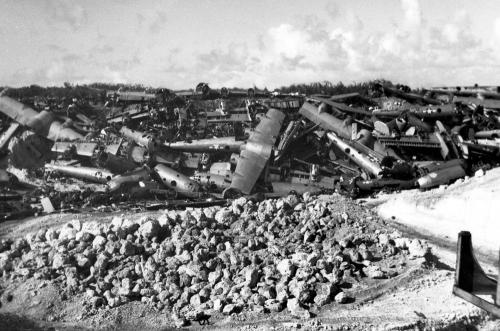
B-29 boneyard, Tinian
Historical facts will show that the B-29s were largely ineffective until the time LeMay unleashed the firebombing campaign on March 9, 1945. The first B-29s were deployed out of India and China in the summer of 1944. For the first missions, about 20% failed to reach their target due largely to mechanical trouble. Of the approximately 80% that made it to target, only a couple of bombs actually hit target. Therefore, ineffective results.
Their engines were also prone to overheating in flight. Criminy.
As for the firebombings/atomic bombings, it is my opinion Japan had already lost the Pacific War due to the ten summarized reasons above. Intelligence obtained by the US Army MIS Nisei’s like my dad’s predecessors support that conclusion. When the Nisei interrogated Japanese prisoners at the front lines, it was clear they were nearly without food, water, medical supplies or ammunition. Their morale was also devastated. For instance, Japanese soldiers that surrendered would say, “We were terrified. For every mortar round we would fire at the Marines, ten rounds would come back.” The Japanese needed to make every round count; the Americans didn’t.
Japanese soldiers – dead, wounded or captured – would have uncensored letters from home on their person. After the Nisei translated those letters on the battlefront, they disclosed that their families, too, were without much food or water…and that morale was extremely low.
____________________________
So some Greek dude said centuries ago that, “In war, truth is the first casualty.”
Pretty smart. But that applies even today – and certainly during World War II.
We were raised with certain textbooks for our history classes. We believed in them. We had no reason not to.
But the truth is, there are many versions of history. Factual versions. Incorrect versions. Factual versions “edited” by the victors. Factual versions written by the losers. And new versions. And versions to further patriotism.
But there is one thing for sure… Said by one of the most brilliant minds this world has known:
“I do not know with what weapons World War III will be fought, but World War IV will be fought with sticks and stones.”
Just two months after Old Man Jack passed away, so did the young boy who stood in the US Marine Corps Recruiting Station in Louisiana in 1942.
The man who told me funerals don’t do a damn for him anymore.
Mr. Johnson was gone.
The cremated remains of Mr. Johnson
___________________________
The neighborhood was in shock. I had waved to Mr. Johnson just three days earlier while he and Marge gingerly got out of their car. I said in a louder than normal voice from across the street: “We’re still on for breakfast on Saturday, right Mr. Johnson?” We were to go have breakfast and chat about Old Man Jack – and perhaps learn more of Mr. Johnson. Instead, he died suddenly just three days later. Three days.
After 66-1/2 years of marriage, Marge was now a widow. A sudden illness took his last breath away when bombs could not 70 years earlier. He was 89 years old.
Marge surprised me when she asked if I would video Mr. Johnson’s funeral. I told her it would be my privilege. I was elated to be of some service to her.
___________________________
After Old Man Jack’s funeral, Mr. Johnson invited me over after I got home from work that night. That was when he volunteered that story about how “he got suckered into becoming a Marine”. Lovingly, of course. You could tell he had esprit de corps in his blood to that day. He was proud of not having BEEN a Marine, but of BEING a Marine. He had all the right to be.
He also talked about how he met Marge. What a wonderful story it was. I will try to capture the essence of what he told me.
_____________________________
By early 1944, Mr. Johnson (now a sergeant) had been taken off the front lines to recover from his grave wounds. He was “pretty messed up,” as he put it. Didn’t say much more. He was put in charge of the motor pool at Camp Pendleton during convalescence.
The base commander’s wife, a proper lady, he said, had come to the motor pool to get her car fixed up. Mr. Johnson said it was a beat up Chevy especially on the inside but it was better than most for those times.
After she commented on the car’s condition, Mr. Johnson said he’ll do his best to make it more presentable.
He had come to know an upholsterer in Oceanside so Mr. Johnson arranged for the interior to get tidied up some. He also had it painted. She was elated.
I wish I had jotted down the commander’s name. Darn.
_____________________________
Sometime towards the latter part of ’44, he said, there was some scuttlebutt about a big operation that was brewing.
But then, the base commander called Mr. Johnson into his office.
“Johnnie,” he said, looking through his file, “you’re pretty used up. I’m sending you to rehabilitation.”
So off he went. While Mr. Johnson used “a hospital out in San Bernardino” as a description, the hospital was likely somewhere near the mountains because he mentioned Lake Arrowhead.
As I write this, there is a good probability it was Naval Hospital, Norco, as it was officially called back then.
Naval Hospital, Corona
_____________________________
During rehabilitation, he ventured to a USO dance being held at the hospital. The USO was such a morale booster for these young men. Mr. Johnson was no exception.
There, against the wall, he said, was this pretty young thing. It was Marge. She was studying to become a nurse…which she did.
…and if I understood him correctly, they got married the day after he got discharged from the Corps in 1945. It sounded like if Marge just didn’t want a husband that would go off to war, let alone as a Marine. She got her way, of course:
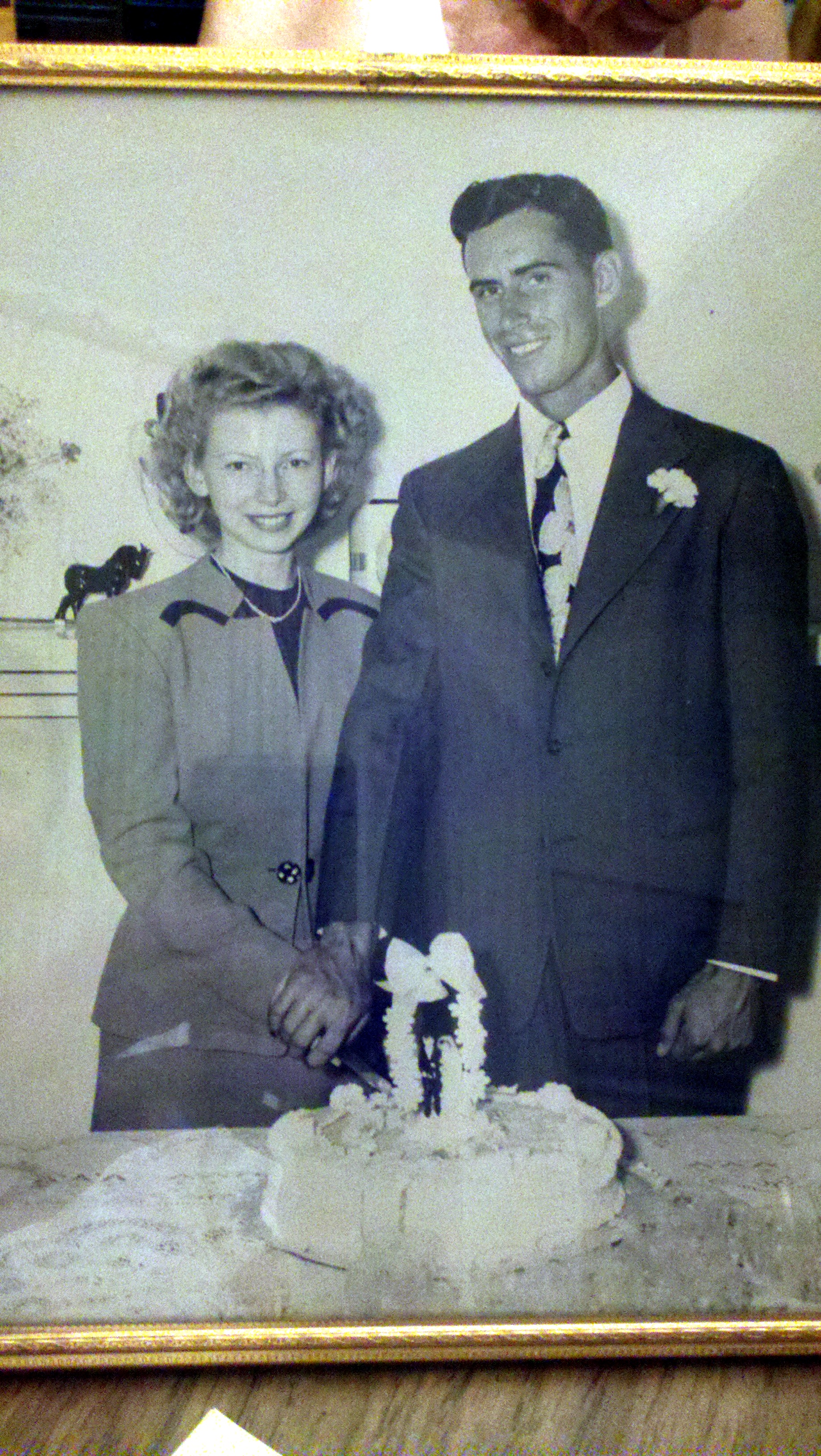
Marge and Mr. Johnson on their wedding day in 1945.
Don’t you think they are a gorgeous couple? A gift of chance… and war.
(As a historical note, the “scuttlebutt” ended up to be… Iwo Jima. Part of the 3rd Marine Division, Mr. Johnson said that in a way, he was glad he didn’t go… Not that he DIDN’T want to go but because of what the Marines horribly found out after the first waves landed ashore. He learned from the Marines that made it back that all vehicles that went ashore in the first couple of days were sitting ducks for enemy artillery. This was made worse by all the volcanic ash being spewed up by the artillery rounds, just choking off the engines just minutes later because it would clog up the air filters. Some of boys were burned alive, he was told, after their vehicles got hit…in the same vehicles he was in charge of at Camp Pendleton.)
_____________________________
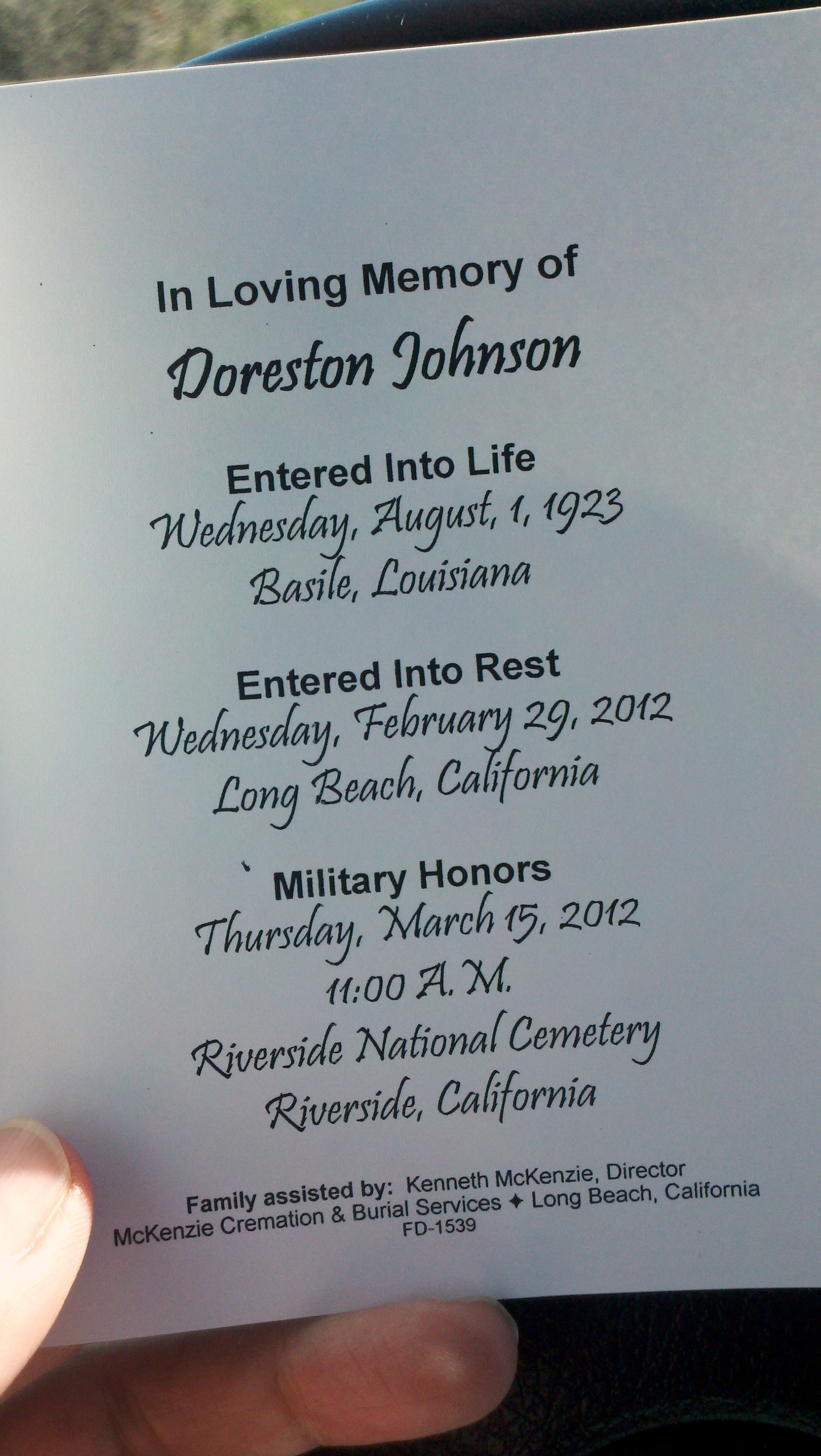
One reason why I was never able to find any military record on Mr. Johnson became obvious on his funeral day; that’s when I – and the other neighbors – found out his name wasn’t Johnnie, but Doreston.
“Doreston”
I was partially successful in videotaping Mr. Johnson’s funeral. It wasn’t as smooth as I wanted it to be for Marge’s sake. There was a bit of disorganization and miscommunication, too. Many of us following the hearse were just waiting in our cars wondering what to do next…when I saw the Marine burial detail getting ready to escort Mr. Johnson’s urn to a covered area. Time for a mad dash.
A couple of notes about the video below if you wish to watch…
I’m not much an editor but I managed to insert the “Marine’s Hymm” from my all-time Marine Corps classic, “Sands of Iwo Jima”. Gives me goose bumps every time. It starts a bit after the 1:00 mark.
There is some footage at the National Medal of Honor Memorial; Mr. Johnson would be interred just yards away. Sgt. Hartsock is my friend’s first husband who was posthumously bestowed the Medal of Honor. You will also see the names of some of the 22 Nisei’s who were also bestowed the Medal of Honor during WWII.
The bugler you see is a long-time friend of Mr. Johnson. I understand he is also in his 80’s and volunteers his services everyday. A very fitting and personal tribute.
This was also the first 21-gun salute I was ever able to have the honor to witness in person. I am glad it was for Mr. Johnson:
_______________________________
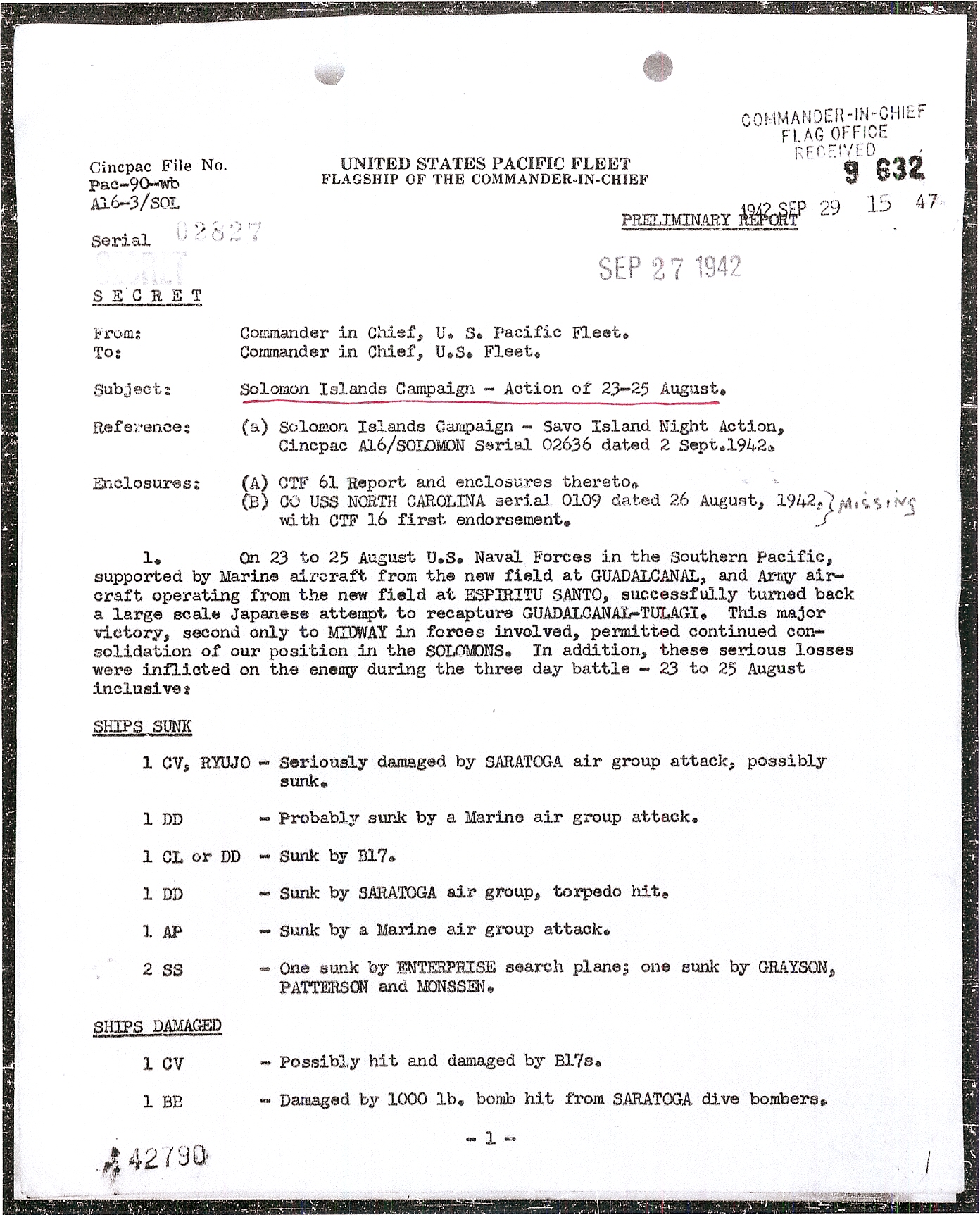
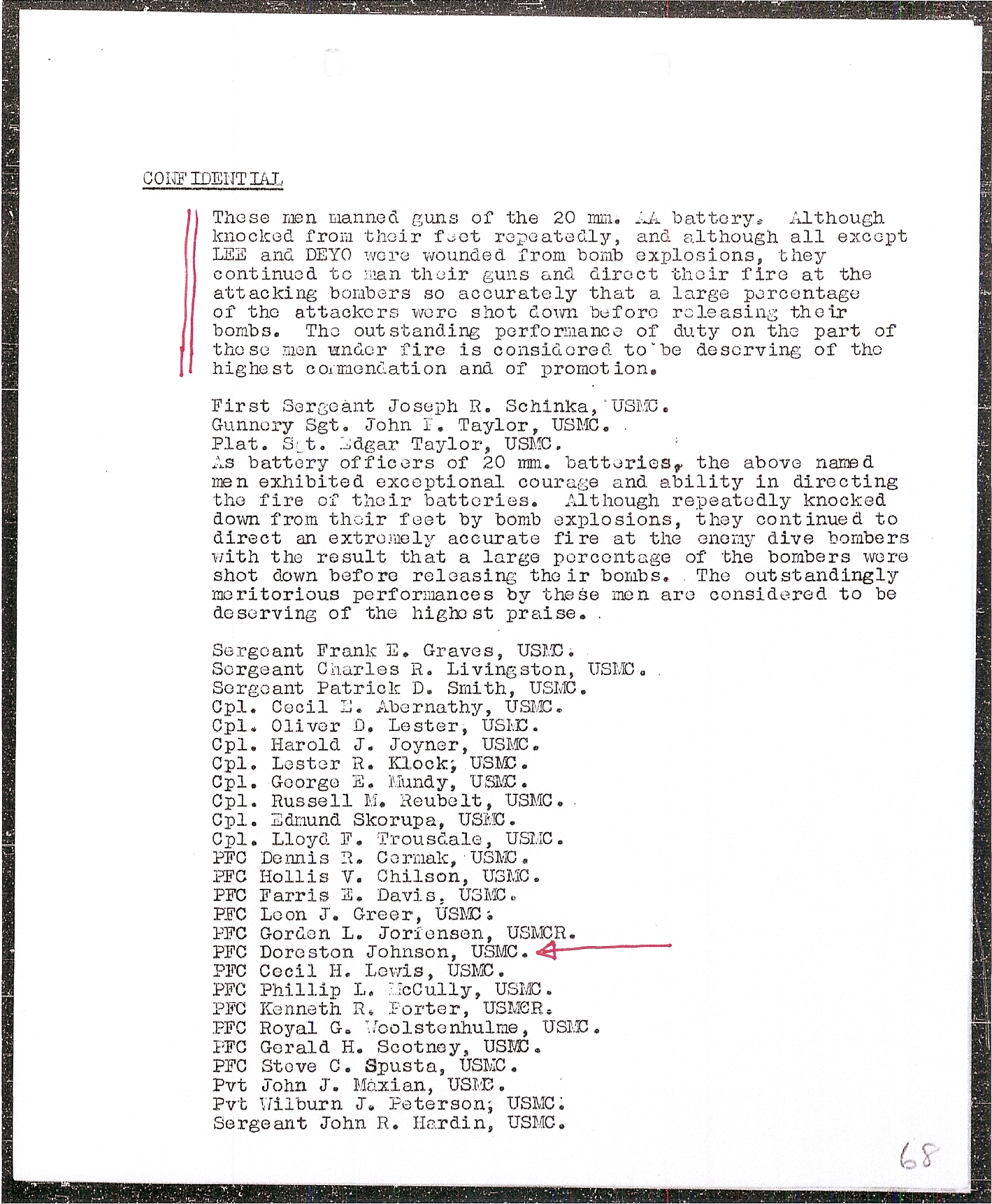
During this time, and now armed with his true first name, I was pretty determined to uncover some of his unspoken valor during the Solomon Islands Campaign and the Battle of Santa Cruz Islands…and I was partially successful.
These are two pages from CINCPAC’s official, confidential after battle report. They were called “War Diaries” and are daily operational journals created by various naval commands throughout the Navy during WWII (The Marine Corps is an arm of the US Navy). I was only able to find this single battle report for the Solomon Islands Campaign:
War Diary, Cover PageSpecific page recognizing Mr. Johnson’s valor under fire.
I do NOT know for sure if Mr. Johnson fought on the islands but Old Man Jack never mentioned anything except him serving on the Big E…
_________________________________
As for Mr. Johnson’s wounds, Old Man Jack muttered once “Johnnie was hit twice. The last time was pretty bad.” He didn’t say more.
But Mr. Johnson collapsed at his house in 2011. Marge called me over to help while waiting for the ambulance. Mr. Johnson was on his side, left hand gripping the bed sheets and right arm pinned in under his body. He was too big for me to lift him off the floor by myself. So I yelled, “C’mon, Marine! Get your sorry ass off this floor!” Seriously. With that, he grunted, grabbed the bed sheets one more time, and together, we got his upper body onto his bed…
But in the process, I saw his chest.
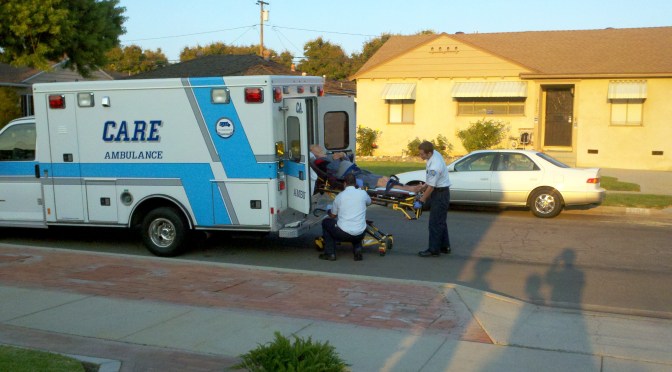
His first fall in the house. Marge’s shadow is the one on the left. My little house can be seen beyond the ambulance’s cab. (Edit)
My god.
The scars.
______________________________
Tears of Remembrance and Closing
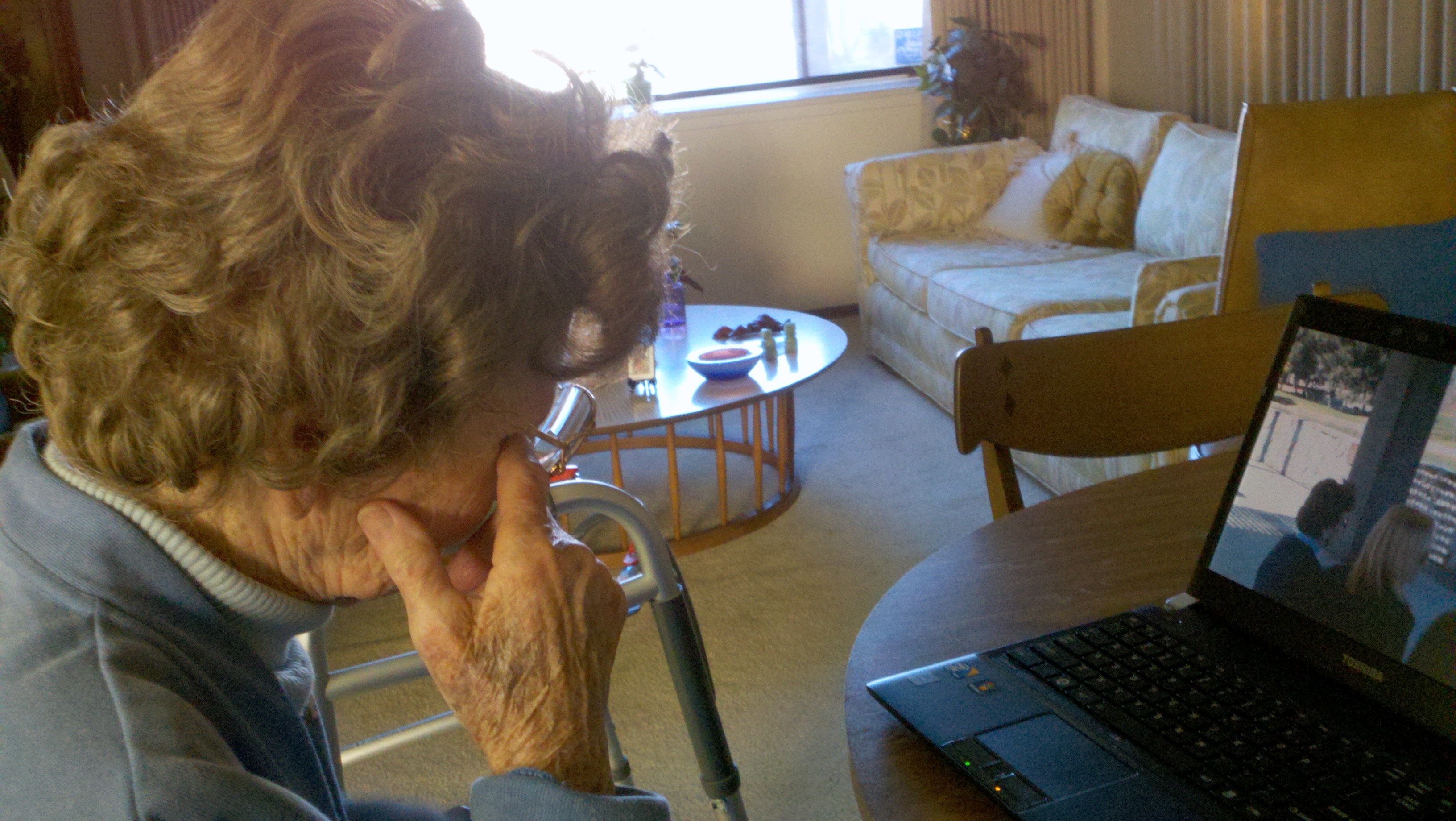
Two days after the funeral, I had finished putting the video together for Marge. We watched it together on my laptop as she didn’t have a DVD player that worked. Dry eyes had to take a back seat. She was so grateful.
But she called me at work a couple of days later. She asked if I could stop by after work again…and show her the video one more time. I was so surprised by her request…but so happy. She must have liked it.
When I played it for her – and when the “Marine’s Hymm” from the John Wayne iconic classic “Sands of Iwo Jima” began playing, her left hand began to rhythmically and softly beat to the theme song… ever so softly. Then her head bobbed along with the beat. That broke me.
Tears of Remembrance – Marge, now a widow after 66-1/2 years of marriage
She asked me again to explain the page from the Solomon Islands Battle Report which clearly states how he valiantly fought and incurred his wounds… Then when the 21-gun salute played on the screen, that was it… She broke down. I cannot imagine how large those floodgates may have been for her emotionally.
She thanked me immensely…
But it was so humbling as it was me who wanted to thank her and her husband… the same young boy in that Louisiana recruiting station who did what he had to do… and had enough humanity left in him to forgive.

















 Masako and Spam Musubi